







Abstract
Interference from competing material at retrieval is a major cause of memory failure. We tested the hypothesis that such interference can be overcome by suppressing competing responses. In a three-phase task, participants in the critical interference condition first performed a vowel-counting task (Phase 1) that included pairs of orthographically similar words (e.g., allergy and analogy). After a delay, participants were asked to solve word fragments (e.g., a _ l _ _ gy) that resembled both words in a pair they had seen, but could be completed only by one of these words (Phase 2). We then measured the consequence of having successfully resolved interference in Phase 2 by asking participants to read a list of words, including rejected competitor words (i.e., the word in each pair that could not be used to solve the word fragments), as quickly as possible (Phase 3). Participants in the interference condition were slower to name the competitor words than participants in conditions that did not require interference resolution. These results constitute direct evidence for the role of active suppression in resolving interference during memory retrieval.
Memory failure has multiple causes, but research suggests that one of the most common is interference between competing responses (e.g., Keppel, 1968; Postman & Underwood, 1973; Watkins & Watkins, 1975). Interference occurs when a cue to retrieve a memory (e.g., a question in a conversation, a self-generated thought, or a cue in an experiment) elicits multiple representations or possible responses. For example, if you have several acquaintances with the first name Bill and are trying to remember the last name of one, the last names of the others may cause interference. To successfully recall desired information, one must resolve such interference.
We (Hasher, Lustig, & Zacks, 2007; Hasher, Zacks, & May, 1999) and other researchers (M.C. Anderson & Spellman, 1995; Bjork, 1989; Zanto & Gazzaley, 2009) have argued that the resolution of interference entails the suppression of competing information. An alternative theory is that facilitatory processes directly enhance the accessibility of target information (e.g., J.R. Anderson et al., 2004; J.R. Anderson & Reder, 1999). These two alternative theories are difficult to test, as inhibitory and facilitatory mechanisms predict similar outcomes: If either mechanism is successful, the target memory is recalled (see MacLeod, Dodd, Sheard, Wilson, & Bibi, 2003). Thus, the mechanisms underlying interference resolution remain an area of active debate (e.g., Jonides & Nee, 2006). The studies presented in this article provide direct evidence that resolving interference during memory retrieval involves the suppression of competing responses.
One distinguishing feature of suppression is that it acts not on targets but on competitors. By making competitors less accessible, suppression increases the relative accessibility of target information. Therefore, we would expect a fingerprint of suppression to be reduced accessibility of competing responses following interference resolution. We tested this prediction by having participants in the experimental condition resolve interference between targets and competitors and then measuring competitor accessibility. The procedure, based on that used by Ikier, Yang, and Hasher (2008), has three consecutive phases. In the interference condition (Fig. 1, first column), Phase 1 creates the potential for interference by embedding pairs of orthographically similar words (e.g., allergy and analogy) in a vowel-counting task. Phase 2 encourages interference resolution, as participants solve word fragments that resemble both words in a pair (e.g., a _ l _ _ gy), but can be completed only by a target word (allergy) and not by its competitor (analogy). If the interference between target and competitor is resolved by suppressing the competitor, competitor accessibility should be reduced. In Phase 3, competitor accessibility is tested with a naming task. The amount of time that a participant takes to name the competing word in the interference condition is then compared with the time taken to name it in several control conditions.
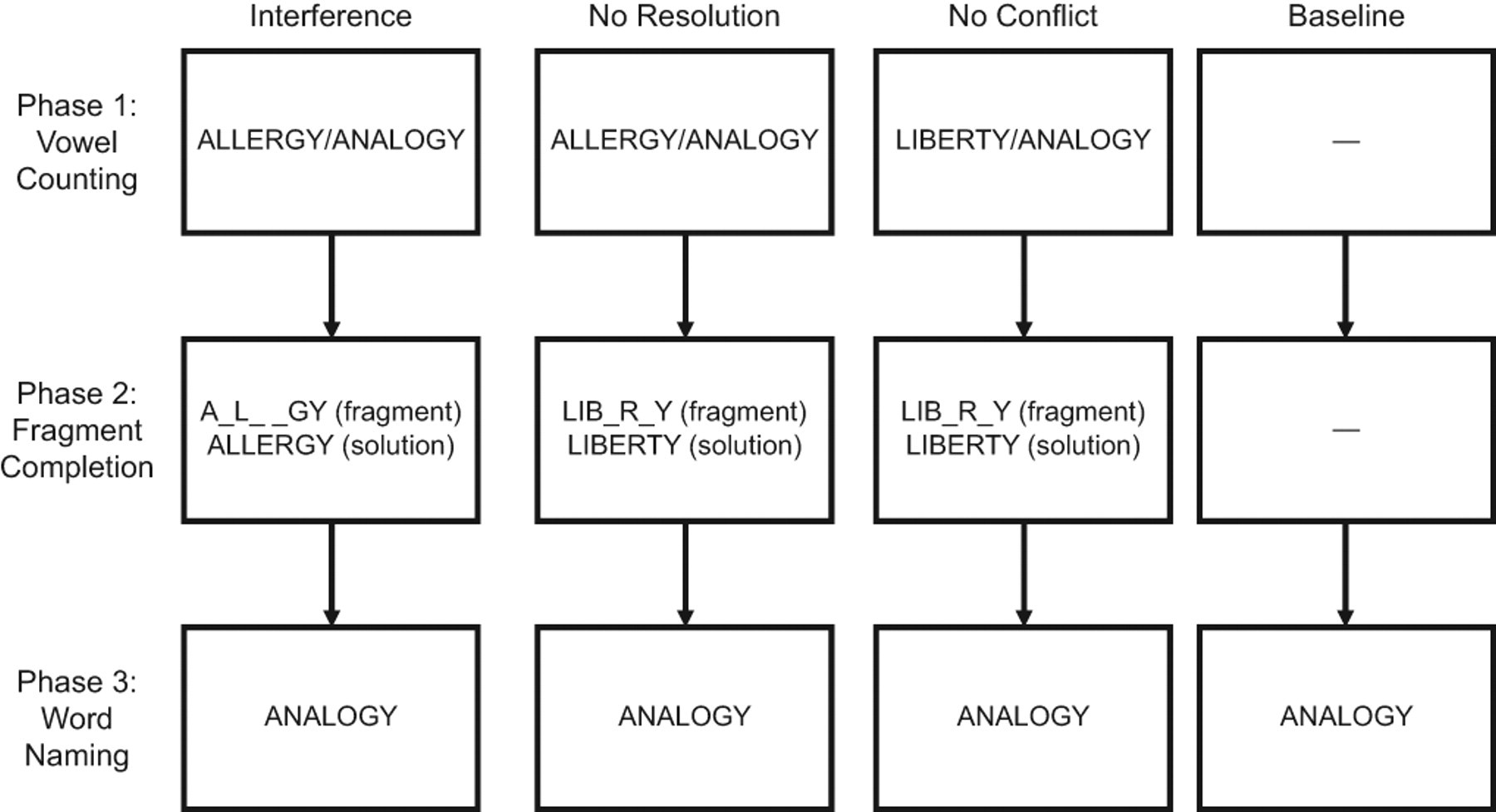
Comparison of the sequence of events in the four conditions (interference, no-resolution, no-conflict, and baseline). The top row shows examples of target-competitor pairs presented in Phase 1. The middle row shows examples of the word fragments to be solved in Phase 2, along with their solutions. The bottom row shows examples of the critical words named in Phase 3.
In the no-resolution condition (Fig. 1, second column), participants are presented in Phase 1 with target words and competitor words that cannot be used to complete any of the word fragments in Phase 2. This condition controls for the possibility that accessibility of competing memories (competitor words) is reduced by the potential interference created in Phase 1, and not by suppression during interference resolution in Phase 2. In the no-conflict condition (Fig. 1, third column), participants are presented in Phase 1 with competitor words but not the corresponding targets. This provides a measure of naming time (or priming) in the absence of either potential interference at encoding or conflict resolution at retrieval. As detailed in the Results section for Experiment 1, participants in the interference condition were slower to name competitors than participants in either control condition, a pattern confirming that selection in the face of competitors entails suppression.
Experiment 1
Method
One hundred forty-one introductory psychology students (fluent English speakers since at least the age of 5) participated in Experiment 1 in exchange for course credit. The paradigm consisted of three phases. Participants in the interference, no-resolution, and no-conflict conditions completed all three phases, whereas participants in the baseline condition completed Phase 3 only.
Phase 1: encoding
During Phase 1, Participants viewed 56 words, including (in the interference and the no-resolution conditions) 15 target words and 15 competing words, and reported aloud the number of vowels in each word. Two lists of 15 target-competitor pairs were created. Target words and their competitors were of the same length, began with the same letter, and shared on average 3.3 letters in corresponding positions (cf. M = 0.5 shared letters between target words and filler words). Orthographic similarity was minimized between nonpaired words, both within and across the two lists.
Participants in the interference condition and the no-resolution condition were shown targets and matching competitors (half of the participants were shown List 1 pairs, and the other half were shown List 2 pairs). Rather than being shown matching targets and competitors, participants in the no-conflict condition were shown targets from one list and competitors from the other list (e.g., rather than allergy-analogy, a no-conflict target-competitor pair would be liberty-analogy; see Fig. 1). In all conditions, we presented the following sequence of stimuli in Phase 1: 3 buffer words, followed by 15 competitor words randomly mixed with 10 filler words, then 15 target words randomly mixed with 10 fillers, and finally 3 buffer words. Filler words were similar in frequency and length to the target and competing words, but semantically and lexically dissimilar. Each word was shown for 1,800 ms, followed by a 1,000-ms interstimulus interval (ISI). Phase 1 was followed by a 6-min filler task, in which participants provided the missing digits in equations.
Phase 2: retrieval
In Phase 2, participants were given 36 word fragments, including 15 critical fragments (e.g., a_l_ _gy) that could be completed only by a target word (e.g., allergy), and not by the corresponding competitor (e.g., analogy). The target words seen in Phase 1 could be used to complete the critical word fragments in the interference and no-conflict conditions, but not the word fragments in the no-resolution condition. Participants viewed each fragment for 4,500 ms (followed by a 500-ms ISI) and responded aloud with a word they thought would complete the fragment. The 15 target-word fragments were presented with 15 randomly interspersed filler fragments. In addition, 6 buffer-word fragments were presented: 3 at the beginning of the task and 3 at the end of the task.
In summary, participants in the interference condition solved word fragments for which they had seen the correct solution, as well as an orthographically similar competitor. Thus, correctly solving the critical fragments required that the participants resolve interference between the solution word and the competing word. Participants in the no-resolution condition also saw targets and their competitors in Phase 1. This condition therefore created the potential for interference, but none of the word fragments in Phase 2 required participants to resolve that interference. Participants in the no-conflict condition solved word fragments for which they had seen only target words in Phase 1 and thus should have experienced little target-competitor interference.
Phase 3: naming
In Phase 3, participants read 33 words aloud as quickly as possible. Each word was presented until a response was given and was followed by a 1,500-ms ISI. A voice key recorded reaction time (RT). This test list began with 3 buffer words, followed by the 15 competitor words (used in Phase 1) mixed with 15 new words (roughly matched to the competing words in length and frequency of occurrence). We expected that if participants in the interference condition suppressed competitor words during the fragment-completion phase, the competitor words would be less accessible than if they had not been suppressed (as in the two control conditions). Evidence of such suppression would be slower reading of competitor words by participants in the interference condition than by participants in either the no-resolution condition or the no-conflict condition. Finally, we included a baseline condition in which participants completed only the Phase 3 word-naming task, without completing Phase 1 or Phase 2 (i.e., without having had any laboratory exposure to the target or competitor words).
Data analysis
Thirty-seven participants reported some awareness of connections among the phases of the study (as determined by a graded awareness questionnaire, which progressed from general questions such as “Did you notice any connection between the tasks?” to specific questions such as “Did you notice that some words repeated throughout the tasks?”), and these participants were therefore eliminated from analyses.
We excluded any trial on which the participant failed to read a critical word or read it incorrectly (5.03% of all observations). For participants in the interference condition, we included in our analyses only competitors for which the participant had correctly solved the corresponding word fragment during Phase 2, as failure to solve the word fragment could indicate that suppression was not successful (and competitor naming might therefore not be slowed). To ensure reliable estimates of word naming time, we excluded data from participants with fewer than 6 usable RTs (n = 4). Including these participants in our analyses did not change the outcome of any of the significance tests. The remaining 100 participants provided 6 to 13 usable competitor-word RTs (M = 7.7). To minimize the influence of nonnormal distributions and outlying observations (Erceg-Hurn & Mirosevich, 2008), we winsorized the naming RT data by 5% and then calculated a mean RT for each word type for each participant. 1
Results
Performance on the vowel-counting task in Phase 1 was accurate (M = 93%, SEM = 0.01%) and did not differ as a function of word type (target vs. competitor words), F(1, 75) = 1.62, p > .20, or as a function of condition, F(2, 75) = 2.60, p > .08. Participants in the interference condition solved on average 8.04 (SEM = 0.27) critical word fragments, reliably fewer than the 8.96 (SEM = 0.33) critical word fragments solved by participants in the no-conflict condition, who saw only targets in Phase 1, t(52) = 2.15, p = .036. This result confirmed our hypothesis that exposure to targets and competitors during Phase 1 produced interference during Phase 2. Participants in the no-resolution condition, who saw word fragments unrelated to any words from Phase 1, solved an average of 7.08 (SEM = 0.36) critical fragments, providing a baseline measure of fragment completion without any exposure to the target words. Participants performed above this baseline in both the interference condition, t(48) = 2.13, p = .039, and the no-conflict condition, t(50) = 3.87, p < .001. In other words, having seen a target in Phase 1 helped participants complete word fragments in Phase 2, but having seen the corresponding competitor as well as the target word created interference, reducing the facilitatory effect of having seen the target.
Table 1 shows participants’ mean naming times for competitor words and new words. There were no differences among the conditions (interference, no-resolution, no-conflict, and baseline) in naming times for new words, F(3, 96) < 1. The naming times for competing words indicated that resolving interference entailed suppressing those words: Interference-condition participants were slower to name competitors than no-resolution participants and no-conflict participants. Analyses of covariance (ANCOVAs) were carried out on competitor naming times, with new-word naming times as the covariate to control for between-subjects variability in naming time. 2 Competitor words were named more slowly by interference participants than by either no-resolution participants, F(1, 47) = 4.98, p = .03, or no-conflict participants, F(1, 51) = 5.53, p = .02, a finding consistent with the hypothesis that suppression is the source of interference resolution.
Mean Reaction Times (in Milliseconds) in the Naming Task in Experiment 1
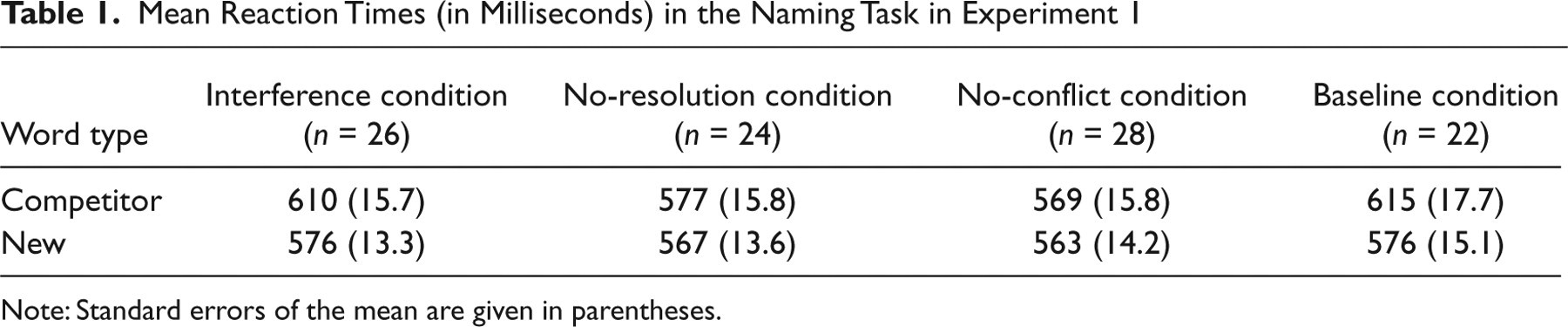
Note: Standard errors of the mean are given in parentheses.
By comparing naming time in the baseline condition with naming time in the other conditions, it is possible to assess the extent of suppression. In all conditions except the baseline condition, participants had seen the competitor words in Phase 1 prior to naming them in Phase 3. We therefore expected that in the absence of any suppression, participants would show priming; that is, they would name competitor words in these conditions more quickly than in the baseline condition. We observed such a priming effect in both the no-resolution condition, F(1, 43) = 9.92, p < .01, and the no-conflict condition, F(1, 47) = 8.30, p < .01, but not in the interference condition, F(1, 45) < 1. Thus, the suppression applied during interference resolution was sufficient to return competing words to baseline accessibility, such that participants in the interference condition performed as if they had never seen the competitors prior to Phase 3.
Experiment 2
Method
Is there an alternative interpretation of the slowed competitor naming times we observed in the interference condition? One possibility is that the association between each target word and its competitor word was strengthened during the word-fragment-completion task in Phase 2. Thus, when a competitor was presented for naming in Phase 3, it may have triggered the retrieval of both the competitor and the target, slowing naming. A strong test of this association-strengthening account would be to measure the priming of target words in the interference condition relative to the priming of target words in a baseline condition: If association strengthening produces the slowing of competitor-word recall, we would expect that target-word naming would also be slowed. By contrast, we would not expect to observe any slowing of target-word naming if suppression was the source of the slowed competitor naming seen in Experiment 1. We therefore tested 56 new participants (using the same selection criteria as in Experiment 1) in the interference and baseline conditions. These participants were asked to name target words instead of competitor words in Phase 3. Except for the Phase 3 naming task, all other procedures (including data screening and trimming procedures) were the same in Experiment 2 as in Experiment 1.
Results
Naming time for targets showed facilitation relative to baseline (see Table 2 for target and new-word naming times), F(1, 53) = 18.83, p < .001. This finding is inconsistent with an association-strengthening account of the competitor slowing we observed in Experiment 1, suggesting that competing information is indeed suppressed during interference resolution. 3
Mean Reaction Times (in Milliseconds) in the Naming Task in Experiment 2
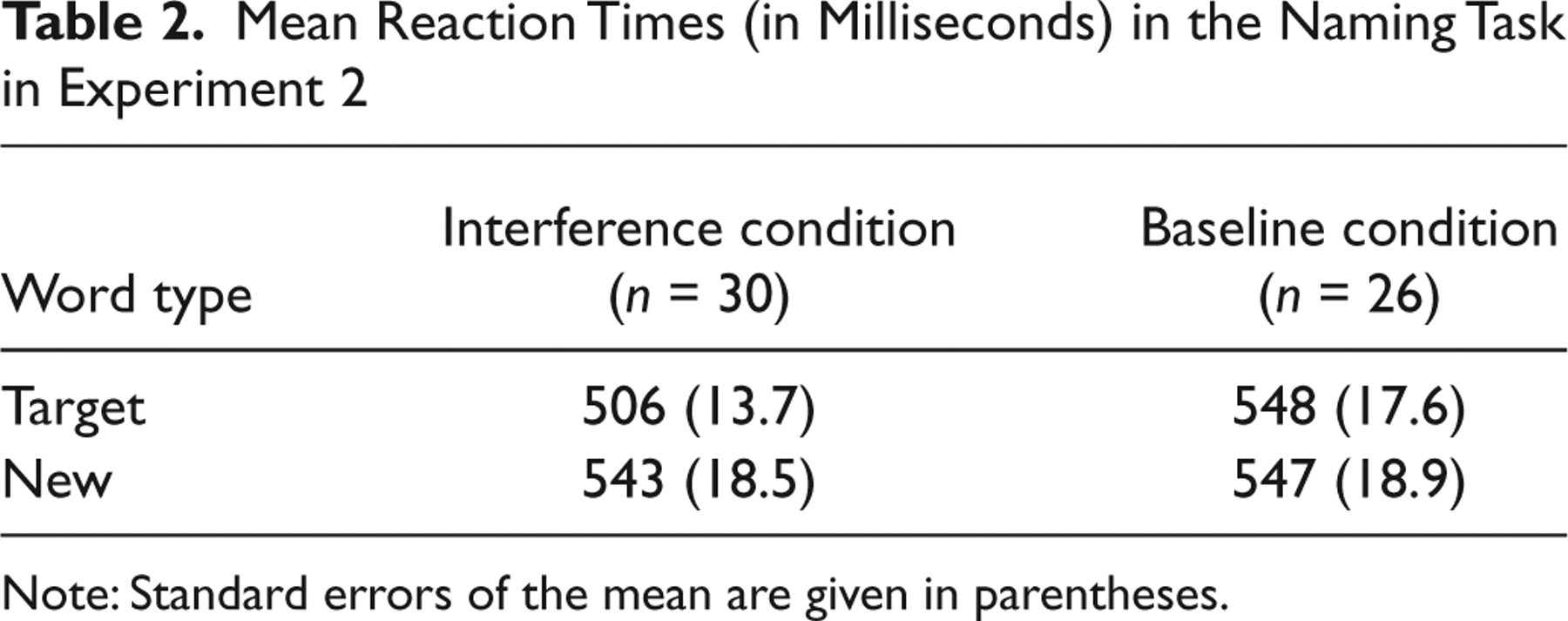
Note: Standard errors of the mean are given in parentheses.
The data from Experiment 2 allowed us to address an additional question: Does resolving conflict entail facilitating the accessibility of target words, in addition to suppressing the accessibility of competing words (e.g., Norman, Newman, & Detre, 2007)? If facilitation does play a role in resolution, then successfully resolving interference should produce increased priming of targets words, just as resolving interference produces decreased priming of competitors. To test for increased target priming, we compared the extent of priming for targets in the interference condition (which should reflect priming due to preexposure to these words during Phase 1, plus any facilitation due to competition resolution) with the amount of competitor priming in the no-conflict condition from Experiment 1 (which reflects only priming due to preexposure to the words during Phase 1). Target words in the interference condition showed 42 ms of priming (target naming time in the baseline condition – target naming time in the interference condition), no more than the 46 ms shown by competitors in the no-conflict condition (competitor naming time in the baseline condition – competitor naming time in the no-conflict condition). 4 As a more rigorous test, we conducted a 2 (condition: baseline vs. priming) × 2 (word: target vs. competitor) ANCOVA with new-word naming time as a covariate. We would expect the ANCOVA to produce a significant interaction if interference resolution increases the amount of priming for targets. However, the interaction was not significant, F(1, 101) < 1, which suggests that resolving interference did not involve facilitating target words.
Discussion
Direct evidence for the operation of inhibitory mechanisms at the behavioral level has been notoriously difficult to find (e.g., MacLeod et al., 2003). In the experiments reported here, we looked for a fingerprint of an inhibitory mechanism by measuring the consequences of interference resolution for the rejected competitor word. We provide strong, direct evidence for an inhibitory mechanism in interference resolution: Participants who successfully resolved interference between competing words were subsequently slower to name the rejected word than participants who experienced no interference.
Our study is not the first to show that retrieving one piece of information has negative consequences for related information: Postretrieval deficits have been shown in a variety of paradigms, such as retrieving versus rereading recently presented information (Higgins & Johnson, 2009), fan-effect studies (Radvansky, Zacks, & Hasher, 2005), category-stem completion (Blaxton & Neely, 1983), and the retrieval-induced forgetting (RIF) paradigm (M.C. Anderson, Bjork, & Bjork, 1994; M.C. Anderson & Spellman, 1995). However, many researchers have argued that these effects are best explained by mechanisms other than suppression (e.g., Gorfein & Brown, 2007; Higgins & Johnson, 2009; MacLeod et al., 2003). Perhaps the best existing evidence for suppression comes from RIF studies, in which participants learn lists of category-exemplar pairs and then practice retrieving a subset of these exemplars. This practice impairs subsequent retrieval of unpracticed exemplars. However, there have been reports of difficulty replicating some of the key findings supporting inhibitory explanations of RIF (e.g., Williams & Zacks, 2001), and several authors have proposed noninhibitory accounts of RIF effects (MacLeod et al., 2003; Williams & Zacks, 2001). One way to adjudicate between inhibitory and noninhibitory accounts in general, however, is to search for converging evidence from different paradigms. The study presented in this article provides such evidence.
Our data expand the current understanding of suppression effects in a number of ways. First, they show that suppression of competing words during retrieval occurs even in implicit tasks in which participants are not explicitly asked to retrieve a subset of previously learned information. Some RIF studies have used implicit tasks to test for suppression after explicit retrieval practice (e.g., Bajo, Gómez-Ariza, Fernandez, & Marful, 2006; Perfect, Moulin, Conway, & Perry, 2002). However, in our study, all phases―including encoding and retrieval―were implicit. Implicit memory tasks may simulate the occurrence and resolution of interference outside the laboratory more closely than explicit tasks. Second, our findings show that suppression of competing information can occur even after a single retrieval episode, whereas most other studies have involved multiple retrieval attempts (though retrieval need not be successful; Storm & Nestojko, 2010), with a single attempt often producing no suppression (Shivde & Anderson, 2001) or even producing facilitation (Blaxton & Neely, 1983). Third, our study provides information about the magnitude of suppression effects at retrieval, showing that interference resolution returns competing information to a baseline level of accessibility (but not lower). We also found no evidence of heightened accessibility (or activation) for target words, which is consistent with the view that the outcome of successful resolution of competition is heightened relative, and not absolute, accessibility of the target words.
Effects similar to the suppression found here may occur in a variety of tasks, including complex working memory span tasks, which involve considerable levels of interference (e.g., Lustig, May, & Hasher, 2001), and which may require retrieval from long-term memory (e.g., Healey & Miyake, 2009; Unsworth & Engle, 2007). Our data are also relevant to neuroimaging findings that implicate the left inferior frontal gyrus (IFG) in interference-resolution processes (Nelson, Reuter-Lorenz, Persson, Sylvester, & Jonides, 2009; Thompson-Schill, D’Esposito, Aguirre, & Farah, 1997). On the basis of these studies, we predict that individuals showing the greatest IFG activity during interference resolution will also show the greatest slowing effect during a naming task. It is also possible that the ability to ignore distraction during memory encoding (Vogel, McCollough, & Machizawa, 2005) is related to the inhibitory mechanism that enables the resolution of competition at retrieval.
Classic interference theory (e.g., Postman & Underwood, 1973) posits that memory failure is largely due to competition between memory traces at retrieval. This view of the centrality of interference has greatly influenced contemporary research, yet the critical question of how interference is resolved remains open and contested. Our study provides some of the strongest evidence to date that retrieval of a memory trace entails the suppression of competing memory traces, reducing accessibility of these competitors to the baseline level of semantic memory. We suggest that the logic of looking for the fingerprints of inhibition, not in what happens to target information, but in what happens to competing information, holds great promise for both behavioral and neuroimaging work.
Footnotes
Acknowledgements
We thank Elizabeth Howard for her assistance with this study.
The authors declared that they had no conflicts of interest with respect to their authorship or the publication of this article.
This research was supported by grants from the National Institute on Aging (R37 AGO4306) and the Natural Sciences and Engineering Research Council of Canada, and by an Ontario Graduate Scholarship to M.K.H.
1.
The pattern of results was qualitatively identical for untrimmed data.
2.
New-word naming time was included as a covariate in all subsequent analyses of RT data and was always a significant covariate.
3.
Norms from the English Lexicon Project (Balota et al., 2007) confirm that the difference in baseline naming speed between targets and competitors is not limited to our study. This difference does not affect our interpretation of the findings.
4.
Had targets been strengthened during competition resolution, one could argue that slowed competitor naming in Experiment 1 was due to interference from the strengthened targets. The finding that targets showed no additional facilitation as a result of competition resolution is evidence against such an account.