







Abstract
In the current research, we tested a novel explanation for previously demonstrated findings that East Asians disclose less personal information to other people than do Westerners. We propose that both between- and within-culture differences in self-disclosure to close friends may be explained by the construct of relational mobility, the general degree to which individuals in a society have opportunities to form new relationships and terminate old ones. In Study 1, we found that cross-cultural differences (Japan vs. United States) in self-disclosure to a close friend were mediated by individuals’ perceptions of relational mobility. In Study 2, two separate measures of relational mobility predicted self-disclosure within a single culture (Japan), and this relationship was mediated by the motivation to engage in self-disclosure to strengthen personal relationships. We conclude that societies and social contexts higher in relational mobility (in which relationships can be formed and dissolved relatively easily) produce stronger incentives for self-disclosure as a social-commitment device.
As a social species, humans have a fundamental need for companionship. Over evolutionary history, humans have faced various adaptive challenges, such as child rearing, resource acquisition, and protection from predators—challenges better faced collectively than alone. Accordingly, the formation and maintenance of close relationships have been crucial to human development and existence.
However, although the need for relationships may be universal, the nature of human relationships is profoundly influenced by culture. For example, research has demonstrated that East Asians are less likely than Westerners to disclose sensitive information about the self (Asai & Barnlund, 1998; Chen, 1995; Gudykunst & Nishida, 1983; Kito, 2005; Ting-Toomey, 1991). East Asians are also reluctant to seek social support by talking about their problems with other people to whom they are close in times of stress, and receive fewer psychological benefits from receiving social support than their European American counterparts do, even when the benefits are judged by physiological responses to stress (Kim, Sherman, Ko, & Taylor, 2006; Taylor et al., 2004; Taylor, Welch, Kim, & Sherman, 2007).
Relational Mobility and Cultural Differences in Self-Disclosure
In this article, we attempt to extend these findings by reinterpreting cultural differences in self-disclosure as adaptive behaviors tailored to incentives created by particular social contexts. We argue that cultural differences in self-disclosure can be understood as strategies adapted to social environments that differ in the degree to which personal relationships are formed through personal choice, or are typically afforded by environment settings (Adams, 2005; Adams & Plaut, 2003; Yamagishi & Yamagishi, 1994). These differences in social structure are encapsulated in the recently introduced concept of relational mobility, defined as the degree to which individuals have opportunities to voluntarily form new relationships and terminate old ones in a given context (Falk, Heine, Yuki, & Takemura, 2009; Schug, Yuki, Horikawa, & Takemura, 2009; Yuki et al., 2007). Although relational mobility is a relatively new theoretical construct in the psychological literature, a variety of studies have provided evidence that it is lower in East Asian than in North American cultures (for a review, see Schug et al., 2009), and perceptions of relational mobility among individuals in Japan and the United States are consistent with this evidence (Falk et al., 2009; Schug et al., 2009; Yuki et al., 2007).
We propose that the amount of effort required to maintain committed relationships is greater in social contexts high in relational mobility (e.g., North America) compared with those lower in relational mobility (e.g., Japan). Because of the relative freedom to form new relationships and terminate old ones, social commitments in high-relational-mobility cultures are relatively fragile. Therefore, individuals must invest time and energy in maintaining their relationships; otherwise, the relationships may deteriorate and end. However, in societies low in relational mobility, in which relationships are more stable, there is less need to actively invest effort into maintaining relationships. Thus, relationship-maintenance strategies should have less utility in low-mobility contexts.
In general, relationships can be maintained by signaling commitment to one’s partners. One way to do this is through self-disclosure, which is known to increase liking and intimacy in close relationships (Altman & Taylor, 1973; Collins & Miller, 1994; Laurenceau, Barrett, & Pietromonaco, 1998). Defined as the revelation of sensitive personal information to another person, self-disclosure can signal commitment because it indicates a willingness to be vulnerable to that person, a distinct marker of trust and commitment in a relationship (Mayer, Davis, & Schoorman, 1995). However, the costs and benefits of self-disclosure as a relationship-strengthening strategy should vary with levels of relational mobility. In societies high in relational mobility, relationships may dissolve if not properly maintained; thus, it is strategically beneficial to devote time and energy toward their explicit maintenance. Furthermore, as new partners are generally available in such contexts, the cost of being excluded by current partners is relatively low. In contrast, in societal contexts low in relational mobility, in which interpersonal relationships are stable and new partners are generally unavailable, there is a salient downside associated with disclosing any information that could potentially lead to a negative reputation, and ultimately social exclusion. Although social exclusion is a literally painful phenomenon even in high-mobility cultures (e.g., Eisenberger, Lieberman, & Williams, 2003), the consequences should be particularly severe in low-mobility societies given the difficulty of forming new relationships and the distinct possibility of continued social isolation following exclusion from a relationship or group.
We predicted that previously noted cultural differences in self-disclosure (e.g., Ting-Toomey, 1991) would be explained by societal differences in relational mobility. Furthermore, because relational mobility can also vary within a single society, we predicted that relational mobility would influence self-disclosure even within a single culture, such that higher levels of self-disclosure would be associated with an increased motivation to engage in self-disclosure to strengthen one’s relationships.
Study 1
In Study 1, we aimed to determine whether cultural differences in self-disclosure observed in Japan and the United States could be explained by cultural differences in relational mobility. We measured self-disclosure to two critical targets: a close friend and a close family member. Although we predicted that increased levels of relational mobility would explain higher levels of self-disclosure to a friend, we reasoned that relational mobility may not explain the level of disclosure to a family member because family relationships are generally inherently low in relational mobility, and therefore self-disclosure may have less utility in strengthening these relationships. Therefore, we predicted that cultural differences in perceptions of relational mobility would mediate self-disclosure to a close friend, but not to a close family member.
Method
Participants
Seventy-four Japanese students (42 men and 32 women; mean age = 18.98 years, SD = 0.88) at a large university in northern Japan and 93 students (21 men and 72 women; mean age = 19.18 years, SD = 2.13) at a large university in the midwestern United States participated in the study.
Procedure and materials
Participants were told that the study was a survey on relationships. First, we measured target-specific self-disclosure tendencies by assessing the likelihood that participants would disclose certain types of information to their closest friend and to their closest family member. As different scales have traditionally been used in Japanese and Western research on self-disclosure, we created a new partner-specific measurement based on indigenous measures, such as the Self Disclosure Index (Miller, Berg, & Archer, 1983) and the psychological component of the Enomoto Self-disclosure Scale (Enomoto, 1997). We then held focus groups in both countries and selected items that were consistently identified by individuals in both cultures as likely topics of self-disclosure. The resulting questionnaire asked participants to report how likely they would be to tell their best friend and closest family member about (a) their biggest secret, (b) their most embarrassing experience, (c) their greatest failure, (d) their greatest worry, and (e) the worst thing that ever happened to them. Responses were indicated on 5-point unipolar scales ranging from 1 (not at all likely) to 5 (extremely likely). Next, participants used the Subjective Closeness Index (Berscheid, Snyder, & Omoto, 1989) to rate levels of relational closeness with both targets. Responses were made on 10-point unipolar scales ranging from 1 (not close at all) to 10 (extremely close).
We then asked participants to fill out the Relational Mobility Scale (Falk et al., 2009; Schug et al., 2009; Yuki et al., 2007), a 12-item measure that asks participants to report their perceptions of relational mobility vis-à-vis people in their immediate environment (school, workplace, neighborhood, etc.) using a 6-point scale ranging from 1 (strongly disagree) to 6 (strongly agree). Items include the following: “They (i.e., people in my immediate society) have many chances to get to know other people” and “They can choose who they interact with.” This measure was developed simultaneously in Japanese and English and has been shown to have similar structural and content validity in these two countries (Yuki et al., 2007).
Results and discussion
Cultural differences across variables
Means, standard deviations, and reliabilities of all measures are shown in Table 1. We first conducted a 2 × 2 × 2 mixed-factorial analysis of variance with country and gender as between-subjects factors, target of self-disclosure (friend vs. family member) as a within-subjects factor, and the amount of self-disclosure as the dependent variable. 1 The results showed three significant main effects. First, replicating previous findings, Study 1 demonstrated that Americans were more likely to disclose than Japanese, F(1, 163) = 22.30, p < .0001, η2 = .12. Second, participants were more likely to disclose to a friend than to a family member, F(1, 163) = 33.09, p < .0001, η2 = .163. Third, women were more likely to disclose than men, F(1, 163) = 6.01, p = .02, η2 = .031. No other significant main effects or interactions were observed. Finally, as in previous studies (Falk et al., 2009; Schug et al., 2009; Yuki, et al., 2007), perceived levels of relational mobility (as measured by the Relational Mobility Scale) were higher in the United States than in Japan, F(1, 166) = 60.83, p < .0001, η2 = .269. Because of the significant main effect of gender, we controlled for gender in subsequent analyses. Detailed results for each measurement are presented in Table 1.
Results of Study 1: Relational Mobility, Self-Disclosure, and Relational Closeness by Country
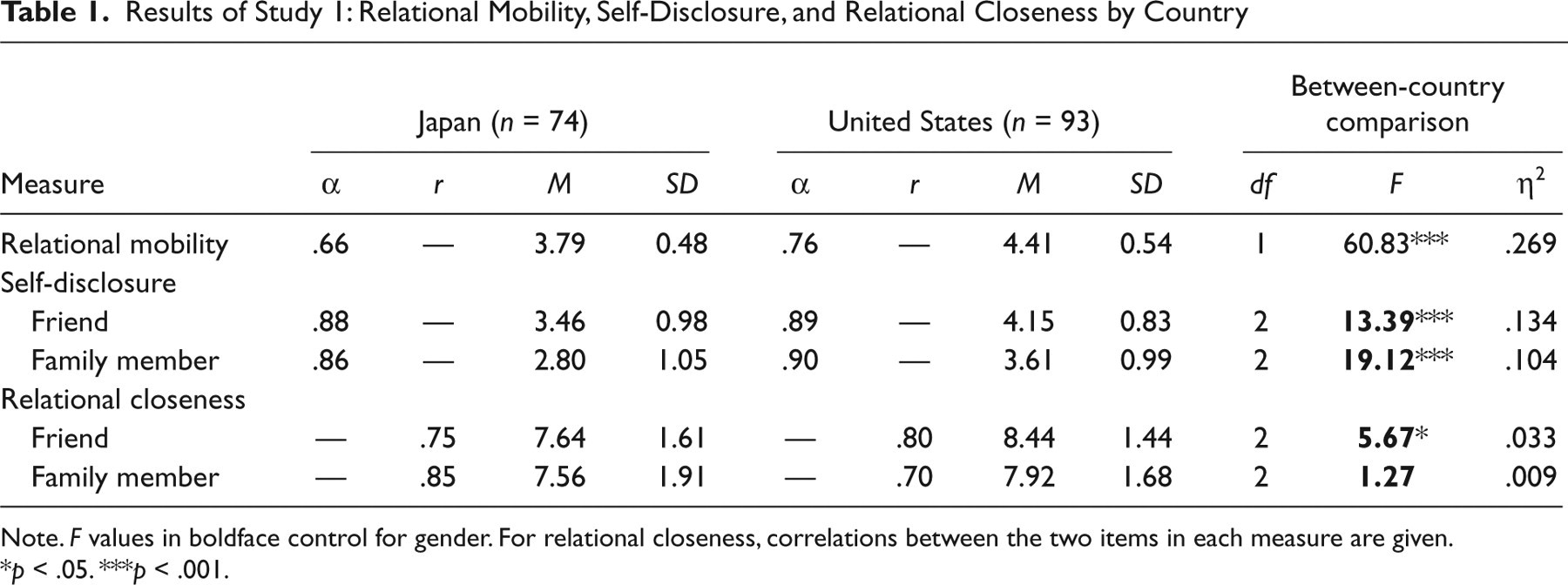
Note. F values in boldface control for gender. For relational closeness, correlations between the two items in each measure are given.
p < .05. ***p < .001.
Mediational effect of relational mobility
Next, we examined the correlations among self-disclosure to each target, relational mobility, and closeness to each target (Table 2). As predicted, relational mobility was positively correlated with self-disclosure to a friend in both cultures, but not to a family member in either culture.
Intercorrelations Among Variables in Study 1
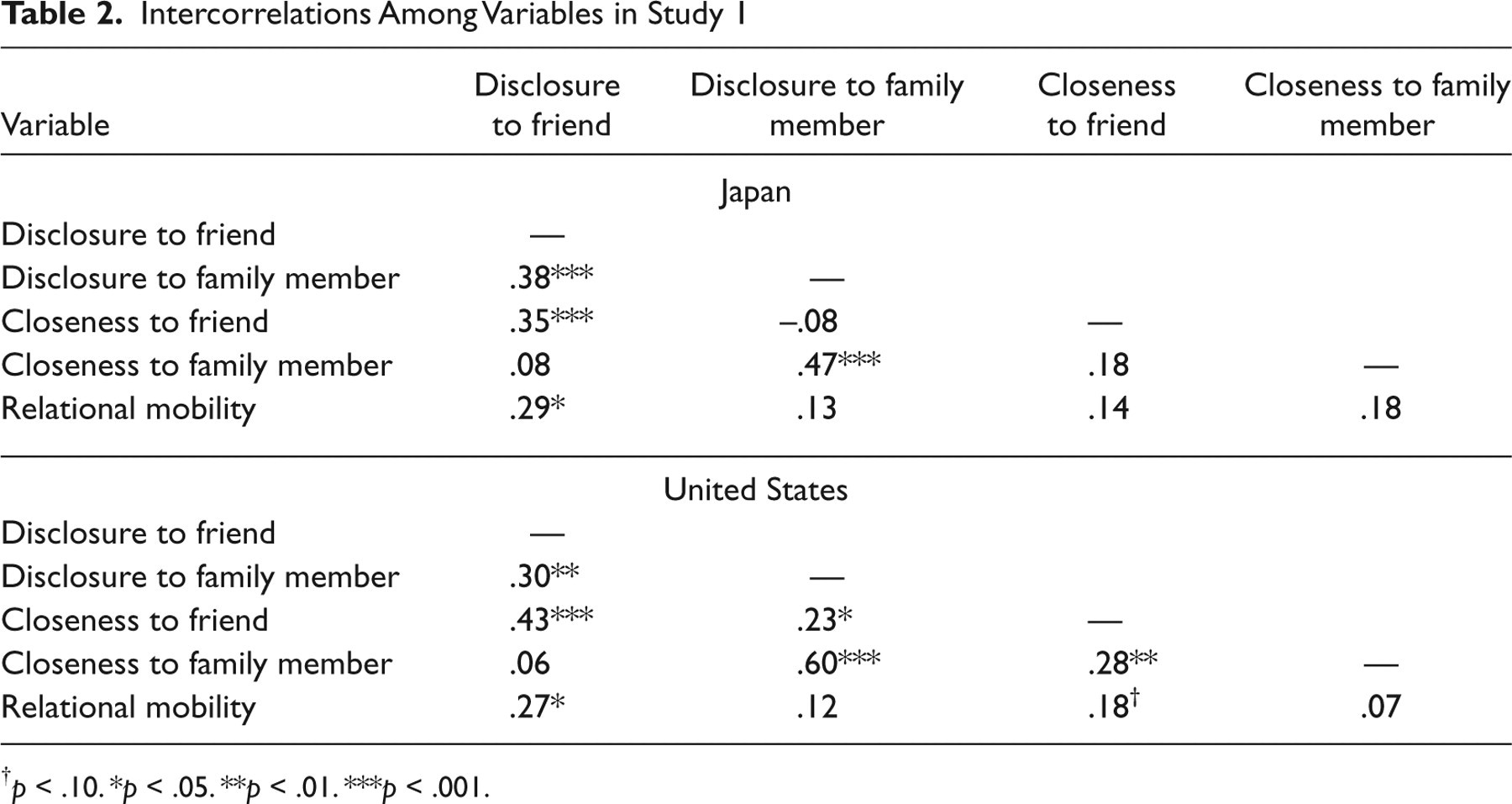
p < .10. *p < .05. **p < .01. ***p < .001.
We then examined whether, as predicted, the cultural difference in self-disclosure to a close friend could be explained by cross-societal differences in the level of relational mobility, controlling for gender and closeness (Baron & Kenny, 1986). First, we conducted a multiple regression analysis with culture predicting self-disclosure to a close friend, controlling for gender. As we noted previously, the effects of both of culture and gender were significant. However, when relational mobility was included in the model, the effect of culture became nonsignificant, whereas the effect of relational mobility remained significant. These results indicated that cultural differences in self-disclosure were significantly mediated by relational mobility (Sobel’s z = 2.80, p = .003; see Fig. 1). 2
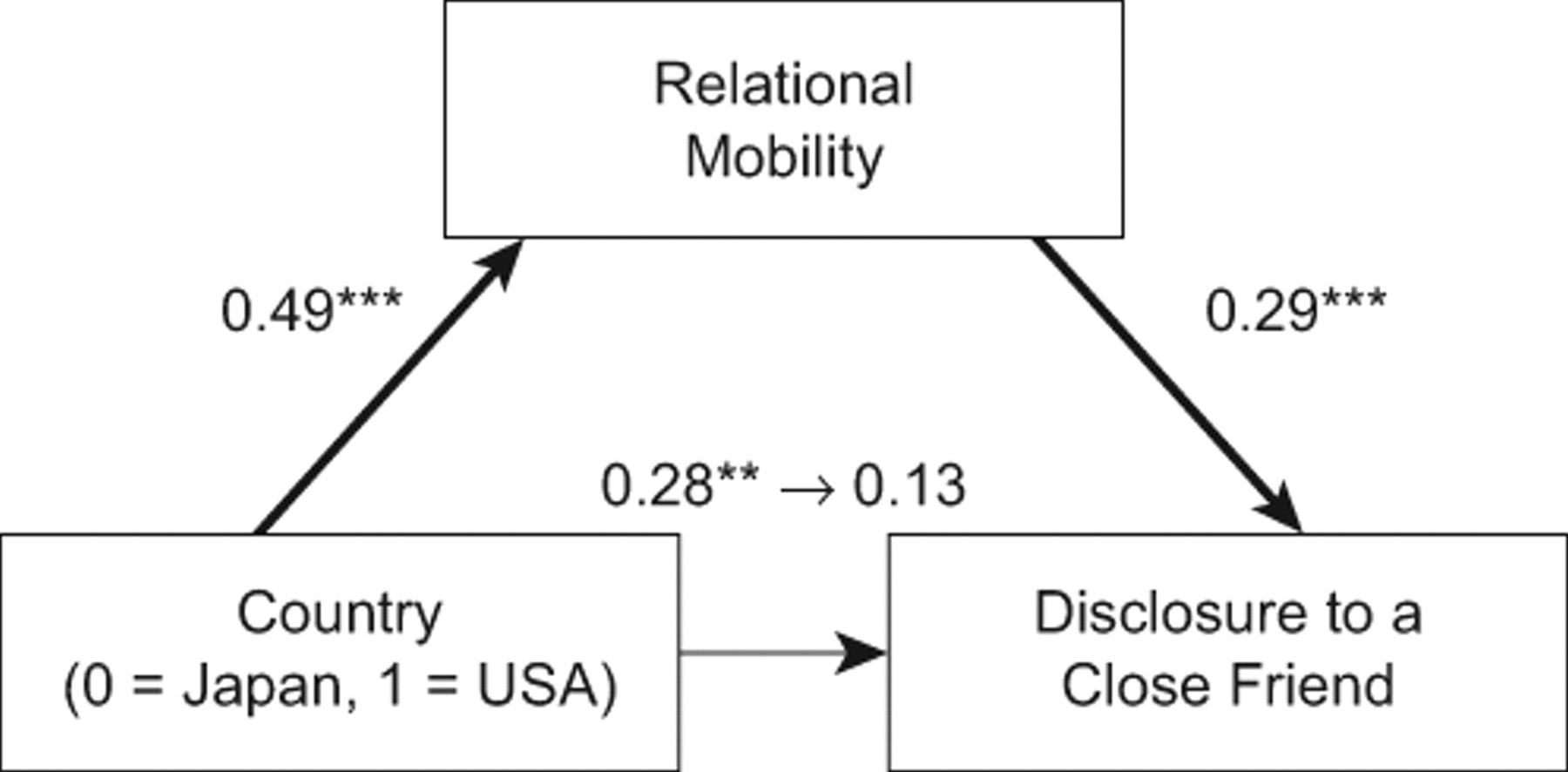
The mediating effect of relational mobility on self-disclosure to a close friend in two countries in Study 1. Standardized regression coefficients are presented. Bold arrows represent significant paths in the final step. On the bottom path, the number on the left represents the standardized regression coefficient before including the mediating variable, whereas the number on the right indicates the standardized regression coefficient in the final model. Asterisks indicate the significance of the coefficients (**p < .01, ***p < .001).
Next, we included the measure of relational closeness in the model to see if the effect of relational mobility would remain significant. Although relational closeness was greater in the United States than in Japan and significantly predicted self-disclosure in both Japan (β = 0.36, p = .002) and the United States (β = 0.48, p < .0001), it had no effect on the relationship between relational mobility and self-disclosure, which remained significant (β = 0.23, p = .003), and did not mediate cultural differences in self-disclosure. Thus, despite relational closeness being highly correlated with both constructs (i.e., relational mobility and self-disclosure), cultural differences in relationship closeness did not explain cultural differences in self-disclosure.
Overall, the results of Study 1 supported our hypothesis that relational mobility can offer a novel explanation for previously demonstrated cultural differences in self-disclosure between friends.
Study 2
Because our theoretical model proposes that differences in self-disclosure can be explained by the utility of self-disclosure as a relationship-strengthening strategy in different social environments, this phenomenon should not be limited to comparisons between cultures. Indeed, there can also be within-culture variability in relational mobility, which could in turn influence the function of self-disclosure. Some support for this notion can be found in Study 1, as relational mobility was positively correlated with self-disclosure to friends in both Japan and the United States.
Therefore, in Study 2, we examined the hypothesis that the utility of self-disclosure as a relationship-strengthening strategy would vary with relational mobility within a single culture. Furthermore, because Study 1 examined only individuals’ perceptions of relational mobility in their society, we included a self-relevant measure of relational mobility, asking participants to report the number of new acquaintances they actually had met in the recent past. This measure, which we refer to as personal relational mobility, is advantageous because it provides a history of the number of opportunities individuals have had to form new relationships, rather than their general perception of the availability (or lack of availability) of new relationship partners in their local society.
We predicted that both measures of relational mobility would be positively related to self-disclosure to a close friend, but not to a close family member. Furthermore, we predicted that the relationship between relational mobility and self-disclosure to a close friend would be mediated by the motivation to engage in self-disclosure to strengthen relationships.
Method
Participants
Ninety-four Japanese students (29 female and 65 male; mean age = 18.90 years, SD = 0.66 years) from a northern Japanese university participated in exchange for a monetary reward. Because the ability to form new relationships is likely greater at the beginning of a school semester, we collected data near the end of the school year, when relationships would be comparatively stable.
Measures
Participants filled out the same measure of self-disclosure used in Study 1, rating their self-disclosure to both a friend and a family member. Furthermore, to measure the motivation to engage in self-disclosure to strengthen relationships, we asked participants to rate the degree to which they felt several statements were important to them when deciding whether or not to disclose personal information to other people. Participants rated five items on a 5-point scale (from 1, strongly disagree, to 5, strongly agree). Items included “Telling others about my problems is a good way to strengthen relationships with others” and “People like me when I trust them enough to tell them about my personal problems.” We also included the same measure of perceived relational mobility used in Study 1 (Schug et al., 2009; Yuki et al., 2007), as well as a measurement of personal relational mobility. For this latter measure, we asked participants to report the number of new friendships and acquaintanceships that they had formed in the past month, as well as over the past 3 months.
Results and discussion
Relational mobility and self-disclosure in Japan
Summary statistics and scale reliabilities are presented in Table 3. Because participants reported the number of new friends and acquaintances over the past month and over the past 3 months, to calculate personal relational mobility we divided the number of new friends and acquaintances made over the past 3 months by 3 and calculated the mean of the two variables (M = 4.8). 3
Means, Reliabilities, and Intercorrelations Among Variables in Study 2
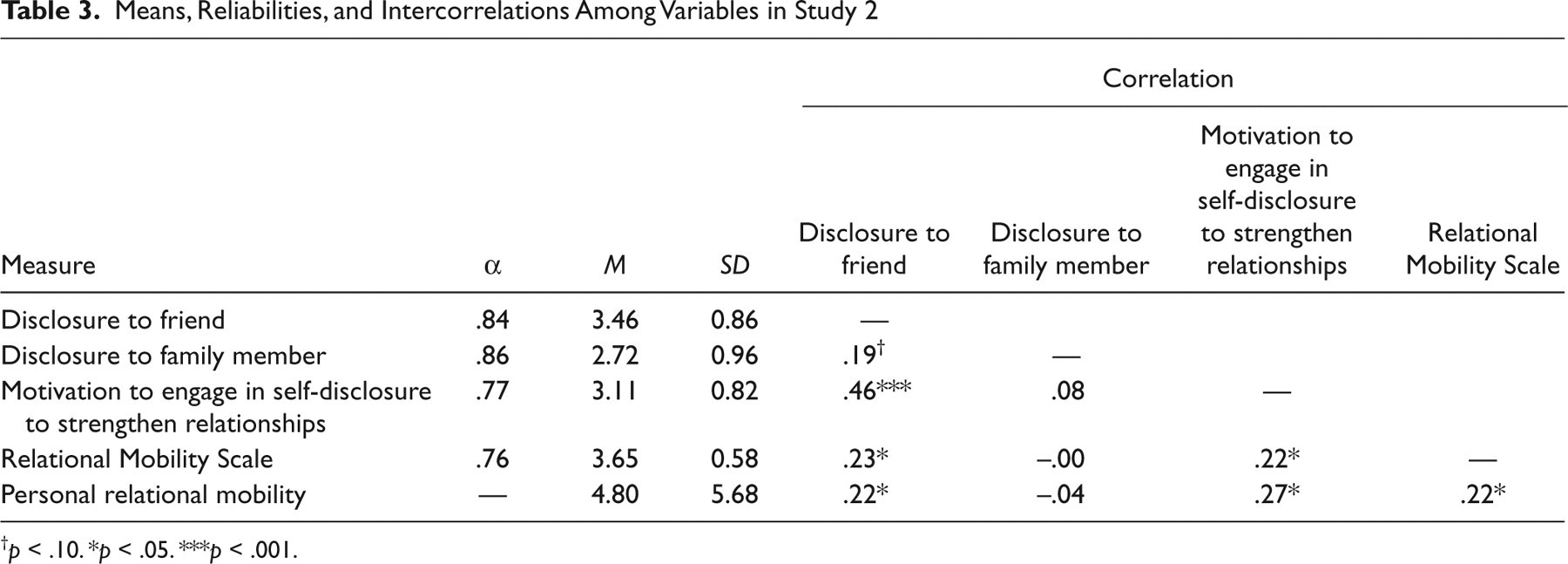
p < .10. *p < .05. ***p < .001.
Next, we examined the correlations between each measure of relational mobility, the motivation to engage in self-disclosure to strengthen relationships, and self-disclosure to each target. As in Study 1, the Relational Mobility Scale was positively correlated with self-disclosure to a close friend (r = .23, p = .03), but not to a family member (r = .00, n.s.). We found strikingly similar correlations between the measure of personal relational mobility and self-disclosure to a friend (r = .22, p = .03) and to a family member (r = –.04, n.s.), as well as significant correlations between motivation to engage in self-disclosure to strengthen relationships and self-disclosure to a friend (r =. 46, p < .0001) and to a family member (r = .08, n.s.). Finally, both the Relational Mobility Scale and personal relational mobility were positively correlated with motivation to engage in self-disclosure to strengthen one’s relationships (r = .22, p = .036, and r = .27, p = .007, respectively).
The mediating effect of motivation to engage in self-disclosure to strengthen relationships
Next, we conducted a series of analyses to determine if the relationship between relational mobility and self-disclosure to a friend could, as predicted, be explained by the motivation to engage in self-disclosure to strengthen one’s relationships (see Figs. 2 and 3). As reported in the previous paragraph, self-disclosure to a friend was significantly predicted by the Relational Mobility Scale (β = 0.23, p = .03) and by personal relational mobility (β = 0.22, p = .03). However, when the variable representing motivation to engage in self-disclosure to strengthen relationships was included in the model, the effect of both the Relational Mobility Scale (Sobel’s z = 1.92, p = .054) and personal relational mobility (Sobel’s z = 1.96, p < .05) became nonsignificant, whereas the effect of motivation to engage in self-disclosure to strengthen relationships remained significant. Thus, the effect of relational mobility (as assessed by two distinct measures) on self-disclosure was mediated by the motivation to engage in self-disclosure to strengthen relationships.
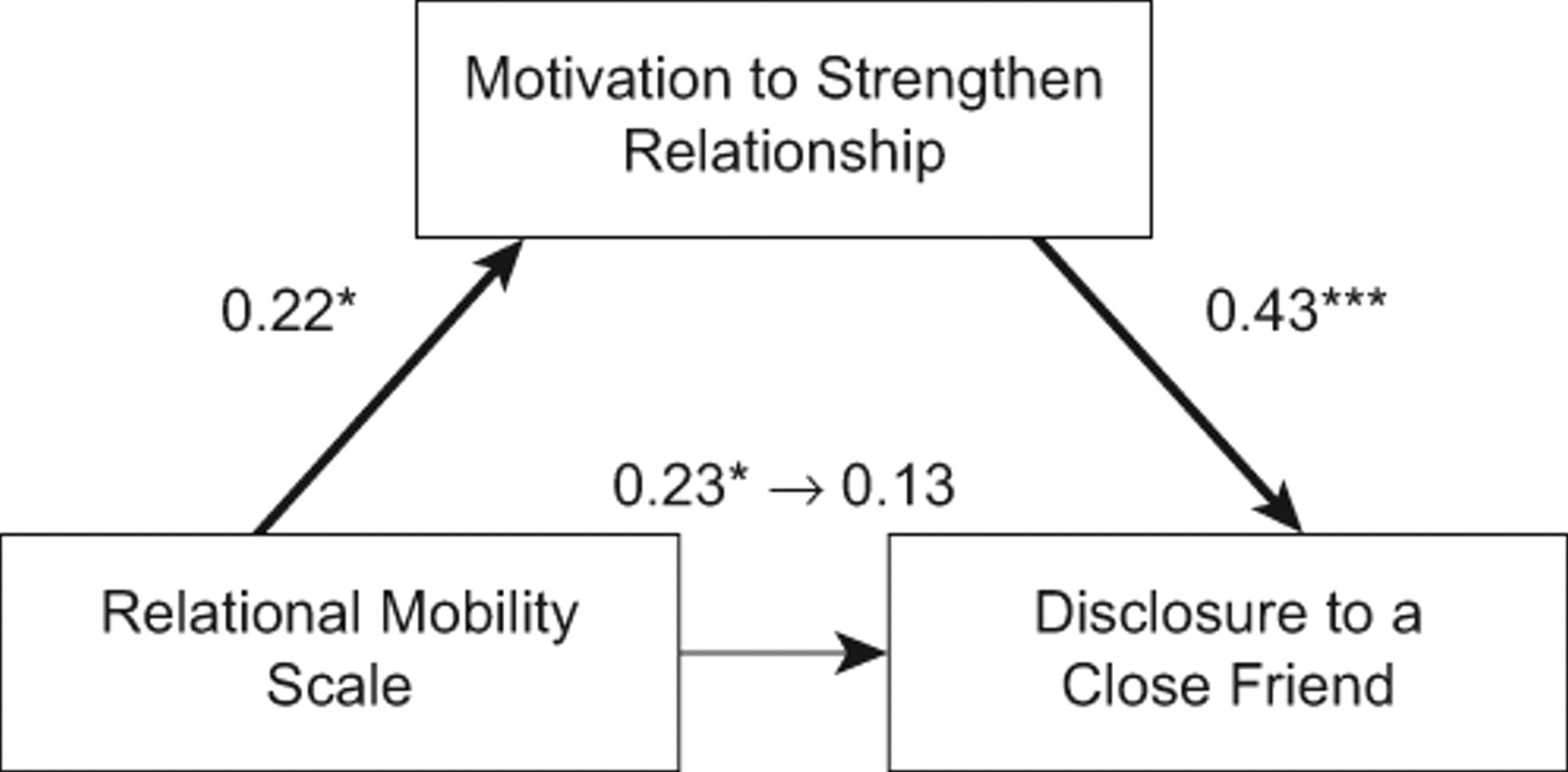
The mediating effect of motivation to engage in self-disclosure to strengthen relationships on the relationship between the Relational Mobility Scale and disclosure to a close friend in Study 2. Standardized regression coefficients are presented. Bold arrows represent significant paths in the final step. On the bottom path, the number on the left represents the standardized regression coefficient before including the mediating variable, whereas the number on the right indicates the standardized regression coefficient in the final model. Asterisks indicate the significance of the coefficients (*p < .05, ***p < .001).
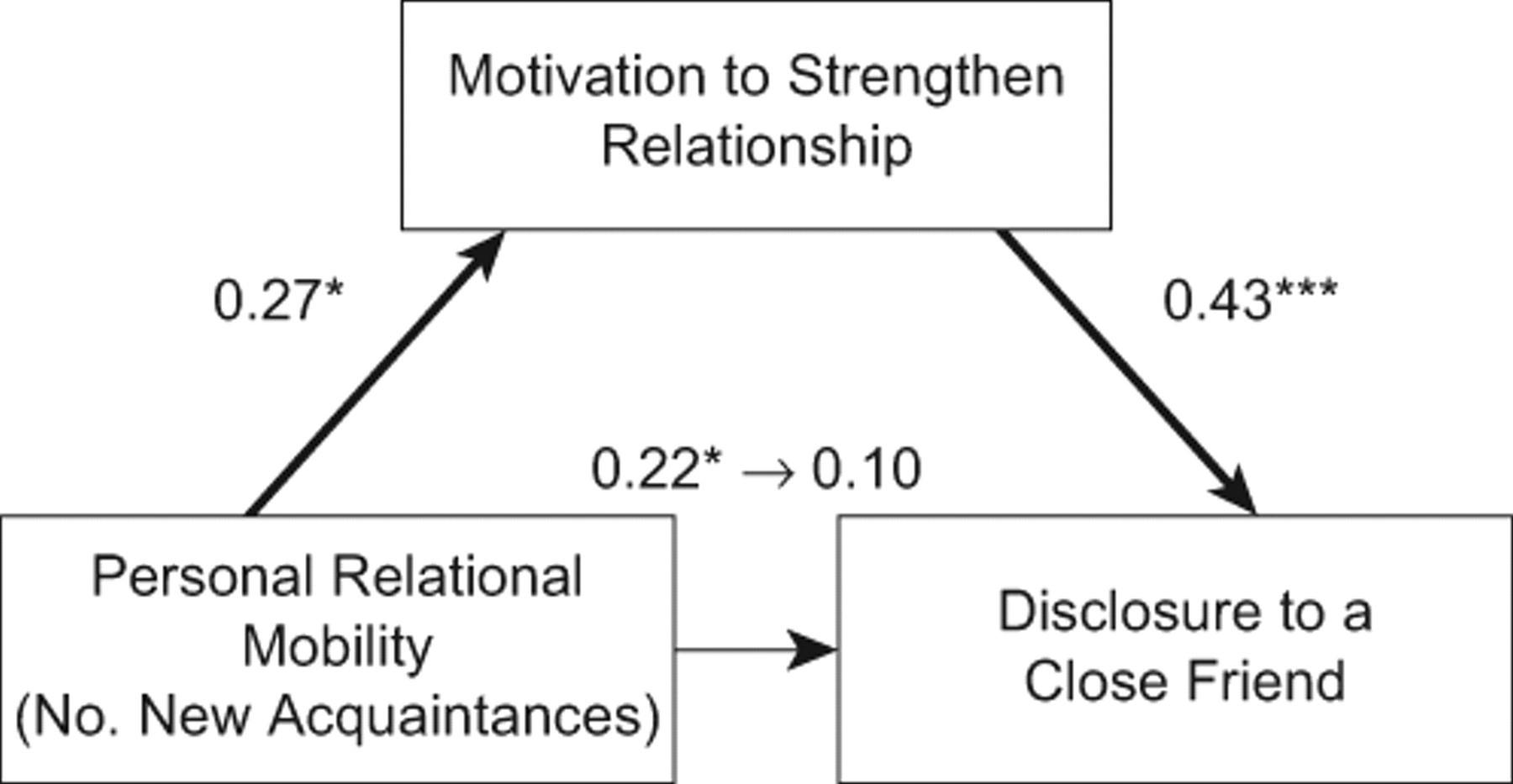
The mediating effect of motivation to engage in self-disclosure to strengthen relationships on the relationship between personal relational mobility and disclosure to a close friend in Study 2. Standardized regression coefficients are presented. Bold arrows represent significant paths in the final step. On the bottom path, the number on the left represents the standardized regression coefficient before including the mediating variable, whereas the number on the right indicates the standardized regression coefficient in the final model. Asterisks indicate the significance of the coefficients (*p < .05, ***p < .001).
General Discussion
The two studies presented in this article offer a novel and parsimonious explanation for between- and within-culture variation in self-disclosure to close friends. In Study 1, we found that between-culture differences in self-disclosure to close friends were mediated by the level of relational mobility in Japan and the United States. In each country, perceived levels of relational mobility in the local environment were positively related to disclosure to a friend, but not to a family member. This finding was replicated in Study 2, which used two different measures of relational mobility in Japan. Even within a single culture, individuals in social environments higher in relational mobility reported engaging in higher levels of self-disclosure, and did so in order to strengthen their interpersonal relationships.
We believe the findings and theoretical perspective presented in this article are consistent with work on how culture influences social support seeking in times of stress (Kim et al., 2006; Taylor et al., 2004, 2007). Such research has shown that compared with European Americans, Asians and Asian Americans seek less social support in times of stress because of concerns about damaging existing relationships. We hypothesized and found that desire to strengthen relationships was critical to explaining levels of self-disclosure to a close friend. However, it is certainly plausible that concerns about damaging existing relationships are concurrently activated, particularly among individuals in social contexts at the lower end of the relational-mobility continuum. Indeed, a motivation to protect existing relationships is highly consistent with the current framework, and researchers should investigate the influence of both motivations on personal relationships formed in various socioecological contexts.
Subjective levels of closeness with the target friend were higher in the United States than in Japan, and although closeness was highly correlated with self-disclosure in both cultures, it did not mediate cultural differences in self-disclosure. Prima facie, this result seems to contradict traditional thinking regarding the effect of culture on the self, given that East Asian cultures are seen as more interdependent and relationship oriented (e.g., Markus & Kitayama, 1991; Triandis, 1995). Our results suggest that interdependence is distinct from other concepts in the relationships literature, such as closeness and intimacy. Thus, our findings add an additional layer of complexity to concepts in the cultural literature by showing that there actually may be greater intimacy in certain types of relationships in independent cultures than in interdependent cultures (e.g., Adams, 2005; Adams & Plaut, 2003).
Limitations and directions for future research
One potential limitation of the current research is that we examined Japanese samples in Hokkaido, thought by some researchers to be a relatively individualistic area of Japan (Kitayama, Ishii, Imada, Takemura, & Ramaswamy, 2006). Although much research has shown reliable cultural differences between Westerners and Hokkaido Japanese (e.g., Maddux & Yuki, 2006; Masuda et al., 2008; Yamagishi, Hashimoto, & Schug, 2008; Yuki, Maddux, Brewer, & Takemura, 2005), and although we believe the current sample allowed us to make a conservative test of our hypothesis, whether our findings generalize to other areas of Japan (and of North America) remains to be determined.
Another limitation is that the current study used a correlational paradigm to demonstrate mediation, and this design does not allow a precise demonstration of causality. Therefore, future studies should use experimental manipulations to explicitly demonstrate the causal role of relational mobility in determining self-disclosure. And although our self-report measure of self-disclosure is consistent with the measures used in past research (e.g., Laurenceau et al., 1998), it would be helpful to try to measure actual self-disclosure in future research, given that it is possible that the self-report measure created demand characteristics. For example, self-disclosure and personal mobility may be more socially desirable among individuals in individualistic, self-enhancing cultures like the United States than among Japanese, and such desirability could have inflated American participants’ judgments on both measures; however, we believe the within-culture findings in Study 2 are evidence against this possibility.
Finally, although we found and controlled for the significant gender differences that emerged in Study 1, because of the relatively small number of women in our Japanese sample, low statistical power may have prevented the detection of an interaction effect between culture and gender. Future research should examine gender and its potential interaction with cultural differences in self-disclosure more closely.
Understanding culture from a socioecological perspective
We believe that the current findings highlight the value of examining cultural differences from a socioecological perspective. From this viewpoint, “culture-specific” behaviors are not seen as necessarily arising from differences in predominant values or beliefs (e.g., Hofstede, 1980; Markus & Kitayama, 1991; Triandis, 1995); rather, cultural differences are characterized as differences in adaptive strategies (both conscious and not) tailored toward producing desirable outcomes in a particular social environment. Although this perspective is largely neglected in psychological research, recently there has been a resurgence of interest in the impact of socioecological factors on behavior (Mastumoto, 2007; Nisbett & Cohen, 1996; Oishi & Graham, 2010; Oishi et al., 2007; Uskul, Kitayama, & Nisbett, 2008; Yamagishi et al., 2008; Yamagishi & Yamagishi, 1994). For example, Uskul and her colleagues (2008) recently examined basic perceptual tendencies among Turks from farming, fishing, and herding communities and found that, within a single culture, herding was associated with analytic perception whereas farming and fishing were associated with holistic perception.
Because our main hypothesis assumed that socioecological incentives (rather than individual values) elicit differences in self-disclosure tendencies, the primary scale used to measure relational mobility in Studies 1 and 2 assessed participants’ perceptions of the opportunities for individuals in their local society to voluntarily form new relationships and terminate old ones. Although this scale is not intended to assess individuals’ actual movement between relationships (which could be affected by many other factors, such as one’s value as a potential partner), the fact that we obtained similar mediational results in Study 2 (in which we measured both perceived relational mobility and the reported number of new friends and acquaintances made by participants in the recent past) suggests that perceptions and individual behavior are intertwined.
Although past research on cultural differences has firmly demonstrated the importance of internalized norms, values, and beliefs in explaining cultural differences (e.g., Hofstede, 1980; Markus & Kitayama, 1991; Triandis, 1995), we believe that novel insights can be gleaned by examining how structural incentives elicit strategies necessary to thrive in different cultural environments. We do not, however, mean to imply that socioecological and incentive-based approaches are inherently separate and distinct from cultural approaches. Indeed, these approaches are likely mutually constructive—different types of ecologies and social structures lead to specific incentives that encourage individuals to behave in manners adapted to those contexts. This will frequently lead to cultural variation in values and beliefs, which in turn reinforce and shape social and ecological systems, creating a self-reinforcing system of incentives, beliefs, and behaviors (Aoki, 2001; Cohen, 2001; Yamagishi et al., 2008). We believe that by understanding how culturally divergent behavior is adapted to different social ecologies, it will become possible to understand both the mechanisms behind cultural differences and how macrolevel factors exogenous to individuals can affect both individual behavior and psychological functioning.
Furthermore, although traditional cross-cultural research often conflates nation and culture (Georgas & Berry, 1995; Matsumoto & Yoo, 2006), we believe the current approach can offer a novel perspective about the behavior and psychological functioning of individuals in differing social contexts. We believe that socioecological approaches, which view social behavior in terms of adaptive strategies, can help facilitate synergies with other disciplines in the natural and social sciences, many of which view the behavior of humans and other species in terms of adaptation to natural and social environments.
Footnotes
The authors declared that they had no conflicts of interest with respect to their authorship or the publication of this article.
1.
Self-disclosure was higher in the United States than in Japan, ts(165) > 2.29, ps < .02, for all five self-disclosure items; thus, subsequent results were computed using the mean of all items.
2.
Although gender had a main effect on self-disclosure, there were no gender differences in relational mobility, and relational mobility did not mediate gender differences in self-disclosure.
3.
Because the distribution of the number of new friends and acquaintances was positively skewed, we computed a square-root transformation to normalize the distribution and used the resulting variable in subsequent analysis.