







Abstract
Whether one is in one’s native culture or abroad, one’s personality can differ markedly from the personalities of the majority, thus failing to match the “cultural norm.” Our studies examined how the interaction of individual- and cultural-level personality affects people’s self-esteem and well-being. We propose a person-culture match hypothesis that predicts that when a person’s personality matches the prevalent personalities of other people in a culture, culture functions as an important amplifier of the positive effect of personality on self-esteem and subjective well-being at the individual level. Across two studies, using data from more than 7,000 individuals from 28 societies, multilevel random-coefficient analyses showed that when a relation between a given personality trait and well-being or self-esteem exists at the individual level, the relation is stronger in cultures characterized by high levels of that personality dimension. Results were replicated across extraversion, promotion focus, and locomotive regulatory mode. Our research has practical implications for the well-being of both cultural natives and migrants.
In today’s world, the phenomenon of intercultural relocation is ubiquitous and perennially growing. Whether as permanent expatriates, temporary residents, foreign students, or emissaries, individuals can find themselves in cultural milieus quite different from their societies of origin. Even within one’s native culture, one’s personality might be disparate from the personalities and behavioral tendencies of the majority, thus failing to match the cultural norm. These situations raise a fundamental question: What effect does being different from the cultural norm have on individuals’ self-esteem and well-being? Scholars know little about the answer to this question because culture and personality research has yet to examine the cross-level influence of cultural environments on the relationship between personality and outcomes at the individual level. To be sure, the intersection of culture and personality has received much attention, starting in the early 20th century with research by Franz Boas and Ruth Benedict, and more recently with macro studies examining the relationship between aggregate personality and cultural values (Hofstede & McCrae, 2004) and micro studies examining the universal structure of personality (McCrae & Allik, 2002) and its association with subjective well-being (Lucas, Diener, Grob, Suh, & Shao, 2000). Nevertheless, to date, there has been no multilevel research that has examined the contextual impact of culture on the psychological effects of personality.
Using data from more than 7,000 individuals from 28 societies, we addressed the nexus of personality and culture by examining how their interaction affects individuals’ self-esteem and well-being. We advance a person-culture match hypothesis that predicts that when a person’s personality matches the prevalent personalities of other people in a culture, culture functions as an important amplifier of the positive effect of personality on self-esteem and subjective well-being at the individual level. We believe that such a multilevel perspective can make a significant theoretical and empirical contribution to the understanding of personality effects by paying explicit attention to the cultural environment and its moderating impact on the personality-outcome relationship at the individual level.
The Person-Culture Match Hypothesis
Numerous scholars have shown that individuals are more satisfied and better adjusted to the extent that their individual attributes are congruent with their immediate and broader environment (Higgins, 2000, 2005; Kristof-Brown, Zimmerman, & Johnson, 2005). Higgins (2000) proposed that individuals’ motivation increases when they are allowed to pursue a goal using a means that matches their regulatory focus. Promotion-focused individuals, for example, should experience more motivation when they engage in activities that are consistent with their eagerness, such as taking initiative and trying new things. This match acts to increase the positive feelings people experience in association with events, such that “people feel right about both their positive responses to things and their negative responses to things” (Higgins, 2005, p. 212). Furthermore, the benefit of such a match is assumed to be broadly applicable to personality factors beyond regulatory foci, such as extraversion and locomotion (Higgins, 2000; Kruglanski et al., 2000).
In this report, we build upon and extend Higgins’s (2000) individual-level matching hypothesis by suggesting that it is not only the types of activities in which one engages that make a difference in one’s positive feelings, but also the types of people to whom one is exposed in one’s cultural environment. Specifically, we propose that being around other people who share one’s personality characteristics has a beneficial effect similar to that of engaging in activities in a way that matches one’s personality. This prediction is consistent with the concept of shared reality: If individuals share an experience with other people, they should experience less uncertainty about themselves and greater social validation of “the way they are” (Hardin & Higgins, 1996). When people are surrounded by other people whose personalities resemble their own, they exist in a shared reality that validates their daily experiences and reactions to events. Such validation should boost their sense of epistemic competence and consequently promote their feelings of well-being.
Therefore, when a personality attribute is systematically related to self-esteem or subjective well-being at the individual level, a person-culture match should make that relation more positive on average. Put differently, the person-culture match is a source of self-validation; interacting with other people who share one’s attribute suggests that one is “all right” and similar to other people, making the positive relation between the attribute and subjective well-being and self-esteem stronger. The research reported in this article submitted these notions to an empirical test.
To that end, we conducted a cross-level analysis of the moderating effect of aggregate personality at the cultural level on the effect of personality on self-esteem and subjective well-being at the individual level. In order to test our hypothesis, we examined three personality characteristics that have consistently been linked to positive psychological outcomes at the individual level across countries—extraversion, promotion focus, and locomotive regulatory mode (Costa & McCrae, 1980; Diener, Sandvik, Pavot, & Fujita, 1992; Higgins, Pierro, & Kruglanski, 2008; Lucas et al., 2000; Schmitt & Allik, 2005). In line with the reasoning outlined earlier, we predicted that the positive relation between an individual’s extraversion and subjective well-being would be strengthened when other people in the culture were, on average, highly extraverted, and that this relation would be weakened to the extent that other people in the culture were introverted. We made parallel predictions for locomotion and promotion focus.
To test the predicted cross-level effects required individual data concerning personality attributes and related outcomes, as well as societal aggregate data, from many countries. Though many studies on personality at the individual level include personality data from multiple cultures, they often do not include individual-level outcomes, such as self-esteem or subjective well-being. Nonetheless, we were successful in locating three databases that satisfied the requirements for our analysis (Diener, Kim-Prieto, Scollon, & Colleagues, 2001; Higgins et al., 2008; McCrae, Terracciano, & 79 Members of the Personality Profiles of Cultures Project, 2005). The samples for our two studies comprised more than 7,000 individuals from 28 societies.
For both studies, we analyzed our data using random-coefficient modeling. At the first analytic level, we included the individual-level personality factors and individual-level outcomes (subjective well-being and self-esteem). At the second analytic level, we included the aggregates of personality factors at the societal level. We analyzed a slopes-as-outcomes model to examine how the individual-level relationship between personality and outcomes was moderated by the societal-level personality aggregates.
Study 1
Method
Study 1 utilized two large databases (Diener et al., 2001; McCrae et al., 2005) and focused on the moderating effect of societal-level extraversion on the individual-level relationship between extraversion and subjective well-being. The sample included a total of 6,224 participants from 26 societies: Australia, Austria, Brazil, Canada, China, Germany, Hong Kong, India, Indonesia, Iran, Italy, Japan, Kuwait, Malaysia, Mexico, Nigeria, Philippines, Poland, Portugal, Russia, Slovenia, South Korea, Spain, Thailand, Turkey, and the United States. Data were collected from multiple sites within each country.
The first database, a subset of the International College Survey (Diener et al., 2001), was used for the individual-level measures (see Table 1 for country means, alpha coefficients, correlations, and sample sizes). Individual-level extraversion (the predictor) was measured using six items from Goldberg’s (1992) scale (mean α = .72). A sample item is, “I am the life of the party.” The individual-level outcomes included (a) subjective well-being, measured by the five-item (e.g., “life is ideal”) Satisfaction With Life scale (Diener, Emmons, Larsen, & Griffin, 1985; mean α = .78); (b) the average of participants’ ratings of their experience of five positive emotions during the past week (happy, cheerful, pride, gratitude, and love; mean α = .69); and (c) a single rating of general life happiness. The second database (McCrae et al., 2005) included societal-level extraversion data. These data were part of the observer-rating personality profiles of culture collected from mostly student samples and some adult samples. Observer rating differs from self-report in that participants rate the personality of another person whom they know well.
Study 1: Means and Correlations Between Individual-Level Extraversion and Outcomes
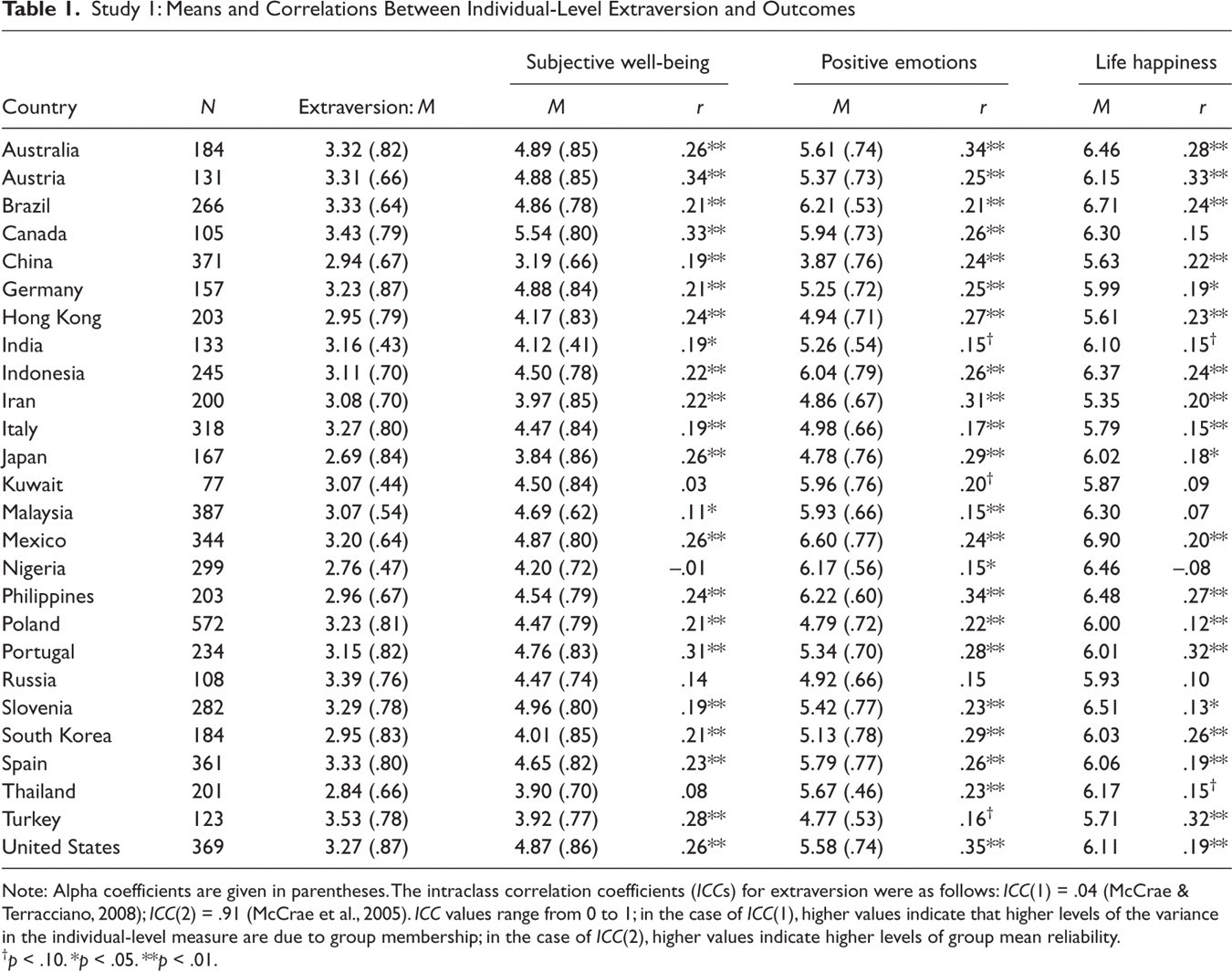
Note: Alpha coefficients are given in parentheses. The intraclass correlation coefficients (ICCs) for extraversion were as follows: ICC(1) = .04 (McCrae & Terracciano, 2008); ICC(2) = .91 (McCrae et al., 2005). ICC values range from 0 to 1; in the case of ICC(1), higher values indicate that higher levels of the variance in the individual-level measure are due to group membership; in the case of ICC(2), higher values indicate higher levels of group mean reliability.
p < .10. *p < .05. **p < .01.
Although the equivalence of personality measures across cultures is debated (see Heine, Buchtel, & Norenzayan, 2008), the factor structure of extraversion has been replicated across many cultures (De Raad et al., 2010; McCrae & Costa, 1997), and the factor structure at the cultural level replicates the factor structure at the individual level (Hofstede, 2001). We estimated the intraclass correlation coefficients, ICC(1)—the extent to which variance in individual-level measures can be explained by differences between groups rather than within groups (Raudenbush & Bryk, 2002)—and ICC(2)—the degree of reliability of aggregate scores for groups (Bliese, 2000). Although individuals in a culture clearly do not all share identical personality attributes, the ICC(1) value of .04 (McCrae & Terracciano, 2008) indicates that individuals within cultures share acceptable similarity on measures of extraversion as a result of cultural-group membership (James, 1982). The ICC(2) value of .91 (McCrae et al., 2005) indicates that the cultural groups can be reliably differentiated on extraversion (Bliese, 2000).
Results
In Study 1, we examined whether the positive relation between individuals’ extraversion and subjective well-being is strengthened when other people in the culture are, on average, highly extraverted, and weakened to the extent that other people in the culture are introverted. Given that individualism at the cultural level is also related to subjective well-being, we controlled for individualism at the cultural level by including the GLOBE (Global Leadership and Organizational Behavior Effectiveness) research project’s societal practiced-collectivism (as-is) scores (House, Hanges, Javidan, Dorfman, & Gupta, 2004) as a Level 2 predictor along with cultural-level extraversion. The as-is collectivism measure assessed the degree to which individuals in each society expressed pride, loyalty, and cohesiveness in their families (House et al., 2004, p.12).
Supporting our person-culture match hypothesis, random-coefficient modeling results showed that, across the 26 countries, the individual-level relationship between extraversion and subjective well-being was stronger in countries with high levels of observer-rating extraversion compared with countries with low levels of observer-rating extraversion (b = 0.03, SE = 0.01, p <.05; see Table 2 for the results for all three outcomes). Likewise, the relationships between extraversion and positive emotions experienced during the past week (b = 0.03, SE = 0.01, p < .05) and between extraversion and general life happiness (b = 0.06, SE = 0.03, p < .05) were also stronger in countries with higher levels of extraversion. These findings support our hypothesis that a match between personality and cultural context promotes the relationship between individuals’ personalities and subjective well-being.
Random-Coefficient Modeling Results for Cultural-Level Extraversion as a Moderator of the Relationship Between Individual-Level Extraversion and Outcomes in Study 1
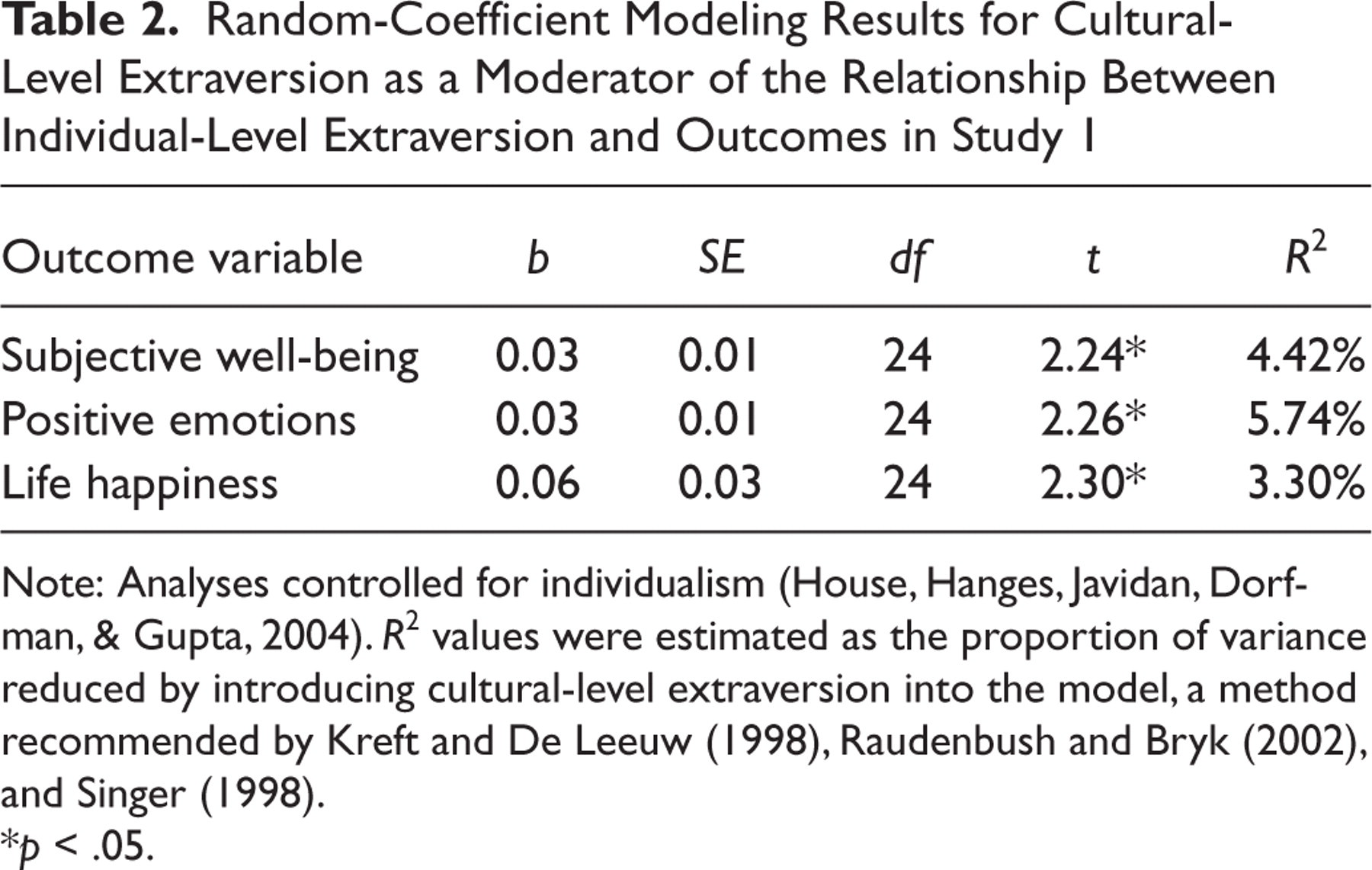
Note: Analyses controlled for individualism (House, Hanges, Javidan, Dorfman, & Gupta, 2004). R 2 values were estimated as the proportion of variance reduced by introducing cultural-level extraversion into the model, a method recommended by Kreft and De Leeuw (1998), Raudenbush and Bryk (2002), and Singer (1998).
p < .05.
Study 2
Method
In Study 2, we tested whether the results for extraversion in Study 1 could be replicated, and we extended the test of the person-culture match hypothesis to include measures of locomotion and promotion focus (see Table 3 for country means, alpha coefficients, correlations, and sample sizes). Our data came from a study that included students’ self-report scores for these three personality factors and self-esteem (Higgins et al., 2008). The scales for locomotion and promotion focus exhibited acceptable internal reliability (mean αs = .77 and .66, respectively). Sample items included “I don’t mind doing things even if they involve extra effort,” for locomotion, and “Do you often do well at different things that you try?” for promotion focus. Individual-level extraversion was measured with Goldberg’s (1992) 20-item scale (mean α = .85). In this database, the individual-level outcome variable was self-esteem, measured with the 10-item Rosenberg Self-Esteem Scale (Rosenberg, 1989; mean α = .80). Although the meaning and function of self-esteem across cultures is by no means uncontroversial, a recent study of the Rosenberg scale illustrated the invariance of its factor structure across 53 nations (Schmitt & Allik, 2005).
Study 2: Means, Alpha Coefficients, and Correlations With Self-Esteem
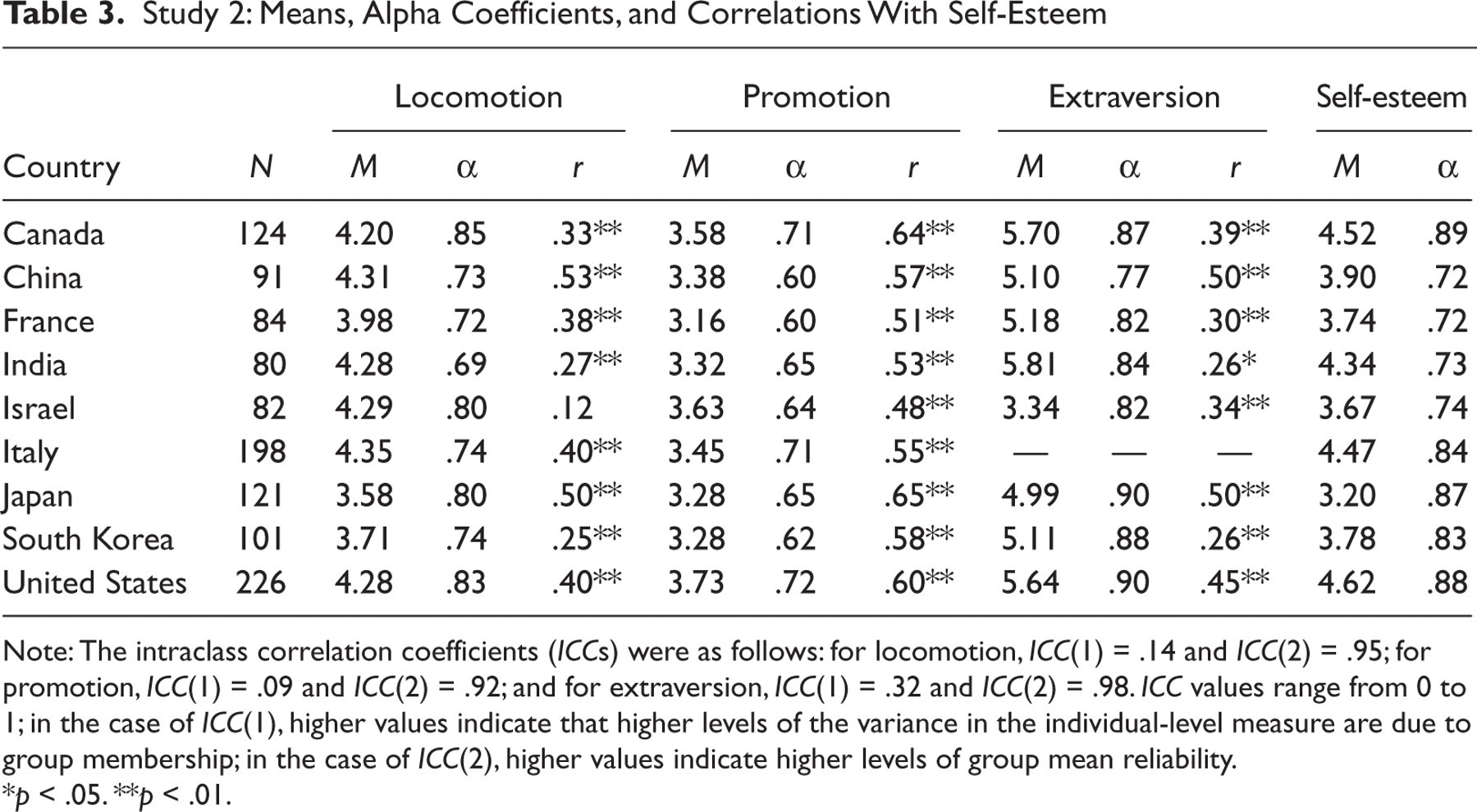
Note: The intraclass correlation coefficients (ICCs) were as follows: for locomotion, ICC(1) = .14 and ICC(2) = .95; for promotion, ICC(1) = .09 and ICC(2) = .92; and for extraversion, ICC(1) = .32 and ICC(2) = .98. ICC values range from 0 to 1; in the case of ICC(1), higher values indicate that higher levels of the variance in the individual-level measure are due to group membership; in the case of ICC(2), higher values indicate higher levels of group mean reliability.
p < .05. **p < .01.
We used the individual-level data on locomotion, promotion focus, and extraversion to create aggregate scores for these variables at the cultural level. We then analyzed whether these aggregation indices had an effect on the relationship between the corresponding personality traits and self-esteem at the individual level. To ensure the rigorousness of our test, we conducted a separate analysis with the same observer-rating extraversion data from McCrae et al. (2005) that we used in Study 1. In this analysis, the observer-rating extraversion data served as the cultural-level moderator of the individual-level relationship between the self-report extraversion and self-esteem data from Higgins et al. (2008). The footnote in Table 3 provides the ICC(1) and ICC(2) values of the three personality aggregates. For the analysis of self-report extraversion, data were collected from a total of 909 people from eight countries: Canada, China, France, India, Israel, Japan, South Korea, and the United States. The analysis with observer-rating extraversion from McCrae et al. (2005) did not include Israel. The analyses of locomotion and promotion focus included 1,107 people from the eight countries plus Italy.
Results
Random-coefficient modeling analyses of both observer-rating and self-report extraversion illustrated the person-culture match effect, thereby replicating Study 1 with a different data set. After we controlled for individualism, the positive relationship between individual-level extraversion and self-esteem was higher in societies with high levels of observer-rating extraversion compared with those with low levels of observer-rating extraversion (see Table 4; b = 0.01, SE = 0.002, p < .05). The aggregate scores of self-report extraversion from Higgins et al. (2008) showed the same effect (see Table 4; b = 0.19, SE = 0.02, p < .01).
Random-Coefficient Modeling Results for Cultural-Level Personality Aggregates as Moderators of the Relationship Between Individual-Level Personality and Self-Esteem in Study 2
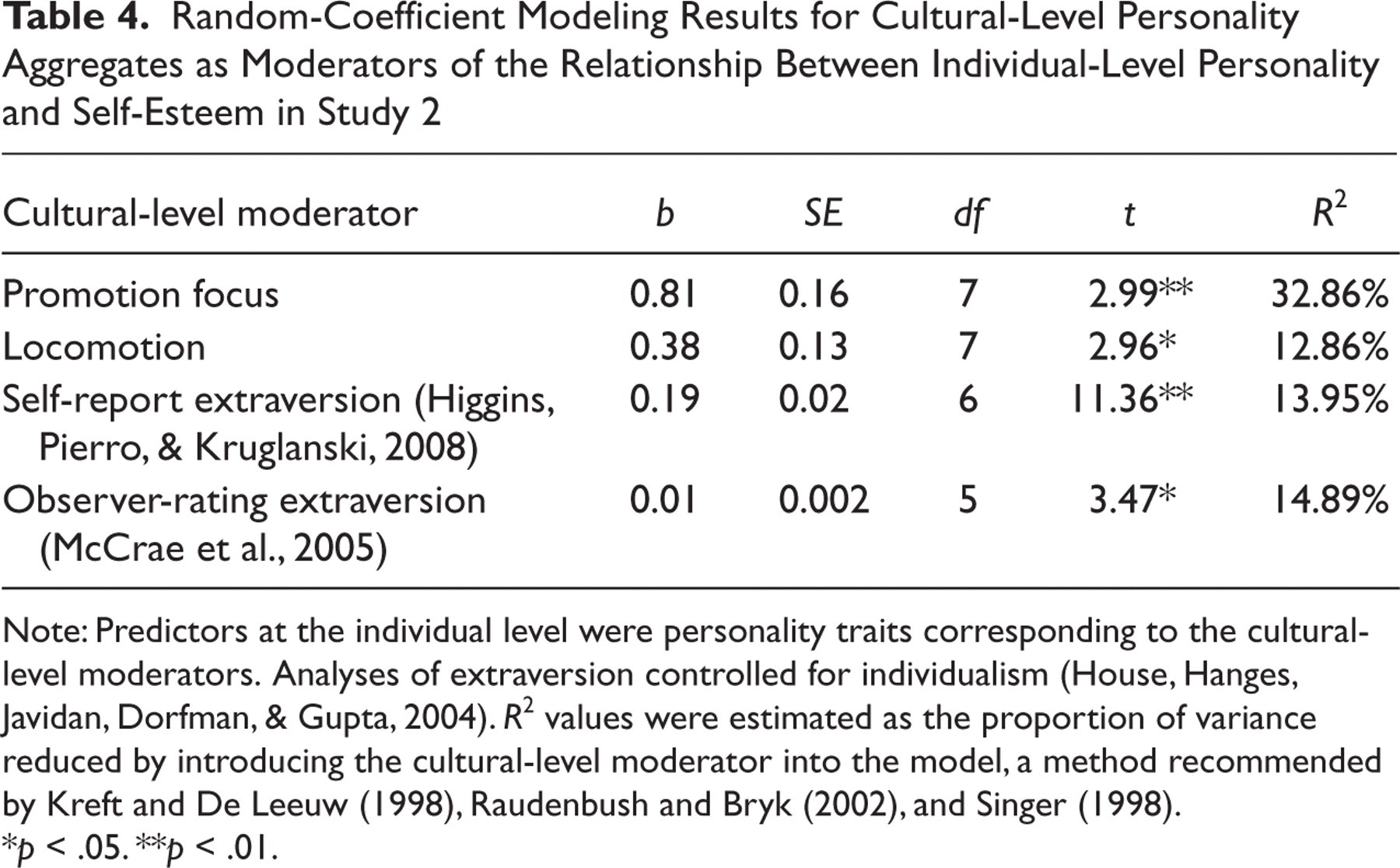
Note: Predictors at the individual level were personality traits corresponding to the cultural-level moderators. Analyses of extraversion controlled for individualism (House, Hanges, Javidan, Dorfman, & Gupta, 2004). R 2 values were estimated as the proportion of variance reduced by introducing the cultural-level moderator into the model, a method recommended by Kreft and De Leeuw (1998), Raudenbush and Bryk (2002), and Singer (1998).
p < .05. **p < .01.
Our analyses also corroborated the hypothesized person-culture match effect for promotion focus and locomotive regulatory mode. As can be seen in Table 4, the positive individual-level relationship between promotion focus and self-esteem was higher in countries with higher levels of promotion focus at the societal level (b = 0.81, SE = 0.16, p < .01). Likewise, the positive relationship between locomotive regulatory mode and self-esteem was higher in countries with higher levels of locomotion (b = 0.38, SE = 0.13, p < .05).
Discussion
Prior research has overwhelmingly focused on the main effect of personality factors on outcomes at the individual level, without paying explicit attention to contextual influences. In response to this state of affairs, Diener, Oishi, and Lucas (2003) have called for research “to examine units of analysis beyond simple traits and situations to find interactive effects of personality on subjective well-being” (p. 410).
In this report, we have advanced the person-culture match hypothesis and argued that when individual-level traits match the cultural aggregate, the relationship between those traits and positive psychological outcomes at the individual level is enhanced. Such a match is theorized to have a self-validating effect, suggesting that one is “all right” and the way one “should be,” as attested by one’s similarity to numerous other people in the social context. Results from two multilevel studies using three large-scale multicultural data sets supported our prediction. In these studies, we consistently found an advantageous effect of person-culture match on positive psychological outcomes (e.g., self-esteem and subjective well-being) for three personality factors (extraversion, locomotion, and promotion focus). The fact that our findings were conceptually replicated across three personality attributes with different data sets and four outcomes suggests that the person-culture match hypothesis is robust. More generally, our multilevel results suggest that one cannot gain a complete picture of the personality-outcome relationship at the individual level without considering the environment to which the individuals belong.
We acknowledge that the debate about measurement issues involved in assessing personality across cultures is ongoing (see Heine et al., 2008). Our analyses, however, focused on cross-level moderators, not main effects, and we did not compare cultural means directly, which would be particularly problematic if there are response biases. It is difficult to ascribe our theoretically driven, cross-level interactions to response biases. Likewise, we acknowledge that there is still controversy about the function and measure of self-esteem across cultures. Nonetheless, our studies replicated the expected effects across multiple dependent variables. Now that the person-culture match effect has been demonstrated, an important agenda for future research is to identify the precise mechanisms that account for these multilevel effects.
Our research has potential implications for cultural natives and migrants. Although numerous factors contribute to psychological well-being, all things being equal, people who match their cultural environment will experience better psychological well-being than people who do not. Furthermore, when relocating personnel, organizations cannot assume expatriates will enjoy a level of well-being in a host culture that is similar to their level of well-being in the native country and should consider the degree of person-culture match, among many other predictors of expatriate adjustment (Bhaskar-Shrinivas, Harrison, Shaffer, & Luk, 2005). Knowledge about the important role that cultural context plays in personality-outcomes relationships can be used effectively to both understand some cultural natives’ feelings of “mismatch” and prepare cultural migrants for the likely psychological impact of their transition.
Footnotes
Acknowledgements
We give special thanks to the members of the MURI (Multidisciplinary University Research Initiative) Culture Group at the University of Maryland for their helpful comments on previous versions of this manuscript. We also thank Jon Sun Lu and Megan Thorne.
The authors declared that they had no conflicts of interest with respect to their authorship or the publication of this article.
This research was supported by the United States Army Research Laboratory and the United States Army Research Office under Grant W911NF-08-1-0144.