







Abstract
Voluntary settlement on a frontier may promote values of independence. At present, however, researchers know little about the behavioral consequences of this process. In this study, we examined regional variations in baby naming. Because baby naming is an act of considerable personal and familial significance, it reflects prevalent cultural values. In support of the hypothesized link between frontier settlement and independence, we found that babies receive popular names less frequently in western regions of the United States than in its eastern regions (Study 1). The same pattern holds in Canada (Study 2), with popular names being less frequent in western provinces than in eastern provinces. Moreover, popular names are less frequently given to babies in world regions in which Europeans have settled (e.g., Australia, the United States) than in European countries (Study 3). These findings have implications for cross-generational transmission of cultural values.
According to the voluntary-settlement hypothesis (Kitayama, Conway, Pietromonaco, Park, & Plaut, 2010; Kitayama, Ishii, Imada, Takemura, & Ramaswamy, 2006), the conditions of frontier settlement attract independently oriented individuals (e.g., people high in openness to experience and low in agreeableness; Jokela, 2009). At the same time, frontier conditions breed independent orientations even among people who are initially more interdependent. This hypothesis is supported by the well-documented association between residential mobility and independent orientation (Oishi, Lun, & Sherman, 2007). However, it also moves beyond that association by specifying other features of the frontier that are likely to encourage independence, such as low population density and an associated herding economy (Uskul, Kitayama, & Nisbett, 2008), relative lack of social connections and institutions (Kitayama et al., 2010), decreased risk of pathogen infections (Fincher, Thornhill, Murray, & Schaller, 2008), and potentially high returns for risks taken (Kitayama et al., 2010).
Contemporary data showing that endorsement of individualistic values is stronger in recently settled U.S. states (e.g., Montana and Utah) than on the East Coast of the United States provides support for this account (Park, Conway, Pietromonaco, Plaut, & Kitayama, 2009; Plaut, Markus, & Lachman, 2002). Parallel differences can be observed between the residents of Hokkaido, which was settled by ethnic Japanese in the late 19th century, and the main islands of Japan (Kitayama et al., 2006), and between the United States and countries (e.g., England and Germany) that colonized it (Kitayama, Park, Sevincer, Karasawa, & Uskul, 2009). Values and psychological orientations of independence might then be expected to guide overt social behaviors to form the frontier ethos that is characterized by a strong commitment to personal autonomy, initiative, and uniqueness.
In an important study, Vandello and Cohen (1999) found that more recently settled U.S. regions scored higher than less recently settled U.S. regions on an index of the frequency of residents’ behaviors that could be guided by individualistic values (e.g., living alone after age 65, self-employment, and divorce). Yet most of the behaviors tested by Vandello and Cohen can also be strongly influenced by factors that are conceptually distinct from independence or individualism per se. For example, the percentage of individuals who are self-employed will depend on the availability of employment opportunities in a given region. Likewise, the divorce-marriage ratio may change as a function of such factors as religiosity and spousal abuse. We sought to fill this knowledge gap by examining a deliberate behavioral choice of substantial consequence that is clearly linked to independent values: namely, giving uncommon names (as opposed to popular names) to new babies.
The choice that parents make between popular names and relatively uncommon names for their children has face validity as an indicator of independent beliefs and values. Therefore, it was used recently by Twenge, Abebe, and Campbell (2010) in their study of cultural changes in independence in the United States. They observed that independence, as assessed in terms of how parents name their children, has increased over the past several decades within the United States. Naming practices embody important cultural values (Liebersen & Bell, 1992) and are linked to a host of psychological, social, and economic outcomes (Christenfeld & Larsen, 2008). Furthermore, choosing a name is viewed as a fairly important decision, one of great interest to parents (a recent Google search for “baby names” returned 8 million results) and one that is often made after lengthy deliberation, sometimes even with the aid of paid professionals (Alter, 2007).
Consistent with the voluntary-settlement hypothesis, our prediction was that popular names would be chosen on frontiers less often than in comparable regions that have little or no history of frontier settlement. In three studies, we tested this prediction in terms of both within-country and cross-national variation. We computed the percentages of four naming variables: babies given (a) the most popular boy’s name, (b) the most popular girl’s name, (c) 1 of the 10 most popular boys’ names, and (d) 1 of the 10 most popular girls’ names in their respective state (Study 1), province (Study 2), or country (Study 3).
Study 1
In this study, we compared regions of the United States that were more recently settled with regions that were less recently settled. Specifically, we predicted that a greater percentage of babies would be given popular names in New England than in the Pacific Northwest and Mountain West regions (see Table S1 in the Supplemental Material available online for a listing of the states in these regions). Furthermore, we predicted that the year in which states were admitted to the United States (a proxy for length of settlement) would be negatively correlated with the percentage of children receiving popular names.
Method
We gathered data on names from the Social Security Administration’s (2010) database of popular baby names for each state in 2007. This database represents a complete sample of Americans born in 2007 who were issued Social Security cards (N = 4,309,707). We also gathered data on the number of live births and the percentage of the Caucasian population per state in 2007 from the U.S. Census Bureau’s (2008) Statistical Abstract of the United States, 2007. We then computed the percentages of the four naming variables for each of the states in the New England region (which were some of the earliest established in the United States) and for each of the frontier states in the Mountain West and Pacific Northwest regions (which were more recently settled).
Results
As predicted, a greater percentage of babies were given popular names in the New England states than in the frontier states (Table S1 in the Supplemental Material presents data for individual states). This held true for all states in those regions on each of the four variables. A one-way analysis of variance (ANOVA) comparing the two regions (Region 1 = New England, Region 2 = Mountain West and Pacific Northwest) found that a greater percentage of babies were given the most popular boy’s name, F(1, 12) = 65.85, p < .001, d = 4.47, or the most popular girl’s name, F(1, 12) = 61.67, p < .001, d = 4.00, in New England than in the frontier states. We observed the same pattern of regional difference in the percentage of babies given 1 of the 10 most popular boys’ names, F(1, 12) = 70.78, p < .001, d = 4.39, or 1 of the 10 most popular girls’ names, F(1, 12) = 103.80, p < .001, d = 5.34. We obtained comparable results after sorting the states into quintiles based on the percentage of babies given 1 of the 10 most common boys’ or girls’ names (see Figs. 1a and 1b). The results did not change when we controlled for state-wise percentages of various ethnic minorities (see Supplementary Information in the Supplemental Material).
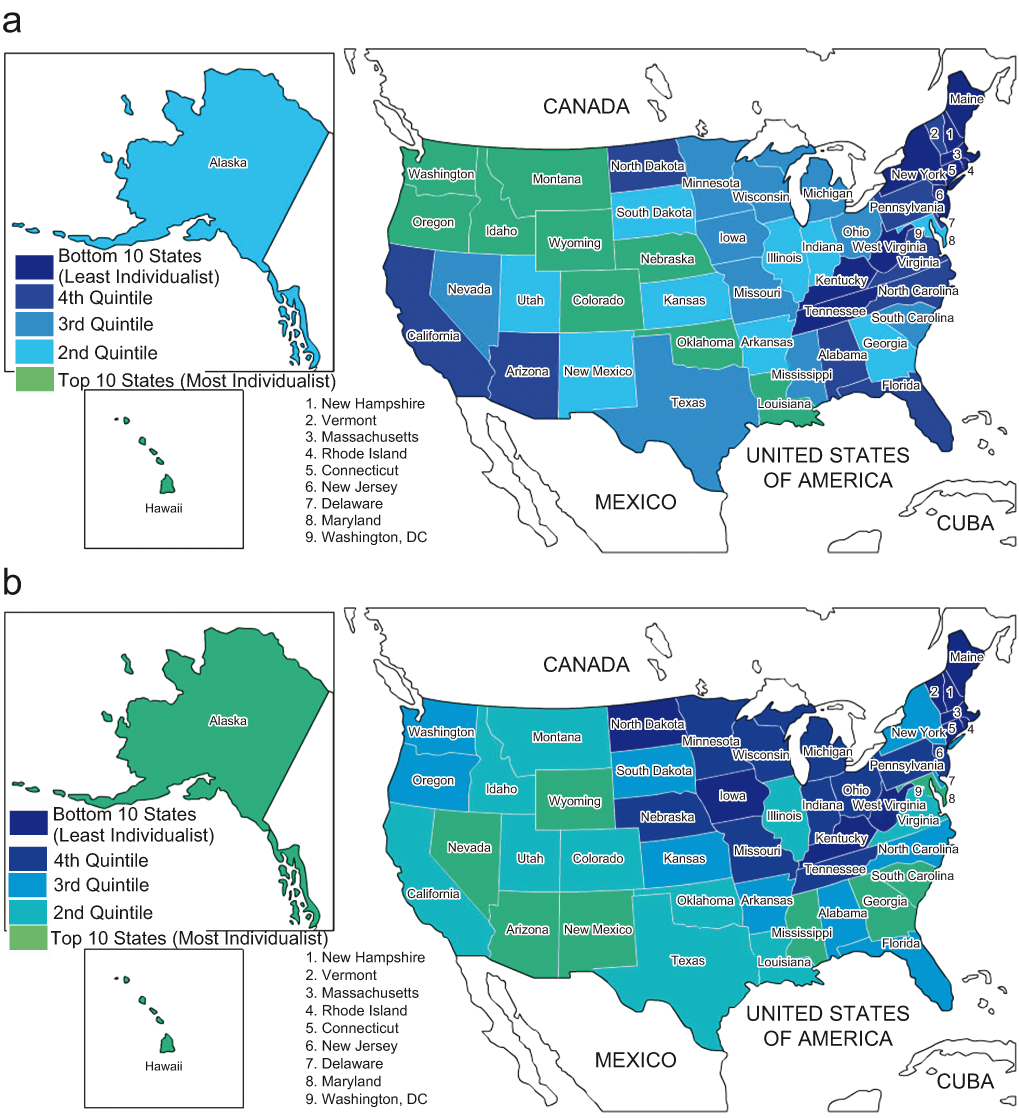
Relative frequency of popular names in the United States (Study 1). States were grouped by quintile according to the percentage of babies given any of the 10 most popular names in their state. Results are shown for (a) boys and (b) girls.
When we examined the correlation between the relative frequency of popular baby names and the year in which each of the 50 states was admitted to the United States, we found that the year in which statehood was achieved was negatively correlated with the percentage of infants receiving the most popular boy’s name, r = −.52, p < .001, and the percentage of infants receiving the most popular girl’s name, r = −.45, p < .001, as well as the percentage receiving 1 of the 10 most popular boys’ names, r = −.60, p < .001, or 1 of the 10 most popular girls’ names, r = −.44, p < .001 (see Figs. 2a and 2b). These relations remained unchanged when we controlled for median income and population density (see Table 1); controlling for state-wise percentages of various ethnic minorities, including Hispanics, Blacks, and Asians, also did not change these relations (see Supplementary Information in the Supplemental Material).
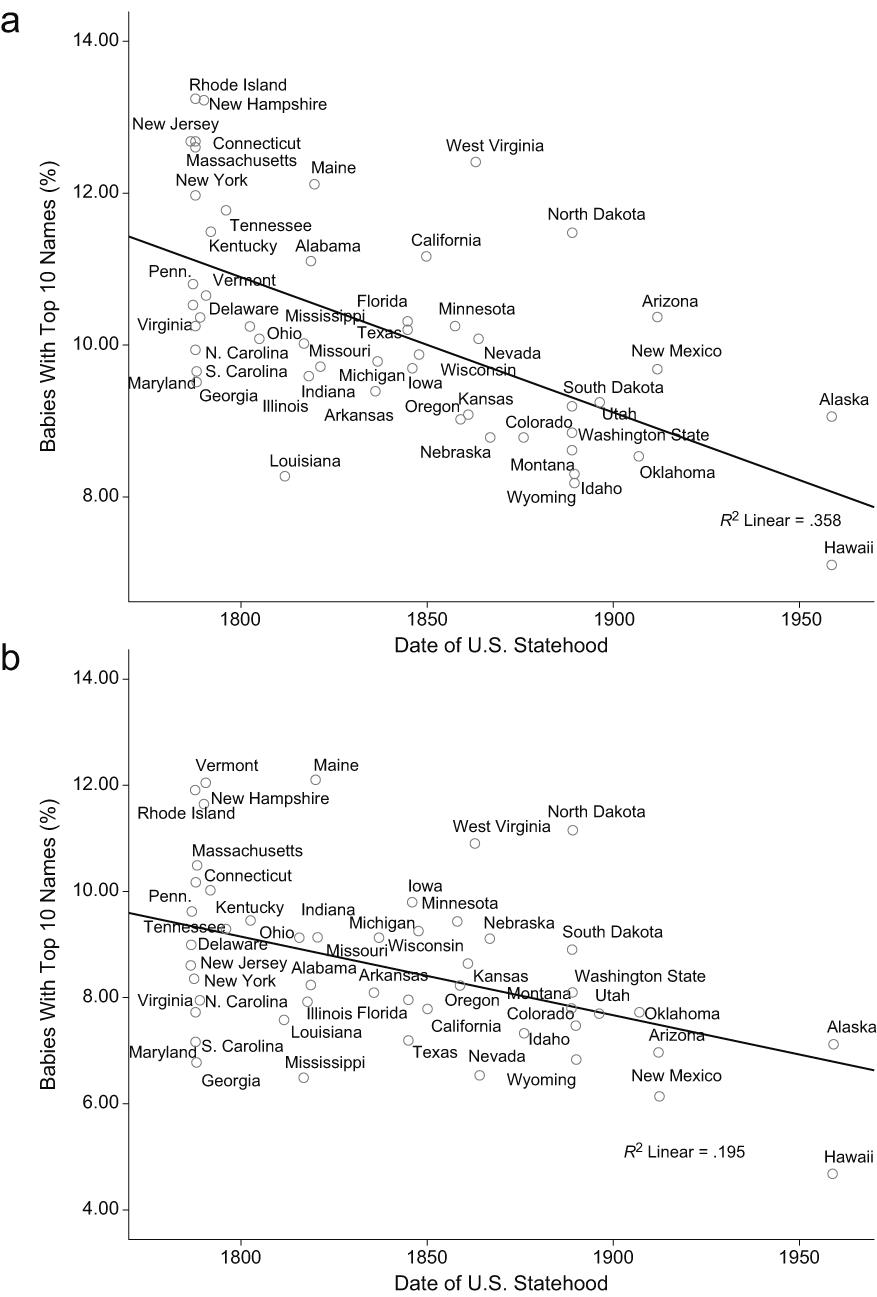
Correlation between the date on which U.S. statehood was granted and the percentage of babies given any of the 10 most popular names in their respective state (Study 1). Scatter plots (with best-fitting regression lines) show results for (a) boys and (b) girls.
Study 1: Effect of Date of Statehood and Other Factors on Naming Practices in the 50 U.S. States
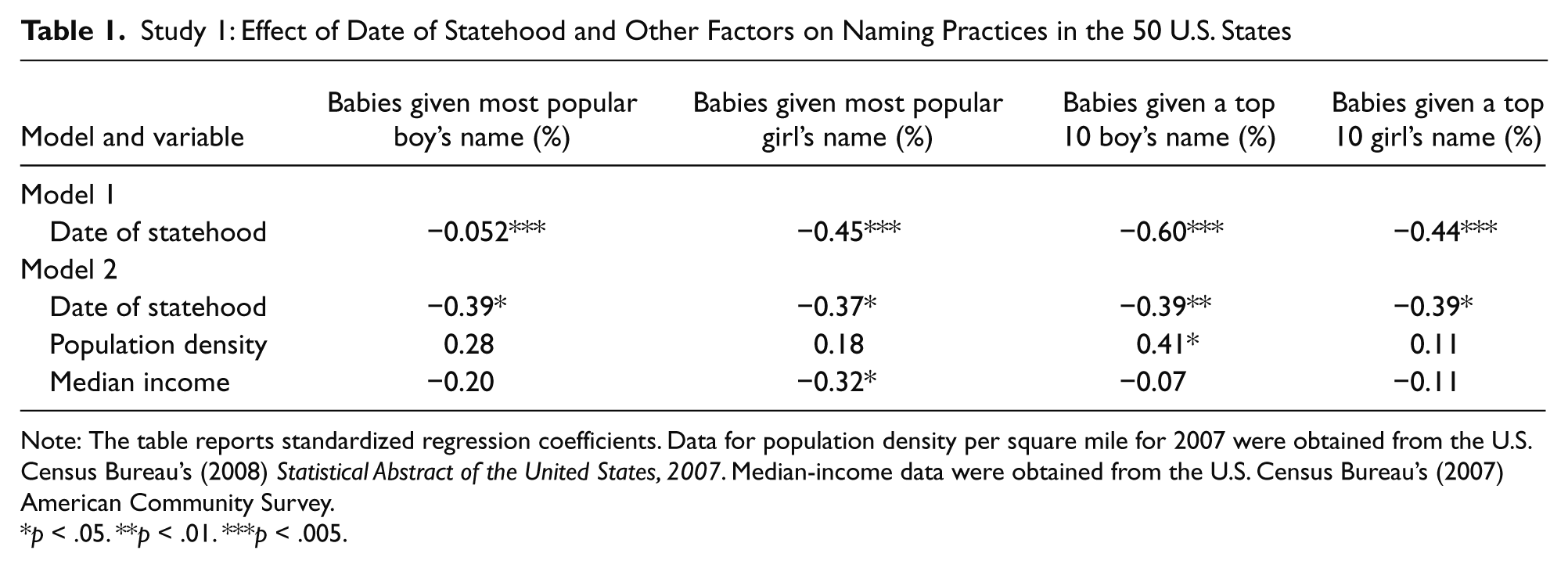
Note: The table reports standardized regression coefficients. Data for population density per square mile for 2007 were obtained from the U.S. Census Bureau’s (2008) Statistical Abstract of the United States, 2007. Median-income data were obtained from the U.S. Census Bureau’s (2007) American Community Survey.
p < .05. **p < .01. ***p < .005.
Study 2
In Study 2, we sought to replicate the regional differences observed in Study 1 in another country with a history of voluntary settlement: Canada. We predicted that a greater percentage of babies would be given popular names in provinces in the eastern regions of Canada (which were settled earlier) than in provinces in the western regions of Canada (which were settled more recently).
Method
We gathered data on baby names in 2007 for seven provinces, including three eastern provinces (Nova Scotia, Ontario, and Quebec) and four western provinces (Alberta, British Columbia, Manitoba, and Saskatchewan). Data on names and live births were gathered from the responsible authorities in each province (see Supplementary Information in the Supplemental Material for a complete list of sources; note that the Ontario data came from 2003). We computed the percentages of the four naming variables for each eastern province and for each western province.
Results
Consistent with our predictions, our results showed that popular names were relatively more common in eastern Canada than in western Canada (Table S2 in the Supplemental Material provides data for individual provinces). A one-way ANOVA comparing the two regions (Region 1 = eastern Canadian provinces, Region 2 = western Canadian provinces) found that a greater percentage of babies were given the most popular boy’s name in eastern Canada, F(1, 5) = 26.78, p = .004, d = 4.00. Although the pattern was the same for the most popular girl’s name, the difference did not reach statistical significance, F(1, 5) = 3.51, p = .12, d = 1.3. We observed the same pattern of regional difference in the percentage of babies given 1 of the 10 most popular boys’ names, F(1, 5) = 22.76, p = .005, d = 3.29, or 1 of the 10 most popular girls’ names, F(1, 5) = 5.73, p = .06, d = 1.65. Controlling for the percentage of the population that indicated French or another language as its mother tongue did not affect the results, all Fs > 14, all ps < .02. Controlling for population density did not affect the regional differences in prevalence of the top boys’ name, F(1, 4) = 18.90, p < .02, or of the top 10 boys’ names, F(1, 4) = 61.49, p = .001; however, it eliminated the effect of region on the top girl’s name and the top 10 girls’ names, Fs < .02, ps > .90.
Study 3
Study 1 and Study 2 provided evidence that regional variation in choosing a popular or relatively uncommon name corresponds to the history of settlement within both the United States and Canada. Would corresponding differences be observed when European countries are compared with countries founded by European immigrants? Study 3 addressed this question. We predicted that a smaller percentage of babies would be given popular names in countries with a history of voluntary settlement by Europeans than in the European countries where those settlers originated. We also sought to test whether the naming practices were correlated with Hofstede’s Individualism scores (Hofstede, Hofstede, & Minkov, 2010). In addition, we examined the strength of the relationship between voluntary settlement and naming practices when controlling for other dimensions of cross-cultural difference that have been linked to cross-national differences in independence.
Method
We gathered data on names and live births for 2007 for nine European countries (Austria, Denmark, England, Hungary, Ireland, Norway, Scotland, Spain, and Sweden) and four frontier countries (Australia, Canada, New Zealand, and the United States; see Supplementary Information in the Supplemental Material for a complete list of data sources). For Australia and Canada, we aggregated the available territory- and province-level data. We calculated the percentages of the four naming variables for each European country and for each frontier country.
Results
Consistent with our predictions, our results showed that popular names were relatively less common in the frontier countries than in the European countries (see Table S3 in the Supplemental Material for data by country). A one-way ANOVA comparing the two regions (Region 1 = European countries, Region 2 = frontier countries) found that a smaller percentage of babies were given the most popular boy’s name, F(1, 11) = 11.63, p = .006, d = 2.31, or the most popular girl’s name, F(1, 11) = 6.59, p = .03, d = 1.80, in the frontier countries than in European countries. We found the same pattern for the percentage of babies given 1 of the 10 most popular boys’ names, F(1, 11) = 18.43, p = .001, d = 2.97, or 1 of the 10 most popular girls’ names, F(1, 11) = 18.97, p = .001, d = 3.05.
We next examined the correlation between countries’ scores on Hofstede’s Individualism dimension and the percentage of newborns who received popular names in those countries. All four measures of the percentage of babies who received popular names were highly negatively correlated with country-level Individualism scores, rs ranged from −.53 to −.70, ps ranged from .07 to .008; this suggests that naming practices are a valid index of independence (see Figs. 3a and 3b and Table S4 in the Supplemental Material). Individualism scores remained a strong predictor of naming practices even when we simultaneously controlled for gross domestic product (GDP) per capita, population density, and historical pathogen prevalence, βs ranged from −0.54 to −0.71, ps ranged from .05 to .003.
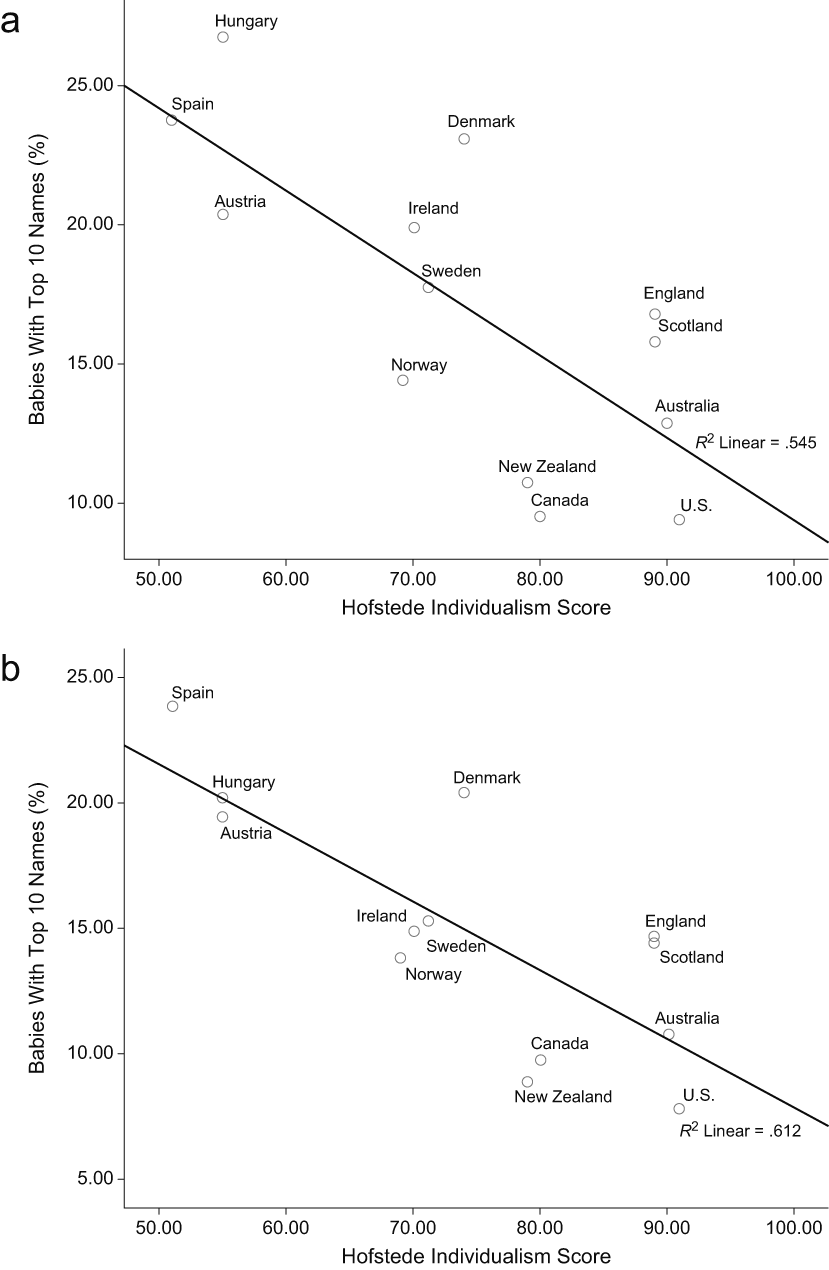
Correlation between Hofstede Individualism score (Hofstede, Hofstede, & Minkov, 2010) and the percentage of babies given any of the 10 most popular names in their respective country (Study 3). Scatter plots (with best-fitting regression lines) show results for (a) boys and (b) girls.
In order to assess the effect of settlement history, we ran a series of regressions with voluntary settlement dummy-coded and entered both alone and simultaneously with three other predictors: population density per square kilometer, GDP per capita, and countries’ scores on Murray and Schaller’s (2010) nine-item index of historical pathogen prevalence. We added historical pathogen prevalence because countries with histories of greater disease prevalence also tend to be more collectivistic and less individualistic (Fincher et al., 2008; Murray & Schaller, 2010). The effect of voluntary settlement remained significant for all four naming variables when we simultaneously controlled for these three other variables (βs ≤ −0.68, ps ≤ .02). This result suggests that settlement history has an effect on naming practices above and beyond the effects of several other variables that have been linked to cross-national variation in individualism (see Table 2).
Study 3: Effect of Voluntary Settlement and Other Factors on Naming Practices
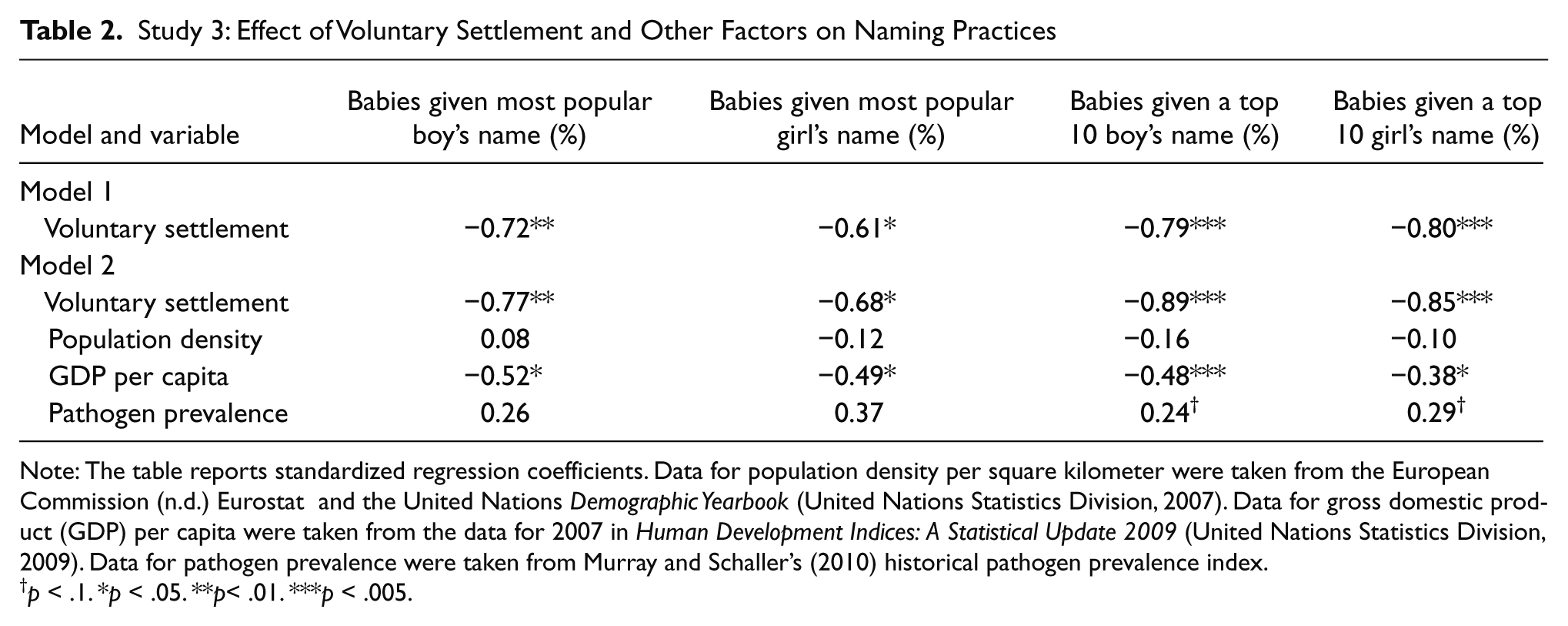
Note: The table reports standardized regression coefficients. Data for population density per square kilometer were taken from the European Commission (n.d.) Eurostat and the United Nations Demographic Yearbook (United Nations Statistics Division, 2007). Data for gross domestic product (GDP) per capita were taken from the data for 2007 in Human Development Indices: A Statistical Update 2009 (United Nations Statistics Division, 2009). Data for pathogen prevalence were taken from Murray and Schaller’s (2010) historical pathogen prevalence index.
p < .1. *p < .05. **p< .01. ***p < .005.
Discussion
In three studies, we found that regional variations in baby naming corresponded to differences in those regions’ history of settlement. People are more likely to choose a relatively popular name in regions with a longer history of settlement, and people in regions that were more recently settled are more likely to choose a relatively uncommon name. This phenomenon is evident not only within the United States (Study 1), but also in Canada (Study 2), and was also found in a cross-national comparison involving European countries and countries founded by European settlers (Study 3). This regional variation in naming practices is robustly predicted by the corresponding variation in individualism when controlling for a number of demographic factors.
We should also note that across the three studies, boys were somewhat more likely to receive popular names than girls were. The gender effect, however, did not depend on whether or not a region was a frontier. We suspect that the gender effect might reflect parental expectations. In particular, our conjecture is that parents might wish their baby girls to be unique and independent relative to their baby boys. This may be in part because parents are well aware that their girls are likely to be subject to more stringent gender-based societal rules than boys are as they grow (Cross & Madson, 1997).
Our work is the first that clearly shows the significant influence of frontier settlement, in multiple cases, on a common behavioral measure of independence that has obvious ecological and cultural validity. We believe that harsh, sparsely populated, and socially mobile frontier conditions foster values of independence, and that, as a consequence, behaviors that are guided by these values are more common in frontier than in nonfrontier regions. Such behaviors are likely to be incorporated into the regional cultural ethos, and, as a consequence, they may be transmitted across generations even when the geographic frontiers have long since disappeared. The study of regional variation, then, may afford a significant opportunity for further explorations into cultural change and the transmission of cultural values and practices.
Supplemental Material
sj-pdf-1-pss-10.1177_0956797610395396 – Supplemental material for What’s in a Name?
Supplemental material, sj-pdf-1-pss-10.1177_0956797610395396 for What’s in a Name? by Michael E.W. Varnum and Shinobu Kitayama in Psychological Science
Footnotes

References
Supplementary Material
Please find the following supplemental material available below.
For Open Access articles published under a Creative Commons License, all supplemental material carries the same license as the article it is associated with.
For non-Open Access articles published, all supplemental material carries a non-exclusive license, and permission requests for re-use of supplemental material or any part of supplemental material shall be sent directly to the copyright owner as specified in the copyright notice associated with the article.
