







Abstract
Why are there national differences in the propensity to bribe? To investigate this question, we conducted a correlational study with cross-national data and a laboratory experiment. We found a significant effect of the degree of collectivism versus individualism present in a national culture on the propensity to offer bribes to international business partners. Furthermore, the effect was mediated by individuals’ sense of responsibility for their actions. Together, these results suggest that collectivism promotes bribery through lower perceived responsibility for one’s actions.
Keywords
There is remarkable consensus transcending national boundaries that bribery is a morally repugnant business practice (Husted, Dozier, McMahon, & Kattan, 1996). Yet more than $1 trillion, or 3% of the world gross domestic product (GDP), are paid annually in bribes, a scale of graft that stymies economic growth and threatens democratic and moral values (The World Bank, 2004). Furthermore, cross-national data, such as Transparency International’s Bribe Payers Index (BPI), which rates countries on the perceived willingness of their companies to bribe abroad, suggest substantial variability across national cultures in the propensity to initiate bribes (Riaño & Hodess, 2008).
Given the proliferation of bribery and the fact that it represents one of the biggest threats to national welfare, worldwide efforts are being conducted to curb it, primarily by improving governance and transparency (Wu, 2005). What has not been sufficiently considered, however, is whether and how national culture might shape the propensity to initiate bribes (Martin, Cullen, Johnson, & Parboteeah, 2007; Triandis et al., 2001).
Collectivism and Moral Disengagement
Because bribery is considered morally repugnant, a decision to offer a bribe typically involves a conflict of interest: a dilemma between upholding one’s moral standards and enjoying unfair benefits from bribing, such as winning a contract. The standard theories of moral agency suggest that individuals desire to live in accordance with their moral standards and refrain from bribery through motivated self-regulatory mechanisms that help individuals to exercise moral agency. Recent theories in social cognition and morality suggest, however, that there are several psychological processes by which individuals can selectively disengage internal moral control to permit detrimental conduct without violating their moral standards. In particular, self-sanctions can be disengaged by reinterpreting one’s actions or the negative consequences of one’s actions, vilifying the target of one’s actions, and, most strongly, by obscuring personal causal agency through diffusion or displacement of responsibility (Bandura, Barbaranelli, Caprara, & Pastorelli, 1996; Mazar, Amir, & Ariely, 2008). Thus, the easier it is for individuals to employ any of these mechanisms and deactivate moral control, the more likely they are to engage in immoral behavior, such as initiating a bribe.
One of the prominent dimensions of a national culture is its degree of collectivism, or the extent to which individuals in that culture see themselves as interdependent and part of a larger group or society (Hofstede, 1980; House, Hanges, Javidan, Dorfman, & Gupta, 2004). According to previous research, individuals in collectivist cultures, relative to those in individualist cultures, tend to hold more favorable attitudes toward sharing responsibilities (Hui, 1988), perceive risky actions as less risky because they see their group or society as providing a “cushion” that would protect them from harm (Hsee & Weber, 1999), make situational rather than dispositional attributions, and have a weaker sense that they themselves—rather than society—determine who they are (Triandis, 2001). Together, these characteristics should make it easier for individuals to selectively disengage regulatory self-sanctions from detrimental conduct through diffusion or displacement of responsibility and, thus, result in a higher likelihood to engage in detrimental conduct without violating their own moral standards. Consequently, we hypothesized that individuals in collectivist cultures would show a higher propensity to bribe abroad than those in individualist cultures and that this effect would be mediated by collectivists’ lower perceived responsibility for their actions. We tested this premise with two studies: one cross-national correlational investigation and one laboratory experiment.
Study 1: Cross-National Analysis
In the first study, we tested the correlation between the degree of collectivism present in a national culture and the propensity of that country’s companies to offer bribes abroad while controlling for different levels of national wealth. To conduct the analysis, we used three independent measures: (a) Transparency International’s 2008 BPI scores (Riaño & Hodess, 2008), (b) the In-Group Collectivism Practices scores from the Global Leadership and Organizational Behavior Effectiveness (GLOBE) study (House et al., 2004), and (c) countries’ per capita GDP adjusted by purchasing power parity (Central Intelligence Agency, 2009).
Transparency International’s 2008 BPI rated 22 of the world’s leading exporting countries in 2006 according to the tendency of those countries’ firms to bribe abroad. The combined global exports and outflows of foreign investment of these 22 countries represented 75% of the world total in 2006. BPI scoring was based on surveys of 2,742 senior business executives from 26 major importing countries that have commercial relationships with the 22 rated countries. In particular, the executives were asked to assess the frequency with which companies from these 22 countries offer bribes when operating in the executives’ countries—in effect controlling for the demand side of the bribes. Higher scores indicate a lower tendency to offer a bribe (Riaño & Hodess, 2008).
The GLOBE In-Group Collectivism Practices score rated 62 countries on the actual “degree to which individuals express pride, loyalty, and cohesiveness in their organizations or families” (House et al., 2004, p. 12). The scoring was based on the responses of 17,300 middle managers in 951 organizations between 1994 and 1997. In particular, we used the adjusted scores that corrected for cultural response biases. 1 Higher scores indicate greater collectivism.
Complete country-level data were available for 21 countries. For ease of comparison, we log transformed all the variables. 2 The regression model explained 75.4% of the variance (root mean square error, or RMSE = 0.058). As results for Model 1 in Table 1 show, national wealth was negatively related with the propensity to offer bribes, t(18) = 2.855, p = .011; semipartial r = .333. That is, the higher a country’s per capita GDP, the lower its companies’ propensity to offer bribes abroad. More important, the more collectivist a national culture, the higher its companies’ propensity to offer bribes, t(18) = −4.284, p < .001; semipartial r = −.5. 3 Controlling for wealth, we found that the degree of collectivism explained over half of the residual variability in the propensity to bribe, partial r = −.711. Furthermore, the effect of collectivism held when we controlled simultaneously for wealth and for GLOBE’s response-bias-adjusted Humane Orientation Practices score (House at al., 2004), which reflects prosocial and ethical considerations—a proxy for moral standards (Table 1, Model 2).
Study 1 Results: Log-Log Linear Regressions Predicting Level of Corruption
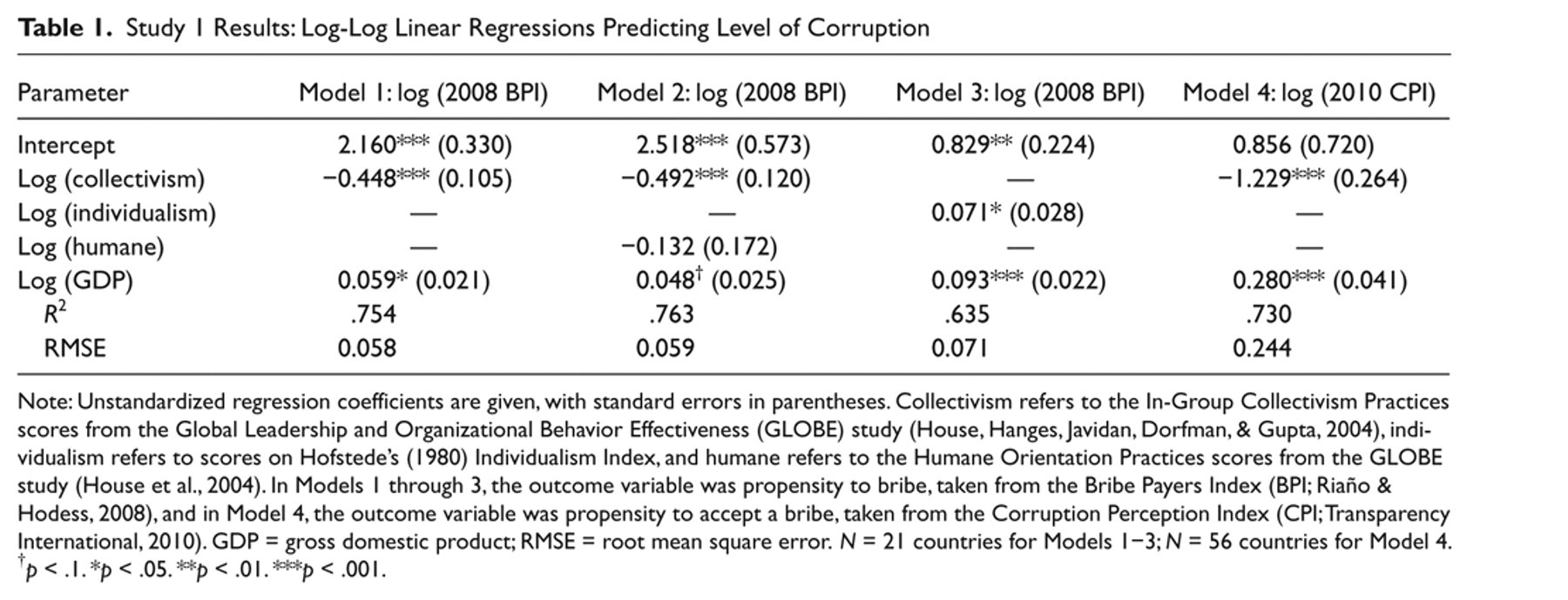
Note: Unstandardized regression coefficients are given, with standard errors in parentheses. Collectivism refers to the In-Group Collectivism Practices scores from the Global Leadership and Organizational Behavior Effectiveness (GLOBE) study (House, Hanges, Javidan, Dorfman, & Gupta, 2004), individualism refers to scores on Hofstede’s (1980) Individualism Index, and humane refers to the Humane Orientation Practices scores from the GLOBE study (House et al., 2004). In Models 1 through 3, the outcome variable was propensity to bribe, taken from the Bribe Payers Index (BPI; Riaño & Hodess, 2008), and in Model 4, the outcome variable was propensity to accept a bribe, taken from the Corruption Perception Index (CPI; Transparency International, 2010). GDP = gross domestic product; RMSE = root mean square error. N = 21 countries for Models 1−3; N = 56 countries for Model 4.
p < .1. *p < .05. **p < .01. ***p < .001.
Although this first study yielded initial evidence of a strong relationship between collectivism and bribery, the results were purely correlational. To examine whether a causal relationship actually exists between these two constructs and, if so, what kind of relationship it is, we next conducted a laboratory experiment.
Study 2a: Responsibility for One’s Actions—A Mediation Analysis
One hundred forty business students (70 females, 70 males; mean age = 20.4 years, SD = 1.8 years) participated in the experiment for course credit. Participants were randomly assigned to one of two priming conditions in a between- participants design: They were primed with either an individualist or a collectivist mind-set through a word-search task adapted from Gardner, Gabriel, and Lee (1999); this task has been demonstrated to shift the degree to which individuals consider themselves interdependent. The word-search task involved paragraphs describing a trip to the city. The two versions of the task differed only with respect to whether the pronouns were individualist (e.g., I, mine) or collectivist (e.g., we, ours). Participants were instructed to circle all the pronouns in the paragraph.
Subsequently, we exposed participants to a scenario in which they assumed the role of a sales agent who had to compete against two other firms to win a contract from an international buyer and earn a commission (the text given to participants in this scenario is provided in the Supplemental Material available online). The sales agent was contemplating whether to offer an unofficial payment (bribe) to the potential international buyer to help win this contract. Next, participants were asked to make a choice between offering and not offering a bribe, and to indicate the degree of perceived responsibility for their actions, how much they wanted to win the contract, how wrong they thought it was to offer the bribe, what the likelihood was that the other two companies would offer a bribe, and what the likelihoods were of winning the contract if they chose to offer or not offer a bribe. Finally, we administered a set of four mood items (sad/happy, bad/good, dissatisfied/satisfied, displeased/pleased) and four arousal items (tired/energetic, calm/excited, down/elated, sedated/aroused). As noted, we expected that participants in the collectivist condition would exhibit a greater likelihood to offer a bribe than participants in the individualist condition would, and that this effect would be driven by a lower perceived responsibility for their actions.
A chi-square test revealed a significant effect of the prime on the decision to bribe: 58.3% of participants primed with the collectivist mind-set decided to offer a bribe versus 39.7% primed with the individualist mind-set, χ2(1, N = 140) = 4.855, p = .028 (see also Table 2, Model 1, for the result of an ordinal logistic regression). As Table 3 shows, the type of prime did not affect participants’ mood (Cronbach’s α = .867), arousal (Cronbach’s α = .778), or motivation to win the contract, nor did it affect their views of how wrong they thought it was to offer a bribe, the likelihood that the two other competing companies would offer a bribe, or the likelihoods of winning the contract if a bribe was offered or not offered (all ps > .2). It is important to note, however, that participants primed with a collectivist mind-set held themselves significantly less accountable for their actions than participants primed with an individualist mind-set held themselves for theirs (b = −0.593, SE = 0.23, p = .011), and this difference in perceived responsibility fully mediated the effect of the prime on participants’ decision to offer a bribe (see Table 2, Models 2 and 3; Sobel z = 2.255, SE = 0.232, p = .024).
Study 2a Results: Ordinal Logistic Regressions Predicting the Propensity to Offer a Bribe (N = 140)
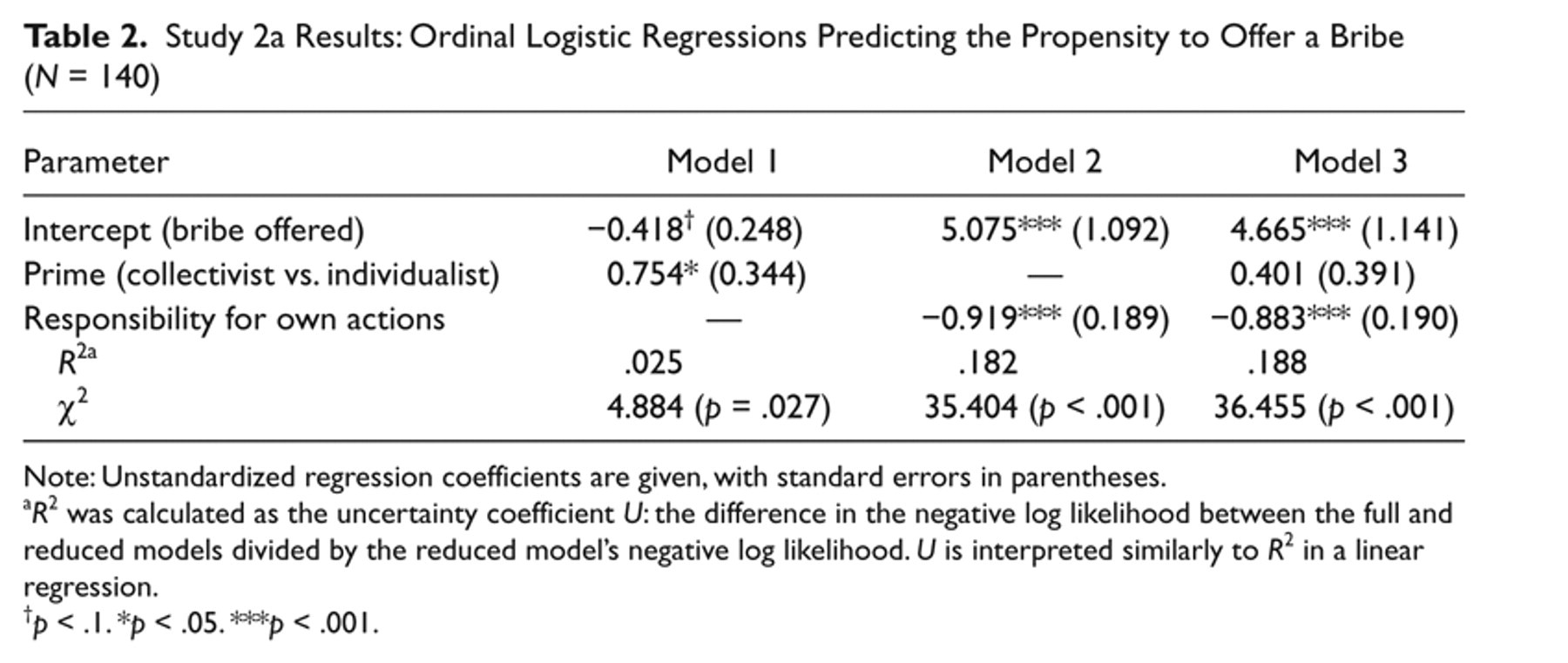
Note: Unstandardized regression coefficients are given, with standard errors in parentheses.
R 2 was calculated as the uncertainty coefficient U: the difference in the negative log likelihood between the full and reduced models divided by the reduced model’s negative log likelihood. U is interpreted similarly to R2 in a linear regression.
p < .1. *p < .05. ***p < .001.
Study 2a Results: Mean Scores and Results of t Tests Comparing the Collectivist- and Individualist-Prime Conditions
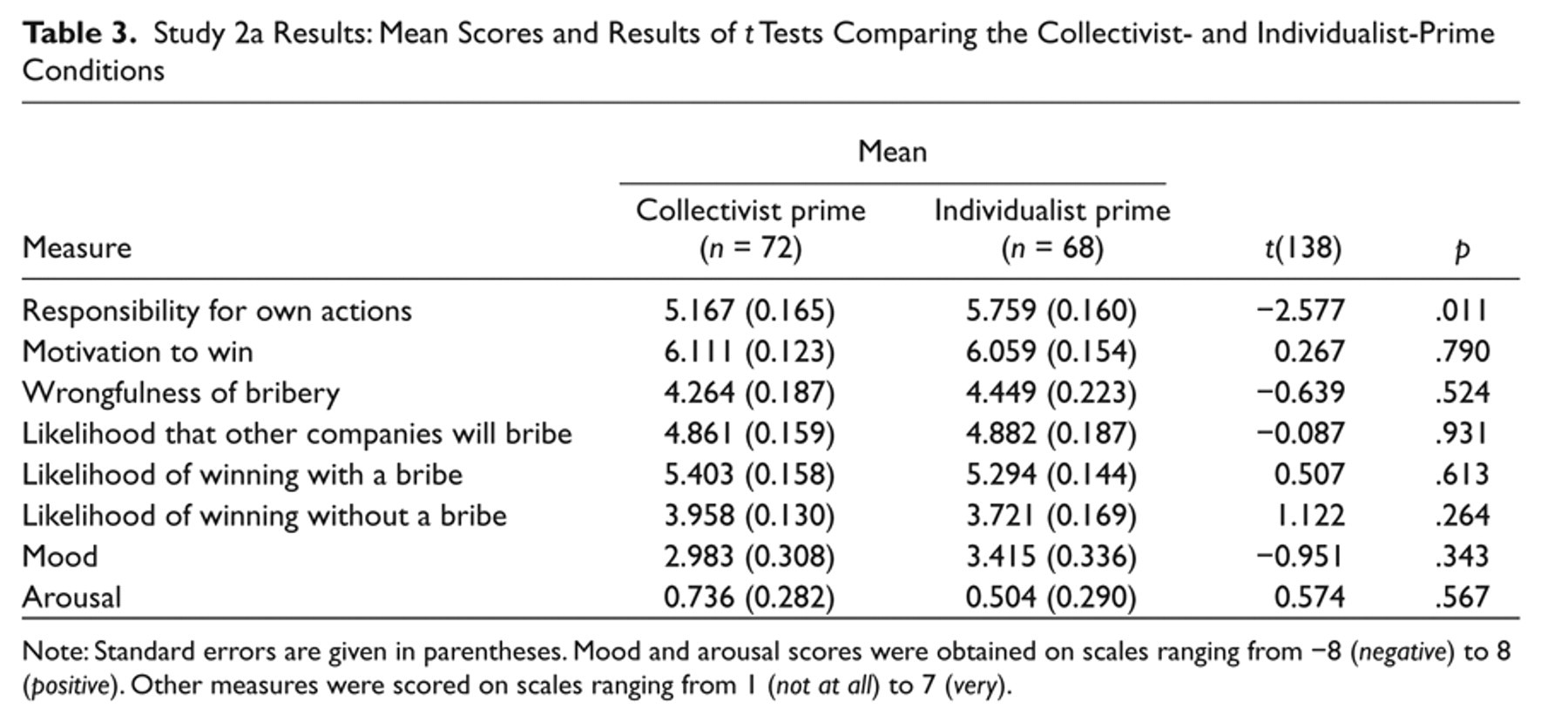
Note: Standard errors are given in parentheses. Mood and arousal scores were obtained on scales ranging from −8 (negative) to 8 (positive). Other measures were scored on scales ranging from 1 (not at all) to 7 (very).
We also tested the alternative account that participants’ lower perceived responsibility for their actions was due to a post hoc rationalization consequent to the decision to bribe rather than a direct effect of the prime. An analysis of the reverse causal model revealed a weaker significant mediation (Sobel z = 2.05, SE = 0.451, p = .04). In addition, controlling for the decision to bribe (b = 1.225, SE = 0.21, p < .001), we found that the prime still had a marginally significant effect on perceived responsibility (b = −0.364, SE = 0.21, p = .085). This analysis thus supports the notion that perceived responsibility for one’s actions was directly affected by the prime and mediated the decision to bribe. Nevertheless, to further support our model, we ran a posttest of this scenario study that examined the prime’s effect on perceived responsibility for one’s actions in the absence of the decision to bribe.
Study 2b: Posttest of the Causal Relationship
Forty-seven business students (35 females, 12 males; mean age = 20.3 years, SD = 1.5 years) participated in the experiment for course credit. The experiment was similar to Study 2a, with two exceptions. First, and most important to the interpretation of our previous mediation analyses, participants only read the scenario without making a choice between offering and not offering a bribe. Second, we asked three questions not asked in Study 2a to rule out other potential explanations: In addition to indicating the degree of perceived responsibility for their actions, how much they wanted to win the contract, and how wrong they thought it was to offer a bribe, participants also indicated how responsible they felt for other people, how much power and control they felt they had, and to what extent they thought that they had no option but to offer the money.
As expected, even in the absence of the decision to bribe, which obviated any need for post hoc rationalization, participants primed with a collectivist mind-set held themselves significantly less accountable for their actions than participants primed with an individualist mind-set held themselves for theirs (p = .008; see Table 4). The two groups did not differ significantly on any of the other questions (all ps > .1).
Study 2b Results: Mean Scores and Results of t Tests Comparing the Collectivist- and Individualist-Prime Conditions
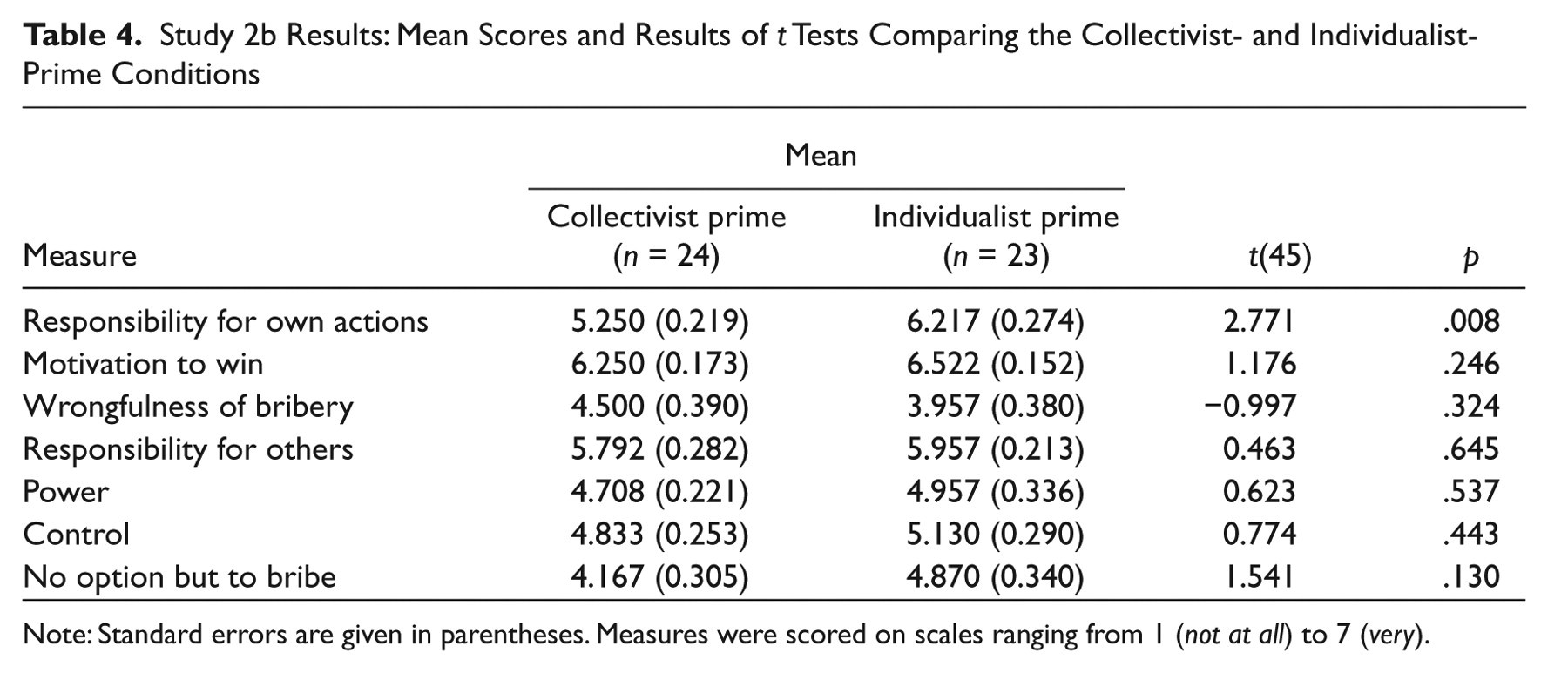
Note: Standard errors are given in parentheses. Measures were scored on scales ranging from 1 (not at all) to 7 (very).
General Discussion
Why are there differences between countries in the propensity to initiate bribes toward the same international business partner? Our results provide evidence that the degree of collectivism versus individualism present in a national culture plays a significant role. In particular, we extend previous work (Triandis et al., 2001) not only by presenting a more controlled correlational analysis spanning a larger set of countries, but also by demonstrating a causal relationship between collectivism and bribery. Furthermore, we identify a mediator of this effect. Together, our results suggest that collectivism promotes bribery by mitigating individuals’ perceived responsibility for their actions.
Finally, a note of caution: Our findings do not imply that collectivist practices promote immoral acts across the board. In fact, the GLOBE study shows a significant positive correlation between countries’ In-Group Collectivism Practices score and their Humane Orientation Practices score, which measures the degree to which societies “encourage and reward individuals for being fair, altruistic, friendly, generous, caring, and kind to others” (House et al., 2004, p. 13). This correlation is in line with the results of experimental research showing, for example, that a collectivist mind-set is positively correlated with helping and keeping track of other peoples’ needs (Clark, Mills, & Powell, 1986; Clark, Ouellette, Powell, & Milberg, 1987). In the studies reported here, we focused on a particular, novel context: offering bribes in an international (i.e., out-group) business exchange. Future research may examine to what extent our effects generalize to contexts involving people’s in-group, personal circumstances, and other types of immoral acts.
In sum, bribery is considered a serious global threat undermining the wealth and development of nations. Most corrective policies adopt the standard economic approach, which assumes that all it takes to curb bribery is to increase its external costs. That is, policies focus on increasing the magnitude of punishments for offering bribes and the likelihood of being caught by, for example, implementing stricter rules and regulations, bolstering law enforcement, and promoting greater transparency in the handling of transactions (Organisation for Economic Co-operation and Development, 2009). This article draws attention to cultural orientation as a contextual factor and the relevance of internal control mechanisms in the choice to bribe. In particular, identifying perceived responsibility for one’s actions as a mediating factor is an important first step in understanding the psychological processes underlying cross-national differences in individuals’ likelihood to initiate bribes and in designing a richer, complementary set of policies to curb the supply side of corruption and its staggering costs (Amir et al., 2005).
Footnotes
The authors declared that they had no conflicts of interest with respect to their authorship or the publication of this article.
This research was supported by grants from the Michael Lee-Chin Family Institute for Corporate Citizenship at the Rotman School of Management, University of Toronto, and from the Social Sciences and Humanities Research Council of Canada.
1.
Our results hold for the unadjusted GLOBE scores.
2.
All three variables were normally distributed (all ps > .05). Our results hold for the untransformed variables.
3.
The results hold for Hofstede’s (1980) Individualism Index ( , Model 3), which is more than 20 years older than GLOBE’s scale. Higher scores on Hofstede’s Individualism Index indicate a more individualist (i.e., less collectivist) national culture. The similarity in results supports the notion that both scales measure a deep-seated trait of national culture that is relatively stable over time. Finally, previous research has focused primarily on the demand side of public-sector corruption and exchanges exclusively within countries. For example, Bond and Rao (2004) and Sanyal (2005) have shown a positive correlation between a national culture’s degree of collectivism and the propensity of its administrative and political institutions to accept bribes, as measured by the Corruption Perception Index (CPI). We replicated these findings with the latest 2010 CPI scores (Transparency International, 2010; higher scores indicate lower corruption levels; Table 1, Model 4).
References
Supplementary Material
Please find the following supplemental material available below.
For Open Access articles published under a Creative Commons License, all supplemental material carries the same license as the article it is associated with.
For non-Open Access articles published, all supplemental material carries a non-exclusive license, and permission requests for re-use of supplemental material or any part of supplemental material shall be sent directly to the copyright owner as specified in the copyright notice associated with the article.
