






Abstract
This study tested the hypothesis that 12-month-old infants’ use of force against peers is associated with known risk factors for violence. We conducted a prospective longitudinal study, which included laboratory observations of firstborn British infants (N = 271) during simulated birthday parties. No gender differences in aggressiveness were observed. The infants’ observed aggressiveness was significantly correlated with mothers’ mood disorder during pregnancy and with mothers’ history of conduct problems. Infants’ observed aggressiveness was correlated with parents’ ratings of infants’ anger and aggression, which were also predicted by mothers’ mood disorder and history of conduct problems. Our findings indicate that infants at risk for serious aggression can already be identified when the motor ability to use physical force first enters the human repertoire.
Philosophers and developmental psychologists have long engaged in debates about the fundamental nature of human nature, as revealed by infants’ behavior. Recently, researchers have claimed that infants have innate capacities for altruism and cooperation (Warneken & Tomasello, 2009), as well as for aggressiveness (Tremblay, 2010). At the same time, developmental scientists have begun to uncover the roots of human individuality at biological and psychological levels of analysis. For example, in contrast to the view that all young children are innately aggressive, recent studies have revealed marked individual differences in aggression among young children by showing that some toddlers can be diagnosed with clinically significant conduct problems (e.g., Egger & Angold, 2006; Keenan & Wakschlag, 2004; Keenan et al., 2011; Wakschlag et al., 2007). In this report, we argue that in the study of aggression, as in the study of many other topics in psychology, one must take into account the distinction between competence and performance. By the time the capacity to use physical force emerges in the human repertoire, individual differences in aggressiveness are already present (Hay, Perra, et al., 2010). We propose that infants who have been exposed to known risk factors for violence are especially likely to show early signs of aggressiveness with their peers.
Human infants develop the motor skills needed to exert force against others in the first year of life (e.g., Alink et al., 2006; Bridges, 1933; Eckerman, Whatley, & Kutz, 1975; Hay, Perra, et al., 2010). However, not all young children use these new skills at high rates. Reports from parents indicate that up to a third of children under 3 years of age do not show signs of physical aggressiveness and that only a minority habitually engage in aggressive behavior (e.g., Baillargeon et al., 2007; Côté, Vaillancourt, LeBlanc, Nagin, & Tremblay, 2006; NICHD Early Child Care Research Network, 2004; Tremblay et al., 2004).
Observational studies of early peer interaction have similarly shown that the use of physical aggression is fairly rare in young children, but that meaningful individual differences are already present by age 3. Infants’ early interactions with peers predict later behavioral problems, even in analyses controlling for infants’ temperament and quality of attachment relationships (Fagot & Leve, 1998). Infants are more likely to tug on peers’ toys than to strike out at peers’ bodies (Bronson, 1981; Hay, Nash, Caplan, Ishikawa, & Vespo, 2011); the actual hitting of peers is rare (Brownlee & Bakeman, 1981). Tugging on toys is influenced by situational factors, including the identity of the peer holding the toy (Hay & Ross, 1982), and is associated with positive features of interaction between young peers (Howes & Matheson, 1992; Williams, Ontai, & Mastergeorge, 2007). However, tugging on toys is also positively associated with bodily force and maternal reports of aggressiveness (Hay, Castle, & Davies, 2000). We predicted that these two signs of early aggressiveness—tugging on peers’ toys and using bodily force—would be linked to known risk factors for violence.
Prospective longitudinal studies have identified a number of maternal risk factors associated with high levels of aggression. These risk factors include social class, level of education, and early entry into parenthood (Côté et al., 2006; NICHD Early Childcare Research Network, 2004; Tremblay et al., 2004); smoking during pregnancy (Maughan, Taylor, Taylor, Butler, & Bynner, 2001; Thapar et al, 2003); and stress, anxiety, or depression during pregnancy (Maki et al., 2003; O’Connor, Heron, Golding, Beveridge, & Glover, 2002), even in unrelated mother-offspring pairs (Rice et al., 2010). These risk factors were examined in the South London Child Development Study, a 16-year longitudinal study of a London, England, birth cohort (Hay, Pawlby, Waters, Perra, & Sharp, 2010); in this study, mothers’ history of conduct problems and diagnoses of depression in pregnancy were the two key predictors of adolescent violence, even when controlling for sociodemographic factors, comorbid anxiety symptoms and diagnoses of anxiety disorder, past mental health problems, subsequent episodes of depression (including postpartum depression), smoking during pregnancy, and fathers’ antisocial history. On the basis of those findings, we hypothesized that a maternal history of conduct problems and mood disorders during pregnancy would predict early signs of aggressiveness in infancy, which we assessed using reports from parents and direct observation during peer interaction. Because sociodemographic risk factors and smoking during pregnancy significantly predicted adolescent violence in univariate analyses in the South London Child Development Study, we used these risk factors as control variables in our analyses.
Method
Design
We tested our hypothesis in the context of a five-wave prospective longitudinal study of the early development of firstborn infants; in this study, assessments of infants and their mothers were made during pregnancy and at 6, 12, 21, and 33 months postpartum. In our analyses, we examined whether risk factors measured at the first wave of assessment (during pregnancy) predicted infants’ aggressiveness at the third wave of assessment (when the infants were approximately 12 months old).
Participants
Three hundred thirty-two primiparous women were recruited from prenatal clinics that we selected on the basis of consultation with the chief midwife and midwifery teams from the two National Health Service (NHS) Health Care Trusts in Wales, United Kingdom. Recruitment was also undertaken by a local NHS midwifery team that specialized in the support of pregnant women at high social risk. This recruitment strategy yielded a nationally representative sample with sociodemographic characteristics that did not differ significantly from those of the sample in the Millennium Cohort Study, the most recent survey of a nationally representative birth cohort in the United Kingdom, conducted by the Centre for Longitudinal Studies at the University of London (K. Kiernan, personal communication, April 2, 2009).
At 12 months postpartum, 12 of the original 332 families (mothers or other caregivers and their infants) had asked to leave the study, and 8 others could not be traced within the time window for the 12-month assessment. Of the remaining 312 families, 9 could not be assessed within the time window because of work commitments, poor health, or adverse family circumstances; 12 had booked laboratory visits but canceled and were unable to reschedule; 16 were able to provide only questionnaire data; and 4 visited the laboratory but the infants could not be observed during peer interaction because other families had canceled. The sociodemographic characteristics of our final sample of 271 infants (121 girls, 150 boys) did not differ significantly from those of the original sample.
Procedure
All procedures were approved by the Cardiff University School of Psychology Research Ethics Committee and the NHS Multi-Centre Research Ethics Committee.
Wave 1: prenatal home visit
Mothers were interviewed at home during the third trimester of pregnancy. The interview included a psychiatric assessment of symptoms of mood disorder. Following the interview, parents were asked to complete questionnaires that measured demographic variables (see the Supplemental Material available online), mothers’ smoking in pregnancy, mothers’ symptoms of antisocial personality disorder, and mothers’ past conduct problems.
Wave 3: laboratory visit
Families were invited to attend a simulated birthday party at the School of Psychology Social Development Laboratory at Cardiff University. Laboratory visits were scheduled to take place while participating infants were between 11 and 15 months of age. Groups of two to four families were brought to a large sitting room furnished with sofas, child-sized soft chairs, picture books, and age-appropriate toys (cloth bowling pins, a jack-in-the-box, puzzles, and teddy bears). The birthday-party paradigm was designed to provide an ethically acceptable yet emotionally arousing setting in which infants might behave aggressively with their peers. The 271 infants were tested in 105 observational sessions (48% dyads, 50% triads, and 2% quartets); 84 infants (31%) were tested in same-sex groups, and 187 infants (69%) were tested in mixed-sex groups. Parents were asked to behave as they would at a friend’s child’s birthday party. For our analyses, we directly observed infants’ interactions with their peers over a period of 20 min during the birthday party.
Measures
Sociodemographic risk factors
Social class was determined using the Standard Occupational Classification 2000 (SOC2000; Elias, McKnight, & Kinshott, 1999). The highest rank of employment the mother had ever had was used to create a dichotomous social-status variable (0 = middle class, 1 = working class). Information provided about mothers’ education was also used to create a dichotomous variable indicating whether the mother had attained the minimum level of qualifications required for the completion of secondary education in the United Kingdom (achievement of grades A* to C or their equivalents on at least five General Certificate of Secondary Education examinations; 0 = yes, 1 = no). The vast majority of parents (94%) were in stable partnerships (0 = in a stable partnership, 1 = without a stable partner). The marital status of the mother was also a dichotomous variable (0 = married, 1 = unmarried). Maternal age at entry into parenthood was treated as a continuous variable and was also dichotomized in terms of whether the mother was 19 years of age or younger (1) or 20 years of age or older (0) at the time of her firstborn child’s birth. We computed a general social risk index by summing scores for social status, education, presence of a stable partnership, marital status, and age of entry into parenthood. The risk index showed an acceptable level of internal consistency (α = .74).
Smoking during pregnancy
Self-reported use of cigarettes was ascertained from the prenatal questionnaire. Mothers reported the number of cigarettes smoked per day during each trimester of pregnancy. A mean score across trimesters was computed for use as a control variable in subsequent analyses.
Maternal psychopathology
The prenatal interview incorporated the mood-disorder section of the Schedules for Clinical Assessment in Neuropsychiatry (SCAN; Wing et al., 1990). Research assistants who administered the interviews had received formal training in the use of the SCAN. Participants were asked to report their mental state during the pregnancy and their worst episode of mood disorder prior to the pregnancy. The interviews were transcribed and then coded in consultation with a psychiatrist according to diagnostic criteria of the fourth edition of the Diagnostic and Statistical Manual of Mental Disorders (DSM–IV; American Psychiatric Association, 1994). There was significant agreement between two psychiatrists’ diagnoses of 22 randomly selected cases, κ = .77, p < .001, an indication of significant reliability. The diagnostic process yielded dichotomous measures of mood disorder (major depressive disorder or bipolar disorder) before pregnancy and during pregnancy.
Mothers’ history of conduct problems
A set of seven items measuring DSM–IV symptoms of disruptive behavior disorders (conduct disorder and oppositional defiant disorder) was incorporated into a section of the prenatal questionnaire titled “What I Was Like as a Child.” The items included measures of anger, fighting, disobedience, truancy, stealing, dishonesty, and vandalism; each item was rated on a scale from 0 (absent) to 2 (definitely present). The resulting composite variable showed an acceptable level of internal consistency, α = .74.
Parental reports of infant aggressiveness
Participants completed the Cardiff Infant Contentiousness Scale (CICS; Hay, Perra, et al., 2010), a four-item scale measuring early manifestations of aggressiveness, which was embedded into a checklist of developmental milestones at the 12-month assessment. Items on the scale are “hits out at people,” “has angry moods,” “bites,” and “has temper tantrums”; each item is scored as absent (0), possibly present (1), or definitely present (2). At the 6-month assessment, the CICS scale had demonstrated reliability and validity: There was significant agreement between ratings from all possible pairs of informants, and CICS ratings were validated by a significant association with the infants’ observed anger in response to being strapped in a car seat (Hay, Perra, et al, 2010).
The CICS was completed by a parent or other caregiver (the mother in 92% of cases) who accompanied the infant to the laboratory session prior to the observation of peer interaction. The reliability of CICS ratings at the 12-month assessment was comparable to that of other brief measures of children’s behavioral problems (α = .69).
Observed peer interaction
At the 12-month laboratory visit, infants’ observed use of physical force in the course of their interaction with unfamiliar peers was recorded by observers who were blind to infants’ CICS ratings and family circumstances. The coding system used by observers was the Peer Interaction Coding System (PICS), which has been used in previous studies of 1- to 3-year-old children (Caplan, Vespo, Pedersen, & Hay, 1991). In the PICS, observers identify episodes of social interaction between peers; these episodes are subdivided into interactive moves made by each participant in each exchange. The PICS can be applied to triadic as well as dyadic interactions (Caplan et al., 1991). Observers transcribed the interactive moves made by each infant, using a set of predetermined behavioral categories, including instrumental force (tugging on peers’ toys) and bodily force (directing forceful actions against the bodies of peers). To distinguish forceful social acts from accidental movements (e.g., bumping into peers), observers classified infants’ movements as socially directed acts of force only if such acts were accompanied by visual gaze at the recipient. Observers recorded whether each peer-directed move definitely or possibly involved instrumental or bodily force, and a summary scale score was derived for each type of force. Transcripts made by independent observers for 61 infants (22%) from 25 (24%) of the observational sessions revealed acceptable levels of observer agreement, as measured by intraclass correlations (ICCs), ICC = .80 for instrumental force and ICC = .79 for bodily force.
Data analysis
Data imputation was undertaken as follows. Imputed CICS scores were predicted from the participants’ CICS scores at the 6-month assessment for 12 infants whose parent or guardian was not able to complete the questionnaire during the laboratory visit. The SPSS Missing Values program was used to calculate imputed scores for 8 infants whose mothers had not reported on their smoking habits during pregnancy and for 2 infants whose mothers had not reported on their history of conduct problems. Subsequent checks revealed that analyses with and without the imputed scores yielded almost identical correlations with variables of interest. Square root transformation of the observational measures improved the normality of the distributions and permitted parametric analyses. Informants’ CICS scores were normally distributed and did not require transformation.
We tested whether prenatal mood disorder and mothers’ history of conduct-disorder symptoms predicted infants’ aggressiveness by using linear multiple regression models with social risk index and prenatal smoking score entered as control variables at the first step and maternal conduct-disorder symptoms and prenatal mood disorder entered as risk factors at the second step. For the observational variables, supplementary SPSS linear mixed-model analyses were then used to confirm significant findings, taking into account the nesting of individual participants within the 105 observational sessions.
Results
Means, standard deviations, and intercorrelations of all variables are presented in Table 1. Scores on the general social risk index ranged from 0 to 5. Fifty-five women (20%) smoked tobacco while they were pregnant. Forty-one women (15%) were diagnosed with a DSM–IV mood disorder (39 with major depressive disorder and 2 with bipolar disorder).
Bivariate Correlations Among Maternal Risk Factors and Measures of Infants’ Aggressiveness
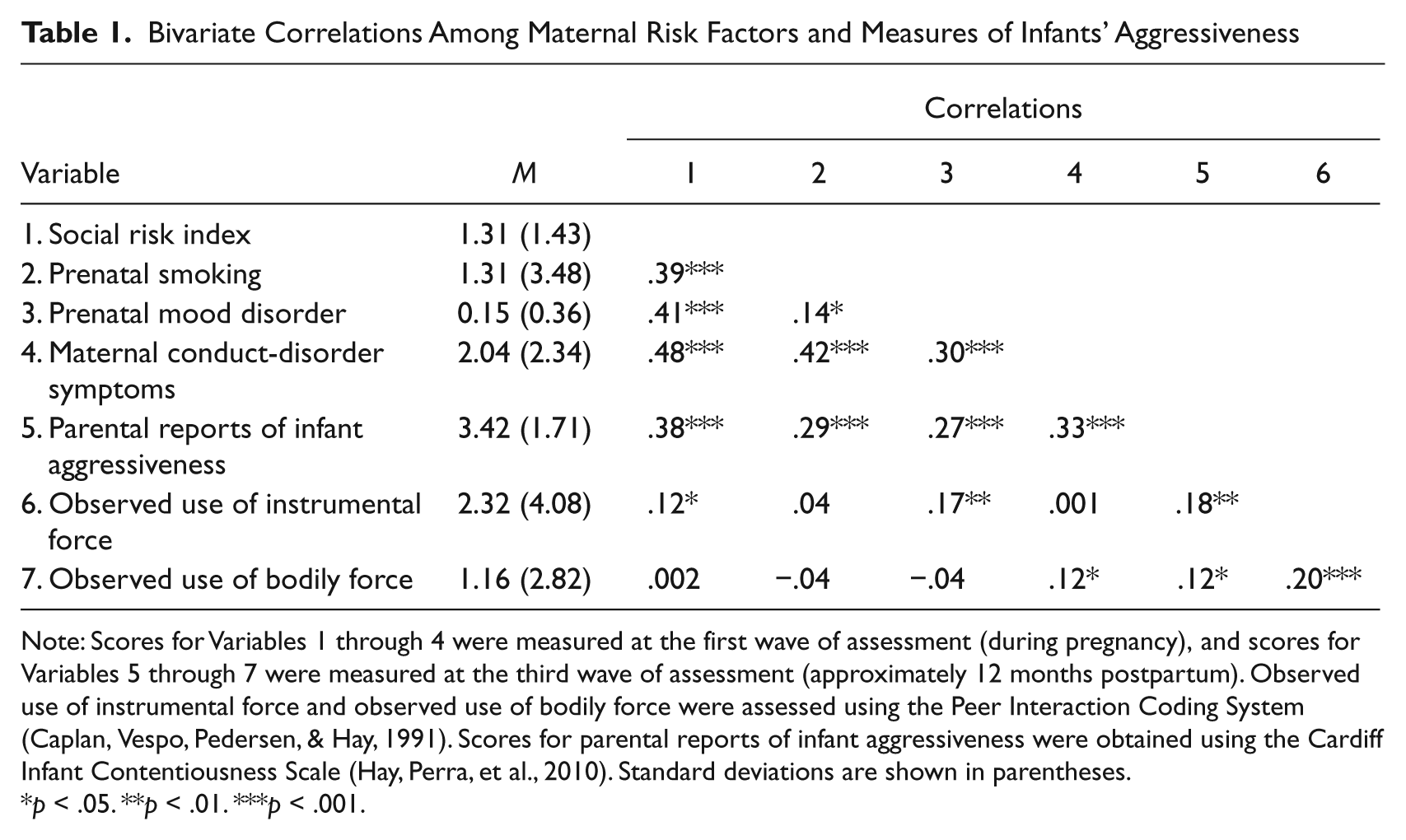
Note: Scores for Variables 1 through 4 were measured at the first wave of assessment (during pregnancy), and scores for Variables 5 through 7 were measured at the third wave of assessment (approximately 12 months postpartum). Observed use of instrumental force and observed use of bodily force were assessed using the Peer Interaction Coding System (Caplan, Vespo, Pedersen, & Hay, 1991). Scores for parental reports of infant aggressiveness were obtained using the Cardiff Infant Contentiousness Scale (Hay, Perra, et al., 2010). Standard deviations are shown in parentheses.
p < .05. **p < .01. ***p < .001.
Preliminary tests revealed no significant gender differences in infant aggressiveness as measured by either informants’ ratings of contentiousness or observed aggressiveness during the experimental birthday party, so subsequent analyses were collapsed across gender. The CICS scores were significantly correlated with the PICS scores for both instrumental and bodily force, which themselves were significantly correlated; these correlations support the notion of a general construct of early aggressiveness.
We used three multiple regression analyses to test whether the CICS scores and the PICS scores for the two observed measures of infants’ aggressiveness were predicted by mothers’ mood disorder during pregnancy and mothers’ history of conduct problems, controlling for social risk index and prenatal smoking. Results of the regression analyses are summarized in Table 2. Infants’ CICS scores were significantly predicted by all four maternal risk factors. Direct observation of the infants’ peer interactions corroborated the informants’ reports on the CICS and highlighted the precise effects of the maternal risk factors on infants’ social behavior: Infants’ use of instrumental force was predicted by maternal mood disorder during pregnancy; by contrast, infants’ use of bodily force was predicted solely by mothers’ history of conduct problems. Subsequent regression analyses showed that the influence of mother’s mood disorder during pregnancy was not explained by mother’s mood disorder before pregnancy.
Prediction of Infants’ Rated and Observed Aggressiveness by Familial Risk Factors Measured During Pregnancy
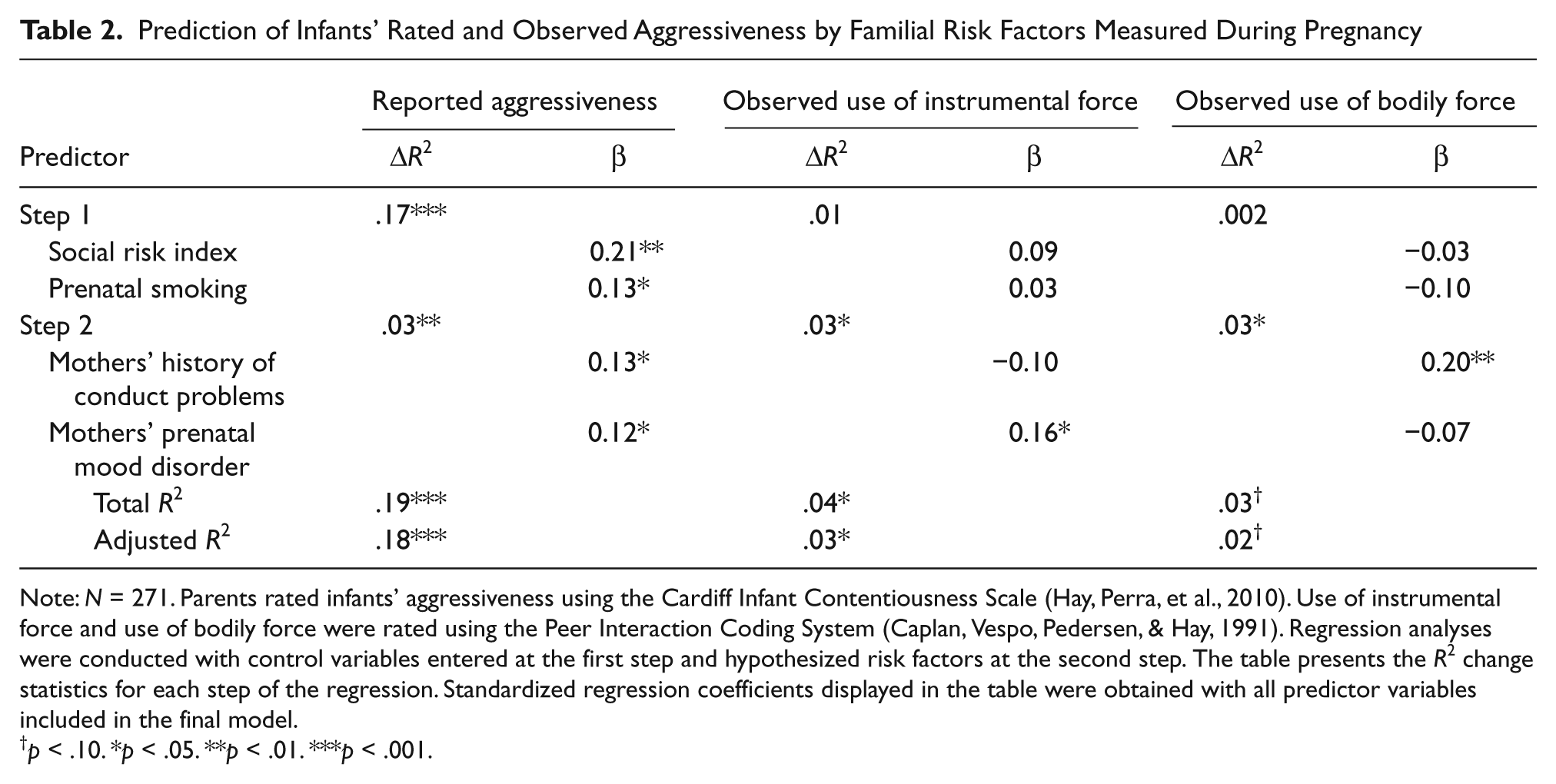
Note: N = 271. Parents rated infants’ aggressiveness using the Cardiff Infant Contentiousness Scale (Hay, Perra, et al., 2010). Use of instrumental force and use of bodily force were rated using the Peer Interaction Coding System (Caplan, Vespo, Pedersen, & Hay, 1991). Regression analyses were conducted with control variables entered at the first step and hypothesized risk factors at the second step. The table presents the R2 change statistics for each step of the regression. Standardized regression coefficients displayed in the table were obtained with all predictor variables included in the final model.
p < .10. *p < .05. **p < .01. ***p < .001.
Analyses using SPSS linear mixed models confirmed that maternal mood disorder had a significant effect on infants’ tendencies to tug toys from peers, F(1, 253.34) = 9.43, p < .002, even when taking into account the significant random effects of infants’ being paired with particular peers on infants’ use of instrumental force, Wald z = 2.10, p < .05. Maternal history of conduct problems influenced infants’ use of bodily force, F(1, 268.95) = 4.08, p < .05, which was not affected by pairings with particular peers.
Discussion
Infants do not universally direct aggressive behavior toward their peers, and aggressiveness in infants is neither random nor entirely determined by circumstance. As in previous samples (Hay & Ross, 1982), in our study the tendency among infants to tug on peers’ toys was indeed affected by the identity of those peers. However, despite the situational influence of peers’ behavior, observed aggressiveness with peers was significantly associated with parents’ reports of aggressiveness and was linked to well-known risk factors for high levels of aggression in childhood and violence in adolescence (Côté et al., 2006; Hay, Pawlby, et al., 2010; NICHD Early Child Care Research Network, 2004; Tremblay et al., 2004).
The significant associations between risk factors for aggressiveness and objectively observed aggressive behavior in our study are worthy of note. Our study is one of the first observational studies of peer interaction conducted using a nationally representative sample of moderate size, and with sufficient statistical power to detect small to medium effects that might not be discernible in smaller, less representative observational samples. The significant correlations between observed aggressiveness and parents’ reports of aggressiveness suggest that the behavior observed in infants during the experimental birthday parties reflected infants’ general dispositions and not just transient moods or responses to situational influences. In addition, the parallel results for observational and questionnaire measures show that the associations of infants’ aggressiveness with parents’ mental state and history of conduct problems were not due to parents’ attributional biases caused by their own depression and aggression. Rather, the infants’ aggressiveness became apparent within 20 min of objective observation.
The parents’ ratings and objective observations both demonstrated that when the capacity to use physical force first enters the human repertoire, the actual use of such force is not universal, but rather is determined by individual differences. Thus, in the study of aggressiveness, it is important to distinguish competence from performance. By 12 months of age, most typically developing infants have the motoric competence to tug on peers’ toys or strike their peers, but the rate at which infants perform those behaviors depends partly on their familial risk for aggression.
It is worthy of note that no gender differences were found in the infants’ behavior. Alink et al. (2006) similarly found no gender differences in aggression among 12-month-olds in a nationally representative sample of 2,253 Dutch infants. Gender differences in aggression are more easily detected after the second birthday (Hay et al., 2011), by which point a minority of boys have begun to employ aggressive behavior at high rates (Baillargeon et al., 2007). Thus, individual differences in aggressiveness predate and may contribute to gender differences in aggressiveness among older children.
Our study demonstrated that systematic individual differences in aggressiveness are present by infants’ first birthday. Key risk factors for adolescent violence found in an earlier longitudinal study (Hay, Pawlby, et al., 2010) predicted infants’ observed use of force against peers as well as parents’ reports of infants’ anger and aggression. The precise mechanisms underlying these effects have yet to be identified; parents convey risk through processes of genetic as well as social transmission (e.g., Dionne, Tremblay, Boivin, Laplante, & Pérusse, 2003), and the mother’s mental state in pregnancy may convey risk through changes in fetal growth and stress reactivity (e.g., O’Connor et al., 2002; Rice et al., 2010). However, our findings provide relevant evidence for theories of the developmental origins of aggression and suggest that it would indeed be possible to identify infants who would most benefit from early programs designed to prevent problems of aggressive conduct.
Footnotes
Acknowledgements
We thank Amy Bryant, Gabriele Cammarata, Kathryn Hudson, Sarah-Louise Hurst, Jessica Lazo, Andrew Parkinson, Tara Pennington, and Amy Williams for help with interviewing and Victoria Beamish, Helen Davies, and Rhiannon Fyfield for help with observational coding. We thank the parents and infants who have given so much of their time to the Cardiff Child Development Study.
The authors declared that they had no conflicts of interest with respect to their authorship or the publication of this article.
The research was supported by

References
Supplementary Material
Please find the following supplemental material available below.
For Open Access articles published under a Creative Commons License, all supplemental material carries the same license as the article it is associated with.
For non-Open Access articles published, all supplemental material carries a non-exclusive license, and permission requests for re-use of supplemental material or any part of supplemental material shall be sent directly to the copyright owner as specified in the copyright notice associated with the article.
