







Abstract

In “Subjective Well-Being and National Satisfaction: Findings From a Worldwide Survey,” Morrison, Tay, and Diener (2011) argued that identification with one’s nation-state, exemplified by feelings of “national satisfaction,” fosters subjective well-being (SWB). We accept the basic premise that affective attachment to a social identity (in this case, one’s nation) should have a positive effect on SWB. However, we argue that this premise must be nuanced. National identity is a multifaceted concept, and SWB may depend not only on the extent to which individuals identify with their nation (in an affective sense), but also on their conception of its social boundaries, and an interaction between these two dimensions.
In this context, it is important to distinguish between the ethnic and civic models of nationalism. The former is based on shared ancestry and ethnicity, and the latter on inclusivity and devotion to basic liberal values. Though the distinction between these two models began with historical accounts based on elite discourse (Brubaker, 1992), it does exist in public opinion (Reeskens & Hooghe, 2010). Ethnic and civic nationalism both reflect basic human values (Schwartz, 1992), but they tend to affect SWB in different ways. Although both models of nationalism arguably appeal to conservative tendencies by erecting boundaries between “us” and “them,” the nature of these boundaries reflects opposing values. Ethnic nationalism encourages xenophobia (Pehrson, Vignoles, & Brown, 2009) and suppresses both trust and associational involvement (Reeskens & Wright, in press); thus, it reflects self-enhancement values, especially of power. Given its inward-looking, reactionary, anxious, and authoritarian nature, ethnic nationalism should dampen SWB (DeNeve & Cooper, 1998; Sagiv & Schwartz, 2000; Schwartz, Sagiv, & Boehnke, 2000). Conversely, civic nationalism encourages greater openness to immigration and pluralism (Wright, Citrin, & Wand, in press); thus, this type of nationalism should encourage greater trust and social engagement (Reeskens & Wright, in press). Civic nationalism thus contains elements of universalism and benevolence and would be expected to increase SWB.
Method
To investigate how these different types of nationalism might affect SWB, we analyzed the 2008 wave of the European Values Study (EVS), a cross-national survey project. For the purposes of our study, the data pool was restricted to 40,677 individuals from 31 countries of the European Union and from the Organisation for Economic Co-operation and Development (OECD) member states. Though EVS measurement does not overlap Gallup’s World Poll precisely, we aimed to replicate the multilevel models of Morrison et al. as closely as possible. The key questions for which we analyzed responses were as follows:
SWB: “All things considered, how satisfied are you with your life as a whole these days?” (1 = dissatisfied; 10 = satisfied)
National pride: “How proud are you to be a [country] citizen?” (0 = not at all proud; 3 = very proud)
Civic nationalism: “How important do you think it is to respect [country’s] political institutions and laws for being truly [nationality]?” (0 = not important at all; 3 = very important)
Ethnic nationalism: “How important do you think it is to have [country’s] ancestry for being truly [nationality]?” (0 = not important at all; 3 = very important)
Results
In our analysis, we controlled for relevant sociodemographic and socioeconomic covariates. At the individual level, we controlled for gender, foreign origin, marital status, level of education, work status, income level, and the “urbanicity” of the respondent’s living area. At the country level, we controlled for per capita gross domestic product (obtained from Eurostat, 2011).
The results of a multilevel analysis indicated that greater national pride predicts significantly higher levels of SWB, b = 0.40, t(40,599) = 26.37, p < .001. This result is consistent with the findings of Morrison et al. Additionally, as expected, the analysis showed that the two models of nationalism have contrasting associations with SWB: Civic nationalism was positively related to SWB, b = 0.13, t(40,608) = 7.71, p < .001, whereas ethnic nationalism was negatively related to SWB, b = −0.08, t(40,359) = −6.41, p < .001. When we added terms capturing the interaction of national pride with each of the ethnic- and civic-nationalism measures, we clearly saw that the relationship between national pride and SWB operates through normative nation-state conceptions; the interaction coefficients were statistically significant for both ethnic nationalism, b = 0.11, t(39,295) = 7.70, p < .001, and civic nationalism, b = 0.07, t(39,289) = 3.83, p < .001. Using the simple-slopes method to probe the significance of the interactions (Aiken & West, 1991), we found a weak significant association between national pride and SWB for individuals low in civic nationalism (i.e., 1 SD below the mean), b = 0.12, t(39,291) = 2.05, p = .04, but a stronger relationship for individuals high in civic nationalism (i.e., 1 SD above the mean), b = 0.24, t(39,296) = 6.67, p < .001. Similarly, we found a weak significant relationship between national pride and SWB among individuals low in ethnic nationalism (i.e., 1 SD below the mean), b = 0.09, t(39,288) = 2.16, p = .03, but a strong association between national pride and SWB among individuals high in ethnic nationalism (i.e., 1 SD above the mean), b = 0.31, t(39,293) = 16.83, p < .001.
An additional test to determine whether the relationship between national pride and SWB was moderated by the interaction of civic and ethnic nationalism (National Pride × Civic Nationalism × Ethnic Nationalism interaction) was insignificant, b = 0.01, t(39,288) = 0.78, p = .54. Figure 1 illustrates the two-way interactions, showing the simple slopes of the effects of national pride on SWB for individuals high and low in civic nationalism (left panel) and ethnic nationalism (right panel).
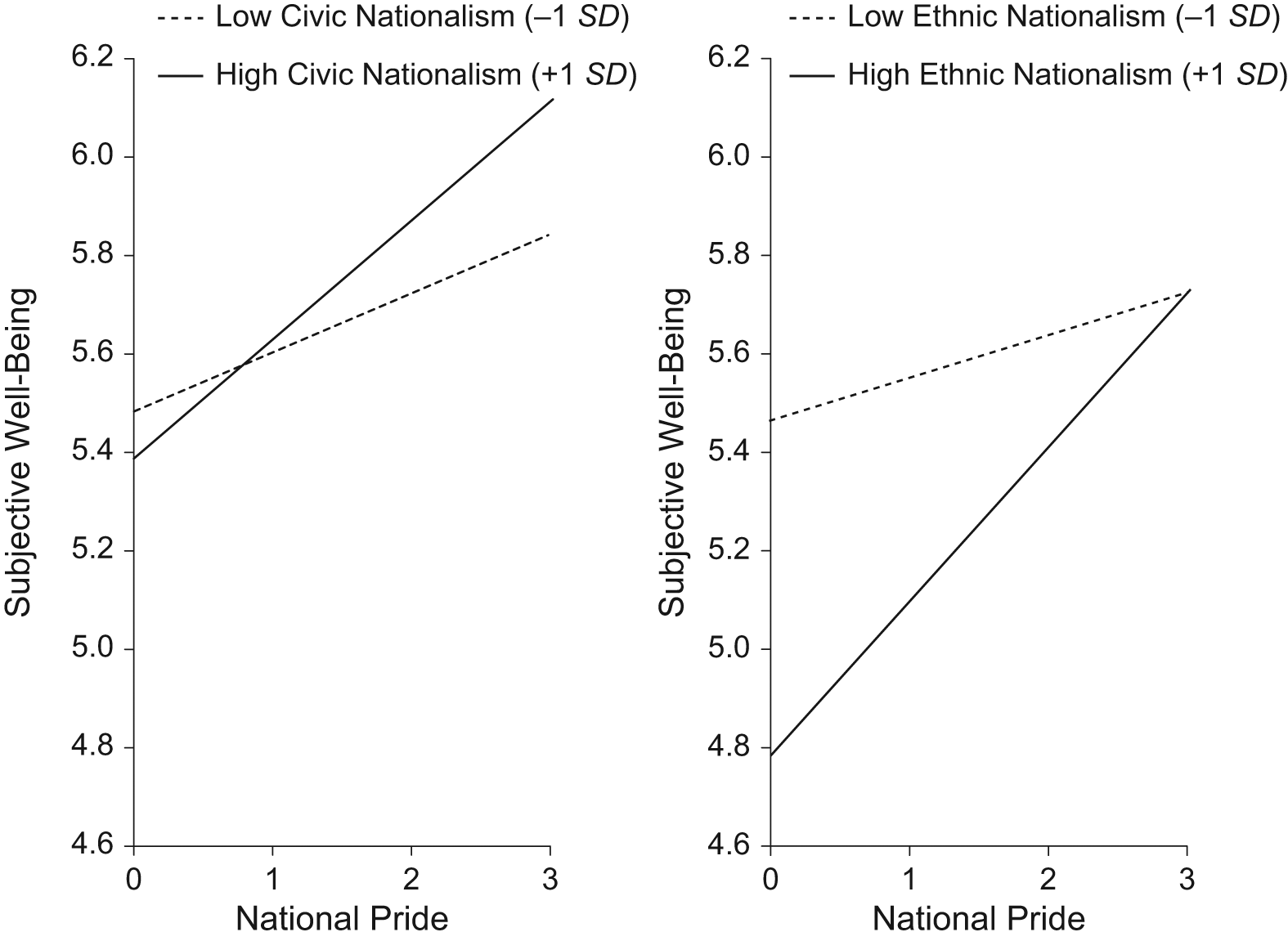
Subjective well-being as a function of national pride for individuals high and low in civic nationalism (left panel) and for individuals high and low in ethnic nationalism (right panel). The graphs represent the results of simple-slopes analyses controlling for individual- and country-level variables. High and low levels of nationalism refer to values 1 standard deviation above and below the mean, respectively.
Conclusions
Although our results support Morrison et al. in replicating the relationship between national pride and SWB, our results also qualify their basic finding. First, we found that greater civic nationalism is associated with higher SWB, whereas greater ethnic nationalism is associated with lower SWB. Second, the interactions of national pride with both civic and ethnic nationalism show that these normative dimensions of nationalism moderate the relationship between the affective dimensions of national pride and SWB. Thus, national pride appears to increase SWB among ethnic and civic nationalists alike. Crucially, however, whether one views one’s nationality along ethnic or civic lines does matter: Proud civic nationalists appear to be the happiest group by far, whereas “nonproud” ethnic nationalists are by far the most unhappy. Further, even the proudest ethnic nationalists score only slightly higher on SWB than the least proud civic nationalists.
Although normative conceptions of the nation are no doubt grounded in history and political culture, these ideas are also responsive to shorter-term influences. Ethnic nationalism in particular may be stoked by terrorism, religious conflict, and the challenges (both cultural and economic) of immigration (Wright, in press), and political elites in Europe and elsewhere have played up fears related to these issues. Thus, although national pride may help generate SWB regardless of how people define their nation, the “proud of what” question also deserves researchers’ attention.
Footnotes
The authors declared that they had no conflicts of interest with respect to their authorship or the publication of this article.