







Abstract

An aspect of age-related stereotypes is that aging is associated with negative cognitive attributes, such as slow thinking and forgetfulness (e.g., Hummert, Garstka, Shaner, & Strahm, 1994). Activation of these stereotypes has been shown to negatively affect memory in older adults. In contrast, previous studies have shown that deemphasizing age-related stereotypes improves older adults’ memory (Hess, Auman, Colcombe, & Rahhal, 2003; Hess, Emery, & Queen, 2009). The goal of the study reported here was to determine the effects of stereotype activation, or stereotype threat (e.g., Steele & Aronson, 1995), on false-memory susceptibility in older adults. To do this, we used the Deese-Roediger-McDermott (DRM) paradigm, in which individuals study lists of associatively related words and then complete a memory test (Roediger & McDermott, 1995).
Research suggests that older adults are more likely than younger adults to falsely remember lures related to studied words because older adults rely on relational processing rather than the more cognitively demanding item-specific processing (Thomas & Sommers, 2005). Relational processing, as compared with item-specific processing, is less likely to make individuating item information accessible at retrieval. Without this individuating information, people cannot effectively discriminate between targets and lures. In the experiment reported here, we tested the hypothesis that when threat was reduced, older adults would be more likely to retrieve information garnered from item-specific processing; this would in turn result in better discrimination among items and a decrease in susceptibility to false memories.
Method
Participants
One hundred twenty-eight adults participated in the experiment. Younger adults (n = 64) were introductory psychology students who received course credit (age range = 18–22 years, M = 18.8 years). Older adults (n = 64) were volunteers (age range = 60–74 years, M = 69.8 years) who were paid $10.00. Older adults were selected from a participation pool maintained by the first author. Older adults were selected from a preestablished participation pool on the basis of their performance on the Mini-Mental State Examination (Folstein, Folstein, & McHugh, 1975), information regarding general health, and mood disorder history. Older and younger participants were tested separately, and in each age group were distributed equally across high- and low-threat conditions. Participants in the two threat groups were matched in vocabulary (Shipley, 1946) and years of education. All participants provided informed consent.
Materials and procedure
Prior to the start of the experiment, all participants took the Vocabulary subtest of the Shipley Institute of Living Scale 2 (Shipley, 1946), on which older and younger adults performed similarly, t < 1. They then began the experiment, materials for which consisted of 24 lists, each of which contained 15 semantic associates of a related lure (Stadler, Roediger, & McDermott, 1999). Twelve lists were studied, and words from the other 12 served as distractors on the recognition test. The recognition test consisted of 96 words: Twelve words were lures related to studied words, 48 words were lures unrelated to studied words, and 36 words had been studied. Stimuli and methodology were taken from standards in the DRM literature (for a review, see Gallo, 2006). The study period consisted of an incidental-learning task, in which participants were presented with 12 lists, each presented in blocked form. List order and item order within each list were random. Participants were told to rate each word for pleasantness on an 8-point Likert scale (0 = not pleasant, 7 = extremely pleasant). After encoding, participants worked on a filler task (a Sudoku puzzle) for 5 min.
The experimenter then read information to participants that included the threat manipulation. Participants in the high-threat condition were read a paragraph describing research that has demonstrated age-related declines in memory. They were then told that the current experiment was about memory. Participants in the low-threat condition were read a paragraph about language-processing research. These participants were told that the current experiment was about language processing and verbal ability. Participants then completed a yes/no recognition test, in which they indicated whether or not they had previously seen a word. After making each recognition judgment, participants rated their confidence in that judgment on an 8-point Likert scale (0 = not confident, 7 = extremely confident). Finally, participants completed a lexical decision task (see Chasteen, Bhattacharyya, Horhota, Tam, & Hasher, 2005) that allowed us to independently examine stereotype activation. 1 The initial encoding, yes/no recognition test, and the lexical decision test were presented using E-Prime software (Version 1.1; Schneider, Eschman, & Zuccolotto, 2001). Participants were tested in age-segregated groups ranging from 2 to 4 individuals. Within a testing group, participants were given the same threat manipulation.
Results
Recognition
A 2 (age: older, younger) × 2 (threat condition: high, low) analysis of variance (ANOVA) on the average proportion of false alarms to the related lures found main effects of age, F(1, 124) = 4.85, p < .05, and threat condition, F(1, 124) = 8.25, p < .005. The interaction between threat condition and age was also significant, F(1, 124) = 6.43, p < .05. As Table 1 shows, the difference in false alarms between the high- and low-threat conditions was significantly greater in older adults than in younger adults. For hit rates, we found a main effect of age, F(1, 124) = 44.07, p < .001. No other effects were significant, Fs < 1. As in previous studies using the DRM paradigm, false alarms to unrelated lures were low (M = .10) and did not differ as a function of either age or threat condition, Fs < 1.
Mean Recognition Accuracy and Confidence Judgments
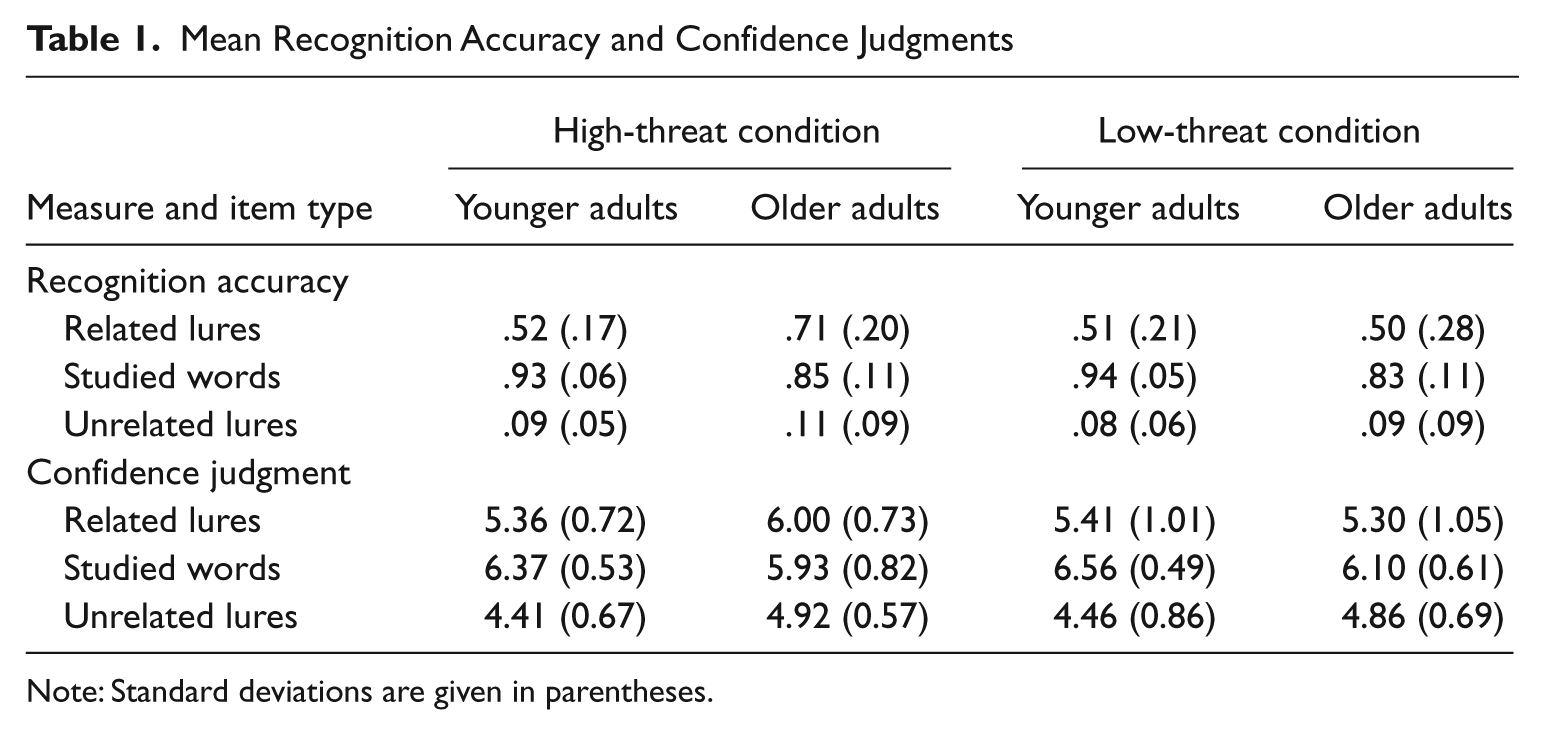
Note: Standard deviations are given in parentheses.
Confidence
We conducted separate 2 (threat condition: high, low) × 2 (item: related lure, studied word) ANOVAs on confidence ratings for each age group. We found a main effect of item for both younger adults, F(1, 62) = 134.32, p < .001, and older adults, F(1, 62) = 9.07, p < .005. In addition, for older adults, the interaction between item and threat condition was significant, F(1, 62) = 12.48, p < .005. As Table 1 shows, confidence was higher for true memories of studied words than for false memories of related and unrelated lures for both age groups. However, older adults in the low-threat condition were less confident in their false memories than were older adults in the high-threat condition, whereas threat condition did not affect confidence ratings in younger adults.
General Discussion
The results from the study reported here suggest that age-related increases in false-memory susceptibility, and overconfidence in these memories, may be reduced in situations in which negative stereotypes associated with memory and aging are deemphasized. Findings of previous research suggest that stereotype activation may result in a burden on available cognitive resources (Croizet et al., 2004; Hess et al., 2003; Schmader, Johns, & Forbes, 2008), as individuals under threat may engage in active efforts to suppress stereotypic thoughts (Schmader et al., 2008). The present findings indicate that this reduction in resources may negatively affect older adults’ ability to use individuating item information to improve discrimination between targets and lures.
In previous research, older adults did show reduced false-memory susceptibility when individuating item information was made accessible (Thomas & Sommers, 2005). However, explicit directions to engage item-specific processing at encoding were employed to affect the accessibility of that information at retrieval. In the present study, in which encoding was incidental, older adults likely engaged in both item-specific and relational processing. However, even under these conditions, we found that when stereotype threat was deemphasized prior to retrieval, older adults showed reduced false-memory susceptibility. These findings suggest that older adults encoded individuating information, and when cognitive resources were freed from the burden of stereotype threat, that information was effectively used.
Finally, an alternative account for the present findings is that stereotype threat may result in a change in criteria setting at retrieval. Under threat, participants may have set a liberal response criterion. When threat was reduced, participants may have modified their decision strategy toward more conservative responding (cf. Schacter, Israel, & Racine, 1999). However, although older adults in the low-threat condition did show less false memories than older adults in the high-threat condition, they did not show a reduction in recognition hits. This result, coupled with the finding that false alarms to unrelated lures were unaffected by threat condition, suggests that the threat manipulation did not result in a criterion shift, but rather in a change in discrimination ability. These results also suggest that age differences in correctly recognizing presented words may result from mechanisms other than stereotype activation. In conclusion, these results demonstrate a direct link between stereotype activation and false-memory susceptibility, and they suggest that when cognitive resources are available, age-related differences in false memories can be eliminated.
Footnotes
Acknowledgements
Aspects of this research were conducted as part of the second author’s senior honors project.
The authors declared that they had no conflicts of interest with respect to their authorship or the publication of this article.