







Abstract
Although prejudice-reduction policies and interventions abound, is it possible that some of them result in the precise opposite of their intended effect—an increase in prejudice? We examined this question by exploring the impact of motivation-based prejudice-reduction interventions and assessing whether certain popular practices might in fact increase prejudice. In two experiments, participants received detailed information on, or were primed with, the goal of prejudice reduction; the information and primes either encouraged autonomous motivation to regulate prejudice or emphasized the societal requirement to control prejudice. Ironically, motivating people to reduce prejudice by emphasizing external control produced more explicit and implicit prejudice than did not intervening at all. Conversely, participants in whom autonomous motivation to regulate prejudice was induced displayed less explicit and implicit prejudice compared with no-treatment control participants. We outline strategies for effectively reducing prejudice and discuss the detrimental consequences of enforcing antiprejudice standards.
Keywords
As multiculturalism rises, initiatives aimed at reducing prejudice proliferate in schools, workplaces, and communities. Programs claiming to reduce racism abound—invoking the notion that prejudice should be battled against or eliminated. To name only a few, the Partners Against Hate (2003) project promotes the “fight against” hate violence, the Anti-Prejudice Consortium (2011) is an organization devoted to “exerting power over prejudice,” and the Government of Canada’s Citizenship and Immigration Department (2011) currently espouses a Racism. Stop it! campaign in schools throughout the country, calling for the “elimination” of racial discrimination and symbolizing the “stamping out” of prejudice. Policymakers in North America spend billions of dollars annually on prejudice interventions (Hansen, 2003), yet very few of these are actually based on sound evidence (Paluck & Green, 2009). Is it possible, then, that certain common prejudice-reduction strategies actually increase prejudice?
Research on prejudice reduction is plentiful. Critics suggest, however, that this work is rarely translational, and the interventions that have been developed on the basis of such research have typically been impractical (Cameron & Turner, 2010). To counter these critiques, we took a new direction in prejudice reduction, using fundamental principles of motivation. We examined whether prejudice can be diminished by boosting the motivational structures underlying the regulation of prejudice. Similarly, we asked whether prejudice reduction can be undermined by enhancing the wrong kind of motivation. In short, we explored how targeting different types of motivation to reduce prejudice succeeds and backfires.
Motivation to Regulate Prejudice
Anchored by self-determination theory (Deci & Ryan, 1985, 2002), a growing body of research has demonstrated that the self-regulation of prejudice varies in the extent to which it is autonomous, or self-determined (Devine, Plant, Amodio, Harmon-Jones, & Vance, 2002; Legault, Green-Demers, Grant, & Chung, 2007; Plant & Devine, 1998). Thus, one’s motivation to regulate prejudice can stem from personal, self-endorsed reasons, or it can satisfy external controls or incentives. Individuals with a controlled motivation to regulate prejudice are motivated to reduce prejudice for external reasons (e.g., pressure, fear). They might suppress racism because they seek approval from others or because social norms require that prejudice be avoided. Conversely, individuals with a self-determined motivation to regulate prejudice are motivated by internal factors, such as the personal relevance and importance of striving to be nonprejudiced. For such individuals, the pursuit of nonprejudice is valuable and enjoyable, and energized by the satisfaction gleaned from intergroup relations.
Evidence suggests that, compared with individuals who have a self-determined motivation to regulate prejudice, those with a controlled motivation demonstrate greater racial bias (Amodio, Harmon-Jones, & Devine, 2003; Devine et al., 2002; Legault, Green-Demers, & Eadie, 2009; Legault et al., 2007; Plant, Devine, & Peruche, 2010) and tend to express resentment in response to pro-Black pressure (Plant & Devine, 2001). However, to our knowledge, motivation to regulate prejudice has been assessed only at the level of individual differences. There has been no investigation into whether self-determined and controlled motivation to regulate prejudice can be manipulated and go on to influence prejudice. Thus, we asked: What happens when people are encouraged to control prejudice for external reasons? Could this actually increase prejudice? In contrast, what if people are encouraged to regulate prejudice for autonomous (self-determined) reasons? Can this reduce prejudice?
Autonomy-supportive contexts nurture inner motivational resources by supporting an internal perceived locus of causality (deCharms, 1968). Thus, people feel autonomously motivated when they identify their behavior as originating from a personal, rather than environmental, source. Perceived autonomy is cultivated by conditions that provide informative rationales for engaging in a given behavior. In contrast, contexts that thwart people’s need for autonomy are controlling (Deci & Ryan, 2000). Controlling environments apply pressure to extract an externally prescribed manner of thinking or behaving. When autonomy is bypassed in this way, motivation becomes contingent on external forces, and internal motivational resources are weakened. We expected that instead of eliciting mere compliance (e.g., Blanchard, Lilly, & Vaughn, 1991), controlling directives against prejudice, such as the common strategies outlined in our opening paragraph, would in fact hinder inner motivational resources and produce results opposite to those intended.
The Present Experiments
We predicted that strategies that foster self-determined motivation to regulate prejudice would reduce prejudice, and that controlling strategies would actually increase prejudice. We tested these predictions in two experiments. The first measured the impact of a content-rich contextual manipulation on explicit prejudice; the second used more subtle priming methods and measured both explicit and implicit prejudice. In both experiments, we tested the mediating role of motivation in the link between intervention and prejudice reduction.
Experiment 1: The Impact of Antiprejudice Brochures on Racism
In Experiment 1, we sought to design instructional material that might be useful beyond the laboratory and desirable for practitioners looking to reduce prejudice in classrooms and workplaces. To this end, we developed two prejudice-reduction brochures based on the principles of autonomy support and control, as outlined by self-determination theory.
Method
Participants and procedure
One hundred three non-Black undergraduates from the University of Toronto Scarborough (71% female, 29% male; mean age = 18.8 years) participated for course credit. Participants were randomly assigned to one of three conditions: an autonomy-brochure condition, a controlling-brochure condition, or a no-brochure condition. The brochures were framed as part of a new campus initiative to reduce prejudice. Depending on condition, participants read either a brochure or other information about prejudice before their motivation to reduce prejudice and their prejudice were assessed.
Brochure manipulation
In the autonomy-brochure condition, the value of nonprejudice was emphasized. Participants’ inner motivation for prejudice reduction was encouraged by emphasizing choice and explaining why prejudice reduction is important and worthwhile. In the controlling-brochure condition, participants were urged to combat prejudice and to comply with social norms of nonprejudice. In the no-brochure condition, participants read only introductory information about the definition of prejudice. (For excerpts from the brochures, see the Supplemental Material available online.)
Dependent measures
To assess participants’ reasons for regulating prejudice, we administered the 24-item Motivation to Be Nonprejudiced Scale (Legault et al., 2007). This scale includes items measuring self-determined motivation (e.g., “because striving to be nonprejudiced is important to me”; α = .88) and items measuring controlled motivation (e.g., “because racist people are not well liked”; α = .83). We used the Symbolic Racism 2000 Scale (Henry & Sears, 2002) to measure prejudice toward Black people (α = .74).
Results and discussion
Influencing motivation
An index of self-determined motivation was created by subtracting the mean score for controlled-motivation items from the mean score for self-determined- motivation items. A polynomial contrast revealed a significant linear effect of condition (effect-coded, such that 1 = autonomy brochure, 0 = no brochure, and −1 = controlling brochure) on self-determined motivation, with more self-determined motivation being elicited in the autonomy-brochure condition (M = 1.76, SD = 4.34) than in the no-brochure condition (M = −2.57, SD = 6.17) and the controlling-brochure condition (M = −2.54, SD = 5.04), F(1, 100) = 12.67, p < .001,
Planned comparisons: influencing prejudice
As illustrated in Figure 1, participants in the autonomy-brochure condition displayed significantly less prejudice than did those in the no-brochure condition, F(1, 66) = 14.49, p < .001,
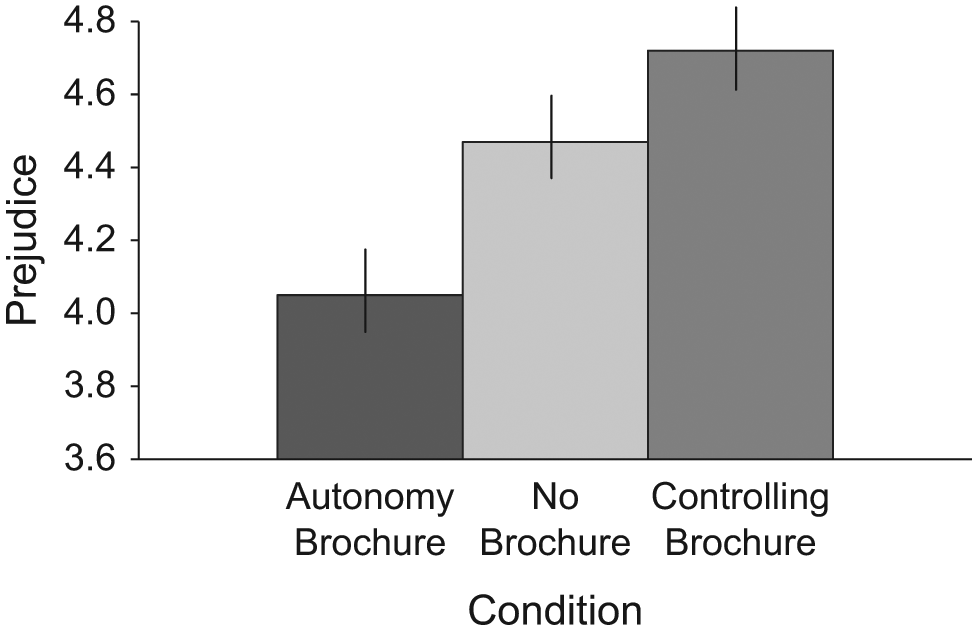
Prejudice as a function of brochure condition in Experiment 1. Error bars represent ±1 SEM.
Mediation by motivation to regulate prejudice
To test the mediating effect (Baron & Kenny, 1986) of motivation on the relationship between condition and prejudice, we constructed an effect-coded condition variable (1 = autonomy brochure; 0 = no brochure; −1 = controlling brochure), which predicted self-determined motivation to regulate prejudice, t(101) = 3.39, p < .001 (Fig. 2a). Furthermore, after controlling for condition, self-determined motivation negatively predicted prejudice, t(101) = −3.34, p < .001. A Sobel (1982) test supported a significant indirect effect of self-determined motivation on prejudice, z = −2.79, p < .01. Thus, the two types of prejudice-reduction brochures produced opposite effects on prejudice, and this effect was partially explained by the source of motivation to regulate prejudice. It should be noted, however, that although autonomy support boosted self-determined motivation to be nonprejudiced, the impact of control on prejudice appeared to be more direct.
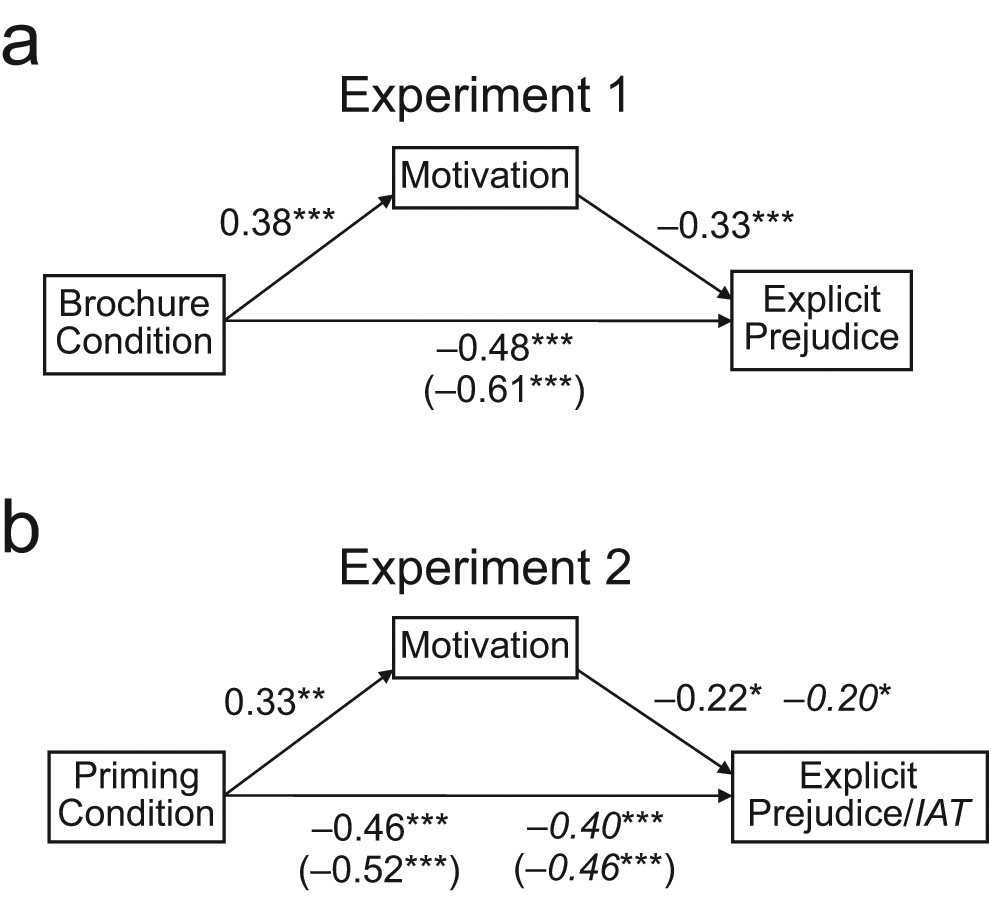
Path diagrams showing self-determined motivation as a mediator of the link between experimental condition and prejudice in (a) Experiment 1 and (b) Experiment 2. The numbers along the paths are standardized coefficients, and those in parentheses indicate the unmediated effect of condition on prejudice. Asterisks indicate significant coefficients (*p < .05; **p < .01; ***p < .001). In Experiment 2, both explicit prejudice and implicit prejudice (Implicit Association Test, or IAT) were assessed; values in italics are results for the implicit measure.
Experiment 1 used a rich and realistic manipulation and an explicit measure. Although we observed an effect on prejudice despite potential demand characteristics, we wanted to test the generalizability of this effect in Experiment 2 by using subtler methods.
Experiment 2: The Impact of Motivational Priming on Racism
In Experiment 2, we manipulated motivation subtly, and then measured automatic racism with the Implicit Association Test (IAT; Greenwald, McGhee, & Schwartz, 1998). This strategy afforded the potential advantage of broadening the results of Experiment 1 to another index of prejudice; it also allowed us to test whether the effects observed in Experiment 1 can occur in situations in which motivation is shifted subtly, rather than through the overt appeals made by a brochure.
Method
Participants and priming procedure
One hundred nine non-Black undergraduates from the University of Toronto Scarborough participated for partial course credit (69% female, 31% male; mean age = 19.3 years). Participants were randomly assigned to one of three experimental conditions: one designed to prime self-determined (autonomous) motivation to reduce prejudice, another designed to prime controlled motivation to reduce prejudice, and a third in which there was no priming.
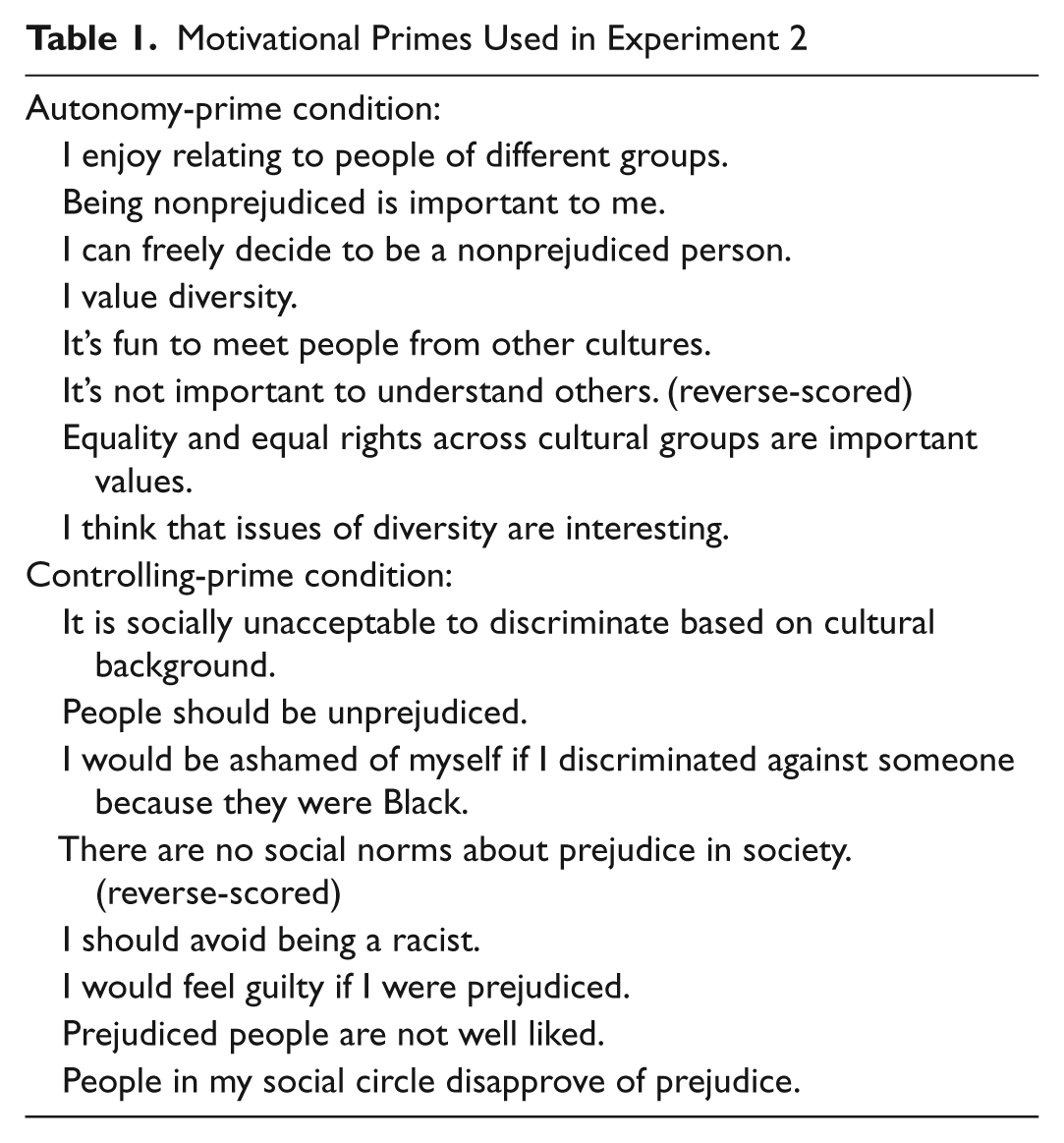
Priming was achieved using a questionnaire format adapted from Burton, Lydon, D’Alessandro, and Koestner (2006). So that this questionnaire would appear to participants as a survey rather than an experimental induction, we included demographic and filler questions, which were followed by a two-part manipulation. First, participants indicated their agreement with eight statements (see Table 1), the endorsement of which was facilitated by requiring participants to indicate either “Yes, I agree at least somewhat” or “No, I disagree completely.” Next, participants were asked to write three sentences regarding the target motivation. In the autonomy-prime condition, they were asked to describe why it is “personally satisfying,” “enjoyable,” and “important” to be nonprejudiced. In the controlling-prime condition, participants described their felt “internal demands,” “obligation,” and “social expectation” to be nonprejudiced. In the neutral, no-prime condition, participants responded to a questionnaire that included only filler questions.
Motivational Primes Used in Experiment 2
Dependent measures
Following the manipulation, the Motivation to Be Nonprejudiced Scale (Legault et al., 2007) was administered to assess participants’ reasons for refraining from prejudice (α = .86 for self-determined motivation; α =.84 for controlled motivation). We measured explicit prejudice using the Symbolic Racism 2000 Scale (Henry & Sears, 2002; α =.71). Finally, we assessed implicit prejudice using the Race IAT (Greenwald et al., 1998), a reaction time measure of racial bias that captures the strength of association between the Black and White race categories, on one hand, and positive and negative attributes, on the other.
Results and discussion
Influencing motivation
Scores indexing self-determined motivation were calculated in the same way as in Experiment 1. Polynomial contrasts indicated a significant linear effect of condition on self-determined motivation, which was highest in the autonomy-prime condition (M = 5.00, SD = 3.27), lowest in the controlling-prime condition (M = 2.53, SD = 3.21), and intermediate in the neutral, no-prime condition (M = 3.33, SD = 2.65), F(1, 106) = 12.77, p < .01,
Planned comparisons: influencing prejudice
Participants primed with self-determined motivation to regulate prejudice displayed less symbolic racism (M = 3.71, SD = 0.51) than did those in the neutral, no-prime condition (M = 4.04, SD = 0.56), F(1, 70) = 6.67, p < .01,
As illustrated in Figure 3, participants primed with self-determined motivation to regulate prejudice exhibited significantly less implicit prejudice than did those in the neutral, no-prime condition, F(1, 70) = 5.86, p < .05,
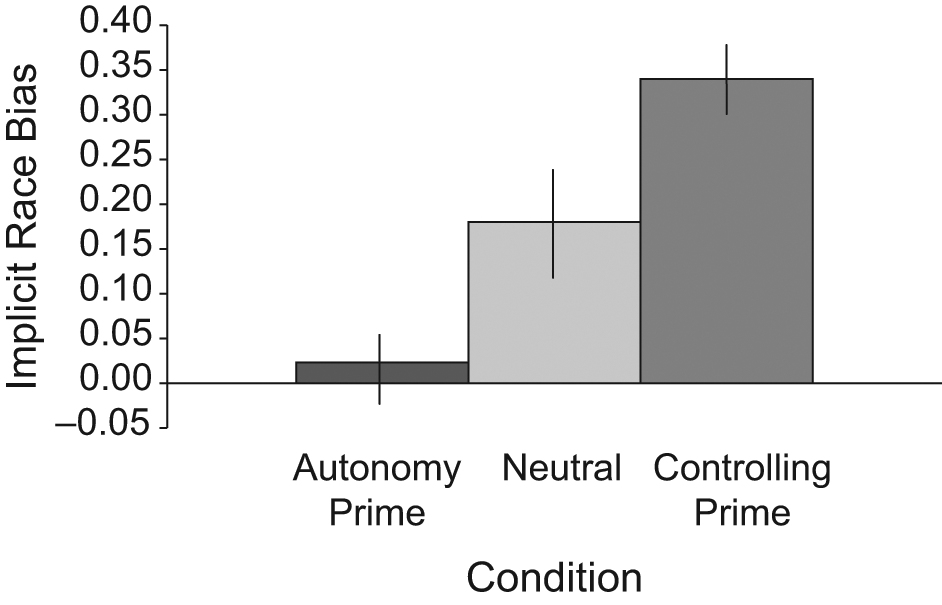
Implicit race bias as a function of condition in Experiment 2. Error bars represent ±1 SEM.
Mediation by self-determined motivation to regulate prejudice
As illustrated in Figure 2b, an effect-coded condition variable (1 = autonomy prime; 0 = no prime; −1 = controlling prime) predicted self-determined motivation to regulate prejudice, t(106) = 3.56, p < .01. Controlling for priming condition, self-determined motivation negatively predicted both explicit prejudice, t(106) = −2.78, p < .01, and implicit prejudice, t(106) = −2.22, p < .05. Sobel tests indicated that these indirect effects were significant—explicit prejudice: z = −2.31, p < .05; implicit prejudice: z = −1.96, p < .05. These results substantiate the role of motivation to regulate prejudice as a link between priming and prejudice reduction.
Experiment 2 extended Experiment 1 by priming motivation using subtler, direct methods and by assessing prejudice at the automatic level. The fact that priming had the hypothesized effect on an implicit measure of prejudice is important because although the motivation primes were subtly embedded, they may still have been detectable.
General Discussion
This investigation exposed the adverse effects of pressuring people to be nonprejudiced, while demonstrating the causal role of self-determination in prejudice reduction. Notably, we demonstrated that strategies urging people to comply with antiprejudice standards are worse than doing nothing at all. This direct effect was robust, even after controlling for motivation (see Fig. 2). Thus, it appears that social control elicited a reflexive, reactive effect that increased prejudice. According to reactance theory (Brehm & Brehm, 1981), this “rebellion” represents a direct counterresponse (i.e., defiance) to threatened autonomy. Interventions that eliminate people’s freedom to choose egalitarian goals or to value diversity on their own terms may incite hostility toward the perceived source of the pressure (i.e., the stigmatized group), or a desire to rebel against prejudice reduction itself. These findings have serious implications for the enforcement of rules and standards of nonprejudice, especially when one considers that many intervention programs and policies use controlling, antiprejudice techniques. This research reveals that these types of messages not only do not work, but also can produce the opposite of their intended effects. At the same time, we offer evidence that supporting autonomy is crucial for prejudice reduction. When people see the value in nonprejudice, they are more likely to internalize it and sustain it (Deci & Ryan, 2000, 2008). Promotion of autonomous prejudice regulation, then, is clearly more beneficial than social pressure for political correctness.
Applications in programming and policy
By focusing on the motivational underpinnings of prejudice regulation, this work offers clear guidelines for practitioners looking to develop prejudice-reduction techniques. We advise teachers and managers to steer away from the antiprejudice strategy, to be aware of controlling tactics, to reduce the use of pressuring language, and to refrain from pressuring people toward strictly prescribed outcomes. Instead, it is important to encourage personal valuing of diversity and equality. This can be done by offering informative rationales, by discussing the importance and enjoyment of nonprejudice, and by examining the benefits of diverse and fair classrooms and workplaces. Similarly, initiatives such as the Partners Against Hate project and the Racism. Stop it! campaign, which promote the “elimination of intolerance” and “fight against racism,” might benefit from reframing their approach. We suggest that antiprejudice pressure backfires—deflating personal autonomy, tapping into external and social concerns at the expense of personal ones, and ultimately increasing prejudice.
Conclusion
This research joins other promising prejudice-reduction research (e.g., Gaertner & Dovidio, 1984; Kawakami, Phills, Steele, & Dovidio, 2007; Page-Gould, Mendoza-Denton, & Tropp, 2008; Pettigrew & Tropp, 2006; Phills, Kawakami, Tabi, Nadolny, & Inzlicht, 2011) in contributing to the development of strategies for prejudice reduction. Although researchers have outlined the benefits of autonomous motivation to be nonprejudiced for more than a decade (Plant & Devine, 1998), notions of how to systematically increase this motivation have been relatively unexplored. We now offer an answer to this problem, using self-determination theory, and we recommend the application of this theory’s motivational principles at various societal levels. Moreover, we have demonstrated the need to terminate ineffective prejudice-reduction practices. We suggest that many organizational strategies aimed at prejudice reduction are actually counterproductive, and our results provide a possible explanation for the finding that, despite the billions of dollars spent annually on prejudice-reduction interventions (Hansen, 2003), prejudice is rarely reduced.
Footnotes
The authors declared that they had no conflicts of interest with respect to their authorship or the publication of this article.
This research was supported by a postdoctoral fellowship awarded to the first author by the Social Sciences and Humanities Research Council of Canada.

References
Supplementary Material
Please find the following supplemental material available below.
For Open Access articles published under a Creative Commons License, all supplemental material carries the same license as the article it is associated with.
For non-Open Access articles published, all supplemental material carries a non-exclusive license, and permission requests for re-use of supplemental material or any part of supplemental material shall be sent directly to the copyright owner as specified in the copyright notice associated with the article.
