







Abstract
Humans need social connections, and without them, people experience physical and psychological problems (Baumeister & Leary, 1995; Williams, 2009). Because social connections are fundamental to survival, researchers argue that humans evolved systems to detect the slightest cues of inclusion or exclusion (Kerr & Levine, 2008; Leary, Tambor, Terdal, & Downs, 1995; Pickett, Gardner, & Knowles, 2004; Williams, 2009). For example, simple eye contact is sufficient to convey inclusion. In contrast, withholding eye contact can signal exclusion. One form this signal can take relates to the German expression “wie Luft behandeln,” which literally means “to be looked at as though air.” Even though one person looks in the general direction of another, no eye contact is made, and the latter feels invisible. Survey data suggest that people purposefully withhold eye contact as a form of ostracism (Williams, Shore, & Grahe, 1998). Diary data suggest that people feel ostracized even when strangers fail to give them eye contact (Williams, Govan, Wheeler, & Nezlek, 2004). Experimental data confirm that eye contact signals social inclusion, and lack of eye contact signals ostracism (Wirth, Sacco, Hugenberg, & Williams, 2010).
We investigated the effect of acknowledgment compared with the effect of being “looked at as though air” in a field experiment in which we further tested the subtle conditions that can fulfill or threaten humans’ need to belong. We hypothesized that being acknowledged by a stranger via eye contact would decrease an individual’s feelings of disconnection, whereas being looked at as though air would increase these feelings. We also tested whether an acknowledgment with a smile was necessary to induce feelings of social connection (Grahe, Williams, & Hinsz, 2000).
Method
Participants
We selected 282 passersby who were walking alone with no distractions (i.e., music or telephone) and appeared to be at least 18 years old and randomly assigned them to one of three experimental conditions. Forty-three passersby refused to complete the dependent measures. The number who refused to complete the dependent measures did not vary across the experimental conditions, χ2(2, N = 43) = 2.69, p = .26. Using the same selection criteria, we approached and surveyed 78 additional passersby who served as a control group. The final sample included 317 passersby (194 men and 123 women).
Procedure and design
The experimenter and a confederate (both college-aged women) collected data in well-populated areas of a large, Midwestern university campus (approximately 40,000 students). This study was conducted in fair weather: The days were sunny, with temperatures between 86 °F and 95 °F. When the confederate approached a passerby, she performed one of the three experimental manipulations at random. Our air-gaze condition was designed to correspond to looking at the passerby as though air: The confederate looked toward the passerby with a neutral facial expression and directed her gaze at the passerby’s eye level, but beyond the ear of the passerby, and did not make eye contact (n = 76). In the acknowledgment-only condition (n = 79), the confederate made eye contact with the passerby. In the acknowledgment-with-a-smile condition (n = 84), the confederate made eye contact with and gave a closed smile to the passerby.
Directly after the confederate walked by the passerby, she put her hand behind her back and gave a thumbs-up signal to the experimenter, who was following 4 to 6 m behind to avoid making the passerby suspicious. The experimenter (blind to condition) then immediately approached the passerby before any other pedestrians could walk by. Because this was a field experiment, and because it was likely that any effect would be fleeting, the experimenter focused on passersby’s responses to two questions: 1 “Within the last minute, how disconnected do you feel from others?” (5-point response scale ranging from 1, not at all, to 5, very much) and “Within the last minute, have you experienced acknowledgment from a stranger?” (yes/no response). The social-connection item was selected from the belonging items in Williams’s (2009) Need Threat Measure.
Passersby in the control group were approached only by the experimenter. Therefore, the responses collected by the experimenter from this group allowed us to establish a baseline level of feelings of disconnection and to determine the direction of the effect of acknowledgment and air gaze. Passersby in the control condition were not asked the acknowledgment item.
Results and Discussion
A one-way analysis of variance including the three experimental conditions and the control condition demonstrated that our manipulation affected passersby’s feelings of disconnection, F(3, 313) = 3.26, p = .02 (Fig. 1). 2 As hypothesized, passersby in both the acknowledgment-with-a-smile condition (M = 1.96, SD = 1.19) and the acknowledgment-only condition (M = 1.95, SD = 1.02) felt less disconnected than passersby in the air-gaze condition (M = 2.45, SD = 1.21; Tukey’s honestly significant difference, HSD: ps < .03, ds > 0.40). Levels of disconnection in the two acknowledgment conditions were not significantly different from each other (Tukey’s HSD: p > .99, d < 0.01). The level of passersby’s feelings of disconnection in the control condition (M = 2.17, SD = 1.11) was between the average levels in the air-gaze condition and the two acknowledgment conditions, although not significantly different from those levels (Tukey’s HSD: ps > .39, ds < 0.27). However, a follow-up linear trend analysis demonstrated that the condition means increased proportionately in the hypothesized direction (i.e., lowest in the acknowledgment conditions, higher in the control condition, and highest in the air-gaze condition), F(1, 313) = 8.56, p < .01.
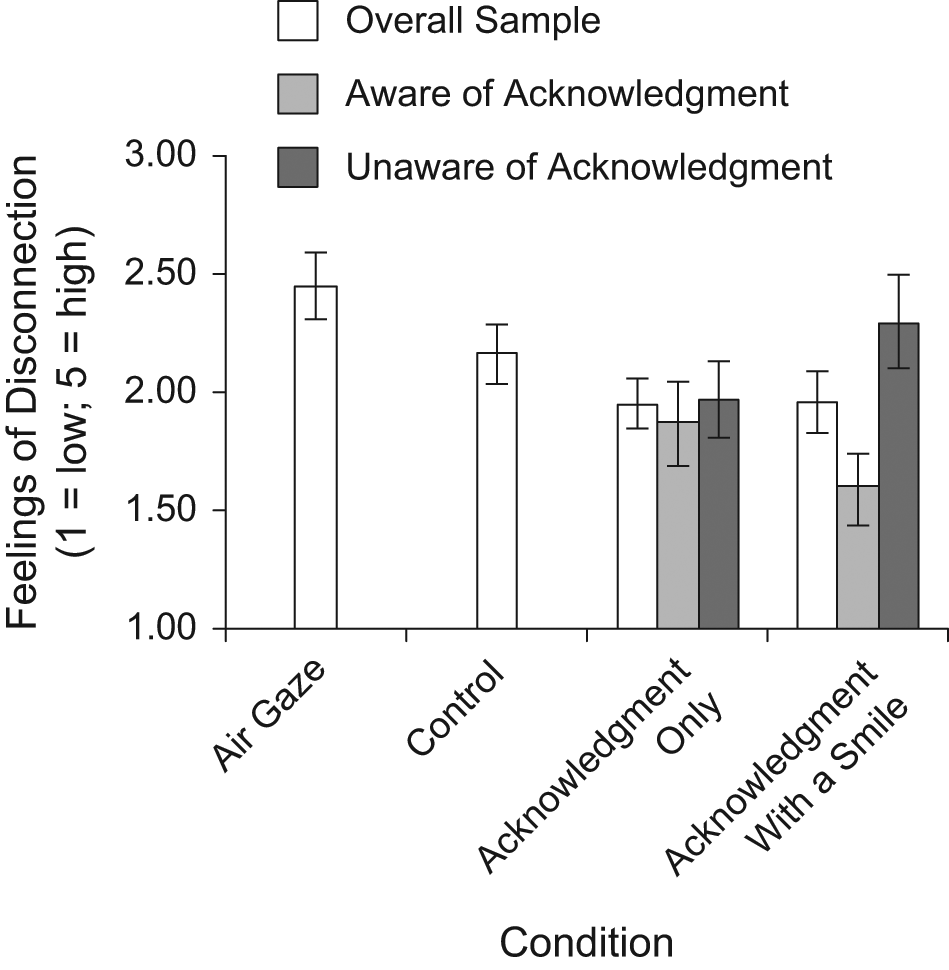
Feelings of social disconnection as a function of condition. For the two acknowledgment conditions, the graph shows overall results as well as results for passersby who were aware versus unaware of being acknowledged. Error bars indicate standard errors of the mean.
Only 45.4% of passersby in the two acknowledgment conditions reported recalling being acknowledged by a stranger. 3 When we analyzed feelings of disconnection excluding these passersby, the linear trend became nonsignificant (p = .34; see Fig. 1 for a graphic presentation of feelings of social disconnection broken down by awareness of acknowledgment). This finding indicates the importance of awareness in inducing the observed effect.
The results of this field experiment add to the literature on minimal cues that convey inclusion (Williams, 2009; Wirth et al., 2010) and extends it to a nonlaboratory setting. It is important to note that lack of acknowledgment may be more painful in some locations (e.g., small towns) and may be normative and preferred in other locations (e.g., large cities; Korte, 1980; Milgram, 1970; Newman & McCauley, 1977). Different cultural contexts may also influence the intensity or direction of the effect acknowledgment has on individuals (Kleinke, 1986). Future research should investigate the influence of acknowledgment on social connection in different locations and cultural contexts, and whether acknowledgment or air gaze has differential effects on other psychological needs or overall civic identity. Finally, we are not suggesting that humans will welcome any and all contact from a stranger. Goffman (1963) argued that some amount of “civil inattention” is necessary (also see Zuckerman, Miserandino, & Bernieri, 1983). Our data suggest that, at least in some contexts, civil attention may help maintain a sense of social connection.
Footnotes
Acknowledgements
We thank Frank Bernieri, Constanza Cardoso, Kristen Iseler, Amanda Jones, and Arzoo Nijhawan for their assistance with data collection and for their feedback.
The authors declared that they had no conflicts of interest with respect to their authorship or the publication of this article.