






Abstract
The pipeline toward careers in science, technology, engineering, and mathematics (STEM) begins to leak in high school, when some students choose not to take advanced mathematics and science courses. We conducted a field experiment testing whether a theory-based intervention that was designed to help parents convey the importance of mathematics and science courses to their high school–aged children would lead them to take more mathematics and science courses in high school. The three-part intervention consisted of two brochures mailed to parents and a Web site, all highlighting the usefulness of STEM courses. This relatively simple intervention led students whose parents were in the experimental group to take, on average, nearly one semester more of science and mathematics in the last 2 years of high school, compared with the control group. Parents are an untapped resource for increasing STEM motivation in adolescents, and the results demonstrate that motivational theory can be applied to this important pipeline problem.
The pipeline leading students toward careers in science, technology, engineering, and mathematics (STEM) begins leaking in high school, when some students choose not to take advanced mathematics and science courses. Only 12% of U.S. students take calculus, 56% take chemistry, and 29% take physics (National Science Board, 2004). High school course choices have significant implications for academic and career trajectories (Simpkins, Davis-Kean, & Eccles, 2006), and it is essential to mobilize all potential resources for motivating adolescents to take courses that will best prepare them for their future. Parents can play a critical role in promoting students’ motivation to prepare for and aspire to STEM careers (STEM motivation), but they may lack the knowledge and support to do so (Hill & Tyson, 2009; Hyde, Else-Quest, Alibali, Knuth, & Romberg, 2006). The research presented here tested a theory-based, experimental intervention intended to influence parents’ values and interactions with their adolescents and ultimately influence the adolescents’ course choices.
One way that parents might motivate their children to pursue advanced STEM courses is to help them perceive value in those courses (Eccles-Parsons et al., 1983; Husman & Lens, 1999). According to Eccles’s expectancy-value theory (Eccles, 2009), a person chooses to take on a challenging task—such as taking a physics course in high school or becoming an engineering major in college—if the person both (a) expects that he or she can succeed at the task (on the basis of self-beliefs) and (b) values the task. Both expectancy and task value are important in predicting course choice. In Eccles’s model (Eccles, 2009), task value includes intrinsic value (the enjoyment experienced from a task) and utility value (how useful the task is). A person finds utility value in a task if he or she believes it is useful and relevant for other aspects of his or her life (e.g., “I will really need this for medical school,” or “This material will be important when I take over the family farm”). Correlational research shows that when students perceive utility value in course topics, they develop interest and take more advanced courses in those academic disciplines (Durik, Vida, & Eccles, 2006; Harackiewicz, Barron, Tauer, & Elliot, 2002; Harackiewicz, Durik, Barron, Linnenbrink-Garcia, & Tauer, 2008; Hulleman, Durik, Schweigert, & Harackiewicz, 2008; Nagy, Trautwein, Baumert, Koller, & Garrett, 2006).
According to the expectancy-value model, parents hold beliefs and engage in behaviors that can shape their children’s values and academic motivation. For example, if parents believe that mathematics and science are relevant to their child’s future, they might encourage him or her to take more STEM courses during high school, and their conversations about STEM courses might also influence their child’s perceptions of the utility value of those courses. Because utility value focuses on how an activity is useful for something else (Wigfield, 1994), it may be particularly amenable to external interventions. Indeed, recent experimental research indicates that it is possible to promote perceived utility value and interest with simple interventions that provide students with information about the utility value of a topic (Durik & Harackiewicz, 2007; Shechter, Durik, Miyamoto, & Harackiewicz, 2011) or that ask students to write about the relevance of course topics to their own life (Hulleman, Godes, Hendricks, & Harackiewicz, 2010; Hulleman & Harackiewicz, 2009). In essence, it may be easier for parents to demonstrate the utility value of academic pursuits than to help their children find these pursuits interesting. For example, even if parents cannot convince their child that mathematics is enjoyable (intrinsic value) or that he or she is good at mathematics (expectancy), they can discuss how useful mathematics is for careers in engineering or computer science and for gaining college admission.
Research comparing the multiple influences on children’s mathematics achievement indicates that the predictor with the largest effect is mother’s education, followed by home learning environment, quality of primary school, and family’s socioeconomic status (Melhuish et al., 2008; Sirin, 2005). These findings emphasize the importance of parents in their children’s mathematics performance, and other research has demonstrated the importance of parental involvement in predicting students’ outcomes (Epstein, 1990; Grolnick & Slowiaczek, 1994; Jodl, Michael, Malanchuk, Eccles, & Sameroff, 2001).
To test whether we could influence adolescents’ motivation to take science and math courses by providing information about utility value to parents, we developed an experimental intervention intended to influence parents’ values and interactions with their children and ultimately to influence their children’s course choices. We hypothesized that this intervention would persuade parents of the utility value of mathematics and science and help them to convey that value to their children in conversations, with the end result being that their children would take more mathematics and science courses in high school, compared with the children of parents who did not receive the intervention.
Method
Participants
The sample consisted of U.S. high school students and their parents from the longitudinal Wisconsin Study of Families and Work (WSFW; for details of recruitment, see Hyde, Klein, Essex, & Clark, 1995). In 1990 and 1991, women in the 5th month of pregnancy were recruited through physicians’ offices and clinics in the Milwaukee (80% of sample) and Dane County (20%) areas of Wisconsin, and families were followed longitudinally through the adolescents’ final year in high school. The average age of mothers at recruitment was 29 years (range = 20–43); 95% of the mothers were married to their child’s father. On average, mothers had 15.42 years of education (SD = 2.10), and fathers also averaged 15.42 years of education (SD = 2.41). For the primary analyses reported here, we averaged these two variables (r = .44) to create a single measure, parents’ education (M = 15.42 years, SD = 1.92). Household income averaged $51,066 per year (median = $50,000/year) at the beginning of the study (1990–1991). In 1991, $48,169 was the median income of two-income married couples in the United States (U.S. Department of Labor, 1993).
Participants in our randomized experiment were 188 adolescents (88 girls, 100 boys) and their parents. These students attended 108 different high schools. The majority (98%) graduated in 2010, and 94% planned to attend college or a technical school. At the first wave of data collection for the current study, adolescents had just finished ninth grade, and their average age was 15.5 years (SD = 0.19). Ninety percent of the adolescents were European American, 2% were African American, 1% were Native American, and 7% were biracial or multiracial. This distribution is representative of the Wisconsin population, which is 10% non-White (U.S. Census Bureau, 2006).
The intervention
We administered the intervention over a 15-month period when the students were in the 10th and 11th grades. First, in October of 10th grade, we mailed a glossy brochure titled “Making Connections: Helping Your Teen Find Value in School” to each household. The package, which was addressed to both parents, included a letter from the WSFW research project thanking them for their participation in the longitudinal study. Second, in January of 11th grade, we mailed a brochure titled “Making Connections: Helping Your Teen With the Choices Ahead” to each parent separately, along with a letter giving access to a dedicated password-protected Web site called “Choices Ahead.” Third, in the spring of 11th grade, we asked parents in this group to complete an online questionnaire to evaluate the Choices Ahead Web site; this questionnaire helped bring many parents to the site. Parents in the control group did not receive any of these materials. During the summer following 12th grade, all families—including both adolescents and parents—completed questionnaires.
The first brochure provided information about the importance of mathematics and science in daily life and for various careers, as well as guidance for parents about how to talk to adolescents about potential connections between mathematics and science and the adolescents’ lives. The second brochure emphasized the same themes with different examples, with a greater focus on the relevance of mathematics and science to everyday activities (e.g., video games, driving, and cell-phone use), and preparation for college and careers. The second brochure also included additional guidance for how parents could communicate with their children and personalize the relevance of mathematics and science for them. The Web site included clickable links to extensive resources about STEM fields and careers, as well as to interesting science sites that illustrated the relevance of STEM topics to everyday life. The Web site also presented interviews with current college students who discussed the importance of the mathematics and science courses that they had taken in high school. Parents visiting the site were given the option of e-mailing specific links to their teens.
Measures
Transcripts
We obtained high school transcripts for 181 of the 188 students in our sample. We were unable to obtain transcripts for the other 7 students because the students refused consent (1 student), did not graduate on time and were still in high school (3 students), or were home schooled (3 students). The availability of transcript data did not vary as a function of experimental condition or gender. The 7 students with missing transcript data were not included in any analyses. Thus, the analyses reported here were conducted on a sample of 181 families (47 girls and 53 boys in the control group; 39 girls and 42 boys in the experimental group). Transcripts were coded by counting the number of semesters of mathematics and science taken during the last 2 years of high school.
Self-report measures from the 12th-grade survey
As part of the longitudinal project, students and parents completed surveys during the summer following 12th grade. Unless a participant requested paper copies, these surveys were completed online. We obtained surveys from 171 students (94%), 169 mothers (93%), and 126 fathers (70%) in our final sample. We used questions in the parent surveys to evaluate the extent to which parents had used the brochures and our Web site in interactions with their child. In the student survey, we asked how much respondents agreed with three items: “I have talked to my parents about the importance of mathematics and science more in 12th grade than in previous years” (scale from 1, strongly disagree, to 7, strongly agree), “I have had more conversations with my parents about course choices and educational plans in 12th grade than in previous years” (scale from 1, strongly disagree, to 7, strongly agree), and “During my senior year, I talked with my parents about my course choices” (scale from 1, not at all, to 7, a lot). We averaged responses to these three items into a Conversations With Parents scale (α = .71). To measure students’ perceptions of the utility value of mathematics and science courses, we averaged responses to six items (e.g., “In general, how useful is what you learned in math classes?”) to create a 12th-grade Students’ Perceived Utility Value scale ranging from 1 (not at all useful) to 7 (very useful; α = .86).
Self-reports of specific classes taken
In order to measure the specific courses that students took, we listed mathematics and science courses that students might take in high school, and asked students to indicate which ones they had taken. 1 We created a measure of early, foundational courses (typically taken early in the high school years) by tallying the number of self-reported biology, earth science, algebra, and geometry courses taken. We created a measure of advanced courses that are more likely to be optional by tallying the number of self-reported intermediate courses from among the following: algebra II or advanced algebra, trigonometry, precalculus, calculus, statistics, chemistry, and physics. This measure provided information about the content of courses taken by students, in addition to the number of semesters of mathematics and science counted from the transcripts.
Self-report measures from earlier waves of the longitudinal study
We were able to use data from earlier waves of the longitudinal study (9th grade and 11th grade) to assess mothers’ perceptions of the utility of mathematics and science for their child at two earlier time points. In 9th grade, prior to the intervention, we obtained surveys from 142 mothers (78% of the 181 families in the current sample). In 11th grade, after the intervention was implemented, we obtained surveys from 148 mothers (82%). When the students were in 9th grade, mothers were asked three questions (e.g., “In general, how useful will _____ be for your child?”) for each of five subjects (algebra, geometry, biology, chemistry, and physics). They responded on scales ranging from 1 (not at all useful) to 7 (very useful). Responses to these items were used to create the 9th-grade Mothers’ Perceived Utility Value scale (α = .96). When the students were in 11th grade, we asked mothers three different questions about the utility value of mathematics and science for their child (e.g., “Math and science are important for my teen’s life”) to create the 11th-grade Mothers’ Perceived Utility Value scale (α = .84).
Results
Randomization check
To determine whether the experimental group and the control group differed prior to the experimental intervention, we examined three variables: mother’s perceptions of utility at ninth grade, parents’ education, and student’s gender. We found no differences on any of the variables (all ps > .75), which suggests that the randomization was successful.
Manipulation check
To evaluate the extent to which parents used the brochures and Web site in interactions with their child, we coded parents’ responses to open-ended questions in the 12th-grade survey. In addition, the Web site program tracked user log-ins and link sending. In 86% of the families, at least 1 parent reported using the brochures or Web site in communications with his or her child. Also, in 82% of the families, at least 1 parent logged into the Web site at least once. To evaluate whether students were exposed to any of these resources (the only way this could happen is if parents shared them with their child), we asked the students if they had seen either brochure or the Web site. Seventy-five percent of students reported that they had been exposed to at least one of these resources. This finding indicates that the intervention was quite effective in influencing parental behavior.
Number of STEM courses taken
We used multiple regression analyses to test the effect of our intervention on the number of STEM courses taken, as reported on the students’ transcripts. Predictors in this model were experimental condition, parents’ education level (mother’s and father’s levels combined), student’s gender, and all interactions among these variables. Our analysis revealed a significant effect of the intervention, F(1, 180) = 4.70, p = .03, β = 0.16; students in the experimental group took significantly more mathematics and science classes during their last 2 years of high school (Ŷ = 8.31 semesters) than did students in the control group (Ŷ = 7.50 semesters). This difference was equivalent to nearly an extra semester of mathematics or science. In addition, there was a significant effect of parents’ education, F(1, 180) = 9.35, p < .01, β = 0.23; the children of more highly educated parents took more mathematics and science courses in high school. 2 Figure 1 shows the effect of parents’ education and of condition (intervention, no intervention) on students’ number of mathematics and science courses. No other effects were significant. So that our study could be compared with previous research that focused on mother’s education as a predictor of academic motivation and achievement (Melhuish et al., 2008), we replaced parents’ education with mother’s education and found that the effect of mother’s education was significant, F(1, 180) = 4.77, p = .03, β = 0.17, and comparable to the magnitude of the intervention effect, F(1, 180) = 4.93, p = .03, β = 0.16.
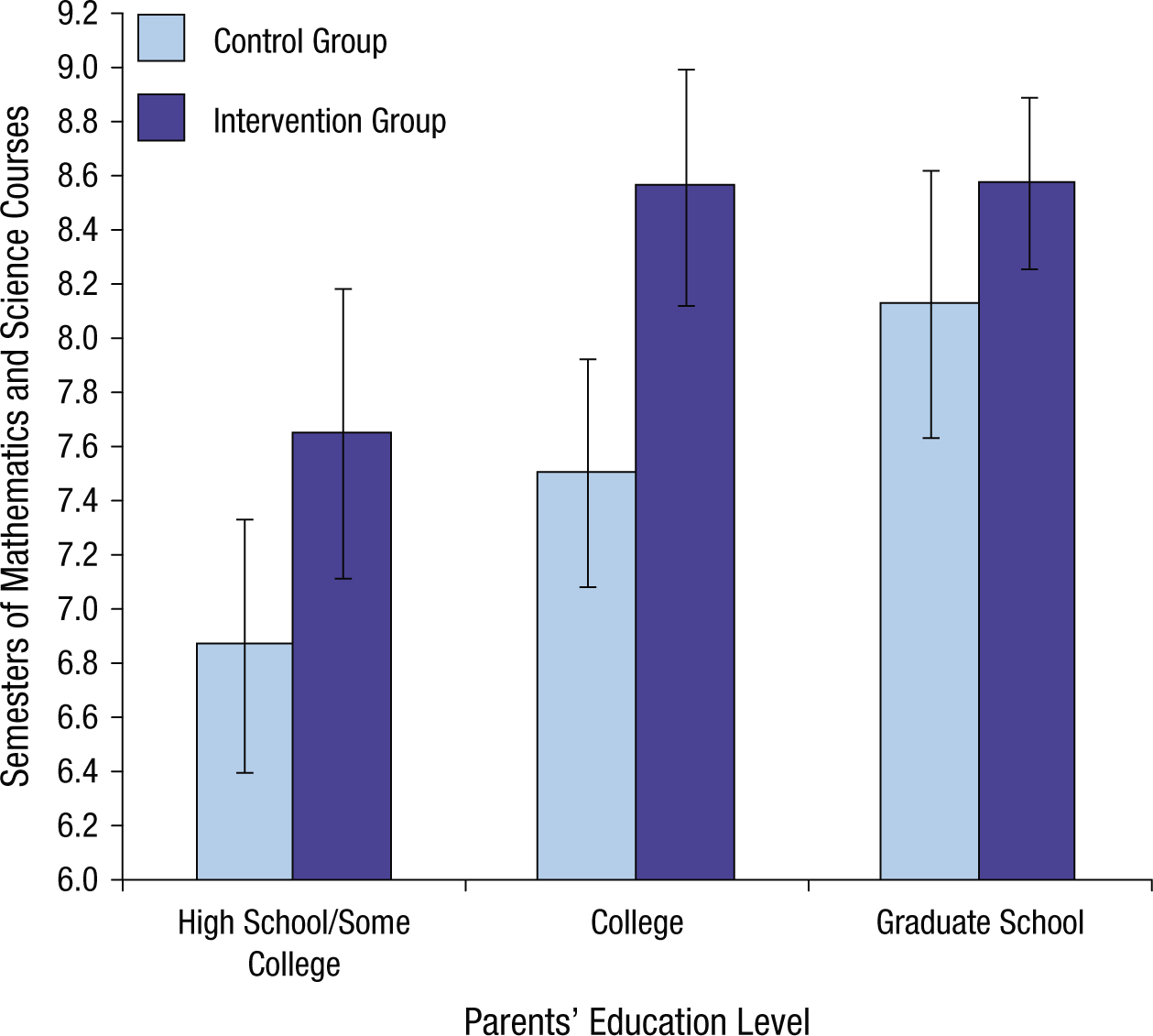
Number of semesters of mathematics and science courses that students took in the last 2 years of high school (as reported on their transcripts) as a function of parents’ education level and experimental condition. Error bars represent ±1 SEM.
We also examined students’ self-reports about the specific mathematics and science courses they took in high school, which allowed us to examine the intervention effect in more detail. For this and all subsequent analyses, we tested the same model that we had used for transcript-measured course taking, but used full-information maximum likelihood estimation methods (Arbuckle, 1996) because of missing data on questionnaire measures. Figure 2 shows the number of self-reported mathematics and science courses (early, foundational and elective, advanced) in the intervention and control conditions. The intervention and control groups did not differ in the number of early, foundational mathematics and science courses (algebra, geometry, biology, and earth science) that they had taken, z = 1.10, p = .28, β = 0.08. For most students, these classes would have been taken before the intervention was implemented with their parents. However, as predicted (see Fig. 2), there was a significant difference between the intervention and control groups in the number of more elective, advanced mathematics and science courses taken (algebra II or advanced algebra, trigonometry, precalculus, calculus, statistics, chemistry, and physics), z = 2.12, p = .03, β = 0.15.
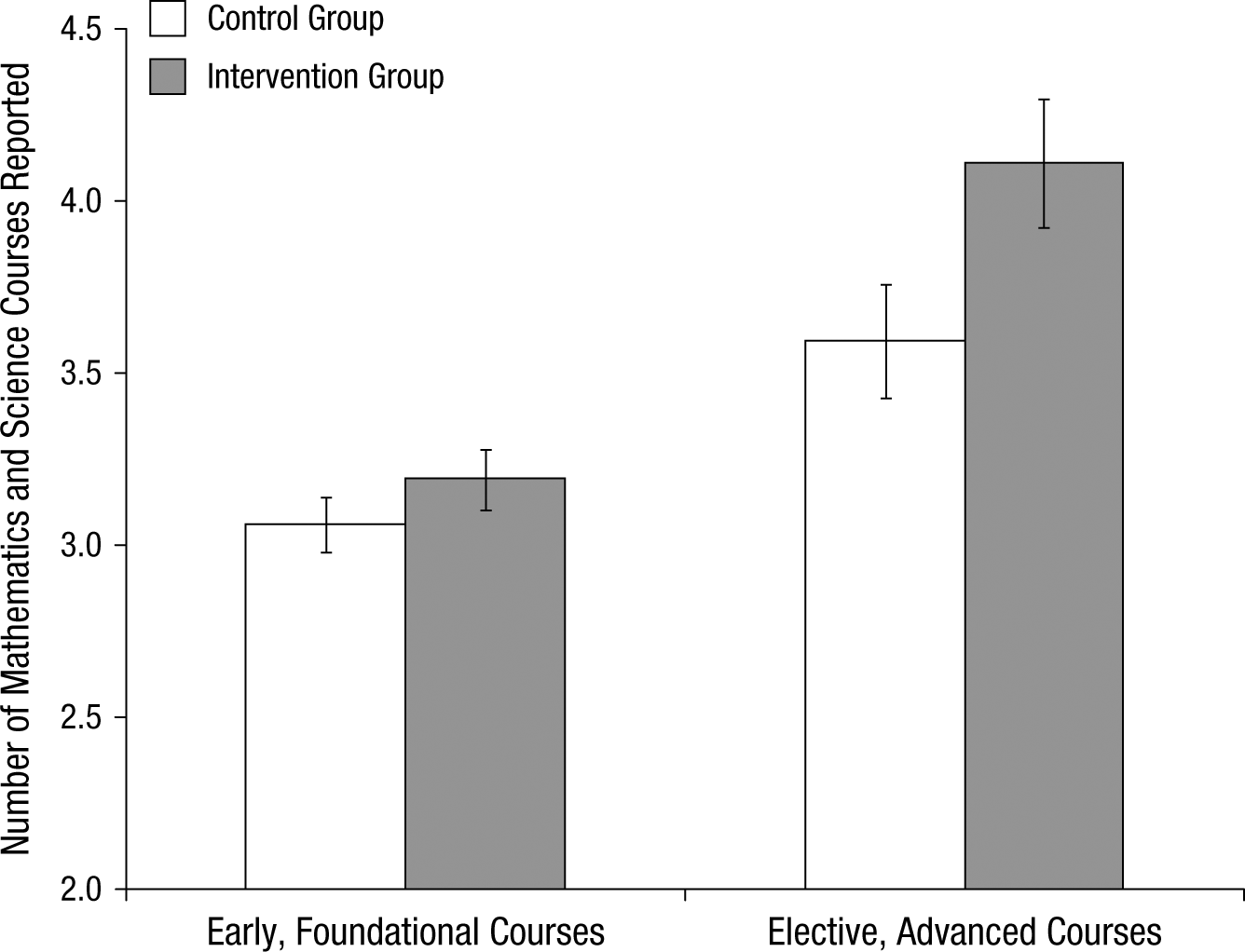
Number of self-reported mathematics and science courses taken during high school as a function of type of course (early, foundational vs. elective, advanced) and experimental condition. Error bars represent ±1 SEM.
Process analyses
We had hypothesized that the intervention would influence not only students’ course taking but also parents’ values at the end of 11th grade, and that it would lead to more conversations between parents and adolescents about the importance of mathematics and science courses. We were able to test this hypothesis only for mothers, because of an insufficient response rate from fathers. We found that the intervention had a significant effect on mother’s perceived utility value, z = 2.09, p = .04, β = 0.17; mothers in the experimental group reported higher perceived utility value of mathematics and science for their child than did mothers in the control group. In addition, mother’s education level had a significant effect on perceived utility value; more highly educated mothers perceived more utility value of STEM courses for their child, z = 3.10, p < .01, β = 0.25. Students’ retrospective reports of conversations with their parents over the previous year, measured at the end of 12th grade, revealed a significant effect of the intervention, z = 2.30, p = .02, β = 0.17. Specifically, compared with students in the control group, students in the experimental group reported having had more conversations with their parents about course choices, educational plans, and the importance of mathematics and science.
Given that these processes occurred during the same time period as course taking, mediation analyses were inappropriate. Mothers’ values were assessed halfway through the student’s course taking, which extended over a 2-year period, and conversations were assessed in retrospect at the end of 12th grade, after all course taking was completed. Thus, the process variables were not measured in the optimal sequence for testing mediation of the intervention effect on course taking. Rather, mothers’ values and conversations are most appropriately conceptualized as process measures that can help show the many ways in which the intervention influenced the parents’ beliefs and behaviors and how these beliefs and behaviors in turn influenced the students’ beliefs and course taking.
However, we could test mother’s perceived utility value, measured after 11th grade, and student’s reports of conversations as predictors of student’s perceived utility value, which we measured after graduation. Therefore, we added these two predictors to the basic regression model tested earlier 3 and examined student’s perceived utility value as the outcome variable. We found that the intervention had an indirect effect on student’s perceived utility value through both mother’s perceived utility value and conversations (Fig. 3). As reported earlier, the intervention promoted both mother’s perceived utility value and student’s reported number of conversations. In turn, these process variables were significant predictors of students’ perceptions of the utility value of mathematics and science for their future. Students perceived more STEM utility if their mothers had higher levels of perceived utility, z = 2.13, p = .03, β = 0.18, and if they had more conversations with their parents, z = 3.11, p < .01, β = 0.23.
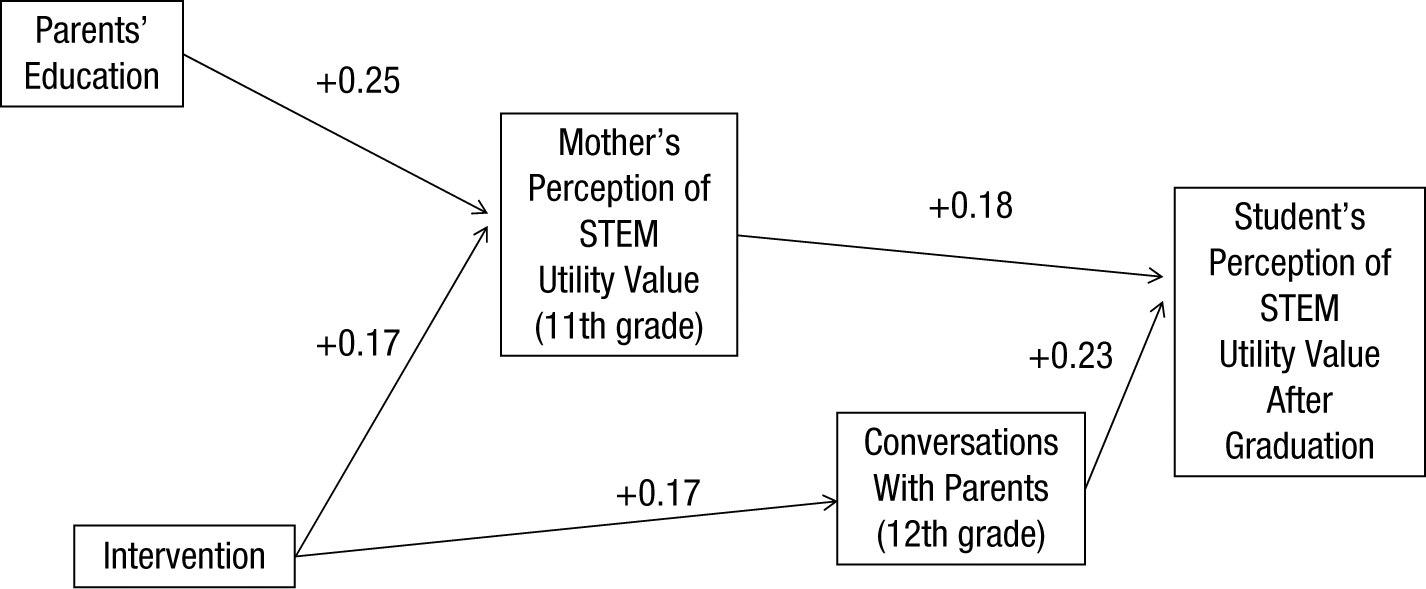
Path model of the direct effects of the intervention on mother’s perceived utility value of science, technology, engineering, and mathematics (STEM) topics (11th grade) and student’s report of conversations with parents (12th grade), and the indirect effects of the intervention on student’s perceived utility value of STEM topics after graduation from high school. These paths were generated from regression analyses in which all prior variables were controlled. In regression on mother’s perceived utility value, we used mother’s education instead of parents’ education.
Discussion
The results of this study demonstrate that a simple, theory-based intervention designed to increase communication between parents and their adolescents about the utility value of mathematics and science courses promoted mothers’ perception of the value of STEM courses, promoted parent-child conversations about the value of STEM courses, and increased the number of STEM courses adolescents took during the last 2 years of high school. These are the critical years in which mathematics and science courses are elective, and our results indicate that parents can become more influential in their children’s academic choices if given the proper support. Moreover, these courses serve as gateways to college majors in STEM disciplines by preparing students in mathematics and science (Riegle-Crumb & King, 2010). Increasing the number of STEM courses that students take in high school is therefore critical for increasing the pool of college students who are eligible for and interested in STEM majors.
We found that parents’ education was a strong predictor of their children’s course taking, as have previous researchers (Jodl et al., 2001; Simpkins et al., 2006): The children of more highly educated parents took more mathematics and science courses in high school. However, the effect of our randomized intervention was almost as strong as the effect of parents’ education, and this finding suggests that theoretically based motivational interventions can be powerful in promoting important academic choices. Our brochures and Web site provided parents with information about the utility of mathematics and science courses for their children’s futures and emphasized the importance of helping adolescents make connections between mathematics and science and their lives. Compared with their counterparts in the control group, mothers in the experimental group perceived more utility value in STEM courses for their children, and parents seemed inspired to discuss the intervention materials with their children. The 12th-grade surveys suggest that parents found the materials useful for starting conversations (e.g., “Presenting the resources was a good way to open a discussion about the importance of school subjects and college”; “We spoke about the usefulness of the website in career choice, classes needed, and ability to find employment”). Also, students whose parents had received the intervention reported having more conversations with their parents about course choices and the importance of mathematics and science.
These findings suggest that our intervention worked to promote parents’ involvement in their children’s educational choices (Grolnick, Benjet, Kurowski, & Apostoleris, 1997). In turn, these conversations were related to higher levels of perceived STEM utility value among students at the end of high school. With such resources and some encouragement to share them with their children, parents may be able to foster their children’s motivation to take mathematics and science classes or pursue STEM careers. In fact, having intimate knowledge of their children’s specific interests and history, parents may be uniquely qualified to help them appreciate the relevance of mathematics and science to their lives.
Educational research has focused on what teachers can do to promote students’ learning and motivation (Harackiewicz & Hulleman, 2010; Hidi & Harackiewicz, 2000; Pintrich, 2003; Yeager & Walton, 2011), and researchers have recently identified some effective interventions to promote students’ motivation and performance in STEM classes (Blackwell, Trzesniewski, & Dweck, 2007; Cohen, Garcia, Apfel, & Master, 2006; Hulleman et al., 2010; Hulleman & Harackiewicz, 2009; Miyake et al., 2010; Walton & Cohen, 2011). However, a critical motivational problem occurs outside of class: convincing students to enroll in STEM courses in the first place. Many important educational decisions are made outside of school, and given that education occurs in a broader social context, it is important to consider the role that parents can play in their children’s education (Epstein, 1990). The social-psychological intervention tested here was based on motivational principles that could be implemented with respect to academic choices and could prove to be a cost-effective method for enhancing parents’ involvement, perceived utility value, and communication.
Unlike previous social-psychological interventions that have been delivered directly to their intended beneficiaries (students), our intervention is novel in that it adopts a family-level analysis and an indirect approach. We delivered our intervention to parents, hoping to inspire them to discuss the value of science and mathematics with their children and to become more involved in their children’s education. Parents are an untapped resource for promoting STEM motivation, and the results of our study demonstrate that a modest intervention aimed at parents can produce significant changes in their children’s academic choices.
Footnotes
Acknowledgements
We thank Carlie Allison, Corinne Boldt, Andrew Carpenter, Amanda Durik, Claire Johnson, Kerstin Krautbauer, Dan Lamanna, Maria Mens, Michael Noh, and Jenni Petersen for their help in conducting this research. We also thank the members of our advisory board—Jacque Eccles, Adam Gamoran, Jo Handelsman, Jenefer Husman, Dominic Johann-Berkel, Ann Renninger, and Judith Smetana—for their guidance. We are most grateful to the families of the Wisconsin Study of Families and Work project for their participation over the years.
Declaration of Conflicting Interests
The authors declared that they had no conflicts of interest with respect to their authorship or the publication of this article.
Funding
This research was supported by the National Science Foundation (Grant DRL 0814750) and by the Institute for Education Sciences, U.S. Department of Education (Grants R305C050055 and R305B090009).