





Abstract
People often face outcomes of important events that are beyond their personal control, such as when they wait for an acceptance letter, job offer, or medical test results. We suggest that when wanting and uncertainty are high and personal control is lacking, people may be more likely to help others, as if they can encourage fate’s favor by doing good deeds proactively. Four experiments support this karmic-investment hypothesis. When people want an outcome over which they have little control, their donations of time and money increase (Experiments 1 and 2), but their participation in other rewarding activities does not (Experiment 1b). In addition, at a job fair, job seekers who feel the process is outside (vs. within) their control make more generous pledges to charities (Experiment 3). Finally, karmic investments increase optimism about a desired outcome (Experiment 4). We conclude by discussing the role of personal control and magical beliefs in this phenomenon.
For so many important outcomes in life, there comes a point when, having done everything one can to make the desired outcome happen, one must simply sit back and hope things work out. After all the résumé tweaking and hand shaking, the job seeker can only wait for the phone to ring. After all the test preparation and statement crafting, the high-school senior can only scan the mail for the dreaded thin envelope or the prized thick one. After controlling whatever can be controlled, people must eventually turn many outcomes over to “the universe”—some combination of controlling gods, other people’s decisions, chance factors, and the fabled flapping of a butterfly’s wings.
We suggest that in these moments—when people face outcomes of important life events that are beyond their personal control—rather than waiting passively to learn their fate, people may act as if they can gain fate’s favor by doing good deeds proactively. Specifically, we propose that the experience of awaiting an important, uncontrollable outcome increases the likelihood that people will do good deeds when confronted with the opportunity, as if they were “investing in karma.” For instance, job seekers may be more likely to drop a few coins in a collection jar after interviewing, and students may be more willing to offer a helping hand on days when they find themselves obsessing about admissions. An alternative possibility is that individuals directed to focus on their own wants and needs may feel disadvantaged, more deserving, and therefore entitled to behave selfishly (Campbell, Bonacci, Shelton, Exline, & Bushman, 2004; Rosenhan, Salovey, & Hargis, 1981; Zitek, Jordan, Monin, & Leach, 2010). In four experiments, we tested which of these two possible responses to wanting is more likely.
Introducing “Karmic Investments”
Although Western religions do not espouse karma, many Westerners are familiar with the general tenet that the universe punishes sins and rewards virtue. This idea may be rooted in the social expectation that institutions will punish criminals and reward benefactors, and that individuals will reciprocate cruel and kind behavior. People find it disconcerting when the tenet is violated, perhaps in large part because this makes them question whether hard work and self-control will result in gratification (Callan, Shead, & Olson, 2009; Hafer, 2000; Lerner, 1977). Thus, when injustices occur, people feel motivated to restore their belief that “you get what you deserve” (Lerner, 1980).
Researchers have documented many strategies that people use to reconcile apparent injustices, ranging from the derogation of victims to the selective recall of good deeds following lucky breaks (Callan, Kay, Davidenko, & Ellard, 2009; Gaucher, Hafer, Kay, & Davidenko, 2010; Hafer & Bègue, 2005; Lerner & Simmons, 1966). We suggest that the inclination toward making karmic investments may originate from the repeated use of one such strategy: In the face of apparently chance outcomes, if earlier moral acts are cognitively available, observers may causally connect the events (Callan, Ellard, & Nicol, 2006). By attributing negative outcomes to logically unrelated moral failings and positive outcomes to moral rectitude, individuals can assure themselves that good things happen to good people. Over time, this immanent justice reasoning may encourage strong associations between moral behavior and good breaks in events that one cannot personally control. We propose that when people await such uncontrollable events in their own lives, as in the wanting experiences that we investigated in the experiments reported here, the good-behavior–good-outcome association may spring to mind, biasing individuals to accept opportunities to do good deeds.
Note that this karmic-investment prediction does not require explicit karmic belief. Indeed, theorists have argued that maintenance of just-world beliefs is largely automatic (Lerner & Goldberg, 1999), and evidence suggests that people rely more on immanent justice reasoning to make causal attributions when systematic thought is interrupted (Callan, Sutton, & Dovale, 2010). More generally, people often behave as if they can influence outcomes that they know they cannot, exhibiting signs of illusory control and outright magical belief (Langer, 1975; Nemeroff & Rozin, 2000; Pronin, Wegner, McCarthy, & Rodriguez, 2006), particularly when personal control is lacking (Friedland, Keinan, & Regev, 1992; Keinan, 2002; Malinowski, 1954). Sports fans provide the most pervasive example, often behaving as if their private rituals can influence their team’s performance. This may bolster their sense of control, and it may also reflect their intuition that something good is more likely to happen under the conditions they associate with good outcomes, an application of the “like causes like” heuristic (Bleak & Frederick, 1998; Damisch, Stoberock, & Mussweiler, 2010; Rozin & Nemeroff, 2002).
The karmic-investment phenomenon that we propose may act similarly: People may be more likely to act prosocially when they face important life outcomes that are beyond their control, even if they know rationally that they cannot influence the uncertain outcomes. Helping others may indulge the intuition that if one acts virtuously, the universe will reciprocate.
Overview of the Experiments
First, we tested whether people are more likely to act virtuously when they want something outside their personal control. Specifically, we examined whether people are especially willing to donate time (Experiments 1a and 1b) and money (Experiment 2) after reflecting on an important, self-selected, uncontrollable outcome, and whether such reflection uniquely affects helping behavior (Experiment 1b). We then isolated the specific effects of personal versus external control by manipulating whether job-fair attendees perceived the search process as within or outside of their control and subsequently measuring their charitable donations (Experiment 3). Finally, we tested whether karmic investments increase job-fair attendees’ optimism about finding work (Experiment 4). (Materials for all the studies are in the Supplemental Material available online.)
Experiments 1a and 1b: Wanting Increases Volunteerism
According to our karmic-investment hypothesis, people should act virtuously when they have recently reflected on a desired future outcome that is beyond their control. As part of a study on “goals and activities,” participants in Experiments 1a and 1b wrote about either an important, unknown outcome that they were currently awaiting or their daily routine. After the study’s ostensible conclusion, we measured participants’ efforts to help a local food depository (Experiment 1a) and a national philanthropic organization (Experiment 1b). We predicted that wanting would increase helping in both cases. According to our hypothesis, wanting should preferentially increase the likelihood of doing good deeds, but not of agreeing to participate in other kinds of activities, so we included an additional factor in Experiment 1b. We framed the subsequent task as an opportunity for participants either to benefit terminally ill children or to entertain themselves. We predicted that wanting would increase participation in the helping task but not the entertaining task.
Method
Experiment 1a
Ninety-five undergraduates (47 women, 48 men) participated in Experiment 1a for $3. First, participants wrote one of two essays. Participants in the wanting condition read: “People are often waiting to learn the unknown outcome of some important event in their lives—for example, scores on an important test, decisions from a job interview, or results of a medical procedure.” They were asked to describe a personally relevant, ongoing event, the desired outcome, and the outcome’s importance. Participants in the routine condition described one of their daily routines. After the essay, the experimenter paid participants as if the experiment were complete.
As participants prepared to leave, the experimenter (blind to condition) explained that she worked for a graduate student who was currently testing a program in which students earned money for charity by completing necessary but tedious lab work. The current task involved rating mundane photos, with $0.02 per trial ($4.00 maximum) going to the Chicago Food Depository. Participants were asked if they would be willing to help, and the percentage who agreed constituted the key measure.
Experiment 1b
Ninety-nine adults (68 women, 30 men, 1 unspecified) participated in Experiment 1b for $0.50. This study, which was conducted online (Amazon’s Mechanical Turk; see Buhrmester, Kwang, & Gosling, 2011), used a 2 (essay: wanting, routine) × 2 (task frame: good deed, entertainment) between-participants design. After participants completed the wanting or routine essay (as in Experiment 1a), a display indicated that their task was complete. On the next screen, instead of the expected payment code, they found an apparently impromptu message indicating that they had finished a bit early. In the good-deed condition, this message asked if they would like to “use the remaining time to do a quick good deed.” They were told that if they completed a 5-min study of cognitive performance, researchers would donate $0.25 to the Make-A-Wish Foundation. In the entertainment condition, there was no donation involved. Participants instead had an opportunity to volunteer for a “short, fun study” involving a creativity game that many others found “entertaining, fun, and interesting.” The percentage of participants who agreed to participate constituted the key measure.
Results
Experiment 1a
A chi-square test supported our prediction that wanting would increase helping rates, χ2(1, N = 95) = 4.90, p = .027, ϕ = .23 (Fig. 1). Participants in the wanting condition were more likely to volunteer (94%) than were participants in the routine condition (78%).
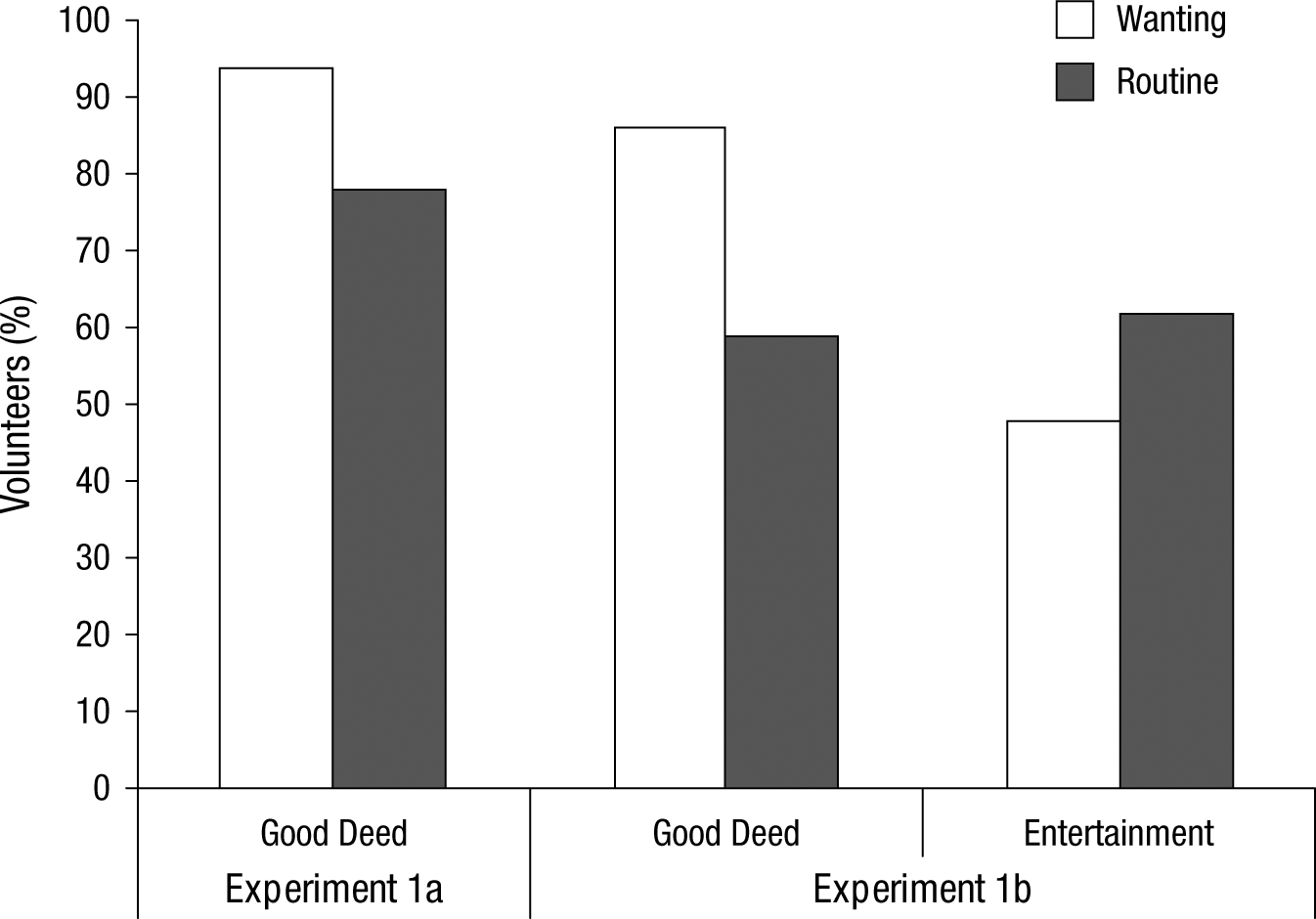
Percentage of participants who volunteered for a subsequent task as a function of essay condition (Experiment 1a) and as a function of essay condition and task framing (Experiment 1b).
Experiment 1b
We first tested whether the influence of wanting on task participation depended on the task framing. We conducted a binary logistic regression predicting participation rate from essay condition, task frame, and their interaction, and found the predicted interaction, Wald’s χ2 = 4.47, p = .034 (Fig. 1). As expected, participation rates to help a charity were higher in the wanting condition (86%) than in the routine condition (59%), χ2(1, N = 48) = 4.00, p = .045, ϕ = .29, but participation rates in a merely entertaining task were not significantly affected by wanting (wanting condition: 48%; routine condition: 62%), χ2(1, N = 51) < 1, p = .331. Thus, wanting preferentially increased participation for a helping task.
Discussion
Experiments 1a and 1b both support the karmic-investment hypothesis. After reflecting on important, unknown outcomes, such as the results of pregnancy attempts, applications to graduate schools, and court proceedings (all were actual responses of the participants), people were more likely to volunteer their time to provide food for hungry community members (Experiment 1a) and to fulfill wishes for terminally ill children (Experiment 1b). They were not, however, more likely to volunteer their time for an entertaining task that did not seem like a good deed (Experiment 1b). This latter result implies that the increased participation rates in the wanting condition reflect neither mere agreeableness nor a general desire for distraction or mood repair following potentially anxiety-provoking reflections. Instead, wanting preferentially affected the execution of good deeds, as if people were investing in karma. These results further imply that participants did not make their helping decisions on the basis of considerations of deservingness, in which case entitlement theories would predict increased selfishness in response to wanting.
Our proposal that people are more likely to help when they desire an uncertain, uncontrollable outcome implies that neither desire on its own nor uncertainty on its own should be sufficient to produce karmic investments. Compared with reflecting on one’s daily routine, the wanting experience in Experiment 1 involved both desire and uncertainty. In Experiment 2, we included additional controls to help identify which aspects of the wanting experience are necessary for producing karmic investments.
Experiment 2: Wanting Increases Donations
In Experiment 2, we compared wanting with two related experiences. We assigned some participants to reflect on a decision that would make them feel uncertain, but not diminish their sense of personal control. We assigned other participants to reflect on personal preferences that would arouse desire, but not diminish their sense of personal control or arouse uncertainty. We also expanded the investigation to examine monetary donations because preferences for donating time and for donating money sometimes diverge (Reed, Aquino, & Levy, 2007). We predicted that people would donate more money in the wanting condition than in the other two.
Method
Ninety-five Chicago community members (49 women, 46 men) participated in Experiment 2, a study on “writing about life events,” for $8. Before administering the ostensibly focal writing exercise, the experimenter asked all participants if they would be willing, “at the end of the study,” to stay a few extra minutes to provide feedback on a pilot version of a “charity-based program.” We introduced the charity initiative at this stage as a way to provide context for the eventual donation opportunity that would serve as the dependent variable. All participants agreed to stay.
The experimenter then delivered one of three essay prompts. The wanting condition was identical to that in Experiment 1. The uncertainty condition utilized McGregor and Marigold’s (2003) personal-uncertainty manipulation (adapted from Taylor & Gollwitzer, 1995), which asks participants to reflect on an unresolved personal dilemma, in the form “should I . . . or not?” For example, participants might reflect on their decision to take a job or stay in school. We intended this condition to match the outcome uncertainty of the wanting condition, but to highlight uncertainty that is within, rather than beyond, one’s control. 1 The essay in the preferences condition involved describing mundane choices (e.g., pizza vs. burger), an experience involving self-focus and personal desires, but no significant uncertainty or lack of control.
Participants then received $8 (including four quarters) and signed a form to indicate receipt of the money. Next, the experimenter directed participants to a professional-looking donation center set up in another area of the lab. Participants’ task was to provide a third-party review of the lab’s “Science & Society” charity initiative by reading the materials at the center and responding to a program-feedback survey that asked questions such as “Do you think this program is worthwhile? Why or why not?” and “Do you think other [lab] participants will be interested in this program? Why or why not?” Before leaving participants alone to evaluate the materials, the experimenter said, “Whether you donate is completely up to you. . . . If you decide that you want to actually donate, all the information is on the card.”
Participants could donate to the Make-A-Wish Foundation, American Cancer Society, or Greater Chicago Food Depository by sealing money in an unmarked envelope and depositing it in a large lockbox. To encourage participants’ sense that decisions were unmonitored, we provided a large stack of empty envelopes (so it would appear that the use of an envelope would not be noticed by visual inspection), and we stuffed the lockbox with a number of apparently used envelopes. In reality, the used envelopes were all empty, so that we could record participants’ donation amounts. Total donations across the three charities served as the key dependent variable.
Results and discussion
We excluded 1 participant in the wanting condition who wrote about a past event. Another participant’s donation of $8 (in the preferences condition) was an outlier (> 3 SDs above the mean), and we trimmed it to match the next highest donation ($3).
We predicted that participants in the wanting condition would donate more money than participants in the other conditions. To test this specific hypothesis, we used an analysis of covariance (ANCOVA), controlling for years of education,
2
with a planned contrast on wanting (+2) versus uncertainty and preferences (both −1). As predicted, people donated more in the wanting condition (M = $0.87, SD = $0.91) than in the other two (uncertainty condition: M = $0.48, SD = $0.66; preferences condition: M = $0.61, SD = $0.86), F(1, 91) = 4.07, p = .047,
Experiment 2 demonstrates that wanting increases monetary donations, and provides initial evidence that a lack of control over an outcome is necessary to stimulate karmic investment. Moreover, in concert with Experiment 1b, it refutes a more general explanation based on relieving negative affect (Cialdini, Darby, & Vincent, 1973). In Experiment 1b, wanting failed to increase participation in a potentially mood-restoring task, and in Experiment 2, the aversive experience of personal uncertainty failed to increase helping relative to voicing mundane preferences. Experiment 3 more directly examined the role of personal control and tested our hypothesis in a real-world setting in which everyone would be focused on the same important outcome.
Experiment 3: Personal Control in a Field Experiment With Job Seekers
If people act prosocially to gain favor with the universe, they should do so only when their own lack of control is apparent. To test whether this is the case, we induced job-fair attendees to focus on the elements of the search process that were either within or outside of their control. We predicted that participants who experienced a lack of control over the process, relative to those who experienced greater control, would pledge more of their potential lottery winnings to charity.
Method
Seventy-seven attendees at a community job fair (49 women, 28 men) completed a survey about the job-search process. The only advertised incentive was candy, but participants also entered a (surprise) $100 lottery after consenting to complete the survey.
The seven-item survey, titled “The Job Search,” served as our manipulation of personal control. Participants read about seven aspects of the job-search process and rated the job seeker’s level of control over each. In the personal-control condition, we preselected items that most people would consider within their control (e.g., “learning a lot about the industry”). In the outside-control condition, we preselected items that most people would say they could not control (e.g., “whether new jobs will open up”). Thus, we led participants in the personal-control condition to experience control over the process and participants in the outside-control condition to experience a lack of control (implying control by “the universe”).
Following the survey, participants learned about a donation opportunity. The donation form came from a separate pile and was printed in a different style than the lottery sign-up to ensure that participants did not think donations would (directly) affect their odds of winning the lottery. The form asked participants how much they would want to donate to charity ($0–$100, in $10 intervals) if they were to win the survey’s lottery prize. Preferred donation amount was the dependent measure.
Results and discussion
We conducted an ANCOVA on donation amount, controlling for education.
4
As predicted, participants in the outside-control condition offered to donate more (M = $34.57, SD = $30.81) than did those in the personal-control condition (M = $20.71, SD = $25.03), F(1, 74) = 4.87, p = .03,
Having accumulated evidence consistent with the karmic-investment hypothesis across four samples in the lab and field, we designed Experiment 4 to test a unique prediction of the hypothesis: If people do good deeds as part of a bargain with the universe, then they should be more optimistic about their desired outcome after doing so (see also Kogut & Ritov, 2011).
Experiment 4: Consequences of Karmic Investment
We again recruited job seekers and manipulated their perceived control over the search process. Then, rather than measuring helping behavior, we manipulated it. We offered participants a low-cost/high-reward opportunity intended to be so desirable that all would accept, and manipulated whether the reward would benefit charity or the individual. We expected that those participants who fulfilled their half of a karmic bargain (i.e., those in the outside-control condition who helped a charity) would be more optimistic about their job prospects than those who did not fulfill a bargain (i.e., those in the outside-control condition who did not help a charity) and those who did not face a bargain in the first place (i.e., those in the personal-control conditions).
Method
Three hundred twenty-seven participants (117 women, 208 men, 2 unspecified) at a college job fair participated in Experiment 4 in exchange for entry into a $100 lottery.
This study used a 2 (control: outside, personal) × 2 (beneficiary: charity, self) between-participants design. Participants completed the same initial survey (i.e., control manipulation) from Experiment 3 and then received an additional opportunity: They could agree to complete a 1-min survey for a $50 increase in the lottery prize. In the charity condition, the $50 would go to their chosen charity. In the self condition, the $50 would be added to their own prize. The instructions clearly stated that this did not constitute a separate lottery and that their participation would not affect their odds of winning. Thirty-one participants (9.5%) chose not to complete the second survey (no difference between conditions, χ2 < 1), which left 296 participants in the sample.
The second survey, which constituted our dependent measure, asked four questions assessing participants’ optimism about their current job prospects (e.g., “How likely do you believe it is that you will be offered a job in the relatively near future?”). Responses were made on a 9-point scale (α = 84).
Results and discussion
To test our specific prediction that participants in the karmic-investment condition (i.e., outside control plus action to benefit charity) would be the most optimistic, we used a one-way analysis of variance to contrast this condition (+3) with all the others (−1). As predicted, participants who felt the search was out of their hands but who engaged in a prosocial action felt the most optimistic about finding a job, F(1, 292) = 5.42, p = .021,
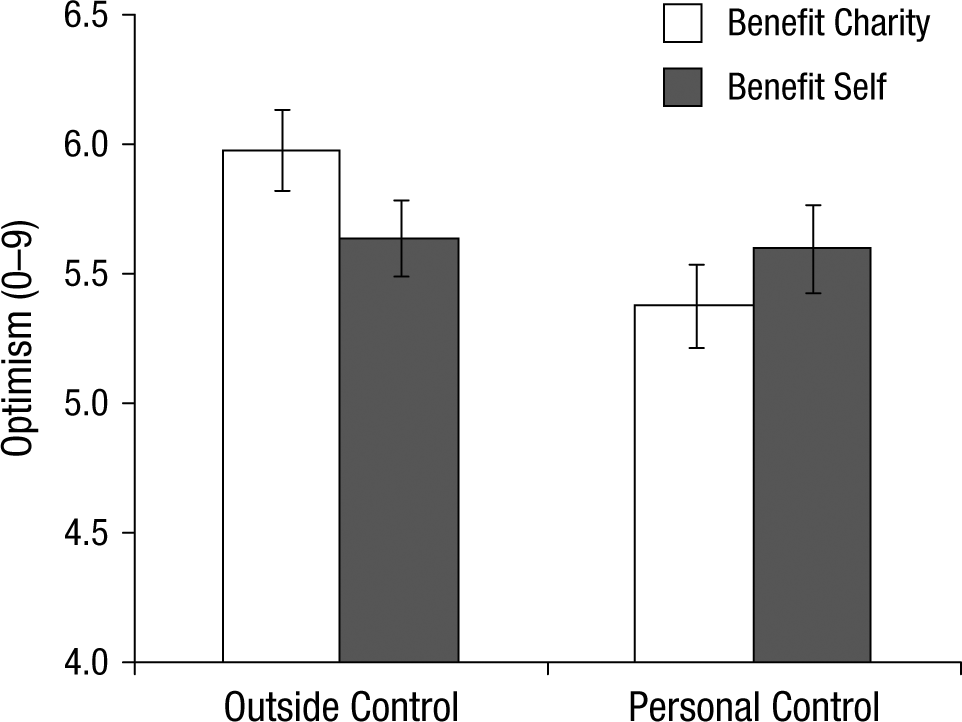
Participants’ optimism about finding a job as a function of their sense of control over the job search and the potential beneficiary of their participation in the second survey (Experiment 4). Error bars represent standard errors of the mean.
General Discussion
In four studies, we found support for the karmic-investment hypothesis. Participants were more willing to donate time and money when they reflected on an uncertain outcome that was beyond their control. In the field, job seekers were more likely to pledge potential lottery winnings to charity if they believed the search process was outside (rather than within) their control. We found repeated evidence of people doing real, consequential, costly good deeds when they wanted something beyond their control. We then tested whether this bargain would influence participants’ expectations. We found that participants who invested in karma—those who did good deeds when they wanted something beyond their control—were the most optimistic about their desired outcome, as if the karmic investment would indeed be rewarded. Furthermore, the predictors and consequences of karmic investments appear to be specific. Wanting increased good deeds but not personally beneficial acts (Experiment 1b), and doing a good deed increased optimism, but benefiting the self did not (Experiment 4).
Personal control
Proximally, karmic investments are a “relevant” response only to an outcome controlled by the universe—that is, not controlled by the self. Experiments 1 through 3 demonstrate that a lack of personal control is necessary for the observed effects, but the precise role of control remains a question for future research. More distally, lack of control may also contribute to the observed effects by increasing superstitious belief in general (Keinan, 2002).
It is also possible that a perceived lack of control prompts attempts to regain it (White, 1959), and these attempts may include acting to affect other individuals’ outcomes (e.g., helping). Although establishing personal control may well be a side effect of karmic investment, there are multiple reasons to doubt that it is the mechanism for the effects we observed. In particular, our participants often faced alternatives to helping that would have been just as effective for restoring personal control, and yet they did not prefer those options. In Experiment 1a, refusing to work on the experimenter’s boring task, and instead pursuing one’s own interests, would presumably have been at least as effective at restoring control as helping. Similarly, withholding money from other people (Experiments 2 and 3) or signing up for an entertaining task (Experiment 1b) seem just as viable for bolstering control as helping other people. Thus, although we suspect that karmic investments may indeed increase a sense of personal control, as suggested by work showing that prosocial behavior can restore control and improve well-being for at-risk populations (Schwartz & Sendor, 1999), this mechanism seems insufficient to account for the current findings. Participants appeared to be particularly motivated to do good deeds, and this motivation suggests karmic concerns.
A spectrum of beliefs
Our results provide reliable evidence that people do good deeds when they want something beyond their control. This suggests that they act in accord with a karmic tenet rooted in immanent justice, but does not imply pervasive explicit belief in karma. There may well be a spectrum of belief (Nemeroff & Rozin, 2000). Some people might express the belief outright. Others might refrain from endorsing it out of embarrassment or a desire to avoid undermining their apparent altruism. Still others might have the idea cross their minds, but disregard it upon reflection. Finally, some may not be aware of holding the belief at all. Thus, the notion of karma may reflect a truly magical belief, in which people erroneously assume that actions can influence outcomes without a causal link (Eckblad & Chapman, 1983; Zusne & Jones, 1989), or a quasi-magical belief, “in which people act as if they erroneously believe that their action influences the outcome, even though they do not really hold that belief” (Shafir & Tversky, 1992, p. 463).
We suspect that helping as a karmic investment may fall on the more implicit side of this spectrum. Past research has found that people automatically anticipate negative outcomes following behaviors that tempt fate (Risen & Gilovich, 2008), and that people associate positive outcomes with virtuous behaviors (Callan, Kay, et al., 2009). Thus, people may develop a basic good-behavior—good-outcome association, such that hoping for good outcomes activates the cognitive script to do good deeds (Lerner, 2003).
If the observed virtuous behavior reflects a form of karmic investment, whether based on explicit or implicit belief, some version of a karmic belief system must be at least momentarily activated when people face important, uncontrollable outcomes. Indeed, a follow-up study showed that the concept of karma was automatically activated for participants who were induced to experience wanting. After writing either the wanting or routine essay from Experiment 1, participants completed 10 letter strings with the first word that came to mind. Critical targets were “KA - - -” (karma, kayak, etc.), “FA-E” (fate, face, etc.), and “L-CK” (luck, lock, etc.). Despite not completing more words overall (M = 8.76 in the wanting condition vs. 8.98 in the routine condition), participants in the wanting condition were more likely to complete these strings with at least one karma-related word (63.1%) than were participants in the control condition (49.7%), χ2(1, N = 307) = 5.58, p = .02, ϕ = .13, a result suggesting activation of karma-related concepts.
Together, our findings fit with the notion that people turn to external sources of control, such as gods and governments, when internal control is lacking (Jost, Banaji, & Nosek, 2004; Kay, Gaucher, Napier, Callan, & Laurin, 2008), and may even turn to apparently magical systems when necessary (Malinowski, 1954). We have provided evidence that people may proactively invest in those systems in the hopes of improving their outcomes. Karmic investments do not appear to be motivated attempts to maintain just-world beliefs, but they may be artifacts of that belief-maintenance process.
Conclusion
We found that, rather than increasing selfishness, wanting can increase helping. Although most job applicants might deny that doing a good deed has any bearing on getting a job offer, they may nonetheless feel compelled to offer a helping hand when reflecting on their wishes. Such karmic-investment behaviors suggest that people may not only pursue reciprocal exchanges interpersonally, but may also attempt to bargain with the universe.
Footnotes
Acknowledgements
We thank Ashley Angulo and Emily Kaiser for help conducting the experiments and Clayton Critcher, Noah Goldstein, and Adam Waytz for insightful comments that improved the research.
Declaration of Conflicting Interests
The authors declared that they had no conflicts of interest with respect to their authorship or the publication of this article.
Funding
This research was supported by the Frank Batten School of Leadership and Public Policy and by the Booth School of Business.

Notes
References
Supplementary Material
Please find the following supplemental material available below.
For Open Access articles published under a Creative Commons License, all supplemental material carries the same license as the article it is associated with.
For non-Open Access articles published, all supplemental material carries a non-exclusive license, and permission requests for re-use of supplemental material or any part of supplemental material shall be sent directly to the copyright owner as specified in the copyright notice associated with the article.
