






Abstract
In multistable perception, the brain alternates between several perceptual explanations of ambiguous sensory signals. It is unknown whether multistable processes can interact across the senses. In the study reported here, we presented subjects with unisensory (visual or tactile), spatially congruent visuotactile, and spatially incongruent visuotactile apparent motion quartets. Congruent stimulation induced pronounced visuotactile interactions, as indicated by increased dominance times for both vision and touch, and an increased percentage bias for the percept already dominant under unisensory stimulation. Thus, the joint evidence from vision and touch stabilizes the more likely perceptual interpretation and thereby decelerates the rivalry dynamics. Yet the temporal dynamics depended also on subjects’ attentional focus and was generally slower for tactile than for visual reports. Our results support Bayesian approaches to perceptual inference, in which the probability of a perceptual interpretation is determined by combining visual, tactile, or visuotactile evidence with modality-specific priors that depend on subjects’ attentional focus. Critically, the specificity of visuotactile interactions for spatially congruent stimulation indicates multisensory rather than cognitive-bias mechanisms.
Keywords
Sensory signals in the natural world are inherently ambiguous. To form a coherent percept of the environment, the human brain needs to infer the most likely causes of the sensory signals. For instance, sitting on a train and looking out the window requires integrating visual, vestibular, and proprioceptive signals with prior world knowledge to infer whether the onset of retinal image motion is induced by motion in the environment or the train starting to move (Ernst & Bülthoff, 2004). From a Bayesian perspective, perceptual inference thus relies on combining prior beliefs with incoming sensory evidence to obtain the posterior probability of the different perceptual interpretations (Kersten, Mamassian, & Yuille, 2004).
Perceptual inference processes are most prominent in multistable perception when the brain alternates between multiple perceptual explanations that have a similar probability, such as in the vase-face illusion, the Necker cube, or binocular rivalry (Andrews & Purves, 1997). In the Bayesian framework, multistability emerges because the posterior distribution is multimodal (i.e., has multiple peaks), so that the sensory inputs can be explained equally well by several hypotheses (Dayan, 1998; Gershman, Vul, & Tenenbaum, 2009; Hohwy, Roepstorff, & Friston, 2008). Multistable perception thus dissociates dynamic perceptual interpretations from constant physical stimulation, which renders it a powerful tool to investigate perceptual organization.
Bistability has previously been employed to study visual perception (for a review, see Blake & Logothetis, 2002; Leopold & Logothetis, 1999; Logothetis, Leopold, & Sheinberg, 1996; Lumer, Friston, & Rees, 1998; Tong, Meng, & Blake, 2006), auditory perception (Pressnitzer & Hupe, 2006; Warren & Gregory, 1958), and tactile perception (Carter, Konkle, Wang, Hayward, & Moore, 2008). Collectively, these studies have demonstrated that multistable processes in different sensory modalities share similar properties, such as the exclusivity of each perceptual interpretation, the inevitability of perceptual alternations, and the independence of the duration of one perceptual dominance period from the previous one (Leopold & Logothetis, 1999). Initial studies have also demonstrated the influence of unambiguous auditory or tactile signals on the dynamics of perceptual rivalry in the visual modality (Blake, Sobel, & James, 2004; Bruno, Jacomuzzi, Bertamini, & Meyer, 2007; Conrad, Bartels, Kleiner, & Noppeney, 2010; Lunghi, Binda, & Morrone, 2010).
However, it is unclear whether concurrent multistable processes interact across the senses. In a previous experiment, no interactions were shown for concurrent visual and auditory rivalry processes that were induced by visual apparent motion and auditory streaming stimuli, respectively (Hupe, Joffo, & Pressnitzer, 2008). Yet the absence of interactions in this experiment may be explained by the fact that the visual and auditory signals were not spatially colocalized and related only at a relatively abstract level. From a Bayesian perspective, spatial and perceptual congruency are crucial for multisensory integration because they inform the brain that two sensory signals are caused by a common source and should hence be integrated.
We therefore investigated whether multistable perceptual dynamics interact across vision and touch when powerful cues of spatial, temporal, and perceptual congruency are provided. To this end, we applied two motion quartets to simultaneously stimulate the domains of vision and touch (see Fig. 1). Each motion quartet employed two pairs of stimuli (two pairs of visual flashes or two pairs of tactile vibration pulses). The members of each pair were presented at diagonally opposite corners of an invisible rectangle. Alternating the pairs in a repeated sequence created the illusion that the flashes or vibrations jumped from corner to corner either vertically or horizontally.
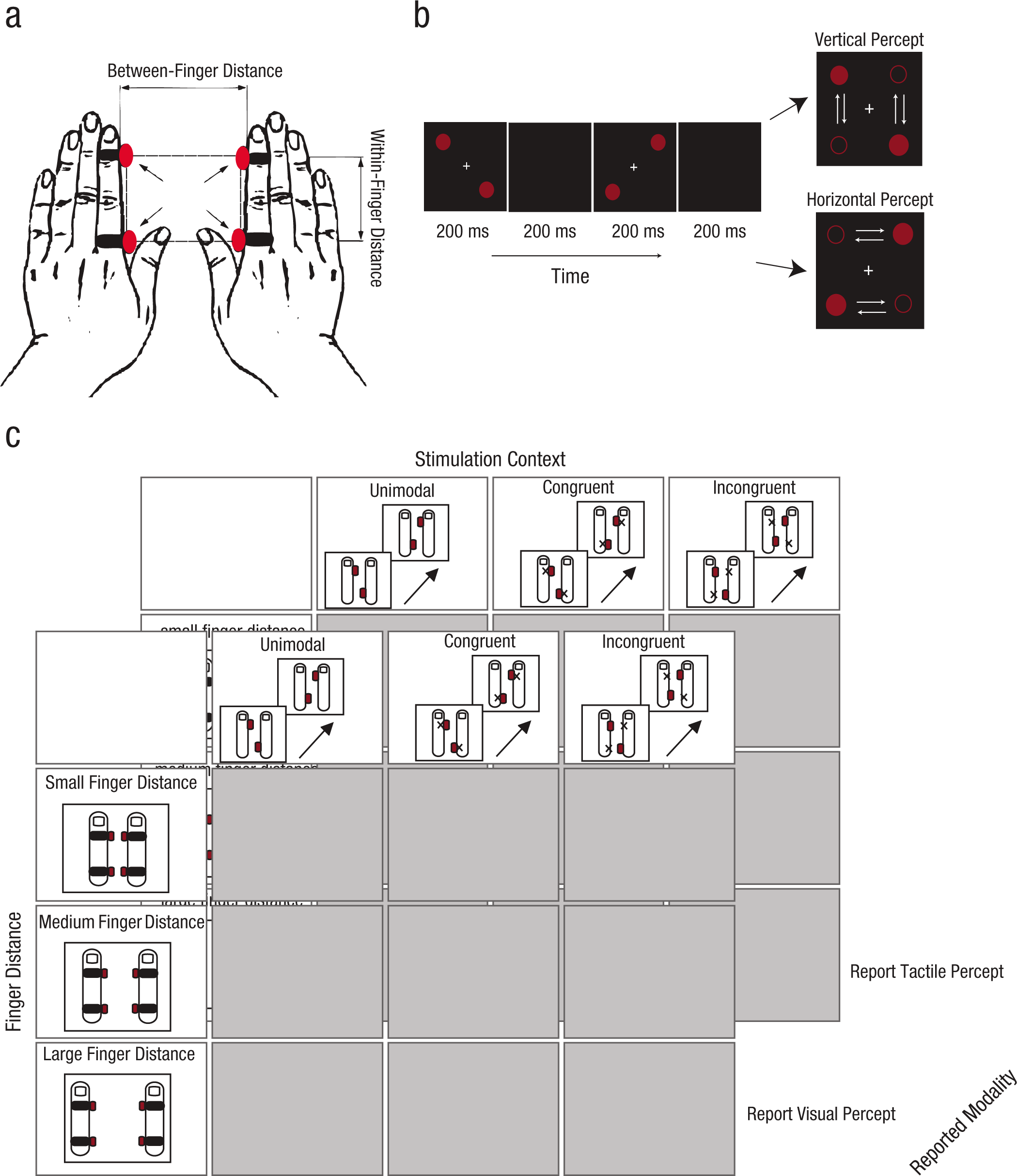
Experimental setup and trial sequence. Two vibrators and two red LEDs (a) were attached to each of subjects’ index fingers so that they formed four corners of an invisible rectangle. The within-finger distance of the LEDs and vibrators was fixed, but the between-finger distance varied. Apparent motion quartets (b) were created with two pairs of stimuli (flashes, vibrations, or both simultaneously). The members of each pair were presented at diagonally opposite corners of the invisible rectangle. Alternating the pairs in a repeated sequence (with a brief interstimulus interval between them) created the illusion that the flashes and vibrations jumped from corner to corner either vertically or horizontally. Experiments 1 and 2 employed a 3 × 2 × 3 factorial design (c) manipulating finger distance (smaller than, equal to, or larger than the fixed vertical distance), reported modality (visual or tactile), and stimulation context (unisensory, spatially congruent visuotactile, or spatially incongruent visuotactile).
This apparent motion quartet is ideal for probing interactions in bistable dynamics across vision and touch by enforcing visuotactile colocalization and synchrony as critical cues for multisensory binding (see Lyons, Sanabria, Vatakis, & Spence, 2006; Stein & Meredith, 1993). Further, visual and tactile apparent motion share similar perceptual properties. They both obey Korte’s third law, whereby the optimal stimulus onset asynchrony between two subsequent visual (or tactile) stimuli increases with their spatial distance (Harrar, Winter, & Harris, 2008).
General Method
Participants
Twelve observers (4 males, 8 females; age range = 24–36 years, mean age = 28.3 years) participated in Experiment 1, and 12 observers (11 new and 1 who participated in Experiment 1) participated in Experiment 2 (5 males, 7 females; age range = 23–37 years, mean age = 25.7 years). Six observers from Experiment 1 participated in Experiment 3 (2 males, 4 females; age range = 26–36 years, mean age = 30.7 years). All were right-handed, had normal or corrected-to-normal vision, provided informed consent, and were naive to the aims of the experiments (except for 1, who was the first author of this article).
Experimental setup: visuotactile apparent motion quartet
To create a visual and tactile apparent motion quartet, we attached two coin-sized vibrators and two red LEDs to the index fingers of subjects’ hands such that they formed four corners of an invisible rectangle (see Fig. 1a). This experimental setup enabled spatial colocalization of visual and tactile stimulation and enforced visuotactile interactions.
The vibrators had a diameter of 12 mm and an average speed of 12,000 rpm. The LEDs had a luminance intensity of 1.4 cd/m2. Both visual flashes and tactile vibration pulses were applied for durations of 200 ms interleaved with 200-ms interstimulus intervals. Subjects’ hands were placed on markers predefined on a workbench at a distance of approximately 50 cm from their eyes. In all experiments, participants fixated on a cross placed centrally between the two hands.
The vertical distance between vibrators and LEDs on the same fingers was fixed to approximately 8 cm. The horizontal distance between vibrators and LEDs on opposite fingers was manipulated by changing the separation of the fingers. We selected three horizontal distances: The small distance (horizontal:vertical = 1:2) created a bias toward horizontal motion, the medium distance (horizontal:vertical = 1:1) created an ambiguous percept, and the large distance (horizontal: vertical = 2:1) created a bias toward vertical motion.
Apparent motion quartets create the illusion that dots or vibrations jump from corner to corner of an invisible rectangle either vertically or horizontally. Both interpretations are plausible explanations for the stimuli, and this ambiguity gives rise to bistable percepts. Indeed, all subjects reported a clear percept of vertical and horizontal apparent motion with frequent rivalry between the two perceptual states. Prior to all experiments, subjects were familiarized and trained on the visual and tactile stimulation and reporting techniques.
Experiments 1 and 2
Method
In Experiment 1, subjects were continuously stimulated over one long trial of 6 min, separately for each of 18 conditions (see Fig. 1c). They verbally reported whenever they experienced a perceptual switch (i.e., a change from vertical to horizontal motion or vice versa). These responses were recorded with a microphone.
In Experiment 2, subjects were presented with 4-s stimulation trials, and they reported their percept after each brief trial (with the response directly recorded by the experimenter). The duration of 4 s enabled the emergence of a stable percept yet excluded perceptual switches. There were 12 trials per condition. In both experiments, the order of conditions was randomized and counterbalanced across subjects.
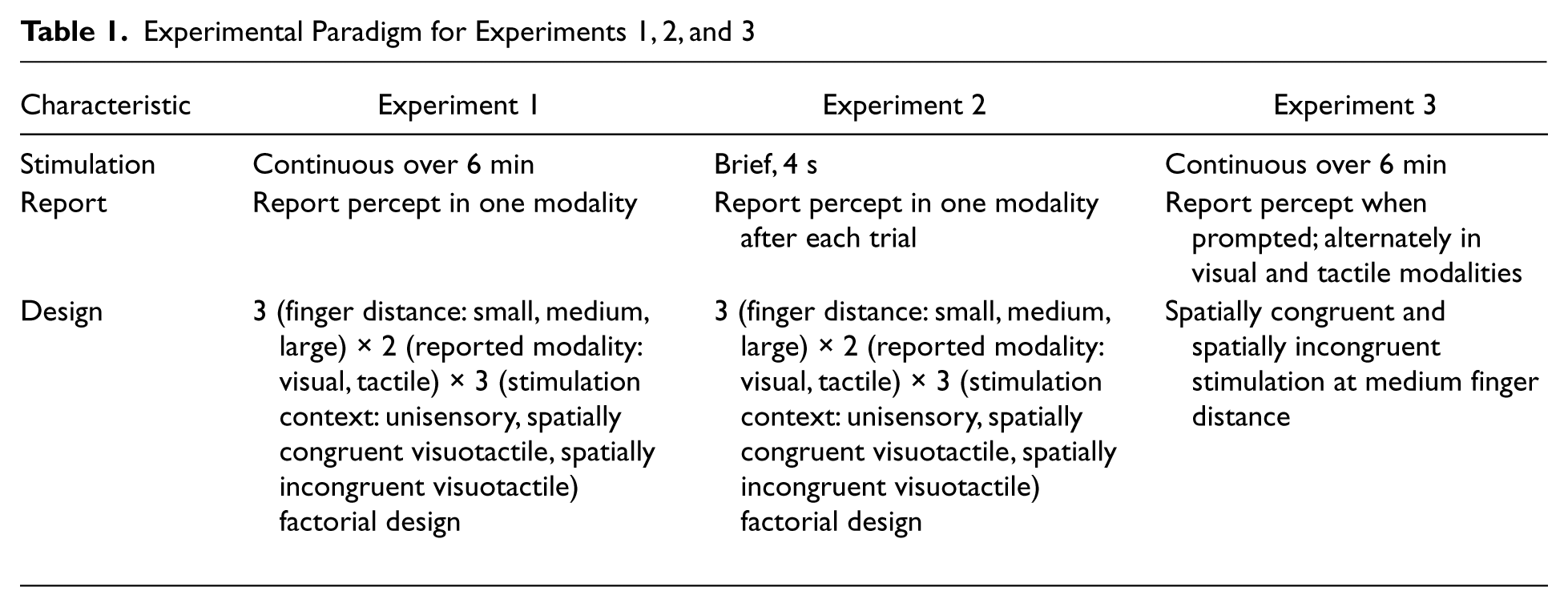
Both experiments had a 3 (finger distance: small, medium, large) × 2 (reported modality: visual, tactile) × 3 (stimulation context: unisensory, spatially congruent visuotactile, spatially incongruent visuotactile) factorial design (see Table 1).
Experimental Paradigm for Experiments 1, 2, and 3
Finger distance
To influence subjects’ perceptual bias, we set the horizontal distance of the visuotactile stimuli in the motion quartet to be (a) smaller than, (b) equal to, or (c) larger than the fixed vertical distance.
Reported modality
Subjects verbally reported either a visual or tactile percept. Reporting selectively only in one modality enabled us to investigate the effects of unattended tactile or visual bistable dynamics on attended and reported visual or tactile bistable dynamics. We did not ask subjects to report their visual and tactile percepts concurrently because subjects were not able to reliably track and report both types of percepts simultaneously in these two experiments. Furthermore, a direct comparison between selective unisensory and bimodal report conditions would be confounded by differences in attentional demands.
Stimulation context
Subjects were stimulated in three ways: only visually or tactilely (unisensory condition), with flashes and vibrations along the same diagonal (spatially congruent visuotactile condition), or with flashes and vibrations along the two orthogonal diagonals (spatially incongruent visuotactile condition). This experimental manipulation enabled us to investigate whether rivalry processes in visual and tactile modalities interact as a function of spatial congruency.
In Experiment 1, we characterized the long-term statistics of the bistable dynamics with three indices: (a) the number of perceptual switches reported during the 6-min trial for each condition, (b) the mean duration of perceptual dominance times averaged across horizontal and vertical percepts, and (c) the percentage perceptual bias, which was calculated as the difference between the cumulative dominance times of the horizontal and vertical percepts expressed as the percentage of the total presentation time. Because Experiment 2 presented brief 4-s trials, we were able to estimate only the percentage perceptual bias.
Results
For Experiment 1, the number of perceptual switches, the mean duration of perceptual dominance, and the percentage perceptual bias were entered into a 3 (finger distance: small, medium, large) × 2 (reported modality: visual, tactile) × 3 (stimulation context: unisensory, spatially congruent visuotactile, spatially incongruent visuotactile) repeated measures analysis of variance (ANOVA). For Experiment 2, the percentage perceptual bias was entered into an ANOVA with the same factors.
Finger distance
Consistent with previous results (Carter et al., 2008; Gengerelli, 1948), our findings showed a main effect of finger distance for percentage perceptual bias in both experiments, Experiment 1: F(1.98, 21.73) = 81.49, p < .001; Experiment 2: F(2.00, 22.00) = 159.14, p < .001. 1 Subjects were more likely to perceive a horizontal motion percept when finger distance was small and a vertical motion percept when finger distance was large. Because subjects were more likely to show a bias toward horizontal motion when finger distance was small and a bias toward vertical motion when finger distance was large, there was an increase in mean dominance durations, F(2.00, 22.00) = 4.60, p < .05, and a decrease in the mean number of perceptual switches, F(1.83, 20.09) = 6.78, p < .01, in both of these conditions. By contrast, when horizontal and vertical finger distances were equal, subjects were equally likely to perceive horizontal and vertical motion, and this led to rapid perceptual alternations between the two types of motion.
Reported modality
We next investigated whether the temporal dynamics differed depending on whether subjects focused on vision or touch. Indeed, a main effect of reported modality for the number of perceptual switches, F(1.00, 11.00) = 15.21, p < .01, and mean perceptual dominance durations, F(1.00, 11.00) = 9.19, p < .01, demonstrated that rivalry dynamics were slower for touch than for vision (Fig. 2). Furthermore, a main effect of the percentage perceptual bias indicated that subjects in Experiment 1 were biased toward the horizontal percept for tactile relative to visual motion quartets, F(1.00, 11.00) = 5.68, p < .05. Intriguingly, we did not observe a significant interaction between stimulation context and reported modality. In other words, the differences in mean perceptual dominance durations, number of perceptual switches, and percentage perceptual bias between visual and tactile rivalry occurred even when tactile and visual stimuli were presented simultaneously; furthermore, these measures were unaffected by the stimuli’s spatial congruency. These results suggest that the temporal dynamics and perceptual biases were also determined by subjects’ focus of attention.
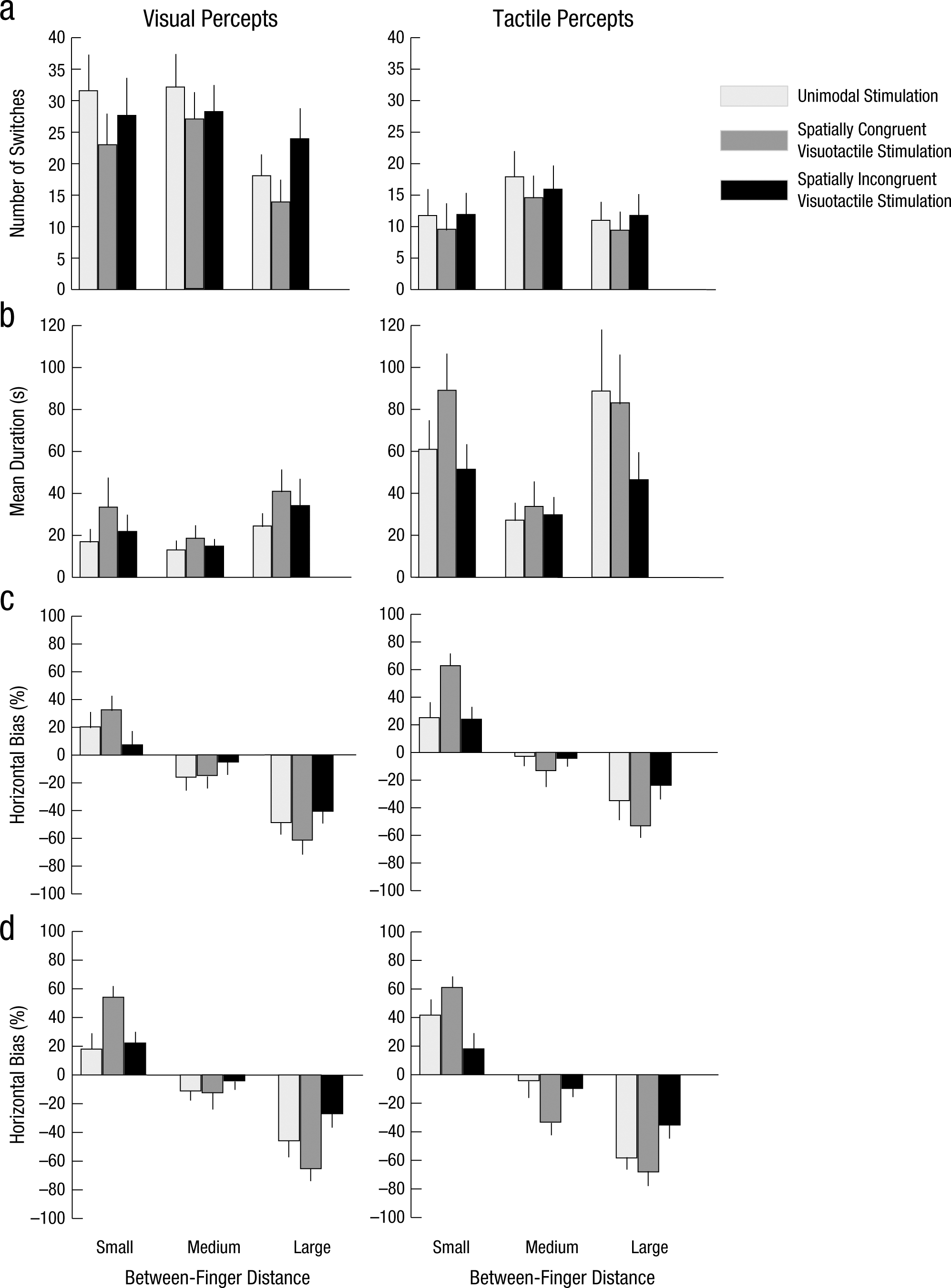
Results for visual percepts (left column) and tactile percepts (right column) in Experiments 1 (a–c) and 2 (d). The graphs show the mean number of switches between horizontal and vertical percepts (a), the mean duration of perceptual dominance averaged across horizontal and vertical percepts (b), and the mean percentage perceptual bias (Experiment 1: c; Experiment 2: d) as a function of the distance between subjects’ index fingers and the stimulation context. All means were calculated across subjects. Error bars show standard errors.
Stimulation context
The central question of our study was whether bistable perceptual processes in the visual and tactile modalities are independent or influence each other. Given the critical role of spatiotemporal congruency for multisensory binding, we specifically compared spatially congruent visuotactile with spatially incongruent visuotactile and unisensory stimulation. Indeed, the stimulation context had a pronounced effect on visual and tactile bistable perception, demonstrating reliable visuotactile interactions. Spatially congruent visuotactile relative to incongruent visuotactile and unisensory stimulation significantly decelerated the rivalry dynamics, as indicated by a main effect of stimulation context for the number of perceptual switches, F(1.66, 18.29) = 9.99, p < .01, and mean perceptual dominance durations, F(1.74, 19.08) = 5.64, p < .01.
Moreover, we observed a significant interaction between stimulation context and finger distance for the percentage perceptual bias consistently across both experiments, Experiment 1: F(4.00, 44.00) = 15.65, p < .01; Experiment 2: F(2.28, 25.06) = 10.38, p < .001. As Figure 2 shows, spatially congruent visuotactile stimulation amplified the percentage perceptual bias that was already present under unisensory stimulation. For small finger distances, it enhanced the perceptual bias toward the already dominant horizontal percept. For large finger distances, it increased the perceptual bias toward the already dominant vertical percept. These results suggest that spatially congruent visuotactile stimulation slows down rivalry dynamics by stabilizing the percept that was already preferred for both sensory modalities when presented alone. Indeed, follow-up ANOVAs performed separately for small, medium, and large finger distances demonstrated a significant effect of stimulation context on the number of perceptual switches, duration of perceptual dominance, and perceptual bias primarily for large and small finger distances (see Table S1 and post hoc t tests in Tables S2 and S3 in the Supplemental Material available online). For medium finger distances that carry only small perceptual biases, we observed a trend only for perceptual bias (in Experiment 2) and nonsignificant increases in perceptual dominance times.
Collectively, the significant effects of stimulation context on the long-term statistical indices demonstrate pronounced interactions between visual and tactile bistable dynamics. The presence of an unattended visual motion quartet amplified the perceptual dominance time and the absolute percentage perceptual bias for the attended and reported tactile motion quartet and vice versa. However, it is important to note that these visuotactile interactions emerged only under spatially congruent visuotactile stimulation.
Experiment 3
Method
Because subjects were not able to reliably track their percepts simultaneously in vision and touch, Experiments 1 and 2 focused on the influence of concurrent unattended visual stimulation on perceptual rivalry in the tactile modality and the influence of concurrent unattended tactile stimulation on perceptual rivalry in the visual modality. Hence, in Experiments 1 and 2, we were not able to investigate whether the perceptual dynamics in vision and touch were coupled over time. To examine this issue, we asked subjects in Experiment 3 alternately about their visual and tactile motion percepts (see Table 1). Participants were presented with spatially congruent or spatially incongruent visuotactile motion quartets continuously over 6-min trials (as in Experiment 1). To maximize the number of perceptual switches, we tested subjects using only the medium finger distance. Subjects were probed alternately about either their visual or tactile motion percepts every 5.5 s (with the order of probing being counterbalanced across subjects). Thus, participants had to switch attention across the two sensory modalities every 5.5 s, which resulted in increased attentional demands relative to Experiment 1. Nevertheless, this alternating probing enabled us to characterize the relationship of the temporal profiles of visual and tactile perceptual rivalry despite observers reporting their percept selectively in one modality at a time.
In Experiment 3, we evaluated the effect of spatial congruency in terms of two long-term statistical indices: mean perceptual dominance duration and persistence index. The persistence index was the probability of subjects having the same motion percept when successively prompted to report their percept alternately in vision and touch. Thus, the persistence index serves as an indirect measure of the coupling of subjects’ percepts across the senses (Maier, Wilke, Logothetis, & Leopold, 2003). In the case of true visuotactile interactions, spatial congruency should increase the probability that temporally adjacent perceptual reports in the visual and tactile modalities are coupled and thereby identical. Hence, we would expect an increase in the persistence index for spatially congruent than for spatially incongruent stimulation.
Results
In line with the findings of Experiment 1, the results of Experiment 3 showed that mean perceptual durations were longer for spatially congruent visuotactile stimulation (M = 13.54 s, SD = 4.15 s) than for spatially incongruent visuotactile stimulation (M = 10.53 s, SD = 3.70 s), t(5) = 2.13, p < .05 (one-tailed). Most important, when comparing the perceptual persistence index for spatially congruent and incongruent visuotactile stimulation, we observed a significant stabilization of the percept during congruent stimulation, t(5) = 2.33, p < .05 (one-tailed). In other words, subjects’ motion percept was more likely to persist across visual and tactile reports when the visual and tactile signals were applied in a spatially congruent fashion. This observation strongly implies that tactile and visual percepts became locked together in the congruent condition. The selectivity of these effects for spatially congruent visuotactile stimulation confirms our findings from Experiments 1 and 2.
Collectively, the spatial specificity consistently observed in all three experiments argues against attentional, decisional, or response biases (that are comparable for spatially congruent and incongruent visuotactile conditions) and points strongly toward multisensory integration as an explanatory mechanism.
Discussion
Little is known about whether and how bistable perceptual processes interact across sensory modalities. From a Bayesian perspective, the human brain should combine prior assumptions with evidence from all senses to infer the most likely interpretation of the incoming ambiguous sensory signals. This Bayesian notion would thus predict profound influences and interactions across the senses in the temporal dynamics of multistable processes. To characterize the relation and mutual influences of multistable processes in different senses, we presented subjects with bistable apparent motion quartets in vision, in touch, or in both vision and touch while enforcing visuotactile interactions via strong spatial, temporal, and perceptual congruency cues.
Our results demonstrate that the bistable dynamics of apparent motion quartets are influenced by subjects’ focus of attention. The temporal dynamics of the apparent motion quartets were slower when subjects reported their tactile than their visual percepts, as indicated by longer perceptual dominance times and a smaller number of perceptual switches for tactile stimuli. Subjects’ tactile percepts were also more biased than their visual percepts toward horizontal motion. Multistable processes in the visual and tactile systems are thus governed by different temporal parameters and perceptual biases that may have emerged as priors from lifelong experiences in vision and touch. For instance, sensory experience may change more rapidly in vision than in touch, which would induce a faster temporal prior. Similarly, the visual bias for vertical motion may reflect people’s exposure to gravity or the fact that vision is less specialized for integrating information across the two brain hemispheres (Pillow & Rubin, 2002). Surprisingly, these differences in temporal dynamics and perceptual biases between vision and touch were observed not only for unisensory stimulation but also for visuotactile stimulation irrespective of spatial congruency. From a Bayesian perspective, subjects’ focus of attention (i.e., whether subjects report their visual or tactile percept) may thus determine which priors control the bistable dynamics and perceptual inference. If subjects focus on and report their visual motion percept, the temporal and perceptual priors are employed from the visual system. Conversely, if they focus on their tactile motion percept, the perceptual dynamics are governed by priors from the tactile system.
In these experiments, we also investigated how visual and tactile inputs influenced the temporal dynamics of subjects’ visual and tactile percepts. Our results demonstrate pronounced bidirectional multisensory interactions operating between vision and touch. A spatially congruent yet unattended visual motion quartet amplified the perceptual dominance time and percentage perceptual bias for the attended and reported tactile motion quartet and vice versa. More specifically, spatially congruent visuotactile stimulation increased the dominance times and percentage perceptual bias for the motion percept that was already dominant during unisensory stimulation. This effect was consistently observed in both modalities irrespective of subjects’ focus of attention. For large finger distances, congruent visuotactile stimulation prolonged the dominance time of the vertical percept that was more dominant when subjects were presented with visual or tactile inputs alone; conversely, for small finger distances, congruent visuotactile stimulation amplified the dominance time of the horizontal percept.
This profile of dominance times parallels the effects of contrast manipulation in binocular rivalry as described by Levelt’s second revised proposition. Although Levelt initially proposed that changes in the contrast of a stimulus presented to one eye primarily affect the dominance duration of the other eye, the applicability of this rule has recently been limited to a small contrast range (Levelt, 1967). Levelt’s revised and more general second proposition posits that changes in the contrast of a stimulus presented to one eye primarily affect the dominance duration of the higher contrast eye (Brascamp, van Ee, Noest, Jacobs, & van den Berg, 2006; Levelt, 1967). Hence, the dominance time of the higher contrast eye can be prolonged via an increase in contrast for this stronger eye or via a decrease in contrast for the weaker eye. Likewise in visuotactile rivalry, vision and touch jointly bias subjects’ percepts toward vertical or horizontal motion for large and small finger distances, respectively.
According to Levelt’s revised proposition, combining consistent bottom-up evidence from vision and touch should therefore primarily increase the dominance times of the percept that was already favored during unisensory stimulation, which is exactly what we observed for large and small finger distances. For medium finger distances, the dominance times of the vertical and horizontal motion percepts were more balanced under unisensory stimulation than under visuotactile stimulation. Even in this case, a similar pattern emerged with an amplification of perceptual bias for visuotactile stimulation mediated by combining small individual biases from vision and touch. Critically, as expected from a Bayesian perspective, the amplification of perceptual biases is far less prominent for medium than for large and small finger distances. At medium finger distances, neither vision nor touch provides reliable evidence for either motion direction. Hence, combining evidence from both sensory modalities does not allow the brain to resolve the perceptual ambiguity of the apparent motion quartet. The brain thus continues to alternate between the two perceptual states. In contrast, at small and large finger distances, both vision and touch provide consistent evidence for one motion direction and thereby jointly stabilize that particular perceptual interpretation. This reduction in perceptual uncertainty is expressed in an increase in perceptual bias and dominance times for spatially congruent visuotactile stimulation.
Thus, Experiments 1 and 2 consistently showed that combined sensory evidence from vision and touch decelerates perceptual dynamics by stabilizing the percept jointly favored already under unisensory stimulation. These results suggest that contrast manipulations (in binocular rivalry) and visuotactile integration (in our experiment) alter the perceptual dominance times in a similar fashion by changing the relative bottom-up evidence for the two percepts. These visuotactile interactions emerged for spatially congruent but not for spatially incongruent visuotactile stimulation, which is in line with the notion that the human brain should integrate sensory inputs only when they emanate from a common source (Körding et al., 2007). Thus, the spatial specificity of the visuotactile interactions strongly points toward true multisensory mechanisms rather than attentional or cognitive biases.
The results from Experiments 1 and 2 demonstrate profound visuotactile interactions in perceptual bistability. Yet because subjects were not able to reliably track and report their visual and tactile percepts simultaneously, they do not provide insights into the immediate coupling between their percepts in vision and touch. Experiment 3 therefore probed subjects alternately for their visual and tactile percepts at regular intervals. Despite potential destabilizing effects of crossmodal attentional switches, subjects’ motion percepts were more likely to persist across vision and touch when they received spatially congruent relative to spatially incongruent visuotactile stimulation. Thus, spatially congruent stimulation induces a coupling of subjects’ percepts across the senses over time. Nevertheless, this sequential coupling between vision and touch was not as forceful and inevitable as the simultaneous coupling that emerges when several ambiguous objects are presented concurrently in vision (Freeman & Driver, 2006; Grossmann & Dobbins, 2003). Most prominently, when subjects are presented with multiple visual apparent motion quartets, the apparent motion axes for all of them are aligned and switch in synchrony (Ramachandran & Anstis, 1983).
In conclusion, in a series of three experiments, we provided convergent and reliable evidence for interactions between concurrent bistable processes across vision and touch. Our results support Bayesian models of perceptual inference and bistability, in which the probability of a percept (as indexed by perceptual dominance times) is obtained by combining modality-specific priors with incoming evidence from vision and touch. These modality-specific temporal and perceptual priors were employed depending on subjects’ focus of attention. Even under visuotactile stimulation, attention to vision induced a greater reversal speed than attention to touch irrespective of spatial congruency.
The modality-specific priors are then combined with the visual and tactile bottom-up evidence that favors the horizontal or vertical motion percept. We observed pervasive visuotactile interactions for spatially congruent visuotactile stimulation only, as indexed by increased perceptual dominance times and increased percentage perceptual bias. The joint evidence from vision and touch stabilizes the percept that is already dominant under unisensory stimulation and thus decelerates the rivalry dynamics. Furthermore, Experiment 3 demonstrated that motion percepts become more synchronized across vision and touch when subjects are presented with spatially congruent stimuli. Critically, this specificity for spatial congruency across all experiments strongly points toward true multisensory rather than cognitive bias mechanisms.
Footnotes
Acknowledgements
We thank Peter Dayan for helpful discussions and Chris Frith, Joy Geng, Sally Linkenauger, and Tim Rohe for very valuable comments on a previous version of this manuscript.
Declaration of Conflicting Interests
The authors declared that they had no conflicts of interest with respect to their authorship or the publication of this article.
Funding
This research was funded by the Max Planck Society.

Notes
References
Supplementary Material
Please find the following supplemental material available below.
For Open Access articles published under a Creative Commons License, all supplemental material carries the same license as the article it is associated with.
For non-Open Access articles published, all supplemental material carries a non-exclusive license, and permission requests for re-use of supplemental material or any part of supplemental material shall be sent directly to the copyright owner as specified in the copyright notice associated with the article.
