







Abstract
The study reported here examined the developmental antecedents of conservative versus liberal ideologies using data from the National Institute of Child Health and Human Development Study of Early Child Care and Youth Development and a follow-up study conducted when the sample was 18 years old. Specifically, we examined variation in conservative versus liberal ideologies at age 18 years as a function of parenting attitudes and child temperament during the first 5 years of life. Consistent with long-standing theories on the development of political attitudes, our results showed that parents’ authoritarian attitudes assessed when children were 1 month old predicted conservative attitudes in those children more than 17 years later. Consistent with the findings of Block and Block (2006), our results also showed that early childhood temperament predicted variation in conservative versus liberal ideologies.
Keywords
In recent years, scholars have become increasingly interested in the interface of political science and personality psychology (Barbaranelli, Caprara, Vecchione, & Fraley, 2007; Mondak, 2010; Sears, Huddy, & Jervis, 2003; Seyle & Newman, 2006; Westen, 2007). The majority of this work has been motivated by attempts to understand the psychological correlates of individual differences in political ideologies. Researchers have found, for example, that conservative individuals, relative to liberal individuals, tend to be more respectful of authority, less open to experience, and less tolerant of ambiguity (e.g., Jost, Glaser, Kruglanski, & Sulloway, 2003).
One of the fundamental questions emerging from work in this area concerns the origin of individual differences in political ideologies. Dominant theoretical models have emphasized the role of right-wing attitudes and authoritarian beliefs about parenting (e.g., the use of punishment, obedience to authority) in shaping a person’s developing political ideology (Adorno, Frenkel-Brunswick, Levinson, & Sanford, 1950; Altemeyer, 1981; Duckitt, 2001; Rokeach, 1960; Wilson, 1973). Indeed, a large number of studies have documented associations consistent with this viewpoint. For example, in their classic research, Adorno and his colleagues found that individuals who reported conservative attitudes were more likely than individuals who reported liberal attitudes to state that their parents had strict rules concerning discipline and little tolerance for rule violations (Adorno et al., 1950). More recent research has found that individuals holding right-wing attitudes were also more likely to report that their parents had restricted their experiences while growing up and had exerted control over their choice of friends (Oesterreich, 2005).
A related approach conceptualizes conservatism as motivated social cognition—a means to manage and rationalize uncertainty and ambiguity (Jost et al., 2003). In support of this view, conservatism has been linked with a number of traits that are associated with intolerance of ambiguity, including low openness to experience (Carney, Jost, Gosling, & Potter, 2008) and high fearfulness (Rokeach & Fruchter, 1956). Although this approach does not make explicit predictions about the developmental antecedents of political orientation, it does emphasize the idea that threat proneness and the regulation of fearfulness, anxiety, and uncertainty are important aspects of conservative ideology. Thus, this perspective suggests that children who are relatively fearful may be more likely than children who are less fearful to adopt conservative values later in life. Indeed, in the only prospective study of the antecedents of political orientation of which we are aware, Block and Block (2006) reported that preschool children who were relatively more anxious, indecisive, and prone to guilt were more likely to endorse conservative values when they were 23 years old.
Although there has been a good deal of interest in understanding the developmental antecedents of political ideology, with the exception of the Block and Block (2006) study, research to date has been based exclusively on retrospective reports of parenting and concurrent assessments of personality traits (e.g., Altemeyer, 1988; Hopf, 1993; Peterson, Smirles, & Wentworth, 1997). By contrast, the present study examined the developmental antecedents of individual differences in political attitudes using data from the National Institute of Child Health and Human Development (NICHD) Study of Early Child Care and Youth Development (SECCYD) and a follow-up study conducted when the sample reached 18 years of age (Booth-LaForce & Roisman, 2012; NICHD Early Child Care Research Network, 2005). Specifically, we examined variation in political ideologies at age 18 years as a function of authoritarian parenting attitudes and childhood temperament.
We used these data to test two hypotheses. First, we evaluated whether the child-rearing attitudes held by parents early in their children’s lives would predict children’s political ideologies in late adolescence. On the basis of prior theorizing, we expected that individuals who were highly conservative when they were 18 years old would be more likely than those who were highly liberal at that age to have had parents who held authoritarian parenting attitudes early in the child’s life. Second, we examined whether measures of child temperament, such as fearfulness, were prospectively related to conservative ideology at age 18 years. The motivated-social-cognition perspective implies that children who are more anxious or fearful may be more likely to develop conservative ideologies. Indeed, the prospective research by Block and Block (2006) would seem to support this claim. Nonetheless, the Block and Block study was based on a relatively small sample of children (< 100) and merits replication.
Method
Participants
Families were recruited for the NICHD SECCYD in 1991 from hospitals located near various research sites around the United States. A total of 1,364 families became study participants after completing an interview when their infants were 1 month old. Details about recruitment and selection procedures are available in prior publications from the study (see NICHD Early Child Care Research Network, 2005) and the NICHD Web site (http://secc.rti.org). The analysis sample for the study reported here included 708 children (52.3% females, 47.7% males) and their parents. Children completed self-report measures of political attitudes at age 18 years, on average. 1 In terms of race and ethnicity, 77.5% of the children from the analysis sample for this study were White and non-Hispanic. All analyses were based on pairwise deletion methods. Because of missing data, some analyses did not include all participants (n = 635–708).
Measures
Political ideology at age 18 years
Conservatism versus liberalism was assessed with the 28-item Conservatism scale (Wilson & Patterson, 1968). The Conservatism scale is designed to assess attitudes toward a variety of topics, including the death penalty, abortion, censorship, and racial segregation. Participants rate each item on a scale from 1 to 3. We created a composite score for each participant by averaging the responses to the 28 items. The composite was constructed such that higher scores represented conservative values, and lower scores represented liberal values. Scores ranged from 1.14 to 2.86 (M = 1.78, SD = 0.29). The Cronbach’s alpha for the scores in this sample was .77.
Parenting attitudes and children’s behavior
Mothers’ attitudes toward parenting were assessed using the Parental Modernity Inventory (PMI; Schaefer & Edgerton, 1985) when their children were 1 month old. This 30-item questionnaire asks parents to indicate the extent to which they agree or disagree with a variety of statements concerning parenting attitudes and practices using a 5-point Likert scale. The PMI is typically used to compute two composites. The first, referred to as “traditional parenting attitudes,” includes items such as “Children should always obey their parents,” “The most important thing to teach children is absolute obedience to whoever is in authority,” and “Children will be bad unless they are taught what is right.” We used this composite as our index of authoritarian parenting attitudes
The “progressive parenting” composite includes items such as “Children should be allowed to disagree with their parents if they feel their own ideas are better,” “A child’s ideas should be seriously considered in making family decisions,” and “Parents should go along with the game when their child is pretending something.” We used this scale as our index of egalitarian parenting attitudes. Scores on both the authoritarian and egalitarian scales had moderate to high Cronbach’s alphas in the full sample (.89 and .62, respectively) and were negatively correlated with one another (r = –.35). Both scales were standardized for the purposes of our analyses.
We also examined behavioral measures of parenting during the first 4.5 years of children’s lives. Mother-child interactions were videotaped during 15-min semistructured tasks at 6, 15, 24, 36, and 54 months (for details, see Fraley, Roisman, & Haltigan, 2012). In each of these assessments, parents and children were videotaped while the children performed tasks just beyond their capacity to complete successfully while the mother provided aid. Observations of maternal sensitivity from the five time points were standardized and averaged to create a composite of observed early sensitivity (α = .73).
Early temperament at 54 months
Early temperament was assessed at 54 months using the Children’s Behavior Questionnaire (CBQ; Rothbart, Ahadi, Hershey, & Fisher, 2001). Mothers rated their children on 80 of the 196 CBQ items. We used empirically derived temperament dimensions by factor-analyzing the item-level data and rotating the factors to varimax criteria. After studying solutions ranging from three to six factors, we extracted five factors (all with eigenvalues greater than 2) to best balance parsimony and content coverage. A composite for each factor was created by averaging responses to items loading .40 or higher on each factor. The first factor, which we labeled restlessness-activity (α = .85), was assessed by items such as “gets worked up before an event,” “tends to run rather than walk from a room,” “gets angry if called from play before ready,” and “has trouble sitting still.” The second factor, which we labeled shyness (α = .87), was measured by items such as “acts shy around new people” and “sometimes seems nervous talking to adults.” The third factor, which we labeled attentional focusing (α = .80), was measured by items such as “is good at following directions” and “moves from one task to the other without completion” (the latter item was reverse-scored). The fourth factor, which we labeled passivity (α = .55), was assessed by items such as “rarely protests if another child takes toy.” The fifth factor, which we labeled fear (α = .68), was measured by items such as “is afraid of the dark” and “rarely upset when watching a sad TV event” (the latter item was reverse-scored).Because reliability for the passivity scale was low, we focused our analyses on the other four dimensions. All temperament scales were standardized for the purposes of our analyses.
Covariates
We assessed a number of additional variables that were used as covariates in our analyses. Child gender was assessed by maternal report at the age of 1 month (1 = male, 2 = female). Child ethnicity was assessed by mother report at the age of 1 month. For the purposes of this report, we coded ethnicity as 1 if the child was White and non-Hispanic and 0 if the child was not. Cognitive ability at 54 months was assessed with the revised version of the Woodcock-Johnson Psycho-Educational Battery (Woodcock, 1990; Woodcock & Johnson, 1989). The 54-month assessment included the Memory for Sentences, Incomplete Words, Picture Vocabulary, Letter-Word Identification, and Applied Problems subtests. Scores across each of these subtests were standardized across participants and averaged to create a broad composite of cognitive ability (α = .80).
We used two indices of socioeconomic status (SES). Income-to-needs was reported by mothers at each major data collection point and converted to an income-to-needs ratio by dividing total family income by the poverty-level income determined by the U.S. Census Bureau for that family size. Ratios used in analyses were averaged from data obtained when children were between 1 month and 54 months old. Because the income-to-needs ratios were positively skewed, we log-transformed the scores to minimize the influence of extreme positive values. Maternal education was assessed by maternal report when the child was 1 month old. Higher values represent greater levels of education or degree obtainment. We created a composite variable to index SES by averaging the (standardized) measures of family income-to-needs ratios and maternal education (α = .92).
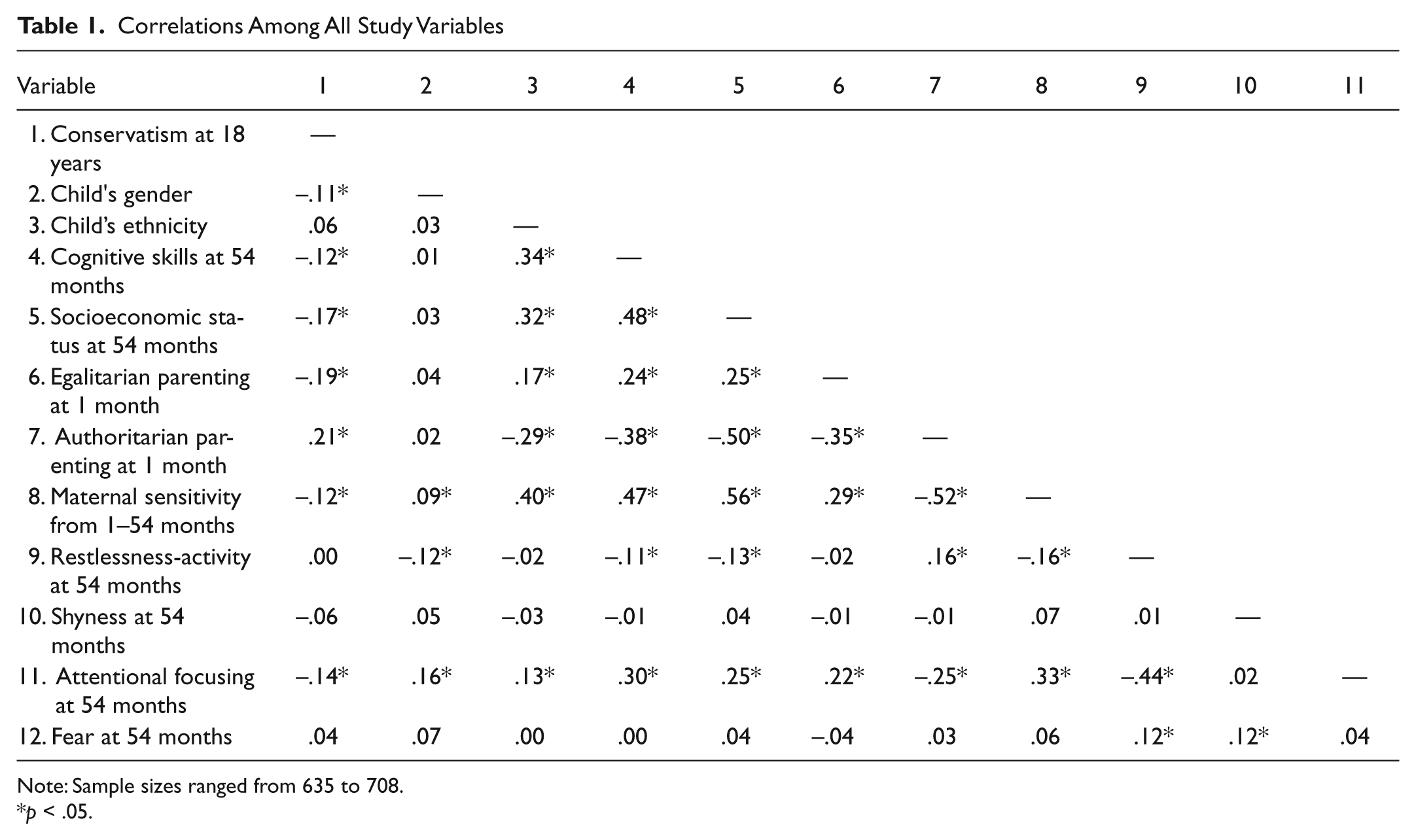
These particular variables were selected as covariates because they are often used as such in research based on the SECCYD (e.g., Fraley et al., 2012). But, as Table 1 shows, these variables also correlated to varying degrees with conservatism and some of our predictor variables. For example, children with lower ratings of cognitive ability at 54 months also tended to be relatively conservative at age 18 years. As such, we thought it would be useful to statistically control these variables while estimating the associations between our primary predictor variables (e.g., parenting attitudes at 1 month) and political ideology.
Correlations Among All Study Variables
Note: Sample sizes ranged from 635 to 708.
p < .05.
Results
Table 1 reports the correlations among all study variables. It is noteworthy that many of the covariates correlated with political orientation. For example, children who were highly conservative at age 18 years were more likely than those who were not to be male (r = – .11, p < .05), to come from lower SES families (r = –.17, p < .05), and to score lower on measures of cognitive functioning at 54 months of age (r = –.12, p < .05). To examine our hypotheses, we first examined the zero-order correlations between the predictors of interest and variation in political ideologies. We followed those analyses with a series of regressions, in which we modeled variation in conservative versus liberal ideologies as a function of the predictor variables of interest while controlling for the covariates.
We first examined conservative ideology as a function of parental attitudes and behavior. The results are summarized in Table 1. In short, parents who were more likely to endorse authoritarian parenting attitudes and less likely to endorse egalitarian parenting attitudes when their children were 1 month old were more likely to have children who were relatively conservative at age 18 years (rs = .21 and –.19, respectively, p < .05). Moreover, parents who were rated as providing more sensitive caregiving to their children during the first 5 years of life were more likely to have children who were lower in conservative ideology at age 18 years (r = –.12, p < .05).
Results from the regression analyses were similar (see Table 2). In short, holding constant the child’s gender, ethnic background, cognitive functioning, SES, and the various parenting predictors simultaneously, authoritarian parenting attitudes at 1 month of age predicted children’s conservative values at age 18 years (β = 0.16, p < .05). Egalitarian parenting attitudes were also related to conservatism in children more than 17 years later (β = −0.13, p < .05), such that parents who agreed more strongly that children should play a role in family decisions, be free to express their ideas, and be allowed to disagree with their parents were less likely to have conservative children. Although our bivariate analyses (see Table 1) indicated that parents who exhibited more sensitive caregiving behavior in early childhood tended to have kids who were less conservative at age 18 years, early sensitive caregiving did not predict conservative ideology at age 18 years when controlling authoritarian and egalitarian parenting attitudes (β = 0.02). In summary, these results are largely consistent with historical perspectives in political psychology that have emphasized the role of authoritarian parenting in the development of conservative ideologies.
Regression Results: Control Variables and Parenting Attitudes and Behaviors as Predictors of Conservatism at Age 18 Years
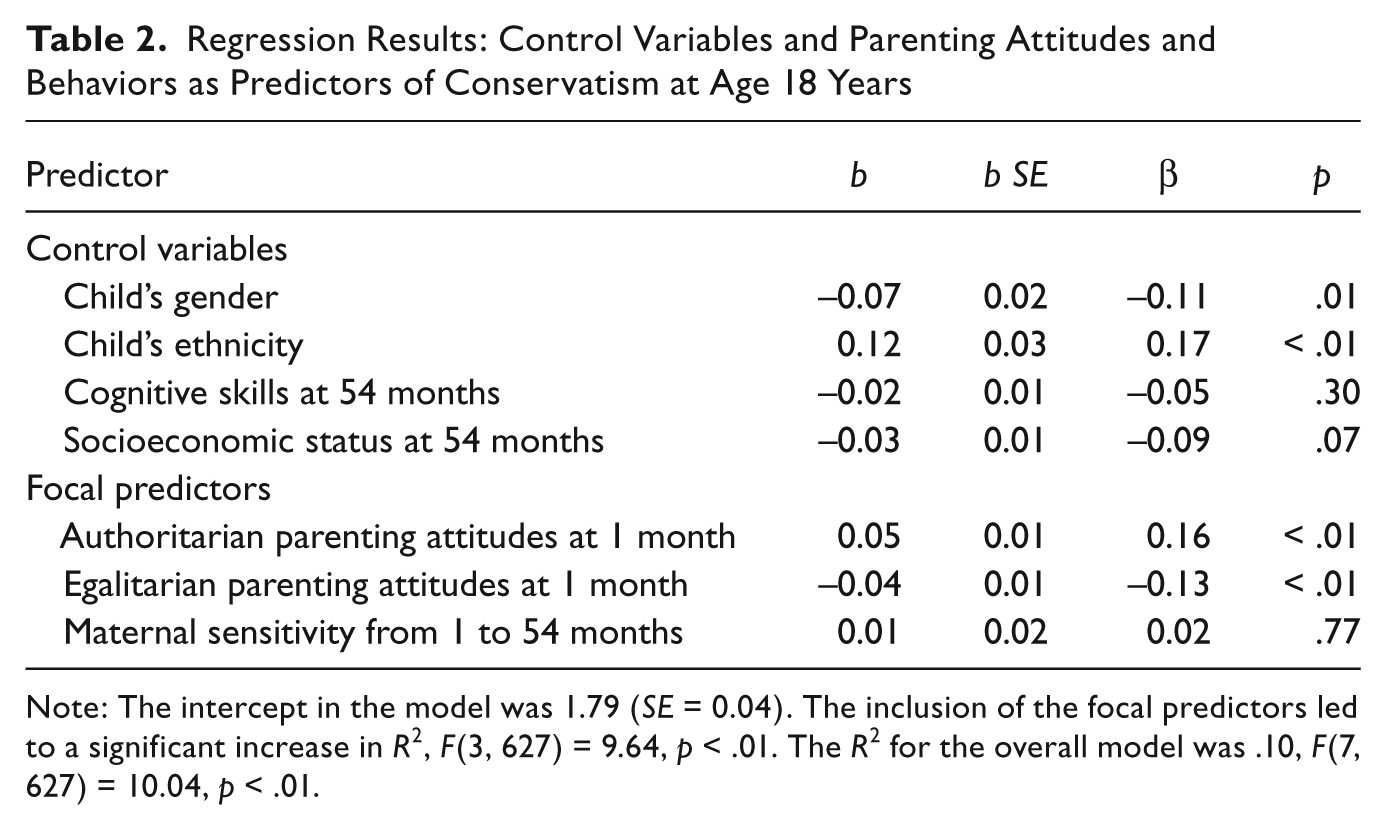
Note: The intercept in the model was 1.79 (SE = 0.04). The inclusion of the focal predictors led to a significant increase in R2, F(3, 627) = 9.64, p < .01. The R2 for the overall model was .10, F(7, 627) = 10.04, p < .01.
We next examined the relationship between childhood temperament and political ideology. The results are summarized in Tables 1 and 3. Conservative attitudes at age 18 years were significantly correlated with attentional focusing at 54 months (r = –.14), such that children who had more difficulty attending to play or various tasks at 54 months were more likely to be conservative at 18 years.
Regression Results: Control Variables and Child Temperament at Age 54 Months as Predictors of Conservatism at Age 18 Years
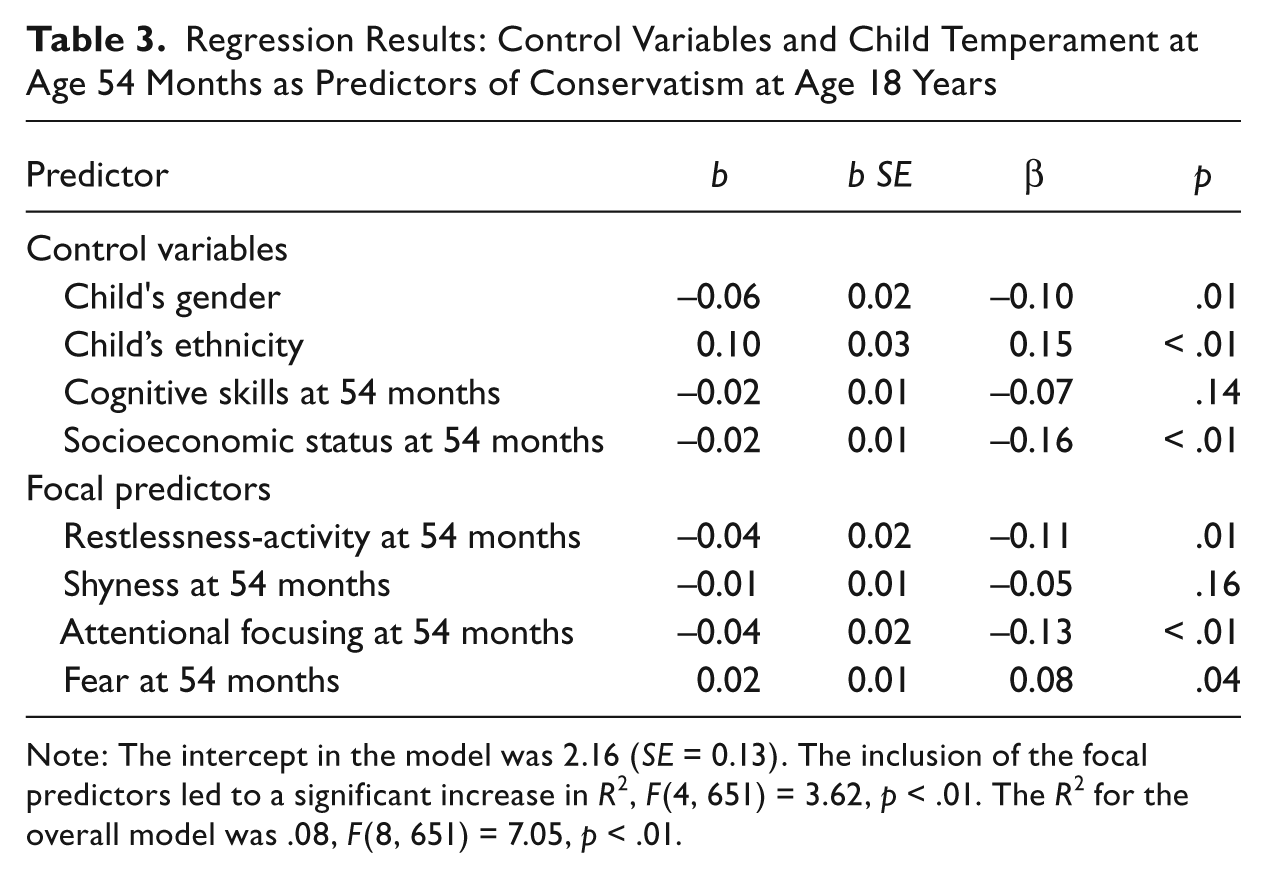
Note: The intercept in the model was 2.16 (SE = 0.13). The inclusion of the focal predictors led to a significant increase in R2, F(4, 651) = 3.62, p < .01. The R2 for the overall model was .08, F(8, 651) = 7.05, p < .01.
We also examined the temperamental factors in a multiple regression analysis holding constant the child’s gender, ethnic background, cognitive functioning, SES, and the mutual covariation among temperament dimensions (see Table 3). Children with higher levels of activity or restlessness at 54 months were less likely to be conservative at age 18 years (β = −0.11, p < .05). In addition, children with higher levels of attentional focusing at 54 months were less likely to be conservative at age 18 years (β = −0.13, p < .05). Finally, children with higher levels of fearfulness at 54 months were more likely to be conservative at age 18 years (β = 0.08, p < .05). In summary, these results are largely consistent with the findings reported by Block and Block (2006). Namely, compared with liberal individuals, conservative individuals were more likely as children to have been rated as being fearful or having deficits in inhibitory control. In contrast, compared with conservative individuals, liberal individuals were more likely as children to have had high levels of activity and restlessness.
Discussion
The purpose of the research reported here was to study the association between characteristics of children’s early caregiving environments and their political ideologies in late adolescence. Specifically, we examined longitudinal data from the NICHD SECCYD and a follow-up study conducted when subjects were 18 years old (Booth-LaForce & Roisman, 2012) to test two hypotheses concerning the development of political ideologies. We found that parents’ attitudes toward raising their children predicted those children’s political orientations at age 18 years. Specifically, parents who endorsed more authoritarian parenting attitudes when their children were 1 month old were more likely to have children who were conservative in their ideologies at age 18 years. In addition, parents who endorsed more egalitarian parenting attitudes were more likely to have children who were liberal in their ideologies at age 18 years.
Although parents who were more sensitive and responsive in their caregiving were less likely to have children who were conservative at age 18 years, this particular association disappeared once authoritarian and egalitarian parenting attitudes were simultaneously controlled, most likely because the variance shared between these measures (compared with the variance unique to these measures) was driving the predictive association. Overall, these findings are compatible with the long-standing theoretical view in political psychology that parenting attitudes and behavior may play a role in shaping the development of children’s political attitudes (e.g., Adorno et al., 1950).
These findings have wide-ranging implications for research at the interface of political and psychological science. Our results are consistent with the view that authoritarian parenting practices and attitudes may promote the development of specific kinds of political values and ideologies in children. Our results, however, do not speak to the specific mechanisms through which this occurs. Some scholars have argued that there are specific genes that underlie variation in political ideologies (Alford, Funk, & Hibbing, 2005; Hatemi et al., 2011). If this is correct, then it is possible that the association between the attitudes of parents and the political ideologies of their children is due to shared genetic variation between parents and their children. It is worth noting, however, that Eaves et al. (1997) found that the members of monozygotic and dizygotic twin pairs were equally similar with respect to conservative ideologies before the age of 20 years (i.e., within the age range studied in the present sample). Thus, if genetic variation plays a role in shaping similarities between parents and their children, these effects might not be manifest until early adulthood. Regardless, our findings seem to suggest that there are ways in which parents’ attitudes influence the political development of their children, even if the specific pathways remain unclear. We believe that clarifying these pathways is an important direction for future research.
We also examined the association between early temperament and conservative attitudes at age 18 years. Jost and his colleagues (2003) have argued that highly conservative people tend to be more rigid, fearful, and dogmatic than less conservative people. Although Jost and his colleagues do not take a strong stand on whether these qualities in early childhood predict the adoption of conservative ideologies in young adulthood, one interpretation of the motivated-social-cognition perspective is that conservative ideologies might have their origins in early-manifesting dispositional attributes, such as fearfulness and shyness (e.g., Wilson, 1973). Indeed, Block and Block (2006) found that rigid and anxious qualities in early childhood were related to conservative ideologies at age 23 years.
Consistent with Block and Block’s findings, our results showed that early temperamental qualities, such as fearfulness and deficits in attentional control, predicted conservatism in late adolescence. According to Block and Block (2006), early manifestations of fearfulness may motivate the adoption of traditional values that are organized to defend and protect the status quo, as implied by Jost and his colleagues (2003). We also found that individuals who were liberal at age 18 years were more likely than individuals who were conservative at 18 years to have had high levels of activity and restlessness at 54 months of age. This finding is compatible with Block and Block’s (2006) characterization of liberal psychology as being rooted, in part, in the undercontrol of ego-related functions. The sense of restlessness may translate indirectly into a desire to challenge the status quo or to change social systems in desired ways.
One of the strengths of the present research was the longitudinal nature of the NICHD SECCYD—a nearly two-decade-long study using a large sample of children. With the exception of the study by Block and Block (2006), no previous studies have investigated the developmental antecedents of political ideologies over such an expansive period. In addition, the SECCYD contains measures from multiple informants. Therefore, reports of parenting and political attitudes are not derived from the same source, which helps to reduce some of the problems that can arise from shared method variance.
One of the limitations of this research is that we did not have measures of parents’ political beliefs. This made it impossible to control parental political ideology when examining the effects of authoritarian child-rearing styles. We believe that one important direction for future research is to examine more carefully the effect of parental political attitudes on children’s attitudes. In fact, it is possible that the transmission of conservative ideologies from parents to children is mediated by the kinds of parenting attitudes and behaviors investigated in the present study. We also think it would be valuable to examine the role of parent-child conflict and support in shaping the development of political attitudes (e.g., Duriez, Soenens, & Vansteenkiste, 2007). Sulloway (1996), for example, has argued that the degree to which a child follows the political mores of his or her parents depends on the quality of the relationship between parent and child. More generally, we think an important direction for future research is to integrate developmental research designs with the kinds of methods commonly used in political psychology.
Another limitation of the present research is that we did not have multiple measures of temperament across childhood. Although some of the early-childhood traits we studied appear to be related to the development of political attitudes, it could be that those traits assessed at a later point in time would be of greater predictive value than those assessed earlier. On a related note, we should emphasize that political attitudes themselves are not perfectly stable and that there are likely to be a number of proximal factors that shape the direction of attitude change that are not situated in early caregiving experiences (see Visser & Krosnick, 1998). It is possible that parenting experiences might help shape the development of political attitudes in late adolescence as individuals begin considering the kinds of issues that are relevant to political discourse. But, as they leave home, join the work force, attend college, and expand their social networks, children’s political attitudes might begin to diverge from their initial attitudes (e.g., Beck & Jennings, 1975). It is our hope that future assessments of the SECCYD sample will allow these kinds of issues to be studied in more depth.
We should note that one of the most robust personality correlates of individual differences in political ideology is openness to experience—the extent to which individuals are intellectually curious, interested in trying new things, and have an active imagination (see Carney et al., 2008). However, as has been noted by some scholars, variation in openness is not reflected in the kinds of temperament inventories that are commonly used in developmental research (e.g., De Pauw, Mervielde, & Van Leeuwen, 2009). Thus, although our data suggest that early temperamental traits predict later political ideology, the traits we examined did not tap one of the most robust personality correlates of political conservatism. It would be valuable for future research to examine early indicators of openness to experience and to study prospectively the way in which those indicators relate to developing political ideologies.
Although this study does not offer a comprehensive picture of how political ideologies develop over time, it does help to advance contemporary research on this topic in some important ways. We hope that this work will help enrich theory at the interface of political and personality science but also underscore the value of studying these issues from a developmental perspective.
Footnotes
Declaration of Conflicting Interests
The authors declared that they had no conflicts of interest with respect to their authorship or the publication of this article.
Funding
Collection of political ideology data was supported by Grant No. HD054822 to C. Booth-LaForce from the Eunice Kennedy Shriver National Institute of Child Health and Human Development.