







Abstract
In two scenario-based studies, we found that women and men evaluate glass-cliff positions (i.e., precarious leadership positions at organizations in crisis) differently depending on the social and financial resources available. Female and male participants evaluated a hypothetical leadership position in which they would have both social and financial resources, financial resources but no social resources, or social resources but no financial resources. Women evaluated the position without social resources most negatively, whereas men evaluated the position without financial resources most negatively. In Study 2, we found that women and men considered different issues when evaluating these leadership positions. Women’s evaluations and expected levels of influence as leaders depended on the degree to which they expected to be accepted by subordinates. In contrast, men’s evaluations and expected levels of acceptance by subordinates depended on the degree to which they expected to be influential in the position. Our findings have implications for the understanding of the glass-cliff phenomenon and gendered leadership stereotypes.
Keywords
The recent financial crisis sparked debate about what is needed from organizational leaders. Some have argued that the crisis in part resulted from aggressive, risk-taking behaviors. Accordingly, a call has been made for leaders who are understanding, cooperative, and focused on long-term sustainability (Cohan, 2010; “A Kinder, Gentler Finance,” 2010). This alternative leadership style moves away from the masculine norms of the “old boys’ club” and instead embraces a more stereotypically feminine approach (Eagly & Johnson, 1990). Although this call is a welcome development for diversity agendas, it runs the risk of reinforcing a phenomenon identified by Ryan and Haslam (2005, 2007) as the glass cliff: the tendency for women to be overrepresented in precarious leadership positions that involve a high risk of failure because of organizational circumstances.
The glass cliff has been demonstrated across a range of situations (Ryan & Haslam, 2007), but questions remain about its underlying mechanisms. Past research on this phenomenon has focused exclusively on the selection of leaders rather than on the choices leaders make themselves. Accordingly, some people have speculated about the part that women themselves may play in their overrepresentation—are women more likely than men to accept glass-cliff positions (Mano-Negrin & Sheaffer, 2004; Ryan, Haslam, & Postmes, 2007)? Though such an explanation runs the risk of blaming the victim, it acknowledges that women are not passive individuals who are simply placed in precarious leadership positions. Women, just like men, presumably evaluate any prospective position and make decisions about it accordingly.
In the research reported here, we therefore asked the following question: Do men and women consider different issues when evaluating glass-cliff positions? We hypothesized that, all else being equal, women should not be more (or less) attracted to precarious leadership positions than men are. Rather, women’s and men’s evaluations of glass-cliff positions should depend on the availability of social and financial resources.
Evidence for the Glass Cliff
Sources of evidence for the glass cliff include archival analyses of stock-exchange-listed companies showing that women were more likely than men to be in leadership positions during times of poor share-price performance (Haslam, Ryan, Kulich, Trojanowski, & Atkins, 2010; Ryan & Haslam, 2005; cf. Adams, Gupta, & Leeth, 2009) and analyses of United Kingdom elections showing that female candidates were more likely than male candidates to contest for hard-to-win seats (Ryan, Haslam, & Kulich, 2010). The causality of these trends has been demonstrated in experimental studies. People tend to preferentially select women for leadership positions in times of crisis (Ashby, Ryan, & Haslam, 2007; Bruckmüller & Branscombe, 2010; Haslam & Ryan, 2008) or threat (Brown, Diekman, & Schneider, 2011). Gender-stereotypic beliefs about leadership seem to contribute to this bias in the appointment of leaders. During times of crisis, the traditional “think manager–think male” association (Koenig, Eagly, Mitchell, & Ristikari, 2011; Schein, 1973) weakens, and a “think crisis–think female” association emerges (Ryan, Haslam, Hersby, & Bongiorno, 2011). Yet how do women and men themselves perceive precarious positions? Are leaders’ evaluations of these positions also informed by leadership-related gender stereotypes?
Gendered Leadership Stereotypes
It is unclear from the literature whether women or men may be more likely to accept glass-cliff positions. Given the continued barriers women face in the workplace (Eagly & Carli, 2007), women may view precarious offers as the only opportunities available (Lyness & Thompson, 1997; Ryan et al., 2007). However, men may also accept such risky offers because of inflated optimism about becoming successful leaders (Gibson & Lawrence, 2010; Major, 1994).
It is important to note that such broad predictions about gender differences in evaluations of glass-cliff positions do not take into account contextual variations associated with the phenomenon. The think crisis–think female association is particularly prominent when a leader is required to manage conflicts among people, ride out a crisis, or act as a scapegoat (Ryan et al., 2011). These relatively passive tasks reflect more stereotypically feminine leadership roles. In contrast, when a leader is required to act as a spokesperson or to improve a company’s performance—arguably more active tasks— stereotypically masculine traits are seen as more valuable. Accordingly, women and men may be expected to contribute to crisis situations in different ways. This reasoning is consistent with findings that people hold gender-stereotypic beliefs about leadership. Whereas female leaders are expected to be communal, male leaders are expected to be agentic (Eagly, Makhijani, & Klonsky, 1992).
Internalization of Gender Stereotypes
Gender-stereotypic notions of leadership do not only influence perceptions of women’s and men’s suitability for leadership positions; they can also—through self-stereotyping—influence the attitudes and beliefs of potential leaders themselves (Koenig & Eagly, 2005). The internalization of gender stereotypes can result from personal work experiences, such as backlash experienced by women in response to stereotypically masculine behavior. Women may consequently place more value on stereotypically feminine notions of leadership (Eagly & Johnson, 1990; Rudman, 1998). However, one does not actually need to have these experiences to develop such beliefs. Self-stereotyping can also be the by-product of broad societal expectations about gender-based differences in leadership behavior—that is, stereotypes can be internalized on the basis of others’ experience (Rudman & Glick, 2001). Indeed, women are aware of the existence of gender stereotypes in the workplace and believe that women’s influence is derived primarily from interpersonal skills (Carli, 1990). Men, in contrast, may embody more traditional, stereotypically masculine notions of leadership based on authority and hierarchical influence (Bass, Avolio, & Atwater, 1996).
We therefore propose that women and men should be sensitive to different aspects of crisis situations: Whereas women should attend to more communal aspects of precarious leadership roles, men should attend to more agentic aspects. This gendered focus should, in turn, inform evaluations of glass-cliff positions. We investigated this proposition in two scenario-based studies in which we systematically varied the communal and agentic aspects of a hypothetical leadership position.
Means to Effective Leadership
In the literature, two key factors have been identified as underlying effective leadership in crisis situations: social resources and financial resources (Hunt, Boal, & Dodge, 1999). Leaders with social resources (e.g., formal approval and support from the organization; Reicher, Haslam, & Hopkins, 2005) are better able to gain acceptance from subordinates (Eisenback, Watson, & Pillai, 1999; Hunt et al., 1999). Leaders with financial resources can influence others, act independently, and be empowered to achieve new goals (Keltner, Gruenfeld, & Anderson, 2003).
Given that social and financial resources facilitate effective leadership, it is likely that women and men consider these resources when evaluating glass-cliff positions, but they may do so in different ways. Without social resources, women may feel unable to fulfill communal leadership roles (Carli, 1990; Heilman, Wallen, Fuchs, & Tamkins, 2004). By contrast, in the absence of financial resources, men may feel unable to fulfill agentic leadership roles (Bass et al., 1996). For these reasons, we expected that gender differences in evaluations of glass-cliff positions should depend on the resources available in such positions: Women should evaluate precarious positions without social resources more negatively than men do, whereas men should evaluate precarious positions without financial resources more negatively than women do.
Study 1
Method
Participants and design
One hundred forty-six Dutch business students (70 female, 76 male; mean age = 19.43 years, SD = 2.05) participated in return for course credit. Female and male participants were randomly assigned across three resource conditions (described in the following paragraph); thus, a 3 (resource condition) × 2 (gender) design was applied.
Participants were instructed to imagine working for a large stationary company in a financial crisis, which was illustrated with a graph displaying a steady 5-year decline in company performance (Haslam & Ryan, 2008). In a hypothetical scenario, participants were offered a top leadership position at the company, where they would be charged with the task of solving the crisis. All participants read a passage containing information about the position’s social and financial resources. In the control condition, in which social and financial resources were both available, participants read that “employees approve of your appointment and support your presence” and that “management has decided to invest additional money so that you will have sufficient financial resources.” In the no-social-resources condition, the information about financial resources remained the same, but the information about social resources was changed to read “the employees disapprove of your appointment and do not support your presence.” In the no-financial-resources condition, the information about social resources remained the same as in the control condition, but the information about financial resources was adapted to read “management will not invest additional money, meaning that you lack sufficient financial resources.”
Measures
We assessed the degree to which participants viewed the position as precarious by having them respond to a single statement, “The offered position comes with a certain amount of risks,” using a scale from 1 (not at all) to 7 (very much). We measured participants’ position evaluation by having them respond to one dichotomous question and rate their level of agreement with three evaluative statements. The dichotomous question was, “Would you accept the position if you were in this situation?” (1 = yes, 2 = no). The three evaluative statements (Haslam & Ryan, 2008) were “I feel positively about the position,” “I think the position is ideal,” and “I see the position as a good opportunity”; responses were made using scales from 1 (completely disagree) to 7 (completely agree; α = .70). Ratings for the three items were averaged to create a continuous position-evaluation score.
Results
The cell frequencies for acceptance of the position are shown in Table 1, and mean position-evaluation scores are shown in Table 2. A Resource Condition × Gender analysis of variance (ANOVA) revealed that women and men were equally aware of the precariousness of the position due to the company crisis (overall mean = 5.33, SD = 1.10). No main effect of or interaction with resource condition was observed (ps ≥ .24). Thus, men’s and women’s evaluations of the position’s precariousness were not influenced by the resource manipulation; on average, all participants realized that the company was in a financial crisis.
Results From Study 1: Acceptance of Glass-Cliff Positions
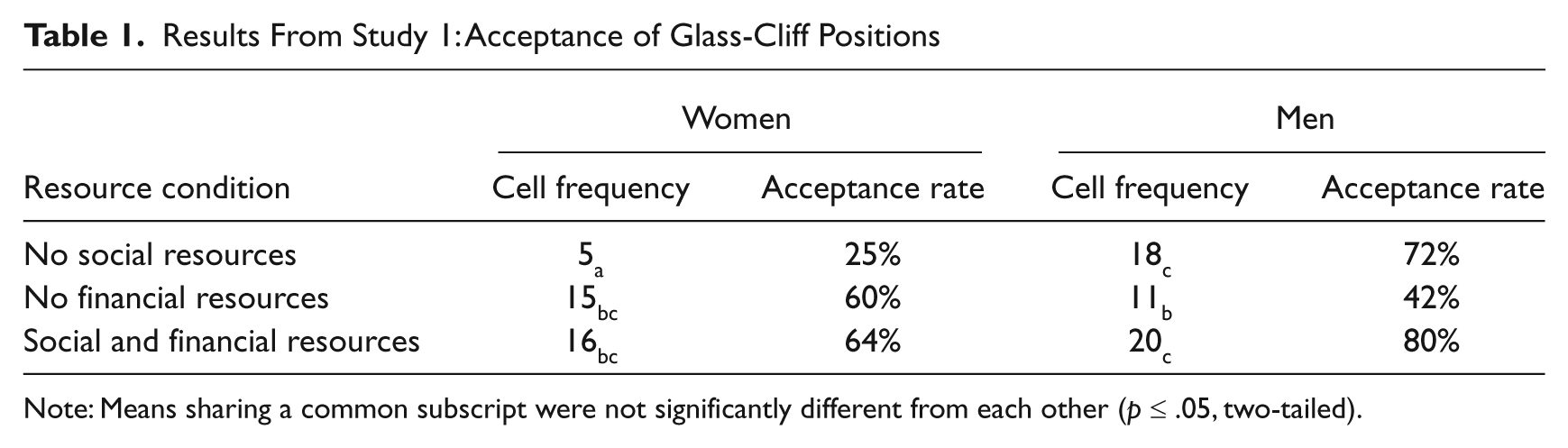
Note: Means sharing a common subscript were not significantly different from each other (p ≤ .05, two-tailed).
Results From Study 1: Mean Position-Evaluation Scores
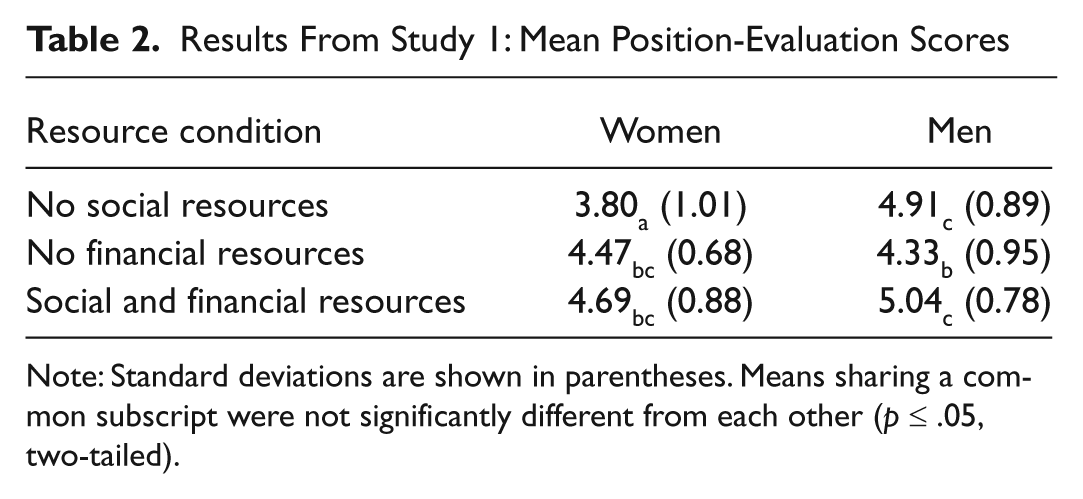
Note: Standard deviations are shown in parentheses. Means sharing a common subscript were not significantly different from each other (p ≤ .05, two-tailed).
Logistic regression on the dichotomous position-evaluation measure revealed a significant Resource Condition × Gender interaction, χ2(4, N = 146) = 10.13, p = .04. We dummy-coded the resource conditions and performed additional regressions to obtain separate coefficient estimates for women and men. Women’s responses differed significantly across conditions, χ2(2, N = 70) = 8.17, p = .02. Women were less inclined to accept the position in the no-social-resources condition than in the other two resource conditions, β = −1.67, SE = 0.66, p = .01. Women’s responses to the position in the no-financial-resources condition and in the social-and-financial-resources condition did not differ (p = .77). For men, the effect was reversed, χ2(2, N = 76) = 8.80, p = .01: Men were less inclined to accept the position in the no-financial-resources condition than in the other two resources conditions, β = −1.70, SE = 0.64, p < .01. Men’s responses to the position in the no-social-resources condition and in the social-and-financial-resources condition did not differ (p = .52).
Critically, we also checked for gender differences within conditions. In the no-social-resources condition, women were significantly less inclined to accept the position than men were, β = −2.04, SE = 0.68, p < .01, χ2(1, N = 45) = 10.22, p = .001. Note that gender differences did not reach significance in the other two conditions (ps ≥ .20).
A Resource Condition × Gender ANOVA on the continuous position-evaluation measure revealed a significant effect of resource condition, F(2, 146) = 5.22, p = .01, η p 2 = .07, a significant effect of gender, F(1, 146) = 9.30, p = .003, η p 2 = .06, and a significant interaction, F(2, 146) = 6.10, p = .003, η p 2 = .08. Testing for simple effects revealed that women’s evaluations of the position were significantly less favorable in the no-social-resources condition than in the no-financial-resources condition (p = .012) and the social-and-financial-resources condition (p < .001). Women’s evaluations of the position in the last two conditions did not differ (p = .36). Overall, men’s evaluations of the position were more positive than women’s. However, men’s evaluations of the position were significantly less positive in the no-financial-resources condition than in the no-social-resources condition (p = .02) or the social-and-financial-resources condition (p = .004). Men’s evaluations of the position in the last two conditions did not differ (p = .59).
Study 2
Our results in Study 1 indicated that women’s and men’s evaluations of a glass-cliff position were dependent on the availability of resources that would facilitate the fulfillment of gender-stereotype-consistent leadership roles—social re- sources for women and financial resources for men. In Study 2, we investigated the mechanisms underlying this effect. We expected that, because of internalized gender stereotypes about leadership, women and men should hold different views about the importance of gaining acceptance and the importance of gaining influence as a leader. Women are aware that other people see them as suitable leaders for positions involving communal issues (Heilman et al., 2004) and realize that their influence is likely to come from their ability to build interpersonal relationships (Carli, 1990). Accordingly, women may base their evaluations of precarious positions on the ability to gain acceptance in such positions. Conversely, men know that they are seen as agentic leaders and believe that influence will ensure acceptance (Bass et al., 1996). Men may therefore take the ability to gain influence into account when contemplating precarious leadership positions.
We therefore predicted that during an organizational crisis, when it is already precarious to take on a leadership role, women would evaluate a position without social resources more negatively than a position with social resources (even if it lacked financial resources) because of concerns about creating acceptance among employees. In contrast, we predicted that men would evaluate a position without financial resources more negatively than a position with financial resources (even if it lacked social resources) because of concerns about gaining influence.
Method
Participants and design
One hundred thirty-four Dutch graduate business students (64 female, 70 male; mean age = 24 years, SD = 5.3) participated in return for course credit. Female and male participants were randomly assigned to the same three resource conditions used in Study 1.
Measures
The degree to which participants perceived the position to be precarious was assessed with the same item used in Study 1. To check participants’ perceptions of the resources that would be available in the position, we had them indicate their level of agreement with a statement regarding social resources (“The employees will support my leadership position”) and with a statement regarding financial resources (“Management will invest additional financial resources into the company”). Responses were made using scales from 1 (completely disagree) to 7 (completely agree).
Position evaluation was measured with the three evaluative statements used in Study 1 (α = .71); ratings for the three items were again averaged to create a position-evaluation score. To measure anticipated acceptance, the proposed mediator for women, we had participants respond to four statements (Haslam & Ryan, 2008; e.g., “In this situation, I will be able to create interpersonal bonds with the employees”; α = .68); responses were made using scales from 1 (not at all) to 7 (very much), and each participant’s ratings for the four items were averaged. To measure anticipated influence, the proposed mediator for men, we had participants respond to six statements (Lammers, Stoker, & Stapel, 2009; e.g., “In this situation, I will be able to influence the employees”; α = .84); responses were made using scales from 1 (completely disagree) to 7 (completely agree), and each participant’s ratings for the six items were averaged.
Results
Means are presented in Table 3. Data were analyzed using Resource Condition × Gender ANOVAs.
Women’s and Men’s Mean Scores for Dependent Variables in Study 2
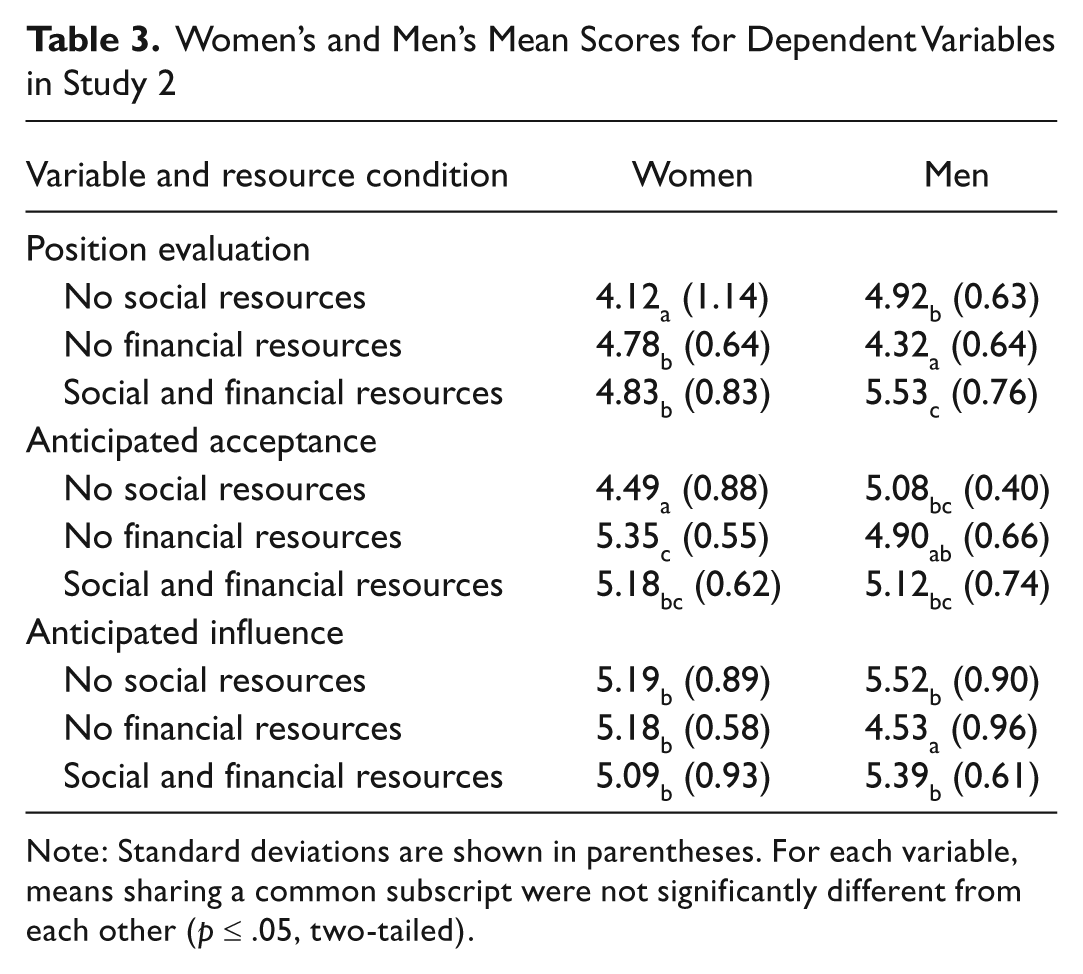
Note: Standard deviations are shown in parentheses. For each variable, means sharing a common subscript were not significantly different from each other (p ≤ .05, two-tailed).
Perceptions of glass-cliff positions
Participants recognized that the leadership position was objectively precarious, regardless of the resources available (M = 5.21, SD = 0.70). A Resource Condition × Gender ANOVA on perceived precariousness revealed no significant main effects and no interaction effects (ps ≥ .23). Participants correctly disagreed with the statement about available social resources only in the no-social-resources condition (M = 1.68, SD = 0.77), not in the other two conditions (no-financial-resources condition: M = 6.31, SD = 0.73; social-and-financial-resources condition: M = 6.23, SD = 0.82), F(2, 133) = 534.6, p < .001, η p 2 = .89. Likewise, participants disagreed with the statement about available financial resources only in the no-financial-resources condition (M = 1.75, SD = 0.82), not in the other two conditions (no-social-resources: M = 6.32, SD = 0.75; social-and-financial-resources condition: M = 6.34, SD = 0.84), F(2, 133) = 483.50, p < .001, η p 2 = .88. We found no main effects of gender on responses to any of these statements and no Resource Condition × Gender interactions (ps ≥ .15).
Position evaluation
A Resource Condition × Gender ANOVA on position evaluation revealed a main effect of resource condition, F(2, 133) = 9.45, p < .001, η p 2 = .13, a main effect of gender, F(1, 133) = 6.61, p = .02, η p 2 = .05, and an interaction, F(2, 133) = 10.55, p < .001, η p 2 = .14. Examining simple effects revealed that women’s evaluations of the position were less positive in the no-social-resources condition than in the no-financial-resources condition (p = .003) or the social-and-financial-resources condition (p = .002). Women’s evaluations of the position in the last two conditions did not differ (p = .89). Men, on the other hand, evaluated the position significantly less favorably in the no-financial-resources condition than in the no-social-resources condition (p = .01) or the social-and-financial-resources condition (p < .001). Men’s evaluations of the position in the last two resource conditions differed (p = .01), but men’s evaluations of the position in these two conditions were still significantly more positive than were women’s (no-social-resources condition: p < .001; social-and-financial-resources condition: p = .003.).
Anticipated acceptance
A Resource Condition × Gender ANOVA on anticipated acceptance revealed an effect of resource condition, F(2, 133) = 4.36, p = .015, η p 2 = .06, which was qualified by an interaction with gender, F(2, 133) = 5.95 p = .003, η p 2 = .09. Women in the no-social-resources condition expected significantly more difficulties in establishing acceptance than did women in the no-financial-resources condition (p = .001) or the social-and-financial-resources condition (p < .001). Women’s anticipated acceptance in the last two conditions did not differ (p = .42). Men’s expectations of acceptance did not vary across conditions (ps ≥ .24).
It is worth noting that women anticipated lower acceptance than men did only in the no-social-resources position (p = .004). In the no-financial-resources condition, men actually anticipated less acceptance than women did (p = .03). Women and men expected similar levels of acceptance in the social-and-financial-resources condition (p = .75).
Anticipated influence
A Resource Condition × Gender ANOVA on anticipated influence revealed a main effect of resource condition, F(2, 133) = 6.43, p = .002, η p 2 = .09, which was qualified by the predicted Resource Condition × Gender interaction, F(2, 133) = 9.62, p < .001, η p 2 = .13. The degree to which women expected to be influential was independent of resource condition (ps ≥ .69). Among men, however, those in the no-financial-resources condition expected to be significantly less influential than did those in the other two resource conditions (both ps < .001). Men’s anticipated levels of influence did not differ between the no-social-resources condition and the social-and-financial-resources condition (p = .58). Notably, men anticipated being less influential than women did only in the no-financial-resources condition (p = .004). In the no-social-resources condition, women actually anticipated lower levels of influence than men did, but this difference did not reach significance (p = .14). In the social-and-financial-resources condition, women and men expected to be equally influential (p = .17).
Moderated mediations
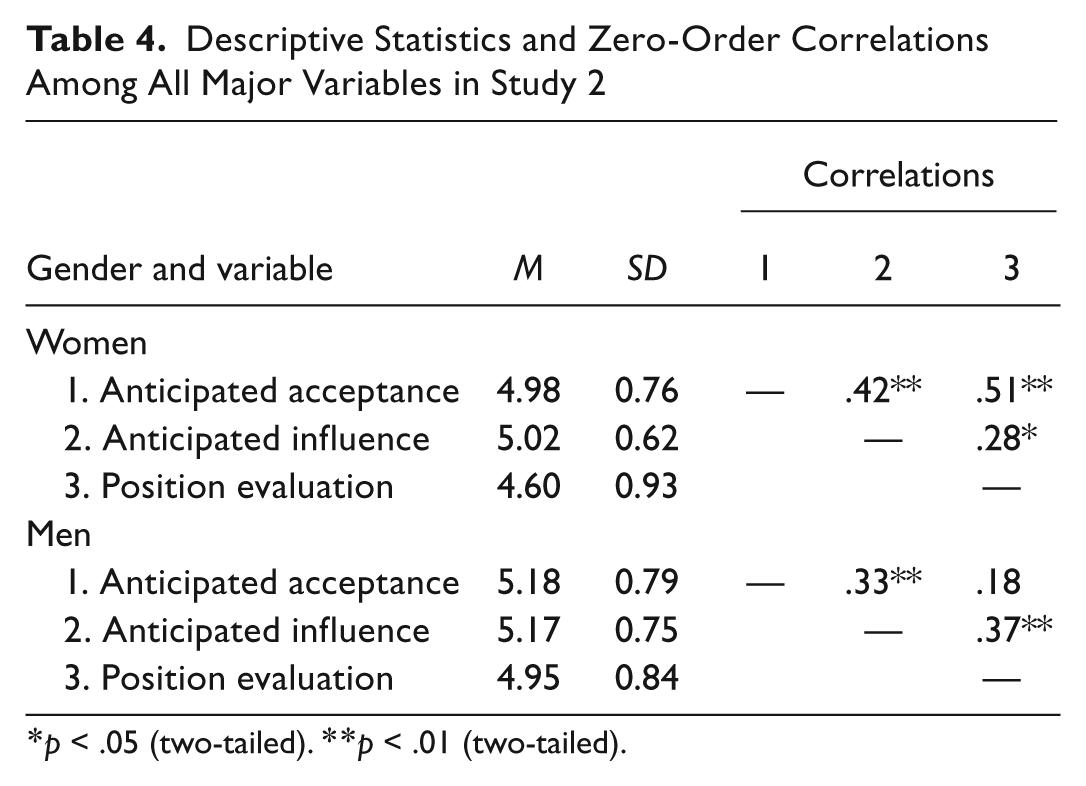
Given that there were no gender differences in anticipated acceptance (the mediator for women) or anticipated influence (the mediator for men) in the social-and-financial-resources condition, we examined the causal relationships among these factors and position evaluation for the no-social-resources and no-financial-resources conditions only. Bootstrapping was employed to obtain the conditional indirect mediation effects separately at the two levels of the moderator (i.e., women and men; Preacher & Hayes, 2008). There were four significant moderated mediation paths (statistics are provided separately for women and men in Tables S1 and S2 in the Supplemental Material available online). The significant indirect estimates for each path are presented in Figure 1. Correlations between variables for men and women are presented in Table 4.
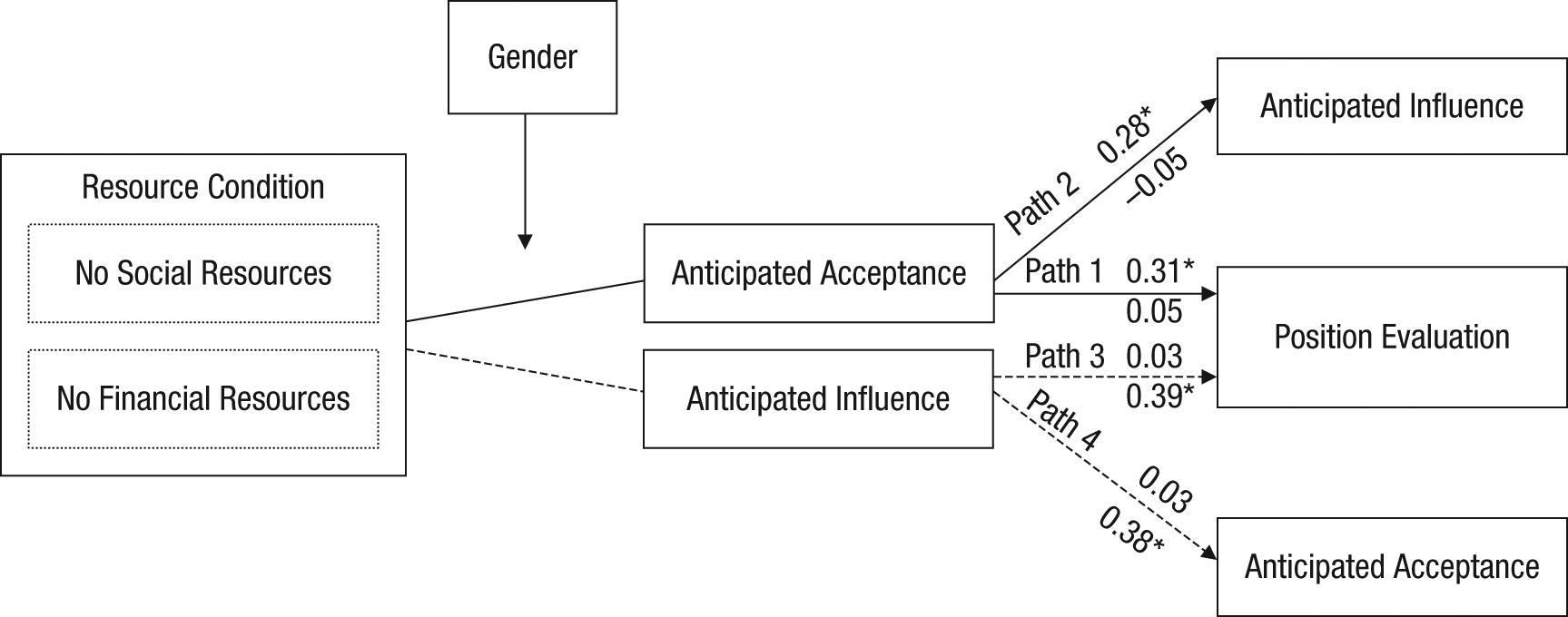
Moderated mediation model showing the results of four path analyses. In these analyses, we investigated whether anticipated acceptance mediated the effect of the Resource Condition × Gender interaction on position evaluation (Path 1) or anticipated influence (Path 2) and whether anticipated influence mediated the effect of the Resource Condition × Gender interaction on position evaluation (Path 3) or anticipated acceptance (Path 4). The statistics above and below each path are indirect-effect estimates for women and men, respectively. Asterisks indicate significant paths (p < .05); significant pathways for women are indicated by solid lines, and significant pathways for men are indicated by dashed lines.
Descriptive Statistics and Zero-Order Correlations Among All Major Variables in Study 2
p < .05 (two-tailed).
p < .01 (two-tailed).
In the first path analysis, anticipated acceptance was entered as the mediator between the Resource Condition × Gender interaction and position evaluation. There were significant direct effects for the interaction, b = 1.02, SE = 0.33, and the mediator, b = 0.39, SE = 0.13 (ps ≤ .01). However, an examination of the indirect effects revealed that anticipated acceptance significantly explained only women’s position evaluations, not men’s (Fig. 1). In the second path analysis, we tested whether anticipated acceptance explained anticipated influence for women or for men. When the interaction term and anticipated acceptance were entered into the model as predictors of anticipated influence, the direct effect of the interaction term remained significant but was reduced (b = 0.87, SE = 0.28, p < .01). Moreover, the effect of anticipated acceptance became significant (b = 0.35, SE = 0.10, p < .001). The indirect effects revealed that anticipated acceptance indeed predicted anticipated influence for women, but not for men. Interestingly, women’s rates of anticipated acceptanceand anticipated influence were both significantly related to women’s evaluation of the position, although the association between anticipated influence and position evaluation was not as strong as that between anticipated acceptance and position evaluation.
Next, we examined whether anticipated influence explained men’s or women’s responses to the precarious leadership positions. In this third path analysis, anticipated influence was entered as a mediator between the Resource Condition × Gender interaction and position evaluation. The direct effects of both predictors were significant (Resource Condition × Gender interaction: b = 0.97, SE = 0.35; anticipated influence: b = 0.35, SE = 0.13; ps ≤ .01). Yet, as can be seen from the indirect effects (Fig. 1), anticipated influence significantly explained only men’s position evaluations, not women’s. In the fourth path analysis, we tested whether the degree to which men believed they would be influential affected their levels of anticipated acceptance. When the interaction term and anticipated influence were both entered into the model to predict anticipated acceptance, the direct effect of the interaction was reduced (b = 0.55, SE = 0.28, p = .08) and the effect of anticipated influence became significant (b = 0.34, SE = 0.10, p < .001). Furthermore, anticipated influence predicted anticipated acceptance for men, but not for women. Note that for men, anticipated acceptance was not significantly related to position evaluation.
General Discussion
Our results in Study 2 indicated that differences in women’s and men’s evaluations of glass-cliff positions are explained by different underlying concerns. Women’s reluctance to take on a precarious leadership position without social resources was explained by anticipated difficulties in establishing acceptance. In contrast, men’s negative evaluation of a precarious leadership position without financial resources was explained by an anticipated lack of influence.
However, it was not the case that women were unconcerned about influence. Rather, women saw influence as a product of the acceptance they could acquire as a leader. Similarly, it was not the case that men were unconcerned about acceptance. Men believed their acceptance among employees would stem from their influence as leaders. Thus, concerns about not having the proper means to successfully fulfill a leadership role caused both women and men to negatively evaluate the position (Van Vianen & Fischer, 2002). For women, these means were social resources, whereas for men, these means were financial resources.
Theoretical implications
Our examination of whether women and men consider different issues when evaluating glass-cliff leadership positions makes an important contribution to the literature. Since the discovery of the glass cliff, researchers and practitioners have questioned whether women are simply more likely than men to accept precarious leadership positions, thereby—albeit unintentionally—putting themselves at a disadvantage in their careers. Yet our results suggest that women actually tend to evaluate precarious positions more negatively than men do. More generally, we found that both women and men based their decisions about glass-cliff positions on a careful consideration of the social and financial resources available.
Accordingly, the research we report here presents two key points. First, our findings make it clear that the glass cliff cannot be attributed to women’s failure to recognize the precariousness of glass-cliff positions, and thus add weight to the argument that the phenomenon is bound up in leader-appointment processes (Ryan & Haslam, 2007). Second, our findings suggest that women’s and men’s evaluations of glass-cliff positions are guided by broad societal expectations about gendered leadership roles. This last notion is consistent with earlier research demonstrating that women and men react negatively to occupations whose dominant characteristics are incompatible with gender-stereotypic roles (e.g., Oswald, 2008; Schader, Johns, & Forbes, 2008). Evidently, gender stereotypes do not influence only the way in which women and men behave in the workplace; such stereotypes can also influence which leadership positions women and men accept and occupy during organizational crises.
Limitations and future directions
Our use of a scenario-based approach allowed us to systematically compare women’s and men’s responses to three different glass-cliff positions and examine the psychological mechanisms underlying these responses. However, our research did not address how women and men respond to such positions when they—in reality—face very different challenges throughout their careers (Eagly & Carli, 2007), nor does it provide insights into how women and men act once they are situated in these positions (Duehr & Bono, 2006). Thus, researchers would be advised to further examine these issues in real-life settings, with actual leaders.
Conclusions
Taken together, our results suggest that women are not simply passive individuals who are placed in glass-cliff positions. Rather, women and men both tend to consider the characteristics of the situation, albeit different characteristics, when evaluating such positions. The many organizations currently searching for new leaders to guide them through crises could benefit from these findings. Prospective candidates may perceive such offers to be either a cliff or an opportunity, depending on the social and financial resources provided. To get the right (wo)man for the right job, it is therefore important for organizations to recognize which aspects of a crisis they want their future leader to solve and to give her or him the appropriate means with which to do so.
Footnotes

References
Supplementary Material
Please find the following supplemental material available below.
For Open Access articles published under a Creative Commons License, all supplemental material carries the same license as the article it is associated with.
For non-Open Access articles published, all supplemental material carries a non-exclusive license, and permission requests for re-use of supplemental material or any part of supplemental material shall be sent directly to the copyright owner as specified in the copyright notice associated with the article.
