






Abstract
In three experiments, we assessed whether older adults’ generally greater tendency to process distracting information can be used to minimize widely reported age-related differences in forgetting. Younger and older adults studied and recalled a list of words on an initial test and again on a surprise test after a 15-min delay. In the middle (Experiments 1a and 2) or at the end (Experiment 3) of the delay, participants completed a 1-back task in which half of the studied words appeared as distractors. Across all experiments, older adults reliably forgot unrepeated words; however, older adults rarely or never forgot the words that had appeared as distractors, whereas younger adults forgot words in both categories. Exposure to distraction may serve as a rehearsal episode for older adults, and thus as a method by which general distractibility may be co-opted to boost memory.
The typical view of cognitive aging is one of decline, as seen, for example, in lapses of attention, heightened distractibility, and increased forgetting. Reports consistent with this view of memory have come from studies using both objective measures (e.g., Balota, Dolan, & Duchek, 2000; Park et al., 2002) and self-ratings (e.g., Commissaris, Ponds, & Jolles, 1998; Halamish, McGillivray, & Castel, 2011). Laboratory studies of attention regulation have also consistently yielded evidence of older adults’ greater susceptibility to visual distraction. These effects have been seen in a range of tasks, including tasks involving problem solving (May, 1999), reading (Connelly, Hasher, & Zacks, 1991; Duchek, Balota, & Thessing, 1998), perceptual speed (Lustig, Hasher, & Tonev, 2006; Rabbitt, 1965), and working memory (Gazzaley, Cooney, Rissman, & D’Esposito, 2005; Jost, Bryck, Vogel, & Mayr, 2011).
Older adults’ performance on these tasks is not only disrupted by distraction; older adults also tacitly remember both perceptual and conceptual aspects of distracting information (Kim, Hasher, & Zacks, 2007; Rowe, Valderrama, Hasher, & Lenartowicz, 2006), including statistical regularities among distracting events (Campbell, Zimerman, Healey, Lee, & Hasher, 2012). Older adults also implicitly transfer knowledge of irrelevant information and thereby benefit (and sometimes disrupt) their performance on subsequent intentional-learning tasks (Campbell, Hasher, & Thomas, 2010; Thomas & Hasher, 2012). In contrast, younger adults do not implicitly use previously distracting information to aid performance, although they sometimes use this information when they are explicitly cued about its connection to the task at hand (Gopie, Craik, & Hasher, 2011; Thomas & Hasher, 2012; but see Campbell et al., 2010).
It has long been established that rehearsals, particularly distributed rehearsals, can improve memory among both younger (e.g., Greene, 1987; Rundus, 1971) and older adults (Balota, Duchek, & Paullin, 1989; Cohen, Sandler, & Schroeder, 1987). Given the greater impact of distraction on older adults compared with younger adults, along with the established benefits of rehearsals, we asked whether exposure to distraction that occurs between learning and a delayed memory test can reduce older adults’ forgetting. We report the results from three experiments indicating that the answer to this question is yes.
Experiment 1a
Younger and older adults studied a list of 20 words and recalled each of the words twice—in an initial test after a brief delay and again in a surprise memory test after a 15-min filled delay. The critical task performed during the delay was a 1-back task (Campbell et al., 2010; Rowe et al., 2006), in which participants saw a rapid stream of pictures and indicated whether consecutive pictures were identical. Superimposed on the pictures were irrelevant words or letter strings that participants were instructed to ignore. These distractors included half of the originally learned words, which created an opportunity for the tacit rehearsal of those items.
Given the differences between younger and older adults in both initial susceptibility to distracting information and subsequent use of that information (Campbell et al., 2010; Kim et al., 2007; Rowe et al., 2006; Thomas & Hasher, 2012), we predicted that older adults would show less forgetting of words that reoccurred during the 1-back task than of words that did not. On the basis of earlier work (e.g., Connelly et al., 1991; Gazzaley et al., 2005; May, 1999; Rabbitt, 1965), we also expected younger adults to effectively ignore the distracting information and thus to show no difference between the forgetting of items that were repeated as distractors and the forgetting of those that were not.
Method
Participants
Information about the average age, level of education, and vocabulary of the 38 younger (14 males, 24 females) and 40 older (13 males, 27 females) adults who participated in this experiment is displayed in Table 1. All participants had learned English prior to the age of 5 and were free of psychiatric or neurological illness. Younger adults were students at the University of Toronto and received course credit or monetary compensation in return for their participation. Older adults were recruited from the community and received monetary compensation in return for their participation. Data from new participants were used to replace data from 3 younger and 3 older adults, 2 of whom (1 younger and 1 older adult) had scores on the 1-back task that were more than 2.5 standard deviations below their group means, 1 of whom (an older adult) reported feeling ill, and 2 of whom (1 younger and 1 older adult) reported both being aware of and using or avoiding using the repeated words to facilitate performance (see the Procedure section for details). On average, older adults had more years of education than younger adults did, t(45) = 4.53, p < .001; moreover, older adults had significantly better vocabularies, as indexed by the Shipley (1946) vocabulary test, t(69) = 6.44, p < .001, which would be expected from increases in vocabulary across adulthood (e.g., Park et al., 2002).
Participant Demographic Information
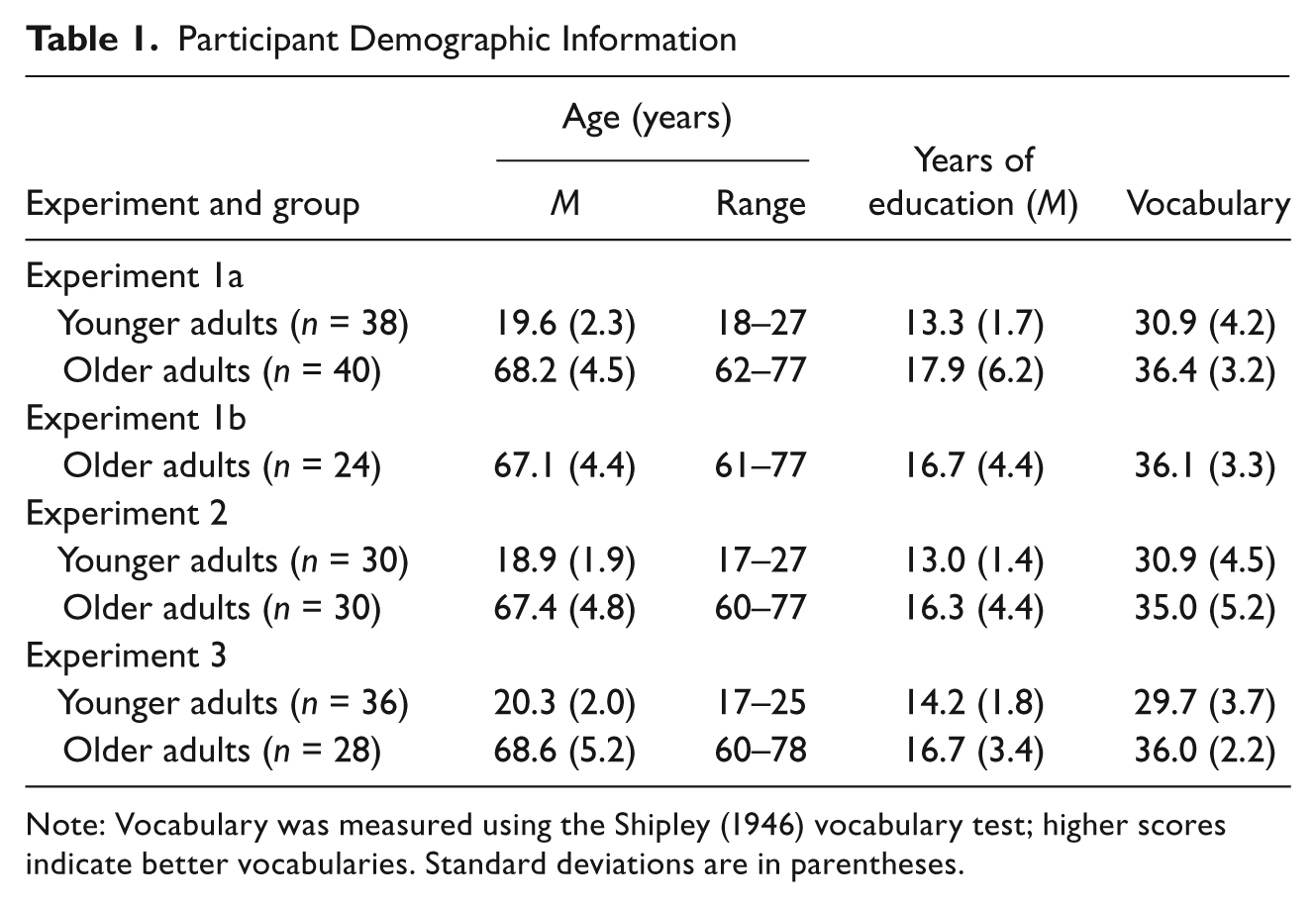
Note: Vocabulary was measured using the Shipley (1946) vocabulary test; higher scores indicate better vocabularies. Standard deviations are in parentheses.
Materials
The studied list of words contained 20 concrete nouns drawn from the MRC Psycholinguistic Database (Coltheart, 1981). The list included 2 buffer words at the beginning and 2 at the end to reduce primacy and recency effects. The remaining 16 words comprised 8 that would be repeated as distractors on the 1-back task and 8 that would not be repeated. Across all participants in both age groups, each word appeared equally often as a repeated word and as an unrepeated word. Eight other words appeared as fillers in the 1-back task, along with 24 nonwords. All words were matched for frequency of occurrence in written language (M = 50 instances per million words, SD = 17; Kučera & Francis, 1967) and length (range = 4–7 letters, M = 5.3, SD = 1.0; Coltheart, 1981). Target pictures in the 1-back task consisted of 42 line drawings selected from Snodgrass and Vanderwart (1980) that were colored red to make them easily distinguishable from the words.
Procedure
For study, words were presented on a computer screen for 3,000 ms (interstimulus interval = 500 ms). Participants next were told to subtract 74 by 3s for 30 s and then to recall aloud as many of the studied words as possible for 45 s. They were not informed about the final test.
The 15-min retention interval began with a 5-min nonverbal task, followed by the 1-back task, in which participants were instructed to press a key whenever two consecutive pictures were identical and to ignore the superimposed words or nonwords (Campbell et al., 2010; Rowe et al., 2006). Each picture and its distracting word or nonword was presented for 1,000 ms (interstimulus interval = 500 ms). Each picture, word, and nonword was presented twice during the task. Repeated words were presented with the same picture on each presentation, whereas all other distracting items appeared with a different picture on each occurrence; this was done to ensure that participants could not respond on the basis of the distracting items rather than the pictures. Fifteen pictures repeated on subsequent trials, requiring a 1-back response, and no memory-list words appeared on these trials. There were 84 trials in total, which occurred in the following sequence: 4 in which pictures were presented alone, 8 in which pictures were superimposed with nonwords, 64 in which pictures were superimposed with either nonwords (32 trials), filler words (16 trials), or the critical repeated words (16 trials), and 8 in which pictures were superimposed with nonwords. Following the 1-back task, participants completed a second nonverbal filler task for 5 min.
At test, participants were reminded of the initial list and were asked to recall as many words from it as possible for 45 s. A graded awareness questionnaire was then administered: Participants were first asked whether they noticed a connection between any of the tasks. If participants reported that they had noticed the repetition of study-list words in the 1-back task, they were asked whether they had consciously tried to use or avoid using these items during final recall. Data were excluded from participants who both noticed the repetition of items and reported deliberate use or avoidance of these items to facilitate recall performance.
Results and discussion
Because scores for accuracy in the 1-back task were not normally distributed, we used nonparametric Mann-Whitney tests across all experiments to examine differences between the two age groups. Older adults were less accurate (median = 93%) in detecting repeated pictures than were younger adults (median = 100%), U = 550, z = 2.34, p = .02, r = .26. Older adults were also slower (M = 582 ms, SD = 110 ms) to respond on 1-back trials in which repeated pictures appeared than were younger adults (M = 516 ms, SD = 83 ms), t(76) = 2.95, p = .004, d = 0.68.
Recall performance (see Table 2 for means) was analyzed using an Age (younger, older) × Test Time (initial, final) × Word Type (repeated as distraction, unrepeated) mixed analysis of variance (ANOVA) with test time and word type entered as within-subjects variables. Overall, younger adults recalled more than did older adults, F(1, 76) = 6.62, p = .01, η p 2 = .08, and recall decreased from the initial to the final test, F(1, 76) = 38.64, p < .001, η p 2 = .34. However, both main effects were qualified by a reliable three-way interaction of age, test time, and word type, F(1, 76) = 4.08, p = .05, η p 2 = .05. Older adults showed less forgetting of words that were repeated as distractors than of unrepeated words, F(1, 39) = 8.39, p = .006, η p 2 = .18. Younger adults, by contrast, showed equivalent forgetting of repeated and unrepeated words, F < 1. With the boost provided by repetition of studied items as distractors, older adults’ final recall of repeated items did not differ from that of young adults, t(76) = 1.02, p = .31, whereas typical age differences were apparent for final recall of the unrepeated items, t(76) = 2.96, p = .004, d = 0.67.
Proportion of Items Recalled
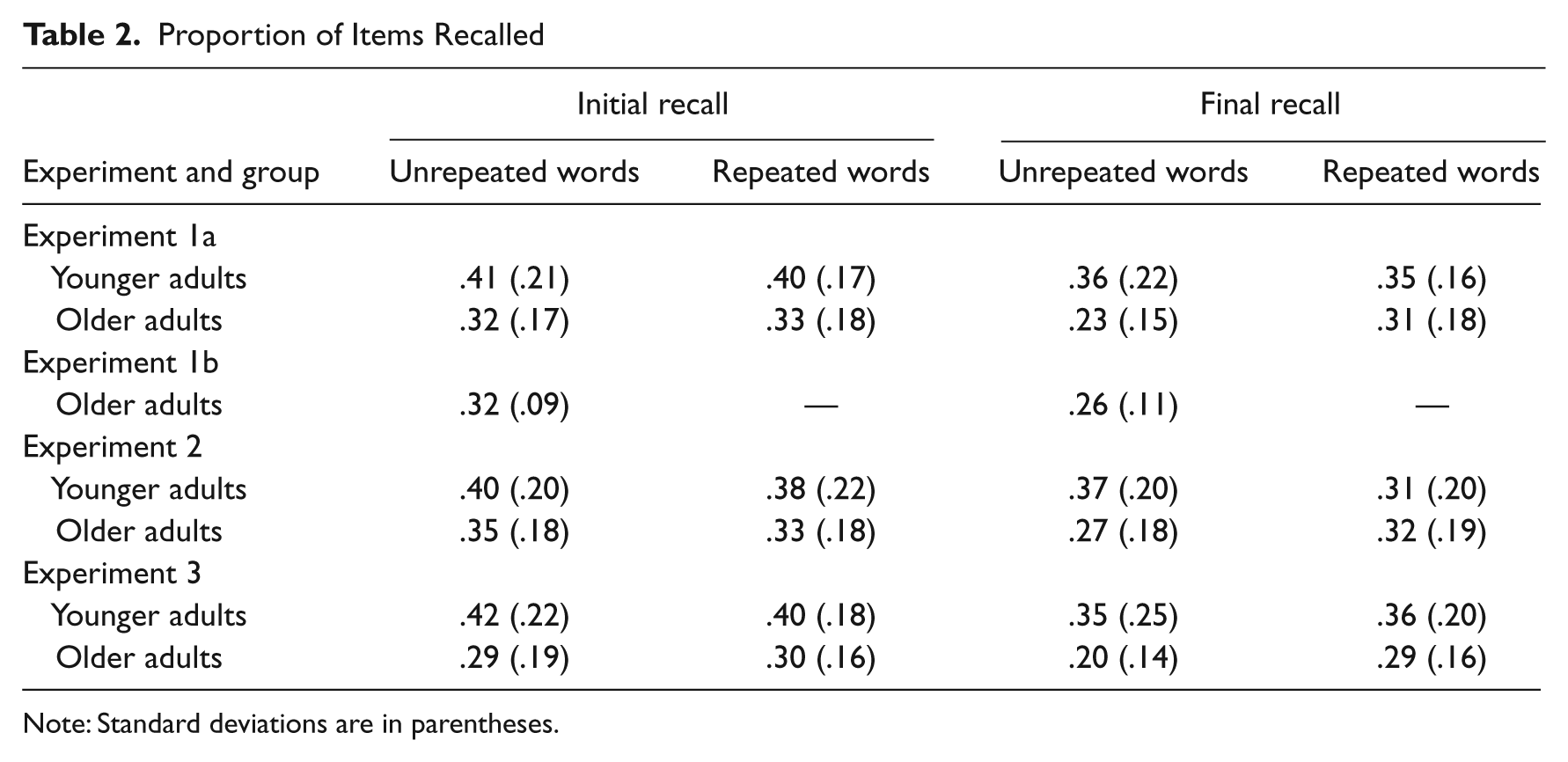
Note: Standard deviations are in parentheses.
For ease of comparison across studies, data are shown in Figure 1 as forgetting scores (the proportion of words recalled in the initial test after study minus the proportion of words recalled after the delay). As is evident in the figure and in Table 2, only older adults benefited from exposure to distraction: Clearly, presentations of relevant distracting information minimized older adults’ forgetting and dramatically eliminated age differences in younger and older adults’ recall of these items, whereas typical age differences were seen in the recall of unrepeated words.
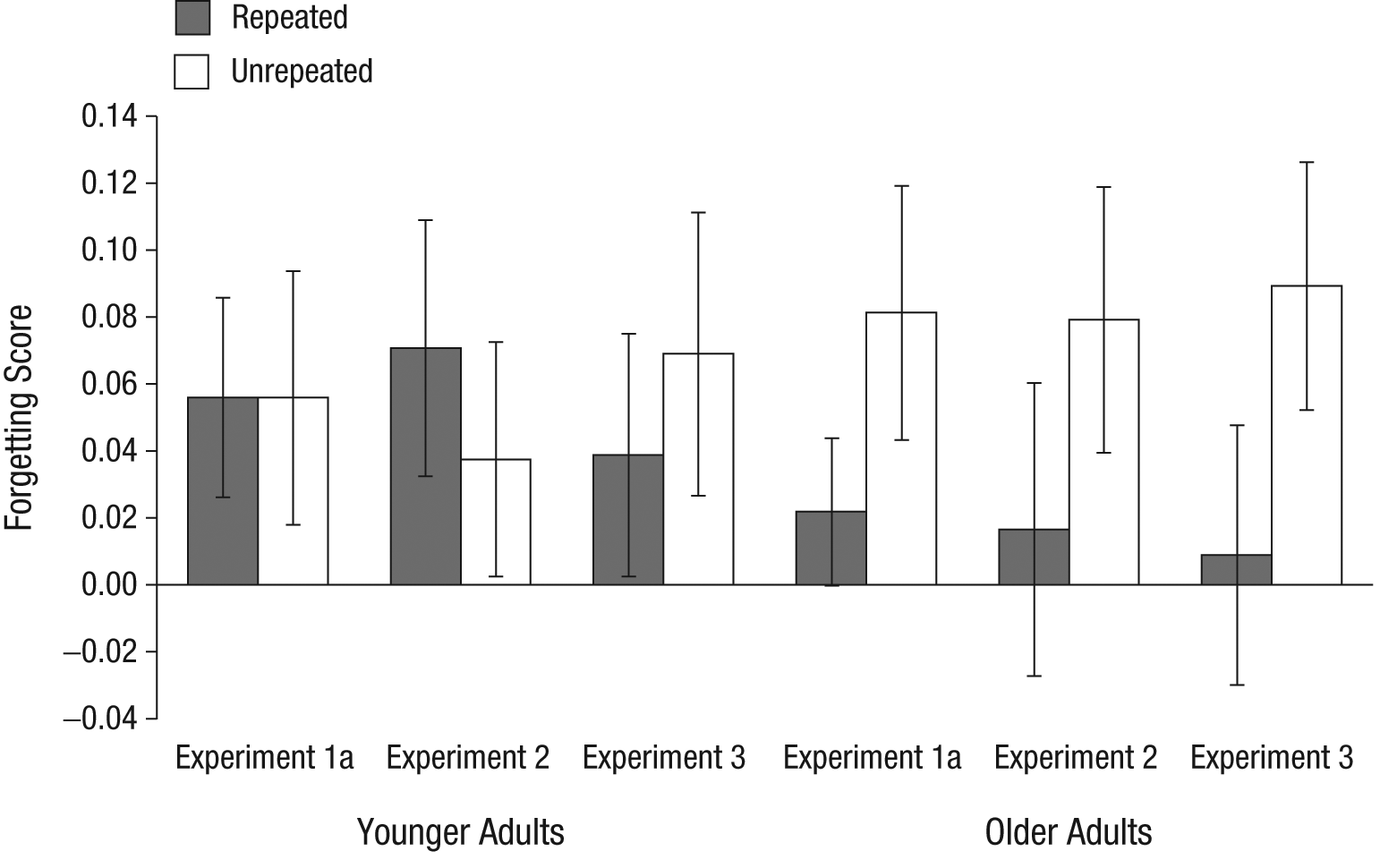
Mean forgetting score (the proportion of words recalled in an initial test after study minus the proportion of words recalled after a delay) as a function of age group (younger adults vs. older adults) and word type (repeated as distraction vs. unrepeated) in Experiments 1a, 2, and 3. Error bars show 95% confidence intervals.
Experiment 1b
A question left open by the first study is whether the benefits of distraction seen among older adults occurred with or without a cost to memory for the unrepeated items. This question arises because of evidence that reexposure to a subset of learned items can disrupt the retrieval of other items (e.g., Ratcliff, Clark, & Shiffrin, 1990). To address this issue, we tested 24 additional older adults in a control condition in which no study-list words appeared in the 1-back task. We compared the performance of these participants with that of the older adults in Experiment 1a who had been reexposed to words from the list.
Method
Participants
A new sample of 24 older adult participants (5 males, 19 females) was recruited in the same way our sample was recruited in Experiment 1a. There were no differences in the average age, level of education, or vocabulary of participants in the two samples (see Table 1), ts < 1.
Materials and procedure
The sole way in which Experiment 1b deviated from Experiment 1a was that the repeated words used in the 1-back task in Experiment 1a were replaced with eight new distractor words. These words matched those in the previous word lists in their frequency (M = 54.5, SD = 26) and length (M = 5.3 letters, SD = 0.7; Coltheart, 1981).
Results and discussion
Older adults in Experiment 1b performed similarly to those in 1a on the 1-back task in terms of both accuracy (median = 93%) and response times (RTs; M = 589 ms, SD = 84), ps > .76. Recall performance of these participants (Table 2), for whom word type (repeated vs. unrepeated) was a dummy variable, was then compared with that of the older participants in the previous study using an Experiment (1a, 1b) × Test Time × Word Type ANOVA. The three-way interaction was reliable, F(1, 62) = 5.00, p = .03, η p 2 = .08. Consequently, we compared participants’ forgetting in Experiment 1b with older adults’ forgetting in Experiment 1a. Forgetting was reduced for repeated words in Experiment 1a compared with words in Experiment 1b, which were never repeated as distractors, F(1, 62) = 4.65, p = .03, η p 2 = .07. In contrast, rates of forgetting of unrepeated items in the two experiments did not differ, F < 1. Thus, we found no evidence that exposure to a subset of studied words in Experiment 1a disrupted the retrieval of unrepeated words. This finding strengthens the conclusion that exposure to distracting but relevant information can boost the recall performance of older adults.
Except for evidence of an absence of age-related decline in the recall of information about the gist of texts (e.g., Radvansky, Zwaan, Curiel, & Copeland, 2001) and personally meaningful information (e.g., prices of groceries, Castel, 2005; safety-related information, May, Rahhal, Berry, & Leighton, 2005), we are unaware of findings comparable to those of Experiment 1a demonstrating a reduction of forgetting in older adults and an elimination of age differences in recall. Given the novelty and potential importance of these findings to theory and real-world applications, we conducted two conceptual replications.
Experiment 2
In the 1-back task in Experiment 1a, participants responded only on trials in which repeated pictures appeared. In Experiment 2, participants responded on every trial, pressing one key if a picture had repeated and another key if the picture had not repeated. This procedure enabled us to compare RTs for unrepeated pictures that were superimposed with study-list words with RTs for those superimposed with control words. If older adults are distracted by recently studied material, their responses to pictures superimposed with repeated words should be delayed. We also expected that Experiment 2 would replicate the results of Experiment 1a, such that older adults would show less forgetting of words repeated as distractors during the 1-back task than of unrepeated items and younger adults would show no difference in forgetting of the two types of items.
Method
Participants
Thirty younger (10 males, 20 females) and 30 older (9 males, 21 females; see Table 1) adult participants were recruited as in Experiment 1a. Data from 3 younger adults who reported both awareness and deliberate use or avoidance of the repeated words and from 2 older adults whose scores on the 1-back task were more than 2.5 standard deviations below the group mean were replaced with data from new participants. Again, on average, older adults had more years of education, t(35) = 3.86, p < .001, and larger vocabularies, t(52) = 5.12, p < .001, as measured by the Shipley (1946) vocabulary test.
Materials and procedure
Picture and word stimuli were the same as those used in Experiment 1a, with the exception that now three sets of eight items (repeated, unrepeated, and control distractor words), instead of two sets of eight items, were counterbalanced across participants. The recall and filler tasks were the same as in Experiment 1a.
As in Experiment 1a, distractors occurred twice on the 1-back task, and all items in the sets of repeated and control distractor words occurred with the same picture on both presentations.
Results and discussion
Overall, younger adults (median = 98%) were more accurate on the 1-back task than were older adults (median = 95%),U = 289, z = 2.40, p = .02, r = .31. RTs from the 1-back task were trimmed by removing incorrect trials and responses with latencies more than 2.5 standard deviations from each participant’s cell mean (this resulted in removal of 1.8% of younger adults’ trials and 1.6% of older adults’ trials). We then compared trimmed mean RTs for trials on which a repeated word appeared with trials on which a control distractor appeared. Among younger adults, there was no difference in RTs for these two types of trials (repeated word: M = 497 ms, SD = 116; control distractor: M = 490 ms, SD = 108), t(29) = 1.08, p = .29. In contrast, older adults responded more slowly on trials in which previously studied items appeared (M = 695 ms, SD = 145) than on those in which control words appeared (M = 671 ms, SD = 146), t(29) = 2.59, p = .02, d = 0.47. These results suggest that older adults were more distracted by the repeated items than the control items, a pattern consistent with older adults’ general difficulty with ignoring distraction (Campbell et al., 2010; Connelly et al., 1991; Lustig et al., 2006; May, 1999; Rabbitt, 1965).
We analyzed recall using an Age × Test Time × Word Type mixed ANOVA (see Table 2). The main effect of age was not significant, F(1, 58) = 1.85, p = .18. There was a main effect of test time, F(1, 58) = 29.44, p < .001, η p 2 = .34, indicating forgetting between the initial and final tests. Critically, the three-way interaction of age, test time, and word type was significant, F(1, 58) = 5.99, p = .02, η p 2 = .09. This pattern of findings was comparable to that of Experiment 1a: Older adults showed less forgetting of words that were repeated as distractors than of unrepeated words (see Fig. 1), F(1, 29) = 5.00, p = .03, η p 2 = .15, and younger and older adults did not differ in their final recall of repeated words, t < 1. Younger adults showed no difference in the forgetting of repeated words and the forgetting of unrepeated words, F(1, 29) = 1.48, p = .23, and there were marginal differences between younger and older adults in the final recall of unrepeated items, t(58) = 1.94, p = .057, d = 0.50. Thus, as in Experiment 1a, repeating words as distractors benefited the recall of older adults, resulting in reduced forgetting across a delay and eliminating age differences in recall of these items.
Experiment 3
In both previous studies, distraction occurred midway through a 15-min delay. In Experiment 3, the same tasks were used, but distraction occurred just before final recall. On the basis of the impact of contextual similarity between rehearsal and recall tasks reported in a number of studies (e.g., Howard & Kahana, 2002), we anticipated that even younger adults might benefit from useful distraction that occurred immediately prior to recall.
Method
Participants
Thirty-six younger adults (9 males, 27 females) and 28 older adults (11 males, 17 females) participated in this experiment (see Table 1). Data for 1 younger and 1 older adult whose scores on the 1-back task were more than 2.5 standard deviations below the group means and from 5 younger adults who reported both awareness and conscious use or avoidance of repeated words at final recall were replaced with data from new participants. On average, compared with older adults, younger adults had fewer years of education, t(38) = 3.49, p = .001, and poorer vocabularies, as measured by the Shipley (1946) vocabulary test, t(58) = 8.40, p < .001.
Materials and procedure
The materials and procedure in Experiment 3 were similar to those used in Experiment 1a. The sole change was the order of tasks in the 15-min interval between initial and final recall: In this experiment, the 1-back task occurred 10 min into the filled interval, immediately before the final recall test.
Results and discussion
Younger adults were more accurate on the 1-back task (median = 100%) than were older adults (median = 100%), U = 366, z = 2.36, p = .02, r = .30. Although in the predicted direction, the difference between 1-back RTs for younger adults (M = 532 ms, SD = 67) and for older adults (M = 569 ms, SD = 123) was not significant, t(39) = 1.43, p = .16.
Recall performance was entered into an Age × Test Time × Word Type mixed ANOVA (see Table 2). As in Experiment 1a, main effects of age, F(1, 62) = 9.73, p = .003, η p 2 = .14, and test time, F(1,62) = 19.33, p < .001, η p 2 = .24, were reliable, and there was a significant Test Time × Word Type interaction, F(1, 62) = 15.21, p < .001, η p 2 = .20. The three-way interaction did not reach significance, F(1, 62) = 2.95, p = .09, η p 2 = .05. However, given the results of Experiments 1a and 2, we analyzed the data in Experiment 3 as we had in those experiments. As in the previous experiments, older adults showed less forgetting of items that had been repeated as distraction than of unrepeated items, F(1, 27) = 11.82, p = .002, η p 2 = .31. As a result, there were no differences between younger and older adults in final recall of repeated words, t(62) = 1.49, p = .14, whereas these differences were evident for unrepeated words, t(62) = 2.97, p = .004, d = 0.77.
For younger adults, there was a nonsignificant trend toward less forgetting of words that had been repeated as distractors compared with unrepeated words, F(1, 35) = 3.18, p = .08, η p 2 = .08. It is possible that the marginal benefit of repeated distraction seen in younger adults in Experiment 3 (but not in the previous experiments) resulted from the timing of the 1-back and recall tasks—that is, the contextual similarity between reexposure to items as distractors and final recall of those items may have produced this benefit (Howard & Kahana, 2002).
Forgetting scores from Experiments 1a, 2, and 3 are shown in Figure 1. As the figure makes evident, presenting studied words as distractors minimized (Experiment 1a) or eliminated (Experiments 2 and 3) older adults’ forgetting of these items but had a minimal impact on the performance of younger adults, who showed reliable forgetting of both types of words across all three of the experiments.
General Discussion
The dramatic and consistent finding across these experiments is that repeatedly presenting items as nontarget information—that is, as distraction—minimizes and even eliminates age-related forgetting. Across Experiments 1a, 2, and 3, older adults showed little or no forgetting of words repeated as distractors but showed marked forgetting of unrepeated words. By contrast, younger adults showed reliable forgetting of both types of words, with differences in forgetting of the two types showing a tendency to emerge only when reexposure to old items on the 1-back task occurred just prior to recall. Perhaps the most remarkable finding was that older adults’ recall of words that had been repeated as distractors was actually equivalent to that of younger adults—a finding that, to our knowledge, has been reported in the aging and memory literature only for studies in which important or emotionally salient information was presented (Castel, 2005; May et al., 2005).
We suggest that reminders of information in the form of distraction may keep that information accessible for older adults, a phenomenon similar to maintenance rehearsal’s enabling items to be recirculated into the focus of attention (Greene, 1987; Rundus, 1971). Although there has been some debate over whether shallow rote rehearsal has any influence on long-term memory (e.g., Craik & Watkins, 1973; Greene, 1987), neuroimaging evidence has suggested that even simple phonological rehearsal boosts memory performance (Davachi, Maril, & Wagner, 2001). Elsewhere in the literature, younger and older adults have been reported to exhibit equivalent benefits of repetition of studied items (Balota et al., 1989; Cohen et al., 1987), although in those cases, repeated items have been presented as target items, not as distractors as in our experiments.
For older adults, the mnemonic benefit of repeated exposure to items in the form of distracting information occurs in the absence of intentions to rehearse or even awareness that rehearsal is taking place. This effect is consistent with evidence that implicit or automatic retrieval of past information can work in concert with recollection to benefit episodic memory (Campbell et al., 2010; Jacoby, 1991; Thomas & Hasher, 2012). This implicit process may be particularly beneficial to older adults because, unlike effortful mnemonic strategies, it is unlikely to be disrupted by negative beliefs about aging and memory (e.g., stereotype threat; Mazerolle, Régner, Morisset, Rigalleau, & Huguet, 2012).
Implicit rehearsal of information in the form of distraction may be applied as a practical method for improving memory function in older adults, whereby rehearsal opportunities are transferred to the environment (Craik, 1986; Lindenberger, Lövdén, Schellenbach, Li, & Krüger, 2008). Of course, some older adults may spontaneously seize on these opportunities—for example, older adults have been shown to exhibit enhanced prospective-memory performance when tested at home, where cues in the environment may serve as reminders, rather than in a lab (e.g., Henry, MacLeod, Phillips, & Crawford, 2004). However, some older adults, such as those who have severe memory impairments or are in nursing homes, have difficulty implementing memory-compensation strategies (Dixon, Hopp, Cohen, de Frias, & Bäckman, 2003). These individuals may particularly benefit from environments that include nontarget reminders of important tasks (e.g., taking medication, attending an appointment).
Using distraction as a rehearsal opportunity capitalizes on older adults’ existing information-processing style, specifically, their reduced ability to suppress distraction (Hasher, Zacks, & May, 1999), to boost their memory performance, and thus differs from many existing interventions that focus on making older adults’ cognitive performance more similar to that of younger adults (e.g., Ball, Edwards, & Ross, 2007; Hertzog, Kramer, Wilson, & Lindenberger, 2009; Winocur et al., 2007). It may be fruitful for researchers and clinicians to instead work with older adults’ natural patterns of cognition—in particular, their tendency to process both relevant and irrelevant information—to improve memory rather than try to make older adults think and remember like younger adults do.
Footnotes
Acknowledgements
The authors thank Elizabeth Howard for her assistance with data collection.
Declaration of Conflicting Interests
The authors declared that they had no conflicts of interest with respect to their authorship or the publication of this article.
Funding
This work was supported by Canadian Institutes of Health Research Grant MOP89769 to L. H., an Alzheimer Society of Canada Postdoctoral Award to G. R., and scholarships from the Natural Sciences and Engineering Research Council of Canada to R. K. B. and K. L. C.