







Abstract
Humans and nonhuman animals share an approximate number system (ANS) that permits estimation and rough calculation of quantities without symbols. Recent studies show a correlation between the acuity of the ANS and performance in symbolic math throughout development and into adulthood, which suggests that the ANS may serve as a cognitive foundation for the uniquely human capacity for symbolic math. Such a proposition leads to the untested prediction that training aimed at improving ANS performance will transfer to improvement in symbolic-math ability. In the two experiments reported here, we showed that ANS training on approximate addition and subtraction of arrays of dots selectively improved symbolic addition and subtraction. This finding strongly supports the hypothesis that complex math skills are fundamentally linked to rudimentary preverbal quantitative abilities and provides the first direct evidence that the ANS and symbolic math may be causally related. It also raises the possibility that interventions aimed at the ANS could benefit children and adults who struggle with math.
Symbolic math is unique to humans. In literate societies, people learn symbolic math in school and continue to rely on basic symbolic calculations throughout life for such essential activities as shopping for groceries, tracking finances, and managing time. Yet people are also equipped with an approximate number system (ANS) that allows them to represent quantities as imprecise, noisy mental magnitudes without verbal counting or numerical symbols (Dehaene, 1999; Feigenson, Dehaene, & Spelke, 2004). The ANS, which is present in other species as well, emerges early in human development (e.g., Libertus & Brannon, 2010; Wynn, 1998; Xu & Spelke, 2000). Its precision (i.e., the degree to which one cardinal value or numerosity of a set of items can be discriminated from another value) gradually increases from infancy to adulthood (Halberda & Feigenson, 2008; Libertus & Brannon, 2010; Wynn, 1998; Xu & Spelke, 2000).
Three pieces of evidence suggest that the ANS is a cognitive foundation for higher-level symbolic math (Dehaene, 1992; Feigenson et al., 2004; Gallistel & Gelman, 1992; Piazza, 2010). First, ANS acuity, typically measured by requiring participants to choose which of two dot arrays contains more dots, correlates with measures of symbolic math in both adults and children (e.g., DeWind & Brannon, 2012; Halberda, Ly, Wilmer, Naiman, & Germine, 2012; Halberda, Mazzocco, & Feigenson, 2008; Lyons & Beilock, 2011). Second, ANS acuity in preschool and kindergarten children predicts their performance on math achievement tests 2 months to 2 years later (Gilmore, McCarthy, & Spelke, 2010; Mazzocco, Feigenson, & Halberda, 2011b). Third, children with developmental dyscalculia (i.e., severe difficulties in symbolic math) have lower ANS acuity compared with children who do not have such difficulties (Mazzocco, Feigenson, & Halberda, 2011a; Piazza et al., 2010).
If the ANS provides a cognitive basis for symbolic-math ability, then training that improves ANS precision should transfer to improvements in symbolic-math ability. Testing this hypothesis is important, because it may provide critical support to the theoretical claims about the foundational role of the ANS and may also have practical implications for interventions aimed at improving math ability. In the two experiments reported here, we sought to determine whether performance on a nonsymbolic approximate-arithmetic task that requires mental operations of ANS-based numerical quantities can be improved over multiple days of training. More important, we tested whether enhancing ANS-based arithmetic skills improves symbolic-arithmetic skills.
Experiment 1
Method
We used a training study with a pre- and posttest design to assess whether performance on a nonsymbolic-arithmetic task would improve after repeated testing and whether improvement would transfer to symbolic-arithmetic skills. Additional details about the study participants, tasks, and procedures are given in the Supplemental Method section of the Supplemental Material available online.
Fifty-two adults were randomly assigned to either a control group or a training group. The latter group (n = 26) was trained over 10 sessions to add or subtract large quantities of visually presented dots in two arrays without counting. Previous studies have shown that adults and children with no training in formal arithmetic are capable of approximately adding and subtracting (Barth et al., 2006; Barth, La Mont, Lipton, & Spelke, 2005; Knops, Viarouge, & Dehaene, 2009) and that performance on this task predicts symbolic-math skills (Gilmore et al., 2010).
On each trial of this nonsymbolic approximate-arithmetic training task, participants viewed an animation of two dot arrays containing from 9 to 36 dots each (Movie S1 in the Supplemental Material). On half of the trials, participants were cued to indicate whether the sum of or difference between the dots in the two arrays was more or less than the number of dots in a third array. In the other half of the trials, they were cued to choose which of two arrays contained a number of dots equivalent to the sum of or difference between the number of dots in the two initially presented arrays. These two trial types were used to keep participants engaged and to discourage task-specific strategies while leaving the core mental computation of adding and subtracting common in both conditions.
The difficulty of the task was manipulated by varying the numerical difference between the correct answer and the alternative option in log-base2 scale (hereafter referred to as the log difference) and was regulated over the course of training to maintain an accuracy rate between 70% and 85%. The second, independent group of age-matched control participants (n = 26) was not given the ANS-based training sessions.
To assess whether ANS-based training transfers to improvements in symbolic-math ability, we gave all participants a set of multidigit addition and subtraction problems on 2 separate days. For the training group, these tests were given before the first training session and after the 10th training session. In this computerized, self-paced symbolic-math test, participants solved as many problems as possible within two 5-min blocks. The same participants were also given a multiple-choice vocabulary test, which served as a control task in the two sessions.
Results and discussion
Over the course of the 10 training sessions, participants in the training group showed substantial improvement on the approximate-arithmetic task, as indicated by a decrease in the log-difference level (Fig. 1a). After the first session, participants were able to solve this task with an average of 70% to 85% accuracy when the ratio of dots between the correct answer and the alternative option was approximately 1:2 (log-difference level of 0.95). After the 10th session, they were able to perform at the same accuracy when the ratio of dots was approximately 2:3 (log-difference level of 0.60). This improvement in log-difference level was captured by a significant linear contrast, F(1, 24) = 39.52, p < .001, and a quadratic contrast, F(1, 24) = 51.91, p < .001, in a repeated measures analysis of variance (ANOVA).

Training and transfer effects in Experiment 1. The mean log-transformed difference between the correct answer and the alternative option is shown in (a) as a function of session. Solving a 1:2 ratio is equivalent to solving a log-difference value of 1. A 2:3 ratio is roughly equivalent to a log-difference value of 0.59. The mean standardized gain score is shown in (b) as a function of test type and group. Error bars represent standard errors of the mean.
Even more critical is that approximate-arithmetic training resulted in a substantial improvement in symbolic-math ability (Fig. 1b). The standardized gain score in math performance, calculated as performance on the posttest assessment minus performance on the pretest assessment divided by the standard deviation of the pretest assessment measure, was significantly greater in the training group than in the control group, F(1, 50) = 7.87, p = .007, η2 = .136. These results suggest that improvement in nonsymbolic-arithmetic training transferred to improvement in symbolic-math ability and that this improvement cannot be attributed to repeated testing on the symbolic-math test or familiarization with the test environment. Furthermore, neither the training nor the control group showed a gain in vocabulary, F(1, 50) = 0.03, p = .875, which suggests that the improvement in math performance was selective.
A final analysis revealed that these results could not be explained by preexisting individual differences between the training group and the control group in math or vocabulary scores. Scores from the posttest assessment were examined using an analysis of covariance (ANCOVA), with pretest assessment scores entered as a covariate to control for any possible systematic bias between the two groups. For the math score, there was a significant effect of group, F(1, 48) = 5.93, p = .019, whereas the group-by-test-score interaction was negligible, F(1, 48) = 0.04, p = .846. Again, this pattern was not observed in an ANCOVA on the vocabulary score, which showed no differences between groups, F(1, 48) = 0.00, p = .964, and no group-by-test-score interaction, F(1, 48) = 1.58, p = .215.
These results show that improvement in an ANS-based, nonsymbolic, approximate-arithmetic training task over multiple sessions transfers to selective improvements in symbolic-math ability. Although these results are promising, the participants in the control group did not undergo any training, so it is possible that the training-group participants improved in symbolic-math skills as a result of mere increased confidence or willingness to expend more effort (i.e., placebo effects; Jolles & Crone, 2012; Shipstead, Redick, & Engle, 2012). Experiment 2 addressed these concerns.
Experiment 2
Experiment 2 was designed to replicate and extend the findings in Experiment 1. First, to account for a possible placebo effect, we included a training group that was given general world-knowledge training over multiple sessions. Second, we aimed to test the relative efficacy of the ANS-based training compared with other training based on symbolic numerical associations. A previous study by Lyons and Beilock (2011) showed that the capacity to accept or reject triads of Arabic numerals as correctly or incorrectly ordered is a strong predictor of symbolic-arithmetic performance and accounts for more variance than ANS acuity does. This finding suggests that efficient processing of the relations among numerical symbols may be a critical factor in mathematical competence (Lyons & Beilock, 2011; Nieder, 2009). Another condition was therefore included to test whether training in numerical-symbol order improves symbolic-math ability and to compare the relative efficacy of ANS training and numeral-ordering training in improving symbolic-math skills.
Method
A new cohort of participants was recruited. During the pre- and posttest sessions, participants received the symbolic-math test and vocabulary test used in Experiment 1, as well as a numeral-ordering judgment test similar to the one used in Lyons and Beilock (2011). They were then randomly assigned to the approximate-arithmetic training group (n = 16), the numeral-ordering training group (n = 14), or the knowledge training group (n = 16). The approximate-arithmetic group was trained on a nonsymbolic approximate-arithmetic task similar to the one used in Experiment 1. The numeral-ordering group was trained with a task that required ordering sets of three Arabic numerals. Participants viewed triads of randomly ordered Arabic numerals that crossed from one side of the computer screen to the other (Movie S2 in the Supplemental Material). A mouse click on a triad changed the position of the three numbers. The task was to click on the triads until they were in an ascending (or descending) order before they disappeared off the screen. The difficulty of the task was manipulated by varying the speed with which the triads crossed the screen (hereafter referred to as the item speed). Item speed increased when participants correctly ordered more than 90% of the triads in a given block of trials and decreased when they correctly ordered less than 80% of the triads. The knowledge training group solved general knowledge questions. On the basis of the results from Experiment 1, we conducted 6 rather than 10 training sessions. See the Supplemental Method section of the Supplemental Material for further details about the experimental method.
Results and discussion
As in Experiment 1, there was substantial improvement on the nonsymbolic approximate-arithmetic task across training sessions (Fig. 2a), with a significant decrease in the mean log-difference level (from 0.91 to 0.54). A repeated measures ANOVA revealed both a significant linear effect, F(1, 15) = 24.33, p < .001, and a significant quadratic effect, F(1, 15) = 20.85, p < .001. This means that participants’ ability to reliably solve the approximate-arithmetic problems improved; in the first session, participants correctly solved problems with a ratio of approximately 5:9 dots in the two test arrays, and in the last session, the ratio improved to 5:7 dots. The numeral-ordering training group also showed substantial improvement (Fig. 2b), as indicated by a significant increase in the item speed from 206 to 240 pixels per second over the course of six sessions. A repeated measures ANOVA revealed both a significant linear effect, F(1, 13) = 24.55, p < .001, and a significant quadratic effect, F(1, 13) = 19.21, p < .001.
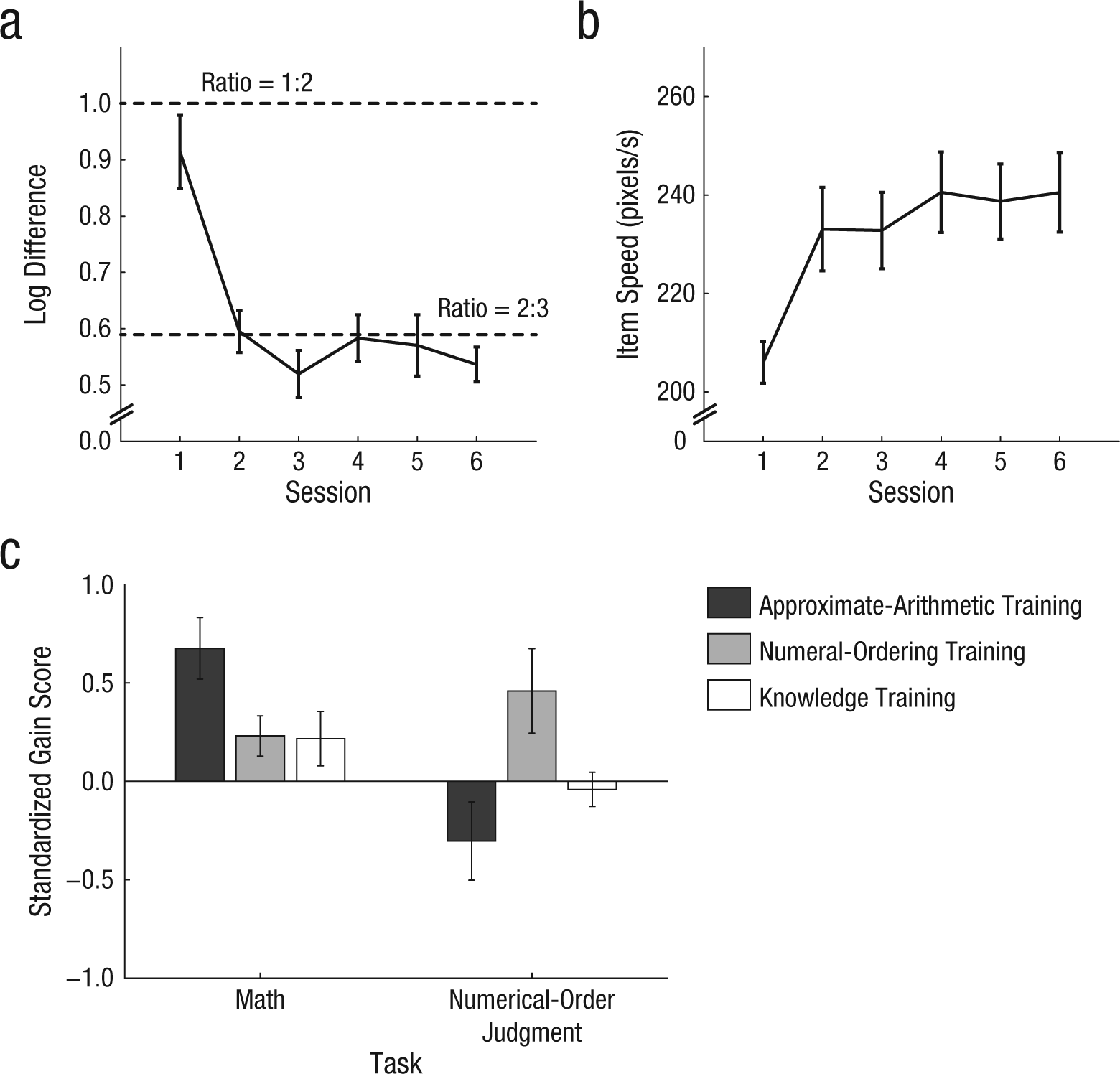
Training and transfer effects in Experiment 2. The mean log-transformed difference between the correct answer and the alternative option is shown in (a) as a function of session for the approximate-arithmetic group. The graph in (b) shows mean item speed as a function of session for the numeral-ordering group. The mean standardized gain scores for math and numerical order accuracy are shown in (c) for each of the three groups. Error bars represent standard errors of the mean.
To assess the transfer effects, we compared the standardized gain scores in symbolic-math performance across the three training groups using a one-way ANOVA. As shown in Figure 2c, this analysis revealed significant differences in the math gain scores across the training groups, F(2, 43) = 3.728, p = .032, η2 = .148, an effect driven by greater math improvement in the approximate-arithmetic group compared with the numeral-ordering group, t(28) = 2.313, p = .028, and with the knowledge training group, t(30) = 2.199, p = .036. It is noteworthy that the numeral-ordering training was no more effective than the knowledge training in yielding symbolic-math improvement, t(28) = 0.074, p = .942. As in Experiment 1, these results could not be explained by preexisting individual differences between the two training groups in math or vocabulary scores. An ANCOVA showed a significant effect of group for math scores, F(2, 40) = 3.68, p = .034, whereas the group-by-test-score interaction was negligible, F(2, 40) = 0.95, p = .397.
This improvement in symbolic math after the approximate-arithmetic training seems to have been facilitated by the increase in participants’ speed of solving symbolic-arithmetic problems. When the same analysis was performed using a standardized gain score for the total number of problems attempted rather than the total number of problems solved correctly, the gain score in the approximate-arithmetic group still tended to be greater than the gain score in the knowledge training group, t(30) = 2.324, p = .027, and in the numeral-ordering group, t(28) = 1.930, p = .064.
An ANOVA on the standardized gain scores for accuracy on the numeral-ordering judgment test revealed significant differences among the three training groups, F(2, 43) = 4.854, p = .013, η2 = .184 (see Fig. 2c). This difference was driven by greater improvement after numeral-ordering training compared with approximate-arithmetic training, t(28) = 2.612, p = .014, and with knowledge training, t(30) = 2.268, p = .031. In contrast, there was little difference among the groups in the gain scores for the vocabulary task, F(2, 43) = 1.983, p = .150, or in reaction times on the numeral-ordering judgment task, F(2, 43) = 2.868, p = .068.
These results indicate that participants’ improvement in symbolic math after the approximate-arithmetic training cannot be attributed to a placebo effect. Moreover, this ANS-based training showed a much more prominent transfer effect than training designed to facilitate symbolic numerical associations (i.e., numeral-ordering training). Consistent with Lyons and Beilock’s (2011) study, our results showed that despite the lack of transfer to symbolic math after numeral-ordering training, symbolic-math scores were correlated with reaction time, r(44) = −.379, p = .009, and marginally correlated with accuracy, r(44) = .285, p = .055, in the numeral-ordering judgment task at pretest.
Discussion
We demonstrated that training on a nonsymbolic approximate-arithmetic task improves performance over 6 to 10 sessions of repeated training and that this improvement transfers to symbolic-arithmetic performance. Furthermore, the amount of improvement in symbolic math ability was beyond the improvement observed in the passive control group and two other training conditions (i.e., one designed to improve general knowledge, and the other to improve symbolic numerical associations).
The current findings are novel and significant in three respects. First, participants showed significant improvement in an ANS-based approximate-arithmetic task over multiple sessions of training. Another attempt to improve ANS performance with the use of a numerical-comparison task (rather than approximate-arithmetic training) yielded little change in performance (DeWind & Brannon, 2012). Because of multiple differences in the paradigms, it is not possible to directly compare the two results. Nevertheless, we speculate that the difference is due primarily to differences between numerical-comparison and approximate-arithmetic training. Alternatively, the current training program may have been more engaging as a result of the two distinct trial types and the regulation procedure, which kept the task challenging. Findings from other training studies suggest that minimizing task-specific strategies and inducing active engagement via adaptive gamelike paradigms may be critical for a training program (Jolles & Crone, 2012; Morrison & Chein, 2011). This adaptive and challenging design may have allowed participants to continue to improve.
Second, there was a striking transfer from our approximate-arithmetic task, which young children and even monkeys can perform (Barth et al., 2005; Cantlon & Brannon, 2007), to a symbolic-math test that taps a uniquely human ability. It is noteworthy that this ANS-based training yielded much greater improvement in math ability than did numeral-ordering training, which was aimed at facilitating associations among numerical symbols (see Fig. 2c). The relative efficacy of the approximate-arithmetic training compared with the numeral-ordering training in yielding a transfer effect in symbolic-math performance is particularly noteworthy, given that (a) the two tasks showed comparable improvements over the course of training (see Figs. 2a and 2b), and (b) the numeral-ordering judgment ability was highly correlated with symbolic-math performance (Lyons & Beilock, 2011). These patterns suggest that approximate-arithmetic training has a specific transfer effect on symbolic-math ability, at least within the context of our study. These results strongly corroborate the proposition that nonsymbolic-arithmetic ability and symbolic-math ability share cognitive foundations. The current results go beyond the prior demonstrations of correlations between ANS and symbolic-math ability and provide the first direct evidence that ANS may causally influence symbolic-math ability.
Third, this demonstrated link between training on approximate arithmetic and symbolic math ability suggests important directions for interventions intended to improve math ability (Kucian et al., 2011; Räsänen, Salminen, Wilson, Aunio, & Dehaene, 2009; Wilson, Revkin, Cohen, Cohen, & Dehaene, 2006). For example, it may be possible to train children with low numerical competence even before their acquisition of symbolic-number knowledge and then expect improved symbolic-math fluency later in development.
Future studies should explore the cognitive mechanisms underlying this transfer effect. Why might improving the ANS-based approximate arithmetic yield benefits for symbolic math? One possibility is that training on the nonsymbolic-arithmetic task may have a domain-specific effect on number representations. The ANS can be characterized as values represented as Gaussian distributions with means located along a mental number line. With increasing magnitude on such a line, there is greater overlap between values because of either logarithmic spacing or increasing spread of the Gaussian distributions (Feigenson et al., 2004; Gallistel & Gelman, 2000). An exciting possibility is that improved performance on the nonsymbolic approximate-arithmetic task actually reflects a sharpening in the Gaussian distributions for each numerosity. Symbolic math may then benefit from increasing precision in the ANS representations that are mapped onto symbols and automatically retrieved.
Another possibility, although not mutually exclusive with the first one, is that the training and transfer effects in the current study reflect facilitations in cognitive processes related to addition and subtraction. For example, previous studies have suggested that approximate addition and subtraction may involve shifting of attention as if one were moving quantities along a mental number line (Knops et al., 2009; McCrink, Dehaene, & Dehaene-Lambertz, 2007). According to this account, repeated training on nonsymbolic arithmetic may yield improvements in visual attention or spatial working memory, a critical cognitive basis of symbolic-math ability (see Raghubar, Barnes, & Hecht, 2010, for a recent review). Therefore, improvements in visuospatial processing required for addition and subtraction during the ANS-based training may in turn benefit symbolic-math ability.
In sum, we have provided the first evidence that ANS training improves symbolic-math ability. This transfer effect, reliably demonstrated in two experiments, suggests that humans’ evolutionarily and developmentally primitive nonverbal number sense, including the internal representation of approximate numbers and their operations, provides a critical foundation for uniquely human symbolic math and may indicate new interventions for math educators.
Footnotes
Acknowledgements
We thank Deborah Moon and Rachel Roberts for their assistance in data collection.
Declaration of Conflicting Interests
The authors declared that they had no conflicts of interest with respect to their authorship or the publication of this article.
Funding
This study was supported by a James McDonnell Scholar Award to E. M. Brannon, by the Eunice Kennedy Shriver National Institute of Child Health and Human Development Grant R01-HD059108 to E. M. Brannon, and by a Duke Fundamental and Translational Neuroscience Postdoctoral Fellowship to J. Park.

References
Supplementary Material
Please find the following supplemental material available below.
For Open Access articles published under a Creative Commons License, all supplemental material carries the same license as the article it is associated with.
For non-Open Access articles published, all supplemental material carries a non-exclusive license, and permission requests for re-use of supplemental material or any part of supplemental material shall be sent directly to the copyright owner as specified in the copyright notice associated with the article.
