






Abstract
The contribution of rewarded actions to automatic attentional selection remains obscure. We hypothesized that some forms of automatic orienting, such as object-based selection, can be completely abandoned in favor of a reward-maximizing strategy. In the two experiments reported here, we presented identical visual stimuli to observers while manipulating what was being rewarded (targets in different locations from the cue or in random object locations) and the type of reward received (money or points). We found that reward alone, not the objects, guides attentional selection and thus entirely predicts behavior. These results suggest that guidance of selective attention, although automatic, is flexible and can be adjusted in accordance with external nonsensory reward-based factors.
Voluntary behaviors are strongly influenced by the consequences that have ensued after similar behaviors in the past. Responses that are repeatedly followed by reward are more preferable than those followed by punishment (or absence of reward). Take, for example, the mundane task of picking out fruit at your local supermarket. You will most likely not purchase a mango if you got food poisoning after eating a mango salad the week before, but you will not hesitate to choose a fruit that has not led to any recent discomfort.
Whereas the effects of reward on such voluntary behaviors as cognitive choices have been extensively researched and are now well understood, the effects of reward on involuntary behaviors, especially those that are considered to be automatic, or outside the range of the volitional control of the organism, remain poorly specified (Della Libera & Chelazzi, 2006; Hickey, Chelazzi, & Theeuwes, 2010). Automatic behaviors vary along a spectrum, or hierarchy, ranging from reflexes (i.e., hardwired behaviors) on one end to certain types of automatic attentional allocation on the other. In the experiments reported here, we exclusively focused on two instances of automatic attentional allocation: space- and object-based attention, the two fundamental mechanisms by which an organism selects a subset of relevant information from an environment rich in sensory stimulation (Egeth & Yantis, 1997; Kanwisher & Driver, 1992; Posner, 1980; Rock & Guttman, 1981; Shomstein & Yantis, 2002). Understanding whether reward modulates automatic attentional control is an important endeavor given that what people consciously perceive ultimately depends on where their attention is directed in both a voluntary and an involuntary manner (Buschman & Miller, 2007; Egeth & Yantis, 1997; Shomstein, Lee, & Behrmann, 2010; Skinner, 1938; Yeari & Goldsmith, 2010).
Here, we present data from two experiments in which we investigated the influence of reward on automatic space- and object-based visual selective attention. We adopted a two-rectangle paradigm, one of the most robust and well-established experimental paradigms for demonstrating the influences of space- and object-based guidance to automatic attentional selection (Egly, Driver, & Rafal, 1994; Moore, Yantis, & Vaughan, 1998), and married it with a regimented schedule of reward and punishments. In a standard object-based paradigm, participants are presented with two parallel rectangles and are required to detect a target event. At the beginning of each trial, one end of one of the rectangles is cued. The critical target event then appears either in the cued location (valid target), outside the cued location but within the cued rectangle (invalid same-object target), or within the uncued rectangle (invalid different-object target), with the latter two locations being equidistant from the cue. Two markers of attentional allocation have been consistently obtained in studies adopting this paradigm. The first marker is automatic space-based facilitation, evidenced by faster and more accurate responses for valid than for invalid targets, which suggests that the distance between the cued location and the target affects perceptual efficiency. The second marker is automatic object-based facilitation, in which invalid same-object targets are detected more rapidly than invalid different-object targets (even though both are equidistant from the cue), which suggests that when part of an object is attended, the rest of the object benefits perceptually (Behrmann, Zemel, & Mozer, 1998; Moore et al., 1998; Shomstein & Yantis, 2004).
To investigate the impact of reward factors on space- and object-based attentional allocation, we made several important modifications to the traditional two-rectangle paradigm. First, instead of unlimited target exposure, we limited the time that targets appeared on the screen to only 60 ms, after which they were swiftly masked (Fig. 1a). This manipulation increased task difficulty, thereby ensuring that participants employed maximal attentional resources (Lavie, 1995). The second, and most important, modification was the imposition of a performance-based reward schedule contingent on point accumulation, such that participants were rewarded for correct target identification and punished for incorrect target identification. The reward schedule was not uniform. Depending on the experiment, two different reward/punishment schemes were imposed. In the different-object-biased experiments (Experiments 1a and 1b), correctly identifying targets presented in the validly cued or in the same-object location resulted in a reward of 1 point, whereas correctly identifying targets in the different-object location resulted in a reward of 6 points (Fig. 1b); this reward structure biased participants toward the different-object location. In the random-reward experiment (Experiment 2), correctly identifying targets presented in the validly cued location resulted in a reward of 1 point, whereas correctly identifying targets presented in the same- or different-object location resulted in a reward of 1 or 6 points (determined randomly), thereby eliminating reward-based biases for either the same- or different-object location while retaining the reward. After each trial, feedback was given stating whether the participant was rewarded with points for correct responses or punished with subtraction of points for incorrect responses (Fig. 1a).
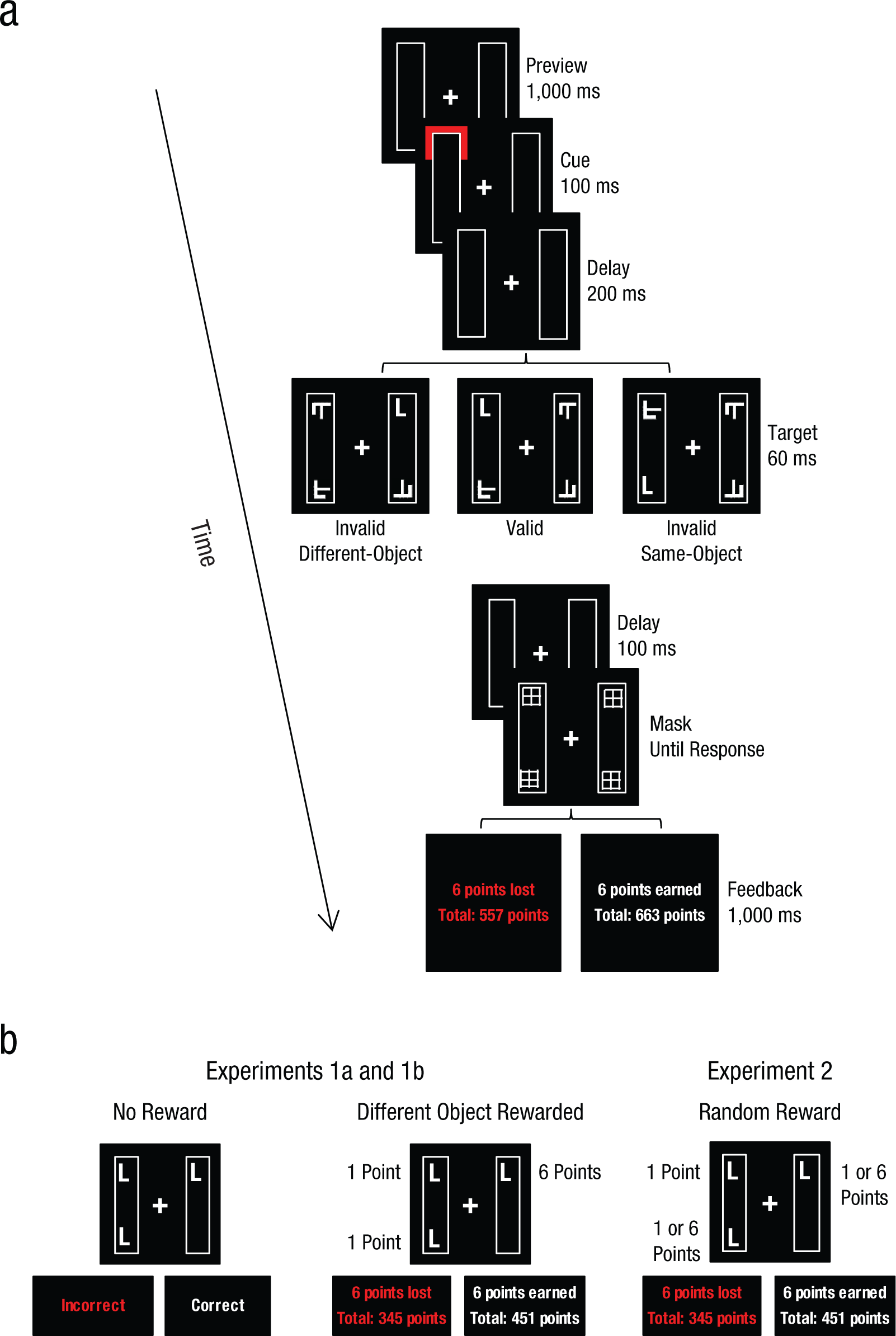
Timeline (a) and conditions (b) in the present experiments. In all conditions, each trial began with a display consisting of two rectangles oriented either vertically (shown here) or horizontally, along with a fixation cross. After a delay, a red cue indicated the likely location of the target. This was followed after another short delay by the target display, in which one target letter (either a T or an L) and three distractors (T-L hybrids) were presented at the four ends of the rectangles. On a given trial, the target could appear in one of three locations: the same location as the cue (valid trials), within the same object as the cue but at a different location (invalid same-object trials), or in the object that had not been cued (invalid different-object trials). The target display was followed by a short delay and then replaced by a mask display. Participants’ task was to indicate, with an appropriate button press, whether the target letter T or L had been present during the target display. Each trial ended with a feedback display. For manipulations in which there was no reward, feedback indicated whether the participant’s response was correct or incorrect. For manipulations in which rewards were greater when targets appeared in different objects from the cue than when they appeared in the same objects, feedback indicated the number of points earned or lost on any given trial along with the total number of points accrued since the beginning of the experiment. Schematic representations of possible target locations in each experiment (b) are shown with the corresponding structure of reward and punishments.
The logic of the experiments was straightforward. First, we aimed to demonstrate that space- and object-based effects can be elicited in a modified data-limited paradigm (Experiment 1a). Second, we adjusted levels of reward in a manner counter to the procedure normally used to elicit standard space- and object-based effects (biasing invalidly cued and different-object locations; Experiments 1a and 1b) or distributed reward randomly, thereby equating the bias (Experiment 2). If reward exclusively affects attentional allocation, then response times (RTs) should be entirely predicted by the levels of reward alone, rather than interacting with space- and object-based attention. For example, object-based effects should be reversed when reward biases different objects (Experiments 1a and 1b) and should be eliminated altogether when reward is distributed randomly (Experiment 2). Alternatively, if reward influences attentional allocation, then reward will interact with space- and object-based effects to the same extent. Yet another alternative is that reward might differentially affect space- and object-based attentional allocation.
Method
Observers
Three groups of 47 participants total took part in two experiments (13 in Experiment 1a, 24 in Experiment 1b, and 10 in Experiment 2). All participants provided informed consent, reported normal or corrected-to-normal visual acuity, and were naive to the purpose of the experiment.
Apparatus and stimuli
Stimuli were displayed on a 19-in. color monitor with a viewing distance of about 62 cm. A central 0.3° × 0.3° fixation cross flanked by two white rectangle outlines oriented either vertically or horizontally appeared on a black background (see Fig. 1). Each rectangle subtended 1.3° × 4.5°, and there was a separation of 1.8° of visual angle between the rectangles. Each end of each rectangle was equidistant from the cue and from each other. The cue was a red outline highlighting the outer edge of one end of one of the rectangles.
One target (the letter T or L) and three distractors (T-L hybrids) appeared on each trial. Each item was centered at one end of one of the rectangles and was constructed with line segments each subtending 0.7° × 0.7°. Target and distractors were rendered in white and appeared in one of four possible orientations—upright or rotated 90°, 180°, or 270°. Masks consisted of 12 line segments arranged into windowlike configurations presented in the same location as the target and distractors and subtending 0.9° × 0.9°. Feedback was written in 14-point font in either white (for positive point accumulation) or red (for point loss).
Design and procedure
For all experiments, rectangle orientation (vertical or horizontal) was counterbalanced across subjects. Validity was defined by whether the target appeared in the cued location (valid trials), at the opposite end of the cued object (invalid same-object trials), or at the end of the uncued rectangle nearest the cue (invalid different-object trials). The cue was valid on 58% of the trials. The target appeared in each of the two invalidly cued locations with an equal likelihood on 21% of trials.
Each trial began with a fixation cross and two rectangles presented for 1,000 ms, followed by a 100-ms cue. After a 200-ms delay, target and distractors were presented for 60 ms, followed by a 100-ms rectangle display. Masks were then presented at each end of the rectangle and remained on the screen until participants’ response. The subjects’ task was to identify the target as either T or L (selected randomly on each trial). Subjects were instructed to ignore the orientation and report the identity of the target letter as quickly and accurately as possible. Each trial ended with a feedback display.
Experiment 1a
Experiment 1a was conducted over two 1-hr sessions. The first session, in which there was no reward manipulation (hereafter referred to as the “no-reward” manipulation), was intended to verify that the time-limited, two-rectangle paradigm was capable of eliciting space- and object-based attentional effects and to acquire baseline measurements of space- and object-based effects without reward. Feedback in this task was restricted to informing participants whether responses were correct or incorrect without any quantifiable reward (Fig. 1b). In the second session of Experiment 1a, we examined whether, and to what extent, automatic space- and object-based effects can be modulated or reversed by reward-based influences. For this purpose, the same group of participants performed the time-limited, two-rectangle task with a superimposed feedback schedule that favored different-object locations (hereafter referred to as the “DO-reward” manipulation; Fig. 1b). In this task, correct identification of targets appearing in the different-object location was reinforced with 6 points, whereas correct identification of targets in the valid or same-object location was reinforced with 1 point. A feedback display indicated the number of points earned or lost on any given trial, along with the total number of points accrued since the beginning of the experiment. Participants were informed that greater accrual of points would correspond to a greater monetary bonus on completion of the experiment: Accuracy of 90% or above earned $10, 80% to 90% accuracy earned $8, 70% to 80% accuracy earned $6, and accuracy below 70% earned $5.
Experiment 1b
We used the same design and procedure in Experiment 1b as in Experiment 1a, with two major differences. First, we employed a between-subjects design with two different groups of subjects participating in the no-reward and DO-reward manipulations. Second, participants were exposed to the same point-reward structure, only this time they received no compensation: Participants simply accumulated points that had no ultimate monetary value.
Experiment 2
The procedure in Experiment 2 was the same as in Experiment 1b, with one major difference: Rewards of 1 to 6 points were randomly given on both same-object and different-object trials. Targets appearing in the valid location were consistently rewarded with 1 point (Fig. 1b).
Statistical analysis
The significance threshold was set to .05. In Experiment 1a, we entered trial type (valid, invalid same-object, invalid different-object) and reward structure (no reward, DO reward) in a within-subjects analysis of variance (ANOVA). Experiment 1b was analyzed using a between-subjects ANOVA with trial type (valid, same-object, different-object) as a within-subjects factor and reward structure (no reward, DO reward) as a between-subjects factor.
Results
Experiment 1a: monetary reward reverses object-based orienting
In the no-reward session of Experiment 1a, we tested whether our modified paradigm is capable of eliciting automatic space- and object-based effects. Figure 2a shows the pattern of performance observed, with feedback restricted to indicating whether a target was identified correctly or incorrectly without providing reward information. The space-based effect was assessed by comparing RTs for invalidly cued targets (same-object and different-object trials combined) with RTs for validly cued targets, which revealed that RTs were 109 ms faster, on average, for valid targets than for invalid targets, F(1, 12) = 34.28, p < .001. In addition, we observed a significant object-based effect by comparing invalidly cued targets appearing in same and different objects, F(1, 12) = 5.52, p < .04: Targets in different objects were identified an average of 17 ms more slowly than those appearing in the same objects. The presence of automatic space- and object-based effects, as well as their magnitudes, is consistent with those reported in a plethora of object-based paradigms (e.g., Drummond & Shomstein, 2010; Egly et al., 1994; Shomstein & Behrmann, 2008).
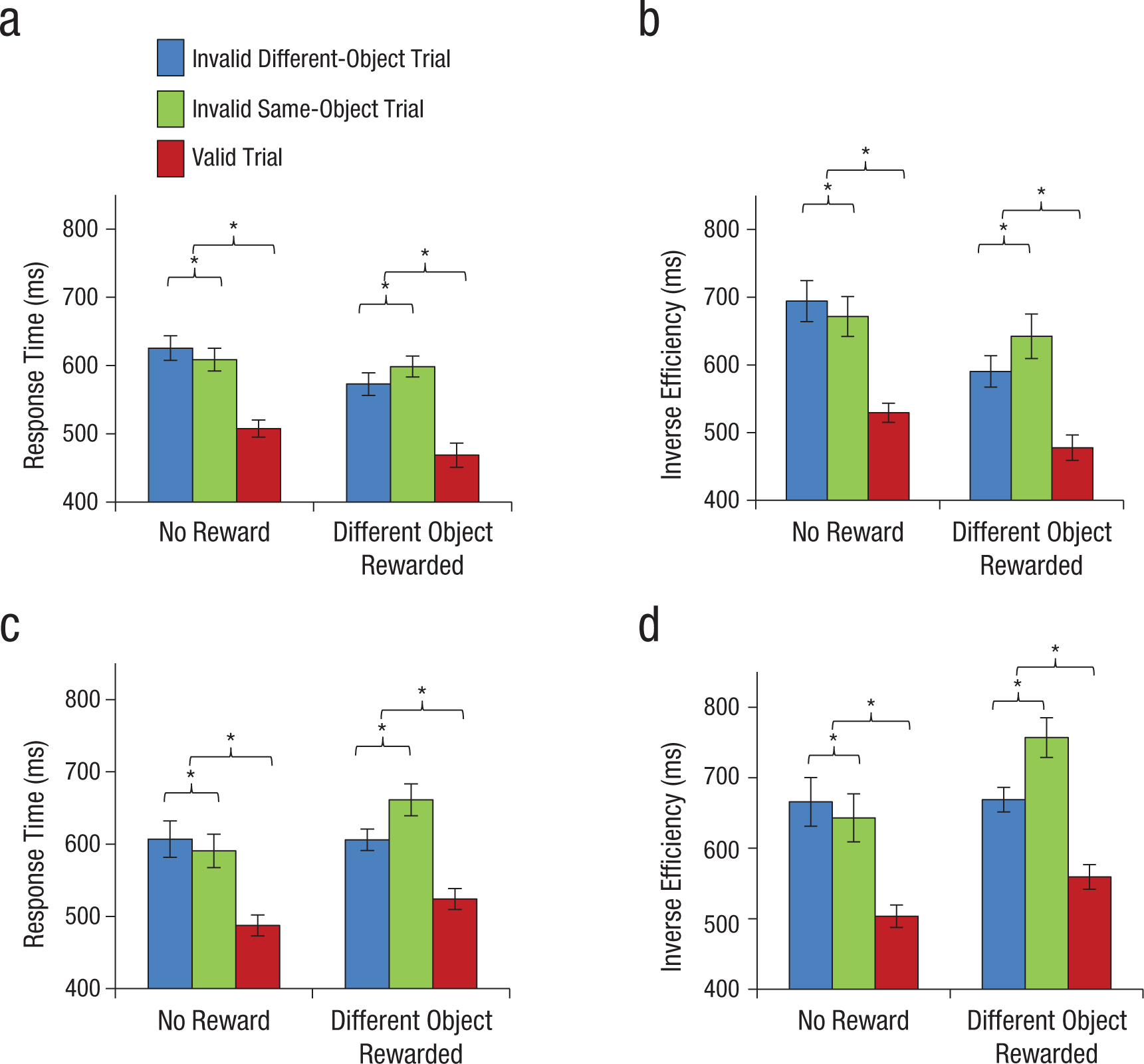
Mean response times (left graphs) and mean inverse efficiency (right graphs) as a function of experimental session and trial type. Results are shown separately for Experiment 1a (a, b) and Experiment 1b (c, d). Inverse efficiency was calculated by dividing the mean correct response time by the proportion of correct responses. Asterisks indicate significant differences between conditions (*p < .05). Error bars represent standard errors of the mean.
The within-subjects design of this experiment allowed us to directly examine whether imposing a reward-based schedule alters the automatic distribution of space- and object-based attentional orientation. To do so, we first compared the magnitude of space-based effects across the no-reward and DO-reward manipulations. An ANOVA was conducted with reward structure (no reward, DO reward) and validity (valid, invalid) as within-subjects factors. The presence of automatic space-based attentional allocation was confirmed by identification times that were an average of 113 ms faster for validly cued targets, F(1, 12) = 45.1, p < .001, compared with invalidly cued targets. Additionally, targets in the no-reward manipulation were identified more slowly than those in the DO-reward manipulation, F(1, 12) = 6.2, p < .03, a finding that could reflect one of two possibilities. On the one hand, this could be a practice effect, because participants always performed the no-reward condition before the DO-reward condition and improved with more exposure to the task. On the other hand, this finding could be a consequence of reward, with the reward schedule motivating participants to perform faster. Regardless of the slight overall decrease in RTs in the DO-reward manipulation, the most important observation is that the magnitude of the validity effect did not differ significantly between the no-reward and DO-reward manipulations (109 ms and 117 ms, respectively), as evidenced by the absence of a two-way interaction (F < 1). This finding strongly suggests that reward-based manipulation did not affect the automatic distribution of spatial attention.
Having established that space-based orienting is robust to the effects of reward, we turned to examining whether object-based attentional allocation is modulated by reward-based influences. An ANOVA was conducted with reward structure (no reward, DO reward) and object (same, different) as within-subjects factors (Fig. 2a). As with the previous analysis, we observed a main effect of reward type, such that participants were faster in the DO-reward condition than in the no-reward condition, F(1, 12) = 5.2, p < .05, which suggests that participants sped up either as the time on task increased or as a result of monetary motivational factors. However, the imposed DO-reward schedule completely reversed the observed object-based effect, as evidenced by the presence of a Reward Structure × Object interaction, F(1, 12) = 11.2, p < .01. In the no-reward session of the experiment, targets appearing in the same-object location were detected 17 ms faster, on average, than those in the different-object location, F(1, 12) = 5.5, p < .04. In contrast, in the DO-reward experiment, targets appearing in the different-object location were detected an average of 26 ms faster than those in the same-object location, F(1, 12) = 10.1, p < .01. This finding strongly suggests that the automatic object-based allocation was replaced by the reward-based factors and that attentional allocation was determined exclusively by the reward schedule. Similar effects were observed in accuracy (see Fig. S1a in the Supplemental Material).
The same effects were replicated using the measure of inverse efficiency (Kennett, Eimer, Spence, & Driver, 2001; Townsend & Ashby, 1983), which verified that faster responses to highly rewarded targets were not attributed to reward-related speed/accuracy trade-offs (Fig. 2b; see also Section 1 in the Supplemental Material).
As a next step, afforded by the fact that the same participants took part in no-reward and DO-reward manipulations, we assessed the relationship between the magnitude of the automatic space-based and object-based effects depending on the imposed reward structure for each individual participant. This analysis allows one to look beyond the overall mean differences and specifically examine whether the magnitude of each individual’s effect remains the same (e.g., space-based) or reverses to the same extent (e.g., object-based) across reward manipulations. First, we correlated the size of the space-based effect (i.e., RTs for valid targets were subtracted from RTs for invalid targets, collapsed across same-object and different-object trials) for no-reward and DO-reward manipulations. If space-based effects are robust to reward structure, then the magnitude of the space-based effect should be similar across reward schedules. A significant positive correlation was observed between the two variables, r = .77, n = 13, p < .001 (Fig. 3). We next correlated the size of the object-based effect for no-reward trials with that for DO-reward trials (for both types of trial, RTs for different-object targets were subtracted from RTs for same-object targets). If automatic object-based effects are completely reversed when a reward for identifying targets in different objects is introduced, then the magnitude of the object-based effect should reverse. A significant negative correlation was observed between the two variables, r = −.39, n = 13, p < .09 (with a single outlier point removed, r = −.64, n = 12, p = .01), which suggests that object-based effects were of the same magnitude but reversed according to the reward schedule (i.e., participants who showed large object-based effects showed large reward-based effects).
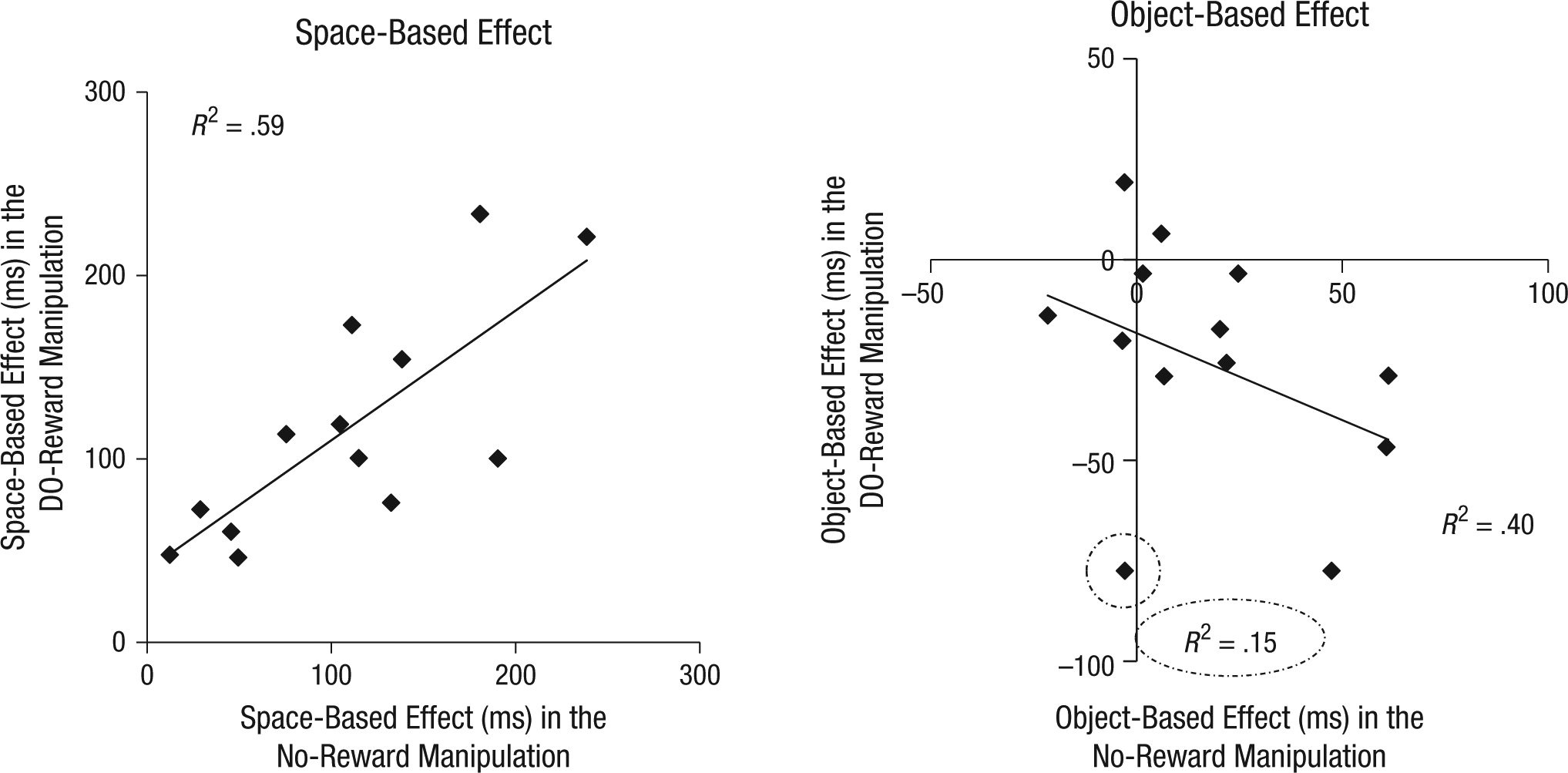
Results from Experiment 1a: scatter plots (with best-fitting regression lines) illustrating space-based effects (left panel) and object-based effects (right panel) as a function of reward for each individual subject (no reward or a reward schedule favoring different-object, DO, locations; for details on the reward manipulations, see the text). The space-based effect was computed by subtracting response times (RTs) for valid targets from RTs for invalid targets (collapsed across same-object and different-object trials). The object-based effect was calculated by subtracting RTs for different-object trials from RTs for same-object trials. In the plot on the right, the outlier is marked by a dashed circle, as is the R2 when the outlier is included in the data.
Thus far, we demonstrated that the time-limited paradigm is capable of eliciting traditional automatic space- and object-based effects when the only feedback given to participants is whether their performance on a trial-by-trial basis is correct or incorrect. However, once we introduced a reward schedule disproportionately favoring targets appearing in the different object, the space-based effect remained unchanged, but the object-based effect became aligned with the reward schedule (i.e., reversed). These results support two important conclusions. First, they show that automatic space-based effects are robust to influences of reward, evidenced by the fact that even when validly cued targets were only reinforced with a 1-point reward, targets appearing in the validly cued locations were identified more quickly than at the highly rewarded different-object location. Second, these findings reveal that automatic object-based effects are reversed when an alternative reward-based schedule is created, evidenced by the fact that reward alone determined attentional allocation within and between objects in the DO-reward manipulation.
Experiment 1b: nonmonetary reward reverses object-based orienting
We next asked whether automatic object-based attentional guidance is abandoned in favor of a reward structure only when there is a monetary reward or whether a nonmonetary reward provides a sufficient signal to elicit reward-based guidance. Demonstrating the influence of nonmonetary reward on automatic attentional guidance will serve two important purposes. First, it will demonstrate that reward-based effects are generalizable to other reward settings, and second, a replication of the observed effect will provide evidence for its robustness.
To assess whether automatic space-based attention changed as a function of the imposed reward structure, we conducted an ANOVA with validity (valid, invalid) as within-subjects factors and reward structure (no reward, DO reward) as a between-subjects factor (Fig. 2c). Results revealed a main effect of validity, or a space-based effect, F(1, 23) = 59.91, p < .01, with valid targets detected more quickly than invalid targets (mean RTs = 506 ms vs. 616 ms, respectively). The absence of a significant interaction of validity and reward structure (F < 1) suggests that the space-based effect remained stable across different reward schedules (replicating the results of Experiment 1a).
To assess whether automatic object-based attentional allocation was affected by reward structure, we constructed an ANOVA with object (same, different) as a within-subjects factor and reward structure (no reward, DO reward) as a between-subjects factor. Results revealed a significant interaction of object and reward structure, F(1, 23) = 9.13, p < .01, and no significant main effect of object (F = 2), which suggests that the magnitude of the object-based effect was completely reversed under the two reward procedures. In other words, when no reward structure was imposed, the standard object-based effect was observed, that is, same-object targets were identified more quickly than different-object targets (mean RTs = 591 ms vs. 607 ms, respectively), F(1, 10) = 4.36, p < .05. However, when a DO-reward schedule was introduced, the object-based effect was reversed—different-object targets were detected more quickly than same-object targets (mean RTs = 606 ms vs. 661 ms, respectively), F(1, 13) = 7.65, p < .02. Inverse efficiency and accuracy data largely mirrored that of RTs (Fig. 2d; see also Fig. S1b and Section 1 in the Supplemental Material). These results strongly suggest that whereas automatic space-based attention is robust to influences of reward, automatic object-based attention is entirely abandoned in favor of the reward-based strategy. These results also suggest that a reward-based strategy is not dependent on concrete monetary reward and that reward-based attentional allocation can be driven by nonmaterial reward.
To rule out that the two groups (no-reward and DO- reward) might have had inherent differences leading to the differential object-based effects, we repeated the DO-reward experiment with another group of 14 participants. We perfectly replicated our original findings (see Section 2 in the Supplemental Material). Additionally, to provide evidence for strong internal validity, we directly compared effect sizes in the DO-reward condition across Experiments 1a and 1b and found exactly the same results (see Section 3 in the Supplemental Material).
Experiment 2: random reward eliminates object-based orienting
To provide the strongest test of the emerging conclusion that automatic object-based attention is abandoned entirely in the presence of a reward structure, we conducted a second experiment in which reward structure was entirely random. We reasoned that if reward alone determines object-based allocation, then when reward is being administered randomly, different-object and same-object locations should be attended to the same extent. However, if automatic object-based attention is insensitive to reward, or was somehow overridden by reward in previous experiments, then we should still observe a same-object advantage over different objects.
An ANOVA conducted with validity (valid, invalid) as a within-subjects factor revealed a main effect, F(1, 9) = 30.84, p < .001, which evidences a strong 125-ms effect of automatic space-based allocation (mean RTs = 647 ms for invalid targets and 522 ms for valid targets). However, we observed no main effect of object (F < 1) when same-object targets were compared with different-object targets in an ANOVA with object as a within-subjects factor (mean RTs = 647 ms for different-object targets and 646 ms for same-object targets). These results strongly support our hypothesis that reward alone determines object allocation and that spatial allocation remains immune (Fig. 4a). We conducted the same analysis on inverse efficiency (Fig. 4b) and observed similar results with a significant main effect of validity, F(1, 9) = 29.51, p < .001, and no effect of object (F = 3). Similar results were observed with accuracy (see Fig. S2 in the Supplemental Material). To provide greater internal validity, we replicated this experiment with another group of 14 participants. The same results were obtained (see Section 4 in the Supplemental Material).
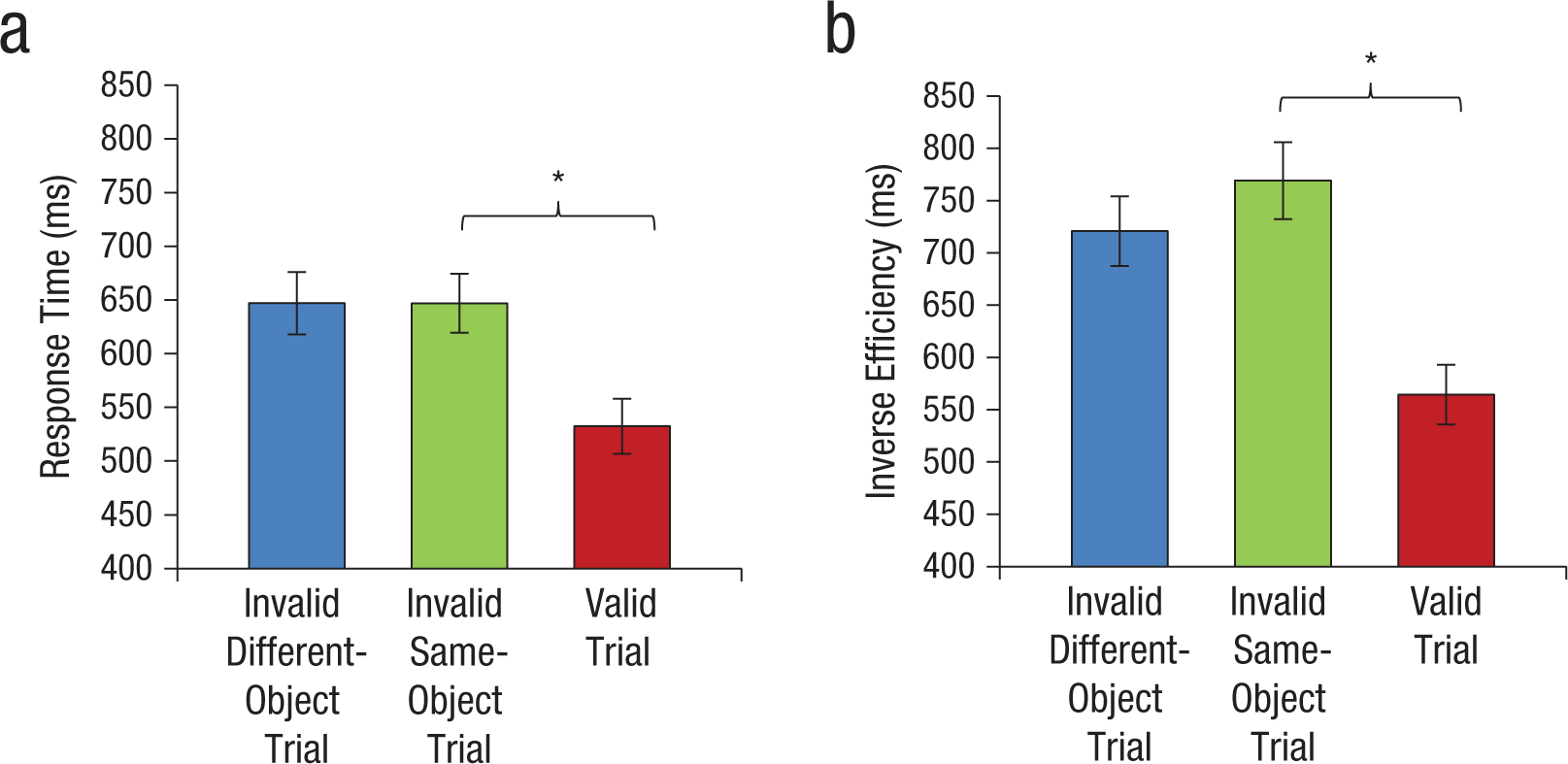
Results from Experiment 2: (a) mean response time and (b) mean inverse efficiency as a function of target type. Inverse efficiency was calculated by dividing mean correct response time by the proportion of correct responses. Asterisks indicate significant differences between groups (*p < .05). Error bars represent standard errors of the mean.
Discussion
In the two experiments reported here, we found strong evidence that reward-based orienting serves as a signal for attentional selection, such that some forms of automatic attentional guidance are abandoned in favor of a reward-based contingency. First, in two experiments, we demonstrated that space-based attentional guidance following an informative sensory cue is robust to reward-based influences. This result, although novel, is not necessarily surprising, as decades of research on space-based orienting have demonstrated the robustness and inflexibility of spatial orienting. In other words, as long as there is a sensory cue, attention will be automatically deployed to that location (Milliken, Tipper, Houghton, & Lupianez, 2000; Posner, 1980). The novel, and surprising, finding reported here is that automatic contribution of objects to attentional guidance, or object-based attention, is completely abandoned in the presence of a reward-based strategy. We clearly, and for the first time, demonstrated that object-based effects are reversed when reward-based structure biases different object, with targets appearing in a different object from the cue identified more quickly and accurately than those appearing within the same object as the cue. More important, we showed that even when a reward-based structure biases same-object and different-object locations equally, object-based attention is completely abandoned and reward predicts orienting with same-object and different-object targets identified with the same speed and accuracy. The latter finding strongly suggests that the reward-based contingency provides an informative signal that constrains attentional allocation (Anderson, Laurent, & Yantis, 2011; Della Libera, Perlato, & Chelazzi, 2011; Hickey et al., 2010; Lee & Shomstein, 2013).
Our results suggest that although space- and object-based effects appear similarly automatic and mandatory (with all things being equal, i.e., there is no reward or other biasing signals), introducing a simple reward-based strategy reveals that the two mechanisms are in fact different. It was observed over the course of two experiments (and two replications) that the magnitude of space-based effects did not change with varying degrees of reward, which suggests that space-based attentional allocation is in fact automatic and mandatory. In contrast, our results clearly indicate that object-based attentional allocation is a default setting that emerges in the absence of an alternative strategy and is not automatic or mandatory. With two objects and no other biases, object-based effects emerge; however, in the presence of another strategy, reward in this case, reward replaces object-based effects (a different-object location is favored when a different object is rewarded or neither different objects or same objects are favored when reward is distributed randomly; see also Yeari & Goldsmith, 2010, and Shomstein, 2012, for discussions on automaticity of object-based effects).
These results also suggest that reward-based contributions to selection should not be viewed separately from attention. Several studies suggest that attentional and reward-modulating effects are independent, which results in separate salience maps based on reward or attention alone. For example, studies using decision-making paradigms showed that the saccade-related activity of the lateral intraparietal (LIP) area increased as a function of the difference in the amount or probability of reward. However, the results of these studies did not differentiate behaviorally relevant and irrelevant distractors, and they strongly suggest that the LIP area contains a salience map that takes only reward and decision information into account (Dorris & Glimcher, 2004; Platt & Glimcher, 1999). This line of research is based on the assumption that visual attention can be treated as conceptually separable from reward-related processes and the hypothesis that there are separate salience maps constructed by either reward or attention alone. In contrast, several researchers have proposed that a single integrated saliency map incorporates both reward and attentional information. This line of research suggests that multiple feature maps, consisting of different units of attention (location, color, orientation, size, movement, etc.), are combined into a single salience map that encodes visual scenes in a featureless manner that predicts attentional allocation. Reward, we argue, is treated as one of the units contributing to attentional guidance (Balan & Gottlieb, 2006; Della Libera & Chelazzi, 2006, 2009; Della Libera et al., 2011; Kiss, Driver, & Eimer, 2009; Small et al., 2005). The observation that automatic object-based attentional selection is discarded, rather than overridden or suppressed, in lieu of the reward-based schedule provides strong evidence for a unified saliency map, with reward as one of the contributing signals guiding and restricting attentional selection.
Footnotes
Acknowledgements
We thank Marlene Behrmann, John Philbeck, and Dwight J. Kravitz for comments and suggestions. We thank Michelle Rattinger for assistance with data collection.
Declaration of Conflicting Interests
The authors declared that they had no conflicts of interest with respect to their authorship or the publication of this article.
Funding
This work was supported by National Science Foundation Grant BCS-1059523 and National Institutes of Health Grant R21-EY021644 to S. Shomstein.

References
Supplementary Material
Please find the following supplemental material available below.
For Open Access articles published under a Creative Commons License, all supplemental material carries the same license as the article it is associated with.
For non-Open Access articles published, all supplemental material carries a non-exclusive license, and permission requests for re-use of supplemental material or any part of supplemental material shall be sent directly to the copyright owner as specified in the copyright notice associated with the article.
