






Abstract
In most prior research, positive affect has been consistently found to promote cognitive flexibility. However, the motivational dimensional model of affect assumes that the influence of positive affect on cognitive processes is modulated by approach-motivation intensity. In the present study, we extended the motivational dimensional model to the domain of cognitive control by examining the effect of low- versus high-approach-motivated positive affect on the balance between cognitive flexibility and stability in an attentional-set-shifting paradigm. Results showed that low-approach-motivated positive affect promoted cognitive flexibility but also caused higher distractibility, whereas high-approach-motivated positive affect enhanced perseverance but simultaneously reduced distractibility. These results suggest that the balance between cognitive flexibility and stability is modulated by the approach-motivation intensity of positive affective states. Therefore, it is essential to incorporate motivational intensity into studies on the influence of affect on cognitive control.
Keywords
Ample evidence in the literature on affect and cognitive control suggests that positive affect, compared with negative or neutral affect, has a robust beneficial effect on cognitive flexibility (for reviews, see Ashby, Isen, & Turken, 1999; Fredrickson, 2001; Isen, 2009). Previous researchers examining the role of affect in cognitive flexibility have focused mainly on the valence dimension of affective states and have rarely examined the underlying dimension of motivation.
In the motivational dimensional model of affect recently proposed by Gable and Harmon-Jones (2010c; Harmon-Jones, Gable, & Price, 2012, 2013), the effects of positive affect on cognitive processing are assumed to be modulated by approach-motivation intensity. Converging with this theoretical view, a growing number of studies have demonstrated that low-approach-motivated positive affect broadens attentional and cognitive scope (Fredrickson & Branigan, 2005; Gasper & Clore, 2002; Isen & Daubman, 1984; Talarico, Berntsen, & Rubin, 2009), whereas high-approach-motivated positive affect has the opposite effect (Gable & Harmon-Jones, 2008, 2010a, 2010b, 2011; Price & Harmon-Jones, 2010).
Given the motivational dimensional model and relevant empirical studies, it seems plausible that positive affective states of varying approach-motivation intensity have different influences on cognitive flexibility. Initial support for this hypothesis has come from Price and Harmon-Jones (2010), whose results showed that low-approach-motivated positive affect increased cognitive broadening and flexibility, as measured by cognitive categorization tasks, whereas high-approach-motivated positive affect decreased cognitive broadening and flexibility. In a similar vein, Wang, Liu, and Jiang (2013) found that low-approach-motivated positive affect facilitated response inhibition and task switching, whereas high-approach-motivated positive affect impaired task switching.
Higher flexibility may lead to higher distractibility (i.e., lower stability), especially when new information is irrelevant to the ongoing task. Some studies (Dreisbach, 2006; Dreisbach & Goschke, 2004; Marien, Aarts, & Custers, 2012) have investigated the impact of positive affect on the balance between cognitive flexibility and stability, which is critical for goal-directed behavior in humans. These studies have consistently shown that positive affect enhances cognitive flexibility but also increases distractibility (Dreisbach, 2006; Dreisbach & Goschke, 2004), especially when participants’ responses are represented in terms of goals (Marien et al., 2012). However, these studies have primarily examined the impact of low- rather than high-approach-motivated positive affect on the flexibility-stability balance, because the induced affect has been a relatively passive state not associated with goal pursuit. The aim of the present research was therefore to investigate whether the influences of positive affect on the cognitive flexibility-stability balance are modulated by approach-motivation intensity.
To systematically examine this issue, we conducted two experiments using the attentional-set-shifting paradigm originally developed by Dreisbach and Goschke (2004). This paradigm, designed to identify the costs and benefits of increased cognitive flexibility, consists of two phases: the preswitch and postswitch phases. In the preswitch phase, participants are instructed to respond to target stimuli appearing in a prespecified color (e.g., red) and to ignore distractor stimuli, which appear in a different color (e.g., blue). Then, in the postswitch phase, participants are given instructions for the perseveration or distraction condition. In the perseveration condition (Experiment 1), targets are in a new color (e.g., green), and distractors appear in the formerly relevant color (e.g., red). In the distraction condition (Experiment 2), targets are in the formerly ignored color (e.g., blue), and distractors appear in a new color (e.g., green). The two switching conditions are widely used to assess the degree of flexibility and stability of cognitive control (Dreisbach & Goschke, 2004; Dreisbach et al., 2005; Müller et al., 2007).
More precisely, the attentional-set-shifting paradigm assesses reactivity toward new stimuli, a main aspect of cognitive control (Dreisbach & Goschke, 2004; Dreisbach et al., 2005; Müller et al., 2007). In the perseveration condition, flexible cognitive control facilitates disengagement from the previous target color and a bias toward the novel color, which identifies new targets. Thus, flexibility should decrease switch costs. In the distraction condition, flexible cognitive control should again bias participants’ attention toward stimuli in the novel color, but because these are the distractors, flexibility should increase distractibility and therefore increase switch costs. The opposite pattern is expected in the stable-cognitive-control mode, in which reactivity toward new information is inhibited: Stable cognitive control should increase switch costs in the perseveration condition and decrease switch costs in the distraction condition.
We hypothesized that in previous studies (Dreisbach, 2006; Dreisbach & Goschke, 2004; Müller et al., 2007), low-approach-motivated positive affect increased reactivity toward novel stimuli, thereby enhancing cognitive flexibility, presumably because low-approach-motivated positive affect occurs after a goal has been achieved or when there is no goal (Gable & Harmon-Jones, 2010c). In such a positive affective state, a flexible control mode can assist organisms in exploring new goals or opportunities. The flexible control mode should reduce perseverance when new information identifies targets but increase distractibility when new information identifies distractors. Thus, low-approach-motivated positive affect should facilitate cognitive flexibility, reducing switch costs in the perseveration condition and increasing switch costs in the distraction condition.
High-approach-motivated positive affect, which often occurs during goal pursuit, should reduce reactivity toward novel stimuli and promote cognitive stability (Gable & Harmon-Jones, 2010c). Enhancing flexibility during goal pursuit might prove maladaptive, because it might lead one away from the current goal. Conversely, a stable control mode can assist organisms in shielding goal pursuit from irrelevant stimuli, perceptions, and cognitions. The stable control mode should enhance perseveration, even in the case of relevant new changes in the environment, but simultaneously reduce distractibility caused by irrelevant new stimuli. Thus, high-approach-motivated positive affect should enhance cognitive stability, increasing switch costs in the perseveration condition and reducing switch costs in the distraction condition. In sum, we hypothesized that the influence of positive affect on the balance between cognitive flexibility and stability is modulated by approach-motivation intensity.
Experiment 1
Method
Thirty-two undergraduate students (19 women, 13 men) participated in Experiment 1 in return for 10 Chinese yuan. All participants had normal or corrected-to-normal vision and were not red-green color-blind. They all provided informed consent and were debriefed after the experiment. In order to control the possible confounding effect of hunger on the effectiveness of the dessert pictures we used to elicit high-approach-motivated positive affect, we allowed only participants who had eaten 2 to 4 hr before the experiment to take part.
The perseveration condition of the attentional-set-shifting paradigm was used in this experiment to assess flexibility and stability of cognitive control. Participants performed a digit-categorization task in which they categorized digits of the target color as odd or even. In this task, the imperative stimuli consisted of two simultaneously presented digits, randomly selected from a set of eight (2–9); the digits appeared one above the other in the center of the screen. The selection of stimuli was completely randomized on each trial, the only constraint being that the target and distractor digits were always mapped to different responses (i.e., if the target digit was odd, the distractor digit was even, and vice versa). The location of the target (above or below the distractor) was determined at random. The digits were always presented in two different colors selected from a pool of three colors: red, blue, and green.
There were three experimental blocks: neutral, low-approach-motivated positive affect, and high-approach-motivated positive affect. The order of these three blocks was counterbalanced across participants. Each 60-trial block consisted of two phases: a preswitch phase (40 trials) and a postswitch phase (20 trials). Low-approach-motivated positive affect was elicited using 30 pictures of beautiful landscapes; high-approach-motivated positive affect was elicited using 30 pictures of delicious desserts. In addition, 30 pictures of household objects were used in the neutral block. The experimental blocks were preceded by a 20-trial practice block in which 10 other pictures of household objects were shown. Each picture was presented twice per block. These pictures were validated in previous studies (Gable & Harmon-Jones, 2008, 2010a, 2010b; Gable & Poole, 2012; Lang, Bradley, & Cuthbert, 2005; Wang et al., 2013).
The experimental program was administered to each participant individually. Participants were informed that the target color would be switched during the experiment. The assignment of relevant color (i.e., the preswitch target color), irrelevant color (i.e., the preswitch distractor color), and new color (i.e., not used in the preswitch phase) remained constant for a given participant but was counterbalanced across participants. At the beginning of each block, a 3,000-ms cue informed participants of the target color. Then, the trials began. On each trial, participants saw a picture of a landscape (low-approach-motivation block), a dessert (high-approach-motivation block), or a household object (neutral block) for 2,000 ms. This was followed by a fixation cross for 500 ms. Then, the imperative stimulus was presented: Two numbers appeared on the screen, one above the other, until a response was given (maximum of 1,500 ms). One number was shown in the target color (e.g., red), and the other was shown in the distractor color (e.g., blue). Participants were asked to indicate whether the target digit was odd or even by pressing either the left “ALT” key or the right “ALT” key on a computer keyboard with the corresponding index finger. Assignment of responses to these keys was counterbalanced across participants. Participants were instructed to respond as quickly as possible while avoiding errors. After a response, a blank screen appeared for 500 ms, and a new trial began.
At the end of the preswitch phase (i.e., after the 40th trial), a 3,000-ms cue informed participants of the new target color (e.g., green). The procedure for the postswitch trials was otherwise the same as that for the preswitch trials, except that the new distractor color was the former target color (e.g., red). Participants rested for 1 min between blocks. Figure 1a presents a diagram depicting the course of trials in the preswitch and postswitch phases.
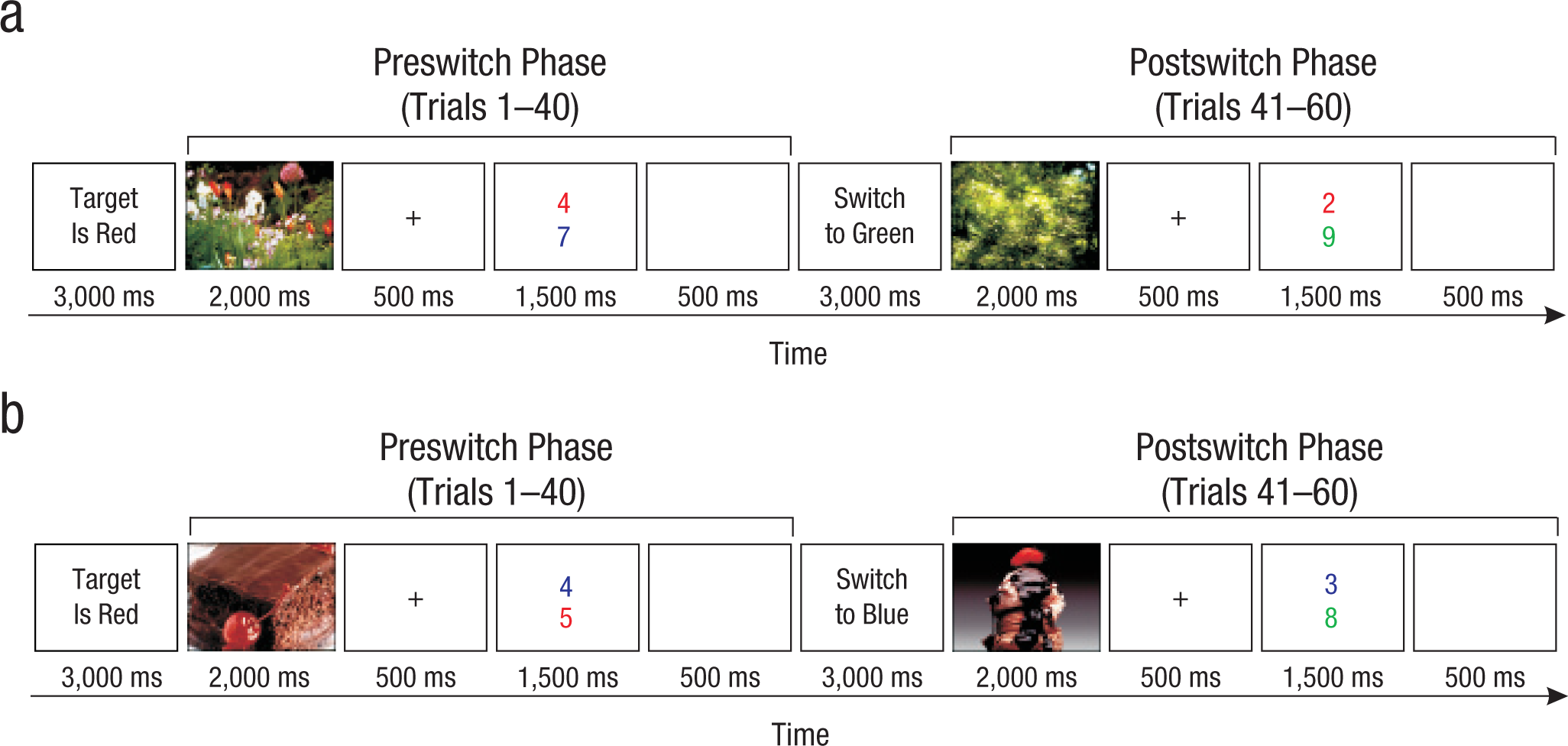
Schematic diagrams illustrating trial sequences in (a) Experiment 1, the perseverance condition, and (b) Experiment 2, the distraction condition. Each block began with a cue indicating the target color. During the preswitch phase, each trial began with a picture, which was followed by a fixation cross and then two digits, one in the target color (e.g., red) and the other in the distractor color (e.g., blue). The task was to indicate whether the digit in the target color was odd or even. In separate blocks, landscape pictures, illustrated in (a), were used to induce low-approach-motivation positive affect, and dessert pictures, illustrated in (b), were used to induce high-approach-motivation positive affect. After 40 trials, participants were informed of the new target color. In the perseveration condition (a), the former target color (e.g., red) became the new distractor color, and a new color (e.g., green) became the target color. In the distraction condition (b), the former distractor color (e.g., blue) became the new target color, and a new color (e.g., green) became the new distractor color. Otherwise, the procedure for the trials in this postswitch phase was the same as that for the preswitch trials.
After completing the experiment, participants viewed the pictures again (3,000 ms each) and rated each for how pleasant it was (1 = very unpleasant, 9 = very pleasant), how arousing it was (1 = calm, 9 = exciting), and how intense their approach motivation was (1 = do not want to approach, 9 = really want to approach).
Results
Affective picture ratings
The ratings for pleasantness (i.e., valence), arousal, and approach-motivation intensity were subjected to three separate within-subjects repeated measures analyses of variance (ANOVAs) with picture type as a within-participants factor. For valence ratings, a significant effect of picture type was observed, F(2, 62) = 59.20, p < .001, η p 2 = .66. Post hoc Bonferroni tests demonstrated that both the dessert pictures (M = 6.22, SD = 0.91; p < .001) and the landscape pictures (M = 6.44, SD = 0.79; p < .001) had significantly higher valence ratings than the neutral pictures (M = 4.64, SD = 0.84). The difference between the dessert pictures and the landscape pictures was far from reliable, p = .62. Likewise, for arousal ratings, there was a significant effect of picture type, F(2, 62) = 16.73, p < .001, η p 2 = .35. Both the dessert pictures (M = 5.35, SD = 1.42; p < .001) and the landscape pictures (M = 4.93, SD = 1.25; p = .002) had significantly higher arousal ratings than the neutral pictures (M = 3.95, SD = 0.88); there was no difference between the dessert and landscape pictures, p = .30. Ratings of approach-motivation intensity also showed a significant effect of picture type, F(2, 62) = 45.69, p < .001, η p 2 = .60. Average motivational-intensity ratings were significantly higher for dessert pictures (M = 6.09, SD = 0.83) than for landscape pictures (M = 5.54, SD = 0.87; p = .01) and were significantly higher for landscape pictures than for neutral pictures (M = 4.22, SD = 0.92; p < .001). Consistent with results from previous studies (Gable & Harmon-Jones, 2008, 2010a, 2010b; Gable & Poole, 2012; Wang et al., 2013), our results indicate that the landscape and dessert pictures we used to evoke low- and high-approach-motivated positive affect, respectively, were effective.
Reaction times
Incorrect responses (7.92% of the total) and responses with a reaction time more than 3 standard deviations from the mean (1.67%) were excluded from further analyses. Following the method of previous studies (Dreisbach & Goschke, 2004; Dreisbach et al., 2005; Müller et al., 2007), we calculated switch costs by subtracting the mean reaction time of the last five preswitch trials from the mean reaction time of the first five postswitch trials. In practice, this method is commonly used in this type of attentional-set-shifting paradigm. As described earlier, cognitive flexibility is reflected in decreased switch costs in the perseveration condition.
Reaction times were submitted to a 3 (block: neutral, low-approach-motivated positive affect, high-approach-motivated positive affect) × 2 (phase: preswitch, postswitch) repeated measures ANOVA. Results revealed significant main effects of both block, F(2, 62) = 3.63, p = .03, η p 2 = .10, and phase, F(1, 31) = 72.61, p < .001, η p 2 = .70. Moreover, these two main effects were qualified by a significant interaction, F(2, 62) = 37.85, p < .001, η p 2 = .55. Relative to the neutral block (M = 61 ms, SD = 57), switch costs were lower in the low-approach-motivation block (M = 14 ms, SD = 61; p = .002) but higher in the high-approach-motivation block (M = 120 ms, SD = 58; p < .001). The mean reaction times for each block and phase are presented in Figure 2.
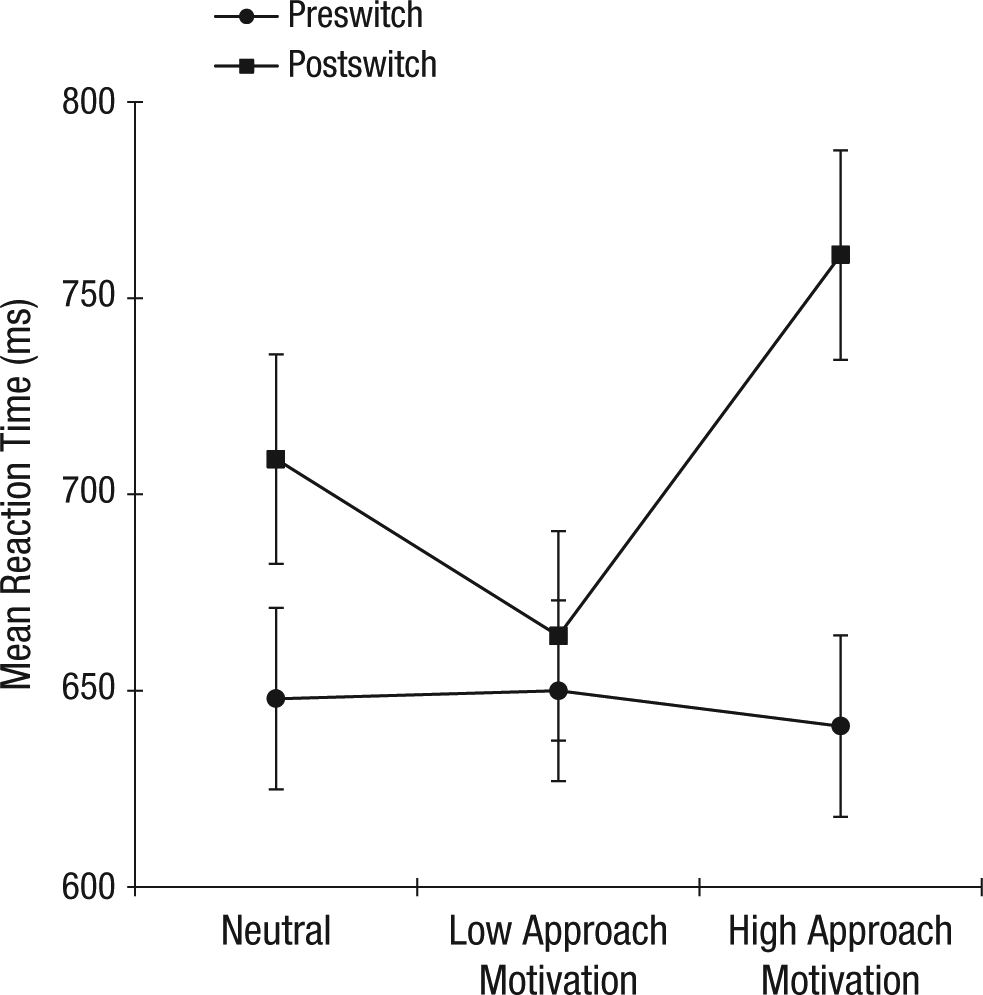
Experiment 1 (perseveration condition) results: mean reaction time as a function of block and phase. Error bars represent within-subjects 95% confidence interval.
Simple-effects analyses revealed that in the preswitch phase, there was no simple main effect of block, F(2, 62) = 0.15, p = .86, η p 2 = .005. Conversely, in the postswitch phase, the simple main effect of block was significant, F(2, 62) = 13.36, p < .001, η p 2 = .30. A post hoc Bonferroni test demonstrated that, compared with reaction times in the neutral block (M = 709 ms, SD = 107), reaction times were lower in the low-approach-motivation block (M = 664 ms, SD = 113; p = .042) but higher in the high-approach-motivation block (M = 761 ms, SD = 114; p = .036). These results suggest that the opposite effects of low- and high-approach-motivated positive affect on reaction time switch costs were driven by postswitch rather than preswitch trials.
Error rates
Error data were entered into an analogous 3 × 2 repeated measures ANOVA. Neither the main effects of block, F(2, 62) = 0.18, p = .83, η p 2 = .006, and phase, F(1, 31) = 1.95, p = .17, η p 2 = .06, nor their interaction, F(2, 62) = 1.28, p = .28, η p 2 = .04, reached statistical significance.
Discussion
Experiment 1 revealed that in the perseveration condition, low-approach-motivated positive affect reduced switch costs, whereas high-approach-motivated positive affect increased switch costs. These results provided initial support for our hypothesis that the impact of positive affect on the balance of cognitive flexibility and stability is modulated by approach-motivation intensity. Previous studies have confirmed that higher cognitive flexibility goes along with increased distractibility, whereas increased cognitive stability can reduce distractibility caused by irrelevant novel stimuli (Dreisbach & Goschke, 2004; Dreisbach et al., 2005; Müller et al., 2007). Thus, it seems reasonable to assume that positive affective states varying in approach-motivation intensity have different effects on distractibility. In hopes of providing more compelling evidence for our hypothesis, we conducted Experiment 2, the distraction condition.
Experiment 2
Method
Thirty-six undergraduate students (24 women, 12 men) participated in Experiment 2 in exchange for 10 yuan. Experiment 2 was identical to Experiment 1 with one exception: The perseveration condition was replaced with the distraction condition (Fig. 1b). The difference between the two conditions is that in the postswitch phase of the distraction condition, the former distractor color becomes the new target color, and a new color becomes the distractor color. For example, in the preswitch phase, the target color might be red and the distractor color blue; in the postswitch phase, the target color would then be blue and the distractor color green.
Results
Affective picture ratings
Results of affective picture ratings were similar to those in Experiment 1. There were significant effects of picture type on ratings of valence, F(2, 70) = 65.58, p < .001, η p 2 = .65; arousal, F(2, 70) = 13.85, p < .001, η p 2 = .28; and approach-motivation intensity, F(2, 70) = 32.56, p < .001, η p 2 = .48. Results again suggested that the affective pictures used in this study could effectively evoke low- and high-approach-motivated positive affect.
Reaction times
Incorrect responses (7.13% of the total) and responses with a reaction time more than 3 standard deviations from the mean (1.11%) were excluded from the analyses. As mentioned earlier, cognitive stability is reflected in decreased switch costs in the distraction condition, unlike the perseveration condition.
Reaction times were subjected to a 3 (block: neutral, low-approach-motivated positive affect, high-approach-motivated positive affect) × 2 (phase: preswitch, postswitch) repeated measures ANOVA. The analysis yielded significant main effects of block, F(2, 70) = 7.27, p = .001, η p 2 = .17, and phase, F(1, 35) = 49.49, p < .001, η p 2 = .59. Furthermore, the two main effects were qualified by a significant interaction of block and phase, F(2, 70) = 18.63, p < .001, η p 2 = .35. Relative to the neutral block (M = 58 ms, SD = 70), switch costs were higher in the low-approach-motivation block (M = 97 ms, SD = 70; p = .008) but lower in the high-approach-motivation block (M = 16 ms, SD = 61; p = .01). The mean reaction times for each block and phase are presented in Figure 3.
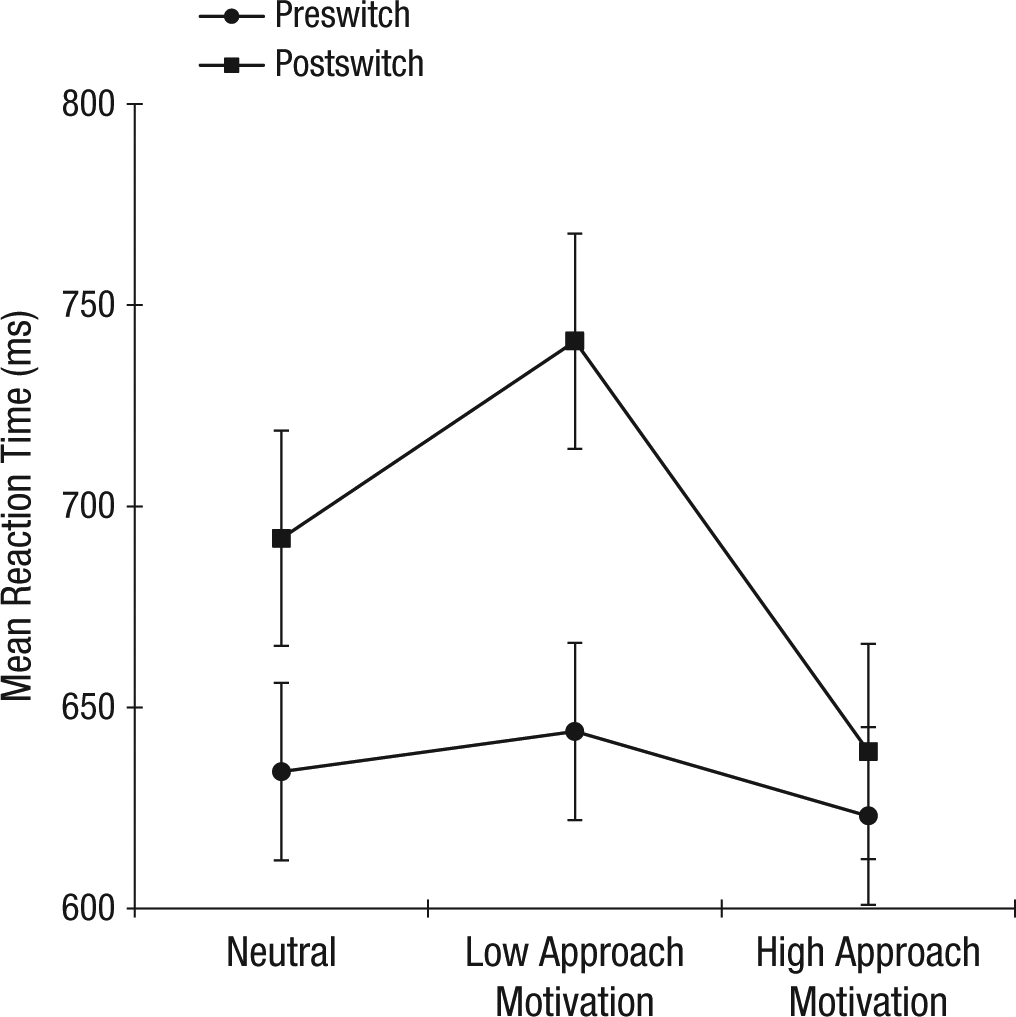
Results from Experiment 2 (distraction condition): mean reaction time as a function of block and phase. Error bars represent within-subjects 95% confidence interval.
Simple-effects analyses revealed that the simple main effect of block was nonsignificant for the preswitch phase, F(2, 70) = 0.86, p = .43, η p 2 = .02, but highly significant for the postswitch phase, F(2, 70) = 14.43, p < .001, η p 2 = .29. A post hoc Bonferroni test demonstrated that, compared with postswitch reaction times in the neutral block (M = 692 ms, SD = 95), postswitch reaction times were higher in the low-approach-motivation block (M = 741 ms, SD = 113; p = .01) but lower in the high-approach-motivation block (M = 639 ms, SD = 111; p = .02). These results suggest that the opposite effects of low- and high-approach-motivated positive affect on switch costs in the distraction condition were driven by postswitch rather than preswitch trials. Thus, the findings of Experiment 2 conceptually replicated the findings of Experiment 1 in a different switching condition.
Error rates
Error data were entered into an analogous 3 × 2 repeated measures ANOVA. A marginal main effect of phase was observed, F(1, 35) = 3.23, p = .08, η p 2 = .08; there was a tendency for error-rate switch costs to be reliable. Neither the main effect of block, F(2, 70) = 2.12, p = .13, η p 2 = .06, nor the interaction of phase and block, F(2, 70) = 0.38, p = .69, η p 2 = .01, proved reliable.
Discussion
In Experiment 2, low- and high-approach-motivated positive affect clearly had opposite effects on distractibility. In particular, low-approach-motivated positive affect increased distractibility, as reflected in higher switch costs, whereas high-approach-motivated positive affect reduced distractibility, as reflected in lower switch costs. This pattern of results is fully compatible with our hypothesis that low-approach-motivated positive affect enhances cognitive flexibility but also incurs a complementary cost in the form of increased distractibility. In contrast, positive affect high in approach motivation enhances perseverance but also reduces distractibility.
General Discussion
The present results indicate that the influence of positive affect on the balance between cognitive flexibility and stability is modulated by approach-motivation intensity. Specifically, low-approach-motivated positive affect enhanced cognitive flexibility but simultaneously increased distractibility, whereas high-approach-motivated positive affect enhanced perseveration but also reduced distractibility.
The finding that low-approach-motivated positive affect promoted cognitive flexibility is well in line with much previous research (Dreisbach, 2006; Dreisbach & Goschke, 2004; Müller et al., 2007; Price & Harmon-Jones, 2010; Wang et al., 2013). The presence of low-approach-motivated positive affect suggests that there is a stable and comfortable environment or that things are going well (Carver, 2003; Fredrickson, 2001; Gable & Harmon-Jones, 2010c). Such a free-floating positive state allows organisms to be open to new information and thereby enhances their cognitive flexibility. This increased flexibility promotes free and full engagement with the environment, which might build enduring personal resources and ultimately improve well-being (Fredrickson, 2001). However, the flexible control mode may cause distractibility when novel stimuli are irrelevant for the ongoing task, which in turn impedes goal pursuit.
The finding that high-approach-motivated positive affect enhances perseverance, or reduces flexibility, converges with results from some prior studies (Price & Harmon-Jones, 2010; Wang et al., 2013). High-approach-motivated positive affect is very relevant to biologically important outcomes such as reproduction, social attachment, and eating and drinking (Gable & Harmon-Jones, 2010c; Harmon-Jones et al., 2012). Such an appetitive state encourages tenacious goal pursuit. During goal pursuit, a flexible control mode might prove maladaptive, because it might increase distractibility caused by irrelevant new stimuli and consequently delay or hinder acquisition of the desired goal. So, high-approach-motivated positive affect should reduce flexibility or, rather, enhance perseverance, so that organisms are less distracted or even not distracted by irrelevant new information. This enhanced stability might assist organisms in achieving desired goals by shutting out irrelevant distractors. However, the stable control mode might cause rigid behavior when novel stimuli are critical for completing a task.
The opposite patterns of effects observed for low- and high-approach-motivated positive affect fit exactly with the motivational dimensional model, according to which approach-motivation intensity modulates the influences of positive affect on cognitive processing. Low-approach-motivated positive affect broadens attentional and cognitive scope to better enable perception of novel stimuli. In turn, this enhances flexibility when novel stimuli serve as new targets but increases distractibility when novel stimuli serve as distractors. In contrast, high-approach-motivated positive affect narrows attentional and cognitive scope to shield perception of the chosen target from irrelevant novel stimuli. In turn, this reduces flexibility and enhances perseverance when novel stimuli serve as new targets but reduces distractibility when novel stimuli serve as distractors. Accordingly, the motivational dimensional model could well explain the increased flexibility and higher distractibility associated with low-approach-motivated positive affect and the enhanced perseverance and lower distractibility associated with high-approach-motivated positive affect.
In summary, the current research provides further support for the motivational dimensional model of affect and extends this model to the cognitive-control domain. Along with previous work on cognitive scope, this research suggests that positive affect should not be regarded as a unitary construct that is beneficial only to cognitive broadening and flexibility. Positive affect can broaden or narrow cognitive scope and can make for flexible or stable cognitive control, depending on the approach-motivation intensity of the positive affect. Thus, the present research highlights the importance of incorporating motivational intensity into studies on the influence of affect on cognitive control.
Footnotes
Declaration of Conflicting Interests
The authors declared that they had no conflicts of interest with respect to their authorship or the publication of this article.
Funding
This study was supported by the National Natural Science Foundation of China (Grant 30970912) and by Innovation Funds of Graduate Programs, Shaanxi Normal University (Grant 2013CXB005).