







Abstract
The induction of categories and concepts from examples—which plays an important role in how people come to organize and understand the world—can happen at multiple levels, but how do competing values at these different levels affect learning? Using perceptually rich images of snakes, we asked participants to attend to either the snakes’ specific genus or a broader categorization and then tested induction at both levels. We also varied the intrinsic value of the broader categorization (high value: whether the snake was venomous; low value: whether it was tropical). We found an interaction between study instruction and intrinsic value: Participants in the low-value condition were better able to induce the level they were instructed to attend to (i.e., genus or broader category) than to induce the level they were not instructed to attend to, whereas participants in the high-value condition, regardless of the level of categorization they were instructed to attend to, were significantly better at learning the broad categorization (for them, whether the snake was venomous) than were participants in the low-value condition. Our results suggest that intrinsically valuable features can disrupt the intentional learning of other, task-relevant information, but enhance the incidental learning of the same information.
One important way in which people come to understand the world is through the process of induction: generating categories and concepts from exposure to multiple exemplars. Research on category learning has focused on the nature of induction, such as whether it is explicit or implicit (e.g., Maddox & Ashby, 2004), whether it is prototype based or exemplar based (e.g., Medin & Schaffer, 1978; Posner & Keele, 1968), and how it can be optimized via the presentation schedule (e.g., Kang & Pashler, 2012; Kornell & Bjork, 2008; Zulkiply & Burt, 2013), but there has been less concern with the factors that affect the induction of multiple category levels. Virtually every item can fall into a number of broader or more specific categories, and some levels may be more important to know than others. An art course, for instance, might prioritize learning the styles of individual artists or learning the different eras of art. Personal agendas and preferences may also play a role: An art major might place greater value on learning individual artists’ styles than might a student taking the course to fulfill a distribution requirement.
The value accorded learning at a given level may also be guided by universal principles, such as survival. Knowing whether a snake is venomous, for example, may have greater importance, survival value, or self-relevance than knowing its specific genus. Though the effects of value-driven encoding have been studied extensively in the domain of memory (whether value is defined as experimenter-assigned points, as in Castel, Benjamin, Craik, & Watkins, 2002; by survival relevance, as in Nairne & Pandeirada, 2008; or by self-reference, as in Symons & Johnson, 1997), value effects have not been examined in the domain of category learning. Certain categorizations, however, are often considered to be more important to learn (e.g., identifying malignant vs. benign tumors) than others (e.g., identifying igneous vs. sedimentary rocks). Investigating the inductive learning of intrinsically valuable categorizations is, therefore, not only interesting but also highly relevant to classification in everyday life, including the organizational processes used to learn and form categories.
Furthermore, research has typically focused on learning only one level of categorization, but has neglected to explore whether attending to a more specific level can lead to incidental learning of a broader level, and vice versa. Using snakes as stimuli, we examined how extrinsic value (e.g., usefulness for a class or test) and intrinsic value (e.g., relevance to a personal preference or usefulness for survival) guide the simultaneous learning of multiple category levels.
An instruction to prioritize learning one level of categorization of snakes—for example, either genus or a broader category (e.g., having venom or being tropical)—might be considered to convey an extrinsic, experimenter-defined value. Studies using a value-directed remembering paradigm (e.g., Castel, 2008; Castel et al., 2002) have shown that people are able to direct their attention selectively toward and recall more items when those items have higher, rather than lower, objectively defined values, but perceived value can be, and often is, determined intrinsically. Grandparents might be likely to remember their grandchild’s birthday, for example, not because they were instructed to, but because the grandchild is important to them. Another example is that people may place high value on learning to distinguish venomous snakes from other snakes given the intrinsic value of such survival-relevant information (Nairne & Pandeirada, 2008). In fact, survival processing has been demonstrated to enhance recall substantially (e.g., Kang, McDermott, & Cohen, 2008; Nairne & Pandeirada, 2010; Soderstrom & McCabe, 2011; Weinstein, Bugg, & Roediger, 2008).
Although Nairne and Pandeirada (2008) theorized that humans have evolved to place high intrinsic value on survival-relevant information, other researchers have offered different explanations for why superior recall has been found in survival-processing scenarios. Butler, Kang, and Roediger (2009), for instance, argued that survival processing benefits only those items that are rated to be highly survival relevant, and that survival-processing benefits are eliminated when items are equally relevant to a comparison condition (e.g., robbing a bank) and a survival-processing condition (e.g., surviving in the savannah). Other researchers (e.g., Klein, Robertson, & Delton, 2011) have suggested that planning strategies drive the survival-processing effect.
In the survival-processing literature, intrinsic value of stimuli has been manipulated via an extrinsic processing mind-set, created by telling participants, for instance, to imagine that they are on grasslands or in a city. It seems plausible, though, that certain to-be-learned items can elicit a “survival mind-set.” Snakes, for example, pose a deadly threat to humans, and research on fear has suggested that humans have evolved to be especially alert to snakes (Öhman & Mineka, 2001). Indeed, snakes possess an intrinsic quality—the presence or lack of venom—that has great relevance to survival. In the present study, using snakes as exemplars, we manipulated the extent to which stimuli elicited survival processing by labeling the snakes as venomous or nonvenomous in one condition and as tropical or nontropical in another.
We examined the effect of explicit study instructions and intrinsic value on learning broad and specific categories of snakes. Of interest were two questions: First, can people who are focusing on one level of categorization (broad or specific) also learn, incidentally, the other level of categorization? Second, how is this multilevel category learning affected by intrinsic value, and particularly intrinsic value related to survival? We presented participants with images of snakes that could be categorized into six genera (the specific category level). These six genera, however, also fell into broader categories. We manipulated the intrinsic value of the broader categorization by showing half the participants a high-value venomous/nonvenomous distinction and the other half a low-value tropical/nontropical distinction. Whether or not a snake is venomous can be highly self-relevant and crucial to survival, and therefore has high intrinsic value; whether or not a snake hails from the tropics is a much less salient, and arguably less intrinsically valuable, distinction. Would people learn intrinsically valuable survival-relevant information about snakes when such learning competed with an extrinsic goal to learn the genera of the snakes?
Method
Participants and design
One hundred sixty-six participants (81 male, 83 female, 2 undisclosed; age range = 18–65 years, mean age = 33.17) were recruited via Amazon Mechanical Turk and compensated $1 for their participation. Four participants (3 from the high-value condition, 1 from the low-value condition) were excluded from the analyses because they had relevant and correct prior knowledge about the distinction between venomous and nonvenomous snakes (e.g., they identified at least one of the snakes from our stimulus set or reported knowing that venomous snakes had slit eyes, diamond-shaped heads, or thicker bodies).
We initially collected data from 82 participants (a sufficient sample size to achieve power of .80 given a medium effect size). The experiment had a 2 (study instruction: focus on broad vs. specific categories) × 2 (intrinsic value of broad category: high vs. low) between-subjects design. For replication purposes, we repeated our experiment with another set of 84 participants, and we obtained the same pattern of results. We therefore decided to report two sets of analyses: 2 × 2 analyses of variance (ANOVAs) of the combined data from the two samples and meta-analyses of the two samples, including separated and pooled results.
Materials
The materials consisted of 108 pictures (60 shown during study, 48 shown during the test) of snakes belonging to six different genera. The snakes in three of the genera are venomous (Bothrops, Bitis, Porthidium), and the snakes in the other three are nonvenomous (Eryx, Pituophis, Epicrates). Participants viewed 10 exemplars of each genus during study and 8 new exemplars from each genus during the test.
Genus constituted our specific category level. Participants were presented with simplified versions of the genus names. In the high-value condition, the broad classification was based on whether each genus was venomous (genera labeled “Throp,” “Bitis,” and “Port”) or nonvenomous (genera labeled “Arix,” “Pituo,” and “Epi”). In the low-value condition, the labels “venomous” and “nonvenomous” were replaced with “tropical” and “nontropical,” respectively.
Visually, there were distinctions between the venomous and nonvenomous (or, in the low-value condition, tropical and nontropical) snakes that could be learned. As illustrated in Figure 1, the venomous snakes had thicker and shorter bodies, more patchy (vs. defined) patterns, arrowhead-shaped (vs. spoon-shaped) heads, and slit (vs. round) pupils. We did not choose rattlesnakes or cobras for the stimulus set, given their familiarity, and we did not select coral snakes, given that they violate these characteristics of venomous snakes.
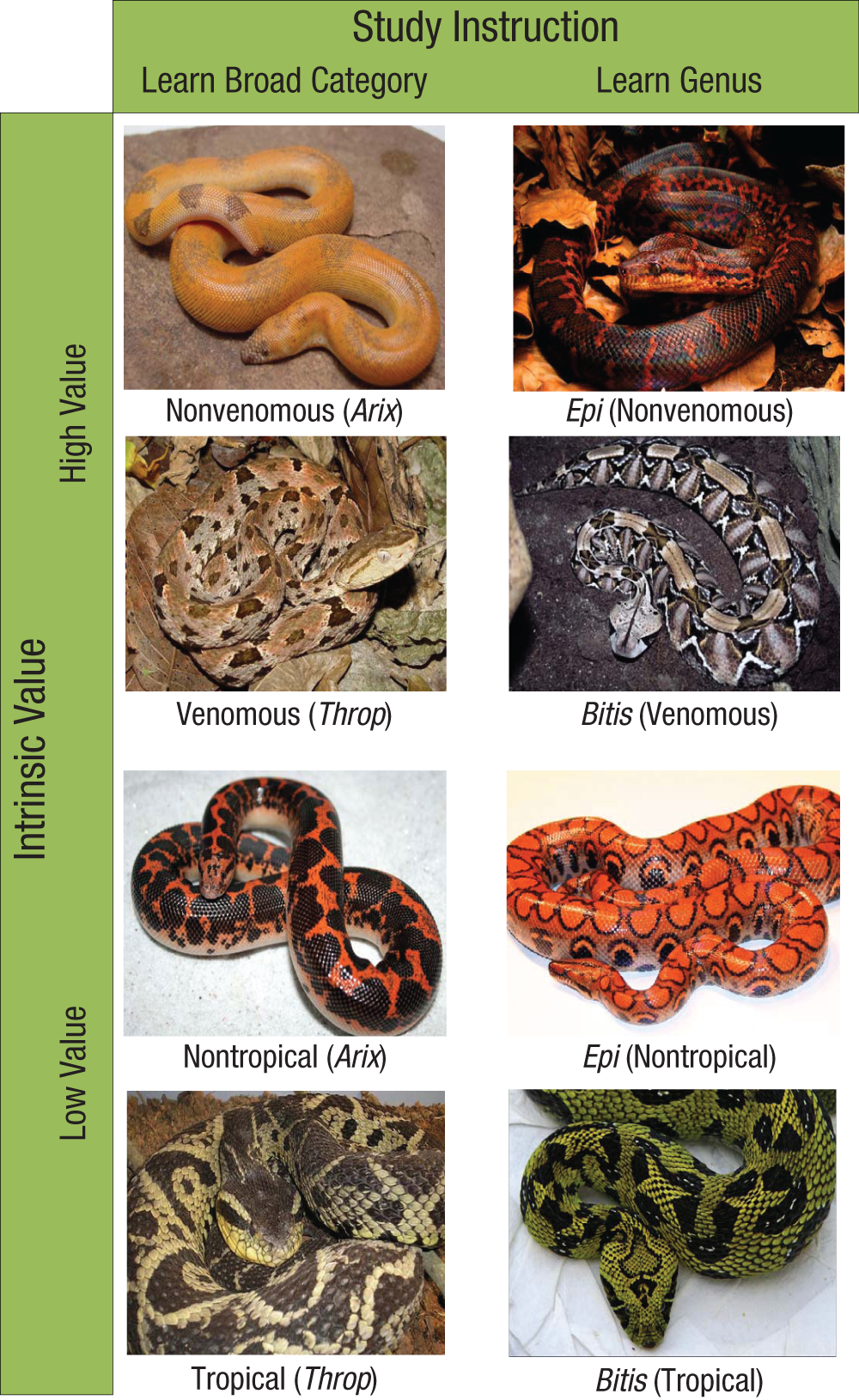
Examples of the snake stimuli, as they appeared on-screen. Participants were instructed to focus on either specific classification information (genus) or broad classification information (venomous or nonvenomous; tropical or nontropical) during the study phase. Intrinsic value of the broad categorization presented (high value: venomous/nonvenomous; low value: tropical/nontropical) was also manipulated between subjects.
Procedure
The experiment was presented using Collector (http://github.com/gikeymarcia/Collector), a PHP-based open-source experiment program and was administered over the Internet through Amazon Mechanical Turk.
Participants were informed that they would study pictures of snakes, each labeled with the snake’s specific genus and a broader categorization (either venomous/nonvenomous or tropical/nontropical). A given participant was asked to learn either the genera or the broader categorization of the snakes, for the purposes of classifying new snakes in terms of the learned categorization during a final test. The participants were then shown 60 images sequentially (10 blocks of six images, one per genus), at a rate of 5 s per image; both the order of the images within a block and the order of the blocks was randomized. Each image was presented centrally, with the specific and broad category labels directly below the image. When participants were instructed to focus on the specific genus, the genus name was on the left, with the broader category label on the right, in parentheses. This ordering was reversed when participants were told to focus on the broad category (see Fig. 1).
The final test phase consisted of two blocks of 24 images each. In one block, participants were asked to select the genus of each snake from a list of genus names, regardless of the categorization they had been asked to learn. In the other block, participants were asked to identify the broad category of each snake, again regardless of the categorization they had been asked to learn. The order of test blocks was counterbalanced across participants.
After the final test, participants responded to a series of questions regarding the experiment. These questions were used to assess any problems that may have occurred during the experiment, as well as to provide insight on individual differences and strategies. In addition, participants were asked to list any distinctions between venomous and nonvenomous snakes that they had known before the study phase, any snakes that they had been familiar with prior to the study, and any snakes they knew or recognized during the study. These questions allowed us to eliminate participants with prior knowledge about the snake classifications.
Results
We analyzed the data in two ways. Combining the data from the two samples, we conducted two-way between-subjects ANOVAs to examine the effects of study instruction and intrinsic value on test performance. We also conducted meta-analyses, treating the two samples as two separate experiments.
Combined-samples analyses
The results collapsed across the two experiments are presented in Figure 2. Across all conditions, average classification performance at test was significantly above chance, ps < .05. Thus, regardless of whether participants were instructed to learn the genera or the broader categorization, they were able to learn something about both levels of categorization.
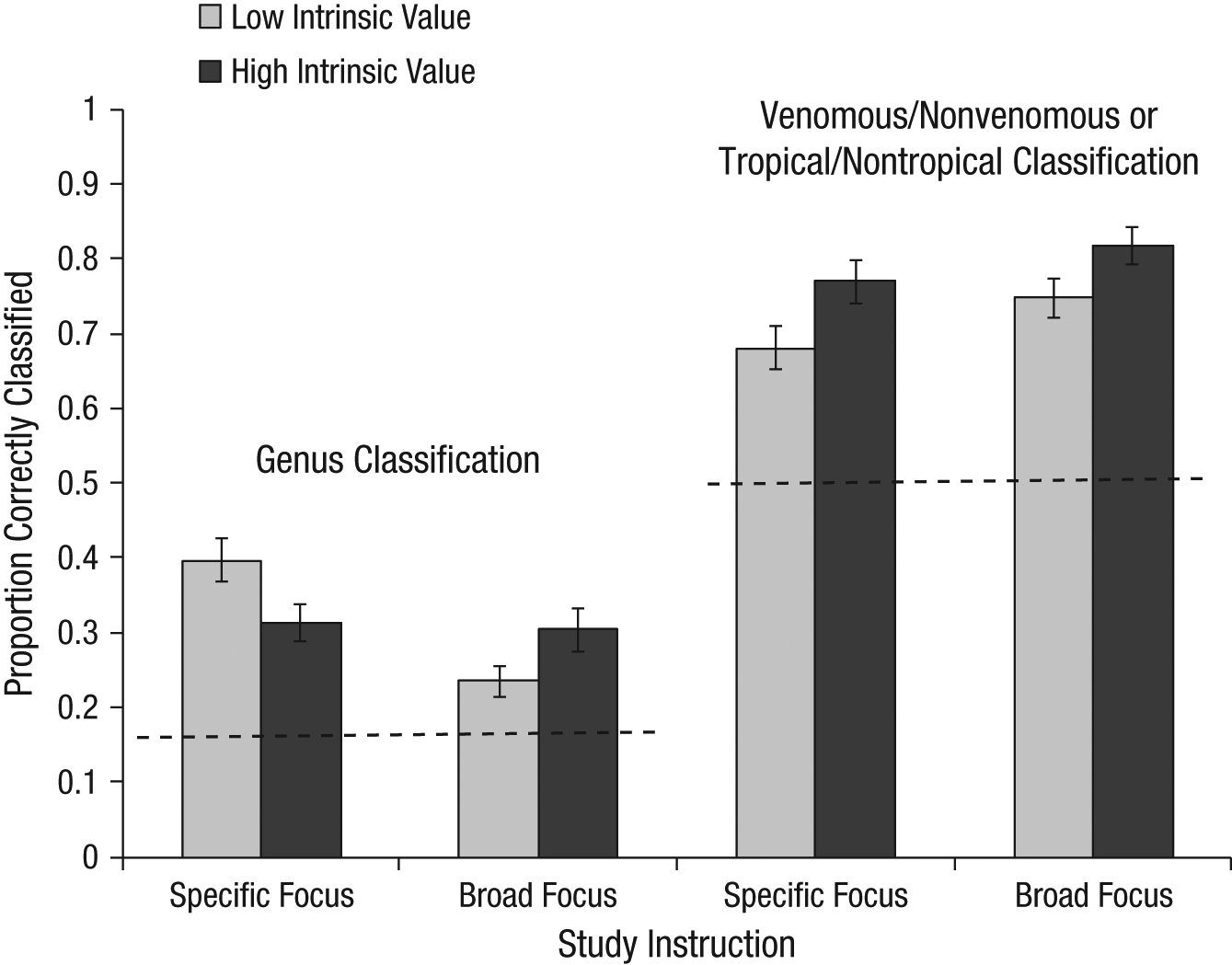
Combined results from the two samples: proportion correct at test as a function of study instruction (focus on broad vs. specific categorization) and intrinsic value of the broad categorization (high: venomous/nonvenomous; low: tropical/nontropical). Results are shown separately for tests of specific categorization (left) and broad categorization (right). The dashed lines represent chance performance (.17 for specific classification and .50 for broad classification). Error bars represent 95% confidence intervals.
Specific category (genus) classification
The proportion of new snake images correctly classified by genus during the test is shown at the left in Figure 2. Participants were overall better able to identify a snake’s genus when the study instruction told them to focus on the genus (M = .36, SD = .17) than when it told them to focus on the broader categorization (whether venomous/nonvenomous or tropical/nontropical; M = .27, SD = .17). A two-way Study Instruction × Intrinsic Value between-subjects ANOVA confirmed that there was a significant main effect of study instruction, F(1, 158) = 10.66, MSE = 0.03, p < .01, η p 2 = .06.
This main effect, however, was qualified by a significant interaction, F(1, 158) = 8.37, MSE = 0.03, p < .01, η p 2 = .05. When participants had been asked to focus on the genus, their ability to learn the genera was impaired when the broader labels were of high value (i.e., survival-relevant “venomous” and “nonvenomous” labels; M = .31, SD = .15) compared with when they were of low value (M = .40, SD = .19), t(76) = 2.17, p < .05, g = .48. When participants had been asked to focus on the broader categorization, however, specific genus classification was marginally better in the high-value condition (M = .30, SD = .19) than in the low-value condition (M = .24, SD = .14), t(82) = 1.91, p = .06, g = .41. There was no significant main effect of intrinsic value, F < 1.
Broad category classification
The right side of Figure 2 shows the proportion of new snake images correctly classified by broad category during the test. A two-way Study Instruction × Intrinsic Value between-subjects ANOVA showed two significant main effects: Participants were better able to identify the broad category when the labels were of high intrinsic value (M = .79, SD = .16) than when they were of low intrinsic value (M = .71, SD = .18), F(1, 158) = 8.67, MSE = 0.03, p < .01, η p 2 = .05, and they were also better able to identify the broad category when they had been told to focus on it (M = .78, SD = .17) than when they had not (M = .72, SD = .18), F(1, 158) = 4.59, MSE = 0.03, p < .05, η p 2 = .03. There was no significant interaction between study instruction and intrinsic value, F < 1.
Meta-analyses
We conducted meta-analyses using the Exploratory Software for Confidence Intervals (ESCI) software package (Cumming, 2011, 2014). The results are presented in Figure 3.
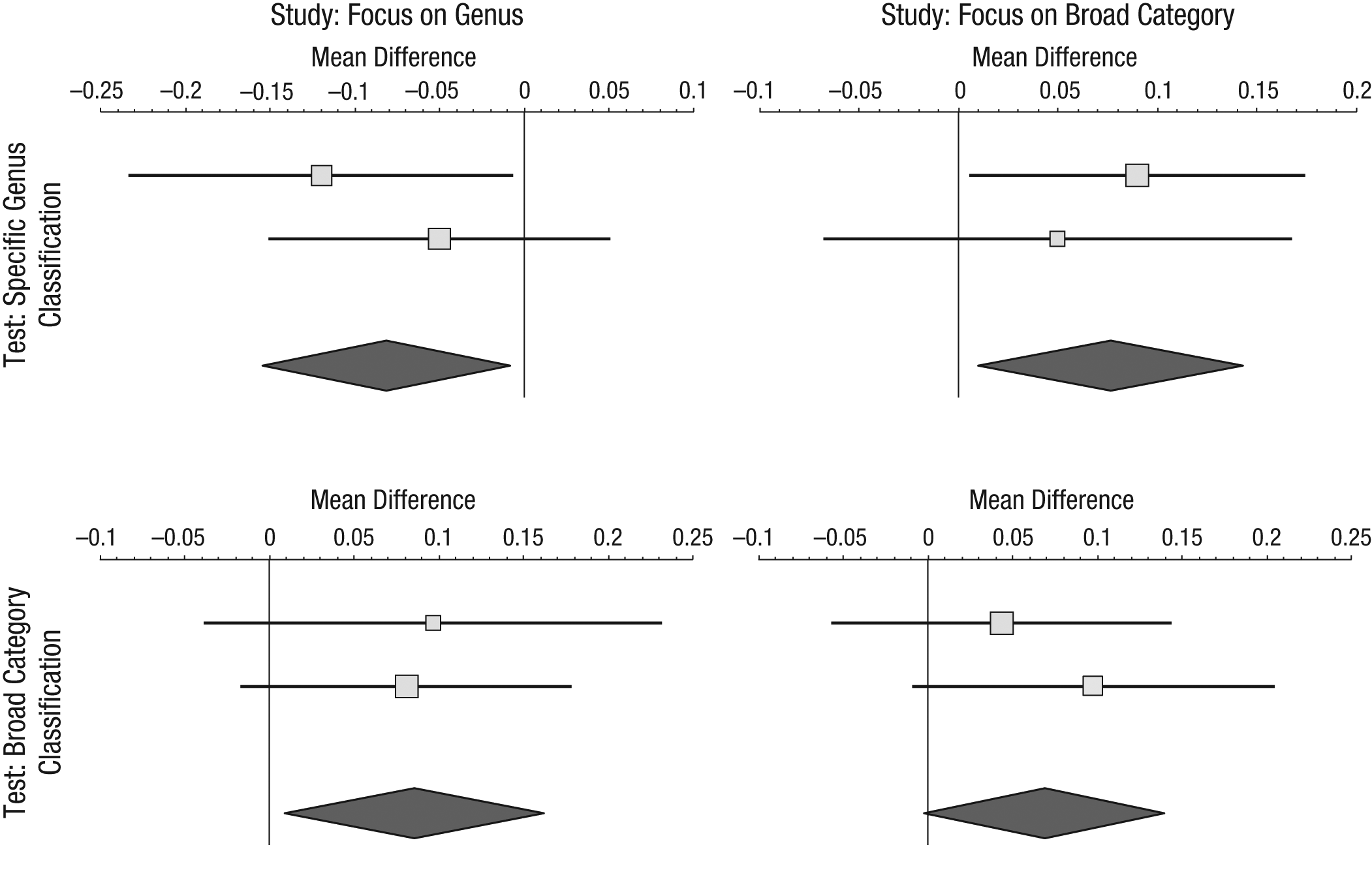
Results of the meta-analyses investigating the mean difference in test performance between the high- and low-value conditions in each of the four study-test combinations. In each graph, the two horizontal lines represent 95% confidence intervals for our first and second samples (n = 80 and n = 82, respectively). The squares represent the means, and their size represents the weighting of the samples in the meta-analysis. The diamond represents the summary statistic for the mean difference.
Specific category (genus) classification
When participants had been instructed to focus on learning the specific category (i.e., genus), they classified snakes according to their genera significantly better in the low-value condition (M = .40, SD = .18, 95% confidence interval, CI = [.29, .52]) than in the high-value condition (M = .31, SD = .14, 95% CI = [.26, .35]); averaged raw mean difference = −.081, 95% CI = [−.15, −.01], p = .03. In contrast, when participants had been instructed to focus on learning the broad categorization, they were significantly worse at classifying snakes according to their genera in the low-value condition (M = .23, SD = .13, 95% CI = [.19, .27]) than in the high-value condition (M = .31, SD = .18, 95% CI = [.25, .36]); averaged raw mean difference = .076, 95% CI = [.01, .14], p = .02. In other words, although participants who had been instructed to focus on the genera were better able to classify genera in the low-value condition than in the high-value condition, intrinsic value had a significant effect in the opposite direction when participants had been told to focus on the broad categorization.
Furthermore, heterogeneity of the effect sizes was not statistically significant in either the genus-focus instruction condition, Q(1) = .87, p = .35, I2 = 0.0%, or the broad-focus instruction condition, Q(1) = .31, p = .58, I2 = 0.0%. Thus, the observed effect did not differ significantly between the two samples.
Broad category classification
When participants had been told to focus on learning the snakes’ genera, participants in the high-value condition classified the snakes significantly better according to the broad category (M = .77, SD = .18, 95% CI = [.71, .82]) compared with participants in the low-value condition (M = .69, SD = .16, 95% CI = [.64, .74]); averaged raw mean difference = .09, 95% CI = [.01, .16], p = .03. Similarly, when participants had been told to focus on learning the broad categorization, those in the high-value condition classified the snakes correctly according to the broad categorization (M = .82, SD = .15, 95% CI = [.78, .87]) marginally more often than did those in the low-value condition (M = .75, SD = .17, 95% CI = [.70, .80]); averaged raw mean difference = .07, 95% CI = [−.002, .14], p = .058.
Again, there was no statistically significant heterogeneity in effect sizes in either the genus-focus instruction condition, Q(1) = .04, p = .85, I2 = 0.0%, or the broad-focus instruction condition, Q(1) = .56, p = .46, I2 = 0.0%.
Discussion
Overall, and not surprisingly, participants were better at learning a particular level of categorization when instructed to attend to that level. Of more interest is our finding that a survival-relevant categorization (venomous/nonvenomous) was learned more effectively than a survival-irrelevant categorization (tropical/nontropical), which is consistent with Nairne’s theory of survival processing (Nairne & Pandeirada, 2008), as well as with prior research on value effects in memory. Effects of the survival-relevant categorization, however, may also have been due to self-reference: From any individual’s perspective, it is more important to know whether or not snakes are venomous than whether or not they are tropical (Cunningham, Brady-Van den Bos, Gill, & Turk, 2013; Rogers, Kuiper, & Kirker, 1977; Symons & Johnson, 1997).
Moreover, when the genus labels had been central to the study task, the presence of the broad, high-value “venomous” and “nonvenomous” labels impaired subsequent classification by genus, as evidenced by the interaction between study instruction and intrinsic value of the broad categorization. This pattern of results suggests that the task-irrelevant labels referring to the presence or absence of venom captured attention and impeded learning of the genera, but any simple attention-allocation interpretation is challenged by the finding that participants learned the snake genera better if they had been focused on learning the venomous/nonvenomous distinction than if they had been focused on learning the tropical/nontropical distinction.
Why might the presence of “venomous” and “nonvenomous” labels have enhanced the learning of task-irrelevant and neutral-valued genus labels? One possibility is that the genus labels were bound to the highly arousing “venomous” and “nonvenomous” labels, but not to the neutral “tropical” and “nontropical” labels. According to Mather and Sutherland’s (2011) arousal-biased competition theory, for example, arousal enhances memory for items with the highest priority (e.g., snakes with venom) and reduces memory for those with lower priority. Although these dynamics often lead to a memory-narrowing effect, impairing memory for peripheral details, they can also lead to within-object binding, enhancing associative memory for features of high-priority items. If we consider the two labels given each image (i.e., genus and broad category) to constitute one object, then the genus labels may have been bound to the high-priority “venomous” and “nonvenomous” labels.
Specifically, in our design, given that both broad and specific categorical information were provided for each snake picture, high-priority labels indicating whether the snakes were venomous could have been bound to the specific genus labels, in effect overwriting the genus information so that a given memory trace included only whether or not the snake was venomous. When those participants who were instructed to learn the broad category labels were tested on the genera, they would have been unable to identify the specific genera, but would have known which three genera fell into each of the two broad categories. Because each broad category contained three snake genera, if these participants had bound genus labels to the broad category labels, “chance” performance would have been one correct classification out of three (i.e., guessing from the three venom-appropriate genus labels), rather than one out of six (i.e., the total number of genera studied). That they would have been guessing from among the three labels follows from the notion that what was encoded were the features that distinguished venomous from nonvenomous snakes, not the features that distinguished the three genera of venomous snakes from each other.
To examine whether this speculative binding hypothesis is plausible, we analyzed participants’ performance on the genus test relative to a chance level of .33. Results were consistent with the hypothesis. When participants had been asked to learn to categorize snakes as venomous or nonvenomous, their accuracy in identifying genera (.30) did not differ significantly different from .33, p > .05, whereas when participants had been asked to learn the tropical/nontropical distinction, their accuracy in identifying genera (.24) was significantly worse than .33, t(42) = 4.64, p < .001, g = .71. The reduced ability to identify genera after focusing on the tropical/nontropical distinction follows from the idea that the genus labels were not bound to the “tropical” and “nontropical” labels, so that participants could not eliminate as many genus labels as possibilities at the time of the test.
To further evaluate the binding hypothesis, we looked at the pattern of errors among participants who had been asked to learn to categorize snakes as venomous or nonvenomous (i.e., high-value condition, broad-focus instruction), calculating a goodness-of-fit chi-square to test the frequency of genus identification errors that fell within versus outside the correct broad (venomous or nonvenomous) category. We found that participants’ responses were not equally distributed across the broad categories; rather, incorrect responses were overwhelmingly within the correct broad category, χ2(1, N = 41) = 15.16, p < .001. This error analysis provides further support for the binding hypothesis.
Concluding Comments
To our knowledge, our study is the first to demonstrate the effects of value in a category-learning paradigm. Although previous research investigating value effects in learning has specifically investigated subsequent memory, our study advances this field by demonstrating that such value effects extend to categorizing nonstudied members of learned categories. Additionally, our study is novel in that it demonstrates that people can incidentally extract higher-order category information (e.g., venomous/nonvenomous) when studying lower-order category examples (e.g., different snake genera), and vice versa, in a task that has strong ecological validity and uses perceptually rich stimuli. Finally, our results suggest that an intrinsically valuable, survival-related feature (e.g., presence of venom) can affect category learning in a surprising way: competing with and impairing the intentional learning of other, non-survival-relevant information (e.g. snake genus), but enhancing the incidental learning of this same information. Given that most learning comprises a combination of intrinsic goals (e.g., personal preferences) and extrinsic goals (e.g., passing exams), these results illustrate the importance of understanding the ways in which competing and compatible extrinsic and intrinsic goals affect learning.
Footnotes
Acknowledgements
We thank James Fullmer, Sean Kang, Nate Kornell, Kou Murayama, Nicholas Soderstrom, Michael Friedman, Elizabeth Bjork, and members of the Castel Lab and Minifog for their contributions to this article. Portions of this research were presented at the 25th annual convention of the Association for Psychological Science, May 2013, Washington, D.C.
Declaration of Conflicting Interests
The authors declared that they had no conflicts of interest with respect to their authorship or the publication of this article.
Funding
This research was supported in part by Grant No. 29192G from the McDonnell Foundation and by Grant No. R01AG044335 from the National Institutes of Health.