







Abstract
There has been a push in recent years for students with disabilities to be educated alongside their typically developing peers, a practice called inclusion. In this study, we sought to determine whether peer effects operate within early-childhood special-education (ECSE) classrooms in which preschoolers with disabilities are educated alongside typical peers. Peer effects specific to language growth were assessed for 670 preschoolers (mean age = 52 months) in 83 ECSE classrooms; 55% of the children had disabilities. We found that the average language skills of classmates, as assessed in the fall of the year, significantly predicted children’s language skills in the spring (after controlling for their relative skill level in the fall); in addition, there was a significant interactive effect of disability status (i.e., the presence or absence of a disability) and peers’ language skills. Peer effects were the least consequential for children without disabilities whose classmates had relatively strong language skills, and the most consequential for children with disabilities whose classmates had relatively poor language skills.
Beginning in preschool, the majority of children spend about half of their waking hours in classroom settings, often surrounded by more than a dozen other children and potentially only one or two adults. Whereas numerous studies have focused on the potential effects of teachers on student outcomes, far fewer have focused on the potential effects of peer skills, referred to in the literature as peer effects. It is increasingly recognized that children and adolescents’ growth over an academic year is positively associated with the skill levels of their classmates (Hanushek, Kain, Markman, & Rivkin, 2001; Henry & Rickman, 2007; Mashburn, Justice, Downer, & Pianta, 2009), even outside of the influence of other potentially related school-, classroom-, and child-level factors (e.g., socioeconomic status, race). Indeed, the rare opportunity to test peer effects in an experimental framework, at a university in which freshmen were randomly assigned roommates, provided causally interpretable evidence that classmates’ skill levels (or roommates, in this case) affect one’s achievement in both negative and positive ways (Sacerdote, 2001).
A conclusion one can draw from the peer-effects literature is that it is beneficial for children to be surrounded by classmates who have relatively high levels of skills in key areas of achievement (Hanushek et al., 2001). Moreover, research suggests that this is particularly true for children who are less skilled than their classmates: Children with low skills in a given area seem to benefit the most from being surrounded by more-competent classmates (Justice, Petscher, Schatschneider, & Mashburn, 2011). In contrast, children who are themselves highly skilled tend to be less influenced by the skills of their classmates (Hanushek et al., 2001; Hanushek, Kain, Markman, & Rivkin, 2003; Henry & Rickman, 2007; Justice et al., 2011).
The peer-effects research has yet to consider the experiences of children with disabilities who are educated alongside typical children or, conversely, the experiences of typical children who are educated alongside children with disabilities. Today, more than 1 in 10 students in the public schools has an identified disability (U.S. Department of Education, National Center for Education Statistics, 2012), and federal legislation requires these students to be educated alongside their typically developing peers to the extent possible, in what is referred to as the least restrictive environment, or LRE (Individuals With Disabilities Education Act, 2004).
Operationalized, this requirement means that children with disabilities should be educated in the school and classroom that they would otherwise attend if they did not have a disability, alongside typically developing peers, a practice referred to as inclusion. The Individuals With Disabilities Education Act (2004) requires school districts to provide a free and appropriate education to all children with disabilities, even those ages 3 to 5 years. However, few states have universal preschool programs in which children with disabilities could be embedded to create inclusive environments. Therefore, many school districts create such environments in early-childhood special-education (ECSE) classrooms by offering slots for typically developing peers along with those for students with disabilities. Nationally, more than half of preschoolers with disabilities are enrolled in early-childhood classrooms with typically developing peers (U.S. Department of Education, National Center for Education Statistics, 2012).
One impetus for such inclusive programming is the hypothesis that children with disabilities will be positively affected by being educated alongside typically developing peers. This idea is in line with the empirical literature on peer effects (Baker, Kupersmidt, Voegler-Lee, Arnold, & Willoughby, 2010; Hanushek et al., 2001, 2003; Henry & Rickman, 2007; Justice et al., 2011; Mashburn et al., 2009). This programming is also informed by social learning theory (Bandura, 1971), which asserts that learning occurs in the process of social interactions, wherein children observe, imitate, internalize, and model the behaviors of more-competent peers. Experimental work involving preschool children has shown that when a “novice” child worked with an “expert” peer (as opposed to a same-ability peer) in a problem-solving task, the novice’s learning was significantly improved (Azmitia, 1988). Therefore, we theorized that children with disabilities should similarly benefit from the opportunity to observe, imitate, internalize, and model the behaviors of their peers who do not have disabilities and who thus may serve as experts.
In the present study, we elected to focus on children’s pragmatic language ability, which is the social aspect of language that children draw on when interacting with other people. This ability includes, for example, using language to make requests of other people and to engage in turn taking. It is well established that children’s language growth is affected by the characteristics of the speech to which they are exposed, such as the grammatical sophistication of teachers’ speech (Huttenlocher, Vasilyeva, Cymerman, & Levine, 2002). The primary aim of this study was to determine whether and to what extent peers’ skill level affects the language skills of students within inclusive early-childhood-education classrooms. Two research questions were addressed: First, to what extent are peer effects observed in inclusive ECSE classrooms? Second, if such peer effects do occur, are they observed for both children with disabilities and typically developing children?
Method
Participants
The present study involved 670 preschool-age children enrolled in 83 ECSE classrooms in multiple school districts in a single Midwestern state over the course of a single school year. At the start of the study, the sample included 769 children, but 12 students were deemed ineligible at study start (e.g., because they were not English speakers; remaining n = 757). Over the course of the study, 62 students withdrew or were excluded because they moved (n = 27), they stopped attending school (n = 15), their teacher withdrew from the study (n = 10), or their parents chose to withdraw them (n = 10; remaining n = 695). Four students did not have a reported IEP status and were excluded (remaining n = 691). An additional 21 students missed either the pretest or the posttest measure of language ability (final N = 670).
The children were participants in a study investigating the literacy practices of their teachers. Sample size was based on a power analysis for main effects of an intervention on outcomes unrelated to the current study. The 83 lead teachers in these classrooms had chosen to participate in the study. The majority were female (99%, n = 82) and White (94%, n = 78), and 3% were African American (n = 2), 3% were Native American (n = 2), and 1% were Asian (n = 1). The teachers had an average of 12 years’ teaching experience (SD = 9.2, range = 0–34 years), and most held a master’s degree (73.5%, n = 61).
All of the classrooms in which the children were enrolled served both children with disabilities and children without disabilities; the mean class size was about 13 children (SD = 4, range = 5–21). On average, the data used in this study represented about 8 children sampled from each classroom (range = 6–11); the variability in this number reflected the range in how many of the children’s caregivers provided informed consent. The response rate for caregiver consent averaged about 85% across classrooms. The data available represented approximately 61% of each classroom’s enrollment, which is more representative of classroom composition than in prior studies of peer effects in preschool settings, in which the data available represented between 25% and 45% of classroom enrollment (Henry & Rickman, 2007; Justice et al., 2011; Mashburn et al., 2009).
The children had an average age of 4 years 4 months (SD = 7 months, range = 33–68 months), and the majority of the children were boys (65%, n = 433). Most of the students were White (65%); 9% were African American, 4% were Latino, and 2% were Asian. The remaining 20% were of other races or their parents provided no data. The students primarily spoke English (84%; < 1% spoke Spanish; data were not available for 15%). Annual family income was $30,000 or less (22%), $30,001 to $60,000 (22%), $60,001 to $85,000 (17%), $85,001 or more (22%), or was not reported (17%). Within each income category, approximately half of the students had individualized education plans (IEPs), with one exception: The lowest income category was composed mainly of students with IEPs (73%). Demographic characteristics were initially included in each analysis but had no significant effects, so they were removed for the sake of parsimony.
About half of the children had an IEP (55.8%, n = 374), signaling the presence of a disability. The percentage of students with IEPs in each class varied; on average, about half of the children in each class had IEPs (M = 56%, SD = 15, range = 25%−100%). Children undergo a multifactorial evaluation to qualify for ECSE, and the majority qualify because of low performance on tests of language ability, cognition, or both. Some of the children did have known diagnoses: autism spectrum disorder (n = 37), language impairment (n = 23), cerebral palsy (n = 10), Down syndrome (n = 9), developmental delay (n = 9), attention-deficit/hyperactivity disorder (n = 5), or sensory integration disorder (n = 4). There was one instance of each of the following diagnoses among the children: amniotic band syndrome, epilepsy, fetal alcohol syndrome, fragile X syndrome, hearing loss, hydrocephalus, hypotonia, low muscle tone, Prader-Willi syndrome, seizure disorder, selective mutism, spina bifida, Stickler syndrome, traumatic brain injury, Tourette syndrome, tuberous sclerosis, Turner syndrome, and Williams syndrome.
As part of the larger project, a subset of children with IEPs (n = 282) were administered a battery of direct standardized language and cognition assessments in the fall. These assessments are distinct from the indirect assessment used to address the main aims of this study (see Measures). The average score on the Core Language Composite of the Comprehensive Evaluation of Language Fundamentals–Preschool (CELF: P-2; Wiig, Secord, & Semel, 2004) was 75.34 (SD = 18.11). The average score on the Matrices subtest of the Kaufman Brief Intelligence Test (Kaufman & Kaufman, 1985) was 81.49 (SD = 18.63, range = 53–124). These data indicate that the children with disabilities had mean language scores nearly 2 standard deviations below the normative mean and mean cognitive scores slightly more than 1 standard deviation below the normative mean.
Measures
Children’s language skills
All children’s language skills were measured in the fall and spring of the academic year using the Descriptive Pragmatics Profile (DPP) of the CELF: P-2 language battery (Wiig et al., 2004). The DPP is an indirect measure of language ability and was completed for each child by his or her classroom teacher. To complete the DPP, the teacher responded to 26 descriptions of specific language skills (e.g., “asks for help from others,” “introduces new conversation topics”). These skills covered three different areas: Nonverbal Communication; Conversational Routines and Skills; and Asking for, Giving, and Responding to Information. Rating were made on a 4-point scale (1 = never, 4 = always). The DPP has a reported internal consistency and test-retest reliability greater than .86 and has demonstrated convergent validity with several other direct assessments of language skills (Wiig et al., 2004). For the present purposes, a composite index was created by summing the scores for all 26 items on the DPP for the fall and spring. Given that direct assessments of language skills were administered to a subset of children in this study, as noted previously, we were able to examine concurrent relations between the Core Language Composite and the DPP of the CELF: P2 for this sample. The correlation between the two language assessments was .50 (p < .01), which suggests that the DPP is a valid measure of children’s language skills.
Peer effects
The primary research question addressed in this study concerned the extent to which peer effects might operate within ECSE classrooms. The specific focus was on the effects of classmates’ language skills on children’s language development over an academic year. The peer effect was conceptualized as the relation between peers’ skills and gains children made in the same skills during the school year. To estimate the peer effect, we first calculated the average level of language skill exhibited by all children within each classroom in the fall (M = 75.39, SD = 10.6), and then used peer skill to predict children’s language development. Thus peer skill is a classroom-level (rather than child-level) construct. This approach is consistent with that used in several prior studies that examined peer effects in preschool settings (e.g., Justice et al., 2011).
This study examined whether peer effects were dependent on a child’s disability status, a child’s language skills relative to the other children within the classroom, or both. Disability status was determined on the basis of whether the child had an IEP. Relative skill status was calculated by subtracting a child’s fall language score from the respective classroom mean language score at that same time point (similar to the method described by Justice et al., 2011). We elected to use a measure of relative status rather than achievement status (i.e., absolute skill level) because a child with a DPP score of 85 in a classroom with a mean score of 50 should be considered differently than a child with a DPP score of 85 in a classroom with a mean score of 98. The child would be considered an expert or more-capable peer in the first classroom, but not in the second. It is important to note that the children’s relative status was highly correlated with their absolute skill level (i.e., language ability at the fall time point), r2 = .80, p < .01, which suggests that our models including relative status can be viewed as controlling (at least in part) for the child’s initial language score.
Results
On average, the children’s DPP scores were 75.85 (SD = 17.60) in the fall and 83.41 (SD = 17.06) in the spring, which corresponds to a gain of 7.55 points (SD = 11.80; d = 0.63) over the year. The DPP test manual provides criterion-based cutoff points against which to interpret children’s raw scores (Wiig et al., 2004). On average, 65% of the children met criterion cutoff points in the fall. This percentage differed as a function of IEP status (85% of the children without IEPs and 50% of the children with IEPs met the DPP criterion cutoff point in the fall). A comparison of DPP scores at each time point (see means for each group in Table 1) indicated that children with IEPs had significantly lower scores in both the fall, t(668) = 13.60, d = 1.08, and the spring, t(668) = 13.84, d = 1.13.
Children’s Language Scores in the Fall and Spring and Effect Size (d) of Gains From Fall to Spring for Children With and Without Individualized Education Plans (IEPs)
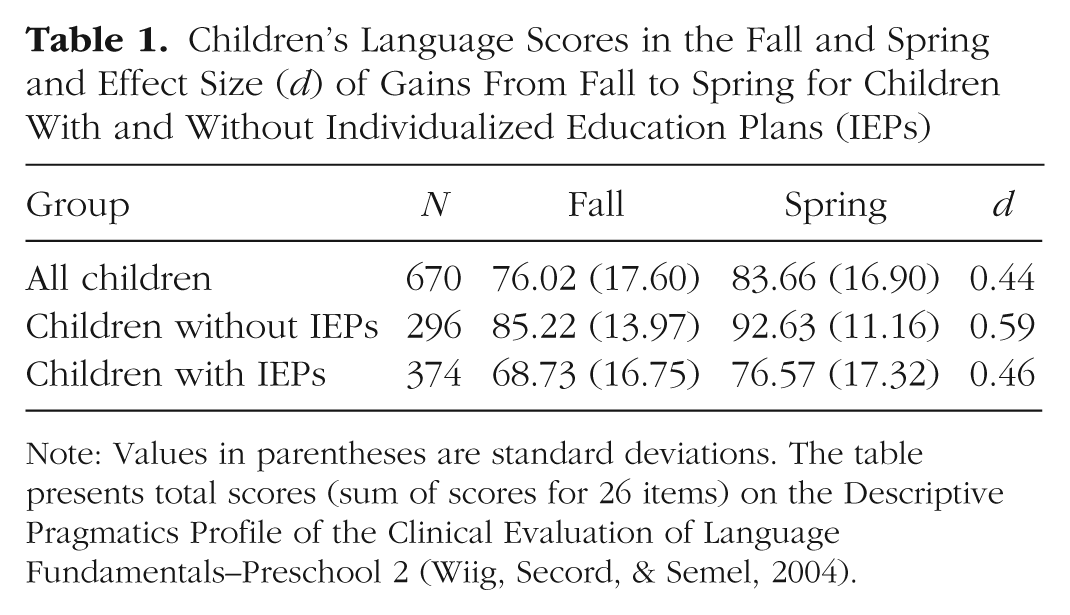
Note: Values in parentheses are standard deviations. The table presents total scores (sum of scores for 26 items) on the Descriptive Pragmatics Profile of the Clinical Evaluation of Language Fundamentals–Preschool 2 (Wiig, Secord, & Semel, 2004).
The data represented, on average, 8 children within each of the classrooms, which resulted in a nested data structure. To account for the nested structure, we used multilevel modeling via the mixed procedure of SAS software (Version 9.3). To answer the first research question, about whether peer effects occurred in ECSE classrooms, we created a model that predicted children’s spring language skills from their peers’ language skills in the fall and children’s relative skill status within their classroom. Results showed that the average spring language score (i.e., for a child with average language scores in an average classroom) was 82.89 (see Table 2, Model 1).
Results of the Multilevel-Effects Models
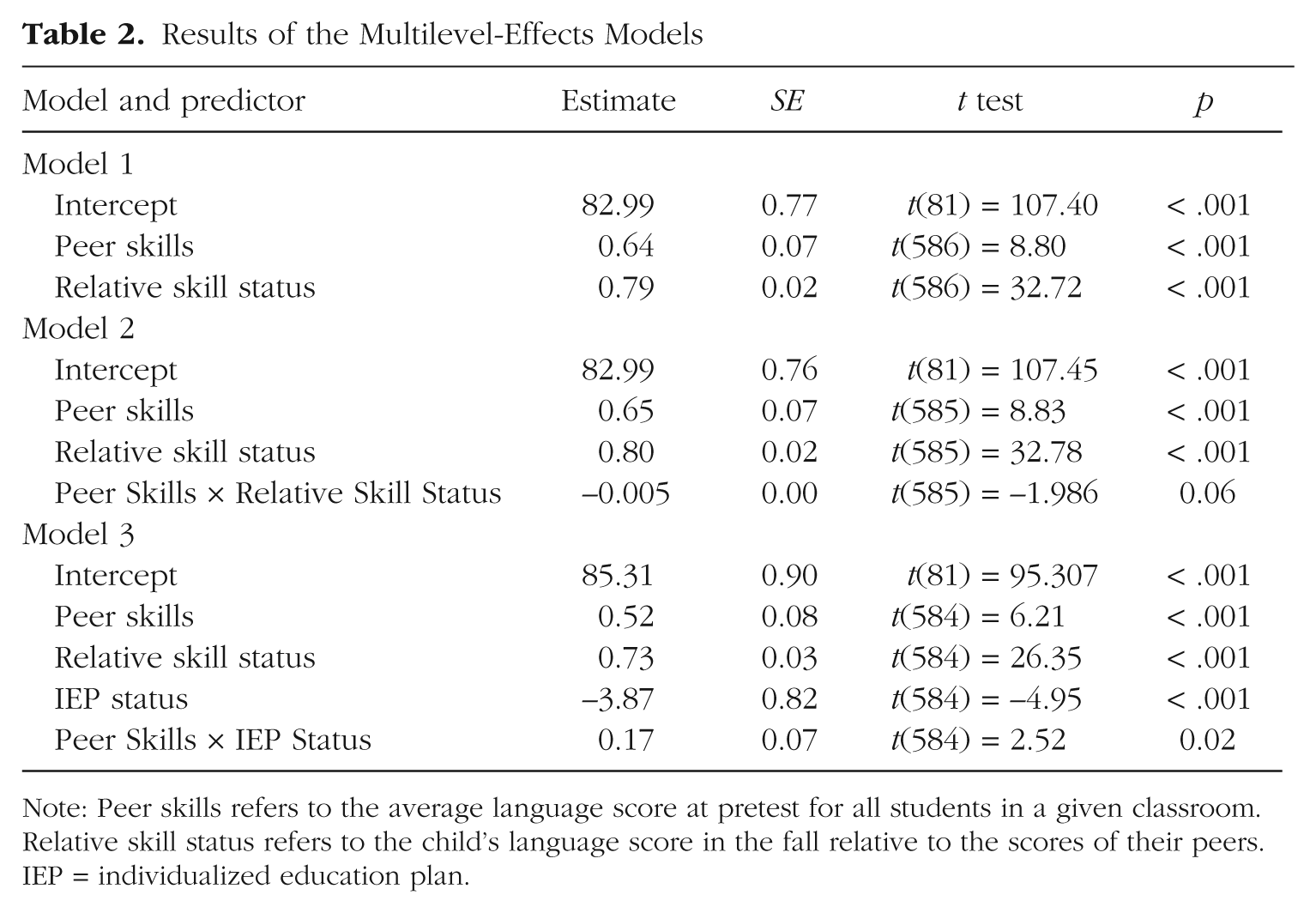
Note: Peer skills refers to the average language score at pretest for all students in a given classroom. Relative skill status refers to the child’s language score in the fall relative to the scores of their peers. IEP = individualized education plan.
Peers’ skills strongly predicted children’s spring language scores (coefficient = 0.64, p < .001) after controlling for relative skill status in the fall (coefficient = 0.79, p < .001). Thus, results confirmed that peer effects are found in ECSE settings; children’s spring language scores were significantly related to the language skills of their classmates (Table 2, Model 1). 1
We further examined whether the relation between peer language skill and spring language skill was moderated by a child’s relative skill status (Table 2, Model 2). Relative skill status was a marginally significant moderator of this relation (coefficient = −0.005, p = .057), which suggests that peer effects may be more important for children of lower relative skill status. Figure 1 graphically represents how the interplay between peer skills and a student’s relative skill status predicted language gains. To illustrate the moderation, we plotted the predicted spring scores for students with high relative skill status (i.e., students who scored 2 SD above their classroom mean), average relative skill status (i.e., students who performed at the average level of the classroom), and low relative skill status (i.e., students who scored 2 SD below their classroom mean) at the average peer skill level and at 1-SD intervals around the average peer skill level (Fig. 1). The slopes of the three graphed lines in Figure 1 are all significantly different from zero, and the slope for students with low relative skill status is larger than that for students with high relative skill status (coefficients = 0.50, p < .001; 0.64, p < .001; and 0.78, p < .001, for students with high, average, and low relative skill status, respectively). In addition, the gap between the predicted spring scores of children with high and low relative skill status was larger for children whose peers had low skill levels in the fall than for children whose peers were highly skilled in the fall. As shown in Figure 1, this gap was 39.20 points for children whose peers’ fall skill level was 1 SD below the mean (mean classroom score of 65) and 33.60 points for children whose peers’ fall skill level was 1 SD above the mean predicted spring scores (mean classroom score of 85).
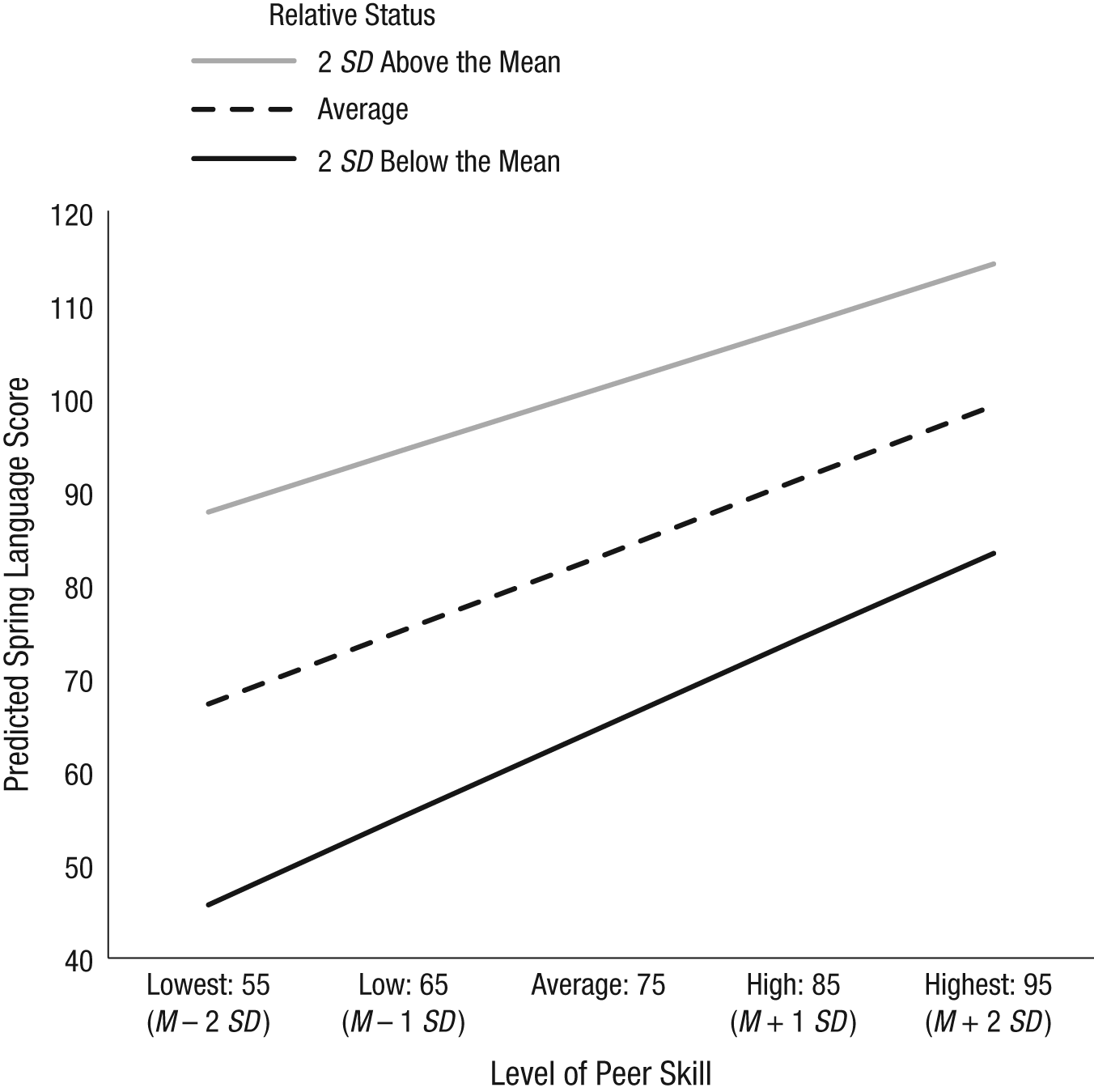
Predicted spring language score as a function of the average level of language skill exhibited by children within each classroom in the fall (i.e., the peer effect) at three levels of relative skill status.
To address the second research question, we tested whether peer effects differed according to whether a child had a disability (i.e., whether the child had an IEP; Table 2, Model 3). Results showed that the predicted spring language score was 85.32 for a child with no IEP, with average language skills, and in an average classroom. The predicted spring language score was significantly lower for a child with an IEP (3.87 points lower, p < .001). Test statistics showed that peer effects were significant even after controlling for disability status (coefficient = 0.52, p < .001) and that the effect of peers’ skill level depended on disability status (coefficient = 0.18, p = .01).
Figure 2 demonstrates the interplay between peer effects and disability status. The significant interaction means that the slopes of the two lines in the figure are significantly different from one another. Peer effects were stronger for children with IEPs than for children without IEPs. For example, among children whose classmates had relatively low language skills (mean classroom language score of 65), the difference between the predicted spring language scores of children with and without IEPs was large, mean difference = 5.86, t(584) = 5.15, p < .001. This difference was much smaller for children whose classmates had relatively high language skills (mean classroom score of 85), mean difference = 2.35, t(584) = 2.30, p = .02. The results indicate that among children whose classmates have relatively low language skills, children with disabilities are more likely to be influenced by the skills of their peers than are those children without disabilities.
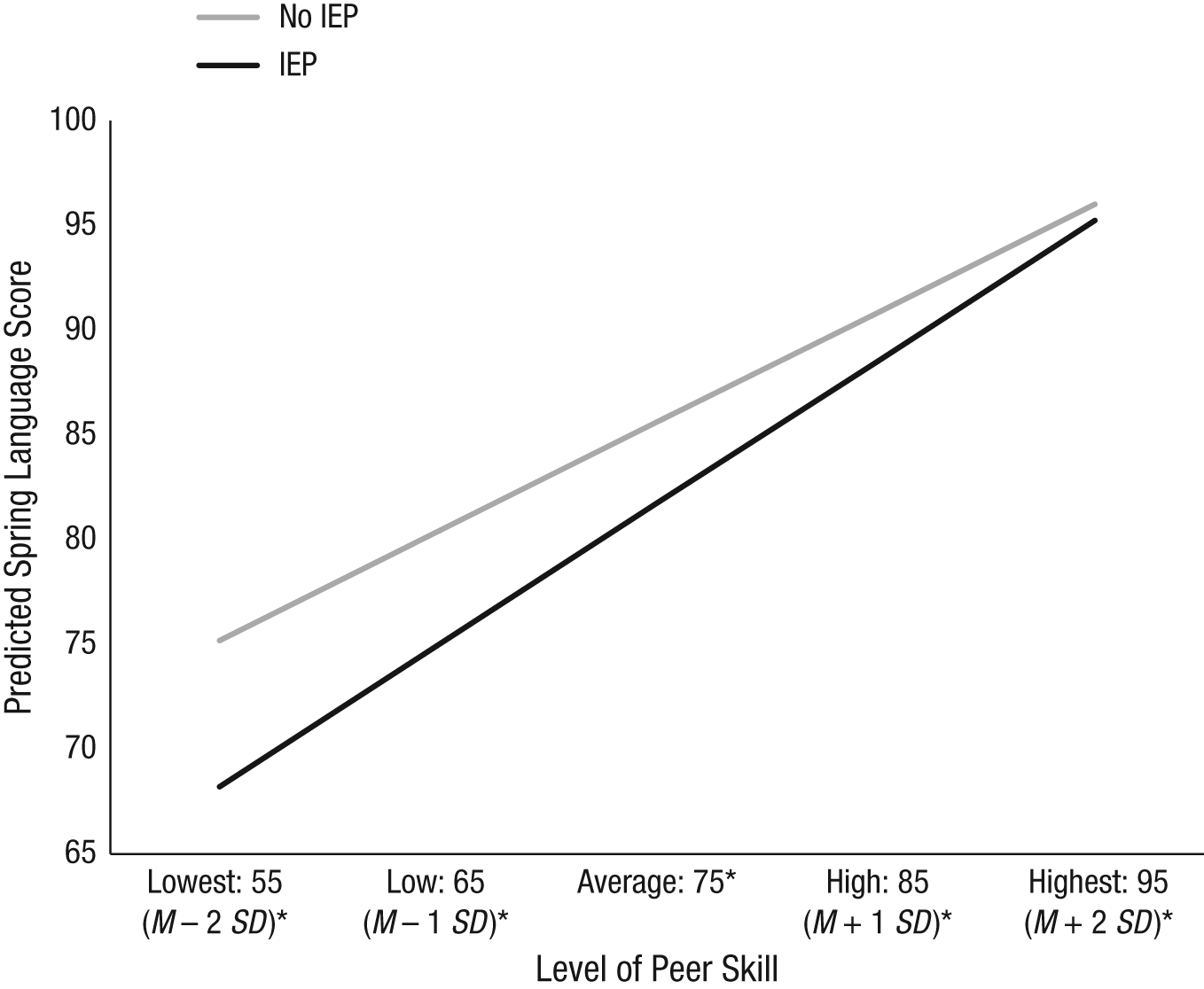
Predicted spring language score as a function of the average level of language skill exhibited by children within each classroom in the fall (i.e., the peer effect) for children with and without individualized education plans (IEP). Asterisks indicate that the difference in spring language scores between children with an IEP and children without an IEP is significantly different from zero (p < .05).
General Discussion
This study examined whether peer effects may be found within early-childhood-education classrooms that serve children with disabilities alongside typically developing peers. Although there is great philosophical appeal in educating young children with and without disabilities together in a common setting, the potential benefits of these classroom arrangements for children’s development has received limited empirical attention. In an initial effort to determine whether peer effects may be found in these settings, we examined children’s pragmatic language skills in the spring as a function of classmates’ abilities. In addition, we compared results for children with and without disabilities.
Our observation of peer effects within early-education settings is consistent with social-learning theory (Bandura, 1971), which posits that interactions with other people are an important mechanism for children’s development. Within the preschool-classroom context, children have many opportunities to interact with one another, perhaps even more so than children in the later grades, who spend less time in play and more time receiving teacher-led instruction. As young children play together, they may have the opportunity to develop such language skills as taking turns in conversation, communicating their needs and wants, and producing narratives. From a social-learning perspective, children who are novices (i.e., less skilled than most of their classmates) may particularly benefit from opportunities to interact with (and thus model or imitate) experts (Azmitia, 1988). However, the examination of peer effects is important for reasons that extend well beyond theory. For instance, the extent to which peer effects can be found in ECSE settings may have implications for caregivers’ decisions about whether to enroll a child in classroom settings that serve children with and without disabilities, and policymakers’ decisions on whether to use, or advocate for, inclusive models of preschool education.
Our results show that children’s peers do matter within ECSE classrooms: Preschoolers in classrooms of children with higher language skills tended to have better language scores in the spring than preschoolers in classrooms of children with lower skills. Of additional note is that among children who entered preschool with poor language skills in the fall, those surrounded by peers with better skills tended to make greater gains. In fact, peer effects were the least consequential for children without disabilities whose classmates had relatively strong language skills, and the most consequential for children with disabilities whose classmates had relatively poor language skills. As Figure 1 illustrates, peers matter for children whether their relative skill status is low or high: Children who had relatively high status but low-language-skill peers and children who had relatively low status but high-language-skill peers had comparable spring scores. These findings closely resemble results from prior research in general preschool programs (Henry & Rickman, 2007; Justice et al., 2011; Mashburn et al., 2009) as well as primary (Hanushek et al., 2003) and secondary and postsecondary education settings (Sacerdote, 2001). These studies consistently found that children’s growth in various dimensions of achievement is affected by the skills of their classmates (or roommates), that these peer effects tend to be positive, and that these effects are largest among the least-skilled children. Our findings suggest that these findings hold for ECSE settings.
Our work is the first study of peer effects in classrooms that serve children with disabilities, and one exciting contribution is our focus on peer effects among children both with and without disabilities. One important and untested idea behind inclusive programming is that being educated alongside typically developing peers will have a positive impact on children with disabilities. We found that children with disabilities were more strongly influenced by their classmates’ language skills than were children without disabilities. Peer effects were particularly strong for children whose classmates had limited language skills: In the classrooms with the lowest fall language scores, children with disabilities scored nearly 10 points lower than typically developing children in the spring (see Figure 2).
Previous research suggests that children with disabilities require exposure to more frequent and varied linguistic input to hasten their language growth, compared with children without disabilities (Bavin, Wilson, Maruff, & Sleeman, 2005). Typical peers may provide more and more varied input than preschool teachers, who provide relatively little direct language stimulation to students (Justice, Mashburn, Hamre, & Pianta, 2008). This may help to explain why, among children surrounded by highly skilled peers (highest peers; mean classroom score = 95), children with disabilities had spring language skills comparable with those of children without disabilities (see Fig. 2).
Given the potentially important implications of this work, we must point out several limitations of our study design. First, the measure of children’s language ability relied on a teacher-report instrument and focused largely on the domain of pragmatics. We acknowledge that indirect assessments may provide a less precise measure of children’s skills than direct assessments, and we encourage replications of this study using direct measures of children’s skills as well as measures that expand beyond our focus on pragmatics. Second, peer effects were estimated for only one dimension of children’s development. During the preschool years, many significant areas of development, including social competence and self-regulatory processes, are likely to be affected by schooling experiences. Whether the significant effects of peers may generalize to such areas of development requires future investigations. Third, this study relied on a correlational design (as has much of the work on peer effects), which means that unknown variables may have driven the observed effects. There is a great need for experimental work that systematically examines the causal impacts of classmates on children’s learning and development (e.g., Sacerdote, 2001).
In conclusion, the results of this work imply that caregivers, educators, and program administrators should carefully consider classroom composition when designing ECSE programming. We infer from our results that administrators of ECSE programs should strive to have a reasonable balance of highly skilled and less skilled children within a given classroom. We further speculate that classroom configurations in which the majority of children exhibit relatively poor language skills are not desirable, whether participants are primarily children with disabilities or a mix of children with and without disabilities. Finally, we must note that the language skills of children with disabilities appear to benefit tremendously from exposure to typically developing peers, who also tend to have stronger language skills in the spring of the school year than they did in the fall; our findings appear to support, at least tentatively, the use of inclusive practices in early childhood in order to benefit the language development of children with disabilities.
Footnotes
Declaration of Conflicting Interests
The authors declared that they had no conflicts of interest with respect to their authorship or the publication of this article.
Funding
This work was supported by Institute of Education Sciences Grant R324A080037.