






Abstract

We are thankful to Levine and Bond (2014) for engaging in a much-needed discussion about the accuracy of human lie detection. As we understand their Commentary, they make two primary, and related, arguments. Their first argument is that the significant difference that we reported (ten Brinke, Stimson, & Carney, 2014) between conscious, direct and unconscious, indirect truth/lie discrimination was due to poor performance on our measure of direct accuracy rather than high performance on our indirect measures. Their second argument is that our indirect measures yielded an effect size for truth/lie discrimination that was not significantly greater than the effect sizes Bond and DePaulo (2006) obtained for direct accuracy measures in their meta-analysis.
We believe that these arguments stem from the assumption that meta-analytic results—collapsed over many varied studies—are directly comparable with results from single studies. By our commentators’ own admission, it is evident that deception-detection accuracy can vary widely across stimuli; therefore, it seems to us that the only way to fairly compare implicit and explicit accuracy is to do so in the context of a within-subjects design (i.e., using the same sample of stimuli and observers, which we did in our original studies). We articulated this hypothesis in our original paper: “As suggested by the variability in accuracy reported by Bond and DePaulo (2006), new stimuli may lead to more or less accurate explicit responses than reported here; regardless, we expect that implicit measures would always outperform explicit judgments of deception [of the same stimuli], because the unconscious mind identifies and processes cues to deception (to the extent that they are available) more efficiently and effectively than the conscious mind” (p. 1104). Whether this statement will bear out remains to be seen; further research is required. Illustrations of our recent findings, those of Bond and DePaulo’s (2006) meta-analysis, and our predictions for future direct-comparison studies can be found in Figure 1.
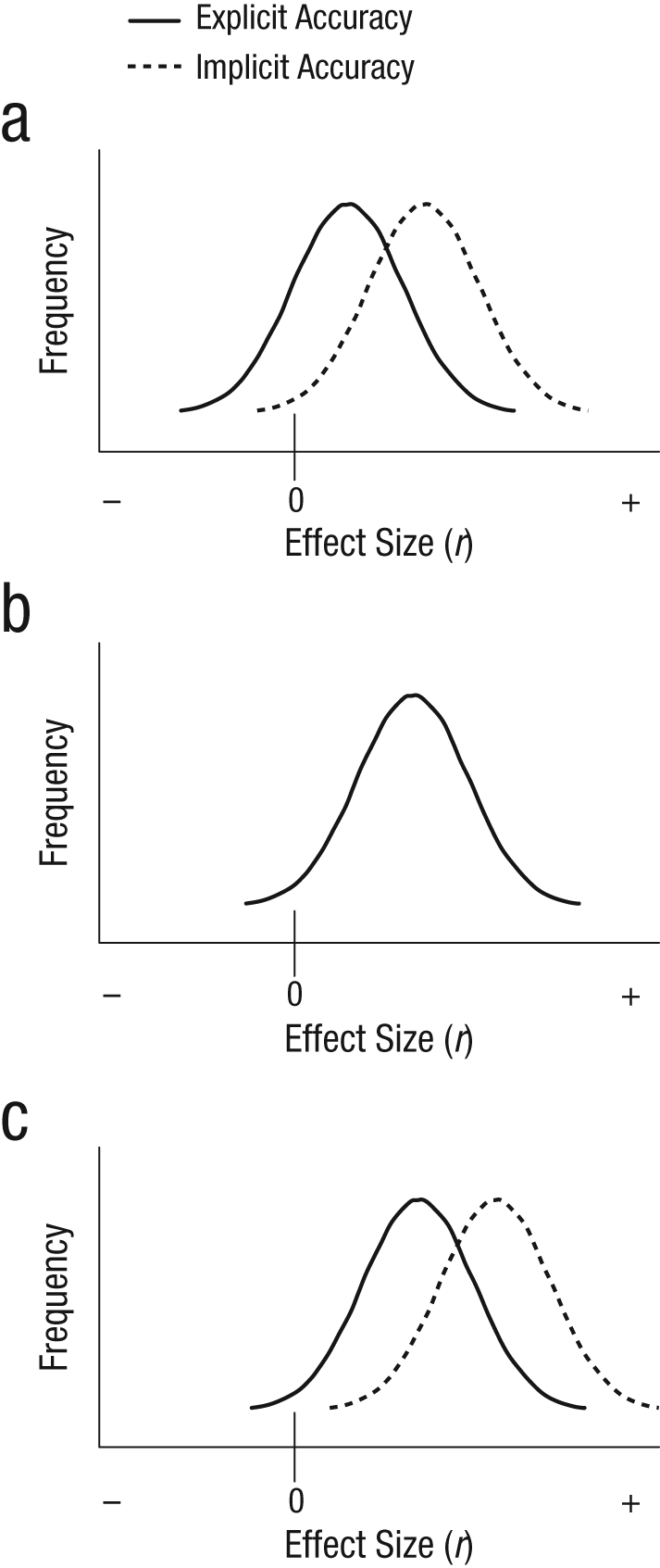
Observed and projected effect-size distributions. We reported (ten Brinke, Stimson, & Carney, 2014) that the effect size (r) for implicit accuracy was significantly greater than that for explicit accuracy for the same stimuli (a). In their meta-analysis, Bond and DePaulo (2006) reported better-than-chance accuracy in explicit lie-detection tasks (b). Their data set included a total of 24,483 judgments of 6,651 genuine or deceptive messages. No implicit-accuracy data for the same set of stimuli exist. However, we propose that if implicit judgments had been gathered in each study included in Bond and DePaulo’s (2006) meta-analysis, implicit accuracy would have outperformed explicit accuracy (c).
We agree that the effect sizes of our indirect measures are small by conventional standards, albeit significantly greater than those for direct measures (using the same target stimuli of liars and truth tellers; Cohen, 1992). That said, we also believe that our results build on important and independent discoveries by Albrechtsen, Meissner, and Susa (2009) and Reinhard, Greifeneder, and Scharmach (2013), who reported that interruptions of conscious thought about veracity decisions lead to substantial increases in lie-detection accuracy.
As in our original article, we call upon other researchers to replicate our experiments—directly and conceptually—with the hope that many within-subjects studies can be subjected to a future meta-analysis. To facilitate such replications, we have made all of our data, stimuli, and methods freely available to any researcher (http://www.leannetenbrinke.com/publications.html, http://faculty.haas.berkeley.edu/dana_carney/vita.html). Such a meta-analytic review might illustrate that although (implicit and explicit) accuracy rates vary in replication studies using different stimuli, the relationship between implicit and explicit accuracies remains constant, with implicit accuracy always being greater than explicit accuracy. Or perhaps not. Regardless of the outcome, we hope that our work and our call for replication will allow for the direct testing of Levine and Bond’s (2014) important observation in the not-too-distant future.
Footnotes
Declaration of Conflicting Interests
The authors declared that they had no conflicts of interest with respect to their authorship or the publication of this article.
Funding
This work was supported by Social Sciences and Humanities Research Council of Canada Grant 756-2012-0096.