






Abstract
Trust is a critical aspect of social interaction. One might predict that individuals trust religious out-groups less than religious in-groups, and that costly signals performed by members of religious in-groups increase trust while costly signals performed by members of religious out-groups decrease trust. We examined how Christian participants perceived the trustworthiness of Muslim and Christian individuals who did or did not engage in religious costly signaling. Religious costly signaling, operationalized as giving to religious charities (Experiments 1 and 2) or adhering to religious dietary restrictions (Experiment 3), increased self-reported trust, regardless of target religious affiliation. Furthermore, when estimating the likelihood that trustworthy versus untrustworthy targets engaged in costly signaling, participants made systematic judgments that showed that costly signaling is associated with trust for both Muslim and Christian targets (Experiment 4). These results are novel in their suggestion that costly signals of religious commitment can increase trust both within and, crucially, across religious-group lines.
People rate trust as one of the most valued characteristics in relationships (Cottrell, Neuberg, & Li, 2007). However, trust may be difficult to assess and cultivate in culturally pluralistic societies. Cultures involve norms that, when adhered to, sustain trust—or when violated, undermine trust. Yet the very practices that promote trust in one culture might seem untrustworthy in others (Saunders, Skinner, Dietz, Gillespie, & Lewicki, 2010).
There has been little psychological research on cultural variables that affect trust (but see Yuki, Maddux, Brewer, & Takemura, 2005), and even less is known about religion and trust. Here, we focused on two aspects of religion that may affect trust: in-group/out-group boundaries and costly signaling. First, religion is a powerful source of in-group and out-group identities, acting as a subjectively important identity for many people (Cohen, 2009). Because people robustly prefer their in-groups to out-groups (Tajfel & Turner, 1979), individuals may trust members of in-group religions more than members of out-group religions (Daniels & von der Ruhr, 2010; Johansson-Stenman, Mahmud, & Martinsson, 2009).
A second religious factor that might influence trust is costly signaling (Sosis, 2005)—behavior that is costly to perform and is understood to communicate commitment to one’s in-group. Religion often involves costly signals such as elaborate rituals, charity, and dietary restrictions, and such signals have been linked to increased cooperation and trust among members of religious groups (Sosis & Alcorta, 2003). Thus, religious costly signaling by an in-group member should increase trust.
An important question that remains, however, is whether costly signaling by members of religious out-groups increases or decreases trust. Religious out-group members who engage in costly signaling could be perceived as untrustworthy because their behavior demonstrates commitment to an out-group. Complex and esoteric rituals, which may demonstrate trustworthiness to coreligionists, might appear strange or potentially threatening to out-group members (Saroglou, 2011). In contrast, out-group members who engage in costly signaling could be perceived as having good character and being more generally trustworthy.
Another unknown is whether the relation between religious costly signaling and trust depends on the form of costly signaling. Do different types of religious costly signals affect trust similarly, or are some more effective than others? For instance, Sosis (2003) hypothesized that signals that can be rationalized by ulterior motives are less likely to be effective at signaling commitment than signals that cannot be otherwise rationalized. Might charity particularly promote trust, because it is a prosocial behavior? Or might religiously specific and complex practices, such as adherence to dietary restrictions, more effectively promote trust than other forms of religious costly signaling?
Current Experiments
Across four experiments, we examined whether religious costly signaling increases trust and, if it does, whether this effect is moderated by a target’s religious in-group or out-group status. Experiments 1 through 3 investigated Christians’ evaluations of the trustworthiness of in-group (Christian) versus out-group (Muslim) targets who engaged in two forms of costly signaling (charity and dietary restrictions). Experiment 4 used an indirect measure to examine the relation between religious costly signaling and trust.
We focused on Muslims as our religious out-group—rather than atheists, who are perceived as particularly untrustworthy (Gervais, Shariff, & Norenzayan, 2011)—because our experimental design required an out-group that could engage in religious costly signaling. Because of the common prejudice against Muslims in the United States and Europe (Raiya, Pargament, Mahoney, & Trevino, 2008; Strabac & Listhaug, 2008), it seemed plausible that Christians would trust Muslims less than other Christians and that Muslims’ religious costly signaling could influence Christians’ trust.
We predicted that Christian participants would trust Muslim targets less than Christian targets and that religious costly signaling by Christian targets would increase their perceived trustworthiness. We had competing hypotheses regarding how religious costly signaling by Muslims would affect trust. One hypothesis is that costly behaviors signal a parochial commitment to one’s in-group. Thus, an out-group target who engages in religious costly signaling might be trusted less than an out-group target who does not engage in such signaling. A competing hypothesis is that prosocial costly behaviors, in particular, signal a broader prosocial character, so prosocial costly signaling should increase trust, regardless of a target’s in-group or out-group status. A third possibility is that it is the cost to the self that is important, so costly signaling should increase trust, regardless of its form or an individual’s group identity.
Pilot Study
We first sought to empirically confirm the appropriateness of Muslims as the out-group in this research, using a sample drawn from the same population studied in our focal experiments. One hundred eighty-eight Christian undergraduates (87 Catholic or Greek Orthodox, 101 non-Catholic Christian; 85 male, 103 female) participated in a pilot study as part of a mass testing session. Participants indicated the extent to which they viewed a range of social groups—including Muslims, Hindus, Buddhists, Catholics, and non-Catholic Christians—to be in-groups or out-groups. These religious affiliations were part of a total of 26 group affiliations (professions, university affiliations, ethnicities, religions, age groups) to obscure the focus on religion. The instructions were “In-group and out-group identities are very important in psychology. In-groups are the groups we belong to and identify with, and derive self esteem from. Out-groups are other groups, that often do not share our values, and that we often compete with. But psychologists are not sure which groups people usually consider to be in-groups or out-groups, when it comes to ethnicities, religions, age groups, professions, etc. Please rate each of the following groups as an in-group, out-group, or not sure.”
Responses were measured on a 4-point scale (ranging from 1, definitely an in-group, to 4, definitely an out-group). Among the various religious groups, Muslims received the highest rating of being an out-group (M = 3.12, SD = 0.90, 95% confidence interval, or CI = [2.99, 3.26]; Table 1). Within-subjects analyses confirmed that the degree to which the religious groups were seen as out-groups varied significantly, F(5, 176) = 77.06, p < .001, η p 2 = .69. Muslims were rated as significantly more of an out-group than each of the other religious groups; there was a small but significant difference between Muslims and Hindus (p = .006) and larger differences between Muslims and all other groups (ps < .001).
Ratings of Religious Groups as In-Groups or Out-Groups in the Pilot Study
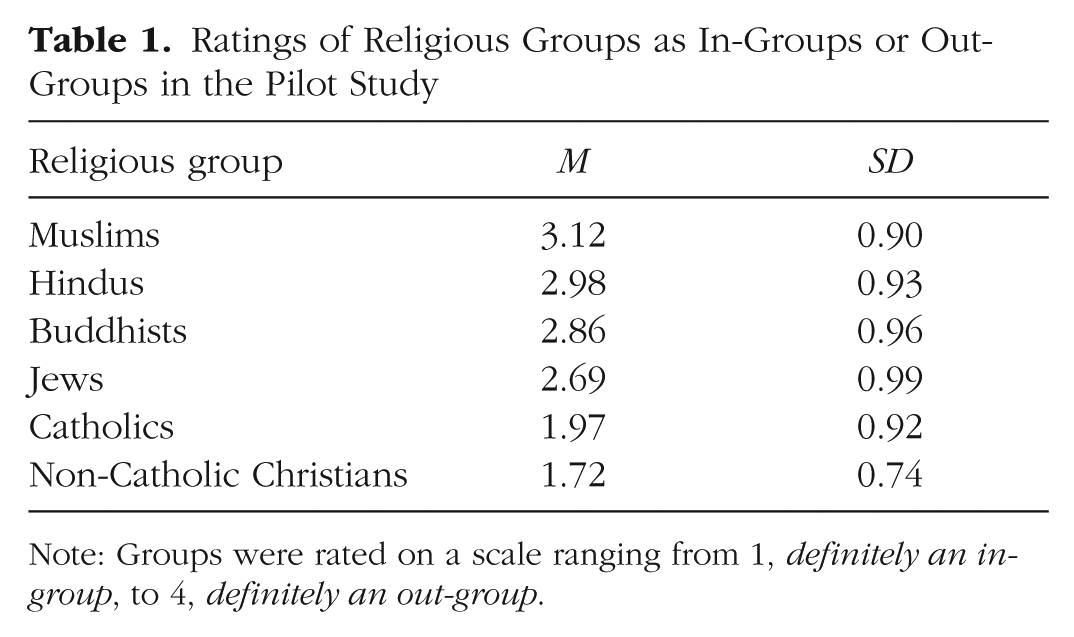
Note: Groups were rated on a scale ranging from 1, definitely an in-group, to 4, definitely an out-group.
Experiment 1
Experiment 1 examined whether Christians would differentially trust Muslims and Christians who did or did not give to religious charities.
Method
Participants
Three hundred ninety-three Christian undergraduates (308 Protestant, 85 Catholic; 153 male, 240 female) participated in the experiment for course credit. Participants ranged in age from 18 to 48 years (M = 19.31, SD = 3.03). On the basis of a preliminary power analysis, we selected a target sample size of 400, with 50 participants per cell.
Procedure
The design for Experiment 1 was a 2 (target religious affiliation: Muslim or Christian) × 2 (costly signaling: does or does not donate to charity) × 2 (belief about God: punishing or forgiving 1 ) between-subjects design. The experiment was portrayed as an investigation of social-networking sites such as Facebook.
Participants were told that they would be viewing an individual’s profile and would be asked about their impressions of that person. Profiles varied in the target individual’s religious affiliation (Christian or Muslim) and costly-signaling behavior (donating 10% of his or her income to a charity for his or her religion, or not donating). We simplified the design by having participants view the profile of a same-sex target individual. All versions of the profile were in the first person, as in “I donate 10% of my yearly income to [Christian/Muslim] charities,” so that they would not arouse suspicion or demand characteristics. The profile included a picture of the same male or female target individuals, identified as Muslim or Christian, so as not to confound the facial features, attractiveness, or apparent ethnicity of the target person with his or her ostensible religion. Distractor information about the targets (e.g., favorite and disliked foods, favorite color, college major) was held constant across conditions.
Trust is difficult to operationalize, and no one scale exists to measure it (Kramer, 1999; Lewicki, Tomlinson, & Gillespie, 2006; Mayer, Davis, & Schoorman, 1995). Our measure was influenced by Mayer and colleagues, who said that trust is “the willingness of a party to be vulnerable to the actions of another party based on the expectation that the other will perform a particular action important to the trustor, irrespective of the ability to monitor or control that other party” (p. 712). Our trust measure consisted of six attitudinal and quasibehavioral items tapping trustworthiness and willingness to be vulnerable to another party, which participants responded to on a scale from 1 (definitely not) to 5 (definitely yes). Participants were asked to indicate whether they thought the target (a) was benevolent, (b) had integrity, (c) had the ability to be trustworthy, and (d) was trustworthy, as well as (e) whether they would lend the target money and expect to get it back, and (f) whether they would trust the target with a sensitive secret. The first three items were based on Mayer et al.’s (1995) views of benevolence, integrity, and ability as elements of trust; the fourth item was chosen because of its face validity; and the last two items were intended to be quasibehavioral assessments of willingness to be vulnerable to another party’s actions.
We also measured intrinsic and extrinsic religiosity (Gorsuch & McPherson, 1989) to investigate the extent to which these religious orientations might moderate the relation between costly signaling and trust. To assess intrinsic religiosity, we measured participants’ level of agreement (on a 5-point scale ranging from strongly disagree to strongly agree) with nine statements regarding the degree to which religion is viewed as an end in itself (e.g., “My religious beliefs are really what lie behind my whole approach to life”). We measured extrinsic religiosity, using the same response scale, by assessing participants’ level of agreement with 11 statements regarding the degree to which religion is viewed as a means to an end (e.g., “The church is most important as a place to formulate good social relationships”).
Results
Principal-axis factoring of our six trust items yielded one factor that accounted for 45.13% of the variance (α = .82). Although we were not specifically interested in gender effects, we did see a significant main effect of gender, F(1, 374) = 23.01, p < .001, 95% CI for the difference = [−0.41, −0.16], η p 2 = .06. However, because participants viewed only same-sex targets, all we can say is that men trusted other men (M = 3.21, SE = 0.05, 95% CI = [3.12, 3.30]) less than women trusted other women (M = 3.50, SE = 0.04, 95% CI = [3.43, 3.57]).
Contrary to predictions, findings revealed that Christian targets (M = 3.34, SE = 0.04, 95% CI = [3.25, 3.42]) were trusted slightly less than Muslim targets (M = 3.38, SE = 0.04, 95% CI = [3.29, 3.46]), but the effect was nonsignificant, F(1, 374) = 0.47, p = .50, 95% CI for the difference = [−0.16, 0.08], η p 2 = .001. Notably, targets who donated to religious charities (i.e., engaged in costly signaling) were perceived as more trustworthy (M = 3.53, SE = 0.04, 95% CI = [3.45, 3.60]) than those who did not (M = 3.19, SE = 0.05, 95% CI = [3.10, 3.27]), F(1, 374) = 32.84, p < .001, 95% CI for the difference = [0.22, 0.46], η p 2 = .08 (Fig. 1). Finally, there was not a significant Target Religious Affiliation × Costly Signaling interaction, F(1, 374) = 0.81, p = .37, η p 2 = .002. Costly signaling increased trust of both Christian targets (p < .001) and Muslim targets (p = .001).
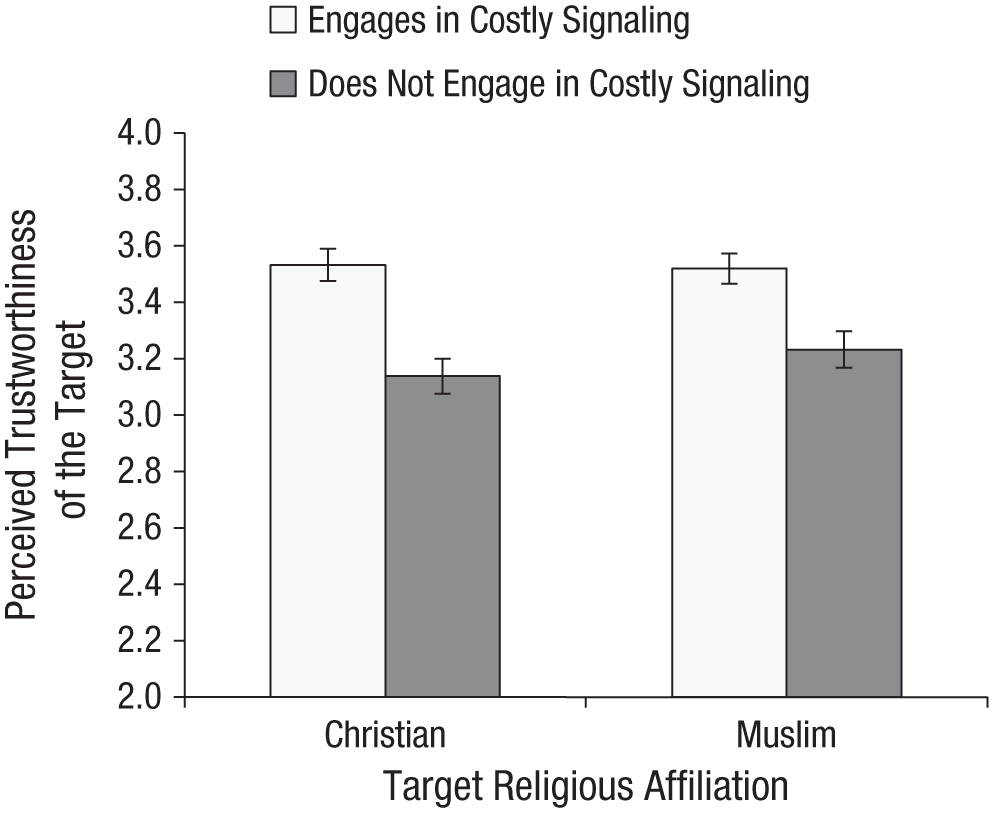
Results from Experiment 1: mean perceived trustworthiness of the target as a function of the target’s religious affiliation and costly-signaling condition. Error bars represent ±1 SEM.
We had no a priori predictions about how intrinsic or extrinsic religiosity might relate to our findings. We performed exploratory analyses to investigate interactions between each religious orientation and our key variables. In a regression model examining costly signaling, target religious affiliation, and intrinsic religiosity as main and interactive predictors of trust (with participant gender included as a covariate), a marginally significant Costly Signaling × Intrinsic Religiosity interaction emerged, b = 0.08, SE = 0.04, 95% CI = [–0.00, 0.16], t(371) = 1.85, p = .065. When rating the trustworthiness of a target who engaged in costly signaling, participants higher in intrinsic religiosity seemed to report higher levels of trust. When participants rated the trustworthiness of a target who did not engage in costly signaling, intrinsic religiosity and trust were unrelated.
A similar model was tested to examine potential interaction effects with extrinsic religiosity. A significant three-way interaction among costly signaling, target religious affiliation, and extrinsic religiosity was found, b = −0.11, SE = 0.05, 95% CI = [−0.22, –0.00], t(371) = −2.02, p = .04. The three-way interaction was driven by a significant Costly Signaling × Target Religious Affiliation interaction that emerged only for participants who were relatively high (1 SD above the mean) in extrinsic religiosity; that is, costly signaling increased trust only for Christian targets.
Experiment 2
In Experiment 1, Christian participants trusted a Christian target who donated to religious charity more than they trusted one who did not. Perhaps surprisingly, they trusted a Muslim target who donated to religious charity more than they trusted one who did not. Thus, religious costly signaling increased perceived trustworthiness, regardless of whether it was performed by an in-group or out-group member.
In Experiment 2, we strengthened the manipulation of religious in-group/out-group status by using photographs in which the out-group targets were more identifiably Muslim (a man wearing a kefiah, a woman wearing a hijab). Target gender was manipulated between subjects. Additionally, we sought to replicate our findings with respect to religious orientation to increase confidence in these unpredicted higher-order effects.
Method
Participants
Three hundred seventy-seven Christian undergraduates (299 Protestant, 78 Catholic; 191 male, 186 female) participated in the experiment for course credit. Participants ranged in age from 18 to 43 years (M = 19.47, SD = 2.54).
Procedure
This experiment employed a 2 (target gender: male or female) × 2 (target religious affiliation: Muslim or Christian) × 2 (costly signaling: does or does not donate to charity) between-subjects design. Our trust measure was the same as in Experiment 1 (α = .83), as were our measures of intrinsic and extrinsic religiosity.
Results
There was a marginally significant main effect of target gender, F(1, 350) = 3.30, p = .07, η p 2 = .01, and a significant Target Gender × Participant Gender interaction, F(1, 350) = 4.07, p = .04, η p 2 = .01. Male participants trusted female targets (M = 3.56, SE = 0.07, 95% CI = [3.44, 3.69]) more than they trusted male targets (M = 3.31, SE = 0.07, 95% CI = [3.18, 3.44], p = .01), whereas female participants trusted male targets (M = 3.42, SE = 0.07, 95% CI = [3.30, 3.55]) and female targets (M = 3.41, SE = 0.07, 95% CI = [3.28, 3.54]) equally (p = .89).
As in Experiment 1, participants trusted targets who donated to religious charities (M = 3.54, SE = 0.05, 95% CI = [3.45, 3.63]) more than targets who did not donate (M = 3.32, SE = 0.05, 95% CI = [3.22, 3.41]), F(1, 350) = 11.20, p = .001, 95% CI for the difference = [0.09, 0.35], η p 2 = .03, and there was no main effect of target religious affiliation, F(1, 350) = 1.30, p = .25, 95% CI for the difference = [−0.20, 0.05], η p 2 = .004 (Fig. 2). Once again, there was no significant Target Religious Affiliation × Costly Signaling interaction, F(1, 350) = 0.88, p = .35, η p 2 = .002. In a pattern that was consistent with Experiment 1, findings revealed that costly signaling increased trust of Christian targets (p = .003) and (marginally) increased trust of Muslim targets (p = .08, two-tailed).
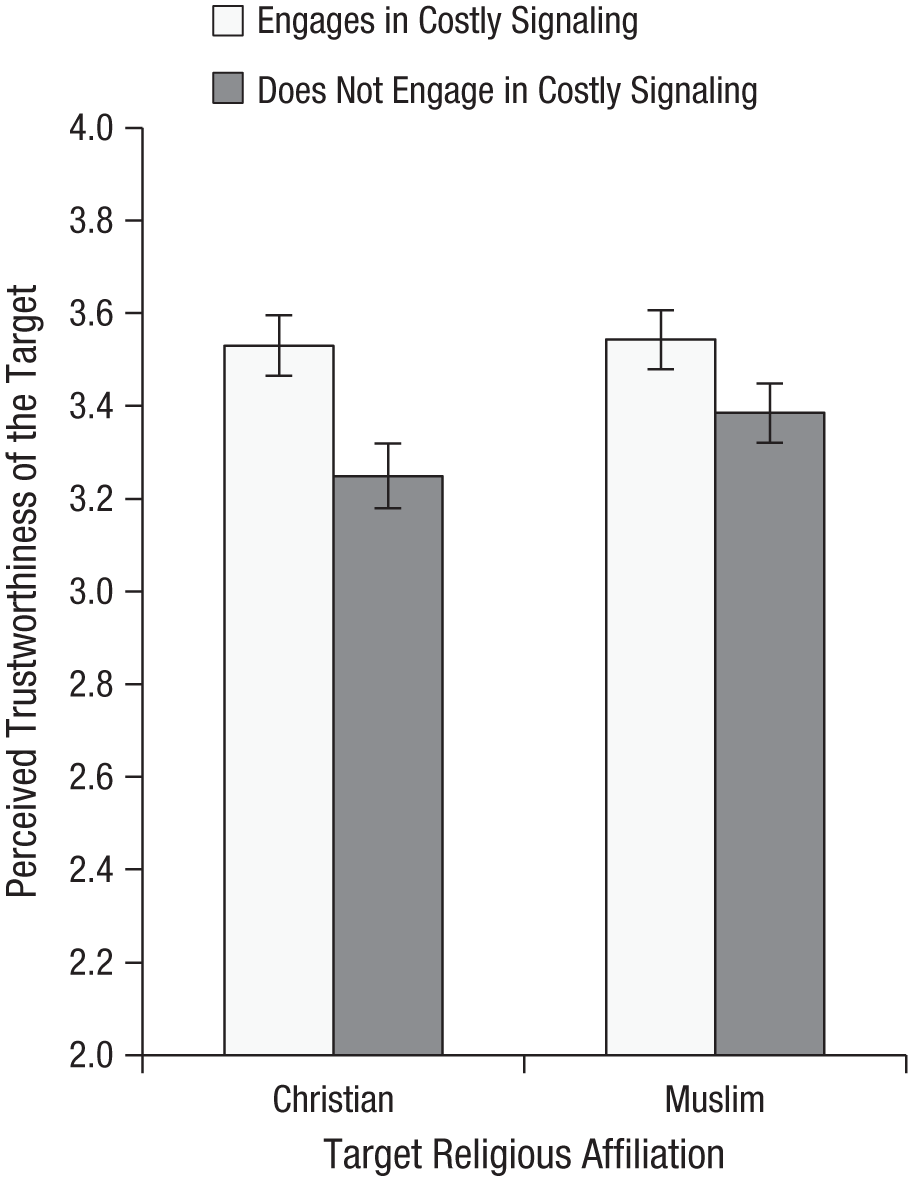
Results from Experiment 2: mean perceived trustworthiness of the target as a function of the target’s religious affiliation and costly-signaling condition. Error bars represent ±1 SEM.
Once again, we investigated potential interactions between each religious orientation and our key variables. In a regression model examining costly signaling, target religious affiliation, and intrinsic religiosity as main and interactive predictors of trust (with participant gender and target gender included as covariates), a significant three-way interaction among costly signaling, target religious affiliation, and intrinsic religiosity emerged, b = −0.09, SE = 0.05, 95% CI = [−0.19, –0.00], t(347) = −1.95, p = .05. The three-way interaction was driven by a significant Costly Signaling × Target Religious Affiliation interaction (in which costly signaling increased trust only for Christian targets) that emerged only for participants who were relatively high (1 SD above the mean) in intrinsic religiosity.
A similar model was tested to examine potential interaction effects with extrinsic religiosity. Results included a significant main effect of extrinsic religiosity (with higher levels of extrinsic religiosity corresponding with greater trust) and a significant interaction between target religious affiliation and extrinsic religiosity, b = −0.16, SE = 0.06, 95% CI = [−0.28, −0.04], t(347) = −2.65, p = .008. When rating the trustworthiness of a Christian target, participants higher in extrinsic religiosity reported greater trust. When participants rated the trustworthiness of a Muslim target, extrinsic religiosity and trust were unrelated. This pattern of findings with respect to intrinsic and extrinsic religiosity was not consistent with the findings from Experiment 1.
Experiment 3
The costly signaling in Experiments 1 and 2 was donating to charity, a prosocial action. Experiment 3 employed a less prosocial and more specifically religious form of costly signaling: adherence to religious dietary laws. We also added a condition in which the target intentionally chose not to engage in costly signaling—by flouting religious dietary laws. Finally, we controlled for participants’ desire to appear unprejudiced toward Muslims, in case our previous findings were influenced by this concern.
Method
Participants
Three hundred seventy-one Christian undergraduates (203 Protestant, 168 Catholic; 128 male, 243 female), ranging in age from 18 to 53 years (M = 20.95, SD = 4.69), participated in the experiment for course credit.
Procedure
Experiment 3 employed a 2 (target religious affiliation: Muslim or Catholic) × 3 (costly signaling: costly signaling, no information, or anti-costly signaling) between-subjects design. Given the inconsistent pattern of results for gender in Experiments 1 and 2, we held target gender constant. Also, we turned to a scenario-based study in case the specific photographs in Experiments 1 and 2 were affecting people’s perceptions. Participants read a scenario in which a target person (Catholic or Muslim) attends a dinner party at a steak restaurant that does not serve religiously acceptable food (it is Lent or the food is not halal). In the costly-signaling condition, the target person (“John” or “Samir”) chooses not to order anything. In the anti-costly-signaling condition, John/Samir ignores religious dietary laws and eats anyway. In the no-information condition, participants were not provided with information about whether the target adhered to or chose to disregard religious dietary laws. John was portrayed as Catholic because we needed a Christian religion with commonly known dietary restrictions (here, the Catholic practice of avoiding meat during Lent).
Participants completed the same trust scale as in Experiments 1 and 2, here adjusted to range from 1 (definitely not) to 6 (definitely yes) to prevent neutral responses (α = .83). We also measured participants’ socioeconomic status, their reported contact with Muslims, the valence of such contact, and intrinsic (but not extrinsic) religiosity. Having seen complex and inconsistent moderator effects with religious orientation in the previous two experiments, we did not analyze the effects of intrinsic religiosity here. We also included a 5-item version of a scale assessing the external motivation to respond without prejudice (Plant & Devine, 1998) that was modified to apply to Muslims (α = .85).
Results
Male (M = 4.25, SE = 0.08, 95% CI = [4.10, 4.40]) and female (M = 4.35, SE = 0.06, 95% CI = [4.24, 4.46]) participants perceived the target individual as equally trustworthy, F(1, 364) = 0.96, p = .33, 95% CI for the difference = [−0.09, 0.28], η p 2 = .003. As in the previous two experiments, participants rated the Catholic target (M = 4.24, SE = 0.07, 95% CI = [4.11, 4.36]) and the Muslim target (M = 4.36, SE = 0.07, 95% CI = [4.24, 4.49]) as equally trustworthy, F(1, 364) = 2.07, p = .15, 95% CI for the difference = [−0.05, 0.31], η p 2 = .01.
Participants trusted targets in the costly-signaling condition (M = 4.49, SE = 0.08, 95% CI = [4.33, 4.65]) more than targets in the anti-costly-signaling condition (M = 4.15, SE = 0.08, 95% CI = [4.00, 4.30]) and in the no-information condition (M = 4.26, SE = 0.08, 95% CI = [4.10, 4.42]), F(2, 364) = 4.94, p = .008, η p 2 = .03 (Fig. 3).
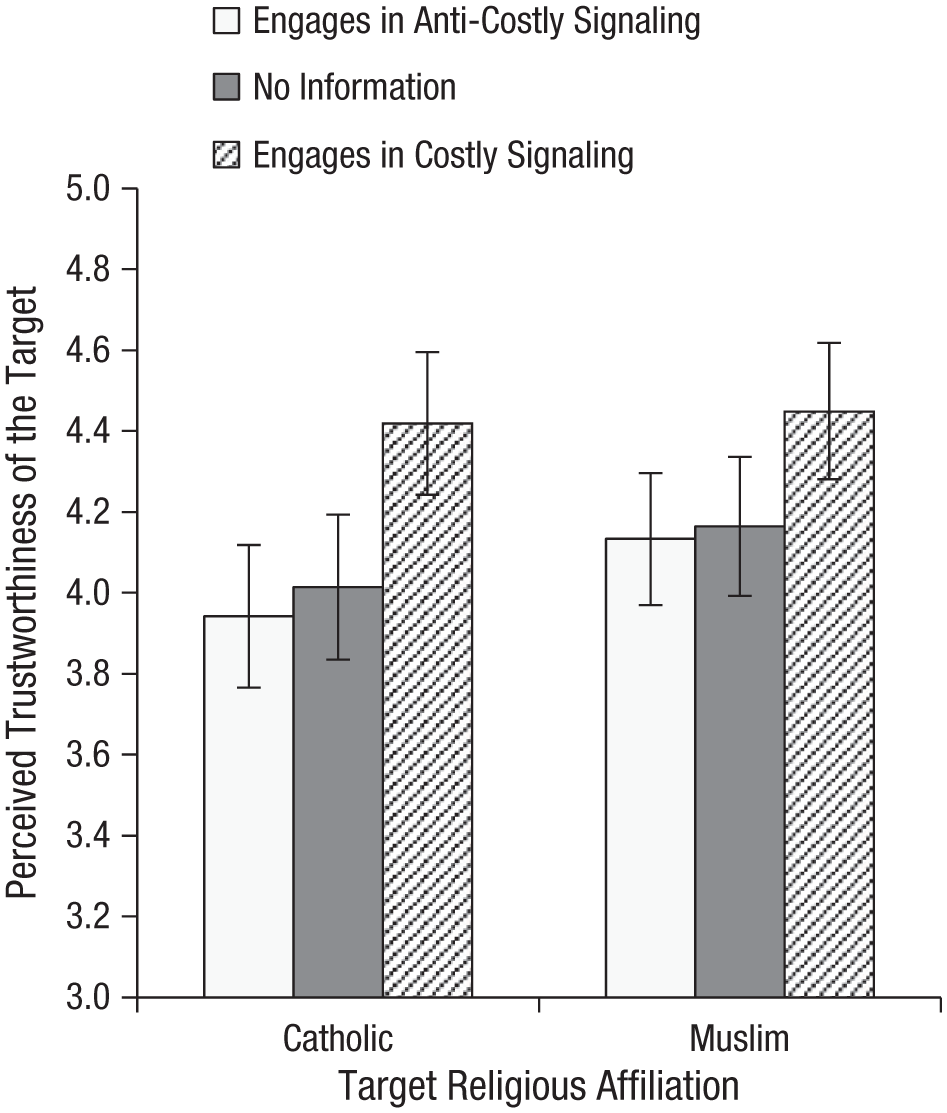
Results from Experiment 3: mean perceived trustworthiness of the target as a function of the target’s religious affiliation and costly-signaling condition. Error bars represent ±1 SEM.
Again, as in Experiments 1 and 2, there was no Target Religious Affiliation × Costly Signaling interaction, F(2, 364) = 0.28, p = .76, η p 2 = .002. Participants trusted Catholic target individuals in the costly-signaling condition more than they trusted Catholics in the no-information condition (p = .05) and the anti-costly-signaling condition (p = .02). Participants trusted Muslim target individuals in the costly-signaling condition as much as they trusted Muslims in the no-information condition (p = .34) and more than they trusted Muslims in the anti-costly-signaling condition (p = .05).
Our measure of desire to appear unprejudiced toward Muslims was not significantly related to the trustworthiness of the target across conditions, b = 0.03, SE = 0.02, 95% CI = [−0.01, 0.08], t(368) = 1.45, p = .15. Including desire to appear unprejudiced toward Muslims as a covariate did not change our results. There was still a significant main effect of costly signaling, F(2, 363) = 5.09, p = .01, η p 2 = .03, no effect of target religious affiliation, F(1, 363) = 1.83, p = .18, η p 2 = .01, and no interaction between target religious affiliation and costly signaling, F(2, 363) = 0.22, p = .80, η p 2 = .001.
Experiment 4
Experiments 1 through 3 demonstrated that different types of religious costly signaling reliably promote trust within and across religious-group lines. A potential limitation is that they relied on self-reported trust. In Experiment 4, we turned to an indirect measure of the association between trustworthiness and costly signaling.
Method
Participants
Five hundred forty-six Christian undergraduates (262 Catholic or Greek Orthodox, 284 non-Catholic Christian; 235 male, 311 female) participated in the experiment as part of a larger mass-testing session. Participants ranged in age from 18 to 43 years (M = 19.29, SD = 2.60).
Procedure
We adapted a paradigm used by Gervais and colleagues (2011) that draws on a classic judgmental bias known as the conjunction fallacy. The conjunction fallacy (Tversky & Kahneman, 1983) is the tendency for people to mistakenly perceive the combined probability of two outcomes (e.g., that a single woman who works at a library and is politically active is both a librarian and a feminist) as higher than the probability of just one of the outcomes (e.g., that the woman is a librarian). Statistically, the combined probability of independent outcomes will always be equal to or lower than the probability of either of the outcomes alone—but never higher. The conjunction fallacy tends to occur when individuals are given information that fits with their existing schemas (e.g., that feminists are usually single women who are politically active).
This experiment employed a 2 (trustworthiness: high or low) × 2 (target religious affiliation: Muslim or Catholic) between-subjects design. All participants read a brief description of a day in the life of a fictitious target (“Mr. R.”), who performed behaviors indicating either that he was highly trustworthy (returned a lost wallet with all of its contents to the correct owner) or that he was low in trustworthiness (kept the money in a wallet that he found on the sidewalk). Participants (who were randomly assigned to the Catholic and Muslim conditions) were then asked to indicate which possibility was most likely: (a) that Mr. R. is a Catholic (or Muslim); (b) that Mr. R. is a Catholic (or Muslim) and observes all of his religion’s requirements, such as what he is allowed to eat according to Catholic Lent (or Muslim halal) rules; or (c) that Mr. R. is a Catholic (or Muslim) and ignores all of his religion’s requirements, such as what he is allowed to eat. Additionally, we included a measure of general religiosity by asking participants to indicate how religious they were along a 7-point scale (1 = not at all religious, 7 = extremely religious).
Evidence of a cognitive association between perceived trust and costly signaling was expected to emerge in the type of conjunction fallacy that participants would make. We predicted that participants who read about a trustworthy Mr. R. would indicate that the likelihood that Mr. R. was a Muslim or Catholic who engaged in religious costly signaling was greater than the likelihood that he was merely Muslim or Catholic. In contrast, we predicted that participants who read about an untrustworthy Mr. R. would rate the probability that Mr. R. was a Muslim or Catholic who did not engage in costly signaling as greater than the probability that Mr. R. was merely Muslim or Catholic. If our results were in line with the results of Experiments 1 through 3, this pattern should hold regardless of whether Mr. R. was Catholic or Muslim.
Results
Because the dependent variables were different (Mr. R. was assumed to be Catholic vs. Muslim in the response options), we performed separate multinomial logistic regressions for participants in the Catholic and Muslim conditions, using the simple religious affiliation (Catholic or Muslim) as the reference category. We compared the likelihood of Mr. R. being someone who engages in religious costly signaling or does not engage in religious costly signaling with the expected frequencies based on the null hypothesis of no relation between trustworthiness and a bias to commit the conjunction fallacy in any particular direction. Participants in both target-religion conditions who made conjunction errors did so consistently with the schema that costly signaling and trustworthiness go together (Table 2).
Distribution of Possibilities Rated Most Likely in Experiment 4
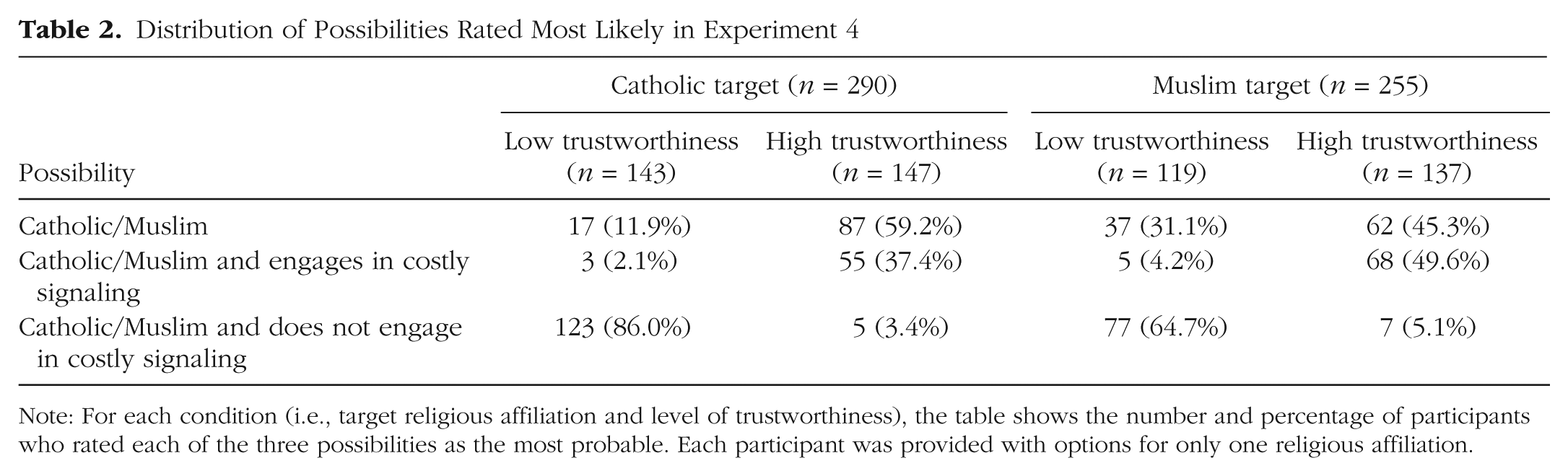
Note: For each condition (i.e., target religious affiliation and level of trustworthiness), the table shows the number and percentage of participants who rated each of the three possibilities as the most probable. Each participant was provided with options for only one religious affiliation.
Relative to the expected values under the null hypothesis, results showed that participants in the high-trustworthiness condition were significantly more likely to perceive Mr. R. as a Catholic who engages in costly signaling (rather than as merely a Catholic) compared with participants in the low-trustworthiness condition, b = −1.28, SE = 0.65, Wald χ2 = 3.86, p = .049, odds ratio (OR) = 0.28, 95% CI = [0.08, 1.00]. In contrast, participants in the low-trustworthiness condition were significantly more likely to perceive Mr. R. as a Catholic who does not engage in costly signaling (rather than as merely a Catholic) compared with participants in the high-trustworthiness condition, b = 4.84, SE = 0.53, Wald χ2 = 83.97, p < .001, OR = 125.89, 95% CI = [44.76, 354.14].
The same pattern occurred when Mr. R. was Muslim. Relative to the expected values under the null hypothesis, results showed that participants in the high-trustworthiness condition were significantly more likely to perceive Mr. R. as a Muslim who engages in costly signaling (rather than as merely a Muslim) compared with participants in the low-trustworthiness condition, b = −2.09, SE = 0.51, Wald χ2 = 17.00, p < .001, OR = 0.12, 95% CI = [0.05, 0.33]. In contrast, participants in the low-trustworthiness condition were significantly more likely to perceive Mr. R. as a Muslim who does not engage in costly signaling (rather than as merely a Muslim) compared with participants in the high-trustworthiness condition, b = 2.91, SE = 0.45, Wald χ2 = 42.67, p < .001, OR = 18.43, 95% CI = [7.69, 44.19]. Post hoc analyses investigating whether these effects were moderated by religiosity were nonsignificant (bs for the interaction terms ranged from −0.65 to 0.65, ps from .11 to .88).
General Discussion
Trust is critical but often hard to cultivate, particularly in pluralistic societies. We investigated two factors that might modulate trust—in-group/out-group religious identities and religious costly signaling. Two manipulations of religious costly signaling—donating to charity and adhering to dietary laws—increased Christians’ trust of a fellow Christian. Crucially, these same forms of religious costly signaling also increased Christians’ trust of Muslims. Additional support was obtained using an indirect measure of the association between religious costly signaling and trust. Christian participants demonstrated a classic judgmental bias when estimating the likelihood that a trustworthy or untrustworthy target engaged in religious costly signaling. Once again, this effect transcended religious-group lines, with Christian participants showing the same pattern of results for Christian and Muslim targets.
Interestingly, Christian participants perceived Christian and Muslim targets to be equally trustworthy. This was surprising given the tendency for individuals to evaluate in-group members more favorably than out-group members (Tajfel & Turner, 1979). Although encouraging from an intergroup-relations perspective, additional explanations for this finding should be explored. People may evaluate the trustworthiness of individual out-group members more positively than they would the trustworthiness of the out-group as a whole. Furthermore, it is possible that participants in our pilot study were evaluating Muslims outside of the United States, whereas participants in our focal experiments were perceiving Muslim American targets. A third possibility is that the undergraduates in our studies were higher in tolerance than the general U.S. population. Given significant differences between millennials and older adults on issues of pluralism and tolerance (Pew Research Center, 2010), future research should clarify whether these results extend beyond a college sample (Sears, 1986; see also Henrich, Heine, & Norenzayan, 2010).
Another avenue for future research is the role of social context in how costly signals performed by religious out-groups are interpreted. As Sosis (2006) notes, “Religious displays can often stigmatize individuals, limiting outside opportunities . . . but they can also confer benefits when outsiders view religious practices as signs of cooperativeness and trustworthiness” (p. 83). In light of prejudice directed toward Muslims (see Raiya et al., 2008), however, our finding that costly signaling promotes trust of even Muslims is striking.
People’s beliefs about God as forgiving or punishing might also affect trust. Religion can help smooth social interaction in large societies where people can outsource punishment of uncooperative behavior to God (Shariff, Norenzayan, & Henrich, 2009). Belief in a punishing God makes people less likely to cheat, but, ironically, belief in a forgiving God makes them more likely to cheat and steal (Shariff & Norenzayan, 2011). In Experiments 1 and 2, we manipulated the target’s belief in a forgiving or punishing God, with the hypothesis that belief in a punishing God would increase trustworthiness. In Experiment 1, participants trusted targets who believed in a forgiving God (M = 3.36, SE = 0.04) as much as they trusted targets who believed in a punishing God (M = 3.35, SE = 0.04), F(1, 374) = 0.003, p = .95, η p 2 = .00. In Experiment 2, participants actually trusted targets who believed in a forgiving God (M = 3.53, SE = 0.05) more than targets who believed in a punishing God (M = 3.33, SE = 0.05), F(1, 350) = 9.16, p = .003, η p 2 = .03.
The differential impact of manipulating a target’s belief about God versus manipulating a target’s costly signaling in our studies opens the door to questions about the relative impact of each. Henrich (2009) has proposed that some religious behaviors—known as credibility-enhancing displays—can serve as cues that the performer sincerely believes in God and can therefore be trusted. Although there are subtle differences between credibility-enhancing displays (which need not be costly or communicate commitment to an in-group) and costly signals, our findings may lead to the provocative suggestion that people care more about targets’ behaviors than they do targets’ beliefs. Future work that pits the influences of beliefs and behaviors against each other might be especially informative. Moreover, some religious groups may respond differently to beliefs versus behaviors of others, as beliefs figure more prominently into some religions than others (Cohen, Siegel, & Rozin, 2003).
In all, this research yielded the theoretically surprising finding that costly signaling increases trust both within and across religious affiliations. Our research thus contains a potentially hopeful message for religiously pluralistic societies. To be trusted by Christians, Muslims do not have to abandon their religious practices—in fact, these practices can promote trust by members of the majority group.
Footnotes
Declaration of Conflicting Interests
The authors declared that they had no conflicts of interest with respect to their authorship or the publication of this article.
Funding
This research was supported by the Air Force Office of Scientific Research (Grant ID No. 4RT0319).
Open Practices
All data and materials have been made publicly available via Open Science Framework and can be accessed at osf.io/zd2j9/. The complete Open Practices Disclosure for this article can be found at http://pss.sagepub.com/content/by/supplemental-data. This article has received badges for Open Data and Open Materials. More information about the Open Practices badges can be found at https://osf.io/tvyxz/wiki/1.%20View%20the%20Badges/ and  .
.
Notes
References
Supplementary Material
Please find the following supplemental material available below.
For Open Access articles published under a Creative Commons License, all supplemental material carries the same license as the article it is associated with.
For non-Open Access articles published, all supplemental material carries a non-exclusive license, and permission requests for re-use of supplemental material or any part of supplemental material shall be sent directly to the copyright owner as specified in the copyright notice associated with the article.
