






Abstract
The disparity in the amount and quality of language that low-income children hear relative to their more-affluent peers is often referred to as the 30-million-word gap. Here, we expand the literature about this disparity by reporting the relative contributions of the quality of early parent-child communication and the quantity of language input in 60 low-income families. Including both successful and struggling language learners from the National Institute of Child Health and Human Development Study of Early Child Care and Youth Development, we noted wide variation in the quality of nonverbal and verbal interactions (symbol-infused joint engagement, routines and rituals, fluent and connected communication) at 24 months, which accounted for 27% of the variance in expressive language 1 year later. These indicators of quality were considerably more potent predictors of later language ability than was the quantity of mothers’ words during the interaction or sensitive parenting. Bridging the word gap requires attention to how caregivers and children establish a communication foundation within low-income families.
Language ability in early childhood is the single best predictor of school readiness and later school success (Hoff, 2013). By the time they are 3 years old, however, many low-income children are already markedly delayed (Ginsborg, 2006). Hart and Risley (1995) demonstrated that children in poverty hear significantly fewer words than their more affluent peers and that this gap—dubbed the 30-million-word gap—predicts lower intelligence scores, lower vocabulary, and less language-processing efficiency (see also Fernald, Marchman, & Weisleder, 2013). These findings spurred national initiatives such as the Thirty Million Words Initiative at the University of Chicago (http://bridgethewordgap.wordpress.com), the Clinton Foundation’s Too Small to Fail, and Bloomberg Philanthropy’s Providence Talks; these programs are designed in part to increase the quantity of language input to underprivileged children in an effort to set positive learning trajectories.
Yet the quantity of language input is insufficient to account for variations in language development. As Hart and Risley (1995) cogently suggested, the number of words children hear is but one indicator—albeit a compelling one—of the ways in which variations in early interactions predict language outcomes. Researchers such as Snow (1977) long ago argued that the quality of mother-child conversations is a key factor in language growth (see Hoff, 2006, for a recent review). Both the quantity and the quality of language input to young children need to be considered when accounting for later language skill. Between the two, quality, measured in part as diversity and complexity of words and grammar, might be the more potent predictor (Cartmill et al., 2013; Goldin-Meadow et al., 2014; Huttenlocher, Waterfall, Vasilyeva, Vevea, & Hedges, 2010; Rowe, 2012). In addition, there is long-standing evidence that sensitive parenting, a global description of a caregiver’s provision of warm, responsive, and stimulating engagement with his or her child (Leigh, Nievar, & Nathans, 2011; National Institute of Child Health and Human Development, or NICHD, Early Child Care Research Network, 2006; Tamis-LeMonda, Briggs, McClowry, & Snow, 2009), also predicts language outcome. Poverty has been repeatedly associated not only with a decreased quantity of language input, but also with decreased quality (Hart & Risley, 1995; Hoff, 2003; Rowe, 2008) and with decreased levels of sensitive parenting (NICHD Early Child Care Research Network, 2005). In aggregate, this work suggests that well-intentioned interventions may not maximize their impact if they do not improve the quality of language children hear and how it is woven into the fabric of early caregiver-child interactions.
In the present study, we broadened the consideration of the quality of early language-facilitating experiences by examining the communication foundation that a child and caregiver co-construct during interactions that occur as children are just beginning to speak. Doing so positioned us to view core features of the significant experiences that, as Hart and Risley (1995) argue, provide the cumulative and sequential basis for later language outcome. Viewed within a transactional framework (Sameroff, 2010), the construction of the communication foundation for language acquisition is both dyadic and developmentally dynamic as an active child and a responsive parent influence each other. The foundation begins to form well before children start to speak (Adamson, 1996; Bruner, 1983), as infants and caregivers “converse” using gaze, gestures, vocalizations, and facial expressions; it then becomes increasingly symbol-infused and decontextualized as children become increasingly sophisticated language users (Adamson, Bakeman, Deckner, & Nelson, 2014; Rowe, 2012). Here, our goal was to determine whether dyadic features of the communication foundation during interactions between low-income parents and 2-year-old children contribute to variability in language at age 3 years over and above the contributions of variations in the quantity of parents’ verbal input and a measure of sensitive parenting.
Three key dyadic features of the communication foundation were measured. The first feature is the child’s joint engagement with symbols (e.g., words and symbolic gestures; Adamson, Bakeman, & Deckner, 2004) as they share activities with a caregiver. Episodes of symbol-infused joint engagement may be a particularly potent interactive context for nurturing a child’s word learning. The second feature is routines and rituals shared by the parent and child that provide a predictable pattern for the interaction. As Bruner (1983) argues persuasively, the sharing of cultural practices such as naming games and picture-book reading help situate language within a meaningful interaction. The third feature is the fluency and connectedness of the exchange. Of central interest here is the way a parent and child use both nonverbal and verbal acts to stay on topic while orchestrating the turn-taking structure of a dialogue. These exchanges are a prelude to the emergence of sustained conversations about a shared topic (Nelson, 2008).
While broadening the consideration of quality, we narrowed our study to sample only from low-income households. Although, as a group, children from low-income households are at risk for language delay, there is nonetheless large variability in outcome (Song, Spier, & Tamis-LeMonda, 2014). To characterize the heterogeneity within this group, we selected participants who spanned the full range of children’s language outcome from the entire NICHD sample. Although this sampling strategy precludes comparative statements about socioeconomic status, it allowed us to examine the precursors of both language success and language delay within the population that is the focus of many intervention efforts.
We asked three questions about how variation in the dyadic features of communication relate to successful language learning in low-income children:
Do low-income children who are successful language learners experience a higher quality communication foundation during early mother-child interactions than their less-verbal peers? Our primary hypothesis was that the quality of the communication foundation at age 2 years as assessed using our three variables of interest (symbol-infused joint engagement, routines and rituals, and fluency and connectedness) would be higher at the age of 3 years for successful low-income language learners than for struggling language learners.
How important is the quantity of language that children hear relative to the quality of their communication foundation? We hypothesized that the quality of the communication foundation would account for more variation in language outcome at age 3 years than the quantity of language input.
Does the quality of the communication foundation, the quantity of language input, or both, predict subsequent language outcome over and above what is predicted by sensitive parenting? We hypothesized that the quality of the communication foundation would account for significant variation in language outcome at age 3 years, even after we controlled for sensitive parenting.
Method
To test these hypotheses, we examined the video records of parent-child interaction at 24 months and the outcome data for expressive language at 36 months of 60 low-income children selected from the archived NICHD Study of Early Child Care and Youth Development (SECCYD; see https://www.nichd.nih.gov/research/supported/seccyd/Pages/datasets.aspx). This comprehensive longitudinal study was initiated to address questions about the effects of early child-care experience on children’s cognitive, language, and social-emotional development and health. Recruited in 1991, the study participants were followed from birth through age 15 years. The study is well known and respected for its extensive longitudinal measures of development across multiple domains and for its observational assessments of parent-child relationships and features of the children’s child-care and school experiences. Numerous publications from the study provide excellent descriptions of the sample recruitment and demographics, and details of the study’s methodology (e.g., NICHD Early Child Care Research Network, 2002, 2006).
Sample selection
We selected only children reared in families with income-to-needs ratio less than 1.8, for whom there were usable video recordings of interaction with parents at 24 months, who had expressive-language scores on the Reynell Developmental Language Scales (Reynell, 1991) at 36 months, and who came from 5 of the study’s 10 sites: Pittsburgh, Pennsylvania; Morganton, North Carolina; Charlottesville, Virginia; Philadelphia, Pennsylvania; and Madison, Wisconsin. We limited our selections to these sites because, compared with the other sites, the sound quality was generally better on their interaction videos and they had larger numbers of low-income children.
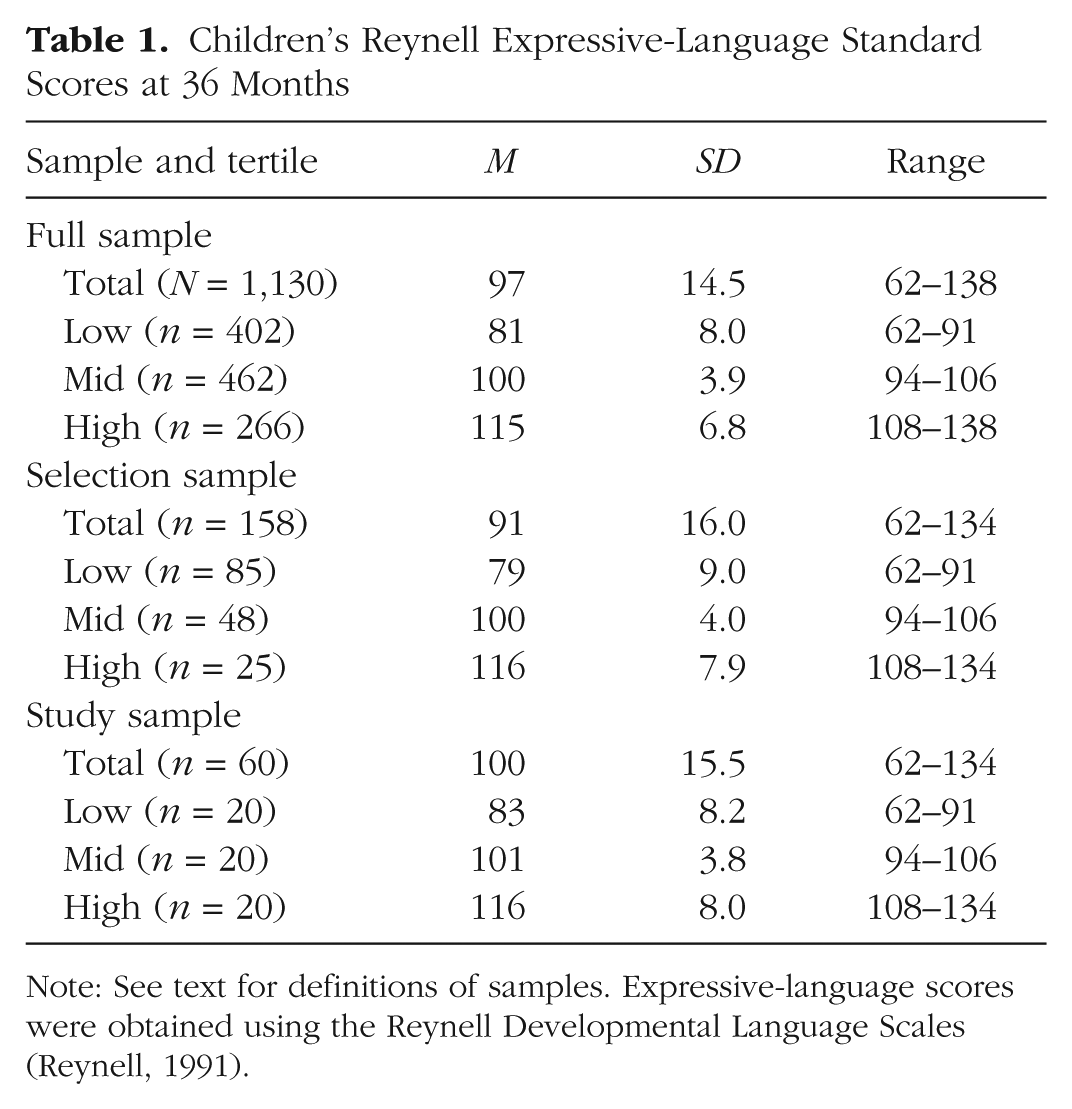
Of the 1,130 children in the archive with Reynell expressive-language scores, 158 fulfilled our criteria. For the present study, we oversampled children with higher expressive-language scores to ensure their sufficient representation in the study sample, selecting equal numbers of boys and girls. Using their 36-month Reynell expressive-language normed percentage score, we categorized children in three tertiles (low = 0–33%, mid = 34–66%, and high = 67–100%). There were 85 children (49 boys and 36 girls) in the low tertile, 48 children (21 boys and 27 girls) in the mid tertile, and 25 children (13 boys and 12 girls) in the high tertile. From these, we selected 10 boys and 10 girls from each tertile. Selection of the sample was made blind to sensitivity ratings of the parent-child interactions but considering maternal education and race/ethnicity to balance representation of high and low education and African American children across tertiles. Descriptive statistics for Reynell expressive-language standard scores for the three samples are given in Table 1—the 1,130 with Reynell expressive-language scores (full sample), the 158 with an income-to-needs ratio less than 1.8 who met our other criteria (selection sample), and the 60 children selected for this study (study sample).
Children’s Reynell Expressive-Language Standard Scores at 36 Months
Note: See text for definitions of samples. Expressive-language scores were obtained using the Reynell Developmental Language Scales (Reynell, 1991).
Means for the corresponding tertiles were about the same in all three samples, as expected. In the full sample, the fact that there were fewer individuals in the high tertile than in the low and mid tertiles suggests that children with relatively advanced expressive language were somewhat underrepresented in the NICHD SECCYD. The fact that the mean expressive-language scores in the high tertile were essentially the same in the full and study samples suggests that children categorized in the high tertile in our study sample were indeed successful language learners.
Sample characteristics
Children’s age at the 24-month visit averaged 25.2 months (SD = 1.0, range = 23.7–29.5). Mean ages were 24.9, 25.3, and 25.5 months for the low to high tertiles, respectively; these differences did not reach a conventional level of statistical significance, η2 = .080, p = .106. Children were 37% Black non-Hispanic (n = 22) and 63% White non-Hispanic (n = 38), with no children coded as Hispanic or any other ethnicity; these percentages did not vary significantly by tertile, χ2(3, N = 60) = 1.87, p = .39.
Thirteen of the 60 mothers had not completed high school, 22 had graduated high school, 20 had some postsecondary education (some college, an associate’s degree, or vocational school), and 5 had earned a bachelor’s degree. In the SECCYD data, these last three categories were coded 12, 14, and 16, respectively, but if the mother had not completed high school, the number of years completed was coded 7 to 11. To create a better-distributed variable for subsequent analyses, we coded maternal education 1 if the mother had not graduated high school; 2 if she had completed high school or obtained a GED; 3 if she had some college but no degree, an associate’s degree, or vocational school beyond high school; and 4 for a bachelor’s degree from a college or university. No mothers in our low-income sample reported education subsequent to a bachelor’s degree.
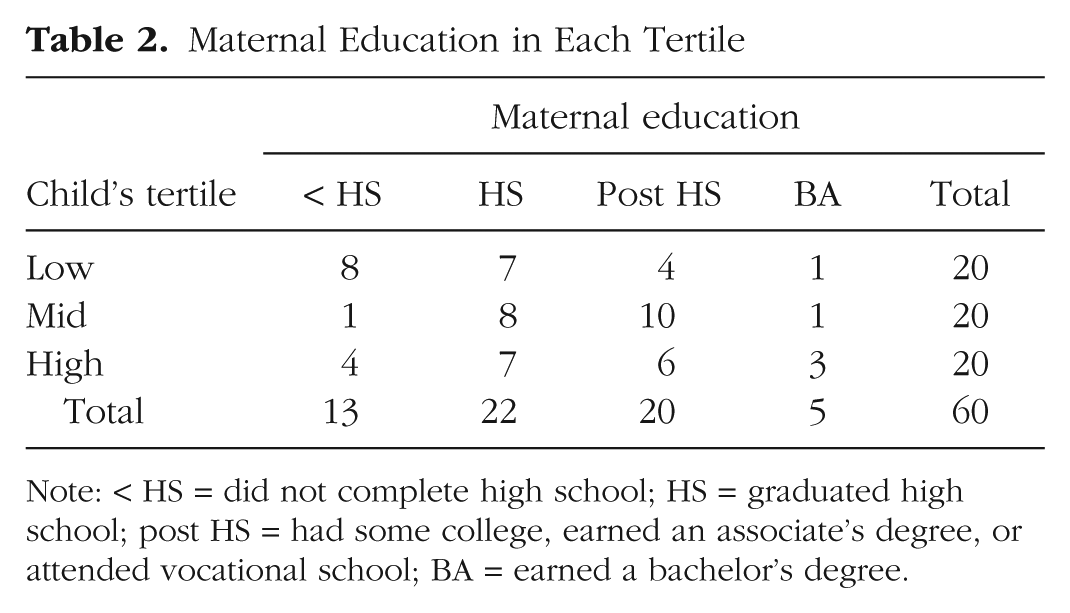
Even though the chi-square test did not achieve a conventional level of statistical significance, mother’s education was not quite evenly distributed by tertile (see Table 2). There were twice as many cases in which the mother had not completed high school in the low tertile than in the high tertile, but almost none in the mid tertile; conversely, there were almost half as many cases in which the mother had completed high school or earned a bachelor’s degree in the low tertile than in the high tertile, and more in the high tertile than in the mid tertile, χ2(6, N = 60) = 10.2, p = .12.
Maternal Education in Each Tertile
Note: < HS = did not complete high school; HS = graduated high school; post HS = had some college, earned an associate’s degree, or attended vocational school; BA = earned a bachelor’s degree.
Measures
Sensitive parenting
Our measure of sensitive parenting was taken from the SECCYD archive and was used in the Early Child Care Research Network’s report addressing child-care effect sizes for different developmental domains (NICHD Early Child Care Research Network, 2006). We selected the composite sensitivity score because it fit what we wanted conceptually and has shown strong effect sizes in previous literature—thus, it provided a stringent test of our third hypothesis. The composite score for each of the three assessment ages (6, 15, and 24 months) was created by standardizing and averaging data from two sources: a composite rating of maternal sensitivity and a measure of stimulation and responsiveness of the family environment. The maternal-sensitivity score was a composite of 4-point ratings made from video records of the 15-min mother-child interaction observation at each age—the sum of ratings of sensitivity and responsiveness to the child, positive regard, and intrusiveness (reverse-scored). Stimulation and responsiveness of the family environment was assessed using the total score from the Home Observation for Measurement of the Environment (HOME; Caldwell & Bradley, 1984). The HOME score for 24 months was the average of the HOME total score from 15 and 36 months because the HOME was not administered at 24 months. Details of these procedures and the validity and reliability of the interaction procedures and ratings of parenting sensitivity and of the HOME are well documented (NICHD Early Child Care Research Network, 1999, 2002).
Reynell Developmental Language Scales
At 36 months, language was assessed in a lab visit using the Reynell Developmental Language Scales (Reynell, 1991). This measure includes two 67-item scales assessing expressive and receptive language and is tailored to detect changes in language development in typical or developmentally delayed children 1 to 7 years old. The expressive-vocabulary standard score, determined from the child’s age using the protocol set forth in the manual, was used for subsequent analyses. To avoid data fishing, we did not also analyze the receptive-language score, although given the strong correlation between expressive and receptive scores (r = .52, p < .001), we would likely have found a similar pattern of results. Cronbach’s alpha for expressive vocabulary, determined for the entire SECCYD sample, was .86.
The three-boxes task
During the 24-month laboratory visit, mother-child interaction was assessed using a semistructured procedure, the three-boxes task. A mother was given three numbered containers and instructed to play with her child as she would normally, first using the contents of Container 1, then 2, and then 3. A picture storybook, Barnyard Tracks, was in Container 1, a toy stove and cooking accessories were in Container 2, and a simple dollhouse with a few moving parts and figures were in Container 3. Videos of these interactions were made using a single camera through a one-way mirror. Sound was recorded using a microphone within the observation room.
The overall task had a time limit of 15 min, with no specific time limit for the individual containers. The mean time for the sessions was 15.1 min (SD = 0.91, range = 10.7–16.6; only five sessions were < 14.5 min). The mean time per session was greater for boys than girls (15.4 vs. 14.9 min; η2 = .075, p = .041), but session time did not differ significantly by tertile nor was the interaction significant (p = .39 and .32), per a tertile-by-child-gender analysis of variance (ANOVA).
Ratings of communication-foundation quality
We used three rating items to characterize the quality of the communication foundation during the time mothers and their children were engaged with the three-boxes task. We used these items, and not items already in the SECCYD archive, because the new items focused more specifically on aspects of the parent-child interaction that might foster a child’s attunement to language at a time when communication is still predominantly carried out using nonverbal modes, such as facial expressions, vocalizations, and gestures (e.g., points and shows). Two of the items, symbol-infused joint engagement and fluency and connectedness, were adopted from Adamson and Bakeman’s battery of rating items that were developed to characterize joint engagement and parent-child interactions (Adamson, Bakeman, Deckner, & Nelson, 2012). The third item, routines and rituals, was developed specifically for the current study. Routines and rituals often reflect implicit shared procedural expectations (Aksan, Kochanska, & Ortmann, 2006) or well-practiced formats. Each item was assessed using a 7-point Likert scale whose anchors span the range of possibilities observed within a sample of 18- to 30-month-old typically developing toddlers. Each of the three items was applied once to the entire 15-min observation. (Observers also rated three additional items from our initial battery—total, supported, and coordinated joint engagement—to further characterize the amount and structure of joint engagement; we elected not to analyze them for the current study because the rating of symbol-infused joint engagement provided a better fit to our conceptualization of the key features of the communication foundation at 24 months of age.)
The rating item symbol-infused joint engagement assessed how well the child actively sustained attention to shared objects and events and to symbols while he or she was sharing an activity with the parent. Although the focus was on the child’s active engagement, the parent’s contribution was essential because the topic must be shared. Symbols included both words and symbolic gestures used both expressively and receptively. For example, an episode of symbol-infused joint engagement occurred when, as child and parent played together with the dollhouse (Container 3), the child produced a label (“baby”) and a symbolic gesture (placed head on hands to indicate sleep) as the mother placed the figure in the bed. Or the child might demonstrate comprehension of the mother’s language by following a verbal direction (“put that baby to sleep”). A rating of 1 was assigned when there were no episodes of symbol-infused joint engagement during the observation. A rating of 7 indicated that the child was frequently engaged in symbol-infused joint engagement, and the episodes were richly textured and varied in content. The midpoint rating of 4 usually indicated that the child had spent about a third of the session (or approximately 5 min total) in symbol-infused joint engagement. However, the amount of time was adjusted by the quality of behavior. Thus, a 4 would be selected if (a) the child spent less than a third of the session in symbol-infused joint engagement but the quality was very high (e.g., when the child spontaneously asked what something was called, produced symbolic gestures frequently during a song, or appeared to wait for a parent’s verbal instruction before acting) or (b) the child spent more than a third of the session in this state but it was of relatively low quality (e.g., the child said a word only after the parent did, or the child gave short, perfunctory responses to a series of questions from the parent).
The rating item routines and rituals assessed the frequency and quality of routines and rituals that occurred during shared activities. Routines and rituals occurred when the dyad appeared to be coordinating their activity using a familiar play routine (“my turn-your turn”) or a cultural script (such as “book reading” or “bedtime”). Sometimes the shared ritual was varied and nuanced (e.g., the parent and child “prepared” breakfast and then “ate” it) and might even have explicit ties to a prior event (“Remember when we made blueberry muffins?”). But sometimes the elements of a routine or ritual were only briefly noted, as when, for example, a parent and child began to read a book but after turning one page and pointing to one picture, the book was tossed away. A rating of 1 was assigned when there was no evidence of routines and rituals during the observation. A rating of 7 indicated that parent and child often sustained varied and nuanced routines and rituals. The midpoint rating of 4 usually indicated that the interaction included some shared routines and rituals but that they were not sustained and did not permeate most of the activity.
The rating item fluency and connectedness assessed the overarching flow and cohesion of the mother-child interaction. Raters attended to the balance between partners’ contributions, how the partners negotiated taking turns, and how smoothly the interaction progressed. A rating of 1 was assigned when no interaction was established. For example, one partner might make several attempts to engage the other partner (e.g., hand the other a toy or ask if he or she would like to read the book), but there was no uptake. A rating of 7 indicated that parent and child often sustained a fluid and balanced interaction during which there were several exchanges that flowed easily and smoothly for several turns, with both partners contributing equally. The midpoint rating of 4 usually indicated that interactions were established but that they were largely dominated by one partner, lacked smoothness (e.g., there were long pauses between turns, missed opportunities in which one partner did not respond), or were not strongly cohesive (e.g., the connection between turns was loose, as when one partner repeated a question and the other simply nodded “yes”).
The study’s raters received 1 month of training before they rated the video records. This training included a day-long workshop led by researchers who had extensive experience with the rating items used to characterize parent-child interactions and consultation with an experienced rater and of a rating manual (available on request) that detailed each rating item. The raters were blind to other information about the children, including their Reynell score. Rating typically entailed viewing the video record of a session three times, during which the rater took notes related to the child’s joint engagement as well as the presence of sustained interactions and routines and rituals.
To check agreement, we assigned 12 of the 60 sessions (stratified by tertile) independently to both raters. The raters did not know which sessions were double rated. Of the 36 possible comparisons (12 sessions × 3 items), 18 were exact agreements, 15 disagreed by 1 point, and 3 disagreed by 2 points. Weighting 1-point disagreements 0 (i.e., effectively considering them agreements), weighting 2-point disagreements 1, and 3-point disagreements 2, we found that weighted κs (Bakeman & Quera, 2011) were .86, .78, and 1.00 for symbol-infused joint engagement, routines and rituals, and fluency and connectedness, respectively. After each agreement check, raters reviewed the ratings with their trainers to ensure that rating criteria and procedures remained stable.
Quantity of language input
Speech produced during the three-boxes task was transcribed and the mothers’ words per minute (wpm) were computed to measure the quantity of maternal language at 24-months. One transcriber, a graduate student in Communication Disorders with extensive transcription experience, produced an initial transcript using the conventions specified by the Systematic Analysis of Language Transcripts program (Miller & Iglesias, 2010). A second transcriber reviewed the transcript while viewing the video record and suggested changes. The first transcriber then either accepted the suggested changes or asked a third transcriber to reconcile the disagreement. All transcribers were blind to the ratings and Reynell scores. The quantity of language input used in subsequent analyses was defined as the number of a mother’s intelligible words in the transcript per minute of observation.
Effect sizes and confidence intervals (CIs)
As is increasingly being recommended (e.g., Cumming, 2014), we report effect sizes and CIs when appropriate. For means and correlations, formulas for estimating the standard errors required to compute CIs are easily found in standard statistics texts, but computing standard errors for the increases in variance accounted for (ΔR2) can be problematic. Algina, Keselman, and Penfield (2007) have shown that formulas based on asymptotic principles are typically inaccurate, even with relatively large sample sizes (e.g., 200). In contrast, they found that determining standard errors with a bootstrap (percentile) methodology resulted in accurate CIs even with sample sizes as small as 50 with three or fewer predictors, 100 with six or fewer predictors, “and likely with smaller sizes as well, say 75” (2007, p. 217). Accordingly, the CIs we report here for ΔR2s are based on percentile bootstrap standard errors (we specified 10,000 samples; see http://www2.gsu.edu/~psyrab/bootCI/ for details about bootCI, the program we used).
Results
Descriptive statistics
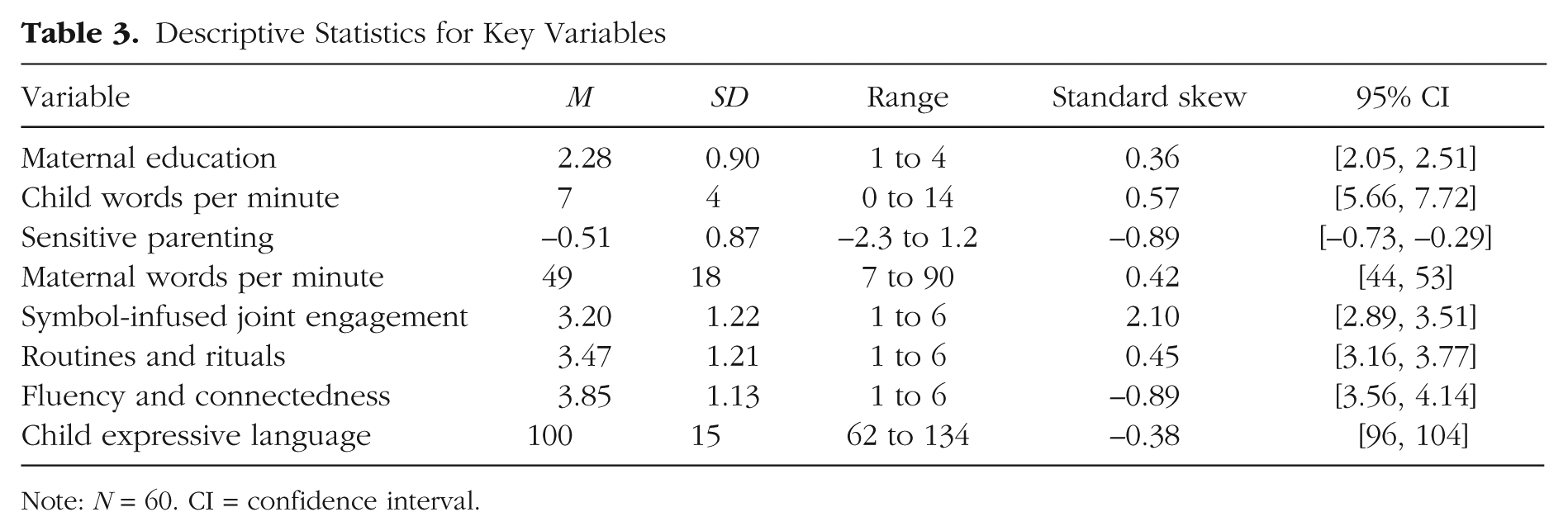
Descriptive statistics for our variables, both ones used descriptively and those used analytically, are given in Table 3. Four points should be noted. First, the children talked relatively little at the 24-month visit. Although their average rate was 6.7 wpm, no words were recorded for one child (and so the range for wpm began at 0), only 1 word was recorded for another child (rate = 0.06 wpm), and the next lowest rates were 0.58 and 0.63 wpm (9 and 10 words). At the high end, more than 200 words were recorded for 5 children (rates > 13 wpm). Second, ratings for the quality of the communication foundation all ranged from 1 to 6; even though the scale given the raters included 7, the highest rating was never used. Third, the standardized skew statistics were all less than 2.58. And fourth, as noted earlier, the mean and standard deviation for the 36-month expressive-language score reflected the test’s norms exactly.
Descriptive Statistics for Key Variables
Note: N = 60. CI = confidence interval.
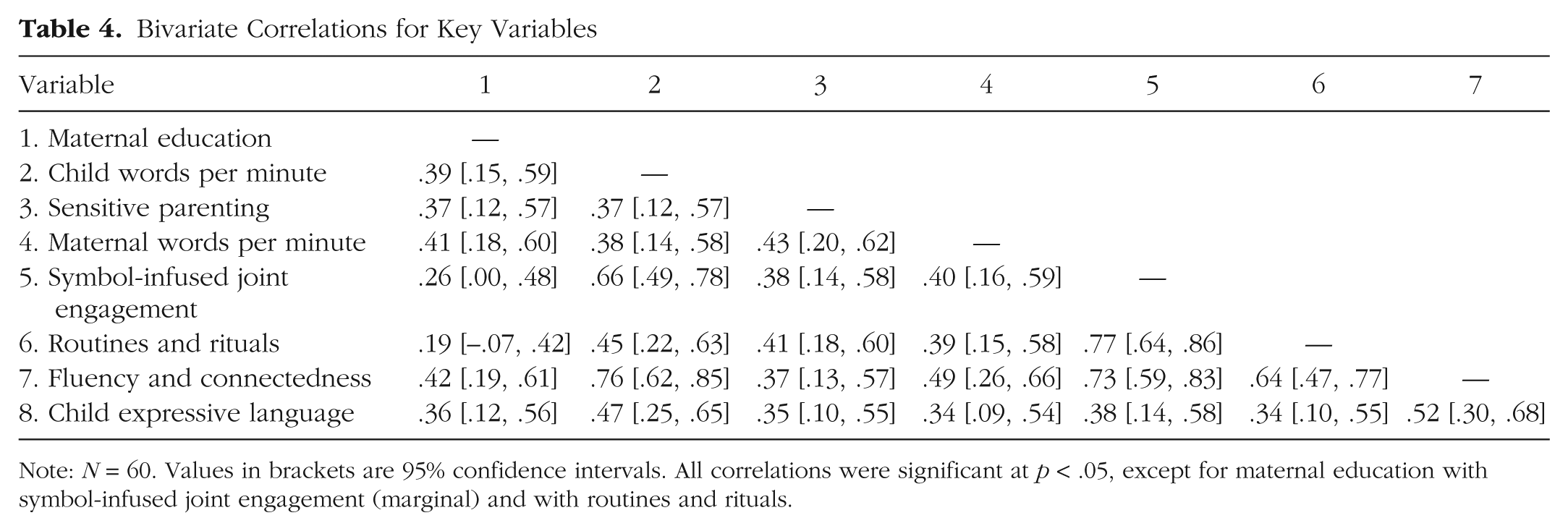
Correlations for these variables are given in Table 4. All correlations were statistically significant and moderate (.3–.5) or strong (≥ .5) in magnitude (Cohen, 1988) with two exceptions: maternal education with routines and rituals (r = .19, p = .15) and with symbol-infused joint engagement (r = .26, p = .049). In particular, the three ratings of communication-foundation quality were strongly intercorrelated (rs = .64–.77), which suggests that these various aspects of quality are intertwined. The fluency and connectedness rating was strongly correlated, and the other variables moderately correlated, with the child’s 36-month expressive-language score, our outcome variable.
Bivariate Correlations for Key Variables
Note: N = 60. Values in brackets are 95% confidence intervals. All correlations were significant at p < .05, except for maternal education with symbol-infused joint engagement (marginal) and with routines and rituals.
Tests of hypotheses
To test whether the quality of the communication foundation at age 2 years, as reflected by our three quality ratings, would be higher for more-successful 3-year-old language learners than for less-successful language learners (Hypothesis 1), we conducted tertile-by-gender ANOVAs (see Table 5 and Fig. 1). Supporting our hypothesis, results showed that children who were on the path to becoming successful language learners at age 36 months (i.e., scoring in the top third of Reynell expressive-language norms) received significantly higher ratings on all three indicators of 24-month communication-foundation quality than children in the bottom third of the language-outcome distribution.
Results From the Tertile-by-Child-Gender Analysis of Variance
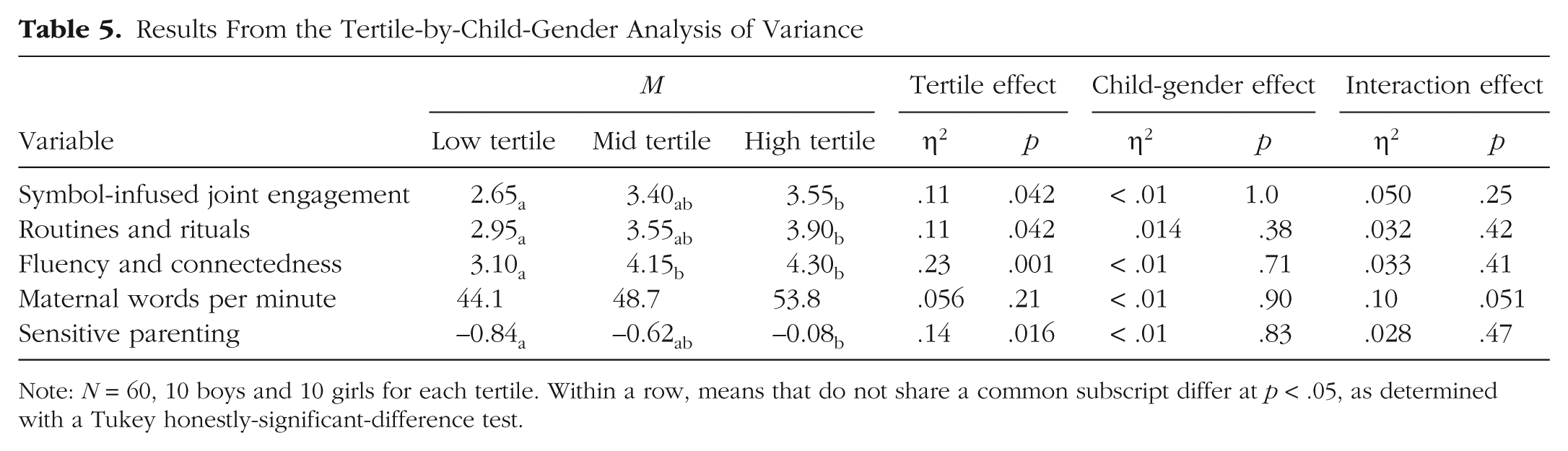
Note: N = 60, 10 boys and 10 girls for each tertile. Within a row, means that do not share a common subscript differ at p < .05, as determined with a Tukey honestly-significant-difference test.
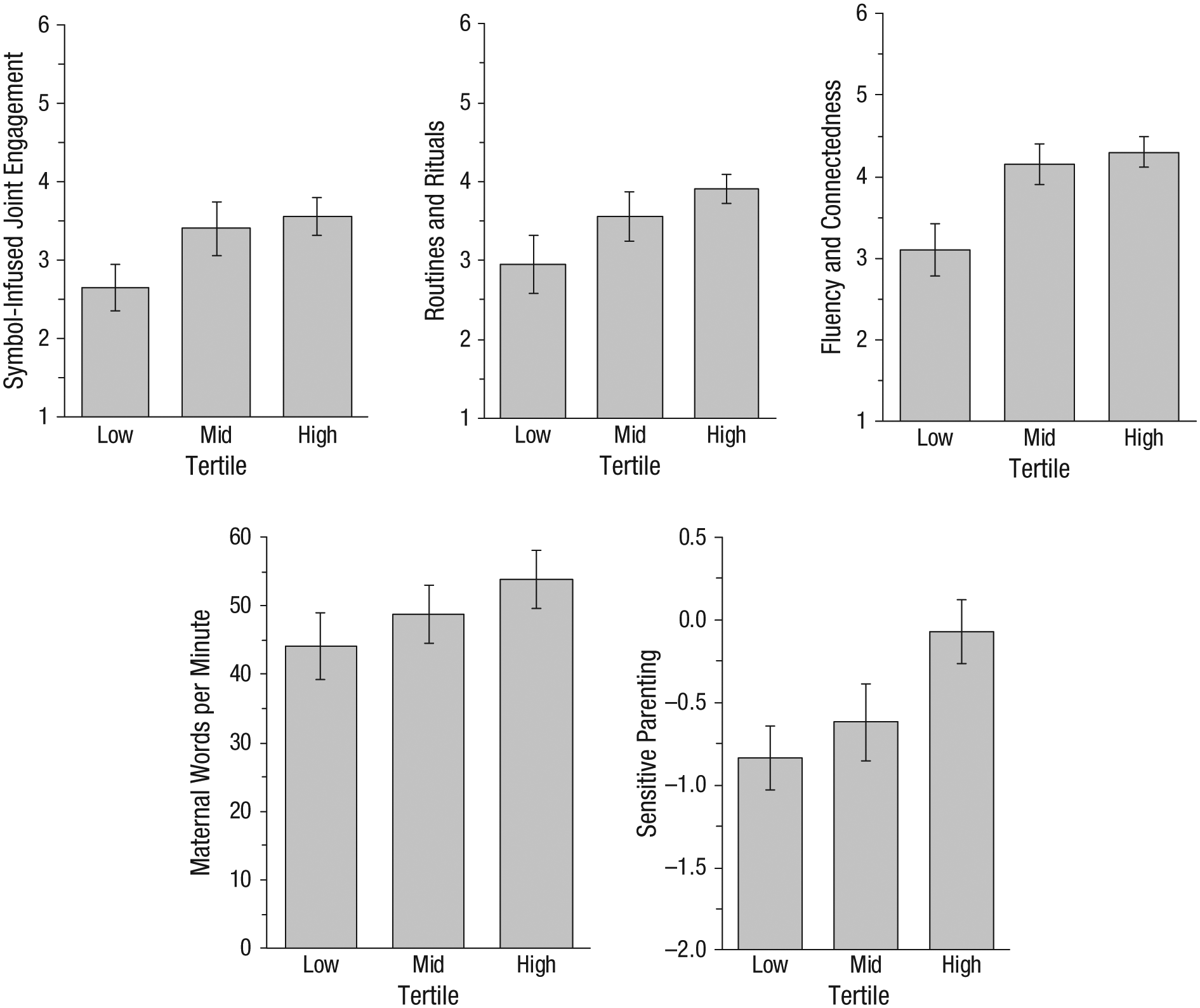
Mean ratings for the three measures of communication-foundation quality (symbol-infused joint engagement, routines and rituals, and fluency and connectedness), maternal words per minute, and the sensitive-parenting composite score. Each measure is shown as a function of children’s expressive-language tertile. Error bars indicate 95% confidence intervals.
We also examined tertile differences for maternal wpm and sensitive parenting, variables that enter into Hypotheses 2 and 3. Both sensitive parenting and maternal wpm showed the same pattern of tertile differences as did the communication-foundation quality ratings, but the differences for maternal words (i.e., quantity of language input) were not statistically significant (p = .21; see Table 5).
To test whether, compared with the quantity of language input at age 24 months, ratings of communication-foundation quality at age 24 months would account for more variance in the child’s expressive language at age 36 months (Hypothesis 2), we conducted hierarchical regression analyses. Because both the ratings of communication-foundation quality and the quantity of language input were higher for higher tertiles, on average (Table 5), we expected that a prediction model for 36-month expressive language including these variables would explain significant variance in expressive-language outcomes, and it did.
Together, the quality ratings and maternal wpm at age 24 months accounted for 27.8% of the variance in child expressive language at age 36 months (see Table 6, Models 1 and 2). Alone, the quality ratings accounted for 26.9%. Adding maternal wpm increased this by only 1.0%. Reversing the order, maternal wpm alone accounted for 11.4% of the variance, and adding the quality ratings increased this by 16.4%. Thus, the quality ratings accounted uniquely for 16.4% of the variance, maternal wpm uniquely for 1.0%, with 10.4% accounted for by both jointly (because maternal wpm correlated with quality ratings, r = .39–.49). In sum, both communication-foundation quality and maternal wpm mattered for later language success, but, supporting our hypothesis, quality mattered more.
Changes in Variance Accounted for Depending on the Order in Which Quality and Quantity of Language Are Added to Models With and Without Sensitive Parenting Included
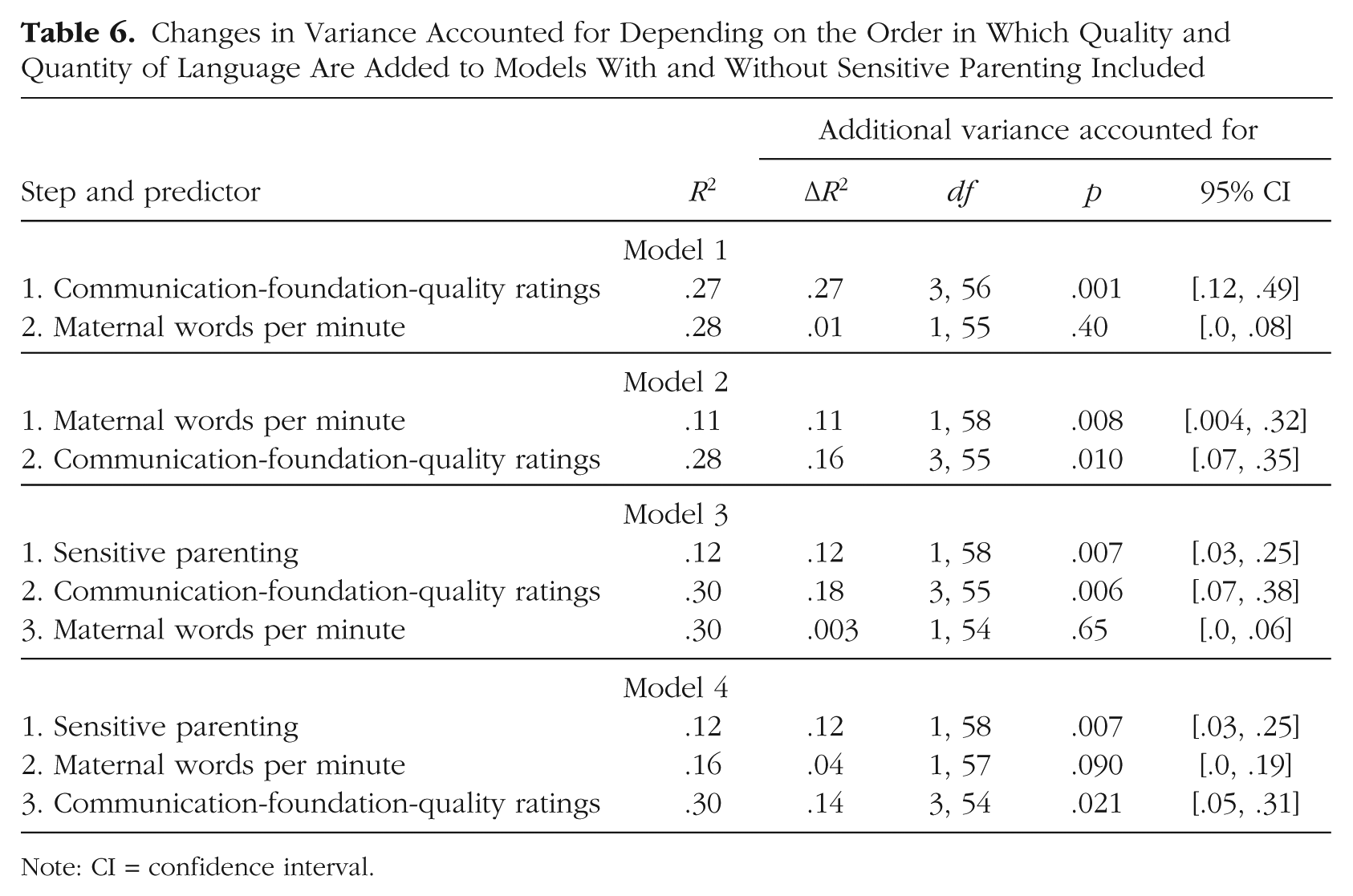
Note: CI = confidence interval.
To test whether communication-foundation quality at 24 months would continue to account for significant variance in children’s expressive language at 36 months, even after we controlled for parental sensitivity (Hypothesis 3), we conducted additional hierarchical regression analyses. Alone, sensitive parenting accounted for 11.9% of the variance in expressive-language scores (see Table 6, Models 3 and 4). After we controlled for sensitive parenting, the quality ratings accounted for an additional 17.8% of the variance, and maternal wpm for almost no additional variance (0.3%), which supported our hypothesis. Reversing the order, and after we controlled for sensitive parenting, maternal wpm accounted for an additional 4.4%, and the quality rating accounted for yet an additional 13.6% of the variance. In sum, controlling for sensitive parenting, we found that the quality ratings accounted uniquely for an additional 13.6% of the variance, and maternal wpm accounted uniquely for an additional 0.3%, with an additional 4.1% accounted for by both jointly, which provides additional support for our hypothesis.
Analyses of ratings for quality of communication foundation
To test Hypotheses 2 and 3, we considered the three ratings for quality of communication foundation as a set, working in concert. However, we also determined what their influence was individually by defining a hierarchic series of models. The first model included one rating, and each subsequent model added another. We could then ask not only how much unique additional variance was accounted for by a rating when it was added to the model (its ΔR2), but we could also note how the beta weight for a given variable changed when other ratings are added to the model.
We considered three hierarchic series. In the first, we entered symbol-infused joint engagement and then routines and rituals, followed by fluency and connectedness; in the second, we reversed the order of the first two variables; and in the third, we entered fluency and connectedness first (see Table 7). When each rating was the only predictor in the model, it accounted for a statistically significant amount of variance in 36-month Reynell expressive-language scores, but the amount was considerably greater for fluency and connectedness (26.9%) than for either routines and rituals (11.8%) or symbol-infused joint engagement (14.2%). When added second, neither symbol-infused joint engagement nor routines and rituals accounted for a statistically significant increase in variance, above and beyond that already accounted for by the other variable in the model, and their beta weights—which indicate their influence on the outcome variable when controlling for the other rating in the model—decreased and were no longer statistically significant.
Results From Hierarchic Models for Ratings of Quality of Communication Foundation
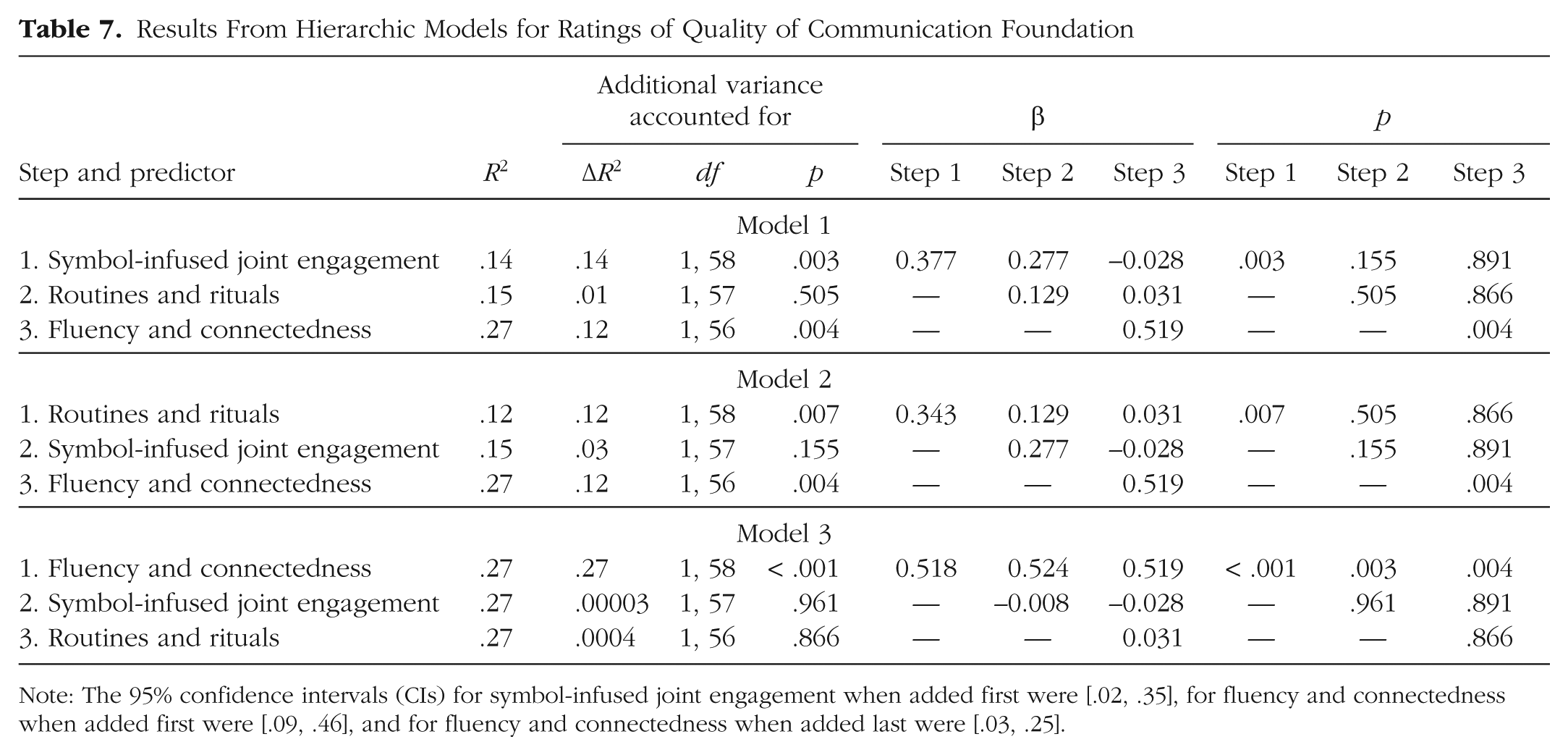
Note: The 95% confidence intervals (CIs) for symbol-infused joint engagement when added first were [.02, .35], for fluency and connectedness when added first were [.09, .46], and for fluency and connectedness when added last were [.03, .25].
This was not the case for fluency and connectedness. When entered first, its beta weight and its statistical significance changed little as the ratings for symbol-infused joint engagement and routines and rituals were added to the model. The additional contributions of the other two ratings were negligible, less than five hundredths of a percent. Moreover, when added last, its unique contribution was substantial (12.0%) and statistically significant (see Table 7). This suggests that a prediction model that included only fluency and connectedness would work as well as one that included all three ratings.
Additional control variables
When testing Hypothesis 3, we used sensitive parenting as a control variable, but there were other possible candidates. Children’s gender is a second possibility. In analyses for Hypothesis 1, children’s gender was used as a factor in tertile-by-child-gender ANOVAs, but no sex effects were statistically significant. Moreover, gender was not significantly correlated (point biserial correlation) with any of the variables listed in Table 4: The two highest, although nonsignificant, correlations were with maternal education (r = .20, p = .12; M = 2.1 for boys and 2.5 for girls) and with children’s wpm (r = .17, p = .19; M = 6.0 for boys and 7.4 for girls). Moreover, when entered first in a regression model, children’s gender accounted for just 0.9% of the variance in child expressive language (p = .48). We conclude that child’s gender did not play much of a role in the analyses reported here.
Child’s age at the time of the 24-month observation is another potential control variable. When age at the 24-month observation was entered in the model first, it accounted for 12.7% of the variance in expressive-language scores (p = .005), about the same as the amount for sensitive parenting reported in Table 6. The ratings of communication-foundation quality, after we controlled for 24-month age, accounted for an additional 17.0% (p = .007), and maternal wpm accounted for an additional 1.3% (p = .33). In sum, even when we controlled for the child’s age at the 24-month observation, ratings of communication-foundation quality accounted for statistically significant and substantial additional variance in 36-month expressive language.
Maternal education was a final potential control variable. It was moderately correlated with sensitive parenting (r = .37) and, like sensitive parenting, was moderately correlated with 24-month language input and ratings of communication-foundation quality and with 36-month expressive language (see Table 4). Regression results with maternal education were almost identical to those reported for sensitive parenting in Table 6. Moreover, if both sensitive parenting and maternal education were entered together, results were almost the same as for either individually. Only a bit more variance was accounted for when both were included in the full model (31.0% vs. 29.7%), which indicates that the influence of these two background variables overlapped considerably.
One variable, included here for descriptive purposes, is children’s wpm during the 24-month observation. Essentially, this is a 24-month measure of expressive language, which makes it a problematic candidate for a control variable when one attempts to account for 36-month expressive language. As a general rule, the best predictor of present behavior is past behavior. Cross-age correlations are important when studying continuity, but including an earlier measure of the outcome in a model tends to obscure contributions of other variables. Nonetheless, we examined a model that contained two predictors, children’s wpm and fluency and connectedness, the strongest of the three ratings. Alone, children’s wpm accounted for 22.5% of the variance, somewhat less than the 26.8% accounted for by fluency and connectedness. When added to children’s wpm, fluency and connectedness accounted for a statistically significant additional 5.9% (p = .034), but when children’s wpm was added to fluency and connectedness, its additional 1.6% was statistically insignificant (p = .26). Thus, of the 28.4% of the variance accounted for by these two variables together, 20.9% overlapped. The prediction equation that resulted was as follows—expressive language: β = 0.372 (95% CI = [0.029, 0.714]) × fluency and connectedness + β = 0.194 (95% CI = [−1.49, 0.536]) × children’s wpm. This equation shows that even when coupled with children’s wpm, the 24-month fluency and connectedness rating remained a strong predictor of 36-month child expressive language, and, unlike children’s wpm, its beta weight was statistically significant and its 95% CI did not include zero.
Discussion
Within our low-income sample, ratings of the quality of dyadic communication during a 15-min seminaturalistic play session proved to be a much stronger predictor of children’s expressive language 1 year later than either a tally of mothers’ words or a cross-age rating of sensitive parenting. We view our current study of the communication foundation conceptualized in terms of joint engagement, shared routines, and the fluency and connectedness of exchanges as complementary with studies of the contributions of the quality of language input, whether assessed through the number of unique words uttered by the parent (Pan, Rowe, Singer, & Snow, 2005; Rowe, 2012); the input to the child in words, grammar, and gesture (Goldin-Meadow et al., 2014; Huttenlocher et al., 2010); or the referential transparency of the word-object relationship (Cartmill et al., 2013). Here, we broaden that literature by specifying crucial aspects of parent-child interactions that build a foundation for later word learning and that pave the way for optimal interventions. Hearing a sufficient number of words and experiencing sensitive parenting are both indisputably important to language success. However, focusing primarily on word quantity neglects how words are integrated into early caregiver-child interactions. And attending only to global characteristics of sensitive parenting might not capture the specific language-facilitating aspects within these interactions.
Why does the quality of the early communication foundation add to the prediction of later language outcomes over and above the parent’s general warmth, sensitivity, and stimulation and the quantity of the parent’s words? One compelling explanation is that communication offers a context for caregivers to guide toddlers toward language by providing scaffolds for the child’s engagement with shared objects, the sharing of well-worn communicative routines, and the mutual negotiation of the flow of the ongoing interaction (Bruner, 1983). When words are introduced within parent-supported shared activities, a child can learn their meaning and practice their use. Without sufficient scaffolding, parents’ words might flow by like background noise, with no impact on child learning.
A crucial question raised by this study is just how early in development the qualities of a communication foundation predict language outcome. We studied 24-month-olds at a pivotal point in language acquisition between preverbal and verbal communication. Two-year-olds typically have begun speaking with regularity (children’s mean rate was 6.7 wpm, about one-seventh of the parent’s rate), but their words are still accessories to communication, and interactions have not yet transformed into conversations (Adamson et al., 2014; Nelson, 2008). Characterizing the communication foundation before words emerge and then again as language dominates exchanges would provide an even fuller picture of how communication sets the stage for language use. Moreover, examining the relation between the quality of dyadic communication and parents’ language input would provide a richer view of the developmental precursors of children’s language.
The three ratings used in this study to assess dyads’ communication foundation were specifically designed to capture how caregivers and children sustain the interactions that might foster language learning. These measures of quality provide a multifaceted view of the communication foundation. Our current findings also suggest that of the three ratings, fluency and connectedness may be a particularly strong predictor of later language. Directionality is always a question in correlational studies, thus we found it reassuring that the quality of the communication foundation both overlapped with children’s wpm during the 24-month interaction and accounted for additional variance in language outcome at 36 months. Findings from this study are thus consistent with the large literature demonstrating that contingent language facilitates later vocabulary and grammatical development and that interruptions to fluent and connected conversations might impair word learning (Goldstein, King, & West, 2003; Tamis-LeMonda, Kuchirko, & Song, 2014). It is important to replicate this finding and clarify further the most potent aspects of caregiver-toddler interactions that specifically influence the course of language development.
Finally, this study reframes the discussion about language differences between children living in poverty and those from higher income homes. Our sample consisted only of low-income children who at age 3 years varied across the full range of language outcome. Thus, we documented not only what might hamper language development in low-income children, but also what contributes to their language success. Our results confirm that both the quantity of language input and the quality of parental sensitivity affected outcome within this sample. This research spotlights the powerful contribution of the quality of the communication foundation co-constructed by caregiver and child—a foundation that itself is nested within a larger ecological framework (Bronfenbrenner & Evans, 2000). Viewing the communication foundation across a broader time frame, across cultures, and within naturally occurring activities will create a fuller understanding of how the foundation intersects with other forms of support for language learners. With the right scaffolds, low-income toddlers can and do become successful language learners.
Revealing specific aspects of early interactions associated with language success offers the promise of malleable outcomes. These data suggest that measures of symbol-infused joint engagement, routines and rituals, and fluent and connected conversations can indicate whether a parent and child are constructing a strong early communication foundation for language acquisition. If they are not, it is crucial that we provide interventions that seek “to equalize children’s early experience” (Hart & Risley, 1995, p. 197). Our longitudinal findings suggest that interventions must extend beyond focusing on word input per se to encouraging dyads to perform a conversational duet that helps build a strong communication foundation that supports word learning. By increasing the potency of language exposure during interactions, such targeted interventions have the potential to help increase language success in at-risk children.
Footnotes
Acknowledgements
Data collection would not have been possible without a team of dedicated students and research staff at Temple University, Georgia State University, and The University of Texas at Dallas. We gratefully thank members of our laboratories: Leah Sheline, Jessa Reed, and Tamara Spiewak Toub (Temple University); Courtney Cadle, Ashleigh Kellerman, and Yemimah King (Georgia State University); and Nazly Dyer (The University of Texas at Dallas).
Declaration of Conflicting Interests
The authors declared that they had no conflicts of interest with respect to their authorship or the publication of this article.