







Abstract
Although evolutionary and social-structural models predict that women will be more supportive than men in relationships, behavioral studies fail to confirm this difference. We predicted instead that gender differences in support will be moderated by stress, and that men will provide lower-quality support primarily when their stress is high. We predicted further that the detrimental effects of stress on men’s support will be more evident when men are responding to women’s emotionally toned expressions of stress than when men are responding to women’s affectively neutral expressions of stress. Stressed and unstressed men and women were observed providing support to a stressed relationship partner. While unstressed, men and women generally provided similar support to the stressed partner. While stressed, men provided lower-quality support than did comparably stressed women, but only in response to emotionally toned expressions of stress. Thus, gender differences in support may arise because women are better able than men to regulate other people’s emotional distress while managing stresses of their own.
Relationship partners routinely turn to each other for support and validation, and diverse theories predict that women will respond more sensitively to an upset mate than men will. Evolutionary models, for example, assert that gender differences in parental investment give women an advantage when comforting other people (Trivers, 1972), whereas social structural theory proposes that social norms channel men and women toward culturally accepted roles and behaviors associated with their gender (Eagly & Wood, 1999). Whether shaped by distal selection pressures or proximal environments, a “support gap” is thought to operate in heterosexual relationships whereby men benefit disproportionately from the higher quality of support that women provide (Belle, 1982; Cutrona, 1996).
Despite strong theoretical grounds for expecting a support gap, direct observation of couples fails to demonstrate gender differences in support behavior (Pasch & Bradbury, 1998; Sullivan, Pasch, Johnson, & Bradbury, 2010; Verhofstadt, Buysse, & Ickes, 2007). Moreover, diary studies of couples show men to be at least as effective as women as support providers (Iida, Seidman, Shrout, Fujita, & Bolger, 2008, Study 1) and, when faced with a partner taking a major professional examination, men are actually more emotionally supportive than women in the weeks preceding the test (Iida et al., 2008, Study 2). Neff and Karney (2005) replicated the finding that men and women were equally skilled as support providers in laboratory tasks and, with diary data from the same couples, showed that men and women were also similar in how fluctuations in their own reports of daily stress covaried with the partner’s positive support behaviors. Negative support behaviors yielded different results, however, in that men grew more critical on days when women reported more stress. Thus, although the notion of a support gap remains theoretically compelling, contradictory findings suggest that unspecified contexts determine whether men respond effectively or ineffectively when their partner is experiencing distress.
We draw on Taylor’s tend-and-befriend model of affiliative behavior (Taylor et al., 2000) to argue that the level of stress experienced by support providers can explain the incongruity between expected and observed gender differences in support behaviors. According to Taylor, men and women should become different in support provision as stress levels increase because selection pressures for caregiving in the face of threat have operated more strongly on women than on men. Extended to contemporary environments, this adaptation predisposes women to orient toward dyadic interdependence specifically when confronted by a threat in the environment; men, by contrast, are predisposed toward a fight-or-flight response (Taylor, 2006; Taylor et al., 2000). This alternative view suggests that men and women may differ as support providers not because women are inherently superior in this role, but because women are especially capable at comforting others while regulating their own stress.
Several lines of evidence are consistent with these proposed gender differences. Men respond to laboratory stressors with higher levels of hypothalamic-pituitary-adrenal (HPA) axis activity than do women (Kudielka & Kirschbaum, 2005). In turn, men become less emotionally sensitive and more egocentric; women, by contrast, become more sensitive and other-oriented in response to stress, which is likely to prepare them for more effective social interactions (Tomova, von Dawans, Heinrichs, Silani, & Lamm, 2014). Intranasal administration of oxytocin before social interaction also generates distinct responses in men and women, increasing self-reported arousal and sympathetic nervous system activation for men and decreasing arousal and SNS activity for women (Ditzen et al., 2013). Because oxytocin heightens awareness of social cues (Bartz, Zaki, Bolger, & Ochsner, 2011), this finding suggests that, compared with women, men may feel a greater sense of emotional “flooding” or hyperarousal, particularly when confronted by more intense social engagement. A similar view has been advanced by Gottman and Levenson (1988) specifically in the context of couple interaction. Finally, women’s reports of tension and anxiety are more likely than men’s to elicit increases in a partner’s negative marital behaviors (Caughlin, Huston, & Houts, 2000). And, when observational studies of couple interaction focus specifically on men in high-stress jobs (e.g., police officers; Roberts & Levenson, 2001), women appear to be particularly adept at regulating their partners’ negative emotion. Thus, under conditions of greater stress, women may respond more effectively to their partners than men do, although to our knowledge this possibility remains unexamined.
In the present study, we tested three sets of predictions regarding how stressed and unstressed men and women would respond to a stressed partner. First, we directly tested gender differences, predicting that unstressed men and women would not differ in the support that they provided to partners, whereas stressed women would be more supportive toward partners than stressed men would be. Second, within each gender, we compared the effects of stress on support, predicting that men would be better support providers when they were unstressed than when they were stressed, whereas women would be equally responsive as support providers regardless of whether they were stressed. Third, following Gottman and Levenson’s (1988) speculation that men are more susceptible than women to being emotionally flooded by their partner’s affect, we tested the prediction that the differences expected according to the first two hypotheses would be more evident when stress was expressed through emotional channels than when it was expressed through matter-of-fact or affectively neutral channels.
To test these hypotheses, we randomly assigned heterosexual couples to conditions in which an unstressed man interacted with his stressed female partner, an unstressed woman interacted with her stressed male partner, or a stressed man and a stressed woman interacted with each other. Stress was induced in the participants by having one or both partners individually complete the Trier Social Stress Task (TSST; Kirschbaum, Pirke, & Hellhammer, 1993). Social-support exchanges were assessed by reuniting the couples after the TSST and then coding (a) the manner in which the stressed partners disclosed their stressful experiences in relatively affective and affectively neutral terms and (b) the manner in which mates provided positive and negative forms of support to the stressed partners. Because responsiveness to disclosures is a central dynamic in maintaining relationships (Reis & Patrick, 1996), we defined social-support quality as the degree of correspondence between disclosures of stress on the one hand and the supportive behaviors displayed by the partner on the other. Thus, stronger correspondence between one partner’s expressions of stress and the mate’s positive support would convey sensitivity and responsiveness, whereas stronger correspondence involving negative support would signal insensitivity or intrusiveness.
Finally, reports of stress and samples of cortisol were collected to ensure that the TSST was generating comparable experiences of stress across experimental conditions. Cortisol—a widely studied glucocorticoid that reflects HPA activation and the cumulative toll of stress (McEwen, 2004)—is especially germane for this purpose, because it changes more reliably than do self-reports in response to the TSST and because changes in cortisol and self-report are only weakly associated (Dickerson & Kemeny, 2004).
Method
Participants
Participants were 198 heterosexual couples living in Switzerland. They had been recruited with advertisements in newspapers, magazines, and Internet sites. The average age of the women was 26.4 years (SD = 5.7), and the average age of the men was 28.5 years (SD = 6.3); 56% of the women and 40% of the men were students. On average, participants had been in their current relationships for 4.2 years (SD = 3.7); 17% were married, and 13% were raising children. On a 5-point index of relationship quality (Hendrick, 1988), participants’ average score was 4.4 (SD = 0.4), which indicates high levels of satisfaction. The sample size of 198 couples was determined according to a power analysis documented in a grant proposal to the Swiss National Science Foundation dated March 19, 2007 (available from the authors); data collection stopped at 198 couples.
Couples were eligible if the partners had been in a stable close relationship for at least 12 months, were between 20 and 45 years old, and spoke German (to facilitate coding of videotapes). To ensure high-quality cortisol data, we required that women have a regular menstrual cycle and that they participate during the luteal phase of their cycle. Participants were excluded if they smoked more than 10 cigarettes per day, reported a chronic illness, were taking medication, were pregnant or breastfeeding, or had participated previously in the TSST. Of the 867 couples who responded, 277 failed to meet selection criteria, 152 could not be scheduled, and 240 declined after learning more about the study; 198 couples remained to participate.
Procedure
Stress was induced using the TSST, a standardized procedure that generates moderate psychosocial stress and has high internal validity (Dickerson & Kemeny, 2004). The TSST reliably activates psychological and biological responses to stress (e.g., Heinrichs et al., 2001, 2003). The 198 eligible couples were randomly assigned to the three groups described earlier: In Group 1, only the woman in each couple performed the TSST; in Group 2, only the man in each couple participated in the TSST; and in Group 3, both partners participated independently and simultaneously in the TSST (Group 3). Seven couples were excluded because of missing video data, 1 couple was excluded because they did not take the experiment seriously, and 1 couple was excluded because one of the partners was ineligible for a health reason. The final sample consisted of 64, 63, and 62 couples in Groups 1, 2, and 3, respectively (N = 189). The couples in the three groups did not differ on any demographic variables, including relationship satisfaction (F ≤ 1.6; p ≥ .21).
Experimental sessions lasted about 2.5 hr and were conducted between 4:00 and 8:00 p.m., to capture highest cortisol reactivity. The couples were informed about study procedures before the study but did not know in advance which partner would be stressed in the TSST. When the couples arrived, they were informed about the experiment and provided informed consent. Partners then completed questionnaires independently on separate laptops. For the videotaped dyadic observations, before and after the stress induction, respectively, the couples were together for 8 min in a room equipped with a sofa and a small table with popular magazines to create an informal, comfortable setting that allowed for free, unstructured interaction. The couples were instructed to remain seated on the sofa and not to stand up or to walk around “because of the physiological measures being taken.” After the first interaction, one or both partners were exposed to the TSST and then returned to this observation room where they remained together for a second 8-min interaction phase. Partners then completed questionnaires in different rooms before being reunited, debriefed about the goals of the study, invited to ask questions or express concerns, and paid 100 Swiss francs (~U.S. $100) for their participation.
The TSST took place in a separate room. In Groups 1 and 2, the partner who did not perform the TSST waited in the observation room, whereas in Group 3, partners performed the TSST simultaneously in separate rooms. Following standard TSST protocol, participants were given 5 min to prepare for a mock job interview. They were instructed to engage in a 4-min public-speaking task in front of an evaluative panel consisting of a man and a woman, who were introduced as communication specialists with expertise in analyzing nonverbal behavior. Participants were instructed to talk about their strengths and qualifications for the job and were asked, “Why do you think you should get this job?” “What makes you more qualified than other candidates?” and “What is your opinion of team work?” Immediately after the interview, participants engaged in a 4-min oral arithmetic task in front of the two apparent experts. This task required participants to serially subtract 17 from 2,043 (2,043 − 17 = 2,026, 2,026 − 17 = 2,009, etc.) as quickly as possible. If participants made a mistake, they were asked to start again from the beginning. Participants faced these experts and a video camera throughout the TSST.
In all groups, the couples were reunited in the observation room after the TSST and were asked to remain seated and wait “while investigators checked whether all data were properly recorded and can be used for analyses.” This second 8-min dyadic interaction was similar to the first interaction but differed in that now one or both partners (depending on group assignment) had been stressed.
Measures
Self-reported stress
To assess changes in stress immediately before and after the TSST, we asked participants to rate their stress, anxiety, distress, anger, and sadness using 5-point scales (1 = not at all, 5 = very much). Internal consistencies ranged from .73 to .79. Increases in self-reported stress were computed by subtracting stress levels before the TSST from stress levels after the TSST.
Cortisol
Several times during the experiment, salivary free cortisol was collected using a commercially available sampling device (Salivette; Sarstedt, Nümbrecht, Germany). For the current research questions, we focused on the difference between the samples taken 1 min before the TSST started and 15 min after the TSST ended (post-TSST cortisol minus pre-TSST cortisol). The post-TSST measure represents the peak in cortisol reaction because an elevation in cortisol levels is detectable in saliva only after 15 to 30 min (de Kloet, Joels, & Holsboer, 2005). Salivette tubes were chewed by participants for about 60 s and then stored at −20 °C until required for biochemical analysis. Before assaying for free cortisol, samples were thawed and spun at 3,000 rpm for 10 min to obtain 0.5 to 1.0 ml of clear saliva with low viscosity. The free cortisol concentrations in saliva were analyzed using a chemiluminescence immunoassay (IBL International, Hamburg, Germany). Five couples were excluded for cortisol analysis because of nonnormal measurement values (i.e., hypercortisolism or nonresponse).
Observed stress communication and social support
As noted in the introduction, we defined social-support quality as the degree of correspondence between a stressed partner’s disclosures of stress and the mate’s supportive (or unsupportive) responses to that disclosure. We used the System to Assess Dyadic Coping (Bodenmann, 1995; see also Bodenmann, 2005) to code two forms of stress communication and two forms of social support in the interactions occurring before and after the TSST. These codes covary in expected directions with self-reports of relationship satisfaction (Bodenmann, 2000) and change reliably in response to couples therapy (Gabriel et al., 2008); these findings thus lend support to their validity.
Stress communication was coded using two categories: affective stress communication, which included all specific verbal emotional self-disclosures, such as telling the partner that one was stressed, upset, or scared; and matter-of-fact stress communication, which included stress expressions on a more global and emotionally neutral level, such as asking the partner for advice, nonverbal stress expressions, and neutral or factual descriptions of what happened during the TSST. Two categories were also used to code social support. Positive support included all supportive reactions after a partner’s stress communication, such as responding to the partner’s requests for support, touching or kissing the partner, listening to the partner and showing interest, or showing empathy. Negative support included all support behaviors that were hostile, ambivalent, dismissive, or superficial. Coders were instructed to code for the presence versus absence of these behaviors (rather than their level of intensity). Examples of these codes are provided in Appendix A in the Supplemental Material available online.
All of the behaviors described were coded at 10-s intervals by independent trained coders blind to study hypotheses; for each couple, one observer coded the woman’s behavior, and another observer simultaneously coded the man’s behavior. Ten percent of the tapes were recoded by independent observers, and interrater reliability was relatively high; Cohen’s κ was .78 for stress communication and .87 for both types of social support. Final variables represent relative frequencies of a particular behavior during the 8-min interaction; the possible range was 0% to 100% (frequency of each code per 10-s interval relative to the number of coded intervals).
Results
Manipulation checks
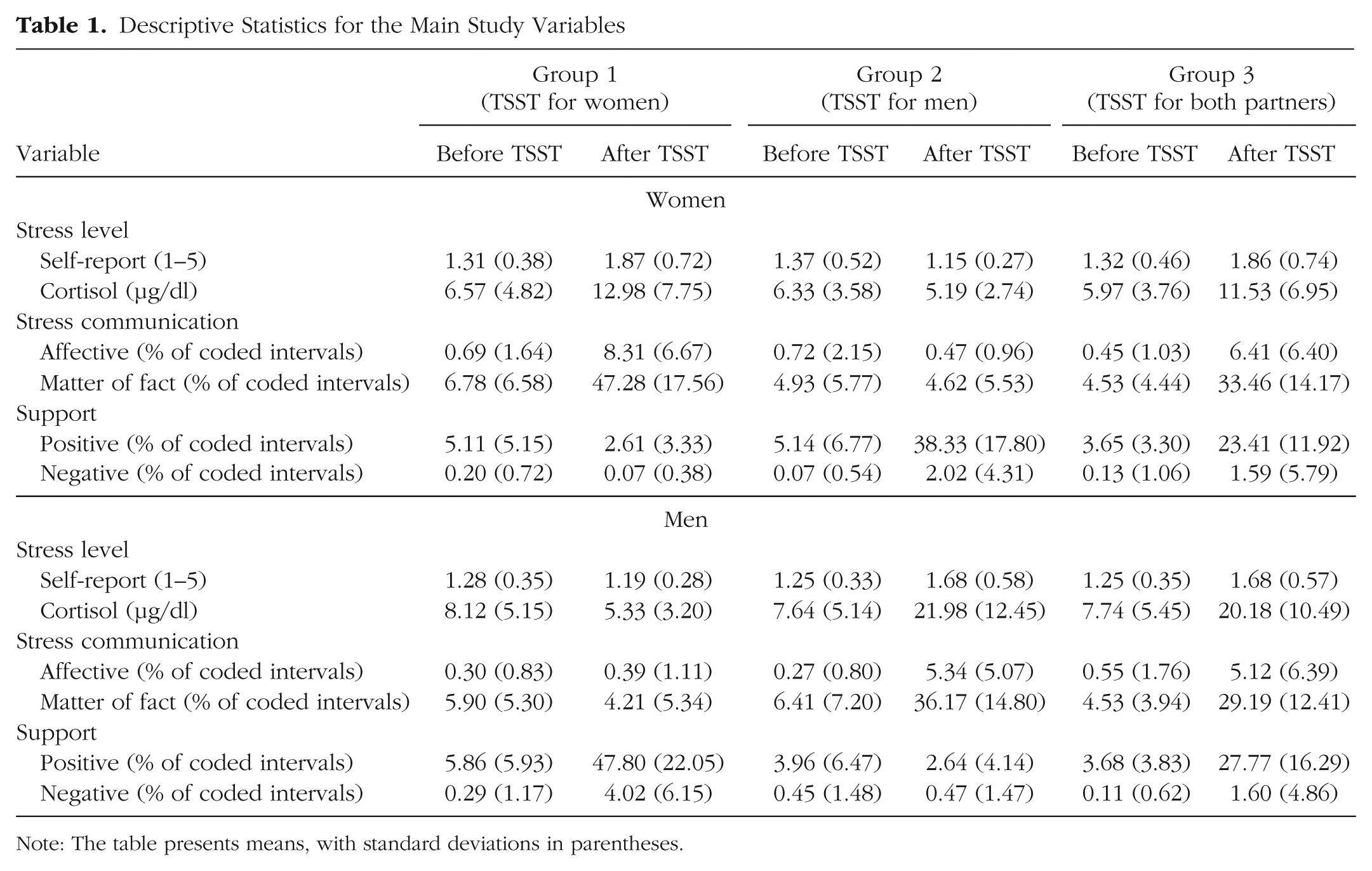
Table 1 presents all the variables measured before and after the TSST for both partners in the three experimental groups. To evaluate whether the TSST produced the intended changes in these variables, and whether it did so differentially as a function of which partner was assigned to the TSST in each group, we analyzed main effects for time as well as Time × Group interactions. The Time × Group interactions indicate whether changes over time varied as a function of experimental group.
Descriptive Statistics for the Main Study Variables
Note: The table presents means, with standard deviations in parentheses.
Self-reported stress
As expected, partners who participated in the TSST reported increases in self-reported stress: Analysis of the stress ratings of Women in Group 1, men in Group 2, and women and men in Group 3 revealed a significant main effect of time, F(1, 186) = 111.3, p < .001, as well as a significant Time × Group interaction, F(2, 186) = 17.3, p < .001. Among partners not assigned to the TSST, self-reported stress levels tended to decline over this same span of time: For men in Group 1, the effect of time was marginal, p = .089, and for women in Group 2, the effect was significant, p = .004 (Bonferroni-corrected pairwise comparisons). Self-reported stress levels did not differ between women in Groups 1 and 3 or between men in Groups 2 and 3 (p > .900). Additional t tests showed that women and men within Group 3 reported comparable stress levels, t(61) = 1.61, p > .100, as did stressed women in Group 1 and stressed men in Group 2, t(125) = 1.61, p > .100.
Biological stress
Cortisol levels measured after the TSST increased for all TSST participants; the main effect of time was significant, F(1, 181) = 261.8, p < .001, as was the Time × Group interaction, F(2, 181) = 34.9, p < .001. The magnitude of this test statistic is noteworthy compared with the parallel results for self-reported stress and is consistent with meta-analytic findings presented by Dickerson and Kemeny (2004). Cortisol decreased for unstressed male partners in Group 1 over the course of the TSST induction (p = .006), whereas the decrease in nonstressed female partners’ cortisol levels in Group 2 was not significant (p = .13).
These results indicate that the TSST increased psychological and biological indices of stress. Moreover, the validity of the hypothesized comparisons is strengthened by evidence that (a) the stressed women in Group 1 and the stressed men in Group 2 experienced comparable levels of TSST-induced stress, (b) the unstressed partners in Groups 1 and 2 experienced similar decreases in stress levels while their partners were participating in the TSST, and (c) the stressed women in Group 1 and the stressed men in Group 2 experienced levels of stress comparable with those of the stressed women and men in Group 3.
Analysis plan
We used Multigroup Design in Mplus (Muthén & Muthén, 2012) to test an extended Actor-Partner Interdependence Mediation Model (Ledermann, Macho, & Kenny, 2011). In this model, changes in both partners’ cortisol levels and stress predicted both forms of stress communication (of both partners), which in turn predicted both partners’ positive and negative support behaviors. This approach allowed us to compare all groups simultaneously and to examine a full range of actor and partner effects, particularly the partner effects captured in our primary dependent variables, which link the stressed participant’s stress communication with the mate’s positive and negative support behavior. Because some behavioral measures of stress communication and support behaviors (e.g., stress communication of nonstressed partners) were not normally distributed, models were estimated using maximum-likelihood estimates with robust standard errors. In Group 1 (women-only TSST), because the variance of women’s negative support was close to zero, we fixed the variance of this variable to 0.01. The same procedure was necessary for women’s affective stress communication in Group 2 (men-only TSST). Appendix B in the Supplemental Material depicts the theoretically expected associations.
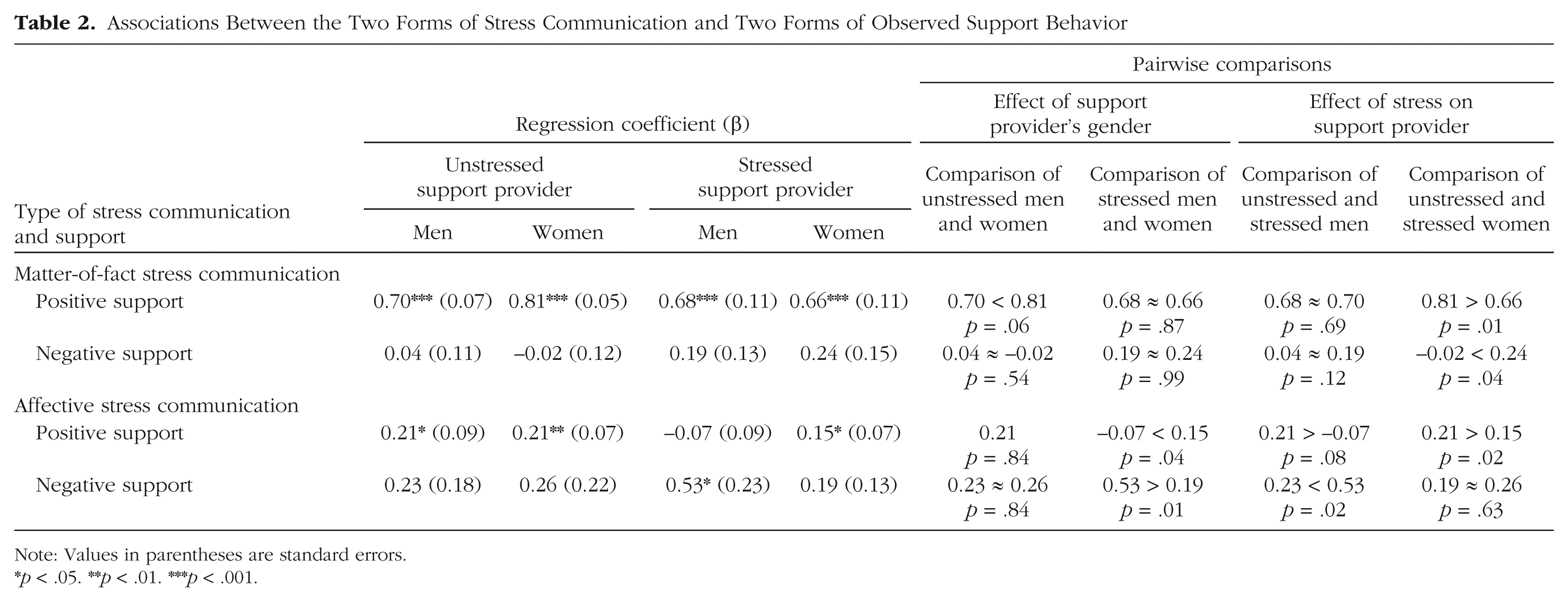
To test the proposed sets of hypotheses, we first used group-specific standardized variables to estimate the (saturated) extended Actor-Partner Interdependence Mediation Model without any restrictions on parameter estimates. The results revealed that neither gender’s changes in stress or cortisol predicted mates’ stress communication; hence, we removed these paths from the model and set all paths linking the independent variables (e.g., increase in stress as measured by self-report and cortisol) with the mediating variables (stress communication) to be equal across groups. Doing so yielded a model with excellent fit, χ2(49) = 64.485, p = .068; root-mean-square error of approximation = 0.07, comparative fit index = .98. This model served as a baseline model, and all other models incorporating the pairwise comparisons of model parameters were compared against the baseline model. In all other models, we restricted the structural parameters to equal those of the baseline model except for the two parameters we wanted to compare. These were freely estimated but were constrained to be equal to each other. The Satorra-Bentler scaled χ2 difference test indicates whether this constraint is tenable; in this case, the test’s result was not significant, so there are no group differences with respect to the parameters. The full set of results from this analysis is provided in Appendix C in the Supplemental Material, and the results pertaining directly to our hypotheses are shown in Table 2.
Associations Between the Two Forms of Stress Communication and Two Forms of Observed Support Behavior
Note: Values in parentheses are standard errors.
p < .05. **p < .01. ***p < .001.
Main results
The left side of Table 2 presents the associations between the two coded forms of stress communication displayed by the stressed partner and the two forms of the partner’s observed support behavior when support providers were unstressed and when they were stressed. The right side of this table presents the results of the four pairwise comparisons that correspond to our first two predictions. Our third prediction was that the results shown in the right-side columns would be more pronounced when stress was communicated in affectively laden terms than when it was communicated with relatively neutral or matter-of-fact expressions.
Results for matter-of-fact stress communication
Results presented in the top portion of Table 2 show that matter-of-fact stress communication corresponded relatively strongly with partners’ displays of positive support behavior. Pairwise comparisons of associations were generally consistent with our prediction that women would not be clearly superior to men when responding to a partner who was expressing stress in affectively neutral ways. Specifically, although unstressed women did respond with marginally more positive support than unstressed men (p = .06), stressed men and women did not differ in the positive support they provided in response to matter-of-fact stress communication. These two results indicate that, at least when the partner communicated TSST-induced stress in an affectively neutral manner, gender differences in provision of social support did not intensify when support providers were operating under higher acute stress. Turning to comparisons within gender, we found that stressed men were no less positive than unstressed men in the positive support they provided, whereas stressed women were less positive than their unstressed counterparts. The latter finding, although unexpected, may reflect the unusually high level of positive support that unstressed women offer to a stressed mate, β = 0.81, p < .001. Finally, the top portion of Table 2 also shows that matter-of-fact stress communication did not reliably covary with partners’ displays of negative support behavior; although stressed women did respond more strongly with negative support than their unstressed counterparts, the associations themselves were not significant, β = 0.24 and β = −0.02, respectively.
Results for affective stress communication
Results presented in the bottom portion of Table 2 show that associations involving affective forms of stress communication conformed closely to predictions derived from the tend-and-befriend model. Specifically, when TSST-induced stress was expressed in a more affectively toned manner by partners, unstressed men and women did not differ in the quality of the positive or negative support they offer. In contrast, when men were under stress and providing support to a stressed partner, the quality of the positive and negative support offered was poorer than that provided by comparably stressed women. Moreover, compared with unstressed men, stressed men appeared to be marginally less responsive with their positive support behavior (p = .08) and reliably more responsive with their negative support behavior when the partner expressed her stress through affective channels. Although associations involving positive support behavior were weaker among stressed women than unstressed women (contrary to prediction), associations involving negative support behavior were not stronger among stressed women compared with unstressed women. In sum, seven of eight findings (including one marginal effect) align with predictions for affective stress communication.
Results for associations between affective stress communication and the partner’s positive and negative support behavior, when support partners were unstressed and stressed, are shown in Figures 1 and 2. The values in these figures come directly from Table 2.
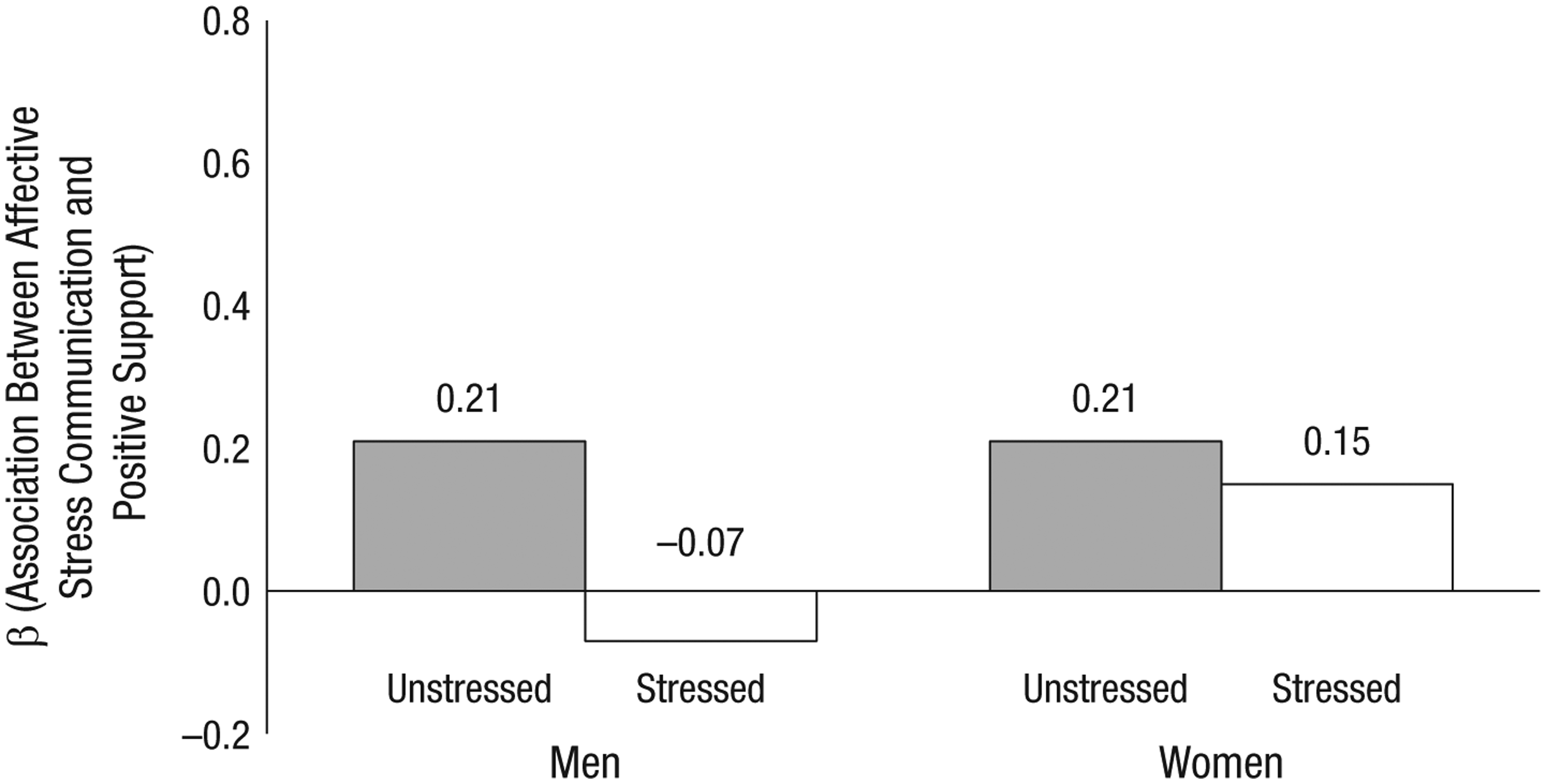
Association between participants’ affective stress communication and positive support provided by their partners, separately for stressed and unstressed male and female partners. Gray bars present results for unstressed men’s and women’s positive support provided to a stressed partner; white bars present results for stressed men’s and women’s positive support provided to a stressed partner.
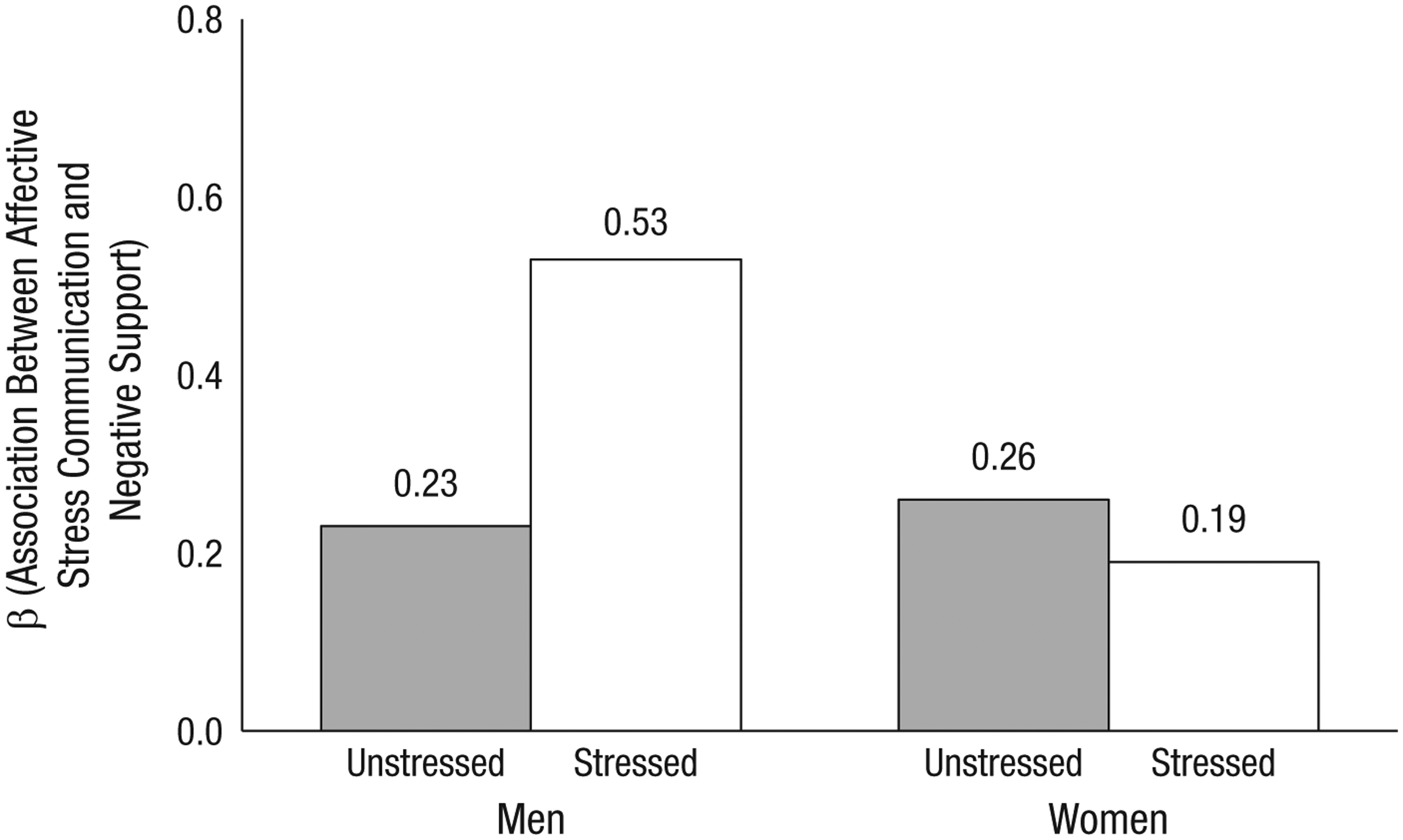
Association between participants’ affective stress communication and negative support provided by their partners, separately for stressed and unstressed male and female partners. Gray bars present results for unstressed men’s and women’s negative support provided to a stressed partner; white bars present results for stressed men’s and women’s negative support provided to a stressed partner.
Differences in stress communication as a rival interpretation
Differences in the stressed partners’ stress communication could provide a rival interpretation for men’s apparent tendency to provide lower quality support under conditions of greater stress. Specifically, men’s apparent shift toward less positive and more negative support as women’s affective stress communication increases might be an artifact of increases in women’s expressions of stress between Groups 1 and 3. This interpretation is unlikely, because stress communication was already controlled in the tested models, and because women’s affective stress communication declined from 8.3% of coded intervals in Group 1 to 6.4% of coded intervals in Group 3 (see Table 1). Moreover, the affective stress communication of men was also consistent between Groups 2 (5.3%) and 3 (5.1%). Thus, results for the support behavior of men in Group 1 and in Group 3 appear to be due to TSST-induced stress rather than to differences in how their stressed partners are communicating their stress.
Discussion
Despite clear theoretical predictions to the contrary, observational and diary studies show no consistent superiority of women over men in the supportive behaviors they display toward an intimate partner. We have drawn on (a) Taylor’s tend-and-befriend model to argue that the degree of stress experienced by support providers is a critical missing moderator in prior studies and (b) work by Gottman and Levenson (1988) to hypothesize that stressed men would be particularly susceptible to their partners’ emotional expressions of stress. Although we saw no clear superiority of stressed women as support providers when partners expressed their stress through neutral matter-of-fact channels, which is consistent with predictions, gender differences became evident when stress was expressed through affective channels. Specifically, affective stress communication covaried reliably with positive support except when men were stressed and providing support and covaried reliably with negative support only when men were stressed and providing support. Stated differently, a reliable association between women’s affective stress communication and men’s positive support fell to nonsignificance when men were under stress, whereas an otherwise nonsignificant association between women’s affective stress communication and men’s negative support achieved statistical significance only when men were stressed. Thus stress appears to orient men, more so than women, away from sensitive support provision.
Although a large sample, an experimental design, and observational data lend confidence to these findings, limitations remain. First, these results do not address whether the support displayed by stressed men and women generalize to other relationships or partners (e.g., same-gender partners) or to the same interaction partners under different conditions (e.g., distressed relationships, conflicts). Second, these findings may not generalize beyond the stress-induction task used here; other tasks might prove challenging for stressed women but not stressed men. Third, generalization of these findings outside the laboratory setting is unwarranted, because stressed men may in their daily lives avoid interactions that would reveal the differences observed here.
Notwithstanding these concerns, the present findings add new information to our understanding of gender differences in relationships. Prior theoretical work suggests that men will be more physiologically responsive than women to a partner’s negative emotion, will feel more overwhelmed or flooded by negative emotion, and will take longer to recover from these exchanges (Gottman & Levenson, 1988; also see Kiecolt-Glaser & Newton, 2001). We provide evidence for this view: Women’s affectively toned stress communication was uniquely effective in recruiting lower-quality support from stressed men, whereas men’s supportive responding to matter-of-fact stress communication was not impaired by stress. At the same time, whereas the Gottman-Levenson perspective locates the cause of dysregulated emotional arousal primarily in negative affect arising between partners, the present findings demonstrate that this arousal can be prompted by acute stressors outside of the immediate interactional context, which then carries over to erode the quality of support that men provide.
Pending replication of our findings, evidence that men’s support is particularly vulnerable to outside stressors would fill a gap in the literature by identifying a specific but largely invisible avenue by which frustrating and arousing environments (e.g., work and family demands) erode the emotional tone of partners’ efforts to remain connected. As future studies elaborate on this idea, it will be essential to recognize that tending and befriending remains well represented within the behavioral repertoires of men, even when they are stressed. People in close relationships regardless of gender clearly respond in supportive ways to one another’s matter-of-fact expressions of distress (Table 2) and probably expect empathic exchanges like these to be routine in their daily interactions. In contrast, stress appears to set a threshold that governs how men will respond to their partner’s affectively toned stress communication: As men became more stressed, supportive responses became less likely. If the partner attributes this ostensibly insensitive response to the partner rather than to the stress that precipitated it, both partners may feel misunderstood; repeated with sufficient frequency, such a pattern might lead both partners to feel unsupported in the relationship. Overall, we found little support for the view that men struggle as support providers because of insufficient skills (cf. Pasch, Bradbury, & Davila, 1997), demonstrating instead that gender differences arise because men’s capacity to deploy available skills in a responsive manner is compromised by diminished resources caused by stress.
Finally, these findings have implications for the larger literature on gender differences. Although advocates of nature-based or nurture-based explanations have long debated the significance of mean-level differences derived from meta-analytic comparisons of men and women, there is growing recognition that “sex differences are highly variable depending on context” and that “all viable theories need to provide a principled account of the systematic variability across contexts in men’s and women’s behavior” (Wood & Eagly, 2013, p. 241). As Taylor’s model suggests, whether a support provider is stressed appears to serve as one such context, revealing similarities in support quality when unstressed men and women are responding to a stressed partner but generating differences in the support that men offer when they themselves are stressed. Generalizations about gender differences in prosocial behavior without reference to context therefore may underestimate the quality of support that men can provide to their partners in the absence of stress and overlook impressive mechanisms of emotion regulation that even stressed women can mobilize when comforting a stressed partner.
Footnotes
Declaration of Conflicting Interests
The authors declared that they had no conflicts of interest with respect to their authorship or the publication of this article.
Funding
This study was supported by Swiss National Science Foundation Research Grants 100013-115948/1 and 100014-115948.

References
Supplementary Material
Please find the following supplemental material available below.
For Open Access articles published under a Creative Commons License, all supplemental material carries the same license as the article it is associated with.
For non-Open Access articles published, all supplemental material carries a non-exclusive license, and permission requests for re-use of supplemental material or any part of supplemental material shall be sent directly to the copyright owner as specified in the copyright notice associated with the article.
