







Abstract
Physically salient but task-irrelevant distractors can capture attention in visual search, but resource-dependent, executive-control processes can help reduce this distraction. However, it is not only physically salient stimuli that grab our attention: Recent research has shown that reward history also influences the likelihood that stimuli will capture attention. Here, we investigated whether resource-dependent control processes modulate the effect of reward on attentional capture, much as for the effect of physical salience. To this end, we used eye tracking with a rewarded visual search task and compared performance under conditions of high and low working memory load. In two experiments, we demonstrated that oculomotor capture by high-reward distractor stimuli is enhanced under high memory load. These results highlight the role of executive-control processes in modulating distraction by reward-related stimuli. Our findings have implications for understanding the neurocognitive processes involved in real-life conditions in which reward-related stimuli may influence behavior, such as addiction.
Physically salient visual stimuli, such as the bright logo of a betting shop on a nondescript street, can attract our attention. However, if these stimuli are not relevant to our current goals (perhaps we were looking instead for a butcher), we may try to ignore them and focus our attention on other cues (e.g., look for displays of meats). Previous research has suggested that resource-dependent, executive-control processes can help reduce distraction by physically salient but task-irrelevant stimuli (Burnham, Sabia, & Langan, 2014; Lavie & de Fockert, 2005). However, it is not only physically salient stimuli that grab our attention: Recent research has shown that learning about the relationship between stimuli and reward also influences the extent to which they capture attention (Anderson, 2016; Failing & Theeuwes, 2017; Le Pelley, Mitchell, Beesley, George, & Wills, 2016). In the current study, we investigated whether resource-dependent control processes can modulate the effect of reward on attentional capture, as they do for physical salience.
Evidence for the role of executive-control processes in modulating attentional capture comes from studies in which working memory load was manipulated. Working memory is an archetypal, frontally mediated executive function (Baddeley & Della Sala, 1996; D’Esposito & Postle, 2015), and individual differences in working memory capacity (and experimental manipulations of memory load) are associated with performance on tasks implicating executive control more widely, in terms of goal maintenance and inhibition (Hester & Garavan, 2005; McCabe, Roediger, McDaniel, Balota, & Hambrick, 2010). Critically, studies have demonstrated an influence of working memory on attentional capture, showing that greater memory load increases distraction by physically salient yet task-irrelevant stimuli (Burnham et al., 2014; Lavie & de Fockert, 2005, 2006). Lavie and de Fockert (2005), for example, used an additional-singleton task, in which participants searched for a circle among diamonds and reported the orientation of a line inside this target circle. On some trials, the search display contained a color-singleton distractor (one of the diamonds was green; all other shapes were red). The typical finding is that the presence of a singleton distractor slows responses to the target (Theeuwes, 1992), suggesting that the salient, task-irrelevant distractor captures participants’ attention. Critically, Lavie and de Fockert demonstrated that interference from the salient distractor was greater when participants were simultaneously required to remember a sequence of five digits, relative to when they had to remember only one number. That is, capture increased when executive working memory resources were taxed by the competing memory task. These findings suggest that executive control can be used to reduce the likelihood of capture by physically salient distractors, in turn increasing our ability to prioritize and select lower salience stimuli that are relevant for current task goals (for a review, see de Fockert, 2013).
Recent research has demonstrated that associations between stimuli and reward also play an important role in attentional capture. The bright logo of the betting shop in our earlier example might also attract attention through its past association with the thrill of gambling. The influence of reward on attentional capture has been established in a substantial body of research (for reviews, see Anderson, 2016; Failing & Theeuwes, 2017; Le Pelley et al., 2016). Consider a study by Pearson, Donkin, Tran, Most, and Le Pelley (2015), which formed the basis for the current procedure. Their task used gaze-contingent eye tracking; eye movements provide an excellent on-line index of attention because eye movement to a location is necessarily preceded by a shift of spatial attention to that location (Deubel & Schneider, 1996).
Pearson et al.’s (2015) task used an additional-singleton procedure in which, on each trial, participants had to make a saccade to a diamond target among circles. Importantly, the color of a color-singleton distractor in the search display signaled the reward magnitude available on each trial. For example, a blue distractor might signal that a rapid saccade to the diamond would produce high reward (500 points; points were later exchanged for money), whereas an orange distractor signaled that a saccade to the diamond would produce low reward (10 points). Importantly, although reward magnitude was signaled by the colored distractor, looking at this distractor was counterproductive because it resulted in omission of the reward that would otherwise have been delivered. Hence, participants were never rewarded for looking at the distractor; their task goal was to make a saccade to the target diamond, and making a saccade to the distractor resulted in reward cancellation and, hence, a lower payoff. Nevertheless, participants sometimes looked at the distractor and, critically, were more likely to do so when it signaled high reward than when it signaled low reward, even though this led to cancellation of more high (than low) rewards. Thus, experience of the reward magnitude associated with the colors influenced the likelihood that they would capture eye movements (and attention) in the future, a finding termed value-modulated attentional capture (VMAC).
Beyond its theoretical importance, understanding modulators of VMAC has clinical implications. Evidence suggests that the processes underlying VMAC are closely related to those that produce attentional biases toward drug-related stimuli in addiction (Albertella et al., 2017; Anderson, Faulkner, Rilee, Yantis, & Marvel, 2013; for a review, see Field & Cox, 2008) and that can promote relapse in recovering addicts (Marhe, Waters, van de Wetering, & Franken, 2013; Marissen et al., 2006; Waters, Marhe, & Franken, 2012). It is thus important to know whether influences of reward on attentional capture are entirely automatic and, hence, immutable or whether—as for physical salience—cognitive-control processes can help reduce the influence of reward on attention when capture is maladaptive and contrary to one’s current goals. We addressed this question by using a modification of Lavie and de Fockert’s (2005) procedure to investigate whether the effect of reward on counterproductive attentional capture is particularly pronounced when concurrent working memory resources are taxed.
Experiment 1
Method
Participants
This experiment was approved by the University of New South Wales Human Research Ethics Advisory Panel (Psychology). G*Power software (Faul, Erdfelder, Lang, & Buchner, 2007) indicated that a sample of 27 participants would provide power of .90 to detect a significant, medium-size (dz = 0.65) within-subjects difference in the VMAC score under high versus low memory load. We tested 30 University of New South Wales students (18 female; age: M = 21.3 years, SEM = 0.5), who participated for course credit or for a payment of 25 AUD. All participants also received a monetary bonus dependent on their performance (M = 9.63 AUD, SEM = 0.3).
Apparatus
Participants were tested individually using a Tobii TX300 eye tracker (300 Hz sample rate; Tobii Tech-nology, Reston, VA) mounted on a 23-in. monitor (1,920 × 1,280 resolution, 60-Hz refresh rate). Participants’ heads were positioned in a chin rest 60 cm from the screen. For gaze-contingent calculations, the experiment script downsampled gaze data from the eye tracker to 100 Hz, with current gaze location defined as the average gaze location of samples from the preceding 10 ms. Auditory stimuli were delivered over headphones. Stimulus presentation was controlled by MATLAB (The MathWorks, Natick, MA) using Psychophysics Toolbox extensions (Brainard, 1997; Kleiner, Brainard, & Pelli, 2007; Pelli, 1997); MATLAB scripts for the experiment are available at https://osf.io/zucn5/.
Design
Visual search task
The task was based on that used by Pearson et al. (2015; see also Pearson et al., 2016). Participants began each trial by fixating on a central cross (for an example trial sequence, see Fig. 1a). After 300 ms of accumulated gaze time inside a circle around the fixation cross (or after 2,000 ms), the cross and circle turned yellow to indicate the imminent search display. This search display consisted of a set of six shapes (2.3° × 2.3° visual angle)—five circles and one diamond (the target)—arranged evenly around an imaginary ring 10.1° in diameter. On the majority of trials, one of the circles was colored either blue (Commission Internationale de l’Éclairage, or CIE, chromaticity coordinates: x = .192, y = .216; luminance = ~24.5 cd/m2) or orange (CIE coordinates: x = .493, y = .445; luminance = ~24.5 cd/m2); all other shapes were gray (CIE coordinates: x = .327, y = .400; luminance = ~8.3 cd/m2). We refer to the colored circle as the singleton distractor to distinguish it from the other (gray) circles in the display, which we refer to as nonsalient nontargets. For half of the participants, blue was the high-reward color and orange was the low-reward color; for the other half of the participants, this was reversed.
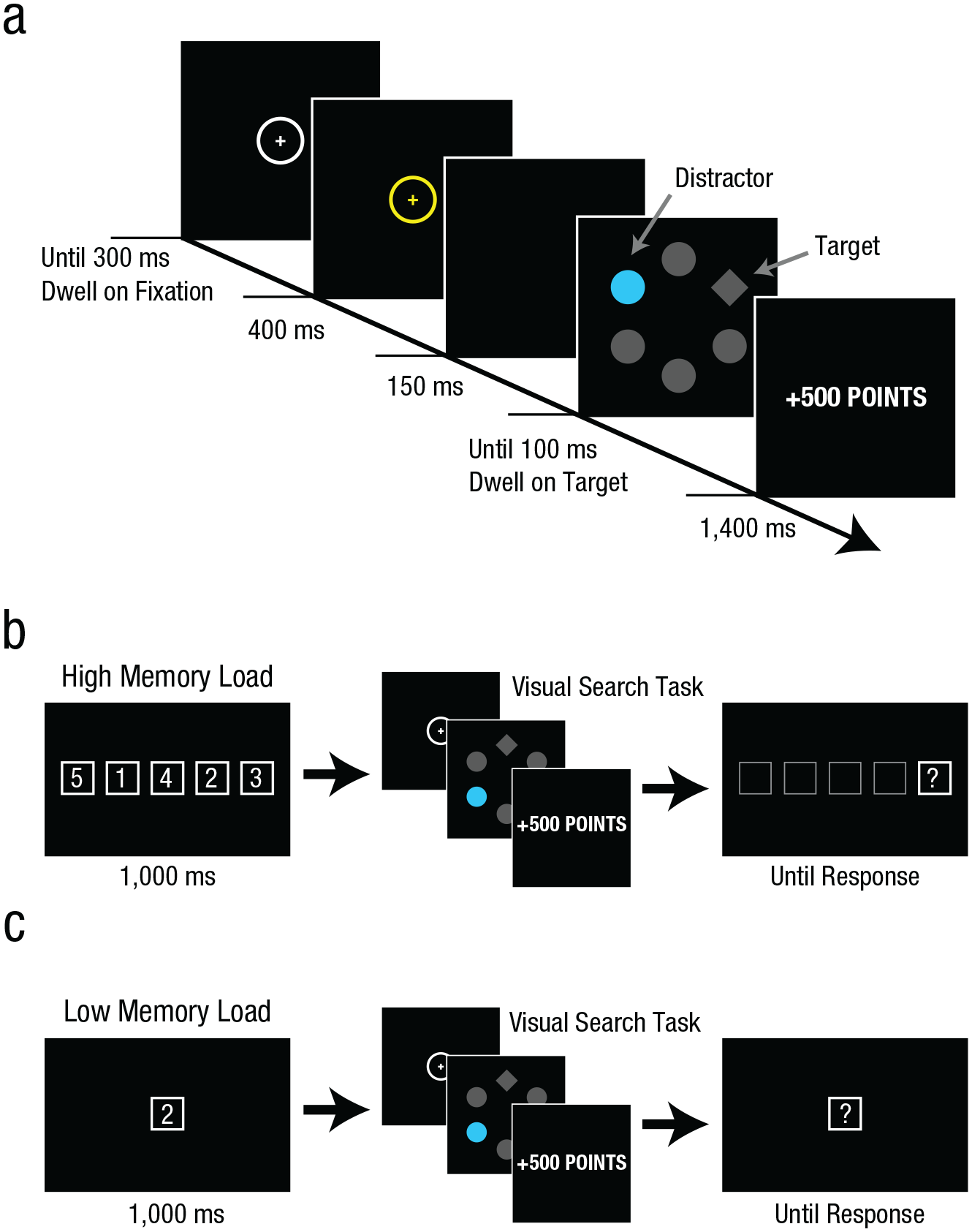
Example trial sequences for the visual search, high-memory-load, and low-memory-load tasks. In each trial of the visual search task (a), participants began by fixating centrally. A search array then appeared, and participants were required to move their eyes to the diamond shape and ignore the color-singleton distractor; a response was registered when they had accumulated 100-ms gaze dwell time on the target. The color of the singleton distractor, blue or orange, indicated the available reward (10 or 500 points, respectively), but looking at this distractor led to reward omission. In blocks with high memory load (b), each trial began with a memory set of five digits (Experiment 1; shown here) or six digits (Experiment 2). This was followed by the visual search task, after which participants were asked to recall one of the digits; one of the placeholder locations was highlighted, and participants entered the digit they thought had appeared in that location. In blocks with low memory load (c), the procedure was the same except that the memory set on each trial consisted of only one digit.
Participants’ task was to move their eyes as quickly as possible to the diamond: A response was registered after 100 ms of gaze dwell time had accumulated within a region (diameter = 3.5° of visual angle) centered on the target. The color of the singleton-distractor circle signaled the reward that was available on each trial: If the display contained a high-reward distractor, a rapid response earned 500 points; if the display contained a low-reward distractor (or no color-singleton distractor), a rapid response earned 10 points. However, if any gaze was registered in a region of 5.1° in diameter around the singleton distractor, the trial was recorded as an omission trial and no reward was given. The trial ended immediately after a response was registered or after 2,000 ms (time-out). If response time was less than 1,000 ms and the trial was not an omission trial, a reward was earned; a feedback screen showed the number of points earned (10 or 500). If the trial was an omission trial, feedback stated “+0 points.” If response time was greater than 1,000 ms or if no response was registered before the time-out, the feedback “Too slow: +0 points. You could have won [10/500] points” appeared, as appropriate. The intertrial interval was 1,200 ms.
Each block comprised 36 trials: 15 with the high-reward distractor, 15 with the low-reward distractor, and 6 with no color-singleton distractor (we term these no-salient-distractor trials), in random order. Target and distractor locations were determined randomly on each trial, with the constraint that the colored distractor never appeared adjacent to the target. On no-salient-distractor trials, one of the nonsalient nontarget gray circles was randomly selected to act as a singleton-distractor location under the same constraint; gaze on this stimulus triggered an omission trial just as on trials with a color-singleton distractor.
Working memory task
The task used to manipulate memory load was based on that used by Lavie and de Fockert (2005). In high-load blocks, each trial began with a 1,000-ms presentation of a memory set of the digits 1 to 5 arranged in random order (see Fig. 1b). After a 500-ms blank interval, participants then completed a trial of the search task, as described above. Immediately following feedback from the search task, participants were prompted to enter the digit that had previously appeared at one of the memory set locations (randomly chosen). If they entered an incorrect number or did not respond within 5 s, an error sound played. In low-load blocks, trials were similar, but participants were presented with only one number (1–5) at the beginning of each trial and then (after receiving search feedback) had to enter that number.
Procedure
Participants were told that they would receive a bonus at the end of the experiment (“typically $8 to $13”), dependent on how many points they earned; no other information on the conversion rate between points and money was provided. They were then informed about the color-reward contingencies in the visual search task, for example, that whenever a blue circle was present in the display, they could win 500 points for looking at the diamond, and whenever an orange circle was present, they could win 10 points. Participants were also informed, “If you accidentally look at the colored circle before you look at the diamond, you will receive NO REWARD. So you should try to move your eyes straight to the diamond.” The experimenter verified that participants understood these instructions by means of check questions. Participants were also told that, later in the experiment, the search task would be combined with a memory task and that they should be as accurate as possible on the memory task because this would influence the amount of money that they received; 100% accuracy on the memory task meant that 100% of the final total points earned in the search task would be converted to money, 99% accuracy meant that 99% of the points would be converted, and so forth. This meant that there was incentive for participants to perform as accurately as possible in every trial of both the memory task and the visual search task; even if they had a poor memory of the memory set on a given trial, they could still earn points in the search task, and this would increase their final total.
Participants first completed three blocks of the search task alone to familiarize themselves with this task (and the color-reward contingencies) before the memory task was introduced. After this, they completed 10 blocks with the search and memory tasks combined. These blocks alternated between high- and low-memory conditions (whether alternation began with a high- or a low-memory block was counterbalanced across participants); participants were informed prior to each block which condition would occur next. Participants took a short break between blocks.
Data analysis
Data analysis followed our previous protocols using this visual search procedure (e.g., Le Pelley, Pearson, Griffiths, & Beesley, 2015; Pearson et al., 2016). We discarded data from the first two trials of each block, trials in which the search task timed out (0.8% of all trials), and trials with less than 25% valid gaze-location data (0.2% of all trials). Valid gaze-location data were registered in 99.3% (SEM = 0.3%) of the 10-ms samples on remaining trials.
The dependent variable was the proportion of omission trials—that is, trials on which gaze was registered on the distractor (or the gray circle assigned the status of a singleton distractor on no-salient-distractor trials; see the Design section) and, hence, the reward was cancelled—for high-reward, low-reward, and no-salient-distractor trials. Our analyses were collapsed across color-reward assignments (whether blue or orange was the high-reward color) to ensure that any effects observed were independent of differences in attention to specific colors.
We were particularly interested in two different contrasts. First, comparing performance on trials with a high-reward distractor versus a low-reward distractor allowed us to isolate the effect of reward on attention, because both search displays featured a color-singleton distractor—the only difference being the size of reward that the distractor signaled. Second, comparing low-reward-distractor trials with no-salient-distractor trials isolated the effect of physical salience on attention, because these trial types differed in whether the search display contained a color-singleton distractor but had the same reward (10 points). 1 These contrasts were compared for high- and low-memory blocks using 2 × 2 repeated measures analyses of variance (ANOVAs). Following Lavie and de Fockert (2005), we included all trials of the visual search task in analyses, regardless of whether the memory-task response was correct or incorrect. The proportion of omission trials was our primary dependent variable, consistent with our previous work using this visual search task (e.g., Le Pelley et al., 2015; Pearson et al., 2016); however, we also performed a secondary, exploratory analysis of saccade latencies (see the Supplemental Material available online).
Results
Memory-task accuracy
Accuracy in the memory task was generally high but, importantly, was significantly higher in the low-memory condition (M = 99.4%, SEM = 0.2%) than in the high-memory condition (M = 96.5%, SEM = 0.5%), t(29) = 5.46, p < .001, d = 1.00. This level of performance is comparable with that reported by Lavie and de Fockert (2005) for their similar memory task (M = 96% and 93% in the low- and high-load conditions, respectively) and suggests that our memory-task conditions placed different loads on cognitive resources as intended.
Visual search task: effect of reward
An ANOVA on the proportion of omission trials with factors of distractor type (high reward vs. low reward) and memory load (high load vs. low load) revealed a main effect of distractor type, F(1, 29) = 45.93, p < .001, η p 2 = .61. Figure 2a shows that omission trials were more likely when the display contained a high-reward distractor versus a low-reward distractor, demonstrating an effect of reward on attentional capture (a VMAC effect). There was also a main effect of memory load, F(1, 29) = 19.28, p < .001, η p 2 = .40, with participants more likely to fixate on both types of distractor in the high-load condition than the low-load condition. Most importantly, there was a significant interaction between these two factors, F(1, 29) = 5.81, p = .022, η p 2 = .17, with a greater VMAC effect (difference in the proportion of omissions for high- and low-reward distractors) in the high-load condition than the low-load condition (see Fig. 2b). Thus, the influence of reward on attentional capture was enhanced under high memory load.
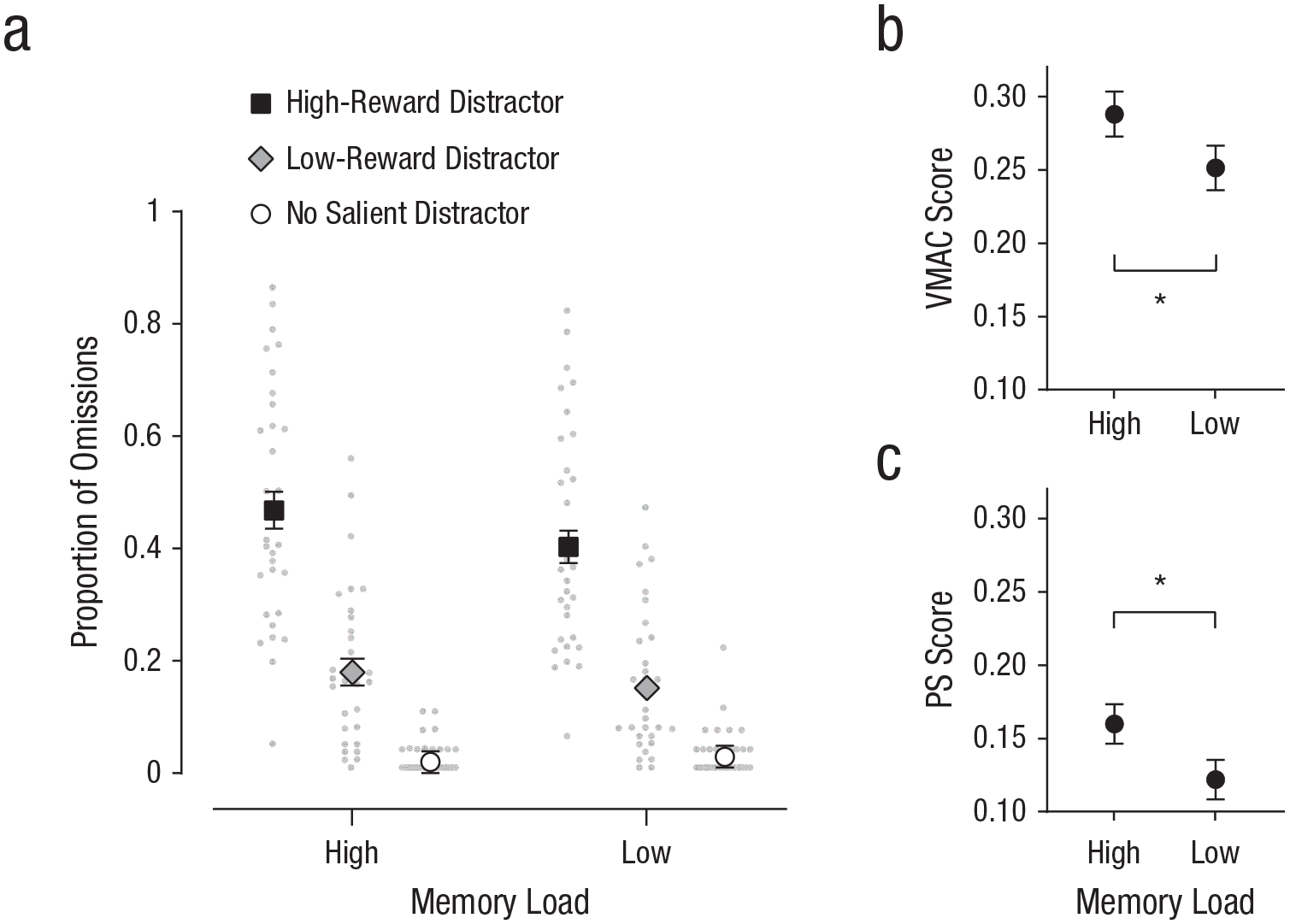
Results from Experiment 1. The proportion of omission trials (a) is shown as a function of memory load (high, low) and distractor type (high-reward distractor, low-reward distractor, and no salient distractor). Omission trials are trials on which participants looked at the color-singleton distractor (or the gray circle assigned the status of a distractor on no-salient-distractor trials) prior to looking at the target, hence causing reward omission. Individual data points are superimposed. The value-modulated-attentional-capture (VMAC) score (difference in the proportion of omissions on high- vs. low-reward-distractor trials) is shown in (b), separately for blocks with high and low memory load. The physical-salience (PS) score (difference in the proportion of omissions on low-reward-distractor vs. no-salient-distractor trials) is shown in (c), separately for blocks with high and low memory load. Error bars represent within-subjects standard errors of the mean (Cousineau, 2005) with Morey (2008) correction. Asterisks indicate significant differences between memory-load conditions (*p < .05).
Visual search task: effect of physical salience
An ANOVA on the proportion of omission trials revealed a main effect of distractor type (low reward vs. no salient distractor), F(1, 29) = 41.84, p < .001, η p 2 = .59, with omission trials more likely when the search display contained a color-singleton distractor than when it did not (see Fig. 2a), demonstrating an effect of physical salience on attentional capture (i.e., an additional-singleton effect). The main effect of memory load was not significant, F(1, 29) = 1.5, p = .24, η p 2 = .05, but there was a significant interaction between distractor type and memory load, F(1, 29) = 7.8, p = .009, η p 2 = .21, with a larger additional-singleton effect (difference in the proportion of omissions for low-reward and no-salient-distractor trials) in the high-load condition than the low-load condition (see Fig. 2c). Thus, the influence of physical salience on attentional capture was enhanced under high memory load, consistent with previous findings (Burnham et al., 2014; Lavie & de Fockert, 2005, 2006).
Experiment 2
Experiment 1 demonstrated that high memory load magnified the distracting effects of both physical salience and reward magnitude on attention. Experiment 2 assessed the replicability of these findings and provided a more sensitive test of the effect of memory load on capture by reward-related stimuli. Our critical novel manipulation was to include occasional both-distractor trials in which both high- and low-reward distractors appeared in the search array, placing them in competition for attention (Pearson et al., 2016). On the basis of Experiment 1, we would expect more eye movements to the distractors under high load. Importantly, however, both distractors had equal physical salience (ensured by counterbalancing) and differed only in reward magnitude. Hence, if memory load increases distraction by reward, then we should expect most or all of the additional distractor-related eye movements under high load to go to the high-reward distractor rather than the low-reward distractor.
Method
Participants
We ran Experiment 2 for as many days as required to test 40 participants, which would give a power of .90 to detect an effect size (dz) of 0.475 (the effect size for the modulation of VMAC by memory load in Experiment 1). In total, we collected 43 data sets. Participants were University of New South Wales students; they participated for course credit or payment of 30 AUD and received a performance-related bonus (M = 11.10 AUD, SEM = 0.40). One participant had an excessive number of time-outs and was excluded (see the Data Analysis section). The remaining 42 participants (19 female) had a mean age of 20.4 years (SEM = 0.4). Blue was the high-reward color for half of the included participants; orange was the high-reward color for the other half. The experiment was approved by the University of New South Wales Human Research Ethics Advisory Panel (Psychology).
Apparatus, design, and procedure
The apparatus, design, and procedure were largely the same as in Experiment 1. As in Experiment 1, participants first completed three blocks of the search task alone, with each trial containing either a single colored distractor (high reward or low reward) or no color singleton. In the following 10 blocks, the search task was combined with the memory task. Each of these combined blocks comprised 44 trials: 15 with a single high-reward distractor (high single), 15 with a single low-reward distractor (low single), 6 with no distractor (no salient distractor), and 8 both-distractor trials featuring both the high- and low-reward distractors. On high-single and low-single trials, the singleton distractor was randomly positioned either one or two locations away from the target; on no-salient-distractor trials, a nonsalient gray circle was chosen in the same way to act as an omission-causing stimulus. On both-distractor trials, the high-reward distractor was positioned as described above, and the low-reward distractor was located the same distance from the target but in the opposite direction (i.e., if the high-reward distractor was two positions clockwise from the target, the low-reward distractor was two positions counterclockwise from the target). Participants could earn 500 points on both-distractor trials, but if gaze were detected near either of the colored distractors, the reward was omitted. Accuracy in the memory task of Experiment 1 was high even in the high-load condition (M = 96.8%). We therefore further increased the load in this condition in Experiment 2 by having participants memorize six digits instead of five. All other details were the same as for Experiment 1; MATLAB scripts for the experiment are available at https://osf.io/zucn5/.
Data analysis
Data analysis was conducted in the same manner as in Experiment 1. One participant registered 188 time-outs (no response within 2,000 ms) from 440 trials in the search task—probably a result of poor eye tracking—and lacked sufficient data for inclusion in analyses. For the remaining 42 participants, we discarded data from the first two trials of each block, trials in which the search task timed out (1.3% of all trials), and trials with less than 25% valid gaze data (0.6% of all trials). Valid gaze data were registered in 99% (SEM = 0.3%) of the 10-ms samples on remaining trials. As in Experiment 1, the proportion of omission trials was our primary dependent variable; findings from a secondary, exploratory analysis of saccade latencies are reported in the Supplemental Material.
Results
Memory-task accuracy
Accuracy was significantly higher in the low-memory condition (M = 99%, SEM = 0.1%) than the high-memory condition (M = 89%, SEM = 1%), t(41) = 6.78, p < .001, d = 1.31.
Visual search task: effect of reward
Initial analysis of the effect of reward on the proportion of omission trials in the search task considered single-distractor trials, as in Experiment 1 (see Fig. 3a). An ANOVA with the factors distractor type (high single vs. low single) and memory load (high vs. low) revealed a similar pattern of results to that in Experiment 1. There was a main effect of distractor type, F(1, 41) = 50.70, p < .001, η p 2 = .55, with more reward omissions on high-single than low-single trials, demonstrating a VMAC effect. There was also a main effect of memory load, F(1, 41) = 36.08, p < .001, η p 2 = .47, and, most importantly, a significant interaction between these factors, F(1, 41) = 3.59, p = .033 (one-tailed because this replicates our previous finding), η p 2 = .08. As in Experiment 1, the VMAC effect was magnified under high memory load (see Fig. 3b).
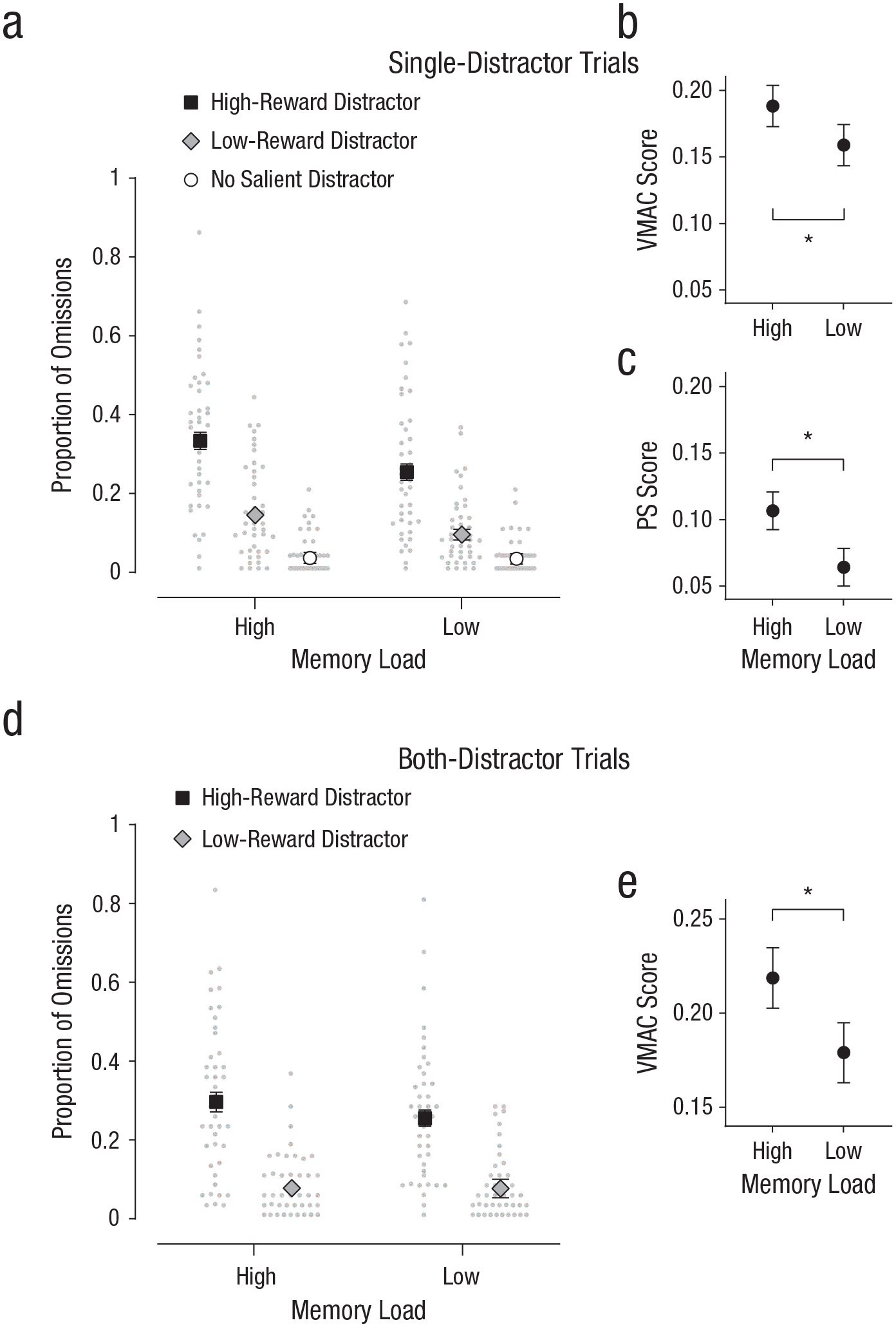
Results from Experiment 2. The proportion of omissions on single-distractor trials (a) is shown as a function of memory load (high, low) and distractor type (high-reward distractor, low-reward distractor, and no-salient distractor). Individual data points are superimposed. The value-modulated-attentional-capture (VMAC) score (difference in the proportion of omissions on high- vs. low-reward-distractor trials) is shown in (b), separately for blocks with high and low memory load. The physical-salience (PS) score (difference in the proportion of omissions on low-reward-distractor vs. no-salient-distractor trials) is shown in (c), separately for blocks with high and low memory load. The proportion of omissions on both-distractor trials (d) is shown as a function of memory load (high, low) and distractor type (high-reward distractor and low-reward distractor). Individual data points are superimposed. The VMAC score (difference in the proportion of omissions caused by looking at the high- vs. low-reward distractor) is shown in (e), separately for blocks with high and low memory load. Error bars represent within-subjects standard errors of the mean (Cousineau, 2005) with Morey (2008) correction. Asterisks indicate significant differences between memory-load conditions (*p < .05).
This conclusion was supported by analysis of the both-distractor trials. Figure 3d shows the proportion of both-distractor trials on which reward omission was triggered by participants looking at the high-reward versus low-reward distractor. An ANOVA revealed main effects of distractor type, F(1, 41) = 40.01, p < .001, η p 2 = .49, and memory load, F(1, 41) = 6.58, p = .014, η p 2 = .14, which were critically qualified by a significant interaction, F(1, 41) = 6.16, p = .017, η p 2 = .13, with a greater difference in capture by high-reward relative to low-reward distractors under high load than low load (see Fig. 3e). Bonferroni-corrected t tests found no effect of memory load on capture by the low-reward distractor, t(41) = 0.13, p = .896, dz = 0.02; by contrast, high load significantly increased capture by the high-reward distractor, t(41) = 3.2, p = .003, dz = 0.51. Not only was the effect of reward on oculomotor capture magnified under high load, but when high- and low-reward distractors directly competed for attention, most if not all of the additional distractor-related eye movements under high load went to the high-reward distractor.
Visual search task: effect of physical salience
As in Experiment 1, we analyzed the effect of physical salience on oculomotor capture via a 2 (low-single trial vs. no-salient-distractor trial) × 2 (memory load) ANOVA on the proportion of omission trials (see Fig. 3a). This revealed main effects of distractor type, F(1, 41) = 35.43, p < .001, η p 2 = .46, and memory load, F(1, 41) = 16.31, p < .001, η p 2 = .29, which were qualified by a significant interaction, F(1, 41) = 13.41, p < .001 (one-tailed because this replicates our previous finding), η p 2 = .25. As in Experiment 1, the additional-singleton effect (more omissions on low-single trials than no-salient-distractor trials) was larger in the high-memory-load condition than the low-memory-load condition, indicating that the effect of physical salience on attentional capture was magnified under high load (see Fig. 3c).
Additional analyses
Our primary analyses of the proportion of omission trials in each experiment were ANOVA based. There are potential concerns with using ANOVAs to assess data relating to proportions because scores are bounded at the extremes (0 and 1), and hence, distributions may not meet parametric requirements assumed by the test. Notably, our critical findings were significant Distractor Type × Memory Load interactions in repeated measures designs. For example, our conclusions around the impact of reward under memory load are based on a comparison of the difference in VMAC score (proportion of omissions for high-reward distractors – proportion for low-reward distractors) under high versus low memory load. These differences are less constrained than the raw proportions (they are bounded at −2 and 2), and hence, concerns about distributions may not apply here. Table 1 shows the results of Kolmogorov-Smirnov normality tests for the difference scores underlying each of the critical interactions tested in Experiments 1 and 2. In only one of these cases (relating to the effect of physical salience in Experiment 1) were data significantly nonnormal (p = .015), suggesting that in most cases, the ANOVA results were valid. Nevertheless, as a conservative measure, we conducted nonparametric tests of all critical interactions using Wilcoxon signed-rank tests to compare (a) VMAC scores and (b) physical-salience scores, both under conditions of high and low memory load. Results are shown in Table 1; these findings are consistent with—and support the conclusions drawn from—the corresponding parametric analyses reported earlier.
Results From Normality Tests and Nonparametric Analyses of Critical Interaction Data
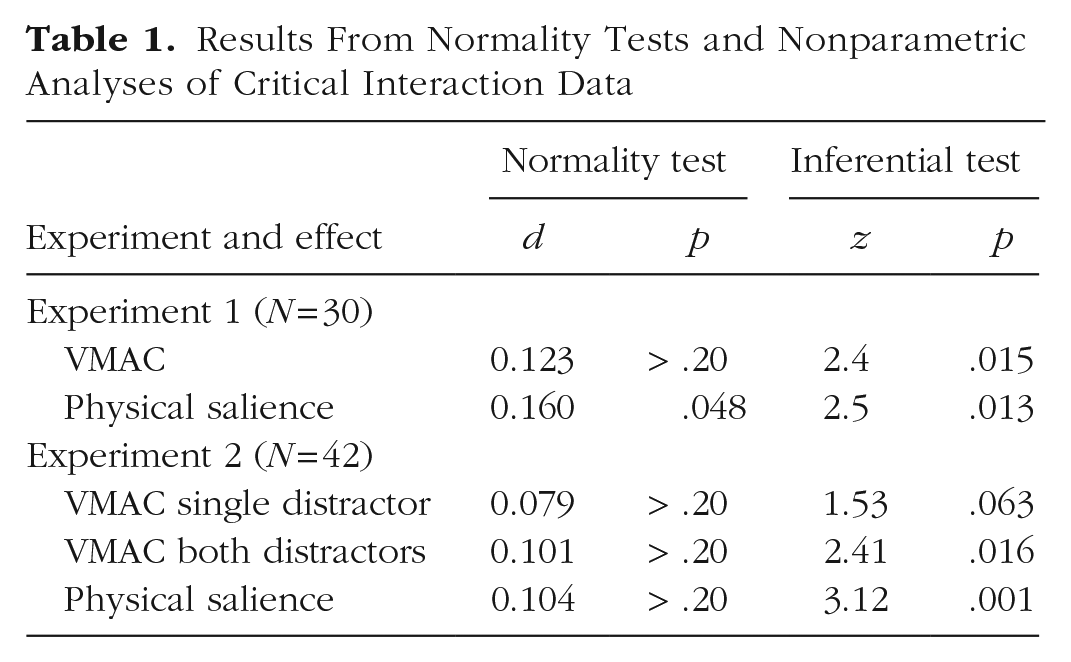
Note: The table shows results for Distractor Type × Memory Load interactions in each experiment. For effects of value-modulated attentional capture (VMAC), distractor type is high-reward distractor versus low-reward distractor; for physical-salience effects, distractor type is low-reward-distractor trials versus no-salient-distractor trials. The normality test used was the Kolmogorov-Smirnov test for normality of the difference scores underlying the interaction (p < .05 indicates a significantly nonnormal distribution); the inferential test used was the Wilcoxon signed-rank test of each interaction (p values for VMAC single-distractor and physical-salience effects in Experiment 2 are one-tailed because they replicate findings of Experiment 1).
Our primary analyses of the proportion of omission trials were collapsed across distractor locations and blocks of the task. We report two further exploratory analyses in the Supplemental Material. The first focused on the effect of distractor type across blocks of the visual search task and found that effects were generally stable across blocks. The second focused on the effect of distractor–target separation: In general, participants were more likely to look at the singleton distractor when it was closer to the target, and there is some evidence that this effect was particularly pronounced for high-reward distractors under high memory load.
General Discussion
We investigated the role of cognitive control in preventing oculomotor capture by salient distractor stimuli. Consistent with previous research (Theeuwes, Kramer, Hahn, & Irwin, 1998), our results showed that participants’ eye movements (i.e., overt attention) were sometimes captured by a physically salient distractor. Furthermore, supporting our own previous work (Le Pelley et al., 2015; Pearson et al., 2016), the present findings revealed that oculomotor capture was also influenced by reward: Participants were more likely to look at a distractor that signaled the availability of high reward than at a distractor that signaled the availability of low reward, even though this resulted in omission of more high rewards (and hence was counterproductive to participants’ final payoff). Critically, the current study showed that the effects of both physical salience and reward on attentional capture were increased under conditions of high versus low working memory load.
The magnified effect of physical salience under high memory load provides a conceptual replication of previous findings (Burnham et al., 2014; Lavie & de Fockert, 2005; but see the discussion of limitations below). Most importantly, our study is the first to demonstrate that the counterproductive influence of reward on attention (VMAC) is also enhanced under high memory load. This effect was most clearly demonstrated in the both-distractor trials of Experiment 2, in which increased memory load resulted in a selective increase in oculomotor capture by the high-reward distractor, with no discernible effect on capture by low-reward distractors. By investigating, for the first time, the impact of manipulating concurrent cognitive load on reward-related attentional capture, we critically demonstrated a causal influence of working memory resources in modulating distraction from ongoing task goals by reward-related stimuli. The wider implications of these novel findings (particularly in the context of addiction) are discussed below.
The finding that memory load modulated the effects of physical salience and reward is consistent with the idea that both properties influence attention (and eye movements) through a common mechanism. Specifically, we suggest that both physical salience and reward determine the activity of stimuli on a topographical saccade map (Itti & Koch, 2001) that influences which stimuli receive the highest priority for selection by the visual system (Pearson et al., 2016). Our findings further suggest that the prioritization of reward-related distractors—such as physically salient distractors—is not a purely automatic process driven by bottom-up activity on the saccade map but can be reduced when participants have sufficient cognitive resources available. The implication is that resource-dependent, executive-control processes can suppress the activity of (and hence likelihood of capture by) task-irrelevant reward-signaling distractors and instead maintain focus on task goals (for related arguments regarding physical salience, see Gaspelin, Leonard, & Luck, 2017; Gaspelin & Luck, 2018).
The current study had some limitations. To ensure sufficient trials for meaningful analysis while limiting the experiment’s duration, we presented participants with only two colors and reward levels. This limited our ability to infer the parametric relationship between reward and attention; participants may have simply classified rewards as “large” or “small” without regard to their specific point values. Future studies could assess effects of a wider range of reward levels. Second, although we interpreted the difference between the low-reward-distractor and no-salient-distractor trials as reflecting the effect of physical salience (because these trial types were matched on reward value), a potentially “purer” test of the effect of physical salience on attentional capture would use a physically salient distractor that was not tied to any reward, small or large. Finally, our study assessed the effect on spatial attention of a memory-load manipulation that itself had a spatial component. Further studies could assess the generalizability of these findings using nonspatial manipulations to tax cognitive resources (e.g., phonological memory, abstract mathematical operations).
As noted earlier, the effect of reward-related stimuli on attention demonstrated in the VMAC procedure bears similarities to the finding of attentional biases toward drug-related stimuli in addiction, and evidence supports a link between the two (Albertella et al., 2017; Anderson et al., 2013; Friese, Bargas-Avila, Hofmann, & Wiers, 2010). These findings are consistent with the possibility that reward-related attentional biases might exert powerful effects on instrumental behavior, leading in some extreme cases to compulsive reward seeking, as observed in addiction (Robinson & Berridge, 1993, 2001). Notably, recent evidence indicates that the relationship between substance use and reward-related attentional bias is moderated by individual differences in levels of executive control, being more pronounced in people with lower levels of control (Albertella et al., 2017; van Hemel-Ruiter, de Jong, Ostafin, & Wiers, 2015; see also Wiers, Boelema, Nikolaou, & Gladwin, 2015). The current findings suggest a direct role for executive control in this relationship. The implication is that participants low in executive control are more influenced by reward-related distractors because they are less able to use cognitive-control processes to inhibit attention to these stimuli. Furthermore, this influence of cognitive resources is not restricted to between-subjects differences but can vary within an individual if cognitive resources are acutely taxed by other demands. Applied to the clinical domain, this implies that drug-related stimuli might be particularly likely to capture attention and influence behavior—potentially producing relapse in individuals attempting to abstain—when cognitive resources are scarce. On a more positive note, the demonstration that capture by reward-related stimuli is amenable to top-down control opens the possibility that maladaptive influences of such stimuli on behavior might be reduced by strengthening these top-down processes, perhaps through appropriate training of cognitive control (cf. Wiers, Gladwin, Hofmann, Salemink, & Ridderinkhof, 2013). This remains a question for future research.
Supplemental Material
Watson_OpenPracticesDisclosure_rev – Supplemental material for Capture and Control: Working Memory Modulates Attentional Capture by Reward-Related Stimuli
Supplemental material, Watson_OpenPracticesDisclosure_rev for Capture and Control: Working Memory Modulates Attentional Capture by Reward-Related Stimuli by Poppy Watson, Daniel Pearson, Michelle Chow, Jan Theeuwes, Reinout W. Wiers, Steven B. Most and Mike E. Le Pelley in Psychological Science
Supplemental Material
Watson_SupplementalMaterial_rev – Supplemental material for Capture and Control: Working Memory Modulates Attentional Capture by Reward-Related Stimuli
Supplemental material, Watson_SupplementalMaterial_rev for Capture and Control: Working Memory Modulates Attentional Capture by Reward-Related Stimuli by Poppy Watson, Daniel Pearson, Michelle Chow, Jan Theeuwes, Reinout W. Wiers, Steven B. Most and Mike E. Le Pelley in Psychological Science
Footnotes
Action Editor
Philippe G. Schyns served as action editor for this article.
Author Contributions
P. Watson, M. E. Le Pelley, S. B. Most, and D. Pearson developed the study concept and task materials. All the authors contributed to the study design. Testing and data collection were performed by P. Watson and M. Chow, and P. Watson and M. E. Le Pelley analyzed and interpreted the data. P. Watson drafted the manuscript. All the authors provided critical revisions and approved the final manuscript for submission.
Declaration of Conflicting Interests
The author(s) declared that there were no conflicts of interest with respect to the authorship or the publication of this article.
Funding
This research was funded by Australian Research Council Grant DP170101715. D. Pearson was supported by an Australian Government Research Training Program Scholarship.
Open Practices
Anonymized data for both experiments and MATLAB source code have been made publicly available via the Open Science Framework and can be accessed at https://osf.io/zucn5. Neither of the experiments reported in this article was preregistered. The complete Open Practices Disclosure for this article can be found at http://journals.sagepub.com/doi/suppl/10.1177/0956797619855964. This article has received the badges for Open Data and Open Materials. More information about the Open Practices badges can be found at  .
.
Notes
References
Supplementary Material
Please find the following supplemental material available below.
For Open Access articles published under a Creative Commons License, all supplemental material carries the same license as the article it is associated with.
For non-Open Access articles published, all supplemental material carries a non-exclusive license, and permission requests for re-use of supplemental material or any part of supplemental material shall be sent directly to the copyright owner as specified in the copyright notice associated with the article.
