







Abstract

Although the classic system view of memory attributes short-term and long-term information retention to independent memory systems (Atkinson & Shiffrin, 1968), the emerging state view of memory replaces this dichotomy with the idea that mental representations are retained in different states (Cowan, 2001). According to this state view, short-term information retention in working memory (WM) is conceptualized as activated long-term memory (LTM) under the focus of attention. Thus, representations across WM and LTM are closely related (e.g., Xie & Zhang, 2018) and can be supported by shared neural mechanisms (Nee & Jonides, 2008, 2013). A previous study by Brady, Konkle, Gill, Oliva, and Alvarez (2013) shows that the precision of retained information across WM and LTM is highly similar, which seems to be consistent with this state view. However, using the same method as Brady et al., Biderman, Luria, Teodorescu, Hajaj, and Goshen-Gottstein (2019) recently reported that precision estimates in WM tasks were substantially higher than those in LTM tasks, suggesting that there are different precision limits across WM and LTM. We found that the interpretation of these conflicting findings was complicated by a conceptual issue in the direct comparison of the behavioral estimates of precision across WM and LTM tasks by both Brady et al. and Biderman et al. To move this line of research forward, we propose an alternative approach using individual differences to provide a better test for the relationship between precision constraints in WM and LTM.
First, caution should be taken when the absolute magnitude of a behavioral estimate of precision is used to infer the precision of retained mental representations. This is because precision estimates can be driven not only by internal noise in mnemonic respresentations but also by many other factors, such as response noise (e.g., van den Berg, Shin, Chou, George, & Ma, 2012). For example, as shown by Biderman et al., precision estimates from the recall paradigm are not immune to the effects of interference occurring at multiple stages of a memory task (e.g., reduced precision estimates across WM reports in Biderman et al.’s Experiment 2 and across short vs. long lists in their Experiment 3). Hence, even if the upper limit of representational precision in LTM is the same as that in WM, increased response interference in the LTM task (e.g., retrieving items from among 180 stimuli in LTM vs. from 3 stimuli in WM in Experiment 1 of Biderman et al.) can introduce additional variability in recall responses, leading to lower LTM precision estimates. Consequently, different precision estimates between WM and LTM tasks (or even just within an LTM task across different list lengths, as in Experiment 3 of Biderman et al.; but see Persaud & Hemmer, 2016) may reflect increased response noise in the LTM task instead of reduced precision in the underlying representation of originally encoded LTM content. Furthermore, because the same issue can also occur during recall of multiple items simultaneously retained within WM (Oberauer & Lin, 2017), interference may not be limited to time-correlated mechanisms. Thus, directly comparing precision estimates from LTM and WM tasks without accounting for additional noise that could be unrelated to mnemonic representations can yield results that are hard to interpret.
This concern is related to the task-impurity problem (Miyake, Emerson, & Friedman, 2000)—the issue that no pure measure in a single task can fully tap a complex underlying psychological construct—in many areas of psychological science. For example, Cowan’s (2001) emphasis on a process-pure estimate of WM capacity has been driving the field to minimize the contributions of sensory memory, LTM, and other orthogonal factors when assessing WM capacity. Likewise, a similar emphasis in the debate on cognitive penetrability has motivated the field to reevaluate empirical evidence regarding top-down influences on perception (Firestone & Scholl, 2016). Efforts to adopt careful experimental designs and analytical approaches to obtain a more process-pure estimate of mnemonic precision are hence not trivial.
Complementary to the direct-comparison approach, the individual-differences approach may be more informative about the relationship between WM and LTM precision at the representational level (see Vogel & Awh, 2008, for a discussion of this approach). That is, if there is a general precision limit across WM and LTM, WM and LTM precision estimates should be correlated across participants. Indeed, our reanalysis of Biderman et al.’s data showed that WM and LTM precision estimates were highly correlated with one another regardless of whether they were analyzed separately in each experiment or meta-analytically combined (Fig. 1; also see Fig. S1 in the Supplemental Material available online; for a detailed description of the procedure we used, see Rosenthal & DiMatteo, 2001). In contrast, the quantitative aspect of WM and LTM, estimated as the probability of successful recall (Pm), did not show significant associations across WM and LTM in either experiment or in the meta-analysis with increased statistical power (all ps > .50). Critically, the significant correlation in precision estimates across WM and LTM was significantly different from the nonsignificant correlation in Pm across WM and LTM (Z = 3.17, p = .0015), as found by comparing the correlated but nonoverlapping meta-analytically combined correlations (Raghunathan, Rosenthal, & Rubin, 1996).
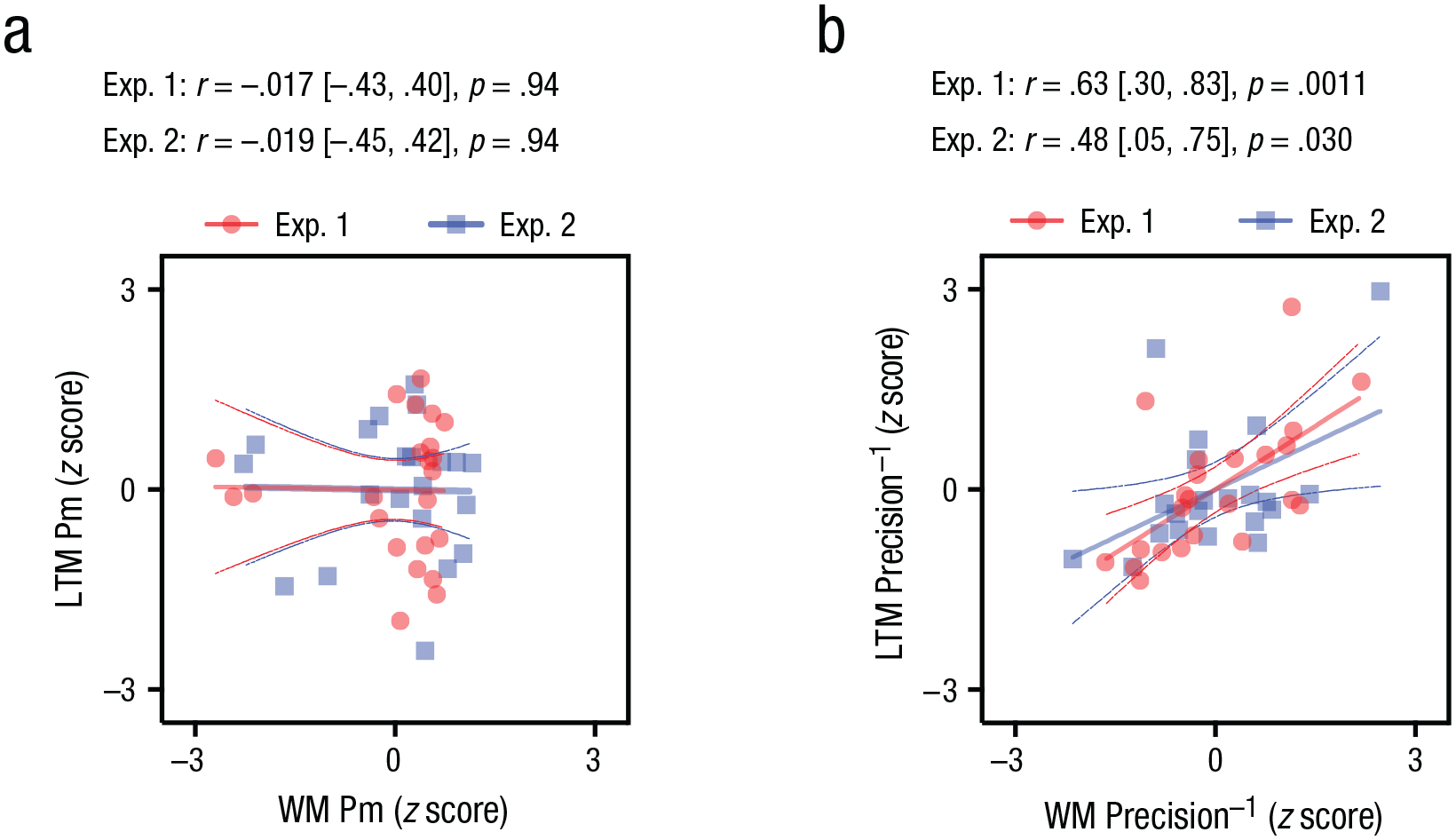
Correlated patterns of (a) probability of successful recall (Pm, namely 1 – the probability of guessing) and (b) mnemonic precision–1 between working memory (WM) and long-term memory (LTM), separately for our reanalyses of data from Experiments 1 and 2 by Biderman, Luria, Teodorescu, Hajaj, and Goshen-Gottstein (2019). Mnemonic precision–1 was estimated from the standard deviation of recall-error distributions from the WM and LTM tasks. Values on the x- and y-axes are maximum-likelihood parameters provided by Biderman et al. (data are available on the Open Science Framework at osf.io/93cvs/; data from Experiment 3 were excluded from the meta-analysis because there was no WM condition in that experiment). Pearson correlations were used to evaluate standardized data; data points represent estimated parameters for individual participants. The solid lines represent linear fits of the data, and the dashed lines represent 95% confidence intervals of the linear fits. In the statistics above the graphs, values in brackets are 95% confidence intervals. (See Fig. S1 in the Supplemental Material for evaluation of the same data using Spearman rank-order correlations, and see Fig. S3 in the Supplemental Material for the results of a meta-analysis of these data along with additional available data in the literature.)
While one may argue that these results seemingly suffer from several major limitations in Biderman et al.’s work (e.g., small sample sizes, presence of potential outliers, restricted data range in some measures, and reliability issues in parameter estimation; but see Fig. S2 and Table S1 in the Supplemental Material), similar findings can be obtained from other available data in the literature (Korkki, Richter, Jeyarathnarajah, & Simons, 2020; see Fig. S3 in the Supplemental Material). These consistent and specific correlated patterns suggest that the correlation in precision estimates between WM and LTM could not simply be attributed to generic individual differences in overall task performance.
However, the mere presence of a correlation does not mean that exactly the same limit constrains representational precision in WM and LTM, because WM and LTM representations can have different but correlated precision limits. It remains to be elucidated where the large amount of shared variance emerges from. One possibility is that a shared perceptual root of WM and LTM information may introduce some shared variance in mnemonic precision between WM and LTM. This perceptual account seems to be supported by evidence showing that there are shared neural substrates for perceptual and mnemonic representations (e.g., Ester, Anderson, Serences, & Awh, 2013; Harrison & Tong, 2009; Schultz et al., 2019). However, mnemonic processes are supported by neural mechanisms beyond those underlying perceptual processes (Eriksson, Vogel, Lansner, Bergström, & Nyberg, 2015; Quian Quiroga, 2016). Furthermore, perceptual precision cannot fully explain individual variability in mnemonic precision (Xie, Berry, Lustig, Deldin, & Zhang, 2019; Xie et al., 2018; also see Korkki et al., 2020). To account for these memory-related variances, one must consider how precise perceptual representations are transformed into high-fidelity mnemonic representations following the offset of sensory inputs (Quian Quiroga, 2016; Yonelinas, 2013).
Another possibility is that additional computation is involved to support mnemonic precision beyond the perceptual processes. One candidate computational process is pattern separation in the medial temporal lobe (MTL), which teases apart similar cortical representations into distinct forms to ensure the fidelity of individual memory content (Marr, 1971). This hypothesis is supported by rich evidence from computational, neuroimaging, and animal studies (Bakker, Kirwan, Miller, & Stark, 2008; Rolls, 1996; Yassa & Stark, 2011). However, it is unclear whether pattern separation is also involved in supporting short-term retention of precise WM content, because the MTL has largely been attributed to LTM in the traditional system view of memory (Jeneson & Squire, 2012). That said, recent progress in human neuroimaging and intracranial electroencephalogram recording provides strong evidence against this traditional system view (Kamiński et al., 2017; Kornblith, Quian Quiroga, Koch, Fried, & Mormann, 2017; Ranganath & Blumenfeld, 2005). If MTL-pattern-separation computation also supports WM precision, especially during the delay period of a WM task, it may serve as a fundamental source of variance for correlated precision estimates between WM and LTM. Inspired by this MTL-pattern-separation hypothesis, researchers should bridge traditionally separate WM and LTM research to investigate the shared mechanism underlying the qualitative aspect of retained mental representations in both WM and LTM.
Supplemental Material
Xie_Supplemental_Material_rev – Supplemental material for Correlated Individual Differences in the Estimated Precision of Working Memory and Long-Term Memory: Commentary on the Study by Biderman, Luria, Teodorescu, Hajaj, and Goshen-Gottstein (2019)
Supplemental material, Xie_Supplemental_Material_rev for Correlated Individual Differences in the Estimated Precision of Working Memory and Long-Term Memory: Commentary on the Study by Biderman, Luria, Teodorescu, Hajaj, and Goshen-Gottstein (2019) by Weizhen Xie, Hyung-Bum Park, Kareem A. Zaghloul and Weiwei Zhang in Psychological Science
Footnotes
Transparency
Action Editor: D. Stephen Lindsay
Editor: D. Stephen Lindsay
Author Contributions
W. Xie identified the issue discussed in this Commentary, developed the concept for the reanalyses, and analyzed the data. All of the authors contributed to the discussion of relevant articles. All of the authors edited and approved the final version of the manuscript for submission.

References
Supplementary Material
Please find the following supplemental material available below.
For Open Access articles published under a Creative Commons License, all supplemental material carries the same license as the article it is associated with.
For non-Open Access articles published, all supplemental material carries a non-exclusive license, and permission requests for re-use of supplemental material or any part of supplemental material shall be sent directly to the copyright owner as specified in the copyright notice associated with the article.
