







Abstract
Is the tendency to morally prioritize humans over animals weaker in children than adults? In two preregistered studies (total N = 622), 5- to 9-year-old children and adults were presented with moral dilemmas pitting varying numbers of humans against varying numbers of either dogs or pigs and were asked who should be saved. In both studies, children had a weaker tendency than adults to prioritize humans over animals. They often chose to save multiple dogs over one human, and many valued the life of a dog as much as the life of a human. Although they valued pigs less, the majority still prioritized 10 pigs over one human. By contrast, almost all adults chose to save one human over even 100 dogs or pigs. Our findings suggest that the common view that humans are far more morally important than animals appears late in development and is likely socially acquired.
Almost everyone cares much more about humans than about nonhuman animals. Across cultures and throughout history, we have used animals for food, clothing products, medical experimentation, and entertainment, and we are often indifferent to their suffering.
Psychological research suggests that these common attitudes and practices are linked to the belief that humans matter far more than nonhuman animals (Amiot & Bastian, 2017; Caviola, Everett, & Faber, 2019; Dhont, Hodson, & Leite, 2016). For example, in moral dilemmas in which the lives of humans are pitted against the lives of animals, adults consistently prioritize humans over even large numbers of animals (Awad et al., 2018; Petrinovich, O’Neill, & Jorgensen, 1993; Topolski, Weaver, Martin, & McCoy, 2013). A recent large-scale study of moral dilemmas involving autonomous cars found that one of the two strongest global preferences is to prioritize saving human lives over those of animals (the other is to save the greater number; Awad et al., 2018). Another study found that we are less empathic and compassionate toward creatures that are more evolutionarily distant from humans (Miralles, Raymond, & Lecointre, 2019).
There are many reasons why people might favor humans over animals. Humans are typically more intelligent, are more socially embedded, and are perceived as having a greater capacity to suffer (Caviola et al., 2019). Alternatively, people might prioritize humans over animals simply because of species membership—they might value humans more merely because they are humans. This is sometimes referred to as speciesism—a term from philosophy that frames our attitude toward animals as a prejudice analogous to sexism or racism (Singer, 1975). In support of the speciesism hypothesis, studies have shown that factors such as the lesser mental capacities of animals play only a partial role in explaining our preference for humans (Caviola et al., 2020). For example, in cases in which humans with severe cognitive impairment have capacities equivalent to or even lower than some animals, people will nonetheless still value humans more than animals.
The view that humans are morally more important is widespread and shapes law, policy, and behavior. However, the developmental trajectory of this view remains unclear. In this research, we investigated whether children also prioritize humans over animals and explored potential explanatory mechanisms (e.g., perceived intelligence).
We are not aware of any work that has directly compared how children and adults morally prioritize animals relative to humans. Of the few studies that have explored children’s attitudes toward animals (see Melson, 2013), only two have systematically investigated these intuitions in a developmental context. One study found that 4- to 10-year-old children cared about an increasingly broad range of entities, including animals, as they grew older, but they generally cared most for humans (Neldner, Crimston, Wilks, Redshaw, & Nielsen, 2018). Another study tracked how 4- to 10-year-old children perceived the moral worth of a range of living, nonliving, and artificial entities, including a dog and a child (Sommer et al., 2019), and found that children thought it was equally wrong to cause physical harm to a dog and a child, but they also thought that it was more wrong to give away a child than a dog. Thus, whereas the first study suggests that children might have a tendency to prioritize humans over animals, this second study suggests that their tendency is weaker than in adults.
To fully investigate possible age differences in the tendency to prioritize humans over animals, we compared children’s and adults’ responses to moral dilemmas that directly pit humans against dogs and pigs. These dilemmas contrasted varying numbers of humans against varying numbers of either dogs or pigs to assess the moral value attributed to humans and animals. Even if participants choose to save a single human over a single dog or pig, for instance, they may still regard the human as just slightly more valuable and hence would not favor a human over two animals.
The Present Research
In this project, children and adults were asked to consider hypothetical scenarios in which two boats and their passengers were sinking, and they had to choose which of the two boats they would rather save (they also had the option of not deciding). More specifically, across several dilemmas, participants were asked whether they would rather save one, two, 10, or 100 humans or one, two, 10, or 100 animals (dogs or pigs).
On the basis of previous research on adults, we hypothesized that adults would prioritize humans even in cases in which many more animals could be saved. By contrast, we hypothesized that children would have a weaker tendency than adults to prioritize humans over these animals. This hypothesis was driven by the findings of a previous study, discussed above, that showed that young children consider harm inflicted on a dog and on a child to be equally wrong (Sommer et al., 2019).
Statement of Relevance
People everywhere tend to care about and value humans more than nonhuman animals. In two studies, we explored whether this “speciesist” attitude is present even in young children. To find out, we asked 5- to 9-year-olds and adults whether they would choose to save the lives of humans or of dogs and pigs. As expected, most adults were highly speciesist, choosing to save one human over even 100 dogs or pigs. But surprisingly, children lacked this prohuman bias. Many children seemed to value the life of a dog as much as the life of a human and chose to save 10 pigs over one person. These findings clash with the view held by many philosophers and psychologists that children have an initially narrow “moral circle” that they gradually expand over development. Instead, they suggest that the perspective that humans are morally special is a socially acquired ideology. It may emerge as children experience the many ways in which we use animals to serve human needs.
Additionally, we hypothesized that both adults and children have a stronger tendency to prioritize humans over pigs than over dogs because they value dogs—a companion animal—more than pigs—a food animal (Bastian, Loughnan, Haslam, & Radke, 2012; Bratanova, Loughnan, & Bastian, 2011; Loughnan, Haslam, & Bastian, 2010). Finally, following past research (Neldner et al., 2018), we hypothesized that children’s tendency to prioritize humans over animals increases with age.
Method
Reports of all measures, manipulations, and exclusions as well as all data, analysis code, and experimental materials are available for download at https://osf.io/24ewh. For all studies, relevant ethical guidelines were followed, and the research was approved by the Yale University International Review Board and University of Oxford’s Central University Research Ethics Committee.
Studies 1a and 1b
Study 1 was preregistered at https://osf.io/q43zk.
Power analysis
G*Power (Version 3.1; Faul, Erdfelder, Buchner, & Lang, 2007) specified that a sample size of 189 would be needed to obtain 80% power to detect a small to medium effect (f2 = .075) with an alpha of .05 in a linear multiple regression with six predictors (animal species, dog exposure, age, sex, sentience, intelligence). To ensure that the study was sufficiently powered, we aimed to recruit 220 participants.
We recruited this sample for both adult and child populations. An a priori power analysis for a 2 × 2 analysis of variance (ANOVA) with two groups (children vs. adults) and two species (pig vs. dog) revealed that a total sample size of 259 would be required to obtain 80% power to detect a small to medium effect ( f = .175) with an alpha of .05. Thus, these studies were sufficiently powered.
Participants
Study 1a (children)
We recruited a total of 249 participants between the ages of 5 and 9 years. 1 Participants were tested in a laboratory, a local museum, local schools, public parks, and local festivals. The children tested in the laboratory were recruited from a list of parents who had previously agreed to participate. Results did not vary as a function of testing location. An additional 14 participants took part in the study but were not included: six because of experimenter error, two because of revoked consent, one because of inattention, and five because they were outside our predefined age range. A further 28 participants were excluded because they failed the two comprehension-check questions (involving plate and worms instead of humans, pigs, or dogs), leaving us with a final sample of 207 (89 female; age: M = 7.71 years, SD = 1.36). Of these, parents of 117 children opted to report their ethnicities (82% White/Caucasian, 8% Black/African American, 4% Asian, 2% Indian, 1% Hispanic, 5% mixed or multiple ethnicities). We also conducted all analyses without any exclusions (N = 221) and when excluding all participants who failed only one comprehension-check question (n = 169). All key findings remained the same (see https://osf.io/xawgj/).
Study 1b (adults)
We recruited 224 American adults online via Amazon’s Mechanical Turk. They received 40¢ in payment (in line with U.S. minimum wage) for their participation. Two participants were excluded for failing either the online attention check or the two comprehension checks, leaving a final sample of 222 people (93 female; age: M = 37.24 years, SD = 10.91). Sample size was determined by the same power analysis employed in Study 1a. Participants reported having the following ethnicities (multiple selections were possible): 83% White/Caucasian, 8% Black/African American, 5% Asian, 1% Indian, 7% Hispanic, and 2% other. The mean religiosity level was 2.44 (SD = 2.08) on a scale from 1 (not at all religious) to 7 (extremely religious); 55% reported having no religious affiliation, 32% reported being Christian, and the remaining fraction reported having another religion or belief. The mean political-ideology score was 3.30 (SD = 1.78) on a scale from 1 (very liberal) to 4 (moderate) to 7 (very conservative).
Materials and procedure
The study employed a within-subjects design, so all participants saw all questions.
Study 1a
Trained lab assistants collected the data. The survey was hosted on Qualtrics, and all stimuli were presented on 10.2-in. iPads. A full copy of the survey, including all experimenter scripts, is provided at https://osf.io/24ewh. After written parental consent was obtained, participants were given the instructions for the study. They were told that two boats were sinking and that no one on either of the boats is able to swim but that they could choose to save one boat. They were also told that if it was too hard to choose, they could pick a third option, “can’t decide.”
They subsequently completed a familiarization task (one bike vs. 10 pens) with the same response options as the main task (save one bike, save 10 pens, can’t decide). This was designed to ensure that children understood the conditions of the task. After they had made their choice, the implications of their decision were explained to them (“You will save one bike, but you won’t save 10 pens”), and they were given the opportunity to change their response as many times as they liked.
After completing the familiarization task, participants completed the main comparisons. These were 18 comparisons of the same structure as in the familiarization phase. These comparisons comprised three blocks. One block contained seven humans-versus-dogs questions, another contained seven humans-versus-pigs questions, and the third contained four additional questions. The seven questions asked about saving one human versus one dog/pig, two dogs/pigs, 10 dogs/pigs, and 100 dogs/pigs and saving one dog/pig versus one human, two humans, 10 humans, and 100 humans. The third block consisted of control questions asking about saving one human versus 10 humans, one human versus 10 worms, one human versus 10 plates, and one dog versus one pig. The purpose of these control questions was to rule out the possibility that children might merely select the larger number of entities rather than engaging maturely with the dilemmas.
The entity type and quantity varied for each comparison. The order in which blocks were presented, order in which questions were presented, and side on which each member of a comparison was presented (left vs. right) were all fully randomized. Note that in the materials presented to participants, the term person (or people) was used instead of human because we assumed this was easier for children to understand.
After completing the main comparisons, participants then completed capacity ratings for all three entities (human, dog, pig). All questions were presented in a random order, and the entities were randomized within each question type. The questions were as follows: (a) “How smart is a [x]?” (b) “How much can [x] feel physical pain?” (c) “How much can [x] feel sad and scared?” Responses were made on a scale from 1 to 4 (not at all, a little bit, a medium amount, a lot). For the analysis, we averaged perceived capacity to experience physical pain and negative emotions to form a single “sentience” score. After completion of the capacity ratings, parents were debriefed, and children were offered a prize as a thank you for participating (a small toy). Children tested in schools were not offered a reward.
Study 1b
This study was almost identical to Study 1a. The only difference was that adult participants completed the task online and read the task themselves rather than having the task administered to them by an experimenter. Adults also reported their income, education level, and political orientation.
Justification of stimuli
This study involved providing children and adults with “tragic trade-off” dilemmas (Tetlock, 2003). This differs from past work, such as the study by Neldner et al. (2018), in which children were asked how much they care about different entities. However, caring and moral status are distinct from each other. Here, we were interested in moral-status attribution, which is closely linked to preventing death and suffering. It is plausible, for example, that someone might dislike people and love animals but still feel uncomfortable choosing to save an animal over a human. Thus, we felt that trade-off dilemmas were best able to capture people’s intuitions about the moral status of different beings. Another reason is that trade-off dilemmas require people to directly compare two options, which allowed us to more precisely measure how many animals people think are worth one human. This sort of dilemma captures many real-life zero-sum situations that we face as individuals or as a society (e.g., where to direct our limited resources). By contrast, the independent ratings used in past work (Neldner et al., 2018) allowed participants to assign high moral worth to all entities.
We chose dogs because they are a highly valued animal (see Neldner et al., 2018) and would provide a strong test of children’s speciesist tendencies. We chose pigs because they are comparable with dogs in many ways (size, behavior, intelligence) but are categorized as a food animal and generally granted less moral status (Caviola & Capraro, 2020).
We purposefully chose abstract categories of individuals (human, dog, pig), following the standard practice in this sort of research (Crimston, Bain, Hornsey, & Bastian, 2016; Greene, Sommerville, Nystrom, Darley, & Cohen, 2001; Hester & Gray, 2020; Neldner et al., 2018; Schein, 2020). Future research could investigate the possible effects of more specific characterizations. It is possible that both adults and children would respond differently if the individuals were described in more concrete terms. Research into “identifiable-victim” effects (Kogut & Ritov, 2011), for example, suggests that we value individuals more if they are given names. It is possible that such an effect would be stronger for humans than for dogs or pigs and, hence, might lead children to behave more similarly to adults, valuing humans more. Further, we would expect participants to be sensitive to historical and social information about the individuals in question. Many adults, we suspect, would rather save a puppy than save a boat with 10 serial killers on it. A lot of children would probably save a boat with their mother on it than a boat with any number of animals on it. Further, it is possible that children would prioritize humans over animals more if the humans at stake were children as well because they perceive them either as peers or as more vulnerable than adults (cf. Goodwin & Landy, 2014).
Studies 2a and 2b
Study 2 was preregistered at https://osf.io/8twbs.
Power analysis
A power analysis indicated that a total sample size of 103 would be required (i.e., 52 per group) to obtain 80% power to detect a medium effect ( f = .28) with an alpha of .05, 1 degree of freedom, and two groups (children and adults). Because we did not plan to conduct a regression analysis as in Study 1, the required sample size was much smaller. To account for exclusions, we aimed to recruit 65 participants per group.
Participants
Study 2a (children)
We recruited a total of 83 participants between the ages of 7 and 9 years. Six participants were excluded because of experimenter error, two because of technical issues, one because of parental interference, nine because they were outside of our age range, and four because they failed the two comprehension-check questions (plate and worms), leaving us with a final sample of 61 (31 female; age: M = 7.89 years, SD = 0.82). Of these, parents of 30 children opted to report their ethnicity (66% White/Caucasian, 13% Black/African American, 1% Asian, 0.3% Hispanic, and 0.6% mixed or multiple ethnicities). Children were again tested and recruited by trained research assistants in a dedicated testing lab, at a local museum, at local schools, and in public parks. Again, testing location did not influence the results.
Study 2b (adults)
We recruited 66 American adults online via Amazon’s Mechanical Turk. They received 36¢ in payment (in line with U.S. minimum wage) for their participation. Two participants were excluded for failing either the online attention check or the two comprehension checks, leaving a final sample of 64 people (23 female; age: M = 35 years, SD = 1.90). Participants reported having the following ethnicities (multiple selections were possible): 88% White/Caucasian, 8% Black/African American, 6% Asian, 2% Indian, 2% Hispanic, and 0% other. The mean religiosity level was 2.27 (SD = 1.86) on a scale from 1 (not at all religious) to 7 (extremely religious); 63% reported having no religious affiliation, 31% reported being Christian, and the remaining fraction reported having another religion or belief. The mean political-ideology score was 2.86 (SD = 1.88) on a scale from 1 (very liberal) to 4 (moderate) to 7 (very conservative).
Materials and procedure
We used the same materials and procedure as in Study 1 with two exceptions. First, instead of being asked about their own preferences, participants were introduced to a character, “Mr. X,” who always does the right thing. They were then asked to report which boat they thought Mr. X would save in each scenario.
Second, we omitted the mental-capacity questions. We did this for two reasons. First, we were interested in determining whether the overall finding was representative of preferences or moral judgments, and thus we were not focused on predicting attitudes. Second, with the smaller sample, this second study would have been insufficiently powered to accurately identify such predictors.
Analyses
For the statistical analyses, we calculated two scores per participant: a humans-over-dogs bias score and a humans-over-pigs bias score. The scores were calculated as follows. Each participant received certain points for each dilemma depending on their choice; these points were aggregated per participant. The point-scoring system was based on the function log2(2x), where x stands for the larger number of beings of the respective dilemma. This would ensure that the scores were weighted by the numbers of beings at stake in the dilemma but not so much that the dilemmas involving a higher number of beings completely dominated the score. For example, it meant that prioritizing one person over 100 dogs contributed more to the humans-over-dogs score than prioritizing one human over 10 dogs, but not 10 times more. The maximum score (absolute prioritization of humans) was 14.96, and the minimum score was –14.96. A score of zero meant that the participants attributed the same moral status to both types of beings. See https://osf.io/xawgj/ for more details about the scoring system.
Results
Studies 1a and 1b
In this study, we presented both children and adults with the same set of moral-prioritization dilemmas. We found that children had a much weaker tendency to prioritize humans over animals than adults did (Fig. 1). For example, whereas 71% of children prioritized 100 dogs over one human, 61% of adults prioritized one human over 100 dogs. The one-versus-one dilemmas were particularly revealing: 35% of children prioritized one human over one dog, 28% of children prioritized one dog over one human, and the rest could not decide. In contrast, 85% of adults prioritized one human over one dog, and only 8% prioritized the dog; 18% of children prioritized one pig over one human, 57% prioritized one human over one pig, and the rest could not decide. In contrast, 93% of adults prioritized one human over one pig, and only 3% prioritized the pig.
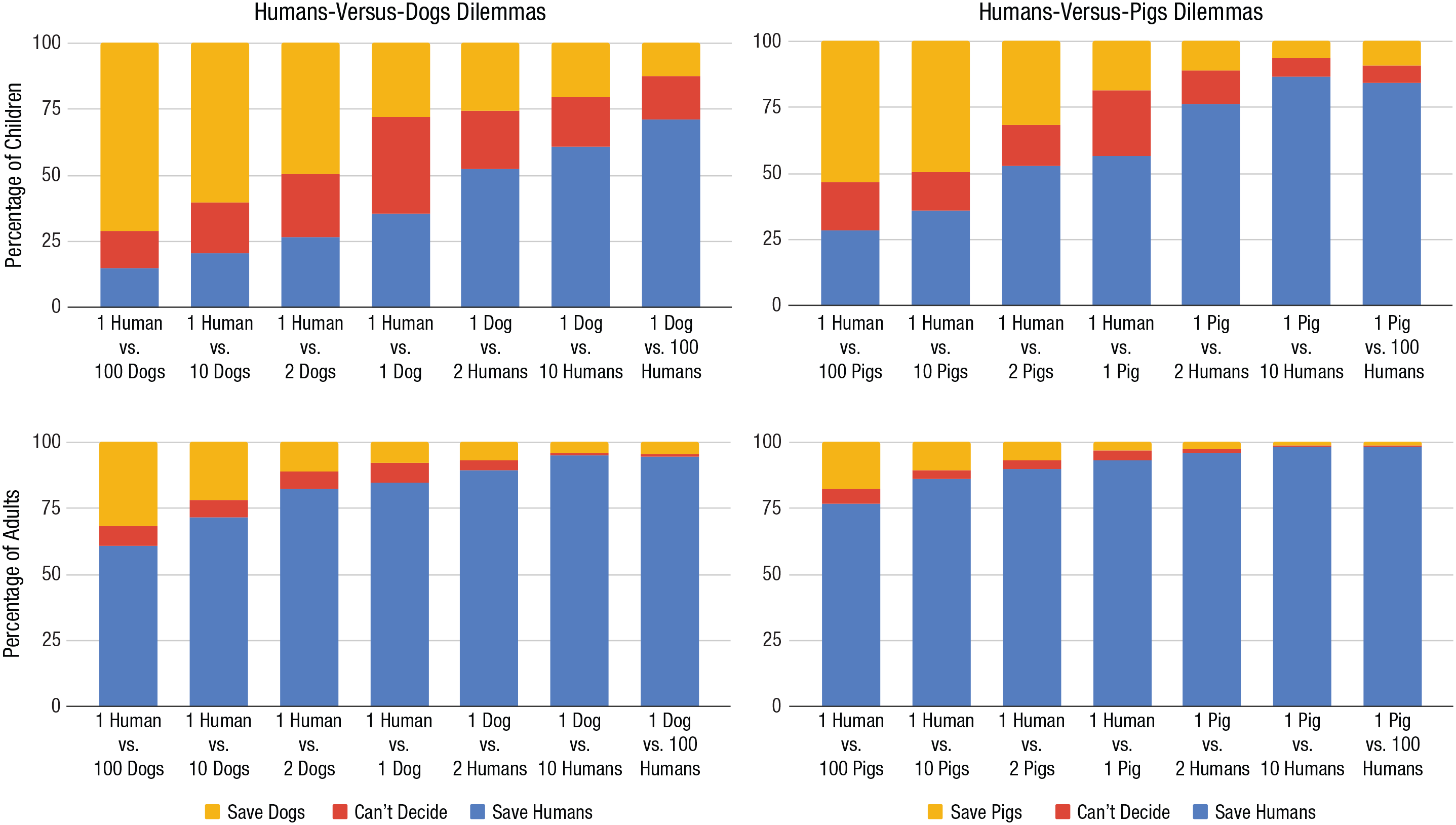
Percentage of children (top row) and adults (bottom row) who prioritized saving humans, prioritized saving animals, or could not decide which to prioritize (Study 1). Results are shown separately for comparisons that involved humans versus dogs (left column) and humans versus pigs (right column).
On the basis of the responses across the seven dilemmas, we calculated a humans-over-dogs and humans-over-pigs bias score for each participant. The higher the score, the stronger the tendency to prioritize the human over the respective animal species. Children had a mean humans-over-dogs bias score of 0.24 (SD = 6.66) and a humans-over-pigs bias score of 4.58 (SD = 6.41). Adults had a mean humans-over-dogs bias score of 9.89 (SD = 7.47) and a humans-over-pigs bias score of 12.3 (SD = 5.43). A one-sample t test showed that children’s humans-over-dogs bias score was not statistically higher than zero, t(206) = 0.52, p = .60, d = 0.04, 95% confidence interval (CI) = [−0.10, 0.17], suggesting that, on average, children tend not to prioritize humans over dogs. Children’s humans-over-pigs bias score, t(206) = 10.26, p < .001, d = 0.71, 95% CI = [0.56, 0.87], as well as both adults’ humans-over-dogs bias score, t(222) = 19.77, p < .001, d = 1.32, 95% CI = [1.15, 1.52], and humans-over-pigs bias score, t(222) = 33.82, p < .001, d = 2.26, 95% CI = [2.05, 2.56], were all statistically above zero, suggesting that children do prioritize humans over pigs and that adults prioritize humans over both dogs and pigs.
A 2 (group: children vs. adults) × 2 (species: pig vs. dog) mixed ANOVA revealed two main effects and an interaction. Children had a weaker tendency than adults to prioritize humans over animals, F(1, 426) = 239.03, p < .001, η p 2 = .36, 95% CI = [.29, .42]. Both children and adults had a stronger tendency to prioritize humans over pigs than over dogs, F(1, 428) = 143.51, p < .001, η p 2 = .26, 95% CI = [.19, .32]. The difference in bias scores was greater for children than for adults, F(1, 428) = 11.85, p < .001, η p 2 = .03, 95% CI = [.01, .06]. This interaction effect, however, could simply be the result of a ceiling effect in adults, that is, their scores were close to the maximum score for both pigs and dogs.
Figure 2 shows that children and adults had similar perceptions about the intelligence and sentience levels of humans, dogs, and pigs. They both perceived humans to be more intelligent than dogs and dogs to be more intelligent than pigs. Similarly, they both perceived humans to be more sentient than dogs and dogs to be more sentient than pigs. Notably, the differences in perceived intelligence and sentience for these beings were of similar degree in adults and children. Yet despite this, children and adults gave different moral judgments, which suggests that perceived intelligence and sentience does not fully account for moral judgments.
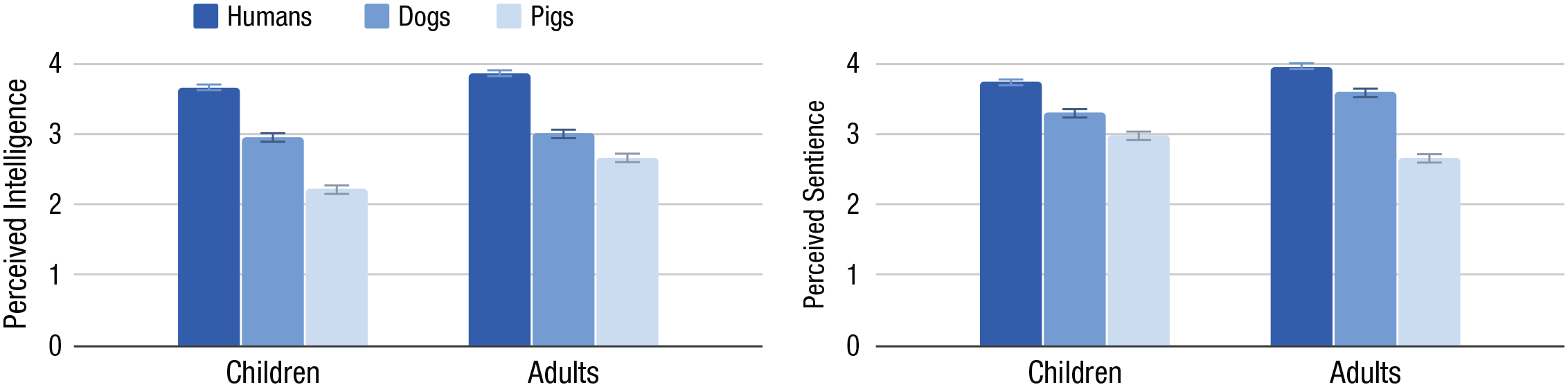
Children and adults’ mean ratings of intelligence (left) and sentience (right) for humans, dogs, and pigs (Study 1). Error bars represent standard errors.
To explore potential explanatory mechanisms, we conducted a linear regression using the bias scores as an outcome variable and with species (pig vs. dog), age, gender, perceived intelligence, perceived sentience, and regular dog (pet) exposure as predictor variables. This analysis was conducted separately for the child and adult samples. Note that we subtracted perceived intelligence and sentience scores for the animals from the perceived intelligence and sentience scores of humans for each participant, producing scores for perceived difference in intelligence and perceived difference in sentience. The results showed that species, perceived intelligence, and dog exposure were significant predictors in both the children and adult samples (Table 1), whereas gender and perceived sentience were not. Age was predictive in the adult sample but not in the child sample.
F Values From the Linear Regression Predicting Bias Scores in the Child and Adult Samples (Study 1)
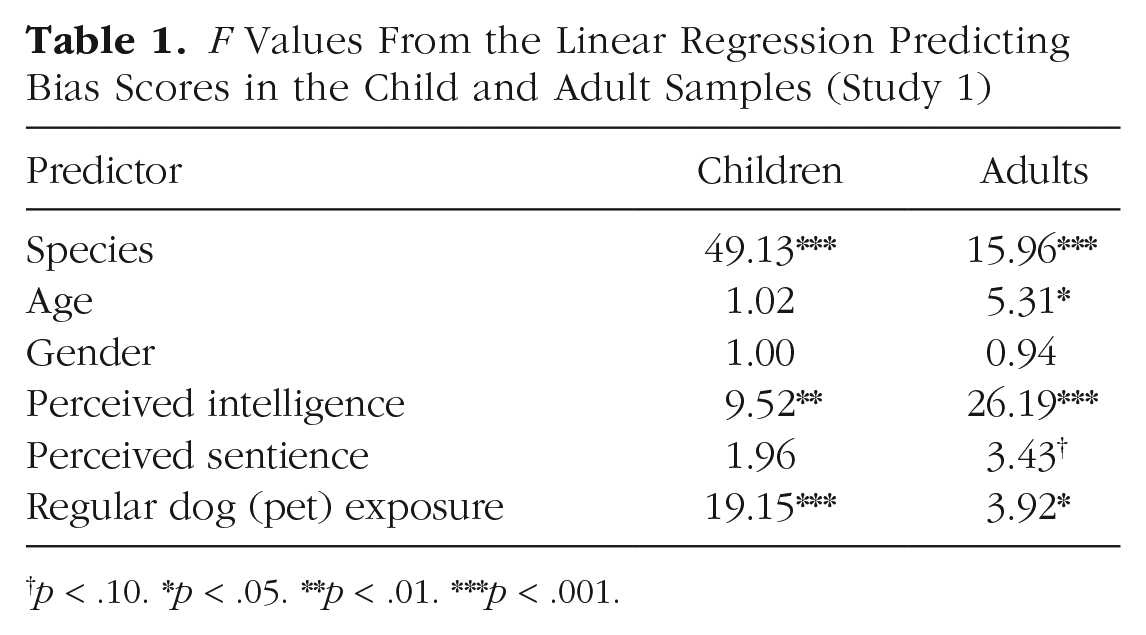
p < .10. *p < .05. **p < .01. ***p < .001.
In opposition to our hypothesis, results showed no significant correlation in children between age and humans-over-dogs bias scores (r = .12, p = .07) or between age and humans-over-pigs bias scores (r = .04, p = .59). In adults, however, age correlated positively with humans-over-dogs bias scores (r = .17, p = .01) but not with humans-over-pigs bias scores (r = .09, p = .21).
Children who had regular exposure to dogs (45%) had a lower bias in favor of humans over dogs (M = −2.26, SD = 6.23) than children without regular exposure to dogs (M = 2.40, SD = 6.37), t(198) = 5.28, p < .001, d = 0.74, 95% CI = [0.45, 1.03]. Similarly, children with dog exposure had a lower bias in favor of humans over pigs (M = 3.02, SD = 6.52) than children without exposure (M = 5.95, SD = 6.10), t(192) = 3.29, p = .001, d = 0.47, 95% CI = [0.18, 0.75]. Adults who had regular exposure to dogs (69%) also had a lower bias in favor of humans over dogs (M = 9.10, SD = 7.93) than adults without regular exposure to dogs (M = 11.83, SD = 5.86), t(173) = 2.86, p = .005, d = 0.37, 95% CI = [0.08, 0.66]. Adults with dog exposure did not have a significantly lower bias in favor of humans over pigs (M = 11.83, SD = 5.86) than adults without dog exposure (M = 13.14, SD = 4.16), t(178) = 1.65, p = .10, d = 0.21, 95% CI = [−0.08, 0.50].
We found that the pattern of results remained even when we excluded children who seemed to merely pick larger numbers in control questions (e.g., children who picked 10 plates over one human). This suggests that the effect cannot be explained merely as a bias in children for choosing the larger number. Moreover, children had a much weaker tendency than adults to prioritize humans over animals even in dilemmas that pitted one human against one dog or pig, that is, when the numbers on both sides were the same. This further supports the hypothesis that children have a weaker tendency than adults to prioritize humans over animals.
Studies 2a and 2b
In Study 2, we aimed to replicate the effects found in the first study. However, instead of asking participants how they personally would decide in the moral dilemmas, we asked them how they thought a person who always does the morally right thing would decide. This would allow us to rule out the possibility that children’s responses in the first study represented their personal preferences rather than their views about what was the morally right decision.
The pattern of results was similar to that of Study 1 (Fig. 3). Children had a mean humans-over-dogs bias score of 1.74 (SD = 6.16) and a humans-over-pigs bias score of 5.15 (SD = 5.65). Adults had a mean humans-over-dogs bias score of 10.66 (SD = 6.47) and a humans-over-pigs bias score of 12.02 (SD = 5.10). One-sample t tests showed that children’s humans-over-dogs bias score, t(60) = 2.20, p = .03, d = 0.28, 95% CI = [0.03, 0.54], as well as their humans-over-pigs bias score, t(60) = 7.13, p < .001, d = 0.91, 95% CI = [0.61, 1.21], were significantly above zero. The same was the case for adults’ humans-over-dogs bias score, t(63) = 13.19, p < .001, d = 1.65, 95% CI = [1.27, 2.03], and adults’ humans-over-pigs bias score, t(63) = 18.85, p < .001, d = 2.36, 95% CI = [1.87, 2.84]. This suggests that both children and adults tended to prioritize humans over dogs and pigs.
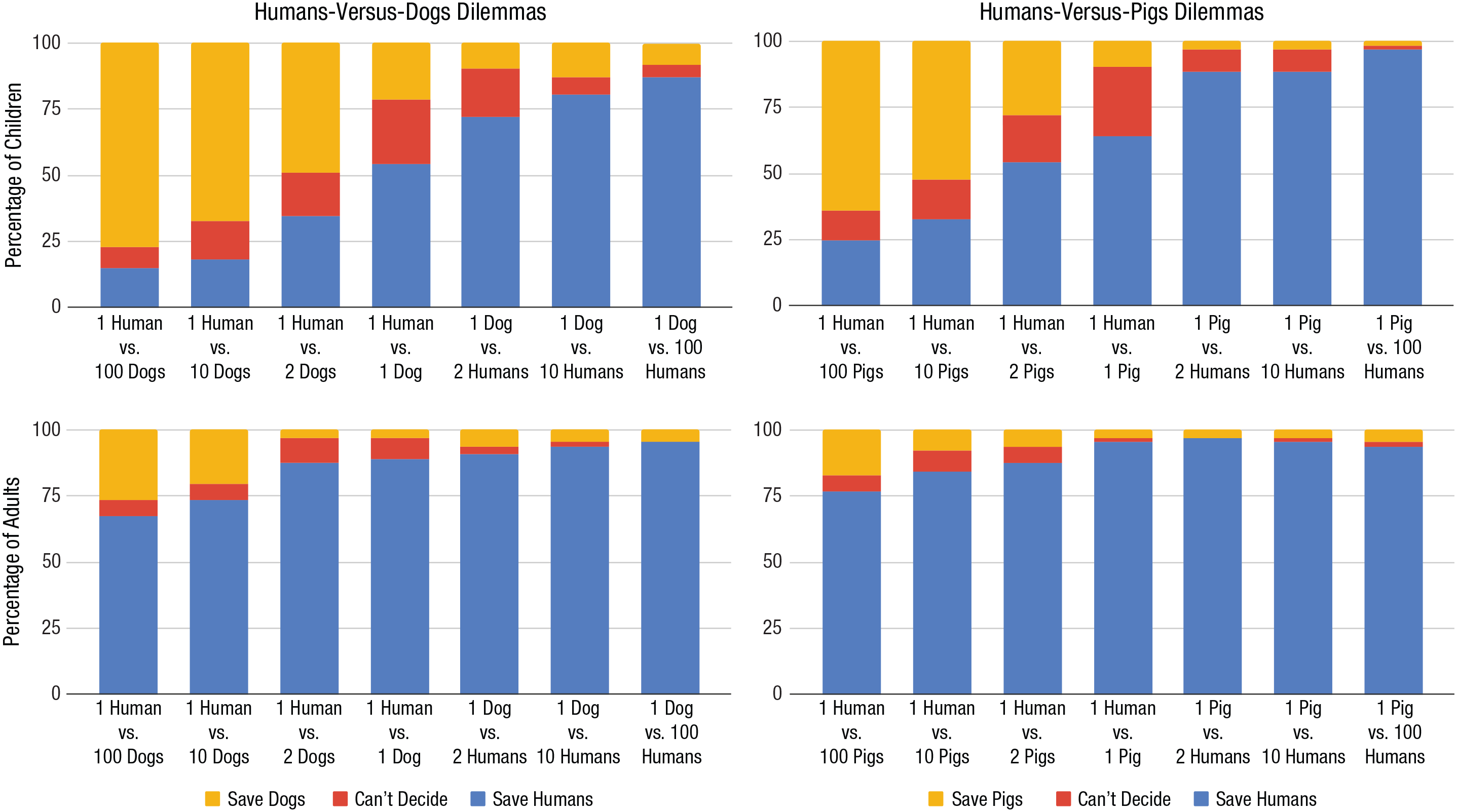
Percentage of children (top row) and adults (bottom row) who prioritized saving humans, prioritized saving animals, or could not decide which to prioritize (Study 2). Results are shown separately for comparisons that involved humans versus dogs (left column) and humans versus pigs (right column).
We found that children had a slightly weaker tendency to prioritize humans over animals in Study 1 than in Study 2. It is possible that this tendency is slightly more reflected in their personal preferences (Study 1) than in their beliefs about what is morally right (Study 2) or what they think adults think is right. Note, however, that the discrepancy was minimal and may merely be fortuitous, given the relatively small sample size of Study 2.
A 2 (group: children vs. adults) × 2 (species: pig vs. dog) mixed ANOVA revealed two main effects and no interaction. Children had a weaker tendency than adults to prioritize humans over animals, F(1, 121) = 72.74, p < .001, η p 2 = .37, 95% CI = [.24, .48]. Both children and adults had a stronger tendency to prioritize humans over pigs than over dogs, F(1, 124) = 23.25, p < .001, η p 2 = .16, 95% CI = [.05, .27]. There was an interaction effect between group and species, F(1, 124) = 4.42, p = .04, η p 2 = .05, 95% CI = [.0, .11].
Again, there was not a significant correlation between age and humans-over-dogs bias scores (r = .09, p = .47) or between age and humans-over-pigs bias scores (r = −.07, p = .60) for children. In adults, however, age correlated positively with humans-over-dogs bias scores (r = .36, p = .003) and with humans-over-pigs bias scores (r = .37, p = .003).
Children who had regular exposure to dogs (68% of children) did not have lower bias in favor of humans over dogs (M = 0.78, SD = 5.80) than those without regular exposure to dogs (M = 4.25, SD = 6.66), t(26) = 1.89, p = .07, d = 0.57, 95% CI = [−0.03, 1.16]. Similarly, children with dog exposure did not have a lower bias in favor of humans over pigs (M = 5.53, SD = 5.43) than children without dog exposure (M = 4.32, SD = 6.39), t(26) = −0.68, p = .50, d = 0.21, 95% CI = [−0.36, 0.77]. Adults who had regular exposure to dogs (55%) did not have a significantly lower bias in favor of humans over dogs (M = 9.69, SD = 7.15) than adults without such exposure (M = 11.84, SD = 5.42), t(62) = 1.36, p = .18, d = 0.33, 95% CI = [−0.17, 0.83]. Similarly, adults with dog exposure did not have a significantly lower bias in favor of humans over pigs (M = 11.61, SD = 4.98) than adults without such exposure (M = 12.51, SD = 2.29), t(58) = 0.69, p = .49, d = 0.17, 95% CI = [−0.32, 0.67].
Discussion
To our knowledge, this is the first project to directly and systematically compare the degree to which children and adults prioritize humans over animals in moral dilemmas. Across two studies, we found that children between the ages of 5 and 9 years have a weaker tendency than adults to prioritize humans over dogs and pigs. This is expressed both in their own preferences (Study 1) and in their beliefs about what is morally correct (Study 2). In both studies, the majority of children said they would save multiple dogs over one human. And in one-human-versus-one-dog scenarios, many children opted to save the dog or could not decide. Children did tend to prioritize humans over pigs, but this tendency was weaker than that of adults. In contrast with our predictions, however, results did not reveal any age-related changes in children’s judgments: Children from 5 to 9 years all tended to value animals far more than adults did.
We found that regular exposure to dogs had a strong impact on children’s tendency to prioritize humans. Children with such a background valued dogs much more than those without it. In Study 1, but not Study 2, dog exposure also predicted children’s tendency to prioritize humans over pigs.
In Study 1, we found that the extent to which participants perceived dogs and pigs as less intelligent predicted the extent to which they prioritized humans. By contrast, levels of sentience did not predict moral judgments. Notably, we found that even though adults and children attributed roughly the same absolute and relative levels of intelligence and sentience to humans, dogs, and pigs, their moral judgments were strikingly different. This suggests that factors other than intelligence or sentience underpin these moral judgments.
Previous studies have suggested that adults exhibit speciesism (Caviola et al., 2019). For example, adults value humans more than animals even in cases in which humans have equal or lower cognitive capacities than animals (Caviola et al., 2020). Thus, one possible explanation of our findings is that children are far less speciesist than adults. Although we found that children weakly prioritize humans over dogs and pigs, we do not know whether this is because of speciesism or because of other factors, such as the belief that humans have more sophisticated cognitive capacities or that they experience more happiness over their lifetimes than dogs or pigs do.
What are the origins of this tendency? One possibility is that it is an unlearned preference. For much of human history, animals played a central role in human life—whether as a threat or as a resource. It therefore seems possible that humans would develop distinctive psychological mechanisms for thinking about animals. Even if there are no specific cognitive adaptations for thinking about animals, it is hardly surprising that humans prefer humans over animals—similar to their preference for tribe members over strangers. Similarly, given that in-group favoritism in human groups (e.g., racism, sexism, minimal groups) tends to emerge as early as preschool years (Buttelmann & Böhm, 2014), one would expect that a basic tendency to prioritize humans over animals also emerges early.
But we would suggest that the much stronger tendency to prioritize humans over animals in adults has a different source that, given the lack of correlation between age and speciesism in children, emerges late in development. Adolescents may learn and internalize the socially held speciesist notion—or ideology—that humans are morally special and deserve full moral status, whereas animals do not. Although ideas and practices reflecting strong speciesism are widespread, these may not be as salient to young children from urban backgrounds in developed countries, to whom animals are largely presented in a highly positive and anthropomorphized form. Most young children have no direct experience, and often no knowledge, of the practices relating to, for example, meat production or animal experimentation. It is possible that strong speciesist beliefs emerge only when these practices become more salient, during adolescence (at least in Western cultures). Thus, the strong form of speciesism exhibited in adults may be a socially acquired ideology.
The hypothesis that speciesism is at least partly a socially acquired ideology could also explain why there are different cultural manifestations of speciesism; for example, in certain cultures, people eat dogs, whereas other cultures consider cows holy. It could also explain why in our studies, older adults had a stronger tendency than younger adults to prioritize humans over animals. This could be a reflection of a generational shift in attitudes toward animal welfare, perhaps partly influenced by the animal rights movement that emerged in the 1970s (Singer, 1975). Although many people today are opposed to unnecessary animal cruelty (Vaughn et al., 2009), historically that was not always the norm (Kelch, 2012; Pinker, 2011).
Further research is required to explore the origins of speciesism. Such research could explore when attitudes shift in adolescence from a weak to a strong tendency to prioritize humans over animals or whether the strong form of speciesism exhibited in adults emerges earlier in cultures in which younger children have more direct exposure to instrumental uses of animals.
Our study provides initial evidence that children prioritize humans less over animals than adults do. However, there are limits to the generalizability of our findings. One limit is that, for reasons given earlier, we chose to look at dogs and pigs. People may respond differently when asked about different animals, such as smaller or scarier ones, or those that are more humanlike, such as chimpanzees. Similarly, our participants may have responded differently if the individuals at stake were specified in more detail. Another limitation is that our sample was primarily Caucasian, English speaking, and recruited from urban areas. Given the apparent social-learning mechanisms, it is possible that children from different backgrounds may respond differently. Another limitation is the use of purely hypothetical dilemmas rather than real-life choices. More research is needed to test the extent to which our finding generalizes across participant populations, moral contexts, and types of beings at stake in both experimental tasks and real-life behavior.
In summary, our research suggests that young children are far less speciesist than adults, at least in the context of dogs and pigs. Across two studies, children as old as 9 years prioritized humans to a far lesser extent than adults did, who almost always chose to save humans. This indicates that speciesism may emerge late in development. This challenges the notion that the tendency to morally prioritize humans is a completely ingrained moral intuition unrelated to social norms. Instead, our findings suggest that, although a general bias in favor of humans may be present in young children, the strong speciesist view held by adults may be socially acquired and, thus, potentially malleable. It is possible, in particular, that strong speciesism would not be as pervasive in cultural contexts in which, for example, vegetarianism is much more common and direct, positive exposure to animals is more common in adolescence.
Footnotes
Transparency
Action Editor: Leah Somerville
Editor: Patricia J. Bauer
Author Contributions
M. Wilks and L. Caviola are joint first authors of this article. All the authors conceptualized and designed the study. L. Caviola conducted the analyses. All the authors contributed to writing the manuscript, and all approved the final manuscript for submission.
