






Abstract
Researchers and practitioners want to create opinions that stick. Yet whereas some opinions stay fixed, others are as fleeting as the time it takes to report them. In seven longitudinal studies with more than 20,000 individuals, we found that attitudes based more on emotion are relatively fixed. Whether participants evaluated brand-new Christmas gifts or one of 40 brands, the more emotional their opinion, the less it changed over time, particularly if it was positive. In a word-of-mouth linguistic analysis of 75,000 real-world online reviews, we found that the more emotional consumers are in their first review, the more that attitude persists when they express it again even years later. Finally, more emotion-evoking persuasive messages create attitudes that decay less over time, further establishing emotion’s causal effect. These effects persist above and beyond other attitude-strength attributes. Interestingly, we also found that lay individuals generally fail to appreciate the relation between emotionality and attitude stability.
Pollsters, marketers, and academics ask the public about their opinions every day. Pollsters and marketers often do so to predict events such as elections or future consumer behavior. Academics design interventions that shift social attitudes in the moment, assuming they will have lasting effects. These approaches are all based on the assumption that people’s attitudes today are a good reflection of their attitudes later. Indeed, attitudes have often been defined as long-lasting evaluations stored in memory (Eagly & Chaiken, 1993), but some researchers have argued that attitudes exist only in the time it takes people to complete a survey (Schwarz, 2007). However, asking whether attitudes are fundamentally stable or unstable overlooks a potentially more useful question: Which attitudes tend to be fixed and which are fleeting?
The ability to predict long-lasting attitudes has implications across many domains. For instance, what persuasion strategies can communicators use to instill a lasting opinion in their audience (Cook & Flay, 1978)? Which consumer opinions should marketers pay attention to and which can they safely ignore (Berger, 2014)? And how can social interventions improve intergroup attitudes that will carry into the future (see Lai et al., 2016)?
Until this point, research on attitude stability has shown a nearly singular focus on thoughtful reasoning as the process for generating long-lasting attitudes. For example, people who enjoy effortful thinking tend to develop longer-lasting attitudes (Cárdaba, Briñol, Horcajo, & Petty, 2013; Haugtvedt & Petty, 1992). Similarly, encouraging people to think carefully about attitude-relevant information produces attitudes that change less in the future (e.g., Chaiken, 1980). Finally, the more people know about a topic, the more their attitudes persist over time (Bartle, 2000).
We propose, however, that emotionality (i.e., the degree to which an attitude is based on feelings and emotional reactions) is a yet-unappreciated predictor of long-lasting attitudes. On the one hand, emotional reactions can be rather ephemeral, existing in the moment and then disappearing. Indeed, incidental mood can change people’s in-the-moment opinions, only for those opinions to shift again in the future (Schwarz, 2007). However, we base our hypothesis on recent findings suggesting that attitudes are quite strong when they are based on emotions elicited by the attitude object itself. Specifically, although people may hold the same overall attitude toward something, those whose attitude is based more on emotion are more likely to rely on their attitude for their judgments and behavior (Lavine, Thomsen, Zanna, & Borgida, 1998; Rocklage & Fazio, 2020; Rocklage, Rucker, & Nordgren, 2018). Moreover, more emotionally based attitudes come to mind more quickly (i.e., they are more accessible), which indicates a stronger link in memory between the attitude object and the evaluation (Rocklage & Fazio, 2018). This is particularly noteworthy because accessibility is a key indicator of a strong attitude (Fazio, 1995).
Overview of the Present Research
Across seven longitudinal studies using multiple topics, methods, participant populations, and settings, we tested whether emotionality predicts relatively fixed evaluations and whether this holds above the effects of other attitude-strength predictors. We anticipated that attitudes marked by greater emotionality would change less over time. We also assessed whether emotionality’s effects differed by valence. Whereas most early attitude-emotionality research did not investigate this possibility, recent research has tended to find stronger emotionality effects for positive (vs. negative) attitudes (Rocklage & Fazio, 2016, 2018). Thus, we were open to the possibility that the same selectivity might also occur for longitudinal attitude change.
Finally, we also assessed whether people generally appreciate emotionality’s role in predicting long-lasting opinions. Through both an initial survey and additional measures in Studies 1 and 2, we probed people’s lay understanding of emotionality and attitude stability.
Lay Beliefs of Stability: An Initial Survey
As detailed previously, researchers have generally emphasized the longevity of attitudes resulting from thoughtful analysis but have given less attention to emotionally based attitudes. We do not necessarily seek to compare the relative potency of these routes for forming strong attitudes but only to highlight that the literature thus far has overlooked the role emotionality may play. Similarly, lay individuals may also give less consideration to the longevity of attitudes based on emotion and may view attitudes based on a more rational analysis as more typical of long-lasting opinions.
Statement of Relevance
Which opinions last across time? This question matters for public-health advocates, social activists, marketing firms, and anyone needing to garner long-lasting support from the public. So far, psychologists have emphasized that lasting opinions are formed by thinking carefully about a topic. Similarly, when we surveyed more than a thousand people, they overwhelmingly expected that rational thinking—and not emotion—leads to more stable attitudes. Across seven studies, however, we found that emotion-based attitudes are also especially long lasting. Attitudes based more on emotion were more stable regarding how much people liked gifts a month after they had received them, how much they supported consumer brands over time, and how favorable their online restaurant reviews were between visits. Finally, persuasive messages that were designed to evoke greater emotion led people to remain convinced for longer. Overall, this research provides insight to anyone in the business of securing lasting support for issues, individuals, or products.
We attempted to recruit approximately 1,000 participants from Amazon’s Mechanical Turk (MTurk) who would answer a single question for $0.05 (final N = 1,012; demographics were not measured to keep the study as short as possible; the preregistration for this initial survey is available at https://osf.io/4btpa). This sample size would provide 80% power to detect quite a small effect (d = 0.09) with a two-tailed one-sample t test. On a 5-point scale, participants indicated the extent to which they believed that evaluations based on feelings or emotional reactions were more stable over time than those based on thinking and rational analysis. We intentionally included a midpoint to the scale (neither) to allow participants the opportunity to indicate that both attitudes could be equally stable.
We found that participants strongly endorsed the stability of attitudes based on thinking and rational analysis, whereas relatively few endorsed the stability of evaluations based on emotional reactions (M = 3.94 out of 5.00, SE = 0.04). This average was significantly above the midpoint of the scale, t(1011) = 24.58, p < .001, d = 0.77, 95% confidence interval (CI) for d = [0.64, 0.90]. In fact, only 15% of participants selected any scale point indicating that they believed attitudes based on emotional reactions would be relatively stable over time (i.e., a scale option below the midpoint). Instead, 74% selected a scale option that emphasized the stability of evaluations based on thinking and rational analysis (see Fig. 1).
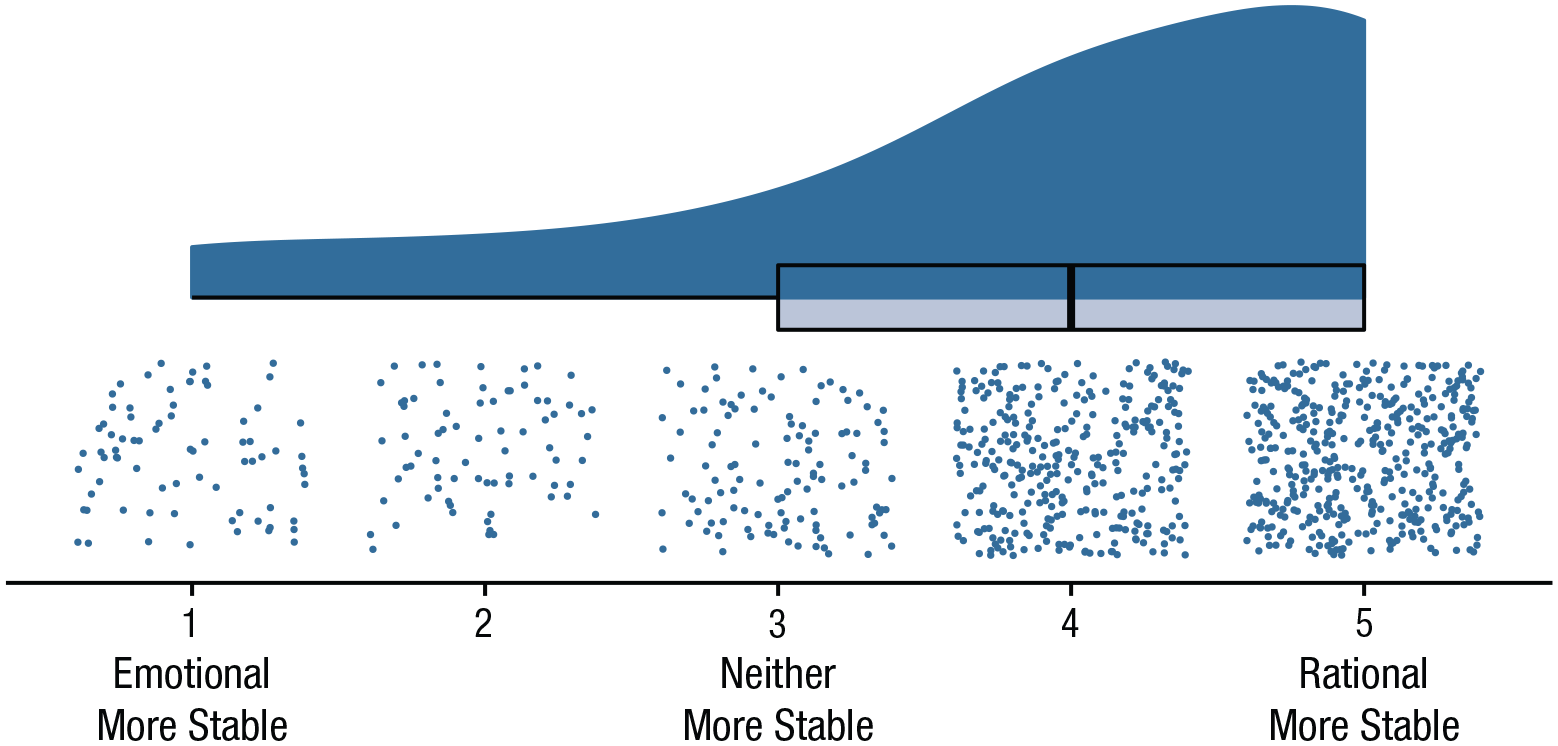
Distribution of lay beliefs of attitude stability in an initial survey. The raincloud plot (Allen, Poggiali, Whitaker, Marshall, & Kievit, 2019) shows individual data points (rain) and the density of the data (cloud). In the boxplot, the middle vertical line indicates the median, and the vertical lines to the left and right of the median indicate the location of the first and third quartiles, respectively.
The present findings show that just as prior research has given little attention to emotions and their role in forming strong attitudes, so do lay individuals tend to give relatively little credence to evaluations based on emotion. It is an interesting added irony that although attitudes based on emotion may be quite stable across time, individuals may not view them as such. In these studies, we use additional approaches to investigate this possibility.
Study 1a and 1b
Method
In Studies 1a and 1b, we considered a novel attitude object: recently received gifts. Presumably gift-givers strive to choose something that will instill long-lasting attitudes in recipients, making this an important social context in which to examine attitude longevity. Considering gifts also allowed us to capture individuals’ attitudes soon after they were formed. Given the nature of gifts, this set of stimuli was also especially likely to capture positive evaluations. In each study, we administered the first survey the day after Christmas and asked participants to recall a recently received gift. This allowed us to measure reactions to relatively new attitude objects in a naturalistic way.
Participants
Although we did not have strong a priori predictions about the size of the emotionality effect on attitude change, prior research on attitude emotionality using a similar statistical approach has found reliable effects with as few as 44 participants (Rocklage & Fazio, 2016, 2018). We recruited more participants (approximately three times as many) in these studies to ensure adequate power and to account for attrition. In Study 1a, the first survey was administered to 150 respondents (mean age = 34.59 years, SD = 11.26, 45% female) on December 26, 2016. In Study 1b, the first survey was administered to 177 respondents (mean age = 36.38 years, SD = 11.16, 47% female) on December 26, 2017. Participants in both studies were recruited using MTurk and were paid $0.75 for completing the first survey. Approximately 1 month after participants completed the first survey, they were contacted via MTurk’s messaging system and invited to complete a follow-up survey for $0.75. If participants did not complete the survey within 48 hr of the initial contact, they were contacted again and offered $1.25. Final response rates were 76% and 79%, respectively, and the mean interval between measurements across these studies was 29.78 days (SD = 1.63). A logistic regression analysis showed that retention was not predicted by the average valence or extremity of people’s gift attitudes (ps > .14), but, at least in the present study, greater emotionality across gifts at Time 1 was associated with being somewhat less likely to complete the follow-up survey, b = −0.42, z = −2.09, p = .04, odds ratio = 0.66, 95% CI = [0.44, 0.97]. 1
Procedure
Participants were first asked to list three gifts they had received recently. The instructions specified that these could be gifts they liked or disliked and asked them to provide enough detail so that they would know what their description referred to if they saw it in a month.
Next, we gave participants a chance to familiarize themselves with a list of adjectives they would be selecting from to describe their attitudes. The adjectives were drawn from the Evaluative Lexicon, which contains words that people commonly use to describe their attitudes along with normative ratings of the valence, extremity, and emotionality conveyed by each word (Rocklage et al., 2018; see Rocklage & Fazio, 2015). Research has validated the Evaluative Lexicon as a measure of attitudes and their basis on emotion using multiple methodologies and has distinguished the Evaluative Lexicon’s assessments of emotionality from other similar constructs, such as intensity and arousal (for more information, see Rocklage & Fazio, 2015, 2018; Rocklage et al., 2018). The particular list of adjectives we used has been used extensively in previous research (Rocklage & Fazio, 2016, 2018) and was utilized because of its wide and representative range of valence and emotionality (see Section 2 in the Supplemental Material available online for a full list).
Then, we displayed participants’ written description of their first gift, along with these adjectives. To help them narrow down this initial list of options, we first asked them to choose two to four adjectives that described their evaluation of the gift. Of these adjectives, we asked participants to select the single best adjective that described their evaluation. This adjective provides individuals’ summary evaluation, and, following past research (Rocklage & Fazio, 2018), we therefore used it as our measure of interest. Participants then reported how much they thought their opinion of the gift would change in the future. This process was repeated for the other two gifts, after which participants reported their demographic information and completed the survey.
One month later, participants were shown the same gift descriptions they had written previously and again completed the adjective-selection process for each gift. To reduce the possibility that participants would merely recall the adjectives they had selected at Time 1, we replaced approximately half of the adjectives in the list of options with other adjectives from the Evaluative Lexicon that were similar in valence and emotionality (see Section 2 in the Supplemental Material).
Materials
Gifts
Participants could freely list any three gifts in response to the previously described instructions, and (as detailed subsequently) they included gifts that elicited a wide range of attitude extremity and emotionality. Some examples included “electric toothbrush,” “a bottle of cologne,” and “Boba Fett limited run die cast figurine.” Notably, participants also listed cash or gift cards as gifts in Study 1a. The value or meaning of these gifts may change between measurements, however, if participants spent the money or changed their plan for using the gift. Thus, at Time 2, we asked participants to report whether or not each gift they listed was money or a gift card. Two respondents said all three of their gifts were monetary, and 48 of the remaining gifts (14% of those listed by the Study 1a sample) were flagged as monetary. Given the ambiguity of these cases, we removed these from subsequent analyses, but all results are similar even with these cases included. In Study 1b, we clarified in the Time 1 survey that they should not list money or gift cards as gifts.
Attitude valence, extremity, and emotionality
Following past research using the Evaluative Lexicon (Rocklage & Fazio, 2015, 2016, 2018), we quantified individuals’ attitudes by imputing the normative valence, extremity, and emotionality implied by their self-selected best adjective for each gift. For example, if participants chose “worthwhile” to describe their evaluation of the first gift, their attitude would be coded as having a valence of 7.16 (out of 9.00), an extremity of 2.68 (out of 4.50), and an emotionality of 4.50 (out of 9.00). On the other hand, participants who chose “appealing” would have a similarly positive attitude but with greater emotionality (valence = 7.15, extremity = 2.78, emotionality = 5.38). As expected, the gifts participants reported were relatively positive overall (M = 7.21, SD = 1.44, minimum = 0.40, maximum = 8.71); however, despite being generally liked, the gifts varied considerably in both emotionality (M = 5.44, SD = 1.56, minimum = 3.00, maximum = 7.33) and extremity (M = 3.02, SD = 0.62, minimum = 1.69, maximum = 4.21) and in fact covered nearly the full range of values possible for each.
Following past research (Rocklage & Fazio, 2015, 2016, 2018), we assessed whether emotionality’s effects were moderated by the valence of initial attitudes by computing a dichotomous valence variable for all Time 1 attitudes. Attitudes whose valence scores fell below the midpoint of the scale (4.50) were classified as negative (−1), and those above this midpoint were classified as positive (1). No attitude had a perfectly neutral (4.50) valence score. As anticipated, across both studies, 95% of Time 1 attitudes were positive.
As we investigated the data, we also found that a subset of attitudes (3%) were quite positive or negative initially but then switched to the opposite valence 1 month later. That is, these attitudes changed qualitatively, and recent research suggests that attitudes that switch valence may be quite different in type from those that do not (Bechler, Tormala, & Rucker, 2019). Indeed, though these attitudes are relatively few in number, they were an average of 8.07 standard deviations from the mean on attitude change. Thus, switching the valence of one’s attitude over time appears to signal a qualitative and very drastic change in one’s attitude. This likely stems from external influences, including idiosyncratic experiences, 2 beyond what individuals’ initial attitudes could predict. Rather than labeling these cases as outliers and removing them altogether, we included them in the analyses while accounting for their effect. To that end, we included a valence-switching covariate in all analyses: −1 = no switch (97%), 1 = valence switch (3%). Results were similar when we simply filtered out these cases as well.
Predicted attitude change
To further examine whether people perceive a connection between emotionality and stability, we also asked participants how much they thought their attitude toward each gift would change over the following month. If people do treat emotionality as indicative of a long-lasting opinion, their attitude emotionality should relate to their predictions. After the adjective-selection task for each gift at Time 1, participants responded to three items about predicted attitude change (e.g., “How likely is your opinion of this gift to change in the next month?”; 1 = not at all, 5 = very likely). Thus, they answered each of the questions for each gift. The three items showed good reliability (α = .80), so they were averaged to form an index in which higher scores reflected more expected attitude change over time (M = 1.70, SD = 0.88).
Attitude change
To index the extent to which attitudes changed between surveys (i.e., attitude instability), we adopted common practice (e.g., Luttrell, Petty, & Briñol, 2016) and computed the absolute difference between the Time 1 valence score and the Time 2 valence score for each gift (M = 0.68, SD = 0.96). Higher values reflected more attitude change in either the positive or the negative direction.
Results
Because Studies 1a and 1b were virtually identical and the reported effects were consistent across samples, we combined all responses into a single data set. The resulting data set contained 927 Time 1 attitudes from 325 participants and 714 Time 2 attitudes from 254 participants.
The unique design of this study—each participant provided responses to multiple gifts across time—also allowed us to use an advanced modeling approach to control for both measured and unmeasured differences between individuals. Specifically, we used an approach called contextual modeling, which allowed us to partial out differences between individuals and assess how changes in emotionality within each participant predict attitude change (e.g., Hamaker & Muthén, 2020). Taking differences between individuals into consideration helps approximate the advantages of randomization in an experiment (Hamaker & Muthén, 2020). Whereas an experiment controls for differences between individuals via random assignment to conditions, contextual modeling explicitly models these differences between individuals, holds them constant, and thereby accounts for them. Any differences between individuals that could be related to emotionality or extremity are partialed out. In essence, each individual acts as his or her own control, and we can therefore assess the unique effect of changes in emotionality within each individual (Bolger & Laurenceau, 2013). This approach is considered particularly pivotal for providing evidence in favor of a construct’s causal effect in longitudinal studies (Bolger & Laurenceau, 2013; Hamaker & Muthén, 2020).
To take this approach, we predicted attitude change using mixed-effects models, entering participant as a random effect to account for the repeated measures nature of the design. We then calculated the average emotionality and extremity each individual expressed across his or her attitudes and included these averages in each of the subsequent models. Regarding these between-subjects averages, it is important to note that although they may partly reflect dispositional tendencies to base attitudes on emotion or to hold extreme attitudes, they may also stem from other factors that differ among participants (e.g., a person’s mood at the time). In the absence of direct validation for this as an individual-differences variable, we used it in the current work to clarify attitude-specific effects by holding these differences constant. Unless otherwise specified, reported results are the fixed-effect coefficients. Additional information about these mixed-effects models and results for each study separately are available in Section 1 in the Supplemental Material. 3
For this study and those that follow, we also conducted the analyses allowing the emotionality effect to randomly vary by person or by attitude object (including additional random effects led to convergence issues). Results from these additional models continued to support the fixed effects of emotionality. This provides some evidence that although some individuals may be more or less emotional than others, the effect of emotion appears relatively similar for each person. These data also suggest generalizability across attitude objects. Given that the results were similar, we report results without random slopes for the sake of simplicity.
Attitude change
We first submitted valence switching, dichotomous valence, extremity, and emotionality as predictors of attitude change. We controlled for between-subjects differences by also including each individual’s average extremity and emotionality. First, regarding these between-subjects differences, individuals who tended to select more extreme adjectives on average did not tend to show significantly more or less attitude change, γ = 0.14, 95% CI = [−0.05, 0.33], t(548.4) = 1.48, p = .14. Individuals who tended to select more emotional adjectives on average tended to hold attitudes that changed less, γ = −0.09, 95% CI = [−0.16, −0.01], t(514.7) = −2.28, p = .02.
Turning to the effects uniquely associated with the properties of the attitude (i.e., the within-subjects effects), we found that the valence-switching covariate was, unsurprisingly, associated with a greater degree of change, γ = 2.26, 95% CI = [2.13, 2.38], t(703.8) = 35.24, p < .001. There was no effect of valence, γ = 0.07, 95% CI = [−0.03, 0.17], t(702.4) = 1.40, p = .16. Consistent with some prior work on attitude stability (Luttrell et al., 2016, Study 2) and regression-to-the-mean effects (e.g., Shrout et al., 2018), results showed that attitudes that were more initially extreme changed more over time, γ = 0.20, 95% CI = [0.08, 0.32], t(465.3) = 3.31, p < .001. Most important, above and beyond these effects, the more an attitude was based on emotion, the less it changed, γ = −0.05, 95% CI = [−0.09, −0.004], t(466.0) = −2.13, p = .03.
Next, we tested whether the emotionality and extremity effects were moderated by initial valence. There was neither a Valence × Extremity interaction nor a Valence × Emotionality interaction, ps > .16.
Predicted attitude change
Although the previous analysis shows that emotionality predicts less attitude change over time, we also tested whether people’s predictions of attitude change were associated with emotionality. That is, did individuals appear to have any sense that the emotionality of their attitude would predict its stability? First, we examined whether participants’ prediction of each attitude’s likelihood of change was at all related to that attitude’s actual degree of change. We also included individuals’ average stability predictions to control for differences between individuals. Between-subjects differences in stability predictions were not significantly predictive of attitude change, γ = −0.05, 95% CI = [−0.23, 0.13], t(670.8) = 0.52, p = .61. Above and beyond this, participants demonstrated significant ability to predict a particular attitude’s change: The more they believed that an attitude would change over time, the more that attitude changed, γ = 0.17, 95% CI = [0.04, 0.30], t(467.0) = 2.51, p = .01. This result provides evidence for the validity of the predicted stability measure.
However, were their predictions at all related to that attitude’s emotionality? The between-subjects effects were nonsignificant (ps > .72). Predictions also did not significantly differ for positive versus negative attitudes, γ = −0.02, 95% CI = [−0.14, 0.11], t(687.8) = −0.26, p = .80. Beyond this, whereas people expected that their more extreme attitudes would change relatively little over time, γ = −0.17, 95% CI = [−0.30, −0.03], t(462.6) = −2.38, p = .02, the emotionality of their attitudes was not significantly related to their predictions, γ = 0.03, 95% CI = [−0.02, 0.08], t(463.04) = 1.12, p = .26.
Given the limitations of interpreting null effects as noneffects, we conducted an inferiority test (Lakens, Scheel, & Isager, 2018) to see whether there was evidence that people do not expect their more emotionally based attitudes to be more stable. We conservatively set the smallest effect size (γ) constituting some evidence that people substantially and accurately perceive stability from emotionality to −0.05. This cutoff reflects an effect in which the difference between the least possible emotionality (0) and the most possible emotionality (9) corresponds with a 0.5-point reduction in predicted attitude change. The observed effect of emotionality on predicted attitude change was significantly more positive than this cutoff, t(463.04) = 3.05, p = .001 (see Section 1 in the Supplemental Material for more on this analysis). Thus, as with the pilot study, participants appear not to associate the emotionality of their attitude with its longevity.
Studies 2a, 2b, and 2c
Study 1 supported emotionality as a predictor of long-term attitude stability even for newly created attitudes. We next considered attitudes toward various consumer brands to test this effect’s generalizability to attitudes that have been established for some time and to provide more opportunities to collect negative attitudes.
Method
We conducted three studies using similar methods. In Study 2a, we sought to establish emotionality’s effect for these longer-established attitudes. Because we are proposing a novel predictor of attitude stability, it is useful to show that emotionality is not redundant with other common predictors of attitude strength. Thus, in Study 2b, we aimed to replicate these results and examine whether emotionality uniquely predicted stability even when controlling for other commonly measured attitude-strength predictors, including those often associated with thoughtful attitudes (knowledge, certainty, ambivalence; see Luttrell & Sawicki, 2020). In Study 2c, we aimed to replicate Study 2b in another population (college students).
Participants
We used the same target sample sizes (N = 150) as in the previous studies albeit with more observations per participant, further bolstering the studies’ power to detect effects of emotionality for these new stimuli. The first survey was administered to roughly 150 respondents in each study (Study 2a: N = 149, mean age = 34.44 years, SD = 10.38, 35% female; Study 2b: N = 150, mean age = 35.30 years, SD = 11.18, 48% female; Study 2c: N = 154, mean age = 19.45 years, SD = 3.24, 60% female). Together, there were 453 participants across these three longitudinal studies.
Participants for Studies 2a and 2b were recruited using MTurk and were paid $1.00 for completing the first survey. Approximately 1 month after participants completed the first survey, they were contacted via MTurk’s messaging system and invited to complete a follow-up survey for $1.00. If participants did not complete the survey within 48 hr of the initial contact, they were contacted again and offered $1.50. Final response rates were 81% and 75%, respectively, and the mean interval between measurements across these studies was 29.63 days (SD = 1.30). Participants for Study 2c were undergraduate students in an introductory psychology class who received class credit for completing each survey. Two weeks after each participant completed the first survey, they received an e-mail inviting them to complete the second part of the study for which they had signed up. Sixty-two percent of participants completed the second survey, and the mean interval between completing the two surveys was 19.10 days (SD = 8.22). A logistic regression analysis across studies showed that retention was not predicted by initial attitude valence, extremity, or emotionality, ps > .17.
Procedure
All three studies followed virtually the same procedure. The adjectives and the adjective-selection process for each brand was the same as in Study 1. In Studies 2b and 2c, participants additionally indicated their certainty, subjective ambivalence, and self-reported knowledge about each brand. In all studies, participants then reported how much they thought their attitude toward the brand would change in the future. Participants followed this process for 10 different brands in total, after which they reported their demographic information and completed the survey.
The follow-up survey used nearly the same procedure as the initial survey, but as in Study 1, the same set of approximately half of the adjectives was replaced with other adjectives (see Section 2 in the Supplemental Material for adjectives used).
Materials
Brands
Given our aim of developing a large and generalizable list of stimuli, after initial pilot testing, we constructed a list of 40 brands that had the ability to elicit a wide range of valence and emotionality (e.g., Ben & Jerry’s ice cream, SeaWorld, Walmart, Swiffer). Given this large sample of stimuli, a single participant would have difficulty completing all measures within a reasonable time. To account for this, we utilized a stimuli-within-block planned-missingness design (Westfall, Kenny, & Judd, 2014). Specifically, we created four groups of 10 brands and constructed each group so it contained a similar mix of relatively hedonic versus utilitarian brands that varied in presumed normative valence. We then randomly assigned each participant to one of those groups. Participants were shown the same stimuli in random order at Time 2. Pairing this approach with mixed modeling allowed us to model variance across both participants and stimuli and maximize both statistical power and generalizability while placing any given participant under less strain (Westfall et al., 2014). See the Section 2 in Supplemental Material for a full list of brands organized into these four groups.
Attitude valence, extremity, and emotionality
These variables were scored the same way as in Study 1. In line with past research (e.g., Zhang & Moe, 2018), scores showed that attitudes toward brands tended to be positive (N = 3,359), reflecting the reality that in order to do well, brands must be perceived as at least relatively positive. Nevertheless, the large overall sample size left 1,171 negative attitudes at Time 1. Most importantly, degrees of emotionality were comparable for negative attitudes (M = 5.15, SD = 1.28, minimum = 3.00, maximum = 7.50) and positive attitudes (M = 5.12, SD = 1.56, minimum = 3.14, maximum = 7.33). Similarly, degrees of extremity were comparable for negative attitudes (M = 2.89, SD = 0.59, minimum = 1.81, maximum = 4.10) and positive attitudes (M = 2.85, SD = 0.64, minimum = 1.69, maximum = 4.21). We again coded for valence switching, which occurred for just 14% (Study 2a), 13% (Study 2b), and 13% (Study 2c) of observations for which Time 2 responses were available in each study. Similar to Study 1, the average attitude change for attitudes that switched valence was 6.98 standard deviations from the mean.
Other attitude-strength indicators
To test the effects of emotionality over and above other predictors of attitude strength, we included single-item measures of certainty, subjective ambivalence, and self-reported knowledge in Studies 2b and 2c for each brand at Time 1. Specifically, participants used separate 5-point scales (1 = not at all, 5 = extremely) to indicate the extent to which they were (a) sure of their opinion of the brand (M = 3.63, SD = 1.12), (b) conflicted about the brand (M = 1.67, SD = 1.01), and (c) knowledgeable about the brand (M = 2.99, SD = 1.14). See Section 2 in the Supplemental Material for full question wordings.
We included these three attitude attributes specifically because they are very typical of the variables often investigated as indicators of attitude strength. Nevertheless, they should also be separable from emotionality. For instance, although subjective ambivalence can involve an uncomfortable feeling of conflict, this is a feeling that arises from metacognitively appraising the coherence of one’s attitude. Emotionality, by contrast, is the extent to which an attitude itself is based on emotion (e.g., enjoyment, excitement). So although these two attitude attributes may share some surface-level similarities in their connection to affective processes, they are conceptually distinct, and our results show that they are empirically distinct as well.
We also note, however, that in the domain of attitude strength in general and attitude stability specifically, recent research has suggested that all three of these attitude attributes’ effects do not always demonstrate strong main effects on outcomes of interest (Luttrell et al., 2016; Luttrell, Petty, & Briñol, 2020; Wallace et al., 2020). Including these items in conjunction with using contextual modeling also had the benefit of allowing us to assess whether the effects of emotionality held above the individual differences that could be associated with these constructs.
Predicted attitude change
This was measured using the same items as in Study 1, which again showed good internal reliability (α = .80; M = 1.74, SD = 0.84).
Attitude change
Absolute differences between Time 1 and Time 2 adjective valence were again used to index the extent to which attitudes changed between surveys.
Results
Once again, because the procedures were nearly identical and results were consistent across studies, responses were combined into a single data set. Results for each study are available in Section 1 in the Supplemental Material. The resulting data set contained 4,530 Time 1 attitudes from 453 participants and 3,270 Time 2 attitudes from 327 participants.
Given that participants provided multiple responses and that there were multiple judgments for a given brand, we again used contextual modeling. Specifically, we used mixed-effects models and modeled the shared variance across both participants and brands, which allowed us to be more confident in the generalizability of the current effects to participants and brands that could be included in future studies (Judd, Westfall, & Kenny, 2012). Thus, participant and brand were both entered as random effects in the following models, and unless otherwise specified, reported results are the fixed-effect coefficients. As in Study 1, we also controlled for valence switching in all subsequent analyses unless otherwise noted.
Attitude change
We entered valence switching, dichotomous valence, extremity, and emotionality as predictors of attitude change. We also controlled for between-subjects differences by including each individual’s average extremity and emotionality as covariates. Regarding the between-subjects differences, individuals who tended to choose more extreme adjectives on average did not tend to show significantly more or less attitude change, γ = −0.01, 95% CI = [−0.19, 0.16], t(397.3) = −0.14, p = .89. Individuals who tended to choose more emotional adjectives on average tended to hold attitudes that changed more, γ = 0.16, 95% CI = [0.09, 0.24], t(390.7) = 4.22, p < .001 (but refer to our earlier discussion for the reasons we refrain from drawing clear conclusions from such a pattern).
Beyond these differences among individuals, once again, changes in valence were associated with greater degree of change, γ = 2.16, 95% CI = [2.12, 2.20], t(3248.7) = 112.39, p < .001, and this time, negative attitudes changed more over time than positive attitudes, γ = −0.04, 95% CI = [−0.07, −0.01], t(1329.9) = −2.41, p = .02. Attitudes that were more initially extreme also changed more over time, γ = 0.21, 95% CI = [0.16, 0.27], t(2784.1) = 7.49, p < .001. More central to the research question, and consistent with our hypotheses, is the finding that the more an attitude was based on emotion, the less it changed over the following month, γ = −0.07, 95% CI = [−0.10, −0.05], t(860.4) = −6.15, p < .001.
Next, we tested whether the extremity and emotionality effects were moderated by initial valence. Although there was not a significant Valence × Extremity interaction, γ = 0.05, 95% CI = [−0.01, 0.11], t(2596.4) = 1.62, p = .11, there was evidence for the suspected Valence × Emotionality interaction, γ = −0.05, 95% CI = [−0.08, −0.02], t(1050.2) = −3.80, p < .001 (Fig. 2). For initially positive attitudes, greater emotionality was associated with less change over time, γ = −0.10, 95% CI = [−0.12, −0.07], t(596.6) = −7.16, p < .001. For initially negative attitudes, by contrast, emotionality did not significantly predict change, γ = 0.01, 95% CI = [−0.04, 0.05], t(1726.3) = 0.25, p = .80.
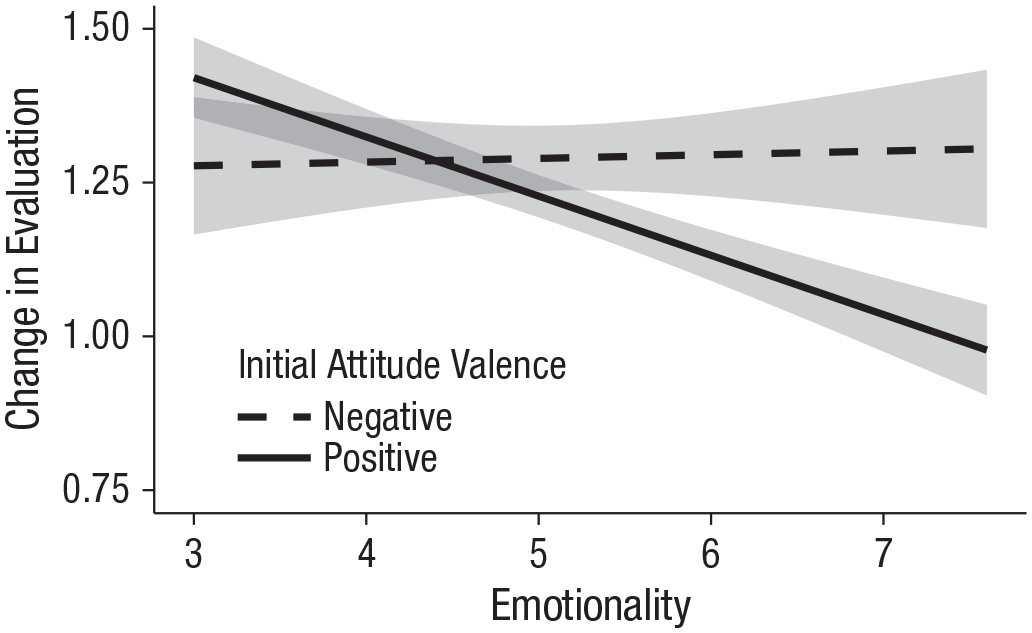
Change in evaluation as a function of emotionality and initial attitude valence (Studies 2a, 2b, and 2c, collapsed). Error bands reflect 95% confidence intervals. Values on the x-axis indicate the approximate range of possible values in the sample.
Finally, we submitted the data from Studies 2b and 2c to the same two mixed-effects models as reported above and additionally included certainty, subjective ambivalence, and self-reported knowledge as covariates. We also included the averages of each of these constructs for each individual to control for any differences between participants that could be related to these constructs. The first model did not include interactions with valence.
Regarding the between-subjects differences, as above, we found that individuals who were more emotional on average showed greater attitude change, γ = 0.14, 95% CI = [0.05, 0.23], t(245.3) = 3.06, p = .002. Similarly, participants who were more ambivalent on average also showed greater attitude change, γ = 0.13, 95% CI = [0.06, 0.20], t(380.5) = 3.50, p < .001. The other individual differences were not significant predictors of change (ps > .36).
When we held these effects constant, attitude-specific emotionality continued to predict less change, γ = −0.08, 95% CI = [−0.11, −0.05], t(741.4) = −5.74, p < .001. The additional strength variables were nonsignificant beyond these effects (ps > .19). In a follow-up model, we added the two interactions with valence from the previous analysis. The Valence × Emotionality interaction remained significant in this model, γ = −0.04, 95% CI = [−0.07, −0.01], t(844.3) = −2.45, p = .01; specifically, the emotionality effect was significant for positive attitudes, γ = −0.10, 95% CI = [−0.13, −0.07], t(574.2) = −6.12, p < .001, but not for negative attitudes, γ = −0.02, 95% CI = [−0.08, 0.04], t(1283.7) = −0.60, p = .55.
Predicted attitude change
Across the three studies, individuals who generally believed that their attitudes would change showed greater attitude change, γ = 0.19, 95% CI = [0.04, 0.34], t(919.9) = 2.49, p = .01. Beyond this difference between individuals, the more participants believed a particular attitude would change over time, the more that attitude changed, γ = 0.28, 95% CI = [0.18, 0.38], t(2931.6) = 5.62, p < .001.
We again assessed whether emotionality was at all related to individuals’ predictions. We utilized Studies 2b and 2c because we had gathered additional measures of strength-related attributes in these studies. We analyzed results for participants who went on to complete the follow-up survey. 4 In the first step of the model, we sought to replicate Study 1’s results for extremity and emotionality. We used a mixed-effects model that included valence, extremity, and emotionality. We also controlled for individual differences in extremity and emotionality. As in Study 1, attitude extremity was related to less predicted change, γ = −0.07, 95% CI = [−0.13, −0.01], t(1849.7) = −2.35, p = .02. Most important, emotionality was again not significantly related to predicted stability, γ = −0.02, 95% CI = [−0.04, 0.01], t(859.5) = −1.58, p = .11. These relationships did not differ by valence, ps > .85. Moreover, as in Study 1, results of an inferiority test provided evidence against people substantially and accurately associating emotionality with stability, t(859.2) = 2.40, p = .01 (see Section 1 in the Supplemental Material for additional details).
We then assessed whether these relationships held when we also included certainty, ambivalence, knowledge, and their between-subjects effects in the same mixed-effects model. For between-subjects effects, only ambivalence was significant. Individuals who were more ambivalent in general predicted that their attitudes would change more, γ = 0.48, 95% CI = [0.37, 0.59], t(236.2) = 8.47, p < .001. Above and beyond this, attitude certainty was related to less predicted change, γ = −0.17, 95% CI = [−0.21, −0.14], t(1857.1) = −9.70, p < .001, and ambivalence to greater predicted change, γ = 0.15, 95% CI = [0.12, 0.19], t(1862.0) = 9.58, p < .001. Predicted attitude change was not significantly related to the other attitude variables. Once again, the emotionality of the attitude was also not significantly related to predicted change, γ = −0.01, 95% CI = [−0.03, 0.01], t(1857.1) = −0.65, p = .52. The effects of extremity and emotionality did not differ between positive and negative attitudes, ps > .38.
Study 3
Across 40 brands and several samples, Study 2 showed that more emotionally based attitudes changed less over several weeks, particularly if they were positive. This occurred above and beyond other strength predictors and associated individual differences. Moreover, people did not account for their attitudes’ emotionality when reflecting on whether those attitudes would change in the future.
Next, we sought to conceptually replicate the stability findings in a naturalistic environment and further test their generalizability. We also examined whether emotionality predicts the way in which people communicate their attitude in the future to others via word of mouth.
Method
To extend our findings to a more naturalistic context, we turned to a source in which individuals openly express their evaluations every day: online reviews. In online reviews, individuals report their evaluations not only via written text—thereby allowing us to quantify their emotionality—but also via a summary evaluation in the form of a star rating. Thus, online reviews allowed us to assess the change in people’s summary evaluation (the star rating), which is similar to what we had investigated thus far. The reviews also allowed us to test whether emotionality predicts the way in which people communicate their attitudes to others via the language they use. Would reviewers’ initial emotionality predict greater linguistic similarity in terms of a review’s positivity?
Data
From Yelp.com, we obtained all reviews for all restaurants in the Chicago, Illinois, area from 2005 to 2017. These reviews contain both individuals’ quantitative evaluations in the form of a final star rating (a scale from one to five stars) as well as their qualitative assessment of the restaurant via the text of the review. Given that the Evaluative Lexicon utilizes language to measure individuals’ evaluations, we had the ability to quantify the valence and emotionality of reviewers’ words. To do so, we used the Evaluative Lexicon 2.0—a version of the Evaluative Lexicon that was specifically created and validated to quantify individuals’ evaluations in natural text (Rocklage et al., 2018; software available at www.evaluativelexicon.com).
Importantly, reviewers on Yelp also have the ability to post a new review of the same restaurant to reflect subsequent visits to that restaurant. In such cases, reviewers reengaged with the attitude object for any number of reasons—for example, they had been invited to the restaurant by friends or family, had gone of their own volition, or had simply been passing by the restaurant again—and had written a new review based on this experience. 5 Both reviews remain on the website. In brief, these data allowed us to test whether greater positive emotionality in individuals’ first reviews predicts less change in their subsequent evaluations.
We used reviews in which there was both a first and an additional review for a given restaurant from a given individual (77,718 reviews). To clean the data, we filtered out additional reviews that contained the exact same text, indicating that there may have been an error with the website resulting in the same review appearing twice or that the review had been directly copied without any changes, thereby rendering ambiguous the interpretation of that review as a new review (2,012 reviews; 2.6% of the total). We were left with a total of 75,706 reviews from 18,786 unique individuals. Of these reviews, 35,843 were first reviews and 39,863 were additional reviews (years between first review and additional review: M = 1.19, SD = 1.44; all results held when we also included time as a covariate in subsequent models). There were more additional reviews because individuals can review a restaurant as many times as they like, though most individuals wrote just one additional review (82%; additional reviews per restaurant: M = 1.11, SD = 0.43).
Quantifying attitudes
Attitude valence, extremity, and emotionality
Given that past research using online reviews has indicated that the most emotional words in a review are all the more diagnostic of individuals’ summary evaluations (Rocklage et al., 2018), we followed this research and quantified reviewers’ initial emotionality by using the most emotionally positive Evaluative Lexicon word and the most emotionally negative Evaluative Lexicon word in their first review. Similarly, we quantified the extremity of individuals’ evaluations on the basis of the most extreme positive and negative Evaluative Lexicon words.
As we have detailed, reviewers are asked to summarize their evaluation of the restaurant in a star rating. These ratings provided a clear index of individuals’ self-designated attitude valence and thus served as the basis for the valence-switching variable (whether reviewers’ first vs. subsequent star ratings were on opposing sides of the scale midpoint). This occurred for 16% of cases, which is very similar to the previous studies’ findings.
Attitude change
As a first approach, we computed the absolute difference between the star rating of individuals’ first review and the additional review they wrote. Given the relatively small number of scale points, 45% of cases showed no star-rating change at all between individuals’ first and subsequent reviews. As approximately half of the data reflected a single value, a model that assumes a continuous outcome would be inappropriate (Hosmer, Lemeshow, & Sturdivant, 2013). We therefore transformed this difference measure to indicate whether an attitude changed (coded as 1) or did not change at all (coded as 0) and used logistic mixed models.
Next, we calculated how reviewers communicated this attitude to readers using the words they wrote. Whereas the star ratings provided somewhat less variability in change, the text of individuals’ reviews allowed for greater variability given its larger scale (0 to 9) and its ability to take on a more fine-grained score (e.g., valence scores of 6.50 vs. 6.60). Thus, we calculated attitude change on the basis of the absolute difference in the mean valence of the text itself (M = 1.50, SD = 1.51, range = 0–7.74).
Results
As detailed in previous guides on text analysis as well as in past research (Rocklage & Fazio, 2015; Rocklage et al., 2018), it is important to keep track of which valence is associated with the emotionality expressed in natural text. If we simply averaged the emotionality expressed in a review, for instance, a review with high levels of conflicting emotionality would be treated the same as one that contained high levels of just positive or just negative emotionality. To avoid this confounding, and following past work (e.g., Rocklage & Fazio, 2015), we separated reviews into those that expressed both positive and negative reactions and those that expressed just positive or just negative reactions.
Reviews with both positive and negative words
There were 37,977 reviews (50.2% of the total) across 10,532 individuals that contained both positive and negative words (first reviews = 18,009, additional reviews = 19,968). Given that a subset of individuals wrote multiple sets of reviews across the sample, we used mixed-effects models with reviewers as a random effect. We used logistic and linear mixed modeling to predict star-rating change and text-valence change, respectively. We report the results with all reviewers included, but this also means that we are unable to include the between-subjects effects in these models: Although a subset of reviewers wrote additional reviews for more than one restaurant and we can therefore calculate their average emotionality and extremity (n = 5,764), most did not (n = 13,022). However, all subsequent results were replicated when we analyzed just those reviewers who wrote additional reviews for multiple restaurants and when we included the between-subjects effects (see Section 1 in the Supplemental Material for results).
All reviews contained both positive and negative words, and we could therefore include positive and negative emotionality and extremity as four separate predictors within the same model to assess their unique effects. We did not include the valence-switching covariate for the star-rating analyses because it would be largely redundant with whether an attitude changed or not, though results were similar when this variable was included.
For ease of reading, we provide the results for both models in Table 1. Positive extremity predicted less change, and negative extremity tended to predict greater change. Negative emotionality was a nonsignificant predictor. Over and above these effects, positive emotionality consistently predicted less change in reviewers’ summary evaluations as well as the very language they used when spreading that information to others.
Mixed-Effects Models for Reviews Using Both Positive and Negative Words (Study 3)

Note: The relative size of the coefficients should not be viewed as the strength of their association with the dependent variable because the predictor variables are on different scales.
Reviews with just positive or just negative words
We then analyzed reviews that contained just positive or just negative Evaluative Lexicon words. There were 37,729 reviews (49.8% of the total) fitting these criteria across 11,549 individuals (first reviews = 17,834, additional reviews = 19,895). We used two separate mixed-effects models—one for positive reviews and one for negative reviews—for each measure of change to examine the effects of positive and negative emotionality and extremity. We again used logistic and linear mixed modeling to predict star-rating change and text-valence change, respectively.
We provide the results of these models in Table 2. Both positive and negative extremity were inconsistent predictors of change across the models. Negative emotionality was a nonsignificant predictor. But as in the prior analysis and consistent with previous studies, results showed that positive emotionality was a consistent predictor of less change above and beyond these effects.
Mixed-Effects Models for Reviews Using Just Positive or Just Negative Words (Study 3)

Note: The relative size of the coefficients should not be viewed as the strength of their association with the dependent variable because the predictor variables are on different scales.
Across Study 3, positive emotionality consistently predicted less change across time for both summary evaluations and the language reviewers used, whereas extremity demonstrated inconsistent results across the models and negative emotionality did not significantly predict change. These results replicated and extended the survey studies using novel stimuli, diverse measures of attitude change, and naturalistic data.
Study 4
In Study 4, we sought to extend these effects to the persuasion domain. Indeed, researchers have long questioned the persistent effects of persuasion (Cook & Flay, 1978)—what kinds of messages create attitudes that last? Our studies suggest that the effects of a message will decay less over time if they instill a relatively emotion-based attitude. This study also allowed us to further probe the causal effect of emotionality.
Method
Participants
Given that this study had a two-condition between-subjects design, we attempted to recruit approximately 150 participants per condition. We opened the study to 300 participants on MTurk and obtained 303 (mean age = 38.32 years, SD = 11.67, 53% female).
The current experiment closely followed the method used in previous research on persuasion persistence that examined attitude decay across 2 days (Haugtvedt & Petty, 1992). Participants were paid $0.40 for completing the first session. They were then contacted 2 days later to complete the follow-up survey for $0.40. Participants who did not complete the survey on that day were contacted again on the third day and offered $0.60. Those who did not complete on the third day were contacted again and offered $0.75. Responses were then closed at the end of the fourth day. Final response rate was 69% (N = 210), and the mean interval between measurements was 2.37 days (SD = 0.63). Conditions did not differ in retention, χ2(1, N = 303) = 0.01, p = .93, ϕ = .005. This final sample provided 80% power to detect condition effects (ds) as small as 0.388 (η p 2 = .036).
Procedure
We used a previously validated experimental manipulation that allowed us to create novel attitudes on the basis of different levels of emotion (Crites, Fabrigar, & Petty, 1994). Specifically, each participant was randomly assigned to read a message about a fictitious aquatic animal—a message that was designed to elicit either low or high emotion. Given that we have found strong effects of emotion for positive attitudes, we focused on instilling positive attitudes and used the positive messages from this previous work. After reading their assigned message, participants indicated their attitude using the same adjective-selection process used in Studies 1 and 2. We then took additional measures to assess whether the messages differed in ways other than just their emotionality. Specifically, we asked participants to indicate how certain, ambivalent, and knowledgeable they were regarding their attitude as well as how clear they thought the message was.
At the follow-up session, participants provided their attitude using the same adjective-selection process but with approximately half of the adjectives replaced with other adjectives, as in the previous studies (see Section 2 in the Supplemental Material for adjectives used).
Materials
Each participant read one of two messages that have been validated as a method of instilling similarly positive attitudes that differ in how much they are based on emotion (Crites et al., 1994; Rocklage & Fazio, 2015). Half of the participants were randomly assigned to read a message that conveyed a positive impression of a fictitious aquatic animal—the “lemphur”—in encyclopedic terms (the low-emotion message). This passage explained that lemphurs are, for example, a source of clothing material and high in nutritional value if consumed. The other half read a short message that also conveyed a positive impression of the lemphur but did so by providing a passage about a swimmer’s underwater interaction with the animal (the high-emotion message). It described an encounter with the lemphur in which the swimmer soared through the water on the back of the lemphur. See Section 2 in the Supplemental Material for the full text of each message.
Attitude valence, extremity, and emotionality
Scoring was the same as in Studies 1 and 2. The messages successfully instilled positive attitudes for 98% of participants who completed the survey at both time points. Because the messages were univalently positive and were meant to instill positive attitudes, we retained for final analyses participants for whom the manipulation was successful (i.e., those with positive attitudes; n = 205). Results were the same when we included all participants.
Additional measures
We measured certainty (M = 3.55, SD = 0.97), subjective ambivalence (M = 1.60, SD = 0.81), and self-reported knowledge (M = 2.12, SD = 0.89) the same way as in Study 2. Additionally, we asked, “How clear was the passage on the lemphur to you?” (M = 3.90, SD = 0.92; 1 = not at all clear, 5 = extremely clear).
Attitude change
Following Haugtvedt and Petty (1992), we calculated attitude decay as the difference in attitude valence between the two sessions (i.e., Time 1 − Time 2).
Results
Initial differences between conditions
The manipulation was successful, replicating past findings (Crites et al., 1994; Rocklage & Fazio, 2015). Attitudes for participants in the high-emotion condition were indeed characterized by more emotion (M = 6.63, SE = 0.07) compared with those in the low-emotion condition (M = 5.28, SE = 0.15), t(203) = −8.04, p < .001, d = 1.12, 95% CI for d = [0.83, 1.42]. This difference between conditions also persisted when we controlled for all other variables, p < .001.
Given the natural association between emotionality and extremity, the low-emotion condition also elicited somewhat less extreme attitudes (M = 3.37, SE = 0.06) compared with the high-emotion condition (M = 3.66, SE = 0.06), t(203) = 3.35, p = .001, d = 0.47, 95% CI for d = [0.19, 0.75]. Following the previous studies, we controlled for attitude extremity in subsequent analyses.
Regarding other differences, conditions did not differ significantly in certainty, t(203) = 1.57, p = .12, d = 0.22, 95% CI for d = [−0.06, 0.50], or ambivalence, t(203) = −0.19, p = .85, d = −0.03, 95% CI for d = [−0.30, 0.25]. However, the high-emotion condition led to less perceived knowledge (M = 1.98, SE = 0.09) compared with the low-emotion condition (M = 2.26, SE = 0.09), t(203) = −2.27, p = .02, d = −0.32, 95% CI for d = [−0.59, −0.04]. Participants also reported that the high-emotion passage was less clear (M = 3.70, SE = 0.09) than the low-emotion passage (M = 4.09, SE = 0.09), t(203) = −3.04, p = .003, d = −0.43, 95% CI for d = [−0.70, −0.15]. To examine the effect of the emotionality manipulation beyond these differences between conditions, we controlled for knowledge and clarity in subsequent analyses. However, results were the same when we did not control for these variables. Results were also the same when we included all additional variables, even those that did not differ by condition (i.e., certainty and ambivalence).
Attitude change
We entered knowledge, clarity, extremity, and condition as predictors of attitude change in an analysis of covariance. Given that the lemphur is fictitious, we did not control for valence switching because it was not possible for individuals to gain idiosyncratic information or experience that could cause drastic and unpredictable changes in that attitude as could have happened in the previous studies. Nevertheless, there was no significant difference between conditions for valence switching, χ2(1, N = 205) = 1.29, p = .26, ϕ = .07, and results were similar when we included this variable as a covariate.
The analyses replicated the results from Study 2: Knowledge was not significantly predictive of attitude change, F(1, 200) = 1.66, p = .20, η p 2 = .01, and more extreme attitudes predicted less persistence, F(1, 200) = 32.97, p < .001, η p 2 = .14. The clearer participants thought the message was, the more their attitude persisted over time, F(1, 200) = 9.33, p = .003, η p 2 = .04. Holding these variables constant, we found that participants in the high-emotion (vs. low-emotion) condition showed significantly less change in their attitude across time, F(1, 200) = 6.18, p = .01, η p 2 = .03 (Fig. 3). Taken together, these results provide experimental evidence for the unique effect of emotion on attitude longevity. They also indicate that a consequence of eliciting emotion in persuasive messages is that individuals’ attitudes may decay less across time.
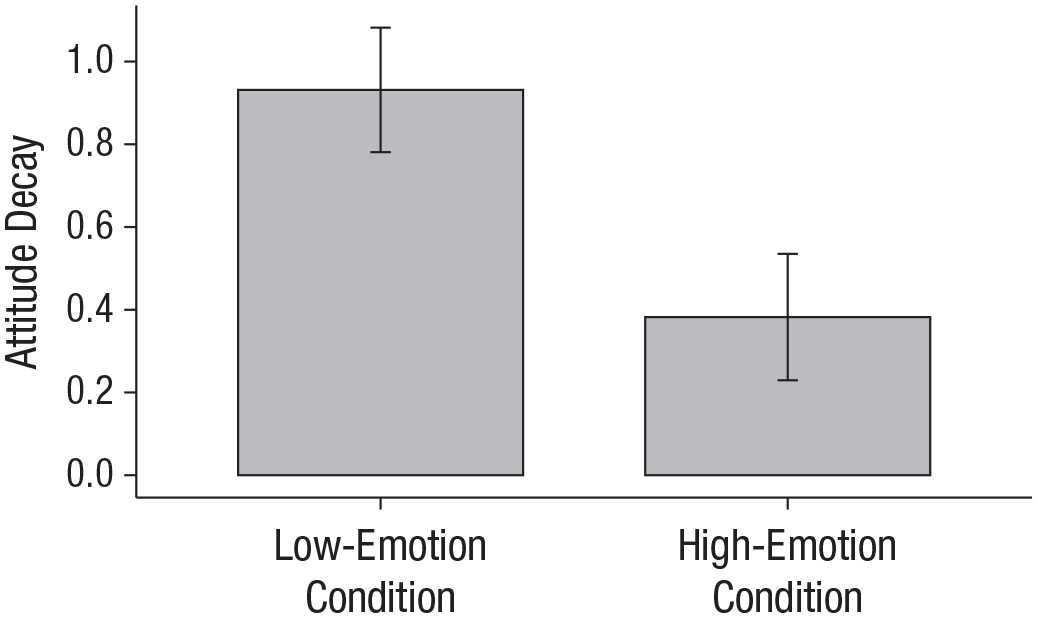
Attitude decay in the high- and low-emotion conditions (Study 4). Higher values reflect greater decay. Error bars represent ±1 SE around adjusted means.
General Discussion
Using a variety of topics and methodological approaches, we conducted seven longitudinal studies—including one field study—that found that emotionality reliably predicted longer-lasting attitudes, particularly positive attitudes. Moreover, emotionality predicted greater consistency in the language individuals used to express their attitude via word of mouth, and persuasion designed to evoke greater emotionality instilled attitudes that decayed less over time.
This effect emerged over and above effects of extremity, certainty, ambivalence, and knowledge. Moreover, contextual modeling demonstrated that the effect held when we controlled for individual differences that may be associated with both emotionality and stability. As argued by other researchers (Bolger & Laurenceau, 2013; Hamaker & Muthén, 2020), evidence that the longitudinal effects held beyond other properties of the attitudes and individual differences provides pivotal support that attitude-specific emotionality was uniquely responsible for stability. We further supported this with a randomized controlled experiment.
Interestingly, these effects go against people’s intuition: People overwhelmingly discounted emotionality as a reliable predictor of attitude stability and did not account for their attitude’s emotionality when predicting how much that attitude would change. Rather, it appears that people instead draw on extremity, certainty, and ambivalence as indicative of long-lasting attitudes, which may overshadow emotionality when individuals reflect on their beliefs about an attitude’s longevity.
These results have implications for predicting future behaviors in a variety of domains because stability is a key mediator of attitudes’ effects on subsequent behavior (Schwartz, 1978). Indeed, evidence from both political and health psychology has highlighted the dominant effects of emotionally based attitudes as predictors of voting and health-related behaviors, respectively (Lavine et al., 1998; Lawton, Conner, & McEachan, 2009). Our data suggest an underlying mechanism for these behavioral effects, indicating that they generalize beyond these domains.
These findings add to a growing body of work suggesting that emotionality deserves to join the pantheon of attitude-strength predictors. To be considered a predictor of strength, a construct should be associated with an attitude’s influence and durability (Krosnick & Petty, 1995; Luttrell & Sawicki, 2020). Prior evidence linking attitude emotionality with accessibility (Rocklage & Fazio, 2018)—a key indicator of attitude strength—and emotionality’s effects on intentions and behavior (Lavine et al., 1998; Lawton et al., 2009) meets the former condition. The present research on temporal stability meets the latter condition. Further, emotionality is a unique indicator of strength; its effects held above and beyond other predictors of strength.
Regarding other strength indicators, Studies 2b and 2c did not find effects of brand-specific certainty, ambivalence, or knowledge. Given that these are often treated as reliable predictors of attitude strength, this may seem surprising; however, there is relatively little support for main effects of these attributes on stability (see Leeper, 2014; Luttrell et al., 2016). Interestingly, we found that individuals who were more ambivalent across various brands also showed more change in their attitudes over time. This pattern is consistent with ambivalence as a sign of weaker attitudes but is intriguing because it occurs at the level of the individual (Britt et al., 2011; Simons, Schneider, & Sanchez-Burks, 2019). Because many studies in the attitude-strength literature tend to measure one attitude at a time, they confound attitude attributes that are specific to a given target with individual propensities to hold attitudes with those attributes. However, the repeated measures, longitudinal design we employed, along with contextual modeling, offered opportunities to probe the unique effects of object-specific emotionality while also supporting compelling new insights about potential individual differences in other attitude attributes. We view these individual-level effects as a thought-provoking and important avenue for future research, particularly in light of recent research highlighting individual differences in attitude stability (Xu et al., 2020).
These results provide critical evidence for an overlooked predictor of enduring attitudes, and future research can help clarify the mechanisms underlying emotionality’s effects on attitude stability. There may be at least two related routes through which more emotionally based attitudes have their longevity. First, past research has suggested that the relatively strong accessibility of these attitudes (Rocklage & Fazio, 2018) likely underlies the consistency in evaluations over time. But what is the mechanism underlying this strong link in memory? Researchers have theorized that the feelings evoked by a stimulus are relatively clear, undeniable cues as to whether the stimulus is liked or disliked, thereby creating a strong link (Fazio, 1995; Rocklage & Fazio, 2018). As a consequence, more emotionally based attitudes should hold up more over time.
Second, and relatedly, our evidence most strongly supports the effects of emotionality for positive attitudes. This is in line with research showing that positive emotionality, but not necessarily negative emotionality, is particularly likely to dominate when individuals arrive at a summary evaluation (Rocklage & Fazio, 2016), and that positive emotionality is particularly predictive of greater accessibility (Rocklage & Fazio, 2018). These results are also in line with research indicating that positive emotion accompanying an experience fades less over time than negative emotion (Skowronski, Walker, Henderson, & Bond, 2014) and, similarly, that individuals bring past positive emotional events to mind more often than negative emotional events (Breslin & Safer, 2011). Thus, individuals may be particularly likely to relive a positive emotional experience they had with an attitude object over time—whether it be a gift, brand, or restaurant—thereby reinforcing the overall evaluation. By contrast, they may be less likely to do so for something that evokes negative emotion. Reliving the positive emotion would also have the effect of enhancing the attitude’s strength and accessibility in memory (Fazio, 1995).
Our evidence suggests that as researchers and practitioners continue to measure attitudes to gain insight into people’s future judgments and choices, they should also assess an attitude’s emotionality. Our results also suggest persuasion strategies that instill lasting opinions. Today’s evaluations of political candidates, consumer products, and social groups are likely to remain relatively fixed to the extent that they are based on emotional reactions, whereas evaluations not based on such emotion may be comparatively fleeting, shifting considerably over time.
Supplemental Material
sj-docx-1-pss-10.1177_0956797620965532 – Supplemental material for Attitudes Based on Feelings: Fixed or Fleeting?
Supplemental material, sj-docx-1-pss-10.1177_0956797620965532 for Attitudes Based on Feelings: Fixed or Fleeting? by Matthew D. Rocklage and Andrew Luttrell in Psychological Science
Supplemental Material
sj-docx-2-pss-10.1177_0956797620965532 – Supplemental material for Attitudes Based on Feelings: Fixed or Fleeting?
Supplemental material, sj-docx-2-pss-10.1177_0956797620965532 for Attitudes Based on Feelings: Fixed or Fleeting? by Matthew D. Rocklage and Andrew Luttrell in Psychological Science
Footnotes
Transparency
Action Editor: Eddie Harmon-Jones
Editor: Patricia J. Bauer
Author Contributions
M. D. Rocklage and A. Luttrell contributed equally to this project and share authorship. Both conceived, designed, and ran the studies; collected and analyzed the data, and wrote the manuscript. Both authors approved the final version of the manuscript for submission.

Notes
References
Supplementary Material
Please find the following supplemental material available below.
For Open Access articles published under a Creative Commons License, all supplemental material carries the same license as the article it is associated with.
For non-Open Access articles published, all supplemental material carries a non-exclusive license, and permission requests for re-use of supplemental material or any part of supplemental material shall be sent directly to the copyright owner as specified in the copyright notice associated with the article.
