






Abstract
How can people wisely navigate social conflict? Two preregistered longitudinal experiments (Study 1: Canadian adults; Study 2: American and Canadian adults; total N = 555) tested whether encouraging distanced (i.e., third-person) self-reflection would help promote wisdom. Both experiments measured wise reasoning (i.e., intellectual humility, open-mindedness about how situations could unfold, consideration of and attempts to integrate diverse viewpoints) about challenging interpersonal events. In a month-long experiment (Study 1), participants used either a third- or first-person perspective in diary reflections on each day’s most significant experience. Compared with preintervention assessments, assessments made after the intervention revealed that participants reflecting in the third person showed a significant increase in wise reasoning about interpersonal challenges. These effects were statistically accounted for by shifts in diary-based reflections toward a broader self-focus. A week-long experiment (Study 2) replicated the third-person self-reflection effect on wise reasoning (vs. first-person and no-pronoun control conditions). These findings suggest an efficient and evidence-based method for fostering wise reasoning.
Keywords
Wisdom is universally valued (Dahlsgaard, Peterson, & Seligman, 2005), especially in difficult situations such as interpersonal challenges (Grossmann et al., 2020). It leads to thoughts, feelings, and behaviors that are both personally and socially beneficial (Grossmann et al., 2020; Sternberg, 2014). Being wise includes epistemic forms of reasoning—intellectual humility, sensitivity to possible change in social relations, openness to diverse perspectives, and the search for ways to integrate different viewpoints (Grossmann et al., 2020). In contrast to general cognitive abilities, these forms of reasoning predict subjective well-being (Grossmann et al., 2020) and prosocial behavior (Brienza, Kung, Santos, Bobocel, & Grossmann, 2018; Grossmann, Brienza, & Bobocel, 2017).
The importance of using wise reasoning seems evident, yet people often fail to exercise it in thinking about issues important to them (Grossmann & Kross, 2014). In particular, personal conflicts tend to elicit bias and low levels of wisdom (Grossmann & Kross, 2014; Staudinger & Baltes, 1996). Though emerging scholarship has started to identify ways to promote wise reasoning in the face of personal challenges, this work has been either cross-sectional or confined to testing short, artificial scenarios in the laboratory. A critical question has remained unaddressed: How can one train people to use wise reasoning in daily life?
Though scholars have not yet empirically evaluated the effectiveness of wisdom training in daily life, propositions about wisdom-enhancing training do exist (Ferrari & Potworowski, 2008; Sternberg, Jarvin, & Reznitskaya, 2008). One dominant proposition has centered on the use of distanced self-reflection—that is, referring to oneself in the third person. Also known as illeism, this ancient form of writing and speaking dates as far back as 58 BC in writings by Julius Caesar (Raaflaub & Strassler, 2017). Though the intention behind referring to oneself in the third person may vary, when applied to self-reflections it promotes psychological self-distancing (Kross et al., 2014; Trope & Liberman, 2010)—a process in which a narrow egocentric focus on the experience in the here and now is diminished and, instead, a focus on the bigger picture is promoted (Kross & Ayduk, 2017; Orvell, Ayduk, Moser, Gelman, & Kross, 2019). In turn, this bigger-picture representation of the situation can bolster wise reasoning (Grossmann, Oakes, & Santos, 2019; Kross & Grossmann, 2012). Indeed, distanced self-reflection is common in diaries of spiritual leaders and has been linked to better emotion regulation (Kross et al., 2014) and relational well-being (Finkel, Slotter, Luchies, Walton, & Gross, 2013).
Past scholarship has also shown that distanced self-reflections can temporarily promote wise reasoning about hypothetical scenarios (Grossmann & Kross, 2014). Whether such short-term effects extend to situations without instructional prompts is unknown. Consequently, we instructed people in two longitudinal experiments to repeatedly practice distanced self-reflections across a range of situations they encountered daily. In this way, we aimed to promote a shift toward more spontaneous self-distancing (Ayduk & Kross, 2010)—that is, a habitually implemented process that can be applied to novel situations. If the intervention successfully promotes an uptake in spontaneous self-distancing, then it should increase people’s propensity to use wise reasoning when facing novel challenges.
We were particularly interested in testing the intervention in the context of adverse events, which is precisely when wisdom is needed the most. Adverse events are more likely to narrow one’s cognitive focus (Garland et al., 2010), which inhibits one’s ability to reason wisely (Grossmann & Kross, 2014).
Study 1
A community sample participated in a month-long training intervention. At the end of each day, people reflected on the central event of the day. Participants randomly assigned to the training (distanced-self-reflection) condition were instructed to use third-person language (e.g., she, her) to promote distanced self-reflections on key daily events. Participants in the control condition were told to use first-person language (e.g., I, mine), which characterizes people’s usual reflections on social issues (Kross & Ayduk, 2017). People used their assigned perspective to reconstruct and reflect on one daily social experience.
Statement of Relevance
Most people experience social conflicts in their lives. The process of working through social conflicts benefits from wisdom, which entails recognizing limits to one’s knowledge, acknowledging different ways the conflict may play out, and considering and balancing multiple viewpoints. Because people typically fail to reason wisely when facing social conflicts, we designed an intervention to help them. In the intervention, people reflected on the major issues of each day from a distanced, third-person perspective. Two experiments tested the effectiveness of this intervention in promoting wisdom over a month (Study 1) or a week (Study 2). Compared with control conditions (reflecting on social conflicts either from a first-person perspective or without instructions), the distanced-self-reflection condition promoted wiser reasoning about personally challenging interactions after the intervention compared with before. This increase in wise reasoning occurred because distanced self-reflection broadened people’s typically narrow self-focus. This research provides the first empirical evidence for the trainability of wisdom in daily life when working through challenging interactions.
We tested whether the intervention could effectively shift participants’ focus toward a broader view of the situation by asking them to repeatedly practice distanced self-reflection on a wide range of meaningful daily experiences. We also tested whether a broader view would promote wiser reasoning about a novel interpersonal challenge that occurred after the intervention.
Method
Unless otherwise noted, we preregistered our predictions and analytical methods (https://osf.io/crw2y) and procedures (https://osf.io/qkmxg/) on OSF. We preregistered our predictions after starting data collection but before quantifying open-ended reflections and performing statistical analyses.
Participants
The study received ethics clearance through a University of Waterloo Research Ethics Committee (Office of Research Ethics [ORE] No. 31889). We recruited local community members from a midsize city in southwestern Ontario and students from a local university to “participate in research on social experiences and personal goals in daily life” for the opportunity to earn up to 110 Canadian dollars. The present study was part of a large-scale investigation of goals, emotions, and reasoning. We aimed to recruit at least 50 participants per cell, similar to the laboratory studies employing third-person-perspective manipulations (Grossmann & Kross, 2014). Analyses with G*Power (Faul, Erdfelder, Lang, Buchner, 2007) indicated that with an effect size calculated by averaging meta-analytic estimates for effect size in preregistered psychological experiments employing between- and within-subject designs (r = .25; Schäfer & Schwarz, 2019) and conventional α and β errors (5% and 20%, respectively), we would need at least 128 participants for a mixed design with two between-subject groups (conditions) and two measurement points (before and after the intervention). Students recruited via the university’s psychology subject pool signed up for the first in-lab session for course credit and then had to opt in for the month-long intervention and subsequent in-lab sessions for extra pay. Accordingly, we anticipated higher attrition in this portion of our sample. Additionally, we anticipated that some participants would not comply with the training, so we proactively doubled the target sample size for the prediary laboratory session to maximize the likelihood of attaining an appropriately powered final sample.
We invited 290 participants for the prediary laboratory session. Of these, 149 participants (77 in the distanced-self-reflection condition, 72 in the control condition; mean age = 22.28 years, SD = 6.93, range = 17–62; 77% female) opted in for the subsequent daily-diary intervention. Sixty percent of these 149 participants did not have a college degree; their median household income was $50,000 to $75,000; and 37% were European Canadian, 30% Asian/Asian Canadian, 11% East Indian, 7% African/African Canadian, 6% Middle Eastern, and 9% other ethnicity. More than half of these participants came from the student subject-pool sample (n = 92; community sample: n = 56). Preliminary analyses indicated that sample type did not significantly qualify training effects on wise reasoning (see the Supplemental Material available online).
Procedure
Participants first completed an online survey and a laboratory prediary session. They then completed a 4-week daily-diary intervention, after which they returned for a postdiary laboratory session. Full project documentation, including a timeline of the study and power analyses, is available in the Supplemental Material and on OSF (https://osf.io/crw2y/).
Daily-diary intervention
Prior to beginning the 4-week daily-diary intervention, each participant was randomly assigned to one of two self-reflection conditions: distanced (i.e., using third-person singular pronouns—she or he, her or him, they or theirs—and their name when referring to themselves) or first-person control (i.e., using first-person singular pronouns—I, me, my, mine). Prior research has indicated that use of first-person singular pronouns is the habitual baseline in self-reflections on daily social events (Kross & Ayduk, 2017). By instructing participants to use these pronouns in the control condition, we aimed to invoke their habitual self-reflection on daily events.
Participants were instructed to complete a daily diary for the duration of 4 weeks. A computer program guided them through the diary reporting. First, they saw a list of events that constituted a range of social experiences (i.e., “conflict/argument with another person,” “annoying/irritating social situation,” “celebration with others,” “enjoyable social event,” “sad/bad news in a social setting”), presented in a randomized order. The content of the survey was then based on the events participants indicated experiencing that day. If participants indicated they had experienced multiple events in 1 day, the program selected only one event, prioritizing an adverse event over a pleasurable one, and randomly selecting one of the same-valence events if multiple such events were reported. If participants indicated that they had experienced none of the social events listed, they did not participate in the training on that day. Instead, they reported their general emotions on the day and whether they had experienced other personal challenges (collected to ensure comparable length across diary days).
Participants reconstructed the social event using the event-reconstruction method (Schwarz, Kahneman, & Xu, 2009), providing the first name of the other person or persons involved in the event, contextual information (e.g., time of day, location), and a detailed description of the event. They rated the intensity of the event on a scale ranging from 0 (not at all intense) to 6 (extremely intense). On Days 1 through 6, participants described their current thoughts about the event from their randomly assigned perspective. We included short writing prompts to ensure that participants understood how to write using a first- or third-person perspective. Participants were asked to use the pronouns appropriate to their assigned condition as much as possible while describing “the event and their stream of thoughts.” We further provided an example. For the first-person control condition, we stated, “For example, you might write ‘I think . . . I feel . . .’” For the distanced-self-reflection condition, we stated, “For example, if your name were Chris, you might write, ‘Chris thinks . . .; Chris feels . . .’” (see Table 1 for exact wording).
Manipulation Instructions in Studies 1 and 2

Note: Study 1 included only the distanced-self-reflection and first-person control conditions. Study 2 included all three conditions. Certain words were presented to participants in boldface to highlight the key aspects of the instructions.
Day 7 of each week was a free-writing day. On Day 7, participants were not instructed to adopt a particular self-reflective language. This effectively served as a process check because it enabled us to measure the degree to which participants’ writing about a social event (randomly chosen from the events they reported in the prior week) corresponded to their assigned condition.
Pre- and postdiary measures
A week before and after the training intervention (i.e., 4-week daily diary), participants visited the laboratory. After they provided informed consent, an experimenter accompanied participants to a computer, on which further instructions were provided via a display interface. First, participants read a standardized definition of a difficult social event and recalled either the most recent social conflict or argument they had had or the most recent annoying or irritating interaction (see the Supplemental Material for verbatim prompts). By providing standardized prompts, we restricted the scope of social conflicts to reduce heterogeneity in the types of social conflicts participants recalled across laboratory sessions (see also the analyses controlling for conflict type below). Participants recalled the experience via the event-reconstruction method. Afterward, participants spent at least 30 s reflecting on the difficult social event. The screen did not advance until 30 s had passed. Subsequently, participants wrote at least one paragraph describing the thoughts that came to mind as they reflected on the event. We coded these reflections to quantify wise reasoning before and after the intervention.
Participants then completed an exploratory questionnaire of reasoning processes, included to compare rater-coded spontaneous reflections with scale-based self-reports of reasoning (see the Supplemental Material for nomological-network analyses). On a subsequent computerized task, we obtained an estimate of participants’ nonverbal fluid intelligence via a version of Raven’s Progressive Matrices (Raven, 1989). This estimate was part of our nomological-network analyses and control covariates.
Manipulation check
Following the preregistered protocol, we examined whether participants in the distanced-self-reflection condition used third-person more than first-person language (relative to participants in the control condition) in their stream-of-thought descriptions on Day 7 of each week (i.e., when no instructional prompts were provided). To this end, a coder (unaware of the condition) counted the number of first- and third-person singular pronouns and references to a participant’s name in each description. We focused on the relative proportion of first- to third-person language to control for people’s general degree of self-reference. We fitted a linear mixed model with participants as a random factor and experimental condition as a between-subjects predictor. Results indicated that the manipulation was successful. Relative to a sum of first- and third-person references, third-person references were 10% more likely to appear in the free-writing narratives of participants in the distanced-self-reflection condition (Mproportion = .16, 95% confidence interval, or CI = [.12, .19]) compared with the control condition (Mproportion = .06, 95% CI = [.01, .10]), b = 0.10, SE = 0.03, t(107.59) = 3.59, p < .001.
Quantifying wise reasoning in laboratory narratives
Two raters unaware of the hypothesis (and with condition masked) coded the written stream-of-thought narratives for wise reasoning. Past research has established a wise-reasoning coding system with five themes (Grossmann, 2017): (a) intellectual humility, (b) recognition of world in flux, (c) acknowledgment of other people’s perspectives, (d) search for a compromise, and (e) consideration of conflict resolution. The face validity of these themes has been established in work on the common-wisdom model in empirical sciences (Grossmann et al., 2020), showcasing thematic convergence across working definitions of wisdom among moral psychologists and adult developmentalists (see also Grossmann et al., 2010, Study 3).
Following our preregistered protocol (https://osf.io/8pg63), the final coding system contained the following five levels: 1 = nothing about the theme mentioned; 2 = one instance of the theme is mentioned but is not described in depth; 3 = several instances of the theme are mentioned, but none are described in depth; 4 = one or more instances of the theme are mentioned, and one of them is described in depth; and 5 = several instances of the theme are mentioned, and two or more of them are described in depth. Interrater reliability between the coders for each theme was very good (Kendall’s Ws > 0.84); disagreements were resolved via discussion between coders. Levels 3 and 5 were rare (each < 1.3% across all themes). Test-retest reliability of the coded wise reasoning across laboratory sessions was medium to high, r = .48 (23% between-person variance), and comparable with the reliability of state-level measures of other constructs, such as extraversion or conscientiousness (see Fleeson & Gallagher, 2009).
Additional information on the coding system can be found in the Supplemental Material, which contains the coding manual and reports the rationale for the five-level coding system and its discriminant, convergent, and predictive validity through associations with measures of cognitive abilities, alternate operationalizations of wise reasoning, and predictive-validity measures of emotional balance and well-being. Also reported are post hoc multiverse analyses (not preregistered) using different coding systems, which yielded similar results to those reported below.
Broad versus narrow self-focus
We hypothesized that the distanced self-talk in the diary would promote a shift from a narrower self-focus to a broader, psychologically distant self-focus (Kross & Ayduk, 2017). We examined whether the experimental training promoted changes in self-focus between participants’ pre- and postintervention self-reflections on social conflicts. We subsequently tested whether changes in self-focus accounted for changes in wise reasoning.
No participants referred to themselves in the third person during the laboratory sessions. In hindsight, this observation is not surprising—distanced self-reflections after completing a standard event-reconstruction method (which explicitly directs people to reconstruct an experience from a first-person perspective) would have suggested that participants had not followed our instructions. Therefore, we used a measure of broad versus narrow self-focus from prior research (Grossmann & Kross, 2010; Pennebaker, Mehl, & Niederhoffer, 2003) that encompassed the proportion of interdependent references (first-person plural pronouns, such as us, our) relative to narrow self-focused references (first-person singular pronouns, such as me, mine), controlling for total number of pronouns.
Completion rates
On average, participants completed nine training sessions (M = 8.74, Mdn = 8, SD = 4.65, range = 2–19). Given initial pilot-data estimates of the frequency of each social event included in our daily diary, this estimate appears typical of the number of the targeted social events people report over the course of a month. The total number of completed diary days, including no-training days (i.e., when participants reported experiencing none of the social events in question) but not free-writing days, was higher (M = 16.35, Mdn = 18, SD = 5.54, range = 2–24).
On average, participants completed 71% of all daily diaries. The retention rate between the first diary day and the postintervention laboratory session was 81% (57 self-reflection participants and 63 control participants in the final session), which is higher than typical retention rates in clinical studies (Geraghty, Wood, & Hyland, 2010) and longitudinal surveys (Roberts, Walton, & Viechtbauer, 2006). We provide further attrition-bias-probing analyses in the Supplemental Material.
Exclusions
Following the preregistered protocol (https://osf.io/crw2y/), we excluded 15 participants (8 in the self-reflection condition, 7 in the control condition) who reported fewer than two social events across four diary weeks. The rationale was that a single self-reflection in a diary would not provide a sufficient basis for notable training differences.
Analytical procedure
Following the preregistered analytic plan, we used a full-information maximum-likelihood estimator to fit mixed models and parsimoniously account for missing data with minimal information loss (Enders & Bandalos, 2001). This approach allowed us to control for attrition between different measurement points. A mixed-model framework also allowed us to enhance power and generalizability, with responses from respective themes of wise reasoning nested within participants.
Following the preregistered analytic plan, we fitted a linear mixed-effects model with time (before vs. after intervention) as a Level 1 predictor, experimental condition as a Level 2 predictor, and wise-reasoning scores nested in participants and coders. Because the dependent variable was right-skewed (skewness = 2.66), we transformed scores for the dependent variable to normal scores with the same mean and standard deviations using the QuantPsyc package (Fletcher, 2012). Results were similar when using (a) a generalized linear mixed model with gamma distribution as another way to account for skewness in the data, (b) a Bayesian multilevel model with scores as an ordinal variable, and (c) a multilevel logistic model with coded responses as a binomial variable (i.e., presence or no presence of a theme; see the Supplemental Material). We used the emmeans package (Version 1.4.7; Lenth, 2020) to estimate marginal means in planned contrasts and post hoc comparisons, with denominators for the t statistics based on pooled information in the overall fitted model. We used Nakagawa and Schielzeth’s (2013) procedure to approximate pseudo-R2 for each model, and we used a model-comparison approach to estimate partial effects from each predictor in the model. We followed Funder and Ozer’s (2019) guidelines, converting all pseudo-R2 estimates into r values, a common metric for effect size in psychological research.
Results
Training effects for wise reasoning
Our key hypothesis was that participants in the distanced-self-reflection condition would show more wise reasoning when reflecting on interpersonal challenges after the intervention (vs. before the intervention) than participants in the control condition. In line with our prediction, we observed a Time × Condition interaction, t(2638.02) = 2.70, p = .007, r = .084 (see Fig. 1). Consistent with random assignment, results showed that participants in both conditions did not significantly differ in wise reasoning before the intervention, t(147.03) = 1.12, p = .264, r = .049. Focusing on postintervention sessions, we observed a nonsignificant trend for participants in the distanced-self-reflection condition reporting greater wise reasoning than participants in the control condition, t(118.15) = 1.00, p = .320, r = .052. Turning to the preregistered tests, we observed that participants in the distanced-self-reflection condition showed more wise reasoning after (vs. before) the intervention, b = 0.13, SE = 0.03, t(1364.15) = 4.78, p < .001, r = .117, whereas wise reasoning in the control condition did not change as a function of time, b = 0.02, SE = 0.03, t(1269.02) = 0.73, p = .464, r = .019.

Mean total wisdom score (left) before and after the intervention, separately for the distanced-self-reflection and first-person control conditions in Study 1. Means are also shown separately for each wise-reasoning theme: intellectual humility, recognition of change, consideration of other people’s perspectives, search for compromise, and search for conflict resolution. Error bars represent 95% confidence intervals (CIs).
To account for possible variance in type of interpersonal challenge before and after the intervention, we quantified conflicts by target (the other person involved: same vs. different), place (e.g., home, work), and type of social conflict (e.g., intimate relationship, family, work; see the Supplemental Material). When performing separate mixed-effect analyses with these covariates, we also observed a Time × Condition interaction, t(2652.98) = 2.80, p = .005, r = .055. Participants in the distanced-self-reflection condition continued to show more wise reasoning after (vs. before) the intervention, b = 0.14, SE = 0.03, t(1339.04) = 4.69, p < .0001, r = .103, whereas wise reasoning in the control condition still did not change across time points, b = 0.03, SE = 0.03, t(1269.75) = 0.89, p = .375, r = .033. The interaction effect also held when analyses controlled for the following potential confounds: number of adverse experiences during the diary-based training, contextual differences between social conflicts people reasoned about (i.e., time of day event occurred, length of conflict), and narrative word count, t(2468.99) = 3.19, p = .001, r = .063. In a separate analysis, the interaction effect was also robust when analyses controlled for age, gender, ethnicity, and fluid intelligence (assessed before and after the intervention), t(2356.63) = 3.44, p < .001, r = .066.
Theme-specific analyses of training-based growth in wise reasoning
Figure 1 and Table 2 show significant training-contingent growth in three of the five themes of wise reasoning. Namely, intellectual humility, consideration of other people’s perspectives, and search for conflict resolution showed significant change after compared with before the intervention.
Estimates of Training on Growth for Each Wise-Reasoning Theme in Study 1

Note: Simple effects of time (before vs. after intervention) by condition were calculated with the Kenward-Roger method for estimating degrees of freedom for estimates from linear mixed models. Boldface indicates significant results. We used a false-discovery-rate approach (Benjamini & Hochberg, 1995) to control for multiple testing in these post hoc simple-effects analyses (not preregistered).
Training effects for broad versus narrow self-focus
Participants in the distanced-self-reflection condition demonstrated a significant increase in the proportion of broad versus narrow self-references from before to after the intervention, b = −0.05, SE = 0.02, t(135) = 2.07, p = .040, r = .158. There was no significant difference from before to after the intervention observed in the control condition, b = 0.004, SE = 0.02, t(138) = 0.17, p = .864. Next, we explored whether the condition-based growth in wise reasoning was statistically mediated by change in self-focus. To this end, we focused on the intervention group to test whether change in wise reasoning before and after the intervention statistically related to change in self-focus. Adding broad or narrow self-focus as a covariate into the model, with wise reasoning as a dependent variable and time point as a predictor, indicated a significant effect of self-focus, b = 0.41, SE = 0.14, t(859.73) = 3.01, p = .003, r = .098, as well as a significant effect of time (after vs. before the intervention), b = 0.11, SE = 0.03, t(1373.17) = 3.91, p < .001, r = .086. Indirect-effects analyses (Tingley, Yamamoto, Keele, & Imai, 2014; 5,000 simulations) with self-focus as a mediator of the training effect on growth in wise reasoning revealed a significant indirect effect, b = 0.02, 90% CI = [0.01, 0.03], p = .004, with self-focus accounting for 13.77% of the total growth effect in wise reasoning. This partial-mediation effect suggests that broader self-focus plays a role in the training-based growth in wise reasoning, though it does not fully explain it. 1
Study 2
In Study 2, we tested the replicability of promoting wise reasoning about interpersonal challenges through distanced self-reflections. We designed a week-long training intervention, used a larger sample, and included an additional no-instruction control condition that we assumed would operate similarly to the first-person condition. As in Study 1, people reconstructed and reflected on the central event of each of the 7 days, following the instructions of their randomly assigned condition. In addition to instructing two groups on the use of third- and first-person pronouns as in Study 1, we instructed a third group of participants to reflect on the event but did not provide explicit instructions on which pronouns to use. We examined wise reasoning in participants’ reflections on social challenges before and after the intervention, predicting that the distanced-self-reflection condition would provide unique benefits for growth in wise reasoning compared with the first-person and no-instruction control conditions.
Method
Participants
This preregistered study (https://osf.io/8pg63) received ethics clearance from the University of Waterloo Research Ethics Committee (ORE No. 30862). We recruited American and Canadian Amazon Mechanical Turk (MTurk) workers to “examine how people reason about social events in their daily lives” for the opportunity to earn up to US$34. We followed the power estimates outlined in Study 1 (N = 290 across two conditions), aiming to recruit 150 participants for each of the three conditions. Of the 454 recruited participants for the initial survey, 11 decided not to participate in any follow-up surveys, disqualifying themselves from the postintervention survey. Of the 443 participants who qualified for the postintervention session, 412 completed the final survey (93% retention rate). We excluded participants whose age and gender did not match on pre- and postintervention surveys (out of suspicion that different people were filling out surveys; n = 15) and participants who did not provide meaningful responses to open-ended questions. The final sample contained 406 participants for the preintervention survey (134 in the distanced-self-reflection condition, 135 in the first-person control condition, and 137 in the no-instruction control condition; mean age = 35.04 years, SD = 10.57, range = 18–70; 45.02% female). Of these participants, 49% did not have a 4-year college degree; their median household income was $35,001 to $50,000; and 72% were White, 7% Asian, 6% Hispanic/Latinx, 9% African/African American, 4% mixed, and 2% other ethnicity. For the postintervention survey, there were 382 participants—127 in the training condition, 128 in the first-person control condition, and 127 in the no-instruction control condition. Thus, the attrition was minimal and comparable across conditions. On average, participants completed six of the seven daily diaries.
Pre- and postintervention measures
Three days before and 1 day after the intervention (i.e., the 1-week daily diary), participants completed a survey online. After providing informed consent, participants read a definition of a difficult social event (either a social conflict or an irritating interaction), as in Study 1. They then recalled and reconstructed such an event, guided by the event-reconstruction method (Schwarz et al., 2009), which included writing a detailed description of the event. After reconstructing the event, participants spent at least 30 s reflecting on the difficult social event; the screen did not advance before 30 s had passed. Subsequently, participants wrote at least one paragraph describing the thoughts that came to mind as they reflected on the event. Finally, participants completed additional questionnaires about their postreflection appraisal of the situation (see the Supplemental Material) and reported their demographics.
Quantifying wise reasoning in narratives
Two raters unaware of the hypothesis and the condition coded the written descriptions and stream-of-thought narratives, quantifying the degree of wise reasoning on the five previously established dimensions of wise reasoning (see the Study 1 Method for more detail; Grossmann, 2017). Interrater reliability for each dimension was very good (Kendall’s Ws > 0.79), and disagreements were resolved via discussion between coders, in consultation with the first author.
Experimental manipulation
Prior to beginning the week-long diary intervention, each participant was randomly assigned to one of three self-reflection conditions: distanced (using third-person pronouns such as she or he, her or him, and they or them, and using their name to refer to themselves), first-person control (using first-person pronouns such as I, me, my, and mine), or no-instruction control (given no specific instructions about pronoun usage).
The daily-diary surveys became available to participants on each afternoon of a respective day and were active for a 19-hr period. The daily-diary method was identical to that used in Study 1. We included short writing prompts to ensure that participants understood how to write using a first- or third-person perspective. When describing “the event and their stream of thoughts,” participants in the first-person condition were instructed to use the pronouns I and me as much as possible, and participants in the distanced-self-reflection condition were instructed to use she and hers, he and his, they and theirs, and their own name as much as possible. Participants in the no-instruction control condition did not receive pronoun-usage instructions. The remaining instructions for this condition were identical to those in the two other conditions (see Table 1). The pronoun manipulation was successful, showing carryover effects to the postintervention survey, which did not include instructional prompts (see Fig. S7 in the Supplemental Material).
Analytical procedure
Following our procedure in Study 1, we fitted a general linear model with the dependent variable transformed via the “normalize” function in QuantPsyc (Fletcher, 2012) to account for violation of the normality assumption (skewness = 1.65). Our model included time (before vs. after intervention) as a within-person Level 1 predictor and self-reflection condition as a between-person Level 2 predictor, with wise-reasoning scores nested in participants and coders. As in Study 1, we used a false-discovery-rate approach (Benjamini & Hochberg, 1995) to control for multiple testing in these post hoc simple-effects analyses (not preregistered). We used Nakagawa and Schielzeth’s (2013) procedure to approximate pseudo-R2 for each model to compare partial effects from each predictor in the model and to contrast magnitude of change in different conditions. Subsequently, we converted R2 estimates into rs as a common metric for effect size (Funder & Ozer, 2019).
Results
The results indicated a main effect of diary-based reflection, b = 0.14, SE = 0.01, t(7647.61) = 12.50, p < .001, r = .141. In line with predictions, this effect was qualified by a Time × Condition interaction, Wald χ2(2, N = 7,871) = 12.52, p < .002, r = .045 (see Fig. 2). Consistent with random assignment, results showed that conditions did not significantly differ from each other before the intervention, ts < 0.84, ps < .679. After the intervention, participants in the distanced-self-reflection condition showed significantly more wise reasoning than participants in the first-person condition, t(718) = 2.17, p = .045, r = .080, and no-instruction control condition, t(727) = 2.42, p = .045, r = .080, whereas these two control conditions were not significantly different from each other, t(726) = 0.25, p = .805.
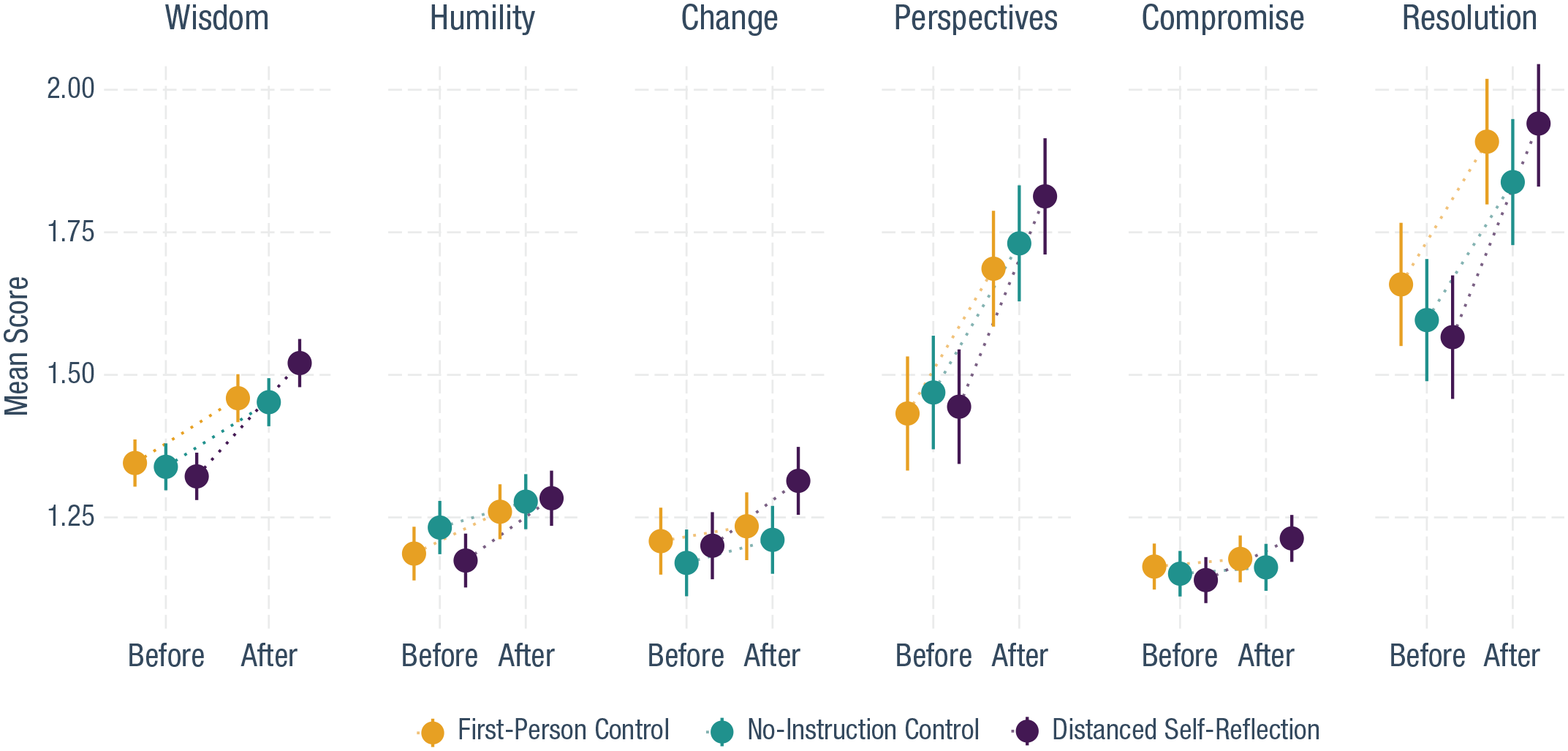
Mean total wisdom score (left) before and after the intervention, separately for the distanced-self-reflection, first-person control, and no-instruction control conditions in Study 2. Means are also shown separately for each wise-reasoning theme: intellectual humility, recognition of change, consideration of other people’s perspectives, search for compromise, and search for conflict resolution. Error bars represent 95% confidence intervals.
The key hypothesis was that training would result in wiser reasoning than habitual reflections (first-person and no-instruction control conditions). Examining this preregistered hypothesis about condition-dependent change in wise reasoning revealed that participants in the distanced-self-reflection condition showed more wise reasoning after (vs. before) the intervention, b = 0.31, SE = 0.03, t(2522.04) = 10.71, p < .001, r = .186, compared with participants in the first-person and no-instruction control conditions—first-person: b = 0.16, SE = 0.03, t(2536.02) = 5.93, p < .001, r = .102; no instruction: b = 0.13, SE = 0.02, t(2557.52) = 5.28, p < .001, r = .089. In separate models with covariates, the Time × Condition interaction effect was robust when analyses controlled for age, gender, and household income, χ2(2, N = 7,841) = 12.85, p = .002, r = .045, and for characteristics of recalled events at each time point (time, duration, and recurrence of the event), χ2(2, N = 7,601) = 14.02, p < .001, r = .037.
Finally, we examined results for each of the five themes of wise reasoning. As Figure 2 and Table 3 indicate, participants in the distanced-self-reflection condition showed significant change after the intervention in each of the five themes of wise reasoning. Similar to Study 1, the training-driven growth in wise reasoning was particularly pronounced for intellectual humility and the social-cognitive themes of wise reasoning: consideration of other people’s perspectives and search for conflict resolution. To evaluate condition-specific growth in each theme of wise reasoning, we compared respective effect sizes of change in the experimental and control conditions (Table 3). Difference in effect-size estimate r varied between .114 and .170 (M = .144), suggesting a small to medium effect size for the intervention effect (Funder & Ozer, 2019) on change in wise reasoning.
Estimates of Training on Growth for Each Wise-Reasoning Theme in Study 2

Note: Simple effects of time (before vs. after intervention) by condition were calculated with the Kenward-Roger method for estimating degrees of freedom for estimates from linear mixed models. Boldface indicates significant results.
A comparison of Figures 1 and 2 reveals a few points of divergence between Study 1 and Study 2. Whereas Study 1 reported no main effect of diary writing for changes in wise reasoning, this effect was significant in Study 2. We consider possible explanations for this point of divergence in the General Discussion.
General Discussion
Two interventions demonstrated the effectiveness of distanced self-reflection for promoting wiser reasoning about interpersonal challenges, relative to control conditions. The effect of using distanced self-reflection on wise reasoning was in part statistically accounted for by a corresponding broadening of people’s habitually narrow self-focus into a more expansive sense of self (Aron & Aron, 1997). Distanced-self-reflection effects were particularly pronounced for intellectual humility and social-cognitive aspects of wise reasoning (i.e., acknowledgment of other people’s perspectives, search for conflict resolution). This project provides the first evidence that wisdom-related cognitive processes can be fostered in daily life. The results suggest that distanced self-reflections in daily diaries may cultivate wiser reasoning about challenging social interactions by promoting spontaneous self-distancing (Ayduk & Kross, 2010).
Additional results in Study 1 (see the Supplemental Material) indicate that distanced self-reflection and growth in wise reasoning can foster greater breadth and evenness in people’s representation of negative emotions. Further supplementary results from the Study 1 intervention show enhanced positive (rather than negative) feelings toward close others in conflict situations, as evidenced by a 1-month follow-up survey on social conflicts experienced by participants after the intervention. These results dovetail with emerging conclusions that wise reasoning provides prospective benefits for interpersonal feelings (Peetz & Grossmann, 2020) and well-being (Santos & Grossmann, 2020). 2
The present work contributes to the literature on training cognition (Larrick, Morgan, & Nisbett, 1990; Perkins & Grotzer, 1997) and attempts to reduce cognitive biases (Larrick, 2004). Prior cognitive-training efforts have largely focused on working memory or formal reasoning, which differ from wise reasoning in several aspects. The former is abstract and decontextualized, whereas the latter is embedded in the social pragmatics and often involves personally relevant matters (Grossmann et al., 2020). Moreover, past work has highlighted the difficulties in extending domain-general training effects to novel situations (Kassai, Futo, Demetrovics, & Takacs, 2019; Sala & Gobet, 2019).
An additional contribution of this work is that it demonstrates how laboratory insights concerning the benefits of distanced self-reflection for self-regulatory processes (Kross et al., 2014) and wisdom-related processes (Grossmann & Kross, 2014) can be extended to training-based interventions in the field. The training used in the current studies suggests the usefulness of situating repeated training sessions in the ecological context of daily real-world experiences. Because people trained across a range of interpersonal challenges over the course of 1 week (Study 2) or 4 weeks (Study 1), this intervention may have facilitated the development of a general tendency (Fleeson & Jayawickreme, 2015) to self-distance in the face of social conflicts. Through repeated training across diverse situations, this intervention increases the likelihood that the target characteristic will be applied to novel situations. The present approach also makes use of meaningful firsthand experiences people encounter in their lives, suggesting greater generalizability and durability compared with laboratory training on hypothetical scenarios.
The current results may have practical implications. The present intervention provides proof of concept for the viability of training cognitive techniques, such as spontaneous self-distancing. Much prior research indicates that in the heat of an argument or reflection on traumatic social events, people tend to spontaneously immerse themselves in the experience, narrowing their focus on the here and now (Grossmann & Kross, 2010; Kross & Ayduk, 2017; McIsaac & Eich, 2004; Wegner & Giuliano, 1980). Such narrow self-focus can be adaptive in the short term, allowing people to redirect resources to immediate concerns and actions. However, narrow self-focus and the resulting egocentrism can prevent one from considering the bigger picture, beyond one’s immediate emotional reactions and actions in a conflict situation (Chambers & De Dreu, 2014). Identifying effective ways to combat maladaptive egocentric tendencies is central both to research on wisdom and clinical practice (e.g., Bernstein et al., 2015).
Several caveats are in order before concluding. First, our work included participants from English-speaking parts of North America. Given cultural differences in wise reasoning (Grossmann et al., 2012) and self-focus (Cohen, Hoshino-Browne, & Leung, 2007; Grossmann & Kross, 2010), future research ought to test the effects’ generalizability in other languages and cultural contexts.
Second, the observed effects of the training were small to moderate in size (.118 ≤ r ≤ .267), which is consistent with typical effect sizes in psychological research (Funder & Ozer, 2019). The lower part of the range is comparable with the well-established effect of attributing failure to bad luck (r = .10), whereas the higher part is comparable with the effect of men weighting more than women (r = .26; see Funder & Ozer, 2019, for a review of effect-size benchmarks in psychological science). Although the effect sizes are in line with other psychological findings, distanced self-reflection may not be uniformly effective when people face challenging interpersonal situations in their lives. Moreover, confidence in the findings’ robustness awaits independent replication.
Third, although there were consistent effects across both studies, there was also some divergence, suggesting possible ways to isolate conditions facilitating training effects. Whereas Study 1’s postintervention session took place in the laboratory 1 week after participants completed the training, the equivalent session in Study 2 was administered online, 1 day after the diary training. This difference may explain why diary training in Study 2, but not in Study 1, resulted in a main effect of diary writing. Web-based testing also resulted in shorter reflection essays than laboratory-based testing did. Essay length, together with the shorter duration of the intervention in Study 2 (1 week vs. 4 weeks in Study 1) may have contributed to further differences between the studies. Repeated distanced self-reflection may be more effective when administered over longer time periods than 1 week (Dorfman, Oakes, Santos, & Grossmann, 2019).
Fourth, because writing a diary can provide socioemotional benefits (Pennebaker, 1997) and facilitates self-distancing on its own (Grossmann, Gerlach, & Denissen, 2016; Park, Ayduk, & Kross, 2016), we did not include a no-diary control condition. To further unpack the mechanisms through which distance and self-reflection jointly facilitate wise reasoning, researchers may wish to consider including a no-diary condition in future work.
Fifth, the training-based intervention used here focused on interpersonal social challenges, raising the question of whether such training can generalize to wise reasoning during intergroup conflicts, political challenges, or challenges of a noninterpersonal nature (e.g., financial decision making). Last, it is worth pointing out that not all types of third-person self-reflection may be similarly effective. Whereas the present studies focused on distanced self-reflection via third-person language in diaries to promote broader self-focus (Kross & Ayduk, 2017), third-person language may also be used strategically in communication, with the goal of advantageous self-presentation or self-promotion. Under such public circumstances, it is less likely to bring wisdom-related benefits because of the more self-focused nature of strategic use of third-person language. We demonstrated this point in an additional preregistered experiment (see Study 3 in the Supplemental Material).
Conclusion
Wisdom concerns a balanced, open approach to reasoning based on a desire to reconcile disparate viewpoints (Grossmann et al., 2020). It predicts a host of desirable outcomes, from harmonious interpersonal relationships (Brienza et al., 2018; Grossmann et al., 2017) to personal well-being (Santos & Grossmann, 2020). The current work showed that wisdom is not the purview of just a few fortunate individuals. Utilizing the ancient practice of distanced self-reflection, we demonstrated that referring to oneself in the third person during repeated reflections on daily events affords a more expansive self-focus, which in turn facilitates wiser reasoning. The results from two field studies suggest that training people in distanced self-reflection can bolster wise reasoning in everyday life.
Supplemental Material
sj-docx-1-pss-10.1177_0956797620969170 – Supplemental material for Training for Wisdom: The Distanced-Self-Reflection Diary Method
Supplemental material, sj-docx-1-pss-10.1177_0956797620969170 for Training for Wisdom: The Distanced-Self-Reflection Diary Method by Igor Grossmann, Anna Dorfman, Harrison Oakes, Henri C. Santos, Kathleen D. Vohs and Abigail A. Scholer in Psychological Science
Footnotes
Acknowledgements
Takuya Shibayuma, Nadine Bolineu, Mane Kara-Yakoubian, Oliver Twardus, and Tianrong Sun provided valuable assistance with qualitative coding, and Sonia Vintan and Konstantyn Sharpinsky provided assistance with data-integrity cross-validation.
Transparency
Action Editor: Patricia J. Bauer
Editor: Patricia J. Bauer
Author Contributions
I. Grossmann conceived Study 1 and Study 3, and I. Grossmann, A. Dorfman, and K. D. Vohs conceived Study 2. I. Grossmann, H. Oakes, and A. A. Scholer designed Study 1, I. Grossmann and A. Dorfman designed Study 2, and I. Grossmann designed Study 3. I. Grossmann and A. Dorfman preregistered the studies. I. Grossmann and H. C. Santos collected data for Study 1. I. Grossmann and A. Dorfman collected data for Study 2, and I. Grossmann collected data for Study 3. I. Grossmann and A. Dorfman analyzed the data for Study 1, and I. Grossmann analyzed the data for Studies 2 and 3. I. Grossmann drafted the initial version of the manuscript. All authors contributed to the revision of the manuscript and approved the final manuscript for submission.

Notes
References
Supplementary Material
Please find the following supplemental material available below.
For Open Access articles published under a Creative Commons License, all supplemental material carries the same license as the article it is associated with.
For non-Open Access articles published, all supplemental material carries a non-exclusive license, and permission requests for re-use of supplemental material or any part of supplemental material shall be sent directly to the copyright owner as specified in the copyright notice associated with the article.
