






Abstract
Differences of opinion between people are common in everyday life, but discussing those differences openly in conversation may be unnecessarily rare. We report three experiments (N = 1,264 U.S.-based adults) demonstrating that people’s interest in discussing important but potentially divisive topics is guided by their expectations about how positively the conversation will unfold, leaving them more interested in having a conversation with someone who agrees versus disagrees with them. People’s expectations about their conversations, however, were systematically miscalibrated such that people underestimated how positive these conversations would be—especially in cases of disagreement. Miscalibrated expectations stemmed from underestimating the degree of common ground that would emerge in conversation and from failing to appreciate the power of social forces in conversation that create social connection. Misunderstanding the outcomes of conversation could lead people to avoid discussing disagreements more often, creating a misplaced barrier to learning, social connection, free inquiry, and free expression.
Keywords
I am convinced that men hate each other because they fear each other. They fear each other because they don’t know each other, and they don’t know each other because they don’t communicate with each other, and they don’t communicate with each other because they are separated from each other. And God grant that something will happen to open channels of communication. . . .
People are commonly advised to avoid discussing potentially divisive topics such as politics and religion in conversation, presumably to avoid the negative reactions that are expected to follow from discussing disagreements about deeply held values (Skitka & Bauman, 2008; Skitka & Morgan, 2014). Increasing political polarization may further heighten these fears (Finkel et al., 2020) because more extreme disagreement would presumably be expected to yield even more negative reactions. Explicit advice to avoid discussing disagreements may be unnecessary, however, because people seem to intuitively avoid engaging with others who disagree with their political views (Chen & Rohla, 2018; Gerber et al., 2012; Motyl et al., 2014; Skitka et al., 2005; Sun & Slepian, 2020) and seek out others with like-minded views (Buss, 1984; Byrne, 1961; Sprecher, 2014, 2019).
Consistent with King’s conviction, however, we suggest that people’s expectations about the consequences of discussing potential areas of disagreement can be systematically miscalibrated such that they overestimate how negatively these conversations would actually go, consistent with King’s conviction. As a result, people may be overly reluctant to talk about potentially divisive topics in everyday life. Misunderstandings about the outcomes of discussing political disagreements may therefore leave people more separated from those with differing opinions than appropriately calibrated expectations would lead them to be.
We suggest that miscalibrated expectations about discussing disagreement could stem from three mechanisms. First, because expectations about out-groups are likely based on stereotypes that exaggerate central differences between groups (compared to perceptions of in-groups; Ames, 2004; Eyal & Epley, 2017), people may underestimate how much common ground they share with an out-group member compared to an in-group member and hence underestimate how positive an interaction with an out-group member might be (Fernbach & Van Boven, 2022; Mallett et al., 2008). Because conversations tend to reveal common ground to enable coordinated communication (a process called “grounding”; Clark & Brennan, 1991), conversation may be especially likely to reveal unexpected areas of agreement. If people underestimate the amount of common ground present in cases of disagreement, and if conversation tends to reveal common ground, then the conversation may be a significantly more positive experience than expected.
Second, dyadic conversation is a cooperative exchange that can strengthen social bonds by sharing attention, disclosing personal information, and showing responsiveness (Collins & Miller, 1994; Reis & Shaver, 1988; Wohltjen & Wheatley, 2021). However, people tend to underestimate how positive conversations (in general) will be, both in terms of positive experience and learning, suggesting that people do not fully anticipate the power of these social forces in dyadic conversations (Atir et al., 2022; Epley & Schroeder, 2014; Sandstrom & Boothby, 2021; for a review, see Epley et al., 2022). If so, then people’s expectations about the outcomes of social interaction may be based more on the type of person they are interacting with (e.g., whether they agree or disagree) than on the type of interaction they are having (e.g., whether they are engaging in a dyadic conversation vs. a noninteractive exchange; Kruger et al., 2005). If people fail to appreciate how social forces present in conversation can draw people together, then they may be especially likely to underestimate the positive outcomes of having an actual conversation with someone who holds opposing views.
Finally, people learn the outcomes of conversations they actually have but do not learn the outcomes of conversations they avoid. Negative expectations that encourage avoidance are therefore likely to be based on less direct experience than positive expectations that encourage engagement (Denrell, 2005; Fazio et al., 2004; Hogarth et al., 2015). If people avoid discussing disagreements because they think the conversation will be unpleasant, then they will miss having the very conversations that could calibrate their expectations. Further, if this avoidance causes people to discuss their disagreements with strangers only rarely, then they might forget just how positive their past experiences have been, or they might not bring these past experiences to mind when anticipating the outcome of a future conversation. In contrast, if people choose to discuss important topics with people they already agree with—because they think they will be more pleasant—then people would also be more calibrated about how these conversations would go because they have actually learned from them. This predicts that people’s expectations about discussing disagreement are likely to be especially miscalibrated compared to their expectations about discussing agreement (Epley et al., 2022).
Statement of Relevance
People are commonly advised to avoid discussing potentially divisive topics in conversation based on expectations that these conversations will be hostile and unpleasant. Avoiding these topics, however, creates a divide between people that keeps them from more accurately understanding others’ perspectives, from identifying common ground and consensus, and from connecting with others in meaningful and authentic ways. On a societal level, such avoidance could enhance polarization and harden political divides. Our research (with U.S.-based adults) suggests that people’s beliefs about discussing disagreements may be systematically miscalibrated such that they underestimate how positively others will respond when discussing disagreements in a dyadic conversation and hence may be avoiding conversations that they would be happy to have had. More calibrated expectations about the outcomes of conversation would yield wiser decisions about when to discuss potentially divisive topics and when to avoid them, potentially leaving people both better connected and better informed.
Several existing findings support our hypotheses but do not involve conversations about the potentially divisive topics of conversation that people often choose to avoid, such as politics and religion. For instance, people in one series of experiments expected that asking a stranger potentially sensitive questions such as “How much is your salary?” would be a more negative experience than it actually was (Hart et al., 2021). In another series, participants underestimated how positive it would be to have a conversation about relatively deep and intimate topics and did so more than for relatively shallow topics (Kardas et al., 2022). In a third series, political partisans expected that being exposed to an opposing political viewpoint—such as by reading an explanation of why someone voted for an opposing candidate or by listening to someone from an opposing political party explain their views—would be a more negative experience than it actually was, and these miscalibrated expectations guided their interest in being exposed to opposing viewpoints (Dorison et al., 2019). We advance this literature by examining people’s expectations and experiences in dyadic conversations about potentially divisive topics, a context that may be both uniquely powerful for creating social connection in daily life but also especially likely to be avoided because of concerns about hostility or aggression. We also test how the context of an interaction moderates people’s expectations and experiences to understand when and why people may systematically misunderstand the outcomes of social interaction.
We describe three experiments testing our hypotheses that people’s expectations about the nature of a conversation guide their interest in having or avoiding it (Experiment 1) and that expectations about discussing disagreement are systematically miscalibrated such that people underestimate how positively such conversations will go with strangers (Experiment 2) compared to discussing areas of agreement. We test how underestimating common ground (Experiments 2 and 3) and the power of social forces in conversation (Experiment 3) could explain why people underestimate the positive outcomes of discussing disagreements. Better calibrated expectations about the outcomes of conversation could lead to wiser decisions about opening channels of communication with others.
Open Practices Statement
All studies were preregistered. All preregistrations, experimental materials, data, and analysis code are available on the OSF at https://osf.io/j6us9/?view_only=a0bbb3d82af544a285848acafbd887de.
Experiment 1: From Expectations to Interest
Method
Participants
We recruited participants online through Prolific in exchange for $1.00. We included an attention-check question at the very beginning of the survey to weed out any low-effort participants and/or bots before they could proceed. We recruited a total of 471 participants to achieve our final targeted sample of 450 participants who passed the attention- and comprehension-check questions (52.67% female; 76.89% White; Mage = 36.15 years, SDage = 12.48 years). This and all other studies were approved by the University of Chicago Institutional Review Board.
Procedure
To test our first prediction that people’s expectations about the nature of a conversation guide their interest in having one and that people would generally be more interested in talking with someone who agreed rather than disagreed with them, we asked participants to imagine that they were about to engage in a conversation on a political topic with a stranger who either agreed or disagreed with them on that topic. Specifically, we first asked participants for their opinions on nine potentially divisive topics related to politics and/or religion, including abortion, climate change, and belief in God (for exact statements, see the Appendix). Participants indicated how much they personally agreed or disagreed with each statement on scales ranging from −5 (strongly disagree) to 5 (strongly agree): “How much do you personally agree or disagree with this statement?”
We then randomly selected one of the nine topics, excluding any that participants reported neither agreeing nor disagreeing with (i.e., reported as 0), and randomly assigned participants to either the agreement or disagreement condition. Participants in the agreement condition imagined discussing the selected topic for 10 min with someone who agreed with their opinion on the topic, whereas participants in the disagreement condition imagined discussing the selected topic with someone who disagreed with their opinion on the topic. On the next page, we asked participants to report the other person’s opinion on the topic as an attention check. We allowed participants two attempts to answer this question correctly. Only two participants failed both attempts and were therefore excluded from the analyses.
Conversation expectations
Participants reported how positive or negative they expected the conversation would be in response to the following items on scales from 0 (nothing/not at all) to 10 (a lot/very): “How much do you think you would enjoy discussing this topic with this person?”; “How awkward do you think it would be to discuss this topic with this person?”; “How much do you think you would learn from this person by discussing this topic?”; “How hostile do you think this person would be toward your opinion on this topic?”; “How much do you think you would like this person?”; “How much do you think this person would like you?”; and “How connected do you think you would feel toward this person?” As a manipulation check, we then asked participants to report how similar they thought their partner’s opinion was to their own on a scale from 0 (very different) to 10 (very similar).
Approach/avoidance
To measure participants’ interest in discussing their assigned topic during this conversation (vs. avoiding the topic and discussing something else), we asked participants to indicate their preference on an 11-point scale from −5 (try very hard to avoid discussing) to 5 (try very hard to discuss), with 0 labeled neither try to avoid nor try to discuss.
Finally, we asked participants to report their gender, age, race/ethnicity, and political orientation. We also asked participants to write one sentence about what they did in the experiment (to filter out any nonhuman or low-effort responses). We did not exclude any participants on this basis.
Results
Manipulation check
As intended, participants in the agreement condition expected that their discussion partner’s opinion would be significantly more similar to their own (M = 7.34, SD = 2.02) than did participants in the disagreement condition (M = 1.21, SD = 1.68), F(1, 432) = 1201.45, p < .001, ηp2 = .74. This main effect was qualified by a significant Conversation Type (agreement vs. disagreement) × Topic interaction, F(8, 432) = 2.65, p = .008, ηp2 = .05, indicating that the magnitude of this difference varied by topic. We describe these results fully in the Supplemental Material available online.
Expectations
As preregistered, we computed a composite (α = .80) of participants’ expected enjoyment, awkwardness (reverse-scored), learning, and hostility (reverse-scored) in the conversation to create a single measure of conversation expectations. A 2 (conversation type: agree, disagree) × 9 (topic) analysis of variance (ANOVA) on participants’ conversation expectations yielded the predicted main effect of conversation type, F(1, 432) = 436.11, p < .001, ηp2 = .50, indicating that participants expected more positive experiences when talking to someone they agreed with (M = 6.89, SD = 1.71) compared to someone they disagreed with (M = 3.37, SD = 1.87). This main effect was qualified by a significant Conversation Type × Topic interaction, F(8, 432) = 3.56, p < .001, ηp2 = .06, indicating that the magnitude of this difference varied by topic. Effect sizes ranged from what are typically considered to be large (d = 1.02) to nearly three times that size (d = 2.85; see Fig. 1).
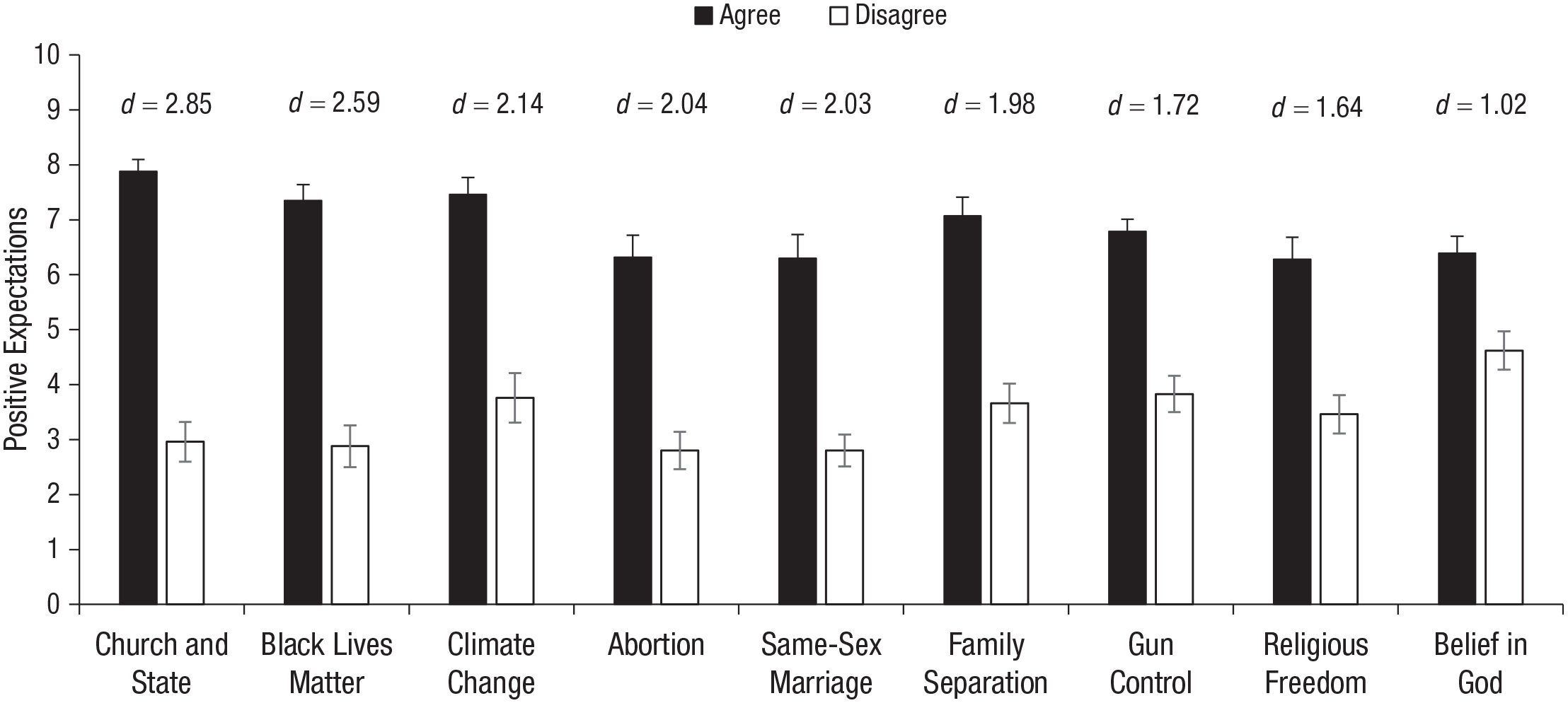
Participants’ expectations about how positive a conversation would be with someone who agreed versus disagreed with them for each of the nine topics (Experiment 1). Error bars represent ± 1 SE.
We observed similar main effects of conversation type in participants’ expectations of how much they would like their partner, F(1, 432) = 265.02, p < .001, ηp2 = .38, how much participants thought their partner would like them, F(1, 432) = 384.37, p < .001, ηp2 = .47, and on their expected sense of connection, F(1, 432) = 331.48, p < .001, ηp2 = .43. We again observed significant interactions between conversation type and topic for each of these measures, indicating the effect of conversation type varied somewhat by conversation topic. Because of the consistency across these measures, we report them fully in the Supplemental Material.
Approach/avoidance
Overall, participants did not report being very interested in having a conversation with a stranger about any of the discussion topics. However, participants were more interested in avoiding the conversation when they disagreed with the other person (M = −1.53, SD = 2.85) than when they agreed (M = 0.28, SD = 2.28), F(1, 432) = 56.02, p < .001, ηp2 = .11. We observed a marginally significant interaction with conversation topic, F(8, 432) = 1.94, p = .053, ηp2 = .03, yielding the biggest effect of agreement versus disagreement on separation of church and state, t(432) = 5.11, p < .001, d = 1.39, and the smallest for belief in God, t(432) = .005, p = .996, d = 0.00. As predicted, participants’ stronger reluctance to talk with someone they disagreed versus agreed with was significantly mediated by the composite measure of participants’ conversation expectations, b = −2.43, 95% confidence interval = [−2.94, −1.95], p < .001.
Although people’s interest in having a conversation with a stranger is guided by many factors, these results suggest that people may be especially uninterested in talking with a stranger who disagrees with them on politically divisive topics at least in part because they expect that the experience will be relatively negative. Experiment 2 tested the extent to which these expectations are calibrated in live conversations between strangers who either agree or disagree with each other on at least one of the nine potentially divisive topics used in Experiment 1. Misunderstanding the outcomes of conversation could lead to misplaced preferences about whom to talk with versus avoid, potentially leading people to avoid conversations they would feel happy—and better informed—to have had.
Experiment 2: Expectations Versus Experiences
Method
Participants
Participants completed this experiment in a university-operated laboratory in downtown Chicago in exchange for $6.00. We targeted a total of 300 participants (150 pairs). However, because of limitations on the number of participants available at our location, we ended data collection before reaching this goal after we could no longer feasibly obtain additional participants. We excluded 21 participants from our analyses—five because of incomplete data, 10 because their opinions did not align as needed on any of the topics, and six because of procedural errors (e.g., participants selecting the wrong opinion for the discussion topic and therefore anticipating a discussion involving disagreement when they actually agreed, or vice versa). This yielded a final sample of 198 participants recruited through a diverse community-based participant pool (34.85% female; 23.23% White; Mage = 41.56 years, SDage = 14.45 years; 27.78% politically conservative). Although we originally planned to end the study sessions of any participants whose attitudes did not align as needed for their condition, and did so for 10 participants as described above, we later modified this procedure by reassigning such pairs to the other condition. Our final sample therefore included 12 pairs who participated in a different condition from what they were randomly assigned to because their opinions did not align as needed for their condition (e.g., they were assigned to the disagreement condition but did not disagree on any of the conversation topics). Results did not meaningfully change whether we included these pairs in our analyses or not. Because this violation of random assignment did not stem from self-selection by the participants themselves, we included these 12 pairs to analyze data from as many participants as possible.
Procedure
To test the extent to which people’s expectations about discussing agreement versus disagreement were calibrated, we asked participants to actually discuss a political or religious issue with another participant who agreed or disagreed with them, measuring their expectations before the conversation and their actual experiences afterward. We included a third uncertainty condition in which participants were not told in advance whether they agreed or disagreed with their conversation partner to test how baseline expectations—when people were unaware of their conversation partner’s position—compared to the agreement and disagreement conditions (when the partner’s position was known). We predicted that participants would underestimate how positive their conversations would be to a larger extent when they disagreed with their partner than when they agreed, and that the magnitude of miscalibration would be somewhere in between for participants in the uncertainty condition. Because participants in the uncertainty condition were randomly assigned to discuss a topic about which they agreed or disagreed with equal frequency—yielding higher rates of disagreement in this uncertainty condition than people are likely to encounter in everyday life—this uncertainty condition provides a conservative test of whether people underestimate the positive experience of discussing political topics when they are uncertain of another person’s attitude in daily life.
Once in the lab, an experimenter led each participant to their own room to complete a survey privately and confidentially, without meeting their partner. Both participants in each pair completed an online survey assessing the extent to which they agreed or disagreed with a series of statements about the same nine topics related to politics and/or religion as in Experiment 1. Participants indicated the extent to which they agreed or disagreed with each statement on a scale from −5 (strongly disagree) to 5 (strongly agree). We also asked several additional questions about participants’ attitudes that we report in the Supplemental Material because they are not central to our hypotheses. Finally, we asked participants to indicate any topics that they would categorically refuse to discuss to make sure that we were sampling from topics that participants would actually discuss. We did this for ethical reasons, given that some of these topics might involve traumatic experiences that we did not feel the participants should be forced to talk about in an experiment. A total of 94 (of 198) participants selected at least one topic that they refused to discuss (260 topics across all participants).
We randomly assigned participants to one of three conditions (agreement, disagreement, or uncertainty) and then selected one of the statements for the participants to discuss in their conversation. In the agreement condition, we selected a statement for which the participants’ attitudes fell on the same side of the scale such that both participants supported the statement or opposed the statement. When participants agreed on multiple statements, we selected the statement with the smallest difference in attitude ratings. In the disagreement condition, we selected a statement for which the participants’ attitudes fell on opposite sides of the scale such that one participant supported the statement and the other opposed it. When participants disagreed on multiple statements, we selected the statement with the largest difference in attitude ratings. In the uncertainty condition, we selected either a statement on which participants agreed or a statement on which they disagreed such that half of the pairs in the uncertainty condition were randomly assigned to a statement they agreed on and the other half to a statement they disagreed on.
After participants completed the survey indicating their positions on the nine statements, the experimenter informed each participant that they would be having a conversation with another participant, as well as which statement they would be discussing. In the agreement and disagreement conditions, the experimenter also told participants whether the other participant agreed or disagreed with them, including the other participant’s exact numeric rating on the statement. In the uncertainty condition, the experimenter did not provide any information about the other participant’s opinion. While receiving this information, we also showed participants the following discussion prompts that they could follow when having their conversation: “1. What is your position on this issue? Why do you think you feel this way? 2. How important is this issue to you? Is there any aspect of the issue that is especially important?”
After learning about the conversation they were about to have, participants reported how positive or negative they expected the conversation would be, and how similar they thought their partner’s position was to their own, on the same items used in Experiment 1. The experimenter then led one participant into the same room as the other, provided them with a reminder of the discussion prompts, and instructed them to have a discussion for the next 10 min. The experimenter then left the room and came back after the 10 min had passed. A computer camera in the room video-recorded these discussions (which participants were informed of, and consented to, during the informed-consent process).
After the discussion, the experimenter brought one participant back to their original room so that each participant could complete the final set of questions on the computer privately. Participants answered the same survey items used to measure their expectations before the conversation except that they were phrased in terms of their actual experiences (e.g., “How much did you enjoy discussing this topic with your partner?”).
Finally, participants provided demographic information (including their political orientation), indicated how often they read or watch the news and how much they care about American politics (both reported in the Supplemental Material), and were then debriefed and paid for their time.
Conversation coding
After conducting the experiment, we asked two research assistants to evaluate the nature of each conversation along several dimensions. We did not preregister this coding procedure because we did not recognize its value until after conducting the experiment, meaning that these results should be considered exploratory and subject to a more strongly powered replication. The primary purpose of these coders was to examine the extent to which participants actually discussed the conversation topics as instructed. We obtained recordings of 90 of the 99 unique conversation sessions, with the remaining nine missing because of experimenter or technical errors (e.g., forgetting to properly save the recordings).
Both research assistants were blind to the participants’ experimental condition. We asked these coders to evaluate how much time the participants spent on topic in the conversation, and how much time they spent in conversation in total, in minutes and seconds using a stopwatch. After watching the conversation, we asked coders to rate how much agreement was expressed in the conversation, how much disagreement was expressed in the conversation, what condition the research assistants thought participants were in (agreement or disagreement), how much participants seemed to enjoy the conversation, and how hostile the conversation appeared to be. Coders reported their evaluations of expressed agreement and disagreement on scales from 0 (none at all) to 5 (complete agreement/complete disagreement), and their evaluations of enjoyment and hostility on scales from 0 (not at all) to 10 (a lot/very).
Results
Because of interdependence within our experimental design, both within participants because of repeated measures and within dyads, all analyses involving conversation experiences reported below (and in Experiment 3) use ANOVAs on mixed linear models with repeated observations nested within participants and participants nested within pairs unless otherwise noted. At the suggestion of a reviewer, we conducted a post hoc power analysis that indicated that our sample size, using this nested design and the resulting data we report below, had 99% power to detect our primary 2 (phase: expectation vs. experience) × 3 (condition: agreement vs. disagreement vs. uncertainty) interaction on our main composite measure. The R code for this power analysis is included on the OSF page cited earlier.
Manipulation check
As intended, participants expected that their discussion partner’s opinion would be significantly more similar to their own in the agreement condition (M = 7.83, SD = 2.09) than in the disagreement condition (M = 3.17, SD = 2.94), t(195) = 10.52, p < .001. The uncertainty condition (M = 6.30, SD = 2.17) fell in between, with participants expecting greater similarity than in the disagreement condition, t(195) = −7.07, p < .001, but less similarity than in the agreement condition, t(195) = 3.63, p = .001.
Conversation measures
We computed a composite measure of participants’ conversation expectations/experiences in the same way as in Experiment 1 (α = .60 for expectations and α = .64 for experiences) and analyzed the rest of our dependent measures individually. Although our preregistration indicated that we would only conduct analyses on a composite of these items if they yielded α > .70 and the α did not meet this threshold, we nevertheless decided to report the results below using this composite for ease of communication and consistency across experiments. The pattern of results remains unchanged when analyzing each item separately. We include our preregistered analyses on individual items in the Supplemental Material.
A 2 (phase: expectation vs. experience) × 3 (condition: agreement vs. disagreement vs. uncertainty) mixed-model ANOVA on our composite measure yielded significant main effects of phase, F(1, 195) = 144.21, p < .001, ηp2 = .43, and condition, F(2, 195) = 6.01, p = .003, ηp = .11, qualified by a significant Phase × Condition interaction, F(2, 195) = 10.44, p < .001, ηp2 = .10. As predicted, participants underestimated how positive their conversations would be in all conditions, but this tendency was largest in the disagreement condition, t(195) = −9.69, p < .001, d = −1.80, and smallest in the agreement condition, t(195) = −3.85, p < .001, d = −0.65, with the degree of miscalibration in the uncertainty condition falling in between, t(195) = −7.01, p < .001, d = −1.19. As shown in Figure 2, participants’ expectations about how positive the conversation would be varied significantly across conditions, F(2, 195) = 13.29, p < .001, ηp2 = .22, but their reported experiences did not, F(2, 195) = 0.77, p = .465, ηp2 = .02. Very few participants reported having negative experiences (< 5 on our scale from 0 to 10) across all conditions.
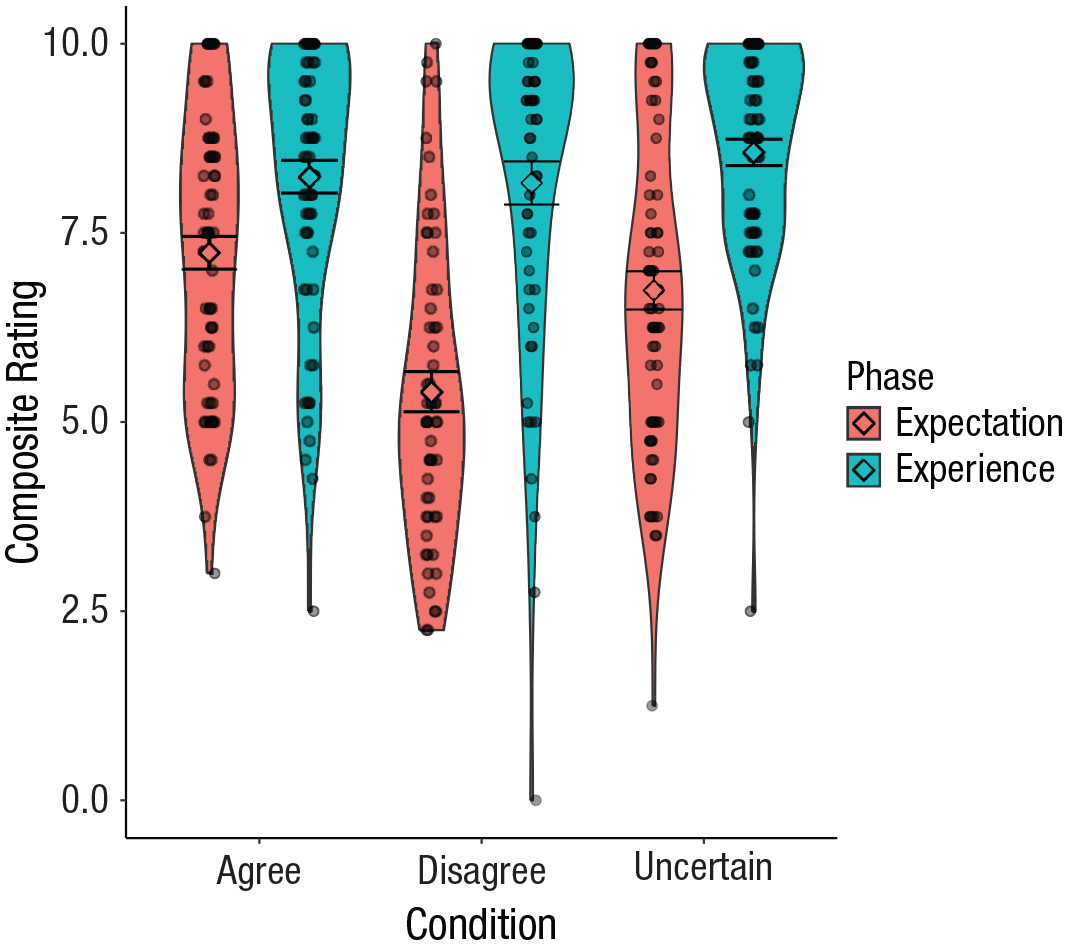
How positive participants expected versus actually experienced their conversations to be when they were talking with someone who agreed with them, who disagreed with them, or whose position was uncertain (Experiment 2). Diamonds show condition means. Error bars represent ± 1 SE.
As shown in Figure 3, we observed similar patterns on our measures of liking, perceived partner’s liking, and connectedness. The Phase × Condition interaction was nonsignificant for liking, F(2, 195) = 2.40, p = .093, ηp2 = .02, and significant for perceived partner’s liking, F(2, 195) = 5.43, p = .005, ηp2 = .05, and connectedness, F(2, 195) = 11.04, p < .001, ηp2 = .10.
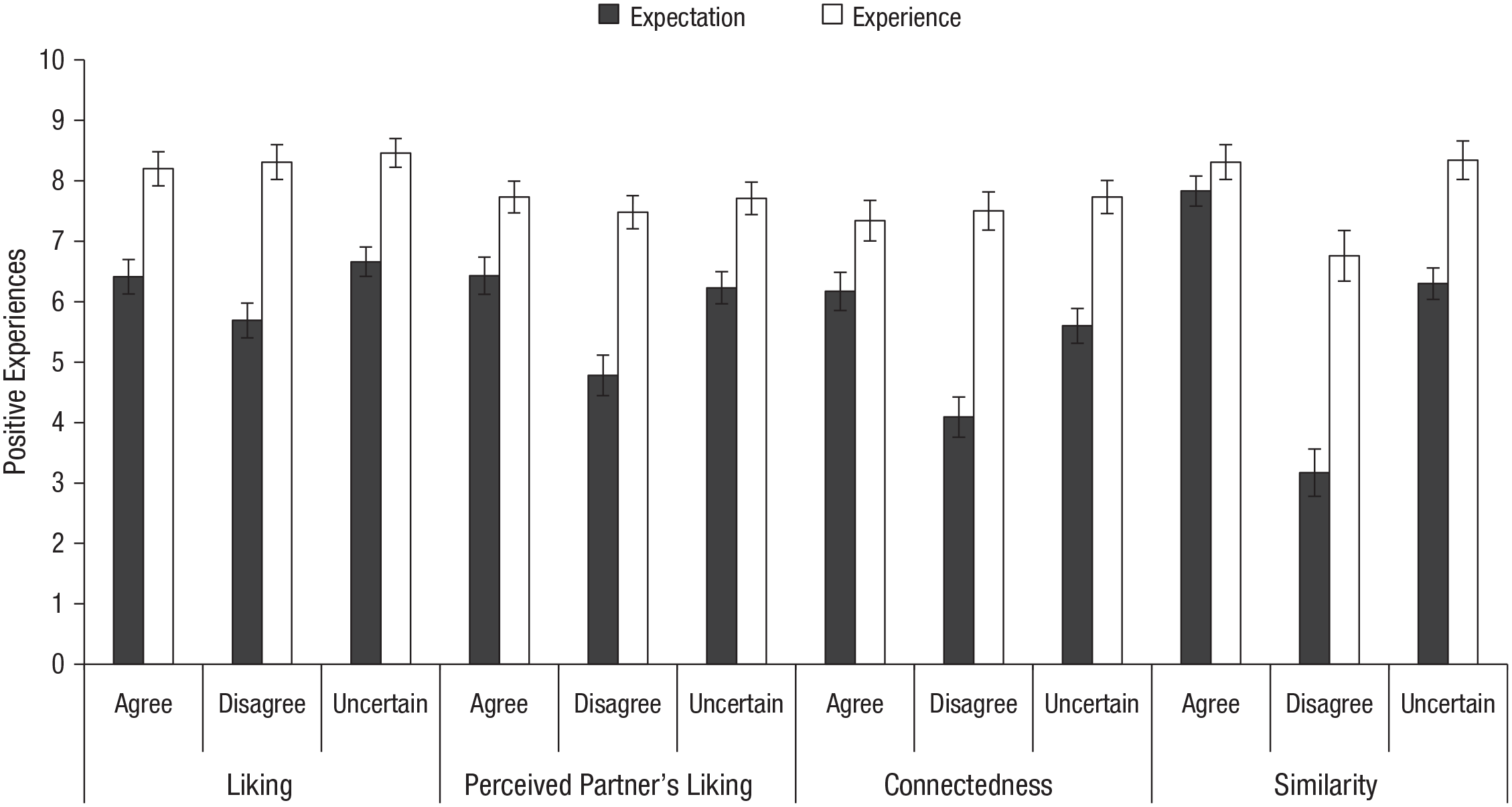
Mean expected and experienced liking, perceived partner’s liking, connectedness, and similarity of opinion when talking with someone participants agreed with and disagreed with and whose position was uncertain in Experiment 2. Error bars represent ± 1 SE.
Finally, we also tested one of our proposed mechanisms—underestimating common ground—by testing whether participants would be especially likely to underestimate how similar they would perceive the other participant’s opinion to be to theirs when they disagreed (and the least likely when they agreed). A 2 (phase: expectation vs. experience) × 3 (condition: agreement vs. disagreement vs. uncertainty) mixed-model ANOVA on perceived similarity of opinion yielded main effects of phase, F(1, 195) = 90.61, p < .001, ηp2 = .32, and condition, F(2, 195) = 29.15, p < .001, ηp2 = .38, qualified by a significant interaction, F(2, 195) = 16.98, p < .001, ηp2 = .15. Participants underestimated similarity of opinion the most in the disagreement condition, t(195) = −9.10, p < .001, d = −1.69, and did so less in the uncertainty condition, t(195) = −5.69, p < .001, d = −0.96, as shown in Figure 3. Participants did not significantly underestimate similarity of opinion in the agreement condition, t(195) = −1.35, p = .177, d = −0.23. Although participants in the disagreement condition recognized that they had less similar opinions after the conversation than did participants in the agreement condition, this gap was significantly smaller than participants anticipated before the conversation.
Alternate design and analysis
Following a reviewer’s request, we also analyzed our data in a 2 (phase: expectation vs. experience) × 2 (condition: agreement vs. disagreement) × 2 (partner’s attitude information: informed vs. not informed) mixed-model ANOVA. We did not conceptualize our experiment in this design, and hence these analyses were not preregistered. Although our preregistered sample sizes were not based on this analysis, a post hoc power analysis indicated that we had 89% power to detect an effect on this three-way interaction on our main composite measure. As expected, we observed what would be the predicted significant three-way interaction on our composite measure, as well as on our measures of partner’s liking, connectedness, and similarity (ps < .014). The interaction on our measure of liking showed the same pattern but was statistically nonsignificant (p = .069). Overall, the three-way interaction indicates that the degree of miscalibration between expectations and experiences is largest in the disagreement/informed condition and smallest in the agreement/informed condition, with the miscalibration for the uninformed conditions in the middle—consistent with our preregistered analyses. We report complete details of this alternate analysis in the Supplemental Material.
Coding conversations
Because the two coders’ ratings were significantly correlated with each other on all items (rs > .45, ps < .001), we averaged them together to create a composite measure for all items. All mean ratings are reported in Table 1.
Our primary interest was the extent to which conversations might differ when people disagreed versus agreed on the topic of discussion (with conversations in the uncertainty condition coded as agreement or disagreement on the basis of whether they actually agreed or disagreed on the topic of discussion). It is possible, for instance, that people did not find discussing disagreement to be as unpleasant as expected because they did not actually spend time discussing their disagreement in the conversation, choosing to avoid the potentially divisive topic instead of engaging with it.
Mean Coder Ratings of Conversation Sessions in Experiments 2 and 3
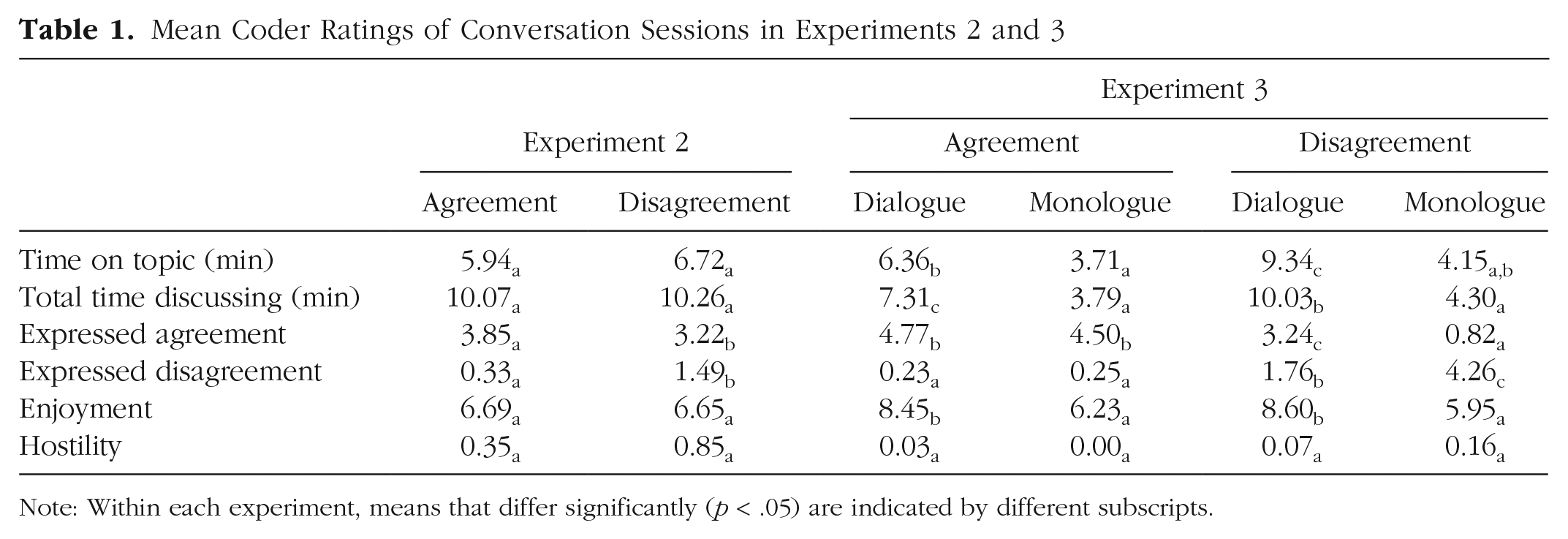
Note: Within each experiment, means that differ significantly (p < .05) are indicated by different subscripts.
Results suggest this was not the case. Conversations involving disagreement versus agreement did not differ significantly in terms of the time spent on topic (Ms = 6.72 vs. 5.94 min, respectively), t(88) = −1.53, p = .129, d = −0.32, or the total time in conversation (Ms = 10.26 vs. 10.07 min, respectively), t(88) = −1.32, p = .191, d = −0.28. Given that experimenters were instructed to let participants talk for 10 min, this latter measure simply indicates that participants typically talked for their entire allotted time in conversation.
Conversations did, however, vary significantly in the degree of disagreement versus agreement expressed in the conversation. As expected, conversation partners expressed more disagreement when they actually disagreed on the conversation topic than when they agreed (Ms = 1.49 vs. 0.33, respectively), t(88) = −5.98, p < .001, d = −1.27, and expressed less agreement when they disagreed versus agreed (Ms = 3.22 vs. 3.85, respectively), t(88) = 3.42, p < .001, d = 0.72. Consistent with participants’ reported experiences, these differences in the nature of the conversation did not seem to affect participants’ enjoyment of the conversation because coders did not perceive significant differences in the extent to which participants seemed to be enjoying conversations involving disagreement versus agreement (Ms = 6.65 vs. 6.69, respectively), t(88) = 0.14, p = .886, d = 0.03. Coders also observed very little hostility in the conversations overall (Ms < 1 on scales ranging from 0 to 10) but did observe nonsignificantly more hostility in conversations involving disagreement compared to agreement (Ms = 0.85 vs. 0.35, respectively), t(88) = −1.80, p = .075, d = −0.38. The coders correctly predicted whether the participants agreed or disagreed with each other, on average, 76% of the time.
Choice, advice, and expectations
As described in Experiment 1, we believe the miscalibrated expectations documented in Experiment 2 matter because they may guide both the choices people make in their own lives and the advice they give to others about whom to talk to and whom to avoid in conversation. To test this, we conducted a follow-up experiment (N = 400) using a 2 (decision: personal choice vs. advice) × 2 (goal: enjoy conversation vs. no goal) between-participants experimental design (for full details, see the Supplemental Material). In this online experiment, we first described the procedure for Experiment 2 and then asked participants either to indicate whether they would choose to be in the agreement or disagreement condition themselves (personal-choice condition) or whether they would advise a specific family member or friend to be in the agreement or disagreement condition (advice condition). We also either gave them the explicit goal to enjoy the conversation or did not mention any goal at all. Overall, a significant majority of participants (69.25%) either chose for themselves, or advised a friend, to talk with someone they agreed with (rather than someone they disagreed with) on a political topic (χ2 = 59.29, p < .001), with nonsignificant effects of target, goal, and the interaction. Participants also reported their expectations for a conversation with someone they agreed with and someone they disagreed with on one of the conversation topics (we did not specify which of the nine topics) on the same measures used by participants in Experiment 2. We replicated the same patterns we observed in Experiment 2 (with nonsignificant interactions by target and goal conditions on all measures). In addition, participants who chose or advised agreement expected a larger gap in experiences between conversations of agreement versus disagreement (on the composite measure) compared to those who chose/advised disagreement, F(1, 398) = 41.71, p < .001, ηp2 = .09. Consistent with their expectations that a conversation with someone they disagreed with would be relatively unpleasant, these participants not only chose to avoid these conversations themselves, but advised others to avoid them as well.
Taken together, these findings replicate existing research documenting that people tend to underestimate how positive they will feel talking with a stranger (Dunn et al., 2007; Epley & Schroeder, 2014; Kardas et al., 2022; Sandstrom & Boothby, 2021) but suggest that this gap is especially large when having a conversation about areas of disagreement. Although participants expected a significantly less positive experience talking with someone they disagreed with on an important issue compared to someone they agreed with, their actual experiences did not differ significantly between these conversations. These miscalibrated expectations could lead people to both avoid, and to advise avoiding, conversations that might be not only surprisingly positive but also objectively positive.
We report another experiment (Experiment S1) in the Supplemental Material that provides additional evidence of the robustness of these results, in which participants had a conversation with someone they knew they agreed or disagreed with on similar important topics as those used in Experiment 3 but modified slightly to involve current events. Results indicated that participants again underestimated how positive they would feel talking with a stranger but that this gap was especially large when discussing an area of disagreement. This pattern again emerged because the difference in people’s expectations of discussing the topic with someone they agreed versus disagreed with was significantly larger than the difference in their actual experiences of discussing the topic.
We suggest that miscalibrated expectations about discussing potentially divisive disagreements stem from misunderstanding the power of a dyadic conversation to focus on common ground and strengthen social connection. We tested this mechanism directly in Experiment 3 by manipulating not only the type of person in the interaction—someone they agreed or disagreed on a political topic with—but also the type of interaction they would be having with another person—whether they would be having a dyadic conversation or not. Specifically, participants randomly assigned to the dialogue condition had a conversation with another person, whereas participants randomly assigned to the monologue condition described their beliefs and position on the topic of discussion and then watched their partner do the same. Because the dialogue condition included an actual conversation involving responsiveness and cooperation whereas the monologue condition did not, we expected that participants would have a more positive experience when discussing disagreement in dialogue than in monologue. We predicted that participants’ expectations of the interaction, however, would be driven primarily by their level of (dis)agreement with the person they were talking with and would be relatively insensitive to the type of interaction they would be having. This would lead people to underestimate how much they would enjoy interacting with another person the most when they were having an actual conversation with a person they disagreed with.
Experiment 3: Dialogue Versus Monologue
Method
Participants
Because of challenges recruiting participants with diverse political opinions (i.e., those who would disagree on the political topics in our experiment), we recruited participants from two sources to have a video conversation online: from an online laboratory of people recruited from the United States maintained by the University of Chicago (n = 156, including one participant who indicated “other” when asked where they were recruited from) and from Prolific (n = 84) to obtain our preregistered sample size of 240 participants (before any exclusions). Conversation sessions included participants from one or both sources. Participants completed the experiment in exchange for a $6 Amazon gift card (lab participants) or $6 (Prolific participants). We excluded any results from 43 participants who started the experiment but did not finish it (e.g., because of partner no-shows, technical issues, or otherwise leaving the experiment early). Of those who finished the experiment, we excluded 12 participants because of procedural errors (e.g., the participant missing the key manipulation information because of experimenter error, being mistakenly asked to discuss a topic that did not match their assigned condition, or being mistakenly assigned to different topics within a pair) and 12 participants because their prediction of their partner’s attitude before the conversation indicated that they had misunderstood the key experimental manipulation. This yielded a final sample of 216 participants (56.94% female; 61.57% White; Mage = 34.44 years, SDage = 13.46; 37.96% politically conservative or in the middle). Within this sample, six pairs completed the experiment in a different condition than the one they had been randomly assigned to because their opinions did not align as needed on any of the topics. The results were not meaningfully affected by whether these six pairs were included or excluded, so we retain them in all analyses to report as much data as possible. In addition, we could not identify the partners of three participants in the data file because of errors recording their ID numbers; again, results were not meaningfully affected when excluding these three participants, so we include them in all analyses below.
Procedure
To increase the odds of recruiting participants for each session who were likely to agree or disagree on the possible topics of conversation as our procedure required, all participants first completed a prescreening questionnaire online to make them eligible to participate in the experiment. This prescreening questionnaire asked participants to report their political orientation (generally liberal, generally conservative, equally liberal and conservative, or “I don’t know”) and required them to successfully use the video-recording software we used in the main experiment. Any participants who selected “I don’t know” for their political orientation were told that they were ineligible for the main experiment. (Note that we only asked participants about their general political orientation to identify people who might be likely to agree or disagree on certain political topics and did not have any hypotheses about how political orientation per se might moderate either people’s expectations or experiences. Testing how political orientation might moderate the results we observed is an interesting topic for future research but is beyond the scope of this article.)
We directed all other participants to a page where they could provide their general availability to participate in the main experiment. Unbeknownst to them, we randomly assigned participants at that point to either the agreement or the disagreement conditions. We then used both their condition assignment and reported political orientation to match participants in time slots on the basis of our belief that participants’ general political leanings could be used as a proxy for the likelihood of agreeing or disagreeing on at least one of the possible conversation topics as our experimental procedure required. In the disagreement conditions, we paired one liberal and one conservative participant together. In the agreement conditions, we paired two liberal or two conservative participants together. Because of our expectations that our sampling of people online would identify people who were more liberal than the average American, we included those who selected “equally liberal and conservative” among the conservative participants because we expected they would be likely to disagree with liberal participants on at least one of these topics. Removing the participants who were politically in the middle, however, did not meaningfully alter the significance levels of our analyses (see the Supplemental Material). Once we paired participants, research assistants emailed each participant to confirm their time slot.
We conducted the main experimental procedure virtually over the Zoom videoconferencing platform. We scheduled two participants for each time slot. The experimenter separated participants at the beginning of the experiment by putting each into a separate “breakout room” to give verbal instructions to each participant individually and to provide each participant with a link to the online experimental survey.
Political-statement opinions
As in Experiment 2, each participant reported their position on a range of potentially divisive political and religious topics. We included several timely topics in addition to others used in Experiment 2 (e.g., wearing masks to prevent the spread of COVID-19, renaming Confederate military bases) for a total of 12 topics (see the Appendix). For each topic, participants reported how much they agreed or disagreed with the statement. Once finished with the attitude survey, the experimenter identified their discussion topic on the basis of their reported opinions and the condition they had been randomly assigned following the same procedure used in Experiment 2. The experimenter then informed each participant of the chosen topic, pasted it into the chat window, and asked them to select it from the list of topics shown at that point on their survey to advance to the next page of the survey.
Participants randomly assigned to the dialogue condition then read that they would be having a conversation with the other participant in their session on the selected topic. Participants randomly assigned to the monologue condition, in contrast, read that they would record a video of themselves sharing their opinion on the selected topic and that they would then watch their partner’s video. We reminded participants of the topic they would discuss and informed them whether the other participant agreed or disagreed with them on the topic (without telling them their partner’s exact numeric rating unlike in Experiment 2). Participants responded to a brief comprehension check of their partner’s attitude toward the topic; if they answered this question incorrectly, they were simply told the correct answer and allowed to proceed. On the next page, we showed participants the same prompts as in Experiment 2 to help direct their conversation or monologue.
To measure participants’ expectations about the interaction, we asked them to answer the same items used to measure expectations in Experiment 2 except that the items referenced the “interaction” rather than the “conversation” to appropriately describe both the dialogue and monologue conditions, and we slightly modified the hostility question to refer to “people with your opinion on the topic.” We also asked participants to report the extent to which they thought their partner had false or inaccurate beliefs on the topic on a scale ranging from 0 (not at all) to 10 (very much). We then asked three additional exploratory items measuring humanization of the other participant, which we report in the Supplemental Material. Finally, we asked participants to guess the extent to which their partner had agreed or disagreed with the statement to be discussed on a scale from −5 (strongly disagree) to 5 (strongly agree).
Once both participants had completed these measures, the experimenter started the interaction. In the dialogue conditions, the experimenter moved participants into the same breakout room on Zoom and asked them to discuss the topic for as long as they wanted and to signal to the experimenter when they were finished by sending a message in the Zoom chat. The experimenter then moved participants back into separate breakout rooms once their conversation was finished.
In the monologue conditions, the experimenter explained to each participant separately how to record themselves describing their opinion on the topic (using a separate Qualtrics survey with the video-recording software embedded) and then sent each participant a link to the other participant’s recording in the Zoom chat once both had created their recordings. Each participant then watched the other participant’s recording.
After finishing their interaction, participants reported their experiences on the same measures used to capture their expectations before the interaction but phrased in the past tense to measure their actual experience of the interaction. Participants then re-rated the extent to which they disagreed or agreed with the statement they were discussing, on a scale ranging from –5 (strongly disagree) to 5 (strongly agree), and predicted their partner’s opinion in response to the following question using the same scale: “How much do you think your partner personally agrees or disagrees with this statement (after having had the interaction)?” On the next survey page, participants then answered an exploratory question asking how much participants now thought their partner had agreed or disagreed with the statement before having had the interaction (see the Supplemental Material). Finally, participants provided demographic information, were debriefed, and submitted a form to receive their payment in the form of an Amazon gift card (lab participants) or through Prolific.
Conversation coding
We obtained videos for 100 of 118 unique conversation sessions (including some sessions for which we had excluded one member of the pair), with the remaining 18 missing because of technical or experimenter errors. We again asked two research assistants to evaluate the nature of each interaction following the same procedure as in Experiment 2. These analyses were again not preregistered because we did not recognize their value until after conducting the experiment, and they should again be considered exploratory and subject to a more strongly powered replication. The primary purpose of these coders was to examine the extent to which participants actually discussed the conversation topics as instructed. We coded the videos from Experiment 3 at the same time as the videos from Experiment 2 using two different research assistants, both of whom were blind to participants’ attitude condition (although were obviously aware of their interaction condition).
Results
As in Experiment 2, all analyses involving conversation expectations and experiences reported below used ANOVAs on mixed linear models with repeated observations nested within participants and participants nested within pairs unless otherwise noted.
At the suggestion of a reviewer, we conducted a post hoc power analysis that indicated that this sample size, using this nested design and the resulting data we report below, had 79% power to detect our primary 2 (phase: expectation vs. experience) × 2 (attitude: agreement vs. disagreement) × 2 (interaction: dialogue vs. monologue) interaction on our main composite measure. The R code for this power analysis is included on the OSF page cited earlier.
Manipulation check
As intended, participants expected that their partner’s opinion was significantly more similar to their own before the interaction in the agreement conditions (M = 7.94, SD = 1.57) than in the disagreement conditions (M = 2.13, SD = 1.97), t(212) = 22.93, p < .001.
Interaction expectations and experiences
For this experiment, our preregistration specified analyses of individual items. However, because the individual items showed the same pattern as the composite measure of interaction expectations and experiences that we calculated in Experiment 2 (with only our awkwardness measure yielding a nonsignificant interaction term and our hostility measure yielding a marginally significant interaction), we report the composite measure of participants’ interaction expectations (α = 0.70) and experiences (α = 0.55) in the main text to ease presentation, and report the item-level analyses in the Supplemental Material.
As predicted, a 2 (phase: expectation vs. experience) × 2 (attitude: agreement vs. disagreement) × 2 (interaction: dialogue vs. monologue) mixed-model ANOVA on our composite measure yielded main effects of phase, F(1, 212) = 157.41, p < .001, ηp2 = .43, and attitude, F(1, 212) = 44.23, p < .001, ηp2 = .17, and a nonsignificant effect of interaction type, F(1, 212) = 2.86, p = .092, ηp2 = .01, qualified by the critical three-way interaction, F(1, 212) = 7.64, p = .006, ηp2 = .03. As shown in Figure 4, participants’ expectations were affected by the type of person they were interacting with such that they expected a more positive interaction when they agreed with their partner than when they disagreed with their partner, F(1, 212) = 67.89, p < .001, ηp2 = .24. Their expectations were not significantly affected, however, by the type of interaction they would be having, F(1, 212) = 1.11, p = .293, ηp2 < .01. Participants’ actual experiences, however, were significantly affected by the type of interaction they were having, especially when discussing disagreement, F(1, 212) = 7.60, p = .007, ηp2 = .06. Although participants generally underestimated how positive their experience in the interaction would be, including when simply learning about someone’s opinion they disagreed with (replicating Dorison et al., 2019), this was especially true when having a conversation with someone participants disagreed with.
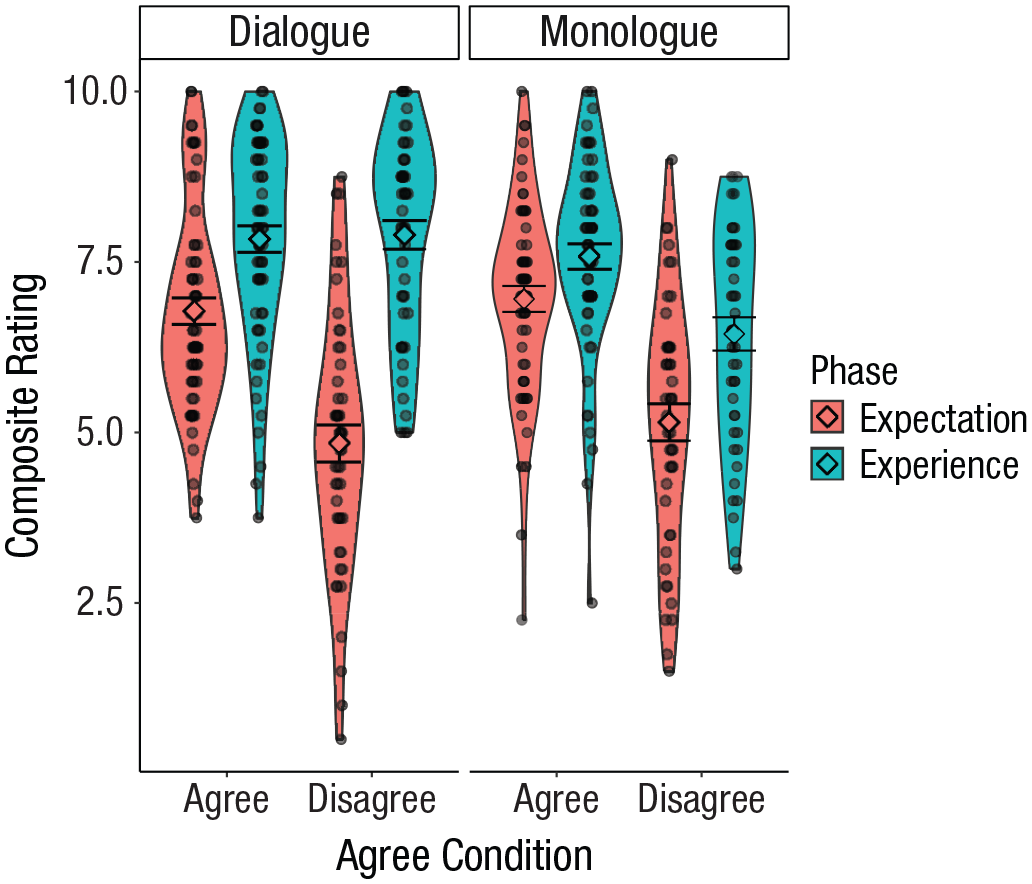
Mean expected and experienced positive conversational experiences by attitude condition and interaction condition in Experiment 3. Diamonds represent condition means. Error bars represent ± 1 SE.
Notably, these results also make it clear that not all interactions between those who disagreed were equally positive experiences. As shown in Figure 4, participants’ experience of listening to someone they disagreed with in the monologue condition was not as positive as actually having a conversation with someone they disagreed with, t(212) = 4.44, p < .001, d = 1.18. However, as we also observed in Experiment 2, having a conversation with someone participants disagreed with did not differ significantly from the experience of having a conversation in this context with someone participants agreed with, t(212) = −0.20, p = .841, d = −0.05. Again, as shown in Figure 4, very few participants had negative experiences (< 5 on our scale from 0 to 10) across all conditions.
We replicated the same pattern of significant three-way interactions on the additional measures of connectedness, F(1, 212) = 7.91, p = .005, ηp2 = .04, liking, F(1, 212) = 8.63, p = .004, ηp2 = .04, and perceptions of others’ liking, F(1, 212) = 7.25, p = .008, ηp2 = .03 (see Table 2). These findings provide additional support for our prediction that people underestimate the positivity of disagreement because they expect the quality of their interactions to be driven by the type of person they are talking to without appreciating how the social forces present in a conversation can create social connection and a sense of common ground.
Means of Additional Measures in Experiment 3
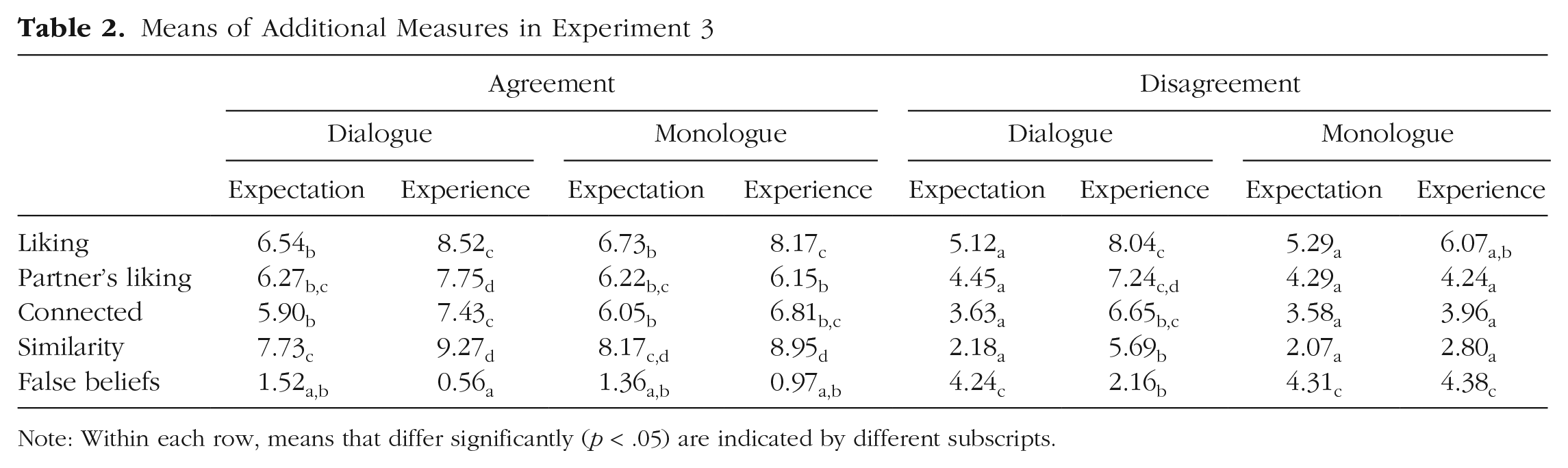
Note: Within each row, means that differ significantly (p < .05) are indicated by different subscripts.
Further support for these hypotheses comes from participants’ perceived similarity of opinion with their partner, for which we observed significant main effects of phase, F(1, 212) = 112.80, p < .001, ηp2 = .35, attitude, F(1, 212) = 466.95, p < .001, ηp2 = .82, and interaction condition, F(1, 212) = 7.59, p = .007, ηp2 = 0.07, again qualified by the predicted three-way interaction, F(1, 212) = 10.65, p = .001, ηp2 = .05. Participants again expected that their perceived similarity in attitudes would be driven (only) by whether the person agreed versus disagreed with them, F(1, 212) = 526.63, p < .001, ηp2 = .83, when their actual experience of similarity was affected by how they interacted with their partner, F(1, 212) = 17.50, p < .001, ηp2 = .14. This means that participants were especially likely to underestimate how similar they would find their partner’s attitudes to be when they had a conversation with someone they disagreed with. We observed a similar pattern of results in participants’ perceptions of the extent to which their partner held false beliefs, including a significant three-way interaction, F(1, 212) = 4.23, p = .041, ηp2 = .02. Because conversation requires cooperation and coordination, it is likely to focus on areas of common ground between people that might otherwise be missed in the absence of a conversation. This, again, was a consequence of conversation that participants did not anticipate when discussing disagreement.
Perceived and actual attitudes
Participants’ beliefs about their partner’s attitudes somewhat matched their perceptions of common ground. To conduct these analyses, we reverse-scored the responses of those who opposed a given position so that positive difference scores before versus after the conversation reflected more moderate perceived attitudes. A 2 (attitude: agreement vs. disagreement) × 2 (interaction: dialogue vs. monologue) × 2 (time: perceived attitude before vs. after conversation) ANOVA on participants’ beliefs about their partner’s attitudes yielded a significant main effect of time, F(1, 212) = 8.47, p = .004, ηp2 = .04, qualified by a significant Attitude × Time interaction, F(1, 212) = 46.90, p < .001, ηp2 = .18. Participants in the disagreement condition believed their partners held more moderate attitudes after the interaction than before the interaction (Ms = 2.18 vs. 3.55, respectively), t(212) = 6.49, p < .001, d = 0.95, whereas participants in the agreement condition showed the opposite pattern (Ms = 4.52 vs. 3.98, respectively), t(212) = −2.99, p = .003, d = −0.38. A nonsignificant three-way interaction indicates that perceived differences in attitude before versus after the interaction did not differ significantly between the monologue and dialogue conditions, F(1, 212) = 2.44, p = .120, ηp2 = .01.
Participants’ actual attitudes before versus after the interaction showed a similar pattern, F(1, 212) = 25.16, p < .001, ηp2 = .11, with participants reporting significantly more moderate attitudes after the interaction when they disagreed with their partner (Ms = 2.64 vs. 4.13, respectively), t(212) = 7.58, p < .001, d = 1.11, but not reporting significantly more moderate attitudes after the interaction when they agreed with their partner (Ms = 4.66 vs. 4.84, respectively), t(212) = 1.03, p = .302, d = 0.13. A nonsignificant three-way interaction indicates that these patterns did not differ between the dialogue and monologue conditions, F(1, 212) = 0.83, p = .363, ηp2 < .01. These results suggest that participants’ attitudes may have changed over the course of the interaction, although these results have to be interpreted with some caution. Because we selected topics that participants reported disagreeing on the most, and hence were likely to report having more extreme attitudes about before the interaction, any noise in the measurement of participants’ attitudes before the interaction would yield more moderate attitudes after the interaction because of a regression to the mean (Chen & Risen, 2010).
Although participants’ beliefs about their partner’s attitudes showed a pattern similar to the participants’ actual reported attitudes, additional exploratory analyses (conducted on complete pairs only) indicated that participants thought their partners had more moderate attitudes after talking about a topic they disagreed on than their partners actually did (Ms = 1.75 vs. 2.84, SDs = 2.70 vs. 2.57), t(192) = −3.61, p < .001, d = −0.77, but we did not observe significant miscalibration in the other conditions (monologue-disagreement: Ms = 2.47 vs. 2.63, SDs = 2.45 vs. 3.01; dialogue-agreement: Ms = 4.63 vs. 4.72, SDs = 0.99 vs. 0.88; monologue-agreement: Ms = 4.57 vs. 4.78, SDs = 0.86 vs. 0.50; all |ts| < 0.75). This pattern was confirmed in a 2 (attitude: agreement vs. disagreement) × 2 (interaction: dialogue vs. monologue) × 2 (measurement type: perceived postconversation attitudes vs. actual postconversation attitudes) ANOVA that yielded a marginally significant three-way interaction, F(1, 192) = 3.28, p = .072, ηp2 = .02. Again, these calibration results in the disagreement condition are somewhat difficult to interpret because we selected, without participants’ knowledge, topics in the disagreement condition that participants were the most extremely different on, which may explain why participants thought their partner had more moderate attitudes than they actually did, even at baseline in the disagreement conditions (Ms = 3.59 vs. 4.16), t(376.17) = −7.42, p < .001, d = −0.75.
Conversation coding
As in Experiment 2, the two coders’ evaluations were significantly correlated on all measures (rs > .43, ps < .001), and so we averaged them together to create a composite measure for all items. We could not calculate the correlation for hostility because one coder indicated no hostility expressed in any interaction.
It is again possible that participants had a more positive experience discussing disagreement than expected because they simply avoided talking about the topic, or maybe talked less, than participants in other conditions. As shown in Table 1, this was not the case. A 2 (attitude: agreement vs. disagreement) × 2 (interaction: monologue vs. dialogue) ANOVA on the estimated time spent on topic yielded main effects of attitude, F(1, 96) = 6.93, p = .010, ηp2 = .07, and interaction condition, F(1, 96) = 36.36, p < .001, ηp2 = .27, qualified by a marginally significant interaction, F(1, 96) = 3.81, p = .054, ηp2 = 0.04. Participants actually spent the most time on topic when they were having a conversation with someone they disagreed with (M = 9.34 min) and less time on topic when having a conversation with someone they agreed with (M = 6.36 min), t(96) = −3.29, p = .001. Participants generally spent less time talking on topic in the monologue condition but did not talk significantly less when they disagreed with their partner (M = 4.15 min) than when they agreed (M = 3.71 min), t(96) = −0.47, p = .636 (means represent the sum of both participants’ monologues). The total time spent talking largely mirrored the time spent on topic, yielding significant main effects of attitude, F(1, 96) = 5.85, p = .017, ηp2 = .06, and interaction condition, F(1, 96) = 47.88, p < .001, ηp2 = .33, with a nonsignificant interaction, F(1, 96) = 2.74, p = .101, ηp2 = .03. Discussing disagreement was not avoided but rather seemed to be the most engaging condition in our experiment.
The interactions did vary significantly across conditions in the degree of disagreement and agreement expressed in the interaction. Separate 2 (attitude: agreement vs. disagreement) × 2 (interaction: monologue vs. dialogue) ANOVAs on expressed disagreement, F(1, 96) = 56.15, p < .001, ηp2 = .37, and agreement, F(1, 96) = 37.76, p < .001, ηp2 = .28, yielded significant interactions, consistent with conversation creating opportunities to express common ground. As shown in Table 1, when participants disagreed, they expressed more disagreement, t(96) = –9.73, p < .001, and less agreement, t(96) = 8.91, p < .001, in the monologue condition than in the dialogue condition. Unable to respond directly in conversation to another’s statement to identify points of agreement and disagreement, or to learn from each other in the process of the conversation, participants in the monologue condition simply stated their views without identifying areas of overlap that seemed to emerge in the conversations.
Coders’ ratings of enjoyment in the same 2 × 2 ANOVA described above yielded only a significant main effect for the interaction condition, F(1, 96) = 111.74, p < .001, ηp2 = .54, indicating that coders believed the participants enjoyed their interaction significantly more in the dialogue condition than in the monologue condition, t(96) = 10.57, p < .001. The coders did not think the participants enjoyed their conversation significantly more when they agreed versus disagreed, t(96) = 0.31, p = .760, consistent with participants’ own reported experiences. Because these interactions contained so little hostility, with one coder indicating no hostility expressed in any interaction, we report the average ratings in Table 1 but do not analyze them here.
Discussion
People quite reasonably avoid conversations that they expect will be unpleasant, but our experiments suggest that some reasons for avoiding conversations may be somewhat unreasonable. Participants in Experiment 1 expected that conversations about potentially divisive topics would be less positive when they disagreed than when they agreed and were therefore more interested in avoiding conversations with someone they disagreed with. Experiments 2 and 3, however, suggest that these expectations may be systematically miscalibrated. In both experiments, participants expected more positive experiences talking with someone they agreed with than someone they disagreed with about a potentially divisive topic. In reality, participants had similarly positive experiences in both cases, meaning that participants were the most miscalibrated about the conversation they would also be most inclined to avoid. Mistakenly fearing a negative interaction may create misplaced partisan divides, not only keeping people from connecting with each other but also keeping people from learning about each other and from each other. Mistakenly avoiding these interactions may indeed, as Martin Luther King suggested, create more fear in social life than is warranted.
Of course, not all interactions across partisan lines are equally pleasant, as the context in which interactions occur has a profound effect on its outcomes. Two groups with opposing views who meet on the street to shout at each other will end up with a very different interaction than two people with opposing views who meet at a coffee shop to talk with each other. Even these same two people who meet at a coffee shop to talk are likely to have a very different interaction than if they were to meet online to type at each other. And yet the power of these situational forces to guide social interaction is easy to overlook either when explaining social interaction (Gilbert & Malone, 1995) or when anticipating it (Kruger et al., 2005; Kumar & Epley, 2021; Schroeder et al., 2017). Participants in Experiment 3 expected that the outcomes of their interaction would depend on the type of person they were interacting with—whether they agreed or disagreed with the person—but did not expect that the outcomes would depend on the type of interaction they were having—whether they were engaging in a dialogue or monologue. Our experiments do not suggest that people misunderstand how positively they will experience all types of interactions across partisan divides to a similar degree. Indeed, our experiments are limited by our reliance on participants who did not know each other and had a single conversation. They do not reveal how such conversations would unfold among friends, family, or in repeated interactions over time. Instead, our experiments suggest that people may be uniquely likely to misunderstand the outcomes of dyadic conversation with strangers across partisan divides.
We believe our findings are of both theoretical and practical importance. Theoretically, our experiments support some existing research (Dunn et al., 2007; Mallett et al., 2008) suggesting that the well-documented preference for similarity in choosing whom to interact with (Montoya et al., 2008) may be guided by miscalibrated expectations about the outcomes of interacting with those who are similar versus different from us. Most existing research on homophily has primarily examined people’s preferences, but more research is needed to examine how people’s preferences for homophily actually align with their experiences (e.g., Dunn et al., 2007; Mallett et al., 2008). Our experiments also contribute to emerging research suggesting that people may underestimate how positively others respond to sociality more broadly, potentially leading people to be less sociable than might be optimal for their own and others’ well-being (for a review, see Epley et al., 2022). Our research documents an important moderator of undersociality: the extent to which another person disagrees on an important issue. Participants in Experiments 2 and 3 underestimated how positive an interaction would be to a greater degree when they disagreed with their conversation partner than when they agreed. Finally, our research enriches our understanding of interpersonal and intergroup conflict. Considerable existing research documents the power of intergroup contact to diminish partisan animosity, diminish intergroup prejudice, and create friendships (Broockman & Kalla, 2016; Bruneau et al., 2021; Pettigrew & Tropp, 2006; White et al., 2021). Despite these consistently positive outcomes, our experiments help to explain why people may nevertheless avoid intergroup contact: because they mistakenly expect their experience will be relatively negative.
Practically, our findings suggest that the popular advice—and common intuition—to censor oneself by avoiding discussions of politics and religion may be too extreme, at least in conversations with strangers. In addition to creating connection, calibrating beliefs, and learning about opposing viewpoints, being more open and honest in a dyadic conversation may also increase feelings of authenticity and decrease regret (McDonald et al., 2020). Modern life now affords a wide array of opportunities for interacting across partisan divides, increasingly involving text-based communication channels or social media that lack the social forces that create the surprisingly positive outcomes we observed in dyadic conversations. A person wanting to connect positively across partisan divides would be wise not to simply open any channel of communication to someone on the other side but rather to rely on the age-old technology of speaking and listening. Recognizing the extent to which partisan fears are miscalibrated could be a critical first step to opening the channels of communication that enable partisans to connect with each other more wisely, to know each other better, and to mistakenly fear each other less.
Supplemental Material
sj-docx-1-pss-10.1177_09567976241230005 – Supplemental material for Misplaced Divides? Discussing Political Disagreement With Strangers Can Be Unexpectedly Positive
Supplemental material, sj-docx-1-pss-10.1177_09567976241230005 for Misplaced Divides? Discussing Political Disagreement With Strangers Can Be Unexpectedly Positive by Kristina A. Wald, Michael Kardas and Nicholas Epley in Psychological Science
Footnotes
Appendix
Transparency
Action Editor: Leah Somerville
Editor: Patricia J. Bauer
Author Contributions

References
Supplementary Material
Please find the following supplemental material available below.
For Open Access articles published under a Creative Commons License, all supplemental material carries the same license as the article it is associated with.
For non-Open Access articles published, all supplemental material carries a non-exclusive license, and permission requests for re-use of supplemental material or any part of supplemental material shall be sent directly to the copyright owner as specified in the copyright notice associated with the article.
