






Abstract
Empowering people to navigate online information competently is essential to complement systemic content moderation and platform regulation. A nationally representative randomized controlled study among adults in Germany (N = 2,666) compared two media-literacy interventions: a source-focused lateral-reading strategy to help participants distinguish trustworthy from untrustworthy news outlets, and a claim-focused search strategy to help them assess the credibility of specific claims. Both interventions showed small improvements in discernment, but not all effects were statistically distinguishable from zero. At a 2-week follow-up, discernment improved in all groups, and differences between the intervention and control groups were no longer statistically distinguishable. We found no evidence of backfire effects. An exploratory analysis of discernment pretreatment indicated the lowest performance for supporters of populist radical-right parties. Behavioral measures suggested increases in information search in both intervention groups. On average, lateral reading reduced trust in untrustworthy sources, and online search increased trust in trustworthy sources.
Keywords
Introduction
The spread of online misinformation can challenge a shared understanding of a factual reality that is necessary for constructive public discourse. To contain the threat that online misinformation poses to public opinion formation and political decision-making, evidence-based mitigation strategies are needed. These range from platform-level content moderation and fact-checking to individual-level interventions aimed at improving users’ ability to navigate online information. However, platform moderation policies are volatile and change with shifting political climates and priorities; user empowerment is therefore increasingly important (Kozyreva et al., 2020). Various individual-level interventions—such as inoculation, media literacy tips, lateral reading, and search strategies—have been proposed to improve media literacy of Internet users and their ability to distinguish between trustworthy and unreliable information (Kozyreva et al., 2024). Interventions like lateral reading and search strategies aim to equip individuals with competences, enabling them to do their own fact-checking. However, recent evidence has demonstrated that searching online to evaluate the credibility of online news articles can backfire and even increase the perceived veracity of false information (Aslett et al., 2023). This raises the question of whether this backfire effect is robust and whether the risk of backfire effects may generalize to source verification strategies like lateral reading. Furthermore, evidence for the effectiveness of these strategies from populations outside the United States, longitudinal studies, and nationally representative samples remains sparse. This makes estimations of variation in discernment as a function of, for example, educational background or political beliefs difficult (Brashier, 2024).
Online information, including online news articles, can be evaluated on different levels—namely, the source from which the content originates (e.g., a news website) or the specific claims made in a piece (e.g., online news articles). Lateral reading—a strategy used by professional fact-checkers to evaluate the trustworthiness of a website—focuses on the former, the source. It involves opening new browser tabs to seek information about the source outside of the website itself (McGrew, 2024; Wineburg & McGrew, 2019). In contrast, online search—the technique tested in Aslett et al. (2023)—focuses on the latter, the individual claim. This strategy advises the user to look online for relevant evidence on claims made in news articles and to evaluate how credible the claim is based on the evidence found. Our study tested the effectiveness of both: lateral reading aimed at boosting Internet users’ competence to discern trustworthy from untrustworthy news sources and an online search aimed at boosting their competence to discern trustworthy from untrustworthy news content.
Lateral reading interventions have been tested primarily in classroom settings as part of the Civic Online Reasoning Curriculum in schools (McGrew et al., 2019; Wineburg et al., 2022) and universities (Brodsky et al., 2021) in the United States. Other studies include a digital workshop in Sweden (Werner Axelsson & Nygren, 2026), an educational game in Israel (Barzilai et al., 2023), a lab experiment with university students in Germany (Fendt et al., 2023), and an online study using a convenience sample of participants from the United Kingdom in which a pop-up summary of the lateral-reading strategy appeared before simulated social-media posts were shown (Panizza et al., 2021); for a meta-analysis of lateral-reading studies, see Fendt et al., 2025.
Our study examines the effectiveness of a lateral-reading intervention delivered in the form of a short video. Notably, we tested it on a large and representative online sample of adults in Germany, supplemented with behavioral web-tracking data. Testing this intervention in a large European country allowed us to move outside the hyperpartisan U.S. media ecosystem and into one that included a strong public-service broadcasting branch, with reliable information dominating mainstream search results (Altay et al., 2022; Reuters Institute, 2025). Our study, therefore, also tested the boundaries of the reported backfire effect observed for the online-search strategy (Aslett et al., 2023), which may, at least partly, stem from untrustworthy content appearing in U.S. partisan search results.
The lateral-reading intervention is part of a broader class of behavioral public-policy tools known as boosts (Hertwig & Grüne-Yanoff, 2017; Herzog & Hertwig, 2025). In contrast to nudges, which steer choices by reshaping the decision environment, boosts seek to cultivate and strengthen individuals’ own competencies—equipping them with the skills and strategies needed to pursue and achieve the goals they set for themselves. The lateral-reading intervention primarily enhances people’s competence to verify information they encounter online (Kozyreva et al., 2024). We developed a 5-min video to convey this competence concisely and efficiently, drawing on a video from the Digital Inquiry Group (2020), that builds on the Stanford History Education Group. Our video (available on YouTube at https://www.youtube.com/watch?v=7_ZyBzGsehc) includes a high-level explanation of the strategy as well as a screen recording of lateral reading in action. In contrast, and following the procedure in Aslett et al. (2023), the online-search treatment was delivered in text form (see Section 1 in the Supplemental Material available online for treatment instructions of both interventions). Both intervention conditions were compared with a control condition without intervention. We also tested the longevity of the intervention’s effects over time.
We tested the following set of preregistered hypotheses:
H1s: Lateral reading improves source-trustworthiness discernment compared with control.
H1c: Lateral reading improves claim-credibility discernment compared with control.
H2s: Lateral reading improves source-trustworthiness discernment compared with control 2 weeks after the treatment.
H2c: Lateral reading improves claim-credibility discernment compared with control 2 weeks after the treatment.
H3c: Online search reduces claim-credibility discernment compared with control (i.e., the backfire effect).
On average, untrustworthy news sources constitute only a small fraction of the overall media diet of people (Altay et al., 2022; Guess et al., 2020; Oswald & Munzert, 2026). However, some groups appear to have an increased risk of exposure. For example, U.S. conservatives and older adults consume and share more untrustworthy news than their liberal and younger counterparts (Baribi-Bartov et al., 2024; Grinberg et al., 2019; Guess et al., 2019), whereas other evidence points toward greater susceptibility of young adults (Kyrychenko et al., 2025). In addition, U.S. conservatives have been found to be worse at discerning true from false news headlines than liberals (Sultan et al., 2024). Therefore, after reporting results for the preregistered analyses of average treatment effects, we describe discernment performance pretreatment along a large set of survey variables, given the opportunity to provide estimates from a nationally representative sample in Germany.
Increased skepticism toward true news or loss of trust in trustworthy sources may be a costly drawback of misinformation interventions (Hoes et al., 2024). We therefore also explored the evidence for a general skepticism effect—that is, the reduction of the level of trust in the two intervention conditions compared with the control condition, for both true and false items.
Research Transparency Statement
General disclosures
Study disclosures
Method
The experiment featured a design between participants with three conditions—lateral reading, online search, and control—within two waves of a nationally representative German sample (N = 2,666) provided by the survey company YouGov (see Fig. 1 for a graphical summary of the study design). Search behavior and adoption of the lateral-reading strategy was further explored using URL tracking data in a subset of that data from YouGov’s Pulse panel (N = 436). The participants rated the trustworthiness of the source and the credibility of the claim of a set of 12 websites at three different time points (before treatment, after treatment, and follow-up; see Fig. 1). Of the 12 websites, six were untrustworthy websites that presented false claims (verified by external fact-checking), and six were trustworthy websites that presented credible claims corresponding to the topic. Data was collected between November and December 2024 in the run-up to the German federal election of February 2025.
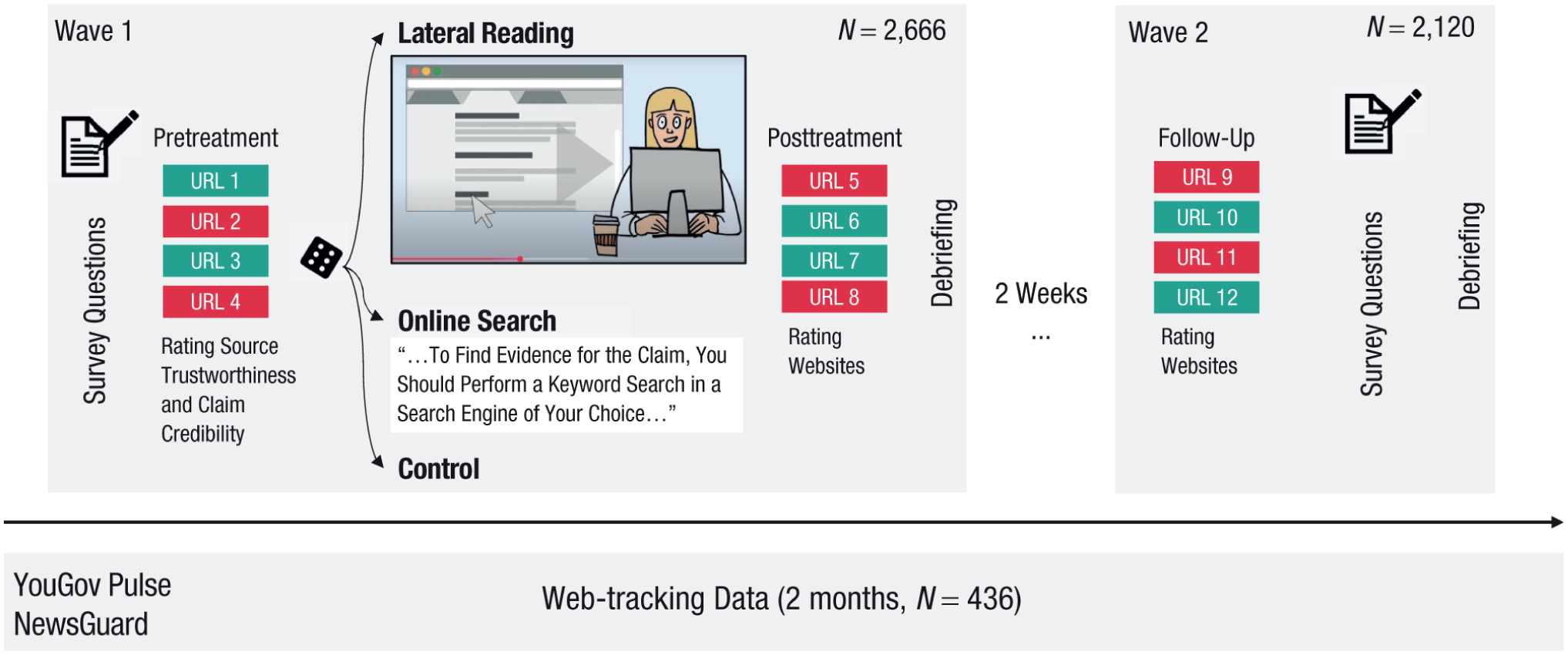
Study design. The study followed a two-wave panel design with three blocks of website assessment: pretreatment and posttreatment in Wave 1 and follow-up in Wave 2. After the pretreatment tasks, participants were randomized to one of three conditions: a lateral-reading intervention (delivered in a video), an online search intervention (delivered as written instructions), or a control condition without any intervention. URLs (green: news article making credible claim from a trustworthy news outlet, red: news article making a not-credible claim from an untrustworthy news outlet; classification according to NewsGuard) were presented in randomized order across the three waves with two trustworthy/credible and two untrustworthy/not credible URLs presented in each of the three blocks. The survey experiment was supplemented with 2 months of web-tracking data from a subset of participants from YouGov’s Pulse panel. Domains in the web-tracking data were evaluated using NewsGuard.
This study was approved by the ethics board of the Max Planck Institute for Human Development on October 2, 2024 (A 2024-29 and Amendment A 2024-39). Informed consent was obtained from all participants, and they were compensated for their participation. We preregistered our methodology (including inclusion criteria and analyses) on OSF (https://osf.io/tsb68/).
Sampling
This study uses an online survey of a national sample of Germans (N = 2,666), supplemented with passively collected web-tracking data from mobile or desktop devices of a subset of respondents (n = 436). Data were collected by the survey company YouGov from members of their nationally representative German panel (n = 2,330) and members of their Pulse panel, (n = 436) who gave their informed consent for their online activities to be tracked anonymously. For members of the Pulse panel, the tracking software monitored web traffic (excluding passwords and financial transactions) across desktop browsers or mobile devices. Users had to consent before installing the software and could disable or uninstall it at any time. Identifying information was not collected, but as tracking data can contain information that could be used to identify participants, a strict data-management procedure was followed. For the main analysis of treatment effects, samples from both panels were pooled into the total sample of N = 2,666. Of these participants, N = 2,120 also completed the second wave. Attrition rates range between 19% and 21% and showed no significant differences between conditions. The sample size was fully determined by the research budget. The pooled sample is representative for the German adult population with regard to age, gender, education, state of residency, and voting intentions for the 2025 federal election. See Table S1 in the Supplemental Material for a comparison with marginals from the 2024 German Microcensus (Statistisches Bundesamt, 2024) and the 2025 election results (Die Bundeswahlleiterin, 2025).
The first survey wave was conducted between November 21 and December 2, 2024. Participants were invited to the second wave roughly 2 weeks after filling out the first wave and were allowed several days to fill out the second survey to minimize attrition between waves, resulting in a fielding period of the second wave between December 9 and December 24, 2024.
Web-tracking data was collected between November 4, 2024 and December 31, 2024, spanning a 2-month tracking period that included more than 6 million website visits, of which 390,000 (approximately 6.5%) could be labeled using NewsGuard.
Experiment
Participants were randomly assigned to one of the three experimental conditions (lateral reading, online search, control). Participants were individually randomized at the start of the survey; participants who replaced dropouts were also individually randomized. Participants were screened and replaced before being assigned a condition if YouGov could not confirm that they were able to watch a video.
Participants evaluated websites at three time points throughout the study: pretreatment and posttreatment within Wave 1, and follow-up in Wave 2 (see Fig. 1).
The lateral-reading condition included a 5-min video explaining the lateral-reading strategy and demonstrating an examination of an untrustworthy website with a screen recording. The video was presented after a pretreatment set of four websites (four more websites were evaluated in the posttreatment block, and the final four websites were evaluated in the follow-up assessment in Wave 2). The instructions for the online-search intervention, explaining how to find evidence around the central claim, were translated from Aslett et al. (2023) and presented as text after a pretreatment set of four websites. Participants in the control condition received no treatment (see Section 1 in the Supplemental Material for treatment instructions).
Following best practices, participants were debriefed after each wave (Greene et al., 2022). We judged that the debriefing of participants, which was necessary to minimize the impact of exposing them to misinformation, as more important than avoiding potential learning effects (for instance, by alerting participants about the potential untrustworthiness of websites).
Stimulus websites
The stimulus material consisted of six trustworthy and six untrustworthy websites containing online articles on specific issues (COVID-19, climate change, migration, international organizations, the integrity of different elections, and the war in Ukraine). For every untrustworthy article, there was one trustworthy article on the same topic. Four websites were selected for the pretreatment assessment, and another four for the posttreatment assessment; the remaining four were shown to participants in Wave 2 for a follow-up assessment. The presentation of stimuli was fully randomized between participants and across waves, with the constraint that in each phase (pretreatment, posttreatment, follow-up), two trustworthy/true items and two untrustworthy/false items were presented.
Stimulus websites (web pages of news sites that contained a news article on a specific issue) were selected using a systematic bottom-up strategy involving an external data provider (NewsGuard), a systematic protocol, and a pretest with 301 participants in Prolific for stimulus evaluation. Websites that were not informative for the assessment of participants’ ability to discern credibility and trustworthiness (e.g., because of ceiling effects—websites that everyone rated correctly, leaving no room for improvement) were not included in the main study. The stimulus pretest was registered separately on OSF (https://osf.io/fp8cs/overview) prior to data collection and was approved independently of the main study by the ethics board of the Max Planck Institute for Human Development on May 13, 2024 (see Section 4 in the Supplemental Material for details on the stimulus-selection procedure and results of the stimulus-selection pretest).
Measurement
To enable a comparison between both strategies, we used two parallel outcome measures: source trustworthiness and claim credibility. The trustworthiness of websites is defined as the extent to which a website can be relied upon to provide accurate information about a specific domain or subject (e.g., politics or health). Similarly, claim credibility is defined as the extent to which the central claim of an online article is based on factually accurate information. Both definitions align with the evaluation criteria used by NewsGuard, the independent rating system for news and information websites that we used here (NewsGuard Technologies, Inc., 2024).
The instructions for assessing source trustworthiness and claim credibility were the same under all three conditions. In all conditions, in the instructions, a 2-min time limit (per website) was stated, although technically it was not enforced. The instructions were as follows (translated from German):
In the following, you will visit different websites. We will then ask you for your personal evaluation of the website. As you probably know, you often come across advertising on the Internet. Sometimes you will be asked to consent to direct messages, sign up for a newsletter, or even make a donation. Please do not respond to any of these requests when visiting the websites within our study. Some of the following websites contain untrustworthy information. At the end of the study, we will inform you in detail which websites are not trustworthy and why.
The instructions presented before every website were (translated from German): Please follow the link [link to article]. The website should open in a new browser tab. Please take no longer than 2 minutes to reach your judgment.
Participants rated two primary outcomes: source trustworthiness and claim credibility. Source trustworthiness was elicited with the question, “How trustworthy do you find the website?” (definitely trustworthy, probably trustworthy, probably not trustworthy, definitely not trustworthy). Claim credibility was elicited with the question, “How credible do you find the central claim of the article?” (definitely credible, probably credible, probably not credible, definitely not credible). We report the outcomes at two levels of granularity: For both preregistered and exploratory model-based analyzes (Figs. 2b and 3a), we use the full 4-point scale ratings (i.e., including their expression of confidence, such as definitely trustworthy vs. probably trustworthy; see Fig. 2a). For exploratory and descriptive analyses, we dichotomized the scale and report proportions of correct ratings to simplify the presentation of results and to aid interpretation (Figs. 2c, 3b, and 3c).
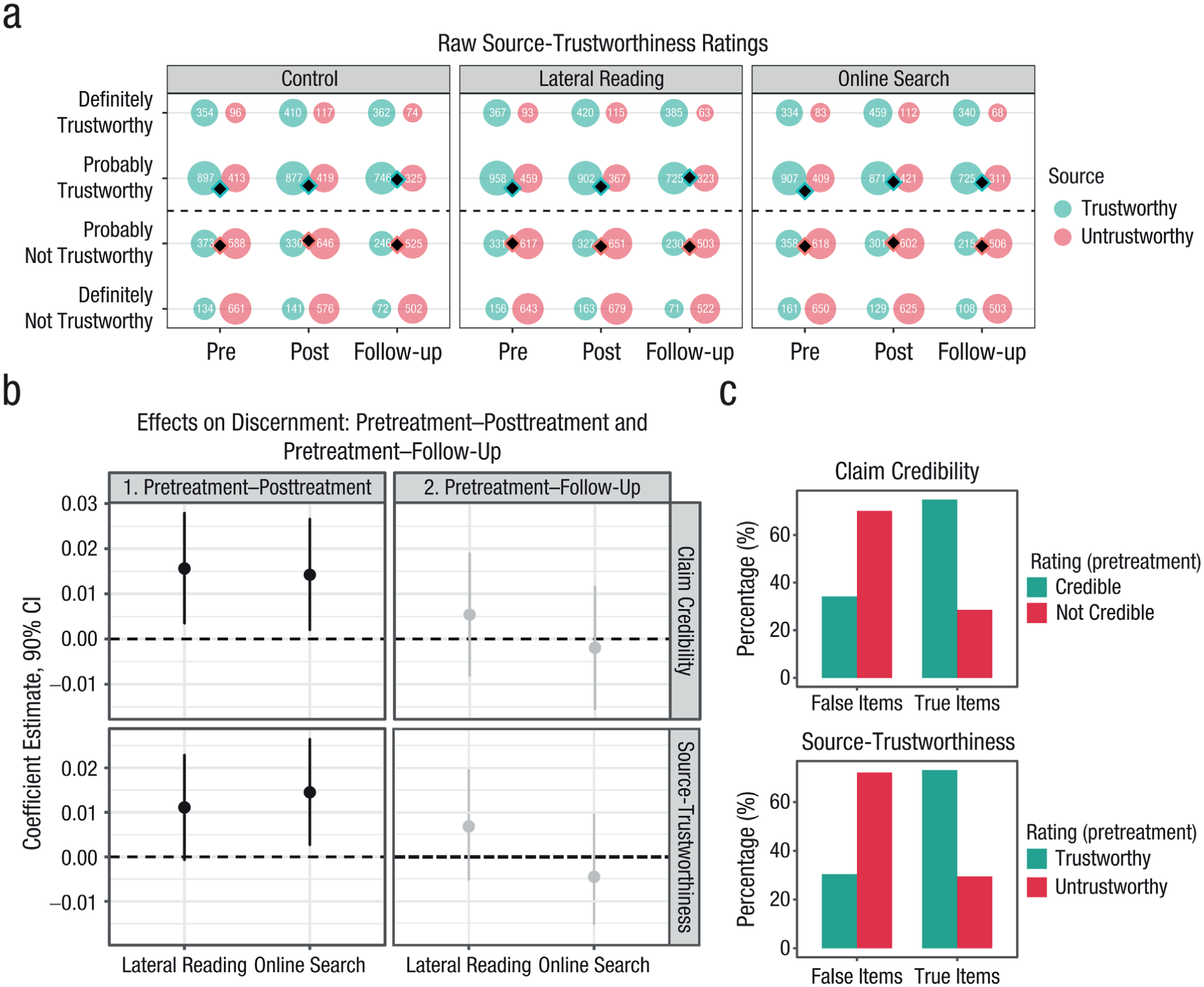
Treatment effects. In (a) are shown raw source-trustworthiness ratings on 4-point scale by condition and assessment time point. Black diamonds above the dashed line indicate mean ratings for true and trustworthy items (error bars representing bootstrapped 95% confidence intervals, or CIs, are hidden because they are smaller than the diamond shape); black diamonds below the line indicate mean ratings for false or untrustworthy items. In (b) are shown average treatment effects as preregistered (left: pretreatment vs. posttreatment; right: pretreatment vs. follow-up). Coefficients indicate effects of the interventions on source-trustworthiness or claim-credibility discernment (i.e., changes pretreatment vs. posttreatment and follow-up) compared with control. Ratings from the original 4-point scale in (a) were scaled to the [0,1] interval so that coefficients represent changes in percentage points. Error bars represent preregistered 90% CIs from one-sided tests. In (c) are shown percentages of binarized ratings pretreatment for both main outcomes, pooled across conditions.
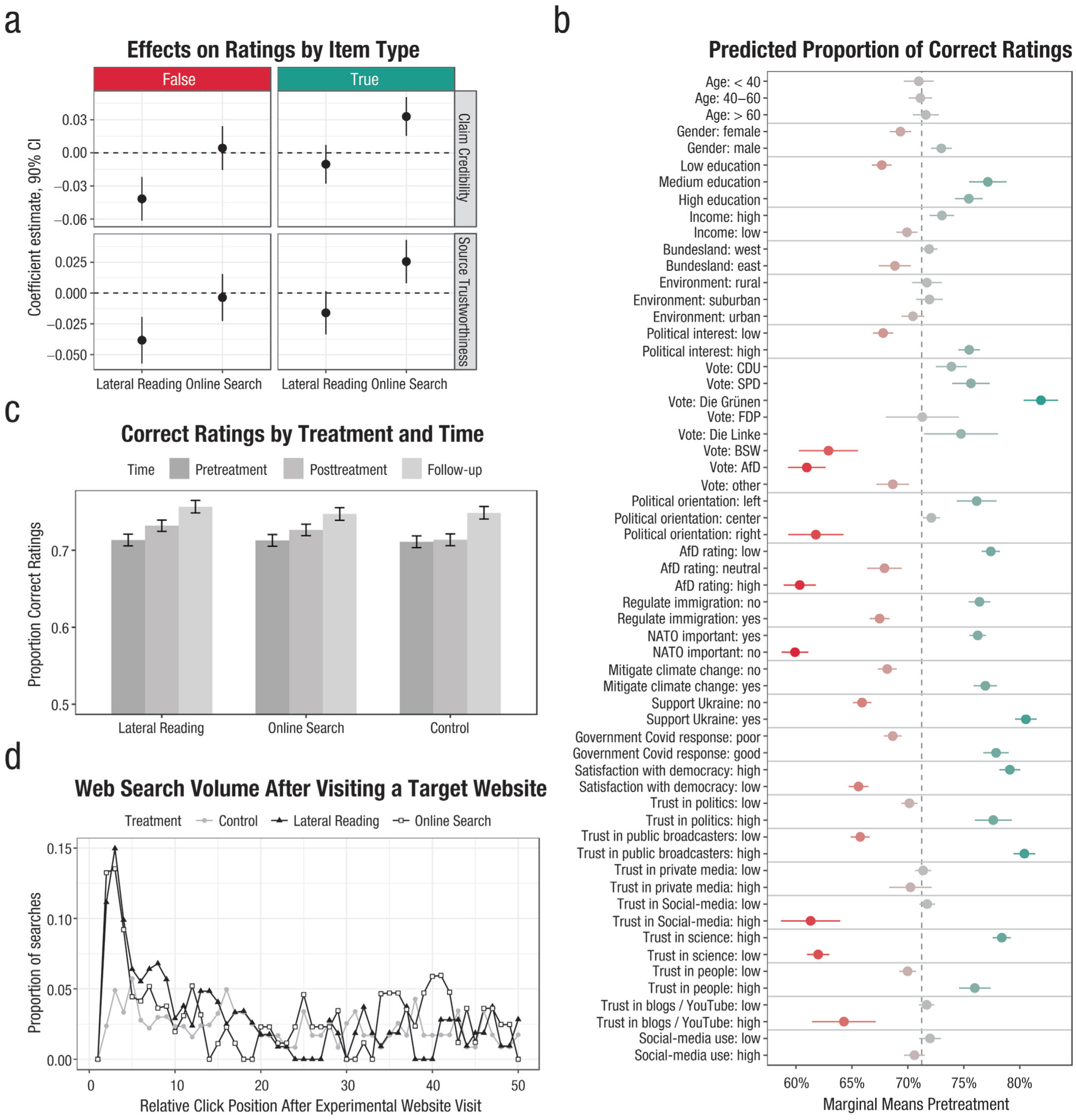
Exploratory descriptive analyses. In (a) are shown treatment effects (pretreatment vs. posttreatment change compared with control) on ratings, split between true and false items. Coefficients represent group-level treatment effects (in the model: two-way interaction between condition, with control as the reference category, and time point, with pretreatment as the reference category). In (b) are shown the marginal means of predicted proportion of correct ratings based on pretreatment ratings. Coefficient estimates stem from separate, single-predictor regression models; error bars represent 95% confidence intervals; dashed line represents global average. In (c) we show the proportion of correct ratings by treatment and time. In (d) we show the web search volume after participants visited a target website, separately for treatments, with temporal trajectories of searches within the postexperimental website click-browsing sequence; the y-axis represents the proportion of searches at respective postexperimental click positions. The analysis is based on a subset of 202 participants with web-tracking data. CI = confidence interval; NATO = North Atlantic Treaty Organization; AfD = Alternative für Deutschland.
For additional exploratory analyses, we elicited the following per website: source intent (inform, convince, mislead), binary claim veracity (true, misleading and/or false, could not determine), and whether participants had encountered the website before (yes, no). We also collected several demographic, political, and psychological variables: age, gender, education, employment status, political position on the left–right scale, party preferences, voting intentions, affective polarization, populist attitudes, political extremism, political knowledge (efficacy), issue attitudes, issue knowledge, institutional trust, and “active open-minded thinking” (including items on myside bias and overconfidence; Baron et al., 2022). This last item was previously found to be strongly correlated with misinformation susceptibility (Roozenbeek et al., 2022). However, given constraints with regard to statistical power, we restricted our exploratory analysis of demographic and survey variables to a descriptive breakdown of pretreatment discernment between groups.
Source trustworthiness
Building on previous research (Lühring et al., 2025), we employed a domain-level approach to measurement. We used the widely applied NewsGuard Reliability Ratings of German online sources as benchmarks of source trustworthiness. NewsGuard has wide coverage of German domains and, in the English context, was found to correlate highly with other news-domain quality-rating sets (Lin et al., 2023).
Analysis
Our primary, preregistered analyses (see https://osf.io/tsb68/) examined the changes in source-trustworthiness discernment (i.e., difference between trustworthiness ratings for trustworthy vs. untrustworthy sources) and changes in claim-credibility discernment (i.e., difference between credibility ratings for credible vs. not credible claims) across two time frames:
pretreatment versus posttreatment (immediate treatment effect), and
pretreatment versus 2-week follow-up (longer-term treatment effect).
Source-trustworthiness ratings served as the first outcome (H1s, H2s). The analysis was repeated with claim-credibility ratings (H1c, H2c, H3c). As an additional robustness check, we explored source intent and binary-claim veracity measures (see Fig. S8 in the Supplemental Material).
We employed linear mixed-effects models, implemented in R using the lme4::lmer() function. Models 1s and 1c (pretreatment vs. posttreatment), to test hypotheses H1s, H1c, and H3c, model the rating using the equation below (shown in lme4 syntax): rating ~ item_type * phase * treatment (1) + (1 + item_type + phase | id) + (1 | item),
where
rating refers to the source-trustworthiness rating assigned to an item (Model 1s, H1s) or the claim credibility assigned to an item (Model 1c, H1c);
treatment is a factor variable representing the three conditions;
item_type is a factor variable that indicates whether the sources of the item are trustworthy or untrustworthy;
phase is a factor variable distinguishing between pretreatment and posttreatment ratings;
id serves as an anonymous unique identifier for each participant; and
item is an unique identifier for each item.
The interaction of rating * item type corresponds to a calculation of discernment; the interaction of this with phase provides a measure of change in discernment over time. Because discernment is defined as a contrast between responses to different item types (true/trustworthy vs. false/untrustworthy) rather than a single observed variable, the reported effect sizes are derived from these interaction terms. The full set of fixed effects estimates is provided in Table S6 of the Supplemental Material.
Models 2s and 2c (pretreatment vs. follow-up), to test hypotheses H2s and H2c, were identical to Models 1s and 1c, respectively, with two exceptions: Only participants who had completed the follow-up wave were included (N = 2,120), and the variable phase now distinguished between pretreatment and follow-up ratings (rather than pre- and posttreatment ratings).
Consistent with our preregistration, and following Bates et al. (2018), we selected a model specification by initially implementing the full random-effect structure (see the preregistration and the Supplemental Material) and iteratively simplified the random effect structure to address issues of singular fit we encountered (see Section 2.1 in the Supplemental Material for details). The equation above is the simplified version used in all analyses reported in the main text.
Consistent with our preregistration, we compared both treatment conditions (lateral reading and online search) to the control condition. We used one-tailed tests, and we report fixed-effects coefficients for the interaction term treatment:phase:item type with 90% confidence intervals (CIs), which reflect the conventional alpha threshold of 0.05 (Hales, 2024).
Web-tracking data
Web-tracking data was collected for a subsample of 436 participants from YouGov’s Pulse panel. The experiment, with visits to target stimulus websites visible in the tracking data, was successfully tracked for only 202 participants. For the remaining Pulse respondents, the tracked device was not the one on which the participants completed the study. The raw URL tracking data contained the following variables: participant ID, full URL of the visited website, time stamp of the visit, and duration of the visit in seconds. Research questions involving URL tracking data were not formally preregistered because of the complexity of analytical decisions; however, we did outline an envisioned processing pipeline in our preregistration.
After extracting domains from the URLs, we classified all potentially relevant domains for which NewsGuard labels were available. However, because engagement with untrustworthy news media was not a frequent behavior in our data set (only 33 of the 436 Pulse respondents visited an untrustworthy outlet in the 2-month tracking period), we decided against substantial interpretations of group differences in pretreatment versus posttreatment browsing.
To explore signals of adoption of the intervention strategy, we extracted search queries from URL strings and constructed sequences of browsing after visits to experimental stimulus websites. Because the tracked sample was small and the analysis of behavioral data requires a complex analytical pipeline, we present the results as a descriptive illustration of search behavior and refrain from any statistical tests between groups.
Results
Pooled across all conditions’ pretreatment judgments, 72% of trustworthy sources and 71% of untrustworthy sources were correctly classified. The participants’ judgments were far better than chance, with, however, plenty of room for improvement: 28% of trustworthy sources and 29% of untrustworthy sources were falsely classified. Figure 2c shows that the credibility results of the claim indicate a similar pattern. The difficulty of the source (the proportion of correct vs. incorrect ratings) and the familiarity of the participants with the presented websites were similar between trustworthy/credible and untrustworthy/not credible websites and claims, as well as between topics (see Fig. S1 in the Supplemental Material).
Lateral-reading and online-search treatment effects
Both interventions showed small positive point estimates for treatment effects on source-trustworthiness and claim-credibility discernment (Fig. 2b). Assuming a quantitative structure (Michell, 2012), coefficients can be roughly interpreted as percentage-point changes in discernment, as the original 4-point outcome scale (see Fig. 2a) was transformed to the interval [0,1], with 1 representing perfect discernment of true and trustworthy and false and untrustworthy information, and with 0 representing consistent misclassifications (e.g., of untrustworthy sources as “definitely trustworthy”). For lateral reading, the estimated effect on source-trustworthiness discernment was 1.1 percentage points relative to the control condition; however, this estimate was not statistically significant, because the 90% confidence interval included zero (H1s: b = 0.011, 90% CI = [−0.001, 0.023]). Lateral reading showed evidence of a small improvement in claim-credibility discernment compared with the control condition (H1c: b = 0.016, 90% CI = [0.003, 0.028], corresponding to a 1.6 percentage-point increase).
We observed a general improvement in the discernment performance from Wave 1 to Wave 2, unexpectedly also in the control condition (see the exploratory results reported in Fig. 3c). This partially changes the interpretation of our preregistered analyses regarding the longevity of the interventions (H2s and H2c). Although we were substantially interested in the longevity of the effects, we specified this effect as a persisting difference from the control group in our preregistered hypotheses. However, lateral reading did not improve source-trustworthiness discernment compared with the control condition after 2 weeks (H2s: b = 0.007, 90% CI = [−0.006, 0.02]), nor did it improve claim-credibility discernment (H2c: b = 0.005, 90% CI = [−0.008, 0.019]).
To determine whether these findings reflect a decrease in the effects of the treatment over time or were instead a consequence of the unexpected improvement in the control group, we computed exploratory contrasts between the posttreatment and follow-up results, separately for each experimental condition. We found that the control group had substantially improved in the follow-up compared with posttreatment (b = 0.023, 90% CI = [0.012, 0.034]), thereby offsetting the previous differences between intervention groups and the control group in pretreatment to posttreatment changes (the main pretreatment–posttreatment effects; see Table S7 in the Supplemental Material for all contrasts between posttreatment and follow-up).
We found no evidence of a backfire effect in the online-search condition. The intervention did not reduce claim-credibility discernment relative to control, as would be implied by an average backfire effect (Aslett et al., 2023). Instead, the point estimates for online search were positive for both claim credibility (b = 0.014, 90% CI = [0.002, 0.027]) and source-trustworthiness discernment (b = .015, 90% CI = [0.003, 0.027]). Although these estimates suggest effects similar in magnitude to those of lateral reading, all observed effects were small, and several confidence intervals approached zero.
The results of the preregistered analyses reported above were robust to alternative model specifications, such as treating the ratings as ordinal measurements and using a Bayesian approach (see Fig. S9 in the Supplemental Material for details).
When comparing treatment effects (pretreatment vs. posttreatment change in comparison to control) on ratings instead of discernment, and splitting the analysis between true and false items, we found that the interventions appeared to work through complementary pathways: The lateral reading interventions lowered participants’ ratings of the trustworthiness of untrustworthy sources and inaccurate claims, whereas the online-search intervention increased ratings of the trustworthiness of trustworthy sources and credible claims (Fig. 3a).
Exploratory descriptive analyses
In separate regression models (many survey variables are strongly intercorrelated) to predict the proportion of correct ratings prior to treatment, pooled across experimental conditions, we found that, broadly aligning with previous research (Guess et al., 2020; Sultan et al., 2024), the following variables were most predictive of poor discernment: positive ratings for the far-right AfD (Alternative für Deutschland) and the new populist party BSW (Bündnis Sahra Wagenknecht; Thomeczek, 2024), right-leaning political orientation, support for regulating immigration, low regard for NATO, lack of interest in mitigating climate change or supporting Ukraine, and disapproval of the German government’s COVID response. In contrast, trust in science and public broadcasting, satisfaction with democracy, interest in politics, and general education were positive predictors of accurate ratings (Fig. 3b). Although these findings illustrate enormous heterogeneity in discernment performance at baseline, our study was underpowered to robustly examine the heterogeneity of the treatment effect along these groups.
Using the subset of YouGov Pulse respondents for whom tracking data was available (n = 202), we explored behavioral signals to determine the extent to which participants used the interventions’ techniques to evaluate websites within the experiment. To this end, we compared the use of search engines when evaluating websites. We found that participants in both treatment groups showed a stronger search for information directly after receiving an evaluation task (Fig. 3d).
Discussion
In our representative sample in Germany, both the lateral-reading intervention and the online-search intervention showed small positive point estimates relative to the control condition for source trustworthiness and the discernment of claim credibility. The differences are on the order of 1 to 2 percentage points. Some of these estimated changes in discernment were statistically distinguishable from zero, whereas for others, the confidence intervals approached or included zero. At 2 weeks of follow-up, overall discernment improved in all three conditions, and differences between the intervention groups and the control group were no longer statistically distinguishable. This convergence should not be interpreted as evidence that interventions did not have an effect on follow-up; rather, the data do not provide evidence of lasting treatment-control differences given the improvement in the control condition.
What could explain this unexpected general improvement? Although only participants assigned to the lateral-reading and online-search treatment conditions underwent an intervention, all participants were extensively debriefed according to best practices in misinformation research (Greene et al., 2022) at the end of Wave 1. The debriefing material combined the screenshots of all presented stimulus websites with salient color-coded labels (“trustworthy” or “untrustworthy”), information on the source, and, for false claims, information on why they were false (see Fig. S12 for an example). Descriptively, our results suggest that all groups improved in the follow-up. It is possible that the debriefing functioned as exposure to the “debunking” strategy (Bruns et al., 2024, and Lewandowsky et al., 2012; see Fig. 3c).
In contrast to results obtained in the United States by Aslett et al. (2023), we found no evidence of backfire effects for online search. Rather, lateral reading and online search showed similar-sized point estimates for improvements in discernment of source trustworthiness and claim credibility. However, the two strategies appear to operate via different pathways: Lateral reading was estimated to primarily reduce ratings for low-quality sources and inaccurate claims, whereas online search was estimated to primarily increase ratings for high-quality sources and accurate claims. In a study of media-literacy tips, Altay et al. (2024) deliberately designed different sets of tips to reduce trust in false news and increase trust in true news. In our study, the complementarity of the lateral reading and online search strategies is a byproduct of their rationale: Lateral reading prompted individuals to be skeptical about a source, whereas the online-search intervention, adopted from Aslett et al. (2023), prompted individuals to search for evidence to support a claim.
Several limitations should be noted. First, the reduced set of web-tracking data limited the scope of our analyses on the level of browsing behavior. Although such data would have allowed for more precise estimates of the techniques participants used when evaluating sources and claims, as well as post-post comparisons of exposure to untrustworthy news sources, the behavioral subsample was too small to allow robust inference. As a result, our conclusions rely primarily on survey-based measures of discernment; analyses from web-tracking data are reported only as behavioral illustrations on a descriptive level.
Second, the estimated treatment effects in the present study are small compared with the effect sizes reported in the existing literature. A recent meta-analysis by Fendt et al. (2025) reports a meta-analytic effect (g) of 0.42 on source-credibility assessment interventions and of 0.55, 95% CI = [0.35, 0.75], for lateral-reading interventions specifically—substantially greater than the effects observed here. Several design elements may contribute to this difference: Our interventions were brief, video-based treatments and are therefore not directly comparable to multihour, in-person classroom interventions. In addition, we estimated intention-to-treat effects without excluding noncompliers, which further attenuates estimated effect sizes but provides realistic evidence for policy contexts where treatment compliance is unobserved. Finally, we relied on a systematic sampling of stimuli rather than researcher-selected examples. Although this approach reduces researcher degrees of freedom and increases both internal and external validity, it may also limit effect sizes considerably.
Third, given the small magnitude of the observed effects, the study was not able to reliably estimate the heterogeneity of the treatment effect between subgroups. As a result, we refrain from drawing conclusions about the differential effectiveness between demographic or attitudinal groups.
Another important limitation is that the two interventions were delivered through different modalities (video vs. text), which introduces a possible confounding related to the mode of delivery. Although the effects of the interventions can still be compared at the outcome level, it is not possible to disentangle whether any observed differences are attributable to the intervention content itself or to modality-specific factors, such as engagement or differential processing of audiovisual versus written material. Furthermore, although attrition rates were comparable across conditions, data missing between waves because of processes other than completely random ones cannot be ruled out as having affected the results.
The fact that we found no evidence of backfire should not be interpreted as certainty that online-search interventions are without risks; the findings provide estimates for average treatment effects, but on an individual level, people can still experience negative effects on discernment. Finally, while this study was conducted on a nationally representative sample of adults in Germany, the results should not be generalized to adolescents or populations in other countries.
With recent shifts in platform moderation and the growing volume of misleading content on X and elsewhere, concerned users who choose to stay will increasingly need to verify claims and sources themselves. That requires concrete, teachable practices, such as lateral reading and online search, among other competencies (Kozyreva et al., 2024). These competencies are not a panacea, but they represent a first line of response and empower citizens without constraining choice (Herzog & Hertwig, 2025). Given the stakes for public discourse and democratic decision-making, investing in these capabilities in schools, newsrooms, and civic organizations is urgent. It is also essential to evaluate these tools, understand their limitations, improve them, and prepare them for new online challenges, such as deep fakes and chatbot-mediated misinformation and disinformation. We further need to estimate their effects—including possible backfire effects—in representative samples of citizens around the globe. This study is a step toward that goal.
Supplemental Material
sj-pdf-1-pss-10.1177_09567976261453813 – Supplemental material for Boosting Media Literacy Using Lateral Reading and Online Search Interventions
Supplemental material, sj-pdf-1-pss-10.1177_09567976261453813 for Boosting Media Literacy Using Lateral Reading and Online Search Interventions by Lisa Oswald, Anastasia Kozyreva, Stefan M. Herzog, Pietro Leonardo Nickl and Ralph Hertwig in Psychological Science
Footnotes
Transparency
Action Editor: Antonio L. Freitas
Editor: Simine Vazire
Author Contributions

References
Supplementary Material
Please find the following supplemental material available below.
For Open Access articles published under a Creative Commons License, all supplemental material carries the same license as the article it is associated with.
For non-Open Access articles published, all supplemental material carries a non-exclusive license, and permission requests for re-use of supplemental material or any part of supplemental material shall be sent directly to the copyright owner as specified in the copyright notice associated with the article.
