






Abstract
Does overconfidence really confer adaptive benefits to children’s learning? Through a tripartite investigation involving a preregistered replication (Study 1; N = 30, children aged 6–8 years), computational simulation (Study 2), and an experimental intervention (Study 3; N = 64, children aged 6–8 years), we first replicated previous findings that highly overconfident (HO) children exhibited less negative performance change across a memory task than their low-overconfidence (LO) counterparts. However, this pattern was driven by participant-selection bias and regression-to-the-mean effects rather than by adaptive benefits of childhood overconfidence. When experimentally manipulating children’s overconfidence levels to eliminate these methodological drawbacks, the difference in performance changes between HO and LO children disappeared. These findings challenge an influential hypothesis about the adaptive nature of childhood overconfidence, underscore the risks of median-split designs with difference scores, highlight the necessity of causal experimental approaches in developmental research, and raise concerns about educational practices promoting positive illusions in children.
Keywords
Overconfidence is a ubiquitous characteristic of children across different countries and cultures (Xia et al., 2022). Young children are generally overconfident about their abilities and attributes, such as erroneously believing that they have better physical abilities (Schwebel & Bounds, 2003), learning and memory abilities (Yussen & Levy, 1975), problem-solving abilities (Heath & Glen, 2005), intelligence (Spinath & Spinath, 2005), and academic competence (Kinard, 2001) than they actually do. A recent meta-analysis demonstrated that, across different tasks and domains, children overestimated their performance by a factor of about 1.35 (Xia et al., 2024).
Overestimating one’s abilities and attributes can cause serious consequences for children. For instance, Plumert and Schwebel (1997) measured 6-year-old children’s self-estimation of their physical abilities and the day-to-day accidental injuries they experienced over 2 weeks. The results showed that the more overconfident children were about their physical abilities, the more prone they were to severe day-to-day injuries. Overconfidence also produces deleterious effects to children in many other domains, such as pedestrian safety (Plumert et al., 2004) and academic performance (Ots, 2013).
Regardless of the obvious detrimental effects of overconfidence, Shin et al. (2007) proposed that overconfidence can produce adaptive benefits to children. They speculated that being optimistic (i.e., overconfident) about one’s abilities makes children persist at tasks longer and, through practice and engagement, improve their task performance. Shin et al. conducted a seminal experiment to test this hypothesis. In this experiment, preschoolers and children in Grades 1 and 3 studied five lists of words. Before studying each list, they predicted how many words in the next list they would remember on a later test. Then they studied the word list and took a free-recall test on it. The results showed that children at all three grades overestimated their recall performance.
Shin et al. used the median-split method to divide children at each grade into two groups: a high-overconfidence (HO) group and a low-overconfidence (LO) group, on the basis of overconfidence scores in the first two lists (predicted minus actual recall in Lists 1 and 2). They also calculated a measure of performance change across the memory task (recall in Lists 4 and 5 minus recall in Lists 1 and 2). The results showed that, for children at all three grades, recall exhibited a more positive or less negative change in the HO group than in the LO group. Put differently, Shin et al. observed that overconfidence scores in the first two lists were positively related to performance changes from the first to the last two lists. They therefore concluded that their findings reflected “the adaptive nature of children’s overestimation of their cognitive abilities” (p. 197).
Shin et al.’s (2007) findings and conclusions are striking and influential in the fields of developmental psychology, educational psychology, evolutionary psychology, and metacognition. According to Google Scholar (June 11, 2025), their study has been cited over 200 times. Furthermore, their findings are widely discussed in dozens of textbooks (e.g., Bjorklund, 2020; Dunlosky & Metcalfe, 2008; Smith & Hart, 2022) and taught in many developmental and educational psychology courses. However, their findings have never been subjected to a formal replication test. This combination of enduring influence and the absence of direct replication motivated us to conduct the first replication attempt.
The current research also aimed to explore the mechanisms underlying the positive relation between overconfidence levels and performance changes observed by Shin et al. (2007). Two possible explanations are available to account for this positive relation. The first is the adaptive-benefit hypothesis, proposed by Shin et al., asserting that overconfidence makes children persist at tasks longer and improves their performance through practice and engagement. Another possible explanation is a methodological-artifact hypothesis, which conjectures that this positive relation is just an artifact induced by participant-selection bias and regression to the mean (RTM; Galton, 1886).
RTM refers to the phenomenon that extreme scores at a prior measurement tend to approach the mean at a subsequent measurement whenever the measurement tool is not perfectly reliable (Campbell & Kenny, 2002; Farmus et al., 2019; Hsu, 1995; Shanks, 2017; Yu & Chen, 2015), which is always true in psychology research (Hedge et al., 2018; Shepperd et al., 2015). In the study by Shin et al. (2007), repeatedly measuring recall across multiple lists creates a risk that RTM may confound measures of performance changes, with those scoring higher in initial lists tending to score lower in later ones and those scoring lower in initial lists tending to score higher in later ones. Furthermore, it is well known that overconfidence scores (prediction scores − performance scores) are strongly and negatively affected by performance scores (Nelson, 1984; Zhao & Linderholm, 2008): That is, the lower a given participant’s performance score, the greater the calculated overconfidence score. Hence, in Shin et al.’s (2007) study, participants with low initial recall in Lists 1 and 2 were more likely to be assigned to the HO group, and those with high initial recall were more likely to be assigned to the LO group, leading to a severe participant-selection bias. Indeed, Shin et al. observed that recall in Lists 1 and 2 was numerically lower in the HO group (M = .31) than in the LO group (M = .37).
In summary, high initial performance in Lists 1 and 2 in the LO group and low initial performance in the HO group were likely to induce opposing RTM effects in the subsequent Lists 4 and 5, leading to a more positive, or less negative, performance change in the HO group than in the LO group. In Study 2, we develop a simulation model to demonstrate that participant-selection bias and RTM are jointly sufficient to produce the exact pattern observed by Shin et al. (2007). Hence, it remains unknown whether Shin et al.’s findings truly reflect adaptive benefits of childhood overconfidence or are more parsimoniously explained as a methodological artifact. The second aim of the current research is to test the adaptive-benefit hypothesis through performing a preregistered intervention experiment that minimizes the risk of participant-selection bias and RTM confounds.
Research Transparency Statement
General disclosures
Study 1 disclosures
Study 2 disclosures
Study 3 disclosures
Further exploratory-analyses disclosures
Study 1: Preregistered Replication
Study 1 was preregistered to test the replicability of Shin et al.’s (2007) original findings.
Method
Participants
According to our preregistered stopping rule, 30 children in Grade 1 (Mage = 7.27 years, SD = 0.58; 16 girls) were recruited from a local elementary school in Guangzhou City, China. See the Supplemental Material available online for details about how the sample size was predetermined. All of the participants were native Chinese speakers, had normal or corrected-to-normal vision, and did not suffer from any neurological or psychiatric diseases, as reported by their caregivers. Each participant received a stationery set as compensation, and informed consent was obtained from their caregivers. This research received ethics approval from the Faculty of Psychology, Beijing Normal University (Protocol No. BNU202403270070).
Materials and procedure
To test the replicability of Shin et al.’s (2007) findings, we strictly followed their task procedure. The materials consisted of 90 categorically related objects shown individually on cards, divided into five study lists (Fig. 1a). Before studying each list, children predicted how many items in the next list they would remember in a later test, studied the 18 items in the list, completed a brief distractor task, and then performed a free-recall test on the list (Fig. 1b). Details of the materials and the task procedure can be found in Shin et al. (2007) and in our Supplemental Material.
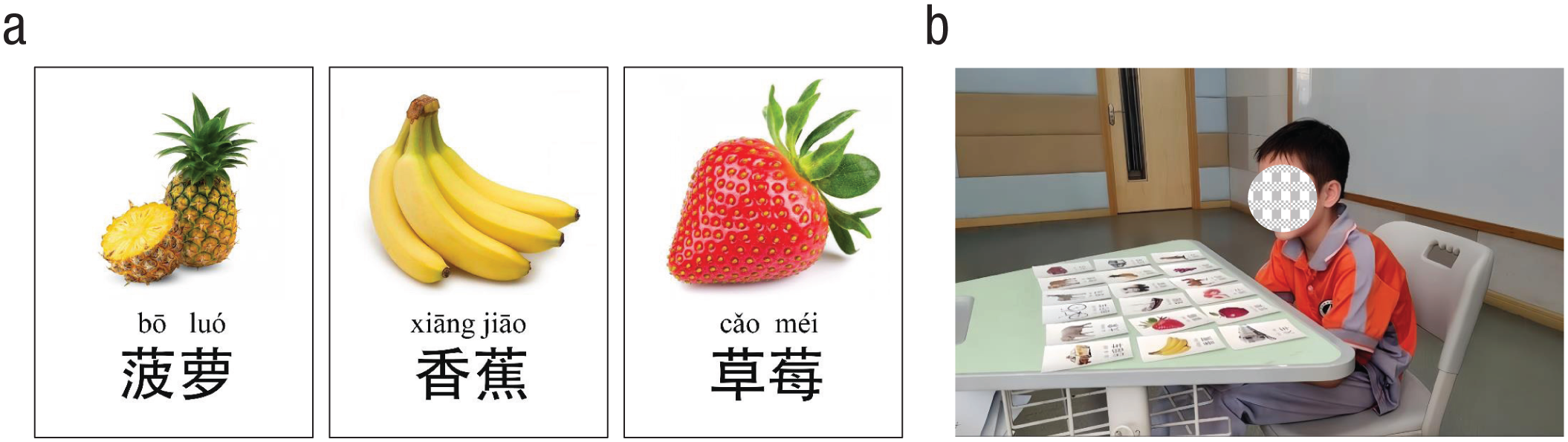
Stimuli and experimental environment in Studies 1 and 3. In (a), we show example items used in Studies 1 and 3; in (b), we show the experimental environment in Studies 1 and 3.
The key measures were List 1 overconfidence scores (List 1 prediction – List 1 recall) and performance changes from List 1 to List 5 (List 5 recall – List 1 recall). See the Supplemental Material for details about why we preregistered to use List 1 overconfidence scores (rather than overconfidence scores in the first two lists) and performance changes from List 1 to List 5 (rather than performance changes from the first two to the last two lists) as key measures. Put simply, if a score is changing approximately linearly, the measured change across the extremes of the scale will inevitably be greater when the unit of aggregation is smaller (that is, aggregating across one list versus two).
Results
All analyses reported below were performed according to our preregistration, except where otherwise noted. All Bayesian analyses were performed via the R BayesFactor and bruceR packages, with all parameters set as default.
In each of the five lists, participants’ predictions of recall performance were translated into proportions (prediction scores/18). The results showed that, across the five lists, recall predictions were significantly higher than actual recall, difference = .07, 95% confidence interval (CI) = [.02, .13], t(29) = 2.70, p = .01, Cohen’s d = 0.49, BF10 = 4.04, reflecting that children are generally overconfident about their memory abilities.
Next, we used the median-split (MS) method to divide participants into an HOMS (n = 15) and an LOMS (n = 15) group according to their List 1 overconfidence scores (List 1 prediction – List 1 recall). 1 As shown in Figure 2a, the HOMS group showed a less negative performance change from List 1 to List 5 than the LOMS group, difference = .13, 95% CI = [.03, .23], t(28) = 2.57, p = .02, Cohen’s d = 0.94, BF10 = 3.62, reproducing Shin et al.’s (2007) original findings.
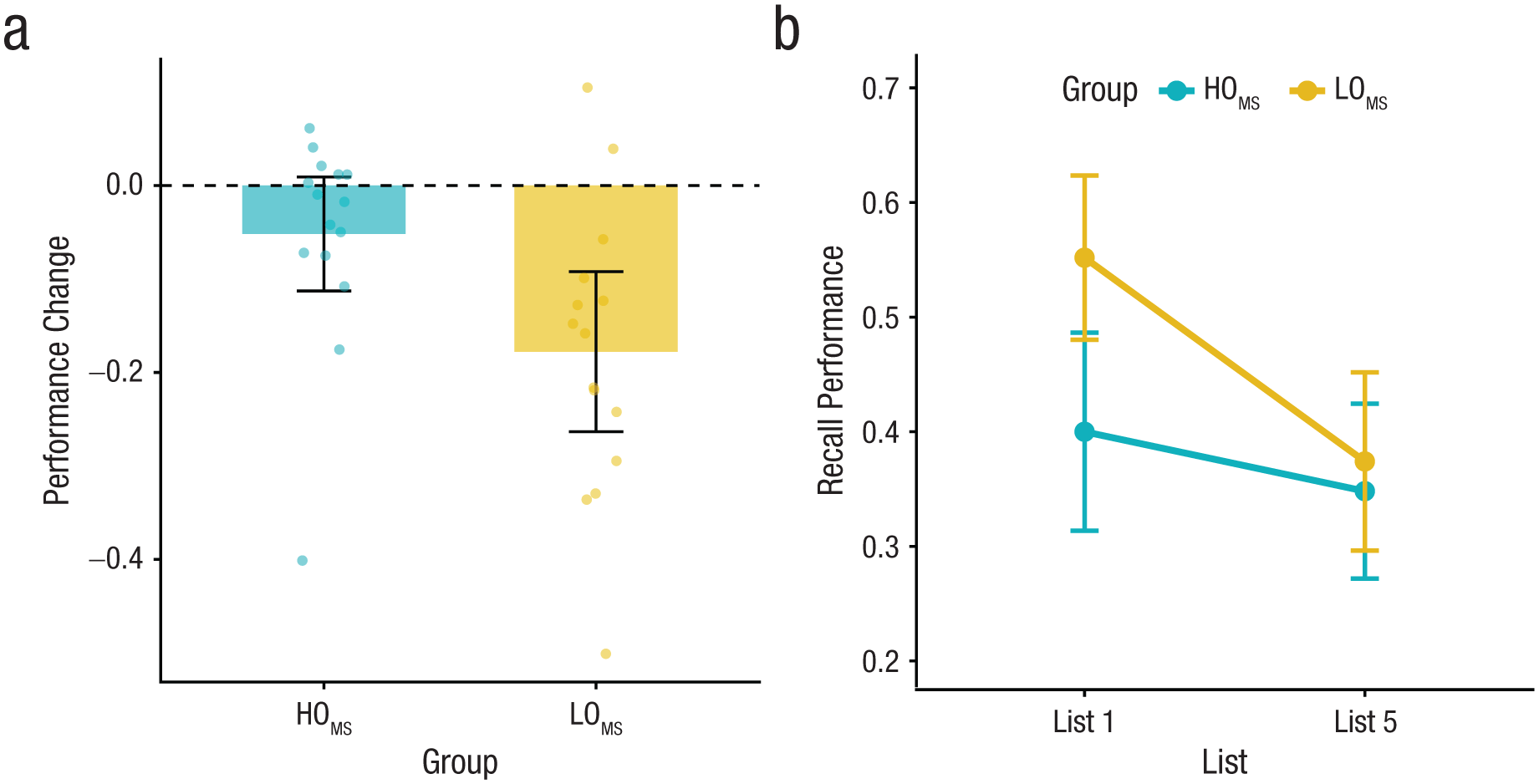
Results of Study 1. In (a), we show performance changes in each group; in (b), we show recall in Lists 1 and 5 as a function of group. Error bars represent 95% confidence intervals. HOMS = high-overconfidence group (median-split method); LOMS = low-overconfidence group (median-split method).
Notably, as shown in Figure 2b, List 1 recall was substantially higher in the LOMS than in the HOMS group, difference = .15, 95% CI = [.03, .27], t(28) = 2.65, p = .01, d = 0.97, BF10 = 4.16, reflecting a severe participant-selection bias. That is, children with poor recall in List 1 were more likely to be assigned to the HOMS group, and those with high recall in List 1 were more likely to be assigned to the LOMS group. Critically, there was minimal difference in List 5 recall between the two groups, difference = .03, 95% CI = [−.09, .14], t(28) = 0.47, p = .64, d = 0.17, BF10 = 0.37. These findings jointly suggest that the difference in performance changes between the HOMS and LOMS groups mainly came from the baseline difference in List 1 recall rather than any difference in List 5 recall. Although the groups also differed in their predictions about List 1 recall, this disparity did not account for the between-group difference in performance change, which was primarily driven by the baseline difference in List 1 recall (see the Supplemental Material for details).
As shown in Figure 2b, there were clear signs of RTM effects in performance changes. Exploratory (not preregistered) analyses showed that recall substantially decreased from List 1 to List 5 in the LOMS group, difference = −.18, 95% CI = [−.26, −.09], t(14) = −4.45, p < .001, d = −1.15, BF10 = 65.27, but decreased only slightly in the HOMS group, difference = −.05, 95% CI = [−.11, .01], t(14) = −1.82, p = .09, d = −0.47, BF10 = 0.99. The small decrease in the HOMS group is inconsistent with RTM, which should have resulted in an increase of recall (rather than a decrease of recall) from List 1 to List 5 in the HOMS group. However, any such effect might be counteracted by an overall performance reduction across lists, because of fatigue, the buildup of proactive interference (Keppel & Underwood, 1962), or other similar processes.
Overall, although Study 1 successfully replicated Shin et al.’s (2007) original findings, there were clear signs that the more positive (or less negative) performance changes in the HOMS group, compared with the LOMS group, might be merely a methodological artifact induced by participant-selection bias and RTM.
Study 2: Simulation Diagnostics
In Study 2, we formulated four simulation models to demonstrate that (a) participant-selection bias and RTM can jointly produce the finding that HOMS children exhibit less negative (or more positive) performance changes than their LOMS counterparts; (b) median-split analyses with difference scores, employed by Shin et al. (2007), are susceptible to methodological artifacts that are indistinguishable from real adaptive benefits; and (c) experimental manipulation of overconfidence is an appropriate method to remove those methodological confounds and to directly test whether childhood overconfidence can truly produce adaptive benefits to children’s learning.
Model 1: methodological artifacts
Model 1 was constructed to demonstrate that participant-selection bias and RTM are jointly sufficient to produce the apparent performance-change advantage of HOMS children reported by Shin et al. (2007). In this model, we simulated a learning task with 1,000 hypothetical children who studied five lists of items, made a performance prediction before studying each list, and completed a free-recall test after studying each list. Observed performance predictions and recall scores were generated from underlying true scores plus random measurement error. Critically, we set the true effect of overconfidence on performance changes to zero (i.e., b1 = 0 in a linear performance-change function, with b1 representing the magnitude of performance changes as a function of overconfidence levels). This ensured that overconfidence had no genuine adaptive benefit in the data-generating process. See the Supplemental Material for full model specifications.
Using the same analytic strategy as Study 1 and Shin et al. (2007), we reproduced the original finding. Specifically, the HOMS group showed a more positive performance change than the LOMS group, difference = .21, 95% CI = [.18, .25], t(998) = 12.74, p < .001, d = 0.81, BF10 > 1,000 (Fig. 3a), which must be a methodological artifact because in reality we simulated a situation in which overconfidence does not produce any adaptive benefits.
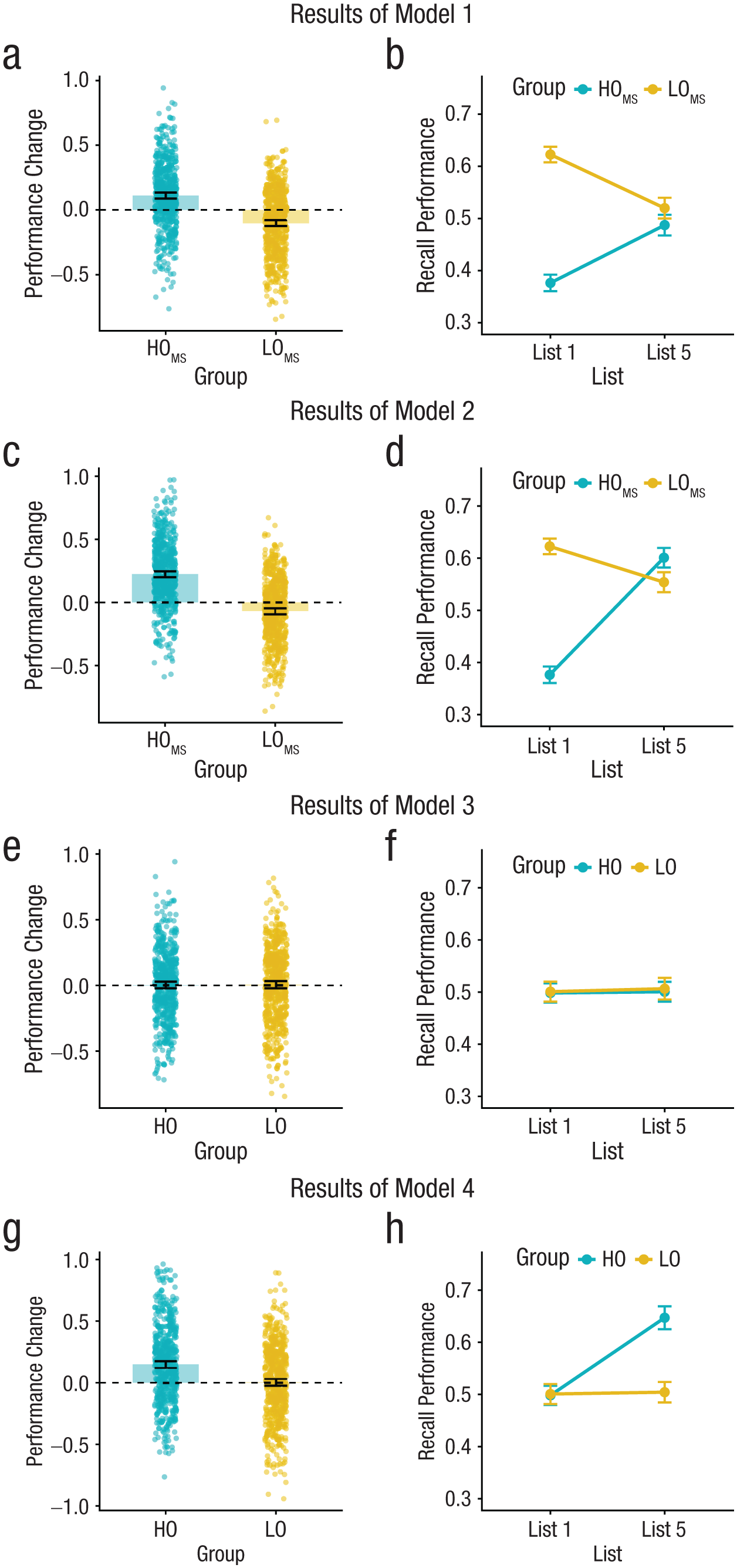
Results of Study 2. In (a) and (b), we show results of Model 1 (methodological artifacts); in (c) and (d), results of Model 2 (true adaptive benefits masked by methodological artifacts); in (e) and (f), results of Model 3 (experimental causal detection without adaptive benefits); and in (g) and (h), results of Model 4 (experimental causal detection with true adaptive benefits). Error bars represent 95% confidence intervals.
As shown in Figure 3b, this group difference in performance changes was entirely artificial. First, List 1 recall was much lower in the HOMS than in the LOMS group, difference = −.25, 95% CI = [−.27, −.22], t(998) = −22.12, p < .001, d = −1.40, BF10 > 1,000, reflecting a severe participant-selection bias. Second, List 1 recall in the HOMS group (low initially) and that in the LOMS group (high initially) regressed to the mean in List 5, leading to a much smaller difference in List 5 recall between the two groups, difference = −.03, 95% CI = [−.06, −.004], t(998) = −2.27, p = .02, d = −0.14, BF10 = 0.88. 2
In summary, Model 1 clearly shows that median-split analyses with change scores can manufacture an apparent benefit of overconfidence, which in fact does not exist.
Model 2: true adaptive benefits masked by methodological artifacts
Model 2 tested whether the analytic approach used by Shin et al. (2007) can distinguish true adaptive benefits from methodological artifacts. We simulated a scenario in which overconfidence genuinely improves learning across lists by setting b1 = 0.20, which means that a 10% increase in overconfidence produces a 2% gain in recall from the prior list to the subsequent list. All other parameters matched Model 1 (see the Supplemental Material for details).
As shown in Figure 3c, the HOMS group again showed a more positive performance change from List 1 to List 5 than the LOMS group, difference = .29, 95% CI = [.26, .33], t(998) = 17.37, p < .001, d = 1.10, BF10 > 1,000. However, only 32.8% of this group difference in performance changes reflected true adaptive benefits of overconfidence, whereas the other 67.2% was still due to participant-selection bias and RTM (see the Supplemental Material for details about the calculation method). Indeed, as shown in Figure 3d, List 1 recall was again substantially lower in the HOMS group than in the LOMS group, difference = −.25, 95% CI = [−.27, −.22], t(998) = −22.12, p < .001, d = −1.40, BF10 > 1,000, reflecting the same participant-selection bias as Model 1. Adaptive benefits and RTM then jointly affected List 5 recall, resulting in a group difference in List 5 recall = .05, 95% CI = [.02, .07], t(998) = 3.42, p < .001, d = 0.22, BF10 = 21.85.
In short, even when real adaptive benefits exist, median-split analyses with difference scores cannot detect them cleanly and produce results that are virtually indistinguishable from those produced by methodological artifacts alone (see Figs. 3a–3d).
Models 3 and 4: experimental causal detection
Models 3 and 4 were set up to demonstrate that experimental intervention (i.e., experimental manipulation of overconfidence with random assignment of participants) can appropriately avoid these methodological pitfalls and validly test the adaptive-benefit hypothesis. In both Models 3 and 4, 1,000 simulated children were randomly assigned to an HO group and an LO group, mimicking a causal experimental design. Overconfidence was manipulated independently of recall, removing participant-selection bias and RTM entirely (see the Supplemental Material for details). Model 3 simulated no true adaptive benefit by setting b1 = 0, whereas Model 4 simulated a real adaptive benefit by setting b1 = 0.20. All other aspects of Models 3 and 4 were the same as Model 1.
As shown in Figures 3e and 3f (Model 3), there was no group difference in performance changes, difference = −.003, 95% CI = [−.039, .032], t(998) = −0.18, p = .86, d = −0.01, BF10 = 0.07, no baseline difference in List 1 recall, difference = −.003, 95% CI = [−.029, .024], t(998) = −0.19, p = .85, d = −0.01, BF10 = 0.07, nor any difference in List 5 recall, difference = −.006, 95% CI = [−.034, .022], t(998) = −0.41, p = .69, d = −0.03, BF10 = 0.08, confirming that experimental manipulation of overconfidence with random assignment of participants effectively eliminates participant-selection bias and RTM confounds.
Critically, Model 4 shows that when a true adaptive benefit effect actually exists, experimental investigation can successfully detect it. As shown in Figure 3g, the HO group exhibited greater performance gains from List 1 to List 5 than the LO group, difference = .15, 95% CI = [.11, .18], t(998) = 7.22, p < .001, d = 0.46, BF10 > 1,000, with no baseline group difference in List 1 recall, difference = −.003, 95% CI = [−.029, .024], t(998) = −0.19, p = .85, d = −0.01, BF10 = 0.07 (Fig. 3h), and a clear causal effect of overconfidence on List 5 recall, difference = .14, 95% CI = [.11, .17], t(998) = 9.49, p < .001, d = 0.60, BF10 > 1,000.
Taken together, Models 1–4 jointly yield three key conclusions. First, median-split analyses with difference scores are fundamentally invalid for testing the adaptive-benefit hypothesis, because they can artificially generate spurious effects driven entirely by methodological artifacts (Model 1). Second, these analytic practices also fail to detect genuine adaptive benefits when they do exist, because they cannot separate true effects from methodological artifacts (Model 2). Third, experimental manipulation of overconfidence can circumvent these methodological pitfalls by eliminating participant-selection bias and RTM confounds (Model 3), thereby providing a valid causal test of whether childhood overconfidence really confers any adaptive benefits (Model 4).
Study 3: Preregistered Experimental Investigation
As shown by Model 1, Shin et al.’s (2007) findings might merely be a methodological artifact induced by participant-selection bias and RTM confounds. At the same time, Model 2 demonstrated that the same empirical pattern could also emerge when artifacts and true adaptive benefits coexist. Thus, the correlational approach used by Shin et al. (2007) cannot distinguish between these two possibilities. To resolve this ambiguity while avoiding the methodological drawbacks of the original approach, and motivated by the conclusions of Models 3 and 4, we randomly assigned children in Study 3 to an HO group and an LO group and experimentally manipulated their overconfidence levels, rather than selecting HOMS and LOMS children according to their List 1 overconfidence scores. According to Models 3 and 4, this design should eliminate participant-selection bias and RTM confounds in Study 3, allowing us to directly test whether overconfidence really produces any adaptive benefits to children’s learning.
Method
Participants
Consistent with our preregistration, we adopted the open-ended sequential Bayes factor (SBF) design to determine the required sample size (Schönbrodt & Wagenmakers, 2018). Specifically, we first recruited eight participants and randomly assigned them to either an HO group or an LO group in which they received the appropriate intervention to manipulate their overconfidence levels (see below for details). We then performed a Bayesian independent-samples t test and obtained a BF10 for the difference in performance changes between the two groups. In parallel, we also followed Shin et al. (2007) and used the median-split method to independently divide children into HOMS and LOMS groups according to their List 1 overconfidence scores. We then performed a Bayesian independent-samples t test to obtain a BF10 for the difference in performance changes between the two groups. If the BF10 in either of the two t tests was uninformative, we collected data from eight new participants and performed the same analyses. This cycle was repeated until BF10s in both t tests became informative (i.e., larger than 3 or smaller than 0.33). Hence, this procedure ensured an adequate sample size to yield an informative outcome for both t tests.
This dual-analytic strategy (one comparing performance changes between the HO and LO groups, and the other comparing performance changes between HOMS and LOMS groups) allows us to directly test the adaptive-benefit and methodological-artifact hypotheses, which make different predictions. Specifically, the adaptive-benefit hypothesis predicts that the HO group will exhibit a more positive (or less negative) performance change than the LO group. By contrast, the methodological-artifact hypothesis predicts no difference in performance changes between the HO and LO groups, but that the HOMS group will demonstrate a more positive (or less negative) performance change than the LOMS group.
In total, 80 Grade 1 children were recruited from a local elementary school in Guangzhou City, China. Following our preregistered exclusion criteria, data from 16 participants were excluded because 14 of them (n = 6 in the HO group and n = 8 in the LO group) reported not believing the overconfidence-manipulation instructions (see below for details), and two (in the HO group) did not complete the experiment. The final data came from 64 participants (Mage = 6.61 years, SD = 0.58; 31 girls), with 32 in each of the HO and LO groups. All participants were native Chinese speakers, had normal or corrected-to-normal vision, and did not suffer from any neurological or psychiatric diseases, as reported by their caregivers. Each participant received a stationery set as compensation, and their caregivers provided informed consent. This research received ethics approval from the Faculty of Psychology, Beijing Normal University (Protocol No. BNU202403270070).
Materials, design, and procedure
The stimuli were identical to those in Study 1, and the procedure was similar to that of Study 1, but with some modifications. Children in each of the HO and LO groups first completed a practice task to familiarize them with the task requirements, and then they began the main experiment.
Before studying List 1, they were told that the experimenter would use an electroencephalogram (EEG) headband to record their brain activity and assess their memory abilities. Each child then wore the EEG headband for 5 min, during which they could view their resting-state EEG waves on a computer screen. After that, children in the HO group were told, “The EEG assessment shows that your memory ability is excellent. It predicts that you will be able to successfully remember X words in the upcoming list.” For each child in the HO group, the number of words that the EEG assessment predicted he or she would remember in the next list was randomly drawn from a normal distribution with μ = 14, σ = 2. Noninteger values were rounded to the nearest integer, with those greater than 18 replaced by 18. By contrast, children in the LO group were told, “The EEG assessment shows that your memory ability is poor. It predicts that you will be able to remember only X words in the upcoming list.” The number of words each child in the LO group was told that he or she would remember in the next list was randomly drawn from a normal distribution with μ = 6, σ = 2. Noninteger values were rounded to the nearest integer, with those smaller than 1 replaced by 1. These instructions were designed to experimentally manipulate children’s overconfidence of their memory abilities.
After the confidence-manipulation phase, children in both groups made a prediction about how many items in the next list they believed they would remember; they then studied List 1 items, completed a 1-min distractor task, and took a free-recall test. This procedure was identical to that of Study 1. The procedure in Lists 2 through 5 was the same as that for List 1, including the overconfidence manipulation, except that children studied new items in each list. Before studying each list, children in the HO group were always told that the EEG showed that their memory abilities were excellent, whereas those in the LO group were always told that the EEG showed that their memory abilities were poor. For each child, the number of items in each list that the EEG assessment predicted he or she would remember was randomly sampled from the corresponding normal distribution. This means that a given child in each group was expected to receive different numbers in the instructions before studying each list; this was intended to enhance the credibility of the manipulation instructions.
At the end of the experiment, the experimenter conducted a manipulation check on children in both groups, asking, “Did you believe the EEG predictions about your memory performance?” Following preregistration, data from those who reported not believing the EEG predictions were excluded from analyses. After answering the manipulation check, children in both groups received a thorough explanation about the purposes of the study, and the experimenter explained the EEG deception in detail to ameliorate potential negative effects.
Results
All analyses reported below were conducted following our preregistration, with no deviations. In the HO group, mean predictions were significantly higher than mean recall, difference = .20, 95% CI = [.14, .25], t(31) = 7.33, p < .001, d = 1.30, BF10 > 1,000, reflecting that participants in the HO group were substantially overconfident about their memory abilities. By contrast, in the LO group, there was no significant difference between mean predictions and mean recall, difference = .04, 95% CI = [−.01, .10], t(31) = 1.56, p = .13, d = 0.28, BF10 = 0.57, reflecting no detectable overconfidence in the LO group.
Of critical interest, mean overconfidence scores were substantially higher in the HO than in the LO group, difference = .15, 95% CI = [.08, .23], t(62) = 4.07, p < .001, d = 1.02, BF10 = 172.95. Furthermore, mean predictions were significantly higher in the HO than in the LO group, difference = .15, 95% CI = [.08, .22], t(46) = 4.35, p < .001, d = 1.09, BF10 = 399.38. These results jointly confirm that our experimental manipulation of children’s overconfidence levels was successful overall.
We also conducted frequentist and Bayesian mixed analyses of variance (ANOVAs) to further examine the effectiveness of the experimental manipulation across the five lists. The within-subjects factor was list (1 vs. 2 vs. 3 vs. 4 vs. 5), and the between-subjects factor was group (HO vs. LO), with overconfidence scores in each list as the dependent variable. The results revealed a main effect of group, F(1, 62) = 16.60, p < .001, η p 2 = .21, BF10 = 167.05, indicating that our overconfidence manipulation successfully influenced children’s overconfidence levels. Critically, there was no statistically detectable interaction between group and list, F(3.44, 213.23) = 2.45, p = .06, η p 2 = .04, BF10 = 0.81, indicating that the effectiveness of the overconfidence manipulation did not systematically fluctuate across lists.
A potential concern is that our confidence manipulation might have influenced only children’s reported predictions, rather than their genuine confidence in their memory abilities. For instance, children might have simply parroted the numbers provided in the EEG feedback. To test this possibility, we conducted exploratory analyses, which provided clear evidence that children genuinely incorporated the EEG feedback into their own confidence judgments rather than merely repeating the numbers they were given (see the Supplemental Material for details).
After confirming the effectiveness of our experimental manipulation, we calculated a performance change score (List 5 recall – List 1 recall) for each participant in both the HO and LO groups. As shown in Figure 4a, there was no detectable difference in performance changes between the two groups, difference = −.02, 95% CI = [−.13, .08], t(62) = −0.46, p = .65, Cohen’s d = −0.12, BF10 = 0.28. If anything, children in the HO group tended to show a numerically more (rather than less) negative performance change than those in the LO group. These findings are fully consistent with those of Model 3 and imply that overconfidence does not confer adaptive benefits to children’s learning, challenging the adaptive-benefit hypothesis but supporting the methodological-artifact hypothesis of Shin et al.’s (2007) findings.
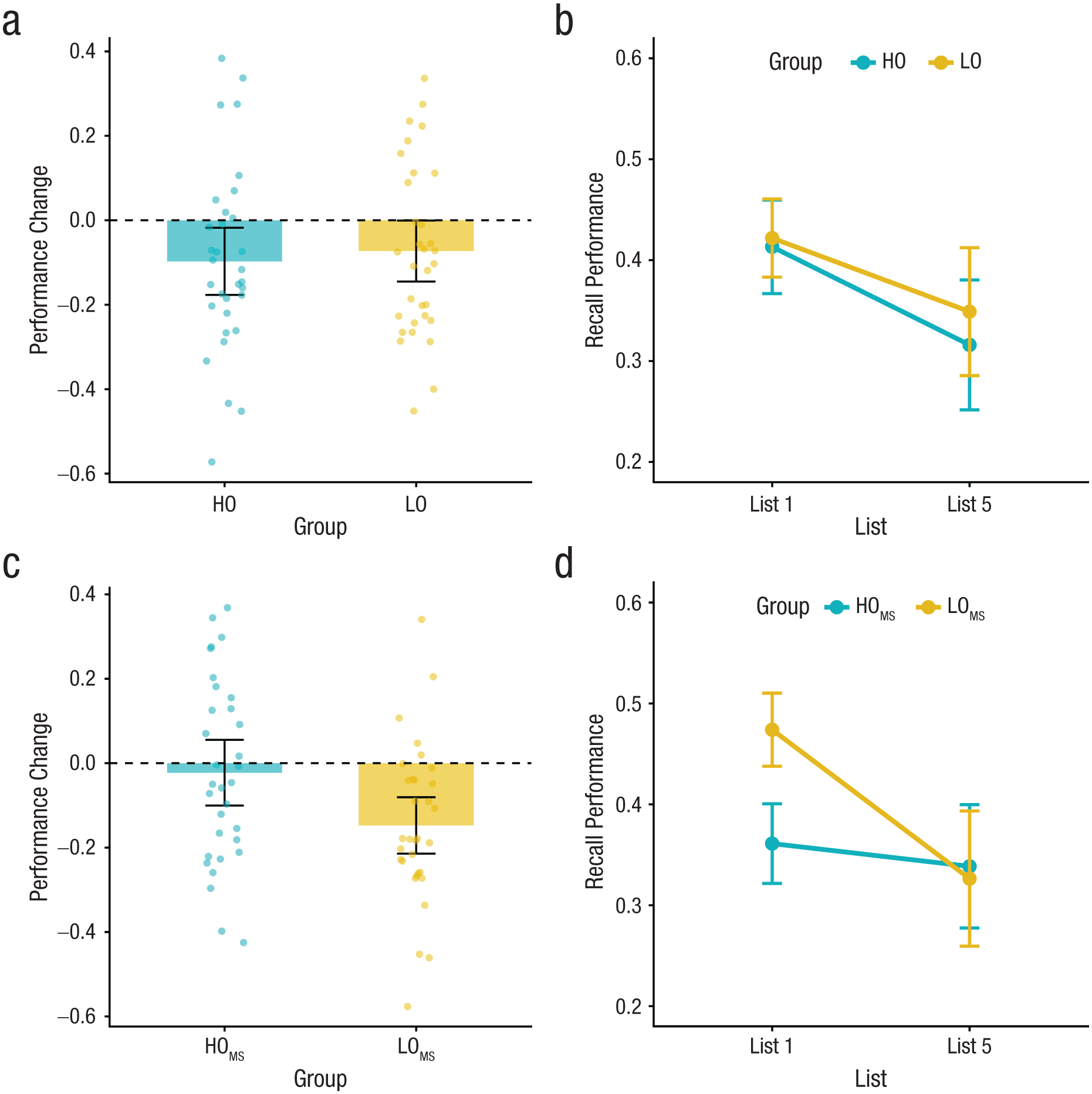
Results of Study 3. In (a), we show performance changes in the HO and LO groups; in (b), recall in Lists 1 and 5 in the HO and LO groups; in (c), performance changes in the HOMS and LOMS groups formed by median split; and in (d), recall in Lists 1 and 5 in the HOMS and LOMS groups. Error bars represent 95% confidence intervals. HOMS = high-overconfidence group (median-split method); LOMS = low-overconfidence group (median-split method).
Importantly, as shown in Figure 4b, there was no difference in List 1 recall between the HO and the LO groups, difference = −.01, 95% CI = [−.07, .05], t(62) = −0.28, p = .78, d = −0.07, BF10 = 0.26, reflecting no baseline difference in List 1 recall between the two groups, thus eliminating both participant-selection bias and RTM confounds. Furthermore, there was also no detectable difference in List 5 recall between the HO group and the LO group, difference = −.03, 95% CI = [−.13, .06], t(62) = −0.72, p = .48, d = −0.18, BF10 = 0.32. These results show that after eliminating participant-selection bias and RTM confounds by introducing an experimental manipulation of children’s overconfidence levels, there was no difference in performance changes between the HO and LO groups. These findings are also fully consistent with those from Model 3, again challenging the adaptive-benefit hypothesis but supporting the methodological-artifact hypothesis of Shin et al.’s (2007) findings.
Next, we reanalyzed the same data by utilizing Shin et al.’s (2007) median-split and difference-score analysis methods. Specifically, we used the median-split method to equally divide participants in each of the HO and LO groups into two groups (HOMS vs. LOMS) according to their List 1 overconfidence scores. Then we collapsed the data across the HO and LO groups to form an HOMS and an LOMS group to increase statistical power, with 32 participants in the HOMS group (including 16 from the HO group and 16 from the LO group who had high List 1 overconfidence scores) and 32 participants in the LOMS group (including 16 from the HO group and 16 from the LO group who had low List 1 overconfidence scores).
As shown in Figure 4c, the results successfully replicated Shin et al.’s (2007) findings. Specifically, as predicted by the methodological-artifact hypothesis, the HOMS group showed a less negative performance change than the LOMS group, difference = .13, 95% CI = [.02, .23], t(62) = 2.49, p = .02, d = 0.62, BF10 = 3.28. However, this difference in performance changes was clearly an artifact induced by participant-selection bias and RTM (Fig. 4d). Specifically, List 1 recall was substantially higher in the LOMS than in the HOMS group, difference = .11, 95% CI = [.06, .17], t(62) = 4.13, p < .001, d = 1.03, BF10 = 203.76, reflecting a severe participant-selection bias. By contrast, there was no detectable difference in List 5 recall between the two groups, difference = .01, 95% CI = [−.08, .10], t(62) = 0.26, p = .79, d = 0.07, BF10 = 0.26. These results are fully consistent with those shown by Model 1 (Figs. 3a and 3b). See the Supplemental Material for further results from each of the HO and LO groups.
Overall, Study 3 again successfully replicated Shin et al.’s (2007) findings when we used their statistical approach (i.e., median-split and difference-score analyses). However, the less negative performance change in the HOMS than in the LOMS group was clearly a methodological artifact induced by participant-selection bias and RTM. When we experimentally manipulated children’s overconfidence levels to avoid these methodological confounds, there was no difference in performance changes between the HO and LO groups. One potential concern is that our manipulation primarily targeted children’s momentary (state) confidence, leaving open the possibility that trait confidence might still predict performance change. However, additional exploratory analyses provided no support for this possibility (see the Supplemental Material for details).
Further Exploratory Analyses
It should be acknowledged that our preregistered data-analysis methods in Studies 1 and 3 differed slightly from those of Shin et al. (2007). Specifically, we preregistered dividing children into HOMS and LOMS groups according to their List 1 overconfidence scores (rather than overconfidence scores in the first two lists) and taking the difference in recall between List 1 and List 5 (rather than the difference in recall between the first two and the last two lists) as a measure of performance change. The Supplemental Material provides a detailed explanation of why we preregistered to adopt the current analysis plan in Studies 1 and 3.
To address potential concerns about the discrepancy in data-analysis methods, we conducted the following exploratory (nonpreregistered) analyses. First, we combined data from 231 children across Study 1, Study 3, and a supplemental experiment to enhance statistical power (see the Supplemental Material for details of the supplemental experiment). Then, following the exact analytic approach of Shin et al. (2007), we used the median-split method within each study to categorize children into HOMS and LOMS groups based on their average overconfidence scores in the first two lists. Performance change was computed as the difference in average recall between the first two and the last two lists.
As shown in Figure 5a, the results again reproduced the original findings of Shin et al. (2007): The HOMS group showed a less negative performance change from the first two to the last two lists than the LOMS group, difference = .04, 95% CI = [.01, .07], t(229) = 2.64, p = .009, d = 0.35, BF10 = 3.74. However, closer examination revealed once again that this apparent advantage is a methodological artifact. Specifically, mean recall in the first two lists was substantially higher in the LOMS than in the HOMS group, difference = .07, 95% CI = [.03, .10], t(229) = 3.61, p < .001, d = 0.48, BF10 = 60.16 (Fig. 5b), indicating a severe participant-selection bias. By contrast, as a clear signature of RTM, there was no detectable group difference in recall in the last two lists, difference = −.03, 95% CI = [−.06, .01], t(229) = −1.43, p = .16, d = −0.19, BF10 = 0.38. These findings mirror the simulation results from Model 1 (Figs. 3a and 3b), demonstrating that even when adopting the same analytic approach as Shin et al. (2007), participant-selection bias and RTM are sufficient to explain the observed pattern. No genuine adaptive benefits of overconfidence are required.
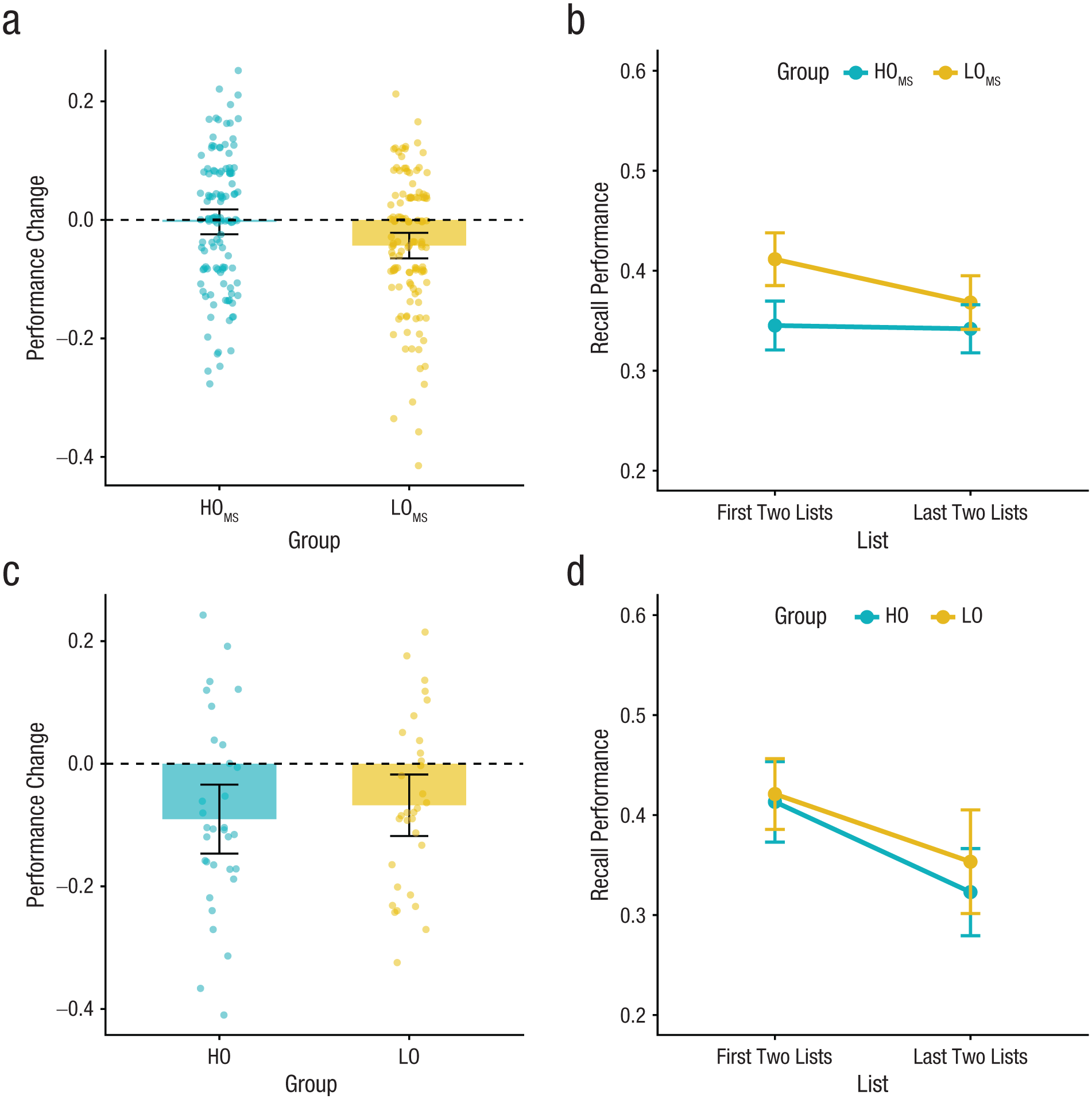
Results of further exploratory analyses. In (a), we show performance changes from the first two to the last two lists in the HOMS and LOMS groups in the combined analyses described in the text; in (b), we show recall in the first two and the last two lists in the HOMS and LOMS groups; in (c), we show performance changes from the first two to the last two lists in the HO and LO groups in Study 3; and in (d), we show recall in the first two and the last two lists in the HO and LO groups. Error bars represent 95% confidence intervals. HOMS = high-overconfidence group (median-split method); LOMS = low-overconfidence group (median-split method).
We further reanalyzed the data from Study 3, computing performance changes from the first two to the last two lists for each of the experimentally assigned HO and LO groups. The results provided clear Bayesian evidence for the absence of a group difference in performance changes, difference = −.02, 95% CI = [−.10, .05], t(62) = −0.61, p = .54, d = −0.15, BF10 = 0.30 (Fig. 5c), again contradicting the adaptive-benefit hypothesis. As illustrated in Figure 5d, the null group difference arose because the experimental manipulation successfully eliminated participant-selection bias and RTM confounds.
In summary, when the identical analytic approach of Shin et al. (2007) was applied, we successfully reproduced their nominal adaptive-benefit pattern. However, this pattern was entirely attributable to methodological artifacts. Once participant-selection bias and RTM were eliminated through experimental manipulation, the apparent adaptive benefits completely disappeared, providing further evidence against the adaptive-benefit hypothesis.
General Discussion
The present research investigated an important question regarding whether childhood overconfidence serves an adaptive function in facilitating children’s learning. Through a combination of preregistered replication, computational simulation, and experimental manipulation, our findings consistently challenge Shin et al.’s (2007) conclusion that overconfidence confers such a benefit. Instead, our results demonstrate that the apparent positive relationship between overconfidence levels and performance changes can be fully explained by methodological artifacts arising from participant-selection bias and RTM. Moreover, once these artifacts are eliminated and overconfidence is manipulated experimentally, no adaptive benefit is observed. These findings have important implications for our understanding of metacognitive development, research methodology in developmental psychology, and educational practices aimed at fostering children’s learning and positive illusions.
Study 1 successfully replicated Shin et al.’s (2007) original findings. At first glance, this successful replication appears to support the adaptive-benefit hypothesis. However, closer inspection revealed critical methodological problems. Most notably, we found substantial baseline differences in initial recall between the HOMS and LOMS groups, reflecting a severe participant-selection bias. Furthermore, the performance-change trajectories in both groups exhibited clear signs of RTM, with children in the HOMS group showing smaller declines than those in the LOMS group (Shanks, 2017; Yu & Chen, 2015).
The model simulations (Study 2) provided compelling evidence that the same pattern documented by Shin et al. (2007) and replicated in our Study 1 can emerge purely from methodological artifacts. Specifically, Model 1 demonstrated that even when overconfidence has no causal influence on learning, applying the median-split and difference-score analyses used by Shin et al. is sufficient to produce an apparent adaptive benefit, fully driven by participant-selection bias and RTM. Model 2 further revealed an even more consequential insight: when a genuine adaptive effect is introduced, the same analytic approach yields a pattern almost indistinguishable from the artifact-only case. This finding shows that median-split analyses with difference scores not only manufacture artificial effects but also obscure real ones, making them fundamentally incapable of adjudicating between competing theoretical accounts. Models 3 and 4 then demonstrated how causal experimental manipulation eliminates these confounds, thereby providing a valid causal test of whether childhood overconfidence truly confers any adaptive benefits.
Together, these simulations revealed the fundamental problem with using median splits of difference scores to test the adaptive-benefit hypothesis: Because overconfidence scores are inherently confounded with initial performance (Nelson, 1984), any analysis that groups children on the basis of these scores inevitably introduces participant-selection bias that interacts with RTM to produce spurious group differences. The simulations demonstrated how these methodological artifacts can generate the illusion of a positive effect of overconfidence on children’s learning even when no such effect exists in reality, and, conversely, how they can distort or conceal true adaptive effects when they do exist. Collectively, the four models clarify not only why prior correlational findings are misleading but also how future developmental research can avoid these pitfalls through principled causal designs.
Study 3 addressed these methodological issues by strategically manipulating children’s overconfidence levels in a randomized controlled experiment (Tennant et al., 2021). Through a carefully designed deception procedure, we successfully created two groups of children who differed systematically in their degree of overconfidence while maintaining equivalent baseline recall performance. This experimental manipulation eliminated participant-selection bias and RTM confounds that plague the correlational design of Shin et al. (2007). The results were clear and straightforward: When these artifacts were removed, higher overconfidence did not produce any adaptive benefits to children’s learning. Notably, when we reanalyzed the same data using the statistical approaches employed by Shin et al., the spurious adaptive benefits reemerged, further demonstrating how easily such methodological pitfalls can generate misleading results.
These findings have important theoretical implications. Specifically, they challenge the widely accepted view that overconfidence serves an adaptive function in facilitating children’s learning (Bjorklund, 2020; Dunlosky & Metcalfe, 2008). Although it remains possible that overconfidence might confer adaptive benefits in other domains (e.g., subjective well-being and risk perception; see Taylor & Brown, 1988; Taylor et al., 2003; Weinstein, 1980; for counterevidence, see Harris & Hahn, 2011; Schimmack & Kim, 2020), our results provide no support for the idea that overestimating one’s memory ability produces superior learning gains in children.
The current research also carries important methodological implications for developmental research. Our findings demonstrate how commonly used analytic approaches in developmental psychology, particularly median splits of difference scores, can lead to misleading results (Maxwell & Delaney, 1993). These methods are especially problematic when the variables of interest are mathematically interdependent (as with initial overconfidence scores and subsequent performance changes) or when repeated measurements are involved, which inevitably creates RTM confounds when measurement tools are not perfectly reliable (Shanks, 2017). Researchers studying similar phenomena should consider more rigorous approaches, such as experimental manipulations, to avoid these methodological pitfalls (Tennant et al., 2021). The field may also benefit from greater use of computational simulations to verify whether the observed findings could emerge through methodological or statistical problems rather than psychological mechanisms (e.g., Hu et al., 2025). Our findings also highlight the critical importance of distinguishing between correlation and causation in developmental research (Noble et al., 2011; Ots, 2013), and encourage future research to employ experimental designs to better identify causal effects in developmental phenomena (Foster, 2010).
From an applied perspective, our findings carry important implications for educational practices. Interventions that seek to promote positive illusions in children (i.e., encouraging them to believe they are more capable than they actually are) may not yield the hypothesized learning benefits (Shin et al., 2007). Although maintaining positive self-views is undoubtedly important for children’s motivation (Sherman & Smith, 2002), our results suggest that artificially inflating children’s confidence in their memory or learning ability does not translate into improved performance. Therefore, educators should realize that although promoting optimism and self-efficacy is valuable, doing so by fostering illusory beliefs about one’s competence is unlikely to enhance learning performance.
Several limitations of the present research should be acknowledged. First, although our findings challenge the adaptive value of overconfidence in children’s learning, overconfidence could confer adaptive benefits in other cognitive domains, a question that awaits future research. Second, the present research examined relatively short-term learning outcomes, leaving open the question of whether childhood overconfidence interacts with learning over longer timescales. Future research could profitably explore this important question. However, it should be borne in mind that Robins and Beer’s (2001) longitudinal study revealed that college students with pronounced academic overconfidence showed no advantages in GPA trajectories across a five-year college period. Third, the present study focused on a belief-based manipulation of overconfidence, targeting children’s perceived ability. It remains possible that other forms of intervention, such as those emphasizing effort or growth (e.g., a growth mindset), may influence learning through distinct motivational mechanisms. Fourth, even if childhood overconfidence does not directly enhance learning performance, it might affect effort (e.g., persistence), which future research should measure directly. Moreover, these findings, which were derived primarily from Chinese children, should be generalized to other populations with caution.
In summary, the apparent adaptive benefits of overconfidence in children’s learning documented by Shin et al. (2007) are in fact methodological artifacts rather than a genuine psychological phenomenon. Through rigorous replication, computational modeling, and experimental manipulation, we demonstrated how methodological choices can create the illusion of such benefits, which disappear when proper experimental controls are implemented. These findings not only challenge the adaptive-benefit hypothesis about the functional value of childhood overconfidence but also highlight the importance of methodological rigor in developmental research. As the field moves forward, researchers should be cautious about interpreting correlational patterns as evidence of adaptation and should employ methods that can more definitively establish causal effects.
Supplemental Material
sj-docx-1-pss-10.1177_09567976261455283 – Supplemental material for Does Overconfidence Really Confer Adaptive Benefits to Children’s Learning?
Supplemental material, sj-docx-1-pss-10.1177_09567976261455283 for Does Overconfidence Really Confer Adaptive Benefits to Children’s Learning? by Mengqi Hu, Wenbo Zhao, Meiyuan Cao, David R. Shanks, Xiao Hu, Liang Luo and Chunliang Yang in Psychological Science
Footnotes
Transparency
Action Editor: Ulrike Hahn
Editor: Simine Vazire
Author Contributions

Notes
References
Supplementary Material
Please find the following supplemental material available below.
For Open Access articles published under a Creative Commons License, all supplemental material carries the same license as the article it is associated with.
For non-Open Access articles published, all supplemental material carries a non-exclusive license, and permission requests for re-use of supplemental material or any part of supplemental material shall be sent directly to the copyright owner as specified in the copyright notice associated with the article.
