







Abstract
The following article offers a comparative, contextualized analysis of two versions of Cauchemar Blanc: its initial iteration as a bande dessinée published in 1974 by Moebius and its cinematic adaptation in 1991 by Mathieu Kassovitz. By analyzing the aesthetic and discursive strategies used, the study demonstrates how the authors use visual media to expose the pervasiveness of racism in France. Though Kassovitz remains faithful to the original, his adaptation intensifies Moebius's critique of French attitudes toward immigration and the ethnic diversification of society through the addition of humor, which functions as a call for collective action and sociopolitical reform. A comparative analysis of the film and comic within their historical contexts reveals the aesthetic and political nuances of transitioning between mediums and highlights evolving discursive strategies used by Left-leaning artists between the mid-1970s and early 1990s, emphasizing the persistence of racism in France despite institutional efforts against it.
Introduction
Moebius is the penname of Jean Giraud (aka Gir), one of France's most influential, versatile, and prolific comic artists, best known for his hit historical series Blueberry (1963–1999), as well as science-fiction works including Le Garage Hermétique (1976–1979) and Arzach (1975). In the early seventies, he traveled to the United States, where he briefly worked on the Marvel comic book Silver Surfer with Stan Lee. The main motivation behind his decision to travel to the United States, however, was to collaborate with Alejandro Jodorowsky on a cinematic adaptation of Frank Herbert's novel Dune. 1 He also worked on costume and set design for films such as The Fifth Element (Besson, 2007) and Disney's Tron (Lisberger, 1979). While his commercial successes and science-fiction works are well-known and studied, Cauchemar Blanc, an early-career work that deals with racist violence, is typically mentioned only in passing by scholars.
The same can be said for Mathieu Kassovitz, who is best remembered for the massive critical and commercial success of his second feature film, La Haine (1995), which won the Best Director award at Cannes that year and made him an international celebrity. Despite directly foreshadowing La Haine's engagement with discrimination and social justice, Kassovitz's short-format adaptation of Cauchemar Blanc (1991) remains little-seen and underappreciated. Cauchemar Blanc was only the second film of his fledging career, closely following Fierrot le Pou (1991), which just like La Haine, his first feature film Métisse (1993), and many of his other works, deal with race, class, and violence. 2
Both versions of Cauchemar Blanc depict the outcome of a racist attack (ratonnade) targeting a male North-African worker returning home to a high-rise public housing project (HLM: Habitation à Loyer Modéré) by moped. The French racists initially fail to hit their target and instead crash their car, prompting an argument with the residents of the HLM, one of whom is a police officer, and infighting among the attackers themselves. The second half recounts the same incident, though in this version, they successfully run over their victim and proceed to beat the presumed immigrant, perhaps fatally, while the residents of the surrounding HLMs turn a blind eye.
Moebius's original comic from 1974 specifically recalls the many acts of racist violence against Maghrebi immigrants that took place in metropolitan France during the Algerian War (1955–1962) and responds to the French political and social climate of the mid-1970s marked by the end of the so-called Trente Glorieuses, rising xenophobia, the rebirth of the extreme right lead by Jean-Marie Le Pen's National front, and a series of new laws regulating immigration. This social and political landscape further fuels Kassovitz's adaptation which complicates and nuances this critique by using humor, media-specific techniques like off-screen sound and by adjusting what seem like small details in key scenes. Kassovitz's adaptation makes clear that despite the passage of 20 years, the stigmatization of minorities remains pervasive in the wake of an increasingly polemic Left-Right debate over immigration and French identity that unfolded during the 1980s. While Kassovitz remains largely faithful to the original in his 1991 adaptation, he responds to the change in the political landscape and the inconsistency of the French state's antiracist policies on the one hand, and discriminatory legislative and judicial actions on the other. While the original bande dessinée (BD) does specifically address racism against Maghrebi immigrants, as it remains by extension, and by intent, a broad denunciation of xenophobia. For his part, Kassovitz emphasizes that dimension by adding characters of different ethnicities. The clear implication for both the BD and the short film, is that French society has been lulled into complacency with regard to racism, which survives thanks to public apathy. While the racist's nightmare expresses his fear of society's judgement, reality shows that he holds the power. Moreover, Kassovitz shows that racism transcends class, age, and race by casting actors of different age ranges with different ethnic traits, different ways of dress and attitudes. Because of the failure of successive French governments to confront racism and the social and political crises that fueled it, France has devolved into a society where anyone can be racist, which means anyone can also be its victim. Rather than achieve their goal of a perfectly harmonious society, like the ideal Jean-Paul Goude had recently depicted in the 1989 bicentennial parade, French Republican values have further divided its people. Moebius and Kassovitz foreshadowed the watershed shift in French identity politics that would take place in the wake of the 2005 riots and the prominence of social media technology, which has led to an explosion of awareness of how deeply embedded post- or neo-colonial forms of discrimination are embedded in French society, and in which minorities now speak for themselves.
By juxtaposing an antiracist nightmare with a nightmarish reality in which racism reigns supreme, both Moebius and Kassovitz force the reader or viewer to confront their own social and ethical subjectivities. Both Moebius and Kassovitz's works are early iterations of what Rothberg would later call the “implicated subject” (2019), inviting readers to think critically about their own position with regard to racist violence in French society and acknowledge their own complicity. The interpretation of what constitutes the nightmare is predicated on the reader/viewer's own ideology though both creators push their audience toward a more active engagement in fighting racism.
In his discussion of state sanctioned commemorations of historical events Emile Chabal raises the question of the author's complicity. He writes: “Each one of these commemorations raised questions about which historical narrative of the war should be prioritized and who has the ‘right’ to speak on behalf of the war's victims.” (2015: 11). The question can certainly apply to Cauchemar Blanc; however, Moebius and Kassovitz do not speak on behalf of or in place of the minority subject who remains silent throughout. Instead, the authors focus their critique on the actions of the racists and the French community, adopting a perspective that clearly indicates to mainstream French consumers of BD and cinema how they can engage in an ethical form of antiracist activism.
Within the field of adaptation studies, comparing these two versions of Cauchemar Blanc in their respective historical contexts provides a basis for appreciating the aesthetics and the politics of adaptation from BD to cinema, as both authors articulate a critique of racist violence from a leftist perspective and highlight the perpetuation of colonial violence that can be traced back to decolonization, especially the national trauma of the Algerian War. The comparison illuminates the shifting discursive strategies that sociopolitically engaged artists on the Left employed to highlight the persistence of postcolonial racism in France between the mid-1970s and the early 1990s, despite the significant institutional investment in antiracism and public sensitization made by the French state and citizens’ associations during the interval.
Moebius's Cauchemar Blanc
Jean Giraud, who brought a remarkable trans-Atlantic, comparative perspective to his work, first engaged with the issue of racial discrimination via American history and the treatment of slaves and Native Americans during the 19th century in his Blueberry series published between the early 1960s and late 1990s.The series is a realistically drawn Western written by Jean-Michel Charlier that was first published in the magazine Pilote, but later evolved into a standalone series. Matthew Screech has pointed out that Moebius's social engagement, as well as his evolution away from traditional Franco-Belge BD conventions, can already be seen early in Blueberry, through the unconventional use of colors inspired by Jijé 3 and through the themes addressed in the series. The main character of the series is Michael Steven Donovan, alias Blueberry, a racist son of a plantation owner. After being framed for a murder, he is rescued by a runaway slave, Long Sam. The latter dies as a result of this rescue and the sacrifice inspires Donovan to join the Union Army against the Confederates in the Civil War, and later to defend the rights of Native Americans.
Giraud brought that same interest to bear on contemporary France in the mid-1970s in Cauchemar Blanc before reimmersing himself in American history to expose the genocide of the Native Americans. The most obvious defense of Native Americans’ rights in Blueberry comes in a 1999 album titled “Géronimo l’Apache” in which he critiques the Carlisle Indian Industrial School for forcibly assimilating Native Americans into white culture. In so doing, Giraud reprises the tone and content of a two-page short “Wounded Knee” that had appeared decades earlier in the magazine Tintin Spécial Western (1979), critiquing both the 1890 massacre of Lakota Sioux in South Dakota and the hostage crisis of 1973 involving the American Indian Movement. Later he published “Discours du Chef Seattle” in an art book titled Moebius: Made in L.A. (1994). In a 1978 interview with Numa Sadoul, Giraud explains he had read about the moving speech in a book. G: It awoke in me a very old indignation Sadoul: The same indignation was there in Cauchemar Blanc twenty years earlier, right? G: Exactly, that is absolutely it, the same emotion, the same revolt. And generally, that is what my political engagement boils down to. My opinions come to me in a passionate way during political upheaval, which pushes me irresistibly to express myself in a pamphlet. (Sadoul, 1993: 77–78)
The artist explains later in the same interview how happy he was with how Cauchemar Blanc turned out saying: “I made Cauchemar Blanc fifteen meters above the ground” (Sadoul, 1993: 78).
4
In a preface to La Citadelle Aveugle, a collection published in 1989, Giraud (alias Moebius)
5
explains his motivation behind Cauchemar Blanc and indicates it remained a touchstone throughout his career, saying it was the result of outrage. One morning while shaving I heard on the radio that a short film recounting racist incidents had been censored by the Ministry of Interior. I thought that was outrageous and immediately decided to create a story on the same theme to express my solidarity both with the victims of racism and with the censored young director (2014: 9)
This social critique expressed in Cauchemar Blanc came at a time during which France was facing political, economic, and social uncertainty. Exploring this social and political context helps to highlight Moebius’ motivation and later helps explain why Kassovitz chose to adapt this work in particular to express his and his contemporaries’ disgruntlement at the lack of positive change in French society. When Moebius originally created Cauchemar Blanc, the nation was not only shifting away from a clearly delineated division between Left and Right to a more complex structure; the intellectual field which in part informed the political spheres was also changing. Chabal details these shifts, explaining that until the 1960s, the world saw “France as the home of Sartrean engagement, radical politics and critical thinking” (2015: 12). With the collapse of the Marxist – or marxisant –consensus that dominated French intellectual life from the end of the Second World War until the 1970s, this image has been progressively dismantled. France no longer represents the possibility of revolutionary theory and practice that it did in the 1960s and, in the eyes of its harshest critics, its intellectual life has become little more than another neo-liberal validation of the status quo. (2015: 13)
Though Chabal nuances these comments, events such as the May 1968 student/worker movement and the rise of new extremist political parties, including the founding of the overtly racist, antiimmigrant Front National in 1972 by Jean-Marie Le Pen, created a new political landscape that would become increasingly polarized and volatile. Moebius hints at this brewing tension during the dream sequence that constitutes the first half of Cauchemar Blanc. After the attackers crash their car, the residents of the HLM come out to sign the accident report and to assess the situation. René, one of the assailants, pulls out an identity card implicitly claiming he is a police officer (Figure 1).
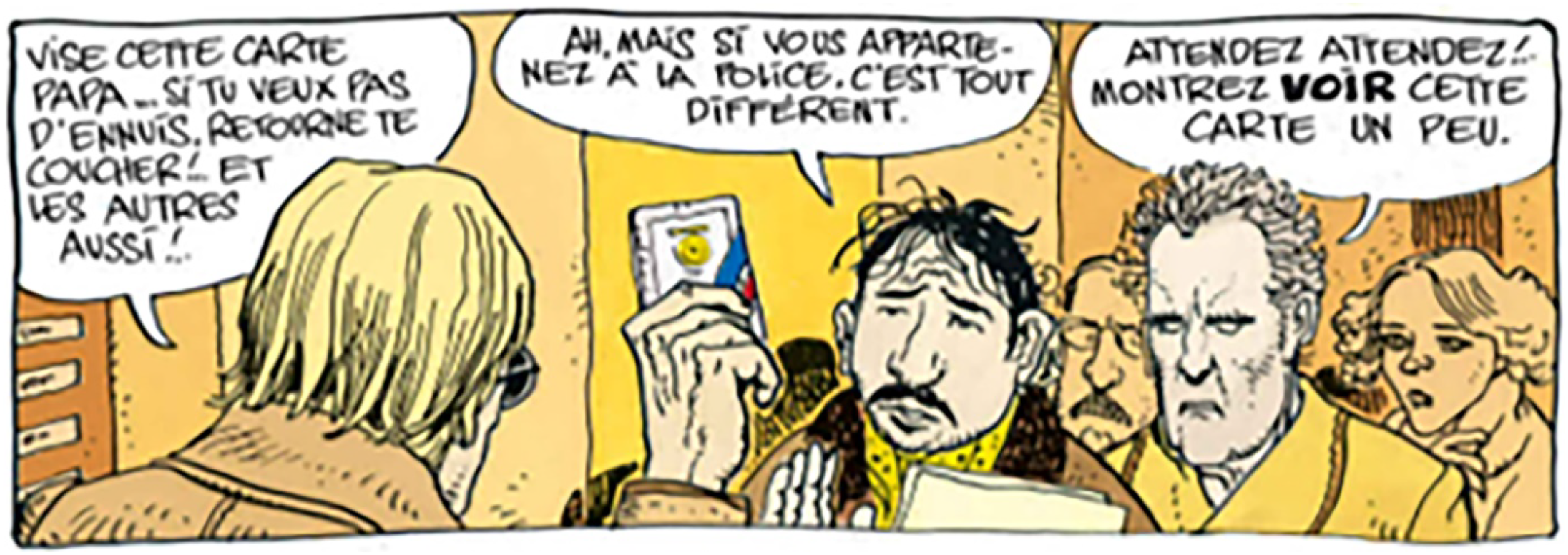
Reproduced with permission from Moebius, 2014, 46. Reproduced with permission from ©2024 Humanoids, Inc. Los Angeles.
However, one of the residents scrutinizes it and observes that it is not a police badge, but rather a member card for the Service d’Action Civique (S.A.C.) (Figure 2).
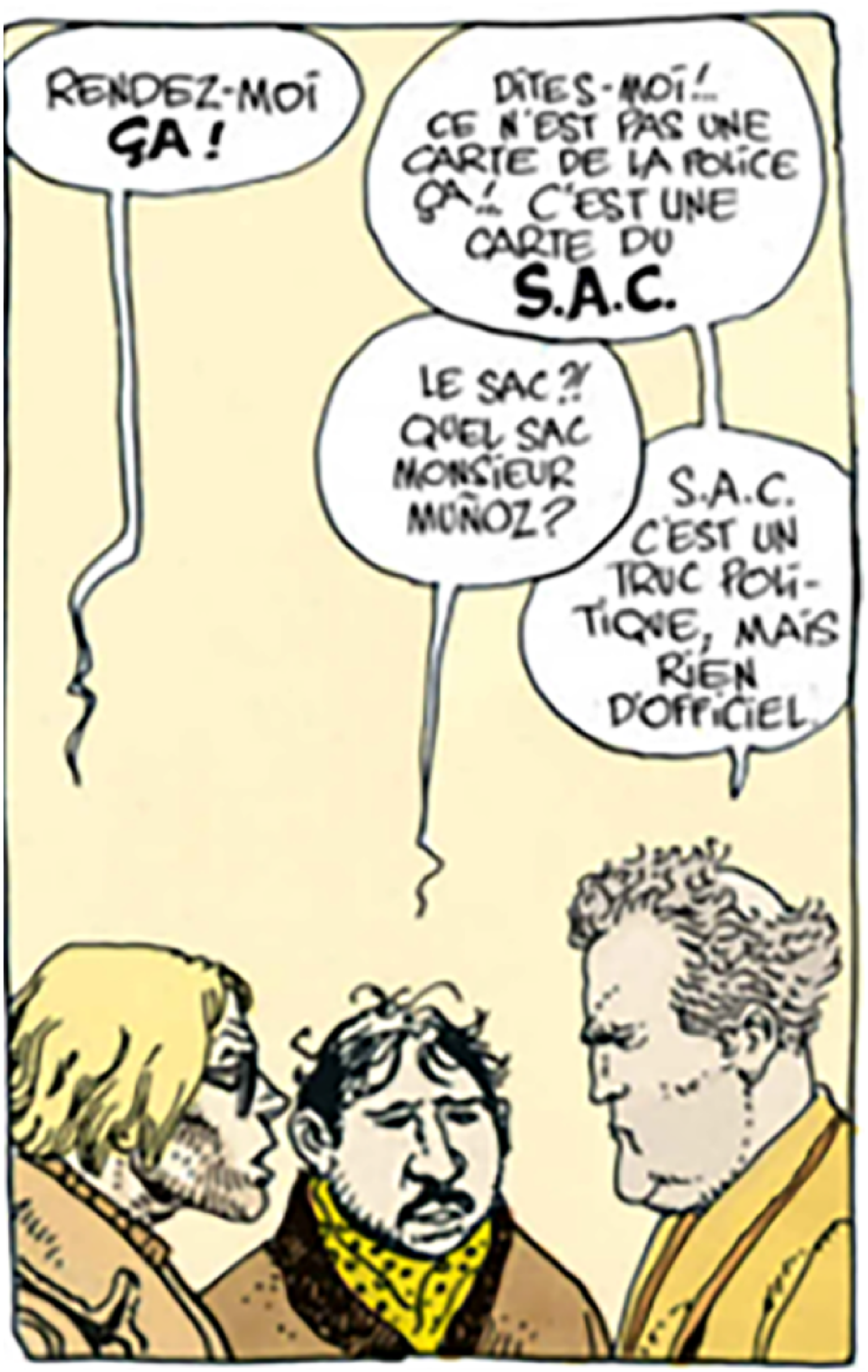
Reproduced with permission from Moebius, 2014, 46. Reproduced with permission from ©2024 Humanoids, Inc. Los Angeles.
The S.A.C. was a Gaullist militia founded in 1960 and disbanded by François Mitterrand in 1982. The militia, initially intended to enforce Gaullist policy toward Algeria by combating all those who opposed De Gaulle's paradoxical approach to negotiating Algerian independence while actively pursuing army and police operations against the Algerian nationalist Front de Libération Nationale, was problematic for multiple reasons. Its members were recruited in part from organized crime rings and, rather unexpectedly, given De Gaulle's credentials as a hero of the Second World War, included former collaborationists as well as former members of the Resistance. The link with the collaborationists is emphasized in the BD through the depiction of M. Barjout, the racists’ ringleader. Dressed in a knee-length trench coat with slicked back hair he resembles a Nazi SS (Schutzstaffel) officer, implicitly casting Gaullism as a variety of fascism.
From its creation in January 1960 and during the remainder of the Algerian War, the organization was frequently linked to beatings, kidnappings, murders, and massacres of both French Communists and Algerian militants. François Audigier, the author of several books on the role of the S.A.C. and its history, explains that the press often misrepresented the S.A.C., either attributing crimes incorrectly to members of the S.A.C. or exaggerating claims of violence. Audigier does nonetheless acknowledge the excessive use of violence by its members, particularly after De Gaulle's death, and even cites the 1982 murder of one of its members and his family (including a 7-year-old child) to prevent him from disclosing S.A.C. secrets (Audigier, 2003). In Cauchemar Blanc, René's gesture of waving his S.A.C card and attempt at abusing his presumed power suggests how the organization was perceived by the French general public. It is important to note that even though De Gaulle died in 1970, the organization continued to be active throughout the 1970s, evolving primarily into an anticommunist organization whose members did not shy away from violence and even murder. The aforementioned murder eventually led President Mitterrand to disband the organization in 1982.
Moebius stresses the negative public perception of the S.A.C: the resident who confronts René is the neighborhood police commissioner and thus the one who has actual legal authority. He keeps René's card and explains to one of the neighbors that the S.A.C. is a political group but nothing official (Moebius, 2014: 42), 6 again confirming that René and the S.A.C. have no legitimacy though his violence and his threats are real. To add insult to René's injury, the commissioner's name is Mr. Muñoz. While the other names in the comic are clearly Franco-French in origin (René, Jacques, Georges, Géraldine…), the Spanish surname indicates that the only legitimate representative of the state is from an immigrant background, thereby validating the place of immigrants in the French Republic. By giving a high-ranking police officer a Spanish surname, Moebius implicitly asks his reader to question why Maghrebi immigrants are viewed as so problematic to French identity. Spaniards had been emigrating to France since the 19th century, with a notable increase following World War I. Similar to the growing Maghrebi population at the end of the Algerian war, many of these Spanish immigrants worked as day laborers in agriculture or as unskilled laborers in industries like the steel and textile industry. Their growing numbers caused growing xenophobia from the French population at the time, though by the 1970s, as Moebius shows in his BD, Spaniards were considered fully integrated and accepted into the French society. 7 In short, Moebius shows immigrants (like Mr. Muñoz) can fully integrate and more importantly become valuable members of French society, forcing the reader to question their own position in regard to all immigrants and the illogical and hypocritical stance of accepting one but not the other.
While Moebius clearly identifies race as a key component of discrimination, he does not reduce the issue to race or ethnicity, instead complicating matters with reference to class as well. The racists start the story with what seems to be racial profiling (known in French at the time as la chasse au faciès), a practice commonly used by the French police during the Algerian War. Documented in great detail through testimonies collected and published by Paulette Péju (1961, 2011) and Jean-Luc Einaudi (2011), as well as by documentary filmmakers Jacques Panijel (1911) and Yasmina Adi (2011), the systematic harassment, beating, and killing of Algerians by French police and their harki auxiliaries culminated in the October 17, 1961, massacre of some 250 8 peaceful demonstrators, many of whose bodies were thrown in the Seine. Cauchemar Blanc insists on the perpetuation of this practice by showing the three so-called Français de souche (French people who do not have recent foreign ancestry 9 )on the side of the road, scoping out passers-by for an appropriate target. A man on a moped drives by and one of them exclaims: “It's one of them, I’m sure it's one of them!”(Moebius, 2014: 46). 10 The gleeful confirmation, which is based purely on sight, indicates that many of the victims of racist violence in France were (and still are) targeted due to their physical appearance.
Moreover, while the Maghrebi victim does hold a job (his attire suggests that he is returning home from a shift at a factory or construction site), the white Franco-French residents of the same HLM are not depicted as being much better off themselves, for they live in the same dire, prison-like government subsidized housing bloc shown on the comic's final page (Figure 3).
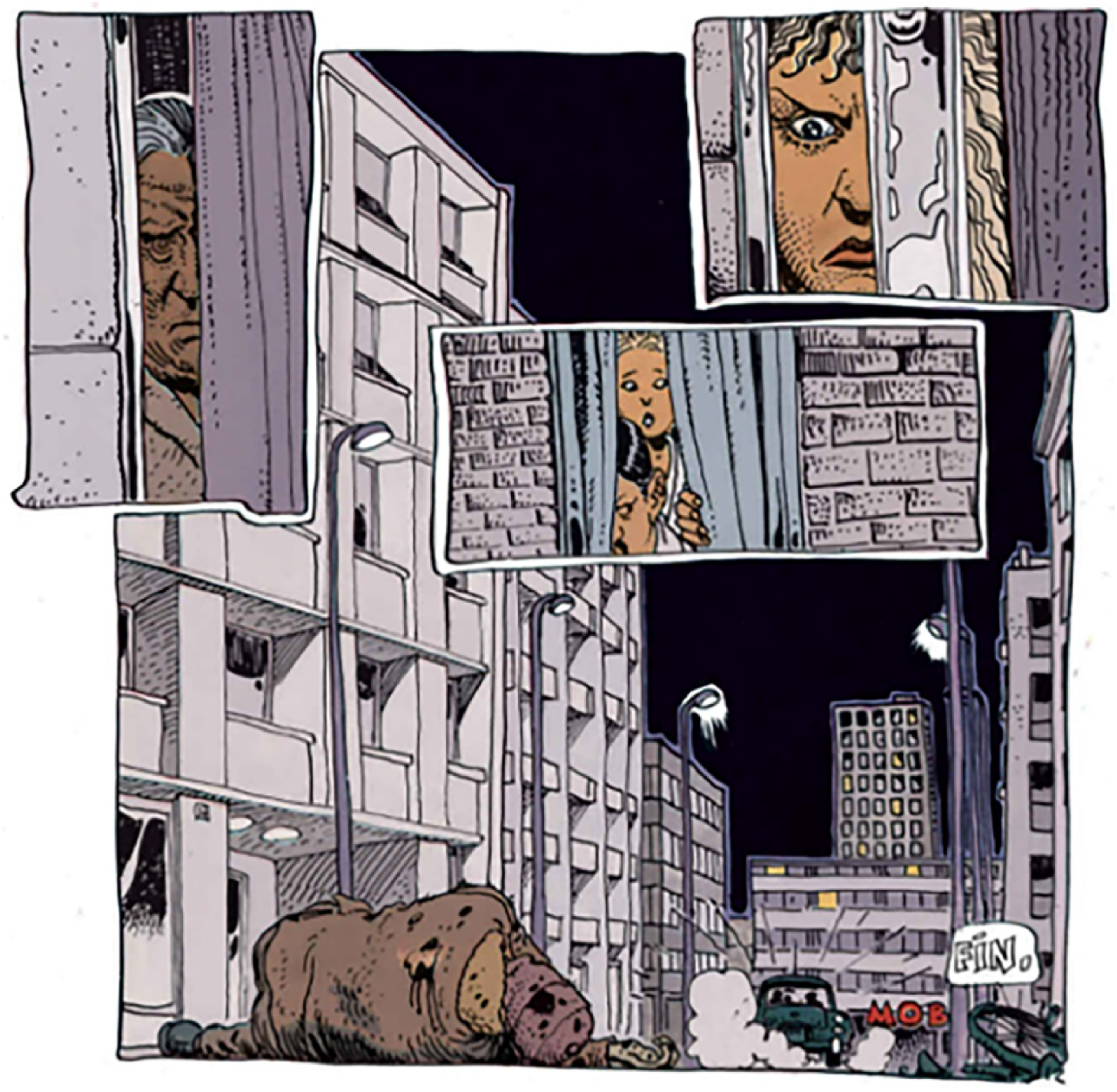
Reproduced with permission from Moebius, 2014, 52. Reproduced with permission from ©2024 Humanoids, Inc. Los Angeles.
First created in the early 1950s to combat the postwar housing crisis, these high-rise apartment blocks proliferated in the 1950s and 1960s to house immigrants from France's African colonies who came to France seeking jobs and upward social mobility in the context of the so-called Trente Glorieuses, the 30 years of steady economic growth following the Second World War. Though typically associated with immigrants, Moebius suggests, following a typically Marxist position common in the 1970s on the French political left, that HLM are synonymous with poverty and unemployment affecting all racial and ethnic groups, including France's white, native-born population.
By the early 1970s, the slowing of France's economic growth, combined with the presence of a larger-than-ever number of male immigrant workers, especially from the Maghreb, led to unease among the white French population, resulting in a series of violent attacks, particularly in 1973. This prompted the Algerian government to call for an end to emigration to France in 1974. For its part, France suspended labor immigration in 1974 but passed the Loi du regroupement familial 11 in 1976, allowing the children, wives, and even parents of legal immigrant workers already in France to join them and acquire permanent resident status. 12
When we read Moebius's work against this background, it becomes clear that the comic's title, illustrated by the first narrative sequence, Georges's dream, functions as a denunciation of racism and the assertion of reactionary white privilege. In the dream sequence, the Maghrebi immigrant triumphs, thanks in large part to the solidarity of his fellow HLM residents, while the white French man loses face and is punished by French society, which is depicted as a well-integrated mix of white and nonwhite minorities. Furthermore, George is depicted as a (petty) bourgeois, who, as we can see when he awakes, lives in a comfortable apartment in what appears to be a gentrified district of central Paris. This suggests, as mentioned earlier, that racism is at least to some degree based on a particular confluence of race, class, and the social privilege that those factors confer.
The fear expressed in racist attacks and the creation of the Front National, and the racists’ failure to bring France back to its supposed former (white) glory falls flat. Yet in the second narrative sequence, we discover that this was only a dream; we now no longer find ourselves in Georges's nightmare, but in France's reality, which remains a metaphorical nightmare from a Leftist point of view. Rejecting solidarity and active engagement in the struggle for social justice, the HLM residents no longer come out and no longer defend the Maghrebi worker. They hide behind their curtains (Figure 3) and watch the attack happen. The “real” nightmare is thus identified as the fearful complacency of multiethnic, working-class French society and its failure to collectively combat prejudice emanating from white, bourgeois culture.
The confusion, for the reader, as well as the sociopolitical shock value of the ending, comes from the fact that we are not sure where the nightmare ends (or starts) and where reality begins (or ends). Moebius makes both possibilities look real, thereby diverging from the graphic conventions of comics that deal with dream sequences, the most famous of these being Winsor McCay's Dream of the Rarebit Fiend (1904) and its spinoff Little Nemo in Slumberland (1905–1927). Though Moebius “clearly and explicitly cites McCay” (McKinney, 2020: 28), Cauchemar Blanc does not evoke the racist's dream by means of the two conventional comic strip devices: “thought-balloons with wavy, cloud borders attached to the dreamer's head by chains of bubbles; and exaggeratedly unrealistic décor” (Screech, 2005: 101). Addressing the same point, Mark McKinney adds that: In “Cauchemar Blanc,” Moebius borrows both the trivial realistic pretext of Dream of the Rarebit Fiend – eating Welsh rarebit before falling asleep causes a stomachache, which triggers a nightmare – and its fundamental structure of reality reversal: images temporarily suggest to readers that a dream world is the waking one. (2020: 28)
By avoiding conventional comic book devices, such as cloudlike borders around or cloudlike patterns in the background of each panel, Moebius thus gives both sequences a shocking sense of realism and “uninterrupted urban banality provides continuity between the racist's dream and the real world; his dream occurs in everyday reality” (Screech, 2005: 101). This makes reading Moebius's short disturbing and uncomfortable and forces the reader to question their own ideologies and actions. “The ‘dream’ is only a dream for the racist. For nonracist readers it becomes a nightmare” (Screech, 2005: 101). What makes it even more nightmarish for readers is the realization that it “shows a racist's violent irrational fantasies mingling with everyday life” (Screech, 2005: 101). In his analysis, McKinney pushes this further: while McCay's “final panel always brings one back to a reassuring reality,” the reality in Cauchemar Blanc is “even more nightmarish than the first half…for anyone with empathy for their victims” (2020: 28). Moebius does not bring his reader back to reality since his goal is not to reassure the reader, but rather to unsettle and perturb. Rather than accept the status quo, Moebius wants the reader to realize their complacency is as harmful as the attack itself.
Kassovitz's Cauchemar Blanc
Almost 20 years after the original publication of the comic, but only 2 years after its color republication in La Citadelle Aveugle (1989), a collection of Moebius shorts, Kassovitz adapted the story into a 10-min film, keeping the unsettling “continuity between the racist's dream and the real world” (Screech, 2005: 101). The adaptation of Cauchemar Blanc was only the second film of his career, following Fierrot le Pou (1990). Though the issue of race appears in this first short, the protagonist, played by Kassovitz himself, is an untalented basketball player who fantasizes about being a talented Black athlete. With Cauchemar Blanc Kassovitz engages more fully with the issue of racism and identity politics. The adaptation won him the Perspectives du Cinéma award at the 1991 Cannes Festival and was named Best Short Film at the Chicago International Film Festival that same year. For Kassovitz's future career as a filmmaker, as it was for Moebius, Cauchemar Blanc was pivotal, and its influence can be seen in his later feature-length films as race and identity politics would play an increasingly prominent role in the multiracial comedy Métisse (1993) and the international sensation La Haine (1995). Furthermore, Kassovitz shares Moebius's unique trans-Atlantic perspective as can be seen in the well-documented inspiration that Kassovitz drew from American cinema dealing with class-, race-, and ethnicity-based forms of inequality: Scorsese's 1970s films; Spike Lee's Do the Right Thing (1986), and John Singleton's Boyz in the Hood (1991). Like Moebuis, Kassovitz brings this trans-Atlantic perspective to bear on France, especially in La Haine. 13
While Cauchemar Blanc depicts a fictitious act of violence that echoes many real-world incidents, Kassovitz reacts directly to a shift in public discourse on racism and its place in French politics between the mid-70s and the early 90s. On the one hand, there was substantial institutional investment in antiracism, as can be seen in the 1983 Marche pour l’égalité et contre le racisme (known colloquially as “La Marche des Beurs”); the founding of SOS Racisme, France's first national antiracist association in 1984; the 1989 bicentennial celebration of the French Revolution celebrating national unity in diversity; and the passage of the Gayssot Law in 1990, formally prohibiting discrimination on the basis of race, ethnicity, nation origin, or religion. Yet such initiatives did not go uncontested and contrasted sharply with the steadily rising popularity of the Front National, growing Islamophobia, and anxiety over the enforcement of laïcité, as was made apparent in the 1989 affaire du foulard, the first incident in which Muslim girls were expelled from a public school for wearing head coverings. In contrast with the outcome of the affaire du Foulard, the state-sponsored bicentennial festivities were especially notable for their attempt to sublimate the old colonialist rhetoric of France's civilizing mission into a celebration of national unity through racial and ethnic diversity.
France in the 1980s and 1990s was marked by a “full-blown national identity crisis,” and this celebration was one of three events in which the government attempted to revive its republican ideals. The affaire du foulard is of particular interest here as it started in late 1989 but was also a symptom of France's political and social crisis as the Front National gained steady support over the course of the 1980s by successfully playing on the public's fears and insecurities. In the 1986 legislative elections the Front National won 9.8% of the votes and 35 seats in the National Assembly, by far its best score ever. Starting his 1988 presidential campaign shortly after this success, Le Pen won an unprecedented 14.4% of first-round votes. Furthermore, the Right's victory in the1986 legislative elections had initiated the first so-called executive “cohabitation” during which socialist President Mitterrand felt compelled to choose a center-right Prime Minister (Jacques Chirac) and to start making concessions to his conservative rivals. The aforementioned affaire du foulard is one example where the cohabitation proved problematic and arguably failed. Beyond being purely about the veil and an outward sign of religion prohibited by French law, this controversy was rooted in growing xenophobia, and more precisely Islamophobia. The ensuing debates and public reactions showed that, despite its apparent efforts, the state's endeavor to reignite French fraternité fell short.
It is in the midst of these debates, Kassovitz decided to make an adaptation of Cauchemar Blanc. Though he remains largely faithful to the comic, to the extent that it seems to have at times served as storyboarding for certain sequences in the film, Kassovitz changes significant details in response to the shifts in the social and political realities that had taken place since the publication of Moebius's original in 1974 and adds humor to heighten the critique on French society. In the comic, for example, the first panels show the victim coming toward the reader, riding his moped through a cité HLM (Figure 4).
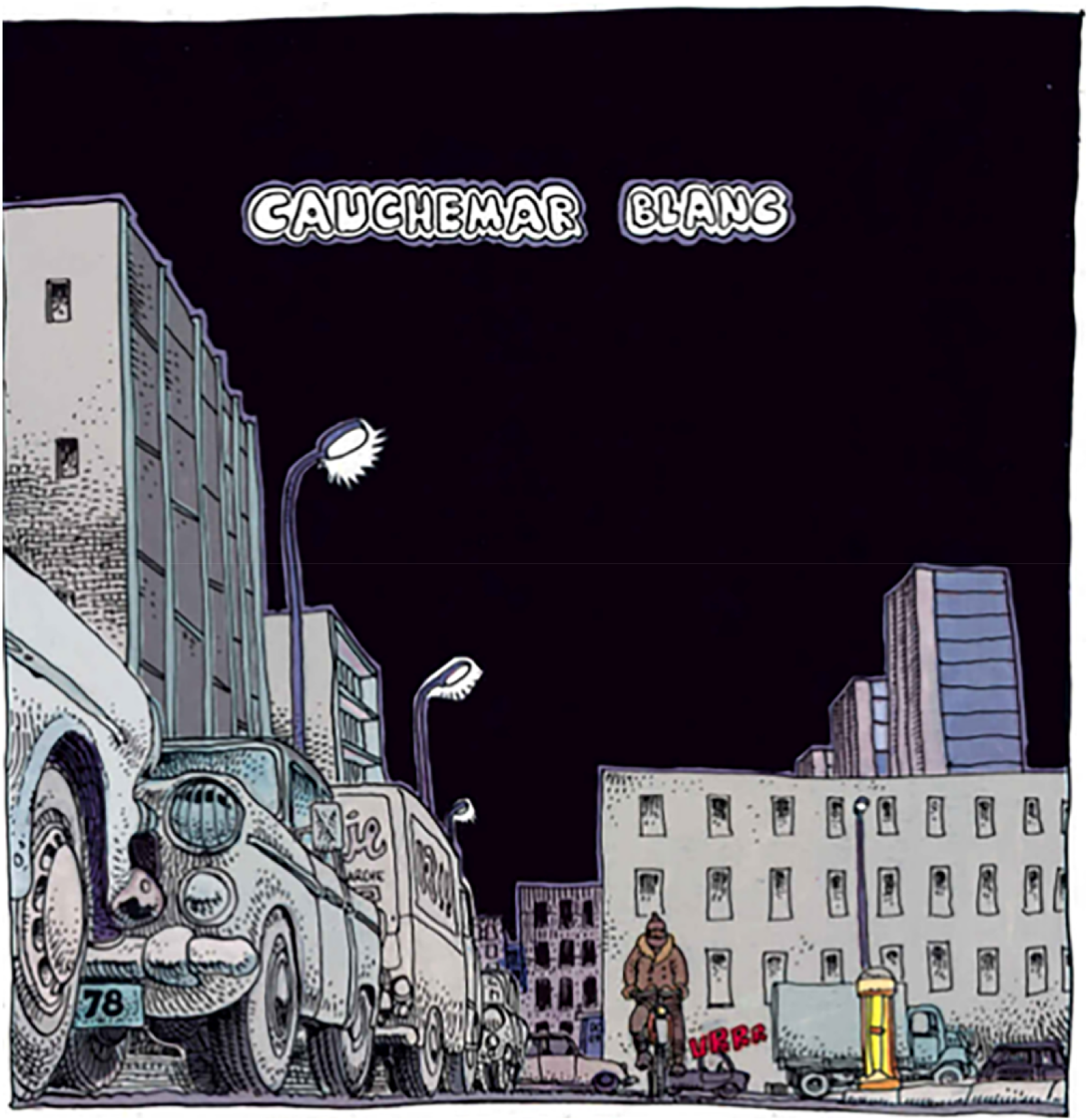
Reproduced with permission from Moebius, 2014, 41. Reproduced with permission from ©2024 Humanoids, Inc. Los Angeles.
Kassovitz, on the other hand, opens with a tilted shot of one of the “racists,” as they are identified in the credits. Whereas Moebius uses a minivan and delivery truck to indicate this is a working-class neighborhood, Kassovitz omits this detail and moves the focus from the class-based distinction to showing his viewer that the situation has shifted and is no longer as easily categorized. Moving from its initial focus on the night sky over the pompom atop a Paris-Saint-Germain 14 (PSG) knit hat, the camera pauses on the face of a young man. Unlike the equally clear distinction between Français de souche and immigrants in Mobius rendition, Kassovitz blurs this distinction by not making it as visually clear. Rather than showing us white men who engaged in racial profiling of minorities, Kassovitz makes identifying racism more difficult through his casting choices, the actors either look ethnically ambiguous or are in fact of Maghrebi heritage.
By blurring the lines and no longer making racism align clearly with class and ethnicity, Kassovitz depicts racism and racist violence as more pernicious and difficult to identify, and combat. While the camera rests on the man's face, he grunts, and soon it becomes obvious he is urinating and seems to be having trouble doing so, though he looks rather young. We then see him sneak up on his friends, who have fallen asleep in the car, eager to prank them. Right from the start, his juvenile actions, and his outfit mark him as a lower-class 20-something young man. In the car, however, the camera lingers on the driver (Georges Barjout) who appears to be of North African or Mediterranean descent. Indeed, two of the actors cast by Kassovitz to play the racists are of immigrant descent. Roger Souza, who plays Barjout, is the son of Portuguese parents, while Yvan Atal, who portrays René, has Jewish Algerian roots.
Kassovitz's choice of actors is a conscious and deliberate decision and responds to the changes in the historical context. In his later works, Kassovitz continues to use multiethnic trios: in La Haine the main characters are a Jewish (Vince), Maghrebi (Saïd), and Black (Hubert) trio who face and react to police brutalities; while in Métisse (1993) 15 the West Indian Métisse Lola is unsure who the father of her child is: a Jewish man, Félix, or a sub-Saharan African man, Jamal. Many scholars have elaborated on Kassovitz's use of multiethnic trios (most notably Ginette Vincendeau, Johann Sadock, and Sven Eric Rose) though few have linked this to his adaptation of Cauchemar Blanc. Johann Sadock writes about these trios in relation to La Haine and Métisse, stating that the real question at the time was not to know if these trios could overcome their and others’ prejudices but to see how Black, Jewish, and Arab communities could live together, and with the Franco-French population. 16 Sadock further states that in Métisse, through Félix, the Jewish character, Kassovitz allows himself to say that everyone can reject others while in La Haine, Vinz (also a Jewish character) shows us that anyone can be the victim of violence. 17 Sven Erik Rose confirms that “Kassovitz's film deftly exposes categories such as social authenticity, ethnicity, and masculinity as sites of self-doubt” (2007: 477).
Indeed, as early as in Cauchemar Blanc, Kassovitz extends Moebius's critique on the chasse aux faciès, and questions ethnic and masculine authenticity, through his choice of actors and sequences like the opening sequence described above. While Rose explores Kassovitz's “Jewish self-reflexivity” in La Haine, answering the question of whether “Kassovitz is ‘authentic enough’ to speak for the ethnic banlieue” (2007: 476), the same can be asked of his iteration of Cauchemar Blanc and arguably, all his films. In this context the adaptation of Cauchemar Blanc together with his first short film Fierrot le Pou gives us a preview of how Kassovitz addresses the question of ‘authenticity’ in his feature films, first in Métisse and later, and more in depth in La Haine. In Cauchemar Blanc, Kassovitz forces his audience to question what it means to be authentically masculine by, for example, showing a younger man with potential prostate problems, but also what it means to be authentically “French.” While French republican ideology strives to erase a citizen's religion, ethnicity, or gender, Kassovitz invites the viewer to rethink their own ideology, identity, and biases.
This opening sequence is also a first indication of Kassovitz's insertion of a particular type of humor, categorized by several scholars as “Jewish” humor, and confirmed by Kassovitz himself during an interview in which he stated: “I am not Jewish but I was brought up in a world of Jewish humor” (Riding, 12). Indeed, Freud's famous description of Jewish humor is readily apparent in Cauchemar Blanc: “A joke is a judgement which produces a comic contrast… By making the enemy small, inferior, despicable, or comic, we achieve in a roundabout way the enjoyment of overcoming him” (Feud, 1960: 10, 130). From the opening sequence onward, Kassovitz substitutes the Jewish community with the French population as a whole, and judges the racist “enemy.” To Freud's description, one could add making the “enemy” look incompetent, which Kassovitz does by emphasizing the young man's trouble urinating and childish behavior. While in the dream sequence Moebius shows an enemy who was incompetent, unable to execute the attack successfully, and then despicable in the waking sequences, Kassovitz amplifies both characterizations by making the racists comedic and ridiculous as well. By adding humor, Kassovitz's dream defeats, but only symbolically, racism. The ensuing juxtaposition with the grim reality reveals that as a society, French society refuses to acknowledge and combat racism, instead turning a blind eye.
As in the comic, when the racists spot the Maghrebi worker on the moped, the man in the PSG hat, J.P., exclaims that it is “one of them” making it obvious that this is still, to large degree an ironic case of racial profiling, ironic because of the perpetrators’ own physical traits. Whereas Moebius underscores this point through the follow-up assertion “Je suis sûr que c’en est un!” [I am certain it is one of them] Kassovitz omits this line and focuses instead on again ridiculing the racists as their car does not start, again questioning their credibility and competence. This further heightens the trio's insecurities and leads to a heated dispute between them and collective anxiety over the prospect of losing their target. Here Kassovitz inserts more humor absent from the original BD, amplifying and nuancing the critique. Barthon, who sits next to René in the back of the car, comically slaps J.P. on the back of the head. This slap further adds to the impression of the latter's juvenile character and initiating a skit reminiscent a Louis de Funès comedy, which later ends in J.P. being slapped several times both by Barthon and René. Louis de Funès, a French comedian who has remained very popular and well-loved even after his death in 1983, combines slapstick and situational humor and is similar to that of Jerry Lewis or The three Stooges. By referring to this type of universally understood humor, Kassovitz appeals to a broader audience and by extension may imply that while humor is known to be universal, racism and bigotry are universal as well. While Barthon and René seem to attempt to assert their dominance over the younger man, their exaggerated slaps push the comedy toward a satirical mockery of their attempts at displaying their dominance. By using this type of easy humor, Kassovitz calls on a large audience, regardless of class, ethnicity, or other identifying characteristics. Though humor requires a certain common knowledge and a shared interpretation of world views, such as racism and (displays of) masculinity, this type of humor is widely understood: though de Funès died in 1983, his comedies and others that followed the same sense of humor in France and elsewhere remain popular.
After Barthon slaps J.P., we move to the high-rise housing estate, with the camera reproducing almost identically, like a storyboard, the first panel of the comic (Figure 5), as well as a subsequent image as the camera tracks to show the car behind the man on the moped.
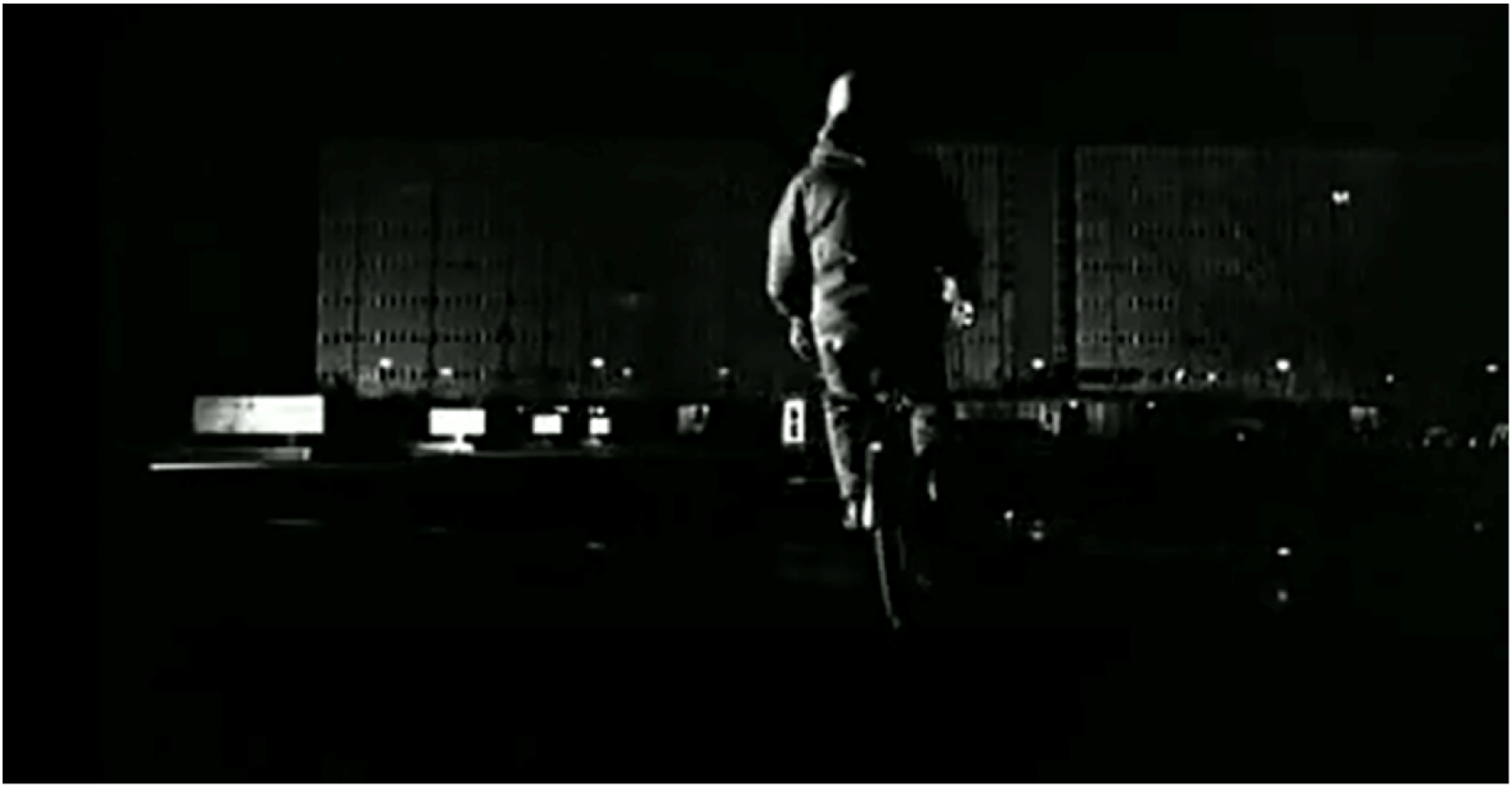
Reproduced with permission from Kassovitz, 1991, 02:07. Reproduced with permission from ©2024 Humanoids, Inc. Los Angeles.
In the comic, this image is followed by the car crashing into a truck but, Kassovitz again leverages humor to ridicule the racists. As they try to hit their victim, M. Barjout loses control of the car after a radiator leak causes steam to rise up from under the hood. After a shot in the car during which we see the scared men holding on and screaming in unison, the camera cuts to a closer view of one of the buildings during which we hear hyperamplified, cartoon-like sound effects of the off-screen crash. These sound effects accentuate the absurd incompetence of their attempted attack. Rather than crashing into a truck, as in the comic, the men have crashed into a telephone booth which is now, implausibly and in violation of basic physics, on top of the car. René, Barthon, and J.P stagger out of the wreck in exaggerated fashion, reminiscent again of slapstick comedy. They realize Barjout is unconscious and start fighting among themselves, leading to Barthon and René slapping J.P. In so doing, Kassovitz further depicts the racists as idiotic stooges. As Will Higbee states: “Kassovitz thus employs surreal comedy to transform the far-right vigilantes from menacingly powerful figures into objects of ridicule” (2006: 19)
When they approach their victim, intending to confront him, the man initially has most of his face covered, emphasizing the absurdity of the chase aux faciès. This further muddies the Manichean understanding of racism expressed in the original comic. As René moves to strike, while J.P. whines about having broken his new nunchucks in a laughable attempt at machismo, the residents of the building are heard off-camera asking what is going on and whether someone needs help. This stops René from hitting the (presumed) Maghrebi man, a close-up having previously shown the viewer he does have stereotypically North African facial traits, and he goes to the building intending to calm the residents down. J.P. and Barthon continue their ridiculous act, and while doing so it becomes clear that they are in fact idiotic cowards. They attempt to get in the Maghrebi man's face yet keep their distance as they cower. When J.P. insults the man calling him a “sale nègre,” Barthon questions the use of the epithet aloud by asking “pourquoi, ‘sale nègre’?” seeming confused, and indicating his belief in a nuanced racial / racist hierarchy that needs to be respected, including the distinction between sub-Saharans and North Africans. Kassovitz again asks his audience to interrogate their own biases: is racism a simple matter of “good” (white) versus “evil” (black) and if it is, where do they draw the line between black and white (i.e., good and evil)? Moebius already hinted at this through the choice of a Spanish name, while Kassovitz's casting further complicates the matter. Just as Moebius reacted to the historical context (the shift from racism toward the Spanish population to racism toward the Maghrebi population), Kassovitz reacts to and points out the increasing absurd forms racism has taken in France in the early 90s, as can be seen in the description above of issues like the affaire du foulard.
Leaving J.P. and Barthon, the camera cuts to the hallway in the building where we see René telling a concerned man wearing a Jewish yamaka to return home. As more residents join them in the hallway, René attempts to establish his authority by brandishing an ID card and claims he is a police officer. Thus, there is no need to call anyone, and they should all just go home. Kassovitz's omission of the S.A.C. reference is reflective of the changing historical context; the S.A.C. having been defunct for almost a full decade. Though he does again use the sequence to indicate a shift in French racist sentiments. René insults the resident who calls him out and tells him it is not a police identification card. Here again, Kassovitz responds to a changed context as the man in question is not of Spanish heritage, as in Moebius's original, but a Black man. René continues to insult him, calling him extremely racist slurs. As he is calling the man a “négro” and a “bougnoule,” 18 it slowly dawns on him that the Jewish resident addressed the Black man as “Monsieur le commissaire.” Here, Kassovitz reminds his viewer of the question he posed earlier, and rephrases Moebius's analogy of Spanish and Maghrebi immigration, adjusting it to the sociopolitical context of the 1990s pointing out that Islamophobia is again a different (still illogical) version of the same racism. René's slow reaction again reinforces the notion that the racists are dimwitted, which is particularly pronounced in this scene as René's erratic and showy behavior is juxtaposed with the calm and composed attitude of the police captain. At the same time, by showing the HLM residents as a diverse group of people, Kassovitz subtly indicates the paradoxical nature of the racism he critiques, showing his viewer it is no longer as simple as it may have been in the seventies.
When the camera returns to Barthon and J.P., the latter unintentionally knocks his fellow racist unconscious while ostentatiously swinging his nunchucks to intimidate the Maghrebi worker. In this particular scene, Kassovitz's repeated insertion of comedy takes on another dimension since the violent posturing (rubbing the baseball bat and swinging the nunchucks) does not faze the Maghrebi worker at all. He stands motionless and impassive the entire time. While J.P. attempts to wake Barthon, the camera pans to Barjout who awakens in the wrecked car to the recurring, shrill error tone emanating from the phone booth. Momentarily disoriented, he gets out of the car and finds René being held by the Black man. In an awkwardly distasteful attempt to help his friend, he threatens to shoot the captain in the head, but René tries to stop him. Rather than getting shot in the leg, as was the case in the BD, René is shot in the stomach. As Barjout backs up exclaiming he did nothing, again emphasizing his cowardice, the residents advance toward him together, forming a zombie-like mob that moves toward the camera, while moaning in unison.
This scene, particularly because Kassovitz chose to shoot in black and white, seems to be a reference to Night of the Living Dead (Romero, 1968), the first zombie movie to become a commercial hit. At the same time, because shooting in black and white was by 1991 unconventional, more than a nod to Night of the Living Dead, this choice was most likely motivated by a desire by Kassovitz to remain faithful to Moebius's original (originally drawn and published in black and white) and to pay homage to the latter. The dream sequence ends with Barjout backing into the Maghrebi worker who tells him to stick his hands up, shifting the power dynamic between the immigrant and the racists.
The narrative pace here coincides roughly with that of the comic. Moebius ends the oneiric sequence on page eight of twelve, in other words, the dream sequence accounts for two thirds of the comic. In Kassovitz's film, which lasts a total of 10 min and 4 s, the dream sequence ends at 7 min and 15 s, taking up just over 70%of the total run time. The reality sequence starts exactly like the dream, with J.P. pranking them and Barthon slapping him on the back of the head. When the man on the moped drives by, Barjout hesitates, looking worried, but when he turns the car key, the motor starts immediately, indicating that reality will be different from what we had seen in the dream. The shift from dream to reality also, fittingly, indicates an intentionally devastating shift in tone and the end of Kassovitz's use of humor. As Freud writes with reference to German philosopher Kuno Fischer, “the joke's object is the concealed ugliness of the world of thought” (1960: 10) which for Freud is linked to the world of dreams. Freud adds that “a favorite definition of joking has long been the ability to find similarities between dissimilar things; that is, hidden similarities” (1960: 11) and that Fischer “defines joking as the ability to bind into a unity with surprising rapidity, several ideas which are in fact alien to one another” (1960: 11). Indeed, the stark contrast between the oneiric and realistic sequences at the end of Cauchemar Blanc removes all trace of humor, indicating the sad truth of how French society still fails to effectively judge and overcome racism.
We see the car approaching the victim, and again as we saw in the dream, the camera cuts to a close up of one of the buildings with a resident peering out the window. When they hit the man, however, we do not hear exaggerated sound effects, and rather than coming out to help, the one resident we do see walks away from the window and turns off the lights. Instead, we hear the all-too-realistic off-screen grunting and thumping mixed with muttered insults as the racists collectively beat the Maghrebi worker, followed by rapid footsteps of the assailants fleeing, then their car starting and speeding away. Here Kassovitz fully exploits the use of sound in the film: rather than exaggerated cartoon sounds we hear a real crash, as well as the realistic suffering of the victim at the end. This not only highlights the contrast between dream/nightmare, it makes the racist violence even more horrific.
The camera zooms out to show more windows in the building. The sad reality, however, is that they all remain dark and none of the residents come out to confront the racists. Less explicit than the comic in which we actually see the victim first being struck by the car, flung in the air, and then beaten, Kassovitz chooses not to show these events, relying on his medium and the use of off-screen sound to convey his message. Nor does he show the multiple residents whom we see peering through their windows in the comic. However, both versions do end with a shot of the victim lying immobile and unconscious, perhaps even lifeless, on the ground. By choosing not to show the crash and the beating, and only providing the viewer the off-screen sound of thumps, grunts, and moans, Kassovitz places the spectator in the same position as the residents, who hear what is happening and will likely see the aftermath but refuse to see the attack itself. In doing so, Kassovitz exploits his medium to go beyond Moebius in order to challenge his audience's complacency and incite them to be proactive in the collective struggle to end racism.
Conclusion
As Moebius depicted it in 1974, the residents witnessing the murderous attack were too scared to act. In Kassovitz's version, the residents no longer even care to see what is going on, knowing they will not intervene. Kassovitz adds humor in order to call out the French public and ask them to witness these types of attacks. In a 2020 interview marking the 25th anniversary of La Haine, he expresses the same point of view. As early as his adaptation of Cauchemar Blanc, Kassovitz wants his audience to see racism in France is not a matter of religion (or ethnicity) but rather a problem tied to ignorance. There is no real antisemitism in France…Yes, there is a blatantly racist hard core, but there are others who are not educated and struggle to see the difference between an orthodox Jew in the street and what they see of Israel on TV with machine guns and shooting. So of course it created a very strong, violent feeling, but it's not antisemitism as we would define it. It's just kids being stupid and not knowing. (Grant, 2020)
While both versions of Cauchemar Blanc depict a fictitious act of violence, real attacks against minoritized communities have not ceased but in recent years have begun to receive increasingly more attention in mass media and from political elites. Violence against the immigrant population and minorities in France continues, we can think, for example, of the death of Adama Traore in 2016, the rape of Théo Luhaka in 2017; the vicious attack on Michel Zecler in 2020 or the police pursuit of an Egyptian man that ended with him jumping in the Seine, also in 2020. The newspaper Libération describes a video of this incident posted on Facebook by a witness in which officers are heard insulting the man: “A bicot
19
like that doesn’t swim” one of them says when a suspect had been fished out of the Seine by the authorities. “Haha, it sinks. You should have attached a cannonball to his feet” another brigadier says. A few seconds later near the police van, the complaints and cries of the suspect mingled with the laughter of the officers are heard. (Delouche-Bertolasi, 2020).
20
The officers seem to directly and consciously refer to the infamous massacre of October 17, 1961 Though recent commemorations and presidential speeches address these events, the extreme violence never seems to fully be reflected in them. Furthermore, laws like the 2004 law which “ended” the affaire du foulard and banned Islamic veils in public venues are indicative of a still rising Islamophobia in France.
The recent speeches given by French president Emmanuel Macron acknowledge these violent acts were and still are reality for Algerian immigrants in France. On January 26, 2022, for example, Macron denounced the violence committed by the French in a massacre of white pied-noir protesters that took place on the rue d’Isly in Algiers in 1962. In 2012, former president Nicholas Sarkozy had given a similar address about the October 1961 massacrein Paris. Neither of these massacres, nor the apologies uttered by the presidents received much press coverage. What did, and still does receive widespread media attention, are the official “celebrations” and commemorations like Bicentennial Parade, in which the officially sanctioned state narrative is apparent.
Significantly, Kassovitz himself acknowledged this change in the 2020 interview cited above, nearly three decades after the release of Cauchemar Blanc. When the reporter asks him if he feels life is better in the banlieues now, referring to La Haine, Kassovitz states: It's the same as before, but the police brutality is much more documented. People are more aware and there are activist movements which didn’t exist 25 years ago. The names of the victims are known today, and people are fighting for them. And that's the difference. I made the movie to warn others about what was happening and the kids who were victims of it. (Grant, 2020)
However, as France's most recent legislative elections suggest, this awareness and increased documentation of violence against minorities has not prompted a decline in racism, xenophobia and general bigotry and prejudice. In the July 2024 elections the extreme-right Rassemblement National (RN, formerly Front National) won 24.6% of votes, gaining 142 of 577 seats in the National Assembly. While the president of the RN, Jean-Marie Le Pen's daughter Marine Le Pen, has successfully rebranded the party and softened its image since taking over from her father in 2011, performatively expelling some of its former members, the core ideology has not changed. The steady increase in the party's respectability and popularity is evidence that the growing tension Moebius and Kassovitz denounced and tried to fight continues to grow. Both versions of Cauchemar Blanc were and still are crucial in raising this awareness and serve as a call to action. As Freud stated, through the addition of humor, Kassovitz further exposed the “concealed ugliness.” The lighthearted comedic treatment of the dream sequence, where the joke ends in the racists being overtaken by the immigrant and his neighbors, renders the successful ratonnade at the end of the waking sequence all the more shocking and makes Cauchemar Blanc just as impactful today as when Moebius first created it in 1974.
