






Abstract
Background
The Subscales Vestibular Activities and Participation Measure Questionnaire (SVAP) measures limitations in activities and restrictions in participation in patients with vestibular conditions. This questionnaire has undergone a translation and cultural adaptation process from English to several languages.
Objectives
The objectives of the study were to translate and culturally adapt the SVAP from English to Puerto Rican Spanish and to administer the translated instrument to a sample of patients with vestibular disorders in Puerto Rico to determine its reliability.
Method
A quantitative methodological study was conducted to translate and culturally adapt the SVAP to a Spanish version following a 7-stage process, obtaining as a result a translated questionnaire into Spanish (SVAP-E). The psychometric evaluation was carried out through internal consistency, where 30 participants of both sexes, from 21 to 85 years old, with vestibular disorders were recruited.
Results
A Cronbach’s alpha coefficient of 0.90 was obtained for the SVAP-E. Subscale A analysis showed a Cronbach’s alpha coefficient of 0.81 and 0.84 for subscale B.
Conclusion
This study supports the Puerto Rican Spanish version of the SVAP as a questionnaire with excellent reliability that could be used to identify activity limitations and restrictions in participation of patients with vestibular conditions.
Introduction
Vestibular conditions are associated with various symptoms that directly affect people’s quality of life, as well as their ability to carry out daily activities and participate socially.1,2 Patients with vestibular conditions usually present various symptoms that include alterations in balance, dizziness, and vertigo, among others. 3 The presence of these symptoms directly impacts patients with vestibular conditions in their ability to perform their activities of daily living. About 40% of individuals affected by balance problems due to symptoms of vestibular vertigo experience disruptions in their daily activities. 4 Another factor that must be taken into consideration when caring for vestibular patients is their age. Symptoms related to vestibular conditions are much more common in older adults when compared to their younger counterparts. 4 This is important to note because it is estimated that the average age of the global population will continue to increase over the coming years. It is estimated that by 2030 one in six people globally will be at least 60 years old. 5
Vestibular disorders cause limitations in the daily lives of individuals and have physical, socioeconomic, and mental health effects.1,6 It is well known that physical therapy through vestibular rehabilitation can help reduce or alleviate the effects of these limitations.7,8 However, the literature is scarce when it comes to emphasizing the limitations in activities and the participation restrictions faced by these patients. 6 Additionally, there is currently no relevant literature that can be compared with the population of Puerto Rico, nor are there patient-reported outcome measures related to activity and participation for those with vestibular disorders available in Spanish.
Considering the set of symptoms that affect this population, it is of utmost importance that instruments be evaluated to assist in establishing better treatment plans so that an accurate prognosis of the condition can be made. 1 To measure how the symptoms of vestibular conditions affect the ability to perform activities and participate socially, there is an instrument created by Alghwiri et al. 1 known as the Vestibular Activities and Participation Measure (VAP). This instrument is based on the International Classification of Functioning, Disability and Health (ICF), specifically contemplating the effect on the ability to perform activities and/or participation tasks. 1 The VAP was subsequently modified into a shortened version known as the Subscales of the Vestibular Activities and Participation (SVAP) by Alghwiri et al. 2 This assessment tool was developed to evaluate the VAP’s dimensional structure and item performance to support the use of a single summary score, to determine whether the scale could be shortened without compromising measurement quality, and to assess the cross-cultural relevance and convergent validity of the abbreviated version. 2 To our understanding, the SVAP has not yet been translated into Spanish or culturally adapted for its use in Puerto Rico. As a fundamental component of patient assessment, it’s important to consider the accessibility of instruments and questionnaires that are translated into the individual’s language and culturally adapted for the population to which he or she belongs.2,9 This is important to keep in mind because cultural norms and expectations can influence the expression or description of the symptoms presented by a patient. 10 Not having an instrument available that aligns with the patients’ language and culture makes it difficult to achieve completely accurate results in terms of the effects of the various symptoms vestibular patients suffer and how this impacts their quality of life.
By creating a translation and cultural adaptation of the SVAP instrument into Puerto Rican Spanish, health professionals are given the possibility of measuring the limitations that patients experience due to their vestibular condition and the effect these symptoms have in their activities of daily living. This seeks to impart health professionals with patient information to establish an accurate treatment and an objective prognosis of the vestibular condition. As a result, there will be a decrease in the number of patients in the Puerto Rican population that suffer from vestibular conditions who are marginalized by the lack of access to an instrument that measures what they present in their condition and the effect it has on their lives. Therefore, the purpose of this study was to translate and culturally adapt the SVAP from English to Puerto Rican Spanish along with determining its reliability by measuring its internal consistency.
Method
Translation and cross-cultural adaptation
Before beginning the translation process, the author’s permission was obtained to translate and culturally adapt the SVAP instrument. To translate the SVAP instrument from English to Spanish, the guidelines established by Beaton et al. 11 and Wild et al. 12 were followed. The translation process consisted of the following steps. First, in the initial translation, two translations were created from English to Puerto Rican Spanish which were named T1 and T2, respectively. These translations were created separately by two translators whose primary language was Puerto Rican Spanish. One translator was a physical therapist, while the other was a professional translator with no medical background but prior experience in translation. Both provided written reports for their respective versions. Throughout the entire translation process, the investigative team also made sure that none of the translators had seen the original SVAP instrument before. In step two, a synthesis of both translations was made after both translators, and the research team could come to a consensus on the discrepancies between both translations. This synthesis was named T-12. In step three, two backwards translations were created from Spanish to English using T-12. These backward translations were named BT1 and BT2, respectively. These translations were created by two professional translators whose primary language was English. Both translators in this step had no medical background. Similar to step one, both translators also made a written report for each version. In step four, a review committee was created to discuss the translations and resolve any inconsistencies or discrepancies. This committee consisted of the research team and all the translators involved. A pre-final version of the SVAP was made in Spanish (SVAP-E) based on the discussion of the four reports by the research team and the translators.
In step five, this pre-final version was administered to 30 participants with vestibular impairments. After completing the questionnaire independently, each participant was asked by one of the researchers what they understood by each item. Depending on their response, the researcher determined if the participant understood the question correctly based on a prior consensus regarding the meaning of each item. All comments were written by the researcher on a suggestions box that was on the same document with the answers of each participant. Participants were also asked to provide written suggestions about the clarity of the questions. In step six, the feedback obtained from the participants was discussed by the research team. After reviewing the feedback, it was determined that none of the recommendations were directly associated with the translation of the instrument; therefore, it was decided that no additional changes were required. Figure 1 (SVAP-E Instrument) presents the instrument translated into Puerto Rican Spanish. Instrument SVAP-E.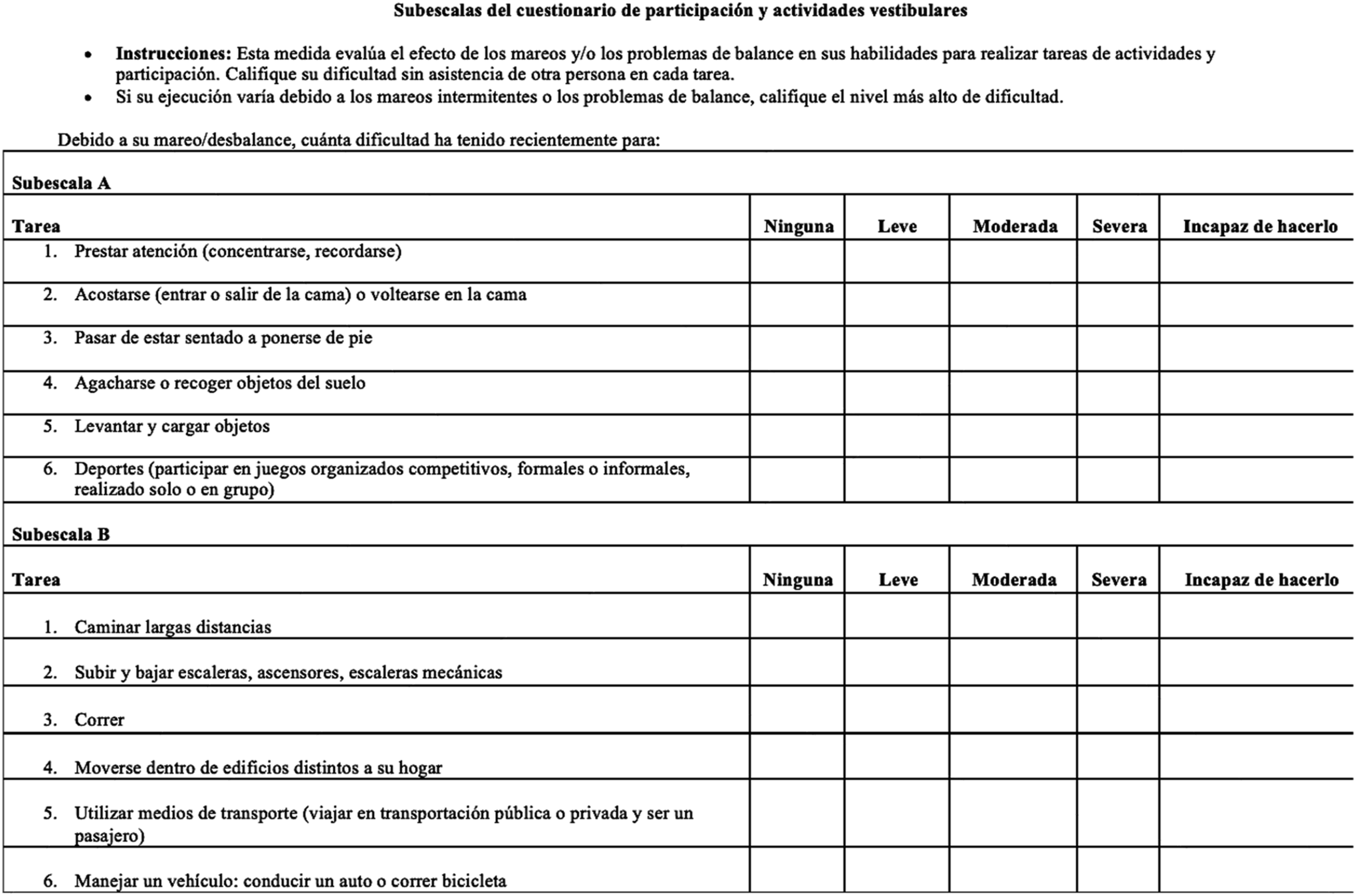
Psychometric properties of the SVAP-E
Participants
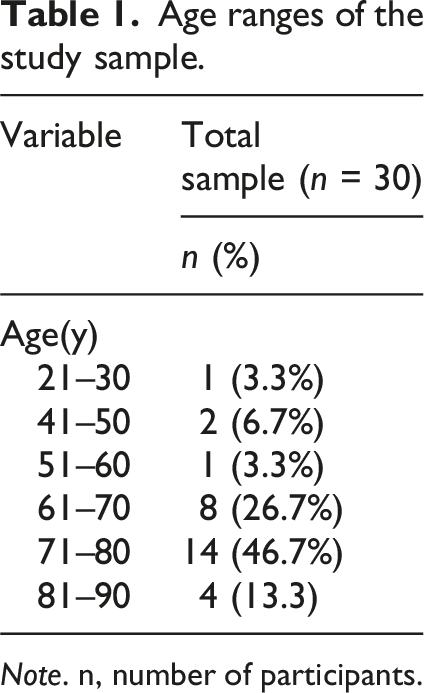
Following the recommendation laid out by Beaton et al. 11 a total of 30 participants of both sexes, from 21 to 85 years old with a vestibular disorder, were recruited. Recruitment was done through a non-probabilistic sample of convenience at two vestibular rehabilitation clinics in Puerto Rico. The inclusion criteria consisted of participants aged 21 to 85 years, having a medical diagnosis of a vestibular disorder, being active patients at one of the two vestibular rehabilitation centers, and having the ability to read and write in Spanish. For the exclusion criteria, any person who presented a neurodegenerative condition or cognitive impairments as measured by the Mini-Cog instrument 13 was excluded from the study.
Procedure
This study was approved by an institutional review board. The researchers began by obtaining informed consent from the participants and administering the Mini-Cog instrument 13 to determine if they were eligible to participate in the study. Those who met the inclusion criteria completed the Spanish-language SVAP-E through self-administration. Participants then provided feedback on the clarity of the translated items as well as suggestions on possible improvements. Based on the context provided by the participant, the researchers determined whether the participant understood the premise or not. Those who completed the process were given a $10 incentive for participating.
Statistical analysis
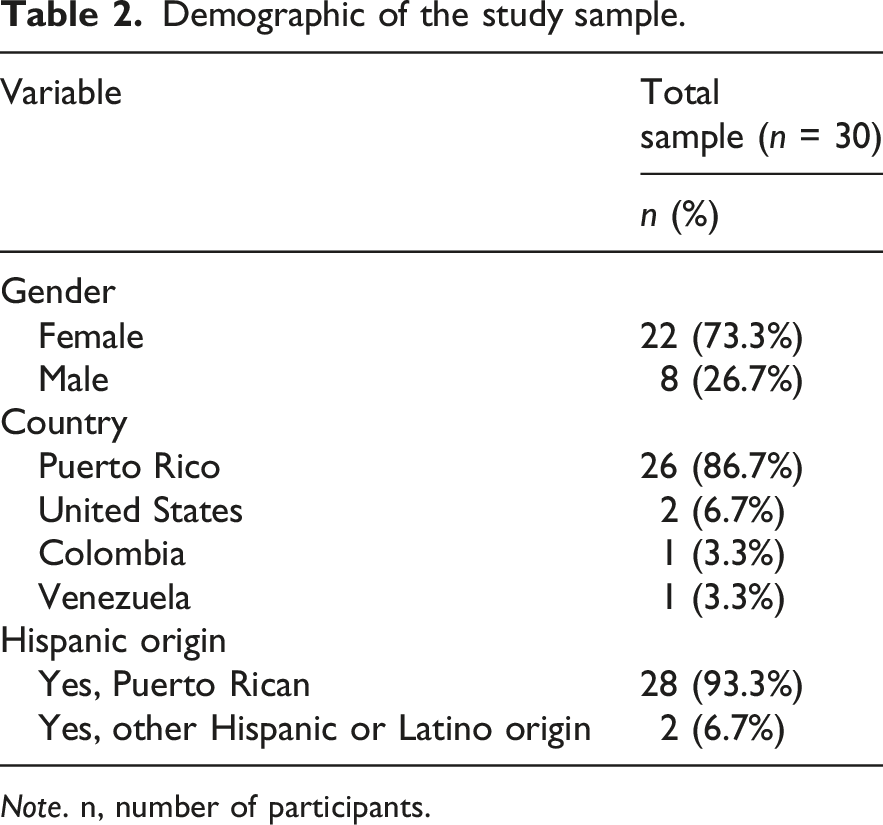
The data obtained from the SVAP-E questionnaire was analyzed using IBM SPSS Statistics (V29.0.1.1). A descriptive analysis of the study sample was performed, in which demographic variables of age, gender, ethnicity, and country of origin were considered. For the age variable, the mean and standard deviation were established, while for the variables of gender, ethnicity, and country of origin, frequency and percentage were calculated. The statistical analysis evaluated internal consistency using Cronbach’s alpha coefficient, which was considered acceptable as greater or equal to 0.70. 14 The correlation between each item and the total consistency of the instrument was considered to corroborate how pertinent each item was. To establish the relevance of each item, a cut-off criterion of 0.30 correlation between item and total was used; this criterion has been used in previous research.15,16 The median imputation method was used to counteract the phenomenon of completely random data failure or random failure in order to establish the inclusion of all cases in the analysis process. 17 Each missing value was replaced with the calculated median of each item. 18 This process was done to prevent missing data from causing an effect on the ability to make valid inferences, causing a reduction in study power, or causing research bias. 18
Results
Age ranges of the study sample.
Note. n, number of participants.
Demographic of the study sample.
Note. n, number of participants.
Internal consistency
A Cronbach’s alpha coefficient of 0.90 was obtained on the total scale of the SVAP-E and a Cronbach’s alpha coefficient of 0.81 for subscale A and of 0.84 for subscale B was obtained.
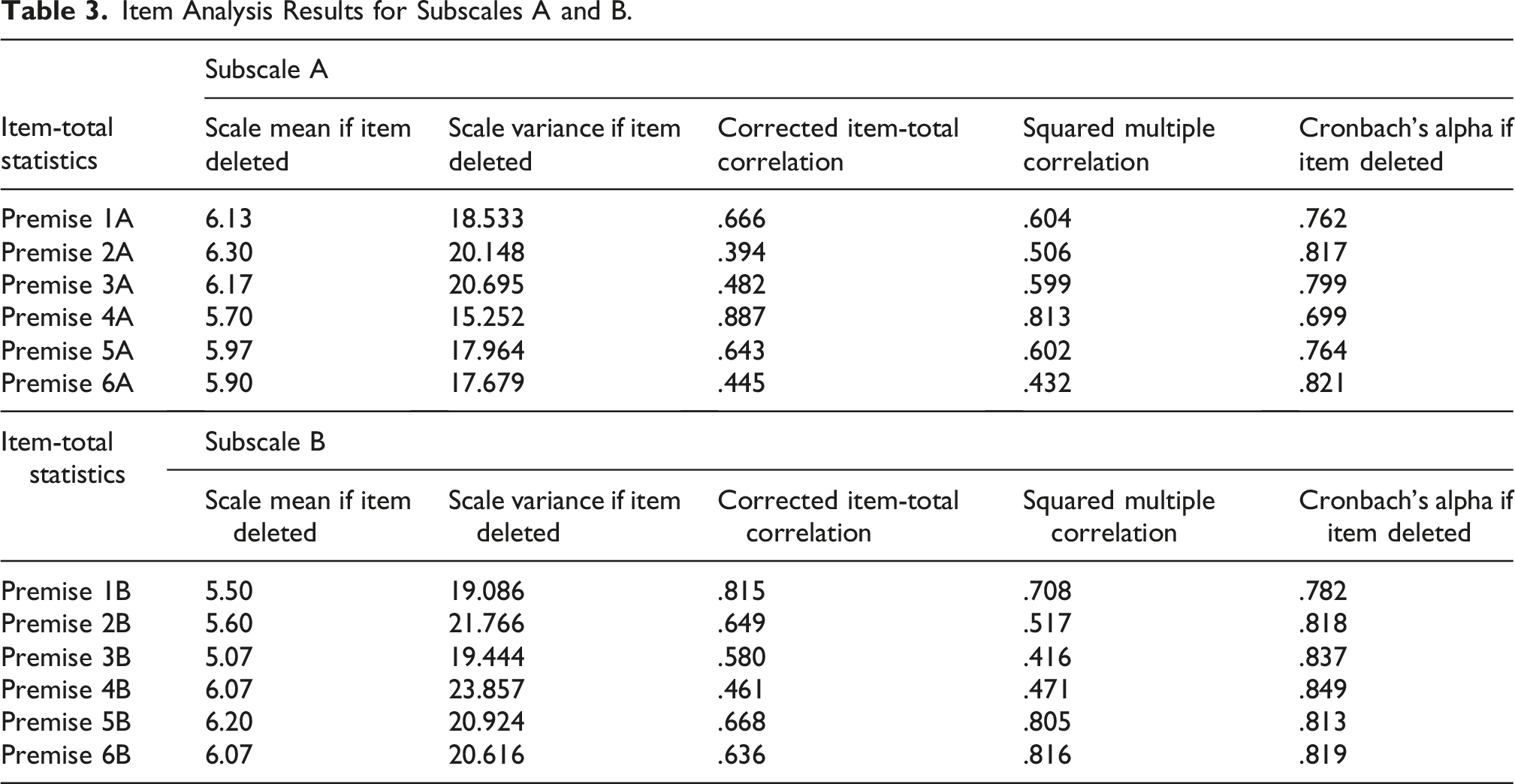
Item-to-total correlation
Item Analysis Results for Subscales A and B.
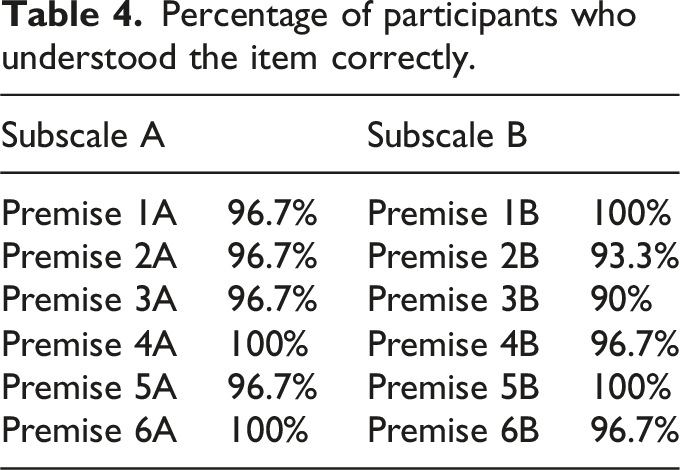
Percentage of participants who understood the item correctly.
Discussion
This study was carried out with the purpose of translating and culturally adapting the SVAP from English to Puerto Rican Spanish and to obtain the internal consistency of the translated instrument. The results obtained from this study demonstrated that the SVAP was successfully translated and culturally adapted for Puerto Rican Spanish. For the translation process, the Forward and Backward Translation method established by Beaton et al..11 and Wild et al. 12 was used. This procedure allowed us to create two versions of the original instrument translated into the target language. With the synthesis of both versions, an initial translation of the instrument was created. From this, a back-translation was made which helped to identify how different our translation was from the original. Thus, this method allows the instrument translated into the language of interest to be as similar as possible to the original instrument. Nonetheless, this process does not replace obtaining the validity of the translated instrument. 19
In this study, Cronbach’s alpha coefficient was used to assess internal consistency. This study demonstrated that the SVAP-E translation has excellent internal consistency with a Cronbach’s Alpha coefficient of 0.90 for the complete questionnaire. 14 These findings resemble the results of studies conducted by Wu et al. 20 and Rao et al. 21 In the study conducted by Wu et al., 20 the researchers translated and culturally adapted the SVAP instrument into Chinese. A similar methodology was used by Rao et al. 21 when they translated the Vestibular Disorders of Activities of Daily Living Scale (VADL) into the Kannada language. Both studies used the steps established by Beaton et al. 11 to carry out their translation. An excellent internal consistency was found for both instruments, with a value of 0.94. Additionally, in this study, each subscale was found to have good internal consistency, with a value of 0.81 in subscale A, and 0.84 in subscale B. 14 Similarly, the study conducted by Wu and colleagues 20 obtained a value of 0.89 in subscale A, and 0.91 in subscale B, also demonstrating good internal consistency per subscale in their translation of the SVAP instrument.
During the meetings between the translators and the research team, certain discrepancies were discussed related to specific words that resulted from the translation process. No significant changes were made that would alter the meaning of the original instrument. The changes suggested and accepted were for words that maintained the same meaning but that were culturally adapted to the Puerto Rican population. For example, in item 6b, “Operating a vehicle: driving a car or riding a bicycle,” the direct translation of the word “operating” was not used since it was agreed that the premise would not be clear enough. Therefore, it was changed to another word that would be better understood culturally.
While administering the questionnaire and throughout the interview process with the participants, it was found that there were items in which the participants suggested some modifications. However, these suggestions were not directly related to the translation but to their applicability. This issue was particularly evident in item 5a, “lifting and carrying objects,” and 1b, “walking long distances.” In the case of item 5a, the recommendations were directly related to the absence of specific details regarding the weight of the object mentioned on the item, whether it was light or heavy. In the case of item 1b, related to walking long distances, six participants gave recommendations based on the lack of clarification regarding specific time or distance measurements. These recommendations were considered as subjective suggestions towards the original instrument and not as suggestions directly related to the translation. Another common suggestion was to add a “Not applicable” option to the scale. Since most of the participants were older adults, they expressed that they did not know how to answer items related to sports activities. Examples can be found in items 6a, “Sports (participating in competitive, formal or informal organized games, performed alone or in a group”), or 3b “Running.” Because many participants did not perform those activities, they were unsure of how to answer those respective items. This issue seems to be expressed in the study by Wu et al., 20 where the premises related to sports and driving were not answered by all participants. The authors mentioned this likely occurred because the average age of their sample was over 50 years of age and in China it is not common for this population to engage in such activities. 20 Nonetheless, in our study, all premises were adequately understood by 90% or more of the participants. However, these findings suggest that, when administering this instrument to older adults, clinicians should confirm whether such items are applicable.
In this study, an item-to-total correlation of less than 0.30 was established as a cut-off criterion to eliminate any question from the questionnaire. According to the results obtained, it was not necessary to eliminate any questions because all of them obtained a value greater than 0.4. The lowest value obtained was in premise 2a “Lying down (getting in or out of bed) or turning over” with a value of 0.453. These items were preserved because, in addition to not meeting the cut-off criteria, they are also important to help health professionals determine the activities that the patient can perform according to their vestibular symptoms.
Study limitations
Despite the significant results of this study, certain limitations are recognized. The sample was non-probabilistic and chosen at convenience in two clinics specialized in vestibular rehabilitation in the metropolitan area of Puerto Rico, so it is not representative of the population of people with vestibular disorders in Puerto Rico. The study only established the validity of the content of the translation through the opinion of the panel of experts, but no other types of validity were determined, and it does not explore other types of reliability such as test-retest. The translation is based on Puerto Rican Spanish, so it does not necessarily apply to the Spanish language of other regions.
Conclusion
The study presented above supports the Puerto Rican Spanish version of the SVAP as a questionnaire with excellent reliability that could be used to identify activity limitations and participation restrictions for patients with vestibular conditions. This questionnaire can also be applied as a reliable instrument to determine limitations in activities and participation in research studies in the Puerto Rican population or as a reference for Spanish-speaking populations. However, further studies are required to establish the validity of the translated questionnaire as the study was limited to validating the translation through the expert opinion of the translators.
Footnotes
Acknowledgment
The authors would like to thank the staff of both the Vestibular and Balance Clinic of Bayamón, Puerto Rico, and Precision Health of San Juan, Puerto Rico, for their support during the recruitment process. The authors would also like to express their gratitude to Dr.Silvia Nieves for peer reviewing the article, and to the translators who helped create the SVAP-E.

Funding
The authors received no financial support for the research, authorship, and/or publication of this article.
Declaration of conflicting interests
The authors declared no potential conflicts of interest with respect to the research, authorship, and/or publication of this article.