







Abstract
The differential transform method (DTM) has been presented for solving relativistic equation. The proposed method is easier and more reliable than usual DTM and other widely used techniques. The algebraic equations related to unknown coefficients of the proposed solution are linear, which simplifies the determination of them. The obtained results have been compared to those obtained by the numerical method (RK fourth order), the differential transform method, the modified Lindstedt–Poincare method and the harmonic balance method. The comparisons demonstrate that the proposed solution is closer to the numerical solution than the other methods.
Keywords
Introduction
The study of nonlinear problems is essential across physics, engineering, and related disciplines because many fundamental laws in these fields are expressed as differential equations that are inherently nonlinear. The mathematical exploration of nonlinear oscillatory issues is an extensive area of research. These issues are particularly difficult to control because the nonlinear characteristics of a system can change drastically with even minor alterations in key parameters, including time. The solutions of nonlinear differential equations are more challenging, as only a few of these equations have exact solutions. As a result, the development of approximate solution methods for nonlinear problems has been an active area of research for many years. Several analytical methods have been developed to determine approximate solutions for nonlinear oscillators. The relativistic equation represents a strongly nonlinear second-order equation that arises in the field of modern sciences, including mathematics, electric circuitry, particle physics, nuclear physics, aerodynamics, quantum field theory, etc. Moreover, it is important in the study of the oscillations of gravitational waves, quantum state changes, and astrophysical processes, including the dynamics of objects near black holes. Due to its strong nonlinear behavior, it is often difficult to achieve exact analytical solutions to the relativistic equation. Therefore, significant research has been channeled into the development of analytical methods that can provide accurate, effective and practicable solutions.
Many analytical methods have been introduced for solving the relativistic equation, including perturbation methods (PM),1–8 the harmonic balance method (HBM),9–14 the variational iteration method (VIM),15,16 the energy balance method (EBM),17–19 etc. As much as these methods can be used to determine rough periodic solutions, their accuracy and convergence rate often become worse when used on highly nonlinear systems. Moreover, higher-order approximations are often subject to numerous and complicated manipulations of algebraic terms. Belendez 20 employed the harmonic balance method (HBM) with a transformed formulation to solve the relativistic equation; however, the resulting algebraic equations are nonlinear, making their solution highly challenging. The modified Lindstedt–Poincare method 5 has been used by Yeasmin 21 to solve the relativistic equation directly without any transformation and has performed well for small amplitudes; however, at large amplitudes, it has produced a triangular waveform that deviates from the numerical solution.
The Differential Transform Method (DTM)22–25 is a semi analytic method, in which the solution is expressed in polynomial-type power series expansion for solving nonlinear differential equations. The DTM provides satisfactory results within small time intervals but diverges for large time intervals. To overcome the limitation of the DTM, several authors26–28 have modified the DTM. Though the modified differential transform method (MDTM) provides better results than the DTM, utilization of the MDTM method is very laborious. Recently, Alam et al. 29 have derived an analytic technique similar to the DTM for solving strong nonlinear problems. The method is independent of harmonic function and determines the related unknown coefficients from a system of linear algebraic equations involving unknown parameters. The higher-order approximate solution via this method is time-consuming, due to the arising in algebraic complexity.
In this article, a more efficient DTM is presented to solve relativistic equation. The process of formulating and determining the solution by using this method is relatively simple and straightforward. This method quickly converges to exact solutions and extensive good comparisons with the results of numerical evaluation and other existing methods.
Derivation of the relativistic equation
Consider the relativistic motion of a particle of rest mass


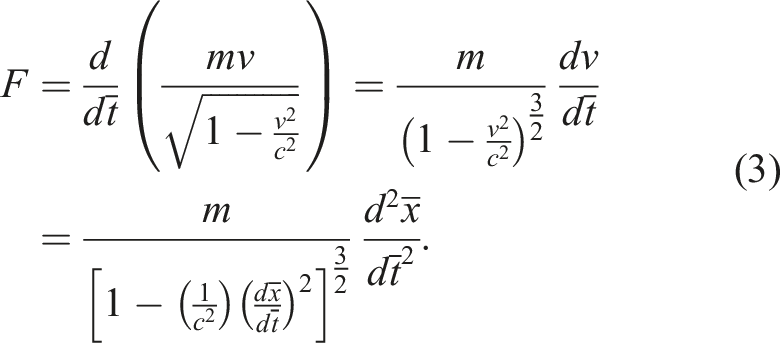
Substitute equation (3) into Newtonian equation of motion in the form

Now, substituting equation (2) into equation (4) and simplifying, it becomes

From equation (5), the governing non-dimensional nonlinear differential equation of motion for the relativistic equation is as follows


Transformation of the non-dimensional relativistic equation 20
According to Belendez,
20
equation (6) can be written as the following system

Hence, the system can be expressed as follows

Here,
From the article,30,31 the required transformation is

Following the Belendez
20
technique, the associated second-order differential equation for

Taking a new variable,

Methodology
The classical differential transform method (DTM) 22
If a function

Then the inverse transform of

Substituting equation (13) into equation (14), it becomes



Although the coefficients
Alam et al. 29 Differential transform method
Consider the relativistic oscillator with the following initial conditions

According to transformation

Consider a polynomial-type solution of equation (19) in the form

Substituting equation (20) into equation (19) and then equating the coefficients of



Solving the above algebraic equations given in equations (21)-(23) yields the coefficients

Substituting the values of unknown coefficients (up to
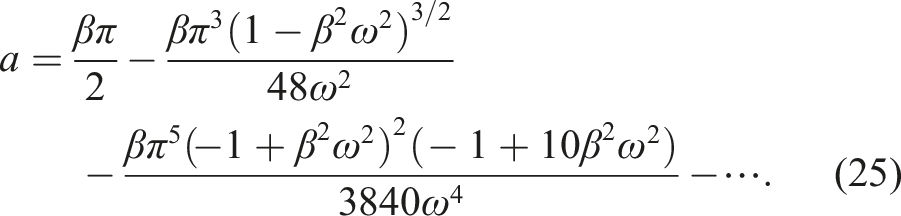


Neglecting all higher-order terms of

The proposed method
Consider that a polynomial-type series solution of equation (12) can be taken as

Equation (12) simplifies to








The unknown coefficients are determined by solving equations (32) to (35) as follows
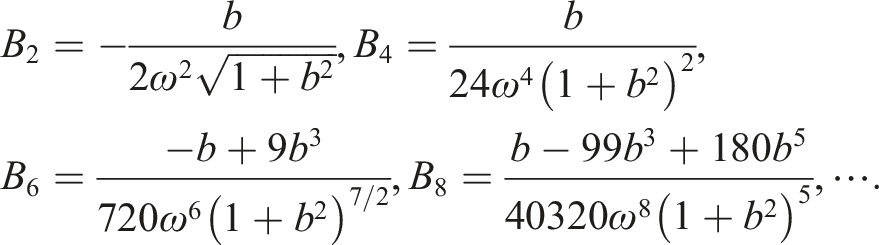
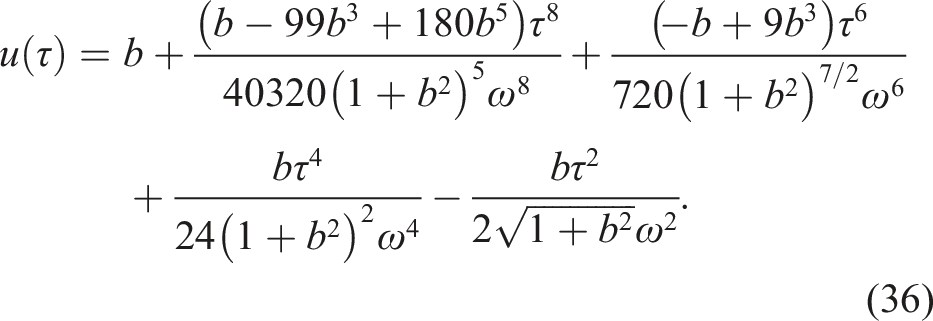
The value of
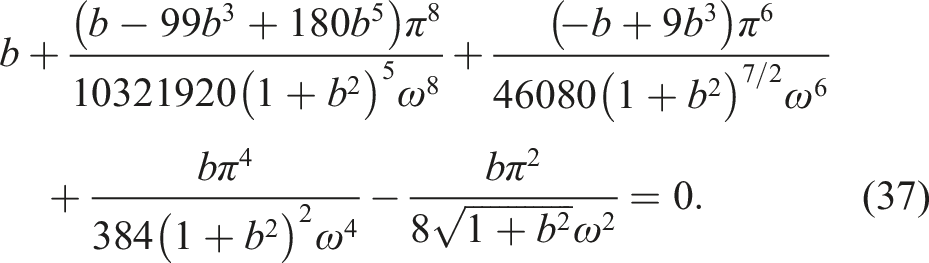
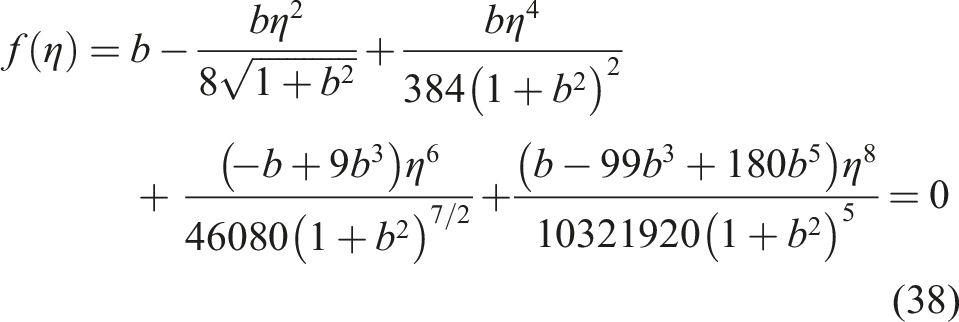
The value of
Now, the frequency of the relativistic equation can be obtained from
Finally, the solution of the original relativistic equation (6) is obtained from the following relation between

Results and discussion
A more efficient differential transform method (DTM) has been applied to solve the relativistic equation. Recently, the DTM
29
method was presented to solve the same problem, but it is a laborious task (see Sub-section 2.2). Earlier, the modified Lindstedt–Poincare method (MLP)
5
was used by Yeasmin
21
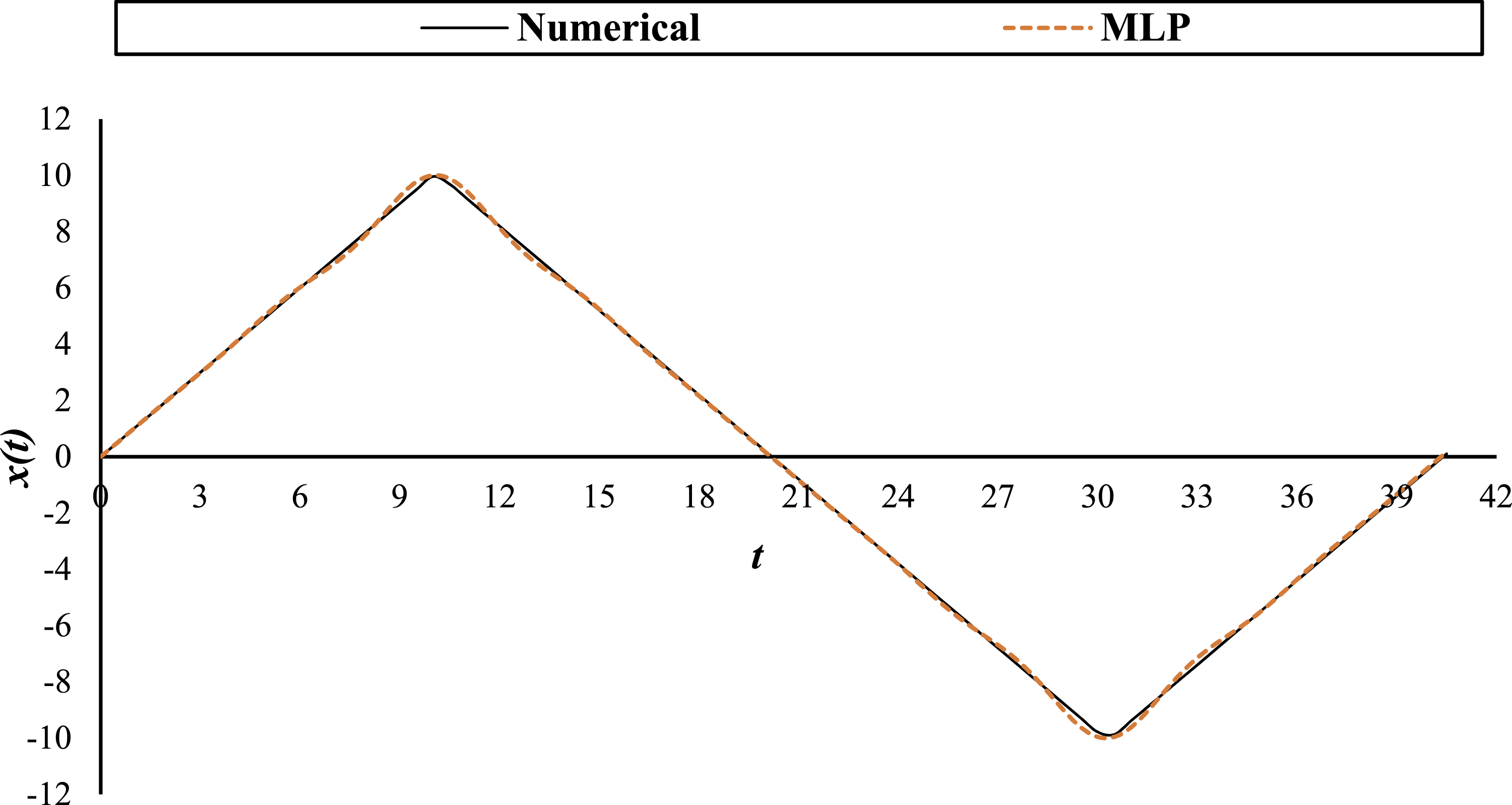
to solve relativistic equation, equation (6). The determination of such a solution is also laborious. Moreover, it does not nicely agree with the numerical solution (see Figures 1 and 2). Belendez
20
used the harmonic balance method to determine the frequency of the oscillator equation (6) but he applied only a fundamental term to find the solution of the equation by integrating equation (10). It is noted that equation (10) cannot be integrated when Comparison between the modified Lindstedt–Poincare (MLP) method
21
and numerical solution at Comparison between the modified Lindstedt–Poincare method
21
(MLP) method and numerical solution at 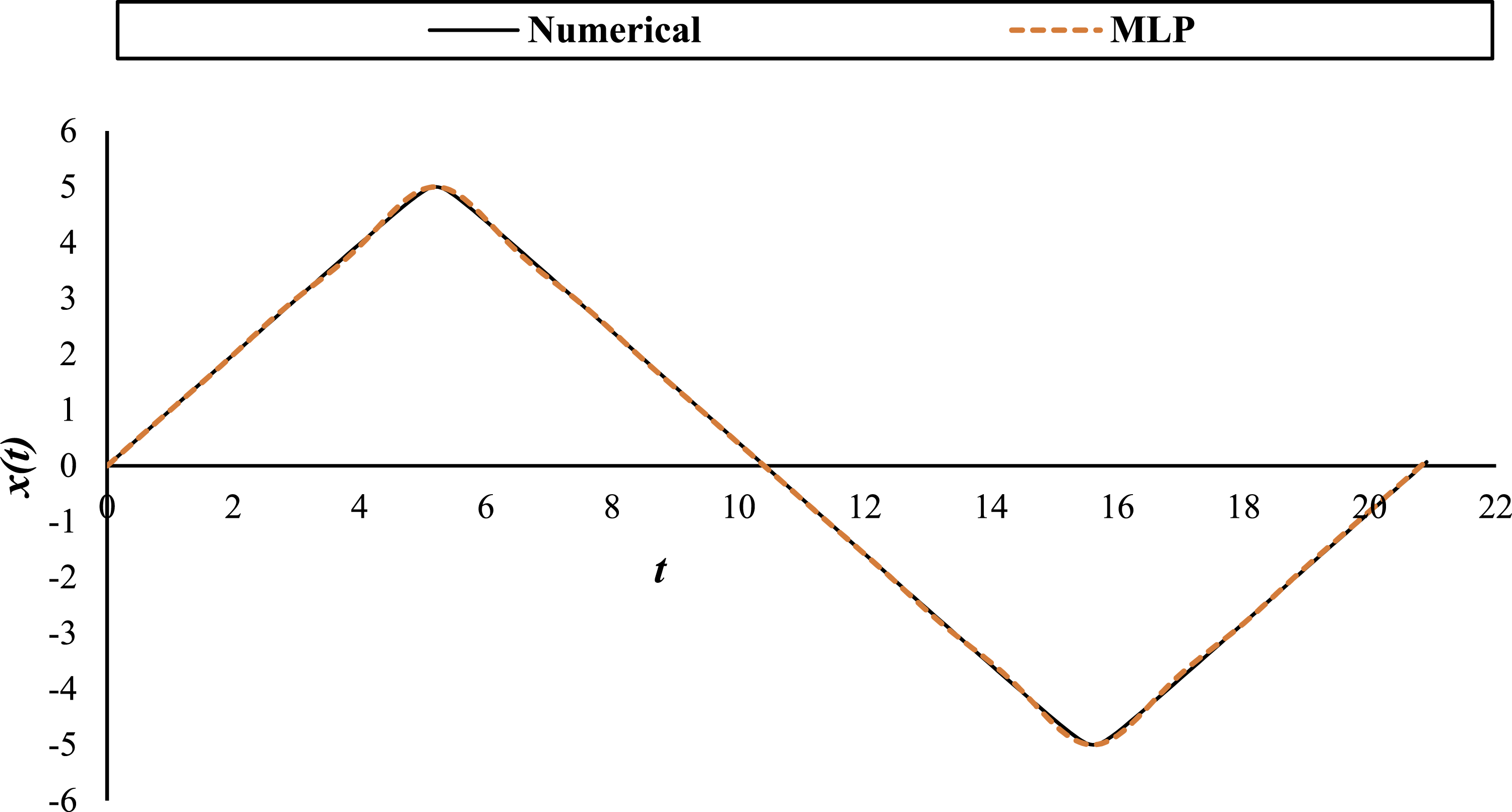
On the other hand, the proposed method has been developed using an easier approach, and the solution nicely agrees with the numerical solution. The algebraic equations for the unknown coefficients are linear and simple.
Comparison of the proposed approximate frequencies with exact and other existing frequencies of the relativistic equation.
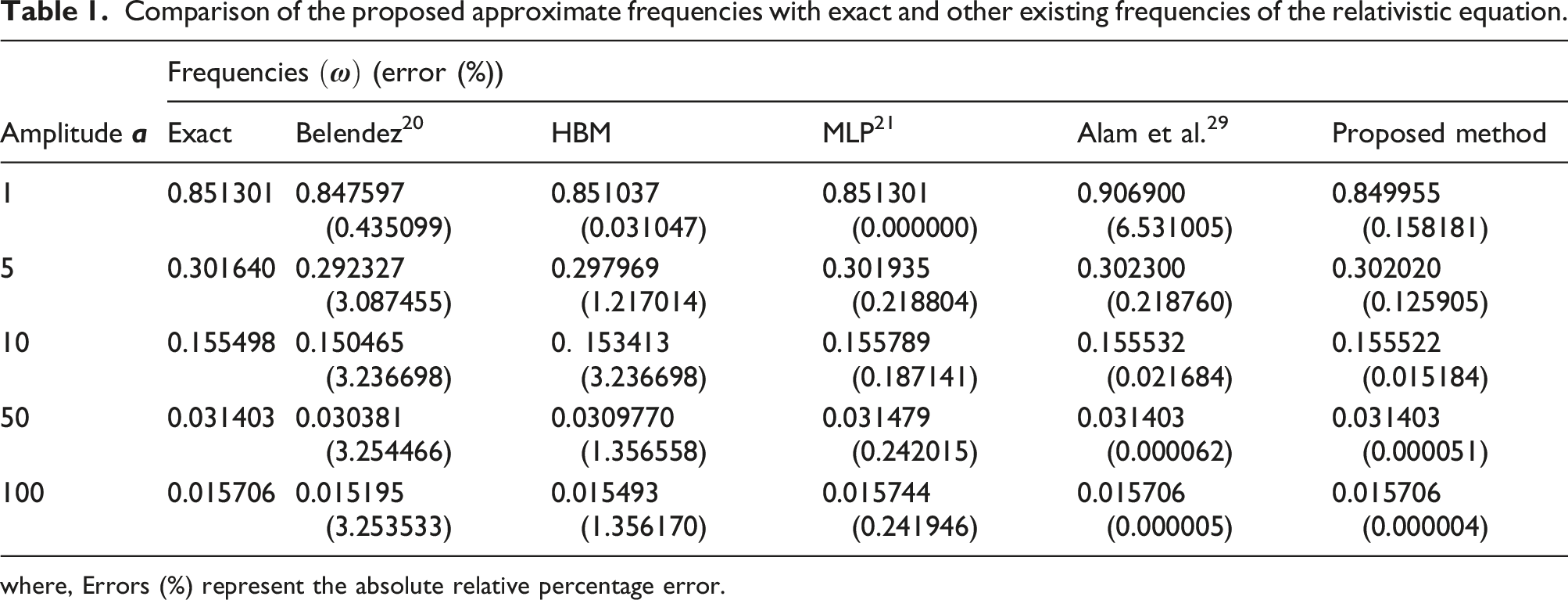
where, Errors (%) represent the absolute relative percentage error.
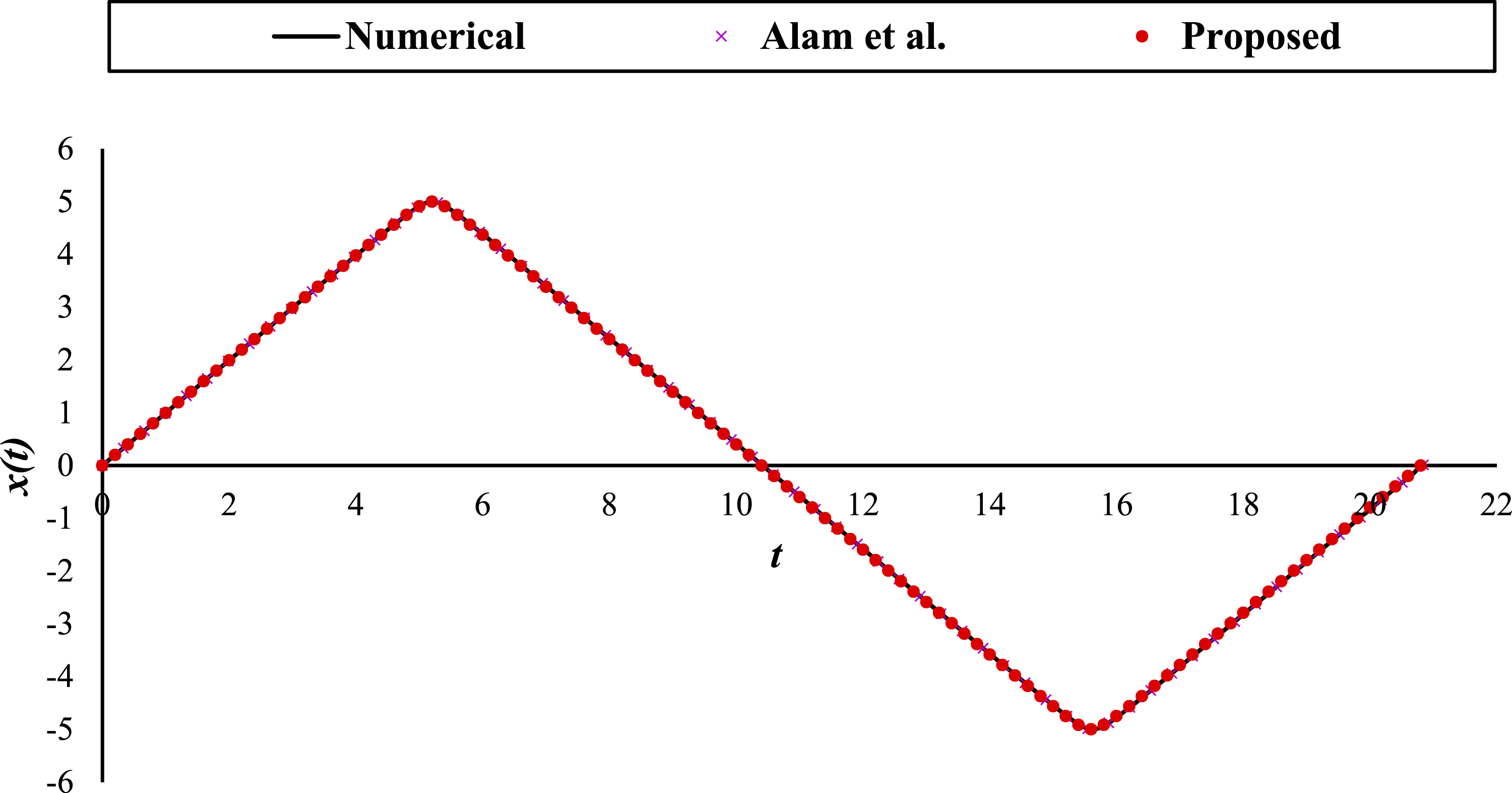
The solutions of equation (6) calculated via the proposed method together with different existing methods and the numerical method (Runge–Kutta 4th order) are shown in Figures 1-6, for different values of a. Figures 1 and 2 illustrate comparison of the relativistic equation between the numerical solution and Yeasmin
21
method for Comparison of the Belendez
20
method and harmonic balance method (HBM) solution with the numerical solution at Comparison of the Belendez
20
method and harmonic balance method (HBM) solution with the numerical solution at Comparison of the proposed method and Alam et al.
29
method solution with the numerical solution at Comparison of the proposed method and Alam et al.
29
method solution with the numerical solution at 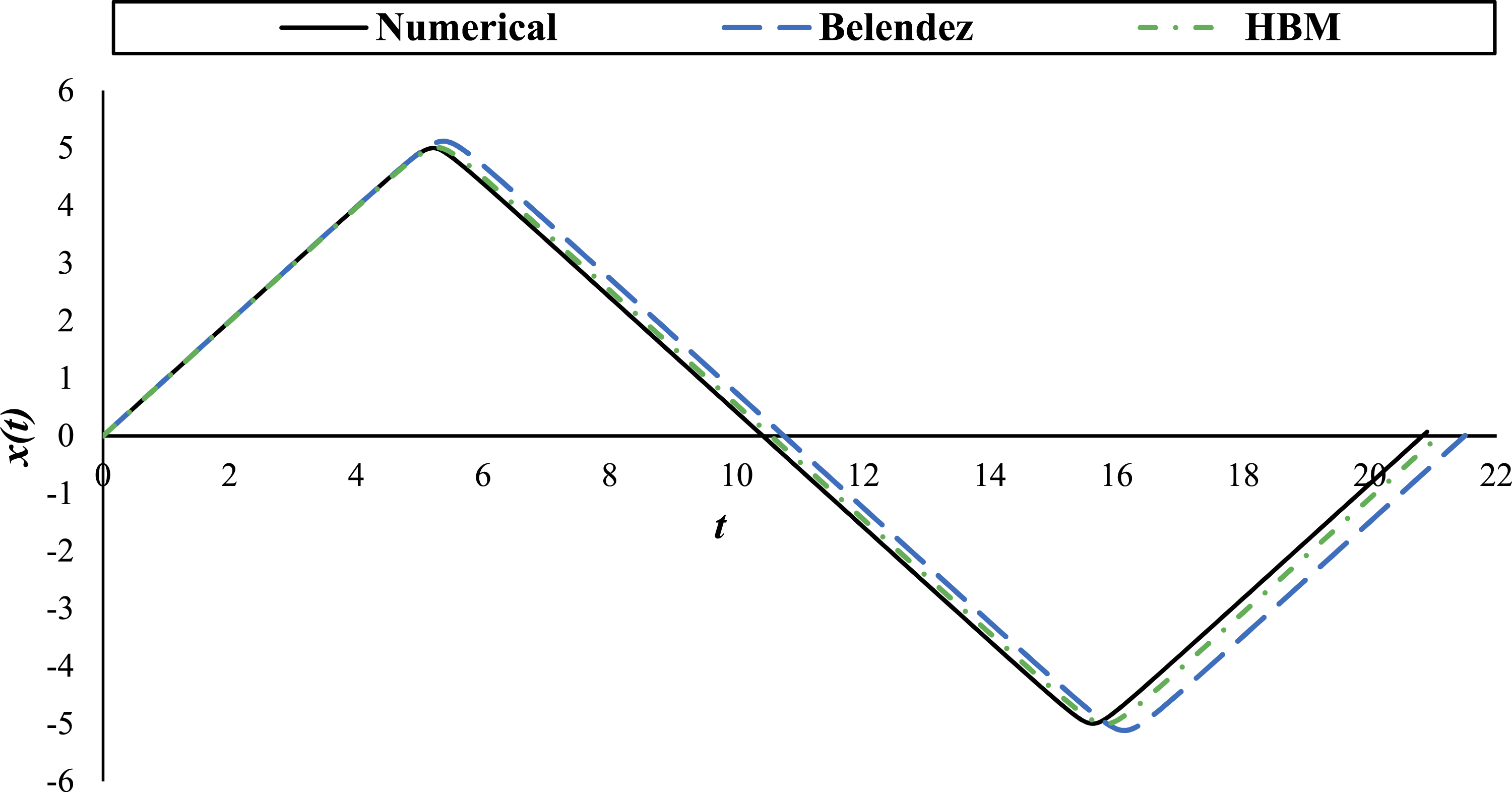
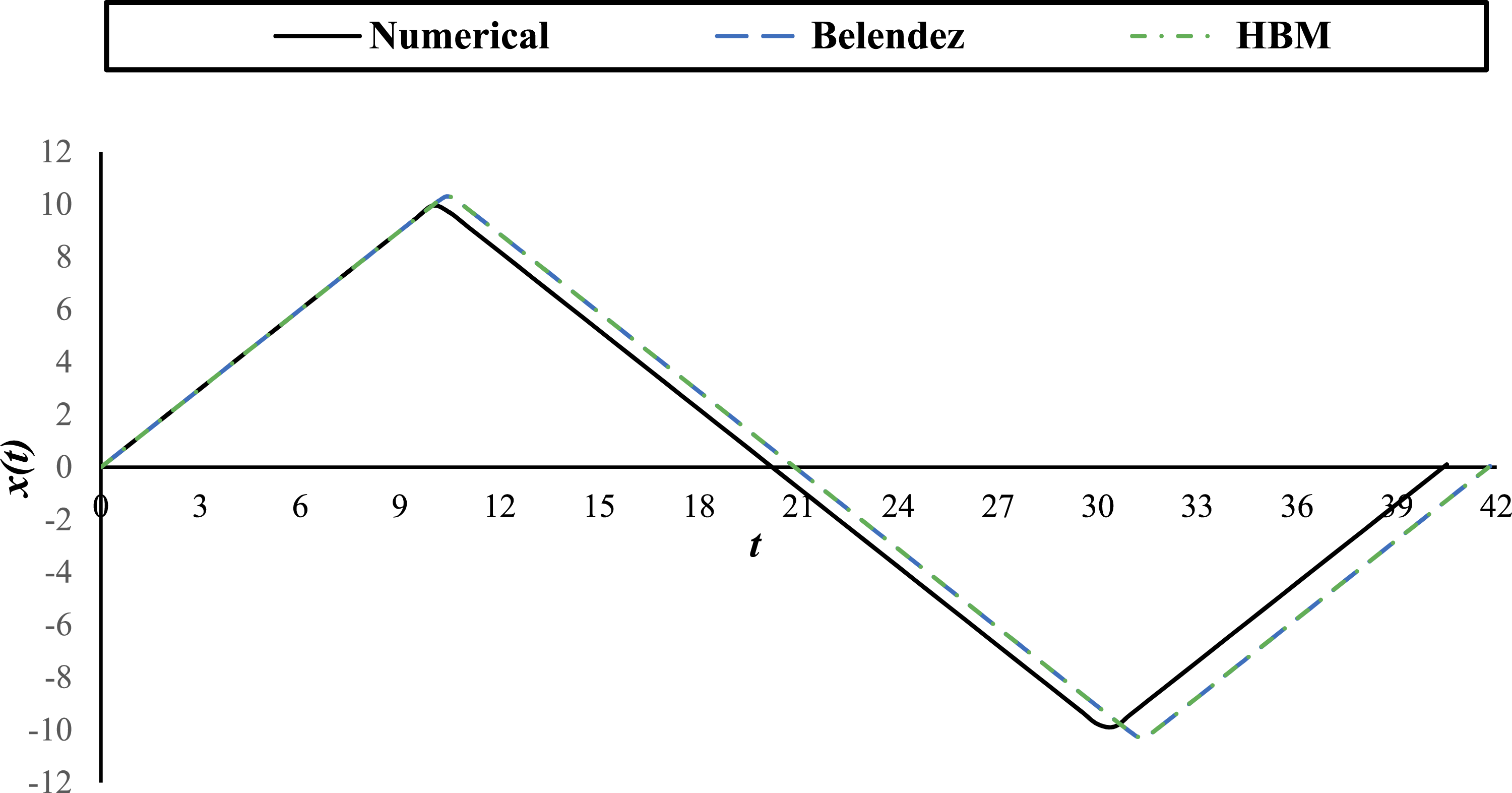
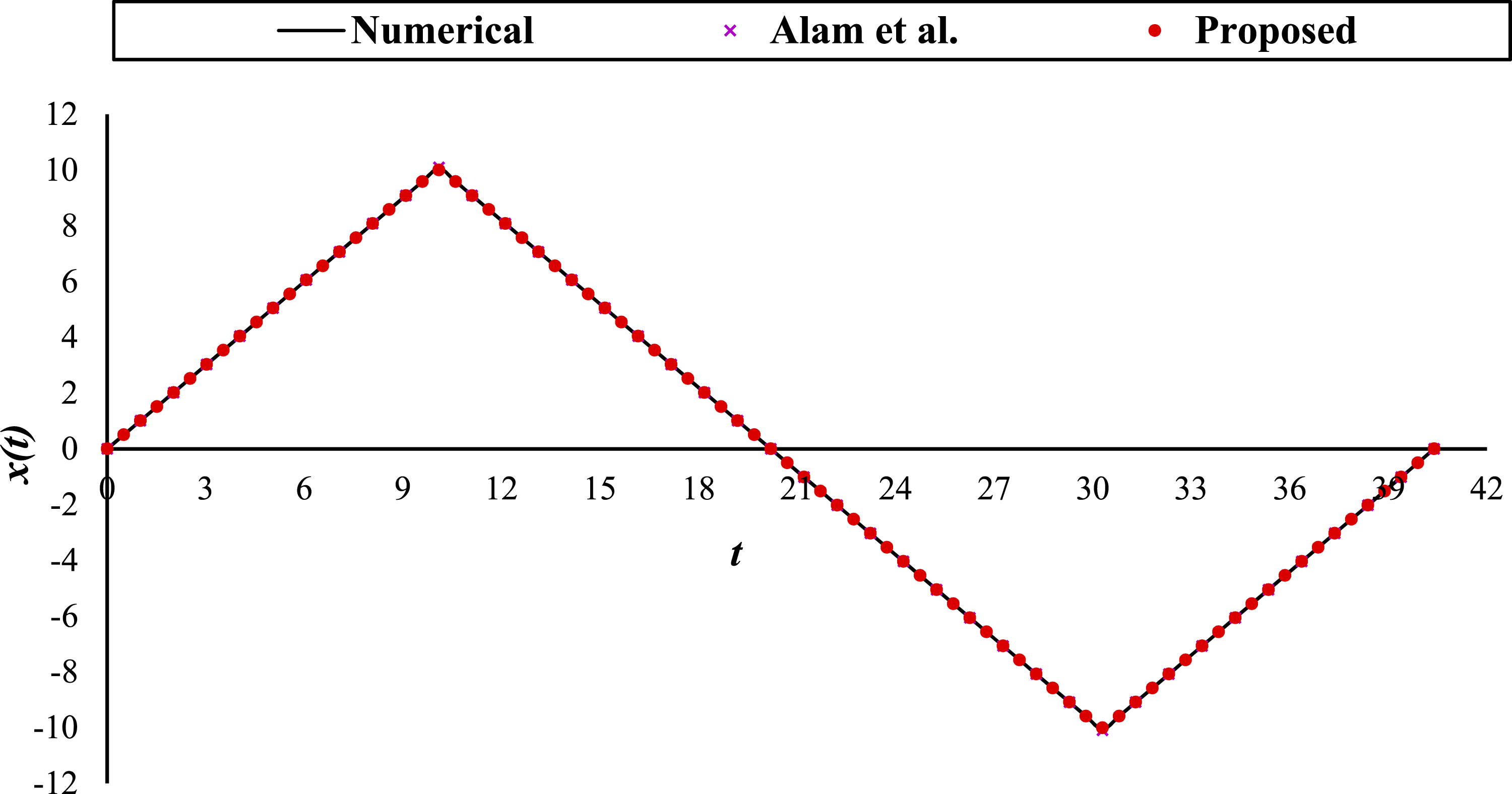
Figures 3 and 4 show a comparison of the numerical solution of the relativistic equation with that obtained by using the Belendez
20
method and the harmonic balance method, respectively, for
Figures 5 and 6 demonstrate a comparison of the solutions among the proposed method (using term up to
Comparing the determination of various solution and seeing all the figures and the results of the Table 1, it may be decided that the proposed method is efficient than all other methods described in this article.
Footnotes
Declaration of conflicting interests
The authors declared no potential conflicts of interest with respect to the research, authorship, and/or publication of this article.
Funding
The authors received no financial support for the research, authorship, and/or publication of this article.
