







Abstract
This is an exploratory study investigating the production of the meaning of ‘freedom’ in US history textbooks used in high schools across America. Responding to current ideological division, this article investigates the production of American patriotism and identity. This study uses methods from critical discourse analysis to dissect how the language used in the textbooks produces a meaning of ‘freedom’. It then explores the production of patriotic citizens through history/civic education and questions the meaning of ‘freedom’ as a value that sits at the heart of American identity and rhetoric. The quantitative and qualitative results show that the story of ‘freedom’ in the textbooks aims to pacify the violent ruptures of history while instilling in students a sense of duty to ‘freedom’ as a cause and value worth furthering – even if its meaning is not fully explained.
Keywords
Americans are more divided along ideological lines than they have been at any point in the past 20 years. Republicans and Democrats are retreating to their ‘ideological silos’ and increasingly view the opposing political party as a ‘threat to the nation’s wellbeing’ (Pew Research Center, 2015b). Such extreme ideological cleavage requires Americans to ask: what does it mean to be American? What ideas are at the basis of an ‘American identity’? And what comprises American nationalism, more often called ‘patriotism’?
As of 2017, 85% of Americans believed that their country is among the greatest in the world (Thorsett and Kiley, 2017). Paradoxically, this patriotic attitude persists despite the realities that the United States accounts for only 5% of the global population, yet incarcerates 25% of the world’s prison population (Wright and Herivel, 2007); is the only ‘high-income nation’ in the world that does not ensure health care (Osborn et al., 2016); and has the second-most unequal income distribution in the ‘developed world’ after accounting for taxes and transfers (DeSilver, 2013). Why does America view itself through rose tinted glasses, despite socioeconomic realities? And with such political divisions, how does a relentless patriotism prevail?
One fundamental value at the basis of American identity is the belief in, and passion for, ‘freedom’, which Harvey (2009: 1) theorizes is essential to ‘The American Ideology’ and Foner (1998) argues is a requisite idea at the base of ‘Americans’ sense of themselves as individuals and as a nation’ (p. xiii). ‘Freedom’ has motivated political endeavors since the country’s inception, manifesting in 20th and 21st century examples like Wilson’s New Freedom in 1912, Roosevelt’s Four Freedoms in 1941 and Bush’s Operation Enduring Freedom in 2001. In practice, these agendas based in pursuits of freedom take on varied and contradictory forms which do not appear to follow a single meaning of the American value. What does ‘freedom’ mean in the American context, and how is this meaning produced?
To explore the production of the meaning of ‘freedom’, this study examines the language of US history textbooks that are used to teach high school students across America, specifically focusing on the question: What meaning of ‘freedom’ is produced in the discourse of high school US history textbooks? All students in the United States are taught American history, and US history/civic education and textbooks have played a role in shaping new generations of patriotic citizens since the founding of the republic in 1776 (Nash, 2009).
This study uses critical discourse analysis (CDA) to analyze the language of the textbooks and produce qualitative and quantitative results. Whereas existing research has explored the contradictory meanings of ‘freedom’ within histories of liberalism, or the narratives reproduced through US history education separately, this study brings together the two lines of inquiry and addresses gaps in the literature. By analyzing how the language in US history textbooks constructs a meaning of ‘freedom’, this study will unpack the meaning of the American value that is taught to students nationwide and investigate one site where patriotism is reproduced.
Literature review and background
Freedom
‘Freedom’ (or ‘liberty’ ‘with which it is almost always used interchangeably’) is a defining concept of American culture and society (Foner, 1998: xiii). Despite the term’s ubiquity, the history of ‘freedom’ surfaces contradictory, inexplicable, and opaque applications and consequences. The epitome of this rupture is the slavery plantation system which drove the US economy, despite the nation’s founding ideals which declare, ‘all men are created equal, that they are endowed by their Creator with certain unalienable Rights, that among these are Life, Liberty and the pursuit of Happiness’ (US Declaration of Independence, 1776).
The attacks on 11 September 2001 popularized the term’s application, as Americans interpreted the events ‘as an attack upon distinctively American values of freedom and liberty, rather than upon the main symbols of US military and financial power’ (Harvey, 2009: 1). In George W Bush’s (2001) speech to Congress days after 9/11, he said, ‘on September the 11th, enemies of freedom committed an act of war against our country … and night fell on a different world, a world where freedom itself is under attack’. Bush (2001) conceived of a world as divided by ‘freedom’ itself, where terrorists ‘hate our freedoms – our freedom of religion, our freedom of speech, our freedom to vote and assemble and disagree with each other’. Later, in the context of the War Against Terror (WAT), ‘freedom’ takes on legitimizing power and is used to justify the American government declaring a war on pre-emptive grounds. Angling ‘the terrorist’ as a threat to ‘freedom’, America constructed an oppositional ‘Other’ through its rhetoric. The language of ‘war-as-self-defense’ inaugurated an age of ‘defensive imperialism’ where the United States imposes its vision of democracy as the ‘solution’ to the threat of terrorism (Anghie, 2004: 278).
The complexity of ‘freedom’ is also visible at an organizational level. The American Civil Liberties Union (ACLU, 2017), which self-describes as the ‘nation’s guardian of liberty’, advocates for issues like lesbian, gay, bisexual, transgender and queer (LGBTQ) rights, prisoners’ rights, racial justice and immigrants’ rights, which it claims are the rights and freedoms granted to American citizens under the constitution. Conversely, the website of the right-wing Tea Party Patriots (2017) also mobilizes around ‘freedom’, but with opposite aims. Their mission is to ‘support policies that protect and defend personal freedom’, through campaigns to reduce taxes, pursue private healthcare and reform immigration policy to reduce the intake of people.
In the United States, ‘the very universality of the language of freedom’ camouflages ‘a host of divergent connotations and applications’, often exposing the contradictions between ‘what America claims to be, and what it actually is’ (Foner, 1998: xiv, xvi). Mehta (1999) argues that such a contradiction of values sits within a greater history of liberalism, where there has been ‘systematic and sustained political exclusion of various groups of people’, within visions of the ‘universality of freedom’ (p. 46). Rana (2010) focuses further on the contradictions of ‘freedom’ by turning to the settler society that founded the United States, where ‘liberty’ for European settlers was contingent on the suppression of native populations.
Anghie (2004) brings the discussion of empire and imperialism to the 21st century in the context of the WAT, which has ‘principles and policies [that] closely resemble if not reproduce, imperialism’ (p. 272). The pre-emptive strategies of ‘defensive imperialism’ represent a paradigm where it is believed that terrorism can only be addressed ‘by the reconstruction of a new, imperial order’, or, bringing democracy to the Middle East (Anghie, 2004: 279). In the name of its own ‘freedom’, America set out to reproduce its hegemonic vision, whereby the ‘projection of American democracy’ was mobilized as ‘a universal solution to the problems of governance’ (Anghie, 2004: 289).
Similarly, Ryn (2003) explains that the ‘push for American empire’ is framed by its supporters as ‘a great moral cause … to serve peace and human well-being’ (p. 11). Such views have their origins in Christianity, where American values are crafted into ‘God-given values’, so that to spread American values is to ‘be on the side of God’ and to resist is ‘to oppose God’ (Ryn, 2003: 7). The ubiquity of ‘freedom’ attaches it to a series of contradictory stories and tangled webs of meaning. Sitting so deeply in the core of American values, the boundaries of the meanings of ‘freedom’ are often taken for granted.
Language and oppression
Language plays a crucial role in the process of social reproduction, and Freire identifies this as a tenant in the dynamic of oppressing groups within society. He explains that often educators and politicians, when in the position of oppressor, use language that is ‘alienated and alienating rhetoric’, but this language ‘cannot exist without thought … and neither language nor thought can exist without a structure to which they refer’ (Freire, 1970: 96). For this to be overcome, in the first instance, it must be understood how language about groups – especially those that are racially oppressed – are dialectically framed in the society’s narrative (Freire, 1970: 96).
Fraser’s (1989) discussions in the context of gender power dynamics highlights that ‘societies must reproduce themselves symbolically; they must maintain and transmit to new members of linguistically elaborated norms and patterns of interpretation that are constitutive of social identities’ (p. 115). Furthermore, Williams’ Key Words (1976) centers around the impact of language as the site of ‘important social and historical processes’ (p. 22). His theory of ‘selective tradition’ demonstrates that ‘someone’s vision of legitimate knowledge and culture, one that in the process of enfranchising one group’s cultural capital disenfranchises another’s’ (Williams, 1961 cited in Apple, 1993: 49).
Fanon (1952) furthers this exploration in application to racism explaining that because language is at the foundation of society, studying it is essential ‘in understanding the black man’s dimension of being-for-others’ (p. 1). Because of racial structures, Fanon (1952) explains that within a white society, ‘[the black man] has no culture, no civilization, and no “long historical past” … whether he likes it or not, the black man has to wear the livery the white man has fabricated for him’ (p. 17). Within a white society, Fanon’s (1952) analysis shows that ‘ontology does not allow us to understand the being of the black man, since it ignores the lived experience. For not only must the black man be black; he must be black in relation to the white man’ (p. 90). The oppression of the black body in its definition as ‘Other’ by white oppressors means that such a schema becomes ‘a definitive structuring of (my)self and the world – definitive because it creates a genuine dialectic between (my) body and the world’ (Fanon, 1952: 91).
Schooling and textbooks
Social theory’s focus on power has often turned toward the process of ‘schooling’ and educational institutions as sites of social reproduction. Apple’s (1993) critique of the production of a society’s ‘official knowledge’ centers around textbooks used in schools, where contents of a curriculum begin from the political question ‘from whose perspective are we seeing, or reading, or hearing?’ (p. 32). Textbooks as the core of many curricula represent the organized knowledge system of society as they ‘help set the canons of truthfulness’ and ‘recreate a major reference point for what knowledge, culture, belief, and morality really are’. (Apple, 1993: 49). But these canons are not built with a universal agreement about what is constituted as ‘official knowledge’, and instead textbooks are ‘results of political, economic, and cultural activities, battles, and compromises … conceived, designed, and authored by real people with real interests … published within the political and economic constraints of markets, resources, and power’ (Apple, 1993: 46).
As underrepresented groups have fought to have a say in the production of official knowledge, ‘progressive items are perhaps mentioned, then, but not developed in depth’, and dominant groups are able to maintain their positions of power ‘through compromise and the process of “mentioning”’ (Apple, 1993: 56). This dynamic is exemplified by Freire’s (1970) description of the dynamic between the oppressors and the oppressed, where ‘any attempt to “soften” the power of the oppressor in deference to the weakness of the oppressed almost always manifests itself in the form of false generosity’ such that the oppressors perpetuate injustice (p. 44).
In this process of social reproduction, power holders may limit access to what Eagles (2017) calls ‘dangerous knowledge’ and constrict education to preserve a powerful societal position (p. 2). Politically incentivized groups have fought for control over the ideological content of textbooks throughout history. As Eagles (2017) explains, after WWII, conservative critics who feared communist infiltration ‘attacked textbooks that they believed approved the welfare state, supported socialism, and failed to appreciate individualism and private enterprise’ (p. 30). Racial bias has been a defining feature in the history of textbook criticism, and a 1949 report by the American Council on Education criticized history books for misrepresentations including ‘portraying slaves as “well treated, contented, and happy”’ and for displaying a ‘“narrow and limited” view of black accomplishments’ in such a way that ‘the textbooks usually left “the student with the belief that all is well” in race relations’ (Committee on the Study of Teaching Materials in Intergroup Relations, 1949, as cited in Eagles, 2017: 95).
Of this political legacy, Eagles documents the production of a Mississippi state history textbook Conflict and Change written by Loewen and Sallis (1974). The revisionist textbook encouraged students to ‘question traditional authorities and challenge orthodoxies, whether in race relations, historical interpretations … even sexuality’ with the intent to have students ‘thinking freely about their society and its problems’ (Eagles, 2017: 234). The State Textbook Purchasing Board rejected Conflict and Change in 1974, with an assessment that the book contained too many controversial issues to fit into the Mississippi curriculum (Eagles, 2017: 156–157). The fight and struggle represented by the authors endured taking this to court to get the book approved for the curriculum ‘grew out of the civil rights movement of the 1960s and anticipated the culture wars of the 1980s and later’ (Eagles, 2017: 234). History education played a key role in the culture wars because ‘it had a major impact on what students learned about American identity’ (Eagles, 2017: 234).
Loewen’s (2007) later book Lies My Teacher Told Me uncovers a trend of factual errors across US history textbooks and finds that the textbooks teach readers to be proud of the country and its past (p. 350). The quantity of false information included within the books shows that textbook writers, looking to engrain a sense of national pride in students, ‘obviously believe that we need to lie to students to instill in them love of country. But if a country is so wonderful, why must we lie?’ (Loewen, 2007: 338).
Epstein (2009) observes the way ideas of ‘nationhood’ and the history of racism are taught in American history classes. Epstein’s (2009) case study found that attempts to use history education to ‘create patriotic citizens through the presentation of sanitized versions of the nation’s past’ failed to teach students the skills to critically examine society and alienate anyone who does not believe the overly optimistic version of history that they are told (pp. 69, 137).
Nash (2009) identifies the role that civic education has played in American society since the Revolution in 1776, by examining the history of textbook production. The Founding Fathers aimed to instill nationalism in students to ensure the longevity of the new republic. Textbooks have been used in schools since the birth of American democracy as the platform providing a citizenship education. Nash (2009) found that the textbooks from Early America ‘did not present a single unified view of what it meant to be an American, or what it meant to be a good citizen’, instead they promoted a version of patriotism that varied according to regional values and beliefs (p. 441). In the early years of the republic, before there was a strong sense of national unity, textbook authors encouraged students to feel a fierce attachment to the ideals of liberty and freedom wherever those ideals flourished, rather than to a concept of nation that might or might not be able to live up to those ideals. (Nash, 2009: 441)
There is no national curriculum in the United States, and every state has the right to decide on their own educational guidelines and requirements, which was seen in the above example of Conflict and Change. However, the large degree of standardization across textbook production creates a level of uniformity independent of state requirements. Publishers sell to the demands of the largest states, Texas and California, which have active lobbying groups, large populations and ultimately the foremost choice over the kind of history students learn in every other part of the country (Loewen, 2007: 308; Moreau, 2003: 87).
Methodology
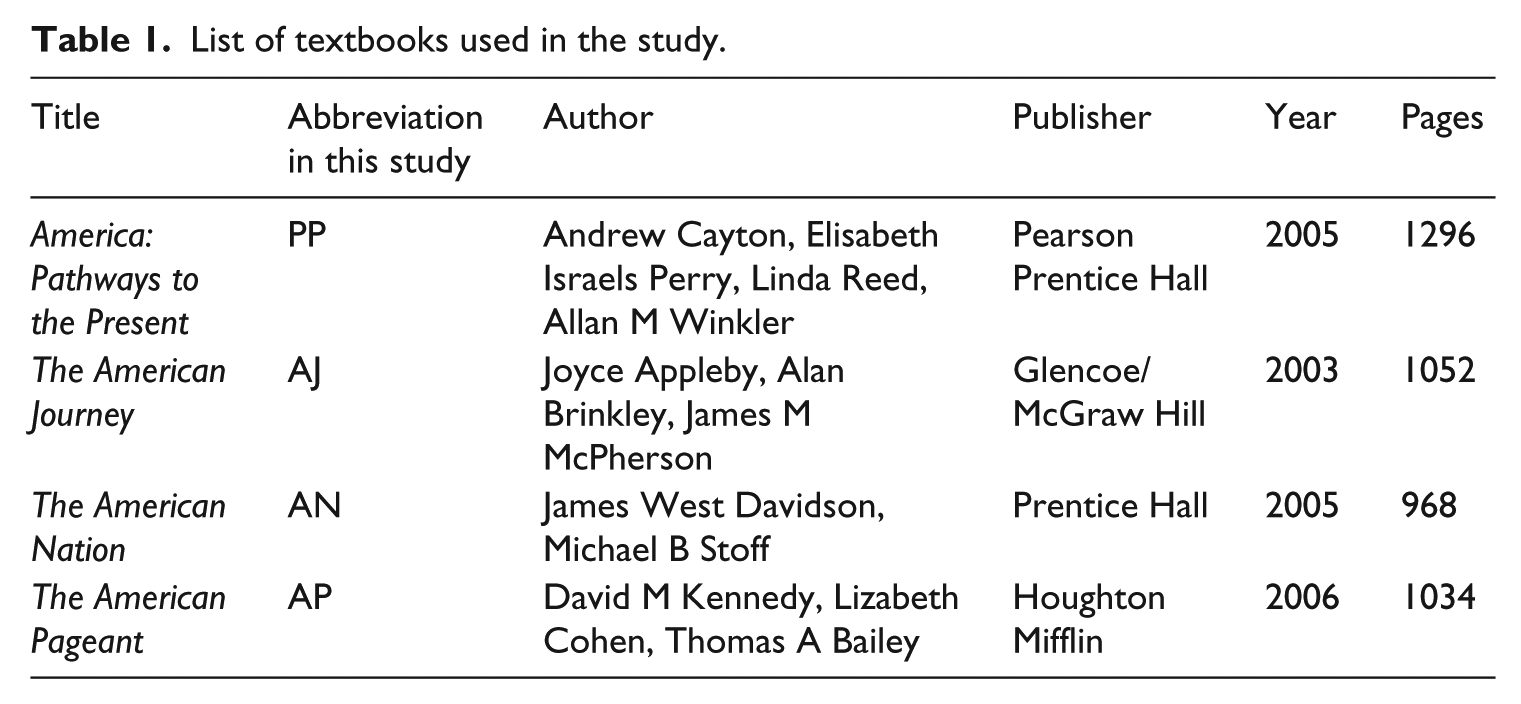
This study analyzes four American high school US History textbooks (Table 1). Because there is no universalized curriculum in the United States, textbooks in this study were selected based on The American Textbook Council (ATC) – an independent, non-profit research organization founded in 1989 ‘dedicated to textbook analysis, review, studies, and evaluation’ (ATC, 2015). According to the ATC, it is nearly impossible to obtain details of textbooks sales and purchases from the distributors. Therefore, selecting textbooks based on popularity from volume of sales was not an option. Although they have discontinued their textbook rankings, the ATC identify that since 2010, the three largest K-12 distributors are Pearson, McGraw-Hill and Houghton Mifflin Harcourt and indicate quality in a three-tiered rank. The textbooks for this study represent those three largest distributors and each ATC tier of quality (Table 2).
List of textbooks used in the study.
Textbook sample quality.
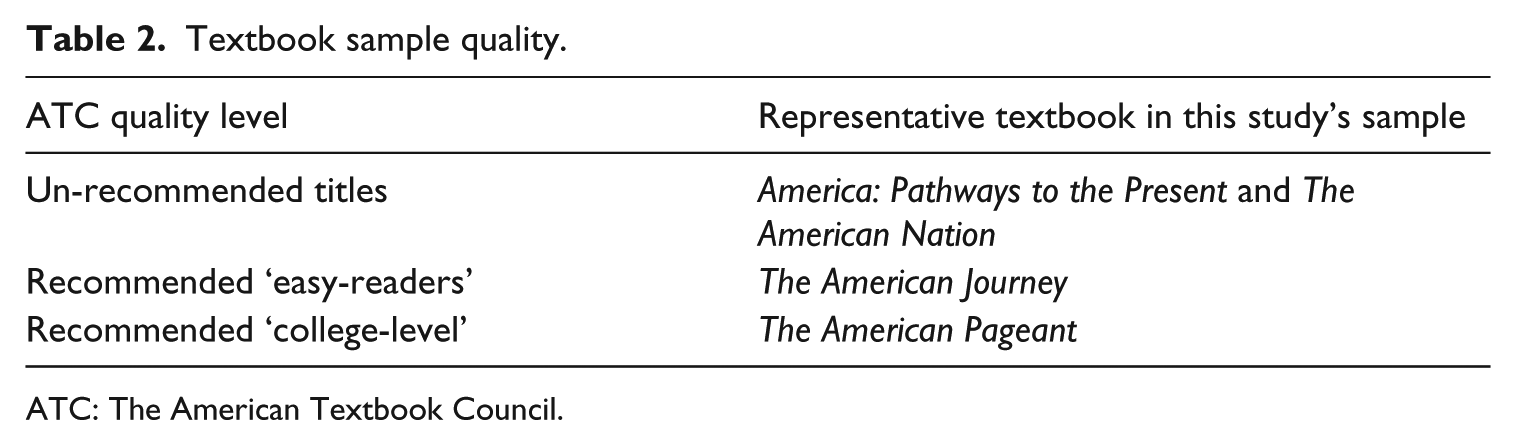
ATC: The American Textbook Council.
Data collection
Together, the four textbooks produce a total of 4350 pages of content, and the data gathering, coding and analysis was conducted manually. The first stage recorded every paragraph that mentioned the following words: ‘freedom’, ‘free’, ‘freely’ or ‘liberty’ – in this context, ‘liberty’ is used interchangeably with ‘freedom’ (Foner, 1998). Only explicit mentions of the word ‘freedom’ were counted, rather than inferring the concept of ‘freedom’ through discussions of other ideas like ‘equality’, ‘rights’ or ‘independence’, to avoid assigning a definition. Only the body of the chapter was considered, excluding any glossary, maps, timelines or ‘reading supplements’ found within the chapters (biographical spotlights, chapter tests or primary source documents). Though largely similar, each of the four books had slightly different chapter denominations, and 20 common periods of history were identified to compare and combine data about the same periods from the different books.
Data analysis
This study is based on the question: What meaning of ‘freedom’ is produced in the discourse of popular high school US history textbooks? Foner (1998) centers his discussion of ‘freedom’ within three interrelated themes, ‘the meaning of freedom; the social conditions that make freedom possible; and the boundaries of freedom – the definition, that is, who is entitled to enjoy it’ (p. xvi). Using this as a guide, the questions in Table 3 were formulated as a basis for the coding structure of this study. A deductive coding structure was then created from elements of CDA, as outlined by Fairclough (1989). CDA intends to unpack the production of ideology in language and provides the strategies needed to unpack latent meaning in text, ‘to analyze how social and political inequalities are manifested in and reproduced through discourse’ (Wooffitt, 2008: 448). For van Dijk (2005), CDA is a method for analyzing the process of social reproduction since it provides tools to understand ‘the ways discourse structures enact, confirm, legitimate, reproduce, or challenge relations of power and dominance in society’ (p. 353). While CDA is often used to analyze spoken discourse, the application of its textual-interpretive strategies, in the context of textbook writing, allows for the interpretation of the latent production of ideological meaning (van Dijk, 2005: 353).
Methodological questions and rhetorical themes.
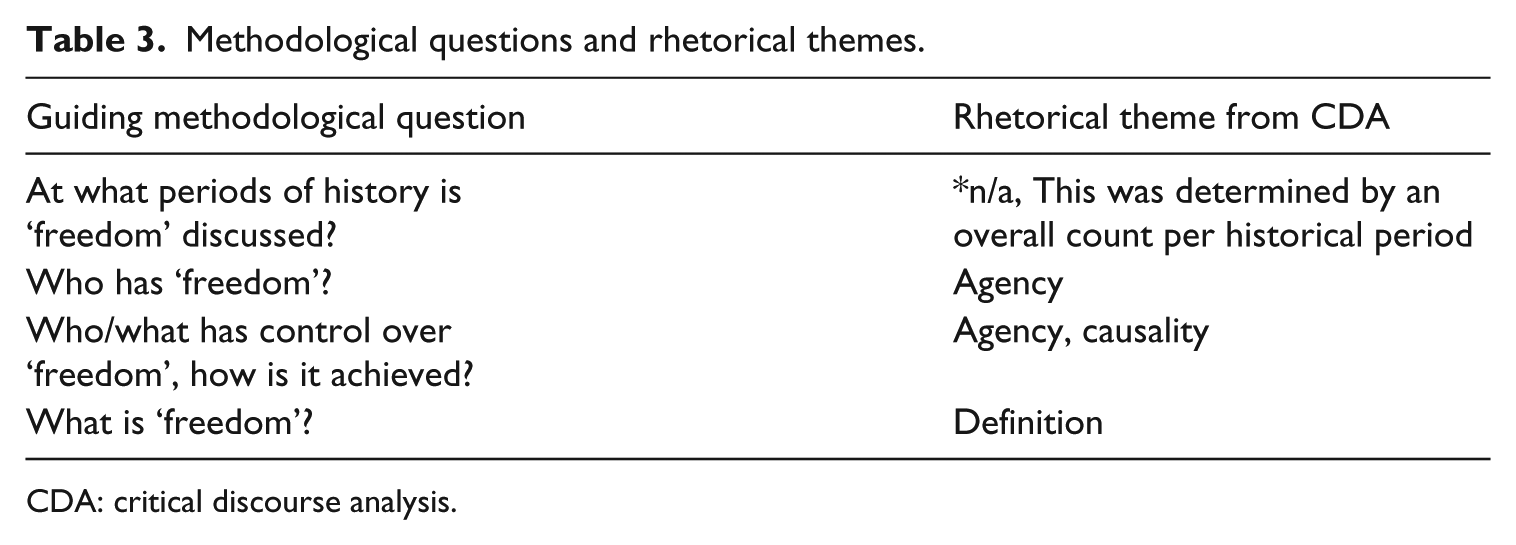
CDA: critical discourse analysis.
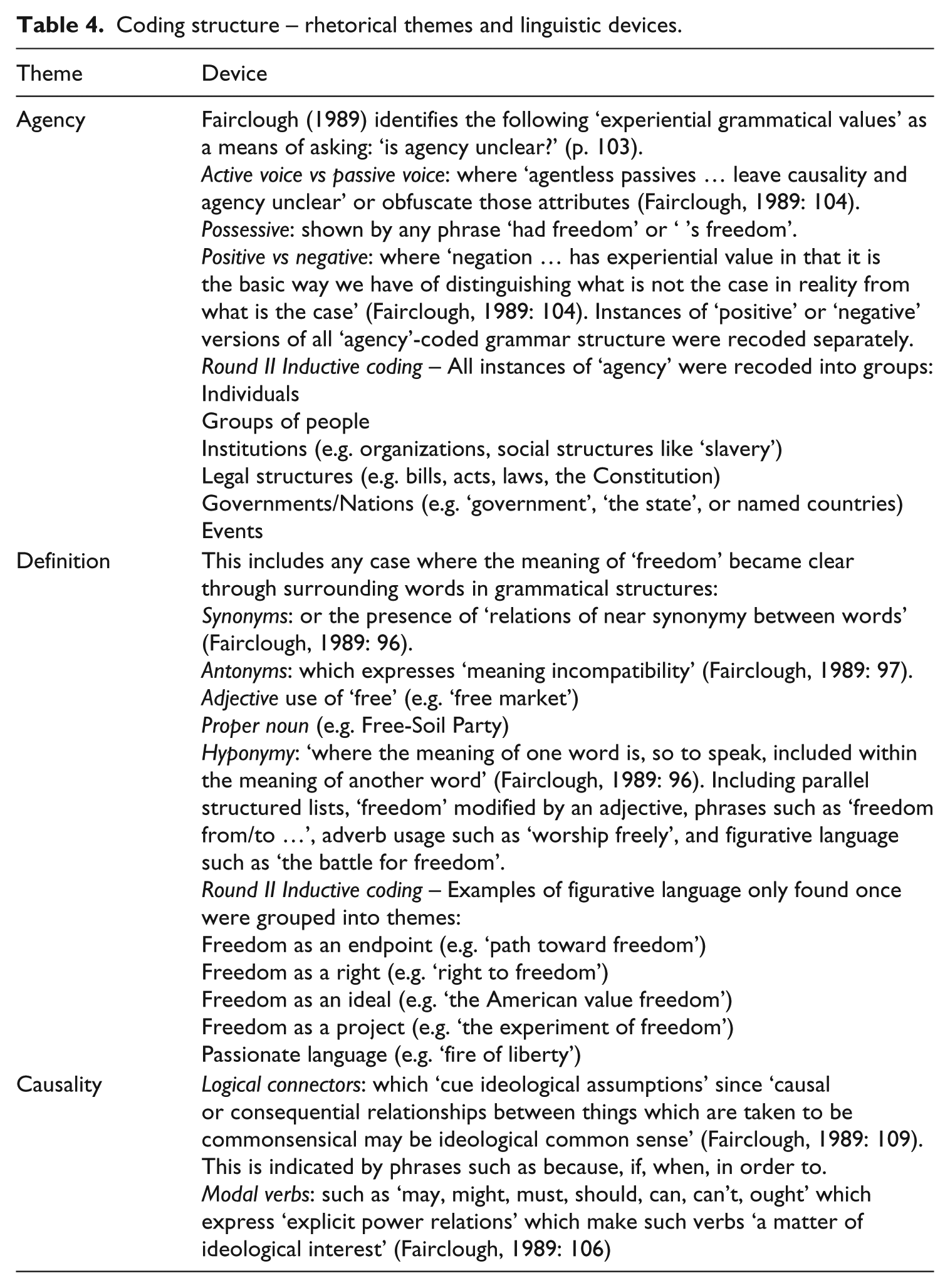
After rhetorical themes from CDA were paired with the study’s guiding questions (Table 3), a coding structure was created to log cases of each example in accordance with the linguistic devices discussed by Fairclough (Table 4). The first round took a deductive approach, and the second round used a set of inductive codes to organize themes (Attride-Stirling, 2001; Patton, 2002).
Coding structure – rhetorical themes and linguistic devices.
Results and discussion
When is ‘freedom’ discussed?
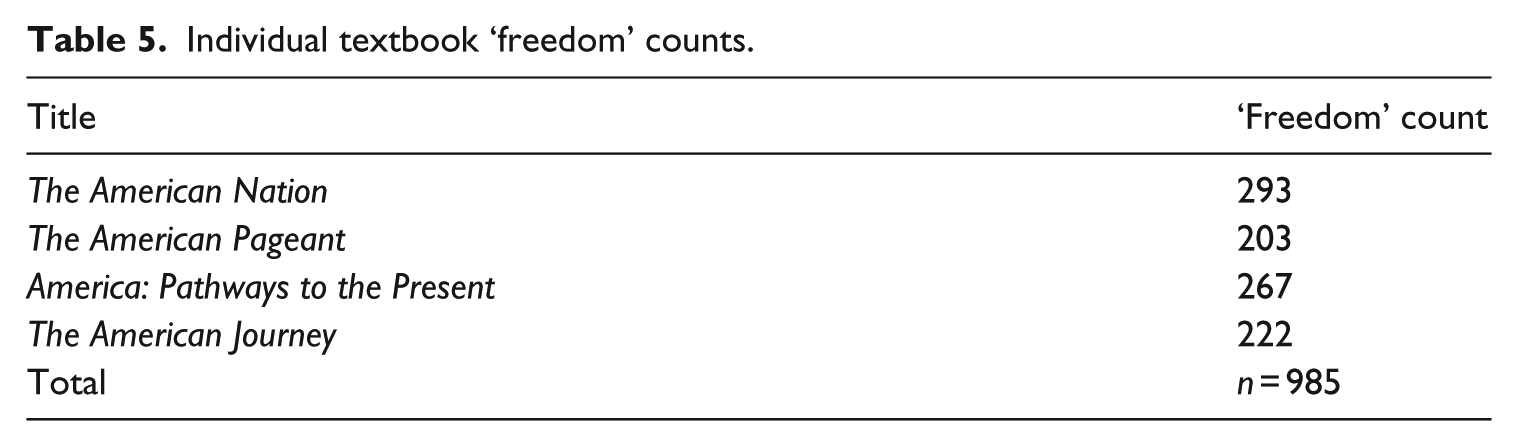
The total number of mentions of ‘freedom’ across the four textbooks combined is 985. The individual book count totals are shown in Table 5. Figure 1 shows the total ‘freedom’ count per period of history, combining all four books. The period ‘Lead-up to Civil War’ represents the most mentions of ‘freedom’, followed by the post-Civil War ‘Reconstruction’ period. The Civil War period, combining ‘Lead up to Civil War’, ‘Civil War’ and ‘Reconstruction’ after the war, accounts for 38.6% of the overall ‘freedom’ discussion.
Individual textbook ‘freedom’ counts.
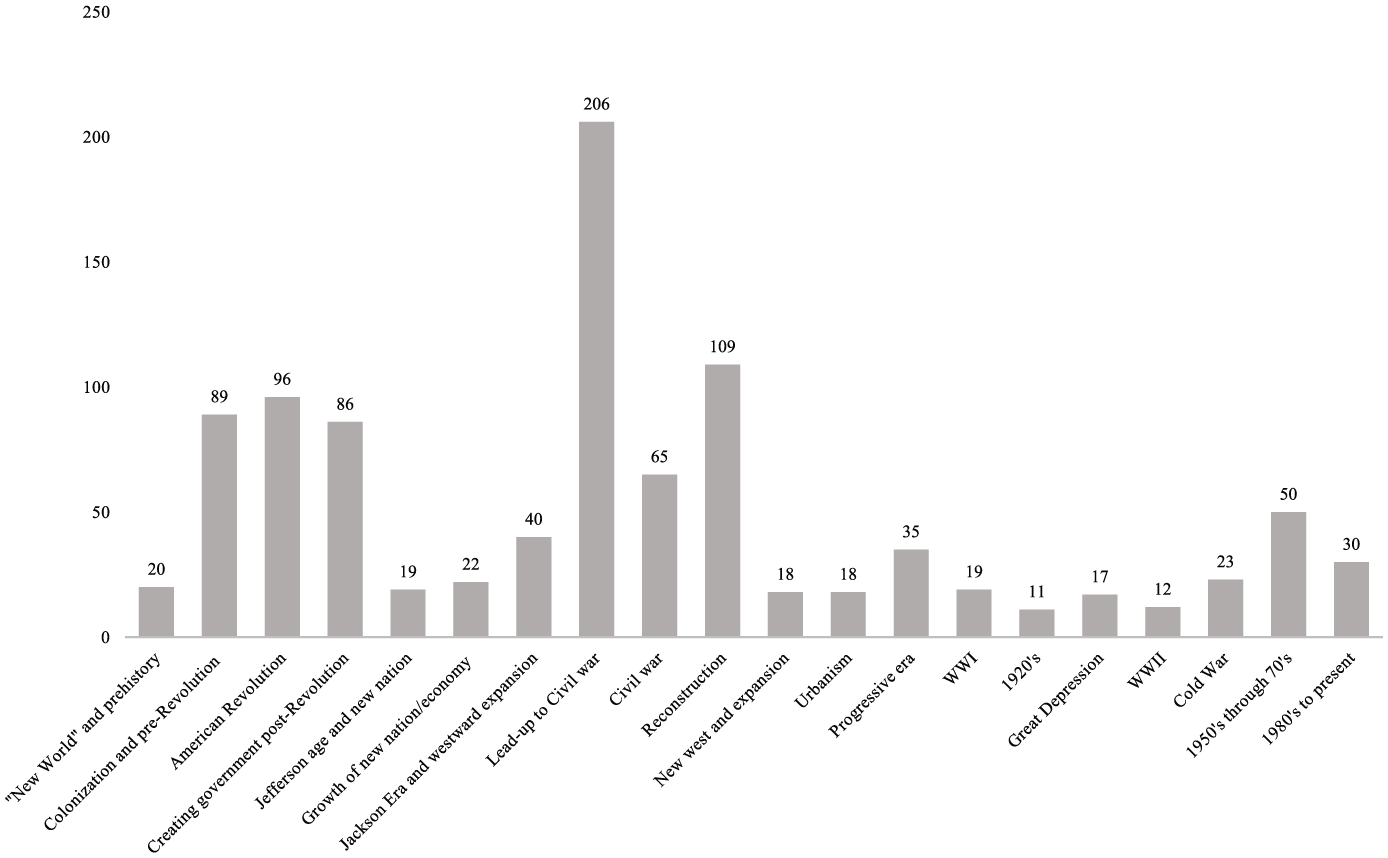
Number of mentions of ‘freedom’ in each time period.
The American Revolution era – including the ‘Colonization and pre-Revolution’, ‘American Revolution’ and ‘Creating a government post-Revolution’ – make up 27.5%, the second-largest portion of ‘freedom’ discussion in the textbooks. Whereas the Revolutionary War era and the Civil War era combined account for 66.1% of the overall mentions of ‘freedom’ in the textbooks, there is a drop off in discussion after the Civil War in the late 19th century through the present. 1
Figure 2 shows periods of history described as relating to ‘positive’ pursuits of ‘freedom’ – gaining ‘freedom’ – versus ‘negative’ descriptions – losing or taking away ‘freedom’. While there are no periods of history where the ‘negative’ count is greater than ‘positive’, the period of history with highest count of ‘positive’ discussions of ‘freedom’ was ‘Colonization and pre-Revolution’, followed by ‘Creating a government post-Revolution’.
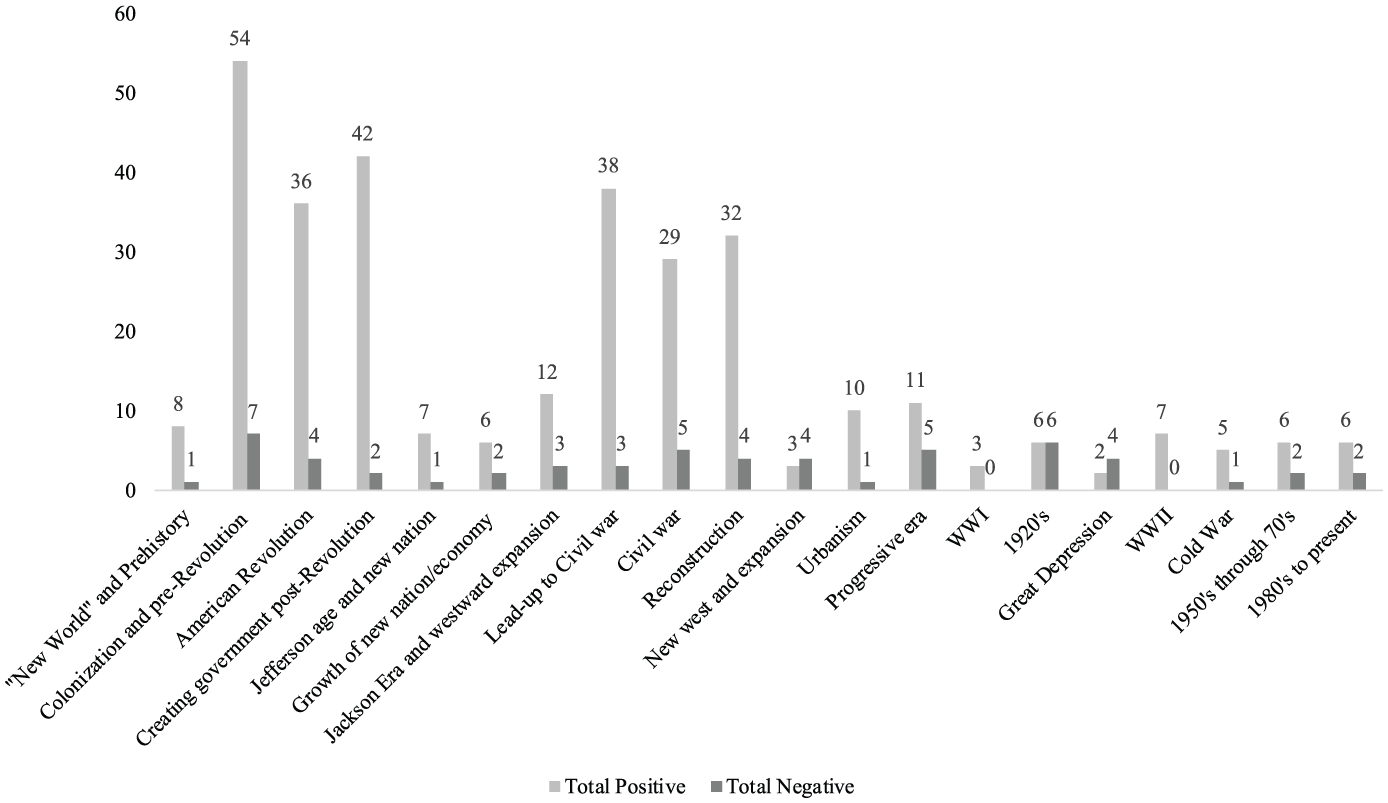
Positive versus negative mentions of ‘freedom’ in each time period.
The association between ‘positive freedom’ and the Revolutionary War era is a theme throughout the textbooks. At times, ‘freedom’ is considered something of the Revolutionary War itself, for example, ‘The Revolutionary War ideals of freedom and liberty inspired some white Americans to question slavery’ (AJ 175). Elsewhere, it is described as an event which caused ‘freedom’: ‘Perhaps the greatest effect of the Revolution was to spread the idea of liberty, both at home and abroad’ (PP 137). It is even credited with bringing about ‘freedom’ later in history: ‘The Revolution established important ideals of liberty and equality. In later years, these ideals of the Revolution would encourage women to campaign for equal treatment – and eventually to win it’ (AN 186).
Who has ‘freedom’?
Table 6 shows the number of times each ‘group’ is mentioned as having ‘freedom’ or as not having ‘freedom’. Quantitatively, ‘slaves’ and ‘African Americans’ make up the most mentions in both categories. They were the only groups even mentioned as ‘not having freedom’. 2 And counterintuitively, both groups are mentioned more times as ‘having freedom’ than they are mentioned as ‘not having freedom’. Such a stark imbalance of having, versus not having, ‘freedom’ promotes an overly optimistic vision of the past.
Who has ‘freedom’: Groups.
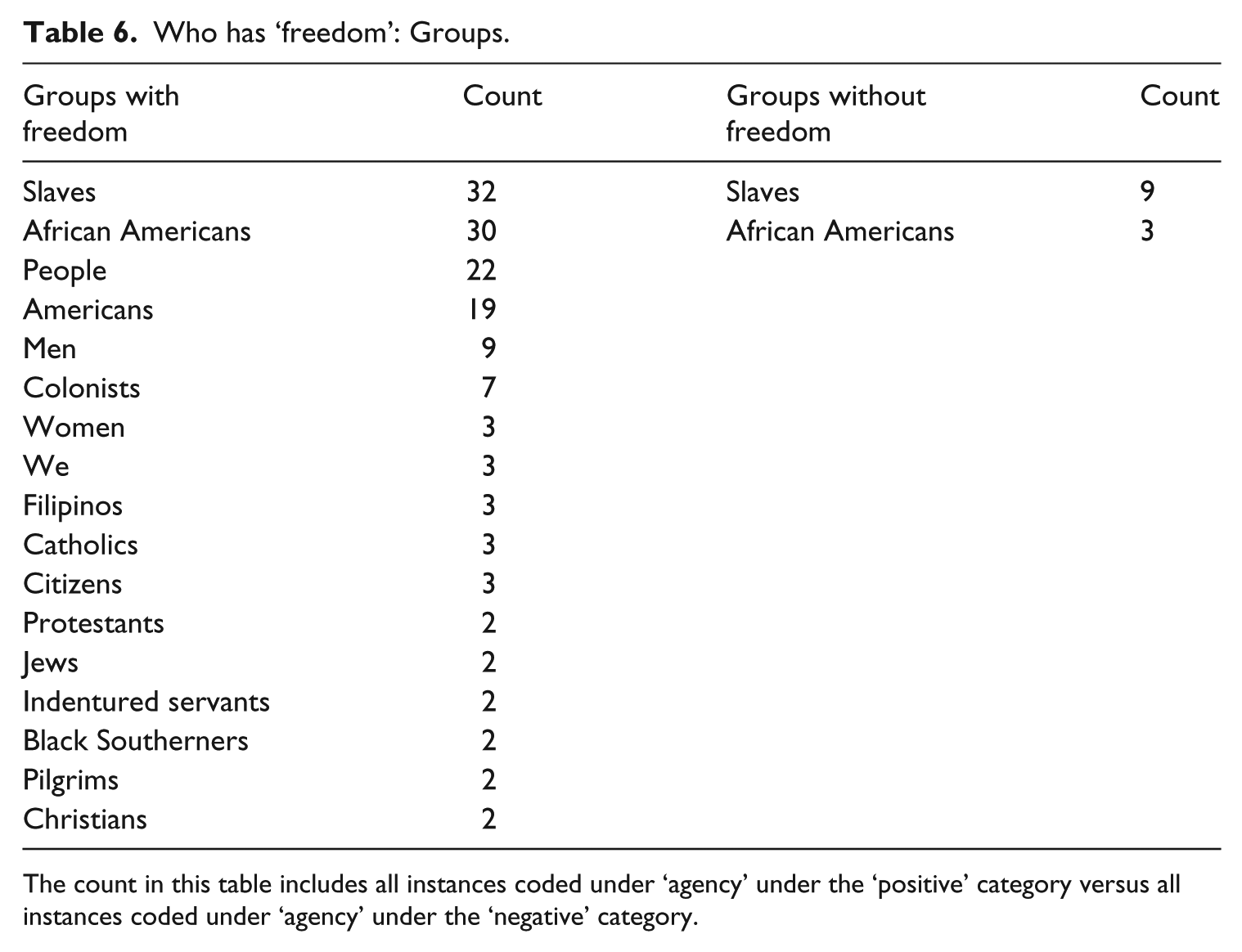
The count in this table includes all instances coded under ‘agency’ under the ‘positive’ category versus all instances coded under ‘agency’ under the ‘negative’ category.
The frequent description of ‘slaves’ as having ‘freedom’ is oxymoronic; by definition, the condition of slavery indicates the opposite of ‘freedom’. Because the textbooks describe individuals as ‘slaves’ even after they ‘were freed’, the conditions of slavery and ‘freedom’ are not presented as opposites. For example, ‘These Democrats warned that Republican policies would bring a flood of freed slaves to the North. What’s more, they predicted that these freed slaves would take jobs away from whites’ (PP 393).
The exclusion of any substantial discussion of groups lacking ‘freedom’ obscures the significant impact of domination and violence over subordinated groups throughout the nation’s history. Macherey (1966) claims that literature ‘exists above all by its determinate absences, by what it does not say’, and in the case of these textbooks, a lack of representation through discussion in the literature not only reflects a manifested social structure but also works to obscure transparency regarding a history of oppression (p. 172). Not only does Table 6 show a high count of ‘freedom’ for ‘slaves’ and ‘African Americans’ but also coding for ‘definition’ showed ‘free’ used as an adjective for those groups more than it was paired with any other term. ‘Free African Americans’ occurred 64 times, and ‘freedmen’ – a term to describe former slaves – occurred 57 times. To this extent, the extreme quantity of discussion of ‘freedom’ for ‘slaves’ and ‘African Americans’ is experienced as an over-compensatory measure, or what Cole (2007) would classify as a shallow attempt at historical reconciliation.
These shallow attempts also recall Apple’s (1993) notion of ‘mentioning’ where existing socio-political power structures are reproduced when ‘a small and often separate section is included on “the contributions of women” and “minority groups”, but without any substantive elaboration of the view of the world as seen from their perspectives’ (p. 56). Furthermore, the absence of the discussion of a real lived experience means ‘“black people have been made Orwellian non-persons” through “omissions, distortions, and paternalistic put-downs”’ (Bennett, 1967 cited in Eagles, 2017: 95). The retelling of the story of race in America without an honest depiction of lived experiences is a violence ‘initiated by those who oppress, who exploit, who fail to recognize others as persons’ (Freire, 1970: 55). The format of erasure of oppressed groups’ lived experience in these textbooks answers Freire’s (1970) earlier proposition to understand how racial groups are dialectically framed – in this case, as non-persons (p. 96).
This study’s findings reflect Epstein’s (2009), where efforts to reconcile the violent past have resulted in textbooks which ‘credit the nation with having done more to dismantle rather than perpetuate inequality’ (p. 7). Through repetition of terms like ‘freedmen’ or ‘freed slave’, or an exaggerated presentation of ‘positive’ discussions of ‘freedom’ for enslaved groups, the authors of the textbooks produce ‘historical amnesia’ where ‘the elite denied the excluded groups’ knowledge of their own past victimization by the powerful’ through an ‘airbrushed white narrative’ (Eagles, 2017: 2; Moreau, 2003: 338). Fraser’s (1989) analysis of ‘needs talk’ provides insight into the process of obscuring a history of struggle. She explains that groups possessing unequal resources compete to establish their respective interpretations of social needs as the hegemonic narrative. Under such conditions, the dominant groups tend to either exclude counter interpretations or co-opt them into their own narrative (p. 166).
Such measures of retrospective optimism fail to connect the relationship between some groups’ ‘freedom’ to other groups’ subordination, such that within current political discourse, the ‘real struggles that produced the country’s institutions remain opaque’, leaving students without a clear understanding of how the institutions developed, thus making it ‘equally difficult to imagine the circumstances and conditions required for their reform and improvement’ (Rana, 2010: 7).
What is ‘freedom’?
Table 7 shows terms and phrasing paired with ‘freedom’ in the language of the textbooks. Most often, ‘freedom’ is described as an ‘endpoint’, including phrases such as ‘route to freedom’, ‘future of freedom’, ‘goal of freedom’, ‘promise of freedom’ and other phrases locating freedom in the future. There are hardly antonyms given for ‘freedom’, the only example that occurred on more than one occasion was ‘slavery’.
What is ‘freedom’: Definitions.
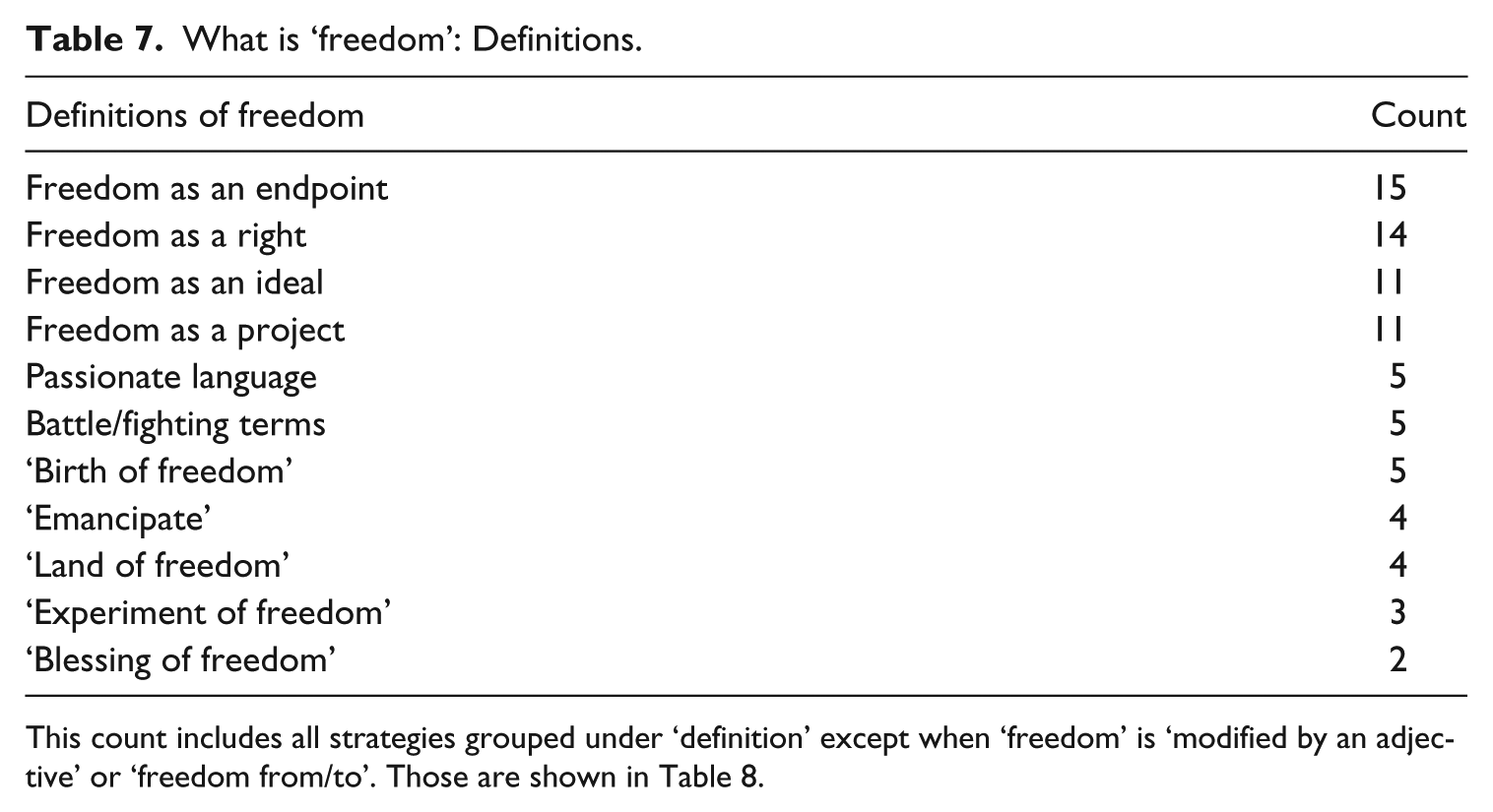
This count includes all strategies grouped under ‘definition’ except when ‘freedom’ is ‘modified by an adjective’ or ‘freedom from/to’. Those are shown in Table 8.
This sense of an inevitable future of ‘freedom’ exhibits a framework that Bowden considers essential to the logic founding imperialist agendas of empire. The West’s history of imperialism fundamentally assumes ‘that human history … is a story of linear progress toward a certain point or end’ (Bowden, 2009: 6). Western imperialism requires that the progress of universal civilization is contingent on spreading democracy, and America specifically has a vision that its national experience is ‘the universal model that all societies are destined to follow’ (Anghie, 2004: 284).
The textbooks additionally frame ‘freedom’ as a ‘right’. Some examples, such as, ‘Lord Baltimore came to fear that Protestants might try to deprive Catholics of their right to worship freely’, clearly indicate that taking away rights is an attack on ‘freedom’ (AN 114). However, this premise is confused by much of the discussion in the textbooks. On several occasions, ‘African Americans’ or ‘slaves’ are described as ‘free’, even when they have no rights, again undermining the dichotomy between ‘slavery’ and ‘freedom’ and the connection between ‘freedom’ and ‘rights’. For example, ‘Now that black southerners were free, would the races have equal rights?’ (PP 425).
For ‘slaves’, often the textbooks used ‘emancipation’ and ‘freedom’ interchangeably, yet one book makes a conceptual distinction: ‘Black leaders knew that emancipation – physical freedom – was only a start. True freedom would come only with economic independence, the ability to get ahead through hard work’ (PP 428). This indicates a story of ‘freedom’ for ‘African Americans’ that has its own set of qualities, where to qualify as having ‘freedom’ necessitates only having ‘physical freedom’, and is separate from ‘rights’.
Table 8 shows that freedom of religion is the most mentioned type of ‘freedom’, followed by freedom of speech and freedom of the press – the first three ‘freedoms’ mentioned in the First Amendment of the Bill of Rights. It is significant that the number of mentions of freedom of religion is much higher than speech or press. Christians seeking freedom of religion is framed in the textbooks as a pillar of American colonization and a trait making American society ‘exceptional’, for instance, ‘It was not easy for people to practice religion freely in Europe during the 1500s’ (AN 93). As a result, Despite many hardships, the newcomers made their colony succeed. Unlike the Jamestown colonists or the Spanish, they sought neither gold, nor silver, nor great riches. What they wanted most was to practice their religion freely. Years later the founders of Plymouth become known to history as the Pilgrims. (AN 93)
What is ‘freedom’: Types.
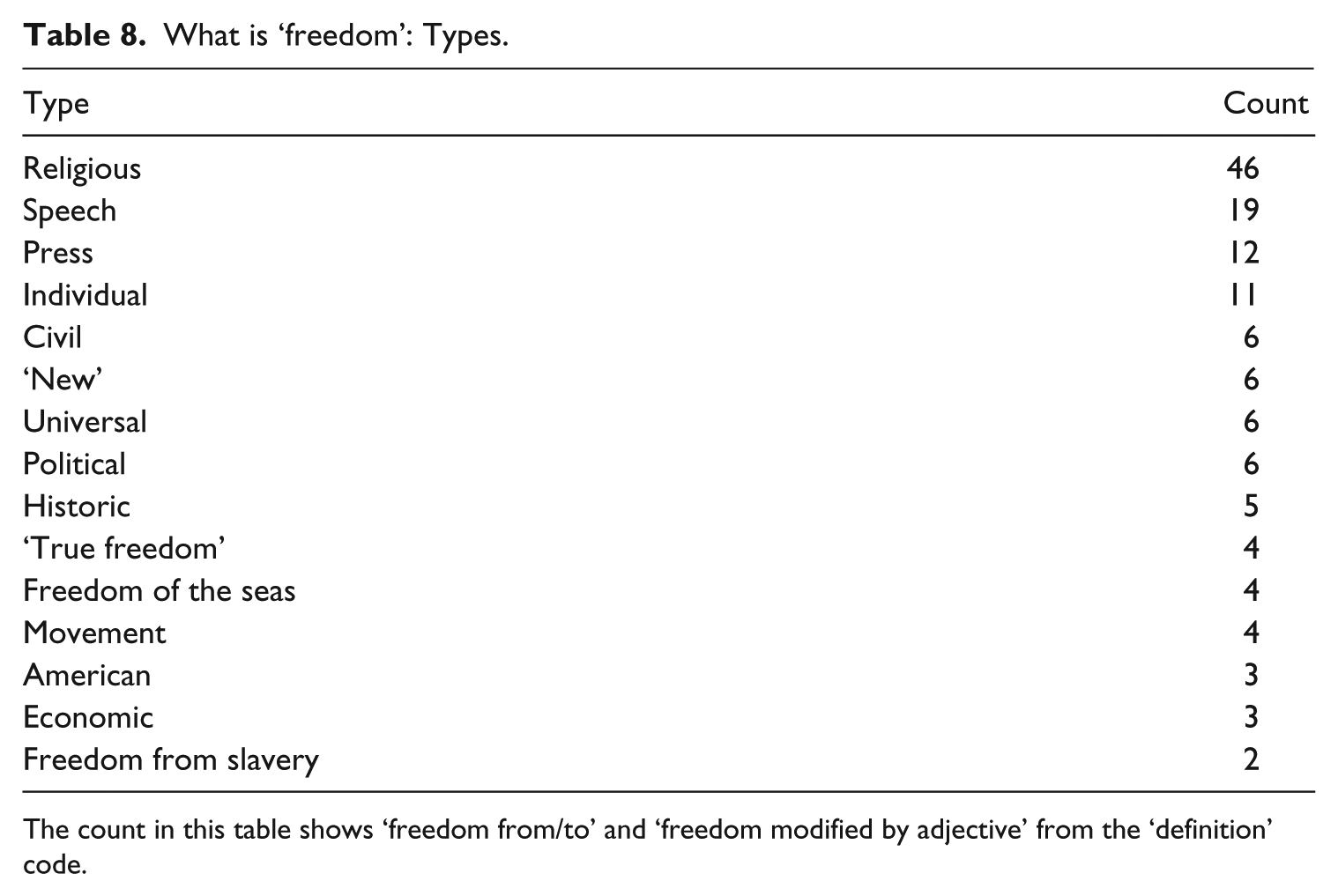
The count in this table shows ‘freedom from/to’ and ‘freedom modified by adjective’ from the ‘definition’ code.
That book continued to describe the lasting legacy of the Pilgrims’ experience in the formation of American society, where ‘the Pilgrims’ desire to worship freely set an important precedent, or example for others to follow in the future … In time, the idea of religious freedom for all would become a cornerstone of American democracy’ (AN 96). Such an emphasis on Christianity fits with the demographic makeup of Americans where 70.6% of Americans identify as some denomination of Christian (Pew Research Center, 2015c). Furthermore, religion plays a much larger role in American society than in other countries that are economically similar; 54% of Americans say that ‘religion was very important in their lives’ compared to the next wealthiest economy represented in the survey, Canada (24%; Gao, 2015). Investigating the role of religious freedom in these textbooks is a job for further research, for a view into the center of American society.
How is ‘freedom’ achieved?
Even though Table 6 showed that ‘slaves’ and ‘African Americans’ in effect ‘have freedom’ more times than any other group represented, in most of these examples, they are not the agents of their own journey. Table 9 shows that this phenomenon is not limited to ‘slaves’ and ‘African Americans’; overall, passive voice occurred more times than active voice in the description of ‘freedom’ as it applied to groups of people. For all groups except ‘Americans’, passive voice was used more times than active voice.
How is ‘freedom’ achieved: Groups with and without agency.
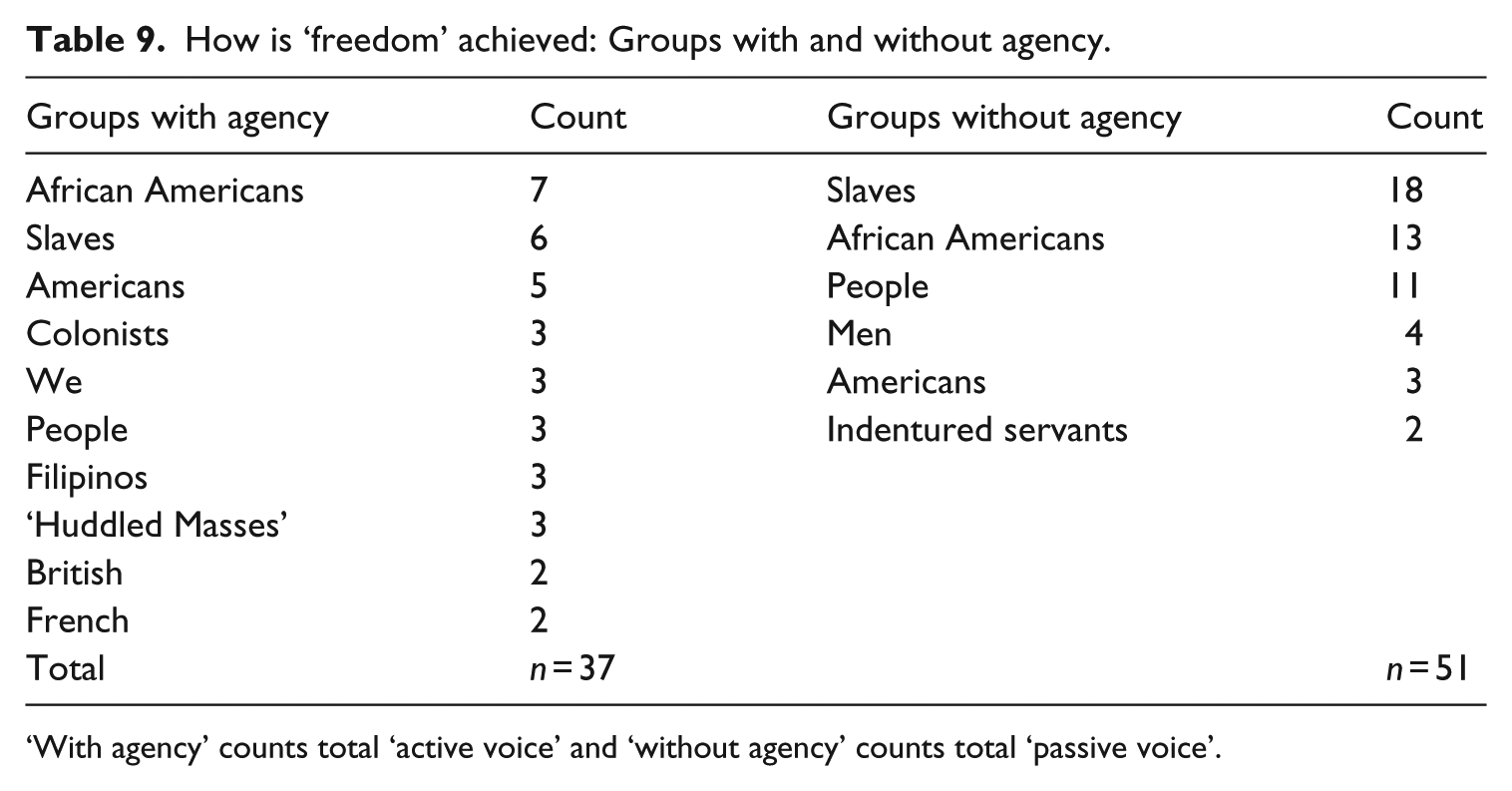
‘With agency’ counts total ‘active voice’ and ‘without agency’ counts total ‘passive voice’.
Fairclough (1989) indicates that passive voice represents the obfuscation of agency and causation in language, often leaving unanswered, ‘how did freedom come about?’ With passive voice, the cause or means by which ‘freedom’ ‘was gained’ is unclear in the textbooks, with sentences such as ‘Usually, slaves were people who had been captured in war. Slaves were part of a community and treated as servants. Most were enslaved for a specific period of time and then became free again’ (AN 84). Rendering African Americans in the textbooks as passive actors, as Fanon (1952) explained, ‘the black man has to wear the livery the white man has fabricated for him’ without the agency to be credited for one’s own narrative (p. 17). A phrase like ‘became free again’ provides no explanation for who or what had agency in any political or social change and fails to explain how they became slaves in the first place. Loewen’s (2007) research also found passive voice to be a common linguistic strategy in textbooks serving to insulate historic individuals from blame or accusations of unheroic and unethical behavior (p. 18).
Because the use of passive voice obscures the unfolding of events, Table 10 considers only active voice and controls for ‘type’ of subject as well as ‘positive’ or ‘negative’ language. ‘Groups’ are shown to have the most agency as well as specifically the most positive agency. ‘Governments/nations’ are described as having the most negative agency, in other words, they are depicted most often as preventing or disrupting ‘freedom’. This outweighs the number of times that ‘governments/nations’ are depicted as contributing positively to ‘freedom’. Note that no specific individuals or groups were listed more than once as having negative agency over ‘freedom’, but instead, as indicated in Table 11, ‘government’ as a figure and the New Deal were described as having control over harming ‘freedom’. For instance, Some critics … say that New Deal programs hindered economic progress, threatened American free enterprise, and encouraged inefficient use of resources … Some people believe that the New Deal violated the free-market system that Americans have traditionally cherished. (PP 782)
How is ‘freedom’ achieved: Type of subject.
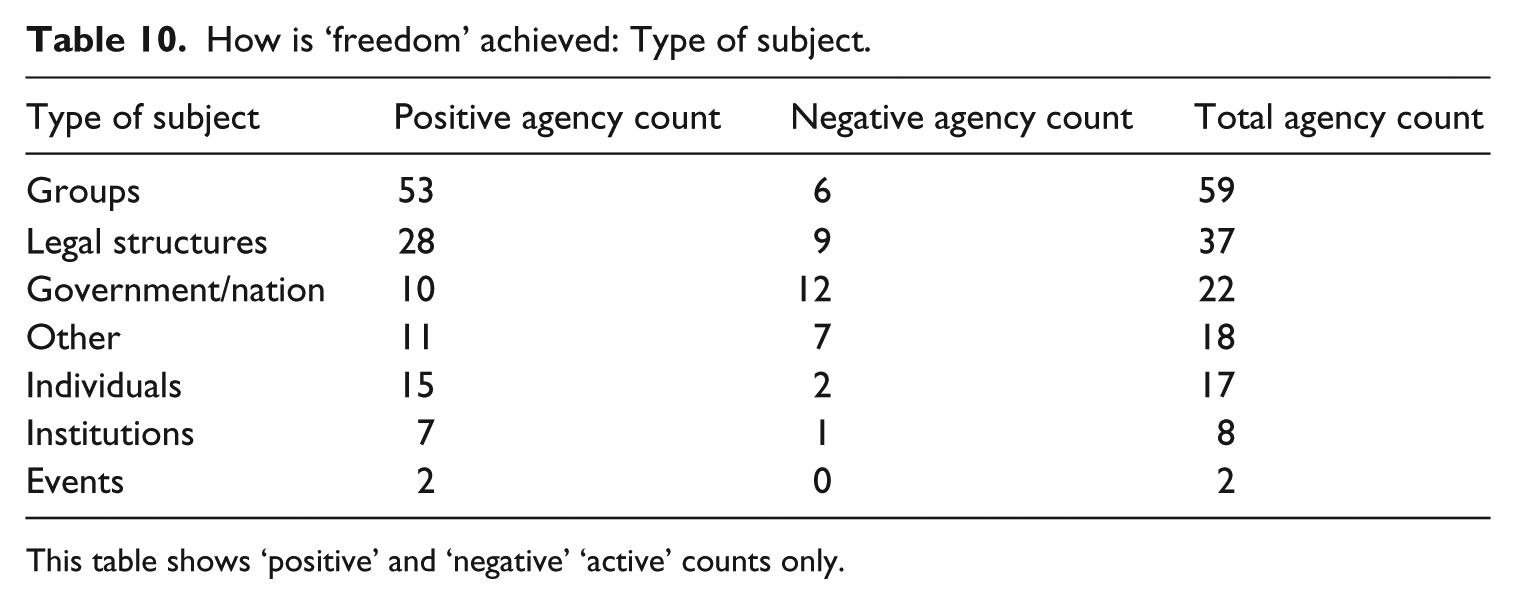
This table shows ‘positive’ and ‘negative’ ‘active’ counts only.
How is ‘freedom’ achieved: Type and name.
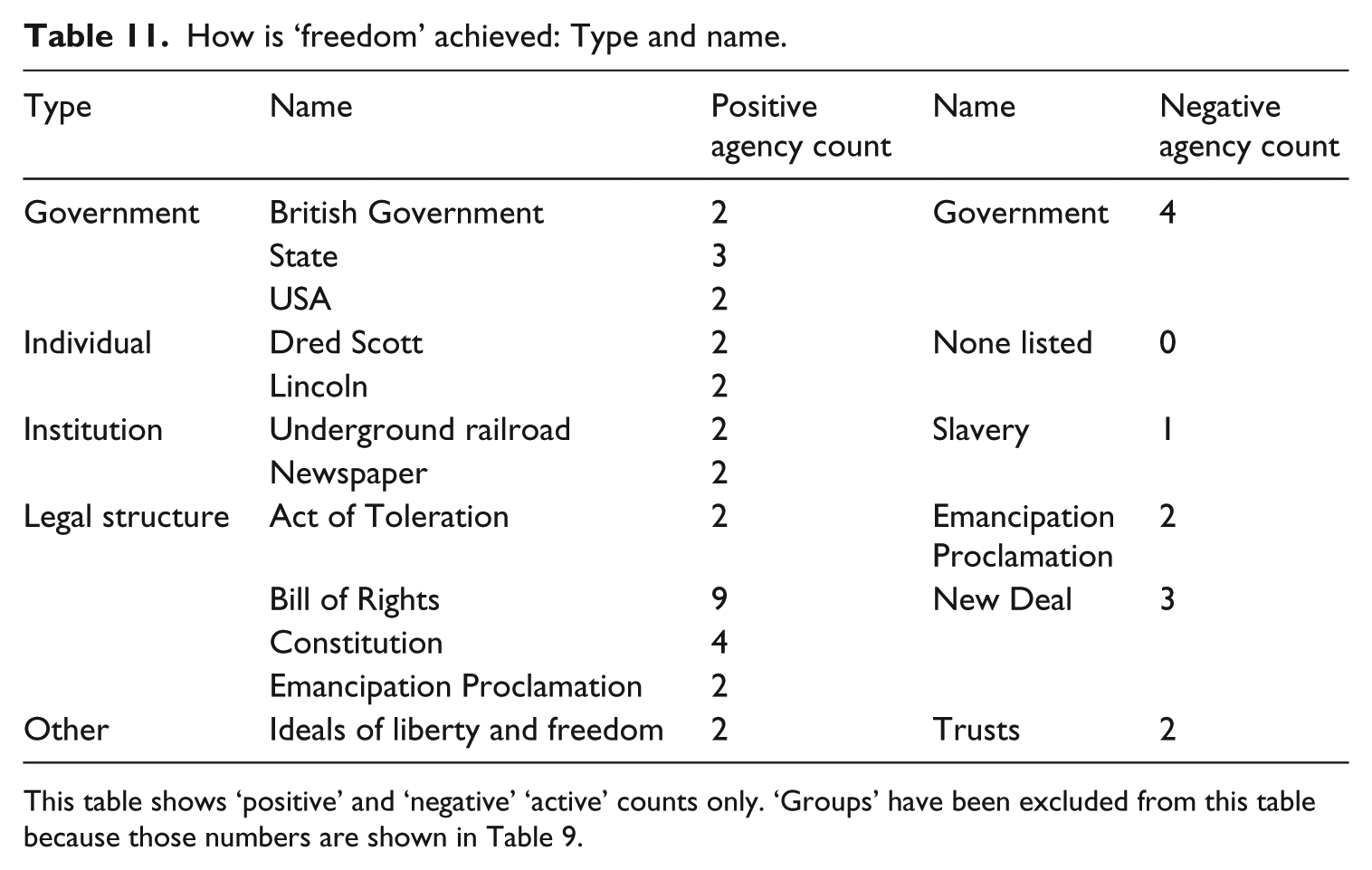
This table shows ‘positive’ and ‘negative’ ‘active’ counts only. ‘Groups’ have been excluded from this table because those numbers are shown in Table 9.
Through such expressions of negative agency, students are taught to be skeptical of the role of the New Deal, or governing forces, in general: ‘Many people worried about the increased power of government. They complained that the government was intruding in people’s lives, threatening both individual freedoms and private property’ (AN 762). This rhetoric of government skepticism fits with an overall American attitude, where only 19% of Americans said they could trust the federal government in 2015 (Pew Research Center, 2015a).
The use of modal verbs like ‘could be’, ‘would be’ and ‘should be’ further display the ongoing theme of obscured causation. Instead of explaining the realities of slavery, one book skipped ahead to an unexplained conclusion by stating, ‘The conflict between liberty and slavery would not be resolved until the 1860s’ (AN 123). Rather than providing a nuanced explanation, which would transfer understanding of the impact of social, political and economic decisions and policies, political processes of resolution and change are skimmed over, arriving at a conclusion like the following: America still had a long way to go to make the promises of freedom a reality for all its citizens, black and white. But emancipation laid the necessary groundwork, and a united and democratic United States was free to fulfil its destiny as the dominant republic of the hemisphere – and eventually the world. (AP 477)
This passage, in addition to expressing a future-oriented resolution, conveys an overall sense of American exceptionalism, which ‘reinforces the inevitability and legitimacy of governing practices’ by presenting resolution as ‘gifts from mythic founders – outside the bounds of popular contest or continued struggle’, instead of explaining the impact of large-scale collective events and institutions (Rana, 2010: 6). Ultimately, the risk is that without an explanation for cause and effect, students come away lacking ‘the ability to think coherently about social life’, the context to reflect on conditions in the present or the tools to formulate grounds for making changes in the future (Loewen, 2007: 7).
Further discussion
The telling of history in an overly optimistic light serves to reproduce the existing social structure, offering no grounds for students to obtain an understanding of current social issues or how they may go about addressing them. While the textbooks repress any enduring agitation about socio-political inequality, encouraging a passive contentment with the American project, they simultaneously encourage students to act on this optimism, rendering it the students’ duty to perpetuate ‘freedom’ as a value in the project of American ideological empire. Frequently using second person to address their readers, they convey messages like, As Americans, you have the right to speak freely, to worship as you choose, to vote, and to serve on juries. These rights are not based on inherited wealth or family connections. They are yours because you are a citizen. Still, nothing is free. As you will see, if we want to enjoy the rights of citizenship, we must also accept its responsibilities. (AN 265)
These strategies work to reproduce ‘freedom fighting’ citizens by identifying ‘responsibilities’ that come with American citizenship in the above example or ‘lessons’ such as ‘Freedom, in other words, does not maintain itself. We must all commit ourselves to its preservation by working to understand and participate in the events around us’ (PP 1149). Or, reaching beyond national borders to envision a world order founded in American-style ‘freedom’, with statements like ‘At the dawn of the twenty-first century, America again beckons the world to join in the common cause of freedom’ (AN 898). Such direct addresses to the readers ideologically summon a ‘we’ and produce motivation around the concept of ‘freedom’, crafting the story of American history as a global vision centered around ‘freedom’ itself.
Limitations and further research
After reading through all four books, and with the findings from the ATC (2015), Loewen (2007) and Moreau (2003), the textbooks prove consistent in terms of content, tone, style and perspective. Therefore, the textbook sample used in this study indicates reliability, but a larger sample would extend scope and validity. Further studies might examine other terms like ‘equality’, ‘rights’ or ‘independence’, and similar methods and research questions could also be applied to other textual sources such as political speeches, newspapers or even museum and historic sites.
In addition, these findings cannot confirm the ‘effect’ of the rhetoric on the readers of the textbooks. The interpretation of the language and its effects does not intend to undermine and ignore the agency and critical capacity of students. Because CDA attributes power to language, further research could study classrooms and student responses in order connect students’ interpretations with the content of the textbooks.
Conclusion
This research asked: what meaning of ‘freedom’ is produced in the discourse of US history textbooks? ‘Freedom’ was most often discussed in relation to the Revolutionary War and Civil War eras. Most often, ‘freedom’ was associated with discussions of ‘slaves’ and ‘African Americans’; presented as a future outcome, a right or a characteristic of the First Amendment; and attributed to convoluted causes, actions or entities. Furthermore, the books employed first and second person to ideologically engage the student readers in their messages about ‘freedom’ as it pertains to American citizenship.
The findings show that overall, the language building a story of ‘freedom’ exhibits two trends. First, there is a pattern of obfuscated agency, causality and a frequent use of passive voice. Second, overly optimistic descriptions of the history of ‘freedom’ are presented in conjunction with framing ‘freedom’ as an inevitable future outcome. Such language has the effect of creating confused stories of oppression, liberation and struggle as they relate to pursuits of ‘freedom’, so that students will not come away from the story with a clear understanding of social/political actions and consequences. The language aims to pacify the violent ruptures of history while instilling in students a sense of duty to ‘freedom’ as a cause and value worth furthering – even if its meaning is not fully clear. At a time when American identity and ideology is being called into question, the findings of this study can be used to mobilize an effort to re-think the national story that we tell, and therefore live out.
Footnotes
Declaration of conflicting interests
The author(s) declared no potential conflicts of interest with respect to the research, authorship, and/or publication of this article.
Funding
The author(s) received no financial support for the research, authorship, and/or publication of this article.