







Abstract
Both scholars and practitioners are frustrated by the complexity of United Nations Security Council reform. Most research on the reform process is situated within international relations, and almost no attention is granted to the discursive dimensions of the reform. This article approaches democracy promotion as a governmental rationality within the United Nations, and it traces how this governmentality is co-constituted and negotiated discursively in the reform debate. The analysis focuses on argumentation and topoi in statements from debates about reform during 2015 to 2016 by two groups: The Group of Four and The Uniting for Consensus. The analysis demonstrates how the two groups utilise a topos of majority and a topos of equality, respectively, and how the groups thereby in different ways co-constitute and negotiate the governmental rationality of democracy. Through this, the article unravels the subtle ways in which the rigidity of the reform process is co-constituted through discourse.
Keywords
Introduction
This paper explores the discursive struggle (Fairclough, 1989) of United Nations Security Council (UNSC) reform at the intersection of critical discourse studies (Fairclough, 2013; Van Dijk, 1993) and international governmentality studies (Walters, 2012). This debate is understood as a matter of ongoing negotiations of a governmental rationality of democracy within the UN (Haack, 2011). The paper demonstrates how two groups, the G4 and the UfC, utilise the same governmental rationality of democracy to pursue different agendas. Through a meticulous argumentation analysis that focuses on topoi (Reisigl and Wodak, 2009) the paper demonstrates how the G4 mainly rely on topoi that invoke a realist version of the governmental rationality of democracy, whereas the UfC rely predominantly on a topos that invokes an idealist version of the governmental rationality of democracy. The manner in which discourses on reform differ in how they rely on either realism or idealism is often subtle because they are part of the same democracy governmentality in the UN. Through this, the empirical aim of the paper is to increase awareness of the inevitable role of discourse in the reform debate, whereas the methodological aim is to contribute, firstly, with a globally oriented perspective on research connecting up discourse studies and governmentality studies (McIlvenny et al., 2016) and, secondly, with an answer to calls for more studies at the intersection of discourse studies and international relations (Lorenzo-Dus and Marsh, 2012)
The debate about a reform of the UNSC is shaped by a number of alliances. This paper is concerned with the positions of the Group of Four, the G4 (Brazil, Germany, India and Japan), that argue for a reform that assign permanent membership of the Council to the G4 members and to two unspecified African countries, and the Uniting for Consensus, the UfC (led by Italy, Pakistan, Argentina, Mexico and South Korea 1 ), that wants to double the amount of non-permanent members from ten to twenty and exclude expansion of the permanent membership. The disagreement between the G4 and the UfC prominently concerns a structural reform of the UNSC: the issues of the permanent/non-permanent seats, the size of an enlarged council, and the question of the veto. To a high extent, the deadlock in the reform debate is due to the G4 / UfC disagreement, and, by implication, an eventual reform relies on increased understanding of this impasse in global governance (Karns et al., 2015).
Review of relevant literature
Studies of UNSC-reform are informed by International Relations (IR), but also draw on Studies of International Politics (IP), International Diplomacy (ID), International Organisation (IO), and International Law (IL). IR-scholars either call for a structural reform (Langmore and Thakur, 2016; Mahbubani, 2014; Schwartzberg, 2003), or for a reform of the UNSC’s working methods (Hassler, 2013; Lee, 2011; Nadin, 2016). UN experts Weiss, Luck and Daws point out the centrality of that question, and note that no reform has occurred since 1965 because of the interests of major powers and sub power’s regional rivalries (Daws, 2005; Luck, 2016; Weiss, 2011). Scholars of judicial (IL) and organisational aspects (IO), comment on the structure/working methods divide but analyse mainly the instrumentality and potential of the UN charter (Slaughter, 2005) and the structure of the UN at-large (Falk, 1998; Hosli and Dörfler, 2017), and whether or how these two essential aspects of the UN can or do prevent or promote a reform of the UNSC. Studies from IR, IL and IO do not attend to the discursive dimension of the debate, and, by implication, there is a lack of research oriented towards how the different reform-alliances legitimate their reform-positions through carefully constructed arguments.
Studies focused on the political (Einsiedel et al., 2015; Klabbers, 2010; Mingst et al., 2017) and interactional dimensions (Hurd, 2008; Paul, 2017) of UNSC-reform come closer to the focus of the present paper. Hurd, for example, has called for research into how reform proposals and their underlying rationales are being legitimised through language and has shown that countries are ‘insincere’ when defending their reform agendas (Hurd, 2008: 213). It is not uncommon to speak of insincerity in countries’ strategic operation in international politics (Smith, 2006; Soussan, 2008). Kissinger labelled this phenomenon constructive ambiguity (Isaacson, 2013). Friedman (Friedman, 2017) elaborates on Kissinger’s term, and points to the utilisation of evasive language in international negotiations which, on the one hand, secures room for manoeuvrability (p.385), but, on the other hand, ‘[serves] the interests of the side who wields hegemonic power’ (p. 398). No claim is made in this paper about a hegemonic status of the discourse of the G4 or of the UfC. Rather, taking inspiration from Haack’s (2011) insights into the dominance of democracy promotion in the UN, we see the debate as co-constituted by this ‘discourse of promoting democracy’, and we suggest that the struggle on reform discourse can be usefully approached as an ongoing negotiation of a governmental rationality of democracy.
Foucault suggests that governmentality, or ‘the conduct of conduct’ is, ‘acting upon an acting subject or acting subjects by virtue of their acting or being capable of action’ (Foucault, 1983b). Accordingly, studies of governmentality are mostly concerned with the more ‘local’ levels of governance in which individuals or subjects are called upon to govern their own conduct in the school or at work or where citizens conduct their conduct as citizens. This paper, however, is oriented to a different level of more dispersed ‘global’ governance. We draw on insights from international governmentality studies (Walters, 2012), and, simultaneously, we see our work as a response to a call ‘for studies of a range of mentalities of international rule hitherto largely ignored’ (Larner and Walters, 2004). At the same time, we aim to follow Kendall (Kendall, 2004) and counter any dichotomised conceptualisations of scales of action and power. Consequently, we understand political governance as an ongoing phenomenon that is accomplished and negotiated in different networks, that is, in various, contingent and continuously accomplished longer and shorter connections of both human, material, social and semiotic character. Thus, rather than focusing on the who and the loci of government, we explore how a governmental rationality of democracy is made thinkable and practicable by UN diplomats.
On the basis of this local/global caveat, it should be safe to outline our understanding of studies of governmentality in slightly more generic terms. The governmental mode of governing, or the ‘conduct of conduct’ is inextricably linked to Foucault’s idea that power is exercised only in the presence of freedom (Foucault, 1983a), or, as Rose (Rose, 1999) has expressed it ‘To govern humans is not to crush their capacity to act, but to acknowledge it and to utilise it for one’s own objectives’. (p. 4). Naturally, in order to get people to ‘freely’ govern themselves in accordance with certain governmentalities, this mode of governing is co-constituted by ongoing processes of rationalisation which prominently unfold in discursive interaction. This is based in the insight that discourse is key for all sorts of negotiations of the legitimations or rationalisations that co-constitute different subject positions cf. e.g. (Berger and Luckmann, 1967; Jayyusi, 1984; Van Leeuwen, 2007). Furthermore, or, we should suggest, by implication, governing through the conduct of conduct is inevitably linked to all sorts of ‘counter-conduct’ in which the governed ones maintain and participate in the governing in and through their very resistance of it. Foucault (1997) points out that power and resistance or conduct of conduct and counter-conduct are co-constituting phenomena, and he defines counter-conduct as ‘the will not [to] be governed thusly, like that, by these people, at this price’ (p.75) Disregarding the apparent necessity to acknowledge counter-conduct in studies of the conduct of conduct, most studies of governmentality do not consider this co-constitutive relationship of power and resistance in much detail. Death (2010) however, has done extensive work on the notion of counter-conduct in studies of governmentality as he adapts Dean’s (2010) framework for an analytics of government and suggests that protest movements, such as protests in relation to global summits, can be usefully studied through four regimes of practices, namely fields of visibility created by the protest, forms of knowledge relied upon by protesters, technologies and apparatuses mobilised by protestors and subjectivities and identities produced by the protest (p. 240). 2 As such, Death presents a fairly systematic approach to the study of counter-conduct, and whereas he focuses on the more subtle details of the interdependent relationship between governmentality and resistance (he observes how the protestor wearing Nike shoes while kicking a Nike sign embodies this relationship (p. 238)), the protests themselves represent an obvious empirical site of resistance. In contrast, this study concerns the much less sedimented, omnipresent phenomenon of resistance in that we conceive of conduct of conduct and counter-conduct as mutually accomplished phenomena in the reform discourses – as we analyse our data, we approach the governmental rationality of democracy as constituted, maintained and challenged in and through the diplomats’ work to establish their respective proposals as the more democratic alternative. 3
In our understanding of a governmental rationality of democracy as simultaneously accomplished and negotiated discursively in the statements of the G4 and the UfC, we conceptualise discourse as commonly done within Critical Discourse Analysis (CDA). Fairclough (1992) points out that discourse and society are dialectically related, and that any ‘discursive event’ should, accordingly, be seen as a three-dimensional phenomenon in which text, discursive practice and social practice are interdependent, co-constitutive aspects. This insight is paralleled by the observation that all discourse studies should orient to textual description, to interpretation of the discursive practices and to explanation of the social practices which the ‘discursive event’ co-constitutes/is co-constituted by. In other words, CDA sees discourse as inevitably intertwined with context, and, by implication, CDA studies are most often informed by various grand and middle-range social theories in order to provide important concepts for the explanatory analysis of the social practice (Khosravinik, 2010). In this study, then, studies of governmentality provide the useful concepts through which we will connect up the ‘descriptive’, analytical findings at the textual level and the ‘explanatory’ social practice-level. 4
The governmental rationality of democracy
As a consequence of the UN’s democracy agenda (Haack, 2011), member states present their statements about UNSC reform as a means of promoting democracy, either explicitly, or by adhering to an international governmental rationality of democracy emphasising liberal values such as increased inclusion of the developing world, international equality, human rights and promotion of peace. The argument that any reform must decrease inequity has been internalised by all participating actors who ‘simply will not be convinced of the merits of any competing claim’ (Nadin, 2016). Acting in opposition to the governmental rationality of democracy can result in exclusion as was the case with the Iranian President Mahmoud Ahmadinejad, whose attack on western policies prompted a walk-out from the GA. Recently, it happened to the Venezuelan vice-president Delci Rodriguez (Charbonneau, 2011; Evansky and Shaw, 2019; Hannam, 2011).
The promotion of democracy is a dominating legitimation strategy throughout the international system, for instance in the EU, UN, WTO, NATO and IMF (Clark, 2009; Franck, 1992; Haack, 2011; Mayall, 2000). Furthermore, no one country can officially denounce support for a reform of the UNSC (Jaeger, 2010; Schaefer, 2017). The inevitability of such rationales means that all reform positions emphasise how they promote democracy. As we demonstrate how this governmental rationality of democracy is discursively maintained and negotiated to promote conflicting reform agendas, we illuminate an inevitable dimension of the practice of UNSC-reform legitimation (Hurd, 2008) and, thus, argue for the necessity of attention towards discourse in analyses of what constitutes global governance (Weiss and Wilkinson, 2018).
Data
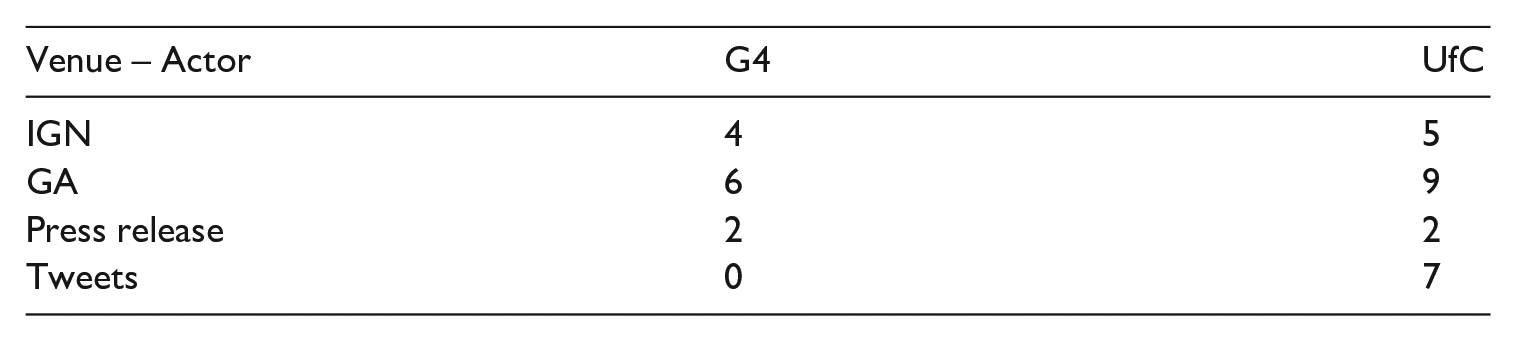
The data consists of texts from 2015 to 2016 UN General Assembly. The assembly celebrated both the 70th UN anniversary and the 50th anniversary of the only UNSC-reform from 1965. The lead up to the GA included brewing optimism for a breakthrough in the reform process (Gowan and Gordon, 2014; Pace, 2015). We collected statements from both the G4 and the UfC from the designated forum for UNSC-reform debates, namely the Intergovernmental Negotiations (IGN), in which diplomats (though more or less explicitly) speak on behalf of their respective alliances. The IGN is closed to the public, but the participating countries can make their statements public. In addition to IGN statements, we included statements from open debates on UNSC-reform in the General Assembly. Finally, the Italian delegation to the IGN have, to a lesser extent, live-tweeted from the closed IGN-meetings, and we have included these tweets in our corpus. The following schema shows the origin of the amount of statements.
Methodology
We utilise the notion of topoi (Reisigl and Wodak, 2001) as it is suggested in relation to ‘discursive strategies’ (Reisigl and Wodak, 2009) within the branch of CDA known as the Discourse-Historical Approach (DHA). In DHA, discursive strategies are seen as the ‘more or less intentional plan of practices (including discursive practices) adopted to achieve a particular social, political, psychological or linguistic goal’ (Reisigl and Wodak, 2016: 88). Following Zagar (2010), however, we strive to do a slightly more rigid type of argumentation analysis than what is, perhaps, the case in some DHA-studies. In particular, we follow Zagar and initiate our analysis with a clear reconstruction of the arguments under study to provide a transparent analysis of both the argument and the topos which, supposedly, connect the premise and the conclusion. 5 In this endeavour, we follow Møller Nielsen (Møller Nielsen, 2016) as we provide a charitable reconstruction (pp. 80-92). Clearly, everyday reasoning or, in our case, political/diplomatic reasoning, do not meet the same criteria for logical validity as does the logical syllogism, and, just as importantly, neither should it meet these criteria since everyday as well as political interaction transcend the realm of the strictly deductive. Hence, when we make the reconstructions, we do our best to read the arguments charitably, to acknowledge that they are both ‘topic-related and field-dependent’ (Reisigl, 2014: 77), and to make the reconstruction from within this particular realm: we attempt to present the, logically speaking, best possible version of the argument. In the second step of our analysis, however, we assess the argument normatively (see, for instance, Møller Nielsen, 2016; Reisigl, 2014; Zagar, 2010). Standardly, in this part of the analysis, DHA discusses soundness/fallaciousness (e.g. Reisigl, 2014: 9), but we suggest that this critical part of the analysis can be nuanced through the lens of governmentality studies, and, in particular, through the notions of conduct of conduct and counter-conduct. Hence, whenever the G4 or the UfC utilise topoi that rely on a somehow ‘questionable’ logic, we do not understand it as a subversive or necessarily ‘evil minded’ attempt to promote an unsubstantiated reform-proposal; rather, we understand it as a counter-conductive attempt to maintain, utilise, and subtly re-define the governmental rationality of democracy of the UN. In order to point out how the UfC and the G4, respectively, contribute to the construction of the overall governmental rationality of democracy, the below argumentation analysis Draws from Toulmin (1995), and meticulously re-constructs more or less implicit premises, conclusions and warrants. In our reconstruction, we provide two columns: one with the literal wording and one with our interpretation of the meaning. The reconstruction of the arguments first considers the logical validity, and, secondly, assesses the argument normatively, that is, considers the ‘soundness’ of the argument. In more detail, the normative analysis concerns an evaluation of the more general topos behind the more specific warrant in terms of governmentality, namely as a matter of conduct of conduct and counter-conduct: In order for this warrant to be true, what topos do we have to agree on? How can the utilisation of this topos as a ‘true place’ be seen as doing counter-conductive work?
Analysis
In the present UNSC, ten seats are up for election and five are permanent seats. Roughly stated, the main disagreement in between the G4 and the UfC is that whereas the G4 want to increase the numbers of both electable and non-electable seats, UfC only want to increase the number of electable seats. Since both the G4 and the UfC present their respective reform-proposals as the rational and moral route to a properly representative democratic council, the starting point of our analysis is that both alliances maintain the governmental rationality of democracy. Similarly, however, we aim to show how the two alliances not only contribute to the maintenance of this governmental rationality, but simultaneously negotiate it in different ways: Whereas the G4 conceptualise representative democracy as properly based in realist notions of resourcefulness (importantly, we understand resourcefulness as including economy, military power, global influence, capability and proven willingness to be involved), the UfC conceptualise representative democracy as a model that should be based in a liberal understanding of equality. To unravel this co-constitutive relationship in between conduct and counter-conduct, our analysis consists of two parts. In the first part, we focus on the G4 discourse on reform in order to demonstrate how the G4 construct representation as (properly) based on resourcefulness, utilising topoi of majority and pars pro toto. In the second part, we focus on the UfC to demonstrate how the UfC construct representation as (properly) based on equality, utilising a topos of (in)equality.
A realist promotion of representative democracy
The G4 believe that a reformed council should reflect the current distribution of global power: the size of countries as well as their influence and resources. 6 Accordingly, the G4 discourse constructs democratic representation as properly based on resourcefulness and thus promotes a realist ideology, namely one suggesting that all countries cannot, and should not, participate or be members in the UNSC; rather the most resourceful individual countries can, and should, represent the will of many countries.
As we demonstrate below, the G4 prominently present their agenda as one that is supported by the majority of UN member states. Therein they simultaneously construct and negotiate the governmental rationality of democracy. Firstly, since majority rule is the most common decision-making approach within democratic systems, it appears self-evident that the proposal supported by the majority is democratically right. Secondly, whatever the content of that proposal is, it is, by implication, reflecting the more democratic alternative. Thirdly, since the content suggests a form of representative democracy based on resourcefulness, the governmental rationality of democracy is necessarily negotiated towards a more realist ideology. It should be noted that the G4 do not, factually, represent the majority (Swart and Pace, 2015). In other words, when the G4 claim to represent the majority, they mitigate or leave out the aspects of their reform agenda that conflict with those of other major alliance groups (whose reform agendas resemble that of the G4), mainly the African Group. 7 Hence, to the extent that the G4 succeed in constructing representative democracy as properly based on resourcefulness, it is due to their successful reliance on a topos of majority; that is, due to their success to construct their proposal as, by and large, supported by a majority.
Our analysis of the G4 discourse on reform consists of two parts. In the first part, we show how the G4 invoke the notion of representation as properly based on resources, and in the second part we, more specifically, demonstrate how this notion of representation is supported by the topos of majority rule.
Focusing on the G4 notion of representation, our first example stems from a statement by Akhbaruddin, India’s permanent UN representative/ambassador (PR), at the IGN, as he addresses the debate about categories of membership and regionalisation.
8
Akhbaruddin reacts to the outcome of the IGN of the 69th GA,
9
a paper wherein most member states (122 out of 193) opted to re-present their positions on UNSC-reform. Akhbaruddin’s reaction to this document can also be seen as an interdiscursive action toward a renegotiation of how the UN’s charter
10
stipulates the ‘principle of sovereign equality of all its members’ (Article 2(1)). The charter might invoke views of representative democracy based not on resourcefulness, but on equality. Consequently, the G4 need to re-negotiate the notion of representation:
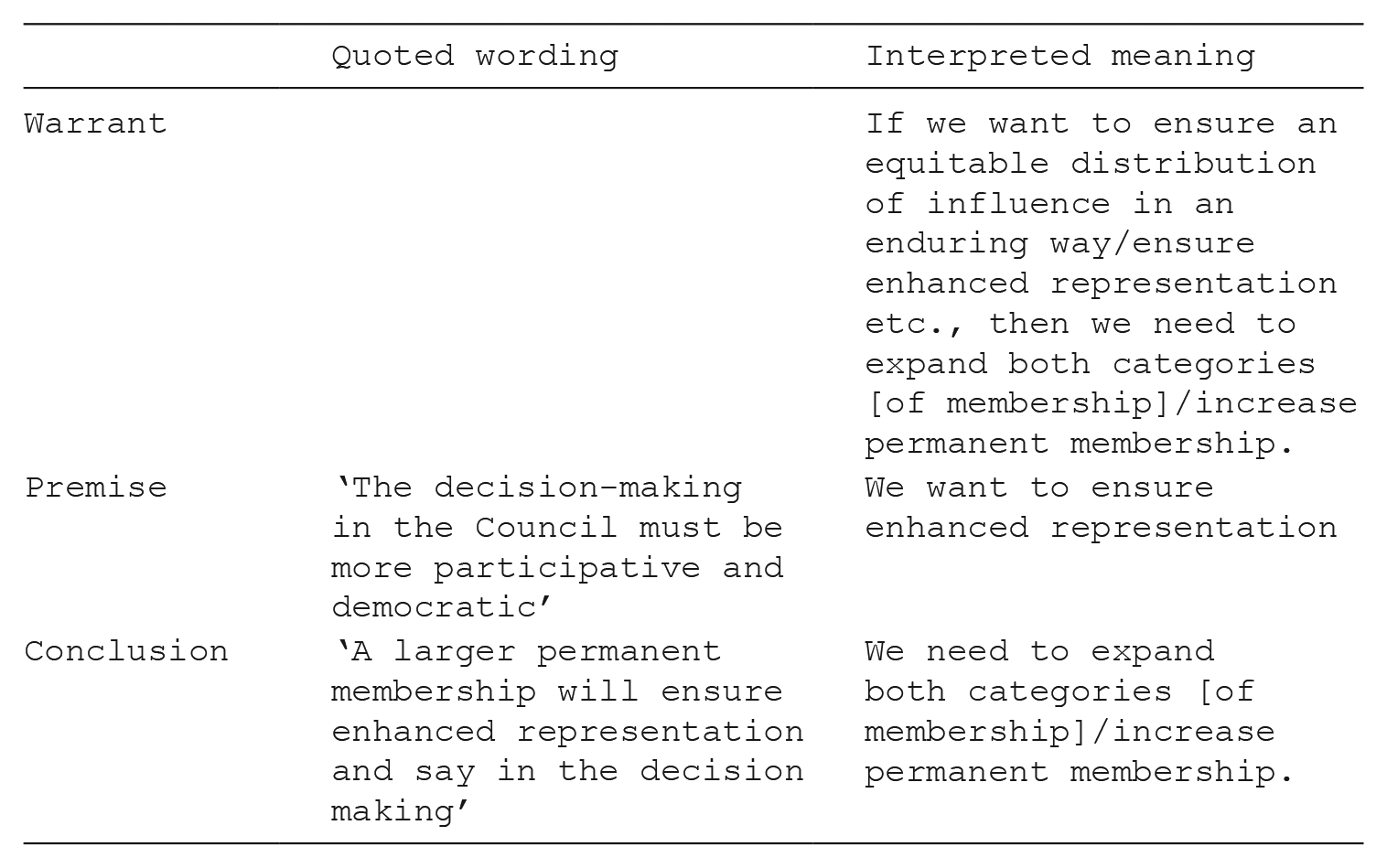
The argument is prefaced by a certain wording of the governmental rationality of democracy, namely ‘The decision-making in the Council must be more participative and democratic’, that unambiguously invokes the argument as a negotiation of the governmental rationality of democracy. Considering this, it is clear that whereas the re-constructed version of the argument is logically valid, it is arguably possible to contest the ‘soundness’ of the warrant; that is, the topos of ‘equitable distribution = enhanced representation’. In particular, it is possible to understand it as a counter-conductive attempt to negotiate the governmental rationality in a way in which representation is seen as an important issue, and, moreover, as meaning regional representation. Further, it should be noted that representation is conceptualised in this way ‘ensure enhanced representation and say in the decision making from the regions, and members which are currently not represented or under-represented compared to their role and input so far’, namely as regional representation. ‘[R]ole and input’ here appears to refer to countries with impactful (regional) roles and proven records of input, and such countries might be exactly the G4 countries that are known to contribute substantially to the UN: In 2015, Brazil, Germany, India and Japan were placed 12th, 4th, 37th 11 and 3rd respectively.12,13 Through this emphasis on impact and status, the quote enhances the realist ideology in the G4 discourse on reform.
The second part of our G4-analysis concerns how the notion of representation is supported by a topos of majority. In the last open GA debate about UNSC-reform, Patriota (Brazil’s PR) emphasises the notion of the G4 as representing the majority in a negative format:
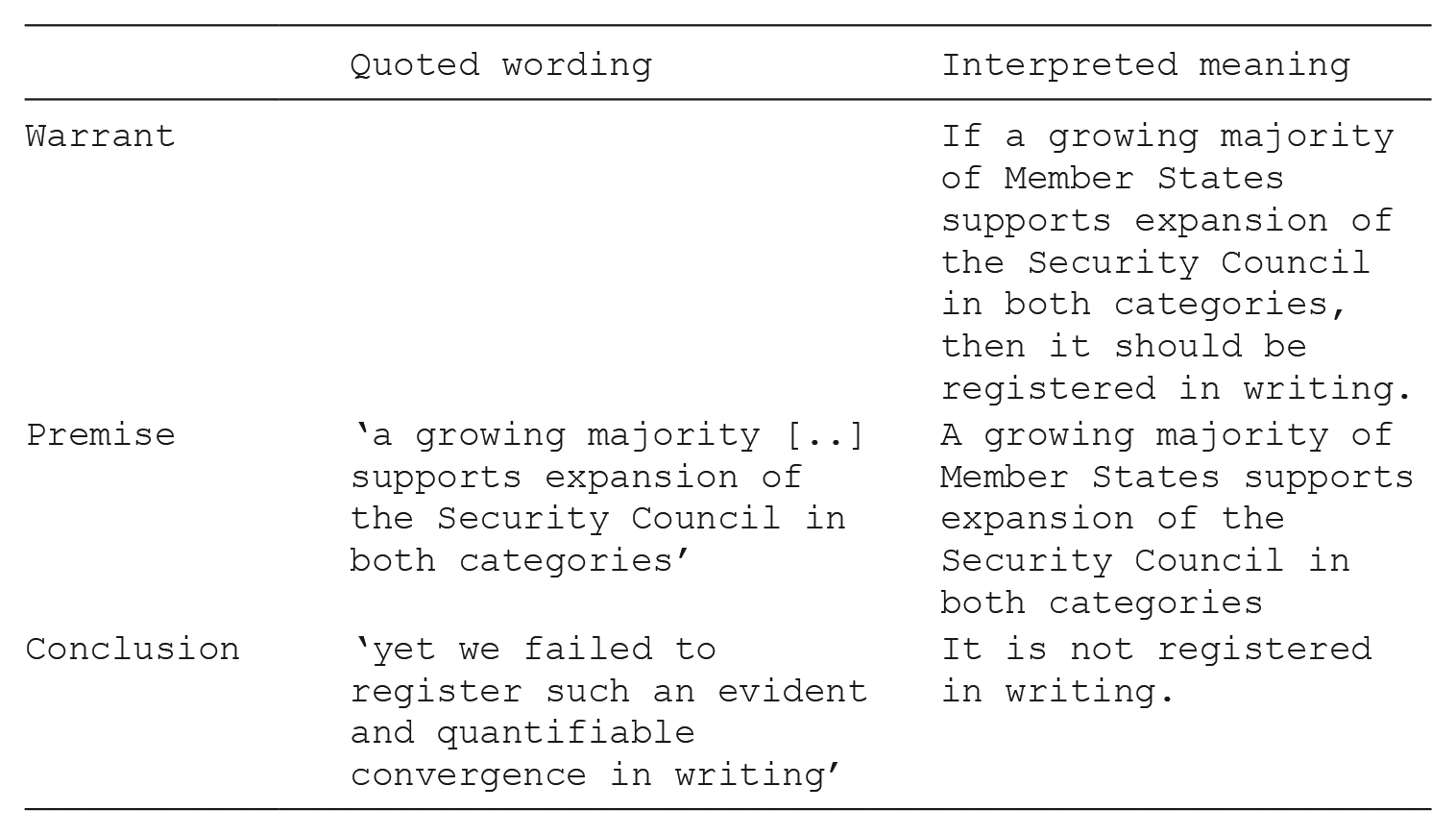
Clearly, this is an invalid argument: According to the modus ponens structure, the conclusion should have been ‘this should be registered in writing’. Arguably, this invalid argument is utilised to demonstrate the invalidity of the situation; that is, the fact that the growing support for expansion is not reflected in writing. Since the warrant is not explicitly stated, this invalidity of course relies on our reconstruction. However, we would argue that our reconstruction is soundly based in two observations. Firstly, the preface ‘It is obvious to any observer that’ is utilised as an intensification strategy that emphasises the trueness of the premise. Secondly, the conjunction ‘yet’ (initiating the conclusion) invokes the contrast to the premise; it invokes the understanding that the conclusion should not be the case. Accordingly, the warrant can be re-constructed on the basis of what is observably represented as a true premise and a false conclusion. Furthermore, we hear the warrant to invoke the topos of majority: if a majority wants something, this should be the case, and, as such, the argument comes off as negotiating the governmental rationality of democracy in a way that promotes majority rule, rather than, for instance, equality. 14 Once again, the quote invokes a realist approach to democracy as majority is here identical with the resourceful and able G4 countries.
We would like to end our G4-analysis with an example of how the G4 notion of representation is also supported by a topos of pars pro toto. At the IGN, Akhbaruddin constructs the veto debate in a way that emphasises application of the veto instead of delegation of the veto. Both aspects are part of the reform debate about the veto, but the prominently idealist issue of delegation is usually more central in the IGN. Particularly, Akhbaruddin outlines two schools of thought, one that calls for limitations on the use of the veto and one which opposes restrictions:
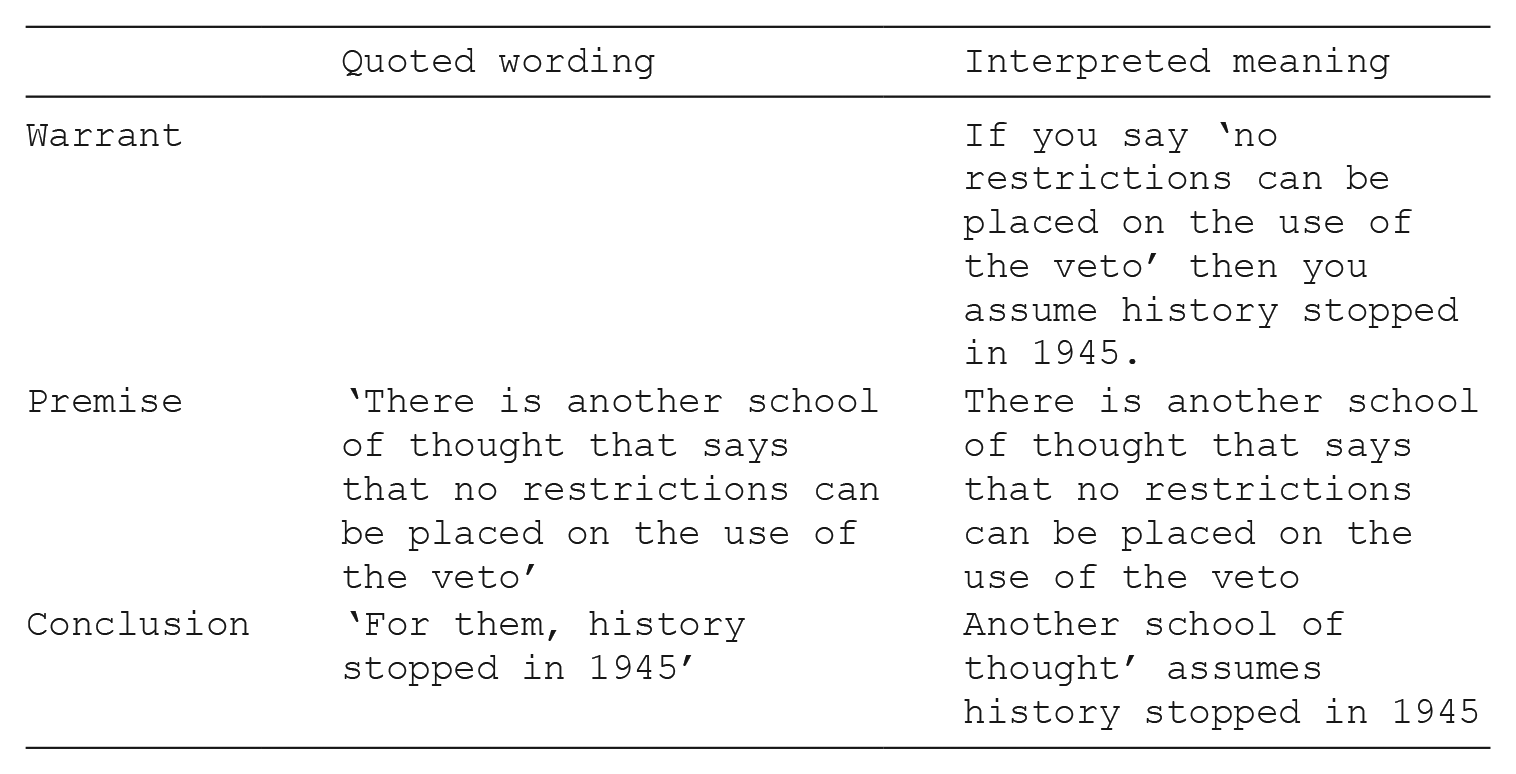
Whereas it is possible to provide a reconstruction of this argument in which it is logically valid, it should, of course, be noted that this logic is utilised in order to emphasise the fallaciousness of the argument; that is, in order to emphasise that the argument does not properly consider the topos of history (the common-sense assumption that it is wise to learn from history). In more detail, the argument could be said to intensify or even exploit the topos of history when it points out that it is a necessary consequence of the statement that ‘no restrictions can be placed on the use of the veto’, that history stopped in 1945. Whether or not people agree on the importance of one or the other of the listed historical events, it is difficult to imagine that anyone (particularly, we would like to add, any ‘school of thought’ within the UN system) would claim that the events simply did not happen. Thereby the argument utilises the common-sensical status of the topos of history in order to demonstrate that ‘another school of thought’ is arguing ad absurdum. In the end of the quote, the ‘fallaciousness’ of the reasoning of ‘another school of thought’ is further emphasised as it is suggested that if the majority does not like this reasoning, then it is ‘so much worse for the majority’. Hence, the quote utilises the sound logics of the topos of history and the topos of majority in order to construct the reasoning of ‘another school of thought’ as obviously fallacious. Or, as we would put it, also this quote comes off as negotiating the governmental rationality of democracy in a way that promotes majority rule.
To further degrade the position of this other school of thought, Akhbaruddin utilises mechanisms of othering and presents it as an ‘out-group’ (Van Dijk, 1997), ‘For them, history stopped in 1945. To them, all subsequent changes [. . .]’ (emphasis added). As such, Akhbaruddin could be heard as drawing on a pars pro-toto-topos: He manages to speak of a dimension of the veto-topic that could be seen as a more unproblematic part of the overall veto-topic: application of the veto. Yet, by framing the issues of application of the veto as being, essentially, a battle ground about racism and plurilateralism against multilateralism, he appears to criticise the P5 countries; those who possess veto rights and defend the system’s exclusivity (plurilateralism). Nonetheless, he could also be heard as bringing up the difference between the G4 and the African Group concerning the veto. The G4 are more flexible concerning delegation of the veto (they are open to permanency without the same veto rights as the P5), whereas the African Group want the same veto rights as the P5. The critique however, is subtle, because it appears illogical to place the African Group (wherein South Africa is a powerful voice) as ignorant of ‘anti-apartheid’. 15 Nonetheless, is it noteworthy, because it is a major problem for the G4, that the African group is opposed to a second-tier veto system in which new permanent members come to possess a restricted veto prerogative. Consequently, a renegotiation of the governmental rationality that frames the discussion (democracy), by invoking a democracy discourse through a pars-pro-toto-topos can be a way of applying diplomatic pressure on the African group.
The reliance on realism in Akhbaruddin’s statement is subtly implied by reference to the majority: ‘The majority may not like it; so much the worse for the majority’. As we have mentioned, the G4 does not represent the majority, but claim to do so by way of right vis-à-vis their resourcefulness and influence, and the G4’s utilisation of the majority topos is, by implication, closely linked to their realist reform discourse.
An idealist promotion of representative democracy
The UfC discourse constructs representation as properly based on equality and promotes an idealist understanding of a representative democratic council, namely one suggesting that all countries should have equal opportunities to participate or be members in the UNSC. The UfC see representation as a matter of equality – disregarding resources, or lack thereof. As many states as ‘possible’ should have a seat for themselves, and to mitigate the fact that a limited number of states can have a seat at the same time, more seats should be up for election. The UfC in various ways construct this notion as one that benefits the majority, and in this construction, they prominently utilise a topos of (in)equality
Italy is the unofficial leader of the UfC, and the Italian statements on behalf of the UfC effectively represents the collective agenda of the group’s members. In the 2015 and 2016 assembly, Italy’s PR was Sebastiano Cardi, and in the first open GA-debate on UNSC-reform, Cardi constructs representation as a matter of the willingness of countries to play more prominent roles in the council:
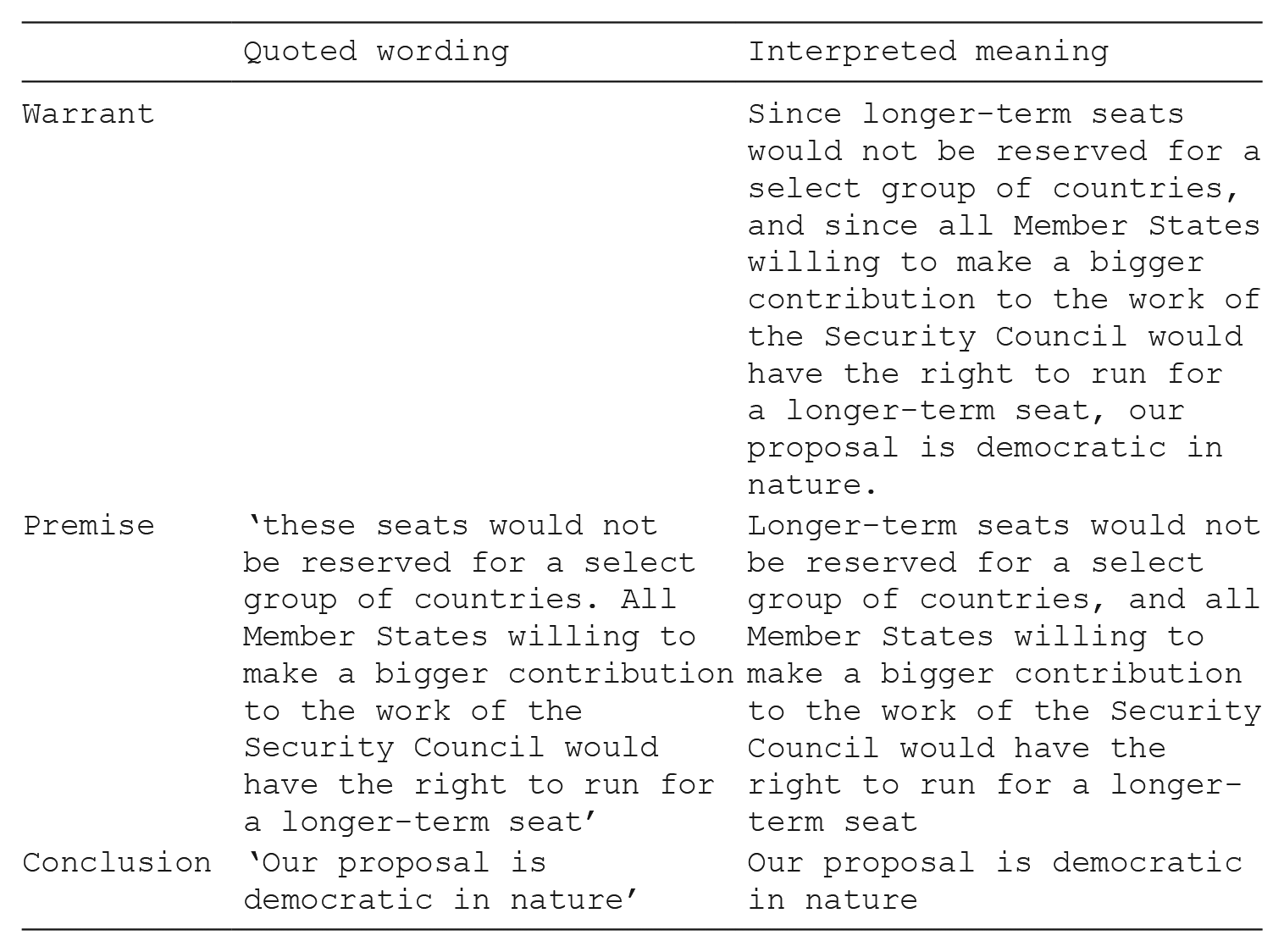
The warrant comes off, quite literally, as a particular topos of democracy, namely as a topos of democracy as naturally (‘in nature’) founded on principles of equality. The preface to the argument invokes an intertextual reference to an opposite argument, when it is stated that ‘No one has asked them to forfeit their willingness to play a greater role in the Council’. This comes off as a rebuttal to the often-proposed argument that the UfC-proposal would hinder an increased contribution from ‘some Member States’ (our emphasis); or that since the UfC-proposal does not include more permanent seats, it does not provide substantial opportunity for countries aspiring ‘to play a more prominent role in the Council’. In ‘some Member States’ ‘some’ comes off as a quantitative pronoun that refers only to a part of the Member States. Remarkably, in the premise, ‘some’ is replaced with the distributive pronoun ‘all’ in ‘all Member States willing to’ and as such it is emphasised that the UfC-proposal is concerned with the interests, the willingness, of the entire UN-membership. Furthermore, it should be noted that Cardi invokes an understanding of representation as based on a question of whether a state is willing to contribute or not. Willingness is for states themselves to decide and, as such, an internally qualified predicate, whereas ability relies on the judgement of others, making it an externally applicable predicate. This emphasis on intent, rather than on resources, strengthens a particular notion of representative democracy, namely that everyone who wants to participate should have equal opportunities for doing so; that is, we suggest the quote negotiates the governmental rationality of democracy in a way that first and foremost promotes equality. 16 From an idealist perspective on equality, countries should not be granted rights based on their power (such as the G4’s realism suggests); rather, equality is a right for all in all contexts – including the right to play a bigger role in the UN.
In a similar vein, at the third IGN-debate, focusing on the question of the veto, Lambertini (Italy’s DPR) presents an argument relying on a topos of inequality:
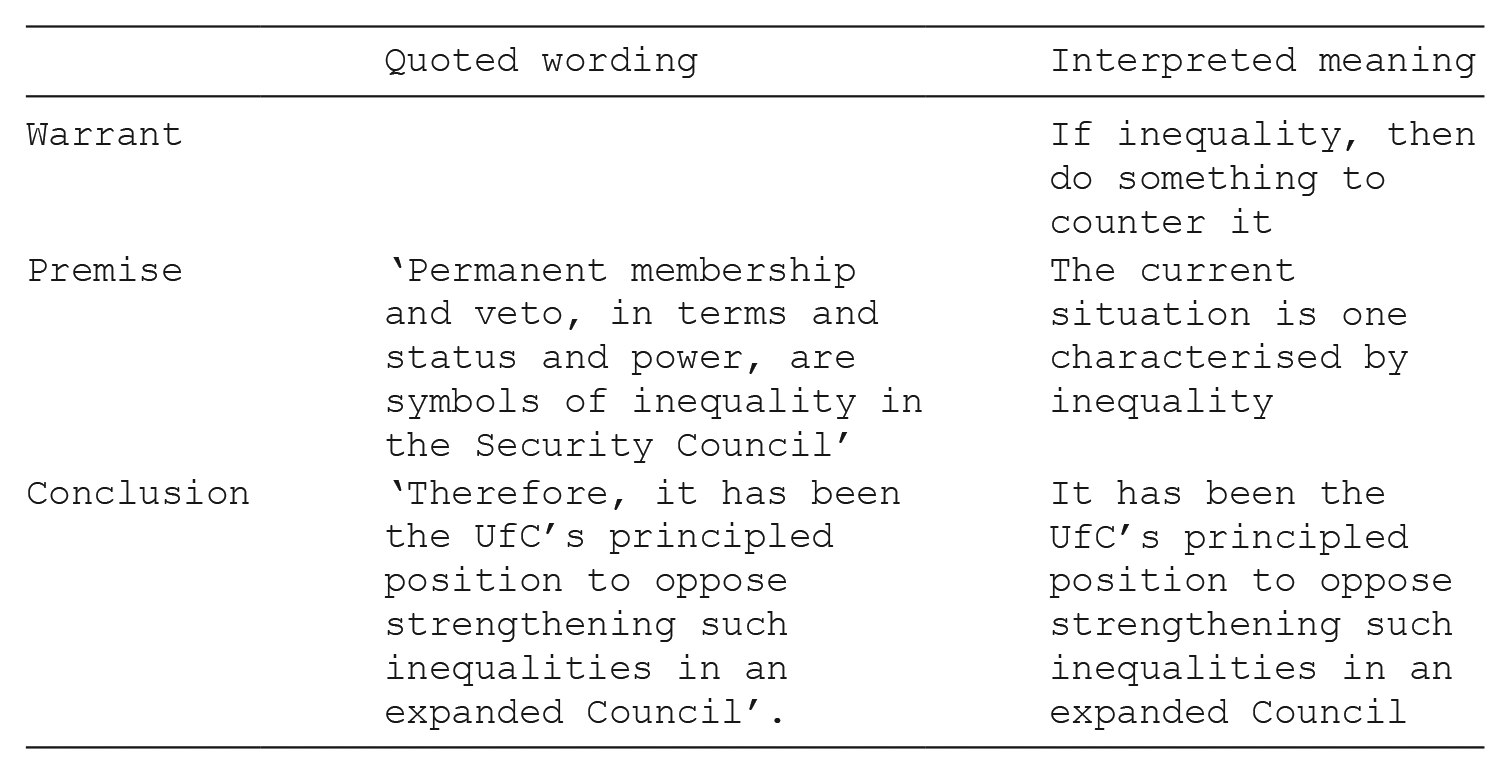
Re-constructed in this way, the argument is logically valid since it is impossible for the warrant and the premise to be true while the conclusion is false. However, the argument is not incontestably ‘sound’ in that it is fairly likely that not everyone would accept that the warrant and the premise are, indeed, true. Concerning the UNSC, it might be difficult to imagine anyone who would explicitly announce themselves against the topos of equality. On the other hand, it might be possible to understand the argument as expressing the very gist of the stalemate about a reform, namely the disagreement about whether or not permanent membership and veto are, essentially and inevitably, symbols of inequality in terms of status and power.
We would like to observe two points. Firstly, as demonstrated above, whereas the G4 might not overtly disagree with a more general topos of equality, they consistently emphasise other aspects of the governmental rationality of democracy (such as majority rule and regional representation). Secondly, G4 might want to contest the more specific formulation of inequality in this quote and argue that permanent membership and veto do not need to be prominent symbols of inequality. Considering this, the argument comes off as a subtle discursive struggle in which the UfC attempts to promote their version of the governmental rationality of democracy, namely a particular understanding and importance of the aspect of equality. Through this ‘principled position’, the UfC promote idealism and as such oppose the notions of pragmatism and realism which are concepts that promote the candidacies of countries who are able, instead of the rights of all countries equally.
Similarly, the UfC maintains an idealist notion of representation as based in equality related to a topos of majority. The example below is from the conclusion of Cardi’s statement in the first open GA-debate:
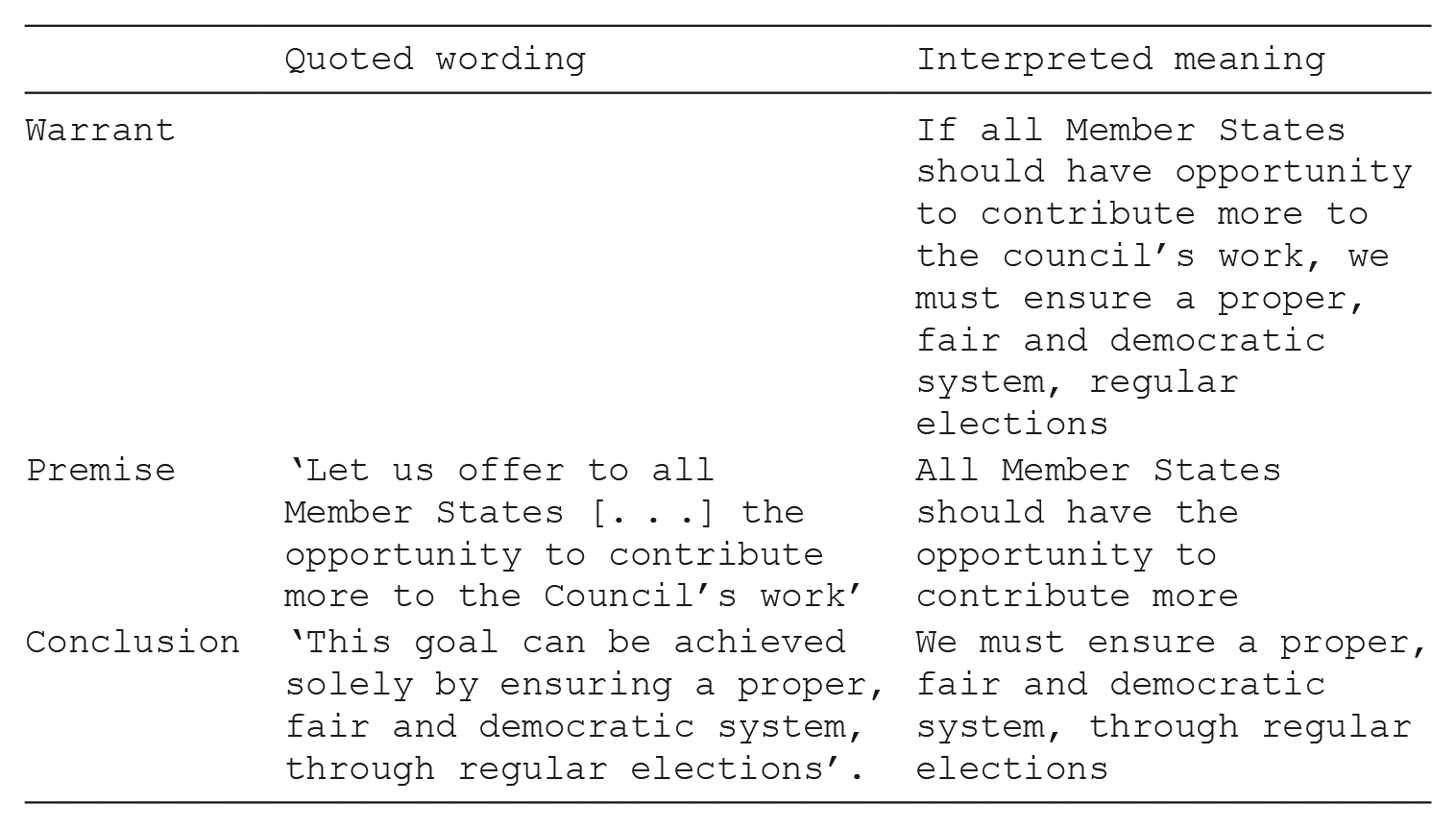
In this reconstruction, the argument is logically valid: If (and only if) the premise is true, the conclusion (logically speaking) needs to be true as well. However, there is of course no guarantee that the warrant and premise are considered to be true by all parties. Particularly, the warrant appears to invoke a topos of democracy as equal opportunities as it appears to rely on/maintain a particular understanding of the governmental rationality of democracy, namely one in which democracy should be done in a way in which all member states have equal opportunities, and, furthermore, this is treated as dependent on whether or not the system builds on regular elections
Again, Cardi constructs the notion of equality as a matter of equal opportunities in whether or not states are willing to contribute. Furthermore, Cardi supports the premise through a topos of majority when he points out that ‘All Member States’ should especially include ‘small States and developing countries, which represent the majority of the membership’ (emphasis added). In this way, Cardi highlights the UfC’s notion of representation as one that benefits the majority (seeing as the majority of states have restricted resources), and as such, their notion is here strengthened through a topos of majority: this equal-opportunity version of the notion of representation is the more democratic one since it benefits the majority. Therein, the governmental rationality of democracy is again simultaneously constituted and negotiated pushing certain aspects of representative democracy, namely equal opportunities and majority rule as indisputable virtues, 17 and, arguably, idealism is invoked when the relevancy of ‘small states and developing countries’ is emphasised in a discussion about participation/seats in the UNSC, which is, again, in contrast to the way in which G4 emphasise the right of resourceful countries to be the primary prefereti for council membership.
Finally, the topos of equality is also utilised in a short series of tweets from the UfC. At the IGN debate about the question of the veto, ‘Italy UN New York’ tweeted:
The tweet (1) was retweeted by Italian diplomat Cesare Morbelli three times during the IGN meeting: (2), (3) and (4).
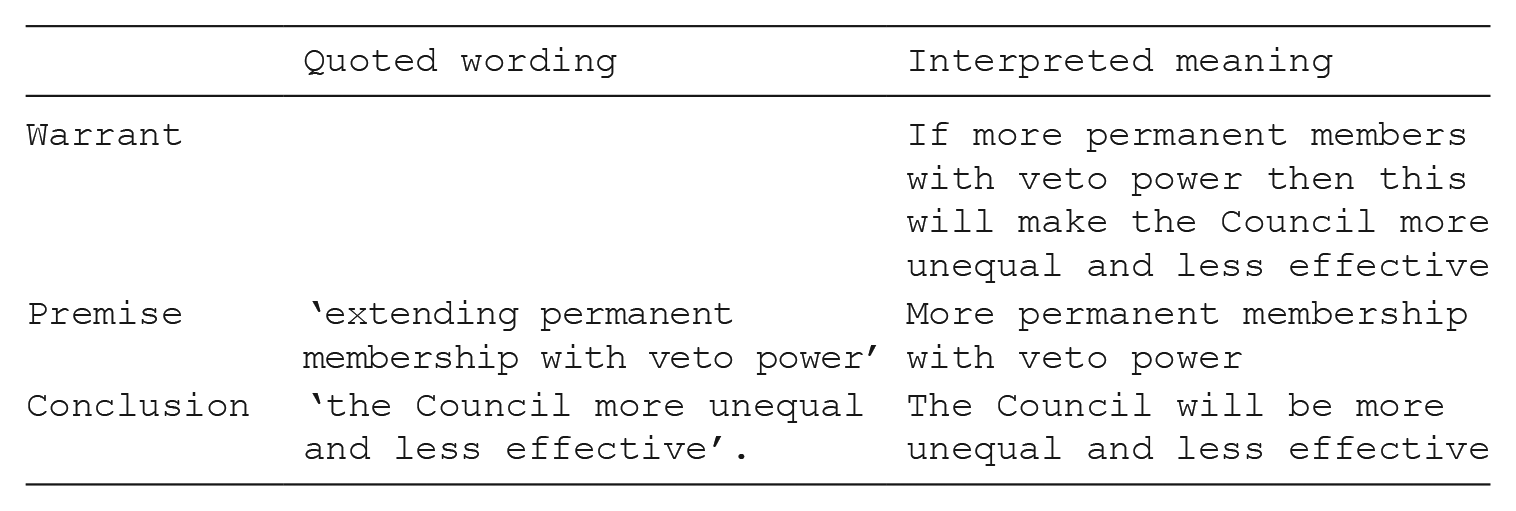
This logically valid reconstruction relies on a particular understanding of the topos of equality as it relies on the commonplace that more permanent members necessarily equals more inequality, and, secondly, that inequality must be decreased. Again, also the G4 alliance would probably never, overtly, disagree on the last part, but, again, they would obviously disagree on the first part and argue the opposite: that, from their more realist perspective, their proposal to increase the number of permanent members is exactly in order to decrease the inequality in the current assemblage of the Council. Accordingly, once again the argument can be understood as a negotiation of the governmental rationality of democracy in that the utilisation of the topos of equality subtly suggests that in order for a reform to be democratic, it must be in accordance with/comply with/reflect the UfC-understanding of equality; inclusive the understanding that permanent membership is an antithesis to equality, which again relies on an idealist understanding of what a reform should enhance, namely the right and opportunity for countries to be involved themselves rather than to be represented by resourceful countries.
We would like to suggest a reconstruction in which we understand tweet (3) and (4) as relying on the same topos of equality as does tweet (2), but as then unfolding not through a modus ponens-structure, but through modus tollens:
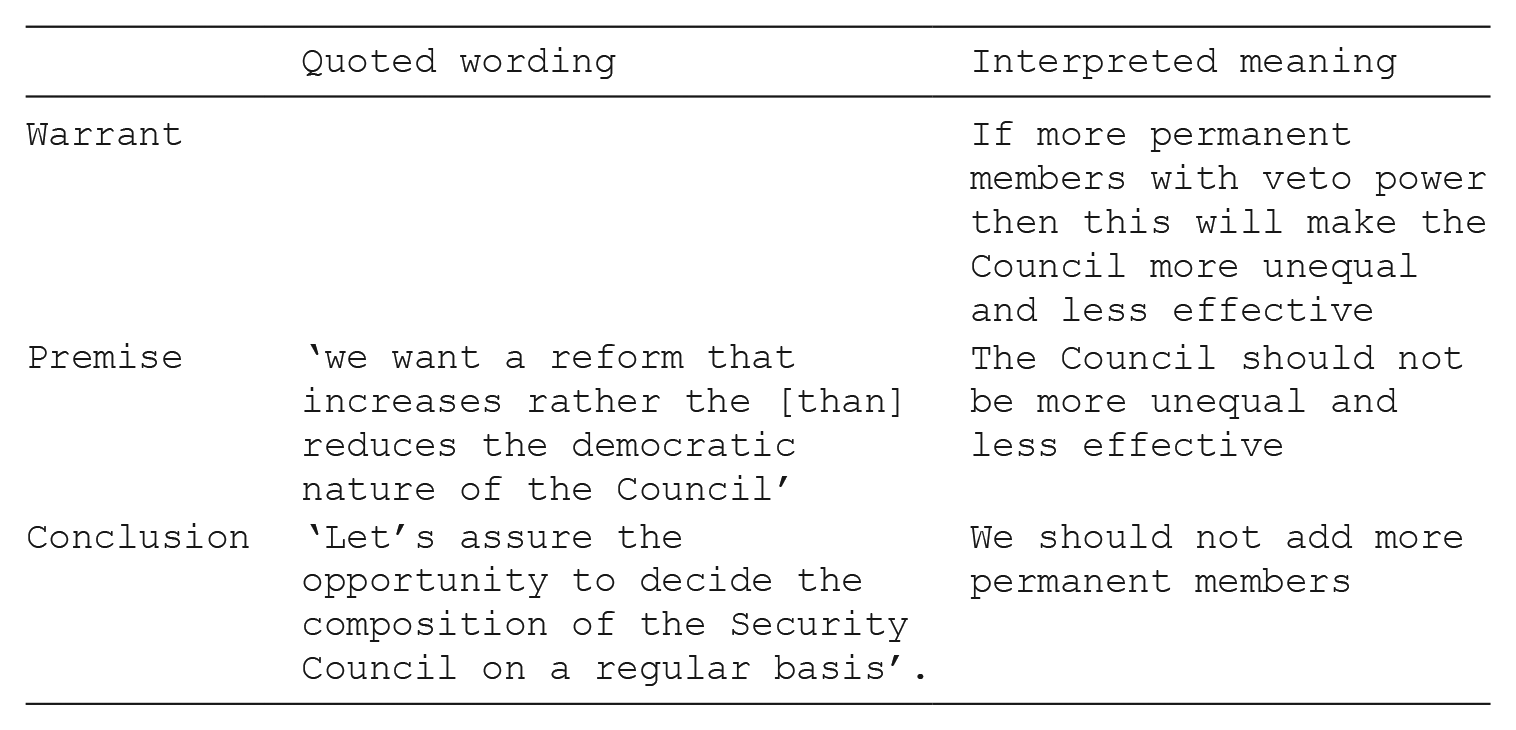
In parallel, then, to the modus ponens-variant of tweet (2) the argument can be understood as a negotiation of the governmental rationality of democracy in that the utilisation of the topos of equality subtly suggests that for a reform to be democratic, it must be aligned with the UfC-understanding of equality; inclusive the understanding that permanent membership is an antithesis to democratic neture/equality. In this latter argument, however, the negotiation is perhaps even more clearly seen as a negotiation of the governmental rationality of democracy in that it is emphasised that only this understanding of equality would increase the ‘democratic nature of the Council’. When the notion of the council’s ‘nature’ is invoked, the discussion is one of idealism, because the nature of the council is, in a sense, deemed more valuable than the function of the council, which relies on capabilities/resources rather than equality as a principle.
Conclusion
While the G4 utilise a topos of majority to mitigate the differences between the G4 and other groups that support generic structural reform, the UfC utilise a topos of equality to point out the differences of privilege between permanent members and states that are less resourceful. Furthermore, the G4 prominently utilise the topos of majority as insulation against rivalling rationalities; for instance, as they argue that neither the EOC nor ‘another school of thought’ (that, otherwise somewhat similarly, opposes restriction of the veto) represents the majority. In contrast, the UfC prominently utilise the topos of inequality in order to deconstruct opposing versions of the governmental rationality of democracy; for instance, when they criticise ‘such inequalities’ as those represented by permanent membership and the veto system.
Accordingly, the G4 mainly rely on topoi that invoke a realist version of the governmental rationality of democracy that emphasises resourcefulness. Clearly, since all G4 countries have significant global influence and happen to be their respective regions’ most influential countries (not counting countries already in the P5), the G4 proposal strengthen the power positions of exactly the G4 countries. Similarly, when the UfC rely predominantly on a topos that invoke an idealist version of the governmental rationality of democracy that emphasises willingness and equality, this appears to reflect the current power positions of the UfC countries.
Within IR, the traditional focus on states as actors (Booth and Erskine, 2016; Wight, 2006) result in a priori assumptions about states, and neglect the ongoing construction of states’ positions and diplomatic agency (Adler-Nissen, 2015). Studies focusing on discourse in international diplomacy can remedy this shortcoming. In concordance with Neumann (Neumann, 2002, 2007, 2008, 2012) and Milliken (Milliken, 1999), we have demonstrated the value of discourse as a way of studying international relations as we have focused on enactments of geopolitical diplomacy through language. We have demonstrated how the reform discourse of the G4 and the UfC rely on topoi to come off as morally sound.
More or less explicitly, many IR-scholars call for better understandings of three tendencies in the UNSC reform conundrum. Our discourse analytical approach has provided answers to all three. Concerning the already mentioned omnipresent inequity argument (Hassler, 2013; Nadin, 2016), our notion governmentality approach has demonstrated how this argument is utilised at the silver-lining of conduct of conduct and counter conduct; that is, how equity is based on willingness for the UfC, and on representation via resourceful countries for the G4. The second tendency concerns the legitimation practices in UNSC reform debates (Hurd, 2008), which we have shown to be closely tied to the governmental rationality of democracy in the UN. Finally, scholars ponder why so many states remain officially committed to supporting reform when nothing happens (Schaefer, 2017). Another way of dissecting the same issue more specifically, is to ask why and how states remain committed to a democracy enhancing reform when nothing of that sort seems to ever materialise? Following Foucault, we appreciate the interdependent relation between power and resistance considering the governmental rationality of democracy, and this has provided an understanding of the persistency of struggle within otherwise apparently gridlocked and conform reform discourses. Our study demonstrates that the struggle about UNSC-reform is not overtly about pro or against reform, but about the meaning of the governmental rationality of democracy. Consequently, reform is unlikely to materialise before the G4 and the UfC agree upon what is democratic. Besides, we remain intrigued by the prospects of more profound studies of how reform in the UN might be conducted through other governmental rationalities than that of democracy promotion.
As we demonstrated how the two groups struggle discursively ‘to not be governed thusly’ and therein negotiate the meanings of notions like majority, equality, representation and, essentially, democracy, we have unravelled the depth of the disagreement between two powerful actors. Perhaps the polity of democratic diplomatic debates has occasionally led to reform-optimism among those who wish for it, but through our analysis of discursive strategies utilised during the 70th GA – a year seen as particularly imbued with anticipation of progress – we have seen that the disagreements rely on a profound ideological conflict (realism vs. idealism). Hence, perhaps future reform progress relies, to some extent, on member states’ ability to somehow transcend this irreconcilable conflict and instead establish a ‘common intellectual culture. A set of shared concepts and a common vocabulary’ (Iklé, 1999).
Footnotes
Declaration of conflicting interests
The author(s) declared no potential conflicts of interest with respect to the research, authorship, and/or publication of this article.
Funding
The author(s) received no financial support for the research, authorship, and/or publication of this article.