







Abstract
This paper discusses web-based public health discursive practices during the Coronavirus (COVID-19) pandemic in Nigeria. It utilises a multimodal discourse approach to explore how a combination of textual and visual resources was deployed to communicate informative and educative public health safety campaigns during the period. Essentially, this study discusses multimodal resources as a rhetorical technique for creating a public discursive engagement space designed to educate the public and mitigate the effect of the pandemic. The dataset was collected during and after the lockdown in 2020 (March–September) through media monitoring and manual downloading of relevant online COVID-19 posts, messages and public health advisories largely from WhatsApp platforms and the portals of some Nigerian national newspapers. Using insights from relevant approaches in discourse analysis (e.g. Multimodal Discourse and Critical Discourse Analysis), we adopted a qualitative content analysis approach to analyse on how online posts as multimodal resources amplify the role of social media affordances in producing and promoting public safety messages helped to control the spread and mitigate the effects of the pandemic. The study also shows that discursive and multimodal resources were deliberately deployed to increase the effectiveness of the technology-driven public health campaign. To a large extent, multimodal resources were found to complement lexico-semantic properties of online communication, where social media messages are created, crafted and reconstructed within a uniquely Nigerian public discourse context. The study further illustrates the increasing importance of web-based platforms as discursive sites for enacting and negotiating meanings during event-driven social activities and public engagement in the Global South.
Keywords
Introduction
The global pandemic that broke out in Wuhan, China towards the end of 2019 has thrown up a variety of discursive practices designed to promote global information on the transmissibility and containment of the virus and its phenomenal impact on the populace. As the global community grapples with the devastating and lingering impact of the pandemic, both the mainstream and social media platforms have continued to play a key role in creating awareness, providing updates on the spread, containment, public health advisories and strategies to prevent or curb fatality. More significantly, web-based platforms became the more dominant discourse space during the lockdown and travel restrictions as public health officials, state actors and average online users became producers and publishers of public health awareness campaign messages. The information overload assumed a frightening dimension that experts had to describe it as ‘infodemic’ (e.g. Banerje and Meena, 2021) due to the massive online transmission of facts, misinformation and disinformation on the virus. In Nigeria, a number of public health communication strategies were adopted in the dissemination of information to the Nigerian public on the nature, spread and containment of COVID-19 as well as its serious public health implications. Beginning from early March 2020 to the end of year 2020 and beyond, the Nigerian social media space was inundated with messages, posts, memes and statistics about the virus.
Background to the present study
It is a fact that Covid-19 global health emergency has thrown more light on the increasingly role that digital media technologies can play during public crises. Although these new platforms have been accused of fuelling the spread of fake news, false information and disinformation, they became important tools for sustaining relationship, educating, informing, motivating and empowering individuals and groups, across different spheres of human and social endeavours, during the global health crisis. The emergence of Covid-19 public health discourses pushed the debates further on how the socio-technical affordances and interactive architecture of the new media platforms permit anyone to create and transmit online content.
The emergent public health discourses are primarily shaped by the need to provide an inclusive community-based participation in managing public health crises. To a large extent, the use of these new technologies to transmit and broadcast public health awareness, public safety and wellness messages impact on proactive, preventive and personalised healthcare initiatives.
Since the outbreak of the pandemic, a huge number of academic and policy literature has been published within the traditional and mainstream sciences and epidemiology discipline. We equally recognise some efforts in corpus-based and critical discourse analysis of news reports on COVID-19 in the United Kingdom, China (e.g. Mu et al., 2021; Yu et al., 2021) and the United States of America as well some parts of Africa (e.g. Dezhkameha et al., 2021). However, similar research efforts are still largely very few in Nigeria. Although scholars such as Unuabonah and Oyebode (2021) have adopted a multimodal discourse approach to study covid-19 memes as political protests in Nigeria, literature on multimodal discourse analysis of the pandemic as a public health enlightenment campaign is sparse. Generally, the study of online public health discourse is yet to receive adequate attention among scholars in Nigeria. This study therefore addresses the dearth of literature on online public health discourse in Nigeria. By focussing on Covid-19 discourse event, we show how digital technologies and social media networks can aggregate and escalate discursive elements in public health campaigns to mitigate the impact of the pandemic on the populace. Exploring such a crucially-important socio-discursive and topical event has two main motivations: (1) analysing the pandemic as a socio-semiotic event is aimed at presenting technology-enabled relatable images and posts from the Nigerian discursive setting; and (2) exploring the variety of COVID-19 public awareness messages is aimed at providing interpretations of the messages, incorporating the written, visual or non-linguistic elements that reflect social, cultural and psychological configurations, as a product of the public health crisis.
This study thus explores digital public health discourse within the prism of the dynamics of multimodal online discursive practices, throwing light on how web-based affordances escalate effective public healthcare campaigns in Nigeria.
Public health and online multimodal discourse
The pervasive influence of these wireless technologies has elevated public health awareness to a new level despite some of the drawbacks, such as fuelling the spread of fake news, hate speech false information and disinformation. They were used extensively to create awareness, educate and inform individuals and groups about the pandemic. These new media platforms enabled stakeholders, state actors and ordinary citizens to create and transmit public health-related online contents during the period. Since public health discourse is primarily shaped by the need to provide an inclusive community-based participation in public health care policy implementation, creative online contents played a major in the management of the crisis.
The integrative perspective of online discourses (e.g. Oprea, 2019) presents a framework which views the Web as a device composed of ‘techniques’, ‘actors’ and ‘statements’. The use of ‘discursive technology’ in this perspective now indicates the interconnections between the intra-linguistic manifestations (textual and verbal elements) of online discourses and their extra-linguistic constraints (hashtags, memes). This integrative perspective is described as non-dualist or post-dualist (Oprea, 2019), wherein the Internet is viewed as a ‘technolinguistic ecosystem’ which contains affordances that activate and sustain a democratised discourse space with online users now as creators and consumers of online contents. This means that technology is no longer a support system, but an essential component of the discursive process.
Herring (2004) has earlier used some principles in computer-mediated discourse analysis to describe these technolinguistic features which must be identified and carefully analysed when they occur in the online environment. Among other assumptions, Herring (ibid.) discusses how online behaviour is shaped by language use and how discourse may be ‘shaped by the technological features of computer-mediated communication systems’ (p.4). Therefore, the statements produced in online environments are regarded as composite discursive technologies which consist not only of linguistic elements, but a combination of language resources which combine with Internet affordances to define the discursive landscapes of online communication practices.
COVID-19 public healthcare messages generally explore the interpersonal dimension in the communicative paradigm by presenting the public (receptors) with recognisable features which identify closely with socio-cultural life in a specific setting. They generally create interpersonal meaning by exploring both textual and semiotic resources in the process of maintaining the social connections between the originator of the message and the public who constantly search the social media for information on how to cope with the pandemic. Zappavigna (2012: 7) describes social search as ‘a mode of searching that leverages a user’s social networks’. The various uses of language as socio-semiotic resources for forming social connectivity in the dissemination of healthcare information on the COVID-19 pandemic in Nigeria provide some of the motivations for this study.
Memes as multimodal features of the WhatsApp messages on the pandemic became a prominent component of the awareness campaigns. Their characteristic creativity, visibility and replicability particularly make these affordances easily attractive and transferable from one social media platform to another. Their socio-technical features actually support the multimodal fluidity of these internet-based messages across the inter/multi-modal platforms. Memes usually reflect the socio-cultural settings of their production and indicate different types of information (ideas, habits, figures) that spread, multiply and change in the environment of human culture (Dawkins, 2006). Milosavljevic (2020: 11–12) observes that Internet memes are a recent phenomenon and refer to the most popular often funny concepts that are created, user-generated discourse materials and transmitted through different online channels. In most cases, memes also reflect the socio- economic, religious and political dynamics, and a whole configuration of the discourse environment designed to convey serious messages on private, public, national or global issues in creative and humorous manners. Milosavljevic (2020) identifies the following key features of internet memes that are found in some of the COVID-19 texts used in this study: imitation, cultural and social conditionality, specificity and visibility; humour and satire, simplicity,
Theoretical framework
Generally speaking, a combination of images and text used in web-based discursive space animates interactions and communicative acts reflecting social, cultural, discursive and technical elements that support the entire discourse ecosystem. Scholars such as Matthiessen (2007), Vovilas et al., (2010) see Multimodal Discourse Analysis (MDA) as an approach to analyse how different semiotic systems interact in the creation and negotiation of meaning within a discursive platform. These semiotic (multimodal) resources such as pictures, text, graphology and graphetics often interact within the larger frame of the text to create meaning (e.g. O’Halloran, 2008, 2009 ). Scholars like Kress and van Leeuwen (2006, 2021; Kress, 2009); and Machin (2007) have explored the social significance of multimodal elements in online discourse. They view multimodal discourse as a form of communication that involves the use of multiple semiotic resources to achieve socio-discursive appeal through visual, textual and other non-linguistic elements. Multimodality is often associated with an attempt to highlight one of two analytical concerns: first: the awareness that all texts are produced and encountered not only as words but also as images, colours, textures, layouts and designs; and, second: the awareness that social interactions are simultaneously embodied as spoken language, gesture, posture, dress, or movement. Machin et al. (2016: 303) argue that ‘“Multimodality” was to follow the works of CDA, but its main innovation was to include not just language but all the semiotic modes that make up a social context’. Multimodal discourse analysts believe that text should be analysed therefore along with the combination of semiotic resources such as text, images and layout that usually form an important and inseparable component of the text. To a large extent therefore, both written and visual elements in texts are considered together as providing comprehensive reading and interpretation of the meaning the text is designed to convey. The multimodality thrust of COVID-19 online texts works within the pragmatic and socio-discursive networks of the online affordances to produce context-based meaning negotiated through a multiplicity of sociocultural elements. Observably, digital discourse has brought along with it multimodal features and formats (text, images, audio and video) that dominated various user-generated social media platforms (e.g. Instagram, Twitter, Facebook, WhatsApp). These multimodal trends in contemporary social media discursive processes enhance the impact of the public health enlightenment discourse and other messages that were published and transmitted, across traditional media and new media handles during the period.
While other approaches may have been developed, the contextual (Kress and van Leeuwen’s, 2006) and grammatical approaches (O’Toole, 2010) seem to be the two most influential perspectives in the study of MDA. Significantly, most insights in MDA derived their inspirations from Michael Halliday’s (1978) socio-semiotic approach to the study of text, society and culture (O’Halloran, 2011). Kress and van Leeuwen’s (2006) Reading Images: The Grammar of Visual Design provides an extensive discussion on theoretical resources that highlight the use of multimodal approaches for analysing discursive practices. For instance, the framework incorporates three major metafunctions: representational, interactive and compositional with each encompassing a set of subcategories. Kress and van Leeuwen’s concept of visual social semiotics is particularly useful in showing how the unpacking of multimodality relies on the interaction of three systems: information value, salience and framing. This visual semiotics model, as a (top-down) contextual approach, embeds a particular orientation to ideology, deriving general principles of visual design which are illustrated through text analysis.
As mentioned earlier, Machin (2016: 303) establishes some connection between multimodality and critical discourse approaches. Public health awareness campaign texts that contain multimodal resources are designed to drive public enlightenment campaigns where power and control may be embedded and negotiated within the contested discourse space. Some scholars in Critical Discourse Analysis (CDA) (e.g. Fairclough 2001; van Dijk, 2001; Wodak, 1989; Wodak & Meyer, 2001) agree that power may be enacted through the creative use of language (text and images) to persuade, convince, or subtly coerce the other person to act according to the wishes of the speaker. They affirm that public/institutional discourses create the space for such demonstration of (unequal) power relations because some participants have access to some critical social privileges above others. As exemplified in most public emergency situations, state actors and relevant agencies of government may need to deploy state and institutional resources to enforce compliance. Discourse thus plays a central role in actualising such government policies as witnessed during the lockdown period in Nigeria. The COVID-19 public healthcare campaigns exhibit such creative discursive patterns which underscore a gradual awareness of the power of multimodal discursive practices to promote and enforce social good.
Methodology
We harvested the dataset for this study primarily from web-based platforms, online portals of national newspapers and the general web that were widely patronised and utilised as sources for receiving and transmitting information on the pandemic in Nigeria. The texts were extracted from a collection of data being compiled for our Corpus of Digital Health Discourse project (ww.cedhul.com.ng). Online posts, images and memes generated from WhatsApp platforms and other social media networks form the bulk of data on the COVID-19 public health awareness campaigns. The data collection methods included media monitoring and manual download of relevant social media posts on the discursive event. The posts were downloaded and saved in easily retrievable media, such as dedicated cloud-based repository on personal mobile handsets, emails and laptops. These were subsequently converted to word format to promote editing and cropping of the visual data. The data falls roughly into the following formats:
The dataset thus covers the different stages in the public education process occasioned by the pandemic and its social implications. In the context of this study therefore, the selected texts used for analysis were largely public enlightenment campaign messages deployed during the period. Oprea (2019) has suggested that discursive materials consisting of multimodal elements cannot be considered wholesome analytical tools if they are removed from the environment in which they were formulated in order to signify meaning. The use of multimodal and critical discourse approaches based on qualitative content analysis aligns with Oprea’s (2019) view which recommends the combination of both textual and contextual information of a multimodal-based discursive practice in order to provide a holistic interpretation of the meanings which are made.
Data analysis: Multi-modal communicative format in public health awareness/enlightenment campaigns on Covid-19
A large number of the data sourced from social media sites exhibits multimodal features. While this may tend to indicate some form of exclusivity in terms of the domain of linguistic interventions in the discourse of the COVID-19 pandemic, it is useful, and indeed necessary, to point out that certain components of the internet-based corpus may be viewed as having ‘bi/trans-modal’ features. Since print media content is increasingly becoming available in electronic formats which are uploaded on social media platforms, social media coverage of the coronavirus discourse naturally includes: stretches of texts in user-defined online formats, electronic versions of print media enlightenment campaigns (in the form of informative colour posters and pictures); user created memes which express people’s thoughts and emotions on the pandemic, ranging from the political, cultural, to the humorous. In promoting public enlightenment and advisories during the COVID-19 season, the communicative impact of multimodal public health campaign messages on social media platforms underlies the discursive content of activities that permeated the public space. Government authorities and other relevant public health management agencies such as the Nigeria Centre for Disease Control (NCDC) initiated massive public enlightenment campaigns, to create public awareness and public safety guidelines and enforce compliance.
Social media harnessed all of these platforms to exhibit an assemblage of colourful, eye-catching and attention-getting awareness campaign pieces that reflected the public health emergency occasioned by the pandemic.
As shown in the images below, Figures 1 and 2, public awareness posters were transmitted from their original public spaces, and posted on the social media portals of the national newspapers to sensitise the public on the transmission of the virus; and to disseminate preventive measures to curb its spread.
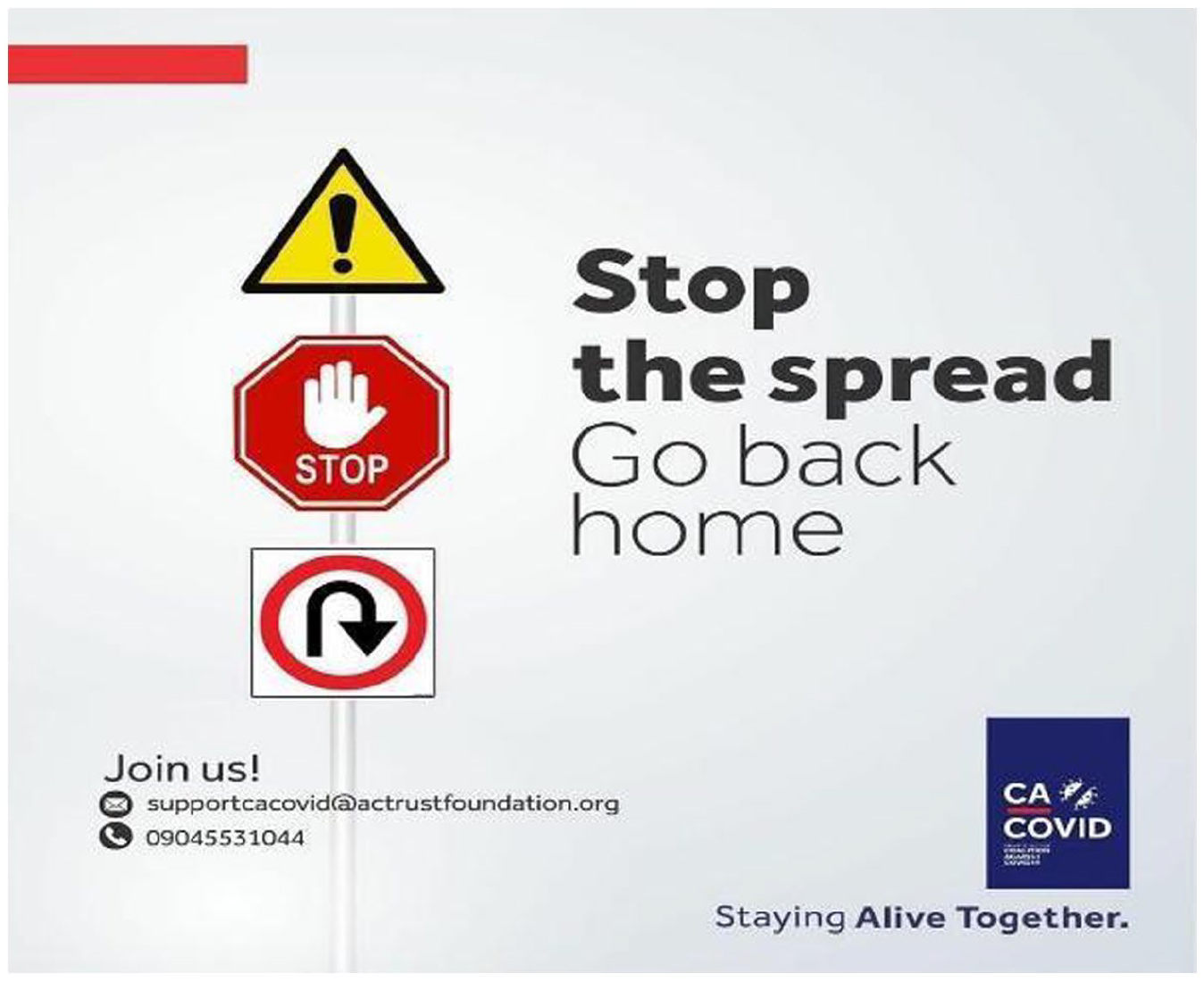
Stop the spread.
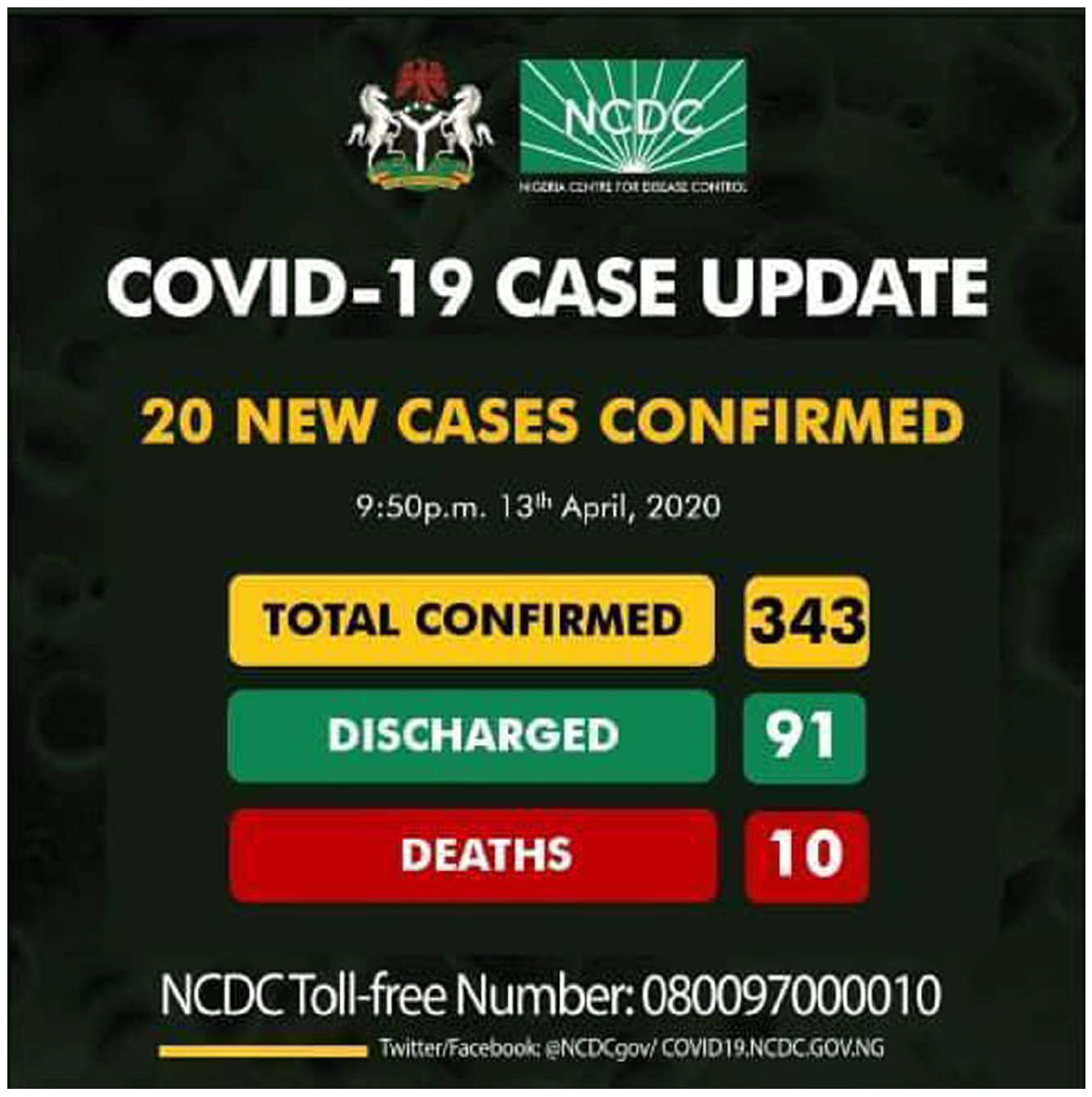
COVID-19 case update.
A common feature in these picture messages is the interplay of both textual and visual resources (Kress and van Leeuwen’s, 2006) pictorial and verbal information). While the main message is conveyed through the textual content, the visual content reinforces the message or vice versa. In these figures, the discursive construction of the pandemic situation sets forth a global response to the spread of the virus and local initiatives to curb the spread. Kress and van Leeuwen’s (2006) compositional metafunctions that espouse three interactive systems: information value, salience and framing provide some useful insight. The concepts demonstrate how the composition of images and meaning extrapolation from the multimodal components may underpin the importance of the public health education posters.
In Figure 1, the information focus of the posters, for instance, consists of verbal and pictorial elements. While the pictorial information appears on the left, the verbal/textual information is placed conspicuously on the right. The logo as pictorial information on the right bottom of the poster is used to provide information authentication technique emanating from a legal authority, the represented participant (i.e. CACOVID.NG). The verbal or textual information at the bottom of the poster, Staying Alive Together, deliberately positioned beside the identity of the promoter of the campaign poster conveys the main message of the public health communication. The structural division of the poster into ‘left’ and ‘right’ columns may roughly equates ‘given’ and ‘new’ information (Kress and Van Leeuwen, 2006). The images as ‘given information’ (in this case, traffic signs) are existentially and contextually located within the transportation space while the ‘new information’ relates directly to the existing Covid-19 advisory guidelines. The represented participant that sponsored the campaign is a registered non-state actor established to support government efforts in sponsoring public enlightenment campaigns and in sourcing and sharing COVID-19 relief materials. Their call for support is visually and textually depicted through icons such as their telephone number, email address and social media handles. This important information is well placed in the middle of the composition to attract the attention of citizens and potential donors. Information-centring strategy has become very important in persuasive discourse to achieve focus and maximum comprehension of the message.
In terms of salience, the visual component contains some foregrounding elements that are designed as attention getters and persuasive strategies. Scholars (e.g. Belgrime and Rabab’ah, 2021: 198) have identified factors such as size, sharpness of focus, colour contrasts and placement in the visual field as multimodal elements that provide complementary information in the text. The images and the graphologically-designed textual information in bold and light fonts case letters are the most salient information in Figure 1. The conspicuous positions that the traffic signs occupy are designed to provide a sharper focus for the instructional texts placed parallel to the images. The traffic signs as semiotic resources are connected with familiar social activities of commuting, vehicular movement, journey and travels. They are deliberately placed alongside the text – ‘
In framing the bigger objective of the campaign, the sponsor of the poster (i.e. represented participant) creates some degree of connection between the different visual and textual elements that constitute the entire discourse. Since the more these elements are connected to each other, the more likely they are to convey and/or reinforce the same information (Belgrime and Rabab’ah, 2021), one can argue that the structural positioning of the elements vertically and horizontally supports the single objective of communicating advisory information that can help to mitigate the spread of the virus. The distance between the frames is carefully managed to avoid any degree of difficulty in linking the images and texts to achieve the same goal. It is evident that each type of information is thus created to complement each other within the larger frame of the poster.
In Figure 2, a top-to-bottom multimodal approach is adopted to project the information value, salience and framing of the message. The mixture of the pictorial and verbal information promotes both visual and cognitive impact that enhances comprehension and persuasion. The instant effect of the graphology and colour mixture and statistics of the daily COVID-19 cases in Nigeria as depicted in the post increases citizens’ consciousness and awareness about the impact of the pandemic. It opens with the pictorial information of the represented participants, the Federal Government of Nigeria and the Nigeria Centre for Disease Control (NCDC) visually represented by the Nigerian coat of arms and the NCDC logo respectively. The black background of the poster foregrounds a sense of sadness and mourning, while providing a colour contrast to figures which are provided. The vertical compartmentalisation of the text into ‘new’ and ‘given’ information provides a top-bottom reading of the message. The pictorial information through the images at the top streams from given information supported by the legitimate legal authorities mandated to communicate information on the pandemic. By foregrounding the represented participants, the information is considered credible and authentic. The headline, COVID-19 CASE UPDATE written with bold text fonts and upper case letters attracts attention easily and creates a sense of suspense that draws the people to seek additional information. The use of statistics or data to convey information value in public discourse is regarded as ethical proof or persuasion through reasoning or logical proof (Aristotle, 1962; Cockroft and Cockroft, 1992). This poster makes effective use of different figures to reveal the current state of the pandemic. NEW CONFIRMED CASES-20, TOTAL CONFIRMED-343, DISCHARGED-91, DEATH-10.
While the caption: COVID-19 CASE UPDATE written in bold upper case letters is one of the most salient pieces of information in the text, the presentation of the details in accurate figures supports the salience of the key information being transmitted. Font sizes of the text, sharpness of focus, colour contrasts and placement in the visual field are other important multimodal elements that supports and projects the salience of the public enlightenment message. The presentation of data and time of the report/update, in smaller font size and sentence case letters, is meant to further enhance the credibility of the information. The graphological effect is equally significant as the combination of colour and text projects the information more vividly. We have earlier observed the deliberate foregrounding of the two legal represented participants, the Nigerian government and NCDC, the infectious diseases control agency carries a quantum of salient information needed to authenticate the accuracy and authenticity of the information in the document. Notice the significance and meaning potential of the types of colour used in the different figures presented. Black colour is placed on yellow for confirmed cases; white colour is placed on green for the discharged cases while white colour is placed on red for the number of deaths. Multiplicity of images, colours, symbols, signs and written messages and their corresponding meanings often characterise public enlightenment texts designed to inform, persuade, warn and alter the behaviour of the consumers of the messages. The predominance of black and red colours that usually indicate danger and death sends forth the message of warning. The yellow colour in this context indicates neutral emotion since it is placed against the background of dark colour. The white colour used here suggests hope, helpfulness and positive sense of victory. It also downplays the sense of anxiety and panic generated during the peak period of the pandemic, Green and white are Nigeria’s national colour codes and they are used to represent the agency fighting the virus and number of discharged cases. One may deduce a subtle sense of effective governance being conveyed through the successes recorded by the government’s disease control agency. The signature line of coda of the poster presents ‘new’ information in the form of NCDC’s toll-free telephone number and social media platforms through which citizens can seek additional information or report cases of infection or transmission.
This poster particularly shows the degree of connection that exists between the different elements in the construction of the message. The framing features here provide a fine thread that links the different parts of the poster with the use of a multiplicity of statistics, colours and images. The different layers of relevant information presented in the poster are included in one bigger frame and are designed to convey the same meaning and message about the rising cases of infection, and the possible fatal consequences if public health guidelines are ignored. They also convey a sense of hope and ultimate victory over the virus if people follow the necessary precautions and official advice.
Figures 1 and 2 represent the social signification and communicative act of multimodality in the COVID-19 public health advisory texts in Nigeria as transmitted through social media. We can identify two distinct patterns of public advisory which are signified by each of these messages as follows:
(i) Directive or instructional; signalling the public to a specific action, through recognisable symbols of social cognition and cohesion. Such messages have the feature of enabling obedience and adherence to social order (as seen in Figure 1). The imperative statements: ‘Stop the spread’, and ‘Go back home’ reinforce the impact of the three traffic signs which symbolise the message- the ‘danger’ sign, the ‘stop’ sign and the ‘u-turn’ sign.
(ii) Informative; represented in Figure 2 – ‘COVID-19 CASE UPDATE’, a daily listing of COVID-19 ‘new cases’, showing the ‘total number of confirmed cases’, the ‘discharged’ and the ‘dead’. The case updates not only serve as daily information advisories on the state of the pandemic, but more significantly, specific facets of the healthcare implications were transmitted by the growing figures, such that they became reliable tools for charting the trajectory of the virus in different parts of the country. For government officials, notably state governors, and state ministers of health, the COVID-19 CASE UPDATEs soon became iconic information tools for documenting the pandemic and for rolling out healthcare initiatives to citizens in their various communities. Apart from serving as a means of communicating to the citizenry, the precarious nature of the raging virus, the ‘case updates’ became a tool of government propaganda, a means of showing the public that ‘government was working’. Furthermore, the underlying reference to the public healthcare situation as occasioned by the pandemic can be easily discerned in the key points of the message: ‘total number of confirmed cases’; the ‘discharged’ and the ‘dead’ allude most poignantly to the healthcare system, not just as the source of these figures, but as an index of the healthcare challenges which confront both the government and the citizenry on a daily basis.
Narrative memes: Telling the story of COVID-19 with visual elements
As discussed earlier, the internet and social media networks have provided a new platform for the production and transmission of memes as creative discourse tools. Memes are one of the most prominent, and frequently used online multimodal public health awareness messages. Their frequent usages online have generated creativity in terms of style and presentation. Therefore, the use of narrative memes to promote COVID-19 safety guidelines was created to leverage the existing oral tradition mode to relate the messages to the audience in a more engaging and interesting manner. Some of the COVID-19 healthcare messages were thus presented in multiple picture formats with story-telling features. As the pandemic progressed, the need arose for more comprehensive information on the nature of the virus and its social implications. Active online users and stakholders devised more detailed information that chronicled the various stages of transmission of the virus in more visually informative and educative formats. The goal, as in the other formats, was to adequately sensitise the public to the needed knowledge for appropriate action on fighting the virus at the individual and community levels.
This section illustrates a peculiar category of healthcare messages, which we may refer to as the ‘story-board’ public health advisories (Figures 3 and 4). These ‘story-board’ formats are quite significant in the analysis of COVID-19 messages as they represent the heightened public enlightenment process that followed the lifting of the ‘stay at home’ directives and restriction of movement in many parts of the country. As people began to move around again, it became imperative to increase the depth of information and also elevate the visual content of the awareness campaigns. The public health advisories thus took on a more dramatic and more visual format, as represented by Figures 3 and 4.
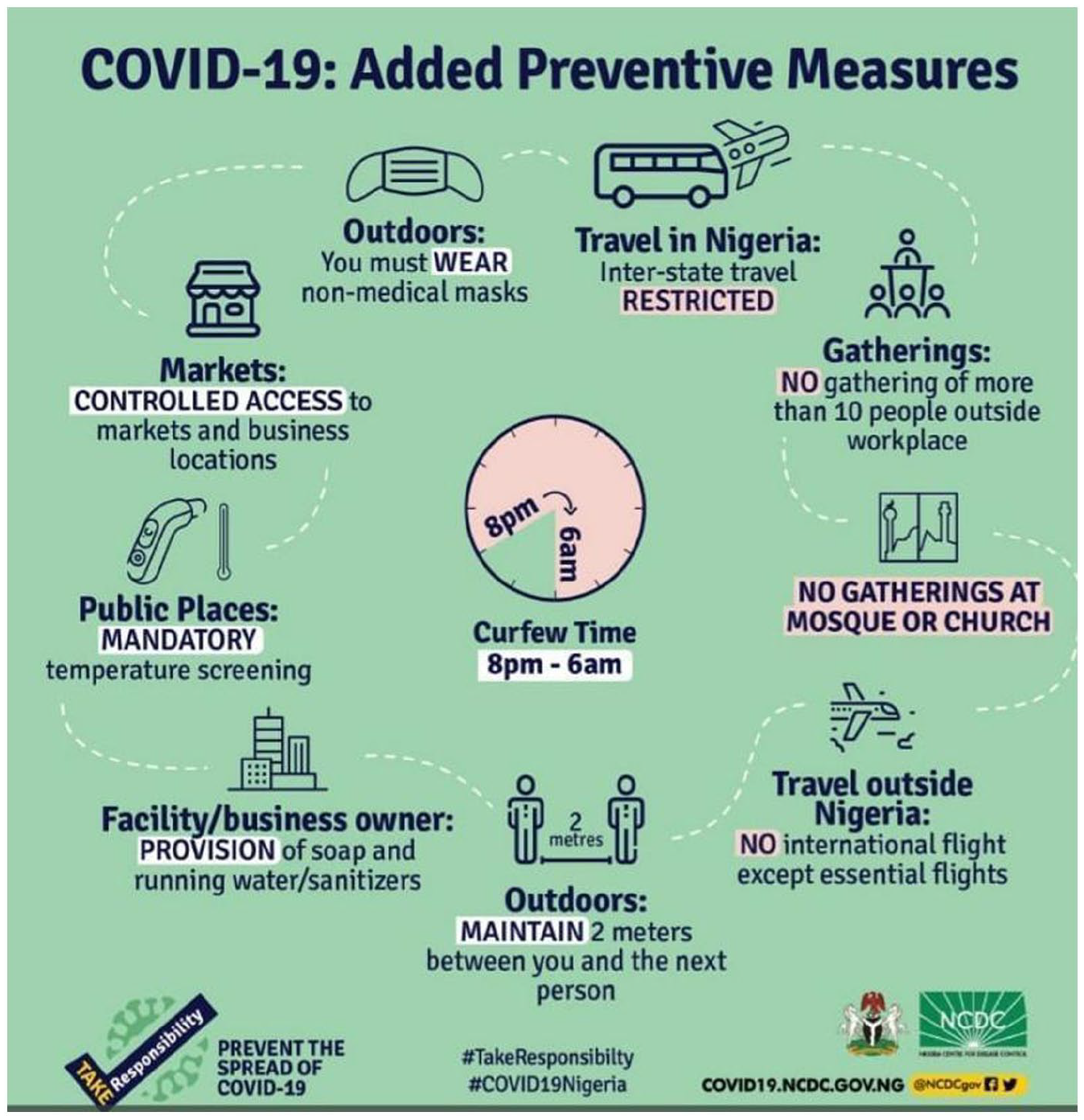
‘Added preventive measures’ meme.
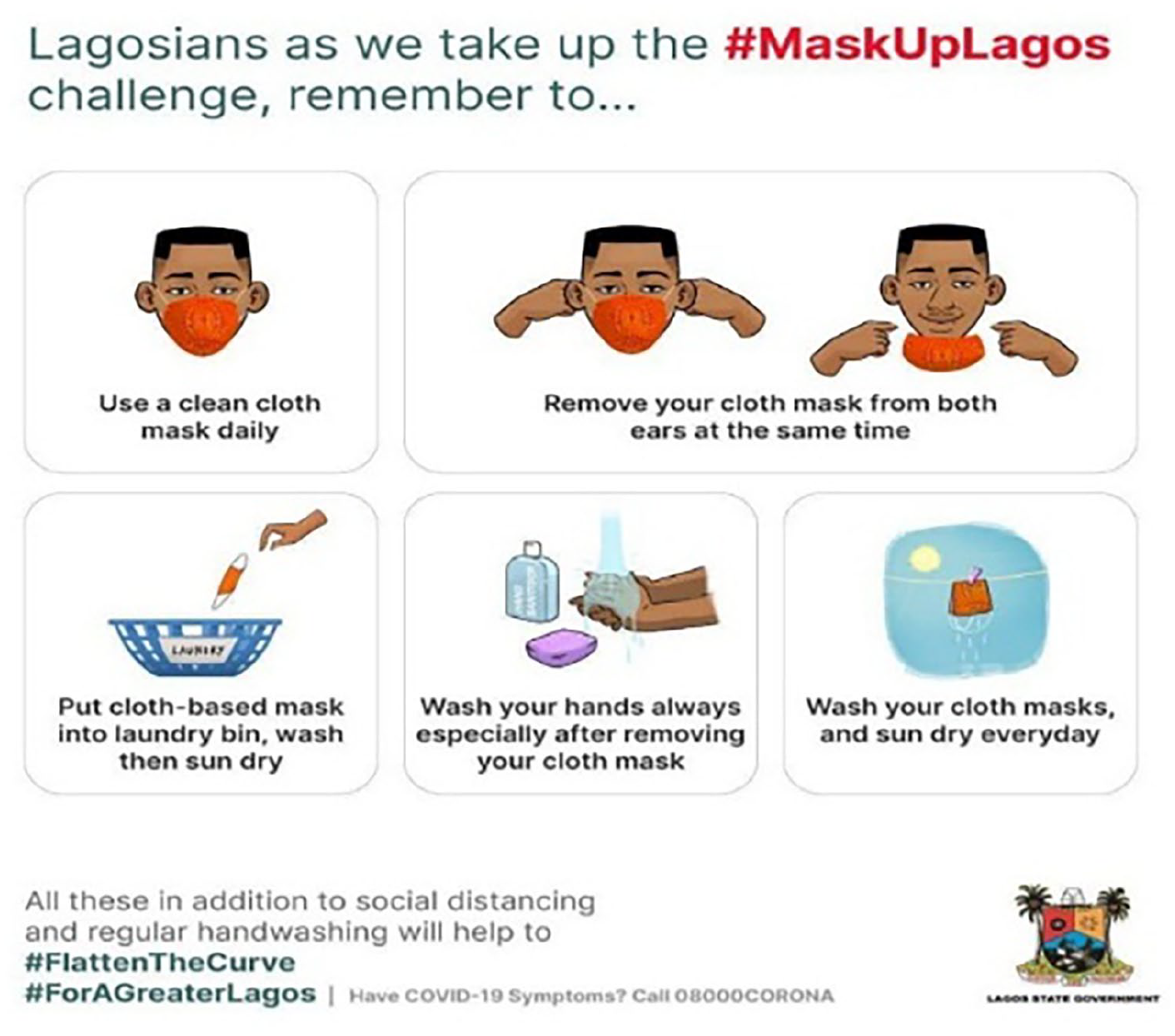
COVID-19 mask protection campaign
Framing as used here (e.g. Goffman, 1974; Scheufele, 1999) shows how information is presented in a format that creates a unique attention for it. In practical terms, it describes a process involving a consious choice of elements for presenting and organising an idea or topic; focussing on the essence or importance of an issue at hand, rather than the issue itself. Thus, by framing specific COVID-19 messages in story-board format, the message producer sets an agenda by placing the message in a particular sphere of meaning-making.
The format or ‘frame’ is therefore intended to influence the choices which the public has in processing that piece of information. It follows thus that while any social media user may easily look past the messages in Figures 1 and 2, the peculiar framing of the messages in Figures 3 and 4 will most likely have a more compelling influence on the audience, simply by virtue of their peculiar presentation format. If we consider the messages as news items for instance, then we may liken their presentation to the agenda-setting format or the framing technique where the producer seeks to structure or influence how the message will be received or perceived. In other words, these two examples of COVID-19 healthcare messages are specially designed, not only to tell the public what to think about the pandemic, but crucially how to think about the issue.
The story-board memes as public awareness discourse
Figure 3 typifies the story-board format in displaying content that summarises, in graphic form, the variety of social practices engendered by the pandemic safety guidelines. It basically outlines the social protocols established by the government, at state and federal levels, for COVID-19 safety procedures in both indoor and outdoor situations, as well as the compliance guidelines for Nigerian citizens. The ‘story’ indicates through illustrative semiotic elements, specific actions required of citizens and their social implications on pandemic safety.
In Figure 3, the interplay of text and images narrates the COVID-19 advisory and public awareness strategy to draw readers into an inclusive and participatory engagement discourse space. The use of illustrations to depict different social contexts where people can easily contract and transmit the virus utilises non-linguistic resources to communicate the messages more forcefully and persuasively. Social settings identified in the story board include, public markets, shopping malls, transportation infrastructure and outdoor social events such as wedding ceremonies, and religious events among others. The instructional material reminds the citizens that wearing of a mask is mandatory in all these public spaces. In fact, the graphological techniques used in the image reinforce the seriousness of the guidelines. The deliberate choice and highlight of words such as NO GATHERING, MANDATORY, CONTROLLED ACCESS, MAINTAIN, Curfew Time, RESTRICTED ACCESS, Travel Outside Nigeria, are all lexicalisation of enforcement rules that attract sanctions when flouted. Lexiconising the COVID-19 safety guidelines has increased the pool of words now being used in public health discourse (see Table 1). The use of multimodal strategies such as capitalisation, font sizes, bold formats and colour codes further amplify the seriousness of the pandemic that must be matched with the seriousness in enforcing the public health guidelines. The use of imperative tone in the instructions manual underpins the authority that controls such discourses in institutional settings.
Analysis of COVID-19 added preventive measures.
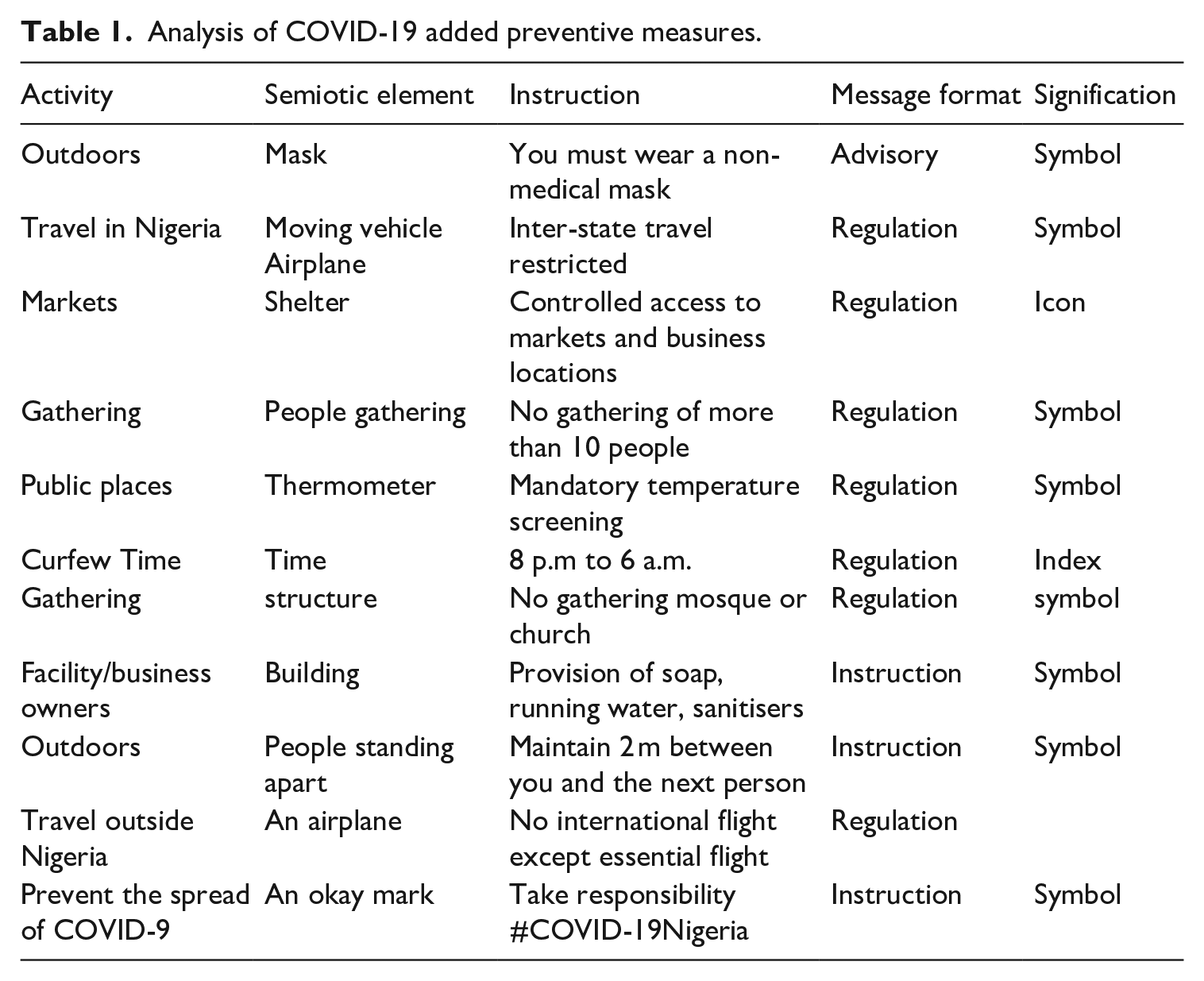
Demonstrating the typical structure of advertising discourse (Awonusi, 1996; Cook, 1992), the structure of the story board falls roughly into the three main parts: Headline, Body and Coda. The flow of the discourse patterns promotes easy communication and comprehension of the message. The graphological features as a multimodal resource creates an instant impact on the participants. The headline has a bold black text with a special font: ‘COVID-19: Added Preventive Measures’ to attract attention and persuade the reader to seek further information in the body copy. The foregrounding of the word, ‘Added’ in the headline seeks to heighten the anxiety and seriousness that accompanied the increase in the rate of transmission, contagiousness and fatality arising from the pandemic when it reached the plateau level in many countries. The presupposition embedded in the word, ‘added’ within the context of the text suggests that increased efforts are being made to provide up-to-date information that will assist the citizens to stay safe. The body copy encodes the main thrust of the public health enlightenment guidelines presented in a combinatory format of text and images as discussed above. It is worthy of note that the arrangement of the images and the text in different font sizes and colour codes makes it easy for easy comprehension of the message. It supports the salience of the information value encoded in the message. The short, crisp nature and features of the texts coupled with the appropriate images provide freshness and vividness in conveying the import of the message and enabling the people to understand the meaning of the message and remember the instructions. The coda concludes the message with a slogan that is meant to reinforce the message and enhance memorability. It also contains a message-authentication device by sighting the source of the message and the state actor responsible for issuing the guideline. This has become important in order to affirm the institutional and legal authorities that issue the guidelines. This may be viewed as message-authentication strategy or demonstration of discursive power to enforce compliance and the possibility of sanctions. ‘Take Responsibility-Prevent the Spread of COVID-19’ presented with the image of tick/correct/right mark – ✔. The mark is allowed to split the image of the virus to suggest that if we all take responsibility we can break the virus.
The two hashtags: #Takeresponsiblity and #COVID19nigeria further enhance the role that citizens are expected to play in curbing the spread of the disease.
The post demonstrates the use of multimodal resources as a discursive instrument to legitimise authority and as instrument of power and control. The pandemic period produced public health campaigns that were used as tools for controlling individual and public views. The spiral effect of the persuasive public campaigns ossifies towards instituting a new culture of aggressive personal and public hygiene with mask mandate, hand washing and social distancing protocols among other COVID-19 public safety guidelines. Authorities used discourse deftly and creatively to compel citizens to comply with those guidelines in order to mitigate the effect of the pandemic.
Reframing COVID-19 discourse through memes
Memes are presented in ways that amplify the socio-communicative intention in the online campaigns. For example, the meme in Figure 5 is a pictorial illustration of the gradual progression of the risk factor involved in the person-to-person transmission of the coronavirus. Against the background of official guidelines on social distancing to prevent local transmission of the pandemic, the meme is graphically framed to depict emblematic images of safety requirements (mask wearing) and risk levels (social distancing) while coping with the virus. The meme thus signifies the relationship between ‘pandemic tasks as social practice’ and observable results in percentages of compliance success or failure. Using similar images, with different patterns of iconicity, the meme provides vivid illustrations of social distancing as social action. The dominant semiotic feature is ‘social distancing’ which serves as a consistent emblem of the pandemic risk calculation through social practice. The use of statistics provides some sense of objective and accuracy in information presentation to further persuade and convince the people of the risk of contracting the virus. The multimodal elements deepen the visual impact and instructional protocols for public safety (Figures 5 and 7).
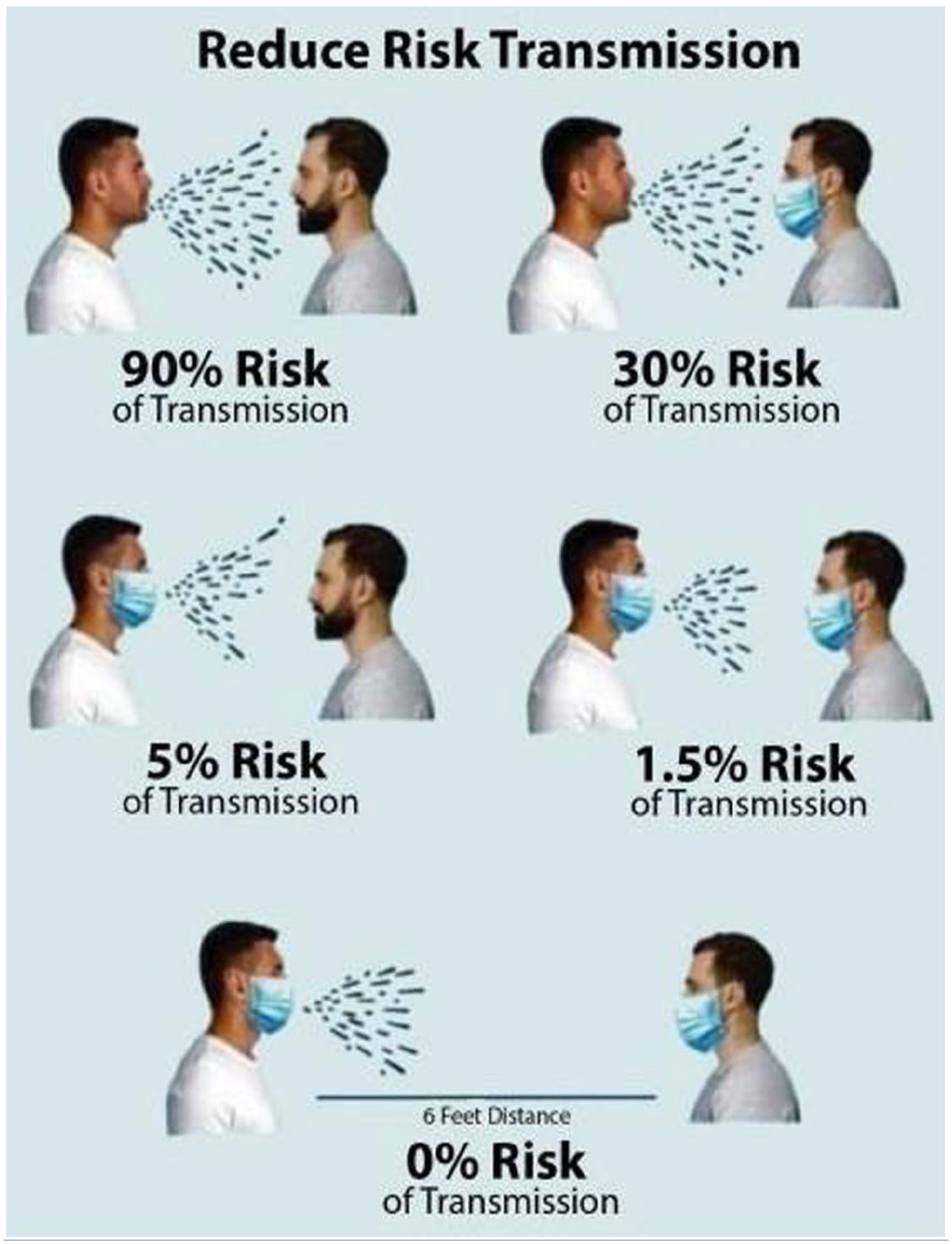
Social distance and risk of transmission.
COVID-19 memes tend to reframe the discourses they represent by promoting specific aspects of the pandemic public education processes in discursive patterns which represent a different perspective. Invariably, these new memes form additional sources of information which extend or explicate the discourse, or an important aspect of it. The discursive elements in the post contain several composite aspects: text, data and static visuals (pictures, images, posters). All these affordances form the bedrock of discursive elements that escalate the written and visual impact of the message. They connect the discourse to vast audiences, promote the space and tool to negotiate meaning and maintain human interactions through an increasingly visual mode.
Reframing COVID-19 discourse for social consciousness
In order to draw global attention to the discriminatory global public health policy, Figure 6 was created for the purpose of promoting some level of social consciousness on the basis of the on-going controversy on the development and testing of COVID-19 vaccines (Figure 6).
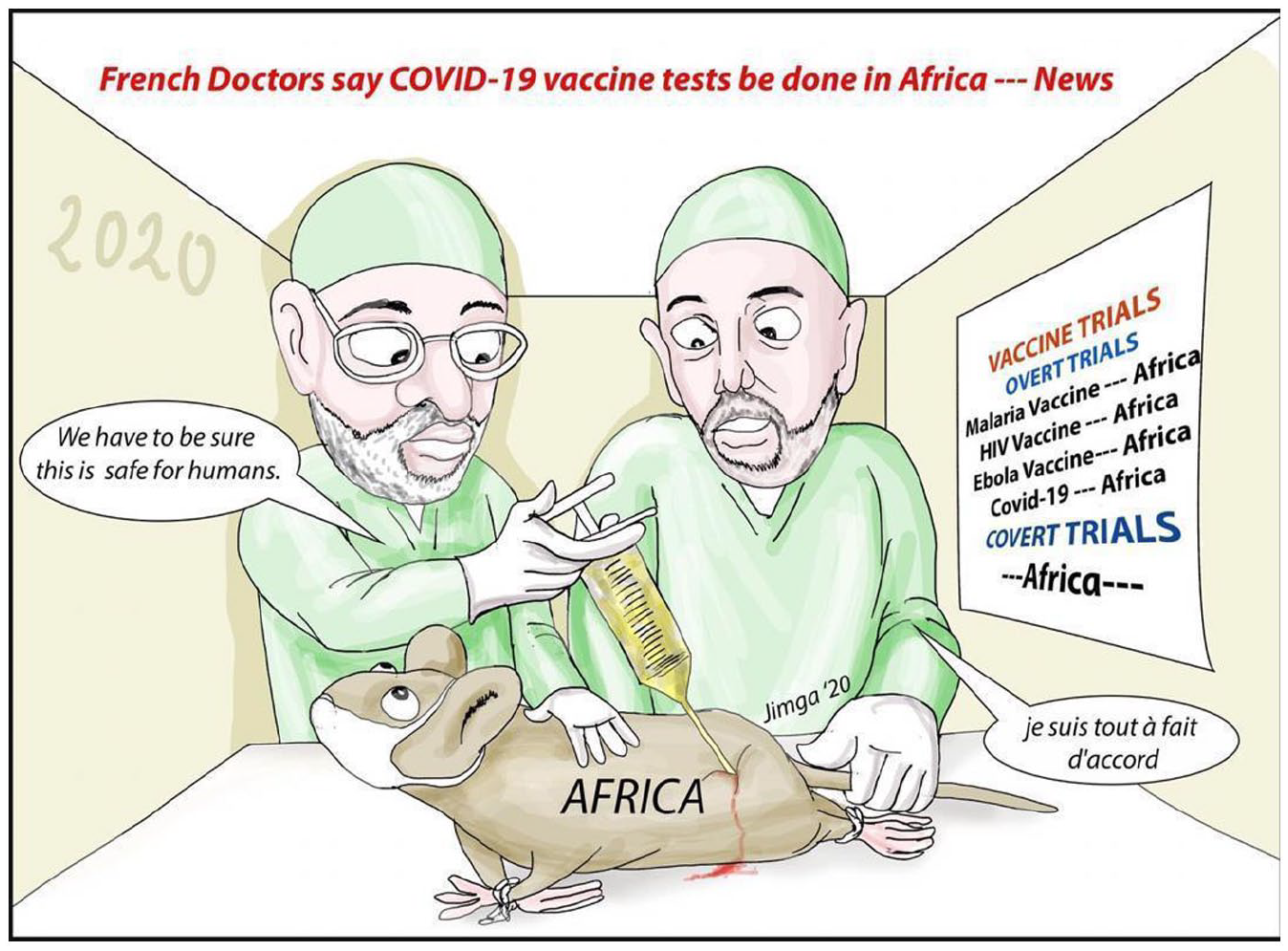
Reframing COVID-19 Discourse for social consciousness.
The post was created in reaction to the suggestion by some foreign doctors that the COVID-19 vaccine be first tested on Africans. The meme thus presents Africa as the helpless lab-rat (i.e. a guinea pig) at the mercy of the European scientists while the picture on the wall depicts previous trial testings conducted on Africans for various vaccines. The meme’s caption: ‘French doctors say COVID-19 vaccine tests be done in Africa’ aptly captures the tread of the on-going social media debate and parodies the situation. The images and texts communicate a strong message of condemnation of the stereotypes, injustice, racial profiling and discrimination against Africa and the developing world in general. It artfully scorns the hypocrisy of the west against the backdrop of their false expectation about the possible devastating effect of COVID-19 in Africa. It also serves as a pushback discourse strategy on the previous vaccination testing-scandals conducted by developed nations in Africa and against populations of colour even in some of those western countries (e.g. Pfizer’s court case in Nigeria over illegal meningitis vaccine test). When situated within the critical discourse analytic frame, the meme becomes a tool to resist power domination conveyed through the statement credited to the French doctors. It thus tactfully calls out the west to have a change of mind and consider Africans as fellow humans that deserve equity and respect because, afterall, ‘African lives also matter’.
Figure 7 below presents another creative reframing of existing COVID-19 public awareness campaigns as discourse power to enforce social distancing. One of the first major directives on the public safety protocols was that citizens should keep their hands away from their faces in order not to spread the virus. This virus containment and control advisory is here being reframed in a somewhat indirect, humorous but creative meme captioned: ‘To be safe from COVID-19 virus, do not touch MEN with unclean hands’. Using iconic images of the Mouth, Eye and Nose, this meme acronymises the initial letters of the key words ‘Mouth’, ‘Eyes’ and ‘Nose’ to form the word MEN, thus using the caption as an indirect proposition for dramatic effect. M.E.N. obviously represents the collective community of humans as potential carrier and transmitter of the virus. If individuals can control themselves, then we can contain the spread of the virus.
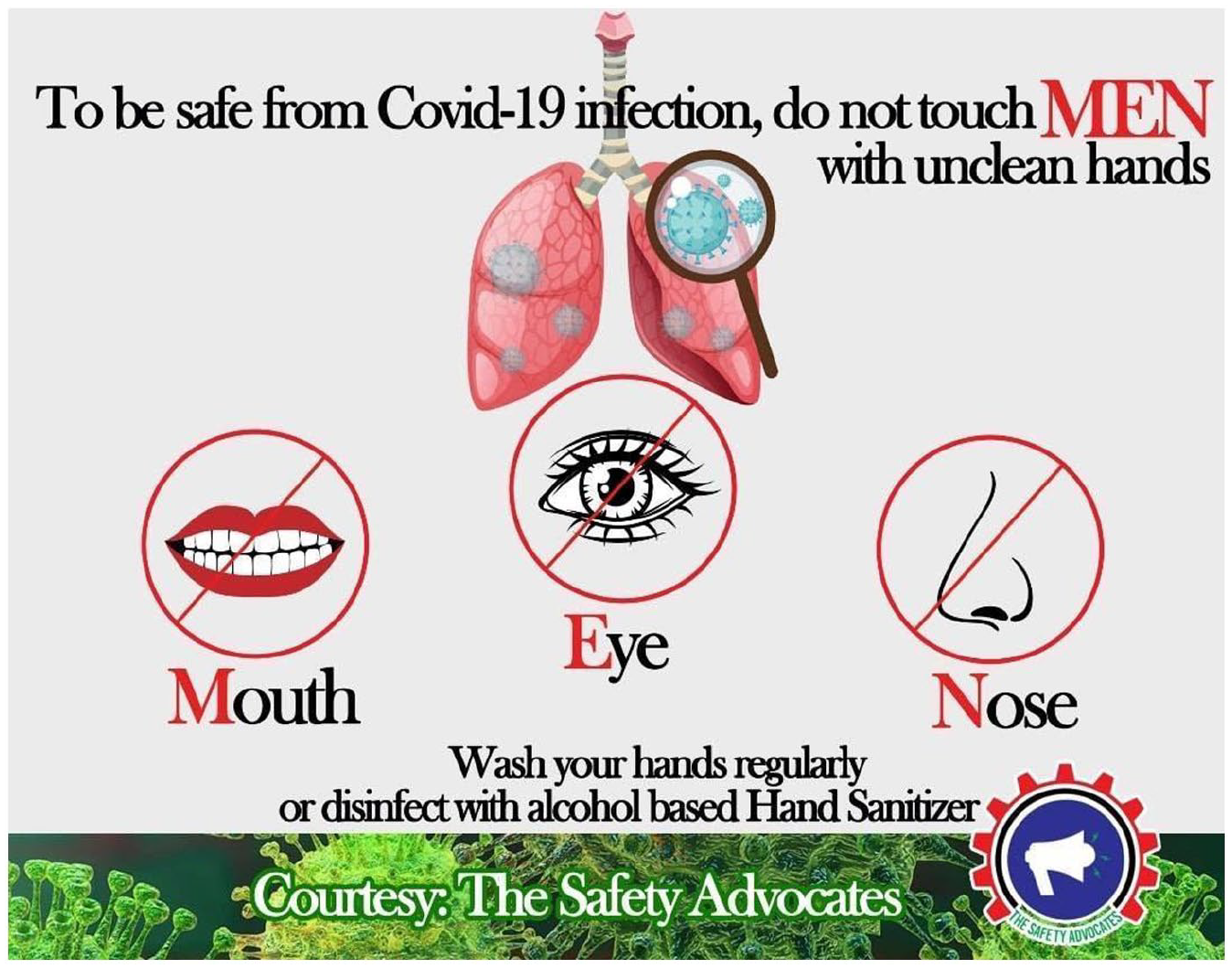
Body parts multimodality as COVID-19 safety campaign.
The use of body parts as multimodal elements in the post is designed to highlight the delicateness and ferocious impact of the virus in using the windows as entry points to attack vital organs of its victims. It is also aimed at further emphasising and promoting personal and community health during the pandemic as means of stemming the tide of infection and community transmission. The visual effect of the post drawn from a combination of images, text, use of special fonts, admixture of colours and graphology further amplify the persauasive effect of the message. The memorability impact of the multimodal elements are designed to make people more conscious about the devastating effect of the virus and thus engender necessary precautionary and safety actions.
In sum, by reframing the linguistic content of COVID-19 texts, the online memes represent a major discursive application of the socio-cultural affordances which may be observed in many online discursive texts on the coronavirus pandemic. These COVID-19 public health campaign texts have the potential to trace the contours of social, cultural and socio-political dimensions of language use in contemporary society.
Based on the discussion so far, we may sum up the discourse features of the online COVID-19 public awareness campaigns in terms of three broad communicative strands which illustrate their purposes:
(a) Information for public education: The primary goal of the COVID-19 public awareness campaign was to provide adequate information on the nature of the virus and the implications for public health. To this end, the flow of information followed the trend outlined by the World Health Organization (WHO) in conjunction with the Nigerian local health agencies, namely the Nigeria Centre for Disease Control (NTDC) and the state and federal ministries of health. While the WHO COVID -19 awareness campaign focused on global-scale information, the local health agencies provided ‘local content’ information on the pandemic, basically focused on individual and social implications of the virus in the Nigerian setting. To facilitate this, government and health agencies employed mostly visual and minimally textual informative strategies such as colour posters, and billboards using bold pictures, eye-catching images and memorable textual elements to convey the danger and urgency of the pandemic.
(b) Safety Awareness: Information on COVID-19 was largely supported by safety awareness directives which comprised a variety of visually educative pieces (videos, interviews, comic skits, etc.) and creative enlightenment memes, emoticons in the form of pictures, texts or a combination of both. All of these were aimed at disseminating maximum safety guidelines toward preventing the spread of the virus. The most dominant emblems of COVID-19 safety precautions were typified by the introduction of healthy lifestyle patterns like: the wearing of masks (‘the mask mandate’), avoiding crowded spaces, frequent washing of hands and ‘hands-free’ social behaviour (social restriction on hand – shaking, touching of bodies, faces, surfaces, clothing, etc.).
(c) Redirecting social behaviour: The COVID-19 public health awareness campaign presented Nigerians with multi-faceted directives on novel social interactive processes necessitated by the pandemic. These include directives on the restriction of movement (‘stay at home’, ‘lock-downs’, travel bans, curfews); restrictions on interpersonal interaction (social distancing), personal health protection guidelines (COVID-19 testing, and structured vaccinations) (Table 1).
This study has shown that the use of new technologies to transmit and share messages on public health emergencies is, to a large extent, designed to enhance proactive, preventive and personalised healthcare initiatives. The use of multimodal discourse strategies thus amplify the awareness messages and public advisories in order to achieve maximum impact on the audience.
Conclusion
In this study, we have discussed how social media users in Nigeria participated actively in the public health discourses on COVID-19 public health crisis, drawing extensively and creatively on a combination of text and images rooted in the country’s diverse linguistic and cultural repertoire. Situating the work in the context of public health discourse, we have relied on the use of sociolinguistic and discourse-oriented methods in exploring how the participants use multimodal computer-mediated techniques to create and negotiate meaning as social action. Specifically, the study uses theoretical concepts from multimodal and critical discourse analysis to investigate the communicative and sociocultural implications of the ‘new normal’ deriving from the pandemic. Our approach featured the investigation of verbal and visual text in the (re)presentation and (re)contextualisation of social, cultural, economic and political issues on COVID-19 across mainstream and online media. Essentially, public health campaigns as socio-institutional discourse space exhibits features of language use to demonstrate power and control as well as legitimise the authority of state actors and public health officials while enforcing the guidelines for public safety and wellness. This systematic [re-]framing of COVID-19 discourses and public health awareness campaigns has achieved some form of socio-psychological [re-] configurations and public health consciousness among the citizens leading to low level of transmission and few cases of fatality resulting from the pandemic in Nigeria.
Footnotes
Acknowledgement/Funding
The Lead Author would like to acknowledge the support received from the Alexander von Humboldt Foundation, Germany during his research stay at the University of Hamburg in 2022.
Declaration of conflicting interests
The author(s) declared no potential conflicts of interest with respect to the research, authorship, and/or publication of this article.