







Abstract
This paper investigates the racial discourse in the Afro-diaspora group in Germany. It uses the ‘discourse-historical approach’ – a strand of Critical Discourse Analysis – for the three-dimensional analysis of language biographical data of 67 African migrants in Germany. The study provides African migrants’ accounts of racism, identifies four discursive strategies, and then examines the semantics of a counter-racialisation term developed to cope with racism. The study finds Afro-diaspora racial discourse as a site for confronting the racism problem, legitimising the race idea, and contingent on migrants’ access to material resources in Germany. Furthermore, the term ‘fake-oyinbo’ indicates an ability to use simple linguistic terms in an intended way of racial categorisation within race relations thinking. The paper concludes that Afro-diasporans’ racial discourse is a ‘grassroots’ minority discourse revealing a counter-racialisation linguistic action while explaining and justifying the condition of the ordinary black minority.
Introduction
This paper investigates African migrants’ racial discourse emerging at the margins of the minority discourse in Germany. Recent studies on minority discourse in Germany have taken their cues from the mainstream analysis that focuses on texts and talk of scholars and scholar-activists seeking equality in discourse representation. This mainstream minority discourse is concerned with bringing to public attention the work of marginalised scholars that have been ‘ghosted’ by the process of canonisation in social science. As a result, research on minority discourse(s) in Germany has primarily relied on the works of scholars, activists, and elite members of the minority as the site of counter-discourse analysis. At its core, these studies analyse systemic racism that suppresses the work of minority scholars and voices of scholar-activists in German universities (Florvil, 2020; Hoppe et al., 2018; Lennox, 2016; Malakaj, 2020). Even though these analyses are valuable to understanding the counter-hegemonic discourse of minorities, they have nonetheless turned away attention from the ‘popular’ or ‘grassroots’ counter racism discourse within the minority community. In this paper, we illuminate this ‘grassroots’ (racial) discourse.
Although this study concerns discourse and anti-black racism research, it intersects with the minority discourse that pushes for equality and social justice in discourse representation (see, for instance, JanMuhamed and Lloyd, 1990; Ojaide and Ashuntantang, 2020). The existing studies on discourse and racism emerged following the ‘linguistic turn’ in the social sciences. Following the ‘linguistic turn’, a burgeoning body of scholarship on racism and discourse has paid attention to anti-racist discourse, especially in talk and texts of elites, media, the parliament, and academics. This research focuses on the analyses of counter-racism discourse that criticises, categorises, delegitimates, and argues against racist opinions and practices (Cheng, 2017; van Dijk, 1992, 1993; Wodak and Reisigl, 2001: 272). While this scholarship has analysed discursive counteractions of opposition to inequality within the framework of the organisation of institutions, multiculturalism, and academic research, it runs the risk of being disconnected from everyday discussion on the racism problem confronted by the ‘black minority’. 1
So, in this paper, we present and discuss the racial discourse of black migrants of African descent. The analysis highlights how Afro-diasporans’ use of language challenges dominant discourse on race and racism. However, a good starting point is to explain what we mean by race and racism. Whereas race is considered a constructed category of difference based on phenotypical, cultural, and other specific characteristics ascribed to designated groups (James and Burgos, 2022), racism embodies ideas and practices that establish, maintain, and perpetuate such categories of difference (Bakan and Dua, 2014: 6; Törngren and Suyemoto, 2022: 2). However, enacting the racial categories of difference through talk and text is a constituent of ‘racialized social systems’ (Bonilla-Silva, 1997: 469). The racialized social system refers to ‘societies in which economic, political, social, and ideological levels are partially structured by the placement of actors in racial categories or races’ (Bonilla-Silva, 1997: 469).
Therefore, in section 3, I will brief discuss the overlapping interests between critical race theory (CRT) and critical discourse analysis (CDA), offering a conceptual overview of racism and how discourse contributes to its (re)production. The analysis enables mapping out Blackness as a ‘signified other’, a negative capital, for situating the racial discourse within the broader dynamic of race relations in Germany. The discourse-historical analysis (hereafter DHA), a strand of Critical Discourse Study, is used to organise the empirical analysis. These include section 4, which presents the accounts of racism from a rich set of interview data I have helped compile for a related project, the discursive strategies in section 5, and the semantics of a counter-racialisation term in the ‘grassroots’ black minority racial discourse in section 6. The analysis shows that the recurrent motifs in interviewees’ racial discourses are tactics of engaging with their racial reality and the awareness of their state of being in their material environment in a white-dominant society. This tactic includes deploying a counter-racialisation term that reflects a grassroots counter-racism discursive action. The following section 2 describes the data for the study, including the coding process.
Data and method
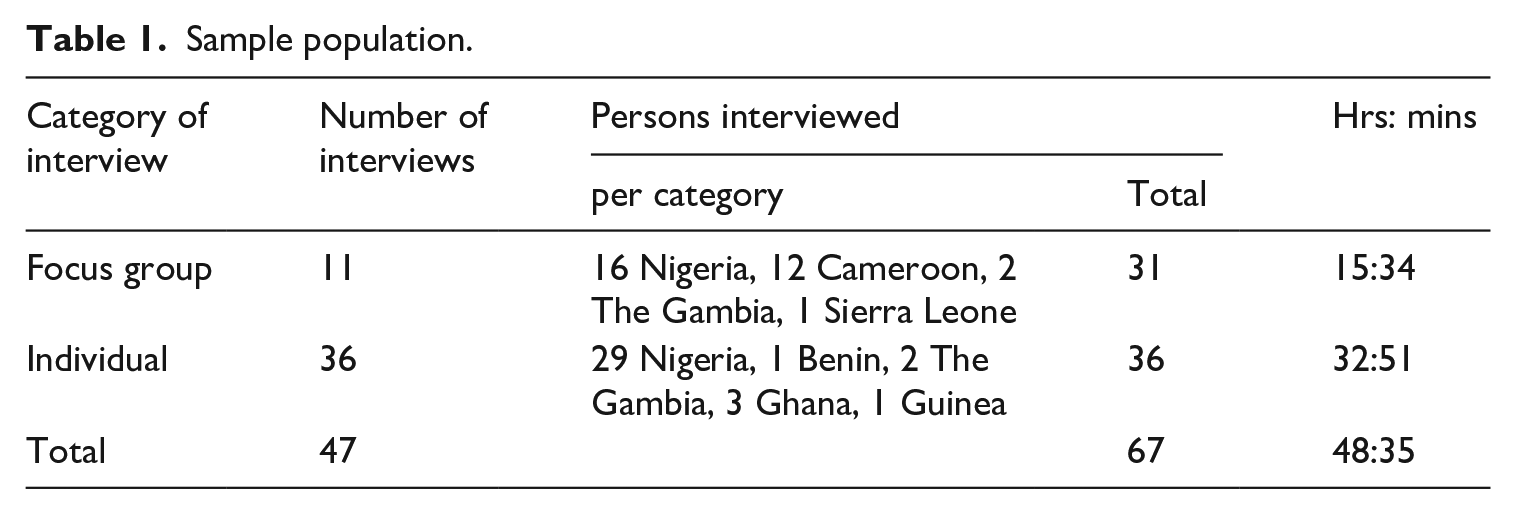
The data for this study derives from language-biographical interviews with West African informants collected in the frame of a research project, ‘West African Englishes on the Move: New Forms of English as a Lingua Franca (ELF) in Germany’ (see Mair, 2022 for a description of the research design and a discussion of results). The focus of this project was on the use of (Nigerian) English and German in lingua-franca interaction, and it did not systematically analyse the numerous mentions of issues related to race and discrimination in the data. This is a research gap that the present paper intends to fill. The material makes up a rich body of non-numerical verbal data from semi-structured interviews and focus groups with Africans living in or near Freiburg in Baden-Württemberg or Mülheim an der Ruhr, North Rhine Westphalia, Germany. The data is generated by talking to the participants about their experience in schools and at work, their problems with language and communication and their situation as migrants in Germany more generally. The sample population comprises 67 individuals in forty-seven in-depth, semi-structured interviews (36 individual interviews and 11 focus groups) that were tape-recorded and transcribed using ELAN 2 transcription software 3 (see Table 1). Most interviewees fall within the age categories of 30–39 and 40–49 (see Table 2).
Sample population.
Interviewees biography.
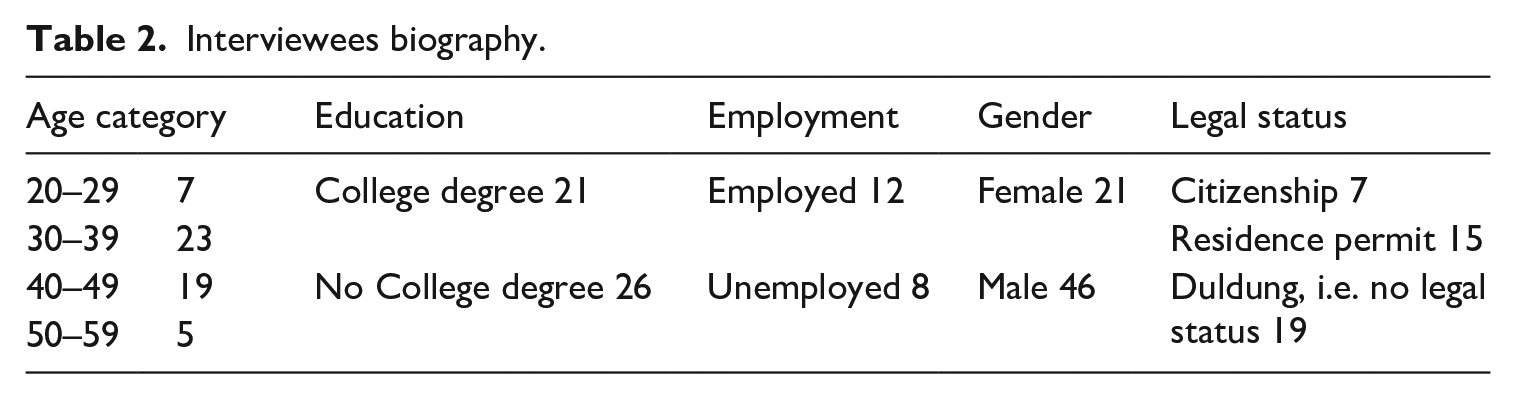
Around half of the participants live in Germany under the precarious conditions of Duldung, which means that they have no legal right to remain in Germany, but their deportation is temporarily rescinded for factual and legal-technical reasons spelled out in the relevant paragraphs of German immigration law. However, those with the Duldung living in Germany for five or more years and consistently working are often granted residence permits on humanitarian grounds. Other participants have acquired German citizenship or reside in Germany legally with student visas. Participants differ not only in legal status, but also with regard to a number of other parameters, such as levels of educational attainment and employment status. However, about a third of the interviewees did not indicate their educational level. One reason that could account for this is that they do not want to be seen as uneducated. Whereas the educational level of the participants affects their response to what they perceive as racist events, there is a general consciousness that the black person is sealed into ‘objecthood’ due to the global and interrelated process maintaining the structure of race relations and inequality. Nevertheless, the effect of legal status, educational level, and length of stay on migrants’ comprehension of racism is subtle because the narration of racism is primarily comprehended through Blackness as a negative capital in White-dominant societies. For reference, the interviews are numbered serially, and the interviewee’s gender is indicated by ‘M’ for Male and ‘F’ for Female. There are 21 female and 46 male participants, but gender role is not centred in this analysis, except for the labelling.
We used the conversational approach in the interview process, including ‘follow-up questions’, such as elaboration and example prompts, restatement and direct questions (Schaffer, 2014: 187), to engage the participants and to encourage them to be as natural and truthful as possible. In addition, each focus group is organised so that the participants know each other to create a conducive environment for sharing opinions, especially on racism and discrimination experiences. In essence, the linguistic discussion on the use of Pidgin proved valuable for the creation of a relaxed atmosphere and the establishment of mutual trust. As a result, the reluctance of Black informants to discuss their experience of racism, that is, the ‘reticence problem’ (Räthzel, 1997: 60), was overcome.
Coding process
The coding is based on an automatically sourced lexical concordance list of 74 ‘discourse segments’ containing the terms racist/racism, discrimination, and ‘Oyinbo’/fake-oyinbo, which was generated from the data with ‘AntConc’ 4 (2014). The word oyinbo is used by Nigerians to represent Caucasian whites. Most of these explicit mentions lead to extensive discussions on racism in Germany, which can be said to define the discourse context (DC). According to Davidson (1967 in Polanyi, 2001: 266), the discourse context (DC) expresses an event or a general state of affairs (i.e. racism) in some spatiotemporal location (i.e. ‘post-racial’ Germany) involving some set of defined participants (i.e. Black African migrants). As the interviewer, I refrained from introducing the topic myself. Only 44 participants out of the 67 raised it themselves. This means that the following analysis is based on data provided by respondents who were willing to talk about their experience of racism. We can only speculate on the reasons why 23 participants kept silent on the topic.
Both short and long transcriptions of spoken text with discursive equivalents within the parameter of ‘discourse levels’, in this case, a grassroots narrative of everyday racism (Reisigl and Wodak, 2001: 26), are tagged ‘race-discourse units’, hereafter RDU (cf. Polanyi, 2001: 266). The RDU represents the constituent discourse unit, which conveys the content of the grassroots discourse of racism. The participants used stories and arguments as the primary genre for providing information on their experience of racism. However, the racism discourse operators connect the attitudinal evaluation of the state of affairs (i.e. RDU) with the discursive strategy through racial expressions that indicate an unfolding racial experience. For example, race discourse operators such as ‘racism’, ‘racist’, ‘discrimination’, ‘Black’, ‘White’, ‘Oyinbo’, ‘German’, ‘Ossi’, ‘Arab’, ‘Poles’, ‘Romanians’, and ‘Russians’, allow insights into? the semantic structure of the racial utterances and are often at the core of the experiential meaning making in the RDU, thereby facilitating the semantic interpretation at the level of discursive strategy (c.f. Polanyi, 2001: 266). The coding tree presented above clearly outlines the process of the analysis (Figure 1).
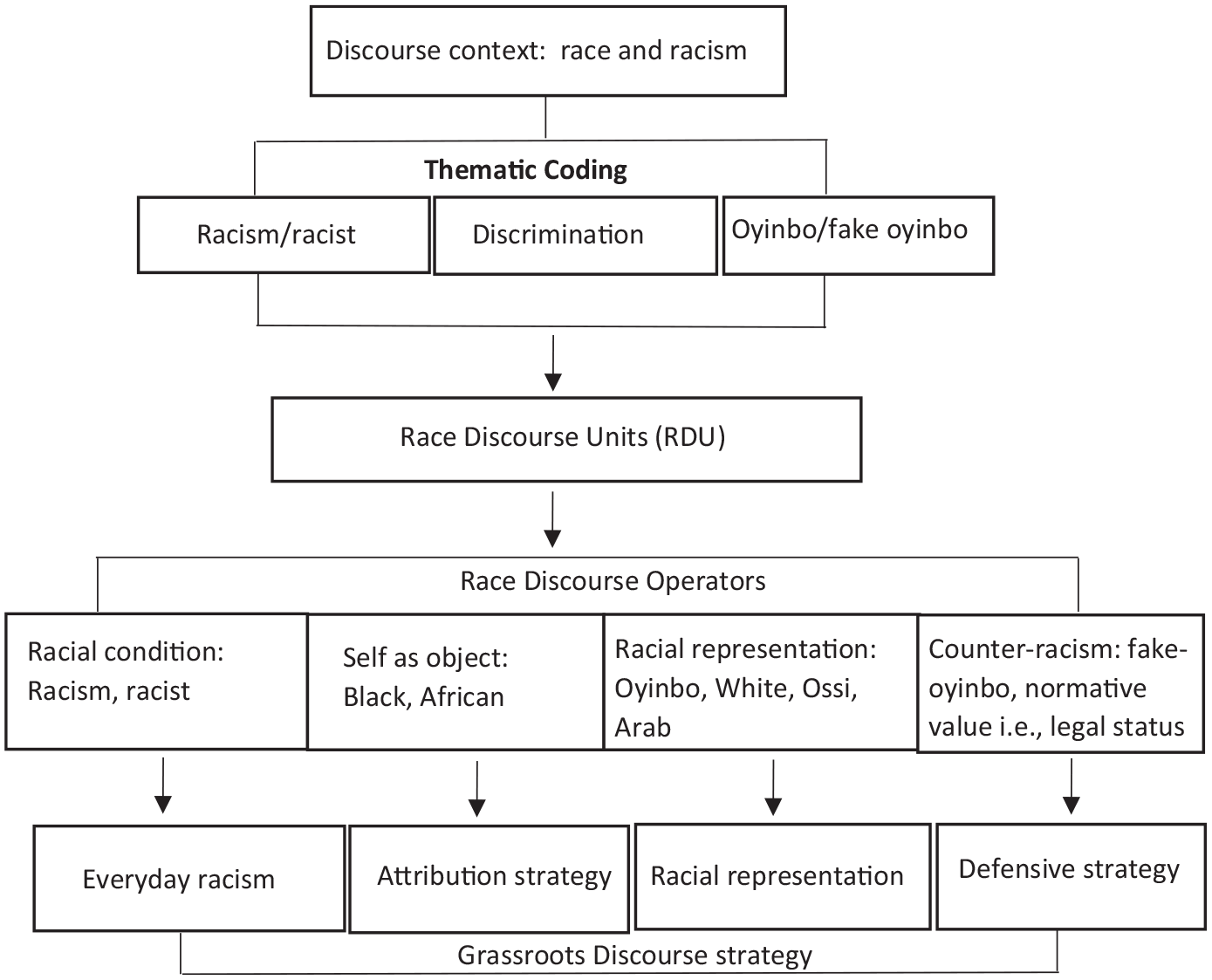
Coding tree for thematic analysis.
Conceptual framework: Blackness as a ‘signified-other’
I briefly sketched a point of similarity between Critical Race Theory (CRT) and Critical Discourse Analysis (CDA) in this section. As a shared entry point on race, racism, and discourse, it maps out a conceptual framework – blacks as the ‘signified other’ – for Afro-diasporan racial discourse within the dynamic of race relations in Germany. Inspired by Foucault’s concepts of discourse, power, and identity, critical race theorists, such as Stuart Hall, suggest that racism is acted out under specific historical conditions as a set of economic, political, and ideological practices that place racial groups in a material structure of inequalities (Hall, 1980). Based on the insight that economic relations, prioritised by Marxism, are insufficient to explain racism, CRT locates the understanding of racism in culture, modernity, and whiteness (Dua, 2014: 23). Critical race theorists thus argue that the appearance of a natural human hierarchy denoting race is constructed as a product of economic, political, and ideological practices perpetuating socio-racial inequality. Therefore, they emphasise the conglomeration of cultural, political, social, and ideological practices in exploring the complexities of race and racism. While race is a concept for explaining human differences, racism originated from the political practices that perpetuate such categories of difference, sustained through multiple, varied, and contextually specific social, political, and economic constructions within a nation-state (Bakan and Dua, 2014: 6). So racism can be expressed either as an explicit belief in racial superiority or as a structural system of racial discrimination (Bonnett, 2000: 4; Törngren and Suyemoto, 2022: 2). Critical race theorists do not just focus on analysing the contemporary structure of racism but are also concerned with how racism is reproduced (Meghji, 2022: 3).
However, the fact that discourse is, consciously or not, oriented to a particular function implies that it achieves a particular consequence (Wetherell and Potter 1988: 171). This means that those with power and control can manipulate? discourse, which constitutes a structure in itself, according to their whims and caprices. Thus, critical discourse analysis concerns understanding the nature of power and dominance and how discourse contributes to their production (van Dijk, 2001: 301). Therefore, the key site of the operation of racism for critical race theorists and critical discourse analysts is beyond the individual consciousness (c.f. Bonnett, 2000: 4–7). It includes the social, cultural, economic, and political processes, which include discourse, that lead to or sustain racial inequality. In this regard, for critical discourse analysts, discourse takes on a structural form that plays a role in the (re)production of social inequality. The CDA thus shares a point of convergence with CRT through the role of discourse in the (re)production of racial structure (or racial categories) and social inequality (racial privilege, power, dominance and hegemony).
In this paper, the enactment of race as a social category of difference and the mental model of a ‘signified-other’ stems from the dominant racism discourse of ‘Fremdenfeindlichkeit’, which means ‘hostility towards strangers’ (Roig, 2017: 613–614). This prevailing frame of the public discourse on racism differentiates Black migrants as strangers in Germany. It projects on them ‘otherness’, the ‘unwanted guest’, thus problematising their existence in the country. This stigmatising orientation facilitates the internalisation of a negative identity by African migrants. The internalisation of negative identity is a crucial socio-cognitive process that connects the migrants’ discursive formulation of racial views with their situations and prospects regarding opportunity and inequality in Germany. As explained by Frantz Fanon, one of the three epiphenomena that appear when Blackness is turned into a signified-other is a negative capital, an Other displaced by the uncertainty of being the ‘signified-other’ (Ibrahim, 2020). 5
Here it can be seen how the CRT and CDA interconnect on the point that structural formations (social, political, economic and discursive) underlie racial (social) inequality. The black African migrant’s discussion of racism can thus be situated within this ideological condition of producing it, that is, the ‘internalisation of the self-as-other’ (Hall, 1997: 49) in Germany. Therefore, in light of the ‘negative identity’ structuring the Afro-diasporan racial discourse at the grassroots, I present, in the remaining sections, in line with the three-dimensional approach of discourse-historical analysis (DHA), (1) the participant’s narration of experiences of racism, (2) the discursive strategies and (3) the linguistic means as context-dependent linguistic realisations (Reisigl and Wodak, 2009, chapter 4, ‘Some tools of analysis and principles of DHA’, first paragraph).
Blacks’ racial discourse: The participant’s narration of experiences of racism
In this section, I discuss the participants’ experiences of racism as part of their everyday life in Germany. The section considers a few elaborate stories of racism because of the information they provided for this analysis. In narrating his experience of racism in Germany, participant [17m], who works as a supervisor in the construction industry, talked about racism in everyday practices. He starts with a generalisation that racism is a regular thing in Germany (see line 2, RDU 1) to acknowledge its persistence in the life of Blacks in the country. He continues with the example of his colleague’s view that black workers should perform the hard labour and not lead/direct White people (lines 7–8). Since he is unsure whether this statement reflects a general ideology of white supremacy, he returns to the colleague on the second day to ensure he had not misconstrued his meaning (line 9). Then the colleague makes it clear that, as a German, he gets angry when a foreigner comes to him (line 10). At this point, participant [17m] reacts with a statement, ‘I am also a German like you’. The claim of status equality challenges the racist colleague’s conviction that Blacks are a subordinate race (line 9).
1 I: so, do you [. . .] have any uhm racism experience?
2 P [17m]: yeah, racism in general is an everyday thing in Germany
3 I: how do you mean
4 P[17m]: I will share with you an instance on my place of work. I have been working with these guys for the past five years
5 P[17m]: we had a little misunderstanding due to the particular work [. . .] we had the same [. . .] interest how to finish the work but the method we had different views on how to approach the work
6 P[17m]: So, all of a sudden, he became so angry, and he was like what do you a black man have to tell me and at first, I was like what do you mean as got into skin colour na [well]
7 P[17m]: he said nein [no] the black man previously they used to work but now they want to tell us what to do
8 P[17m]: you früher ihr habt nur gearbeitet und jetzt wirst du mir sagen was wir machen sollen [you earlier you just work but now you will tell me what I should do]
9 P[17m]: [. . .] and the next morning I thought ok it’s just a usual stress at work. I went to him he said du nerve mich [you annoy me]
10 P[17m]: in his right words when a foreigner comes to him, he is a German he gets angry
11 P[17m]: then I was pissed off and told him I am also a German like you
A repeatedly articulated notion is that White migrants, especially Eastern Europeans, are more likely to commit explicit racism than Germans. Participant [10f] refers to Eastern Europeans as the people that discriminate against Blacks. She works as unskilled staff at a hospital – employment also held by many Eastern Europeans. As she talks about her experience of racism in interaction with colleagues at work, she casts Eastern Europeans as racist. This generalisation of a group of people as racist comes from her experiences with members of this group. She describes them as very racist, saying they are not like Germans, who do not discriminate against her. Her statement (RDU 2, line 3) that the Deutsch people do not discriminate, but that it is the Ausländer [foreigners] is a strategy minimising racism.
1 P[10f]: for example [. . .] the Deutsch people don’t [. . .] discriminate it’s the Ausländer to the Ausländer [. . .] the German people doesn’t have problem with you [. . .] they are very friendly [. . .] these Ausländer that come here like the way you come here [. . .] they are demon
2 I: have you ever had troubles with them
3 P[10f]: In my working place sometimes [. . .] this people [. . .] they are racist that’s the Russisch, the Polish, the Slowakei [. . .] Rumänien. All these people all these East people that come they don’t want to see blacks
The opinions expressed in RDU 1 and 2 are consistent with that of a participant in [FG1] who, within Germany, attributes racism to the Ossi [derogatory term for East Germans, i.e. people coming from the territory of the former German Democratic Republic]. RDU 3, from participant 3[m], illustrates another belief apparently widely held in the group and articulated in several interviews, namely that Arabs receive preferential treatment over Blacks because of their skin-colour. Participant 3[m] has difficulties regularising his legal status despite his wife and children having residence permits as protected persons. In his word, ‘I don’t have the same equal opportunity with Arabs, but we are immigrants’ (line 5). He believes that the German authorities give Arabs residence permits (line 8) faster than it will take a black migrant to get one because they prefer to mix with Arabs rather than blacks.
1 I: but the German governments are doing a very good work when it comes to immigrant.
2 P[3m]: yeah, they are doing a lot of good work when it comes to immigrants [. . .] but [. . .] in that good work you can see so many differences so many unbalance
3 P[3m]: like let me use myself as an example
4 I: ok
5 P[3m]: I’m black. I don’t have the same equal opportunity with Arabs, but we are we are immigrants
6 P[3m]: For instance, because they are white, they see them as second to them and this is kind of racist too that I talk about. They give them paper easily
7 I: ok so you think German government is unfriendly to Nigerians to Africans
8 P[3m]: yeah, they are partial not unfriendly [. . .] they don’t want here to be mixed with blacks [. . .] they are gleich [similar] like them. They give them paper easily.
This notion that the German authority treats white skinned migrants better than Blacks is supported by a German-wide Afrocensus survey of Blacks or people that identified as black. In this survey on racism in Germany, 74.1% of the respondents claim discrimination by government institutions due to their skin colour (Aikins et al., 2021: 34). White favouritism, which minimises competition from qualified black minorities, has been argued to be a part of the ‘violence of racism’, that is, how Blacks and other racialised people understand and experience racism (Lentin, 2020: 67). Participant 6[f] talks about how her child ends up at the end of the line in the Laternenfest [Lantern Procession] on St. Martin’s Day, 6 explaining this as an instance of race-based favouritism. Although this might be a case of interpreting every unfavourable action or behaviour against Blacks as racism, most participants assume that Blacks are treated differently in German society [see, e.g. RDU4, line 1]. For example, a female participant [27f] likened being Black in Germany to sin. She argues that Blacks are judged by skin colour (RDU 5). Since black Africans are disproportionally confronted with the inter-related challenges of legal regularisation and securing regular employment compared to other migrant groups in Germany, members of the group strongly believe in a negative bias towards them.
1 P[6f]: yeah, in a way you know you can’t be their colour you can never [. . .] they will treat you [. . .] different
2 P[6f]: or maybe for instance, you are like my son now let me use my son as example in the kindergarten
3 P[6f]: like two years ago when they were doing Laternenfest [Lantern Procession] they first of all they will give all the white people things before they will give him
4 I: so, even if he is in the front
5 P[6f]: lie, lie, they will never give you first as far as you are black
1 P[27f]: the only thing I know is that some of them still make some kind of racism when they see black, they feel black is like their enemy or black is like a sin already or [. . .] it seems like we are judged by our colour you know
In another example of a story on inequality in German intergroup relations (RDU 6), participant [4f] referenced the invisibility of Blacks in upper-level professions using the case of Blacks born and raised in Germany. She talks about the difficulty of finding a white-collar job for children of African migrants born in Germany. The conversation was co-constructed by her husband, who was present at the interview in their home. She laments that there is hardly a black person in a prominent position simply because they are not given such opportunities (line 8). As narrated in RDU 3, participant [3m] thinks foreigners, especially Blacks, are treated as second-class citizens. This is confirmed by participant [4f], ‘for this job [managerial positions] they don’t give it to us they want us to be under someone which is not good’ (line 9). In another example in the focus groups [FG1], a participant says that ‘you may even [go] to job interview due to you are black, you will not get the job’.
1 P[4f]: I have some group of uhm youths that I used to have like some lectures with here [. . .] they are all born here and automatically I think they are all German [. . .] but these children [. . .] they still see themselves like they are not real Germans.
2 P[4f]: they are still like a foreigner like from Africa where their mother or their father are coming from [. . .] and I asked them, why do you think so? [. . .] and they say yes because they have had a lot of them that are graduate born here in Deutschland and they don’t have access like [. . .] for instance to be a doctor.
3 P[4f] _hus: being the one leading
4 P[4f]: leading not being under someone (.) doctors like lawyers or something like that
5 P[4f] _hus: hmm or work in bank
6 P[4f]: yeah [. . .]one wanted to work in bank she has applied [. . .] they didn’t give her this job and the people like some of the Arab that she apply with [. . .] they gave them this job and then I asked her what do you think that is the problem she say that she believes it’s because of the colour
7 P[4f]: I say I don’t understand but you are born here you are a Deutscher you are a German [. . .] so why won’t they give you the job [. . .] she told me plainly that this is what they have been experiencing in Germany
8 P[4f]: and I tried to check and it’s true [. . .] you won’t see a black in here in this city here [. . .] in a very big position in the office not that we are not studying not that we are not ready to do that but because [. . .] they don’t give us when we apply for this opportunity
9 P[4f]: for this job they don’t give it to us they want us to be under someone which is not good
1 P[3m]: yeah, and this is a country they are not they don’t give black a chance. How many blacks do you see in their parliament? I have not seen [. . .]
2 P[3m]: even here as big as Freiburg is I have never seen a black Polizei. What I’m really saying is that German is not like England or Canada where they give foreigners a chance [. . .] the foreigners always come second.
3 P[3m]: yeah, they always come second no matter you may be [. . .] train here and everything [. . .] there’s a job for Germans [. . .] there is a job for foreigners this I have known and this is how it stands
4 P[3m]: One thing I found out that that I didn’t really like about Germany [. . .] racism about colour.
However, some participants (i.e. in [FG1]) are less strongly opinionated on ‘black skin’ as a limitation to progress – stating that other factors, such as lack of proficiency in the German language, may prevent Blacks’ integration and advancement in the country. Interestingly, the participants that share this opinion tend to speak above-average German, find their work comfortable, are mostly well-educated, or are married to German partners. These factors have helped their integration and acceptance in society and, as a result, shaped their view on anti-black racism in Germany. The takeaway is that successful black migrants are less likely to view their life chances in a white-dominated society through the racial lens. These participants tend to play down the idea of anti-black racism by normalising it as a part of everyday routine. For example, the participant [17m], who completed an apprenticeship and occupies a supervisory role at his workplace, acknowledges acts of subtle racism as a part of daily routines. A participant in FG 1 contends that ‘racism is all over from black to black, from white to black, from white to white’. The analogy puts all racialized phenomena under the umbrella of racism. Therefore, simple, brief, and commonplace negative racial slights that are microaggressions which send denigrating messages to Black people are seen as examples of a wider everyday racism in Germany. For example, one of those subtle forms of racism is the avoidance of body contact with blacks by some white people on the bus, train, or street. In RDU 8, a participant describes microaggressions as discrimination that makes black people feel unwelcome in Germany. Microaggressions are not limited to public spaces, as a participant described his experience of rhetoric on racism at the workplace (see RDU 9). In his statement, when a printer malfunctions by printing shades of black, a colleague links it to the presence of a black person. The female colleague has jovially related the printer malfunctioning to his [Black] presence (see RDU 9, lines 3–4). However, participant [22m], who happens to be an exception, thinks Black people talk about racism only when they are comfortable. If they are not comfortable, they do not discuss racism. He points out that racism does not stop a Black person from progressing; self-determination determines one’s progress. This does not align with the logic of racism as normative in Germany shared by most participants.
1 FG1(P2[m]): the discrimination when you enter into a bus, and they see [. . .] a black person seated they will not sit on that seat or sit close to you
2 FG1(P2[m]): they will just look at you as if you’re a different person [. . .]
3 FG1(P2[m]): once you sit close to them you will see the way they package themselves as if the person sitting close to them [. . .] you want to kill them [. . .]
4 FG1(P2[m]): I’m telling you
5 FG1(P2[m]): so, and at times some of them they will leave [. . .] the seat and go to other place
1 FG1(P[3m]): for example [. . .] I don’t know what they think about me because I’m a black one [. . .]
2 FG1(P[3m]): the printer was kaput[spoil] [. . .] and dann [then] they bring new one [. . .] the printer starts to druck [print] everything in black [. . .] and the one lady said ah why is it not going to happen when black is here
3 FG1(P[3m]): but for me I don’t take it personal I just like okay yeah, I said I was laughing, and I say uh I’m very sorry that it print in a white
4 FG1(P[3m]): that shows that someone is here that you have to give a respect to him [. . .] also to take him as how I am
5 FG1(P[3m]): they were so happy to hear this from me and I said you have to take me the way I am
In a similar fashion, some participants perform counter racism linguistic actions by stressing that they belong in German society, that is, a normative value in a context of migration (for instance, see and RDU 6, line 4). The remark of participant [17m] that ‘I am also a German like you’ (RDU 1, line 11) challenges racist ideology by pointing to equality in legal status as a German regardless of whether an individual is White or Black. Similarly, a participant in one of the focus groups [FG1], comprising three Nigerians, replies to his colleague by saying that Black does not struggle to be visually noticed to counter her statement of subtle racism. Another example is the reaction to a racist utterance with an expression of positive contribution that benefit such racist individual. The participant [17m] counters an act of overt racism with an expression that ‘I pay part of your pension’ (RDU 10, line 6). He has evaluated an utterance of an elderly woman [you refugee] ‘du Flüchtling’ (line 5) in a banking hall as a form of everyday racism.
1 P_17[m]: and in other, situation I just you know
2 I had my off that particular day I felt I should take off and I went to the bank
3 and an elderly woman was sitting by the chair bank but and
4 I was trying to check my bank slip and all those stuff
5 she looked at me she said you, you asylum seeker du Flüchtling
6 then I paused I looked at her and I told her I pay part of your pension
7 have a nice day
Whereas both latent and overt racism are discussed as a normative part of everyday life, explicit acts of anti-black racism are attributed to specific white groups. In addition, there is a strong preference for the construction of Blacks as a different category in the discourse and, as such, the notions that Blacks are treated differently. Portraying themselves as different is not unconnected to the discursive production of migrants in the public discourse as the ‘other’. In the absence of the optimal assimilation of the African migrants in the dominant culture, the migrants are problematised as outgroups in German society. The discourse of black migrants as problem shapes the migrants’ opinions around notions of racial hierarchy. So the discursive strategy is elaborated against the backdrop of the ‘internalisation of the self-as-other’ that shapes Blacks’s representations, opinions, and evaluations of racism in Germany.
The discursive strategies
In this section, I will explain the four discursive strategies that the Afro-diasporans used in describing and narrating their experience of racism. The discourse strategies are the linguistics and social-cultural knowledge employed for conversational inference on the experience of racism by Afro-diasporans in Germany (c.f Gumperz, 1982: 3).
Everyday racism
This strategy is based on the normative claim of racism as a part of everyday life. Most participants frame their experience around the belief that racism in Germany is an everyday thing. ‘Everyday racism’ links ideological dimensions of racism with daily attitudes interpreting the reproduction of racism in terms of experiences of everyday life of victims (Essed, 1991: 2). This strategy is often used to explain, justify, and sometimes counter-narratives or accept the African migrant’s marginal condition in the country. In the pattern of argumentation, the ‘Speaker’ is the Subject in the experiential structure of racial meaning. This process takes on a present form in their location, that is, context-dependent linguistic realisations of speakers. For example, statements such as ‘racism is an everyday thing’, ‘they don’t give black a chance’, ‘you can’t be their colour’, etc. are all expressions, that is, racial meaning, that indicate arguments of an unfolding racial experience. In this sense, they see themselves as the object of racism in Germany. This comprehension of self as an object of racism is similar to an earlier finding that Black women in the Netherlands define themselves as the object of racism, although they do not see themselves as a part of the history of Black resistance in that country (Essed, 1991: 117).
Racial representation
In racial representation, the participants employ the notion of race by its referential meaning. It is the process of constructing and categorising the social actors and the events involved in incidents of racism. The participants use mostly subject-related pronouns such as ‘we’, ‘they’, and ‘these people’, including nationalities and ethnically specific terms such as oyinbo, Ossi and ‘fake oyinbo’ (describing White groups) in their evaluation of racism incidents. For examples, utterances such as ‘they are not really white people’, ‘we call them fake oyinbo’, and ‘you can’t be their colour’ are used to refer to migrant groups and for self-disclosure and identity construction. The discursive circulation of ‘fake oyinbo’ is unique among these terms because it constructs a White category in an anti-essentialist counter-dominant discourse on race. In addition, self-disclosure (or consciousness of Blackness) is linked to a racial signification of negative identity.
The strategy of attribution
This strategy involves a relative display of stance-taking in their expressions about incidents of racism or racist people. It implies that some of the participant’s evaluations of their experiences quantify racism by attributing it as more or less to a group. For instance, there is the view that White migrant groups like the Poles, the Romanians, the Russians etc., are very discriminatory. The idea is that white migrants, especially Eastern Europeans, instead of Germans, carry out real racism against Blacks in Germany. Real racism here implies explicit racist behaviour against Blacks. However, since most migrants assemble at the lower hierarchy of social and economic activities in Germany, most Black experiences come from interacting with the people at the margin of society. Notably, this discourse limits the understanding of racism against Blacks to attitudinal behaviours of racist individuals that exclude the structural conditions of race relations in Germany.
Defensive strategy
Finally, the defensive strategy to racism varies from delegitimating a racist to denaturalising a racial category. On the one hand, the strategy relies on simple responses aimed at delegitimating racist individuals, such as equality of legal status and expression of the positive contribution of Blacks in German society. However, on the other hand, it includes ‘reverse racialisation’ (to be distinguished from ‘reverse racism’, cf. ACLRC, 2021), which denaturalises the White category. ‘Reverse racialisation’ is a defensive strategy through which African migrants construct some White people as lacking racial privilege within the structure of White domination. As an emergent strategy of counter-racialisation, it is a product and instrument of racial ideology. In addition, the use of the term ‘fake oyinbo’ in this strategy reflects an Afro-diasporic ‘raciolinguistic’ (Alim et al., 2016) practice concerning the experience of the ‘race’ conditioned obstacles and opportunities for Blacks in a ‘White’ dominant society. ‘Fake oyinbo’, explained further in the following section, exemplifies a grassroots counter-racism linguistic action.
The semantics of ‘fake oyinbo’
This section examines the semantics of ‘fake oyinbo’ as a counter-racism term in Afro-diasporans’ racial discourse. The analysis follows from a causal, externalist, semantic theory that views meanings of words as not entirely determined by the internal mental states of individual speakers, but as at least in part dependent on the external social practices of the speaker’s linguistic community (Hom, 2008: 430). In other words, the term’s meaning derives from the social practice of race relations and signification. It implies that the external condition of race relations reflects awareness of African migrants’ state of being in terms of thinking, knowing, and understanding race and racism in Germany. The broader system of race-thinking is the condition for perceptions and understanding of the self and the ‘others’ in racial terms.
The term oyinbo, a racial signification term, is the common Yoruba/Nigerian English/Pidgin designation for ‘White’. Oyinbo was used by 16 participants (i.e. 13 individual interviewees and the three participants in focus group one. The specific racial epithet ‘fake oyinbo’ was used by three participants (i.e. two individuals and one person in focus group eight. In Nigeria itself, the term Oyinbo has no derogatory connotation but merely distinguishes the community in-group from the White out-group. In addition to White people, oyinbo can also refer to White man’s language (typically English) and country. The term may take on additional significance in German, as the resident population generally cannot make sense of this unfamiliar term. However, the differentiation of this term into sub-categories, such as ‘fake oyinbo’, can be seen as a form of counter-racialisation use of language in the Afro-diasporic community. As a hybrid English-Yoruba compound, fake oyinbo is unremarkable in its form, as language mixing and borrowing. As a way of de-constructing ‘Whiteness’, the term fake oyinbo subverts the ‘white privilege’ ideology. It gains considerable rhetorical force when used in reference to white people living in economically disadvantaged circumstances.
Fake oyinbo, which means ‘fake-white people’, is typically used to refer to the nationals of economically less successful European countries and Arab migrants as against the real oyinbo, that is, people from the more prosperous European countries and the US. Therefore, the semiotics of the fake oyinbo delegitimises the ‘Whiteness’ superiority claim making the term an important part of an anti-essentialist counter-discourse on race. This dimension indicates that the Afro-diasporans comprehend Whiteness as a heterogeneous category with its internal divisions. As explained by a participant in focus group 8 and participant 6[f], fake oyinbo is economically less successful Whites (see RDU 11 & 12).
FG8[P2f]: di one wey dem kommot di other kontries wey dem no de do well like Slovakia Romania na fake oyinbo wi de call dem [i.e. those that come from the other countries that aren’t doing well, like Slovakia and Romania, it’s fake-white that we call them].
P[6f]: all those that’s not really white people you know we call them fake oyinbo because they are not German or England or France [. . .] you know all those uhm Syrian, Pakistan, all those uhm Iran. All those are fake oyinbo oder [or] uhm Bulgaria.
Fake oyinbo becomes imbued with racial meanings since it reflects beliefs and perceptions considered in the light of the structural mechanism of race relations, that is, the system of race thinking. As much as it is used for racial signification, it is meaningful through its function for othering and acting on race within the informal and institutional contexts of race relations as practiced in present-day Germany. In this regard, it can only be fully understood as a gesture of resistance to anti-black racism, especially in the language of Nigerians in Germany. In addition, the racial epithet has derogatory connotations since ‘fake’ is synonymous with ‘not genuine or not authentic’.
Conclusion
The above analysis shows that popular Afro-diasporic racial discourse in Germany is socially contingent on the condition of race relations. The discourse reflects how African migrants make sense of the problem of racism and how they engage with it, sometimes literally on their own terms (e.g. fake oyinbo). The analysis has pointed to the effects of blackness as a bodily marker central to the development of racial discourse in the Afro-diaspora community. The Afro-diasporans recognised the referential meaning of the category of Blacks sealed into the objecthood of a ‘signified other’. ‘Reverse racialisation’, as verbalised by the concept ‘fake oyinbo’, stands out as a practice of resistance, which can generate a counter-discourse on the race idea in the language use of Afro-diasporans. This ‘popular’ minority discourse deserves attention because it differs from much of the prevailing public, political and academic discourse on migration, including many interventions by the Afrodiasporan elites. Whereas these voices often study Africans in Germany in the migration paradigm and deal with discrimination in terms of ethnic/national identity, the ‘popular’ discourse emphasises ‘race’ as the key to making sense of Blacks’ experiences in the country.
Footnotes
Declaration of conflicting interests
The author declared no potential conflicts of interest with respect to the research, authorship, and/or publication of this article.
Funding
The authors disclosed receipt of the following financial support for the research, authorship and/or publication of this article: This research is funded by Deutsche Forschungsgemeinschaft (DFG) through the project “West African Englishes on the Move: New Forms of English as a Lingua Franca (ELF) in Germany” (Grant number DFG MA 1652/12-1, Principal Investigator Christian Mair). I am particularly grateful to Professor Christian Mair for his constructive suggestions and comments that help me to clarify my thinking about the topics addressed in this article.
