







Abstract
This paper explores the multimodal realization of social polarization in European digital news through the construction of threat. Drawing from both Media and Communication Studies and Cognitive Critical Discourse Analysis, this study investigates how media framing and event-construal operations shape news interpretations through a proximization strategy. For this purpose, a multilingual sample of 73 European newsbites about the attack on Brazilian congress by the followers of Former President Jair Bolsonaro was collected. The analysis reveals several framing devices and construal operations that present the events in Brazil as relevant and potentially threatening to European audiences. Findings indicate that media framing encourages European readers to sympathize with Brazil’s current government under Lula da Silva, while portraying Bolsonaro’s supporters as an imminent threat, thereby reflecting and reinforcing polarization in public perception. These results offer valuable insights for media discourse analysts, cognitive linguists, and researchers examining polarized discourse.
Introduction
This paper aims to explore the multimodal construction of a political event in European digital news. The event selected is the attack to Brazil congress on 8th Jan 2023, when a mob of supporters of Former President Jair Bolsonaro assaulted the federal government buildings in the capital, Brasilia, destroying property and vandalizing art and offices of legislators. Extensive damage was caused. Rioters were finally arrested by the police and the sequence of events was widely covered for 2 days in the media around the world. In this context, our focus is on the European media coverage of this attack and particularly how the construction of a close, immediate threat is conveyed in both the images and texts used in the news. This paper does not focus on the discursive construction of Bolsonaro as a right-wing populist, but rather on how European newsmakers portray rioters as a threat to democracy.
Given the aims of this study, the type of discourse analyzed – namely, newsbites as the default format of online news (Knox, 2007; Porto and Alonso-Belmonte, 2016) – and the existing polarized social context in Brazil prior to the congress attack, we believe it is pertinent to integrate theoretical and analytical frameworks from two distinct fields: Media and Communication Studies (Caple, 2017; D’Angelo, 2017; De Vreese, 2003, 2005; Entman, 1993; Goffman, 1974) and Cognitive Critical Discourse Analysis (Chilton, 2005, 2014; Dirven et al., 2010; Hart, 2011; Hart and Lukeš, 2009; Romano and Porto, 2016; Van Dijk, 2008, 2014). We argue here that the integration of these two perspectives will provide a more comprehensive understanding on the processes of both production and interpretation of the newsbites under study, the compressed meanings provided by their reduced structure, as well as their possible effects on the shaping of the public opinion. More specifically, this study will explore the interconnections between two key concepts in these fields, that is, framing and construal, to unveil how the events under analysis are conveyed and interpreted. The overlapping between these two notions seems evident. In Cognitive Linguistics, construal is a cognitive operation by which speakers can conceive and portray the same situation in alternate ways, and so it constitutes an essential part of meaning (Langacker, 2013). Similarly, in Media and Communication studies, framing refers to the way an event can be perceived and interpreted differently by selecting and highlighting some aspects of it, which can be seen in the composition and structure of news (Entman, 1993; Goffman, 1974). Following some previous research on the relationship between these two concepts, and on its practical application in the form of multimodal framing devices in digital news (Alonso-Belmonte and Porto, 2020; Romano and Porto, 2021), this paper intends to go further into the identification of the detailed cognitive operations (profiling, schematization, and perspectivization) that allow multimodal framing and so guide the interpretation of events.
Our main hypothesis in this paper is that the framing devices and construal operations identified in our sample result in a global strategy of proximization of the events happened in Brazil to European readers (Cap, 2013, 2017). As results will show, the incidents represented in the sample texts are schematized and interpreted by the readership in terms of division between two distinct groups: Brazil’s former president Jair Bolsonaro’ supporters and the present Brazilian government, led by Luis Inácio Lula da Silva. The self-identification of European readers with one of these groups is promoted by the framing, whereas the other is represented as a serious, imminent threat, especially when the existing distance between them is reduced.
The following section, then, will introduce the four key concepts for our study, that is, polarization, proximization, framing, and construal. After that, section 3 will briefly present our case study, including the socio-political context of the events reported, the data collected for the analysis, the methodology, and how the theoretical concepts were applied to the sample of newsbites collected, as well as the results. The last section provides further discussion on the research.
Theoretical framework: Key concepts
Polarization
Polarization, defined as the division between in-groups (i.e. the self, ‘Us’) and out-groups (i.e. the other, ‘Them’), is a complex social phenomenon which involves a variety of psychological, cultural, and sociological factors and that has a linguistic and multimodal manifestation in discourse. Social polarization occurs when two opposing and irreconcilable sides emerge around a topic of discussion and citizens are encouraged to strict adherence, whether public or private, to one of these sides. Among the causes often cited to explain the spread of polarization in society are, on the one hand, the rise of populism and hate speech, and on the other, the spread of fake news and misinformation (Azzimonti and Fernandes, 2023; Blanco-Herrero, 2024; Masip et al., 2020; Roberts, 2022; Rosa, 2022).
Media has been well established as a driver of affective polarization (Iyengar et al., 2012), a phenomenon rooted in strong social identities. In fact, polarized (social) media and social polarization can work intertwined in a feedback loop, each reinforcing the other in a cycle that can be difficult to break (Kubin and von Sikorski, 2021). Snow (2024), for example, shows that, in some cases, media exposure can indeed lead to stronger polarized attitudes among audiences. However, as some reports reveal (Bjornsgaard and Dukić, 2023; Fletcher and Jenkins, 2019), the influence of media on polarization may not be universally felt across Europe. Specifically, these reports indicate that simply consuming like-minded or opposing news does not necessarily cause widespread polarization of attitudes. Factors like individual susceptibility to bias reinforcement, the intensity of media exposure, and the type of content consumed all play a role. This variability points to media influence as contingent on socio-political contexts.
Thus, our focus in this study is on the linguistic and multimodal realization of social polarization in the European digital news. Polarization in discourse has recently gained scholarly attention (Filardo-Llamas et al., 2021; Marín-Albaladejo, 2022; Alonso-Belmonte, Porto and Romano, in preparation). Hyperboles, evaluations of different kinds, emotionally laden language, metaphors, and linguistic reappropriation of terms are often used in newspaper discourse as frequent drivers of polarization (Alonso-Belmonte and Porto, 2025). In the next section we will examine one of the discourse strategies that can contribute to the polarization of news: proximization.
Proximization
Proximization Theory is a recent cognitive and critical discourse model for constructing crisis and threat narratives. Particularly relevant for analyzing political or media language, this framework examines how speakers or writers create a sense of imminent threat or urgency in discourse by presenting certain groups, ideas, or events as posing a danger that requires immediate action.
Developed by Cap (2013, 2017), Proximization Theory is based on Chilton’s (2005, 2014) Discourse Space Theory and intends to explain how discourse can be conceived in spatial terms. According to the theory, speakers construct discourse structures as discourse spaces in which there is some distance, either spatial, temporal, or axiological, between the Self party at the deictic center of this space and the Other party (see Figure 1). At the center, the discourse producer’s space is marked as ‘here, now, right, us/self/speaker’. The speaker takes his anti-ideological group as outsiders of the deictic center, placing them at the periphery with markers as ‘there, then/past/future, wrong, them’.
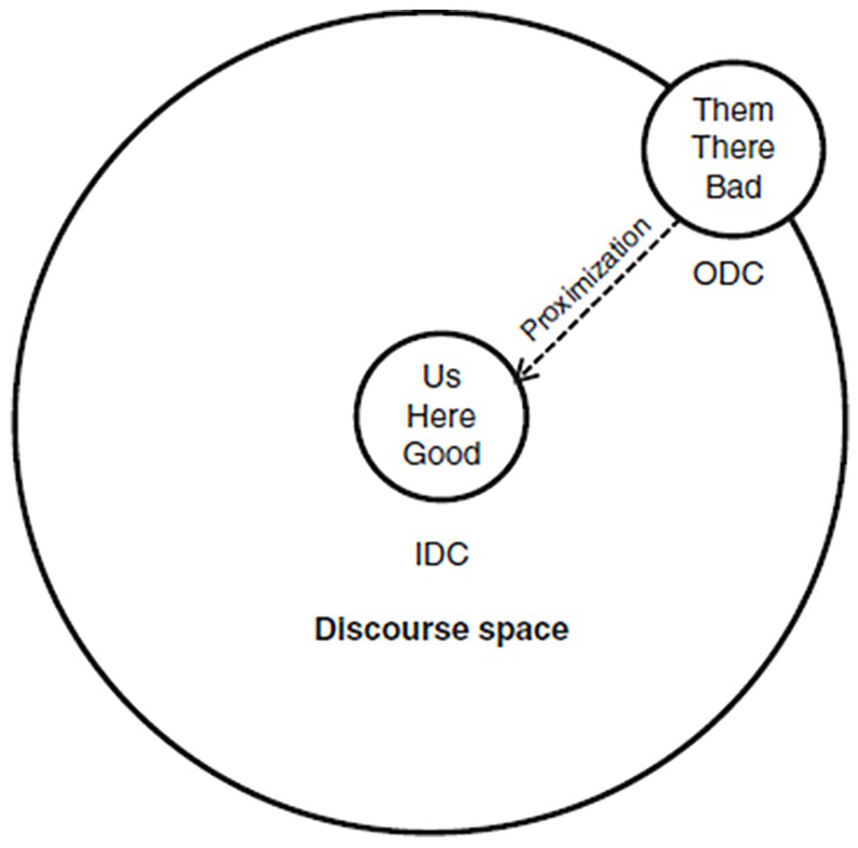
Proximization in discourse space (Cap, 2017: 18).
Proximization occurs when there is an intended construction of closeness between these two parties and so feelings of fear and insecurity are generated in the audience. It is, thus, a discursive strategy used to present ‘physically and temporally distant events or state of affairs (including ‘distant’, i.e. adversarial and ideologies) as increasingly and negatively consequential to the speaker and her addressee’ (Cap 2017: 16). Furthermore, it must be noted that this is a dynamic construction of discourse space, as it involves not only the opposition between two groups, but also ‘the capacity of the out-group to erase these distinctions by forcibly colonizing the in-group’s space’ (p. 17)
Proximization can intensify polarization by enhancing the emotional impact of information, creating a sense of threat from the out-group, or constructing the in-group as under attack. The perceived closeness of the threat can escalate polarized perspectives, as people feel compelled to adopt a more rigid stance in favor of protecting or defending their own group. The interplay of these strategies thus intensifies ideological divides, making them highly influential in shaping public opinion in polarized environments.
Proximization Theory has been widely applied to public and political discourse analysis, as it seeks to legitimize the adoption of preventive measures by authorities (Cap, 2013, 2017; Chen et al., 2020; Florea and Woefel, 2022; Kowalski, 2022; Mando and Stack, 2018; Pan, 2024; Riaz, 2021).
Framing and construal
Following Entman’s (1993) definition (p. 52), to frame is to select some aspects of a perceived reality and make them more salient in a text, in such a way as to promote a particular problem definition, causal interpretation, moral evaluation, and/or treatment recommendation for the item. Framing can highlight certain aspects of information while downplaying others, shaping the audience’s perception and response. Research shows that frames realize through specific textual and visual elements in texts, called ‘framing devices’ or ‘reasoning devices’, which reinforce clusters of facts or judgments (Van Gorp, 2007) and can impact cognition (Rhee, 1997) and public opinion formation (Entman, 1993; Pan and Kosicki, 1993).
On its part, the notion of construal in Langacker’s (2008, 2013) Cognitive Grammar refers to the ability of speakers to conceive and portray the same situation in alternate ways. It highlights that language does not represent reality in a neutral way but involves various cognitive processes that influence how situations and objects are perceived and described: focusing, prominence, specificity, and perspective. That is, in Langacker’s (2013) words, ‘what we perceive depends on what we choose to look at, what elements in it we pay more attention to, how closely we examine them and what point of view we take’ (p. 55). When applied to discourse analysis, this ability manifests itself in a number of construal operations (Hart, 2013, 2014), understood here as conceptual processes invoked at the interpretation stage in order that discursive strategies are brought into effect. The relationship between construal operations, discourse strategies, and cognitive systems, as established by Hart (2013, 2014), is shown in Table 1.
Construal operations in discourse (Hart, 2013).
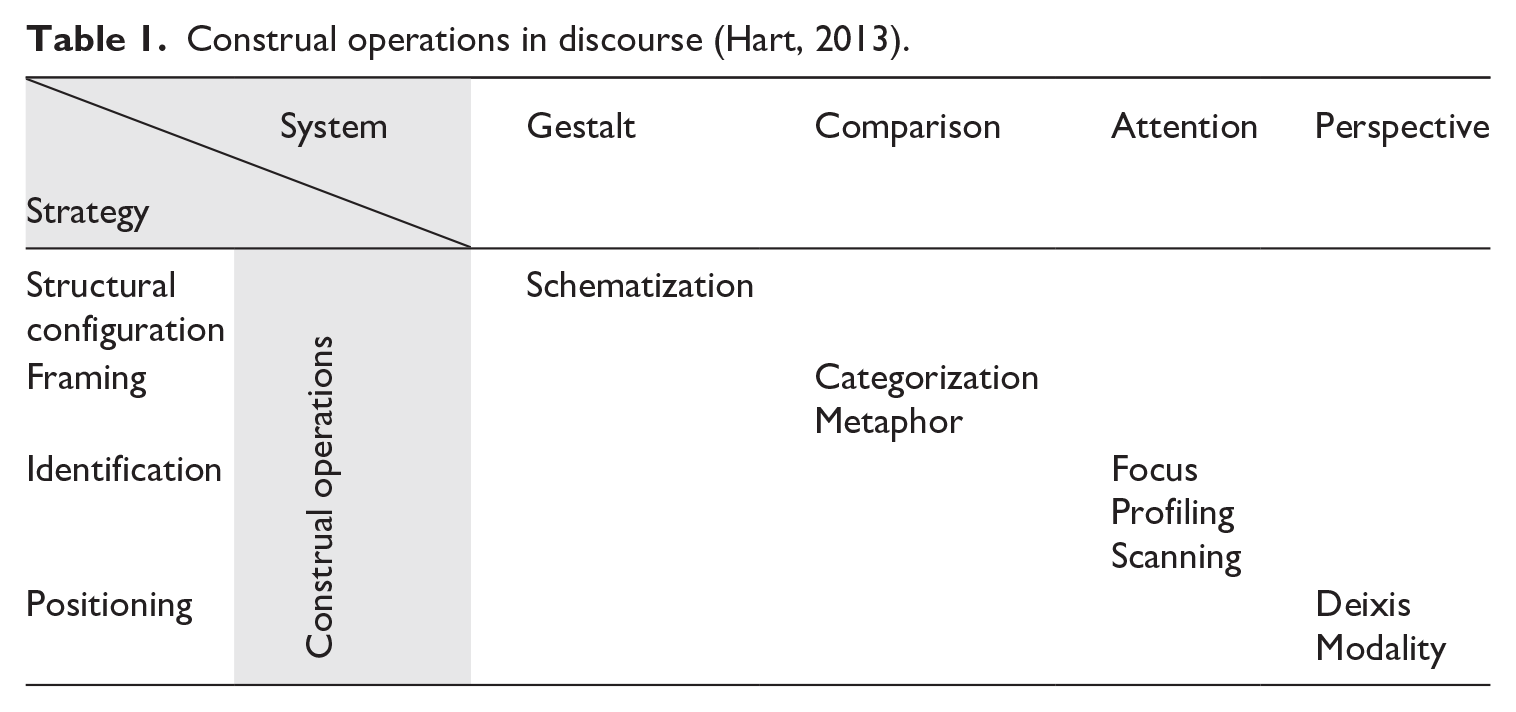
According to this author (Hart, 2013, 2014), schematization is one of the possible construal operations invoked by discourse. Grounded in Gestalt, that is, in our in ability to perceive entities and events holistically rather than separate parts, it constitutes a structural configuration discourse strategy that provides a basic understanding of the whole event in terms of very abstract image schemas (
What is common to the notions of framing and construal is the claim that the way in which an event is presented to an audience will influence their interpretation. Framing devices directly influence construal by guiding the audience’s attention to certain aspects of information over others, and this influence is manifested in a number of construal operations like the ones described above. Back in 2020, Alonso-Belmonte and Porto first attempted to combine these two notions into a single instrument of analysis and tested it in a sample of European news. Results showed that the textual and visual choices made by newsmakers can be multimodally realized by four types of multimodal framing devices: subject choice, composition, distance, and point of view, which correspond to the four dimensions pointed out by Langacker (2013) in construal, that is prominence, focusing, specificity, and perspective (p. 55).
Subject choice, the equivalent to Langacker’s prominence or ‘what we choose to look at’, deals with the selection of a precise aspect or component of a given event that is profiled in the news about it. Composition, which can be matched with the focusing dimension in Cognitive Grammar, refers to the specific elements (people, objects, institutions, and organizations) chosen to be included in the account, either textually or visually, to direct readers’ attention to them. Distance refers to the level of detail in the information provided to the audience, depending on how closely the scene is presented, and corresponds to the specificity dimension in Langacker’s construal. It can be seen as different degrees of detachment, either physical, temporal, emotional, social, or moral. Point of view is the equivalent to the construal dimension of perspective and deals with the ideological, moral, or attitudinal stance adopted by the newsmaker in presenting the events.
In this paper, we intend to identify the multimodal framing devices present in the news analyzed, as well as the specific construal operations underlying them. The integration of both models, framing devices and construal operations, will be further explained in the following section, when exposing our method for the analysis of the sample.
The study
Political context
Brazil’s 2022 presidential election brought the country to a boiling point, as it represented not just a choice between two candidates but a stark divide between opposing visions for Brazil’s future. Luiz Inácio Lula da Silva, the leftist former president, faced off against the far-right president Jair Bolsonaro. The election quickly became a battleground for deeply entrenched political, social, and economic issues, exposing and intensifying divisions within Brazilian society. On October 30th, Lula won the election by a narrow margin. However, President Jair Bolsonaro and his supporters expressed skepticism over the election’s integrity, alleging unproven claims of fraud, particularly concerning the electronic voting system. This deepened the distrust between Bolsonaro’s supporters and the elected Brazilian government.
On January 8th, 2023, this tension culminated in thousands of Bolsonaro’s supporters storming the buildings of all three branches of Brazil’s government – Congress, the Supreme Court, and the presidential palace – overwhelming security forces and calling for Lula’s removal. In response, more than a thousand people were arrested, and the events drew widespread international media coverage. The attack echoed the January 6, 2021 insurrection at the U.S. Capitol in Washington, D.C., when supporters of former U.S. President Donald Trump, a close ally of Bolsonaro, stormed Congress in an attempt to block the certification of his election defeat.
Objectives
The main purpose of the present study is to identify the construal operations used to represent the Brazilian congress attack in a sample of multilingual newsbites published in European mainstream newspapers. It is hypothesized here that the construal operations elicited by images and texts generate a framing effect through a number of multimodal framing devices. Eventually, these unfold a global proximization strategy in the analyzed texts which emphasizes the distance between the in-group (President Lula and his government) and the out-group (Former President Bolsonaro’s supporters) and, additionally, illustrates the out-group’s perceived ability to encroach upon the in-group’s domain.
Data
To illustrate our hypothesis, a multilingual sample of 73 newsbites was collected and analyzed. These were published on January 8th, 9th, and 10th 2023 in digital European newspapers, namely El País, El Mundo, La Repubblica, Corriere della Sera, The Times, The Guardian, Le Monde, and Le Figaro. The dataset used in this study is publicly available in e-cienciaDatos, a Spanish open data repository. 3 The multilingual nature of the sample offers an opportunity to explore potential differences among newspapers and across countries. Table 2 shows the distribution of newsbites by newspapers and languages.
Sample distribution by newspapers.
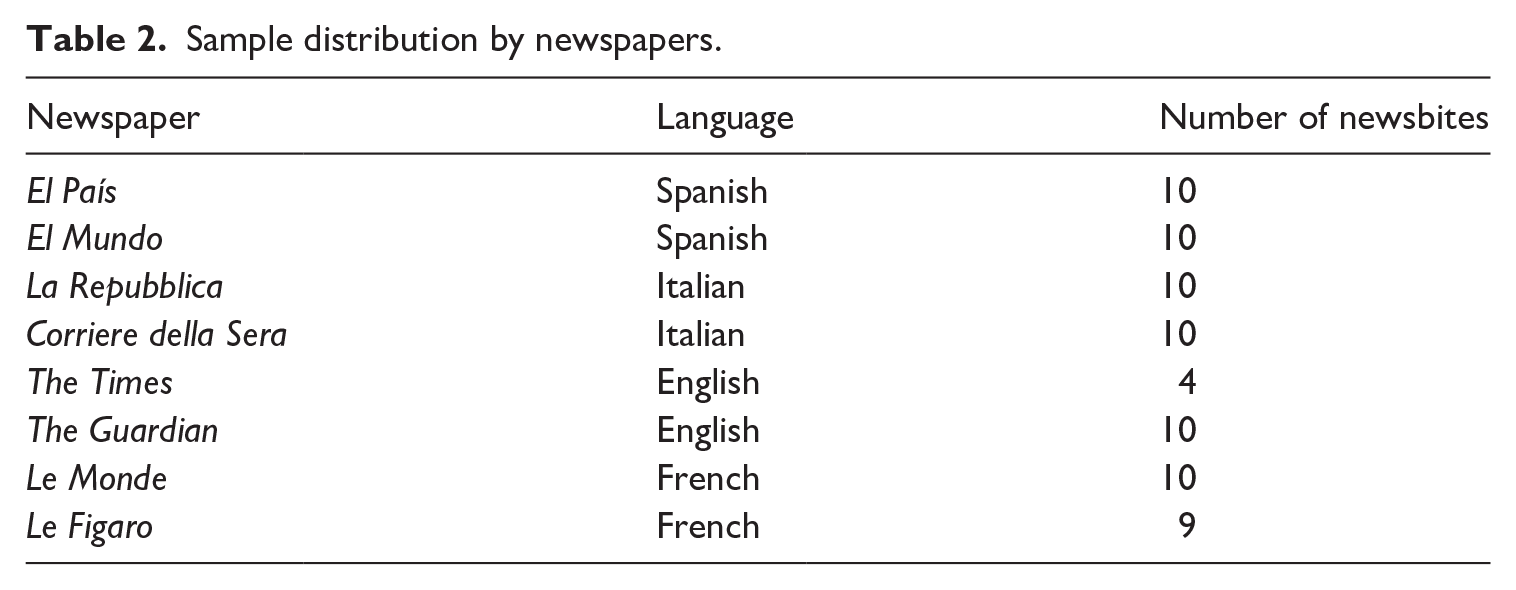
We decided to select 10 news items per newspaper for analysis. Unfortunately, The Times and Le Figaro offered fewer than 10 news items on the issue. Besides, as it is frequent in digital news, some newspapers altered their headlines and/or images up to three times per day. To address this issue, screenshots of each newspaper’s front page were taken multiple times per day to capture ongoing updates during January 8th, 9th, and 10th, 2023. Once all the sample newsbites were compiled, they were numbered and codified by newspaper and date.
Method
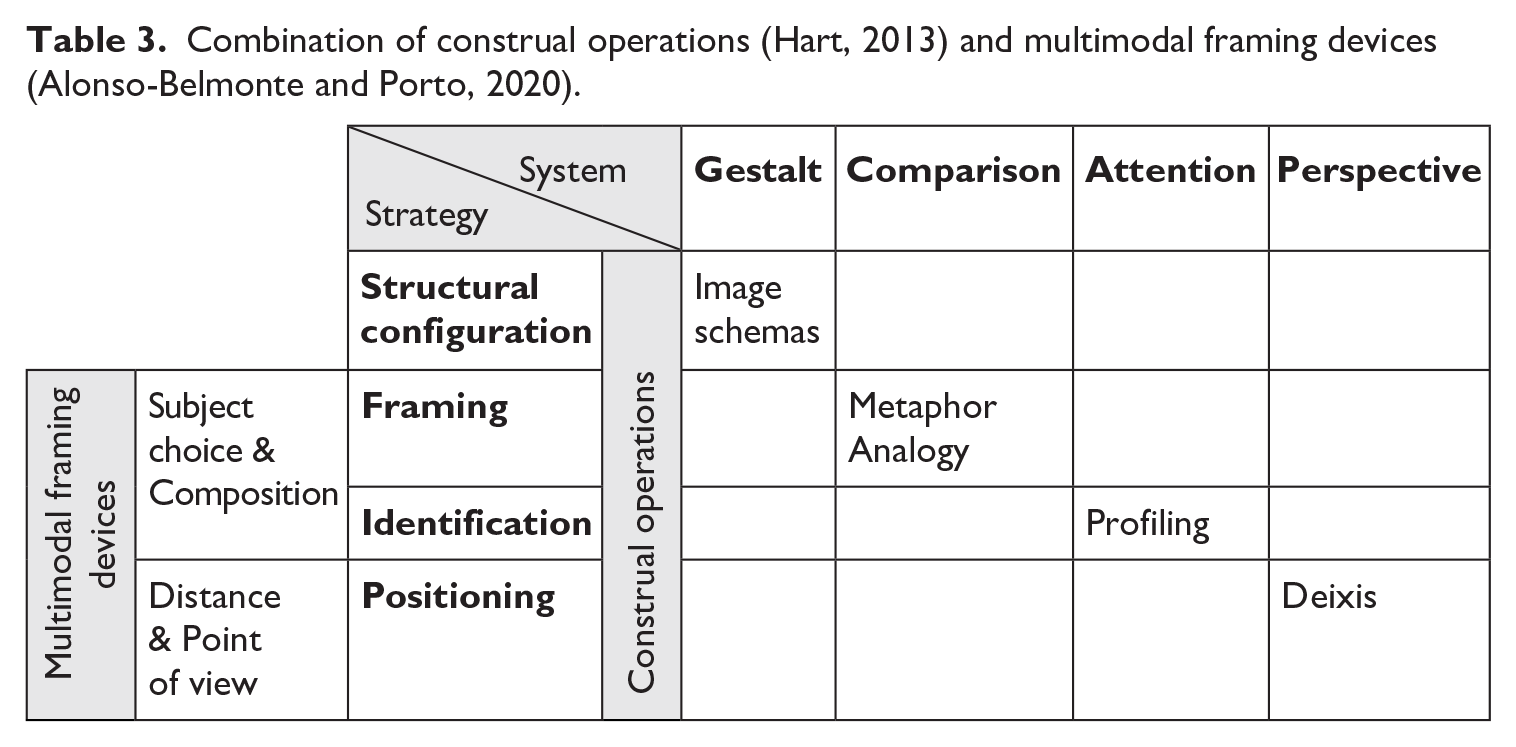
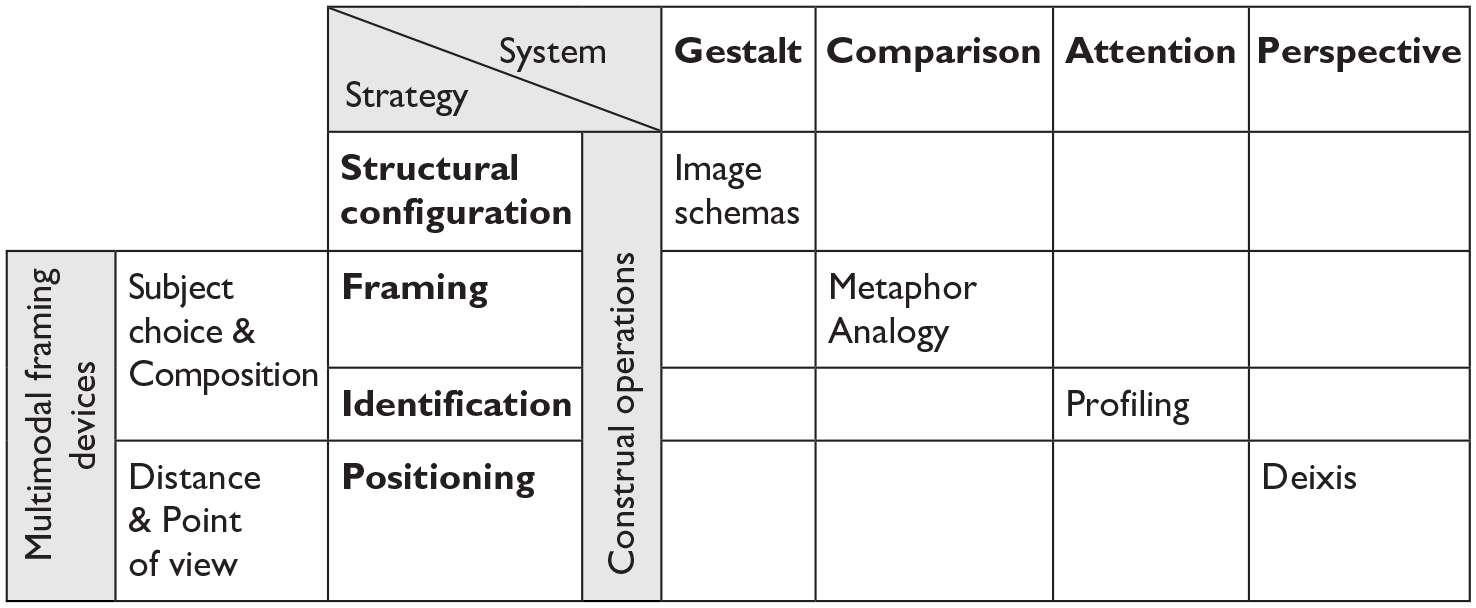
As for the method applied to elucidate the mechanisms by which proximization strategies are embedded within discourse, we draw on Alonso-Belmonte and Porto’s (2020) four types of multimodal framing devices, combined with the construal operations as defined by Hart (2013, 2014) for event-construal in the press. Table 3 shows the adaptation of Hart’s conceptual processes for event-construal. We have added an extra column with the multimodal framing devices and included in the table the specific construal operations found and analyzed in our sample of newsbites, namely image schemas, metaphors, analogy, profiling, and deixis. It is our view that the framing devices of subject choice and composition correspond to the discourse strategies of identification and framing in Hart’s table, and consequently they are mainly performed through conceptual metaphors and analogies, as well as specific lexical choices that profile certain elements and direct the reader’s attention to them. As for the multimodal devices of distance and point of view, they are associated to the positioning strategy accomplished by the use of deixis, presenting the events from a certain point of view and at a given spatial or metaphorical distance. Finally, the image schemas underlying both images and texts contribute to the whole structuring of the incidents reported in a very schematic representation that guides the readers’ construction of the discourse space.
Combination of construal operations (Hart, 2013) and multimodal framing devices (Alonso-Belmonte and Porto, 2020).
Results
The findings are organized into three distinct subsections: (1) Subject Choice and Composition, (2) Point of View and Distance, and (3) Proximization via Image Schemas and Force Dynamics. The first two subsections outline the framing devices identified in the sample and the construal operations underlying them. The third subsection examines how a global strategy of proximization is generated through the schematization of the incidents in terms of image schemas and force dynamics.
Subject choice and composition
Data shows that European newsmakers represent the congress assault in Brazil as a violent event. The lexical choices in the headlines include references to storming, assault, riots, revolts, vandalism, and orgy of violence and more specifically, to an attack against the legitimate government with expressions like coup d’etat and insurrection (see examples 1–3). Furthermore, sample texts emphasize the extensive damage inflicted by the assailants in their event reporting. Accompanying photographs and videos predominantly display scenes of wreckage, shattered glass, smoke, and images of the assailants being subdued by police equipped with shields and batons. It is even possible to hear the mob shouting and the sounds of breaking glasses in some videos accompanying the reports. 4
Two main construal operations, analogy and metaphor, contribute to the identification and characterization of the main subject of the news. Metaphorically, the congress attack is perceived as an earthquake (see examples 4–6). The conventional metaphor
Some news items, more or less explicitly, established an analogy between the events in Brasilia and those in Washington a year before, when a mob of supporters of Donald Trump, defeated in 2020 presidential election, assaulted Capitol Building. Both headlines and images evoke previous knowledge of the readership on this happening. So, there are textual references to these similarities (see 7–9), whereas some images of the assaulters inside the Brazilian Congress resemble those published during the attack to US Capitol, with people draped in flags, breaking into the buildings, and occupying the seats inside the legislative chambers. There are also visual references to these similarities and to the good relations between Trump and Bolsonaro who can be seen side by side in one of the photos illustrating these references. 6
As for composition, the central figures involved in this narrative are displayed as two distinct groups. On the one side, the group composed of Bolsonaro and his supporters, that is, the assaulters – unidentified Brazilian citizens − and on the other side, the group around Lula and the government, supported by international leaders and assisted by the police. Assaulters are visually represented as a frenzied mob of people approaching the federal buildings, as a violent and uncontrolled crowd, referred to as folla and turba in Italian and Spanish headlines, respectively, dressed in the national football team t-shirt, that is yellow and green, the colors of the Brazilian flag. President Lula is depicted with a serious expression, dressed in black, 7 standing in stark contrast to the images of those storming the federal buildings, whereas textually is portrayed as an authority figure who speaks for the establishment, condemning the attack, and issuing a stern warning of immediate action against any insurrection (10):
Several other actors are represented, either textually or visually, like well-known political leaders (Biden, Von der Leyen, or Macron) and entities or institutions, like the Supreme Court, the Brazilian right-wing, or the Congress. In the headlines, international leaders appear as supporters of Lula’s authority (see 11 and 12) As for the police, it is portrayed in black uniforms, standing or on horseback while forming barriers or arresting attackers. See, for example, the contrasting representation of these two groups in Figure 2:
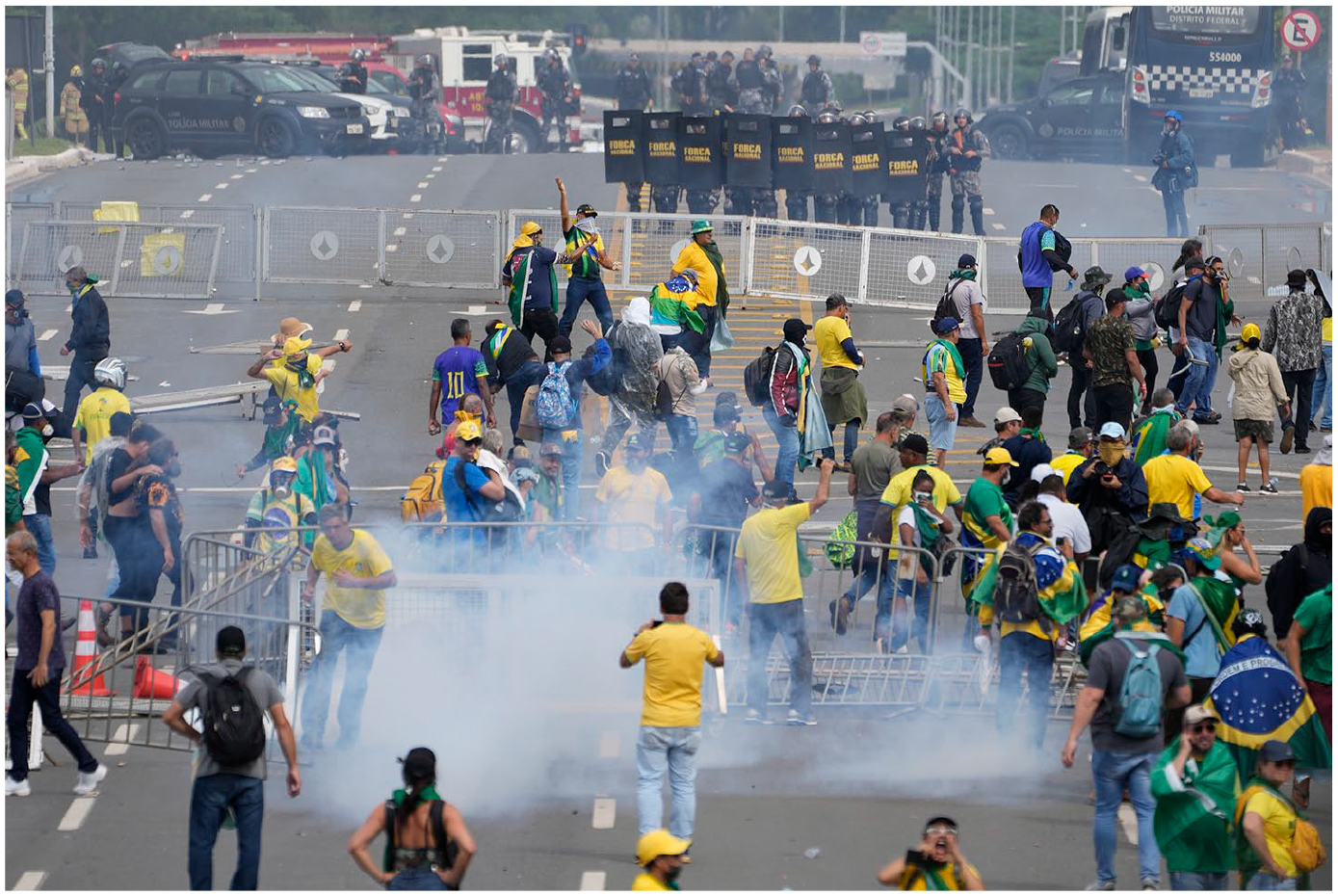
Representation of the two groups, the rioters and the police, in Corriere della Sera (LaPresse) (reproduced under permission).
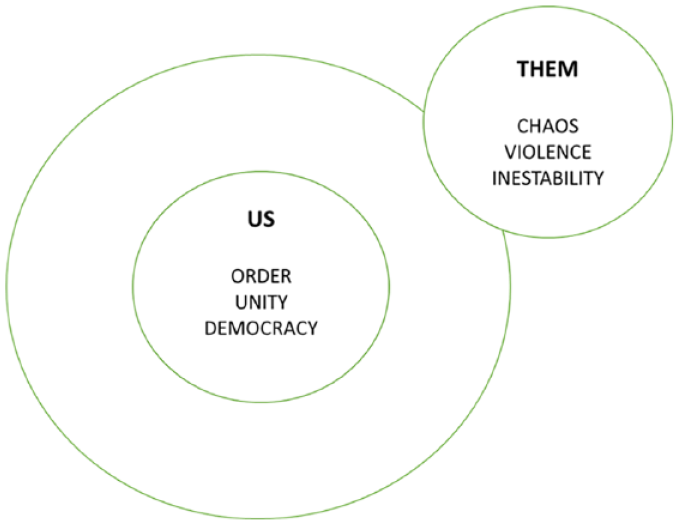
This multimodal profiling of the social actors involved in the event results in the representation of two groups of participants: the assaulters, associated to concepts of

Two groups resulting from subject choice and composition framing devices.
Point of view and distance
The framing of the news collected induces readers to take sides with one of the two groups, namely that of democracy and Lula’s legitimate government. As already pointed out, Bolsonaro’s followers are presented as violent rioters that threaten democracy, which is the system of government in the countries where these newspapers are published − UK, Italy, France, and Italy. As we have seen, international leaders are reported to have condemned the attacks, aligning themselves with Lula. It is quite straightforward, then, that European readers, as part of that international community with democratic governments, will identify themselves with the group of Lula and so make it the in-group. In terms of polarization, this group is ‘us’, whose traits are always positively evaluated, whereas the group of Bolsonaro and his supporters constitutes the out-group, ‘them’, whose negative attributes are emphasized. Not only evaluative language (scandalous, tragedy, terrorists, vandals) contributes to the negative evaluation of the out-group (see 13–14), but also, deixis confirms this perspectivization, signaling the group of ‘us’ as the deictic center of the discourse space (see Figure 2), whereas the out-group is typically referred to as ‘them’ or ‘those’, treated as aliens that do not belong to ‘Brazil’ (see 15).
As a matter of fact, Bolsonaro himself was in Florida at the time of the attack, so he was physically away from Brazil, at a long, real, geographical distance from the place of the events (see 16–17). This fact strengthens the idea that he and his followers constitute the out-group ‘them’, away from the deictic center of discourse (see Figure 4).
Taking stance and establishing one of the groups as deictic center.
As for distance, the news in the sample shows a revealing framing of the events in Brazil. Many of the photos depict a colorful crowd, dressed in green and yellow, approaching the buildings and flooding the rooftop of the congress, while being observed by the mounted police in the distance (see Figure 5):
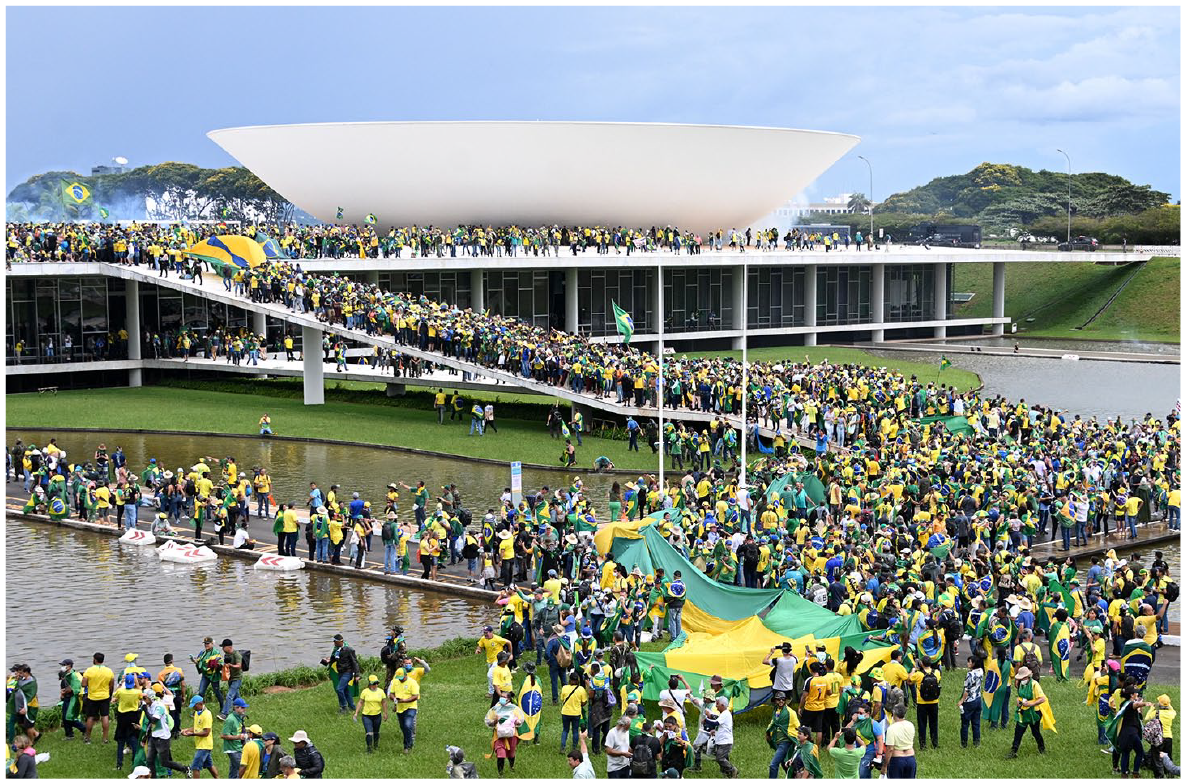
Rioters seen in the distance as published in Le Figaro (Evaristo SA/AFP) (reproduced under permission).
This collective representation of ordinary individuals serves as a strategy employed by news creators to homogenize the out-group and to depersonalize it. On the other hand, closer shots are taken inside the buildings, showing protesters vandalizing offices or the damage caused in the interior. There is also a short distance in the photos of the arrests of individuals made by the police.
8
The general impression, then, is that of a progressive reduction of physical distance, from the distant mass of people advancing toward the buildings to the sight of assaulters inside the Congress or under arrest. Both images and headlines, then, present a similar process of proximization (see Figure 6) that can be better explained in terms of image schemas like
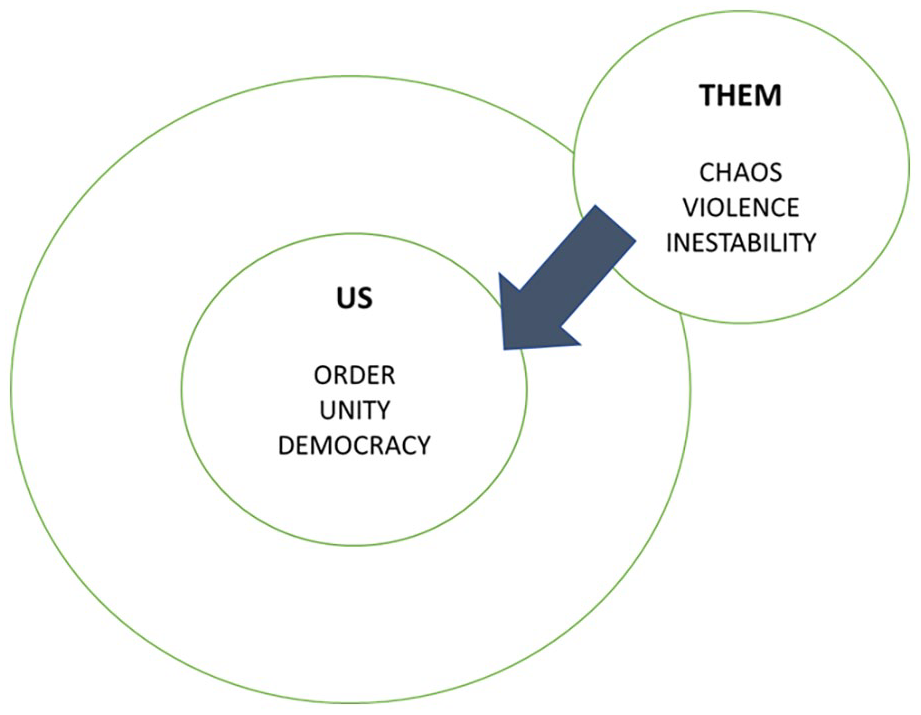
Reducing distance between the two groups.
Proximization strategy via image schemas and force dynamics
The whole construal of the events can be conceptualized in terms of Image Schemas and Force Dynamics, with two force entities, agonist and antagonist, in clear opposition. The framing of the events presents Bolsonaro’s followers as an external group acting as the agonist, reducing distance and advancing toward the in-group, whereas Lula and his government act as the antagonist, resisting that force. Therefore, the image schemas of
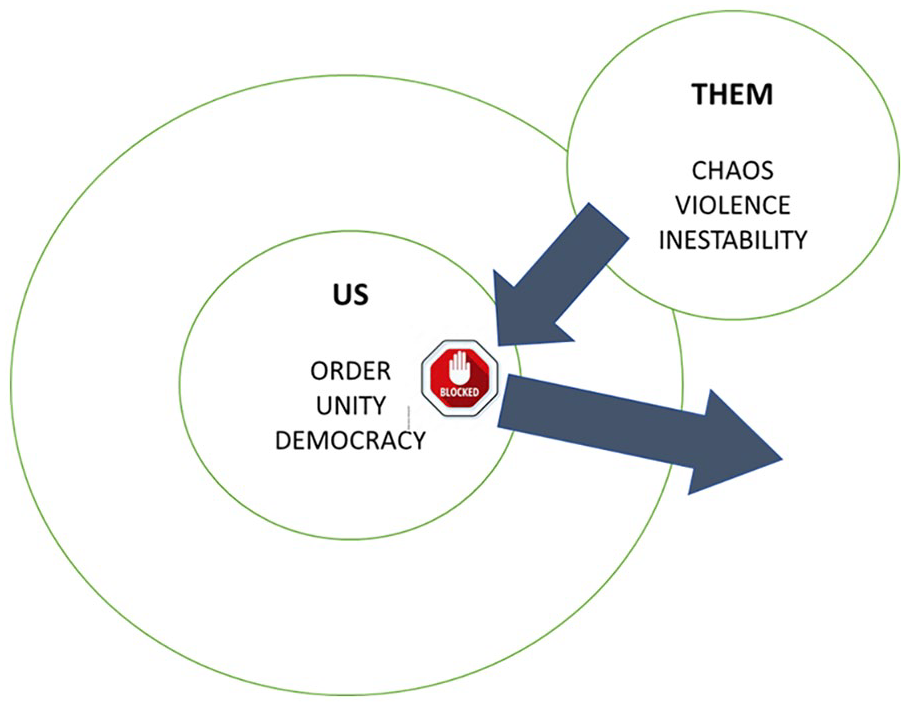
Force Dynamics in the construal of the events.
The final result of this dynamics is, apparently, the reinstatement of the original situation, with the legitimate government at the center, the abandonment of violence, and the return to order (23–24):
Discussion and concluding remarks
This paper provides valuable insights by integrating analytical perspectives on framing and construal. The analysis performed on the news items collected has revealed a number of crisscrossing influences and overlapping between construal operations and framing devices as analytical tools. Metaphors, analogies, deixis, and schematization are common cognitive operations by which we interpret the world. When applied to the specific construal of an event in the news, they manifest in a number of framing devices designed to guide readers and produce a certain interpretation about it.
We have seen how the multimodal framing was carried out, in the first place, through the profiling of violence and chaos as the subject choice and of a few selected elements and participants represented both in texts and images. Secondly, through the metonymical and metaphorical mapping, the attack to the buildings was framed as an assault to democracy as a universal concept, not only in Brazil, supported by the analogy established with similar events occurred in Washington. Thirdly, the perspective adopted guided the readers to construct a discourse space in which deixis marked Bolsonaro’s followers as the outsiders, placing them at a distance of the deictic center conformed by the legitimate government of Lula da Silva. Readers are also positioned at this central point and so invited to take sides with Lula’s in-group and assume their same point of view.
When considered as a whole, the result of these framing devices and the construal operations that allow them is a global strategy of proximization, schematized in a force dynamics process that presents Bolsonaro’s group as a threat, reducing distance and invading the deictic center. On the one side, the spatial proximization of the out-group when breaking into the federal buildings is perceived as an axiological proximization, an ideological menace that could destroy democracy in Brazil. On the other side, there is also a proximization process of events that are geographically distant for European readers, who are invited to identify themselves with Lula and his government, conforming the in-group characterized by positive values. Eventually, the proximization process is reverted. The threat posed by Bolsonaro’s supporters is neutralized by the action of the police, arresting assaulters while the government demands responsibilities. The order is reestablished and so, the distance between the two groups seems to have been reinstated.
Interestingly, the coverage of the Brazilian Congress attack by European newspapers reveals a unique editorial stance, condemning the attack as an assault on democratic values and a symptom of the rising tide of authoritarianism globally. No significant variations appear across different European newspapers or countries. Both traditionally conservative and progressive media outlets seem to echo a shared narrative, avoiding differences in their usual national or ideological framing. This unanimity in tone and interpretation underscores the broad perception of the incident as a case study of a broader, global threat, ultimately revealing shared concerns across Europe about the health of democracy worldwide. In any case, expanding the sample to other media outlets may uncover contrasting strategies, particularly in contexts influenced by figures like Bolsonaro. Specifically, a future line of research which is worth exploring involves scrutinizing news media platforms where the perspectives of rioters find expression and analyzing the prevalent discourse strategies employed therein.
To conclude, the global discursive proximization strategy above described may contribute to a sense of societal tension by sustaining the possibility of an ongoing threat to democracy. This is especially relevant given the recent pattern of post-election protests that has emerged in multiple countries, potentially as the consequence of contested electoral outcomes. Thus, the democratic, ordered, controlling in-group that European readers identify themselves with appears to be under threat – not from a single source, but from multiple violent, rebellious out-groups, such as those seen in Washington in 2021 and Brazil in 2022. This may raise concerns that other legitimate governments could face similar challenges. Future research could delve deeper into these phenomena to better understand their effects on social cohesion and political discourse.
Footnotes
Declaration of conflicting interests
The author(s) declared no potential conflicts of interest with respect to the research, authorship, and/or publication of this article.
Funding
The author(s) disclosed receipt of the following financial support for the research, authorship, and/or publication of this article: This study has been carried out under the grant ‘Polarization and Digital Discourses: Critical and Socio-Cognitive perspectives’ (PID2020-119102RB-I00) funded by Spanish Ministry for Science and Innovation (Agencia Estatal de Investigación. Ministerio de Ciencia e Innovación), which belongs to the Thematic Research Network CoCoMint (Comunicación conflictiva y mediación: interacción, vínculos relacionales y cohesión social) RED2022-134123-T, funded by the same Ministry (MCIN/AEI/10.13039/501100011033).
