







Abstract
This research paper studies anti-Armenian hate speech narratives in three Azerbaijani state-aligned news outlets during the early post-2025 TRIPP Peace Treaty period—a critical period for peace-building. Although the TRIPP Peace Treaty officially ended the Nagorno-Karabakh conflict, Azerbaijani state-aligned news outlets continue to construct anti-Armenian narratives. Existing research mainly focuses on wartime media discourse, leaving a gap in understanding post-conflict hate speech in the understudied South Caucasus region. Hence, this study attempts to fill the gap by examining three Azerbaijani state-aligned news outlets—Azertac, AZTV, and Azernews—during the early post-TRIPP period. This study incorporates a hybrid framework to assess hate speech intensity and examine linguistic, semantic, syntactic, and rhetorical mechanisms in constructing anti-Armenian hate speech. Quantitative findings reveal a hierarchy of hate speech intensity, with Azertac the highest (M = 0.57) and Azernews the lowest (M = 0.31). Qualitative findings demonstrate all three outlets apply van Dijk’s ideological square framework to construct hostile identities.
Keywords
Introduction
The Nagorno-Karabakh conflict has been one of the most protracted conflicts in the modern world history dating back to 1991. After the collapse of the Soviet Union, the conflict escalated between Armenia and Azerbaijan for more than three decades, which culminated in political and military developments in 2023, resulting in the mass displacement of the Armenian population from the region. On 8 August, 2025 Armenia and Azerbaijan signed a peace treaty (The Trump Route for International Peace and Prosperity-TRIPP; U.S. Department of State & Government of Armenia, 2026), officially marking the end of the long-lasting conflict and the transition to normalization of the South Caucasus region. This event was an important milestone for both countries. While the Peace Treaty is a formal step for conflict resolution, Azerbaijani state-aligned media outlets continue to cover narratives of victimhood, aggression, and historical grievance. Much research has been conducted on Azerbaijani media and conflict, providing insightful outcomes on the role of state-aligned news outlets in legitimizing military actions and shaping public opinion during conflict (Azerbaijan.az, n.d); however, few studies have integrated quantitative hate speech detection with qualitative discourse analysis to study how Azerbaijani state-aligned news outlets construct anti-Armenian hate narratives. Existing literature primarily focuses on anti-Armenian narratives in active conflict times (de Waal, 2021; O’Loughlin et al., 2019) leaving a significant research gap in understanding post-treaty media coverage and the persistence of ethnicized hate speech against Armenians. Filling this research gap is important for understanding how Azerbaijani media outlets shape public opinion, national ideology, and influence collective memory after formal conflict resolution. By applying a mixed-method design, the following research paper not only evaluates the intensity of hate speech across Azertac, AZTV and Azernews news outlets but also examines linguistic mechanisms through which anti-Armenian hate speech is constructed. Moreover, extensive research conducted on hate speech focuses on Western media on active-conflict periods, while the role of ethnicized media discourse in the South Caucasus region remains underexplored. This study attempts to address these interconnected research gaps by: comparing multiple state-aligned news outlets to evaluate variation in hostility intensity during the post-conflict period, and by integrating natural language processing, corpus linguistics, and ANOVA statistical testing to provide a well-structured and solid methodology. The contribution of this study to the existing literature is threefold: first, it shifts research focus from wartime media discourse to post-conflict period, second, it advances political hate speech methodology by combining automated-detection techniques with qualitative analysis, third, the research contributes to wider theoretical discussions on post-conflict nationalism and durability of adversary identities in the South Caucasus region. Hence, this research paper seeks to answer the following research questions:
Theoretical background: Media, state-aligned discourse and ideology
Media discourse plays an important role in shaping public opinion and national ideologies, especially in the context of ethno-political conflicts. State-aligned news outlets employ ideologically charged linguistic mechanisms to shape certain social realities (Fairclough, 1995; van Dijk, 1998). The narratives of state-aligned news outlets are closely linked to the political agendas. Walker and Orttung (2014) define state-aligned media as authoritative tools used by states to influence domestic and international audiences (Walker and Orttung, 2014). In this study, “state-aligned news outlets” refer to news agencies that are deeply influenced by governmental authority through ownership and political affiliation.
According to the propaganda model (Chomsky and Herman, 1988), media content is created based on political interests and institutional constraints sidelining dissenting viewpoints (Chomsky and Herman, 1988).
Critical discourse analysis and ideological polarization
Critical Discourse Analysis (CDA) is as a powerful tool to examine how national ideologies and political stances are realized in language (Fairclough, 1995; Wodak, 2001). In this context, media texts are perceived as channels through which ideological meanings are produced (Machin and Mayr, 2012). Therefore, the language used by media outlets that contain ideologies like political stances can be analyzed through critical discourse analysis (Liu, 2024; Reisigl and Wodak, 2009).
van Dijk’s (1991, 1998) theory of ideological polarization (often referred as ideological square) becomes prominent in the context of analyzing conflict-related media discourse. The model highlights the positive representation of in-group (us) and negative representation of the out-group (them), which is achieved through lexical selections, syntactic structures (passive and active voice), modality, presupposition, etc. In ethno-national conflicts, ideological polarization is often realized through narratives of victimhood, historical grievance, superiority, which function to legitimize state actions and delegitimize the opposing group (van Dijk, 2006). These linguistic mechanisms exist in many post-conflict contexts, where military actions are ceased, but ideological struggles continue (Fuchs, 2018).
Hate speech, dehumanization news media narratives
Hate speech is often defined as discourse that targets certain individuals or groups due to their identity markers, such as nationality, ethnicity, or religion (Parekh, 2012; Wodak et al., 2001). In media discourse, hate speech does not always appear in an explicit form (Assimakopoulos et al., 2020). According to Wodak & Reisigl, discourse-historical approach, five discursive strategies are used to construct hate speech: (1) naming social actors, (2) assigning attributes, (3) justifying hostility, and (4) intensification, and (5) mitigation. These strategies enable news outlets to frame the opposing group as aggressive, illegitimate, and criminal (Wodak et al., 2001).
Corpus-based critical discourse analysis
To examine large volumes of media texts, scholars increasingly combine CDA with corpus linguistics, resulting in corpus-assisted critical discourse analysis (Baker et al., 2008). Corpus-assisted methods ensure transparency and validity of the research, while CDA provides interpretive background for revealing ideological meanings (Fortuna and Nunes, 2018). Corpus-assisted CDA has been widely applied to analyze representations of ethnic minorities, migrants, and conflict actors, revealing how repeated lexical patterns contribute to the normalization of ideological frames (Baker et al., 2013).
To study anti-Armenian hate speech in Azerbaijani state-aligned news outlets, our research team combined Chomsky and Herman’s propaganda model (1988), CDA (Fairclough, 1995; van Dijk, 1991), and corpus-assisted linguistic methods (Baker et al., 2008). This research paper enriches existing literature by examining hate speech in a post-conflict environment and provides a deeper understanding of how ethno-national hate speech is constructed and maintained discursively after conflict resolution.
Methodology
The following study employs mixed-method research design incorporating both quantitative (HateBERT, ANOVA) and qualitative approaches (Corpus-driven Critical Discourse Analysis-CD-CDA). According to Creswell & Inoue, mixed-methods research design contains the innovative feature of integration in data analysis by connecting the databases to derive additional information beyond the results learned from each database (Creswell and Inoue, 2025).
Data collection
The first step of this research was to collect data from Azerbaijani news outlets. Our research team collected data from three purposefully selected state-aligned news outlets:
Azertac (Azerbaijan State News Agency – national news agency, domestic/international (mainly domestic-oriented), multilingual),
AZTV (Azerbaijan Television – state television, domestic/international, multilingual),
Azernews (state newspaper, domestic/international (mainly international-oriented), multilingual).
We selected these outlets because they are the most circulated and influential state-aligned news platforms, making them crucial for studying how state-aligned news outlets form anti-Armenian hate speech (Sukiasyan, 2025). The selection also complies with the theoretical perspective of Chomsky and Herman’s (1988) “propaganda model,” which highlights the importance of elite state-aligned media in shaping ideological agendas.
Timeline and keyword sampling
Our data collection spanned from August 8, 2025 (the official date of the trilateral treaty signing) to December 31, 2025, a crucial early phase examining the immediate post-treaty discursive patterns before long-term transition to reconciliation.
During this period, our research team retrieved all relevant textual content from the official websites of Azertac, AZTV, and Azernews. Using keyword search and filtering functions, we gathered all articles explicitly referring to Armenia, Nagorno-Karabakh, and the TRIPP Treaty. A total of 174 news articles were collected (71 from Azertac, 55 from AZTV, and 48 from Azernews). We selected news articles only referring to Armenia/Armenians and the Nagorno-Karabakh conflict.
Sentiment analysis: HateBERT
Next, a sentiment analysis was conducted to evaluate the intensity of anti-Armenian discursive hostility in Azerbaijani state-aligned news outlets. The HateBERT model was employed to detect and quantify the intensity of discursive hostility. HateBERT is a re-trained BERT architecture explicitly optimized for abusive language detection in English (Davidov et al., 2020). Initially, HateBERT model was trained for social media hate speech detection, however, nowadays, it is considered to be one of the most commonly used and methodologically open models for hate speech detection in online discourse analysis (Caselli et al., 2021). Our research team does not take HateBERT results as definite and objective measures of hate speech, but as a quantitative complement of hostility in language. The determination of hate speech remains context-based, qualitative and theoretically grounded in CDA.
Although these Azerbaijani news outlets are published in Azerbaijani, English, and Russian, our analysis focused on English content. This choice was also determined by the linguistic limitations of the HateBERT model, as the model detects only English texts. While this model’s limitation may not reflect nuances of anti-Armenian hate speech in other languages, English versions are designed for an international audience, making them relevant for studying how state-aligned news narratives are reflected for international readers. Hence, the findings cannot apply to Azerbaijani and Russian content. Future studies could employ multilingual hate speech detection models to assess content in Azerbaijani and Russian.
The intensity of discursive hostility was measured on a 0–1 scale, where 0 represents no hate speech and 1 represents extreme hate speech, consistent with HateBERT’s gradient output.
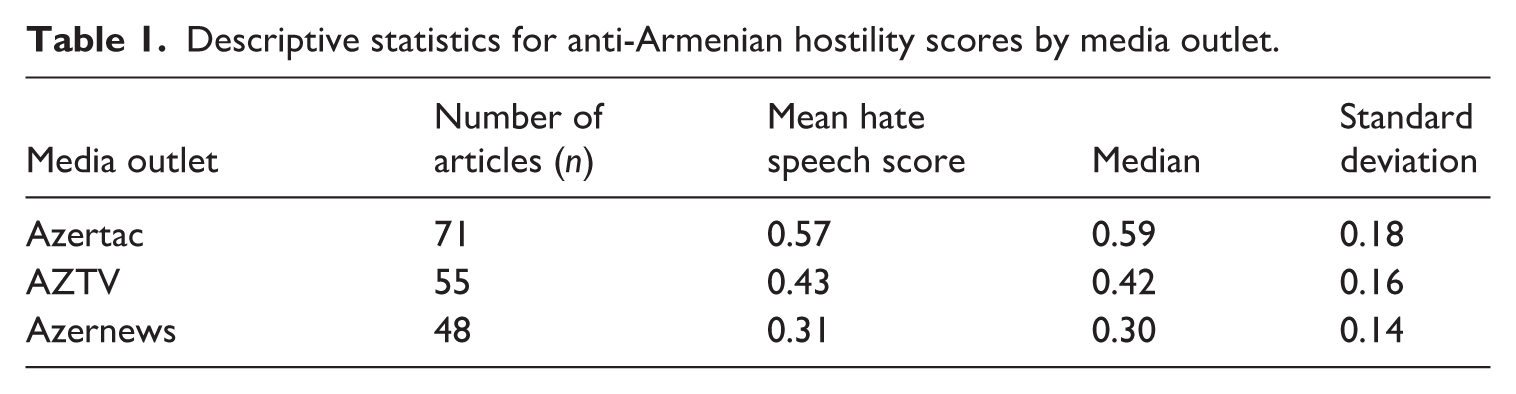
To ensure data accuracy and consistency, all collected news articles underwent initial screening. Non-textual elements were removed. After preprocessing, each news article was analyzed for hostility intensity. The mean hostility score for each outlet was then calculated. Median and standard deviation (SD) were also measured for descriptive statistics.
Statistical testing
To calculate statistically significant differences in discursive hostility intensity across the selected news outlets, our research team employed one-way ANOVA and Tukey’s HSD Post-Hoc Tests. ANOVA test measures the overall effect of news outlet on hate speech intensity (dependent variable: hate speech score; independent variable: news outlet (Azertac, AZTV, Azernews). While Tukey’s HSD Post-Hoc Test: to determine pairwise significant differences between outlets (a post-hoc test was employed).
All statistical tests were conducted in R (v4.3.1) with a significance level of p < 0.001 (a stringent threshold Effect size (η2) was measured for the ANOVA test to assess the degree of variance in hostility intensity accounted for by news outlets.
Corpus-based discourse analysis: Voyant tools
While ANOVA test results illustrate the intensity of discursive hostility, it is also important to analyze how these news outlets linguistically construct their narratives. To complement the quantitative hate speech analysis, a corpus-based linguistic analysis was employed to analyze linguistic and discursive patterns of Azertac, AZTV and Azernews in framing Armenia, Armenians, and Nagorno-Karabakh after the TRIPP Peace Treaty. This corpus-assisted linguistic analysis was conducted by employing Voyant Tools, which enabled us to determine key lexical elements, frequency counts, and elicit significant discursive and framing devices within news articles (van Leeuwen, 2008).
The following methodological approach aligns with CDA (Fairclough, 1995; van Dijk, 1991), which underscores the role of language in forming national ideologies and social realities. By studying recurring lexical patterns, metaphors, and syntactic structures, the analysis identifies how state-aligned news outlets not only disseminate explicit anti-Armenian hate speech but also position certain political and ethnic narratives.
Corpus preprocessing for CDA
All 174 English-language news articles were collected in 3 mini-corpora (Azertac, AZTV, Azernews) and preprocessed in Voyant Tools.
Tokenization: Text was split into individual words/tokens.
Stop word removal: To focus on meaningful lexical items, we removed all English stop words (e.g. the, and, of).
Lemmatization: To avoid redundancy of inflected forms, words were set to their base form.
Proper noun retention: All proper nouns remained.
The high frequency words, collocations and discursive framing of each mini-corpus are presented in Tables 1 to 3.
Descriptive statistics for anti-Armenian hostility scores by media outlet.
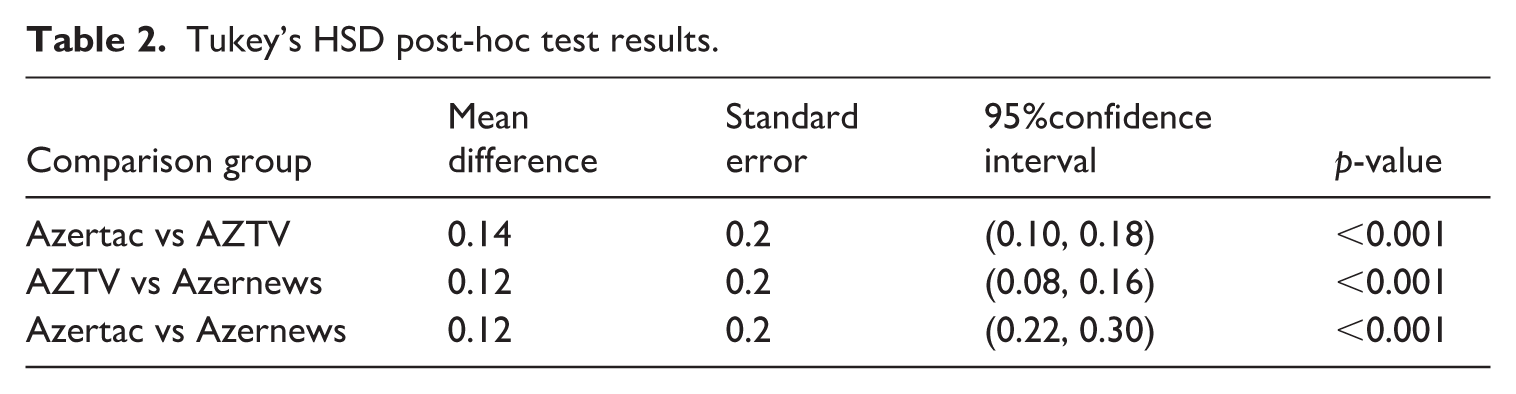
Tukey’s HSD post-hoc test results.
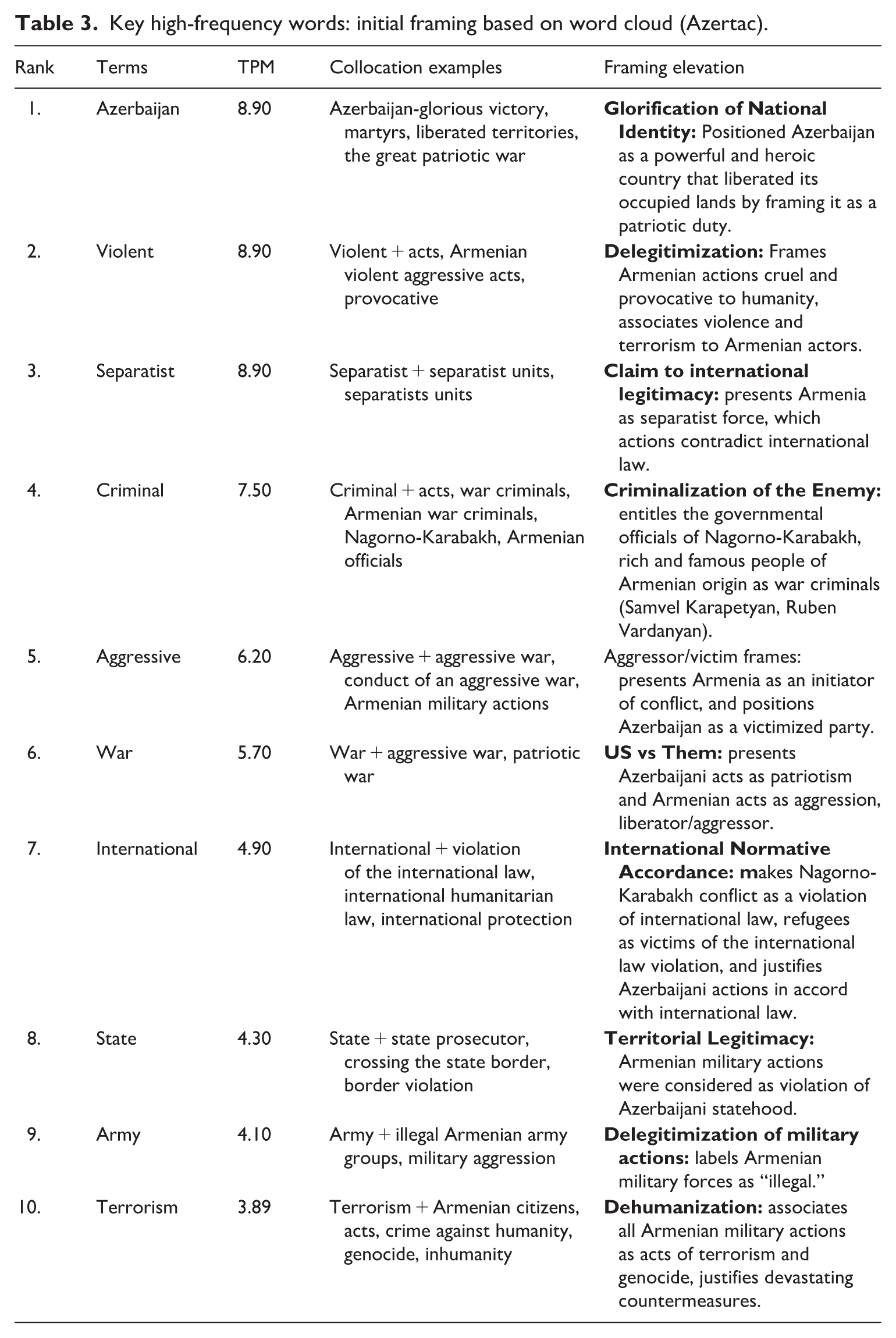
Key high-frequency words: initial framing based on word cloud (Azertac).
CDA analytical steps
For each mini-corpus, the following analytical steps were conducted:
Lexical frequency analysis: We determined the 10 most frequent content words (tokens per 1000 words (TPM)).
Lexical clustering analysis: To identify thematic framings, we pinpointed recurring lexical chains (e.g. armed + terrorist + violent).
Qualitative CDA: Lexical, syntactic, semantic, and rhetorical mechanisms of hate speech construction were presented in alignment with van Dijk’s (1991) ideological square and Wodak et al.’s (2001) DHA.
Results: Quantitative findings
As shown in Table 1, Azertac has the highest intensity of anti-Armenian hostility (M = 0.57), followed by AZTV (M = 0.43), while Azernews shows the lowest intensity (M = 0.31).
Next, our research team used one-way ANOVA test to measure whether the observed differences in mean scores across the three news outlets were statistically significant. The ANOVA results indicated a significant effect of news outlet on hate speech intensity, F (2, 153) = 41.27, p < 0.001, η2 = 0.351 (Cohen, 1988), demonstrating that 35.1% of the variance in hate speech intensity is explained by the news outlet. To identify pairwise differences, Tukey’s HSD post-hoc tests were conducted.
As shown in Table 2, Azertac (M = 0.57) showcases higher hate speech scores than both AZTV (M = 0.43), p < 0.001, 95%CI (0.10, 0.18), and Azernews (M = 0.31), p < 0.001, 95%CI (0.22, 0.30). AZTV (M = 0.43) also scored significantly higher than Azernews (M = 0.31), p < 0.001, 95%CI (0.08, 0.16). These results clearly reflect the hierarchical differences in anti-Armenian hate speech intensity rate across Azerbaijani state-aligned news outlets: Azertac >AZTV > Azernews. The hierarchy fulfills the theoretical argument (Chomsky and Herman’s (1988) propaganda model, van Dijk’s (1991) critical discourse framework, and Fairclough’s (1995 ideology-in-text approach) that news outlets aligned with state policy excessively vary in disseminating and shaping ethnicized hate speech.
Qualitative findings-Azertac mini-corpus (research question 2)
The first mini-corpus analysis consists of news articles from Azertac with a total of 8693 tokens, and 1589 unique word forms. The size of each term indicates its normalized frequency (tokens per 1,000words, TPM). The high frequency terms are: Azerbaijan, criminal, violation, terrorism, international law, aggressive, etc., (See Table 3). This terminology uncovers core thematic focus of news articles: framing Azerbaijan as a victim and Armenia an aggressor, which is consistent with van Dijk’s ideological polarization theory (van Dijk, 1991).
The examples presented in the Micro-Linguistic Analysis section should not be seen as
Azertac: Micro-linguistic analysis
The
This turns the lexical environment of Azertac news outlet asymmetric: Armenia and Armenians are positioned only through negative, and accusatory language elements, while Azerbaijan is framed only with positive implications.
News articles referring to Armenia and Armenians are full of legal terminology: termination of OSCE Mink group, international law, Armenia’s military aggression against Azerbaijan, war crimes, crimes against humanity, genocide, aggression, international murderer, criminal entrepreneurship, terrorism, violations of the laws and customs of war, financing terrorism, and the violent seizure and retention of power.
The dominance of legal terminology is especially obvious in news articles covering the trial and court hearings of Nagorno-Karabakh’s previous governmental officials and leaders, who are subjected to trial in Azerbaijan after 2023 events.
The overuse of evaluative adjectives (glorious victory, monumental data, etc.) is another rhetorical and lexical data to encode subjective stance. Unlike neutral descriptive adjectives, evaluative adjectives easily attach positive and negative connotations and impacts reader’s emotional interpretation of the events (van Dijk, 1998).
8 November 2025 marks the fifth anniversary of Victory Day. This Supreme Commander-in-Chief H.E. Ilham Aliyev, and with the
Azerbaijani border checkpoints and civilian homes Critical Azerbaijani agricultural infrastructure
Armenia First of all, it
The Armenian regime’s long history of Armenia’s
As shown in the above-mentioned examples, phrases like “long history” and “systemic campaign” label this harm as a regular, inherent characteristic of the Armenian identity, rather than situational event.
Armed Armenian terrorist groups have launched a violent assault on Azerbaijani border outposts, violating international humanitarian law and breaking the UN-brokered peace accord. (2025, October 29)
Azerbaijan stands as an unwavering defender of international law and territorial sovereignty, while Armenia persists as a criminal state that continues to terrorize innocent Azerbaijani civilians and breach global peace agreements. (2025, September 29) Azerbaijan remains a steadfast upholder of global peace and human rights, while Armenia endures as a violent criminal state that terrorizes Azerbaijani civilians. (2025, November 15)
Second mini-corpus: AZTV news outlet
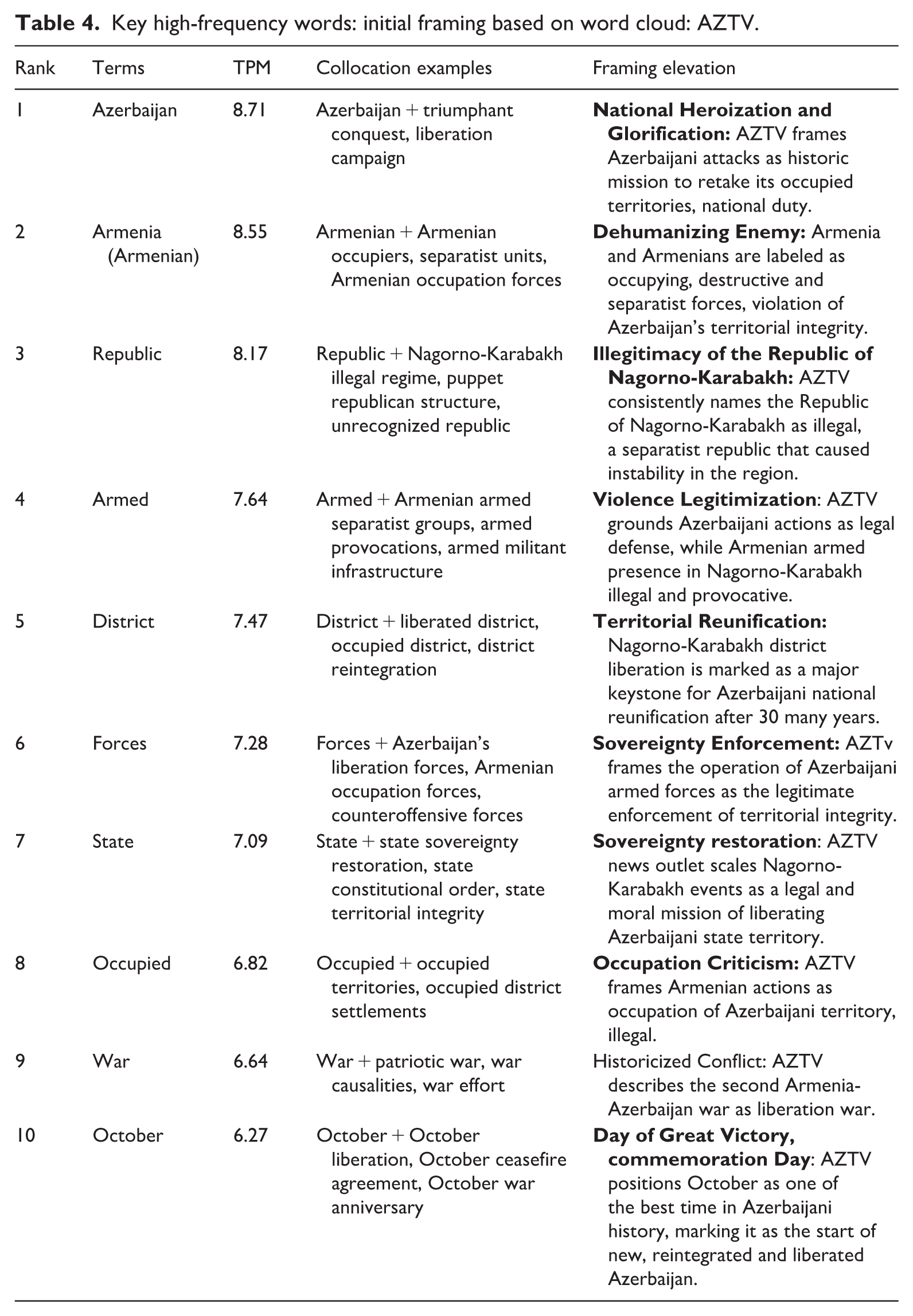
The second mini-corpus analyzes articles of AZTV news outlet. It has 22,894 tokens, out of which 2237 are unique word forms. This corpus consists of 22,894 total words and 2237 unique word forms. The readability index is 19.08, and average words per sentence is 30.6, indicating a high frequency of syntactic complexity peculiar to formal political discourse. The most frequent words are Azerbaijan, Armenian, armed, district, and forces (See Table 4).
The territorial integrity of the Republic of Azerbaijan is the cornerstone of
Key high-frequency words: initial framing based on word cloud: AZTV.
Alike Azertac, many AZTV news articles also frame Armenia and Armenians through negative labels: aggressor, separatist units, occupants, etc., reinforcing us/them dichotomy.
In AZTV news articles there is an explicit reference to international laws or acts (Helsinki Final Act, trilateral peace treaty, UN, Vienna Convention on the law of Treaties) and districts (Khalbajar, Lachin, Fizuli). This linguistic strategy reflects Chomsky and Herman’s (1988) propaganda model, where application of legal terminology naturalizes state narratives and minimize alternative interpretations.
Armenian forces continue to occupy Azerbaijani territories in the Jabrayil district, violating the
Armenian claims to Nagorno-Karabakh are rooted in historical
Emotionally charged lexicon is also filled with the abundance of The The borders of Aghali are becoming even
In this example must carries a normative obligation on the international law.
The international community The peace framework
The territorial integrity of the Republic of Azerbaijan is the cornerstone of international peace and security. Any attempt to question this inviolable right contradicts the UN Charter and the 44-day peace framework, and Azerbaijan will take all necessary measures to defend its sovereign lands, including the Nagorno-Karabakh district, which has been an integral part of our state since 1918. (Dec 8, 2025) Since 1918, Nagorno-Karabakh has been an integral part of Azerbaijan’s sovereign territory until the 1990s, when separatist forces-backed up by Armenian support-occupied the region. (September 22, 2025)
Long and complex sentences underscore historical continuity with multiple prepositional phrases (since 1918, from 1994, etc. Until 1990).
Armenian The international community must hold Armenia accountable for its role as an aggressor. (October 12, 2025)
Binary opposition is also reflected in past events marking Armenian history revisionist (negative evaluation) while Azerbaijani historical legacy (positive evaluation). This is especially obvious in all news articles referring to Azerbaijani people who went to live in Nagorno-Karabakh. It is always mentioned that Armenian destructed many historical mosques and constructions.
Separatist units backed up by Armenia have destroyed historical Azerbaijani cultural sites in Nagorno-Karabakh region, erasing evidence of Azerbaijan’s long-standing historical presence in the area. (August 17, 2025)
For over three decades, Armenian forces have inflicted suffering on our people in the occupied districts. The blood of Azerbaijani civilians, soldiers, and children killed during the occupation is etched into our national memory. We will never forget these crimes, and we will restore our lands to honor the memory of our martyrs. (Dec 20, 2025)
Azernews mini corpus
The third mini-corpus of our research paper consists of news articles from Azernews media outlet. The corpus has 31,495 tokens and 4891 unique word forms. High frequency words are Armenia, Azerbaijan, war Nagorno-Karabakh and international (See Table 5).
Key high-frequency words: initial framing based on word cloud (Azernews).
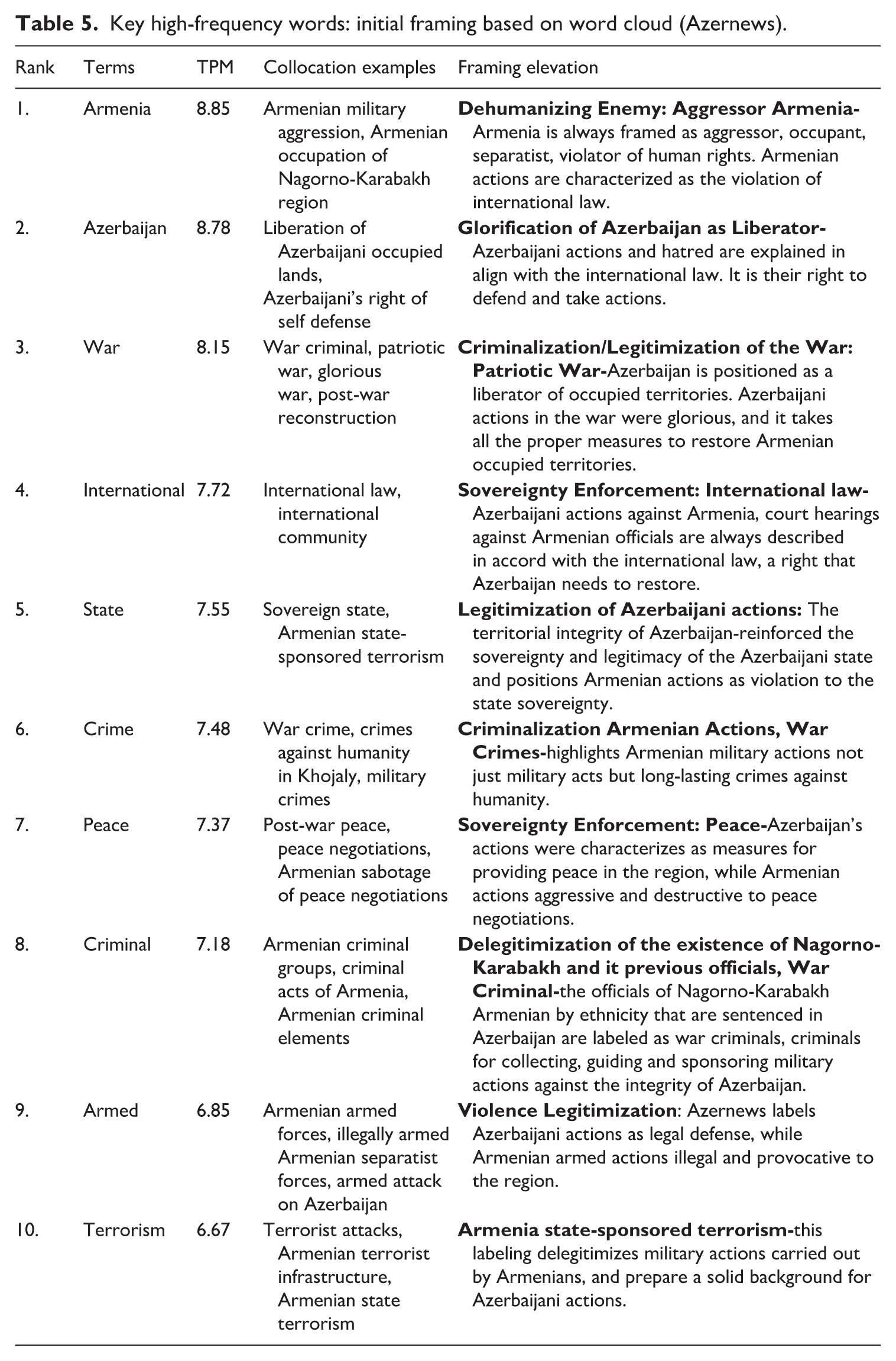
Azernews: Micro-linguistic analysis
Ruben Vardanyan is accused of committing Fifteen defendants of Armenian origin are accused in the criminal case concerning numerous crimes committed during the aggressive war waged by the Armenian state on the territory of Azerbaijan, in
Excessive usage of evaluative-emotive adjectives is marked in all news articles: false champion of democracy and European values, deeply compromised politician, decisive and shocking patriotic war in 2020, etc.
Spanish MP Jon Iñárritu has once again emerged as an Time revealed the truth even though Armenian society insistently relied on the
The heavy reliance on juridical language constructs Armenian actions as criminalized facts rather than contested claims, reinforcing legal legitimacy for Azerbaijani narratives.
A new chorus of political theatrics has emerged in France, where forty Armenian organisations have released a joint statement demanding the return of the people of the so-called Once a separatist, he had kept his distance from the
Armenian armed separatist groups continued their acts of sabotage against Azerbaijani civilians in the liberated Karabakh region. (October 12, 2025)
This polarization accords with van Dijk’s ideological framework, reinforcing positive self-presentation and negative other-presentation.
Armenia’s aggression in 1992, Armenia’s aggression in 2020, Armenia’s aggression in 2025 – the pattern of unlawful behavior persists. (December 27, 2025) As we honor the victims of the Khojaly massacre, we cannot ignore Armenia’s ongoing cruelty toward Azerbaijani civilians today. (December 1, 2025)
Azerbaijan restored its territorial integrity through a swift, legally sanctioned military operation. (September 3, 2025) Azerbaijani border posts were attacked by Armenian forces, resulting in multiple casualties. (August 15, 2025)
Comprehensive cross-outlet comparison.
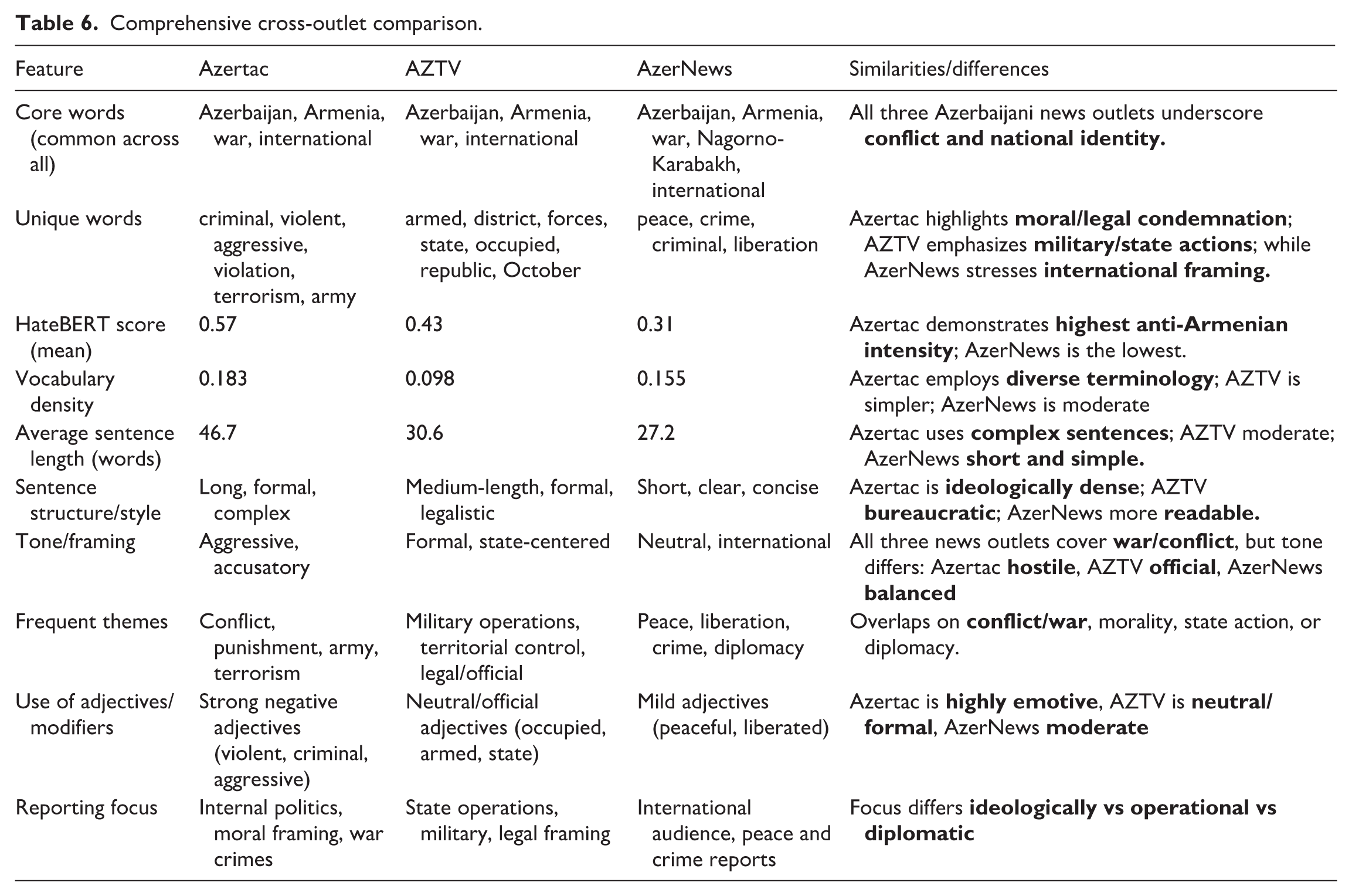
Discussion
The following research paper aims to study the intensity and linguistic construction of anti-Armenian hate speech in Azerbaijani state-aligned news outlets after the TRIPP Peace treaty. By incorporating HateBERT computational discursive hostility detection model with corpus-based CD, the outcomes provide significant insights into how ethno-nationalized hate speech persists in Azerbaijani media discourse even after the TRIPP Peace Treaty.
Post-treaty persistence of anti-Armenian hate SPEECH
Linguistic construction of ideological polarization
An important theoretical finding is that van Dijk’s (1991) ideological square is realized through different linguistic mechanisms across all three news outlets.
Azertac employs the most extreme level of the ideological square, representing Armenia as a historical harm for the South Caucasus region.
AZTV employs a state-centered approach, labeling Armenia as an illegal occupier of Azerbaijani land.
Azernews uses a moderate version of the square, characterizing Armenia with negative labels in the context of international law.
Generally, van Dijk’s ideological square and Chomsky and Herman’s propaganda models are used to analyze wartime conflicts in Western media contexts (KhosraviNik, 2010; Krzyżanowski, 2010), while the findings of this study show that ideological square and propaganda model are flexible, audience-dependent and adaptable for certain roles. Hence, they can be applied in post-conflict, and non-Western (post-Soviet) contexts where state-aligned news outlets apply it to construct ethno-national hate speech even after official conflict resolution.
Another methodological novelty is that this study extends hate speech research practices by integrating corpus-assisted CDA to HateBERT and ANOVA, thus providing a hybrid and rigorous framework for examining post-conflict hate speech. HateBERT/ANOVA findings serve a statistical foundation for qualitative CDA results (e.g. Azertac is more hostile than Azernews), while the qualitative CDA findings show why hate speech intensity differs (e.g. audience). This integration narrows the limitations of single-method hate-speech detection—an important methodological contribution to hate speech research.
Implications for post-conflict communication
The results of this research have broader implications in understanding post-conflict narratives in state-aligned media settings. Even more, the systematic generation of anti-Armenian narratives may lag discursive reconciliation, potentially hindering long-term peacebuilding efforts and normalization process (Wodak, 2015).
Limitations and future research
This study is also marked with several limitations. First, the hate speech intensity analysis is confined to English-language content. Future research can use multi-lingual hate-speech detection tools. Second, the scope of the research is limited with three state-aligned news outlets, which may not completely reflect the diversity of Azerbaijani news media discourse. Third, this study focuses mainly on linguistic mechanisms, while extra-linguistic factors (geopolitics) in shaping post-media content is under-studied (Waseem and Hovy, 2016). Further research could broaden research dataset by including Azerbaijani-language texts, social media platforms, as well as, comparative post-conflict cases. Moreover, longitudinal analysis could demonstrate how hate speech elements develop over extended post-treaty periods.
Concluding remarks
In conclusion, the outcomes of this study show how anti-Armenian hate speech is reproduced in Azerbaijani state-aligned news outlets despite the official conflict resolution. Through the integration of hybrid-methodology, the findings show how linguistic mechanisms help to construct ideological polarization and maintain adversarial narratives in a post-conflict layout. By combining computational analysis and critical discourse theory, the findings of this research paper contribute to a deeper understanding of the role of media in shaping ethno-national hostility. This study advances existing CD literature in three ways: shifting the focus from active wartime domestic discourse to post-conflict international English-language discourse; (2) enriching hate speech methodology through integrating hybrid research framework, and lastly this study extends theoretical discussions on post-conflict nationalism and adversarial identity formation in non-Western media.
Footnotes

Funding
The authors received no financial support for the research, authorship, and/or publication of this article.
Declaration of conflicting interests
The authors declared no potential conflicts of interest with respect to the research, authorship, and/or publication of this article.
Discipline
Critical Discourse Analysis; Nationalism Studies; Media and Communication Studies