






Abstract
This study examines the textual and visual discourse relating to sustainability initiatives on the websites of three of the world’s largest fossil fuel companies, namely BP, Shell and TotalEnergies. The study’s conceptual underpinnings draw on what is advanced in scholarship on corporate social responsibility (CSR). Multimodal critical discourse analysis is the approach used, with a focus on the legitimation practices by the companies. The findings show that their actions are discursively constructed as compatible with efforts to achieve sustainability, and function to justify the continued use of fossil fuels into the foreseeable future. The use of stock imagery depicting people in generic roles and recognisable environmental symbols support what is communicated textually. I argue that this conveys generic empathy, which lacks substance and contradicts the current scientific consensus that fossil fuel exploitation needs to be phased out as a matter of urgency to slow life-threatening climate change.
Keywords
Introduction
Fossil fuel extraction has for the past 150 years been key to energy production throughout the world, and a number of large multinational fossil fuel corporations have since been established. These companies are also responsible for environmental damage and destruction, human rights violations and contributing to climate change. Their actions have at times resulted in negative publicity and increasing scrutiny from consumers and stakeholders. Consequently energy companies have implemented a number of professed sustainability initiatives, which are communicated through corporate social responsibility (CSR) policy documents. The websites of these companies serve as an important means to articulate their CSR activities (Wanderley et al., 2008). While welcomed as a step to ensure accountability, critics argue that CSR is a legitimation practice which deflects attention from the environmental harm resulting from fossil fuel exploitation (Cherry and Sneirson, 2011; Frynas, 2009; Mobus, 2012). This may also constitute greenwashing, which is seeing increasing interest from researchers, partly due to the importance of environmentalism in public discourse (Lyon and Montgomery, 2015).
Analyses of the textual content of environmental policy documents and public relations materials comprise a significant part of related research. The examination of visual artefacts has seen less scholarship. To address this, the present study examines the lexical and visual discourse in the sustainability sections on the websites of three energy companies, namely BP, Royal Dutch Shell (henceforth Shell) and TotalEnergies. CSR scholarship provides the theoretical underpinnings for the study, which employs multimodal critical discourse using van Leeuwen’s (2007) framework for examining how legitimation is discursively constructed. In the first part of the article I provide an overview of CSR, and then focus on how it has been employed by the fossil fuel industry, largely to mitigate criticisms of harmful environmental practices. The data analysis is then conducted, followed by a discussion of the findings and their implications.
Corporate social responsibility
CSR, whether applied in business practices or as a focus of academic enquiry, has evolved considerably (Carroll, 1999). As a result, a single, widely accepted definition of CSR has not been formulated. Furthermore, how it is interpreted is contextually dependent (Blowfield and Frynas, 2005; Frynas, 2009). CSR now encompasses a wide spectrum of issues, including environmental management, animal welfare and social development, according to Frynas (2009).
Concerns about the impact of businesses on society have long been acknowledged (Bakan, 2004; Carroll, 1999; Frynas, 2009; Tombs and Whyte, 2015). In the 19th century, for instance, boycotts were organised against companies which manufactured goods using slave labour (Frynas, 2009). Over time this culminated in the establishment of CSR, which can be broadly understood as a company’s obligations to the public of a country where it operates (see Blowfield and Frynas, 2005; Carroll, 1999; Tombs and Whyte, 2015). The provenance of modern CSR can be traced back to the mid-20th century, as discussed in Wanderley et al. (2008). According to Frynas (2009) the development of CSR can be attributed to the increasing attention which was given to environmentalism as a pressing social issue in the 1970s. At the time in the United States environmental issues started gaining prominence with companies seeing increased scrutiny of their practices (Vos, 2009). Frynas (2009) notes that Western energy companies have been instrumental in the advancement of CSR. Increased awareness of the environmental harm resulting from their actions, and the need to mitigate the resulting negative publicity accounts for this. BP and Shell are singled out in this regard.
CSR is also seen as a consequence of globalisation and the view that capitalism has a societal role, in addition to generating profits (Kaplan, 2015; Wanderley et al., 2008). Examples of social issues in this regard are addressing the HIV/AIDS epidemic, poverty alleviation and climate change. The perception exists that this obligation is likely to increase in the future (Frynas, 2009). It is important to note, however, that since its inception CSR initiatives such as those mentioned above have been largely voluntary as opposed to legally mandated (Blowfield and Frynas, 2005; Carroll, 1999). According to Blowfield and Frynas (2005) advocates supporting voluntary approaches to CSR argue that they encourage corporate accountability, and are of the view that companies are able to regulate themselves in instances where national or international laws are lacking. However, the extent to which companies implement their planned environmental policies is unclear (Ramus and Montiel, 2005). Moreover, according to Tombs and Whyte (2015) clear measures for assessing CSR outcomes have not been established. In some respects CSR may thus be considered to be a pre-emptive tactic to assuage criticism of a company’s activities and a means to curtail regulation and avoid delegitimisation (Benson and Kirsch, 2010; Kaplan, 2015)
CSR disclosures
CSR is seeing increasing interest by corporations, and concomitant with this has been attention to the manner in which such information is communicated to stakeholders (Wanderley et al., 2008). The activities companies are involved in relating to environmental and other sustainability issues are typically articulated in environmental disclosure reports, commonly referred to as CSR reporting (Nwagbara and Belal, 2019). As noted by Mobus (2012), such reports are distributed to stakeholders such as investors, governments and also the broader public. According to Wanderley et al. (2008), the Internet has become an important medium for the communication of CSR disclosures, due to its cost-effectiveness and the rapidity with which it facilitates the dissemination of information. Fossil fuel companies also use the Internet for this purpose (O’Connor and Gronewold, 2013).
Organisations benefit from CSR reporting due to the perceived legitimacy it affords them in the public sphere (Mobus, 2012; Ramus and Montiel, 2005). According to Suchman (1995) legitimacy can be defined as actions by an entity which align with generalised norms and beliefs in a social setting. Of relevance in this regard are stockholders and members of the public who make moral judgements about an organisation based on its commitments to the wellbeing of society, for instance, which affect its trustworthiness. In terms of attaining legitimacy Suchman states that an organisation needs to undertake activities that appeal to its pre-existing stakeholders. This needs to be followed up by additional initiatives that appeal to wider audiences in an attempt to increase its legitimacy. CSR reports can seen as one way to facilitate this.
Energy companies were among the earliest adopters of CSR. As early as the 1960s they were initiating CSR activities of their own volition, by providing detailed assessments of their operations (Frynas, 2009). Disclosures made in this respect are due in part to the nature of the oil and gas industry, which has a large ecological impact (Frynas, 2009; Mobus, 2012). CSR reporting can be advantageous for organisations; however, it might invite scrutiny and can be seen as a public relations tool (Mobus, 2012). It is also worth noting that the type of information disclosed is influenced by the industry sector as well as the origin of the company in question (Wanderley et al., 2008). This may lead to certain corporations being selective about what they communicate to their stakeholders. Thus a company may focus on information portraying it in a positive light in an attempt to gain legitimacy. Conversely, should its activities invite undesirable attention, the company may downplay them (Benson and Kirsch, 2010).
The publication of CSR reports does, however, not entail corporations adopting environmentally responsible practices. A study by Adams (2004) highlights such concerns. A company whose environmental performance reports she analysed failed to fully acknowledge the negative environmental impact of its operations. Furthermore, the established guidelines lacked the necessary mechanisms for ensuring compliance, even from the industry associations tasked with creating them. Mobus (2012) argues that voluntary CSR reporting is inherently flawed as it permits organisations to self-promote, as opposed to reflecting on their activities, which may have undesirable outcomes. Cherry and Sneirson (2011) contend that this allows companies to claim to be socially responsible when their actions demonstrate otherwise. An important aspect of such reporting is the discourse used, as it can shape how fossil companies are perceived, as reported in Nwagbara and Belal (2019). However, according to Runyon (2024) mandates are now increasing, with companies facing litigation for their claims concerning environmental initiatives. TotalEnergies, for instance, is currently involved in legal proceedings for promoting natural gas as integral to its decarbonisation efforts (Johnston, 2025). Moreover, a number of countries are considering legislation based on internationally recognised standards to ensure compliance with respect to their marketing and public relations activities (Runyon, 2024).
Greenwashing
The practices by companies discussed in Cherry and Sneirson (2011) and Adams (2004) are examples of greenwashing, a term applied to environmental communication that aims to mislead (Lyon and Montgomery, 2015; Mobus, 2012). It may also be used to improve a company’s public perception, while concurrently obscuring harmful practices (Plec and Pettenger, 2012; Vos, 2009). Greenwashing can thus be seen as a legitimation strategy which embodies some of the practices articulated by Suchman (1995). For example, O’Connor and Gronewold’s (2013) analysis of CSR reports published by prominent petroleum companies reveal that a number of them described their activities as exceeding required standards. Cherry and Sneirson (2011) cite CSR as one of the factors which led to the 2010 Deepwater Horizon environmental disaster in the Gulf of Mexico. BP, the energy company responsible, had for many years prior to this flouted environmental regulations in addition to having a poor safety record. However, according to Mobus (2012) it was able to deflect attention from this due to selective disclosures and effective public relations campaigns.
Similarly, Plec and Pettenger (2012) claim that ExxonMobil has used greenwashing to discourage critical examination of its policies. Moreover, it uses advertising to highlight its commitment to environmental causes, while concurrently downplaying the detrimental ecological impact of consuming fossil fuels. A recent study by Li et al. (2022) which analysed the discourse used in the annual reports of four energy companies, including Shell and BP, from 2009 to 2020 found that they elevated their professed commitments to reducing greenhouse gas emissions, while also increasing investments in cleaner energy. These authors note, however, that their actions contradicted this and that they continued to view fossil fuel exploration and extraction as core to their operations. Ramus and Montiel (2005) argue that energy companies, while supporting sustainability and development policies, are reluctant to reduce fossil fuel production. Economic reasons account for this, demonstrating once more the incompatibility of CSR with companies that prioritise profits over the environment (Bakan, 2004). Furthermore, when faced with dealing with the undesirable consequences of its actions, a company may opt to increase its greenwashing efforts instead of addressing the problem in question (Kassinis and Panayiotou, 2018; Vos, 2009).
Greenwashing in visual discourse
Images have also become an integral part of corporate communication (Schroeder, 2013). This extends beyond profit-driven companies to environmental organisations such as Greenpeace, which ascribes a great deal of importance to the photograph as a medium to highlight the need to address climate change (Doyle, 2007; Kuen, 2021). Energy companies have also embraced visual-centric modes of corporate communication. According to Yang et al. (2025) images may be especially useful for conveying pro-environmental messaging. A study they undertook found a correlation between the use of images in environmental disclosure reports connoting environmentally friendly messaging, and favourable perceptions among potential investors. Moreover, such images were especially effective when used by companies associated with poor environmental practices. Some of these representational strategies may thus constitute greenwashing. Kassinis and Panayiotou (2018) claim that BP’s activities exemplify how companies employ images to obfuscate ecologically harmful practices, and as a means to regain legitimacy following negative publicity. In the period following the aforementioned Deepwater Horizon disaster, the company relied on image-centric signalling on its website as a means to counter the adverse public response that was evoked, arguably, by the visual spectacle created by the news media. Moreover, this strategy “aimed at dispersing an alternative understanding of BP” (Kassinis and Panayiotou, 2018: 40). BP’s public relations campaign after the disaster was believed to be successful in engendering a high degree of trust by the public in the company (Cherry and Sneirson, 2011). This alludes to the perceived importance of visuals in the public relations activities of energy companies.
Generic images in organisational communication
The nature of the images typically used in organisational communication is also of relevance to the construction of legitimacy. A large number of the photographs disseminated by various organisations are stock images (Hansen and Machin, 2008). They are sold by companies such as Getty and Shutterstock, are also used in advertising and the news media (Aiello, 2016). They are characterised by their genericity, and their aesthetic qualities are emphasised for the purposes of branding and marketing (Hansen and Machin, 2008). The implications are significant because such images are created to prioritise the interests of multinational corporations (Machin, 2004). Hansen and Machin (2008) state that people depicted in stock photographs are presented as a collective instead of individuals, and the settings depicted in these images usually lack identifying features. Also of importance are the potential meanings connoted by stock photos, which are typically decontextualised visual accounts of the events in question (Aiello et al., 2022; Hansen and Machin, 2008). An additional drawback such images have is that they may connote stereotypical depictions (see Aiello, 2020; Thurlow et al., 2020).
Generic empathy
As discussed above, criticisms of CSR often relate to the belief that it merely offers reassurances to the public, but often fails to deliver tangible benefits. This is due to corporations being profit driven, with other activities they undertake being of secondary concern (Bakan, 2004). CSR initiatives are thus often seen as merely symbolic (Benson and Kirsch, 2010). Inferences in this regard are often derived from the examination of textual discourse, but stock images can perform a similar function when employed in organisational settings. They typically depict decontextualised events, as noted previously, and can be used to legitimise corporate activities including those related to the environment (Hansen and Machin, 2008). Taken together, such textual and visual discursive practices entail what I term generic empathy. At first glance, it appears committed to environmental sustainability, but on closer introspection lacks clearly articulated goals to achieve this.
Multinational energy companies
The three companies chosen for the present study comprise BP, Shell and TotalEnergies, all of which are European. They were selected, first, due to their international prominence as they are among the world’s largest producers of hydrocarbon products, and from 1965 to 2018 were responsible for approximately 7.75% of global fossil fuel emissions (Kenner and Heede, 2021). Second, examining the sustainability initiatives of these companies, while not representative of all regional energy companies, sheds light on the discursive strategies employed by large energy companies within the European context.
BP was established close to a century ago and is currently headquartered in the Britain. The company’s first refinery was constructed in Iran in 1912 (BP, 2025a). Shell began its fossil fuel processing operations as a kerosene trader, and pioneered the transportation of large volumes of oil in tankers. It later merged with the Royal Dutch Company to become Royal Dutch Shell, or Shell, as it is more commonly known (Shell, 2025a). TotalEnergies is a French company that was created in 1924 and started oil production in Iraq in 1927. Since then it has expanded its operations to a number of European countries and further afield in Algeria, Angola and Indonesia. It claims to be at the forefront of transitioning to cleaner forms of energy, and aims to be carbon neutral by 2050 (TotalEnergies, 2025a).
The preceding sections detail the provenance and evolution of CSR, and shows that corporations are becoming increasingly attuned to presenting their operations as embodying environmentally-friendly practices. While such initiatives have been applauded (Frynas, 2009), some companies have also faced criticism for the failing to deliver on their pledges and have been accused of greenwashing (Cherry and Sneirson, 2011; Kassinis and Panayiotou, 2018; Mobus, 2012). Taking cognisance of this, the present study analyses the sustainability sections of the websites of BP, Shell and TotalEnergies, and seeks to answer the following research questions:
To what extent does the textual and visual discourse dealing with the CSR initiatives of BP, Shell and TotalEnergies accord these companies legitimacy?
What does a critical analysis of these initiatives reveal in relation to conveying the notion of generic empathy about environmental concerns?
Methodology
Sample
The sample was retrieved from the sustainability sections of the websites of BP, Shell and TotalEnergies. Within these sections viewers can find information about various environmental initiatives which the companies claim to be involved in. I limit the analysis to the text and photographs. The procedure followed for retrieving the sample entailed first, navigating to the relevant sections and then saving the respective published webpages as .pdf files. The data were then uploaded to the qualitative data analytical software, NVivo, and coded. In total 44 web pages and 97 images were analysed (see Table 1 below).
Data summary (n = 141).
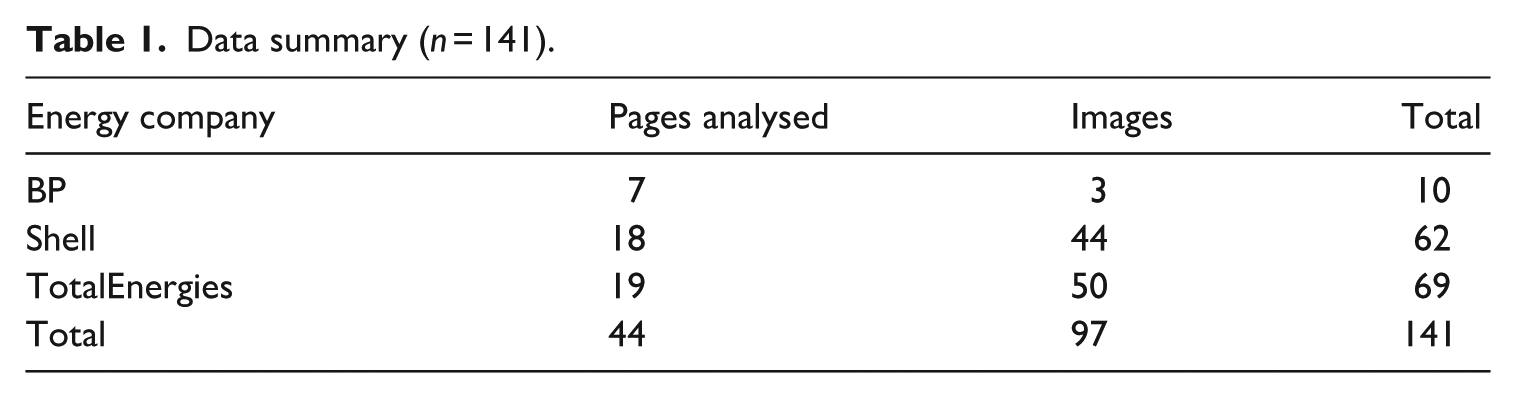
The concepts related to the three companies’ CSR practices as dealt with above were focused on, with specific attention paid to how they might construct legitimacy. Preliminary codes were created for the written discourse and then for the images. These codes were then revised in several rounds of iterative coding (Saldaña, 2016). The data were then organised thematically to facilitate a more detailed analysis, based on the prominence of the coded items. For this I draw on Van Leeuwen’s (2007) analytical framework, in addition to employing multimodal critical discourse analysis (MCDA). As discussed above, CSR aims to establish legitimacy and publishing CSR reports is one way that this is done (Mobus, 2012). CSR and legitimation practices are thus closely connected. The framework advanced by van Leeuwen provides a means to illuminate how legitimacy is constructed in textual and visual discourse, and is therefore suited to analysing the data sample.
Categories of legitimation
Van Leeuwen’s (2007) framework comprises four categories of legitimation. The first, authorisation (authority legitimation), relies on legitimation associated with traditions, customs or people seen as having institutional authority. The second is moral evaluation (moral legitimation), which is concerned with value systems that are in many cases implicit. Rationalisation legitimation, the third category, draws on societal norms to advance and validate certain goals. The final category is mythopoesis, and it relies on narratives that confer legitimacy upon certain social practices that align with the established order, but de-legitimise others.
Multimodal critical discourse analysis
Legitimation practices, van Leeuwen (2007) contends, may be articulated textually and visually, and as such an analytical approach should take these two modes into consideration. I thus use multimodal critical discourse analysis, consisting of critical discourse analysis (CDA) and social semiotics. CDA provides insights into the power relations and social inequalities believed to inform discourse, which comprises a “multidimensional phenomenon”, not only written or spoken language. Thus certain actions, social practices and cultural practices are of interest to CDA (van Dijk, 2009: 67). This may be overt or less obvious (van Dijk, 1993), and contextual factors are also believe to be an influence in this regard (Fairclough, 1992; Wodak and Meyer, 2009). Language and discourse is therefore intertwined (Fairclough, 2003). The discourses we are exposed to and how we understand them is typically relayed through more than one mode (van Leeuwen, 2012). Multimodal analyses are thus increasingly important in related scholarship.
Social semiotics provides possible explanations for how the semiotic elements within an image create meaning in a certain context (Kress and van Leeuwen, 2006; van Leeuwen, 2005). As noted above, critically analysing texts to expose power structures is integral to CDA (Fairclough, 2003; van Dijk, 2009). A social semiotic approach can also account for how power relations function in terms of the choices made by the image’s producer, and the semiotic elements contained within an image (Aiello, 2020). It is important to note that, as van Leeuwen (2005) points out, social semiotics does not attempt to prescribe precisely how meaning is derived from the elements of an image under analysis. Instead, of interest is how people in a certain context “regulate the use of semiotic resources” (p. xi). Van Dijk (2009) defines context as consisting of a spatial and temporal setting, in addition to being a communicative situation informed by the participants’ “subjective mental representation” (p. 66), which is connected to their ideologies. The production and comprehension of discourse which takes place in such situations is constrained by an organisation’s norms and objectives. In terms of applying this to the present study by drawing on van Dijk, the societal setting for the communicative event comprises the CSR initiatives of the three energy companies under analysis, disseminated through their websites. The participants include the energy companies whose role is to communicate and thereby attempt to legitimise their fossil fuel exploitation activities. The other participants are their shareholders and concerned members of the public, who possess preconceived knowledge and beliefs about these companies.
Key to CDA is understanding how the micro-elements in a text create meanings in the broader context in which they occur (Fairclough, 2003). I thus began the analysis by examining the lexico-grammatical structures in the written discourse, in addition to the various elements in the images. This involved recording information such as the subject, background, composition and camera height and angle. Following this, I made inferences about the potential meanings they communicated within the relevant categories of van Leeuwen’s (2007) framework.
Findings
In the proceeding sections I only include illustrative textual excerpts from the sample and analyse three representative images.
Authorisation
The legitimation practices identified as most relevant within this category are authority and commendation. Legitimation in this respect can be constructed at the personal or impersonal level, and by associations with expert figures or institutional authority (van Leeuwen, 2007). In the texts under analysis frequent references were made to how the three companies were conducting their activities in a way which elevate environmental concerns, human rights and sustainability. Van Leeuwen notes that legitimation in this manner can be expressed using certain verbal process clauses. Shell and TotalEnergies draw on the institutional authority of the United Nations and Sustainable Development Goals (United Nations, 2025) to attain legitimacy, as shown in the two excerpts below.
We welcome the SDGs and will play our part in helping governments and societies to achieve them. (Shell, 2025b) TotalEnergies has structured its sustainable development approach for conducting its activities so as to contribute to the achievement of the United Nations Sustainable Development Goals. (TotalEnergies, 2025b)
In Shell’s case the affirmative future verb will indicates certainty, which can be construed as a firm commitment to this objective, and the use of the present perfect tense in has structured, in the second excerpt suggests that the objective already informs TotalEnergies’s activities.
How the images convey authorisation is, however, is less clear. Shell featured an image associated with the United Nations, consisting of a tablet computer displaying the 17 SDG icons. This could be seen as an attempt to associate its actions with the authority of the United Nations as it has done in the excerpt above. None of the photographs on the websites of BP or TotalEnergies feature widely recognisable institutions that, I argue, could accord them legitimacy. This suggests that the depicted subject matter does not easily lend itself to representing authorisation.
Moral evaluation
Legitimation in this category concerns practices deemed to be acceptable in a general sense, and may be expressed as evaluation, abstraction and comparison. Of most relevance to this analysis are the first two sub-categories.
Evaluation
In the excerpts below, the highlighted adjectives communicate moral values, thus legitimating the companies’ activities.
We support the goals of the Paris Agreement, which recognize the importance of a A
Pronominalisation was another feature of the discourse, with the pronouns our and we appearing regularly throughout the sample, including at the top of the sustainability pages of the companies’ websites. According to Smith (2004) advertisers frequently make use of such lexical items to establish relationships between consumers and companies in order to promote their products. Such devices may also perform a legitimation function, by portraying the authority figure as personable and thus easy to relate to. Communicated by such associations, therefore, is behaviour and practices by an affable actor that can be interpreted as morally acceptable.
Such positive evaluations are also connoted by a number of images in the sample, especially those depicting people. They are diverse in terms of ethnicity and gender, and are shown in a number of settings. Images of people, ostensibly employees of the three companies, feature them in or in close proximity to industrial plants and warehouses, on ships and oil extraction platforms. Other images feature people working outdoors in pristine settings, alongside rivers and streams and in forested areas. They are also shown in corporate settings, seated in boardrooms appearing to be engaging in conversation, and are typically smiling or displaying expressions connoting contentment or fulfilment. Most of the images of people show them in small groups or pairs, thus engendering a sense of a community (Hansen and Machin, 2008). In terms of composition, the majority of such photographs are medium-length shots taken at eye level, with either side or oblique camera angles. As discussed in Kress and van Leeuwen (2006), a subject at eye-level may convey equality between the viewer and the photographer in terms of a power dynamic.
I infer from such depictions that the three energy companies attempt to communicate equality despite the hierarchies which characterise the internal organisation of corporations, and the hierarchies which these social actors occupy in regards to the public readership. The emphasis on employee safety is also communicated in the images. Many of the human subjects depicted as employees of the energy companies are shown wearing high-visibility clothing, safety helmets and goggles. The prominence of the energy companies’ branding on the uniforms and safety equipment signifies the importance they ascribe to worker safety. The images thus have a legitimating function by accentuating what is connoted in the textual discourse, particularly with regard to the companies’ activities being evaluated positively. In addition, the expressions of the subjects connote affability through pronominalisation. Figure 1 is illustrative of such depictions (see Appendix).
Abstraction
Van Leeuwen notes that what is communicated discursively is often implicit and therefore depends on an adequate knowledge and understanding of the cultural context where the practices in question occur and are interpreted. One of the items most prominently coded in the sample, which I titled Energy transition, demonstrates such abstraction. All three companies regularly mentioned their commitments to a transition, which may be understood to be a reduction in the use of fossil fuels and an increased focus on renewable energy. A cursory viewing of the respective sections on the websites does not, however, provide a clear explanation for what is meant by this transition, beyond stated aims to reach “carbon neutrality” in the long term (TotalEnergies, 2025d). Instead, an assumption is made that the reader will understand what this means, which van Dijk (2000) refers to as presupposition. Additional examples of abstraction include claims by the companies that they were reducing emissions by utilising low-carbon fuels. TotalEnergies, for instance, promotes green and blue hydrogen as “gateway” energy sources in addition to natural gas, stating that they will form part of its future energy offerings (TotalEnergies, 2025e). Critics have argued, however, that producing blue hydrogen results in high methane emissions. Regarding it as source of energy which can benefit the climate is thus somewhat tenuous (Howarth and Jacobson, 2021). The company is also currently involved in legal proceedings for claims it has made relating to natural gas as being more beneficial to the environment than oil and coal (Johnston, 2025).
Also noteworthy are the other lexical choices used to describe the companies’ operations. Products and the collocation energy products, occurred in 36 and 20 instances respectively across the sample. By comparison oil products (5 instances), petroleum products (4 instances) and gas products (1 instance) were less prominent. Due to the negative associations conveyed by words such as gas, oil and petroleum, this might be a deliberate discursive tactic to obfuscate the three companies’ involvement in hydrocarbon exploitation. On Shell’s website, energy products occupies a visible position in the “Climate” section, highlighted in a rectangular, yellow text box. Moreover, in TotalEnergies’ “Climate and Sustainable Energy” section, a header in bold, blue text titled “Improving our products and supporting our customers”, draws the viewer’s attention. However, similar phrases are less noticeable on BP’s website.
Abstraction was also noticeable in the visual discourse, principally through the use of stock images. Despite the relatively rich visual subject matter in the sample, no captions were displayed clarifying what was in depicted in the photographs. Thus it appears that they are stock images, commissioned or licensed by the respective companies. I also base this on the information retrieved from the metadata of several images in the sample. They depict settings and subjects in a decontextualised way (Aiello et al., 2022; Hansen and Machin, 2008). While the nature of the companies’ operations is made reasonably clear through corporate branding and placing subjects near oil and gas infrastructure, the specifics are missing; namely, what fossil fuel exploitation entails. Furthermore, there is no indication that these operations have an adverse ecological impact. Through such depictions, the visuals function in the same way as the textual discourse by according legitimacy to the three companies.
Rationalisation
Van Leeuwen makes a distinction between two types of legitimation practices in this category. The first of these is instrumental rationality which is goal or purpose-orientated, and the second, theoretical rationality, views such practices as simply part of the established order. Rationalisation, like evaluation, relies on morality as understood in the context in question. As discussed beforehand, discursive constructions relating to the professed sustainability objectives of the three energy companies were salient in the sample. For this reason instrumental rationality is best suited to the analysis. van Leeuwen (2007) contends that when expressed lexically, instrumental rationality should contain elements indicating an activity which is linked to a “purpose” or “state” (p. 101). These micro-level elements are then connected to a broader purpose or goal, which constitute a “moralized action” (van Leeuwen, 2007: 102). Moreover, for such practices to be effective, the agency of the actor should be made explicit and it should perform the purposeful action in question. The extracts below relate to the activities undertaken by the three companies in relation to climate change, and exemplify how such legitimation practices function.
Our aim is to reduce to net zero the average lifecycle carbon intensity of the energy products we sell by 2050 or sooner. . . (BP, 2025c) As we implement our strategy to deliver more value with less emissions, we are reducing emissions from our operations, and helping our customers transition to cleaner energy solutions. (Shell, 2025c) The Company is taking action to reinvent energy and achieve its ambition of carbon neutrality by 2050 (TotalEnergies, 2025f)
In the first extract, “aim” is the action. In the second, three actions can be identified, namely “implement a strategy”, “reducing emissions” and “helping customers”; while in the third it involves “taking action”. In all of the examples, the actions are proceeded with the preposition “to”. The role of the preposition is to link the activity to its broader purpose, according to van Leeuwen. In all three extracts, the stated purpose relates to mitigating the undesirable effects of hydrocarbon exploitation, by reducing the “carbon intensity”, advancing toward “cleaner energy solutions” and achieving “carbon neutrality”, respectively. These actions are likely to be evaluated as moral and thus legitimate.
Rationalisation is also conveyed visually, often through the use of recognisable symbols and by depicting the companies’ activities in harmony with the natural environment. Images of solar panels and wind turbines were displayed on the three companies’ websites, with the exception of BP which only showed wind turbines. Scholars have argued that visualising climate change in a manner which media audiences can relate to presents challenges (Hansen and Machin, 2008; O’Neill, 2026). However, in recent years the widespread deployment of images featuring wind turbines and, although to a lesser extent, solar panels in mainstream media discourse when covering environmental issues, has arguably simplified this (see O’Neill, 2026). Wind turbines, in particular, evoke positive associations in this regard (Doyle, 2007). The second way rationalisation is connoted is by conflating the companies’ activities with environmental sustainability. As noted previously, images depicting settings of natural beauty were prominent in the sample. One image on Shell’s website shows a large ship transporting what could be natural gas along a river. Foregrounded in the bottom left quadrant is an array of solar panels positioned on the river bank. In the top left of the image three wind turbines are visible. Combined with a clear, blue sky these elements convey a scene of tranquillity synonymous with a healthy environment, and devoid of the environmental harm resulting from fossil fuel extraction. In addition, the viewer’s gaze is drawn to the top left of the frame, following the river’s course, which can be interpreted as a metaphor of looking toward a sustainable future. This resembles Shell’s stated action and purpose articulated lexically in the extract above, which is to reduce its emissions going forward (see Figure 2 in Appendix).
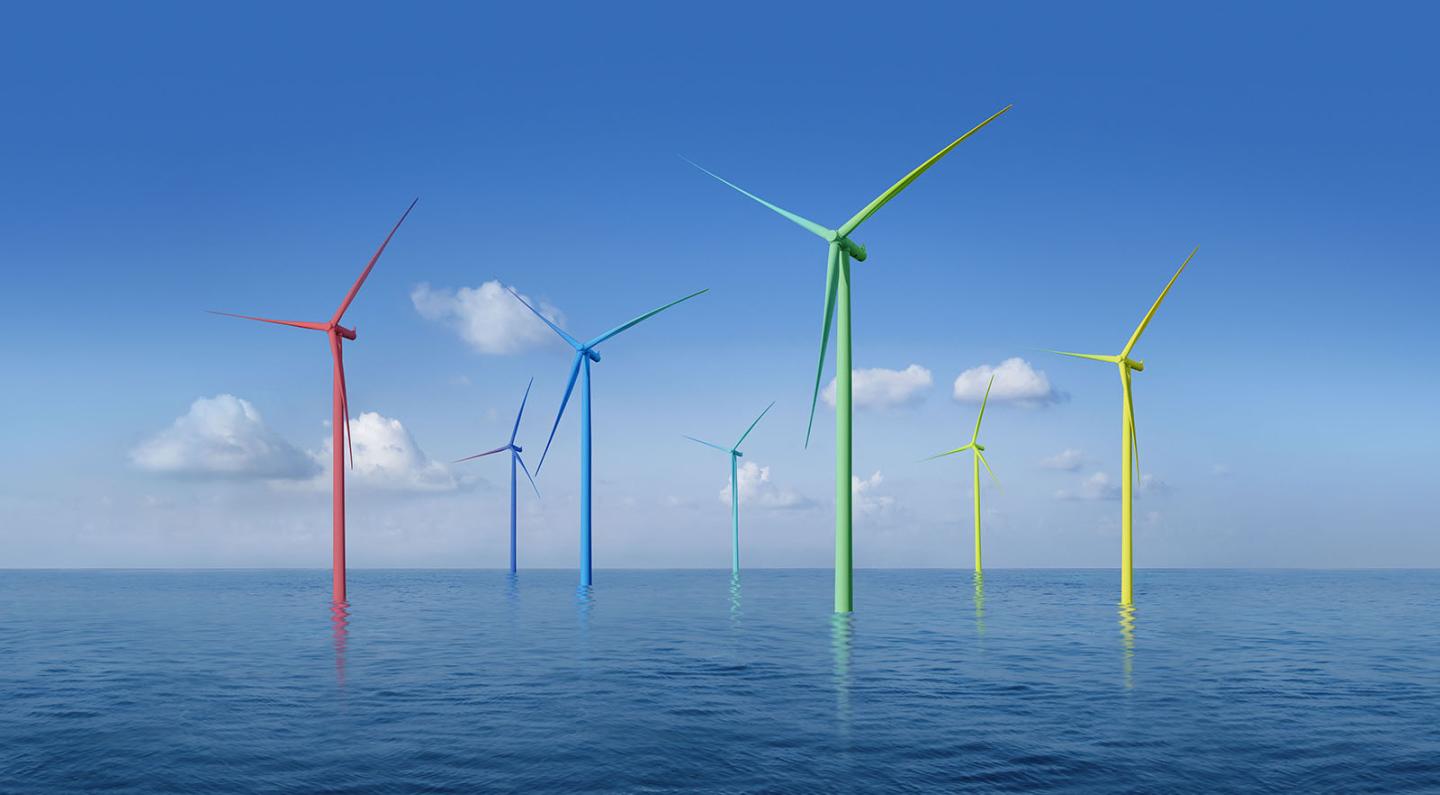
On TotalEnergies’ website an image features seven wind turbines located in what appears to be the ocean (see Figure 3 in Appendix). Each displays a colour found on the company’s logo. Dark blue water dominates the bottom third of the frame with a partly cloudy sky taking up the remaining two thirds. A green wind turbine is placed slightly off-centre to the right, and is the most prominent of the seven. Its prominence is accentuated by vignetting. A low camera height is used and the viewer is drawn to the top of the green turbine and the sky. The green connotes sustainability, and as with the previous image, allusions are made to the future by the dominant elements toward the top of the frame. What is purveyed in the image is synonymous with TotalEnergies’ verbal claims that its actions are purposeful and aspire to reducing fossil fuel emissions, centred on renewable energy.
Mythopoesis
Another way in which legitimation can be attained is through the creation of stories, according to van Leeuwen. They comprise either moral or cautionary tales and can obfuscate the reality of the subject in question. Furthermore, they may legitimise or de-legitimise certain social practices which reflect the “naturalistic specifics” of dominant institutions (van Leeuwen, 2007: 107). The acceptance, and therefore, legitimacy of fossil fuel exploitation can be seen as aligning with establishment norms, based on the perception that they are essential to modern economies.
The analysis in the preceding sections has revealed that the textual and visual discursive strategies attempt to present the three energy companies’ activities as virtuous and, therefore, moral. The initiatives they claim to aspire to are dedicated to the betterment of the people affected by their actions, in addition to mitigating the effects of climate change. In particular, the emphasis on an energy transition, the increased utilisation of low-carbon technologies and placing human rights at the centre of their operations underpin the position that hydrocarbon exploitation is compatible with sustainability. Taken as a whole, their activities therefore exemplify moral tales and are legitimate. However, none of the companies make a commitment to phase out fossil fuel extraction in the medium or long term. The scientific consensus is that fossil fuel exploitation must end if catastrophic climate change is to be averted, and that this needs to be done as soon as possible (The Editorial Board, 2025). The professed initiatives articulated by the three companies can be seen thus contradictory, or what van Leeuwen describes as inversion. Ultimately, therefore, the discursive practices in question de-legitimise principled efforts by social and environmental justice organisations, groups and individuals to attain true sustainability. The practices to legitimise the companies’ activities are clearly articulated textually, and are effective in reinforcing the morality of continued fossil fuel use. This demonstrates how mythopoesis operates in the discourse to deflect attention from the ecological harm inflicted by these companies. The images displayed on their websites reaffirm this legitimacy, which points to their perceived importance in environmental communication (Kassinis and Panayiotou, 2018; Schroeder, 2013; Yang et al., 2025). De-legitimisation, in contrast, is implicit textually and absent visually, suggesting that the visuals do not effectively connote de-legitimising practices through mythopoesis. It may also indicate, however, an awareness among the three companies of the need to avoid publishing photographs that draw unwanted attention to their more undesirable actions, or that antagonise their shareholders and members of the public.
Discussion and conclusion
The findings reveal that all three companies employed a number of legitimation strategies, with much of the textual and visual discourse displayed on the websites of BP, Shell and TotalEnergies highlighting their desirable attributes. This included associating their activities with authoritative institutions such as the United Nations, and initiatives such as the Sustainable Development Goals (United Nations, 2025). In addition, the companies are portrayed as moral and attuned to the wellbeing of their employees and the people affected by their operations. Discursively this is communicated through the use of abstract, and arguably more palatable, lexical constructions such as an energy transition, in addition to the prominence of phrases such as energy products instead of oil, gas or petroleum products. This may be seen as a tacit acknowledgement of negative consequences of hydrocarbon exploration and extraction experienced by certain communities, and the desire to assuage criticism in this respect (Blowfield and Frynas, 2005). A third legitimation strategy employed through rationalisation was emphasising that the continued exploitation of fossil fuels is compatible with efforts to mitigate climate change. Visually, similar legitimation practices can be observed. I contend that the use of stock imagery lacking captions and other identifying information, accentuates much of the abstraction connoted lexically.
It is important to point out, however, that despite commitments to more sustainable practices, oil and gas exploitation continues to remain a core part of the companies’ business operations going forward, a concern highlighted by Li et al. (2022). In addition, claims such as achieving net zero emissions by 2050 are vague. This arguably permits these companies to adjust their policies as they see fit, which speaks more broadly to the drawbacks of voluntary nature of CSR disclosures (Cherry and Sneirson, 2011; Mobus, 2012). Such concerns may be justified, taking into account that BP and Shell have recently drawn criticism for doing reneging on pledges they have made with respect to sustainability (see Ambrose et al., 2024). I argue, therefore, that the aforementioned representational practices constitute greenwashing, and downplay the negative consequences of the energy companies’ operations (Plec and Pettenger, 2012; Vos, 2009). The lexical choices made and the images used are effective in conveying what constitutes generic empathy. Outwardly, this is environmentally conscious and supports sustainability, but at the same time lacks meaningful and clearly stated commitments to achieve this.
The study makes a contribution to a scholarship in two ways. Examining the CSR initiatives of the energy companies in question can provide important, critical insights into the representational strategies of these and other fossil fuel corporations. It may also further illuminate how they attempt to present themselves in a manner exemplifying environmental sustainability. Another contribution is the approach used, namely MCDA. This approach is able to shed light on the ideological underpinnings implicit in the textual and visual discourse of powerful actors, and may ultimately assist in contesting it (van Dijk, 2009). As the climate crisis continues to intensify, there is an increased need for such awareness.
There are some limitations to the study which need to be acknowledged. The scope of the data analysed is limited to the CSR initiatives published on the websites of three European energy companies. The findings are therefore not representative of energy companies in other socio-political contexts. Furthermore, I only examined specific lexical items and visual artefacts, and did not take into consideration the layout and other design features of the websites under analysis.
Footnotes
Appendix
Figure 1: TotalEnergies (2025d) Reducing our emissions. Available at: https://totalenergies.com/sustainability/climate-and-sustainable-energy/reducing-our-emissions (accessed 1 June 2025). [The image in question appears toward the top of the web page and depicts two workers wearing white helmets and blue uniforms.]
Figure 2: Shell (2025d) Climate. Available at: https://www.shell.com/sustainability/climate.html (accessed 1 June 2025) [The image in question appears toward the bottom of the web page on the left.]
Figure 3: TotalEnergies (2025g) Energy transition. Available at: https://totalenergies.com/sites/g/files/nytnzq121/files/styles/1440x795/public/images/2023-10/TotalEnergies_Building_a_multienergy_company.jpg?itok=bgbjRg8O (accessed 1 June 2026). [This image is no longer featured on the website of TotalEnergies. In addition, the vignetting visible in the original image has been removed.]

Funding
The author received no financial support for the research, authorship, and/or publication of this article.
Declaration of conflicting interests
The author declared no potential conflicts of interest with respect to the research, authorship, and/or publication of this article.