






Abstract
This study examines how legitimation is interactionally constructed in US Senate Judiciary Committee (SJC) lower court nomination hearings. Drawing on legitimation theories and using Conversation Analysis, I argue that legitimation is accomplished not just through the content of senators’ talk, but also through its sequential positioning, specifically through having the “last word,” or through securing the final turn during hearing Q&A exchanges. Data includes video-recorded hearings from 2020 and 2022, with analysis focusing on instances where senators invoke the hearing’s time limits to conclude their questioning. These invocations enable senators to claim last-word turns while expressing critical evaluations of nominees and precluding their opportunities to respond, rebut, or contextualize the criticisms levied against them. In doing so, senators interactionally legitimize their own stances while delegitimizing nominees and their candidacy. By reconceptualizing legitimation as a sequential achievement, the study extends political communication and legitimation studies beyond monologic discourse to interactive formats.
Keywords
Introduction
In the context of United States Senate Judiciary Committee (SJC) hearings, talk is shaped not only by institutional rules and formal procedures, but also by the moment-to-moment coordination through which members manage interaction. This local management of talk is central to the doing of institutional identities in SJC hearings, of which power, authority, and political partisanship are tied. In a prior study (Montiegel, 2024), I used Conversation Analysis to investigate the dual function of time limits in SJC lower court nomination hearings as both a component of the procedural framework of SJC hearings, as well as a strategic tool for senators to invoke and regulate who speaks, what is said, and for how long. In the present study, I extend these insights by integrating several theoretical perspectives on legitimation (Mackay, 2021; van Dijk, 2006; van Leeuwen, 2007). I focus on when senators invoke time limits as part of having the “last word” when questioning judicial nominees, a practice illustrative of what I will describe as sequential legitimation. I discuss the implications this has for discursive control, institutional authority, and power.
A cornerstone of the US federal court system, the judicial nomination process is vital for ensuring the selection of fair and independent judges who receive potentially lifetime appointments. Nomination hearings are public forums that offer a window into how senators vet judicial nominees about their background, qualifications, and judicial philosophy (Dancey et al., 2020). In recent decades, however, these hearings have grown increasingly contentious, amassing media attention and public scrutiny and prompting critiques that they are highly partisan political performances (Collins and Ringhand, 2016; Truscott, 2024). Such events are ripe for examining senators’ communicative maneuvers in enacting institutional authority and shaping partisan influence. A focus on legitimation in particular can make visible how senators discursively justify their evaluations of a nominee, which can have real consequences for public perception and confirmation decision-making.
In the following sections, I first provide a brief overview of SJC lower court judicial nomination hearings, then I review the relevant literature on legitimation informed by van Dijk (2006), van Leeuwen (2007), and Mackay (2021), and lastly I discuss insights drawn from Conversation Analysis (CA), specifically the consequentiality of having the “last word” in interaction.
Background on lower court nomination hearings
The US Senate consists of 100 senators who serve on 16 standing committees and several special and joint committees. Collectively, these bodies exercise the Senate’s constitutional power of advice and consent, which entails considering and voting on amendments, motions, treaties, and Presidential nominations. Committee assignments are determined by political parties, with the seniority member of the majority party typically serving as chairperson. Among these, the SJC is tasked with overseeing the Department of Justice and its agencies, reviewing relevant legislation, and evaluating Presidential appointments to public office, most notably federal judgeships for both the Supreme and lower courts (District and Circuit).
When the President nominates a candidate for a federal judgeship, the SJC begins a thorough vetting process including background checks, multiple interviews, ratings from outside organizations, and reviews of the nominee’s past writings and speeches (Rutkus, 2016). The SJC then holds one or more hearings, which are usually open to the public, webcasted, and archived at the SJC’s official website (www.judiciary.senate.gov). In these hearings, members question the nominee about their qualifications, experience, and judicial philosophy. Afterwards, the committee votes on the nomination and forwards its recommendation to the full Senate. The entire Senate then votes, with a simple majority required for confirmation (Rutkus, 2016).
Lower court judicial nomination hearings have grown contentious in recent decades (Dancey et al., 2020; Truscott, 2024). Nominations face more opposition, which is often linked to growing political polarization, interest group influence, expanded media coverage, and, at its core, ideology (Collins and Ringhand, 2016; Cottrill and Peretti, 2013; Hasen, 2019; Wittes, 2009). Senators typically support nominees who share their party’s views and resist those who do not (Cottrill and Peretti, 2013; Dancey et al., 2020), and may seek to discredit them in hearings, often through pointed questions (Caldwell and Raclaw, 2023; Montiegel, 2024). Sometimes senators ask little to no questions at all and instead use their questioning time to do other things (e.g., accuse, attack, praise, etc.), leading Dancey et al. (2020) to argue that, though nomination hearings are meant to be genuine opportunities for senators to assess nominees, senators actually use them as platforms to pursue their own policy and electoral goals.
Furthermore, while much research has examined communication phenomena in nomination hearings at the Supreme Court level (Boyd et al., 2025; Kaur, 2022; Raymond et al., 2019; Truscott, 2024), comparatively fewer have focused on lower court nomination hearings, even though District and Circuit court judges also receive potential lifetime tenure and rule on vastly more cases per year (Dancey et al., 2020). Thus, lower court judges have considerable influence shaping public policy and interpreting the law (Hartley and Holmes, 2002).
While previous studies have highlighted the increasingly partisan and performative nature of hearings (Carrington and French, 2021; Chen and Bryan, 2018; Cottrill and Peretti, 2013), less attention has been given to how senators, through their talk, project authority and ascribe legitimacy to their actions in hearings, thus exercising power and shaping perceptions of themselves, their political party, and/or the Senate at large. This study, part of a larger project on discursive practices in SJC judicial nomination hearings (Montiegel, 2024), seeks to address this gap.
Legitimation
My research inquiry is guided by several key perspectives on legitimation. van Dijk (2006) situates legitimation within broader ideological and cognitive structures, illustrating how discourse can be used to justify the actions, policies, or power of dominant groups, and often in ways that overlap with “‘communicative’ or ‘symbolic’ forms of manipulation” (p. 360). That is, legitimation is a discursive practice embedded in power relations that is aimed at shaping people’s beliefs, knowledge, and opinions. For example, van Dijk argues that legitimation occurs in part through manipulation of short-term memory, or our “discourse understanding” of the meanings or actions “of words, clauses, sentences, utterances and nonverbal signals” in text and talk (p. 365). As he articulated, if “dominant groups or institutions want to facilitate the understanding of the information that is consistent with their interests, and hinder the comprehension of the information that is not in their best interests,” they can control what information is emphasized, repeated, or simplified, and what is abstruse, complicated, or left vague (p. 366). A key mechanism through which manipulation of understanding occurs is positive self-presentation and negative other-presentation, what van Dijk refers to as the ideological square. This overall strategy involves speakers’ or writers’ discursive moves that present themselves or their group in a favorable way, while blaming problems on their opponents or marginalized groups. By repeatedly constructing an “us” versus “them” divide, the ideological square guides interpretation in ways that legitimizes the speaker’s interests and delegitimizes others.
van Leeuwen (2007) similarly focused on “the language of legitimation” (p. 92), examining how social practices are justified and made to appear “right” or “acceptable” through discourse. He proposed four categories of legitimation, each of which can be constructed separately or in combination with others: (1) authorization, (2) moral evaluation, (3) rationalization, and (4) mythopoesis. Authority legitimation is described across a spectrum, where authority is legitimized through speakers’ institutional role or status (i.e., personal authority), expertise (i.e., expert authority), or behavioral influence (i.e., role model authority), as well legitimized in discourses based in law/rule, tradition, or conformity. Moral evaluation legitimation is recognized through discourses of values. Rationalization legitimation can be constructed by appeals to purpose or the conventional knowledge of society. Lastly, legitimation can occur through mythopoesis, or the use of stories and narratives. These categories have been applied and expanded upon in political communication studies on the use of (de)legitimizing strategies regarding a range of issues—including trade (Cheng, 2021), capital punishment (Wong, 2025), and foreign policy (Karlsson, 2024)—and across a variety of formats—such as presidential speeches (Mirhosseini, 2017; Oddo, 2011; Reyes, 2011), political campaign advertisements (Chaidas, 2018), news media and social media posts (Hansson and Page, 2023; Igwebuike and Chimuanya, 2021). Collectively, these studies demonstrate how legitimation strategies are employed to do face- and identity-work (e.g., uphold a positive public image; foster a sense of collective identity) as well as justify political positions, policies, and actions.
Though van Leeuwen focused on legitimation through linguistics means, he acknowledged that legitimation can be expressed multimodally, such as through visuals or music. This notion was further developed by Mackay (2021), who argued legitimation as “not bound to language” (p. 222), but constructed through visual and semiotic modes. For example: even the typed record of legal proceedings includes layout, typography, and paper quality, and for all these features decisions are made which can be used to legitimate or delegitimate, mark legitimacy or the lack thereof (p. 3)
In other words, legitimation is constructed not only through what is said, but also through what is shown, arranged, and embodied. Blending van Dijk’s and van Leeuwen’s work on legitimation, Mackay proposed a six-layer framework for the analysis of multimodal legitimation “in all types of texts, from online articles to official political broadcasts” (p. 3), with “multimodal resources’ as the top layer. 1 This layer includes questions such as the modes that are used, their respective affordances and whether a modal hierarchy exists, as well as the contextual demands, the cultural context, and temporal features of the text (see pp. 37–39). Ultimately, Mackay promotes a multifaceted investigation of how legitimation operates and manifests.
Extending these insights on modes as meaning-making resources, Chaidas (2018), in his study on filmed political advertisements during a 2015 Greek parliamentary election, found that competing political parties’ legitimation strategies entailed mainly spoken language for argumentation and information conveyance, while music, images, gaze, music, voice, and gesture were used to trigger emotion. Similarly, in their examination of anti-immigration discourse by UK politician, Nigel Farage, Hart and Winter (2022) found that gesture played an integral role in how Farage enacts discursive strategies, such as denial and othering, to legitimize stricter immigration policies. For instance, Farage can be found constructing an “us” versus “them” divide in part by moving his hand closer and further away from his body, respectively, which gesturally reinforces an othering process. As such, gesture is a multimodal resource that can contribute to the “legitimation of discriminatory practices” (p. 35).
Despite van Leeuwen’s (2007) proposal of legitimation study as it occurs “in public communication as well as in everyday interaction” (pp. 91–92), it seems the majority of legitimation research in political communication has focused on noninteractive discourse (e.g., public speeches or texts). Examining real-time political interaction is vital for documenting the local achievement of legitimation as it is established, negotiated, and contested by speakers on a moment-to-moment basis. Thus, like Mackay, I aim to extend van Dijk’s and van Leeuwen’s frameworks vertically, particularly by shifting the analytical depth or dimension of which legitimation operates from discursive content to its real-time interactional organization. That is, my focus rests on how legitimation is accomplished through turn-taking and participant frameworks. As such, while legitimation studies usually employ Critical Discourse Analysis, I draw on Conversation Analysis (CA), namely, the principle of sequence organization (Schegloff, 2007), to inform my inquiry.
Conversation analysis, closings, and having the “last word”
CA is a qualitative approach to investigating the underlying structures and patterns of talk that enable speakers to coordinate intelligible, effective social action in interaction (Sidnell and Stivers, 2012). Sequence organization, one such structure, entails how turns-at-talk are arranged in an orderly and coherent manner (Schegloff, 2007). One of CA’s core assumptions is that meaning emerges and social actions are recognized not just through words but also through how turns are placed relative to one another. That is, the position of an utterance in an ongoing conversation can shape understanding of the action the utterance is performing, the response it makes relevant, and the social consequences that can follow.
In institutional settings, talk is locally managed and partially pre-determined by specific constraints related to institution-relevant identities, roles, and objectives. For example, in Senate nomination hearings, the committee chairperson presides over the meeting and allocates speaking turns to each member, thus senators (usually) cannot speak unless called upon. During hearing Q&A rounds, senators are given a set amount of time to question nominees, to which nominees must answer. However, as noted earlier in the paper, senators frequently use their allotted time for purposes other than questioning; yet nominees do not have that same latitude with answering, as doing so could jeopardize their confirmation by the committee.
Furthermore, the interactional infrastructure of different settings may have built-in affordances that structure opportunities for turn-taking, response trajectories, and the distribution of interactional rights. Such is the case of time limits in Senate hearings and buzzers in political debates that effectively manage the duration of speakership (Montiegel, 2024; Montiegel and Robinson, 2019). These affordances, however, are not always readily available to all participants and depends on the institutional identity one occupies within the interaction, which has implications for enactments of authority. This also relates to issues of power, and specifically forms of “power-over,” or participants’ abilities to govern interactional trajectories and constrain others’ actions (Ekström and Stevanovic, 2023).
Hutchby (1996) underscored these points in his analysis of talk radio, a setting in which callers phone-in to discuss a range of topical issues with the host. Hutchby described how hosts can simply hang up on callers with whom they disagree on various points, effectively operating as an argumentative move and indexing the power relations between host and caller. Specifically, hosts can enact power through their ability “to close down the caller’s channel of verbal access to the dispute and so put an argument forward without allowing his opponent any chance to respond” (p. 94). While callers may certainly hang up on hosts, they do not have the same on-air “last word” argumentative opportunity. In this way, having the last word is a powerful and specific interactional resource within the institutional-interaction framework.
Relatedly, in the context of jury trials, Caldwell et al. (2002) explain how closing arguments are especially influential because “people remember best the last thing they hear about a person or event and that which goes last does have a disproportionate impact on the listener” (pp. 1068–1069). This echoes van Dijk’s (2006) explanation of manipulation in discourse by influencing short-term memory-based discourse understanding, where strategically emphasizing certain elements of talk or text may “contribute to more detailed processing and to better representation and recall” (p. 355). From van Dijk’s perspective, securing the last word enables speakers to ensure their argument or version of events is the most recently processed in listeners’ short-term memory and thus the most salient.
Securing the last word can also be understood in relation to what Deetz (1992) termed “discursive closure,” a form of distorted communication where ideal speech conditions are violated, thus preventing genuine dialogue from unfolding. Discursive closure “exists whenever potential conflict is suppressed,” and can be derived through “the denial of the right of expression, [. . .] through rendering the other unable to speak adequately,” and through “the privileging of certain discourses and the marginalization of others” (p. 187). Woo et al. (2022) elaborated how discursive closure is commonly used in “contexts where individuals or organizations seek to assert power, avoid conflict, or prevent inquiries” (p. 75). Seen through this lens, the ways in which closings (i.e., conversational conclusions) are accomplished become a key site of empirical investigation, where the organization of interaction becomes consequential for not just participation but also for how legitimation is sequentially achieved or contested.
From a CA perspective, Schegloff and Sacks (1973) explained that closings present practical problems for participants who must jointly bring the interaction to an end in such a way that one speaker’s completion does not inadvertently project a next turn, nor does the ensuing silence be heard as belonging to a particular speaker. As part of this, interactants take into account their relational status and the situational context to establish a fitting (or sometimes deliberately unfitting) way to end the interaction (Raymond and Zimmerman, 2016). For Senate hearings in particular, the closing of Q&A rounds can be crucial moments of legitimation, where having the last word can enact power over participants (Ekström and Stevanovic, 2023), which can signal authority to the audience and the broader American public.
The present study
This examine examines SJC lower court nomination hearings as sites of struggle over legitimation. Drawing on legitimation literature and CA principles, I analyze how legitimation in discourse can also be achieved through sequential organization (the sequential placement of speakers’ talk) and, specifically, in the final turn of an interaction. More colloquially, I examine legitimization through having the last word. I focus on hearing Q&A rounds between senators and judicial nominees. In a previous study (Montiegel, 2024), I documented how senators invoke the hearing’s time limits during this phase as a strategy for managing nominees’ responses, especially when pursuing or challenging them. The present study extends these insights by illustrating the practice of time invocations in senators’ attempts of securing the last word in Q&A exchanges with nominees. I explore how invoking the time limits in sequence-closing position can be understood as bringing the Q&A round to an end, reflecting institutional asymmetries between senators and judicial nominees and how this shapes the management of subsequent responses and the ways senators construct their perspectives and positions as legitimate.
Data and method
This study stems from a previous project on interaction in SJC lower court nomination hearings that began in 2022. There were 15 SJC nomination hearings in 2022, and from this pool I randomly selected 6 hearings for analysis, excluding Supreme Court hearings. In 2022, Democratic President, Joe Biden, served his second year in office and Democrats held the majority party of the Senate. To control for temporal and partisan factors, I also randomly selected 6 nomination hearings from the year 2020 during the 116th Congressional term in which Republican President, Donald Trump, served in office and Republicans held the majority party of the Senate. All data is drawn from the collection of video-recorded nomination hearings found at the SJC’s official website (www.judiciary.senate.gov).
Only the Q&A portions of the 12 hearings were examined, totaling roughly 13 hours 36 minutes of data (see Montiegel, 2024 for tables on selected hearings, including SJC members and judicial nominees). Within this dataset, I previously documented 82 instances in which senators invoked the hearing’s time limits. In this study, I use Conversation Analysis to examine moments when senators invoke the time limits to manage their speakership closings. I focus on the role of sequence organization in the discursive ways that senators legitimize the positions they put forth through their questioning. See Table A1 in Appendix for a modified list of CA transcription conventions. Given my express focus on sequence organization, I do not provide a full CA transcription of data excerpts.
Analysis
My main argument is that legitimation in SJC lower court judicial nomination hearings is achieved not only through what senators say, but through how interactional sequences are organized, specifically through securing the last word in Q&A exchanges. By invoking the hearing’s time limits, senators can strategically secure this sequential position and use it to express critical stances that cast nominees in an unfavorable light. These last-word turns block nominees’ opportunities to respond to, rebut, or contextualize the criticisms levied against them, thereby interactionally legitimizing senators’ stances as they effectively remain uncontested. Through these means, sequential legitimation functions as a strategy for the enactment of interactional power. Yet, this power is neither automatic nor predetermined; instead, it is continually oriented to, negotiated, and even resisted by participants on a moment-by-moment basis.
However, before I provide evidence for this argument, a note that, in SJC lower court nomination hearings, senators frequently invoke the time limits when concluding their allotted round of questioning, as demonstrated in Excerpt a, where Senator Sheldon Whitehouse expresses gratitude to the committee chairperson before conceding speakership due to his expired time.
Oftentimes the conclusion of a senator’s questioning round unfolds in a similarly unproblematic way, with frequent references back to the presiding chairperson and/or acknowledgment of expired time. However, the chairperson can also enforce the time limits during a questioning round and effectively terminate speakership if time runs over. This is demonstrated in Extract b, wherein Senator Mazie Hirono asks a nominee a question about his personal views on marriage.
The nominee refuses to answer on the basis of maintaining judicial neutrality. Immediately after (line 8), the chairperson selects himself as the next speaker and invokes the time limits to end Hirono’s questioning round. In other words, instead of Hirono yielding her own time, challenging the nominee’s answer, asking a follow-up, or doing anything virtually anything else, her questioning round was concluded for her.
Thus, it is reasonable to believe that it is in senators’ best interests to conclude their questioning rounds on their own terms, rather than being cut-off by the chairperson. One way for senators to do so is by invoking the hearing time limits to signal that they are soon “wrapping up,” thus preempting the need for the chairperson to intervene. This is my focus in the proceeding analysis.
Interactionally securing the last word
Take, for example, Excerpt 1 below. Republican senator from Missouri, Josh Hawley, questions Arianna J. Freeman, who was nominated by President Biden for a Judgeship for the Third Circuit. Prior to line 1, Hawley launched a series of questions that criticized Freeman about her past defense of Terrance Williams, a man who was found guilty of violent crimes and sentenced to death row, after which Freeman intervened against his execution. Freeman defended her counsel, citing constitutional challenges and a violation of due process that ultimately prevailed in Williams’ resentencing. Hawley goes on to note that multiple courts rejected Freeman’s legal claims, even quoting the former Chief Justice of the Pennsylvania Supreme Court who opined of Freeman’s office as consistently “pursuing an obstructionist, anti-death penalty agenda,” through tactics such as “multiple attempts to delay and obstruct cases like Mr. Williams, as well as attempts to unsettle and undermine Pennsylvania law” (transcript not shown). Freeman responds with the following:
While Freeman acknowledges the Chief Justice’s opinion, she justifies her duty as a public defender (lines 1–5). Hawley interjects by questioning whether this opinion was wrong or misinformed (lines 6–8), which implicitly probes whether Freeman agrees or disagrees with the accusations charged in the opinion. Ultimately, Freeman reiterates that the opinion under discussion is a matter of the Chief Justice’s personal judgement (line 13). Hawley, however, challenges this defense.
Hawley begins his retort by invoking the hearing’s time limits while addressing the chairperson (line 14). In doing so, Hawley signals that he is wrapping up his turn, a move that is strategic in the sense that it potentially avoids being prematurely cutoff from the chairperson who is tasked with managing procedural rules of speakership, precisely because Hawley has already indicated that he is about to yield the floor. Following this, Hawley crafts a position opposing Freeman’s nomination through negative other-presentation (van Dijk, 2006). In essence, he implies Freeman’s legal work as one that follows a particular ideology, which calls into question her credibility as an impartial judicial candidate. This position is discursively legitimated through expert authorization by referencing allegations from a Chief Supreme Court Justice, as well as through moral evaluation of Freeman’s professional record as “extremely extremely disturbing” that engenders “very serious concerns” (lines 16–17, 21) (van Leeuwen, 2007). These moves also demonstrate epistemic positioning by referring to allegations and records as evidentials of Hawley’s stance against Freeman, thus framing his stance as measured, reasonable, and ostensibly true (Hart, 2011).
Beyond these discursive moves, sequence organization also notably contributes to the legitimation of this stance. Specifically, Hawley’s harsh criticism of Freeman is partly legitimized by virtue of being the last word, one that goes unchallenged by Freeman before a next senator is assigned their time to question (line 23). What the hearing’s oral record reflects, and what the overhearing audience perhaps remembers best (Caldwell et al., 2002), is an insinuation that Freeman, should she be confirmed, may be biased in her judicial decision-making and is thus unfit for the job. In this way, having the last word functions as a strategy for delegitimizing Freeman’s nomination and legitimizing Hawley’s stance against her. This move establishes interactional control and functions as an exercise of institutional power, echoing Hutchby’s (1996) account of the last word as a strategic resource in formal settings with interactional asymmetries.
In the next example, Democratic senator from Minnesota, Amy Klobuchar, questions Justin R. Walker, who was nominated by President Trump for a Circuit Court Judgeship for the District of Columbia. Prior to line 1, Klobuchar questions Walker about his past statements criticizing court rulings, including the Chevron Doctrine, which required courts to defer to a federal agency’s interpretation of an ambiguous statute that the agency administers. Klobuchar then asks Walker to reflect on how he would approach ruling on agency regulations and safety rules in the future, given that they are often vital to public health and safety and that courts have historically upheld most agency actions, though the Trump administration’s record of defending them in court was unusually low. Walker responds with the following:
Walker responds by arguing that, while agencies play an important role in protecting public health and safety, judges have a duty under Marbury vs. Madison (a landmark Supreme Court case that established the principle of judicial review) to strike down regulations that exceed statutory authority, even if the policy itself seems beneficial. A good judge, Walker suggests, sometimes issues rulings that go against their own preferred policy outcomes. In this response, Walker tries to legitimize his judicial approach through expert authorization (by referencing a Supreme Court decision), rationalization (through reasoning of respecting the boundary between judicial review and policy-making), and moral evaluation (of what a “very good judge” entails). Note also how Walker’s use of the deictic expressions “our” and “we” (lines 02, 05, 06) functions to situate him in relation to the senator and overhearing audience and not against them (Mackay, 2021).
In line 21, Klobuchar begins her rebuttal (“my problem is”) but momentarily stops to invoke the time limits before continuing with her counterargument. In this way, Klobuchar signals that she is wrapping up, thus potentially securing the floor to finish her thoughts. Invoking the time limits also signals that, regardless of what she says next, there is no time left and thus no opportunity for Walker to respond. Indeed, Klobuchar goes on to raise “other things” Walker has said that suggests his skepticism of agency independence (like the Consumer Financial Protection Bureau and the Federal Trade Commission; line 23), as well as the ruling in Humphreys Executor (lines 24–25), a Supreme Court case that restricts the President’s ability to fire agency officials from their positions. She then describes Walker’s remarks as aligned with judicial decisions that are harmful to people (lines 25–26), discursively constructing legitimation through negative moral evaluation (van Leeuwen, 2007), as well as victimization of the broader public against the potential threat of Walker’s judicial leanings should he be confirmed (van Dijk, 2006). Once she yields the floor, the chairperson allocates speakership to a next senator (line 28). In short, Klobuchar secures the last word and uses it to criticize Walker. She does so by invoking the time limits to foreclose opportunities for Walker to issue a justification or rebuttal, which demonstrates legitimation through sequential positioning as her critique effectively remains unchallenged.
In Excerpt 3, taken from the same hearing as the previous example, Mazie Hirono, Democratic senator from Hawaii, questions Walker. Prior to this excerpt, Hirono asks the nominee if it is important for a judge to get all the relevant facts of a case before making a decision, to which he agrees. Hirono then asks if it is important for a judge to hear the facts from all parties in a case, to which the nominee responds below:
Walker responds by describing his penchant to “consider all briefing and have hearings if time allows” (lines 1–3), though he seemingly begins to introduce a caveat to this attestation (lines 3–4) before ultimately being cut off by the senator. Hirono interrupts to explain what she frames as “the crux of this matter” (lines 6–7), a move that initiates legitimation through rationalization in that it attempts to guide listeners’ reasoning by presenting her forthcoming interpretation as decisive and reasonable. Specifically, Hirono points to one of Walker’s cases, On Fire Christian Center (a church in Louisville, KY), and accuses him of purposely excluding the opposing side (i.e., “the city” of Louisville; line 10) and issuing a temporary restraining order (TRO) without providing them notice nor opportunity to be heard, despite their multiple attempts to contact the court (lines 8–14). Similar to Extract 1, Hirono’s reference to “local and news reports” (lines 12–13) constitutes evidence for which her assertion against Walker is based, thus having the legitimizing function of both authorization and epistemic positioning (Hart, 2011; van Leeuwen, 2007). While such TROs are legal under exigent circumstances, which Walker claimed (lines 14–15), Hirono expresses suspicion by pointing out the inconsistency between the alleged time-sensitive circumstances and Walker’s ability to produce a lengthy and detailed opinion piece (lines 15–17), legitimizing her stance through rationalization.
Ultimately, Hirono questions Walker’s judicial fairness and factual decision-making (a form of legitimation through moral evaluation, lines 17–19) before ending her turn with reference to the hearing’s time limits, “my time is up.” This turn is potentially damaging as Hirono essentially accuses the nominee of being an impartial judge. By invoking the time limits in this sequential position (rather than closing simply with, for example, I’m done or Thank you, Mr. Chairman) Hirono does not invite nor expect the nominee to counterargue—the round is over; it is another senator’s questioning time. In other words, Hirono has the last word, one that publicly paints an unflattering picture of the nominee and remains unchallenged. As such, legitimation is also discursively accomplished through Hirono’s control of sequential organization.
However, although invoking time limits as part of having the last word functions as a strategy of legitimation, its outcomes are not predetermined. As Hutchby (1996) argued, the power of a setting’s interactional framework and affordances is not automatic; instead, “it exists only as potentialities that must be instantiated in actual talk” (p. 103). Senators do not hold unconditional authority; it must be interactionally achieved and thus can be resisted, challenged, and negotiated on a moment-to-moment basis. This is shown in the example below, which is a continuation of Excerpt 4.
Walker orients to the institutional authority enacted by Hirono and the procedural rules of the hearing by seeking the chairperson’s permission to respond, despite Hirono’s expired time (line 21). Note how he also minimizes the imposition of his request by signaling that his reply will be brief. After his request is granted, Walker begins to refute Hirono’s previous depictions. However, before finishing his turn, Hirono interjects with another invocation of the time limits (lines 28–29), this time by asserting her right to retain time on the clock that had been allotted to her. Hirono then employs a series of legitimation strategies to counter Walker’s explanation “for the record.”
First, she asserts epistemic authority (“it is very clear,” line 31) to present her interpretation as indisputable, positioning Walker as having made an obviously flawed decision. Next, Hirono accuses Walker of bias, claiming his decision was based on a one-sided argument and implying negligence or incompetence by suggesting he failed to properly ascertain the facts (lines 31–37). Hirono intensifies her criticism of Waker through the charge of “totally ex parte” decision-making (lines 37–38), a practice that is generally prohibited in law except under special circumstances, framing Walker’s actions as ethically and professionally improper. Finally, Hirono produces the negative evaluation, “That’s how important all the facts of the case are to you,” generalizing her specific criticism of Walker to a broader assessment of poor character. Together, these moves work together to delegitimize Walker (by portraying him as biased, careless, or dismissive of ethical legal procedure) and thus legitimize her position against his nomination. Ultimately, Hirono’s re-attempt at having the last word displays an orientation to the influence of this sequential position, demonstrating the power of sequence organization for legitimation.
Discussion
In line with van Dijk (2006) and van Leeuwen (2007), this analysis explored strategies towards the construction of legitimation in institutional discourse. In line with Mackay (2021), I explored how legitimation is not confined to linguistic content alone but is also multimodally accomplished. Despite this expansion, much research in political communication has focused on noninteractive or monologic formats, leaving the real-time, interactional accomplishment of legitimation comparatively underexplored. Responding to this gap, this study contributes to legitimation literature by shifting the analytical focus from discursive strategies to their organization within turns-at-talk, examining how legitimation is locally produced, negotiated, and contested through naturally-occurring interaction. Drawing on Conversation Analysis, and particularly the principle of sequence organization, this approach reconceptualizes legitimation as a moment-by-moment interactional achievement embedded in turn-taking systems and institutional asymmetries.
My findings demonstrate that legitimation in SJC lower court nomination hearings is not only achieved through what is said, but through how interactional sequences are brought to a close. By securing the final turn with time-limit invocations, senators can enact power by “shutting down” the exchange, an interactional affordance reserved for them through their institutional role and unavailable to judicial nominees, functioning to legitimize their positions (namely, their stance regarding a judicial nominee’s candidacy) by precluding any counter-response. As such, these findings contribute to CA research by integrating theories of legitimation. While CA is traditionally cautious about importing external theoretical constructs onto its examination, the present study uncovers how legitimation related to interactional control and authority can be made visible through participants’ orientations in interaction—for example, in how senators mobilize time limits as an institutionally sanctioned resource for securing the last word, in how judicial nominees withhold any further contributions after a senator’s last word is produced (Extracts 1 and 2), and in how, when such closing spaces are indeed negotiated by nominees (Extract 4), nominees treat this as transgressive (e.g., by requesting permission to respond from the chairperson, who has higher institutional authority).
With regards to power, the findings exemplify a form of power-over, which Ekström and Stevanovic (2023) explained can manifest through any “dominant interactional behavior that is unresponsive to other people’s concerns and constrains their possibilities to address them” (p. 3). Senators’ last-word turns constitute a dominant interactional behavior that controls the trajectory of Q&A exchanges and imposes their perspectives of the nominee, while the nominee is expected to adapt to this exercise of power. Power-over also becomes observable “in those situations in which control over the agenda of the interaction is in the hands of a specific person,” a feature common in institutional interaction where “participants construct an asymmetrical turn-taking system that endows them with quite inequal amounts of freedom in terms of their talk” (Ekström and Stevanovic, 2023: 4). In this sense, senators’ last-word turns can be understood as a form of agenda control in which their critical stances are foregrounded and uncontested, while nominees’ stances or opportunities to respond to, explain, or challenge senators are silenced.
This is also consistent with the notion of discursive closure (Deetz, 1992; Woo et al., 2022), where senators’ stances of nominees and/or interpretations of related issues—which are often framed as obvious, factual, or morally superior—closes off the possibility for nominees’ alternative stances and interpretations to be presented on the grounds that doing so would be a procedural violation (i.e., they are out of time). Under such distorted communication (Deetz, 1992), manipulation of the audience’s understanding becomes possible by shaping what is made decisive, memorable, and seemingly taken as legitimate (van Dijk, 2006).
In terms of audience, senators’ strategic efforts to secure the last word may be attempts to legitimate their positions before multiple audiences simultaneously, including judicial nominees (e.g., sequential legitimation to convey opposition), fellow senators (e.g., to convey party alignment and/or shape their votes), and the broader public (e.g., to appeal to their constituents). However, Dancey et al. (2020) noted that, while lower court nomination hearings are generally low-salience events for the mass public, these hearings nevertheless attract substantial attention from political elites, particularly party activists and interest groups. Specifically, the authors argued that the involvement of such groups in controversial judicial nominations creates “a national, ideologically driven, and partisan audience” that incentivizes senators “to engage in much more intensive, individualized scrutiny of nominees in order to advance senators’ policy and electoral goals” (p. 10). In this sense, strategic interactional behavior in nomination hearings may also serve as a form of elite signaling, allowing senators to ingratiate themselves with those “that have the ability to mobilize resources in support of or opposition to a senator” (p. 119).
Altogether, the findings suggest that senators’ last-word turns are implicated in broader processes of ideology, and particularly, political polarization. In line with work conceptualizing political polarization as communicative enactments (Reinig et al., 2023), the data excerpts examined here seem to suggest that securing the final turn in SJC nomination hearing Q&A rounds may be more advantageous for senators whose party is ideologically distant from the judicial nominee, which can be inferred through nominees’ past voting, ruling patterns, or statements on certain issues (Dancey et al., 2020). That is, it seems reasonable to believe that less interactional effort in constraining nominees’ responses is necessary if senators want to frame nominees favorably in support of their nomination.
Ultimately, these conjectures serve as a study limitation as partisanship was not a central focus of this analysis. Future studies could examine this relationship by comparing last-word turns across partisan lines, as well as investigate how such sequential closings shape audience interpretations of senators’ and nominees’ legitimacy, as well as the legitimacy of the party and institution they represent. On a micro-level, the findings can directly relate to practices of conversational polarization (van Burgsteden et al., 2025), where polarization can “be enforced unilaterally through repeated refusals to acknowledge the legitimacy of the other’s position or right to speak” (p. 913). By invoking time limits at sequential moments to prevent nominees from responding, senators, in a way, preemptively refuse to engage nominees any further, thus unilaterally reconfiguring what counts as legitimate participation in hearing Q&A rounds.
Furthermore, the role of the committee chairperson in facilitating senators’ last-word turns also warrants consideration. As Raymond et al. (2019) demonstrated, Senate chairpersons can strategically insert partisan perspectives into “interstitial spaces,” or transitional moments between questioners in which the chair oversees procedural matters such as allocating next speakership or declaring breaks (p. 103). It therefore seems reasonable to suggest that chairpersons may be more inclined to facilitate extended floor control for questioning senators aligned with their own party affiliation, thereby structurally affording greater interactional space for the legitimation of partisan positions and evaluation of nominees. Future studies should explore such possibilities.
Another limitation lies in my somewhat narrow application of CA. While I focused on sequence organization, a full CA examination of Senate hearings can reveal how other features of talk (such as intonation, prosody, emphasis, etc.) contribute to the interactional achievement of legitimation, aligning with Mackay’s (2021) account of legitimation as a multimodal process. More CA studies of legitimation would thus be fruitful. Lastly, given that I had an existing dataset readily available from a prior study on SJC hearings, I did not examine senators’ last-word turns that were absent of time limit invocations. This might potentially overlook other interactional practices through which legitimation is accomplished in hearings and may overemphasize the role of time invocations relative to other resources (e.g., interruptions, repair, chairperson intervention). Analyses of closings that occur without explicit reference to the hearing’s time limits could reveal additional mechanisms through which control and authority is accomplished, offering a more comprehensive account of the legitimizing role of political communication in this institutional setting.
Footnotes
Appendix
Conversation analytic transcription conventions adapted from Jefferson (1984).
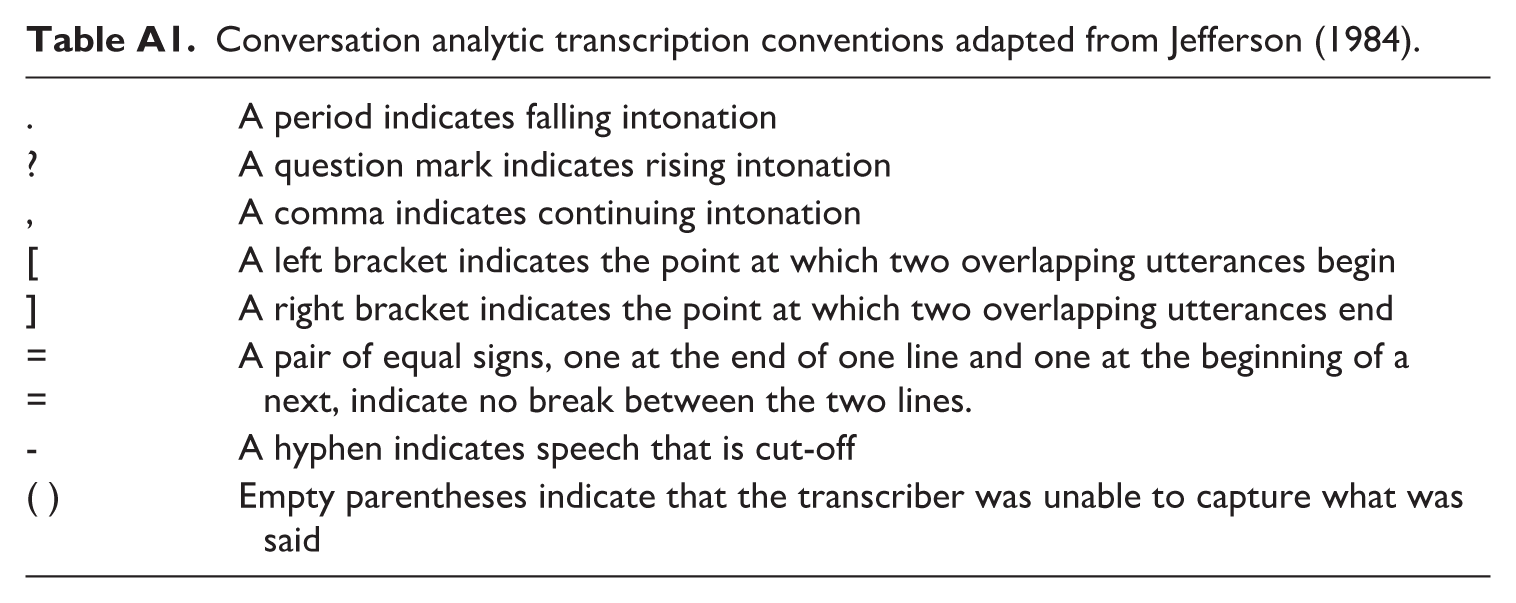
| . | A period indicates falling intonation |
| ? | A question mark indicates rising intonation |
| , | A comma indicates continuing intonation |
| [ | A left bracket indicates the point at which two overlapping utterances begin |
| ] | A right bracket indicates the point at which two overlapping utterances end |
| = = |
A pair of equal signs, one at the end of one line and one at the beginning of a next, indicate no break between the two lines. |
| - | A hyphen indicates speech that is cut-off |
| ( ) | Empty parentheses indicate that the transcriber was unable to capture what was said |

Ethical considerations
This study analyzed publicly available, archived video recordings of Senate hearings and did not involve interaction with human subjects nor the collection of private identifiable data. Institutitional Board Review approval was not required.
Consent to participate
This study analyzed publicly available, archived video recordings of Senate hearings and did not involve interaction with human subjects nor the collection of private identifiable data. Informed consent approval was not required.
Funding
The author received no financial support for the research, authorship, and/or publication of this article.
Declaration of conflicting interests
The author declared no potential conflicts of interest with respect to the research, authorship, and/or publication of this article.