






Abstract
Shadow education, particularly private supplementary tutoring, has become a prominent feature of competitive, high-stakes schooling systems. Situated within Singapore’s meritocratic educational context, where educational success is seen as the product of strategic planning, this article examines the semiotic landscape of a shopping mall housing a dense concentration of tuition centres. Through an analysis of tuition-related signage emplaced across corridors, storefronts, glass railings, lift-lobby areas, and escalator balustrades, it identifies four salient discursive framings: credentialized achievement, anticipatory preparedness, aspirational trajectories of learning, and competitive differentiation. The analysis shows how these framings are realized through linguistic, visual, and spatial modalities, and how they derive their force through visibility, emplacement, recurrence, accretion, and situated encounters within the mall’s publicly accessible spaces. The article argues that this semiotic landscape functions as an affective infrastructure, orienting parents, students, and visitors towards particular understandings of shadow education while normalizing neoliberal meritocratic rationalities in everyday commercial space.
Keywords
Introduction
Singapore’s education system is often characterized as competitive, meritocratic, and intensely performance-oriented. A longstanding regime of high-stakes national examinations sorts students into differentiated educational pathways, with implications for longer-term socioeconomic prospects. Such a system rests on a belief in meritocracy, broadly understood as the allocation of rewards and advancement on the basis of merit, and long espoused by the Singapore state as fair and necessary (Cheang and Choy, 2024; Mulligan, 2023; Tan, 2008). Nonetheless, such narratives obscure the reality of uneven starting points and the effects that family wealth and resources have on children and their educational and future success (Tan and Tan, 2016). In such a context, the pursuit of educational advantage does not only take place within the formal schooling system, but also through supplementary forms of educational intervention that allow families to secure competitive advantage beyond the classroom.
These tensions have become increasingly visible as private supplementary tuition – commonly referred to as ‘shadow education’ (Bray, 2009) – has expanded well beyond its earlier association with remediation for struggling students. Indeed, Singapore – long dubbed a ‘tuition nation’ (see e.g. Teng, 2015; Toh, 2008) – is home to one of the world’s fastest growing shadow education industries, providing private tutoring services to 80% and 60% of primary and secondary school students respectively in 2015 (Davie, 2015). The number of registered tuition centres has climbed steadily from 700 in 2012 to over 1300 in 2021 (Goransson, 2021; Ng, 2016), representing an increase of more than 85% in just under 10 years. Consequently, private tuition is now widely seen as a key and routinized strategy for managing academic risk, success, and failure, and for maintaining competitive advantage across a broad socioeconomic spectrum, with Singaporean households cumulatively spending S$1.8 billion (USD1.35 billion) on private tuition in 2023, a figure that outpaces household income growth (Zalizan, 2025).
Such developments can be understood as part of a broader neoliberal restructuring of education, in which academic performance is framed as something parents and students are expected to actively take charge of and manage. Educational pathways are seen as high-stakes, future-oriented projects requiring planning, monitoring, and strategic investment, while success and failure are framed as the result of strategic individual and familial decisions (or lack thereof) rather than a corollary of wider social and institutional factors such as structural inequality (Brown, 1990; Ong, 2006; Tan, 2008). In this environment, educational risk is not eliminated but redistributed. Households are expected to anticipate, mitigate, and hedge against risk and potential failure, and strategic planning and investment become moral imperatives. Private tuition centres operate within and benefit from this distribution of responsibility. With private tutoring positioned as a solution to uncertainty and potential failure, these providers offer a means through which parents exercise foresight and diligence within a competitive system, translating moralized responsibilities into purchasable services and solutions for their children.
While much research on shadow education has examined its growth, regulation, household participation, and socioeconomic effects (see e.g. Bray, 2009; Christensen and Tan, 2025; Entrich and Lauterbach, 2021), less attention has been given to the discursive and semiotic mechanisms in and through which the tuition industry legitimizes itself and mobilizes parental and student engagement in everyday settings (but see Teo and Koh, 2024). This issue is especially salient because tuition services involve what are known as credence attributes, given that the quality of tuition services and their influence on student achievement cannot be reliably assessed prior to or even after consumption of the service (see e.g. Dulleck et al., 2011; Zeithaml et al., 2024). Communicative labour therefore becomes central to how the industry operates and thrives: providers must render tuition value visible, credible, and affectively compelling while enacting qualities such as expertise and effectiveness and reducing perceptions of uncertain or substandard service provision in a saturated market.
This paper focuses on such processes of semiotic enactment specifically in the spatial context, by way of examining the semiotic landscape of what we will call SM, a shopping mall in Singapore that positions itself as a ‘learning hub’ and houses a dense cluster of tuition and enrichment centres. The mall’s public spaces and thoroughfares – corridors, atrium, escalator and lift lobbies, walkways, storefronts, railings, and glass surfaces – are suffused with tuition-related posters, banners, decals, and other signage produced by and/or aligned with tuition providers, which frame tuition in particular ways that aim to appeal to parents, students, and other consumers. The analytic relevance of the landscape lies in how the public visibility, recurrence, and accretion of such signage turn tuition-related claims into ambient, site-based cues. Even where comparable claims may circulate through websites or other provider-controlled channels, their emplacement and accumulation across the mall’s surfaces and circulation spaces change how they operate: they are encountered as part of the ordinary use and occupation of commercial space, rather than as messages sought out through a provider’s own channels. Taking affect as a socially organized and discursively mediated dimension of social life (Wee, 2016; Wetherell, 2012), the paper investigates how the emplaced discourse constitutes an affective infrastructure that orients parents, students, and visitors towards particular socio-affective understandings of private tuition in ways that legitimate the industry and what it offers. The analysis approaches the signage as public discourse through which neoliberal meritocratic rationalities are materially and semiotically lodged in everyday commercial space.
Shadow education, meritocracy, and neoliberal governance
The expansion of private supplementary tuition in Singapore must be situated within broader debates on shadow education, meritocracy, and the governance of education. Across diverse national contexts, shadow education has shifted from a marginal or remedial supplement to a deeply embedded feature of competitive national education systems (Bray, 2009, 2024). In such systems, high-stakes examinations that perform a sorting role form part of an educational regime within which one’s performance is widely viewed as decisive for one’s progression, access to opportunities, and future success or failure. Shadow education emerges here as a market response to the anxieties such systems generate among parents and students, even as it is implicated in reproducing the educational hierarchies and competitive logics that render private tuition intelligible and desirable. This dynamic is especially pronounced in (East) Asian societies such as Singapore, where intense educational competition intersects with deeply entrenched pro-educational attitudes and social and cultural investments in schooling and credentialled advancement (Marginson, 2011). In such contexts, shadow education is a highly salient feature across the urban landscape, and tuition providers are often accepted – grudgingly or otherwise – as part of everyday educational experience and social life (Bray et al., 2013; Silova et al., 2006; Yamato and Zhang, 2017).
In Singapore, such attitudes are undergirded by an official discourse of meritocracy that remains politically entrenched and foundational to the public justification of educational competition. Cheang and Choy (2024; see also Ong, 2006: 177–194; Tan, 2008) argue that meritocracy has become a key ideological resource actively cultivated to shape a deferential citizenry acquiescent to state hegemony and technocratic leadership as the natural outcomes of a system that enables ‘the best’ to be elevated, and to encourage citizens to prioritize developmental goals over liberal-democratic forms of contestation. Indeed, the meritocratic system is continually defended by key state actors as the best system available, and that there is no ‘better set of organising principles’ for Singapore; it is also presented as central to the city-state’s social compact, allowing people to be recognized and progress on the basis of merit, ability, and achievement rather than ‘birth rights, family connections or inherited wealth’ (see e.g. Chan, 2023; Ong, 2019).
Yet, this is also where the tensions inherent to Singapore’s meritocracy and the educational regime it engenders lie. The putatively meritocratic allocation of rewards operates under unequal conditions of family resources and opportunity, and children do not enter the system with the same access to strategic support or intervention. Private tutoring is one of the main mechanisms through which this intergenerational transfer of advantage is enacted, as parents with means engage in the strategic acquisition of educational resources and opportunities for their children. The results of the 2024 Household Expenditure Survey are particularly revealing here, indicating that the top 20% of Singaporean households by income outspent the bottom 20% on private tuition by more than four times (Christensen and Tan, 2025). The ‘parentocracy’ that is operational here – where parents’ socioeconomic capital wields a disproportionate effect relative to the child’s own efforts and abilities on the latter’s educational outcomes – is closely intertwined with a high-stakes educational arms race that reproduces educational and social inequalities (Brown, 1990; Entrich and Lauterbach, 2021), thereby straining the much-vaunted claim of meritocracy as fair and just in Singapore (Gee, 2012; Tan, 2017). As differential access to supplementary resources mediates educational outcomes, private tuition comes to occupy an ambivalent position, regarded as a rational response to systemic pressures even as it is simultaneously decried for exacerbating the anxieties that students and their parents already experience in an intensely competitive system and contributing to the consolidation of advantage for those with the wherewithal (Tan, 2017; Tan and Tan, 2016).
This ambivalence points to a broader ideological context in which the strategic management of educational pressure has come to be regarded as rational and necessary. The continued growth of the shadow education industry is one sign of how neoliberal orthodoxy has taken hold, as citizens in a welfare-averse society imbibe the valorized ethos of self-reliance, in a system where uncertainty is recontextualized as opportunity, and socioeconomic underachievement as a moral failing (Teo, 2012). Rather than provoking greater interrogation of an intensely competitive, examinations-based system in which people compete under unequal conditions, the promise of rewards and success is held out through the responsibilization of families as active managers of their children’s educational, and hence socioeconomic, trajectories and futures (Ong, 2006; Rose, 1999). Within such an environment, supplementary tuition appears less an anomaly than a routine extension of competitive schooling. Its prominence in commercial spaces signals the degree to which this private provision has been normalized and accepted. What warrants closer attention, then, is not so much its growth, but the ways in which private tuition and the affective-semiotic orientations it leverages and valorizes are enacted, normalized, and made persuasive in everyday settings.
Affect and semiotic governance in everyday commercial space
Critical research has long been concerned with the ways in which language and other semiotic resources contribute to the reproduction of ideological formations and social hierarchies. More recent work has drawn attention to the affective dimensions of such processes, arguing that affect is not reducible to private emotional states but is socially organized and patterned (Ng, 2019; Wee, 2016; Wetherell, 2012); affect here concerns not only feeling, but socially and institutionally shaped evaluative-dispositional orientations through which people come to perceive, judge, and respond to particular objects, values, practices and domains of life. In this view, governance of public life does not operate solely through formal regulation or policy mechanisms, but importantly, through the shaping of such orientations in social life and everyday practices.
Wee’s (2016) notion of affective regimes is useful here, since it directs attention to the conditions under which particular affective dispositions are made appropriate and legitimate, while others are marginalized. In linguistic landscapes and other public semiotic environments, affective regimes are discursively enacted through recurrent lexical choices, visual motifs, ideational tropes, evaluative framings, and spatial arrangements to steer discourse recipients in particular affective directions (Ng, 2019; Wee, 2016; see also Jaworski and Thurlow, 2010). These do not dictate individual feeling or cognition, nor are they deterministic. Rather, they shape the conditions under which particular affective orientations become socially available and normatively endorsed, gradually taking shape as contextually appropriate models of subjectivity. Semiotic landscapes can thus function as affective infrastructures, cultivating particular ‘affective communities’ characterized by particular sensibilities, attachments, dispositions, and practices within a given site (Wetherell, 2012).
The semiotic landscape of SM provides a concentrated site and case study for examining this process. Tuition-related messages are not encountered as isolated textual events. They suffuse the spatial context, recurring across corridors, glass railings, escalator panels, lift lobbies, storefronts, and other material spaces, in the form of signs, banners, decals, and other texts, accreting along common routes of circulation and navigation and in spaces where visitors may pause or linger. As a commercial environment densely populated by tuition centres, SM is a site in which tuition providers repeatedly and purposefully communicate with parents, students, and other users of the space through emplaced discourse. Such environments are also not encountered only in passing; students, parents, and caregivers may spend sustained periods of time there before, after, or between tuition classes, extending the duration and repetition of semiotic exposure, while even casual shoppers or passers-by are drawn into the same visual field.
The density of such emplacement is analytically consequential. Attention to these patterns of encounter resonates with geosemiotic approaches to the study of discourses in place, emphasizing how the meaning of signs is shaped by placement within the material environment as well as by situated encounters in the course of everyday movement, pause, and occupation of space (Scollon and Scollon, 2003). Through repetition and spatial proximity, these messages and meanings begin to function less as discrete promotional or brand claims than as an assemblage of ambient cues shaping affective orientations in ways that are deemed to be educationally optimal. Affective governance here is enacted not so much through direct injunction or prescription, but the gradual alignment of parent/student/visitor subjectivity with the valorized aptitudes, attitudes, and dispositions that inhere in the discourses assembled in place through the linguistic, visual, and multimodal emplacements in the semiotic environment.
By foregrounding emplacement and affect, the analysis in this paper extends linguistic landscape research beyond its conventional focus on multilingual display or symbolic identity (see e.g. Landry and Bourhis, 1997; Shohamy and Gorter, 2009). The semiotic landscape approach adopted here recognizes that the tuition discourse is realized not only through written language, but in conjunction with visual design, spatial arrangement, material surfaces, and routine forms of situated encounter within the mall (Gorter and Cenoz, 2024). Signs are treated not merely as representational artefacts, but as infrastructural; they contribute to the production of an atmosphere in which certain affective-semiotic orientations are rendered more fitting, sensible, and desirable than others. Particularly in the present context, where private tuition seeks continual legitimation, the affective dispositions so valorized and naturalized are those that support the pursuit and purchase of private tuition in the interest of educational and socioeconomic goals. The analysis that follows examines how such processes are enacted in and through the linguistic, visual, and spatial modalities embedded in everyday commercial space as represented by the semiotic landscape of SM.
Site and methodology
The study draws on data collected at SM, a five-storey shopping mall located in Singapore’s central region (the 30-storey office tower that is part of the building complex is excluded for the analysis). It has long positioned itself as a ‘learning hub’ which accommodates a high concentration of tuition and enrichment providers, with about 15 centres within a mall area of just over 18,000 m2. While family-oriented retail, food, and entertainment options are found alongside these educational establishments, shadow education appears to be the mall’s primary organizing logic, with many of the fashion and lifestyle retail outlets, for instance, catering to the child- and student-oriented visitor profile (e.g. H&M Kids and Cotton On Kids). The mall also houses several of Singapore’s most established tuition service providers, with at least one occupying space across three floors.
Found in one of the most densely developed parts of the city-state, SM is situated in a district characterized by high residential property values and a large number of private housing developments. The wider central zone also includes several established and competitive schools, and residential geography in this part of the city has long been tied to school reputation and selective progression pathways. Educational aspiration is widely distributed across Singapore; however, in central districts like these, the closer intersection of economic capital and elite schooling circuits reinforces and spatially anchors the pursuit of educational achievement and socioeconomic mobility. SM is therefore approached here as a site that instantiates the socio-educational dynamics observable across Singapore in heightened form. Its clustering of tuition and enrichment service providers within a single commercial space renders these dynamics and their associated affective-semiotic enactments particularly palpable, enabling closer examination of how supplementary education is semiotically configured and encountered in everyday urban space.
The dataset consists of photographic records of publicly visible tuition-related signage displayed within the mall’s shared circulation spaces. Data were collected during five site visits over a 6-month period (September 2025 to March 2026), during which all publicly accessible retail levels were systematically walked. Consisting of about 120 photographs, the dataset records signage routinely encountered along the main spaces of emplacement and movement, such as corridors, escalator and lift lobbies, glass railings, and storefront exteriors. Interior classroom materials, transient handouts within units, and textual content accessible only online were excluded, as the focus of the study is on the emplaced discourse that constitutes the mall’s visible spatial environment. In keeping with this focus, the analysis is concerned with recurrent landscape-level patterns rather than systematic comparisons among individual providers. While tuition providers may differ in clientele, pedagogical positioning, brand identity, and discursive framing of private tutoring, signs produced by or associated with specific providers are discussed here as instances of wider landscape-level patterns rather than as the basis for provider-by-provider comparison.
The selection of materials is guided by emplacement and prominence principles, with particular attention paid to signage formats that occupy transitional zones and structure pedestrian attention, including window-display notices, glass-balustrade decals, corridor-facing posters, and escalator-side panels. These formats are difficult to avoid and recur across circulation routes and spaces where visitors may pause or linger, shaping the visual field within which visitors move and spend time. The analysis is qualitative and focuses on three interrelated dimensions. First, drawing on geosemiotic approaches to discourses in place, it treats signs as emplaced discourse by examining where they are positioned, how they face or address viewers, and how they are encountered in the mall’s corridors, thresholds, railing and escalator areas, and other publicly accessible spaces as visitors move, pause, or linger (Scollon and Scollon, 2003). Second, it examines multimodal social-semiotic features such as typography, visual salience, layout, gaze, and relations between written and visual elements (Kress and van Leeuwen, 2021). Third, it attends to discourse-analytic features such as lexical choice, evaluative language, presupposition, metaphor, comparison, and subject positioning. These dimensions are considered in tandem across the analysis, allowing particular signs to be examined as contributing to a wider affective-semiotic infrastructural assemblage rather than as isolated promotional texts.
Analysis
Across the tuition-related signage in SM, a number of recurring patterns can be observed in how supplementary education is framed and given prominence within the mall. Four discursive framings are salient: credentialized achievement, anticipatory preparedness, aspirational trajectories of learning, and competitive differentiation. Although the following analysis examines particular signs in turn, these framings are treated not as specific to individual signs, but as recurrent patterns that take shape across the mall’s visual and spatial environment. The sections that follow examine how these framings are realized through linguistic formulation, visual design, material emplacement, and situated encounter within the mall’s publicly accessible spaces.
Credentialized achievement
A prominent strategy in the emplaced texts is the indexing of tuition quality through legible markers of authority and performance, as proxies for what cannot be directly and reliably evaluated in advance given the credence attributes of tuition services. Within the mall’s publicly accessible environment, tuition providers address this uncertainty through condensed markers of credibility, including institutional affiliation, collective endorsement, and performance metrics. The significance of these markers is also shaped by their placement on storefront façades, glass railings, and other visible surfaces, where they enter the mall’s wider field of educational evaluation.
One such marker is institutional credentialization – that is, drawing on affiliations with prestigious institutions, and by extension their symbolic capital, to confer legitimacy on commercial actors. In Figure 1, for instance, Founded by former RJC Lecturer (together with the founder’s name) appears as a compact credential line beneath the large brand name THE PHYSICS CAFE. The formulation is terse and unelaborated, assuming shared recognition of what ‘RJC’ (Raffles Junior College) indexes in Singapore’s educational hierarchy – recognition that, where it occurs, also produces a sense of shared connection between the brand/provider and its intended clientele, as both draw on the same educational-cultural knowledge. Historically associated with elite junior college placement and A-Level trajectories in Singapore, RJC was folded into Raffles Institution’s (RI) broader brand architecture after the merger of the two affiliated schools in 2009 to form an elite Integrated Programme (IP) school catering to those placed in the top 10% of each primary school graduating cohort. The credential tapped by the tuition provider hence functions as a semiotic shorthand that recontextualizes institutional prestige as market expertise and authority in the private tuition landscape.

Sign on storefront façade.
Materially, this credential line is positioned prominently on the storefront façade, where it is made visible before visitors cross the threshold of the centre or encounter the service within. Well-lit and further accentuated by spotlights, the sign is readable from the corridor and projects elite-school affiliation outwards into the mall’s publicly accessible space. By foregrounding ‘borrowed’ institutional authority and expertise at this threshold, the credential line operates at the interface between the tuition centre’s frontage and the mall’s shared corridor space, addressing not only those approaching the unit, but also visitors who pass or pause nearby.
Another way that credentialized achievement is conveyed is through invoking social validation and longevity. Figure 2 shows a glass-railing decal that declares the service provider as PARENTS’ TOP CHOICE SINCE 2010. The possessive PARENTS’ performs important discursive work, interpellating the relevant evaluative community and rhetorically presupposing that judgement has been collectively made by the community. The phrase since 2010 frames the parental preference as durable, indexing continuous endorsement rather than short-lived validation. Visually, the claim is given high salience; large uppercase lettering sits within a relatively clean and uncluttered layout to maximize attention, accompanied by a cartoon-style drawing of what is likely to represent a student looking directly at the passerby. As the visual equivalent of the direct address, the direct gaze helps to construct (pseudo-)relations between the represented student and viewer (Kress and van Leeuwen, 2021: 115–117), with the cartoon figure depicted as speaking into a microphone as if to announce and echo the endorsement as a satisfied student-customer of the tuition centre. Emplaced on a glass railing beside the lift doors, the sign is not confined to the provider’s storefront but extends the endorsement claim into a lift-lobby visual field, making it part of the mall’s ambient visual environment for visitors passing, pausing, or waiting nearby.
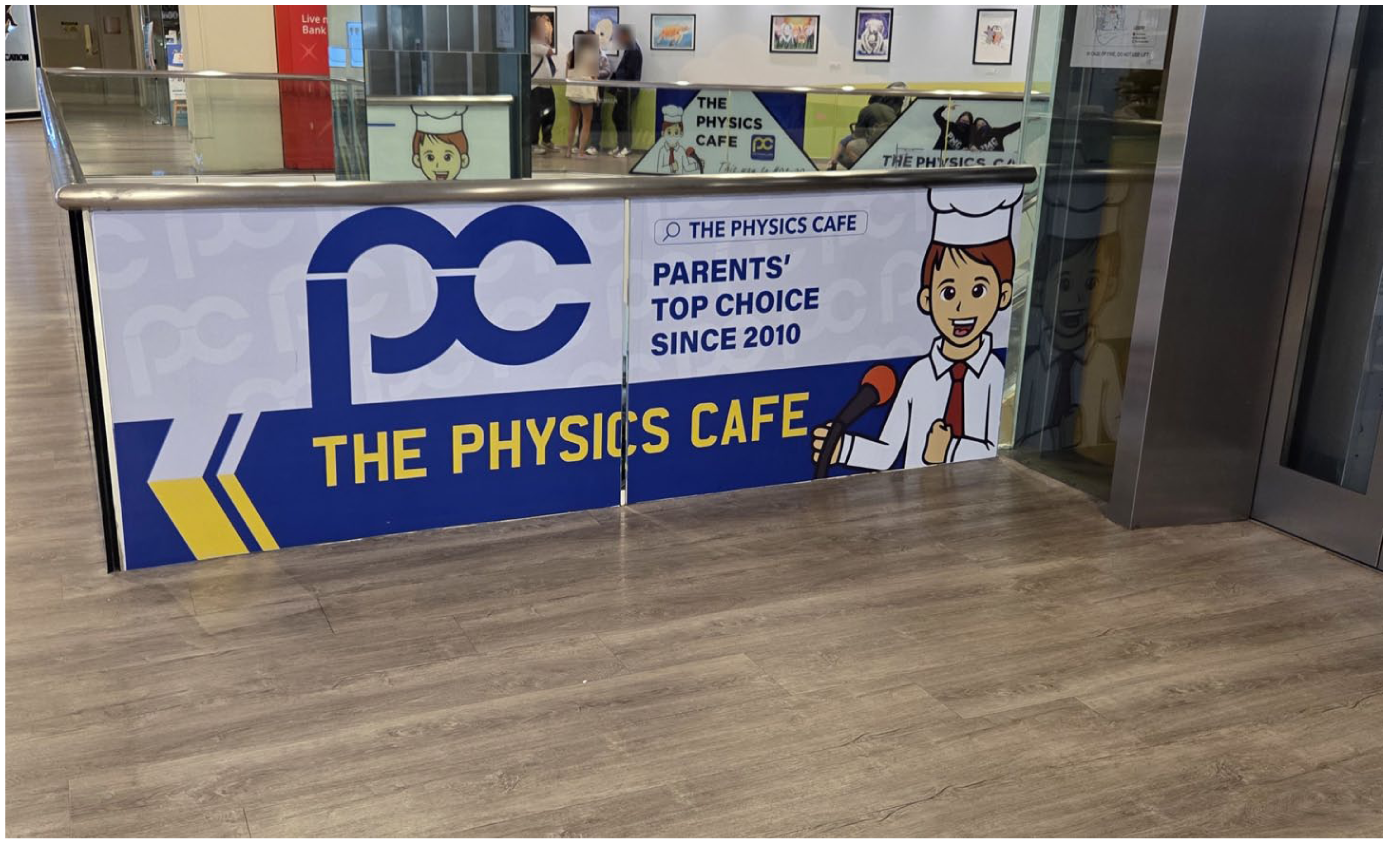
Glass-railing decal beside lift doors.
The third and perhaps most explicit way of enacting credentialized achievement is in the form of metric display. In Figure 3, the text proclaims %A DOUBLED THE NATIONAL AVERAGE, foregrounding a numerical claim that compresses educational value into a single proxy indicator. The language is economical and emphatic: DOUBLED is a high-impact verb, and NATIONAL AVERAGE invokes an external benchmark against which performance is measured and, in this case, exceeded. The claim is then visually underwritten through a strip of media logos (AS FEATURED ON), which adds a second layer of legitimacy by referencing coverage and recognition in public media. As with the earlier example, this sign is also a railing decal, projecting the provider’s performance claim beyond the storefront into the mall’s publicly accessible visual field. Positioned along a circulation route, the numerical claim is designed to register quickly, while its continued visibility contributes to an ambient environment in which tuition quality is made assessable through performance metrics and benchmarked outcomes.
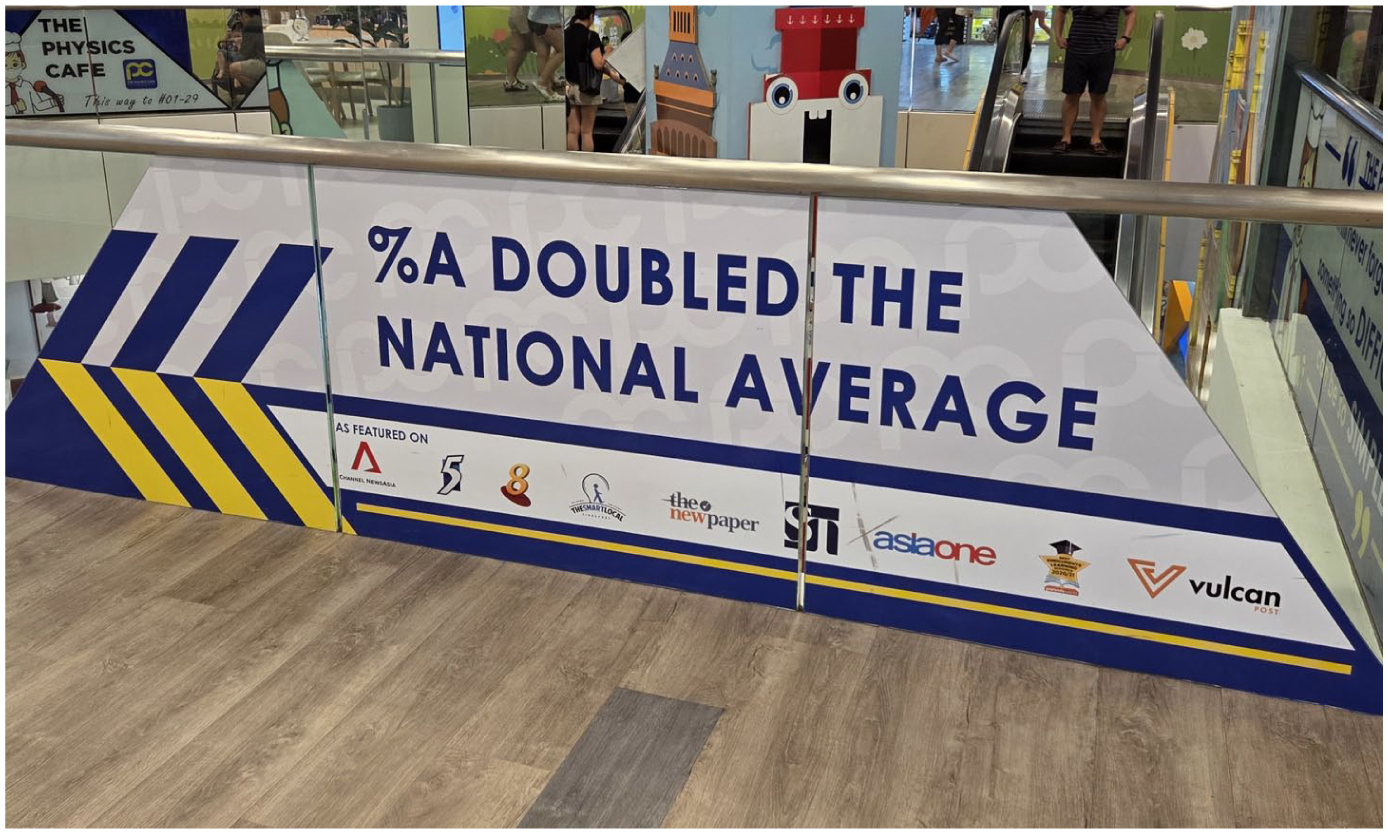
Glass-railing decal.
Across these examples, the emphasis is not so much on pedagogical process but proxies for quality: elite affiliation, collective endorsement, durability, and metric results. In a market where outcomes are difficult to assess in advance, these signs provide parents and students with condensed points of evaluation. Educational value is made measurable, comparable, and socially validated through a small repertoire of recognizable markers. At the same time, these markers are spatially distributed rather than confined to informational materials inside tuition centres. The storefront credential, lift-lobby endorsement, and railing-based performance metric appear on highly visible surfaces within the mall’s shared visual field, where they can be apprehended at approach, in passing, or during brief moments of pause. They therefore help shape the mall as an environment in which tuition quality is repeatedly rendered visible through signs of prestige, endorsement, and measured achievement. Through this repetition, credentialized achievement becomes part of the site’s affective-semiotic infrastructure, valorizing an evaluative orientation in which responsible educational choice is tied to the recognition of institutional authority, social endorsement, and benchmarked success.
These effects are supported by compact discursive structures that compress complex evaluations into short, highly legible formulations. Institutional authority is invoked through compressed attributional formulations (e.g. Founded by former RJC lecturer), which foreground affiliation while backgrounding the commercial actor. Collective endorsement is realized through nominal preference claims (e.g. PARENTS’ TOP CHOICE), presenting individual parental choices as settled social judgements rather than contestable evaluations. Durability is indexed through temporal anchoring (SINCE 2010), while achievement is constructed through metric statements (%A DOUBLED THE NATIONAL AVERAGE) that frame educational success through comparative-competitive benchmarking. These linguistic structures allow claims about pedagogical and service effectiveness to be made indirectly using compact evaluative signals, while their emplacement on façades, railings, and other surfaces gives these signals a public and recurrent presence within the mall.
Anticipatory preparedness
A second pattern positions tuition participation around advance timing, early enrolment, and the management of anticipated academic demands. Rather than presenting tuition classes simply as available services, such signs direct attention to timelines, registration windows, access categories, and trial opportunities. In Figure 4 (captured in the latter half of 2025), for instance, the signboard stands on an easel along the centre’s exterior wall, near the entrance. This freestanding format gives the notice the character of a current announcement rather than a fixed brand display, projecting the registration timetable outwards into the corridor-facing environment with a sense of currency and immediacy. The headline 2026 REGISTRATION immediately shifts the temporal frame forward, directing attention to the next academic cycle rather than the present moment. Beneath it, enrolment is structured through labelled categories such as ANNUAL REGISTRATION and PRIORITY REGISTRATION, each associated with specific dates. Such formulations appropriate the routine administrative register of institutional scheduling, presenting enrolment information in the matter-of-fact style of institutional notices, thereby normalizing participation as a procedural step within the strategic management of educational futures.
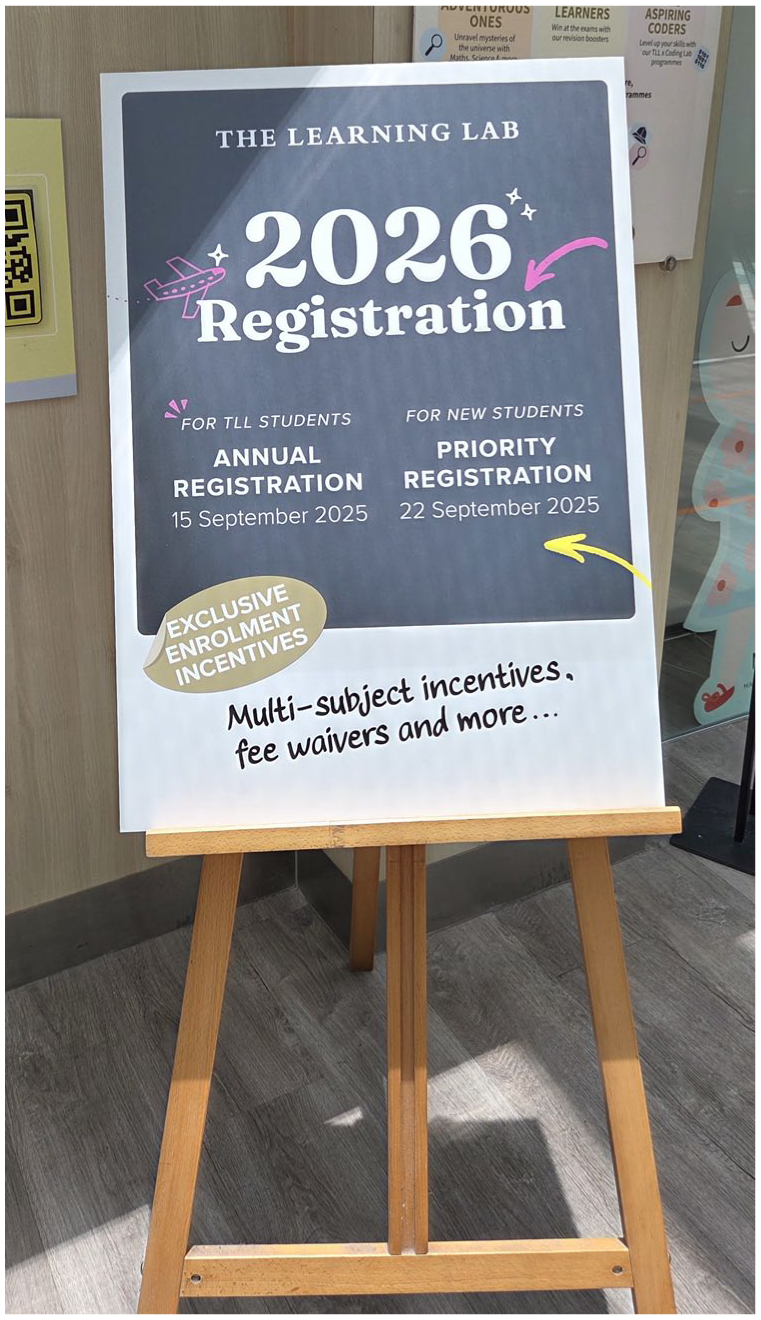
Signboard on easel.
The discursive effect of such formulations lies in how they recast a commercial service on offer as a scheduled, seemingly necessary, and unremarkable form of educational participation. Temporal anchoring (2026) projects the relevant decision into the future, while access categories such as PRIORITY REGISTRATION introduce an implicit hierarchy between those who act early and those who do not. The presence of tiered registration windows suggests that timely action carries advantages, thereby encouraging prospective customers to treat enrolment as something to be secured rather than merely considered. This administrative framing, however, is not purely procedural. The text also includes a promotional hook – EXCLUSIVE ENROLMENT INCENTIVES and Multi-subject incentives, fee waivers and more. . . – positioned below the registration categories and dates. Rather than interrupting the timetable logic, these incentives reinforce it, attaching immediate rewards to early enrolment and aligning prudent planning with tangible benefits.
Visually, the information is arranged into clearly separate blocks that allow dates and categories to be scanned quickly. The graphic layout resembles the formatting of institutional notices or administrative announcements, which again lends the information an appearance of procedural legitimacy. Together, the temporal anchoring, administrative register, incentive framing, and structured layout present early enrolment – and, by extension, prompt participation in supplementary tuition – as both sensible and advantageous within a forward-looking logic of educational management. Emplaced near the entrance and facing the corridor, the signboard makes the registration timetable part of the mall’s corridor-facing informational environment, presenting tuition enrolment and participation as something to be strategically planned for and secured early rather than deferred.
A related formulation appears in Figure 5, which advertises a 1-Week Trial Programme. Linguistically, the headline combines a bounded temporal unit (1-week) with the noun trial, which frames participation as a provisional testing period during which the service may be strategically evaluated before any longer-term commitment. The sign also includes a scarcity cue (LIMITED-TIME ONLY), which places the opportunity itself within a restricted time frame. This combination encourages timely response, since participation appears easy to initiate, but the chance to do so is fleeting. Although physically inside the tuition centre, the sign stands just behind a glass wall and faces outward towards the corridor, projecting the trial offer into the mall’s corridor-facing informational environment rather than keeping it within the service interior. The anticipatory orientation is therefore semiotically staged through a correspondence between temporal advance and spatial pre-entry visibility. The bounded trial period and scarcity cue configure enrolment as a low-risk action whose value depends on timely response, while the sign’s outward-facing emplacement makes this first step visible at the edge of the service space, before any fuller enquiry, entry, or commitment takes place. In multimodal terms, temporal wording and spatial placement work together to frame and encourage early engagement with supplementary tuition as prudent anticipatory conduct. Such linguistic, visual, and spatial semiotizations, in concert, construct and privilege an idealized anticipatory subjectivity in which the strategic management of educational trajectories is expressed through early assessment, timely action, and the securing of opportunity while it remains available.
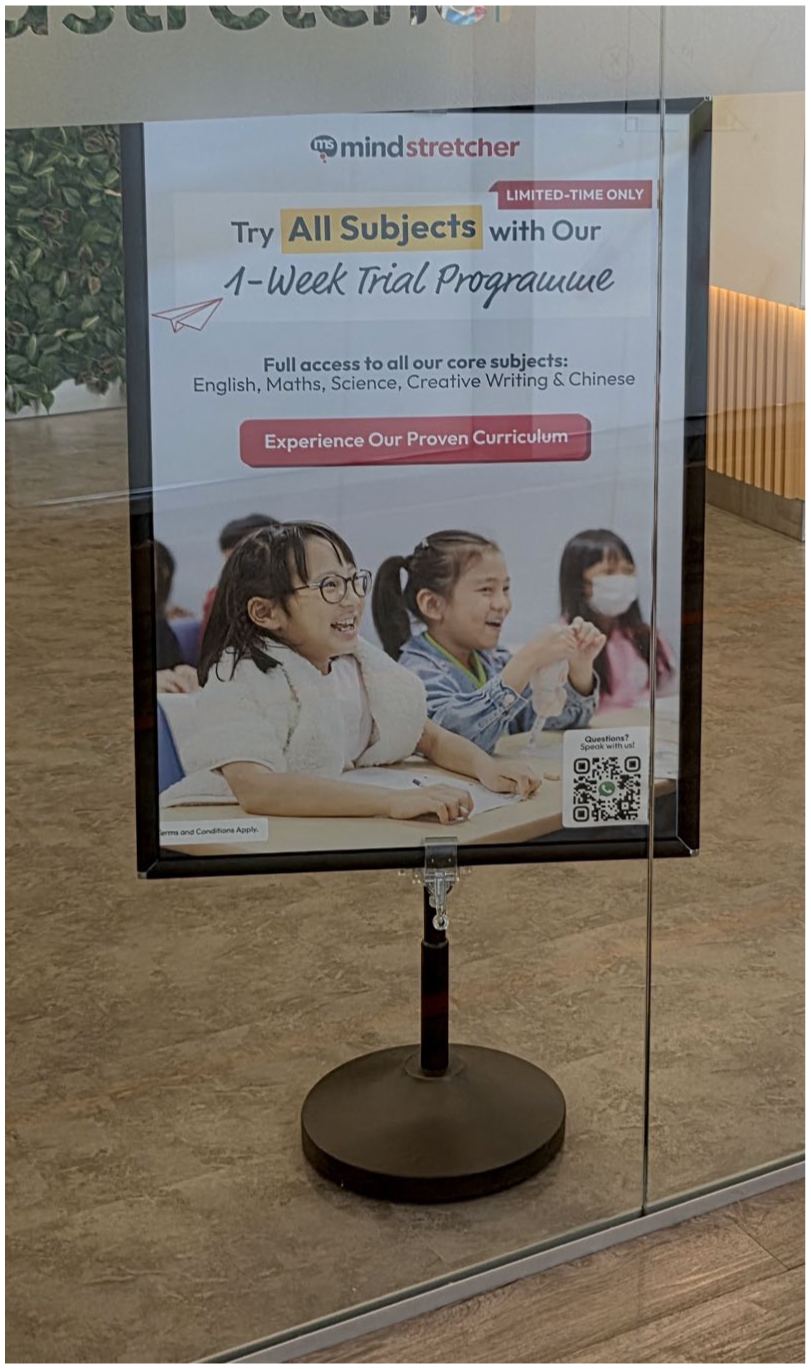
Sign standing just behind glass wall.
Aspirational trajectories of learning
A third pattern observed in the emplaced texts situates tuition within a broader trajectory of intellectual development, invoking aspirational educational ideals and dispositions such as curiosity, a spirit of exploration, and leadership. Figures 6 to 8 show part of a series of corridor-facing panels organized around the recurring linguistic structure Let’s + verb as headings: Let’s Lead, Let’s Solve, Let’s Explore, Let’s Think, and Let’s Achieve. These statements take the form of exhortative constructions using the inclusive first-person plural imperative let’s (let us). The formulation positions the reader within a shared undertaking, aligning students, parents, and the provider within the same project, and the various parties as collaborators and co-participants rather than the tuition provider instructing students. The learner is therefore interpellated as someone already participating on a collective journey of intellectual progress.

Corridor-facing panels.

Corridor-facing panel (Let’s Explore).

Corridor-facing panel (Let’s Solve).
At the lexical level, the verbs form a chain revolving around cognitive activity and advancement. Think, Explore, and Solve foreground intellectual activity, while Achieve and Lead point towards the outcomes of accomplishment, status, and authority, resulting in a sequence that links acts of learning with the aspirational outcomes and markers of success. Rather than presenting tuition narrowly in terms of examination preparation, the discourse associates it with the cultivation of desirable learner dispositions, such as analytical capacity, curiosity, and leadership abilities, situating tuition participation within a broader aspirational narrative about personal development and (future) accomplishment. Such a discursive pattern resonates with widely circulating ways of conceptualizing education in terms of movement and advancement. Cognitive approaches to metaphor have noted how educational processes are frequently framed using journey or path-oriented conceptualizations in which learners progress toward particular goals or destinations (see e.g. Goatly, 2007: 208; Ng, 2018a). Within such framings, learning activities correspond to stages along a developmental trajectory, while outcomes such as achievement or leadership mark points of advancement or even goals. The verbs used in these panels instantiate this logic; ‘explore’ evokes movement through a metaphorical intellectual terrain, ‘solve’ implies overcoming obstacles, and ‘lead’ signals a position ahead of others. The copy below the headings, although smaller in size, similarly supports such path-oriented conceptualizations. For example, the panels enjoin the reader to pave the path to new frontiers, explore uncharted territories, and not be discouraged by multiple hurdles, because every setback is just a step forwards in this continual process of progress and differentiation. More broadly, the discourse supports an implicitly neoliberal-oriented, teleological understanding of education, where learning is imagined as dynamic movement towards a desired endpoint associated with success and self-actualization.
This aspirational, forward-looking framing is realized not only through language but also the spatial organization of the emplaced discourse within the mall environment. The headings in the panels appear in large, prominent lettering against uncluttered backgrounds, allowing the short clausal formulations to dominate the visual field and be read instantly. Such brevity is particularly significant given the spatial conditions under which the signs are encountered. The panels line corridor-facing walls, so visitors encounter them successively in movement, or as part of the surrounding visual field when lingering nearby. Essentially, the corridor produces a spatially ordered encounter with the discourse: as viewers move along the route, the exhortations – lead, solve, explore, think, achieve – appear in succession, aligning spatial progression with the metaphorical progression of learning and achievement (cf. Scollon and Scollon, 2003: 170–171). In multimodal terms, the spatial affordances of panel emplacement and the repeated linguistic structure of the statements together frame learning as a progressive, forward-oriented endeavour.
The significance of this alignment lies in the way it situates private tuition within a broader horizon of aspiration rather than as instrumental preparation for examination success. The discourse associates tuition participation with a particular learner subjectivity that is intellectually engaged, forward-looking, and oriented towards accomplishment and leadership. Through the interaction of inclusive exhortative grammar, aspirational metaphorical conceptualizations, and spatial emplacement that shapes particular kinds of situated encounters, the signage contributes to an affective-semiotic environment in which educational participation is framed as an ongoing trajectory of self-improvement and self-actualization, with supplementary tuition represented as an aspirational, progressive endeavour.
Competitive differentiation
Tuition provision can also be represented through explicit differentiation from competing providers, with educational quality made legible through comparison across alternatives within a competitive marketplace. Figure 9 shows a prominent wall display anchored by the headline WHAT MAKES ASPIRE HUB DIFFERENT?, followed by a two-column comparison between the tuition provider and its competitors, which contrasts ASPIRE HUB EDUCATION with OTHER CENTRES. Each column contains a series of short statements describing organizational practices, teacher qualifications, and programme structure. Unlike the more condensed railing decals or corridor-facing slogans discussed earlier, this display invites a slower evaluative mode of attention: viewers are positioned to compare aligned entries, weigh differences between providers, and arrive at a supposedly informed judgement regarding relative superiority. As a publicly visible wall display, the sign turns the mall surface into a comparative field, in which tuition choice is framed as a matter of evaluating differences and discerning advantage among available alternatives.
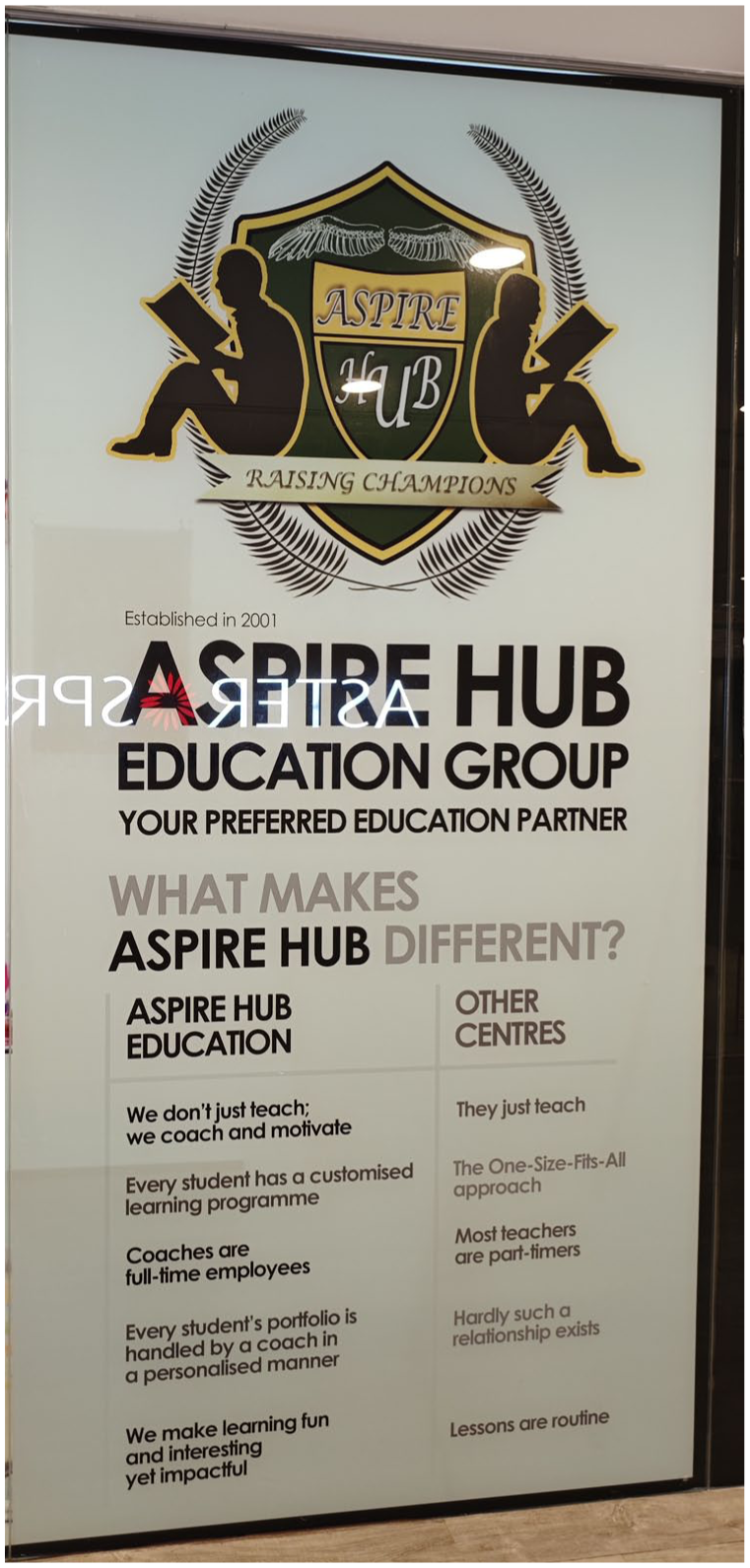
Wall display.
Such discourse relies heavily on contrastive parallelism, with pronoun choice and evaluative wording constructing asymmetrical characterizations of pedagogical practice. In the ‘ASPIRE HUB EDUCATION’ column on the left, the centre speaks in the first-person plural (we), such as We don’t just teach; we coach and motivate, while the opposing column attributes comparatively limited, and, by implication, inferior practices to a genericized competitor: They just teach. Similarly, for the centre, Every student has a customised learning programme, as opposed to the One-Size-Fits-All approach that others are said to follow, while full-time coaches are contrasted with the part-timers that others employ. These paired statements construct value relationally. Difference is presented as the basis for evaluating educational quality, through systematic differentiation from an unspecified but putatively inferior field of competitors against which the centre’s own practices appear more attentive, customized, and professionally committed.
The evaluative force of these contrasts is reinforced visually through the columnar layout. The two columns are separated spatially but aligned vertically, allowing corresponding statements to be read side by side as a sequence of contrasts. This layout invites immediate and easy comparison, setting up a series of evaluative moves that cumulatively cohere into an overall judgement of superiority and advantage for the provider. Importantly, the competing centres are never named. The category OTHER CENTRES functions as a generic adversary against which the company defines its own distinctiveness and superiority. In doing so, the display constructs the tuition industry as a competitive field composed of differentiated providers whose relative value must be assessed by prospective clients. The broader visual design and framing of the display also contribute to this competitive positioning; above the comparative statements sits the crest of the tuition company accompanied by the motto RAISING CHAMPIONS, flanked by laurel leaves and shield imagery that evoke the iconography of sporting achievement.
This symbolism resonates with another sign placed within the same spatial environment. Along the escalator balustrade (see Figure 10), a large axiomatic slogan declares that Records are meant to be broken, flanked by two confident student faces that do relational work by gazing directly at viewers. The statement draws on a sports-performance metaphor in which success is defined through surpassing previous records. Educational attainment is thus framed as the continual surpassing of performance limits. In doing so, the language here extends the trajectory metaphors observed in the previous section; if the signage discussed earlier framed learning as movement along a developmental path, the language of record-breaking intensifies this imagery and imbues the path metaphor with the competitive logic of sport and race. The breaking of records implies exceeding previous standards set by self or others, transforming the idea of educational progress into one of accelerated advancement, competitive advantage, and positional superiority.
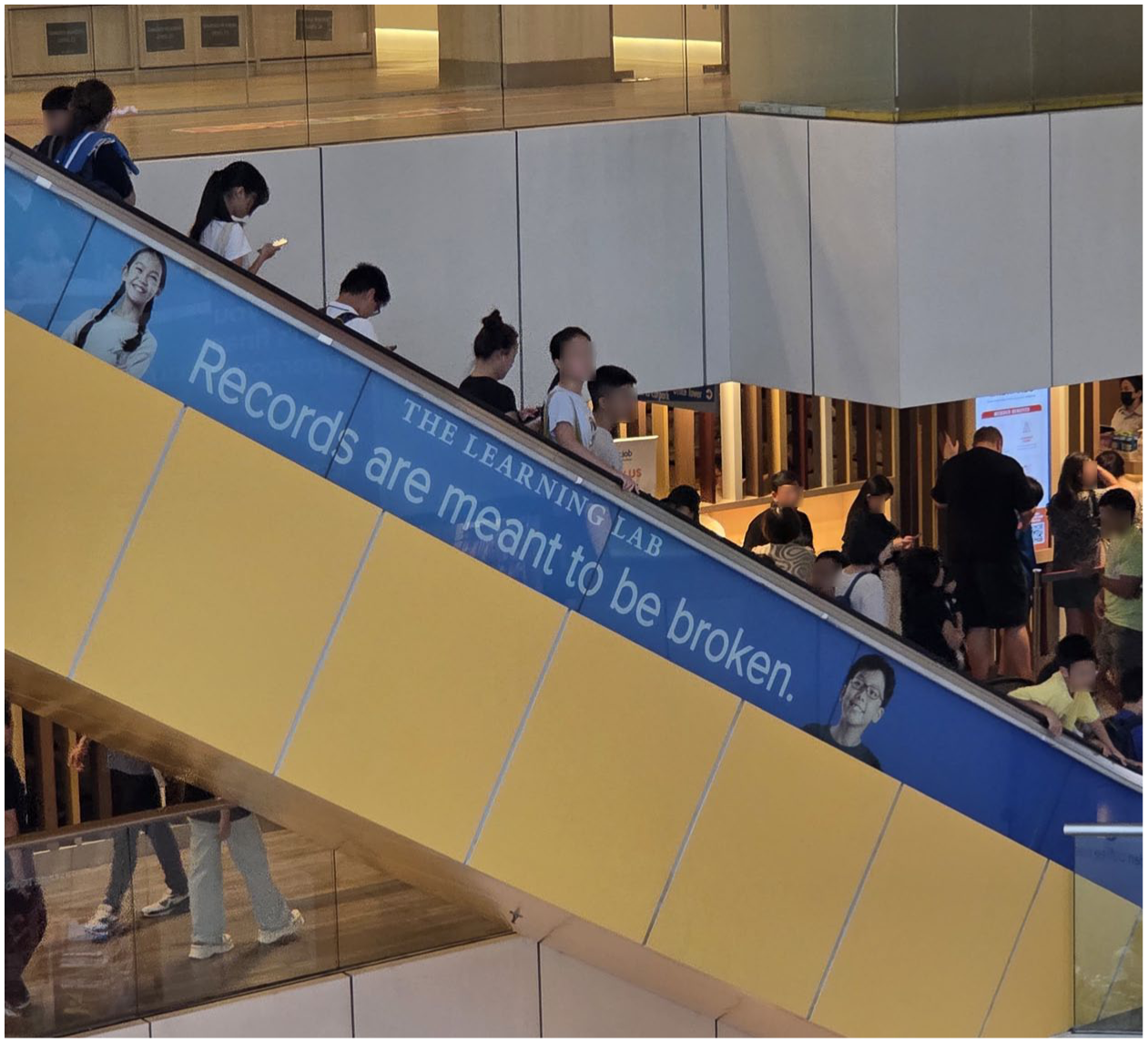
Escalator panel.
The sign’s placement along the escalator balustrade gives this competitive framing a spatial and kinetic form. The text runs diagonally along the length of the panel, producing a sloping trajectory across the viewer’s field of vision. As part of the mall’s movement infrastructure, the escalator balustrade attaches the slogan to a circulation system through which bodies are moved between levels. This spatial arrangement aligns with the record-breaking discourse: the idea of surpassing limits is stated linguistically and visually extended across a surface associated with movement, transition, and bodily circulation. Unlike signage addressed only to those riding the escalator, the text faces outward towards the open mall space, making it salient to visitors in the atrium, corridors, and other circulation areas. The valorized competitive ethos is therefore projected into the mall’s shared visual environment, where the record-breaking slogan acquires a directional and kinetic quality through its attachment to the material infrastructure of movement.
In concert, these forms of signage make competitive differentiation part of the mall’s affective-semiotic environment. The wall display solicits a relatively deliberate evaluative posture, structuring tuition choice as side-by-side comparison between providers. The escalator panel gives the competitive ethos a more dynamic form, attaching record-breaking success to the mall’s movement infrastructure. Across these formats, tuition provision is configured as a field of relative advantage, while learning itself is drawn into a logic of dynamic and relentless advancement directed towards the continual surpassing of limits. The signage orients viewers towards an evaluative disposition in which differentiation, accelerated advancement, and positional advantage are normalized as desirable educational values. It therefore contributes to an affective infrastructure in which the logic of competitiveness is made ordinary, visually salient, and materially embedded in everyday commercial space, while supplementary education is represented as a practical means of securing advantage within this competitive field.
Discussion
The analysis has shown how the emplaced tuition discourse is constituted through a recognizable set of discursive, visual, and spatial forms. Private tuition and its value are indexed through appeals to credentialized authority, benchmarked performance, and social validation. Participation in tuition is structured through registration windows, trial formats, and incentives that present early action as prudent. Learning is also cast through exhortative formulations and tropes of progression that align study with movement, both developmental and competitive, while contrastive comparison renders educational quality relationally, as something to be judged against alternatives. These patterns are not realized through textual and visual design alone, but given force through their emplacement on highly visible surfaces and circulation infrastructures: storefront façades, glass railings, lift-lobby areas, corridor-facing walls, and escalator balustrades. Across these sites, the mall’s built environment becomes part of the semiotic work, shaping how signage is read and encountered, and how evaluative, anticipatory, and aspirational orientations become available in the course of ordinary movement, pausing, and occupation of the space. In concert, this discourse constructs tuition as performance-oriented, measurable, anticipatory, competitive, and aspirational, while framing supplementary educational participation as a strategic means of monitoring, managing, and securing educational advantage.
Such semiotic patterns are therefore not confined to individual signs. Their cumulative significance and efficacy lie in their recurrence and accretion across the mall’s publicly accessible spaces, where credential claims, registration prompts, aspirational exhortations, and competitive comparisons enter the same visual and spatial field. The corridor panels are especially revealing, with their compact exhortations unfolding in sequence along a route of movement, so that spatial progression and discursive-metaphorical progression become aligned. Elsewhere, the relation between discourse and emplacement takes different forms: credentials are projected from storefront façades, endorsement and performance claims occupy railings and lift-lobby areas, registration and trial offers are made visible at the edge of service spaces, and competitive slogans are attached to movement infrastructure. These emplacements do not simply amplify already-formed messages; they are central to the onsite configuration in which educational values become ambient, recurrent, and difficult to detach from the ordinary experience of the mall as a semiotic landscape. What emerges is not the incidental presence of branding, promotional, and informational texts, but a socio-semiotic assemblage in which tuition and the affective orientations associated with it are made salient, durable, and materially embedded within the site (Pennycook, 2024: 96–97).
Within such an affective-semiotic infrastructure, the subject positions made available to parents and students are premised on self-responsibility, though tied to their different roles. Parents are interpellated as strategic and vigilant managers of their children’s advancement, risks, and futures, called upon to evaluate providers, anticipate educational needs, and intervene in timely fashion. Students are positioned as objects of parental intervention, as well as reflexive learner-subjects expected to steer their own developmental trajectories and sustain motivation, initiative, aspiration, and continual self-improvement. Such values and dispositions are aligned with the quintessential neoliberal precepts of self-steering conduct, responsibilized planning, continual improvement, and competitive differentiation (Ng, 2018b; Ong, 2006; Rose, 1999). What gives these values particular traction in the present context is their fit with an educational regime already structured by competition, metricized forms of comparison, and the need to manage risk and disadvantage. Within that setting, acting early, monitoring progress, and seeking advantage are easily moralized and readily understood as signs of diligence and responsible care. Tuition comes to appear less as an optional consumption choice than as responsible stewardship. At the same time, it serves as both solution and symptom – a means of managing competitive pressures and possible disadvantage, even as it contributes to reproducing the unequal conditions and comparative logics that make such interventions appear obligatory.
This also helps explain why private supplementation can seem so unremarkable within competitive educational settings. In the landscape analysed here, it is folded into a broader socioeconomic common sense in which trajectories should be actively managed and possible disadvantage anticipated rather than merely responded to after the fact. Meritocracy is not displaced by this logic so much as reworked through it. Tuition becomes one of the practical means through which families are called upon to navigate a competitive system, even though the capacity to do so remains unevenly distributed. What the semiotic landscape normalizes, then, is not simply tuition itself, but an affective disposition that regards private supplementation as an ordinary but strategic means of managing educational and socioeconomic advancement, risk, and disadvantage. Precisely because this strategic orientation is made to seem routine and commonsensical within the mall’s everyday visual and spatial environment, its ideological force becomes less palpable even as it remains potent.
Conclusion
This paper has argued that the tuition-related signage at SM cannot be understood as a concentration of branding, promotional, or informational discourse alone. As part of the mall’s semiotic landscape, it contributes to an affective-semiotic infrastructure through which private tuition is made intelligible as measurable, anticipatory, aspirational, competitive, and strategically necessary. Its force lies in the accretion of evaluative claims and conceptualizations, developmental exhortations, temporal cues, comparative framings, visual prominence, and material emplacement across the site, and in their patterned encounter through ordinary movement, pausing, and occupation of the mall’s publicly accessible spaces. Through this configuration, the landscape renders ordinary a mode of educational subjectivity in which advancement is to be actively managed, possible disadvantage anticipated, and timely intervention understood as prudent. Parents are responsibilized as vigilant managers of educational futures, while students are positioned as reflexive subjects of continual self-improvement. The landscape thus gives semiotic form to neoliberal values centred on self-steering conduct, competitive differentiation, and the obligation to secure one’s own advancement through strategic action in everyday urban space and social life.
Seen more broadly, the case suggests that the normalization of shadow education is sustained through more than the competitive pressures of schooling, consumer demand, or the persuasive claims of individual providers. It also takes shape in ordinary commercial environments in which strategic educational conduct is made familiar, sensible, and affectively compelling. At stake here is the cultivation of subjectivities tied to a broader neoliberal logic in which risk is individualized, advancement is responsibilized, and inequality is managed through private action rather than addressed as a structural condition. Tuition is represented as a practical means of navigating competitive pressures and possible disadvantage, even as it helps reproduce the unequal conditions and comparative logics that make such intervention appear necessary in the first place. Meritocracy remains central to this arrangement, but in a form increasingly inflected by families’ unequal capacities to anticipate, intervene, and secure advantage. Everyday semiotic environments help naturalize this configuration, embedding competitive rationalities and the inequalities they reproduce in the textures of urban life, where they are more easily lived as common sense than recognized as ideology.
Footnotes

Ethical considerations
All data were publicly displayed texts collected from publicly accessible spaces. No interaction with human subjects was involved, and no personally identifiable information is included.
Funding
The authors received no financial support for the research, authorship, and/or publication of this article.
Declaration of conflicting interests
The authors declared no potential conflicts of interest with respect to the research, authorship, and/or publication of this article.