







Abstract
Phase change materials can provide large heat storage density with low volume. But their low thermal conductivity limits their heat transfer capabilities. Since carbonaceous nanoparticles have a good thermal conductivity they can be applied as an additive to phase change materials to increase their heat transfer rate. In this study, nano-graphite is used as an additive and the influences of its various concentrations on the thermal conductivity and melting and freezing rate for the nanoparticle-enhanced phase change materials is experimentally investigated. Experimental results indicates a reduction of 22% in melting time and a reduction of 75% in solidification time of 0.5% nano-graphite-embedded phase change material.
Introduction
Energy demand is increasing worldwide due to technological advancement. Consequently, emissions containing carbon particles will increase in the coming years. If new policies would not be formulated, by the end of 2050, the carbon emissions from energy sector would increase by 61% of 2011 levels. 1 In a country like India, where the air quality index of many metropolitan cities is beyond dangerous levels, it is critical to find out a way to solve this problem. To curb these emissions, it is mandatory to make effective use of the heat energy produced by elevating the energy efficiency of heat recovery and by promoting the use of non-conventional energy sources as solar energy, wind energy, etc. 2 A very promising technique for energy storage is latent thermal energy storage (LTES) due to high energy density per unit volume. Phase change materials (PCMs) are found to be most popular method for LTES.3,4 A number of PCMs, such as salt hydrates, organic PCMs (paraffins and non-paraffins), and eutectics are available for TES systems. But PCMs suffer disadvantage such as low thermal conductivity and low melting and solidification rate. 5
Inorganic PCMs possess the advantages of non-flammability, high heat storage capacity, constant phase transition temperature, etc.
Salt hydrates are promising materials for use in LTES systems as they possess the advantage of relatively high thermal conductivity, relatively high density of volumetric storage, and cheaper than paraffin waxes, with few exceptions. These properties render inorganic PCMs more acceptable and safer to use in LTES application than organic PCMs. In inorganic PCMs, most researchers have studied the CaCl2·6H2O and MgCl2·6H2O PCM system results because of their high availability, low cost, and high LTES performance.
As obtained by El-Sebaii et al., 6 for latent heat storage purposes, MgCl2·6H2O possess stable thermal properties. Magnesium chloride hexahydrate (MCH) does not possess a sharp melting point, it melts over a range of temperature (117℃–120℃). It freezes at 117℃ but no supercooling occurs on freezing. Also, no solid hydrolysis products are formed and it has congruent melting.
MgCl2·6H2O is seen as an attractive substance for low-temperature TES systems.7–11 Its thermal conductivity is 0.694 W/m-K at 90℃ and 0.570 W/m-K at 120℃. 12 Its phase change enthalpy is in the range of 165 KJ/Kg to 172 KJ/Kg. 13 Also, MgCl2·6H2O has a heat capacity of 315.266 J/mol/K. 14
Different salt hydrates that are Al2(SO4)3.18H2O, MgSO4.7H2O, MgCl2·6H2O, and CaCl2·6H2O have been investigated by Van Essen et al. 15 that can be most suitable as PCM for application in solar LTES systems and MgCl2·6H2O were found out to be most promising.
MgCl2·6H2O has some supercooling issues to be used in a PCM system. Its modification for its use as a heat storage material has been studied by Pilar et al. 16 Several nucleating agents like Ca(OH)2, CaO, Mg(OH)2, Sr(OH)2, and SrCO3 have been selected by Lane 17 to prevent the problem of supercooling in MgCl2·6H2O.
The incorporation of nanoparticles may enhance both the thermal conductivity and the heat capacity of the storage media.18–22 Choi investigated the enhancement in thermal property of some fluids by the introduction of aluminum and copper nanoparticles. 23
This increase in heat capacity may pave way for numerous advantages for the LTES systems since a large amount of heat can be stored in considerably less volume. So it makes the system more compact, consequently reducing cost.
The objective of this study is to analyze the melting/solidification transfer characteristics of MCH by loading nano-graphite (NG) at different wt% (0.1%, 0.2%, 0.3%, 0.4%, and 0.5%). For this purpose, NG-embedded MCH-based PCM (NG-MCH) composite was prepared and examined.
Experimental section
Samples preparation
MCH was used as the pure PCM in the preparation of nano-PCM composites. MCH was purchased from CDH, India, which has a melting temperature range of 115–118℃. Laboratory grade NG powder was used for the preparation of nanocomposite. Mg(OH)2 was used as the nucleating agent.
The nanocomposite NG-MCH was prepared by melting and mixing method. MCH was heated to 130℃ and NG was added to liquid MCH with variable concentrations (0.1, 0.2, 0.3, 0.4, and 0.5 wt.%). The suspensions were then placed in an ultrasonic bath for 30 min. After then, the suspensions were poured into different molds and allowed to cool at ambient temperature (30℃) for the formation of NG-MCH composites.
Characterization technique
The surface morphology of NG and PCM was inspected with Zeiss EVO-18 scanning electron microscope (SEM). Also, the morphologies of the composites prepared were observed to examine the satisfactory dispersion of the nanoparticles. Linseis Transient Hot Bridge Thermal Conductivity Meter (THB6N43) was used for the measurement of the effective thermal conductivity of various NG-MCH samples.
Experimental setup
For the investigation of heat transfer (melting/freezing) characteristics of pure PCM and NG-MCH composites, conventional heating setup was used, as depicted by Kardam et al.
24
Typically, the setup comprises a hot plate with a fixed temperature range of 30℃–400℃ and a temperature sensor attached. A glass vial consisting of pure PCM or NG-MCH (10 g), with a thick thermally insulated layer, was placed on the hot plate. The temperature of PCM (or NG-MCH) in the prepared experimental setup was measured with the help of the attached temperature sensor by inserting into the PCM through a small hole drilled on the lid of vial, as depicted in Figure 1. A digital thermometer, which is in direct connection with the temperature sensor, is used for temperature readings.
Pristine PCM and varying concentration (0.1–0.5 wt.%) NG-PCM. Setup of conventional heating system.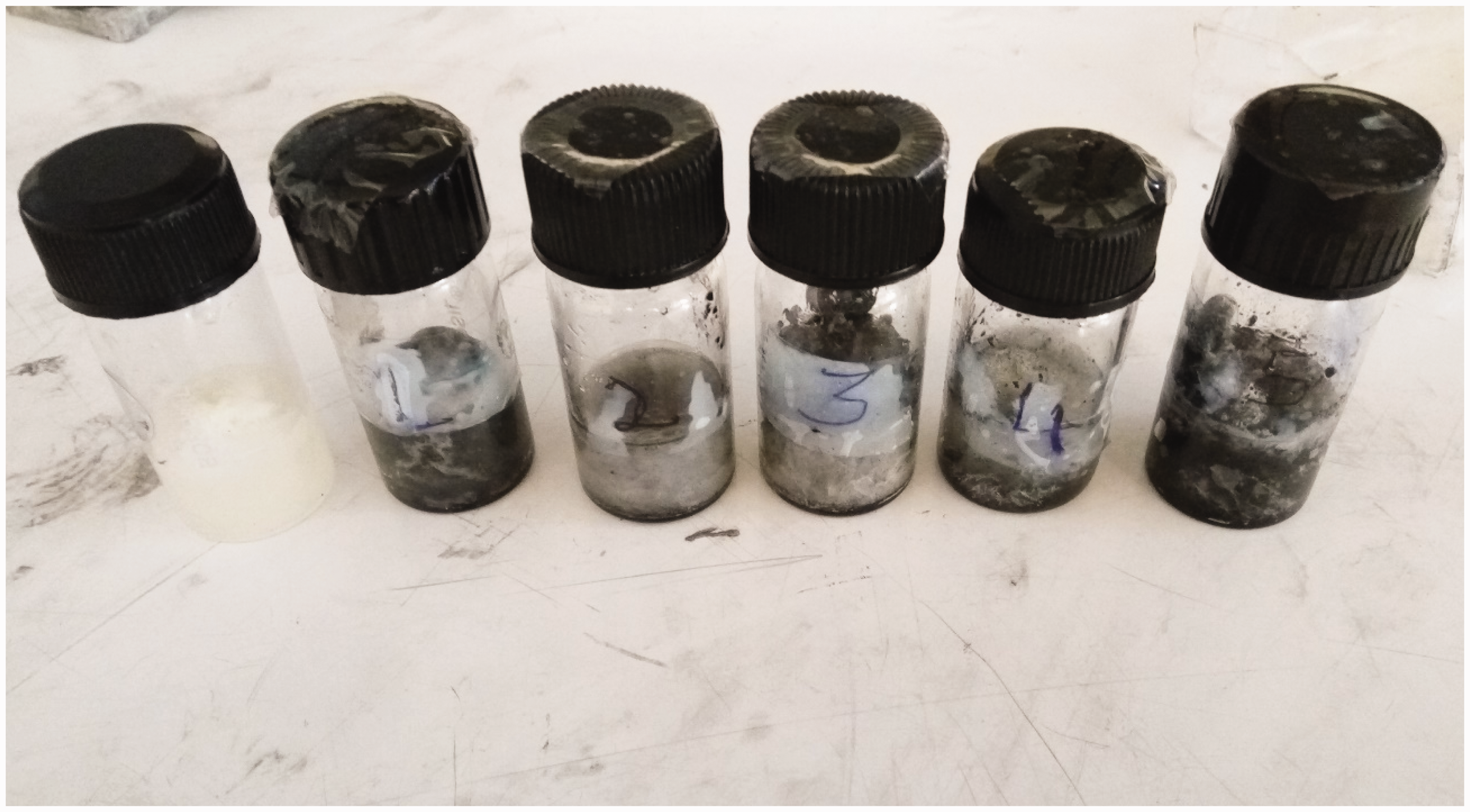
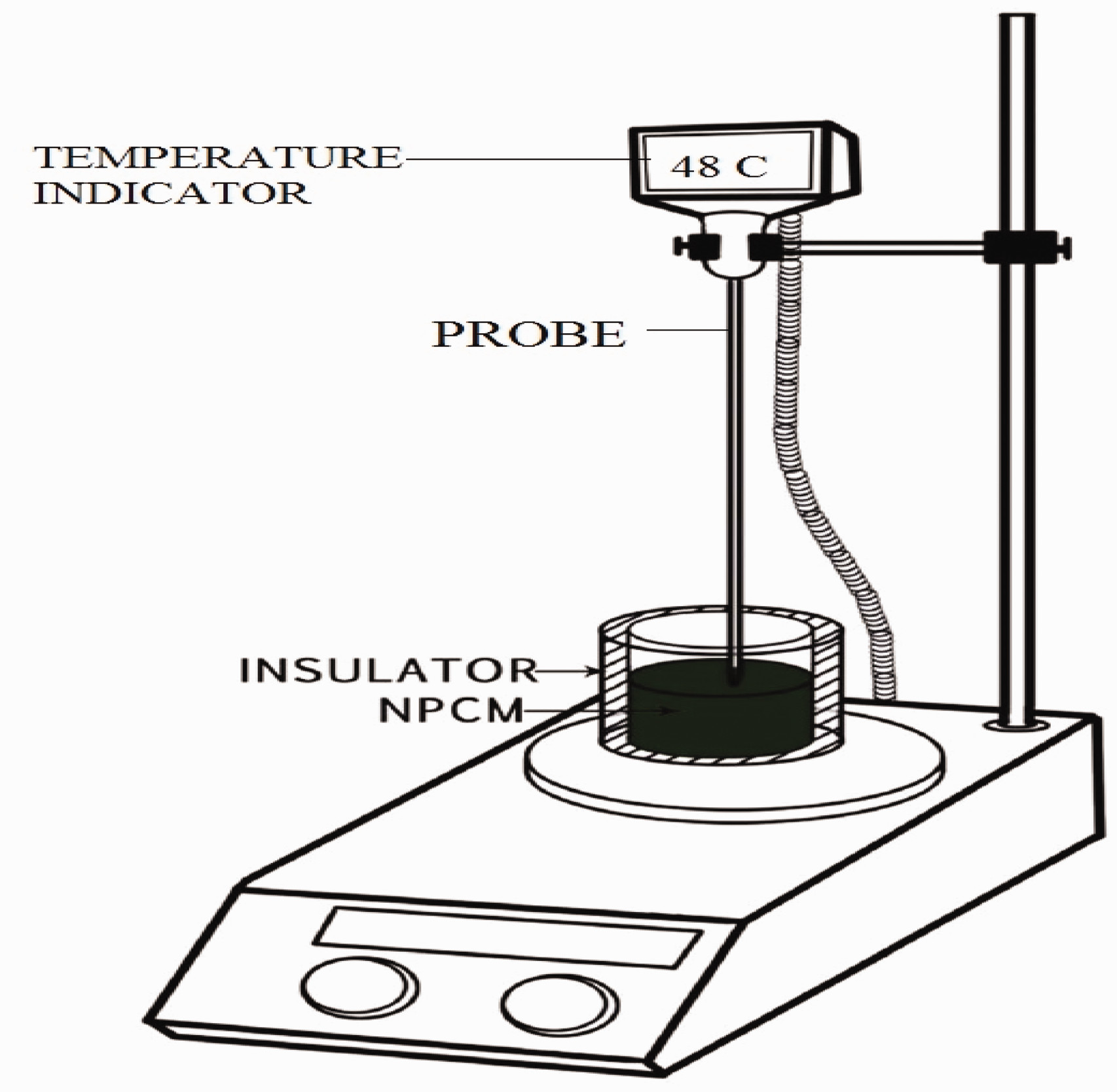
For melting experiments, the temperature supplied to the NG-MCH nanocomposites was increased at a rate of 5℃/min and the temperature was recorded. For solidification experiments, the vial was allowed to cool naturally and the temperature was recorded.
Results and discussion
Characterization of PCM and NG-MCH composites
The SEM image of the NG, used as additives in our experiments, is shown in Figure 3(a). The SEM image of pristine PCM (MgCl2·6H2O) is shown in Figure 3(b), which looked like flakes. From the image of NG-MCH (Figure 3(c)) obtained from SEM, it is clearly seen that NGs were properly dispersed in the pristine MgCl2·6H2O.
SEM images of (a) graphite nanoparticles, (b) pristine PCM, and (c) NG-PCM composite.
Increase in the thermal conductivity of PCM with increasing nanoparticle concentration.
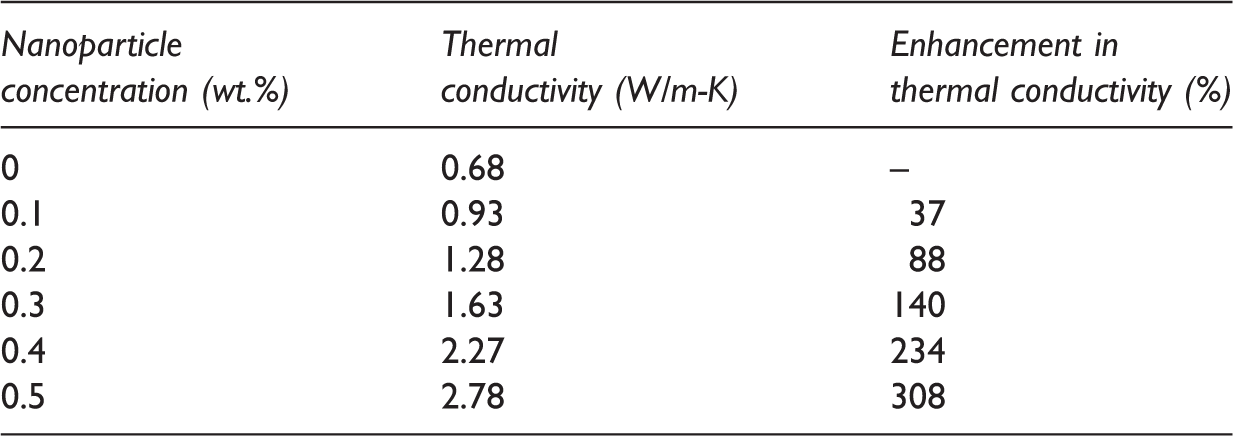
PCM: phase change material.
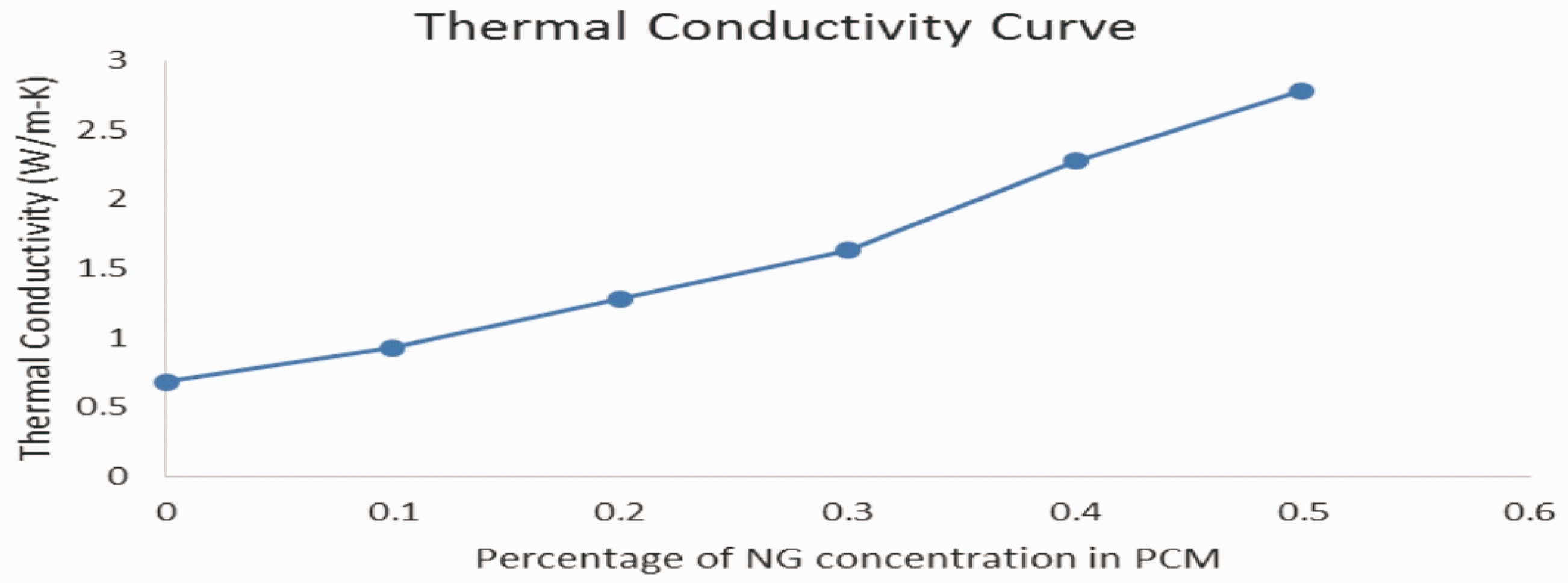
Thermal conductivity versus nanoparticle concentration in PCM.
Experimental results from heating setup
Melting and solidification process was used to investigate the enhancement in the rate of heat transfer. Comparison was done by performing heat transfer experiments using conventional heating approach on pristine PCM, which followed experiments by nanocomposites (NG-MCH). Graphs of melting of the pure PCM and NG–MCH composites with varying concentrations of NGs (0.1–0.5 wt.%) are presented in Figure 5. At the beginning of melting process, all samples were maintained at ambient temperature. There was a gradual rise in the pristine PCM’s temperature and also on nanocomposites until they achieved their respective phase change temperature (118℃). At approximately 94 min from the starting point, pristine PCM started to melt. By increasing the concentration from 0.1 wt.% of NG to 0.5 wt.% of NG, a sharp decrease in attaining the melting time of NG–MCH composites was observed. On increasing the concentration of NG to 0.5 wt.%, the time taken in melting of NG–MCH composite was only 74 min. This showcases an overall reduction of 22% in the melting duration of the NG–MCH composite at 0.5 wt.% in comparison to pristine PCM.
Melting curves for pristine PCM and NG–MCH composites at varying concentrations (wt.%) of NG. PCM: phase change material; NG: nano-graphite; MCH: magnesium chloride hexahydrate.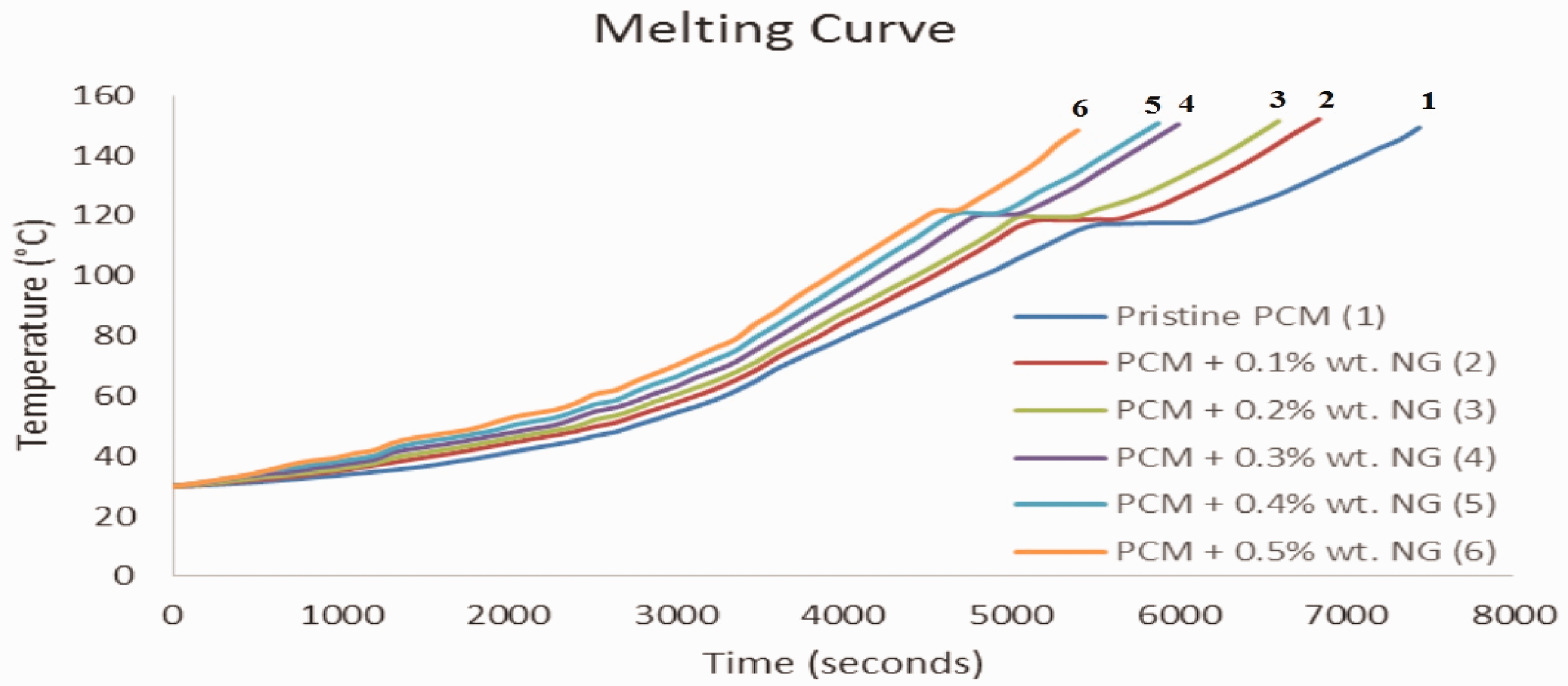
Investigation of solidification curves of the pure PCM and nanocomposites was performed. The temperatures of pristine PCM and nanocomposites at the start of solidification process were found to be 150℃. As shown in Figure 6, the temperatures of the pure PCM and nanocomposites decreased on cooling naturally and this trend continued until their respective solidification point is reached. A similar trend is shown in the solidification curves as those of heating curves, i.e. decrease in solidification time as the NG concentration was increased from 0.1 wt.% to 0.5 wt.%. A reduction of 75% was observed in the solidification time of the NG–MCH composite at 0.5 wt.% in comparison to that of pristine PCM. These results are a confirmation that our NG–MCH composites exhibit a higher rate of heat transfer. This is beneficial in charging and discharging process as higher rate of heat transfer means improved energy utilization efficiency. It is clearly evident from these results that carbonaceous nanoparticles have a prominent effect in enhancing the heat transfer properties and thermal conductivity of the nanocomposites. The above results of enhanced heating/cooling of NG–MCH composites are mainly the characteristic of the high thermal conductivity of NG.
Solidification curves for pristine PCM and NG–MCH composites at varying concentrations (wt.%) of NG. PCM: phase change material; NG: nano-graphite; MCH: magnesium chloride hexahydrate.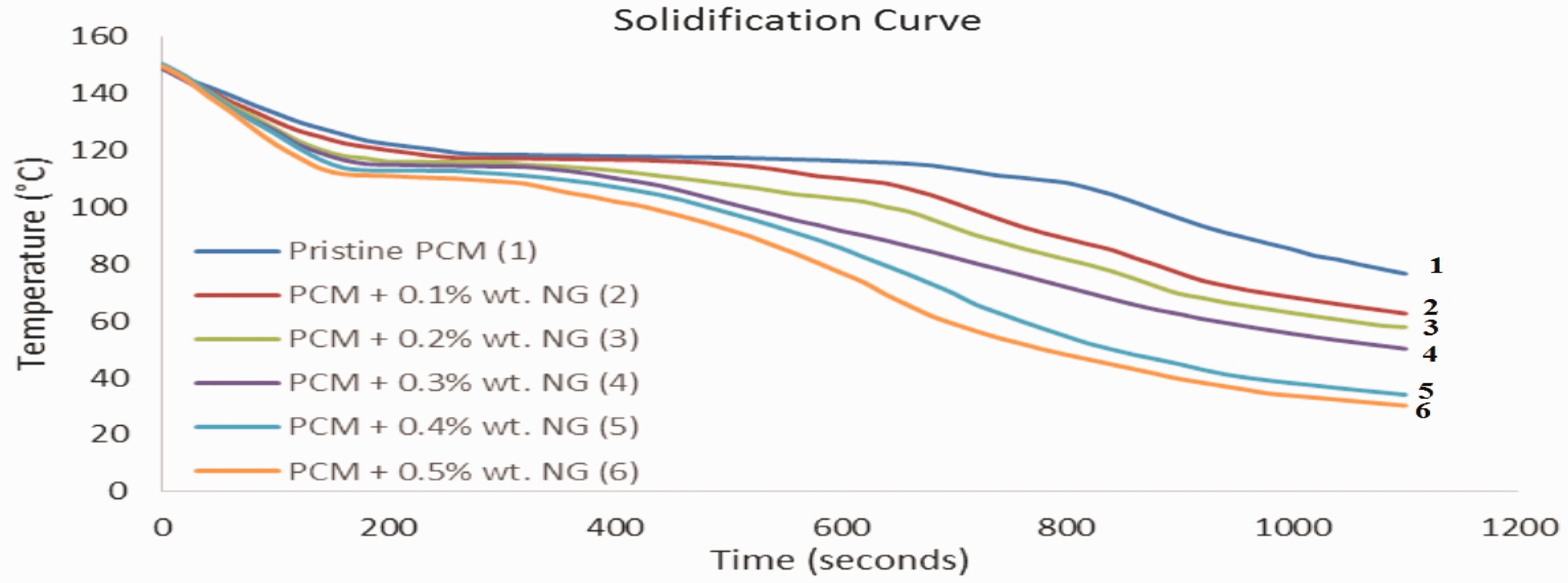
Although dispersed nanoparticles helps in increase in PCM’s thermal conductivity consequently increasing the solidification and melting rate of nanocomposites, it is not the only factor that affects the temperature variation rate in nanocomposites. Nanoparticles inclusion while increasing thermal conductivity also affects the viscosity of nanocomposites. Increase in nanoparticle concentration increases the viscosity of nanocomposites thereby degrading natural convection, leading to decrease in the melting rate. The relative intensity of weakened natural convection and enhanced heat conduction decides whether the heat transfer rate of nanocomposites will be either enhanced or deteriorated. Therefore, it is imperative to disperse an optimum amount of nanoparticles in PCM to enhance heat transfer rate and thermal conductivity of the nanocomposites keeping the effect of other negative properties like viscosity to a minimum. Several reported cases on nano-PCM have shown the trend of decreasing latent heat with increasing nanoparticle concentration except few special cases. Latent heat capacity degradation also depends on some other factors like modification in surface properties and size variation in different ways. As in viscosity case, an optimum nanoparticle concentration has to be determined for which degradation of latent heat capacity is minimum and thermal conductivity enhancement is maximum, resulting in enhanced thermal transfer characteristics of the nanocomposites. The heating process is dictated by conventional thermal diffusion on the application of conventional heating approach. In thermal diffusion, heat is slowly supplied from the hot area, from where the heat is first absorbed and transferred to other part of the energy storage material (PCM). The variation in the phase change temperature with respect to the nanoparticle concentration may be because of the inclusion of layers of NG into the pure PCM, affecting process of phase change .25 Our results on nanocomposites are in good agreement with reported data by Pilar et al. 16 who reported MCH as suitable PCM.
Conclusions
Carbon nanomaterials (NG) have been used to prepare salt hydrate-based stable nanocomposites. NG has been used as nanofillers and nano-cellulose was used as stabilizing agent. Nanocomposites of different concentrations of NG (0.1–0.5 wt.%) were prepared. The prepared nanocomposites (NG–PCM) exhibited remarkable enhancement in heat transfer rate and thermal conductivity. Addition of 0.5 wt.% of NG to MCH led to an increase of ∼308% in thermal conductivity. Also, melting and solidification rate has been increased by approximately 22% and 75%, respectively. Nanocomposites have been applied for the demonstration of the uniform and fast heating in comparison to pristine PCM using conventional heating method. Application of these novel nanocomposites will accomplish an environment friendly and cheaper solution to the rising demands of energy. Its application can be home heating and cooling, seasonal heat storage, waste heat recovery system. As recourses of MgCl2·6H2O are abundant, other potential and valuable function and application for this novel nano-PCM will be realized soon.
Footnotes
Declaration of conflicting interests
The author(s) declared no potential conflicts of interest with respect to the research, authorship, and/or publication of this article.
Funding
The author(s) received no financial support for the research, authorship, and/or publication of this article.