







Abstract
This research article investigates the impact of democracy on peak turning point of the environmental Kuznets curve in the context of the Association of South East Asian Nations (ASEAN) countries that have different levels of development and democracy. For this purpose, time-series data for the period of 1980–2014 have been employed. The empirical findings support the existence of the environmental Kuznets curve for CO2 emission in the ASEAN countries. It is also found that democracy measured by civil liberties delays the turning point of the environmental Kuznets curve and, therefore, increases the environmental cost of economic growth. The research output provides meaningful inputs to formulate an effective public policy for the protection of the environment in the ASEAN countries.
Introduction
The relationship between income and environmental degradation was empirically examined during the start of the 90s. The output of these studies formulated the so-called environmental Kuznets curve (EKC) hypothesis. This hypothesis postulates that economic growth eventually overcomes the environmental damages of early stages of economic development.1–4
EKC states a nonlinear relationship between economic growth and pollution as shown in Figure 1. During the early stages of the economic development, economic growth deteriorates environmental quality; however, as growth process continues, it generates conducive conditions for a better environment. Economic growth, therefore, can be considered a cause as well as remedy to the environmental problems.
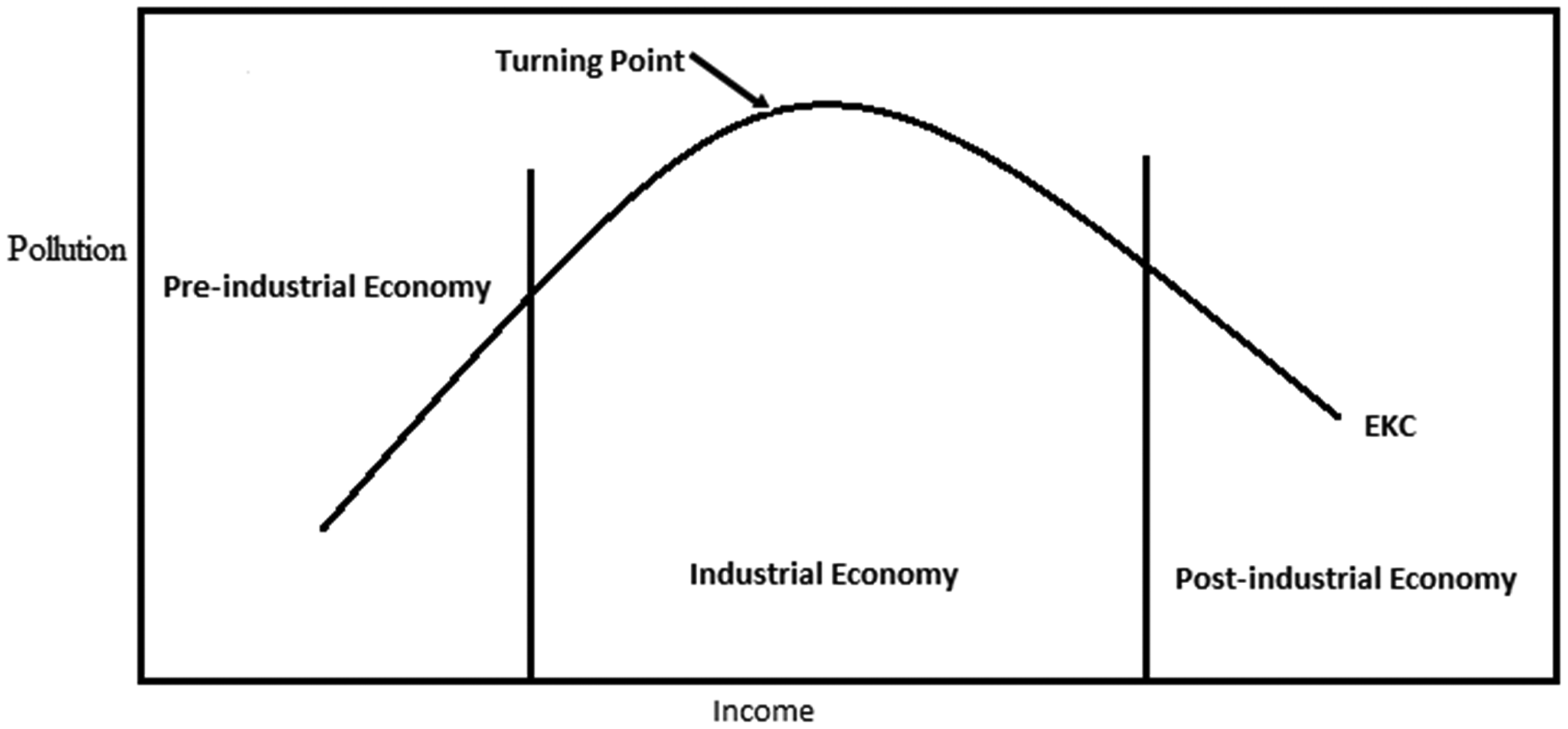
EKC relationship between economic development and pollution.
The rationality of the EKC relationship can be assessed on both supply and demand sides. The supply side effects are disintegrated into scale, composition, and technique effects. The scale effect starts with the surge of economic activities by utilizing more natural resources that results in more pollution, while the composition effect refers to the transition in production structure of an economy from agrarian to industrial and then to services sectors. In addition, composition effect reallocates the resources along with upsurge in environmental degradation in the first stage and improvement in environment in the second stage. Finally, the technique effect ensures better methods of production due to technological advancement. The outdated machineries are substituted with updated and cleaner technologies that lead to a decline in the level of pollution.
Whereas on demand side, people are worried about the improvement of material welfare at the early phase of economic development. They are less concerned about the quality of the environment. However, as their income increases, their inclination to pay for a cleaner environment improves, and the institutions that regulate environment also develop more effective approaches for regulating the pollution. 5 These supply and demand side changes lead to an inverted U-shaped relationship between economic growth and pollution.
EKC has been empirically tested and critically reviewed in all parts of the world. Though some of the researchers agree about its existence, they have disagreement on the shape and turning point of the EKC. From the theoretical and empirical reviews on the EKC, Copeland and Taylor 6 concluded that the economic development and environment lack any predictable and simple relation.
The EKC, as an optimal growth path and high income as a prerequisite for environmental improvement, has fascinated the development and environmental policies of the world. 7
The EKC notion also signifies tradeoff between economic growth and environment at early stages of economic development. For developing countries, this tradeoff has important implications. Economic growth is central to counter unemployment, poverty and hunger; therefore, these countries cannot compromise over economic growth. Thus, the real issue for the developing countries is that how they can maintain economic growth yet minimizing its environmental cost.
The EKC provides an important policy guideline in this regard. The steeper EKC implies high environmental cost of economic growth while the flatter EKC indicates least environmental losses of economic growth. Several factors such as international trade, foreign direct investment (FDI), technology, environmental governance, environmental awareness, and democracy contribute to determine the slope and altitude of the EKC.
The current study, therefore, aims to examine the role of democracy in shaping income environment relation in the Association of South East Asian Nations (ASEAN) countries. It is the least searched area in the EKC literature especially in the context of ASEAN countries as they have different levels of development and democracy.
According to Deacon and Mueller, 8 the political system of a country, either democratic, semi-democratic, or autocratic, plays a critical role in the allocation of environmental resources. When democratic governance and rule of law are not well established, prospective corruption may boost rent-seeking behaviour among government officials and businessmen. Similarly, when government tends to represent the interest of selected groups rather than of entire population, the provision of a public good like environment may be compromised. Those who defend the role of liberal democracies for environment claim that there is no other system than democracy that guarantees all basic human rights to individuals including the right of a healthy environment.
On the other hand, the critics of liberal democracy hold that democracy provides the individuals with opportunities to escape their environment responsibilities if they choose to do so. The young democracies also lack necessary institutional arrangements that can foster peoples' participation and accountability. The nascent institutions, therefore, fall prey to the preference of the elites rather than to protect the interests of broad-based population. Chang and Cho9,10 and Midlarsky 11 held the view that democracies in developing countries did not generate supporting conditions for a cleaner environment. Hence, there is no conclusive argument about the role of democracy in shaping the income environment relation. Some take it as a prerequisite of environmental performance while others consider it as a plague for environmental quality.
The ASEAN countries have several environmental problems. According to literature, 12 increased industrialization and urbanization in the 1990s and 2000s generated severe environmental problems like air and water pollution and accumulation of urban wastes in the ASEAN countries. The Global Climate Risk Index (2016) also indicated that ASEAN countries are the most vulnerable to environmental changes. Most of these countries are island countries and are exposed to the risk of rising of the ocean level. Moreover, World Bank (2015) observed momentous increase in CO2 emission over the last three decades in the ASEAN region. The countries like Singapore, Malaysia, Indonesia, Thailand, and Vietnam have a significant increasing trend of carbon emission.
While democracy made inroads in the ASEAN region after colonial rule ended, it has been struggling to take root as authoritarianism has left deep legacy. After the human right declaration adopted unanimously in 2012, the ASEAN countries sought to believe in democracy as the engine for economic growth. Though socialist states like Laos and Vietnam have embraced capitalism on economic front, they are still ruled by communist parties and have not abandoned the authoritarianism. Similarly, Malaysia and Singapore, despite economic modernization, have kept democratizing at bay. Likewise, the other ASEAN states in the past have experienced democratization such as Philippines in 1986, Cambodia and Thailand in the early 1990s, and Indonesia in 1998; however, none of them have fully entrenched the liberal and democratic values.
Given this performance of the ASEAN countries on democracy and environment, the current study aims at examining the role of the former to decrease the environmental losses of economic growth. In other words, the study tests the hypothesis: Has democracy potential to get an early turn in the EKC in ASEAN countries?
Literature review
Various empirical studies provide contrasting results on the relationship between the level of democracy and environmental degradation. For instance, Congleton 13 found a positive impact of liberal democracies on the environment from the analysis of democratic and non-democratic countries of the world. Torras and Boyce 14 pointed out that more equitable distribution of political power resulted in better environmental quality. Barrett and Graddy 15 also found that political liberties and civil rights have a positive impact on the environmental quality of a country. Similarly, Neumayer 16 verified a positive relationship between democracy and environmental commitment and recommended that more democracy around the world would result in more commitment on the environmental front.
While Li and Reuveny 17 found a non-monotonic impact of democracy on the environment that varied across different degrees of the democracy, they, therefore, concluded that the impact of democracy on income and environment relation was dependent on how much democracy was matured in that country. They used CO2, land degradation, deforestation, and organic pollution in water as a measure of environmental quality and regressed them against the level of democracy and Gross Domestic Production (GDP) per capita in 143 countries for the period of 1961–1997.
Aubourg et al. 18 pointed out that the level of democratization was so important that it could change the turning point of the EKC. Likewise, Ward 19 indicated that stable democracies performed better on sustainability indicators as compared to stable autocracies. Similarly, Bernauer and Koubi 20 provided support to the stance that the degree of democracy has an independent positive impact on air quality in a country. Moreover, Bernauer and Koubi 20 highlighted that more liberal political system is conducive to environmental quality.
Buitenzorgy and Mol 21 again confirmed that democracy had larger explanatory power than income to explain the variation in deforestation rate. Arvin and Lew 22 found the same evidence that democracy was beneficial for the improvement of environment; however, this outcome varied across various pollutants.
Vanek 23 analyzed the impact of the operations of capitalist and democratic firms on the environment. He found that the democratic firms were more concerned about the natural environment as compared to the capitalist firms. Moreover, he also indicated that capitalist firms tend to avoid environmental-related costs and, therefore, destroy the environment. Farzanegan and Markwardt 24 revealed that democratic development in the Middle East and North African (MENA) countries was beneficial for the curtailment of environmental problems. Similarly, Dipietro 25 showed a positive impact of democracy on total national environment performance.
Equally, Fredriksson and Neumayer 26 argued that democratic capital (i.e. stock of historical experience with democracy) has more sound impact on the environment rather than the current level of democracy. They claimed that higher level of democratic capital was highly correlated with the stringency of environmental regulations. Therefore, as democracy gets consolidated in developing countries, it would exert a positive impact on the environment. Furthermore, Sjöstedt and Jagers 27 found that more democratic countries were more successful in protecting the marine life.
You et al. 28 examined the role of better democracy to reduce emissions among the nations with most and least carbon emission. Their results showed that the effect of democracy on CO2 emissions was not homogeneous, rather more democracy appeared to reduce emissions in most emissions nations. From a panel of 47 transition economiesPolicardo 29 also concluded the same that democracy is conducive to control environmental degradation in the process of economic development. He indicated that democracy had better environmental targets than dictatorship.
Buitenzorgy 30 empirically tested the political EKC in Indonesia. Political (EKC) implies an inverted U-shape relation between environmental quality and level of democracy. He confirmed that pollutants like CO2 and biochemical oxygen demand follow an EKC path with the development of democracy. He also supported that improved democracy may play more significant role than increased income to reduce the environmental degradation. Sulemana et al. 31 also came up with the similar findings that democracy significantly affected the Particulate Matter (PM10) emissions in the African countries. Further, Ghodrati et al. 32 also revealed that improvement in democracy in the countries that have low and medium human development indices can lead to improvement in environmental quality.
On the contrary, Chang and Cho 9 claimed an inverse relationship between democracy and environment in 27 Asian countries for the period of 1991–2001. They found that democracy measured by civil liberties had increased the CO2 emission in these countries. Similarly, López and Galinato 33 suggested that countries at early stages of democratic process had unstable governance institutions that created negative implications for the environment.
Scruggs, 34 after going through the 58 studies that directly deal with the influence of democracy on environmental performance of a country, concluded that economic growth and wealth have more sound impact on environmental performance of a country as compared to the impact of democracies. Arvin and Lew 22 did not find any uniform relation between the state of democracy and state of the environment. Similarly, Faure et al. 35 raised the doubts over the role of democracy for the improvement of environment. They argued that, at the early phases of economic development, citizens do not demand investments for environmental protection at the cost of basic public goods like health or education. This lack of pressure from the public on democratic governments results in least investment to improve the environment. Therefore, at the early phases of economic growth, democratic developing countries are not a better performer on environmental front.
Halkos and Tzeremes 36 pointed out the same that the regional variation and difference in the economic development of the countries determine the way how different governance indicators affect carbon emission. Likewise, Lv 37 pointed out that democracy reduces carbon emission only if the economy has reached a certain level of income. He deduced these results by analyzing the interaction effect of democracy and GDP on carbon emission in 19 emerging economies for the period of 1997–2010.
Vadlamannati and Gaarder 38 contributed to the debate by analyzing the contentious relationship between environmental degradation and regime type in 139 countries for the period of 1990–2012. They also found that democracy was linked with lower level of forest coverage. Their analysis further revealed that positive impact of democracy on environment is conditional upon the certain level of economic development. Similarly, Povitkina 39 argued that impact of democracy on environment is limited due to widespread corruption in developing countries that reduces the capacity of the democratic governments to reduce CO2 emission and to meet climate targets. He investigated the environment and democracy linked in 144 countries over the period of 1970–2011.
Hence, empirical literature on the role of democracy in income–environment relation does not have empirical and theoretical consensus. Moreover, scant of the studies have examined the impact of democracy on income–environment relation in the context of ASEAN countries.
Model and data
Model
EKC postulates a nonlinear relationship between income and pollution. The empirical studies on the EKC have used the following model proposed by literature
40
:

As this study aims to examine the role of democracy to determine the income–environment relation in the context of ASEAN countries, therefore, in equation (3),

Most of the empirical studies that advocate the role of political and institutional factors in income–environment relation use these factors as dummy variables. In this specification, dummy variables cannot affect the turning point of the EKC, rather they can only change the altitude of the EKC. Resultantly, these studies are unable to address the issue of the different turning points of the EKC, as pointed out by the EKC literature. This study, therefore, includes democracy variable in the EKC model interactively with income so that turning point will become context specific as suggested by literature.
51
This specification provides a way to empirically investigate the different turning points of the EKC due to various level of democracy. The resulting model will be as follows:

In equation (3), democracy affects the environment indirectly by affecting the economic growth. This indirect effect is assumed to influence the turning point of the EKC owing to its effect on GDP. This specification is very important in terms of tracing out the true impact of democracy on the turning point. According to Aubourg et al.,
18
this model allows locating the turning point GDP values inclusive of democracy indicators. With this specification, the formula for determining the GDP per capita at the turning point will be

Data
Depending upon the availability of data, six ASEAN countries namely Singapore, Malaysia, Indonesia, Thailand, Vietnam, and Philippines have been selected for investigation over the period of 1980–2014. As per usual practice in the EKC literature, CO2 emission in “metric ton” has been taken as a measure of environmental degradation and GDP per capita as a measure of income. The data for CO2 emission have been taken from International Energy Statistics (2016), while per capita GDP data have been obtained from the World Economic Outlook 2016. The data about EC (measured in kg of oil equivalent per capita) and FDI have been collected from World Development Indicator 2015.
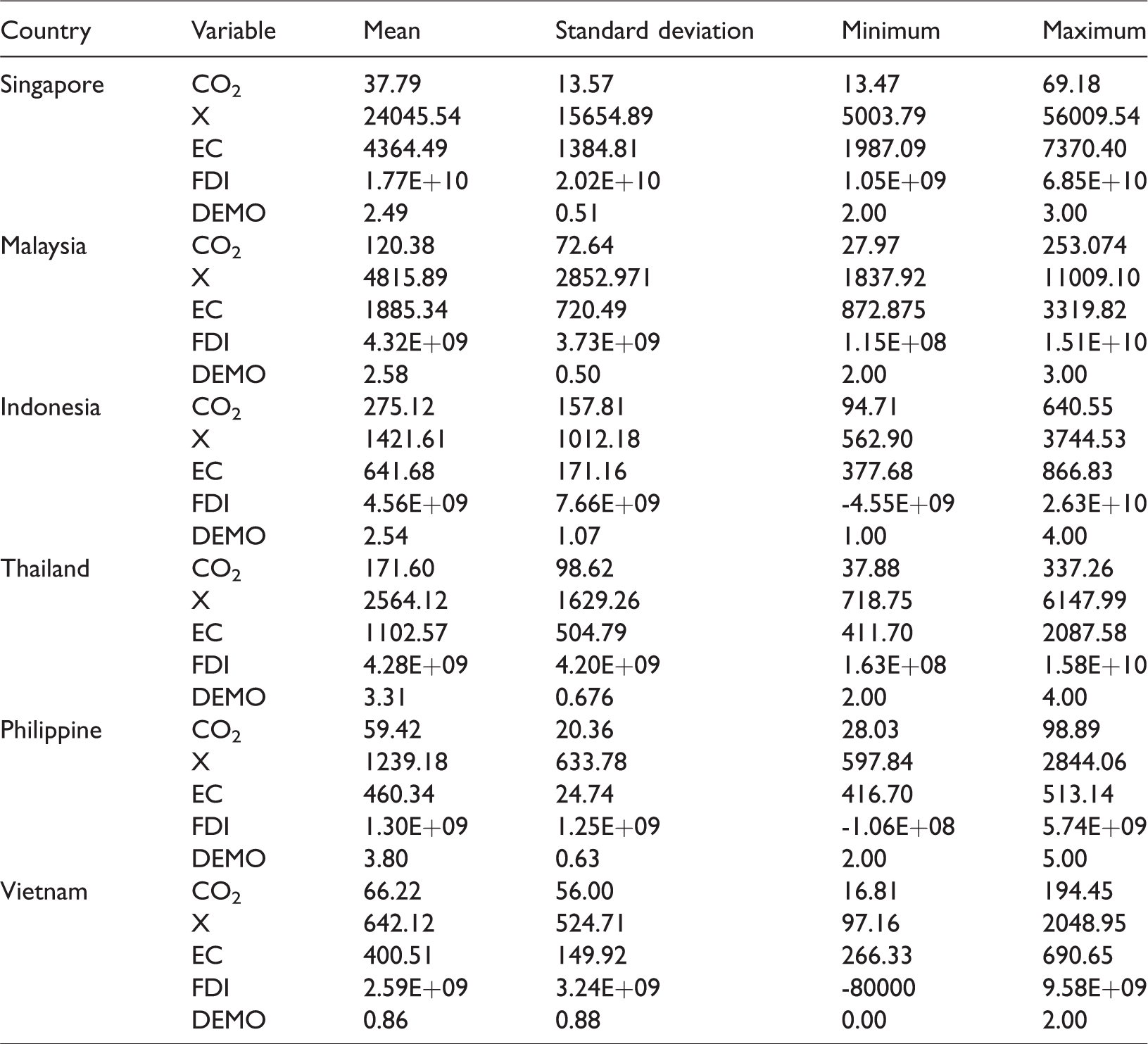
For the measurement of democracy, present study uses “Freedom in the World” a yearly survey report prepared by Freedom House 2016. It measures the degree of political rights and civil liberties in all the countries of the world and produces scores for the level of civil liberties and political rights for each nation, and then these scores are combined into an index. These scores are measured on one to seven scales where one represents the highest degree while seven is the lowest. However, to simplify the interpretation of the results, scale has been reversed by subtracting each value from seven. The zero, therefore, represents the lowest level of democracy, and seven represents the high level of democracy. Table 1 provides a descriptive summary of the data used in this study.
Description of the used variables.
Results and discussion
The standard ordinary least square regression technique with non-stationary time series leads to spurious regression and may cause invalid inference of the empirical results.52,53 It is therefore, imperative to examine the stationary properties of each variable before estimating the relationship between the variables. For this purpose, panel unit root tests by Levin et al. 54 (LLC) and (IPS) 55 have been used. After finding that the variables are co-integrated in the panel, the next step is to estimate long-run cointegration vector. The long-run coefficients are estimated using fully modified least square (FMOLS) estimation method developed by literature. 56 FMOLS is estimated with non-parametric approach that includes the alterations to tackle the serial correlation and endogeneity problem.
The analysis starts with description of the variables used in the extended EKC model as shown in Table 1. The high values of standard deviation as compared to mean values of the dependent and independent variables indicate substantial variation in the variables.
The precondition using panel cointegration tests is to decide whether the time series variables in the panel have a unit root problem. The panel unit root confirms that all the variables must be either stationary at level I (0) or stationary at first difference I (1) The Im, Pesaran and Shin (IPS) and Levin, Lin and Chu (LLC) unit roots tests for each time series variable are summarized in Table 2. The test statistics of LLC and IPS fail to reject the null hypothesis implying that all the variables in the panel are non-stationary. However, taking the first difference of all the variables, both LLC and IPS reject the null hypothesis and accept the alternate hypothesis that variables are stationary. Hence, it can be concluded that all the variables in the panel are integrated of order I (1).
Results of panel unit root tests.
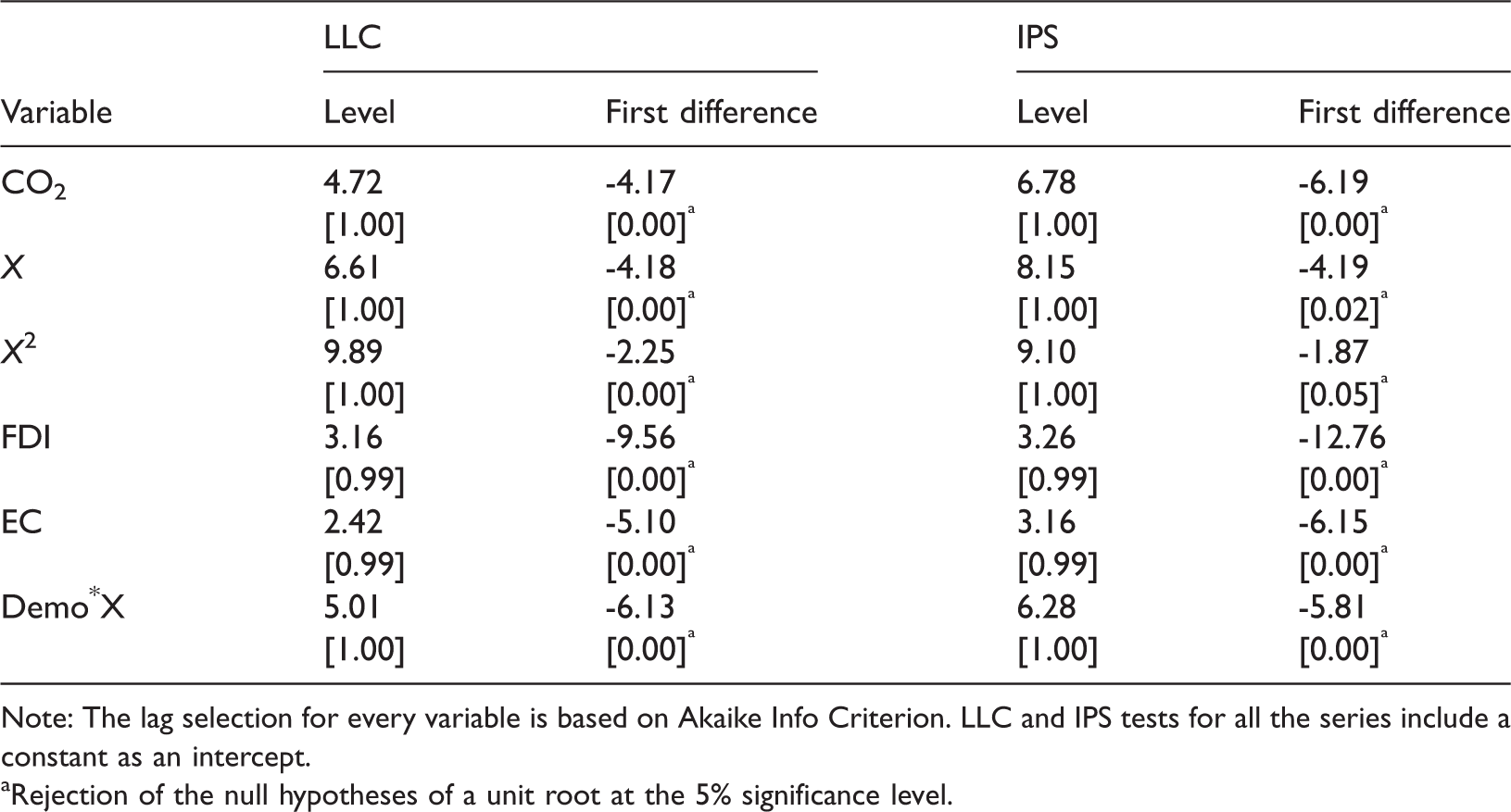
Note: The lag selection for every variable is based on Akaike Info Criterion. LLC and IPS tests for all the series include a constant as an intercept.
Rejection of the null hypotheses of a unit root at the 5% significance level.
With the robust proof that every variable is non-stationary and become stationary at first difference, the panel cointegration tests have been applied to examine the long-run equilibrium relationship among the variables. The results of various cointegration tests suggested by Pedroni 57 and Fisher 55 are presented in Table 3. The five Padroni tests’ statistics are well significant at 5% critical values and, therefore, reject the null hypothesis of no cointegration. The Fisher test also rejects the null hypothesis of none and at most one cointegration vector. Thus, the alternate hypothesis of one and more than one cointegrating vectors is accepted. Resultantly, panel cointegration tests strongly support the existence of long-run equilibrium cointegrating relation among CO2 emission, per capita GDP, FDI, EC, and democracy in ASEAN countries.
Results of panel cointegration tests for equation (3).
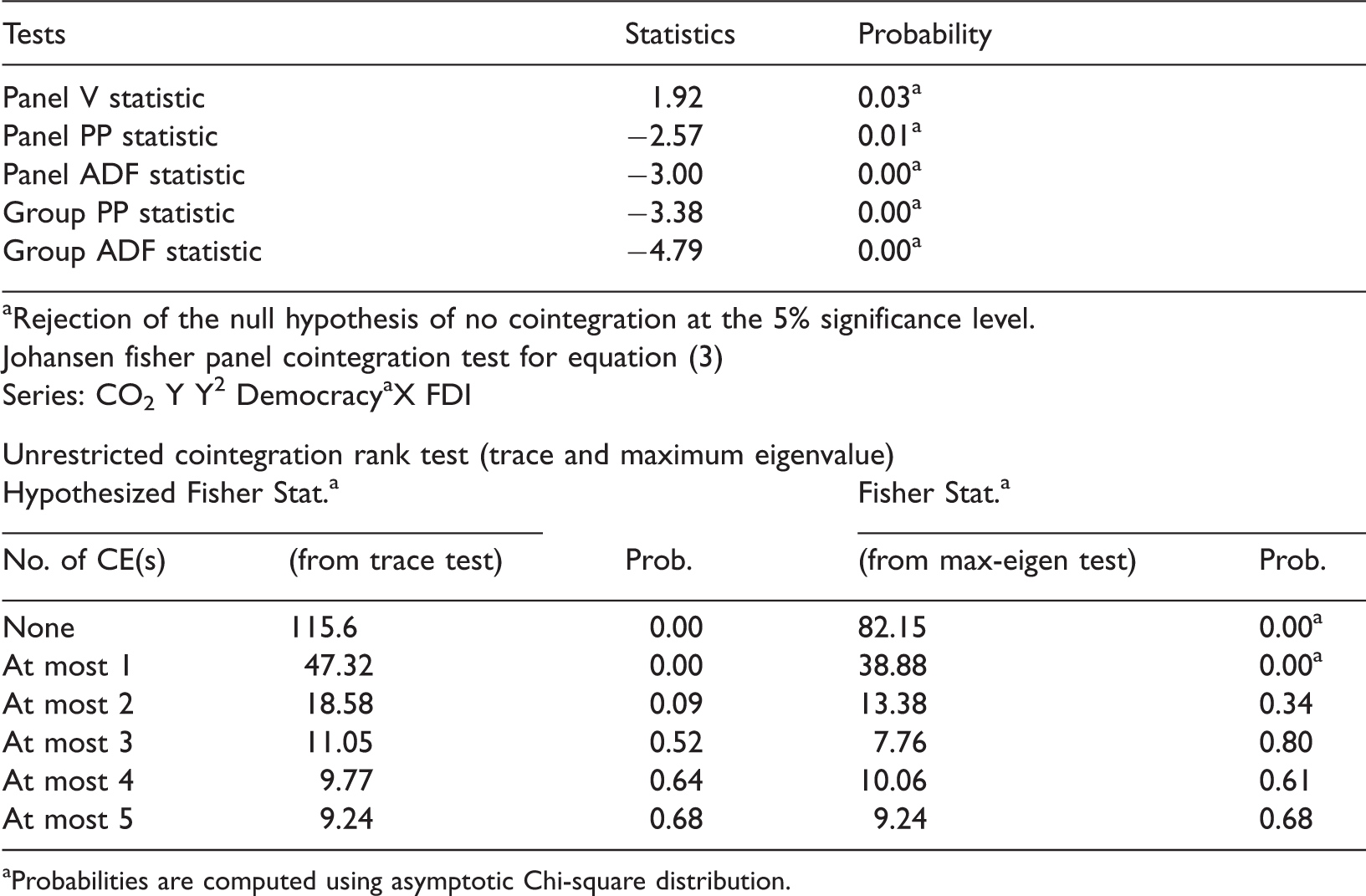
Probabilities are computed using asymptotic Chi-square distribution.
After finding the long-run cointegrating relation among the variables, the FMOLS has been applied to estimate the long-run co-integrated relation among the variables. The results are shown in Table 4. According to the FMOLS results, the coefficient on income is positive and statistically significant and the coefficient on squared income is negatively significant. This proves the existence of EKC for this region. The coefficient on two control variables FDI and EC are also found positive and statistically significant. It implies that these variables also contribute to the emission of CO2 from the ASEAN region.
Results of FMOLS for equation (3).
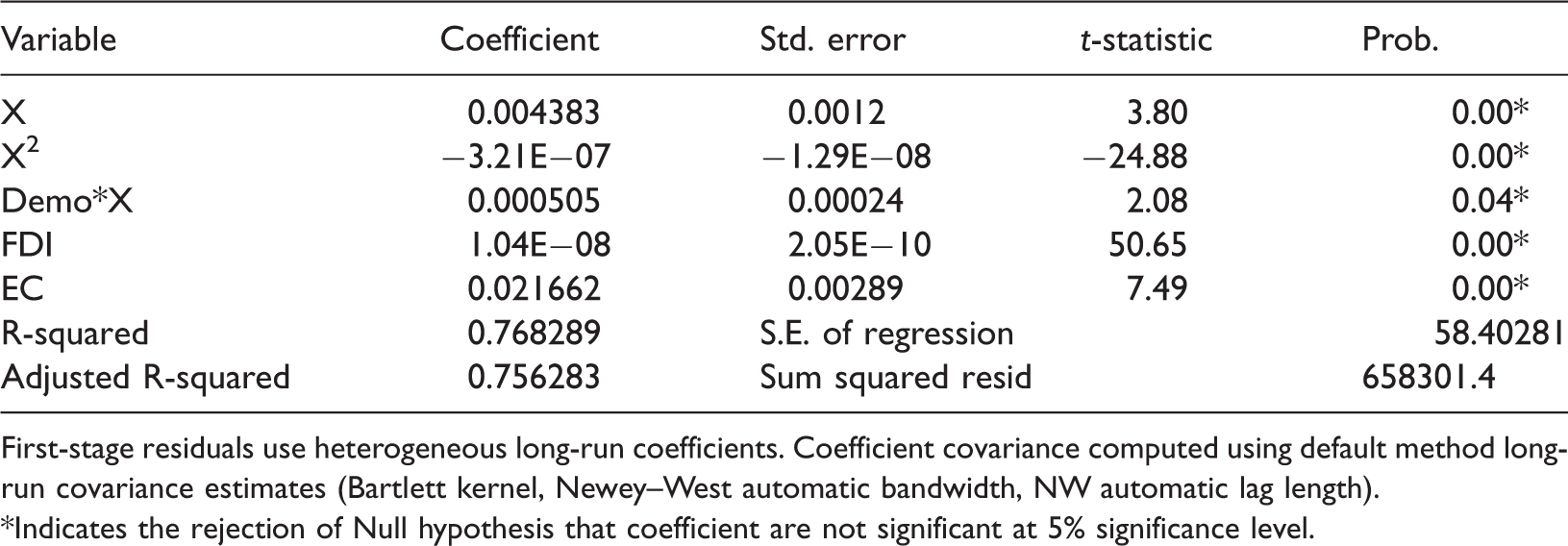
First-stage residuals use heterogeneous long-run coefficients. Coefficient covariance computed using default method long-run covariance estimates (Bartlett kernel, Newey–West automatic bandwidth, NW automatic lag length). *Indicates the rejection of Null hypothesis that coefficient are not significant at 5% significance level.
The main concern of this research study was to investigate the role of democracy to mitigate the problem of environmental degradation in the context of the ASEAN countries. The study has interesting results in this regard. The efficient on interaction term Demo*X is positive and statistically significant which indicates that given the income level, democracy causes CO2 emission to rise in this region. The ASEAN countries have a model of controlled democracies where stable and continuous policies have played a significant role to maintain a conducive environment for investment and growth, especially in Singapore and Malaysia. Therefore, given the positive association between income and CO2 emission, the indirect impact of democracy on CO2 emission via income is also positive.
The peak turning point income level of the EKC where pollution starts to decline with further economic growth can be calculated by equation (4).

The turning point of EKC at zero scores of democracy is observed at $6827.11 per capita. However, considering the average score on democracies of ASEAN countries, the peak turning point of the EKC reaches to $8872.27 per capita. Moreover, at the highest score on democracy, the turning point of the EKC reaches to $123333.33 per capita. These results imply that the environmental cost of economic growth start to increase in the ASEAN countries as they move to a higher score of democracy. Hence, it can be concluded that economic growth with more democracy seems to produce more pollution at the early stages of economic development in this region.
Moreover, most of the ASEAN countries except Malaysia and Singapore are well below the peak turning point income level of the EKC. This implies that the economic growth without any policy measures related to environmental preservation will be accompanied by CO2 emission in the region.
The Wald test of coefficient restriction has been applied to examine whether the interaction term in equation (3) should be included or not. The results of the test are shown in Table 5. The t-statistics, F-statistic, and Chi-square statistics reject the null hypothesis (H0) that interaction term does not matter in the equation (3). The alternate hypothesis (H1), therefore, is accepted that interaction term does matter in the said equation. Hence, Wald test of coefficient restriction supports the inclusion of the interaction term in the EKC model.
Wald tests results.
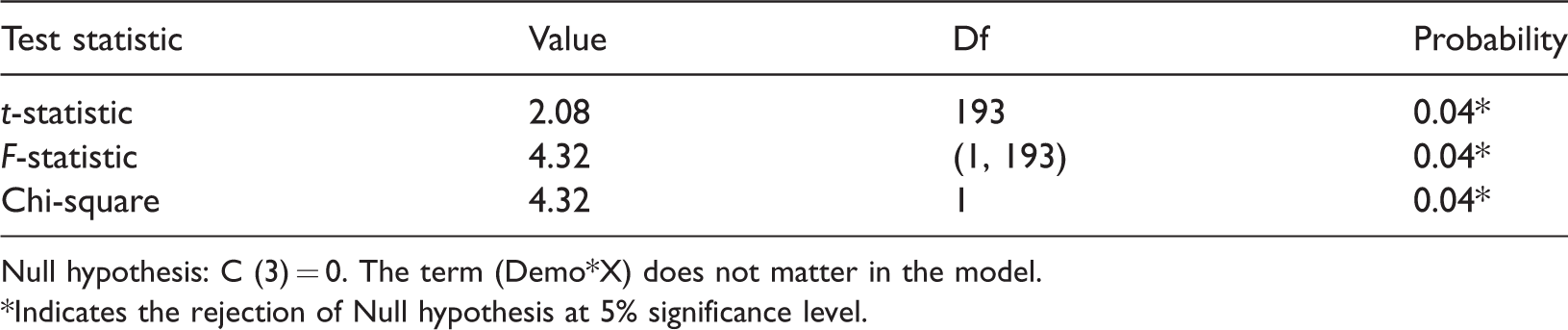
Null hypothesis: C (3) = 0. The term (Demo*X) does not matter in the model. *Indicates the rejection of Null hypothesis at 5% significance level.
The empirical results of the study support the stance of Faure et al. 35 that at the early phases of economic growth citizens do not demand investments for environmental protection at the cost of basic public goods like health or education. This lack of pressure from the public on democratic governments results in least investment to improve quality of environment. Therefore, at the early phases of economic growth, democratic developing countries are not a better performer on environment front. These findings are consistent with the EKC theory that at earlier stages of economic development the focus remains on employment and income growth than environmental protection.
The study also supports the stance of Paehlke 58 that “the great danger for both democracy and the environment is that while economy and environment are now global in character, democracy functions on only national and local decision levels.” Consequently, the global public good like environment will be ignored at the local level. This is very true in the case of CO2 emission that has more global repercussions than on local communities. The results are also in line with Scruggs 34 who found that “economic wealth and economic growth have the most steady influence on the environmental performance of a country than democracies.” Similarly, the findings are also in line with Arvin and Lew, 22 Halkos and Tzeremes, 36 and You et al. 28 who suggested that democracy was not a uniform solution to environmental problem of the world. Also, the results are consistent with Lv 37 who concluded from 19 emerging economies that democracies curtail CO2 emissions only if the countries have reached to a certain per capita income level.
Conclusion and recommendation
The current study contributes to literature by examining the impact of democracy on peak turning point of the EKC in the context of ASEAN countries from 1980–2014. The ASEAN countries have a different level of development and democracy and are also a group of emerging economies. Therefore, studies of the EKC and its connection with democracy may provide important policy implications. The findings support the existence of the EKC for Green House Gases (GHG) emission in the ASEAN countries. It is also concluded that democracy measured by civil liberties can delay the turning point of the EKC.
These results also support the EKC stance that at the early stages of economic development people are more concerned about income and employment. Environment as a normal good is demanded at higher income level. Democracies incorporate these preferences in public policies and, therefore, do not respond to the environmental problems at the early stages of economic development.
While the results are new to the present literature about democracy and environment, yet the current study has its own limitations. For instance, similar to the previous studies on the EKC, underlying study also uses CO2 emission that is a partial measure of environmental degradation. The future prospective studies may use some comprehensive measures of environment like environmental performance index while examining the democracy environment nexus. Moreover, the results cannot assert any role of democracy for environment unless the results are compared with those from non-democratic countries. Moreover, findings of the study do not imply that autocracy is a remedy to environmental problems of the day. However, we believe in following short run, midterm, and long-run recommendations for the favourable functioning of democracy to protect the environment.
A proactive public policy is needed that can make the flow of the information about environmental problems publicly available and can make people realize that environment is as important as employment and income growth. The notion of “development versus environment” needs to be transformed to “environment for development.” There is a need to clearly define property rights of natural resources like clean air, water and forests so that free individuals or interest groups may not tend to overexploit them. The developing countries need democracies that are more responsive to environmental needs of the people and life-threatening problem of environmental degradation. The democracies should have both the citizen watch groups and environmental interest groups that are vital for the favourable functioning of democracies for environment in the developing countries.
Footnotes
Declaration of conflicting interests
The authors declared no potential conflicts of interest with respect to the research, authorship, and/or publication of this article.
Funding
The authors received no financial support for the research, authorship, and/or publication of this article.