







Abstract
In this article, a small-scale partially premixed combustor was designed with 1.5 kW heat input rate. Through altering premixing ratio of gas and air, the lifting and yellow tip characteristics were experimentally tested with the burner head material of cast-iron and copper–aluminum respectively. Combined with burner head temperature influences, the lifting and yellow tip characteristics of small-scale partially premixed combustor are discussed when natural gas is substituted. It is found that when lifting and yellow tip occur, the cast-iron burner shows a slow tendency of temperature change, but the temperature of copper–aluminum burner fluctuates sharply. Yellow tip is related to gas properties and burner structure, and is more likely to appear with the increase of the Wobbe index and heavy hydrocarbon fraction, while lifting is very likely to appear when temperature fluctuates. Yellow tip characteristic can be predicted by Wobbe index, but this method is unsuitable for lifting prediction.
Introduction
In China, natural gas consumption had risen from 48.3 billion cubic meters in 2005 to 237.3 billion cubic meters in 2017. With the increasing demand of natural gas, more and more multi-source gas supply networks have been constructed in Chinese cities to expand supply scope and reduce costs, and liquefied natural gas (LNG) is playing an important role in urban gas supply system, with import volume of 51.9 billion cubic meters in 2017. Gas composition and properties are quite different from each other, especially for LNG and pipeline natural gas (PNG). When gas composition changes, the combustion stability of the burners will change too. With incomplete managements of natural gas quality and various structures of gas terminal devices in different application fields, natural gas interchangeability issues are very serious in China. 1
The American Gas Association had done a lot on gas interchangeability research and presented a prediction method consisted by three main indices, namely lifting index (IL), flash-back index (IF), and yellow tip index (IY).2,3 In China, the study of gas interchangeability issues mainly focused on the interchange of natural gas and manufactured gas, when natural gas was firstly used in 1990s. There was still no effective prediction method for Chinese gas interchangeability, especially for the issues between same gas families of natural gas. 4 Historically, most interchangeability tests focused on domestic gas appliances whose heat input rate was between 2 and 6 kW, with the reason of large market share of natural gas consumers in China on the one hand, and most consumers were in lack of professional knowledge to readjust gas appliance structure when facing changes of gas composition on the other.
Domestic gas burners mainly adopt partially premixed combustion. The appearance of yellow tip will lead to incomplete combustion and emission pollution issues, 5 and lifting will affect the ignition and influence the daily operation and thermal efficiency. 6 In order to avoid these phenomena, the flame stability of partially premixed combustion has always been the focus of research. Juan José Hernández et al. 7 carried out a study about laminar premixed flames derived from the combustion of natural gas and producer gas mixtures in a partially premixed burner. Lee et al.8,9 investigated the flame stability of landfill gas (LFG) and LFG-mixed fuels for domestic appliances using premixed combustion. Mishra 10 studied the flame stability limits of CNG–air premixed flame. Elbaz et al. 11 investigated the stability limits of highly stabilized partially premixed methane flames in a concentric flow conical nozzle burner with air. Dam et al. 12 presented the experimental measurements of flame stability of methane and syngas oxy-fuel steam flame. Jackson et al. 13 combined experimental and numerical investigation on the effects of H2 addition to lean-premixed CH4 flames.
Some other researchers experimentally tested the characterization of flame stabilization behavior in quartz channel with premixed methane–air flame. Jerzak and Kuznia 14 tested the combustion of natural gas in a quartz tube using a burner with three swirl generators to determine the ranges of stable combustion limited by flame flashback and blow-off. Maruta et al. 15 studied the flame propagation characteristics of premixed methane–air mixtures in a 2.0-mm diameter straight quartz channel with a positive wall temperature gradient along the flow direction. Hsieh and Lin 16 analyzed the flame stability of a methane flame in a jet impinging onto a wall. There are also some researchers who have studied the flame stabilization behavior and combustion performance of a non-premixed oxy-methane jet in a lab-scale slot burner, 17 jet inverse diffusion flame,18,19 a planar and curved premixed flame, 20 and a perforated-plate burner. 21
Up to now, few studies have been reported on flame stabilization characteristics of domestic gas appliances with various gas compositions, especially for the change of heavy hydrocarbon and inert gas. For the cooking habit of Chinese people, there are lots of domestic gas appliances with different burner materials in the market, but few studies have been conducted on the effects of burner materials on flame stability characteristics. In this article, a small-scale partially premixed combustor (SPPC) with 1.5 kW heat input rate was designed to represent typical domestic gas appliances in China. Through altering premixing ratio of gas and air, the lifting and yellow tip characteristics were experimentally tested under different burner head material of cast-iron and copper–aluminum respectively. Combined with burner head temperature influences, the lifting and yellow tip characteristics of SPPC are discussed when natural gas is substituted. The study of the relationship between gas composition and flame stabilization characteristic as well as the temperature influence will help improving the design of partially premixed domestic gas appliances. Meanwhile, the results obtained in this work will help us to further understand Chinese natural gas interchangeability issues on domestic gas appliance.
Experimental setup
As a representative to study the flame stabilization characteristics of domestic gas appliances, the designed SPPC mainly includes three parts: burner head, low pressure ejector segment, and air–gas mixing chamber, shown in Figure 1. Gas and premixed air can be individually supplied into air–gas mixing chamber and burner head through low pressure ejector segment. The burner head includes 36 round ports with the design parameters of thermal intensity qp = 8 W/mm2, port diameter dp = 2.5 mm, port depth h = 5 mm, port inclination φ = 15°, and port space l = 5 mm. In order to measure the real-time burner temperature of SPPC, two K-type thermocouples are used to monitor the temperature of gas/air mixture and flame root. The temperature of gas/air mixture is measured at the inner wall of SPPC, which is 3 mm away from ports, and that of flame root is measured at the middle of two ports.
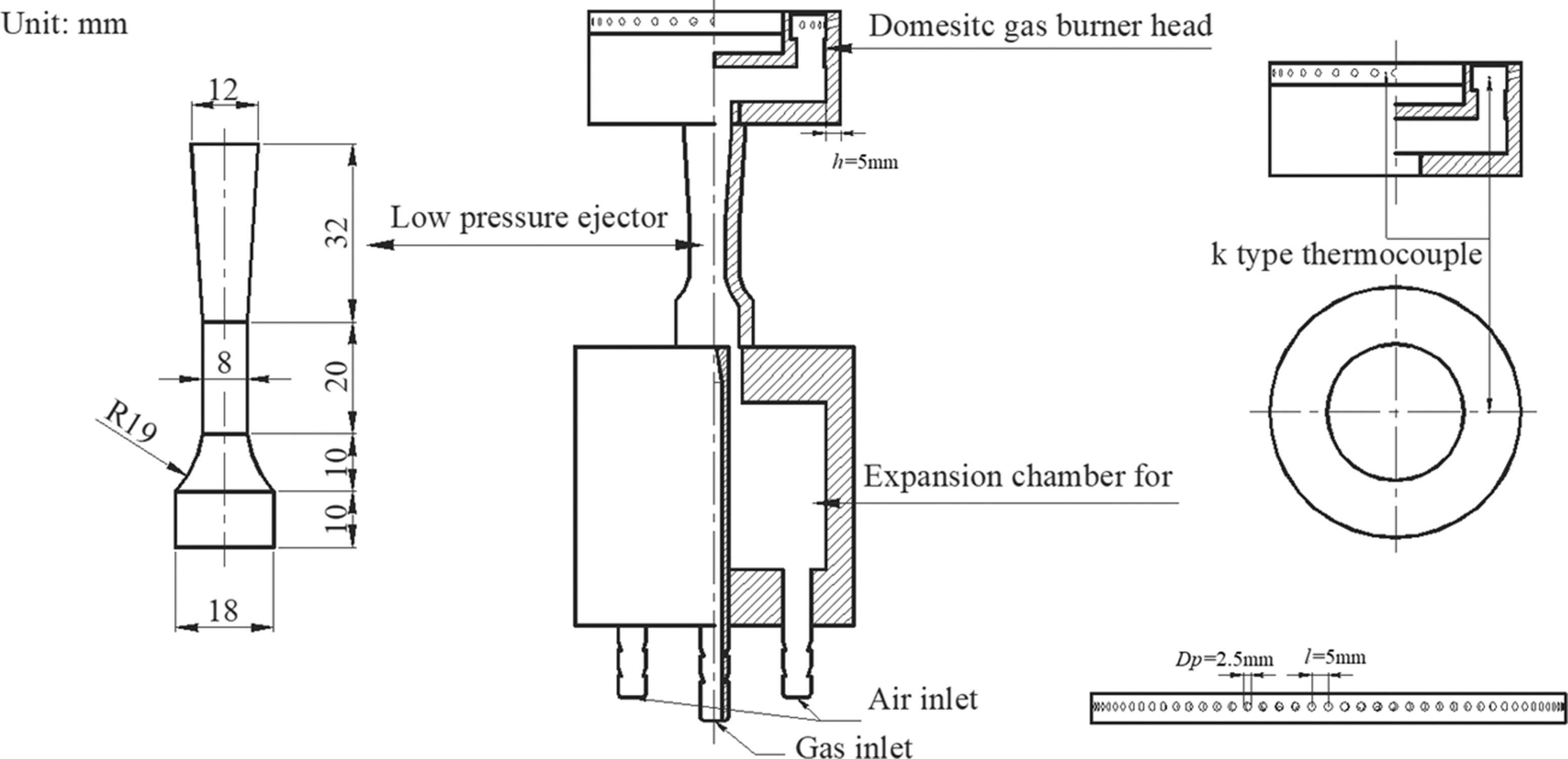
Schematic diagram of designed small-scale partially premixed combustor (SPPC).
In order to find the influence of burner material on combustion temperature and flame stabilization characteristic, two kinds of burner head with different materials, cast-iron burner head and copper–aluminum burner head, were designed, as illustrated in Figure 2.

The structure of cast-iron burner head and copper–aluminum burner head.
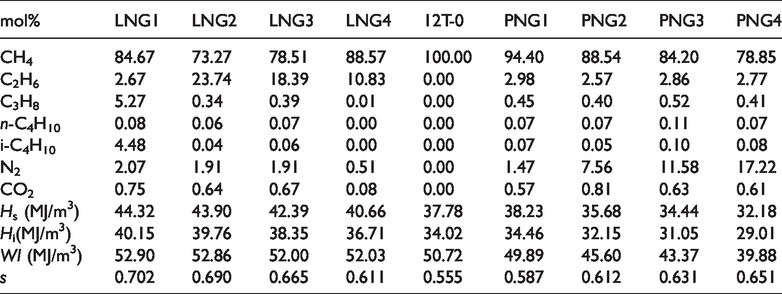
The SPPC test system is shown in Figure 3. Test air flowed through a wet gas flow meter with full scale of 6 m3/h and ±0.1% full scale (FS) precision. Experimental sampled gas stored in a 5-m3 storage tank piped through a soap film flow meter with test range of 0.001 to 30 L/min and ±0.1% FS precision to SPPC. Test gas was sampled from the pure gas sampling point and analyzed by means of gas chromatography. All temperature data were recorded by a computer, and a digital camera was used to record the form of flame. The composition and properties of test gases are listed in Table 1, including 100% CH4, namely 12T-0, 4 kinds of LNG, and 4 kinds of PNG, arrangement according to the order of Wobbe index, which is calculated by dividing gas’s calorific value by the square root of its relative density to compare the combustion energy output of different fuel gases. These test gases can basically represent the natural gases used in China. The primary air ratio, which is defined as the ratio of mixed air to the amount of air required for complete combustion, was controlled by adjusting the mixing ratio of gas to air. The flame stabilization characteristic and burner temperature were tested under different port thermal intensity.
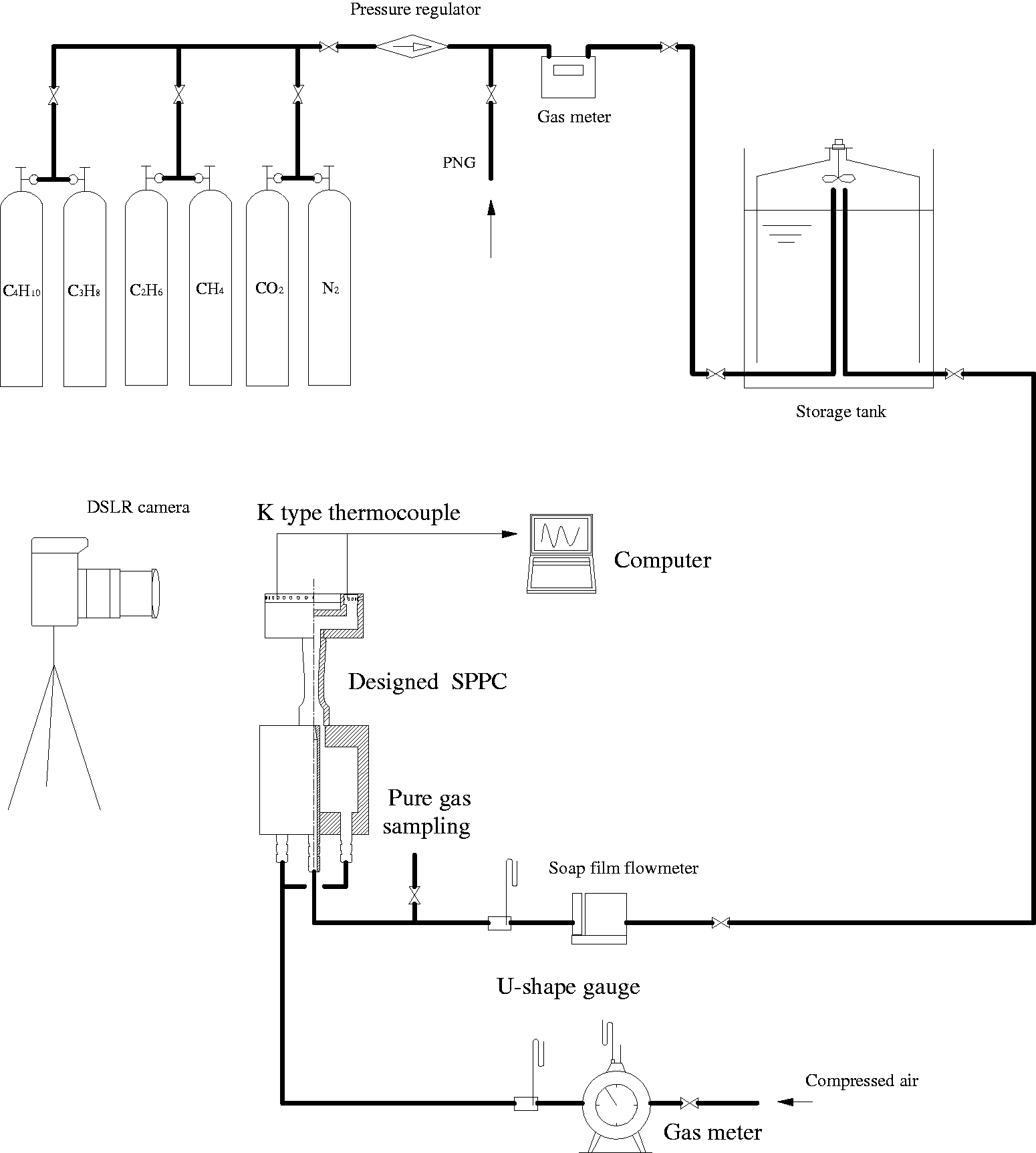
Schematic diagram of gas blending and test system.
Constituents and properties of tested gas (101.325 kPa, 15°C).
The test method of yellow tip flame is described as follow: igniting and preheating the SPPC for 10 to 15 min without lifting, flashback, and yellow tip; after preheating, lowering the gas flow, and fitting the air flow to make yellow tip appear, then increasing the air flow gradually till the yellow tip just disappears, recording the flow rate values and the two temperature values when the burner temperature is kept in a stable range; repeating the above test procedures under different gas flow rates to test yellow tip characteristic of SPPC on different primary air ratios and port thermal intensities. The test method of lifting flame is quite similar, with the only difference that after preheating is completed, the gas flow rate is kept in a certain value, and the air flow rate increases gradually till the appearance of lifting flame (more than 1/3 flame holes without fire), then recording each test value. The test results of yellow tip and lifting on LNG2 with different primary air ratios and port thermal intensities are illustrated in Figures 4 and 5 as a sample.
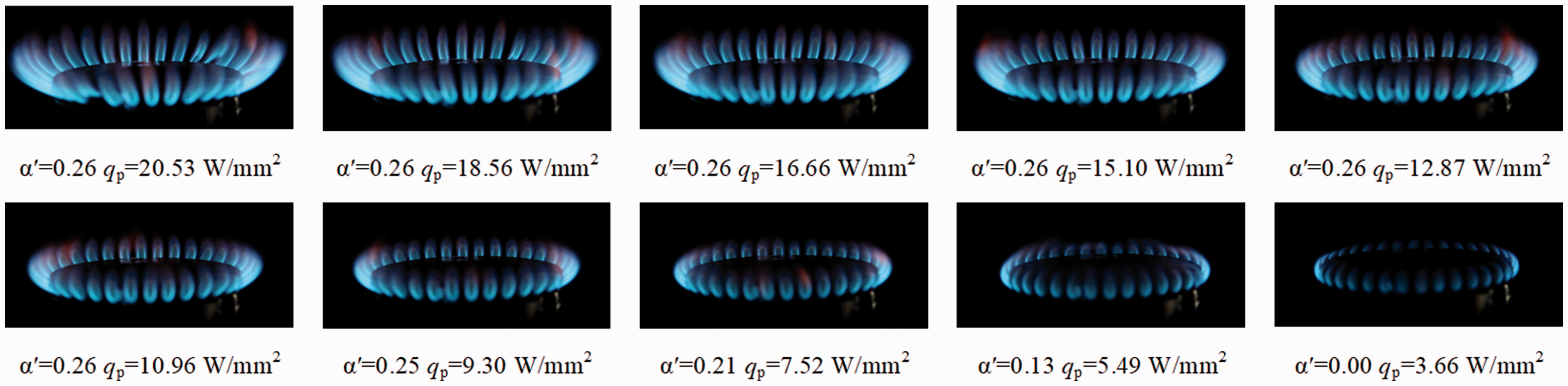
Yellow tip test results on LNG2 with different primary air ratios and port thermal intensities.
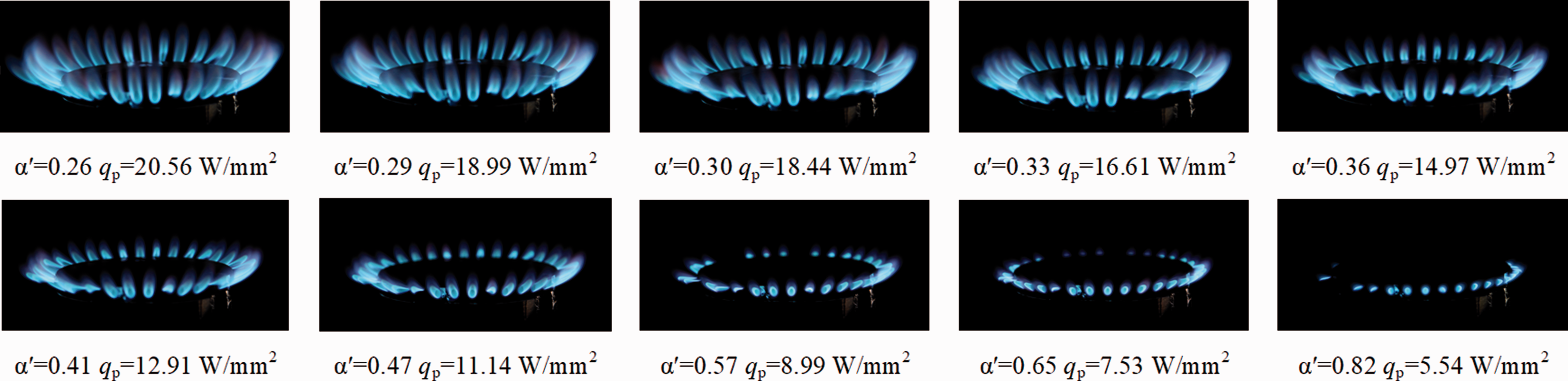
Lifting test results on LNG2 with different primary air ratios and port thermal intensities.
Results and discussion
Test on different burner materials
In this section, we will discuss the flame stabilization characteristic and head temperature of SPPC on cast-iron burner and copper–aluminum burner with four kinds of natural gas, namely 12T-0 (W = 50.72 MJ/m3), PNG1 (W = 49.89 MJ/m3), PNG4 (W = 39.88 MJ/m3), and LNG2 (W = 52.86 MJ/m3). According to the experimental method described above, temperature of gas/air mixture and flame root of two burners with different port thermal intensities were tested and shown in Figures 6 and 7, the solid line represents the temperature of cast iron burner when lifting and yellow tip appear, and the dotted line represents that of copper–aluminum burner.
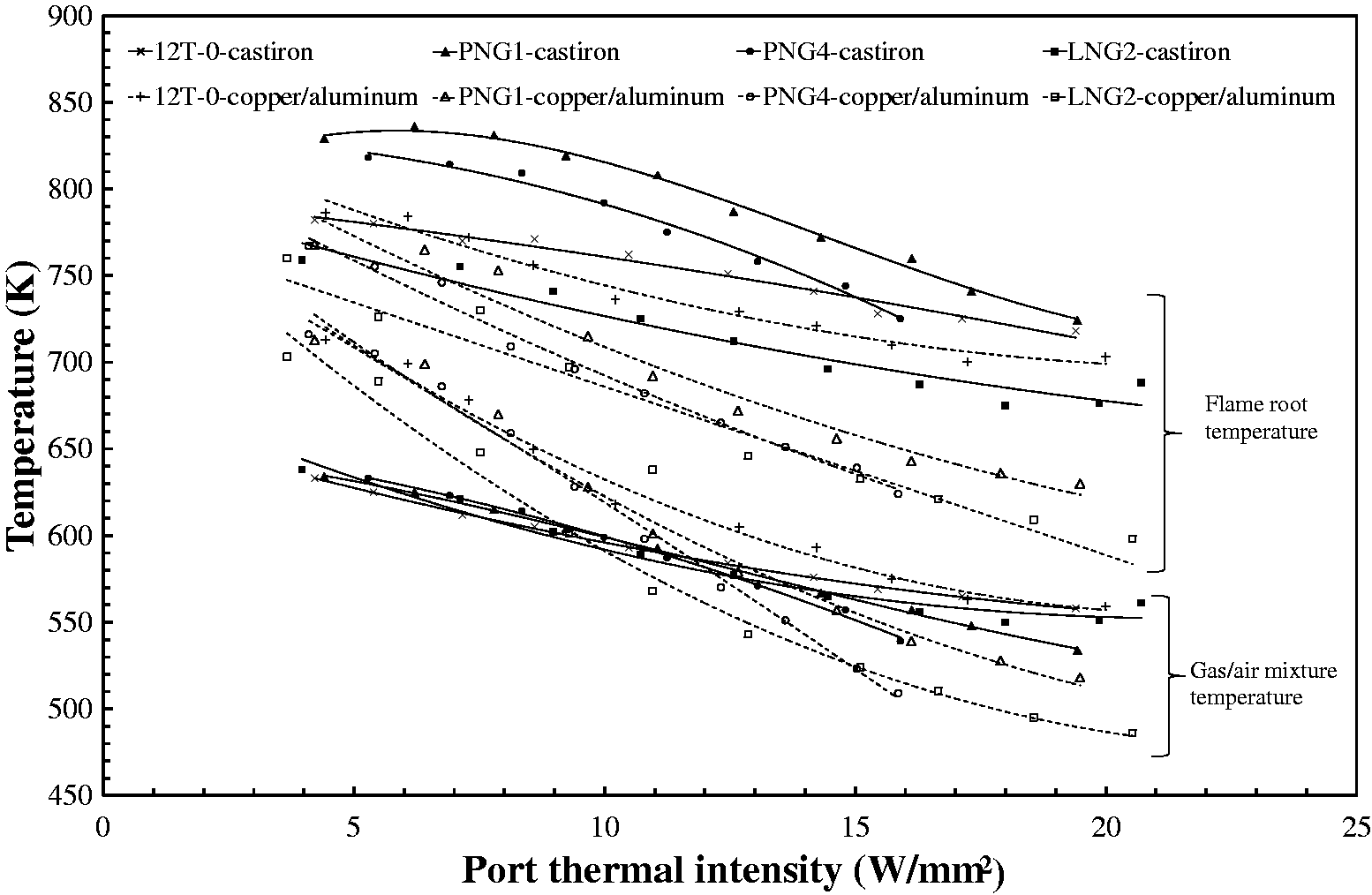
The temperature change of two kinds of SPPC with port thermal intensity when yellow tip happens.
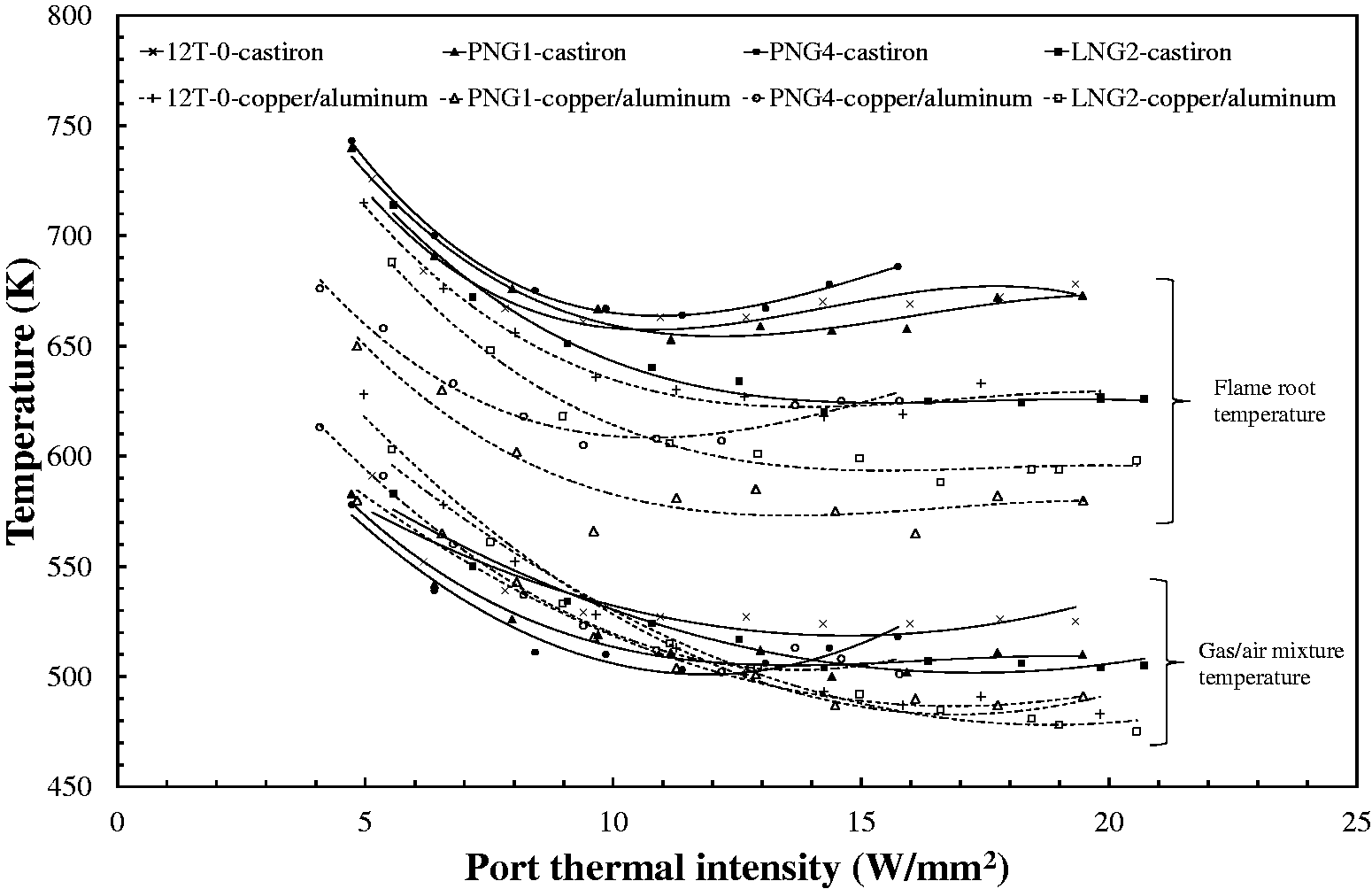
The temperature change of two kinds of SPPC with port thermal intensity when lifting happens.
It is found that when lifting and yellow tip appear, the flame root temperature of the cast-iron burner is higher than that of the copper–aluminum burner, using the same kind of natural gas. The gas/air mixture temperature of the copper–aluminum burner is little higher than that of the cast-iron burner with low port thermal intensity, while the two are very close when burners’ port thermal intensities are high. Comparing the four kinds of natural gases, the temperature of the cast-iron burner shows a slow tendency of temperature changing, while the tendency of the copper–aluminum burner is obvious, especially in lifting situation. Both the temperature decreases with the increase of port thermal intensity on the two burners, while the temperature drop of the cast iron head is relatively slow.
The reason why the phenomenon above happens is that the surface of the cast-iron burner is rough and black, which leads to greater radiation heat transfer than conduction heat transfer, while the light and smooth surface of the copper–aluminum burner has an opposite heat transfer effect. The cast-iron burner can absorb more radiation heat from flame, leading to higher flame root temperature. On the contrary, the inner temperature of the copper–aluminum burner is higher, resulting in a higher gas/air mixture temperature. When the flame temperature changes with different component or port thermal intensities, the radiation heat of flame will be different, and for the surface of the copper–aluminum burner, whose radiation absorption rate is low and conductivity coefficient is high, the temperature of head points can be easily affected, then making the burner very sensitive to temperature fluctuation. It means that when lifting or yellow tip appears, it is easier for the cast-iron burner to maintain its temperature than the copper–aluminum burner.
Figures 8 and 9 illustrate the relationship between air flow rate and gas flow rate when yellow tip and lifting appear on two kinds of SPPC with four kinds of natural gas. It can be concluded from Figure 8 that when the gas flow rate is the same, lifting appears at a very low air flow on the copper–aluminum burner, which means that lifting is more likely to appear than the cast-iron burner, and the flame root temperature has a similar pattern as shown in Figure 7. As shown in Figure 9, when yellow tip appears, the two kinds of SPPC have the same distribution trend of air flow rate. It means that the impact of the change of gas burner temperature caused by burner materials on characteristic of yellow tip is not serious. According to the combustion theory, lifting is very sensitive to the fluctuation of gas burner temperature, since lifting will cause an unstable combustion and then affect the burner temperature, which will in turn affect the lifting flame through changing the air–gas ratio which can strengthen the lifting.
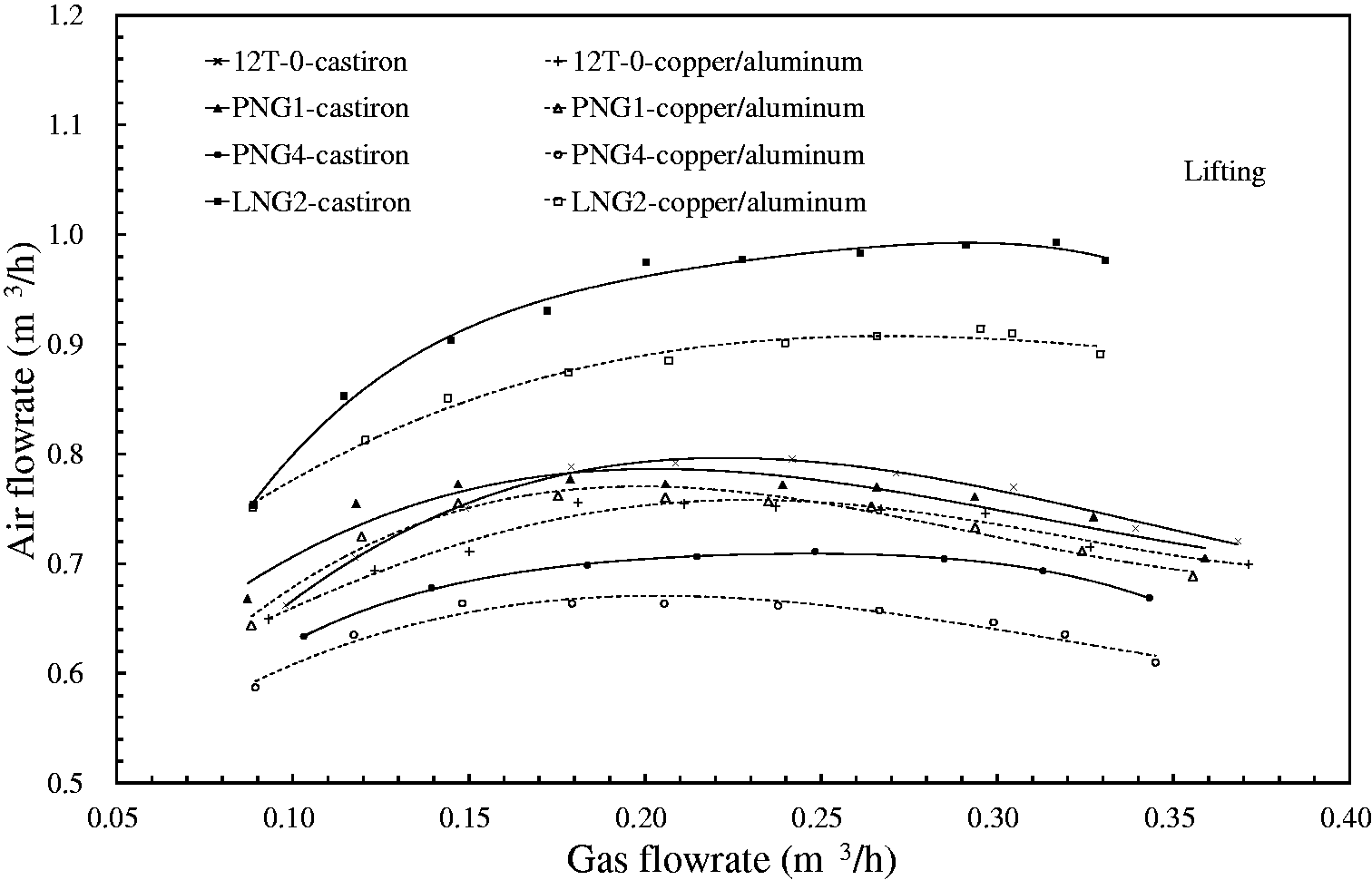
The relationship between air flow rate and gas flow rate when lifting appear on the two kinds of SPPC.
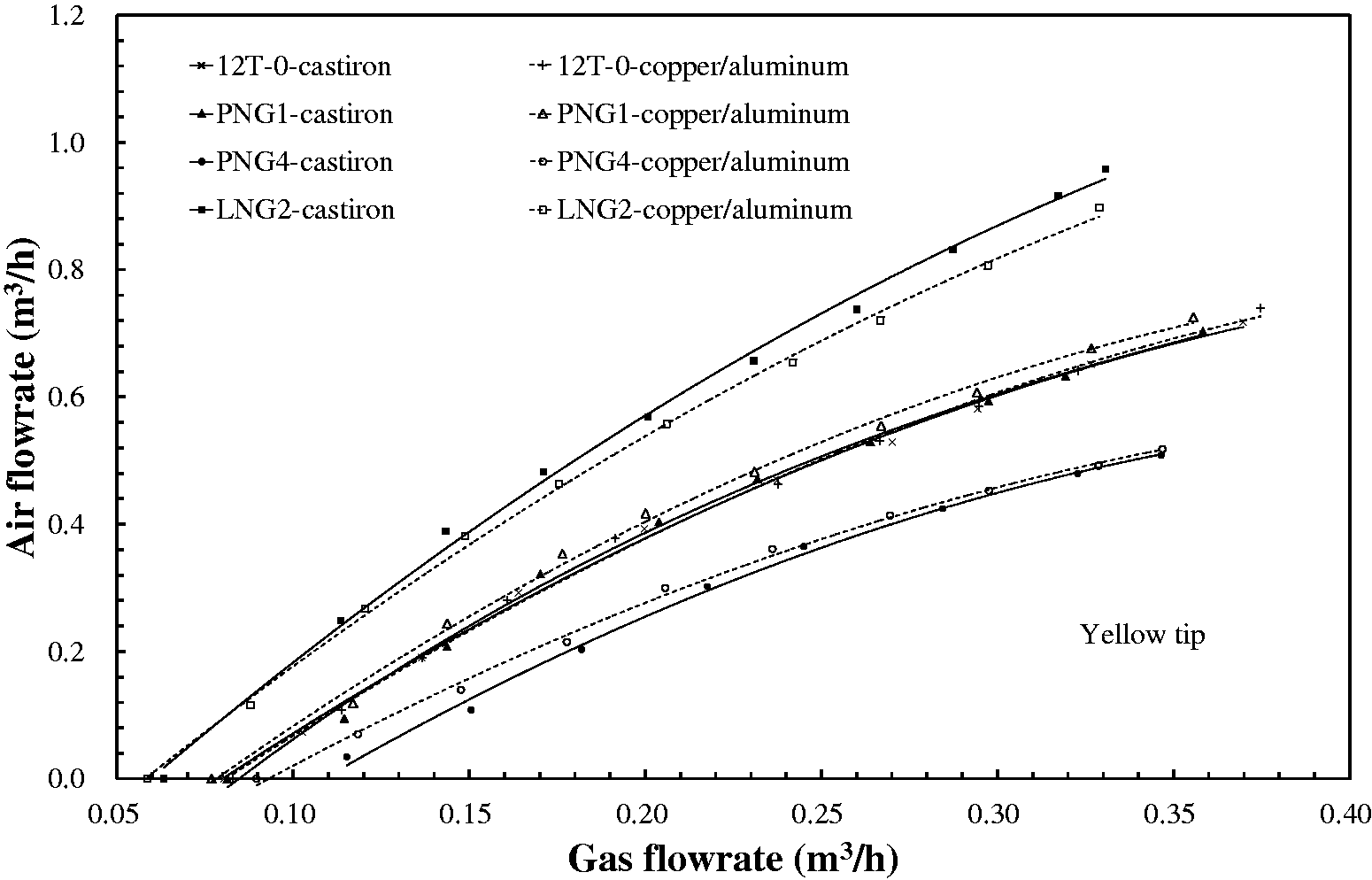
The relationship between air flow rate and gas flow rate when yellow tip appear on the two kinds of SPPC.
Different natural gas composition on cast-iron burner
In this section, the SPPC with the cast-iron burner were tested using five kinds of PNG and four kinds of LNG listed in Table 1. The influence of temperature and the relationship between combustion characteristic and gas composition were discussed. In the following figures, the solid line represents PNG, and the dotted line represents LNG.
Yellow tip characteristics with different natural gas composition
Figures 10 and 11 show the curve of yellow tip of different PNG and LNG with different transverse ordinates. The relationship between air flow rate and gas flow rate shown in Figure 10 illustrates that when yellow tip appears, the air flow rate increases from PNG4 to LNG1 with the Wobbe index increasing successively at a certain gas flow rate. It means that with a certain heat load, the higher the Wobbe index of natural gas is, the more air is needed to eliminate the yellow tip flame. Each gas has a certain gas flow, with which the yellow tip is just eliminated while there is no air flow, and that certain gas flow value decreases with the increase of the Wobbe index of the gas.
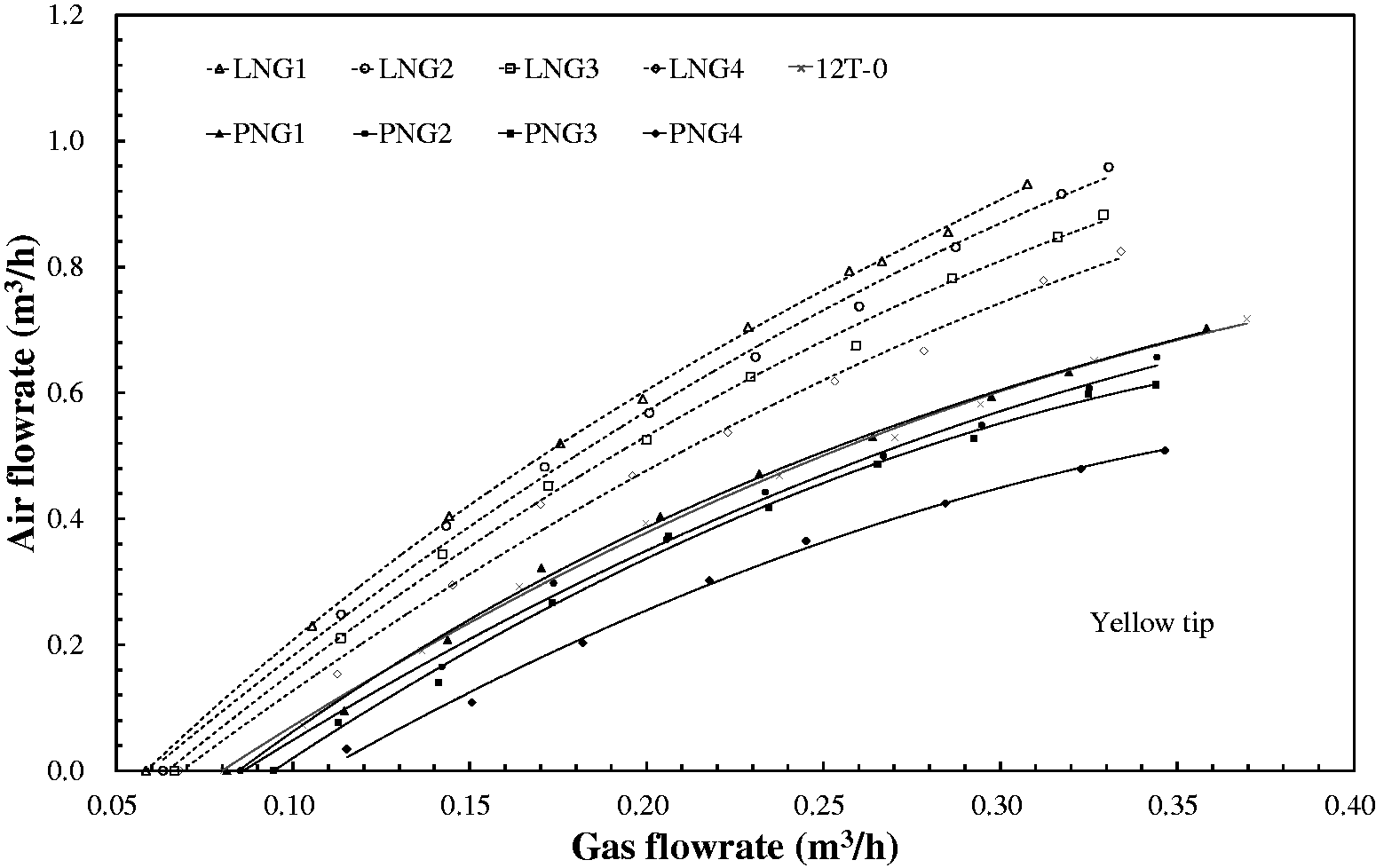
The relationship between air flow rate and gas flow rate when yellow tip happens on different natural gases.
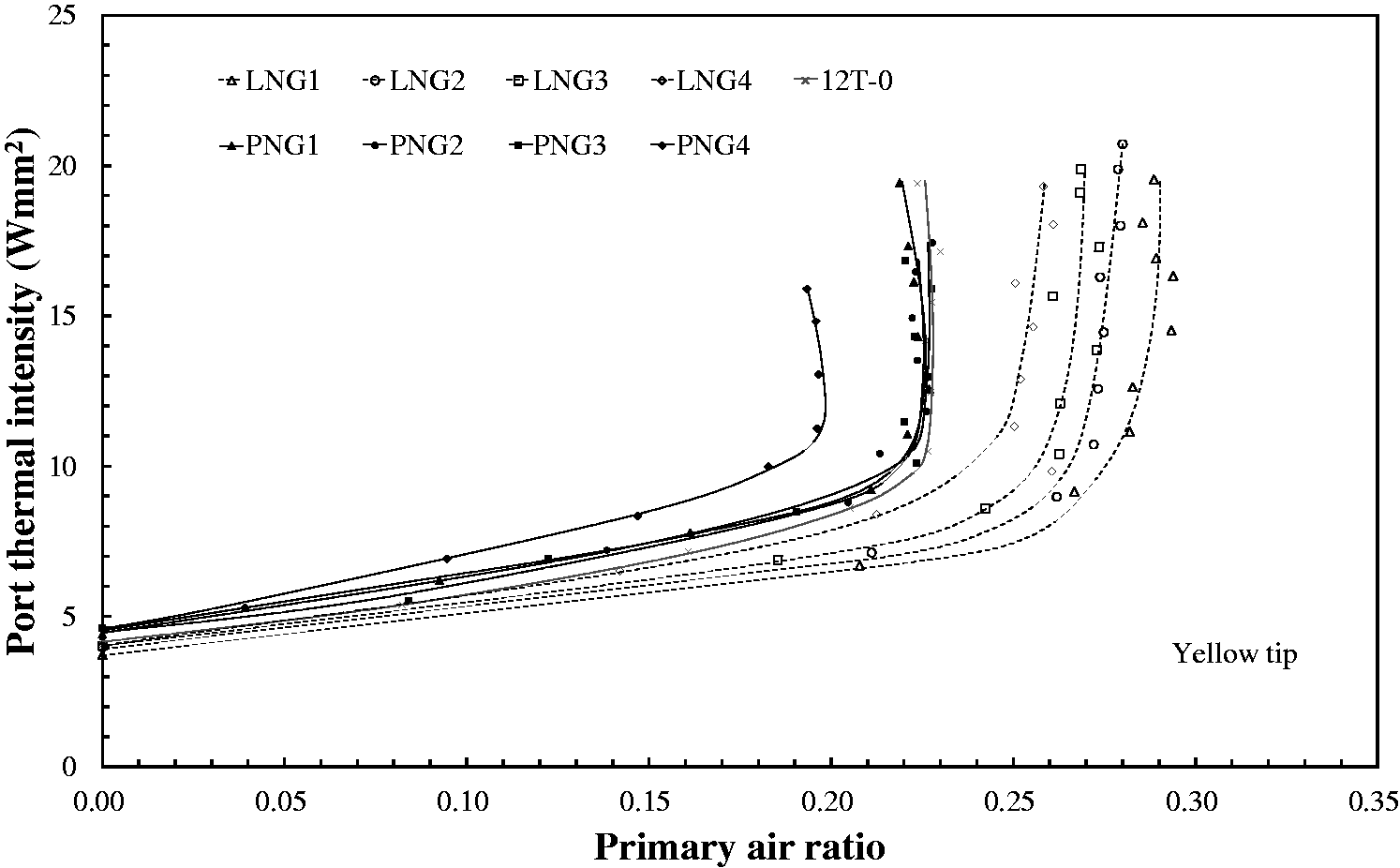
Yellow tip curve of different PNG and LNG.
Yellow tip characteristic shown in Figure 11 illustrates that the primary air ratio is larger when yellow tip appears with the increase of Wobbe index from PNG4 to LNG1 and there is a limit curve of yellow tip. For a certain kind of natural gas, when the air flow reaches a certain value, the occurrence of yellow tip is only affected by the burner heat load, and the position of the curve will go rightward when the Wobbe index value increases. Except for PNG4, the curve of yellow tip of PNGs are almost at the same position of the curve of 12T-0, while there is a certain distance between the lines of LNGs, although the Wobbe index values of LNGs are even closer. In addition to the Wobbe index, the main difference between these natural gases is the ratio of heavy hydrocarbons. Yellow tip is most likely to appear with LNG1 whose heavy hydrocarbon fraction is the highest (4.56% C4H10, 5.27% C3H8, and 2.60% C2H6), followed by LNG2, LNG3, and LNG4 with the C2H6 fraction changing from 23.74% to 10.83%. For the PNGs, there are hardly any other heavy hydrocarbon components except 2.5% C2H6 fraction in each. In addition to Wobbe index, the heavy hydrocarbon fraction is the main factor to influence yellow tip characteristic of domestic gas appliances burning natural gas.
Lifting characteristics with different natural gas composition
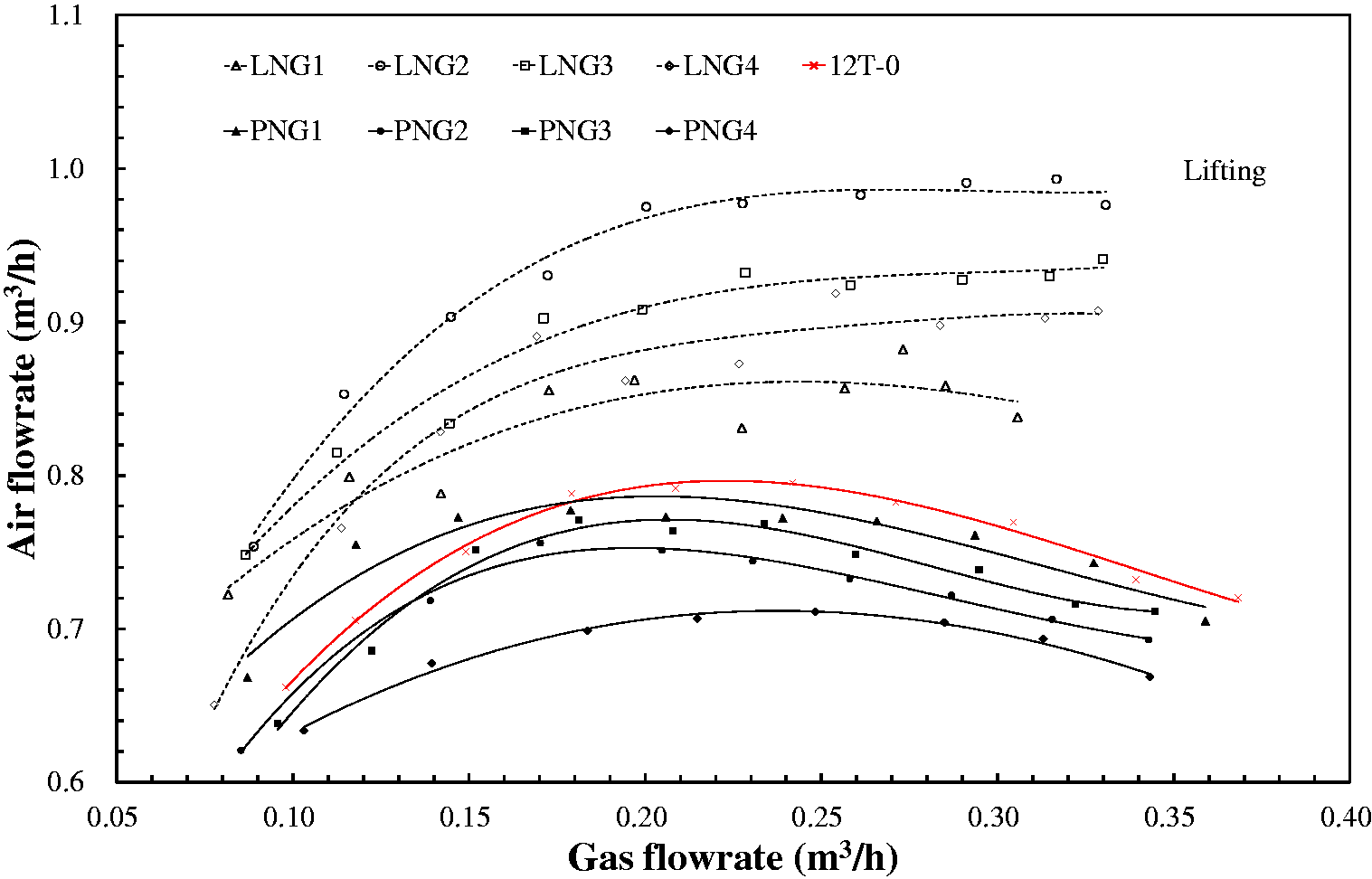
The law of the appearance of lifting is different from that of yellow tip, for it does not regularly change with the Wobbe index, as shown in Figure 12. Compared with LNG, lifting is more likely to appear with PNG, and the lifting curves of LNG and PNG are separated by the curve of 12T-0. The values of the Wobbe index of LNGs are very close, but the distribution of lifting curves gradually moves down by LNG2, LNG3, LNG4, and LNG1, while the C2H6 fraction reduces from 23.74% (LNG2) to 2.67% (LNG1). For PNGs, with the increase of N2 fraction (PNG1 1.47% to PNG4 17.22%), the lifting curve moves down. Inert gas such as N2 will reduce the combustion temperature for its high calorific capacity and finally lower the flame speed. The lifting characteristic is related to flame speed directly, the slower the flame propagation speed is, the more likely the lifting flame will occur. Therefore, with the constant Wobbe index of gases, the increase of the fraction of C2H6, which has a faster flame propagation speed than CH4, will reduce the possibility of flameout to a certain extent, while the inert gas fraction has the opposite effect.
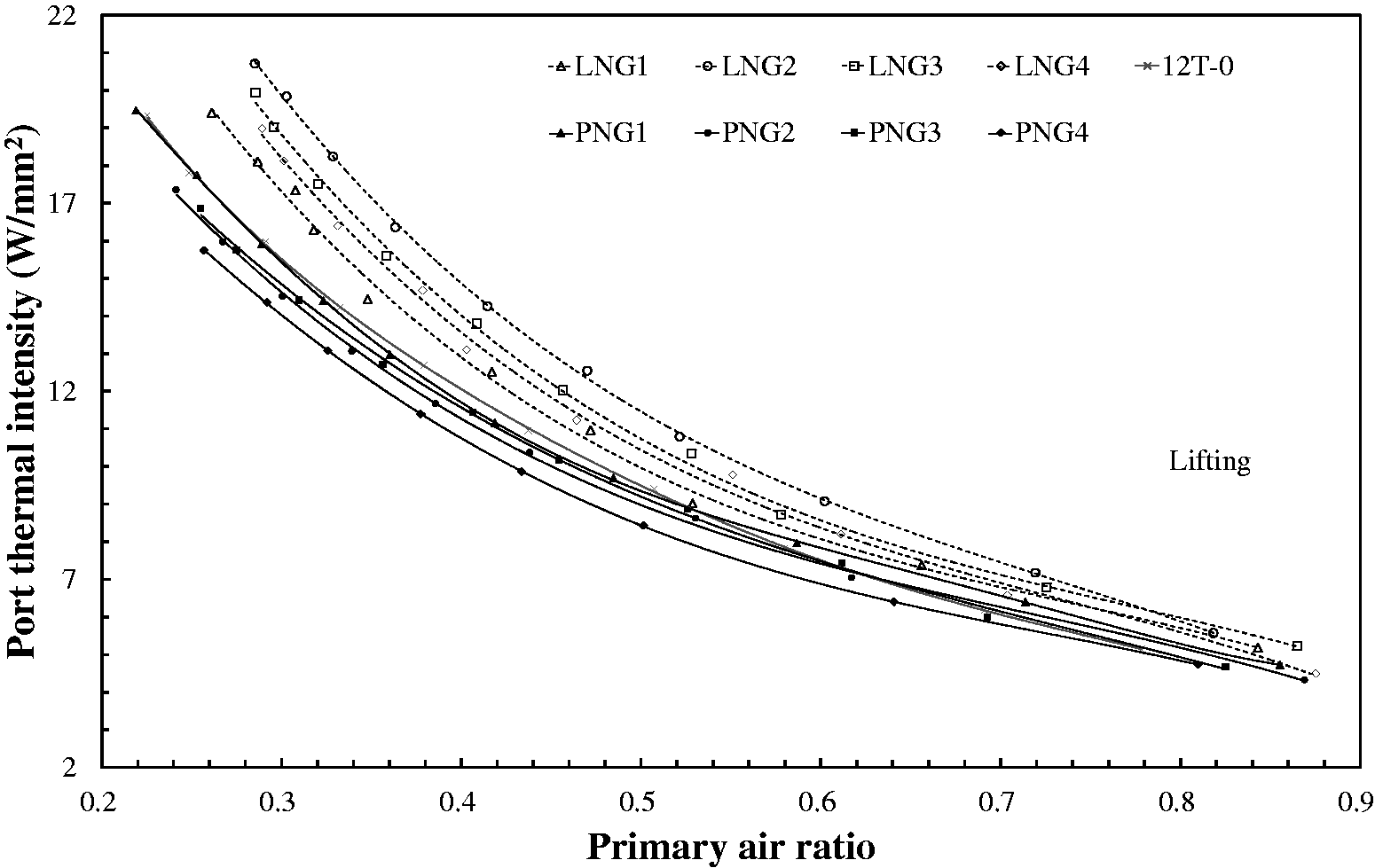
Lifting curve of different PNG and LNG.
Figure 13 shows the relationship between air flow rate and gas flow rate when lifting appears with different natural gases. The lines of air flow rate of LNGs, which have high Wobbe index, are higher than PNGs’ at the certain gas flow rate. When gas flow rate is low, the air flow rate will obviously increase with the rise of gas flow rate, and the increase trend of LNG is more obvious than PNG’s, while the gas flow rate is high, the air flow rate of LNG will be constant and that of PNG will reduce. It means that when air flow rate increases to a certain value, lifting will appear for sure and will hardly disappear by the increase of gas flow rate. Therefore, the best way to prevent lifting is to reasonably select the amount of ejected premixed air.
The relationship between air flow rate and gas flow rate when lifting happens on different natural gases.
Temperature changes with different natural gas composition
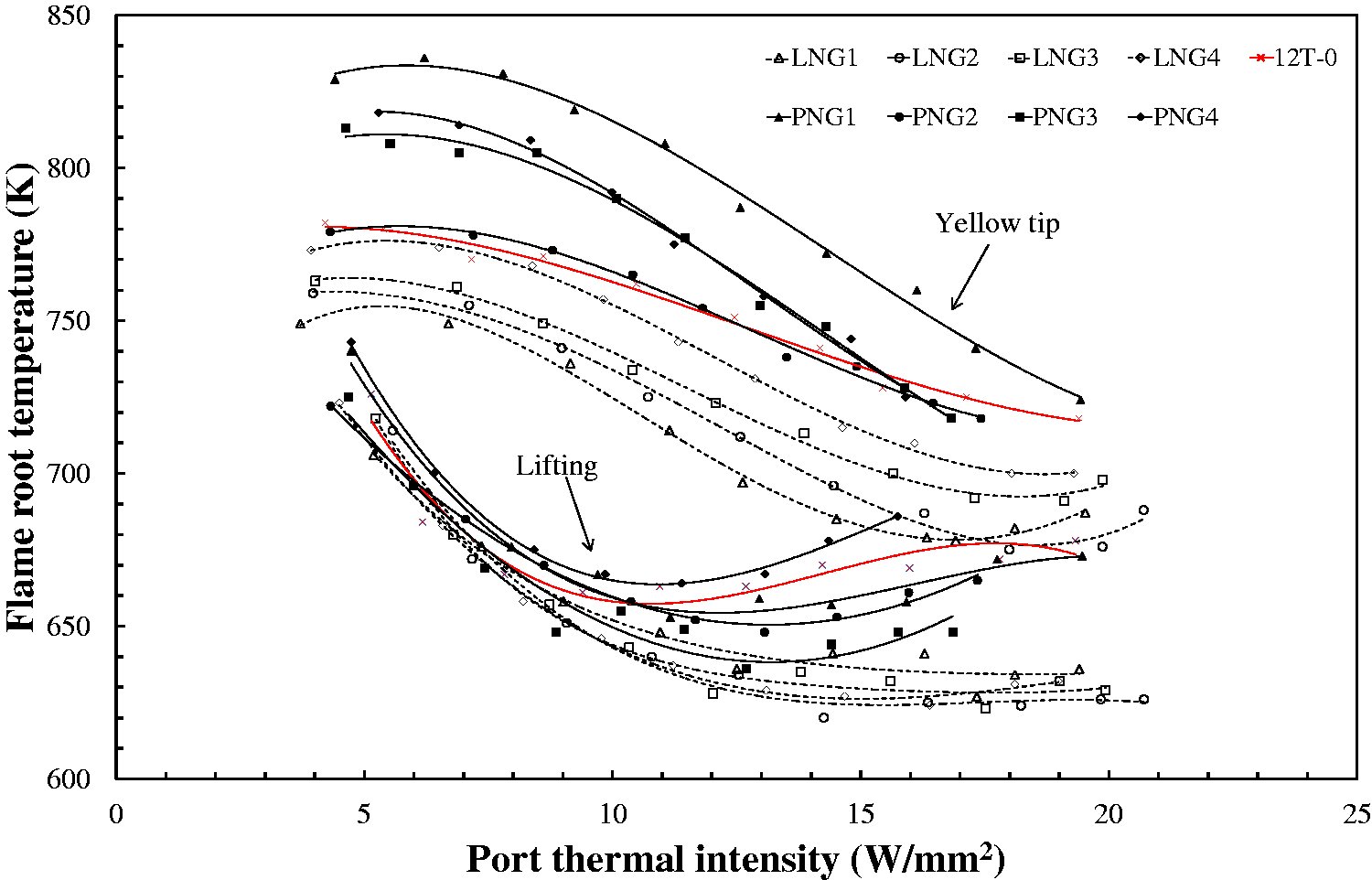
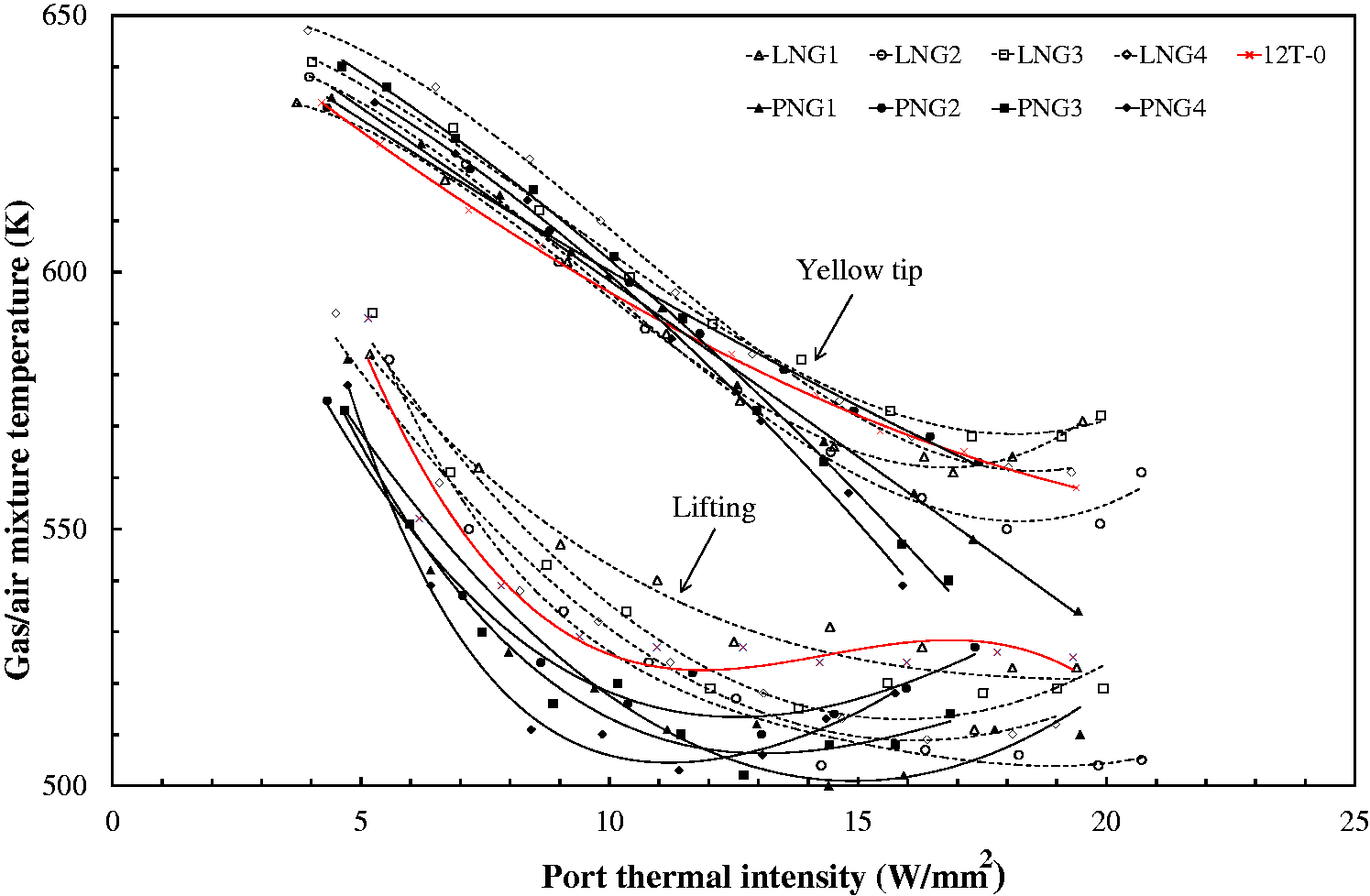
The temperature change of flame root and gas/air mixture temperature with port thermal intensity is shown in Figures 14 and 15 respectively, when yellow tip and lifting flame appear on SPPC. It is obvious that both temperatures of yellow tip flame are higher than the lifting flame.
The change of flame root temperature with port thermal intensity.
The change of gas/air mixture temperature with port thermal intensity.
When lifting flame appears, the flame root temperature and gas/air mixture temperature will rapidly drop firstly and then remain steady with the increasing port thermal intensity. After the port thermal intensity increases to more than 10 W/mm2, there is an inflection of the flame root temperature and the gas/air mixture temperature, after which two temperatures will no long decrease with the increase of the port thermal intensity. For PNG, the inflection temperature is re-raised, with the air flow rate reducing in high port thermal intensity when lifting flame appears. As the temperature decreases, lifting will be strengthened, and the distance between flame and fire hole will increase. The flow rate of the air injected into burner will remain in a fixed value or even decrease, as shown in Figure 13. With the mutual effect of combustion and heat transfer, the burner head will reach a heat balance, and the lifting will no longer be strengthened.
The flame root temperature and gas/air mixture temperature of yellow tip regularly decrease with the increasing port thermal intensity, and the flame root temperature of PNG is 100 K higher than that of LNG. The main reason is that when the port thermal intensity is low, the inner core of flame is short and the distance between flame and flame root is close, so the radiation heat transfer has a great impact therefore leading a higher temperature. On the other hand, the air flow rate of LNG is higher than that of PNG, so when yellow tip appears, as shown in Figure 10, more air is injected into burner leading a lower flame root temperature compared with PNG.
Conclusions
In this article, a SPPC was designed, and the burner head temperature and the premixing ratio of gas and air were experimentally tested with different burner head materials using the SPPC testing system. The lifting and yellow tip characteristics of SPPC are discussed when natural gas is substituted.
Burners with different materials show different performance, even when they are supplied with the same gas. When lifting and yellow tip appear, the flame root temperature of the cast-iron burner is higher than that of the copper–aluminum burner, while the gas/air mixture temperature of the copper–aluminum burner is little higher. Both the temperatures decrease with the increase of port thermal intensity on the two burners, while the temperature drop of the cast iron head is relatively slow. Compared with the other burner, the cast-iron burner with higher radiation heat transfer and lower conductivity coefficient shows a more steady trend in temperature change, especially for lifting.
The yellow tip characteristic is affected by the Wobbe index and heavy hydrocarbon fraction. With the increase of the Wobbe index, the yellow tip is more likely to appear. Lifting is very sensitive to temperature fluctuation and has no direct relationship with the Wobbe index. When the change of natural gas composition leads to a big change of flame speed, the lifting characteristic of natural gas will also be affected seriously. For example, inert gas N2 will reduce the combustion temperature, leading to lifting flame, while the C2H6 fraction will reduce the possibility of flameout. To some extent, the yellow tip can be predicted by the Wobbe index, but it is unsuitable for predicting lifting.
The burner temperature will rapidly drop firstly and then remain steady with the increasing port thermal intensity when lifting flame appears. When yellow tip appears, the burner temperature regularly decreases with port thermal intensity increasing. As the air flow rate of LNG is higher than that of PNG, when yellow tip appears, the flame root temperature of LNG will be lower, compared with PNG.
Footnotes
Declaration of conflicting interests
The authors declared no potential conflicts of interest with respect to the research, authorship, and/or publication of this article.
Funding
The authors received no financial support for the research, authorship, and/or publication of this article.
