






Abstract
Over the last 50 years, nuclear energy has reduced US energy-related CO2 emissions by over 30 gigatons compared to if the same electricity were produced by fossil fuels such as coal and natural gas. However, many kilotons of spent nuclear fuel have accumulated at different sites across the country, and sociopolitical factors have frustrated efforts to address the challenge of nuclear waste disposal. Presently, a consolidated interim storage facility in Andrews, Texas, provides a promising temporary solution. In this paper, we compare the technical and policy risks of the project to continued storage at independent spent fuel storage installations. Our results indicate that the cost of the radiological risk is low (<$30,000) for both scenarios. However, policy and societal considerations will impact the viability of the proposed consolidated interim storage facility. The safety and suitability of this interim storage facility will be affected by when a permanent repository becomes available, whether insurance for offsite waste storage is available, and the impact of climate risks. Although a consolidated interim storage facility at Andrews can potentially serve as a safe and economically advantageous solution, we highlight why these concerns must be addressed for the successful implementation of this facility, and more broadly for the future of the US nuclear industry.
Keywords
Introduction
Nuclear Energy is the second-largest source of low-carbon electricity, providing 10% of electricity globally.1,2 According to some estimates, nuclear capacity must double by 2050 to limit global warming to 2°C above preindustrial levels. 3 Moreover, the low-carbon energy transition is expected to cost an additional $1.6 trillion if no nuclear capacity is added by 2040. 1 However, a combination of growing investment risks, unfavorable market economics, and public opposition to expansion has slowed down the addition of nuclear reactors. 4 In addition, a key consideration that will impact the future of the nuclear industry in the US is the absence of a permanent, that is, million-year, nuclear waste storage solution. 5
Even though nuclear materials have been used for energy generation for over 65 years, it is only recently that most countries have initiated varied efforts to develop a permanent repository for spent nuclear fuel (SNF) 1 . In some countries, the process involves community consultations to identify willing host communities. Contrarily, in countries like the US, insufficient public confidence poses a significant barrier to site selection despite strong support from the technical community. 6 Currently, the US has 81,000 metric tons of SNF at 23 decommissioned plants and 57 sites co-located with operating plants. 7 The Nuclear Waste Policy Act (NWPA) of 1982 set a goal of developing a permanent repository by 1998 and mandated nuclear utilities to pay into the Nuclear Waste Fund (NWF). 8 As a result, the US Department of Energy (DOE) selected nine sites in six states for review, of which Yucca Mountain in Nevada was chosen as the most suitable site for the permanent repository. The project was indefinitely suspended in 2010 after spending nearly $21 billion 9 on exploratory evaluation, predominantly due to sociopolitical pressures and the project's inability to build consensus within the scientific community and credibility with the public. 10
Rather than waiting for a permanent disposal site to be licensed, several entities in the US have proposed that a consolidated interim storage facility (CISF) be developed to host waste from decommissioned sites, also known as independent spent fuel storage installations (ISFSIs). Most recently, Interim Storage Partners (ISP) has applied for a license to host high-level nuclear waste (HLW) at a facility in Andrews, Texas. This facility has been treating, storing, and disposing low-level waste (LLW) since 2011 and is the only facility in the US that can accept all classes of LLW from anywhere in the country. 11 The facility hosts two sites, one owned by the Texas LLW Radioactive Waste Compact, and another by the federal government for usage by the US DOE. By the end of the 40-year proposal, ISP plans to transport 40,000 metric tons of SNF to the CISF in eight phases to facilitate the permanent closure of 36 ISFSIs, saving the US government $3.3 billion, according to one scenario from their application. 12 Notably, ISP demonstrates that economic benefits could vary from $400,000 to nearly $7 billion depending on the circumstances of the project's approval. Andrews County is in the hydrocarbon-rich Permian Basin in West Texas and houses a population of ∼19,000 people over 1500 sq. miles. Three-quarters of this population live in the city of Andrews, which is spread over an area of 7 sq. miles. 13
The region near the Texas and New Mexico border (Figure 1) has become a focal point for policy discussions on nuclear waste storage, owing to the sites near Andrews, Texas and Carlsbad, New Mexico, where the Waste Isolation Pilot Plant has been storing defense-related transuranic waste since 1999. When these projects were initiated, they had the support of local communities and the state governments, as they were expected to bring new jobs and related benefits to a region primarily supported by oil and gas activities, and thus susceptible to boom and bust cycles. For the current proposal, ISP claims that the CISF will create 4550 jobs over its lifetime, generating a stable economic output of $800 million. 14 However, the basis of the economic output has not been clarified and the analyses have not been vetted by neutral third-party agencies. At present, the uptake of the Andrews site has been delayed due to concerns raised by a diverse set of regional stakeholders, including the Governor of the State of Texas, Greg Abbott. 15 The public health and safety, environmental impact, energy security, and national security implications of the project have been highlighted by the stakeholders, of which the most predominant concerns are potential impacts from the transportation of SNF to the site and the site's proximity to oil and gas fields of the Permian basin, which accounts for 40% of oil and 15% of natural gas production in the US. 16

Map of the United States with circles indicating the location of ISFSI sites presently storing SNF (blue), the proposed CISF in Andrews, TX (green), the Waste Isolation Pilot Plant in Carlsbad, NM (orange), and the failed repository site at the Yucca Mountain, NV (black). Dotted lines indicate the Permian Basin (yellow) and the Ogallala Aquifer (blue).
Numerous convoluted and interconnected issues such as economics, radiological safety, political salience, public opinion, and geopolitics play a significant role in the decision-making process, making it historically challenging to perform a risk assessment on nuclear projects.4,17 Many analyses, like those included in ISP's application, do not fully account for policy, financial and societal risks, and their potential consequences to the public.12,18–20 Notably, ISP neglects to consider terrorism, which we demonstrate here to be the class of incident most likely to cause a consequential discharge of radioactivity.
In this work, we address these issues by providing a comprehensive and independent analysis of risks posed by the proposed project in Andrews, Texas. Our analysis is focused on three key questions: what are the technical risks of transporting and storing SNF at a CISF compared to continued ISFSI storage? What policy and societal risks will influence decisions on SNF storage? Under which scenarios do the benefits of consolidated storage outweigh its risks and costs? We integrate these elements and discuss their risk costs to compare hazards coherently and transparently. We analyze foreseeable events that could compromise the integrity of waste storage containers to quantify a radiological risk cost, which represents the financial cost of the projected consequences from discharged radioactivity, for the two SNF storage alternatives. We use the calculated risk costs as a basis for identifying the measures that are necessary to enhance the safety of SNF storage. Given the Nuclear Regulatory Commission (NRC) environmental impact assessment and the staff's recommendation that the first phase of the CISF should be granted a license, we also discuss the technical, policy, and societal risks that have not received commensurate attention in ISP's and NRC's analyses. 12
Methods
Risk model
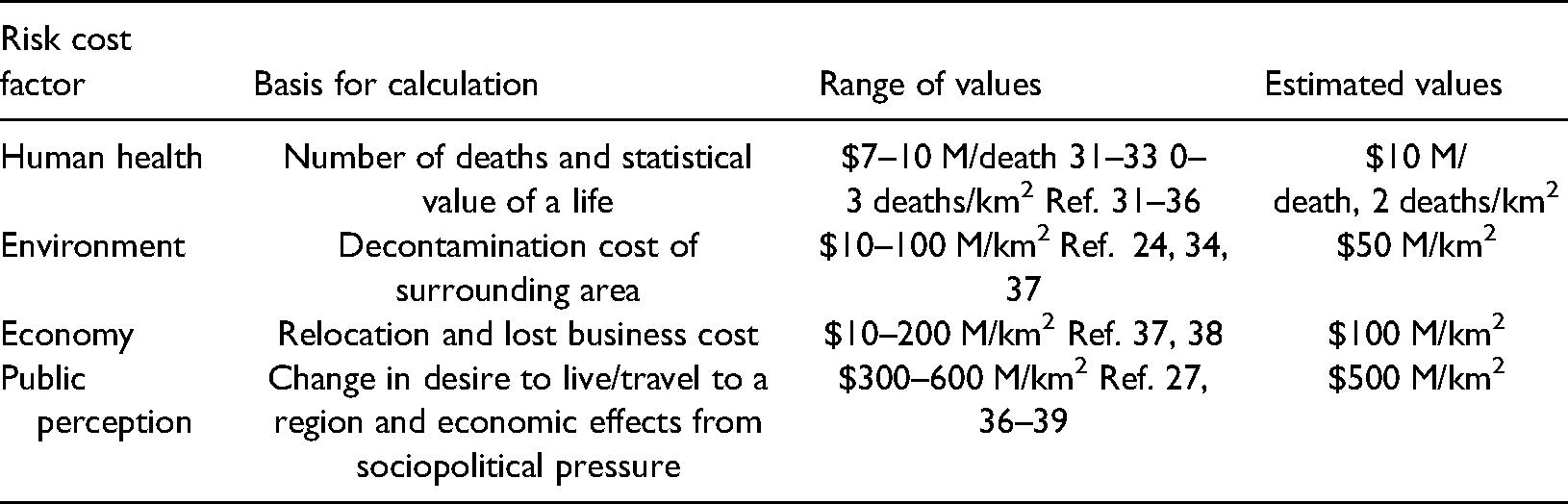
In this section, we describe the model used to quantify the radiological risk cost for incidents that could discharge radioactive material during the transportation and storage of SNF. Typically, such an incident would have significant consequences on the surrounding region; however, we will demonstrate that its probability is exceedingly low. Unfortunately, the complexity of these events obfuscates efforts to precisely quantify both the probability of occurrence and potential impacts. The risk analysis presented here follows a reported method for analyzing high-risk, low-probability events wherein we calculate a radiological risk cost (Calculations section) by discretizing the potential costs into separate classes. 21 In accord with previous studies,21,22 we selected four factors, which contribute to the risk cost: (a) cost to human health, (b) cost of cleaning the environment, (c) direct cost to the economy, and (d) cost associated with public perception; the bases for calculating these costs are presented in Table 1. These four factors are used to calculate a risk cost for each of the four potential incidents presented in Table 2, that is, terrorism during transit, terrorism during storage, accident during transit, and accident during storage. These four classes of events encompass any possible cause, intentional or accidental, of discharged radioactivity during active transit or passive storage.
Individual factors contributing to the total risk cost and approximate valuations used in the model for urban areas.
Cost per incident for terms contributing to the total risk cost, where costs are not discounted and
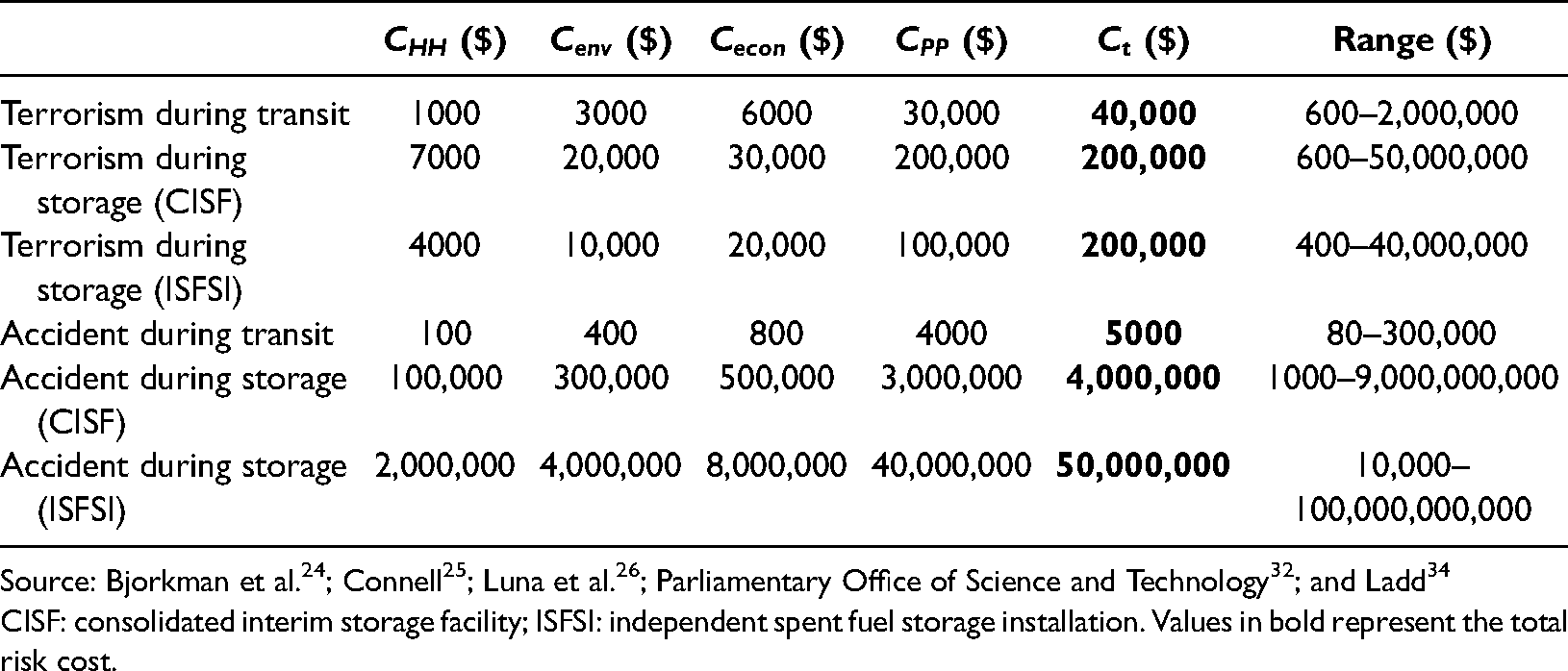
Source: Bjorkman et al.24; Connell25; Luna et al.26; Parliamentary Office of Science and Technology32; and Ladd34
CISF: consolidated interim storage facility; ISFSI: independent spent fuel storage installation. Values in bold represent the total risk cost.
Assumptions
Our key assumptions regarding nuclear waste transportation and storage are as follows:
Waste casks are designed and built per specifications required by the NRC. Waste casks are thoroughly tested for their ability to safely transport and store SNF.22,23 The four potential incidents that could result in discharge of radioactivity are considered as independent events.
24
For incidents during transit, costs in rural areas are 100 times lower than for a similar incident in cities or other areas of significant economic import. Based on an analysis from Sandia National Laboratories,
25
costs in rural areas are expected to be lower than this assumed cost; however, we use this conservative estimate because it is challenging to predict how a rural incident will affect public perception. Small amounts of aerosolized particles, when released, are diluted rapidly under relevant wind conditions.
26
In total, 3,400 type B waste casks will be transported to the CISF in Andrews, Texas via train from 36 sites that have been decommissioned or are close to decommissioning.22,23 Each cask contains 500 kCi worth of radioactive material.
28
The CISF will store SNF casks above ground for 40 years, at which time the site will require relicensing if a permanent disposal solution is not available.12,14
We also use several details from ISP's application in our model:
In Table 1, we present the values assumed for each of the four factors, which were derived from experimental estimates, predictive models, and historical records of exposure to radioactivity.25,29–37 Even though the challenges associated with predicting or quantifying risk associated with high-risk, low-probability events cannot be understated, we illustrate that radiological risk costs associated with HLW are considerably less significant compared to other relevant risk factors.
Calculations
For each of the four independent incidents outlined above (e.g. terrorism in transit), we calculated the risk cost (
Policy risks
We evaluate the scope, delivery, and impact of current policies and regulations that are most likely to either prevent the success of this project or pose a significant hazard to human and environmental health to assess the policy risks associated with this project. We analyze the financial, societal (consisting of political, institutional, ethical, and health and safety risks), and climate risks 3 associated with the project based on their direct and associated costs or through the cost of insuring against the risks. We allocate project-specific costs, wherever applicable, and discuss how these elements interact with technical risks to identify the most pressing challenges facing the proposed project, and more broadly, nuclear waste projects in the US.
Results and discussion
Quantitative risk analysis of technical risks
In this section, we quantify the radiological risk cost by modeling each risk associated with two alternatives for storing nuclear waste, that is, the proposed CISF in Andrews and continued ISFSI storage. We compare the two options based on their respective risk costs and conclude with a comprehensive description of the significance of our results.
Transportation and storage of SNF are the two phases during which a radiological incident can occur. Of these, only the storage phase is relevant to the ISFSI scenario. We do not account for SNF transportation from CISF/ISFSIs to a permanent repository in this section as we do not know where the repository will be located. During each phase, accidents and acts of terrorism pose a threat of radioactive discharge. While ISP did not account for the latter in their analysis, 12 we demonstrate below that acts of terrorism are associated with a higher risk cost than accidents because they are more likely to result in the release of a significant amount of radioactive material, even though the likelihood of occurrence for an act of terrorism is substantially lower than that of an accident.
Acts of terrorism
A significant challenge associated with calculating the probability of acts of terrorism is their unpredictable nature. Here, we use ton-mile as a fundamental unit to estimate historical rates of terrorism for several modes of transportation, that is, airplane, train, truck, and boat. The likelihood of an act of terrorism for these modes ranges between
Terrorism during transit
For casks being transported, one study demonstrated that even a fully penetrated cask would only discharge 4% of its material (∼20,000 Ci).32,38 In another study, Sandia National Laboratories demonstrated that in a more realistic scenario less than 0.4% (∼2,000 Ci) of radioactive material would be released, only 0.5% of which is aerosolized. 26 Specifically, computational simulations of casks impacted by state-of-the-art weapons reveal that 0.00002–0.0003% of the contents are aerosolized. 26 In such a scenario, the area wherein humans are at risk of exceeding the maximum recommended annual radiation dose of 20 mSv is less than 0.003 sq. km, which is less than 1 acre. 26 Using equation (1) and the costs in Table 2, this yields an expected risk cost of $4,000.
Therefore, the consequences of such an incident are relatively low owing to the diluted nature of the nuclear waste and the low probability of substantively compromising the cask integrity. Additionally, the risk associated with these attacks can be further mitigated by rerouting shipments of waste away from cities. Under the modeled circumstances, the only way to release a significant amount of radioactive material from transport casks is with a weapon so energy-dense that we can confidently assume the attack itself would likely be the most consequential action. For example, to cause significant dispersion of nuclear waste, a bomb would have to be so potent that the act of bombing would cause more damage than any associated exposure to radioactivity.
Terrorism during storage
We model the risk of an act of terrorism during storage by assuming that an incident will be caused by an aircraft strike. The NRC modeled stored waste casks struck by an aircraft and calculated a probabilistic risk of a latent cancer fatality from radiation exposure in less than one in 1,000 cases. 24 To this end, the risk of terrorism in storage is greater than during transit owing to the larger number of casks, but we calculate that the exposed region where the radiation would exceed the maximum recommended annual radiation dose of 20 mSv would be less than 1 km2. Notably, this exposure range will not significantly impact the city of Andrews or oil and gas fields in the Permian Basin. 24 It is also unlikely that radioactive material would significantly contaminate the soil or groundwater because this region has exceptionally low rock permeability and SNF will be stored in a solid waste form. 12 In contrast, ISFSIs store a smaller volume of waste but are typically located in less remote regions. 12 Ultimately, using equation (1) and the costs in Table 2, the risk cost for terrorism in storage is the same ($20,000) for both scenarios.
Accidents
During the transportation and storage of nuclear waste, accidents can readily occur at almost any stage.
24
For our purposes, it was critical to quantify the probability that one of these accidents damages a canister and leads to a release of radioactive material (
Accident during transit
Historical data reveals that accidents occur during the transportation of hazardous materials via train approximately once every 4–100 billion ton-miles. 22 Transporting the entire fleet of SNF to Andrews would entail about 80 billion ton-miles of travel, 12 so we conservatively estimate that 10 accidents could occur during waste transportation, which aligns with estimates used in ISP's application. 12 Notably, these accidents can involve events with a wide range of severity, including minor inconveniences and train collisions.
A previous study on nuclear waste transport casks demonstrated that 99.95% of scenarios will be sufficiently below the design threshold of the transport casks such that no breach will occur.
22
Computational studies by the NRC have demonstrated that only 0.0003% of remaining scenarios will result in a loss of shielding or a release of radioactive material.
22
Therefore, an exceedingly small fraction of accidents (
Modeled risk costs for independent risks facing CISF and ISFSI storage of SNF.
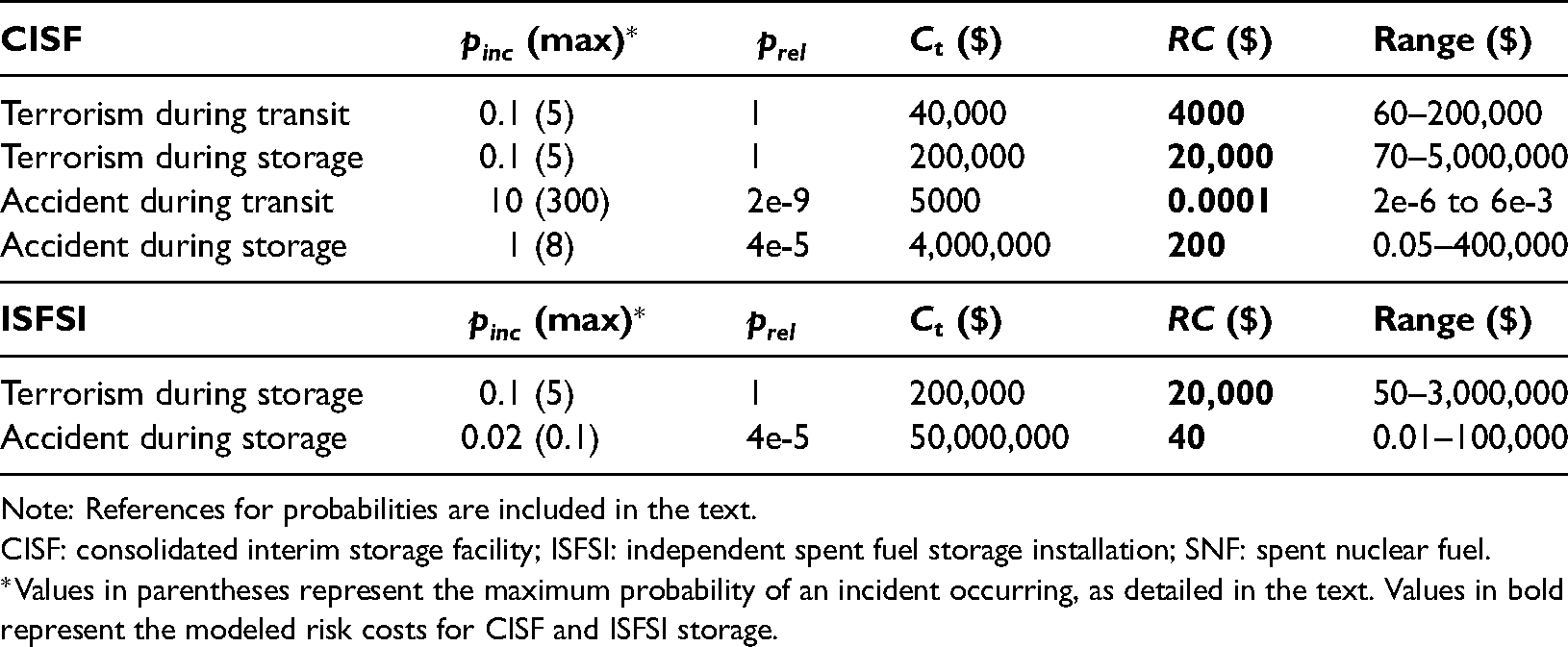
Note: References for probabilities are included in the text.
CISF: consolidated interim storage facility; ISFSI: independent spent fuel storage installation; SNF: spent nuclear fuel.
*Values in parentheses represent the maximum probability of an incident occurring, as detailed in the text. Values in bold represent the modeled risk costs for CISF and ISFSI storage.
Accident during storage
ISP's application did not identify any credible accidents during the storage phase that could pose a risk to the public or the environment. We calculated the risk cost of storage-phase accidents most likely to result in a release of radioactive material to investigate this claim based on an NRC report that evaluated the safety of dry casks under all foreseeable scenarios. 24 The NRC found that the greatest potential for a hazardous release would be caused either by an accidental drop when transferring the cask or by certain accidents during passive storage like an accidental aircraft impact, a seismic event, or a meteor strike. Their calculations illustrate that the probability of the latter events is exceedingly low, such that the risk associated with an accidental drop is two orders of magnitude greater than accidents during passive storage.
Our probabilistic risk analysis indicates that, on an average, four accidents (range of 0.2–8) can occur over the project's proposed 40-year lifetime; however, the probability of release from such an incident is very low (
Conclusions of technical risk analysis
Although these calculations entail many assumptions and a wide range of uncertainty, particularly for the threat of terrorism, we can draw several important conclusions from the results summarized in Table 3. Our analysis reveals that costs associated with public perception account for the most significant portion of the total risk cost, while the smallest portion is associated with human health (Table 2). These results substantiate prior evidence25,30,40 that public concerns associated with nuclear materials are disproportionately high relative to the risks, which are low regardless of where the SNF is stored. Furthermore, we demonstrate that risk costs during storage are higher than those during transit because there is a higher volume of material in storage and storage casks are more susceptible to damage than type B transport casks. 38 Overall, we find that nuclear waste storage at ISFSIs (RC = $20,000) is not significantly safer than storage at a CISF (RC = $24,000), since the latter is intentionally sited in an isolated area, and transportation risks, a common concern cited by local stakeholders, are inconsequential.
To further illustrate that these calculations confirm the safety of SNF storage, we compare the technological risk costs above to the overall economics associated with ISFSI and CISF storage. As mentioned above, ISP projected the economic benefit of the proposed CISF to be $3.3 billion. Therefore, the overall risk cost is five orders of magnitude below relevant project costs. On this basis alone, it seems reasonable to license and build a SNF storage facility in Andrews. Upon consideration of other factors, however, the solution is not so clear. For example, the project's economic benefits, as asserted by ISP, have a high degree of uncertainty associated with them wherein the net benefit may be as little as $400,000. 12 In the next section, we consider risks posed by policies, climate impacts, increases in seismic activity, public opposition, and the absence of plans for a permanent repository to provide a holistic view of the vulnerabilities of the project and nuclear waste storage in the US.
Policy analysis
The share of nuclear energy in the US electricity mix has evolved with market dynamics, the increasing share of natural gas and renewable-based electricity, and policy shifts. The latter have been strongly influenced by perceptions of stakeholders, including the nuclear industry, regulatory agencies, policymakers, interest groups, and the public. Given the disparate policy preferences held by these stakeholders, several efforts have been made to overcome the disjointed ways policy risks are measured, quantified, and communicated. The NRC recommends comparing the environmental, social, and policy risks of on-site and off-site waste storage alternatives using a scale from the National Environmental Policy Act (NEPA) of 1970. NEPA governs environment-based decision-making for permit applications, the adoption of federal land management actions, and the construction of publicly owned facilities. 41 However, NEPA was not designed specifically for the nuclear industry, and extending the same scale to CISFs or ISFSIs without quantifying the boundaries of analysis, the numeric probabilities of associated risks, and the magnitudes of their impacts leads to a disjointed comparison of alternatives and spurious cost–benefit analyses. The International Atomic Energy Agency attempted to standardize analyses by providing quantitative guidance through the International Nuclear and Radiological Event Scale (INES) scale; however, the scale is only applicable in the event of a radioactive release and characterizes all other events as “out of scale.” 42 The US National Academies of Sciences spearheaded quantitative risk-based guidance to address the inconsistencies in federal policies for managing and regulating LLW, but a similar effort has not been undertaken for SNF. 43
We address these issues by comparing the scope, delivery, impact, and associated risks of the policies and regulations that are relevant to the proposed project and nuclear waste storage in the US. For this, we identified the most impactful elements of policy risks that differentiate ISFSI and CISF storage. The monetary costs associated with a CISF differ from that of an ISFSI in terms of the cost of construction, the regulatory processes associated with licensing, permitting and compliance, staffing the facility, insuring against risks, transport, and storage costs. Our analysis indicated that regulatory, insurance, and transportation costs, and climate risks are the impactful differentiators between CISF and ISFSI storage. We discuss each of these below.
Accident insurance
Accidents involving radioactive release in the US are insured by the Price-Anderson Nuclear Industry Indemnity Act (PAA) of 1957, which ensures that funds are available in the event of an accident regardless of the entity liable for the incident. Under the PAA , nuclear plants can obtain $450 million for offsite liability coverage 4 through American Nuclear Insurers, a group of private insurance and reinsurance companies. If claims exceed this value, each licensee is liable to be assessed a prorated share of the excess up to $131 million per reactor. 44 After the Three Mile Island accident, 5 the NRC mandated minimum of $1 billion additional on-site property insurance for all nuclear operators, but the PAAt delivers no protection against offsite liabilities or acts of theft/sabotage once planned transportation ends. The US is also a member of the International Atomic Agency's Convention on Supplementary Compensation for Nuclear Damage (CSC), which allows $57 million in liability coverage in case of a nuclear accident. 45
Although the PAA has proven effective for liabilities originating from onsite activities, the insurance demand for offsite waste storage at CISFs remains unmet by the insurance mechanisms discussed above. Despite the nuclear industry's safety record, private insurance providers have been reluctant to underwrite the liabilities from storage as nuclear waste policies in the US have been embroiled in litigation. A few private insurance companies provide environmental, theft, and sabotage-related insurance, which can be extended to waste transportation to an offsite location. Notable examples of these include the American International Group (AIG) and Zurich North America, which provide coverage up to $35–50 million for bodily injury, property damage, and optional additional coverage for onsite cleanup, and third-party liability.46,47 Based on our model estimates from the Accident during storage section, this cap would cover accident costs at a CISF, but it is unclear if these companies would insure CISF-based storage. Since current policies and market-based mechanisms exclude waste management companies, ISP would need to maintain funds sufficient to cover the costs of an accident. This would result in costs that are significantly higher than those modeled in the previous sections.
Terrorism insurance
The Terrorism Risk Insurance Act (TRIA) was adopted after the terrorist attacks of 11 September 2001 to provide a transparent system of shared public and private compensation for insured losses resulting from acts of terrorism. 48 The terrorism-related risks discussed in the Acts of terrorism section are presently insured for over $1.7 billion under TRIA. TRIA coverage against terrorism-related risks is considered sufficient by policymakers and the nuclear industry, a viewpoint which is supported by our model, insofar as it demonstrates that risk costs associated with exposure to radiological hazards are orders of magnitude lower than $1.7 billion.
TRIA does not cover terrorism losses directly; instead, it reimburses private insurers for losses, thereby enabling a private market backed by government support. This momentous policy motivated by national security concerns, bipartisan efforts, and public support for risk mitigation alleviated the concerns of private insurers and led to a delivery-focused program. If the same sense of urgency is extended to developing government-backed support for offsite accident insurance (Accident insurance section) and climate risk insurance (Climate risks for ISFSIs, the nuclear industry, and insurance section), then market-based economic and credit risks encumbering nuclear waste storage can be ameliorated.
Risk from uncertainties related to a permanent repository
The US Internal Revenue Service (IRS) has approved amendments to section 468A of the Internal Revenue Code of 1986 to broaden the definition of nuclear decommissioning costs as a permanent repository is yet to be established in the US. 6 These costs now include expenses related to SNF storage at on-site and off-site ISFSIs, allowing deductions and using the Nuclear Decommissioning Funds for storage-related expenses at ISFSIs. Under NWPA, however, decommissioning funds or regulatory fees paid for onsite waste storage 7 cannot be extended to CISF-based storage, handling, or transportation. 49 Therefore, if a CISF is licensed, it remains unclear as to what costs and liabilities the plant operator would have to bear, how the costs would compare to the case of a disposal site, and how it would impact the Nuclear Decommissioning Funds.
If a permanent repository is delayed beyond 40 years, CISF storage will be increasingly beneficial as costs are consolidated at one site. One disadvantage would be the requirement of transporting the casks from ISFSIs to the CISF and then to the repository, 8 but our model corroborates findings from ISPs application that these costs and risks are outweighed by the savings from implementing a CISF by several orders of magnitude. 12 From a safety perspective, neither CISF nor ISFSI storage is ideal, considering that the potential for hazardous radiological events increases beyond 40 years in both cases. 50 At the same time, casks currently stored at ISFSIs will be subject to greater climate-related risks the longer a permanent repository is delayed. We discuss these concerns in the next section.
Climate risks for ISFSIs, the nuclear industry, and insurance
Climate risks are a key differentiator between waste storage at ISFSIs, many of which are coastal, and at a CISF in Andrews, which is inland and thus reasonably protected against rising sea levels. This provides the proposed project a location advantage, although the uncertainty of how, when, and where climate risks will present themselves makes it challenging to assign a cost and quantify the benefit. Nonetheless, climate risks pose an indirect risk to the project's viability and safety.
Our analysis of current regulations, compliance requirements, industry and government-backed insurance mechanisms, and plant preparedness in the US revealed that these policy instruments do not deliver adequate safeguards against climate risks and require urgent prioritization. Although plants have invested in supplies like emergency generators, pumps, and employee shelters under the FLEX program, preparedness related to waste storage is limited. 51 Namely, many sites have not reported the estimated climate risks they may face or have underestimated the threats. The issue was highlighted when the NRC required all operating plants, most of which also store nuclear waste, to evaluate their flood risks and overall climate risks post-Fukushima 52 ; in short, 54 of 60 plants were deemed susceptible to flooding risks that exceeded their design specifications. 9 For example, the Turkey Point plant in Florida estimated an on-site sea-level rise of 0.3 ft by 2040, but the National Oceanic and Atmospheric Administration (NOAA) predicts that the region will witness a sea-level rise between 0.7 ft and 2.7 ft 53 over the same period. 10
While this led the NRC to increase the reporting frequency for waste stored on operating sites and ISFSIs, climate risk reporting is yet to be mandated by regulations. Moreover, federal policies prioritize extreme weather events like flooding or hurricanes as a threat to operational safety but do not account for the recurrent economic, credit, and environmental risk that plants and ISFSIs will likely face. As a result, government or market-based climate risk insurance remains negligible. 11 For the proposed project, ISP states that funding will be secured through future contracts with the DOE or other SNF title holders and may include debt financing, equity investments, and net income; however, funding may be jeopardized by the resistance of private investors to back nuclear projects unless climate risk disclosure is mandated and government support for insurance becomes available. As discussed above, a lack of funding may also delay the availability of a permanent repository. 50
Risks from increased human activities in Andrews
Historically, Andrews has been characterized by the USGS 54 as an area of low-intensity seismic activity in a region that presents low seismic hazards. However, West Texas has witnessed a substantial increase in localized geohazards such as land subsidence and earthquakes since 2009. While most earthquakes have been below a magnitude of 4, their growth pattern suggests that impacts of greater magnitudes are possible in the near term.55,56 Mathematical analyses have found that waste casks are liable to tip over during an earthquake with magnitude greater than 7. 24 While we stated above that a seismic event is not expected to breach the cask and release radioactive material, our model does not account for increases in the frequency or severity of seismic activity driven by human activities, including increased oil and natural gas production, brine mining in salt domes, and fluid injection. 12 Most earthquakes in the region have been observed at focal depths of 4.0–5.2 km below sea level, which is within or just below the strata at which hydrocarbons are recovered and wastewater is injected.55,56 Similar causal links have been noted between increased groundwater consumption by growing populations and heightened seismic activity. 55 Groundwater in Andrews is supplied by the Dockum, Antlers, Cenozoic Alluvium, and Ogallala aquifers. The Ogallala aquifer is experiencing severe to extreme drought conditions, which may also result in increased land subsidence. 57 While specific implications for nuclear waste storage in the region are yet to be ascertained, the lack of rigorous testing on seismicity and land subsidence for the proposed project in Andrews is concerning.
ISP should holistically address these concerns about seismicity and land subsidence before they can guarantee the safety of the facility. As ongoing studies and scientific discourse probe the correlations between human activities and increased geohazards, the resultant health and safety considerations for all nuclear waste storage must be appropriately accounted for. Policymakers and industry representatives should accordingly employ effective and consistent methods for geohazard mitigation and risk communication to stakeholders.
Conclusions
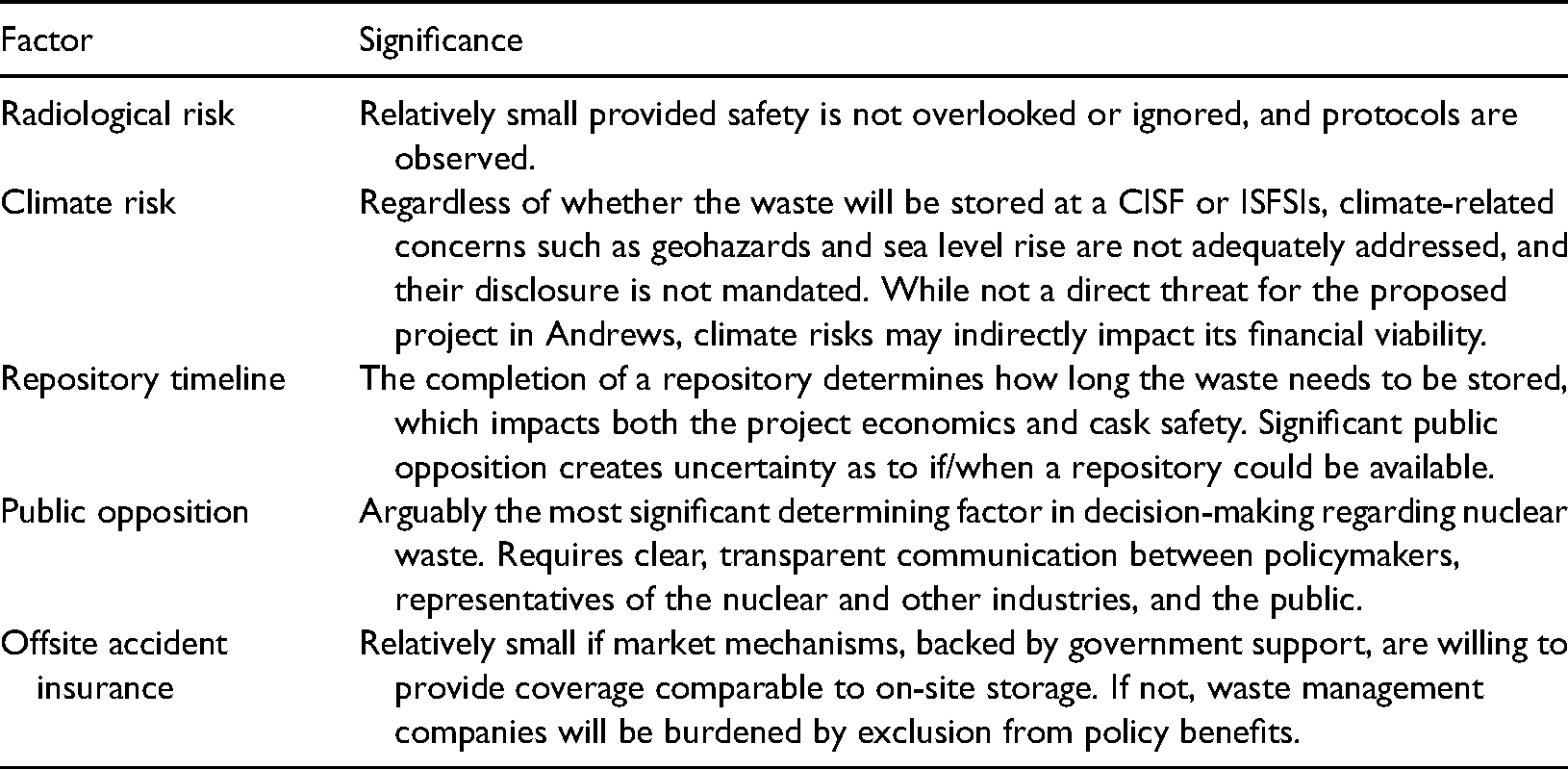
In this work, we have modeled and analyzed technical and policy risks associated with the proposed CISF at Andrews, Texas. In Table 4, we present the most consequential factors relevant to the decision of siting the CISF at Andrews and describe their relative significance. Although the radiological risks associated with the project are low, any waste storage or disposal site must address the risk from climate change and increased human activity, the uncertainty induced from the timeline for a permanent repository, and the effects of stakeholder preferences, particularly, public opinion.
Technical and policy risks relevant to decisions regarding nuclear waste storage.
We quantified a radiological risk cost from four classes of hazards, concluding that the risk cost of developing a CISF ($24,000) is not significantly greater than that of continued ISFSI storage ($20,000) for several reasons. First, the transportation of SNF casks is not liable to lead to a significant discharge of radioactivity. Additionally, the threat of radioactive release from terrorism poses a greater threat than accidents, specifically during the storage phase when a higher volume of SNF is vulnerable to attacks. Although a CISF would store more SNF than individual ISFSIs, these risks are balanced by the proposed facility's remoteness from major population centers. Importantly, we find that risk costs associated with public perception are disproportionately high, suggesting that resources should be dedicated towards developing trusting relationships between entities responsible for SNF storage and their local communities. One notable concern of CISF storage is the provision of adequate insurance, where the absence of offsite waste insurance poses a challenge to the project's viability. Nuclear waste storage at ISFSIs is insured by the Price-Anderson Act and private insurance providers; however, these mechanisms do not apply to CISF-based waste storage. A CISF at Andrews will also be impacted by regional risks such as increased human activity and volatile public opinion, as well as broader risks from policy inertia, project delays, and climate risks. Among these, mounting climate risks and the risks presented by geohazards like seismicity and land subsidence at the proposed site and at ISFSIs across the US warrant rigorous scientific analysis, effective mitigation efforts by policymakers and the nuclear industry, and transparent and consistent risk communication to all stakeholders. Overall, these findings should be employed to enhance the probability of a safe and successful SNF storage program.
Supplemental Material
sj-docx-1-eae-10.1177_0958305X211051328 - Supplemental material for Consolidated nuclear waste storage in Andrews, Texas: An integrated technical and policy risk analysis
Supplemental material, sj-docx-1-eae-10.1177_0958305X211051328 for Consolidated nuclear waste storage in Andrews, Texas: An integrated technical and policy risk analysis by Adam J. Mallette, Aparajita Datta and Ramanan Krishnamoorti in Energy & Environment
Footnotes
Conflict of Interest
The authors declare that there are no relevant financial or non-financial competing interests to report.
Funding
The authors received no financial support for the research, authorship,and/or publication of this article.
Supplemental Material
Supplemental material for this article is available online.

Notes
References
Supplementary Material
Please find the following supplemental material available below.
For Open Access articles published under a Creative Commons License, all supplemental material carries the same license as the article it is associated with.
For non-Open Access articles published, all supplemental material carries a non-exclusive license, and permission requests for re-use of supplemental material or any part of supplemental material shall be sent directly to the copyright owner as specified in the copyright notice associated with the article.
