







Abstract
One of the important issues humankind globally faces in recent years is the scarcity of non-renewable energy resources. Solar energy is considered safe and renewable, which can fulfil the demand and supply chain requirements. Solar box cookers (SBCs) are popular in domestic cooking due to their ease of use and handling. The prime objective of the present work is to develop and test the performance of a cylindrical SBC fitted with decahedron-shaped reflector (CSBC-FDR). The CSBC is designed using minimum entropy generation (MEG) method. Through experiments, we observed that absorber plate attains peak temperature of about 138°C–150°C with the aid of decahedron reflector. The first figure of merit (F1) is found to be 0.13, indicating better optical efficiency and low heat loss coefficient for the SBC. The second figure of merit (F2) is obtained as 0.39, which indicates good heat exchange efficiency (F') and less heat capacity for cooker's interior. The average energy efficiency, exergy efficiency, and standardized cooking power values are 21.93%, 3.04%, and 25.28W, respectively. These results show that the present CSBC-FDR is able to cook food in a shorter period with better efficiency. The experimental and numerical values of overall heat loss coefficient of the developed SBC are in close agreement. The experimentally assessed performance parameters reveal superior performance of the present cylindrical SBC in comparison with many conventional rectangular and trapezoidal box solar cookers.
Keywords
Introduction
A large share of energy consumption in the world is attributed for cooking purposes. 1 Increased consumption, ever increasing price of fossil fuels, and environmental pollution drive the need for renewable energy sources for cooking. Solar energy is considered as one of the most promising renewable resources to meet present and future energy demands.2,3 Solar cooking has been a major research interest for the past few decades around the world due to many advantages such as zero running cost, non-polluting character, and ample availability. 1 Solar cooker converts solar irradiance input to heat energy required for cooking. 4
Saussure introduced solar cooking technology in 1767 by developing solar box cooker (SBC). Many studies have been conducted for the last few decades on the advancement of different kinds of solar cookers.5,6 Solar cookers are mainly classified into two classes depending on the heat transfer mechanism to the cooking vessel as direct and indirect type. 7 For the first case, cooking process is carried out under direct sunlight, whereas heat is transferred to the cooking pot using fluid medium in the indirect type. Panel, concentrating, and box types are the three direct type solar cookers. 1 SBCs are popular for their ease of use and handling. Since the concentration factor is low for SBC, no tracking is required, allowing unattended cooking. 7
The basic working principle behind all kinds of SBCs is similar, but their performance will differ by the design modification in external or internal parts such as; single reflector,8,9 double reflector, 10 four reflectors, 11 eight reflectors, 12 dodecagonal reflector, 13 absorber plate configuration 14 and hybrid solar cooker. 15 Apart from the design modifications, various test procedures and performance assessment parameters were proposed for the standardization of SBC, which includes; the first and second figure of merit, 16 cooking power, 17 energy and exergy efficiency, 18 revised figure of merit, 19 effective concentration ratio 20 and heat retention time. 9 The effects of instrumentation for testing SBC were studied using statistical and uncertainty analysis. 21 To use the solar cooker in sun downtime, various heat storage materials were incorporated. We recently developed SBC, 22 which includes an optimum combination of sensible heat storage (SHS) medium, such as sand, brick powder, iron grits, and charcoal. Also, use of latent heat storage materials (LHSMs) such as phase change materials (PCMs) in SBC has become vital due to its high energy storage density and isothermal operating characteristics. Different PCMs were tested in SBC, including magnesium nitrate hexahydrate, 23 stearic acid, 24 acetamide, 25 acetanilide, 26 propolis, 27 and erythritol. 12 Our recent study reported erythritol as the optimum PCM for thermal energy storage (TES) units integrated solar cookers by using different multi-criteria decision making methods. 28 Extensive research has been done using numerical analysis to study the heat transfer involved in SBC for determination of performance parameters. It is accomplished by computing the temperatures at each component of SBC, such as absorber plate, glazing cover, cooking vessel, air cavity, inner and outer wall, and cooking load. All the numerical analysis was based on thermal balance equations at each component but differ in solution methodology like fourth order Runge-Kutta method,29 Newton-Raphson method, 11 and number of components considered such as; five components,14,30 six components, 11 seven components. 31 Apart from numerical analysis, artificial neural network (ANN) model was developed for the prediction of SBC's thermal performance parameters. 32 The parametric optimization of SBC has been done using Cramer's rule. 33 The exergy efficiency optimization of double exposure solar cooker using response surface method (RSM) was performed by Zamani et al. 34
Recent studies show the advancements and enhanced performance of SBCs. Siddique et al. 35 fabricated and experimentally assessed the performance of combined solar cooker cum dryer. The hybrid system consists of trapezoidal-shaped cooker with rectangular dryer chamber placed at the top to cook and dry separately. Under the same ambient condition, they observed two different temperature ranges for the cooker (80°C-135°C) and the dryer compartment (35°C–65°C). The first and second figure of merits of the cooker are respectively 0.11 and 0.303. Khallaf et al. 30 developed and tested the performance of SBC named as Quonset Solar Cooker (QSC) with transparent fibreglass reinforced plastic glazing cover. They found that characteristic boiling time is about 50% slower for boiling 1 kg of water with the QSC compared to SBCs. Coccia et al. 12 developed portable type SBC with TES containing 2.5 kg of erythritol as PCM. They tested portable SBC with water and silicone oil as cooking load. Engoor et al. 36 improved the thermal performance of SBC by incorporating two Fresnel lens magnifiers. By integrating the Fresnel lens magnifier, first and second figures of merit and cooking power enhanced from 0.11 to 0.12, 0.43 to 0.45, and 43.83 W to 46.87 W, respectively. Saxena et al. 37 developed and tested SBC incorporated with copper tube containing paraffin wax as PCM. By comparing conventional SBCs, they obtained better results in terms of efficiency (53.81%), heat loss coefficient (5.11 W/m 2 °C), cooking power (68.81 W), and heat transfer coefficient (56.78 W/m 2 °C). Shanmugan et al. 38 carried out experimentation to study the effects of absorber plate coating of stepped solar box cooker (SSBC) with different ratios of SiO2/TiO2 nanoparticles for performance enhancement. Mostafaepour et al. 39 developed structural equation model (SEM) to investigate factors and risks associated with the production and usage of solar cookers and ranked the SBCs by applying factor analysis. They inferred that factors like capital, technology and infrastructure, interactions, and financial support directly affect the execution of solar cookers. Vengadesan and Senthil 40 experimentally investigated the effects of adding fins to the cooking vessel of SBC. They used four different cooking pots, both finned and un-finned, with fin lengths ranging from 25 mm to 45 mm. Sensible heating test reveals that the finned cooking vessel performs better than the un-finned ones. Mawire et al. 41 compared SBC with and without reflector and parabolic dish solar cooker under different water loads of 1 kg, 1.5 kg, 2 kg, 2.5 kg, and 3 kg based on exergy and energy performance parameters. The results reveal that the SBC with reflector has the highest average energy and exergy efficiency and is independent of the water load. Atmane et al. 42 developed solar cooker operated with photovoltaic (PV) energy formed by PV panels, power blocks, controls, and thermal resistances. Compared to traditional solar cookers, performance results significantly improved cooking temperature, boiling duration, and heating speed to 178%, 83.3%, and 943%, respectively. They achieved thermal efficiency of 86%, which is significant gain over traditional cookers. Singh 43 presented solar-based, electronically controlled indoor cooking system by developing solar parabolic dish concentrator, mechanical support, sun-tracking mechanism, heat transfer fluid system, and heater plate fitted with heating coil. In this system, solar P-V panel continuously charges 12 V battery through charge controller. The battery then powers the solar tracker and DC motor-pump set, circulating heat transfer fluid via heater plate's heating coil. Arif et al. 44 conducted comparative study to investigate the effects of changing position of cooking pot on absorber plate, mirror and aluminium reflector, as well as the number of cooking pots on the performance of two geometrically similar SBCs. Their research found that the lugs helped to reduce heat transfer rate between absorber plate and cooking pot. Using mirror and aluminium reflector, respectively, the cooking load temperature increases by 25.5% and 23.4%. With increasing numbers of cooking pots and loads, the second figure of merit rises linearly. Palanikumar et al. 45 carried out thermal performance study (experimentally and theoretically) on three kinds of solar cookers such as SBC with waste cooking oil and C4H4O3 as PCMs (SBC-PCM), novel SBC with (SBC-NPCM) and without nanocomposite PCM (SBC-WNPCM). The results showed that using absorber plate coated with MgAl2O4/Ni-doped, Fe2O3 nanoparticles combined with PCM raises interior temperature of the cooker to 164.12°C. Furthermore, the bar plate absorber temperature was 163.74°C, 147°C, and 113.34°C for SBC-NPCM, SBC-PCM, and SBC-WNPCM, respectively, under solar irradiance of 1037 W/m2.2 Tawfik et al. 46 proposed new solar cooker equipped with tracking type parabolic reflector (TBPR) at the bottom. They carried out thermal performance assessment of first figure of merit (F1), cooker opto-thermal ratio (COR), and effective concentration ratio (ECR). Their study found COR 0.165 for the cooker with TBPR and 0.123 for the one without and overall efficiencies of 10.7% and 12.5% respectively. With TBPR, the cooker reached intermediate temperatures between 140–150°C, and F1 and ECR were 0.119 and 1.34. Coccia et al. 47 designed, fabricated, and tested low-cost concentrating solar cooker equipped with lens-mirror system that directs solar energy to the bottom of cooking pot. It has high geometrical concentration ratio of 40.97 and is tested with water and silicone oil as cooking loads. Bhavani et al. 48 used fuzzy logic and experimental study to examine the thermal performance of SBC with absorber plate covered with Cr2O3–MoS2–Fe2O3 nanocomposite.
As per literature review, commonly employed box geometries for the SBCs are rectangular, trapezoidal, and cylindrical. Recently, we examined the effects of various box shapes - rectangular, trapezoidal, cylindrical, and frustums of cones on solar cooker performance using numerical analysis. 49 Using numerical analysis, we compared absorber plate temperatures for different geometries, and found out that trapezoidal cavity reached the highest. Yettou et al. 50 experimentally showed that rectangular SBC with inclined glass cover performs better than the horizontal since it provides more solar irradiance to the cooker surface via large interception area. Kurt et al. 51 experimentally found that cylindrical solar box cooker (CSBC) has high significant thermal efficiency and reduced boiling time than rectangular type. Since the cylinder side area is more efficient than the rectangle, heat loss from sideways is less for the cylindrical box geometry. Recently, cylindrical SBC has been tested for the effects of SHS medium 14 and microporous absorber configurations. 52 The literature review also sheds light on the fact that performance of SBC in any climatic conditions is affected by every element of the cooker system, such as solar irradiance, box geometry, absorber plate, glazing system, cooking vessel, heat storage, external and internal reflector, insulation material and thickness. However, solar irradiance entering cooker surface is one of the most significant factors. It can absorb maximum energy and transfer it to the cooking load through conduction and radiation mode of heat transfer. Hence, augmentation of incident solar irradiance on the cooker surface to achieve optimum temperature for cooking load is of utmost importance. We can accomplish this by fitting an outer reflector made of plane mirrors with SBC. Nahar 10 studied two-reflector hot SBC of rectangular shape with transparent insulation material and compared it with single reflector. In the morning, one mirror faces south and the other faces east, while in the afternoon, the cooker is rotated 90°, again facing south and west The solar cooker did not move, but SBC was tracked towards the sun every hour. Accordingly, their results indicate that tracking towards the sun for three hours can be eliminated by adding a reflector. Guidara et al. 11 studied trapezoidal-shaped SBC fitted with four reflectors. A four-reflector design increased optical efficiency of the solar cooker, leading to an improvement of 0.07 to 0.14 in the first figure of merit and temperature increase of 133.6°C for the absorber plate. Accordingly, the second figure of merit was in the range of 0.34 to 0.39. Coccia et al. 13 developed SBC with dodecagonal reflectors and studied its performance. Optical efficiency and thermal insulation are good with this cooker, allowing it to cook at high temperatures.
The absorber plate, whose surface area should be optimal, is another important parameter of the SBC. Optimizing the cooker surface area minimizes overall heat loss coefficient, resulting in optimal performance. In our work, 22 we designed rectangular-shaped SBC by computing optimum cooker surface area using theoretical heat loss and design equations solved by an iterative procedure. Optimal SBC design is also possible by applying minimum entropy generation (MEG) principle, which minimizes loss of useful work or destruction of availability. 53
An up-to-date review of literature reveals that no work has been reported on CSBC fitted with outer reflector until now to the best of author's knowledge. Further, design of CSBC using MEG method and the determination of overall heat loss coefficient numerically and experimentally is not reported in literatures till now. The novelty and objectives of the present work are deduced from these observations. Accordingly, the present work includes design, development, and thermal performance evaluation of CSBC fitted with decahedron-shaped outer reflector (CSBC-FDR). The augmentation of solar irradiance on the absorber plate of solar cooker is achieved by providing decahedron-shaped external mirror. The CSBC is designed using MEG method. Comparison is made between the absorber plate area obtained from MEG method and with iterative solution procedure (reported in our recent study). 22 Thermal performance is assessed through cooking power, energy and exergy efficiency, and overall heat loss coefficients. In addition, it includes an iterative algorithm developed in MATLAB for calculating total heat loss coefficients. Next, the performance parameters are subjected to statistical and uncertainty analysis. Real cooking performance is then tested with the developed CSBC-FDR.
Methodology
Minimum entropy generation method for design of SBC
A system works with MEG will result in least destruction of availability or minimum loss of useful work. MEG also called thermodynamics of irreversible processes can be used for thermal optimization of heat transferring devices. 54 In SBCs, irreversibility occurs due to finite temperature differences between the sun and absorber plate or between absorber plate and cooking load.
The energy balance for SBC with incoming solar energy, useful heat energy and losses to surroundings is written as:



The entropy balance for closed system is given by,








Experimental setup
The CSBC (Figure 1(a)) developed in the current study comprises mild steel cylindrical box with external diameter 53 cm, internal diameter 43 cm, and height 30 cm with double glass cover at the top. The gap between two layers is filled with glass wool of thickness 5 cm as insulation 14 to reduce heat transfer with the surroundings. Aluminum absorber plate of diameter 43 cm, thickness 2 mm, and black in colour is fixed at the base of cooker's inner cavity. Glass wool insulation with 5 cm thickness is provided below the absorber plate to reduce heat transfer through bottom surface. A small door is provided on lateral surface of the cooker rather than at top as in conventional SBC. 14 Hence, glazing covers at the top are permanently fixed without leakage at edges, which reduces heat loss through top of cooker cavity. The cooking pot used for the experiment is made up of aluminium having diameter 18 cm and height 6 cm.
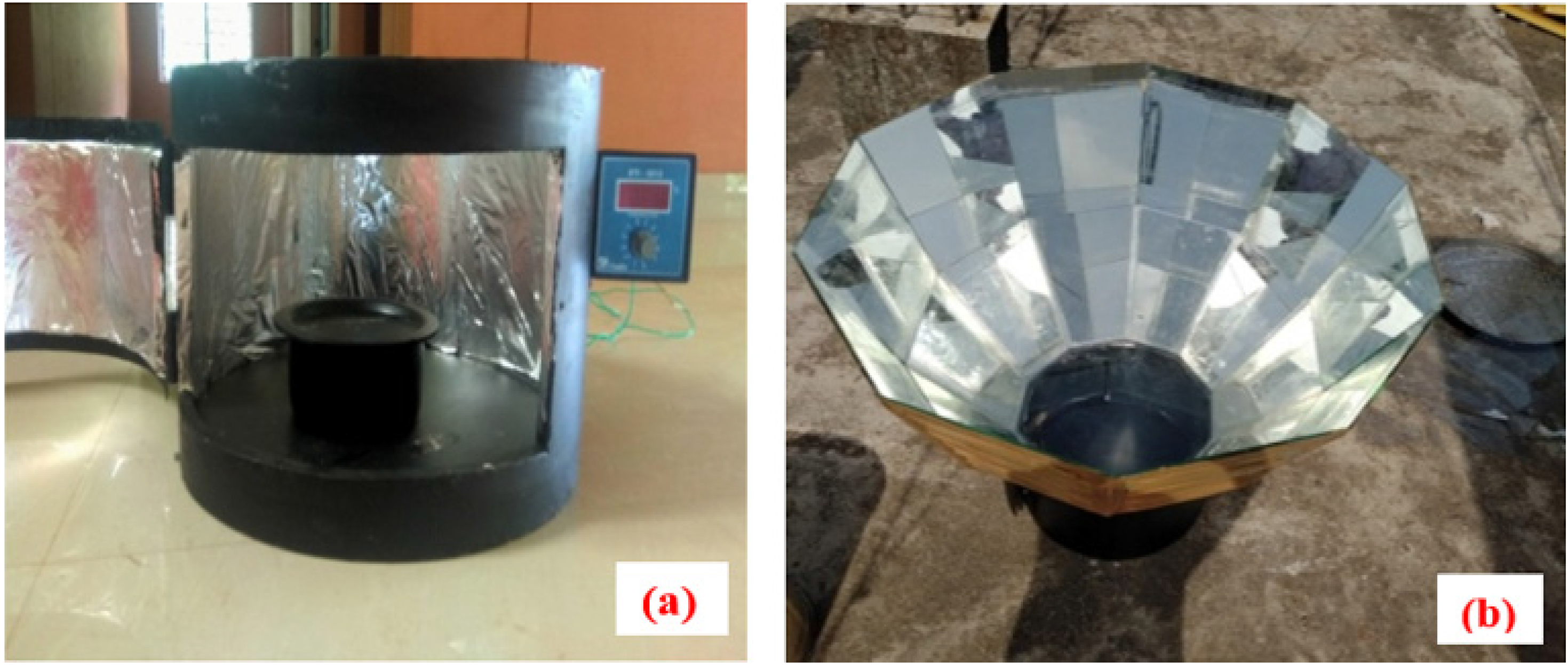
(a) Cylindrical box cooker with cooking vessel (b) cooker fitted with decahedron reflector.
Decahedron - shaped reflector made up of plane mirrors is also provided to increase solar radiation penetration though glazing (Figure 1(b)). The reflector has ten identical pieces of double row mirrors, trapezoidal in shape. The mirror's upper (32.1cm long) and lower (33.7 cm long) portions make an angle of 70° and 63°, respectively, with the horizontal surface. Dimensions of reflector are calculated based on aperture area of the cooker (Figure 2).
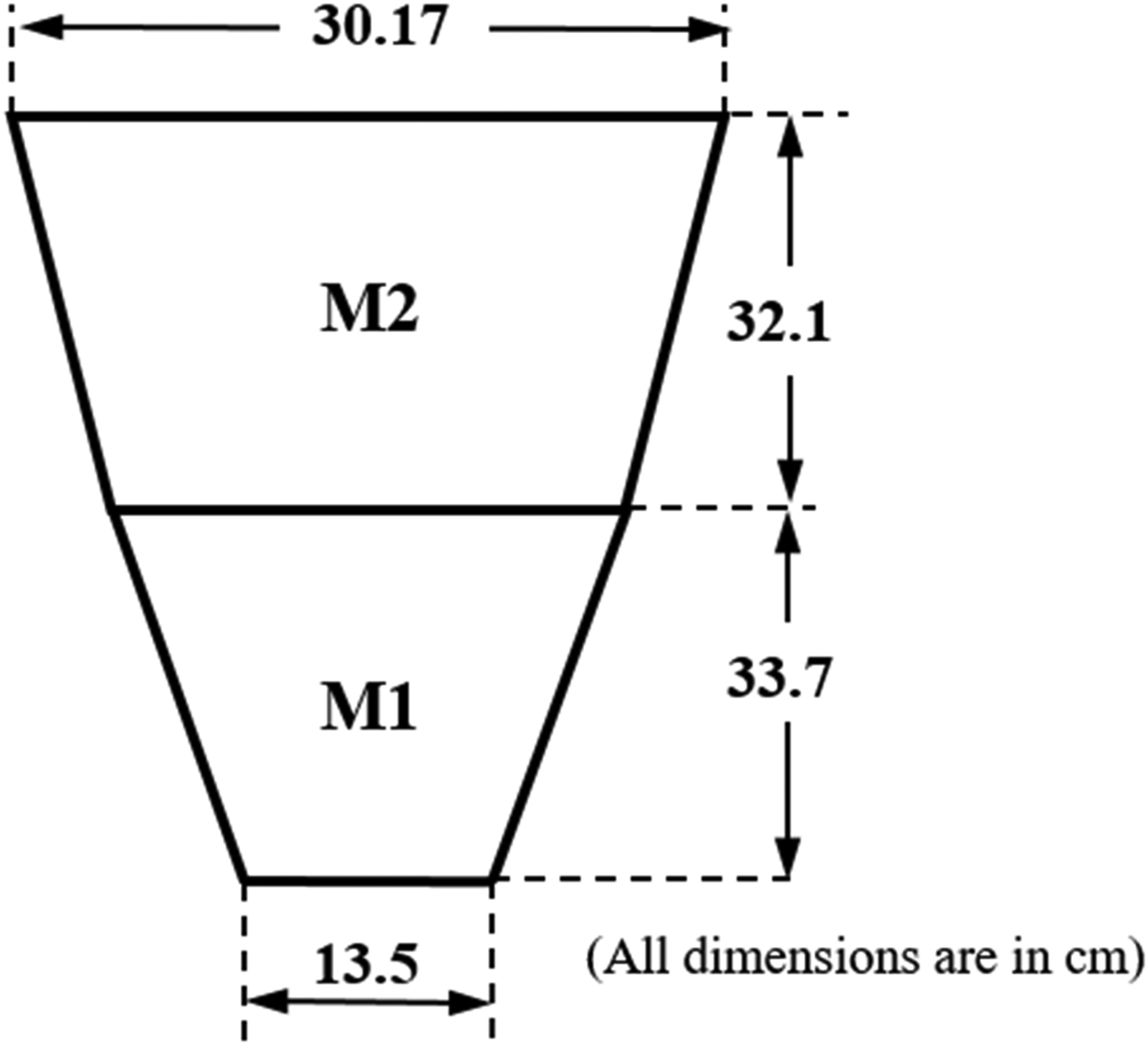
Schematic of single reflector.
Performance evaluation
Stagnation and load test
The performance assessment tests are carried out under International standards (IS) 13429. The stagnation and load tests are conducted for finding first figure of merit (F1) and second figure of merit (F2) of SBC. 16 The required temperature measurements are performed using thermocouples connected to different parts of the SBC. The solar irradiance is measured using calibrated solar power metre.
F1 and F2 are computed using equations (12) and (13) respectively,
16


Energy and exergy analysis
Energy efficiency is the ratio of thermal energy gained by cooking load to the incident solar energy. 18 On the other hand, exergy is that portion of energy that is available in solar energy conversion. Exergy efficiency is the ratio of exergy output of water and solar irradiance. 18
The energy and exergy efficiency of SBC are calculated using equations (14) and (15) respectively.
17


Cooking power analysis
Cooking power is the rate of thermal energy which is productive during heating time and is calculated by,
17


Computation of overall heat loss coefficient
Total heat loss from the SBC cavity to ambient air is computed by taking into account heat loss through all surfaces (Figure 3). This is represented as the overall heat loss coefficient (UL) involving heat losses through cooker's bottom, top and lateral surfaces. Recently, Saxena et al.
37
computed UL for the SBC using correlation
56
with neglecting side heat losses. However, present study considers all heat loss coefficients for the computation of UL as:

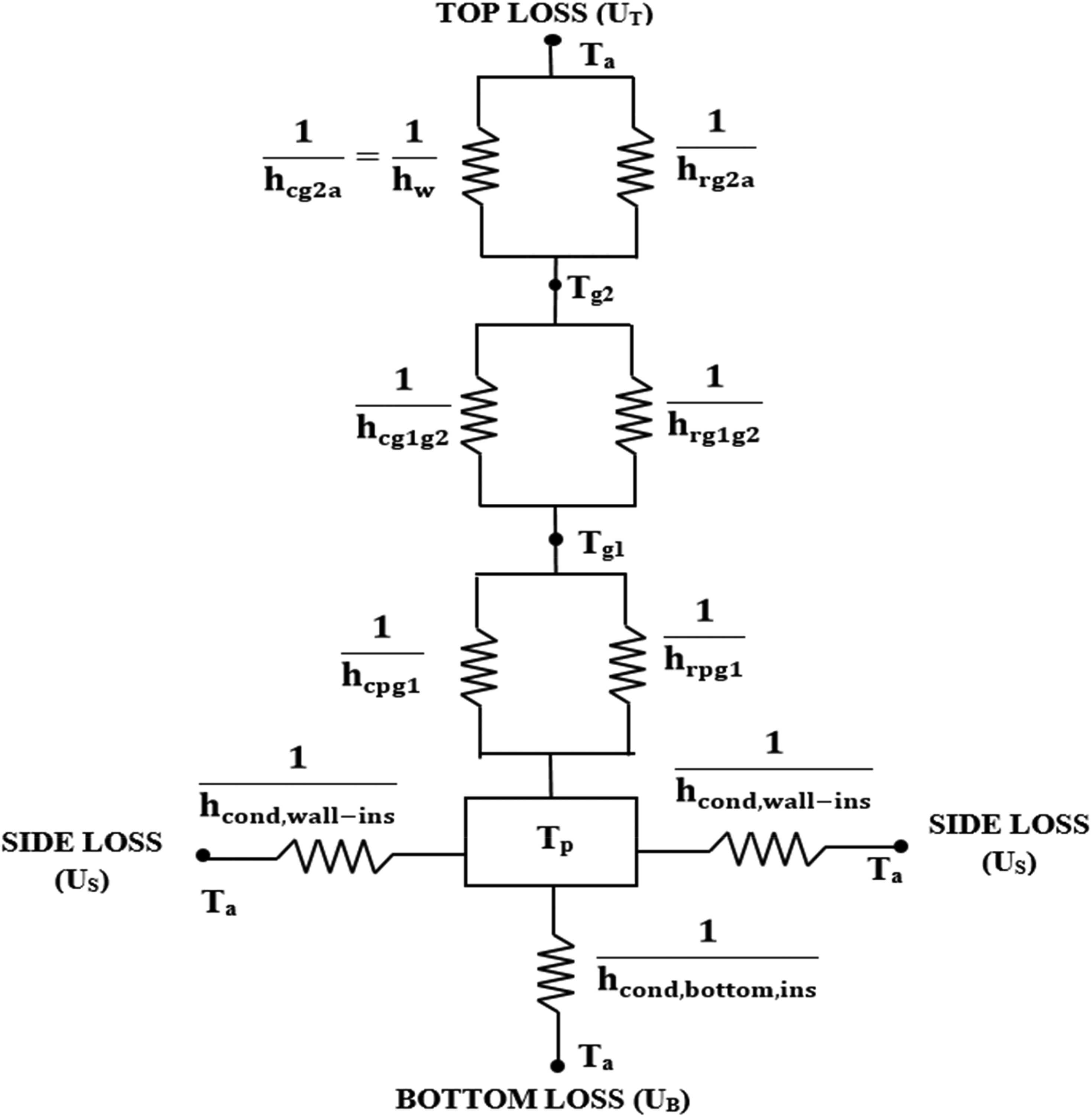
Thermal resistance network of SBC.
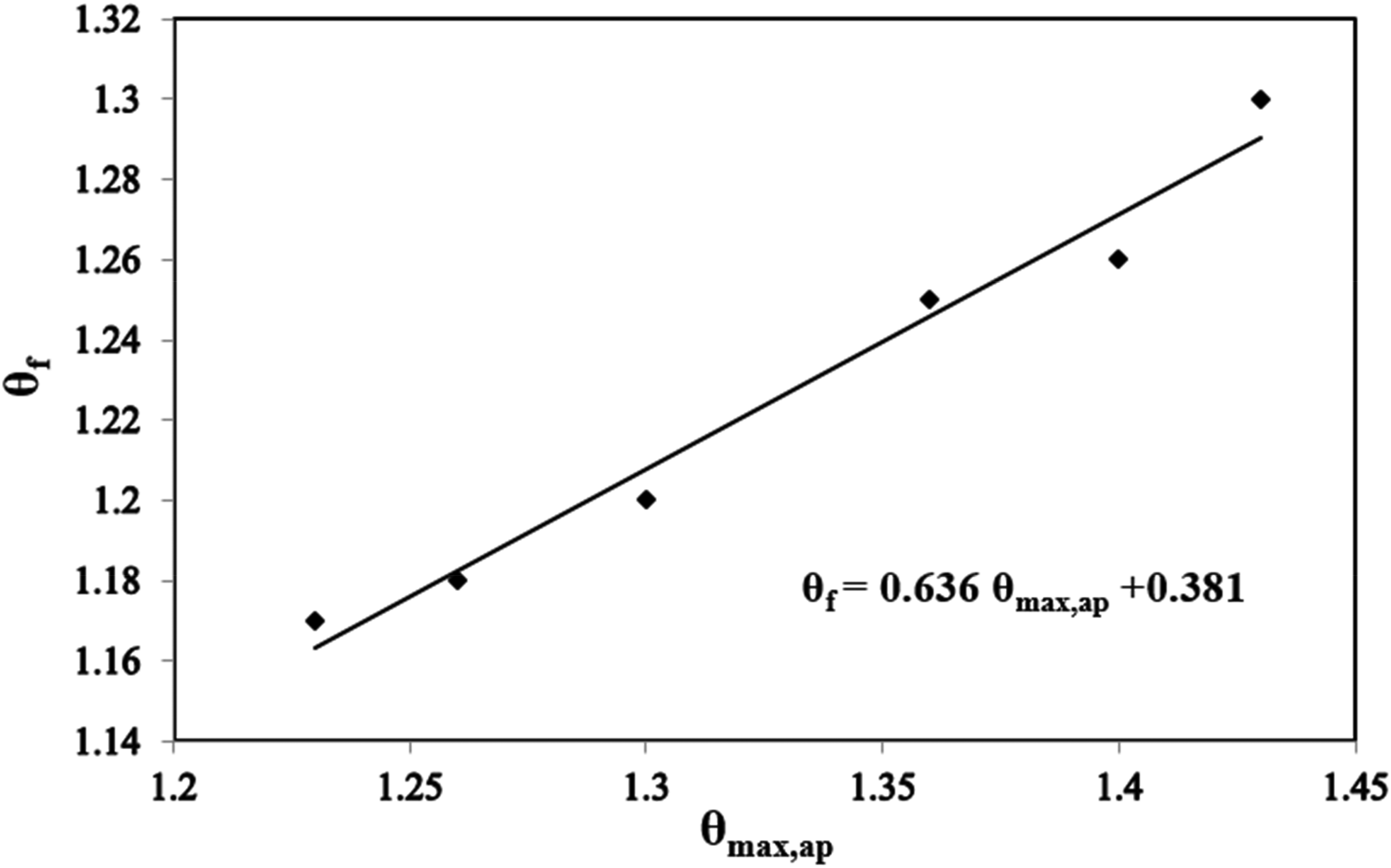
Relationship between cooking load final and absorber plate maximum temperature for MEG condition.
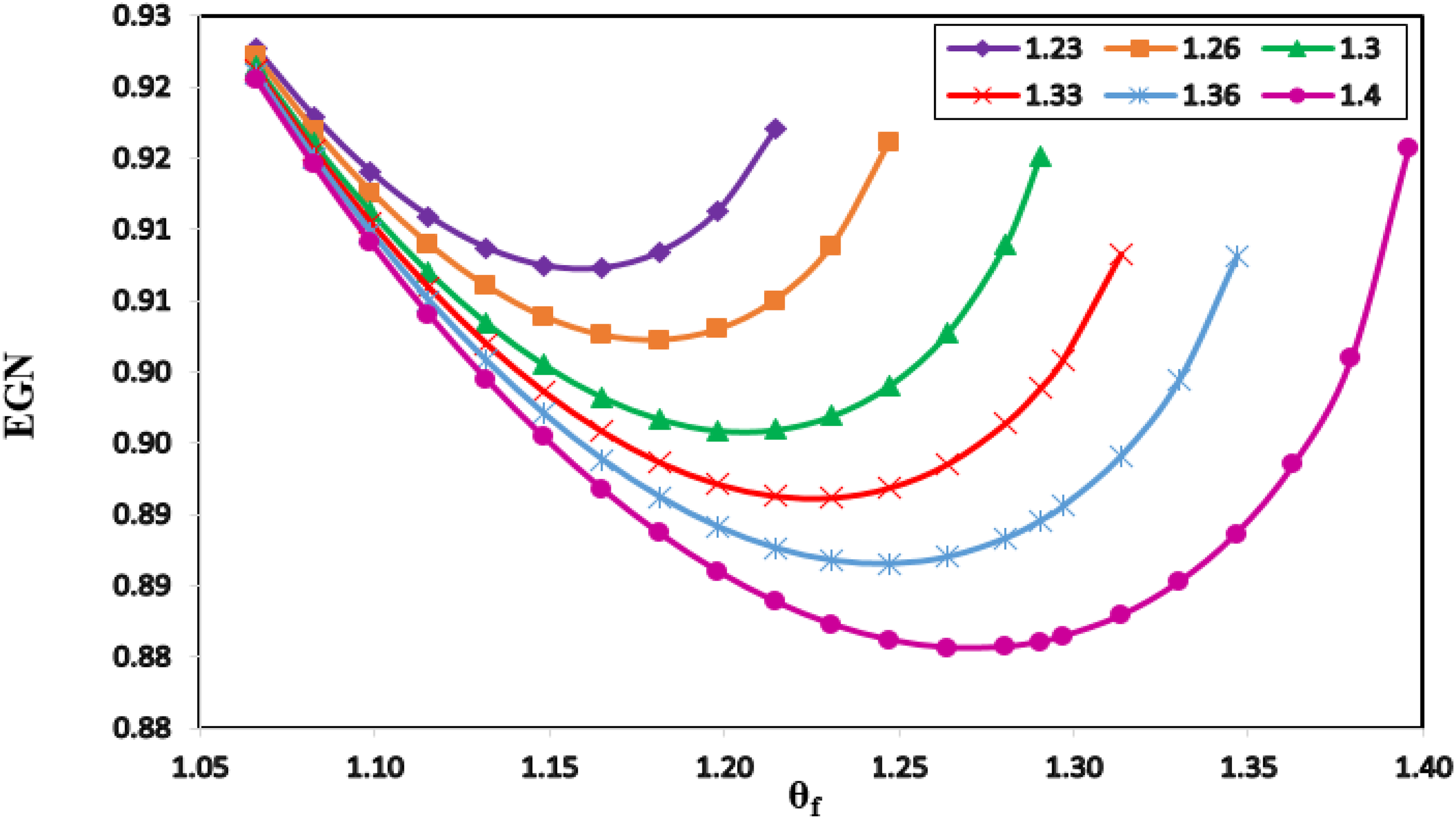
EGN as a function of final temperature of cooking load for different values of θmax,ap.
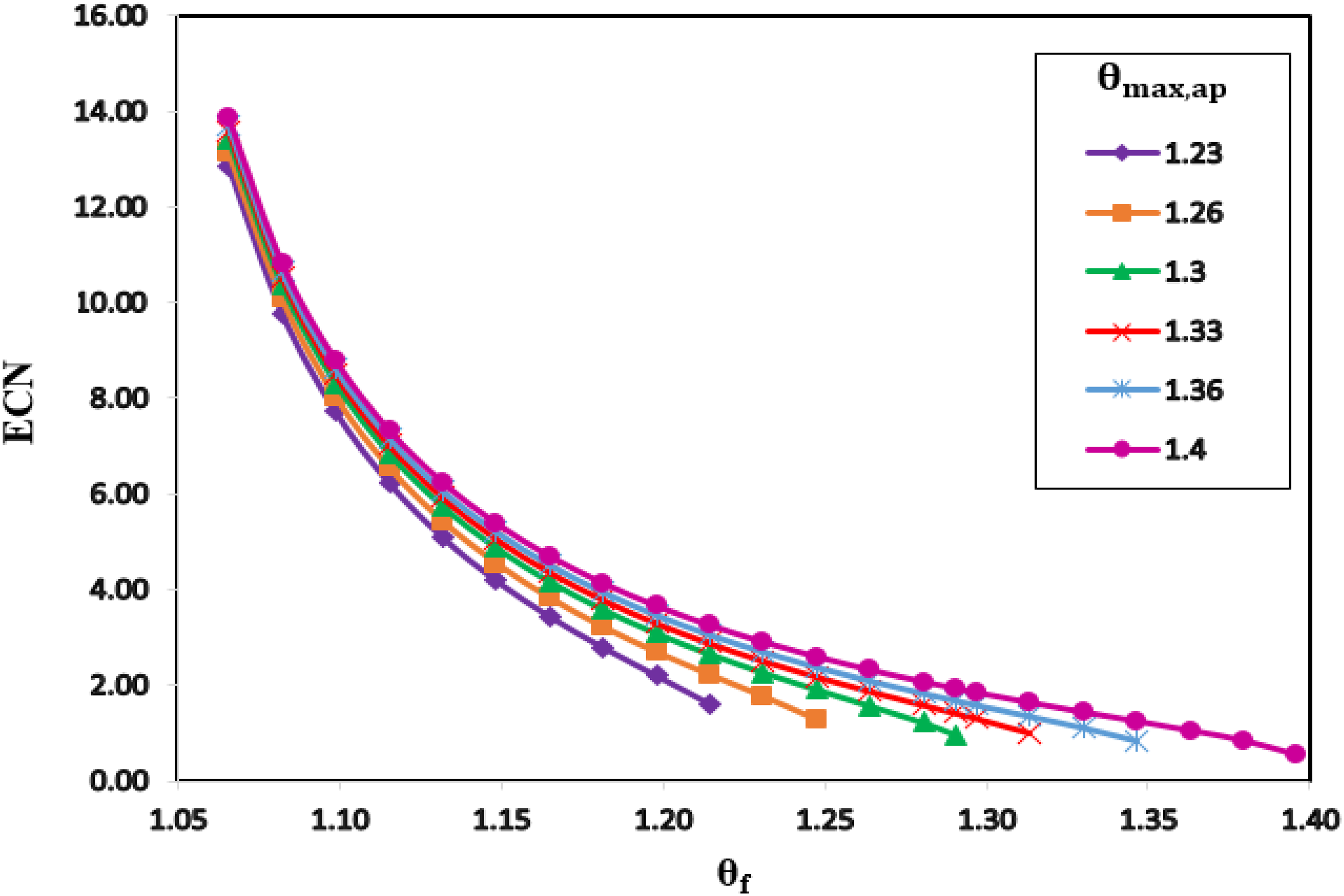
ECN as a function of final temperature of cooking load for different values of θmax, ap.
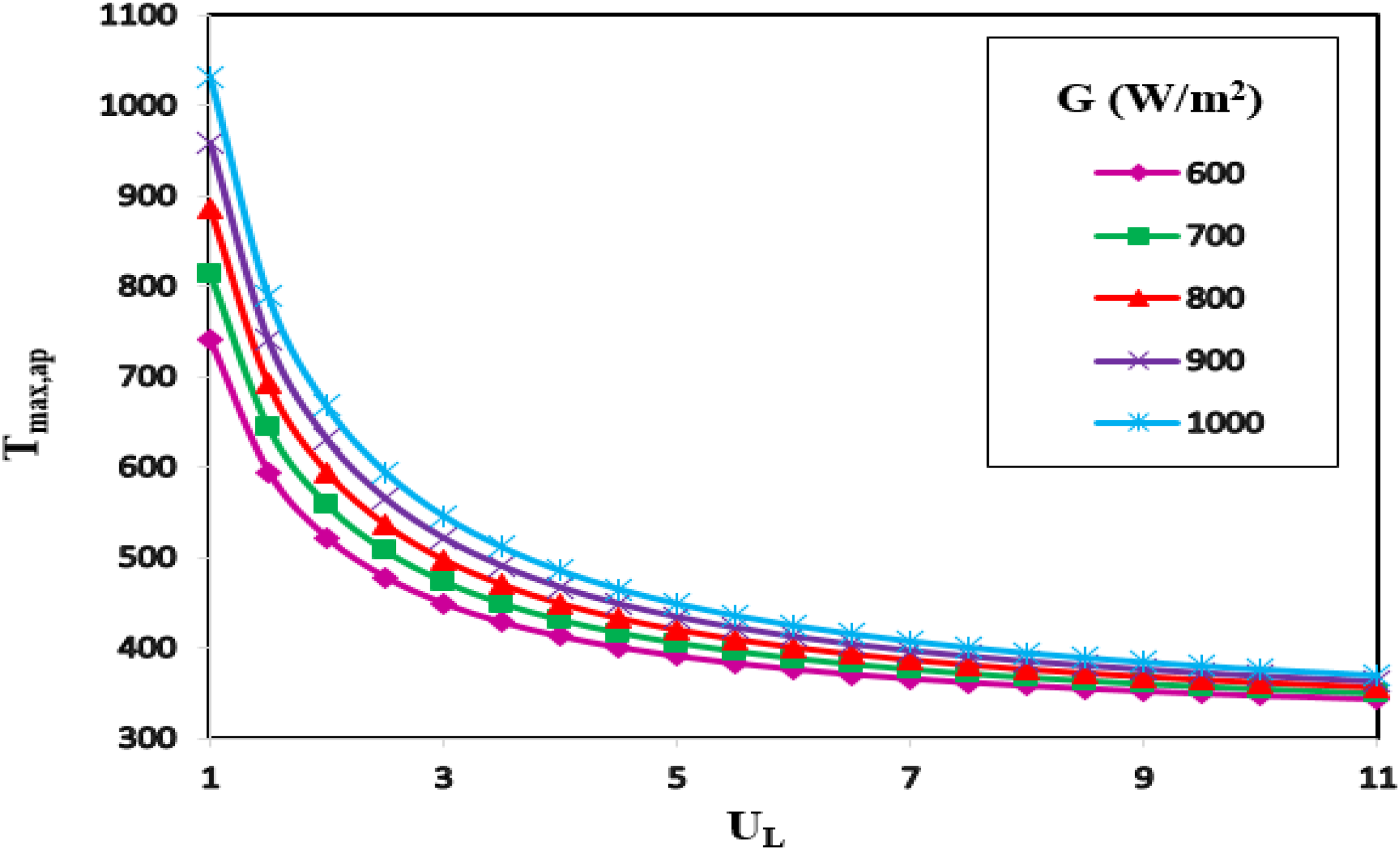
Absorber plate peak temperature as a function of overall heat loss coefficient for different solar irradiance.
The correlation for top heat loss coefficient (UT) for SBC is given by,
56



UB and US are computed using equations (22) and (23) respectively:


Instruments used and uncertainty analysis
Experiments are performed at a place (12.5° North, 75.0° East) in India during March, April, and May 2019. Monthly mean solar irradiation of 6.1 kWh/m 2 /day is observed at the place of testing. The calibrated solar power metre (±10 W/m 2 accuracy) with range 2000 W/m 2 and resolution 0.1 W/m 2 is used to measure solar irradiance intensity (G). The temperatures at various components of SBC are measured using K-type (Chromel-Alumel) thermocouple with an accuracy of 2°C. The electronic weighing balance with an accuracy of 0.001 kg is used to measure the mass of water. It is important to compute uncertainties in performance parameters that arise due to errors during measurements. Percentage of uncertainty in F1, F2, ηexergy, ηenergy, and Ps are calculated based on our recent study. 22 More details can be found in. 22
Results and discussion
The principle of MEG method is used to compute absorber plate area of CSBC. The CSBC-FDR is fabricated, and thermal performance test is carried out as per IS 13429. The experimental study includes stagnation, sensible heating, and real cooking performance tests. As per IS 13429 (Part 3):2000 test standard, minimum three tests should be carried out to evaluate first (F1) and second figures of merit (F2). In the present study, six tests are conducted for both stagnation and sensible heating. Solar irradiance and temperatures of absorber plate, inner air cavity, glazing cover, cooking load, and ambient air are measured at every 10-min time interval from 10.00 AM to 4.00 PM on each test day. The statistical and uncertainty analysis of test results is also carried out to find the effects of instrumentation.
Design of CSBC using MEG method
Monthly average value of solar irradiance (G) and ambient temperature (Ta) are taken as 850 W/m 2 and 30°C respectively. The required final temperature of cooking load is assumed to be 100°C. Initial temperature of cooking load (Tw1) is assumed to be equal to ambient and desired time (t) for boiling water is 90 min. The absorptivity (αp) of absorber plate material and transmissivity of glass (τg) is taken as 0.95 and 0.9 respectively.
The correlation between dimensionless temperatures θf and θmax,ap is obtained from regression analysis (Figure 4). The correlation is given by,

Stagnation test
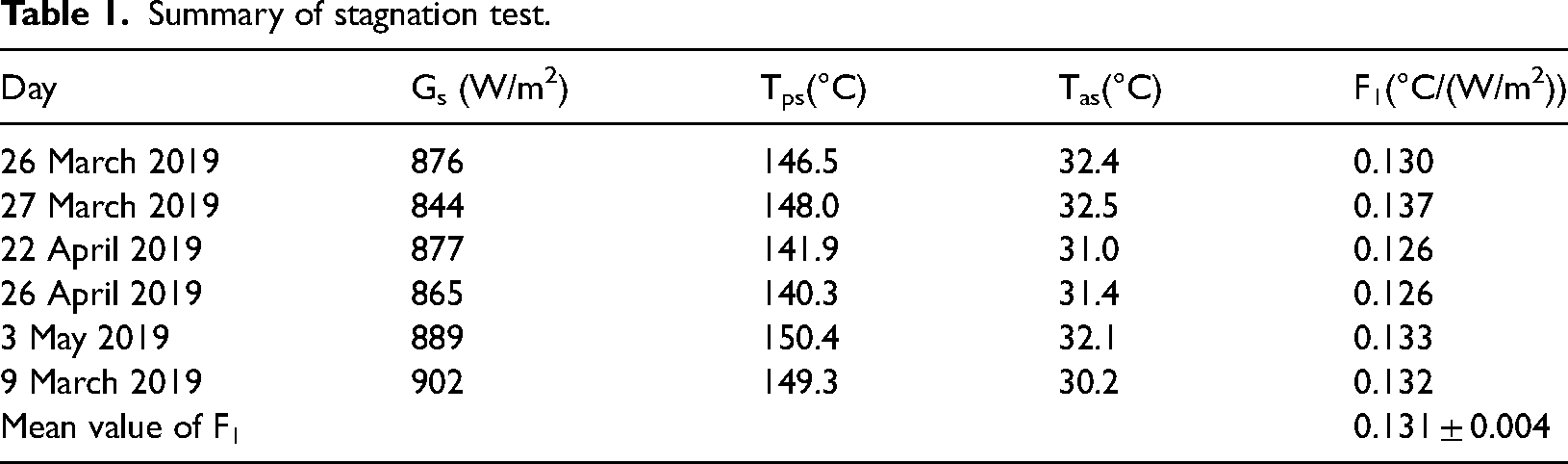
The stagnation test or test without load on the developed CSBC-FDR is carried out to find F1 value. The summary of measured data and calculated first figure of merit is shown in Table 1. For a particular day (26th April 2019), stagnation temperature of 140.3°C is obtained as maximum value for the absorber plate corresponding to solar irradiance 865 W/m2 at around 1.00 PM. The corresponding ambient air temperature is measured as 31.4°C, and F1 is found to be 0.126. Through all stagnation tests, average value of F1 is found to be 0.131. As per, 14 A-grade cookers have first figures of merit between 0.12 and 0.16; B-grade cookers have values less than 0.12. As a result, the present CSBC is classed as A-grade solar cooker. Since first figure of merit implies the ratio of optical efficiency (ηo) and overall heat loss coefficient (UL), we can infer that present SBC has good optical efficiency and low heat loss factor. 16 Figure 8 shows solar irradiance variation and temperatures of absorber plate, glazing cover, inner air cavity, and ambient air measured during the test. The maximum absorber plate temperature attained by solar cooker under certain climatic conditions depends on the total thermal losses of inner cavity. The temperature of internal air cavity also contributes to the cooking process by natural convection. This temperature is much lesser than absorber plate due to heat loss from inside air to the surroundings through top glazing. We performed experiments on the CSBC fitted with and without decahedron reflectors to evaluate the effects of providing outer reflector. Results show that external reflectors proved to be an important addition to the SBC. The temperature profile recorded during stagnation test for the cooker with and without reflectors is depicted in Figure 9. Using decahedron-shaped reflectors, the maximum temperature of the absorber plate is increased by 40.56%. The peak temperature gained by the absorber plate without reflector during stagnation test (2nd May 2019) is 107°C. However, incorporating decahedron reflector, absorber plate attains maximum temperature of 150.4°C on 3rd May 2019. Further, analysing the tests carried out in March and April 2019, it is observed that SBC without reflector has lower absorber plate temperature than the one fitted with reflector. Since absorber plate temperature significantly contributes to cooking power and thermal performance, the CSBC-FDR shows better result.
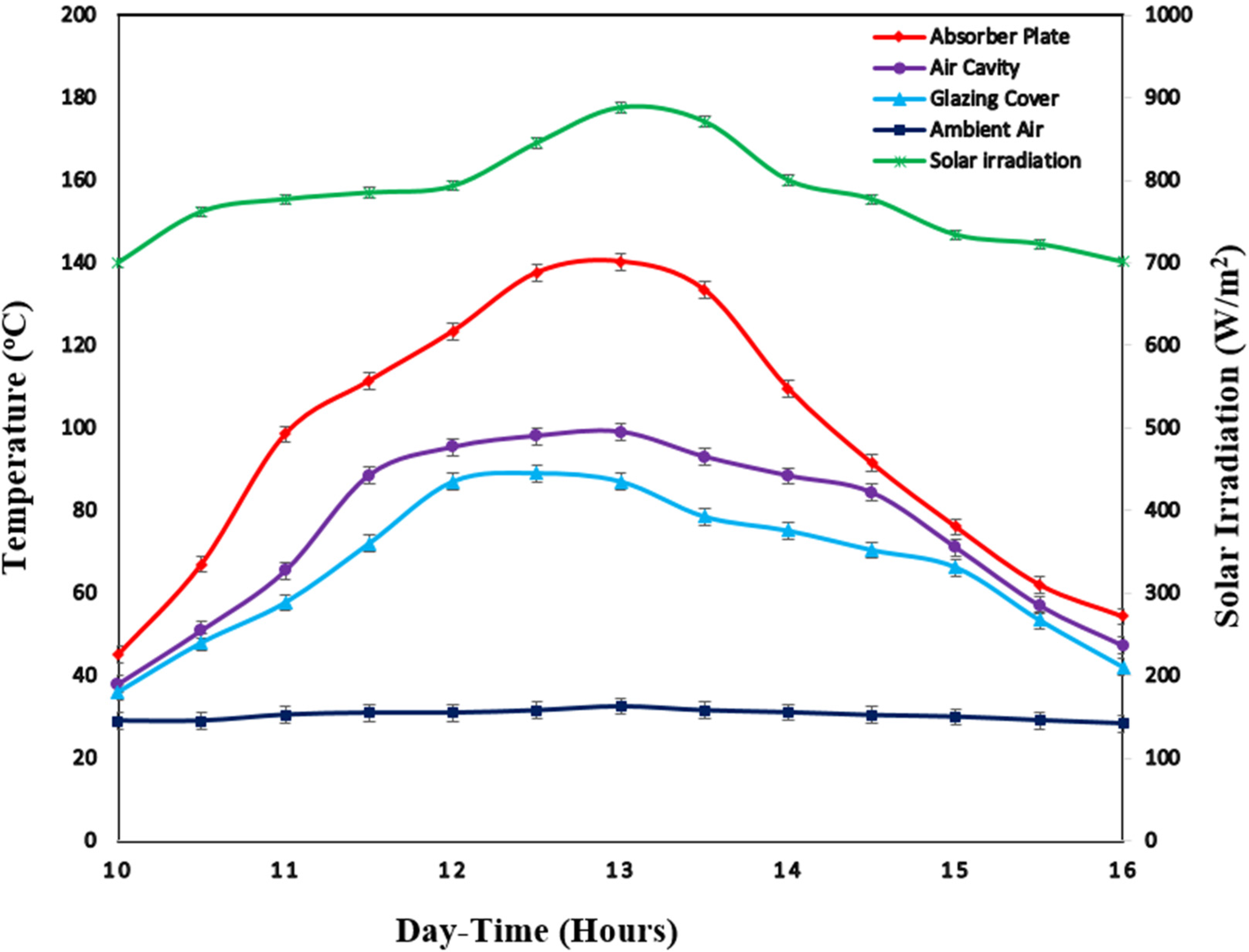
Variation of solar irradiance and different temperature with time of during stagnation test (based on the data collected on 26th April 2019).
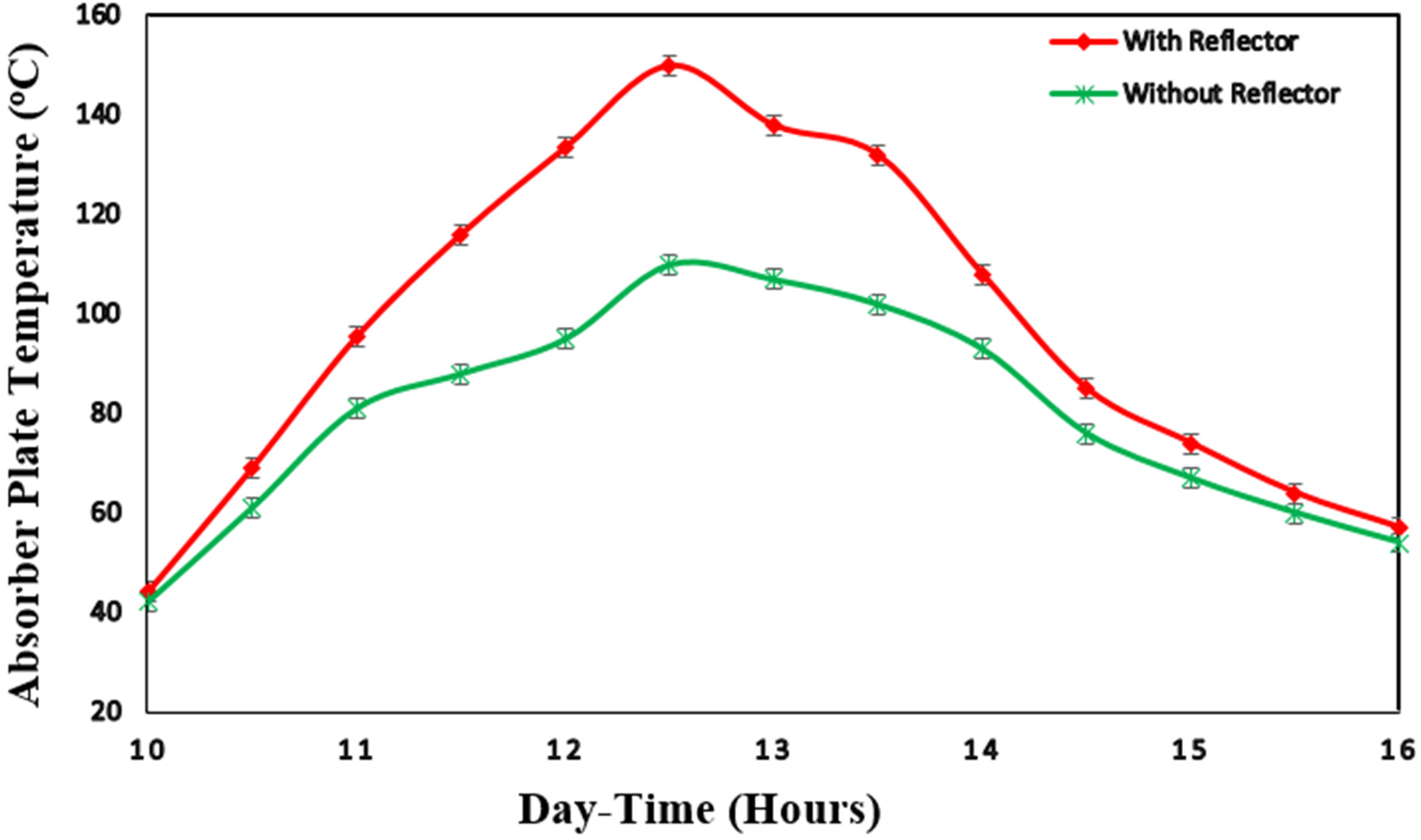
Absorber plate temperature variation with time for the cylindrical solar cooker without reflector (2nd May 2019) and with reflector (3rd May 2019).
Summary of stagnation test.
The maximum air temperature in the inner chamber increased from 83.2°C to 106.4°C, which is nearly 28.8% improvement compared to CSBC without external reflector. Furthermore, when outer reflector is fitted to the CSBC, temperature of lower glazing cover increases by 32.2%. Accordingly, the maximum temperature of lower glass rises from 72.4°C to 95°C. Because of air gap (that separates upper glass from lower) and direct exposure of upper glass to ambient air, this enhancement has less effect on the maximum temperature of upper glass. Therefore, the outer reflector fitted with CSBC enhances temperatures of every component except upper glass and hence improves overall performance.
Load test
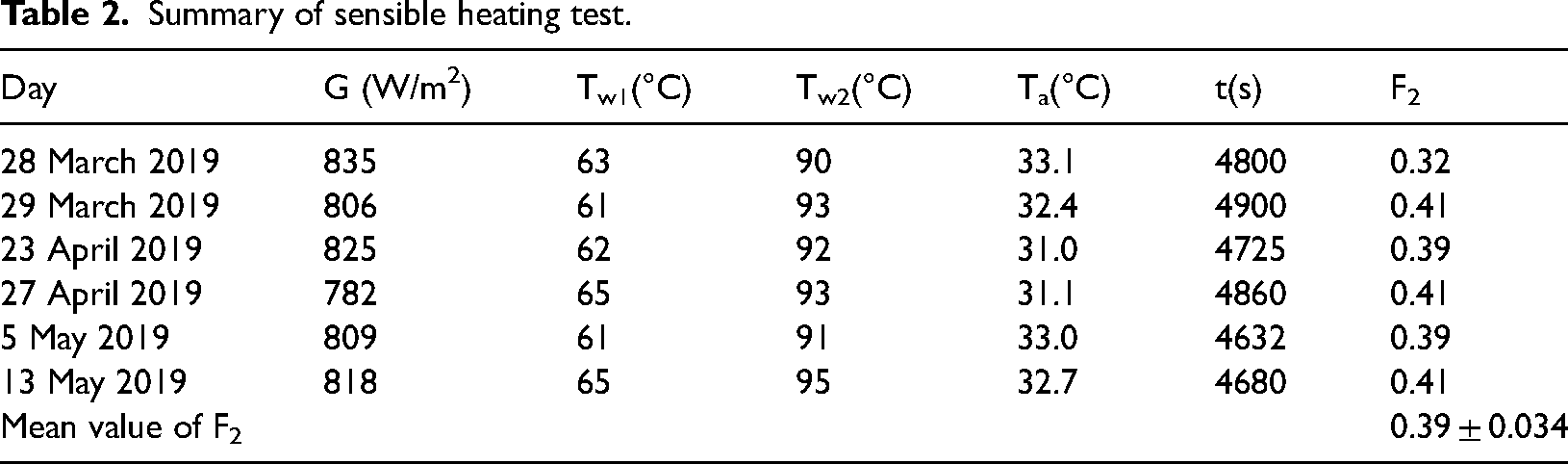
Load test is performed to determine second figure of merit (F2) of the CSBC-FDR Six load tests are conducted with 1 kg of water as cooking load. The summary of the tests is shown in Table 2. Figure 10 shows variation of solar irradiance and water and ambient temperatures measured during the experiment conducted on 13th May 2019. Experiments started at 10 AM, and measurements for every 10-min time interval are recorded. The water temperature reached 65°C at 11:22 AM, and corresponding solar irradiance and ambient temperature are observed to be 789W/m2 and 31°C, respectively. Later, water temperature attained 95°C at 12:40 PM, and the solar irradiance and ambient temperature are found to be 845W/m2 and 33.4°C, respectively. The second figure of merit (F2) calculated for the above test data is 0.41, and average value from all sensible heating tests is found to be 0.39. For SBC, second figure of merit is defined as the product of optical efficiency (ηo), heat exchange efficiency factor (Fʹ), and heat capacity ratio (CR). 16 Here, CR is the ratio of heat capacity of water and sum of heat capacity of water, cooker interior, and cooking vessel. Therefore, the present SBC has good heat exchange efficiency factor (Fʹ) and optical efficiency but low heat capacity of cooker interiors and vessel. Also, average values of thermal efficiency (ηenergy) and exergy efficiency (ηexergy) are 21.6% and 3.01%, respectively.
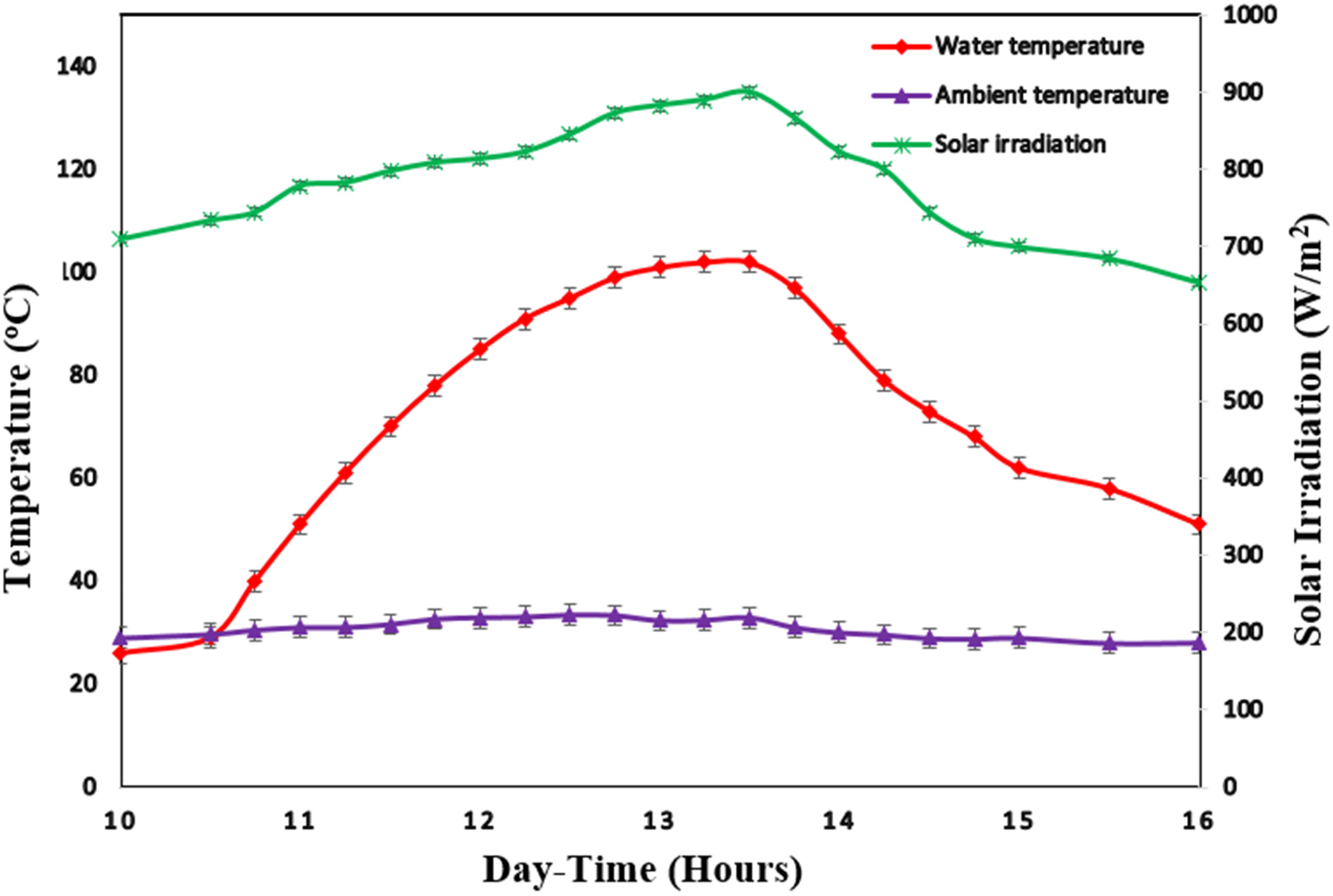
Variation of water temperature and solar irradiance with time (13th May 2019).
Summary of sensible heating test.
The boiling time and second figure of merit obtained in the present study are compared with Guidara et al. 11 under similar operating and environmental conditions. The boiling time for 1kg of water during sensible heating test on 13th May 2019 is 78 min. The average solar irradiance and ambient temperature during the test are 818 W/m2 and 32.7°C, respectively. Guidara et al. 11 reported cooking time of 68 min for the sensible heating test on rectangular SBC with inclined glass cover to boil 1kg of water at average solar irradiance of 828 W/m2 with ambient temperature 33°C. This boiling time is 10 min slower than the present study, even though the environmental cooking conditions are similar. This may be due to larger absorber surface area (0.4678m2) than the present SBC (0.146 m.2) However, there is close agreement between F2 values (0.34–0.39) for the SBC stated in 8 and present study (0.32–0.41).
As per the IS 13429 (Part 1):2000, solar box cookers satisfying BIS are categorized as A-grade (F1 > 0.12) and B-grade (F1 > 0.11). Also, second figure of merit, F2 should be higher than 0.4 for both categories. Therefore, present cylindrical SBC of F1 (0.126–0.137) and F2 (0.32–41) satisfies the requirements of A-grade SBC.
Cooking power
To study the impact of outer reflector on CSBC's performance, we calculated standardized cooking power (Ps) following the international testing procedure. The standardized cooking power and corresponding temperature difference between water and ambient air (ΔT) are calculated for every 10-min time interval during sensible heat test. The correlation between standardized cooking power (Ps) and temperature difference (ΔT) is obtained from regression analysis of test data for the load test conducted on 13th May 2019 (Figure 11). The correlation is given by,
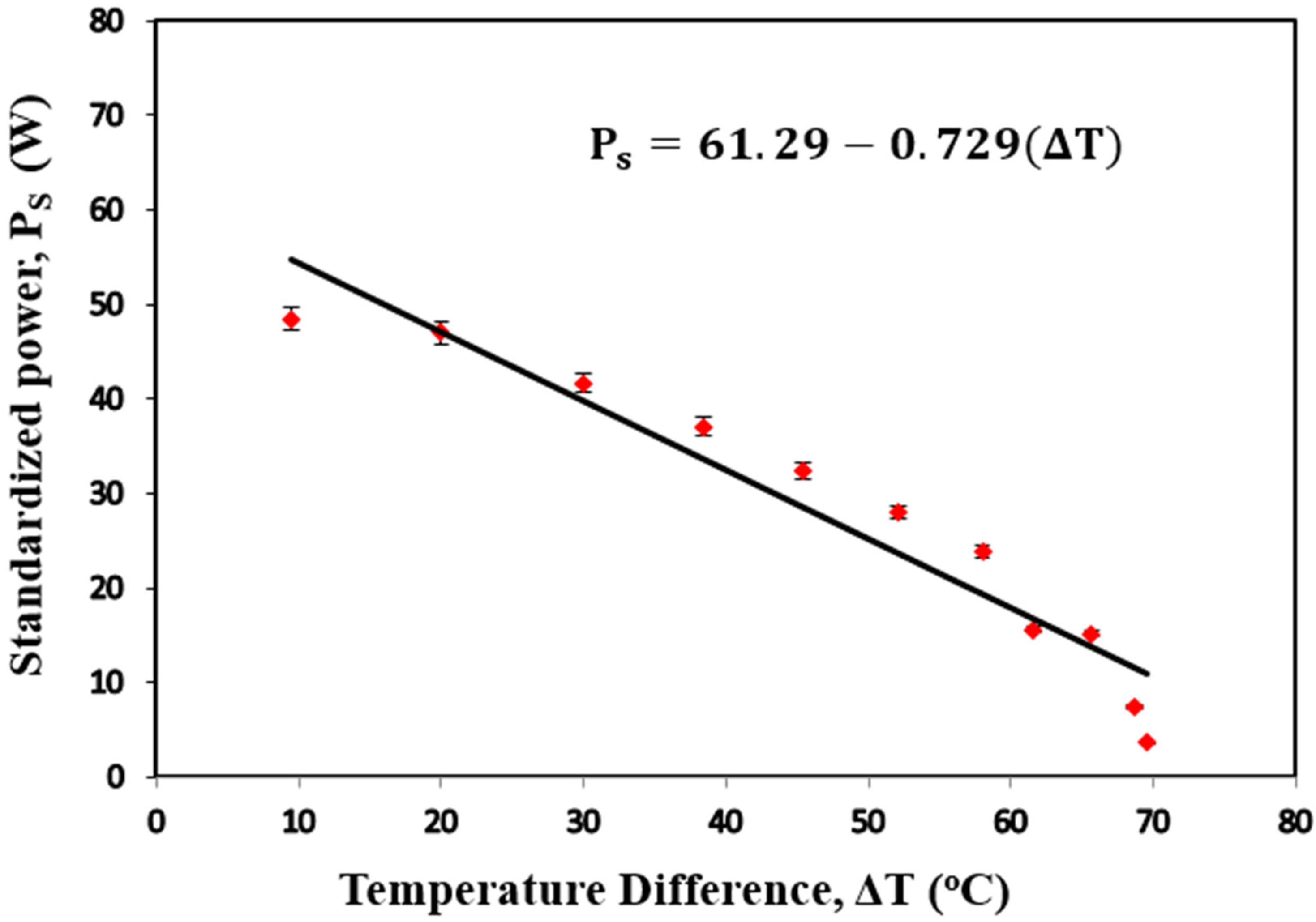
Relation between the standardized cooking power and the temperature difference for the CSBC-FDR (13th May 2019).
The value of regression coefficient (R2) is found to be 0.92 which satisfies the testing standard (>0.75) proposed by Funk. 17 As indicated by its low slope, the CSBC-FDR exhibits good thermal insulation. The results indicate that as temperature difference increased, cooking power decreased. It is primarily because temperature of water increased faster at the beginning of experiment. Eventually, increase in water temperature subsides, resulting in reduced temperature difference. The standardised cooking power (Ps) at 50°C is calculated as 25.28 W.
Comparative study
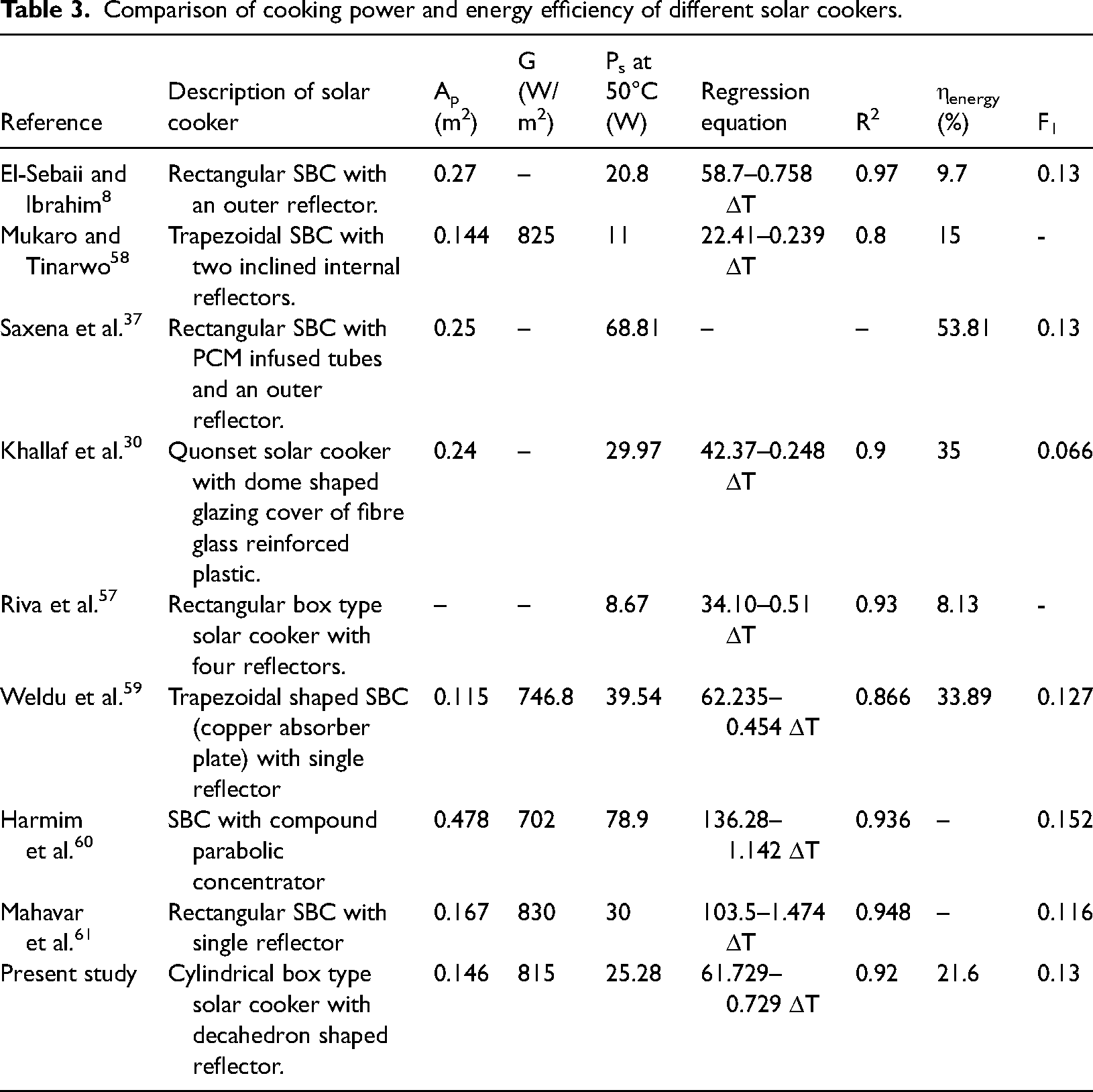
Different SBCs are compared concerning standardized cooking power, energy efficiency, and first figure of merit (Table 3). The correlation obtained for cooking power in the present study is similar to that of other solar cookers 8 tested for the cooking load of 1 kg of water contained in single cooking pot. It is found that standardized cooking power at 50°C and energy efficiency for the present solar cooker is more than those obtained by El-Sebaii and Ibrahim, 8 Riva et al., 57 and Mukaro and Tinarwo. 58 However, solar cooker developed by Saxena et al. 37 shows more significant value of Ps (68.81W) and ηenergy (53.81%) compared to present work. This can be due to larger absorber area and inclusion of PCM-infused tubes in the solar cooker. Compared to test results of the solar cooker developed by Khallaf et al., 30 present cooker shows slight decrease in cooking power. This may be due to larger absorber plate area and inner cavity volume, which accumulates more heat onto the cooking vessel in Quonset dome-shaped SBC. Their reported value of F1 is 0.066, which is much less than the standard value of 0.12 for A-grade solar cooker. The standardized cooking power and energy efficiency of SBC developed by Weldu et al. 59 are 39.54 W and 33.89%, higher than the present work despite smaller absorber plate area. This can be due to the fact that three inner sidewalls of their SBC are inclined at an angle of 105° to the cooker's base, allowing additional solar rays to enter the cooking vessel beside the sun and reflector. However, F1 value and maximum absorber plate temperature obtained in the present study (0.13 and 150°C) are within their range (0.127 and 148.7°C). They used copper as absorber plate material because of its low thermal resistance and superior corrosion resistance. For the SBC with compound parabolic concentrator as outer reflector and absorber plate in the form of step, cooking power and F1 are 78.9 W and 0.152 60 and are considerably larger than those found in the present study. Also, in this case, surface area of the absorber plate (0.478m2) is three times larger than that of our SBC. Comparing with the findings of Mahavar et al., 61 there is insignificant decrease in cooking power. When compared with similar previous works, it is clear that cylindrical SBC with smaller absorber plate area will perform well when integrated with booster reflectors. The present work involves permanent glazing cover provided on the cooker since it has back-door for placing cooking vessels. As a result, more heat is trapped within the cooker cavity because top glazing cover minimizes heat loss via convection. Therefore, the current design has higher inside air temperature than already developed solar cookers.
Comparison of cooking power and energy efficiency of different solar cookers.
Overall heat loss coefficient
Overall heat loss coefficient (UL) is found to be 8.97 W/m2K using the experimental data obtained during sensible heating test on 13th May 2019. For SBC modified by placing PCM infused tubes, Saxena et al. 37 reported UL of 5.11 W/m2K, which is lower than the present study. This is because of PCM as a thermal energy storage in the solar cooker. Numerically and experimentally obtained top heat loss coefficients (UT) in the present study are 7.9 W/m2K and 8.13 W/m2K respectively. The results show variation of 2.9% between experimentally and numerically obtained top loss coefficients. Because of more heat losses through top of the cooker via convection and radiation, which relies on wind heat transfer coefficient, absorber plate and ambient temperatures, top loss coefficient is comparatively higher than the side and bottom.
Cooking performance test
The real cooking performance of the developed CSBC-FDR is conducted on 20th May 2019. Cooking vessel containing 500 g of water is kept on the cooker which is exposed to direct solar irradiance on roof of the building. After 80 min, water started boiling. Then, 100 g of rice is poured in to boiling water and covered the cooking pot with lid. It took another 20 min to cook the rice fully. Therefore, total of 100 min is taken to cook 100 g of rice.
Statistical analysis of test data
The CSBC-FDR is subjected to different outdoor experiments at varying climatic conditions such as ambient temperature and solar irradiance. The mean value, standard deviation and 99% confidence intervals for F1 and F2 (Table 4) are calculated based on our recent study. 22 The results indicate that some deviation occurs in F1 values which are due to the changing environmental conditions like solar irradiance and ambient temperature. Moreover, deviation in F2 value is found to be more than F1 value because of inclusion of more variables in the calculation of F2.
Statistical parameters for F1 and F2 of SBC.

Uncertainty analysis
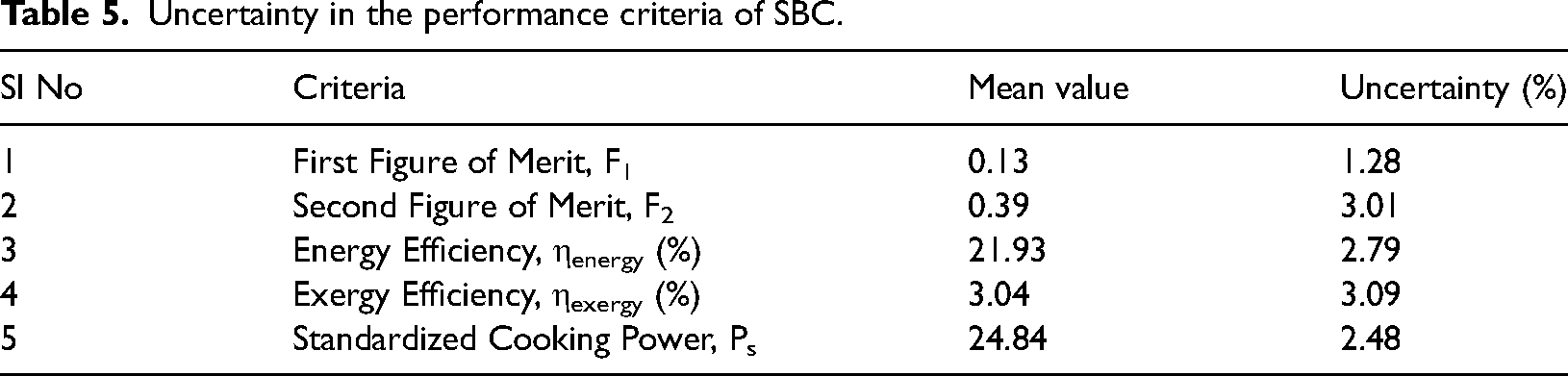
Table 5 shows percentage of uncertainty involved during the calculation of performance parameters of solar cooker. The uncertainty in F1 and F2 are obtained as 1.28% and 3.01% respectively. The uncertainty in F2 is greater than that of F1 due to inclusion of more criteria in the calculation of F2. Therefore, more instrumental uncertainty is associated with the calculation of F2. The uncertainty of standardized cooking power, energy and exergy efficiencies are obtained as 2.48%, 2.79% and 3.09% respectively. Considering uncertainties, the experimental value of F1, F2, ηenergy, ηexergy, and Ps are respectively 0.13 ± 0.0016 m2K/W, 0.39 ± 0.012, 21.93 ± 0.612%, 3.04 ± 0.094%, and 24.84 ± 0.62W.
Uncertainty in the performance criteria of SBC.
Conclusions
In the present work, performance evaluation of CSBC fitted with decahedron-shaped outer reflector is carried out. The CSBC is designed and fabricated based on principle of MEG method. Experimental investigation is conducted to check the effectiveness of decahedron reflector on cooker's performance, including stagnation, sensible heat, and cooking performance tests. The average values of first figure of merit (F1) and second figure of merit (F2) are found to be 0.13 and 0.39, respectively, which satisfies the requirements of A-grade SBC as per the Bureau of Indian Standards (BIS). The thermal efficiency (ηenergy), exergy efficiency (ηexergy), and standardized cooking power (PS) are found to be 21.93%, 3.04%, 24.84 W, respectively. The developed cooker shows better performance in terms of standardized cooking power and energy efficiency than the conventional rectangular and trapezoidal shaped SBCs. The heat loss coefficient is computed through iterative procedure and compared with experimentally obtained value. The time for boiling 0.5 kg of water and cooking 100g of rice is 80 and 100 min, respectively. Cooking above 100°C with minimum boiling time is possible with the cylindrical SBC fitted with decahedron reflector.
We believe that the developed CSBC is a promising device that can be further optimized for better performance. Additionally, the developed solar cooker offers several characteristics such as low cost, ease of use, and modest cooker surface which makes it well suited for household cooking. One of the remarkable findings in the present work is that CSBC-FDR attained boiling temperature in shorter time compared to previously developed models cited in literatures. It is suggested that the proposed method of MEG theory could be used as a starting point for further research on optimum design of solar cookers that minimize energy loss. Computational methods for estimating heat loss coefficients will also assist in improving the efficiency of solar cookers.
List of Symbols
Area of absorber plate [m2] Specific heat of water [J/kgK] Diameter of absorber plate [m] Convection heat transfer coefficient between upper glass cover and ambient air [W/m2K] Radiation heat transfer coefficient between upper glass cover and ambient air [W/m2K] Convection heat transfer coefficient between upper glass and lower glass cover [W/m2K] Radiation heat transfer coefficient between upper glass and lower glass cover [W/m2K] Convection heat transfer coefficient between lower glass cover and absorber plate[W/m2K] Radiation heat transfer coefficient between lower glass cover and absorber plate[W/m2K] Solar irradiance at stagnant condition [W/m2] Average solar irradiance [W/m2] Thermal conductivity of insulation material[W/mK] Mass of water [kg] Number of glazing covers Cooking power [W] Standardized cooking power [W] Entropy generation rate [W/K] Ambient temperature [°C] Ambient air temperature at stagnant condition [°C] Average value of absorber plate temperature [°C] Stagnation temperature of absorber plate [°C] Solar radiation temperature [K] Initial temperature of water [°C] Final temperature of water [°C] Time [s] Insulation thickness [m] Overall heat transfer coefficient [W m−2 K−1] Bottom heat loss coefficient [W m−2 K−1] Side heat loss coefficient [W m−2 K−1] Wind speed [m/s] Distance between absorber plate and lower glass [m] Emissivity of absorber plate material Absorptivity of absorber plate material Emissivity of glass material Transmissivity of glass material Dimensionless temperature
